
Aluminum Die Casting Market Overview:
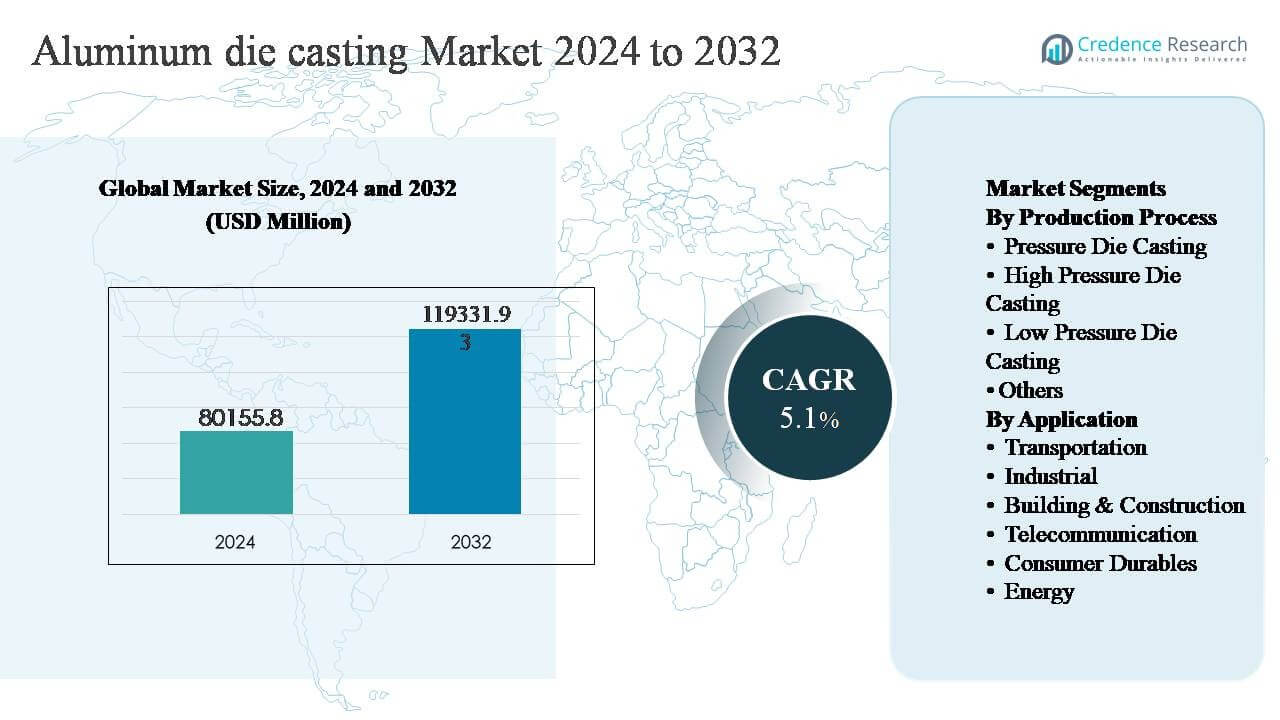
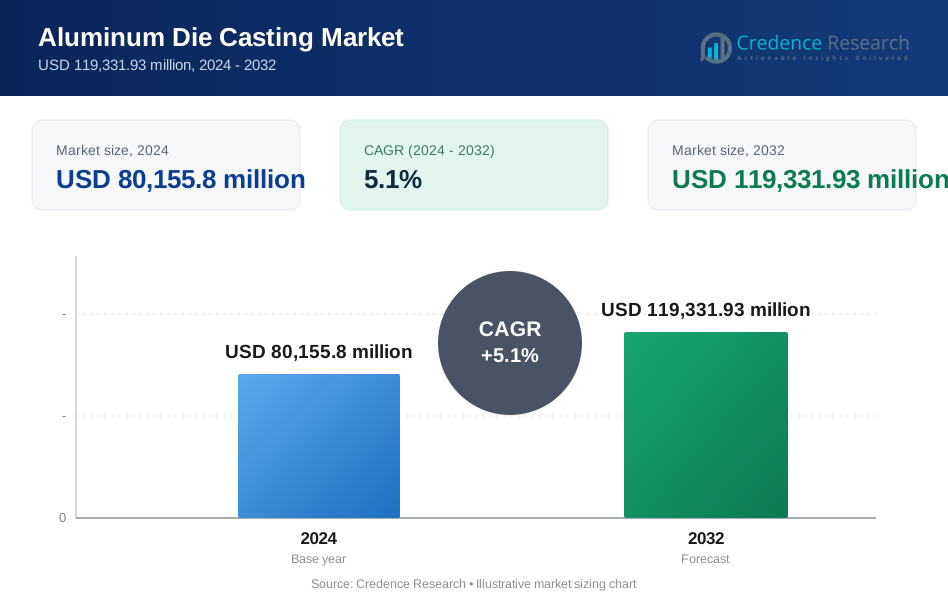
The global aluminum die casting market was valued at USD 80,155.8 million in 2024 and is projected to reach USD 119,331.93 million by 2032, growing at a CAGR of 5.1% during the forecast period.
| REPORT ATTRIBUTE | DETAILS |
|---|---|
| Historical Period | 2020-2024 |
| Base Year | 2025 |
| Forecast Period | 2026-2032 |
| Aluminum Die Casting Market Size 2024 | USD 80,155.8 million |
| Aluminum Die Casting Market, CAGR | 5.1% |
| Aluminum Die Casting Market Size 2032 | USD 119,331.93 million |
Aluminum Die Casting Market Insights
- Lightweighting requirements in automotive and electric vehicles remain the primary growth driver, with high-pressure die casting dominating production due to its suitability for complex, thin-walled components used in powertrain and structural applications.
- Market trends highlight increasing adoption of large structural castings, automation, and recycled aluminum, while transportation remains the dominant application segment, accounting for over 50% market share, followed by industrial and energy uses.
- The competitive landscape is moderately consolidated, led by global players focusing on capacity expansion, advanced alloys, and long-term OEM partnerships, while regional foundries compete through customization and proximity advantages.
- Regionally, Asia Pacific leads with ~49% market share, followed by North America (~23%) and Europe (~19%), supported by strong automotive production, EV investments, and advanced manufacturing ecosystems.
Aluminum Die Casting Market Segmentation Analysis:
By Production Process:
By production process, the aluminum die casting market is dominated by high pressure die casting (HPDC), which accounts for the largest market share due to its high productivity, superior dimensional accuracy, and suitability for complex, thin-walled components. HPDC is extensively used in automotive powertrain, structural, and EV battery housing applications, where tight tolerances and high-volume output are critical. Low pressure die casting supports steady demand in wheels and structural parts requiring enhanced mechanical integrity, while conventional pressure die casting and other processes serve niche industrial needs. Continuous automation, vacuum-assisted casting, and alloy optimization remain key growth drivers.
- For instance, in April 2024, Martinrea Honsel Germany GmbH reported operating HPDC cells with clamping forces up to 4,400 tonnes, enabling the single-piece casting of large automotive structural components exceeding 5 meters in length with wall thicknesses below 2.5 mm, meeting stringent OEM lightweighting requirements.
By Application:
By application, transportation represents the dominant segment, holding the highest market share driven by extensive aluminum usage in passenger vehicles, commercial vehicles, and electric mobility platforms. Automakers increasingly rely on aluminum die-cast components to reduce vehicle weight, improve fuel efficiency, and extend EV driving range. Industrial and energy applications follow, supported by demand for durable housings, motors, and power equipment. Building & construction, telecommunication, and consumer durables contribute stable growth through applications requiring corrosion resistance, thermal conductivity, and design flexibility, reinforcing aluminum die casting’s role across diversified end-use industries.
- For instance, Ryobi Limited was supplying large-scale aluminum components for high-volume automotive programs and aggressively expanding into 'gigacasting' (ultra-large integrated die casting). While its global facilities, including Ryobi Die Casting (Dalian) and sites in Mexico, continued to produce high-volume structural components, the company centered its primary gigacasting initiative at the Kikugawa plant in Japan.
Key Growth Drivers
Rising Demand for Lightweight Automotive Components
The increasing focus on vehicle lightweighting remains a primary growth driver for the aluminum die casting market. Automotive manufacturers are under sustained pressure to reduce vehicle weight to meet stringent fuel efficiency and emission regulations while maintaining safety and performance standards. Aluminum die casting enables the production of complex, thin-walled components such as engine blocks, transmission cases, structural parts, and battery housings with high strength-to-weight ratios. The rapid expansion of electric vehicles further amplifies this demand, as aluminum helps offset the added weight of battery systems and improves driving range. High-pressure die casting, including large structural castings, is increasingly integrated into modern vehicle platforms, reinforcing aluminum die casting as a core manufacturing solution for next-generation mobility.
- For instance, Tesla implemented large high-pressure die-cast rear underbody structures produced on 'Giga Press' machines with clamping forces of 6,000 tonnes. This innovation reduced the part count from over 70 stamped components to a single aluminum casting, effectively cutting body-shop assembly steps by more than 300 individual joining operations per vehicle."
Expansion of Industrial and Electrical Applications
Growth in industrial machinery, electrical equipment, and automation systems significantly supports aluminum die casting demand. Industrial motors, pumps, compressors, enclosures, and power distribution components rely on aluminum die-cast parts for their thermal conductivity, corrosion resistance, and dimensional precision. Rapid industrialization in emerging economies, coupled with modernization of manufacturing facilities in developed regions, continues to generate steady demand. Additionally, the transition toward energy-efficient equipment and smart industrial systems increases the need for lightweight, heat-dissipating metal components. Aluminum die casting aligns well with these requirements, offering high repeatability and cost-efficient mass production for industrial and electrical applications.
- "For instance, leading die-cast manufacturers are developing high-thermal-conductivity aluminum alloys (e.g., Al-Fe or specialized Al-Si alloys) for motor housings to support continuous-duty electric motors. While current commercial die-cast aluminum alloys typically have a thermal conductivity of 90-130 W/m·K, new research alloys can achieve values up to 160 W/m·K (and even higher in research settings) through material science advancements.
Advancements in Die Casting Technologies and Alloys
Technological advancements in die casting processes and aluminum alloy development are driving market growth by improving product quality and manufacturing efficiency. Innovations such as vacuum-assisted die casting, automated cells, real-time process monitoring, and advanced mold design reduce porosity, improve mechanical performance, and enhance yield rates. At the same time, new aluminum alloys provide improved strength, ductility, and thermal performance, expanding suitability across demanding applications. These advancements enable manufacturers to meet tighter tolerances and higher performance standards while reducing scrap rates and production costs, strengthening aluminum die casting’s competitiveness against alternative materials and fabrication methods.
Key Trends & Opportunities
Adoption of Large Structural and Integrated Castings
A major trend shaping the aluminum die casting market is the adoption of large, integrated structural castings, particularly in the automotive and electric vehicle sectors. Manufacturers are consolidating multiple welded or assembled steel parts into single aluminum die-cast components, reducing part count, assembly time, and overall vehicle weight. This approach improves structural rigidity while lowering manufacturing complexity and costs. The growing use of giga-casting and mega-casting technologies creates new opportunities for die casting companies with advanced tooling, high-tonnage machines, and strong engineering capabilities, positioning them as strategic partners to OEMs.
- For instance, In early 2024, research and industry trends confirmed Martinrea Honsel Germany GmbH's capability for the serial production of ultra-large aluminum structural castings, including front-end and rear-end components. While public records lack confirmation of a specific 1.4-meter-long demonstration in January 2024, the company utilizes vacuum-assisted high-pressure die casting (VHPDC) to achieve thin, uniform walls as low as 2.3 mm across critical load-bearing sections.
Growth Opportunities from Energy and Renewable Infrastructure
The expansion of energy infrastructure, including renewable power generation and electrification systems, presents notable growth opportunities. Aluminum die-cast components are increasingly used in solar inverters, wind turbine systems, power electronics, and energy storage solutions due to their durability and heat management properties. As global investments in renewable energy, grid modernization, and electric charging infrastructure accelerate, demand for precision aluminum components is expected to rise. This trend supports long-term diversification beyond automotive, strengthening market resilience.
- For instance, In 2023, Alcast Company (USA) produced high-precision aluminum cast components, including structural housings and turbine enclosures for the power generation and renewable energy sectors. Utilizing their proprietary "Mitchener Molding" an electro-magnetic, low-pressure permanent mold technique these components are engineered for maximum durability, reduced porosity, and high structural integrity.
Increasing Focus on Sustainable Manufacturing
Sustainability is emerging as a strategic opportunity for aluminum die casting manufacturers. Aluminum’s recyclability and lower lifecycle emissions compared to steel align with global decarbonization goals. Companies investing in recycled aluminum usage, energy-efficient furnaces, and closed-loop material systems gain competitive advantage. This shift not only supports regulatory compliance but also enhances customer preference for environmentally responsible suppliers.
Key Challenges
Volatility in Aluminum Raw Material Prices
Fluctuating aluminum prices remain a critical challenge for the die casting industry. Raw material cost volatility directly impacts production expenses, profit margins, and pricing strategies, particularly for manufacturers operating under long-term supply contracts. Price instability complicates cost forecasting and may limit the ability of small and mid-sized foundries to absorb sudden increases. While recycling helps mitigate some cost pressure, dependence on global aluminum supply dynamics continues to pose financial and operational risks.
High Capital Investment and Process Complexity
Aluminum die casting requires significant upfront capital investment in high-tonnage machines, tooling, automation systems, and quality control infrastructure. Advanced processes such as high-pressure and vacuum die casting demand skilled labor, strict process control, and continuous maintenance. These factors increase entry barriers and operational complexity, particularly for new or expanding manufacturers. Additionally, tooling costs and long development cycles can limit flexibility, posing challenges in responding quickly to changing customer requirements and shorter product lifecycles.
Regional Analysis
Asia Pacific
Asia Pacific dominates the aluminum die casting market, accounting for approximately 48-50% of global market share, supported by strong manufacturing bases in China, Japan, India, and South Korea. The region benefits from high automotive production volumes, rapid electric vehicle adoption, and expanding industrial infrastructure. China remains the largest contributor due to its integrated supply chain, large-scale die casting capacity, and strong demand from automotive, electronics, and energy sectors. India and Southeast Asia are emerging as high-growth markets, driven by industrialization and localization of automotive manufacturing, reinforcing Asia Pacific’s leadership position.
North America
North America holds around 22-24% of the global aluminum die casting market, driven primarily by the United States. The region benefits from advanced automotive engineering, rising electric vehicle investments, and early adoption of large structural aluminum castings. Automakers increasingly integrate high-pressure die casting for vehicle lightweighting and platform consolidation. Strong demand from industrial machinery, aerospace support applications, and energy infrastructure further contributes to market stability. Technological leadership, automation, and high-quality standards position North America as a key hub for value-added and precision aluminum die casting applications.
Europe
Europe accounts for approximately 18-20% of the global market, supported by a strong automotive manufacturing base in Germany, France, Italy, and the United Kingdom. Stringent emission regulations and sustainability targets accelerate the shift toward lightweight aluminum components in passenger and electric vehicles. European manufacturers emphasize high-performance alloys, precision casting, and energy-efficient production processes. In addition to automotive, demand from industrial equipment, renewable energy systems, and building applications supports market growth. Europe’s focus on recycled aluminum usage further strengthens long-term market competitiveness.
Latin America
Latin America represents around 5-6% of the global aluminum die casting market, with Brazil and Mexico as key contributors. Growth is driven by automotive assembly operations, industrial equipment manufacturing, and increasing foreign direct investment in regional production facilities. Mexico benefits from proximity to North American automotive supply chains, while Brazil supports demand through domestic vehicle production and industrial machinery sectors. Although market maturity remains moderate, gradual industrial expansion, infrastructure development, and improving manufacturing capabilities support steady demand for aluminum die casting across the region.
Middle East & Africa
The Middle East & Africa region accounts for approximately 3-4% of global market share, reflecting its developing industrial base. Demand is supported by investments in energy infrastructure, construction, and power equipment, particularly in Gulf countries. Aluminum die casting is increasingly used in electrical enclosures, industrial components, and energy-related applications. While automotive production remains limited, ongoing industrial diversification initiatives and infrastructure projects create long-term growth potential. Gradual expansion of local manufacturing capabilities is expected to enhance regional market participation over time.
Aluminum Die Casting Market Segmentations:
By Production Process
- Pressure Die Casting
- High Pressure Die Casting
- Low Pressure Die Casting
- Others
By Application
- Transportation
- Industrial
- Building & Construction
- Telecommunication
- Consumer Durables
- Energy
By Geography
- North America
- U.S.
- Canada
- Mexico
- Europe
- Germany
- France
- U.K.
- Italy
- Spain
- Rest of Europe
- Asia Pacific
- China
- Japan
- India
- South Korea
- South-east Asia
- Rest of Asia Pacific
- Latin America
- Brazil
- Argentina
- Rest of Latin America
- Middle East & Africa
- GCC Countries
- South Africa
- Rest of the Middle East and Africa
Competitive Landscape
The competitive landscape of the aluminum die casting market is moderately consolidated, characterized by the presence of large multinational manufacturers alongside numerous regional and specialized foundries. Leading players compete on manufacturing scale, technological capability, product quality, and long-term supply relationships with automotive and industrial OEMs.
Major companies focus on high-pressure and vacuum die casting technologies to deliver complex, lightweight components with tight tolerances, particularly for automotive and electric vehicle platforms. Continuous investments in automation, large-tonnage casting machines, and advanced alloy development strengthen competitive positioning. Strategic initiatives such as capacity expansions, regional footprint diversification, and long-term contracts with automotive manufacturers are common.
Additionally, companies increasingly emphasize sustainability by incorporating recycled aluminum, improving energy efficiency, and reducing production scrap. Smaller players remain competitive through niche specialization, customized solutions, and proximity to end users, sustaining competitive intensity across global and regional markets.
Key Player Analysis
- Alcoa Corporation
- MartinreaHonsel Germany GmbH
- Gibbs Die Casting Corporation
- Ryobi Die Casting Dalian Co.
- Shiloh Industries Inc.
- Dynacast Deutschland GmbH
- Walbro LLC
- Alcast Technologies Ltd.
- GF Casting Solutions
- Consolidated Metco Inc.
Recent Developments
- In October 2025,Alcoa Corporation’s proprietary EZCast™ aluminum alloy was recognized with its fourth consecutive NADCA award for megacasting innovation, highlighting its use in large integrated castings tailored to EV and aerospace structural components. This award reflects continued industry validation of Alcoa’s high-performance die casting materials in complex, large-format applications.
Report Coverage
The research report offers an in-depth analysis based on Production process, Application and Geography. It details leading market players, providing an overview of their business, product offerings, investments, revenue streams, and key applications. Additionally, the report includes insights into the competitive environment, SWOT analysis, current market trends, as well as the primary drivers and constraints. Furthermore, it discusses various factors that have driven market expansion in recent years. The report also explores market dynamics, regulatory scenarios, and technological advancements that are shaping the industry. It assesses the impact of external factors and global economic changes on market growth. Lastly, it provides strategic recommendations for new entrants and established companies to navigate the complexities of the market.
Future Outlook
- Aluminum die casting will continue to gain importance as manufacturers prioritize lightweight and high-strength components across industries.
- Electric vehicle production will increasingly rely on large and integrated aluminum die-cast structures to improve efficiency and reduce assembly complexity.
- High-pressure and vacuum die casting technologies will see wider adoption to meet quality and performance requirements.
- Advancements in aluminum alloys will expand applications requiring improved thermal and mechanical performance.
- Automation and digital process control will enhance productivity, consistency, and defect reduction in die casting operations.
- Use of recycled aluminum will rise as sustainability and emission reduction goals influence material selection.
- Industrial machinery and energy infrastructure will create steady demand for precision aluminum cast components.
- Regional capacity expansion in Asia Pacific will strengthen global supply chain resilience.
- Collaboration between die casters and OEMs will intensify to support platform-specific component development.
- Ongoing regulatory pressure on emissions will reinforce long-term adoption of aluminum die casting solutions.
Request a Free Sample
Fill in your details and we'll send you a free sample report.
- Sample data tables & charts
- Research methodology
Need a Custom Version of This Report?
Tailor the scope, geography, or segments to your exact requirements.
- Custom geography or segment scope
- Direct access to our analyst team
Frequently Asked Questions
What is the current market size for Aluminum die casting, and what is its projected size in 2032?
At what Compound Annual Growth Rate is the Aluminum die casting market projected to grow between 2024 and 2032?
Which Aluminum die casting segment held the largest share in 2024?
What are the primary factors fueling the growth of the Aluminum die casting market?
Who are the leading companies in the Aluminum die casting market?
Which region commanded the largest share of the Aluminum die casting market in 2024?
Table of Content
Chapter 1. Report Introduction
- 1.1 Report Description & Purpose
- 1.1.1 Report Title & Market Definition
- 1.1.2 Unique Selling Propositions (USP) & Key Differentiators
- 1.1.3 Value Proposition for Stakeholders
- 1.2 Research Objectives
- 1.2.1 Market Sizing Objectives (Volume & Revenue)
- 1.2.2 Segmentation Objectives
- 1.2.3 Competitive Intelligence Objectives
- 1.2.4 Forecast & Scenario Objectives
- 1.3 Report Scope
- 1.3.1 Aluminum Die Casting Scope – Types & Subtypes Covered
- 1.3.2 Geographic Scope – Regions & Countries Covered
- 1.3.3 Historical Period, Base Year & Forecast Period (2024; forecast to 2032)
- 1.3.4 Inclusions & Exclusions
- 1.4 HS Code & Classification Framework
- 1.5 Currency, Units & Pricing Basis
- 1.6 Target Stakeholders
- 1.7 Limitations & Assumptions
Chapter 2. Executive Summary
- 2.1 Global Aluminum Die Casting Market Snapshot
- 2.1.1 Market Size – Historical (2024) & Forecast (2024-2032) (2024: USD 80,155.8 million → 2032: USD 119,331.93 million)
- 2.1.2 Volume & Revenue – Global Totals
- 2.1.3 Key Market Highlights – Top Five Facts
- 2.2 Aluminum Die Casting Market Segmentation Snapshot
- 2.2.1 Market Split by Region – 2024 vs. 2032
- 2.3 Competitive Snapshot
- 2.3.1 Top 10 Players by Revenue Share – 2024
- 2.3.2 Top 10 Players by Volume Share – 2024
- 2.3.3 Recent Strategic Developments (18-Month Summary)
- 2.4 Key Investment Highlights & Strategic Conclusions
Chapter 3. Aluminum Die Casting Market Dynamics & Industry Analysis
- 3.1 Market Overview & Context
- 3.1.1 Aluminum Die Casting Market Position in the Broader Automotive Value Chain
- 3.1.2 OEM vs. Replacement Market Dynamics
- 3.1.3 Market Maturity & Development Stage by Region
- 3.2 Aluminum Die Casting Market Drivers
- 3.3 Aluminum Die Casting Market Restraints & Challenges
- 3.4 Aluminum Die Casting Market Opportunities
- 3.5 Porter's Five Forces Analysis
- 3.5.1 Threat of New Entrants
- 3.5.2 Bargaining Power of Suppliers
- 3.5.3 Bargaining Power of Buyers
- 3.5.4 Threat of Substitutes
- 3.5.5 Competitive Rivalry – Intensity Assessment
- 3.6 Aluminum Die Casting Value Chain Analysis
- 3.6.1 Upstream – Raw Material/Input Suppliers
- 3.6.1.1 Raw Material/Input 1
- 3.6.1.2 Raw Material/Input 2
- 3.6.1.3 Raw Material/Input 3
- 3.6.2 Midstream – Production/Manufacturing/Service Delivery
- 3.6.2.1 Production/Process Overview
- 3.6.2.2 Key Facility Locations & Capacity by Manufacturer
- 3.6.3 Downstream – Distribution & End Consumer
- 3.6.3.1 Primary Channel – B2B/OEM
- 3.6.3.2 Secondary Channels – Dealer, Retail, Online, Direct
- 3.6.4 Value Chain Profitability Analysis
- 3.6.1 Upstream – Raw Material/Input Suppliers
- 3.7 PESTEL Analysis
- 3.7.1 Political Factors
- 3.7.2 Economic Factors
- 3.7.3 Social Factors
- 3.7.4 Technological Factors
- 3.7.5 Environmental Factors
- 3.7.6 Legal Factors
- 3.8 Aluminum Die Casting Supply Chain Analysis
- 3.8.1 Raw Material/Input Supply Risk Assessment
- 3.8.2 Manufacturing Concentration Risk (Geographic Exposure)
- 3.8.3 Trade Disruption Impact Analysis
- 3.9 Regulatory & Policy Landscape
Note: The regulatory and policy landscape section covers regulations based on their applicability to the market, Aluminum Die Casting category, geography, and scope of the study. Only regulatory frameworks with a material impact on operations, compliance, trade, sustainability, or market access are analyzed in detail.
Chapter 4. Key Investment Pockets & Opportunity Analysis
- 4.1 Aluminum Die Casting Market Attractiveness Analysis
- 4.1.1 By Region – Investment Attractiveness Matrix (Volume × CAGR)
- 4.2 Absolute Revenue Growth Opportunity
- 4.2.1 By Region – Absolute USD Growth Through 2032
- 4.3 Incremental Volume Opportunity
- 4.3.1 By Region – Incremental Volume Through 2032
- 4.3.2 Segment – Incremental Volume
- 4.4 Emerging Submarket Opportunity Deep Dive (Subject to Applicability)
- 4.5 Emerging Market Opportunity Scorecards
- 4.5.1 United States
- 4.5.2 Europe
- 4.5.3 Asia
- 4.5.4 Middle East & Africa
Note: Emerging Market Opportunity Scorecards will be included based on relevance and strategic importance. Regions listed are indicative and may vary depending on data availability and market dynamics.
Chapter 5. Aluminum Die Casting Import-Export Analysis & Trade Flows
- 5.1 Global Trade Overview
- 5.1.1 Global Export Value by Country (2024)
- 5.1.2 Global Export Volume by Country (2024)
- 5.1.3 Global Import Value by Country (2024)
- 5.1.4 Global Import Volume by Country (2024)
- 5.1.5 Net Trade Balance by Country (2024)
- 5.2 Export Analysis – Segment
- 5.2.1 Type 1 (HS Code)
- 5.2.2 Type 2 (HS Code)
- 5.2.3 Type 3 (HS Code)
- 5.2.4 Type 4 (HS Code)
- 5.2.5 Type 5 (HS Code)
- 5.3 Import Analysis – Segment
- 5.3.1 Type 1 (HS Code)
- 5.3.2 Type 2 (HS Code)
- 5.3.3 Type 3 (HS Code)
- 5.3.4 Type 4 (HS Code)
- 5.3.5 Type 5 (HS Code)
- 5.4 Average Unit Trade Prices
- 5.4.1 Average Export Price – Segment & Country
- 5.4.2 Average Import Price – Segment & Source Country
- 5.4.3 Price Trends (2024)
- 5.5 Key Trade Route Analysis
- 5.5.1 Trade Route 1
- 5.5.2 Trade Route 2
- 5.5.3 Trade Route 3
- 5.5.4 Trade Route 4
- 5.5.5 Trade Route 5
- 5.6 Trade Policy Impact Assessment
- 5.6.1 US Anti-Dumping & Section 301 Tariffs
- 5.6.2 EU Customs Union Impact
- 5.6.3 Major Free Trade Agreements
- 5.6.4 USMCA Rules of Origin
Note: Trade policy analysis will be included only where relevant to the Aluminum Die Casting market.
Chapter 6. Competitive Landscape & Company Benchmarking
- 6.1 Aluminum Die Casting Market Concentration & Structure
- 6.1.1 Herfindahl-Hirschman Index (HHI) – vs. 2024
- 6.1.2 Tier 1, Tier 2 & Tier 3 Market Structure
- 6.1.3 Global, Regional & Local Player Dynamics
- 6.2 Aluminum Die Casting Market Share Analysis – 2024
- 6.2.1 Global Revenue Share by Company
- 6.2.2 Global Volume Share by Company
- 6.2.3 Regional Revenue Share
- 6.2.4 Market Share Evolution ( vs. 2024)
- 6.2.5 OEM Segment Share by Company
- 6.2.6 Replacement Segment Share by Company
- 6.3 Production/Delivery Capacity & Facility Analysis
- 6.3.1 Global Installed Capacity
- 6.3.2 Capacity Utilization Rates
- 6.3.3 Production/Output Volume
- 6.3.4 Facility Locations & Capacity Map
- 6.3.5 Planned Capacity Additions
- 6.4 Aluminum Die Casting Competitive Benchmarking Matrix
- 6.4.1 Revenue, Volume, CAGR & Profitability Comparison
- 6.4.2 Channel Revenue Mix
- 6.4.3 Geographic Revenue Exposure
- 6.4.4 R&D Intensity
- 6.4.5 Sustainability Maturity
- 6.5 Strategic Developments in Aluminum Die Casting (Last 24 Months)
- 6.5.1 Mergers, Acquisitions & Divestments
- 6.5.2 New Aluminum Die Casting Launches
- 6.5.3 Facility Expansions
- 6.5.4 Strategic Alliances, Joint Ventures & Partnerships
- 6.5.5 Distribution Expansion & Market Entry
- 6.5.6 Sustainability & ESG Initiatives
- 6.6 Competitive Strategy Mapping
- 6.6.1 Leader, Challenger, Follower & Niche Classification
- 6.6.2 Pricing Strategy Comparison
- 6.6.3 Channel Strategy Matrix
Note: Strategic developments are included based on their materiality and the availability of reliable information.
Chapter 7. Global Aluminum Die Casting Market – By Distribution Channel
- 7.1 Segment Overview
- 7.1.1 Volume & Revenue Split by Channel (2024 & 2032)
- 7.1.2 Channel Mix Evolution (2024-2032)
Chapter 8. Regional Market Analysis – Global Overview
- 8.1 Global Regional Overview
- 8.1.1 Regional Volume Share
- 8.1.2 Regional Revenue Share
- 8.1.3 Regional Volume by Region
- 8.1.4 Regional Revenue by Region
- 8.1.5 Regional Forecast Through 2032
- 8.2 Cross-Regional Segment Analysis
- 8.2.1 By Distribution Channel
- 8.2.2 By Brand/Price Tier
Chapter 9. North America Aluminum Die Casting Market
- 9.1 United States
- 9.2 Canada
- 9.3 Mexico
Chapter 10. Europe Aluminum Die Casting Market
- 10.1 Germany
- 10.2 France
- 10.3 Italy
- 10.4 United Kingdom
- 10.5 Spain
- 10.6 Poland
- 10.7 Russia
- 10.8 Netherlands
- 10.9 Belgium
- 10.10 Sweden
- 10.11 Denmark
- 10.12 Norway
- 10.13 Rest of Europe
Chapter 11. Asia Pacific Aluminum Die Casting Market
- 11.1 China
- 11.2 India
- 11.3 Japan
- 11.4 South Korea
- 11.5 Thailand
- 11.6 Indonesia
- 11.7 Vietnam
- 11.8 Malaysia
- 11.9 Australia
- 11.10 Rest of Asia Pacific
Chapter 12. Latin America Aluminum Die Casting Market
- 12.1 Brazil
- 12.2 Argentina
- 12.3 Colombia
- 12.4 Chile
- 12.5 Rest of Latin America
Chapter 13. Middle East Aluminum Die Casting Market
- 13.1 Saudi Arabia
- 13.2 United Arab Emirates
- 13.3 Turkey
- 13.4 Israel
- 13.5 Iran
- 13.6 Rest of the Middle East
Chapter 14. Africa Aluminum Die Casting Market
- 14.1 South Africa
- 14.2 Egypt
- 14.3 Nigeria
- 14.4 Morocco
- 14.5 Rest of Africa
Chapter 15. Aluminum Die Casting Company Profiles
- 15.1 [Company 01]
- 15.1.1 Company Overview
- 15.1.2 Key Management Personnel
- 15.1.3 Products & Services Portfolio
- 15.1.4 Financial Performance
- 15.1.5 Key Market Focus & Geographic Presence
- 15.1.6 Recent Developments & Strategic Initiatives
Note: The company profile list is preliminary and may change based on research findings, market developments, data availability, and client requirements.
Chapter 16. Appendices
- Appendix A – List of Abbreviations & Acronyms
- Appendix B – Industry Classification Code Reference – Full Series
- Appendix C – Production & Capacity Data Tables
- Appendix D – End-Use & Demand Base Tables
- Appendix E – Consumption & Replacement Rate Assumptions
- Appendix F – ASP Reference Tables
- Appendix G – Manufacturing & Facility Database
- Appendix H – Import-Export Data Tables
- Appendix I – Regulatory Summary Tables
- Appendix J – Primary Research Participant List (Anonymized)
- Appendix K – Primary Research Questionnaire Framework
- Appendix L – Data Sources & Bibliography
- Appendix M – Market Size Divergence & Source Comparison
Chapter 17. Research Methodology
- 17.1 Research Framework & Philosophy
- 17.2 Secondary Research – Sources, Hierarchy & Data Extraction
- 17.3 Data Modeling – Bottom-Up & Top-Down Market Sizing
- 17.4 Primary Research – Stakeholder Framework, LOI & Sample Sizes
- 17.5 Forecast Methodology – Regression, Scenario & Sensitivity Analysis
- 17.6 Quality Control – Four-Layer Validation Framework
- 17.7 Limitations & Standard Assumptions
- 17.8 Disclaimer