Home » Consumer Goods » Household Cleaners Market

Household Cleaners Market By Product (Surface Cleaner, Glass Cleaner, Toilet Bowl Cleaner, Others); By Ingredients (Natural, Chemical); By Distribution Channel (Offline, Online); By Region – Growth, Share, Opportunities & Competitive Analysis, 2024 – 2032

Report ID: 7167 | Report Format : Excel, PDF

Market Overview:

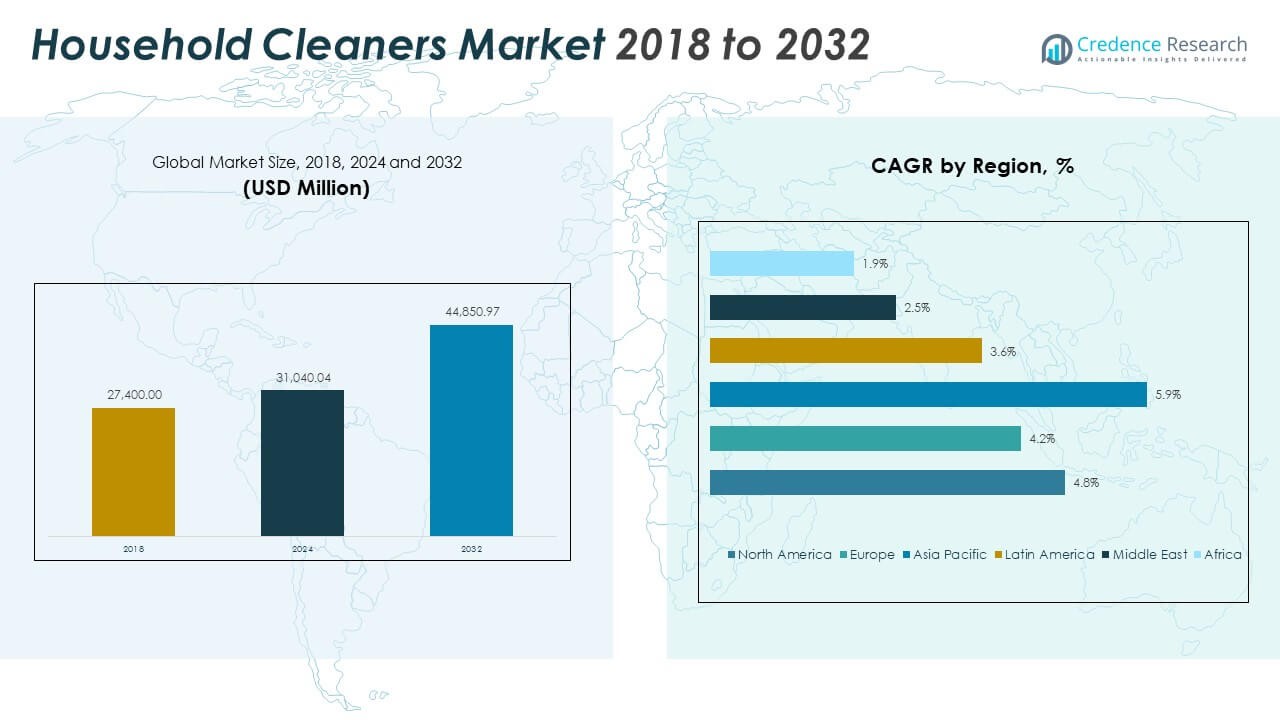
The Household Cleaners Market size was valued at USD 27,400.00 million in 2018 to USD 31,040.04 million in 2024 and is anticipated to reach USD 44,850.97 million by 2032, at a CAGR of 4.76% during the forecast period.

REPORT ATTRIBUTE DETAILS
Historical Period 2020-2023
Base Year 2024
Forecast Period 2025-2032
Household Cleaners Market Size 2024 USD 31,040.04 Million
Household Cleaners Market, CAGR 4.76%
Household Cleaners Market Size 2032 USD 44,850.97 Million


Rising health awareness and demand for eco-friendly cleaning solutions are major drivers of the Household Cleaners Market. Consumers prefer products that ensure safety, efficiency, and environmental compatibility. Manufacturers are developing biodegradable and non-toxic formulations to align with sustainability goals. The growing influence of digital marketing, easy product availability, and higher disposable incomes further enhance sales. Changing lifestyles and the need for quick cleaning options continue to support steady market growth across urban and semi-urban populations.

North America and Europe dominate the market due to mature consumption habits and strong brand presence. Both regions show high demand for sustainable and premium cleaning products. The Asia-Pacific region is emerging rapidly, driven by rising disposable income, urban expansion, and growing hygiene awareness in countries like China, India, and Japan. Latin America and the Middle East & Africa are also expanding, supported by retail development and increasing adoption of modern cleaning practices in developing economies.

Access crucial information at unmatched prices!

Request your sample report today & start making informed decisions powered by Credence Research Inc.!

Download Sample

Market Insights:

  • The Household Cleaners Market was valued at USD 27,400.00 million in 2018, reached USD 31,040.04 million in 2024, and is projected to hit USD 44,850.97 million by 2032, expanding at a CAGR of 4.76%.
  • Europe, Asia Pacific, and North America together account for the top three regional shares 23%, 34%, and 21% respectively driven by strong retail infrastructure, rising hygiene awareness, and preference for sustainable cleaning products.
  • Asia Pacific remains the fastest-growing region with a 34% share, fueled by urbanization, retail expansion, and growing adoption of branded and eco-friendly cleaners.
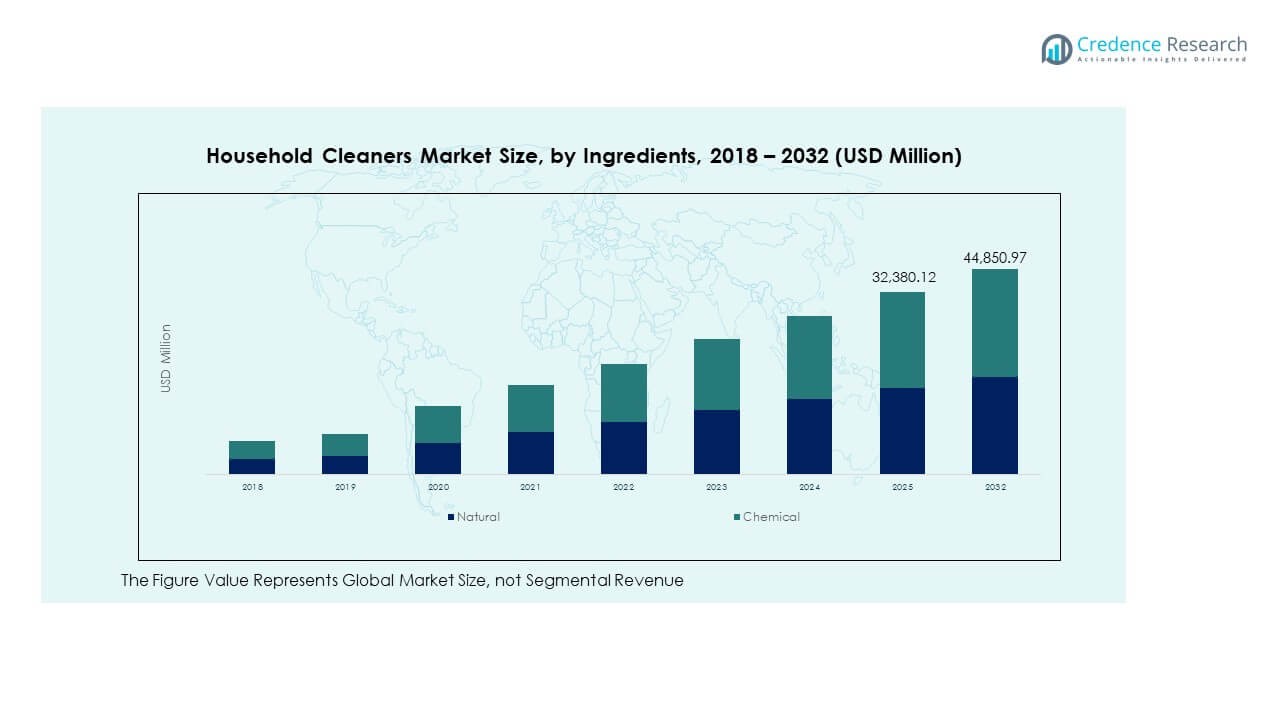
  • Based on the image, chemical-based products represent roughly 60% of total market share, maintaining dominance due to their superior cleaning and disinfecting strength.
  • Natural ingredients hold around 40% of the market share, expanding rapidly with increased consumer demand for biodegradable and plant-based cleaning formulations.

Household Cleaners Market Size

Market Drivers

Rising Focus on Hygiene and Health Safety Post Global Health Awareness

Growing concern about infectious diseases has boosted the use of cleaning and disinfectant products. Consumers are prioritizing hygiene to protect against bacteria and viruses in homes and workplaces. It has led to strong adoption of surface disinfectants, toilet cleaners, and multipurpose sprays. The Household Cleaners Market benefits from public health campaigns and sanitation drives by governments. Consumers now value products offering antibacterial and antiviral properties. Manufacturers focus on developing advanced cleaning solutions that meet hygiene standards. The awareness of cleanliness as a preventive measure continues to sustain steady demand. Increased household hygiene practices have now become a lifestyle trend across urban regions.

Expanding Urbanization and Lifestyle Shifts Encouraging Product Adoption

Urban populations are driving consumption through exposure to modern cleaning habits and convenience needs. Compact living spaces demand efficient cleaning solutions that save time and effort. It supports product innovations like spray-based and ready-to-use formulations. The Household Cleaners Market gains from organized retail growth and smart packaging that enhances shelf appeal. Dual-income households prefer premium products that ensure long-lasting freshness and hygiene. The rise in e-commerce platforms improves accessibility to diverse cleaning products. Manufacturers leverage online channels to reach tech-savvy consumers directly. This shift toward convenience and hygiene-focused lifestyles accelerates long-term market penetration.

  • For instance, in January 2024, Procter & Gamble’s Febreze brand introduced its third “Scent of the Year,” Romance & Desire, developed by the company’s Innovation Foresight of Fragrance and Ingredients team. The launch reflects P&G’s focus on fragrance innovation and trend-based product development to align with evolving consumer preferences in the home and air care segment of the Household Cleaners Market.

Increased Consumer Preference for Eco-Friendly and Non-Toxic Formulations

Environmental awareness and chemical sensitivity concerns push consumers toward sustainable cleaning products. Demand for biodegradable, plant-based, and fragrance-free cleaners is increasing steadily. It has driven producers to replace harsh chemicals with renewable raw materials. The Household Cleaners Market aligns with green-label certification programs promoting environmental safety. Leading brands launch low-VOC and allergen-free solutions to meet eco-regulatory standards. The preference for refillable packaging and concentrated liquids further supports sustainability goals. Companies adopting transparent labeling and ethical sourcing gain consumer trust. This move toward eco-conscious consumption strengthens market reputation and consumer loyalty.

  • For instance, Seventh Generation, a Unilever brand, continues to advance sustainability by prioritizing concentrated detergents and using bottles made from 100% post-consumer recycled plastic. The company’s packaging and formulation efforts reflect its broader goal to reduce plastic use and minimize environmental impact across its cleaning product portfolio.

Technological Integration in Product Formulation and Distribution Channels

Innovation in product formulation enhances performance and user convenience. Enzyme-based, pH-balanced, and fast-drying cleaners offer superior cleaning efficiency. It allows manufacturers to address specialized cleaning needs across residential and commercial sectors. The Household Cleaners Market integrates digital marketing and smart distribution platforms for wider outreach. Automated dispensing systems and smart packaging improve safety and precision in use. Research and development efforts support the development of long-lasting and multi-surface cleaners. Collaborations with chemical innovators promote continuous improvement in product quality. Advanced cleaning technology and targeted marketing strategies drive global brand competitiveness.

Market Trends

Increasing Popularity of Multi-Purpose and Specialty Cleaning Products

Modern consumers seek versatile cleaning products capable of handling multiple surfaces. Multi-purpose cleaners reduce clutter and simplify household chores. It has created steady demand for hybrid formulations combining disinfectant, deodorizing, and polishing functions. The Household Cleaners Market experiences rising innovation in concentrated solutions that reduce waste. Specialized cleaners for kitchens, electronics, and pet-safe environments are gaining popularity. Manufacturers introduce compact, easy-to-store products catering to urban households. Demand for fragrance-enhanced variants remains consistent among premium product users. Continuous product diversification ensures strong engagement in both offline and online retail channels.

Growth of Natural and Organic Household Cleaning Brands

Consumers are increasingly concerned about chemical exposure in conventional cleaners. Organic and natural brands have emerged as a preferred choice across major cities. It supports expansion of products certified by eco-labeling agencies and safety regulators. The Household Cleaners Market is witnessing growth in essential oil–based and hypoallergenic products. Independent and startup brands capitalize on clean-label marketing and transparency. Consumers show interest in cruelty-free and vegan cleaning products with sustainable sourcing. Established manufacturers are acquiring niche eco brands to expand market portfolios. This shift toward clean formulations enhances product differentiation and brand equity.

  • For instance, Seventh Generation’s All Purpose Cleaner is certified as a USDA BioPreferred Product with 91% biobased content and recognized by the EPA Safer Choice program for its safe formulation and use of 100% post-consumer recycled plastic packaging. These third-party certifications, including Leaping Bunny for cruelty-free standards, position the brand as a leader in the natural and organic household cleaners segment.

Evolving Role of E-Commerce and Direct-to-Consumer Distribution Models

The expansion of digital platforms has transformed how consumers purchase household cleaning products. Online sales enable easy comparison, subscription services, and fast doorstep delivery. It supports smaller brands competing with established market leaders. The Household Cleaners Market benefits from digital advertisements and influencer-led promotions. E-commerce platforms allow data-driven customization of offers and bundles. Retailers use algorithms to analyze consumer preferences and optimize stock levels. Direct-to-consumer models ensure better pricing transparency and engagement. Growing smartphone penetration and online payment reliability further strengthen e-commerce-based growth.

  • For instance, in 2024, Reckitt Benckiser collaborated with Shopee to host a Super Brand Day campaign across six Asia-Pacific markets Singapore, Malaysia, Thailand, Philippines, Indonesia, and Vietnam promoting brands including Lysol and highlighting its expanding digital presence in regional e-commerce.

Rising Adoption of Concentrated and Refillable Cleaning Products

Consumers prefer concentrated cleaning liquids that minimize packaging waste and reduce carbon footprint. Refillable systems are being implemented by major retailers to promote reuse. It helps consumers save costs and adopt more sustainable practices. The Household Cleaners Market aligns with corporate sustainability goals encouraging packaging circularity. Major players invest in refill stations and recyclable containers. Concentrated solutions improve transportation efficiency and lower environmental impact. The market’s innovation strategy focuses on convenience and environmental responsibility. This refill and concentrate trend continues to reshape retail packaging standards globally.

Household Cleaners Market ShareMarket Challenges Analysis

Stringent Regulatory Standards and Raw Material Compliance Constraints

Manufacturers face complex compliance challenges due to diverse chemical safety regulations. Strict formulation standards across regions increase development costs and testing requirements. It pressures small and mid-sized producers to limit product innovation speed. The Household Cleaners Market must adhere to REACH, EPA, and other chemical safety frameworks. Differences in permissible substances create difficulties in global product harmonization. Raw material shortages and fluctuating import costs affect consistent supply. Manufacturers often struggle to maintain product performance while meeting eco-safety benchmarks. Balancing safety, cost, and effectiveness remains a critical operational challenge for industry participants.

Intense Price Competition and Limited Product Differentiation

High competition among brands keeps product prices under pressure in both developed and emerging economies. Large multinational firms dominate shelf space through marketing investments and economies of scale. It limits growth opportunities for smaller regional players in key markets. The Household Cleaners Market faces a challenge in creating strong product identity due to category saturation. Frequent promotional discounts erode profit margins for established companies. Limited differentiation in performance or fragrance reduces consumer switching incentives. Sustained R&D and brand storytelling are required to maintain relevance. Competitive intensity continues to demand strategic innovation and agile pricing policies.

Market Opportunities

Growing Demand for Sustainable Packaging and Green Product Innovation

Consumers increasingly support brands promoting recyclability and minimal environmental footprint. Companies introducing eco-refill packs and bio-based containers enhance market visibility. It drives collaboration between chemical suppliers and packaging innovators to meet sustainability goals. The Household Cleaners Market gains advantage from regulations favoring reduced plastic use. Manufacturers investing in recyclable and compostable packaging improve brand reputation. Rising adoption of concentrated cleaning agents offers room for sustainable expansion. Innovations in zero-waste packaging strengthen premium and eco-conscious product segments. This green transformation opens a new path for long-term value creation globally.

Expansion Potential Across Emerging Economies Through Retail Modernization

Rapid retail expansion in Asia-Pacific, Latin America, and Africa creates major opportunities. Urban populations adopt modern cleaning habits supported by rising incomes and education levels. It drives supermarkets and e-commerce growth offering premium cleaning solutions. The Household Cleaners Market capitalizes on government-led sanitation initiatives and housing development. International brands are forming partnerships with local distributors to enhance market entry. Regional players invest in culturally adapted fragrances and affordable packaging options. The growing middle class across these regions ensures expanding product accessibility. The rising infrastructure and organized retail networks will drive sustained future growth.

Household Cleaners Market Segmentation

Market Segmentation Analysis:

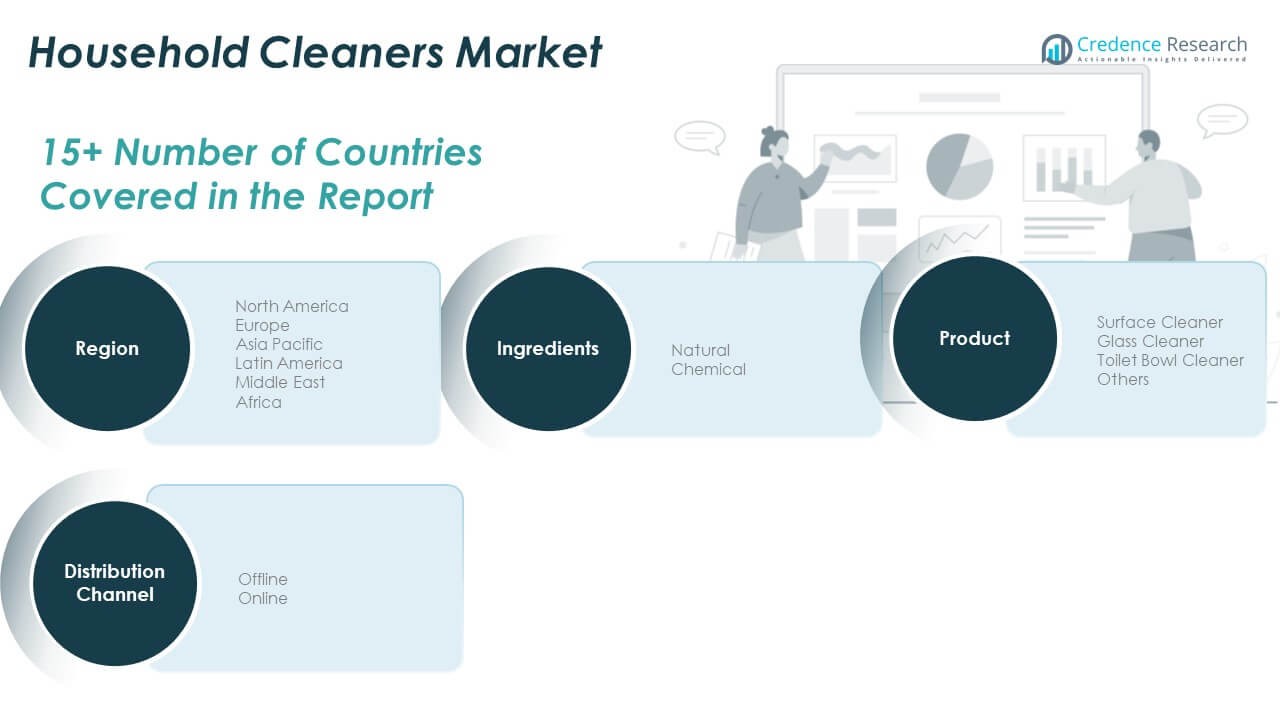
The Household Cleaners Market is categorized by product, ingredients, and distribution channel.

By product, surface cleaners lead due to their frequent use in kitchens, floors, and appliances. They offer versatility and convenience, driving consistent consumer demand. Glass cleaners hold a strong position, supported by increased use of glass surfaces in homes and offices. Toilet bowl cleaners show rising adoption due to heightened hygiene awareness and regular sanitization habits. The “others” category includes niche cleaning agents such as specialty sprays and multipurpose wipes, gaining attention in premium segments.

  • For example, Windex Original Glass Cleaner promotes an unbeatable streak-free shine based on lab tests of leading competitors, reinforcing its position in the streak-free glass cleaning segment.

By ingredients, chemical-based cleaners dominate because of their strong stain-removal and disinfecting properties. Manufacturers continuously refine formulations to reduce harmful components and improve safety. Natural cleaners are expanding rapidly, driven by the preference for biodegradable and plant-based ingredients. It supports eco-conscious consumers who prioritize sustainable and non-toxic alternatives in daily cleaning routines.

  • For instance, Dettol Antibacterial Surface Disinfectant contains benzalkonium chloride as its active ingredient, as listed in Reckitt’s official safety data documentation. Laboratory studies cited by Reckitt confirm that certain Dettol disinfectant formulations can inactivate 99.9% of the SARS-CoV-2 virus when used according to directions.

By distribution channel, offline retail remains dominant with supermarkets and hypermarkets providing easy product access and brand visibility. However, online channels are growing quickly through e-commerce platforms offering convenience, wide product variety, and subscription models. The growing digital presence of leading brands supports direct-to-consumer engagement and personalized marketing. This multi-channel approach ensures broader product reach across both urban and rural markets.

Segmentation:

By Product

  • Surface Cleaner
  • Glass Cleaner
  • Toilet Bowl Cleaner
  • Others

By Ingredients

  • Natural
  • Chemical

By Distribution Channel

  • Offline
  • Online

By Region

  • North America
    • U.S.
    • Canada
    • Mexico
  • Europe
    • Germany
    • France
    • U.K.
    • Italy
    • Spain
    • Rest of Europe
  • Asia Pacific
    • China
    • Japan
    • India
    • South Korea
    • South-east Asia
    • Rest of Asia Pacific
  • Latin America
    • Brazil
    • Argentina
    • Rest of Latin America
  • Middle East & Africa
    • GCC Countries
    • South Africa
    • Rest of the Middle East and Africa

Regional Analysis:

North America

The North America Household Cleaners Market size was valued at USD 8,063.82 million in 2018 to USD 8,998.32 million in 2024 and is anticipated to reach USD 12,979.95 million by 2032, at a CAGR of 4.8% during the forecast period. North America holds a 21% market share, supported by high hygiene awareness and demand for premium cleaning products. The market is driven by innovation in disinfectants and eco-friendly formulations. It benefits from well-established retail networks and strong brand loyalty among consumers. Increasing household incomes encourage purchases of specialty and multipurpose cleaners. The United States remains the largest contributor, followed by Canada. Consumer focus on sanitation and green product labeling further supports regional market stability.

Europe

The Europe Household Cleaners Market size was valued at USD 8,877.60 million in 2018 to USD 9,739.51 million in 2024 and is anticipated to reach USD 13,444.20 million by 2032, at a CAGR of 4.2% during the forecast period. Europe accounts for a 23% market share, with growth supported by strong environmental regulations and consumer preference for sustainable products. It is influenced by the European Union’s green chemistry policies promoting biodegradable formulations. Germany, France, and the UK lead demand due to their mature retail infrastructure. Premium brands offering low-toxicity cleaners are expanding across Western Europe. Consumers prefer refillable and concentrated cleaning liquids to reduce plastic waste. The rising influence of e-commerce enhances product accessibility and awareness.

Asia Pacific

The Asia Pacific Household Cleaners Market size was valued at USD 7,836.40 million in 2018 to USD 9,214.10 million in 2024 and is anticipated to reach USD 14,500.35 million by 2032, at a CAGR of 5.9% during the forecast period. The region leads with a 34% market share, driven by rapid urbanization and population growth. Expanding middle-class income levels fuel demand for branded cleaning solutions. It experiences strong retail expansion and product localization strategies by global players. India and China dominate production and consumption, with growing awareness of hygiene in semi-urban areas. E-commerce adoption and increased marketing visibility accelerate market reach. Affordable eco-cleaners gain popularity among younger households, reshaping long-term consumption patterns.

Latin America

The Latin America Household Cleaners Market size was valued at USD 1,496.04 million in 2018 to USD 1,675.85 million in 2024 and is anticipated to reach USD 2,218.78 million by 2032, at a CAGR of 3.6% during the forecast period. Latin America captures a 6% market share, driven by rising hygiene standards and expanding urban populations. Brazil and Mexico dominate sales through retail expansion and domestic production. It benefits from marketing campaigns promoting surface and bathroom cleaners. Growing awareness of environmental safety drives interest in natural cleaning alternatives. Distribution partnerships between global and local companies enhance supply chain efficiency. The demand for affordable yet effective cleaners continues to shape purchasing trends.

Middle East

The Middle East Household Cleaners Market size was valued at USD 657.60 million in 2018 to USD 670.26 million in 2024 and is anticipated to reach USD 812.05 million by 2032, at a CAGR of 2.5% during the forecast period. The region accounts for a 4% market share, with growth supported by urban development and rising disposable incomes. It shows increasing acceptance of branded household cleaning products across Gulf countries. The hospitality and real estate sectors contribute to institutional cleaning demand. Consumers prefer strong disinfectants and fragrance-rich products suited to regional preferences. Global brands are expanding through partnerships with regional distributors. Retail modernization and increased hygiene campaigns sustain market growth.

Africa

The Africa Household Cleaners Market size was valued at USD 468.54 million in 2018 to USD 741.98 million in 2024 and is anticipated to reach USD 895.64 million by 2032, at a CAGR of 1.9% during the forecast period. Africa holds a 3% market share, supported by gradual improvements in living standards and hygiene awareness. Urban centers such as South Africa, Nigeria, and Egypt drive primary demand. It faces price sensitivity challenges, leading to growth in economy-brand segments. Multinational companies invest in affordable packaging and local production facilities. Awareness campaigns by health organizations encourage regular use of disinfectants. Expanding modern trade networks improve distribution and accessibility. Rising population and household spending support long-term market potential.

Key Player Analysis:

  • Procter & Gamble (Cascade)
  • Unilever
  • Henkel AG & Co. KGaA (Pril)
  • Reckitt Benckiser Group PLC (Finish)
  • Colgate-Palmolive Company
  • Kao Corporation
  • The Clorox Company

Competitive Analysis:

The Household Cleaners Market features intense competition among global and regional players focusing on innovation, sustainability, and brand differentiation. Leading companies such as Procter & Gamble, Unilever, Henkel AG & Co. KGaA, Reckitt Benckiser Group, Colgate-Palmolive, Kao Corporation, and The Clorox Company dominate the market through strong brand portfolios and distribution reach. It emphasizes product innovation, including biodegradable and plant-based formulations, to meet evolving consumer preferences. Companies invest in marketing campaigns highlighting hygiene, eco-friendliness, and performance efficiency. Strategic mergers, acquisitions, and product launches strengthen their presence across high-growth regions. It continues to witness growing participation from private-label and local manufacturers offering affordable alternatives. Competitive intensity drives constant research and digital engagement to retain consumer loyalty.

Shape Your Report to Specific Countries or Regions & Enjoy 30% Off!

Recent Developments:

  • In March 2025, Cascade, a flagship brand of Procter & Gamble, launched its New & Improved Cascade Platinum Plus dishwasher detergent. This product features an upgraded formula designed to remove up to 100% of food residue, tackling stubborn grease and achieving a virtually spot-free shine and dry. The launch campaign involved comedian Kenan Thompson to demonstrate its effectiveness and promote easier home cooking cleanup.
  • In July 2025, Reckitt Benckiser entered into an agreement with Advent International to divest its Essential Home business for up to US$4.8 billion, retaining a 30% equity stake. This strategic move is part of Reckitt’s effort to streamline its portfolio, focusing on high-growth health and hygiene Powerbrands, with completion expected by year-end 2025.

Report Coverage:

The research report offers an in-depth analysis based on Product, Ingredients and Distribution Channel. It details leading market players, providing an overview of their business, product offerings, investments, revenue streams, and key applications. Additionally, the report includes insights into the competitive environment, SWOT analysis, current market trends, as well as the primary drivers and constraints. Furthermore, it discusses various factors that have driven market expansion in recent years. The report also explores market dynamics, regulatory scenarios, and technological advancements that are shaping the industry. It assesses the impact of external factors and global economic changes on market growth. Lastly, it provides strategic recommendations for new entrants and established companies to navigate the complexities of the market.

Future Outlook:

  • The Household Cleaners Market will expand steadily with growing hygiene awareness and evolving cleaning habits.
  • Demand for eco-friendly, plant-based, and biodegradable cleaners will strengthen as sustainability gains priority.
  • Innovation in concentrated and refillable packaging will redefine product delivery and reduce environmental impact.
  • Online retail and subscription-based supply models will drive consumer convenience and brand engagement.
  • Product diversification toward multi-surface, allergen-free, and antibacterial solutions will attract premium consumers.
  • Companies will intensify R&D to create advanced formulations that balance performance, safety, and affordability.
  • Partnerships between global and regional brands will enhance product localization and supply efficiency.
  • Regulatory alignment with green chemistry standards will shape formulation practices across key regions.
  • Marketing emphasizing hygiene, transparency, and sustainability will reinforce consumer trust and loyalty.
  • The market will witness growing adoption of digital tools for predictive analytics and demand forecasting.

CHAPTER NO. 1 : GENESIS OF THE MARKET

1.1 Market Prelude – Introduction & Scope

1.2 The Big Picture – Objectives & Vision

1.3 Strategic Edge – Unique Value Proposition

1.4 Stakeholder Compass – Key Beneficiaries

CHAPTER NO. 2 : EXECUTIVE LENS

2.1 Pulse of the Industry – Market Snapshot

2.2 Growth Arc – Revenue Projections (USD Million)

2.3. Premium Insights – Based on Primary Interviews

CHAPTER NO. 3 : HOUSEHOLD CLEANERS MARKET FORCES & INDUSTRY PULSE

3.1 Foundations of Change – Market Overview

3.2 Catalysts of Expansion – Key Market Drivers

3.2.1 Momentum Boosters – Growth Triggers

3.2.2 Innovation Fuel – Disruptive Technologies

3.3 Headwinds & Crosswinds – Market Restraints

3.3.1 Regulatory Tides – Compliance Challenges

3.3.2 Economic Frictions – Inflationary Pressures

3.4 Untapped Horizons – Growth Potential & Opportunities

3.5 Strategic Navigation – Industry Frameworks

3.5.1 Market Equilibrium – Porter’s Five Forces

3.5.2 Ecosystem Dynamics – Value Chain Analysis

3.5.3 Macro Forces – PESTEL Breakdown

3.6 Price Trend Analysis

3.6.1 Regional Price Trend

3.6.2 Price Trend by product

CHAPTER NO. 4 : KEY INVESTMENT EPICENTER

4.1 Regional Goldmines – High-Growth Geographies

4.2 Product Frontiers – Lucrative Product Categories

4.3 Ingredients Sweet Spots – Emerging Demand Segments

CHAPTER NO. 5: REVENUE TRAJECTORY & WEALTH MAPPING

5.1 Momentum Metrics – Forecast & Growth Curves

5.2 Regional Revenue Footprint – Market Share Insights

5.3 Segmental Wealth Flow – Product & Ingredients Revenue

CHAPTER NO. 6 : TRADE & COMMERCE ANALYSIS

6.1. Import Analysis by Region

6.1.1. Global Household Cleaners Market Import Revenue By Region

6.2. Export Analysis by Region

6.2.1. Global Household Cleaners Market Export Revenue By Region

CHAPTER NO. 7 : COMPETITION ANALYSIS

7.1. Company Market Share Analysis

7.1.1. Global Household Cleaners Market: Company Market Share

7.2. Global Household Cleaners Market Company Revenue Market Share

7.3. Strategic Developments

7.3.1. Acquisitions & Mergers

7.3.2. New Product Launch

7.3.3. Regional Expansion

7.4. Competitive Dashboard

7.5. Company Assessment Metrics, 2024

CHAPTER NO. 8 : HOUSEHOLD CLEANERS MARKET – BY PRODUCT SEGMENT ANALYSIS

8.1. Household Cleaners Market Overview by Product Segment

8.1.1. Household Cleaners Market Revenue Share By Product

8.2. Surface Cleaner

8.3. Glass Cleaner

8.4. Toilet Bowl Cleaner

8.5. Others

CHAPTER NO. 9 : HOUSEHOLD CLEANERS MARKET – BY INGREDIENTS SEGMENT ANALYSIS

9.1. Household Cleaners Market Overview by Ingredients Segment

9.1.1. Household Cleaners Market Revenue Share By Ingredients

9.2. Natural

9.3. Chemical

CHAPTER NO. 10 : HOUSEHOLD CLEANERS MARKET – BY DISTRIBUTION CHANNEL SEGMENT ANALYSIS

10.1. Household Cleaners Market Overview by Distribution Channel Segment

10.1.1. Household Cleaners Market Revenue Share By Distribution Channel

10.2. Offline

10.3. Online

CHAPTER NO. 11 : HOUSEHOLD CLEANERS MARKET – REGIONAL ANALYSIS

11.1. Household Cleaners Market Overview by Region Segment

11.1.1. Global Household Cleaners Market Revenue Share By Region

11.1.3. Regions

11.1.4. Global Household Cleaners Market Revenue By Region

.1.6. Product

11.1.7. Global Household Cleaners Market Revenue By Product

11.1.9. Ingredients

11.1.10. Global Household Cleaners Market Revenue By Ingredients

11.1.12. Distribution Channel

11.1.13. Global Household Cleaners Market Revenue By Distribution Channel

CHAPTER NO. 12 : NORTH AMERICA HOUSEHOLD CLEANERS MARKET – COUNTRY ANALYSIS

12.1. North America Household Cleaners Market Overview by Country Segment

12.1.1. North America Household Cleaners Market Revenue Share By Region

12.2. North America

12.2.1. North America Household Cleaners Market Revenue By Country

12.2.2. Product

12.2.3. North America Household Cleaners Market Revenue By Product

12.2.4. Ingredients

12.2.5. North America Household Cleaners Market Revenue By Ingredients

2.2.6. Distribution Channel

12.2.7. North America Household Cleaners Market Revenue By Distribution Channel

2.3. U.S.

12.4. Canada

12.5. Mexico

CHAPTER NO. 13 : EUROPE HOUSEHOLD CLEANERS MARKET – COUNTRY ANALYSIS

13.1. Europe Household Cleaners Market Overview by Country Segment

13.1.1. Europe Household Cleaners Market Revenue Share By Region

13.2. Europe

13.2.1. Europe Household Cleaners Market Revenue By Country

13.2.2. Product

13.2.3. Europe Household Cleaners Market Revenue By Product

13.2.4. Ingredients

13.2.5. Europe Household Cleaners Market Revenue By Ingredients

13.2.6. Distribution Channel

13.2.7. Europe Household Cleaners Market Revenue By Distribution Channel

13.3. UK

13.4. France

13.5. Germany

13.6. Italy

13.7. Spain

13.8. Russia

13.9. Rest of Europe

CHAPTER NO. 14 : ASIA PACIFIC HOUSEHOLD CLEANERS MARKET – COUNTRY ANALYSIS

14.1. Asia Pacific Household Cleaners Market Overview by Country Segment

14.1.1. Asia Pacific Household Cleaners Market Revenue Share By Region

14.2. Asia Pacific

14.2.1. Asia Pacific Household Cleaners Market Revenue By Country

14.2.2. Product

14.2.3. Asia Pacific Household Cleaners Market Revenue By Product

14.2.4. Ingredients

14.2.5. Asia Pacific Household Cleaners Market Revenue By Ingredients

14.2.5. Distribution Channel

14.2.7. Asia Pacific Household Cleaners Market Revenue By Distribution Channel

14.3. China

14.4. Japan

14.5. South Korea

14.6. India

14.7. Australia

14.8. Southeast Asia

14.9. Rest of Asia Pacific

CHAPTER NO. 15 : LATIN AMERICA HOUSEHOLD CLEANERS MARKET – COUNTRY ANALYSIS

15.1. Latin America Household Cleaners Market Overview by Country Segment

15.1.1. Latin America Household Cleaners Market Revenue Share By Region

15.2. Latin America

15.2.1. Latin America Household Cleaners Market Revenue By Country

15.2.2. Product

15.2.3. Latin America Household Cleaners Market Revenue By Product

15.2.4. Ingredients

15.2.5. Latin America Household Cleaners Market Revenue By Ingredients

15.2.6. Distribution Channel

15.2.7. Latin America Household Cleaners Market Revenue By Distribution Channel

15.3. Brazil

15.4. Argentina

15.5. Rest of Latin America

CHAPTER NO. 16 : MIDDLE EAST HOUSEHOLD CLEANERS MARKET – COUNTRY ANALYSIS

16.1. Middle East Household Cleaners Market Overview by Country Segment

16.1.1. Middle East Household Cleaners Market Revenue Share By Region

16.2. Middle East

16.2.1. Middle East Household Cleaners Market Revenue By Country

16.2.2. Product

16.2.3. Middle East Household Cleaners Market Revenue By Product

16.2.4. Ingredients

16.2.5. Middle East Household Cleaners Market Revenue By Ingredients

16.2.6. Distribution Channel

16.2.7. Middle East Household Cleaners Market Revenue By Distribution Channel

16.3. GCC Countries

16.4. Israel

16.5. Turkey

16.6. Rest of Middle East

CHAPTER NO. 17 : AFRICA HOUSEHOLD CLEANERS MARKET – COUNTRY ANALYSIS

17.1. Africa Household Cleaners Market Overview by Country Segment

17.1.1. Africa Household Cleaners Market Revenue Share By Region

17.2. Africa

17.2.1. Africa Household Cleaners Market Revenue By Country

17.2.2. Product

17.2.3. Africa Household Cleaners Market Revenue By Product

17.2.4. Ingredients

17.2.5. Africa Household Cleaners Market Revenue By Ingredients

17.2.6. Distribution Channel

17.2.7. Africa Household Cleaners Market Revenue By Distribution Channel

17.3. South Africa

17.4. Egypt

17.5. Rest of Africa

CHAPTER NO. 18 : COMPANY PROFILES

18.1. Procter & Gamble (Cascade)

18.1.1. Company Overview

18.1.2. Product Portfolio

18.1.3. Financial Overview

18.1.4. Recent Developments

18.1.5. Growth Strategy

18.1.6. SWOT Analysis

18.2. Unilever

18.3. Henkel AG & Co. KGaA (Pril)

18.4. Reckitt Benckiser Group PLC (Finish)

18.5. Colgate-Palmolive Company

18.6. Kao Corporation

18.7. The Clorox Company

Request Free Sample

We prioritize the confidentiality and security of your data. Our promise: your information remains private.

Ready to Transform Data into Decisions?

Request Your Sample Report and Start Your Journey of Informed Choices


Providing the strategic compass for industry titans.

cr-clients-logos

Frequently Asked Questions:

What is the current market size for the Household Cleaners Market, and what is its projected size in 2032?

The Household Cleaners Market was valued at USD 31,040.04 million in 2024 and is projected to reach USD 44,850.97 million by 2032, showing consistent growth across all product categories.

At what Compound Annual Growth Rate is the Household Cleaners Market projected to grow between 2024 and 2032?

The Household Cleaners Market is projected to grow at a CAGR of 4.76% during the forecast period from 2024 to 2032.

Which Household Cleaners Market segment held the largest share in 2024?

Surface cleaners held the largest share of the Household Cleaners Market in 2024 due to high usage in kitchens, floors, and multipurpose cleaning applications.

What are the primary factors fueling the growth of the Household Cleaners Market?

Rising hygiene awareness, urbanization, sustainable product innovation, and expansion of e-commerce channels are key drivers of the Household Cleaners Market.

Who are the leading companies in the Household Cleaners Market?

Major players in the Household Cleaners Market include Procter & Gamble, Unilever, Henkel AG & Co. KGaA, Reckitt Benckiser Group, Colgate-Palmolive, Kao Corporation, and The Clorox Company.

Which region commanded the largest share of the Household Cleaners Market in 2024?

Asia Pacific commanded the largest share of the Household Cleaners Market in 2024, supported by rapid urbanization, retail expansion, and rising household incomes.

About Author

Rajdeep Kumar Deb

Rajdeep Kumar Deb

Lead Analyst – Consumer & Finance

Rajdeep brings a decade of consumer goods and financial services insight to strategic market analysis.

View Profile

Related Reports

Roofing Shingles Market

The Roofing Shingles Market size was valued at USD 130.87 Billion in 2024 and is anticipated to reach USD 157.84 Billion by 2032, at a CAGR of 2.37% during the forecast period. 2024

Reusable Period Panties Market

The Reusable Period Panties Market size was valued at USD 148.2 million in 2024 and is anticipated to reach USD 472.62 million by 2032, at a CAGR of 15.6% during the forecast period.

Recreational Boat Market

Recreational Boat market was valued at USD 20.09 billion in 2024 and is anticipated to reach USD 32.75 billion by 2032, growing at a CAGR of 6.3 % during the forecast period.

Performance Wear Market

The Performance Wear Market size was valued at USD 211.02 billion in 2024 and is anticipated to reach USD 293.5 billion by 2032, at a CAGR of 4.21% during the forecast period.

Medicated Skin Care Products Market

Medicated skin care Products market was valued at USD 45.91 billion in 2024 and is anticipated to reach USD 67.32 billion by 2032, growing at a CAGR of 4.9 % during the forecast period.

Toilet Tank Fittings Market

Toilet Tank Fittings Market was valued at USD 8.03 billion in 2024 and is anticipated to reach USD 13.47 billion by 2032, growing at a CAGR of 6.68 % during the forecast period.

Canned Tuna Market

Canned Tuna market was valued at USD 20.4 billion in 2024 and is anticipated to reach USD 28.57 billion by 2032, growing at a CAGR of 4.3 % during the forecast period.

Pico Projectors Market

The global pico projectors market was valued at USD 6,057.5 million in 2024 and is projected to reach USD 27,834.05 million by 2032, expanding at a CAGR of 21% during the forecast period (2024–2032).

Luxury Lighting Market

Luxury Lighting Fixtures Market size was valued at USD 23.08 Billion in 2024 and is anticipated to reach USD 37.63 Billion by 2032, at a CAGR of 6.3% during the forecast period.

Africa Beauty and Personal Care Market

Africa Beauty and Personal Care Market size was valued at USD 70,640.92 Million in 2024 and is anticipated to reach USD 115,165.51 Million by 2032, at a CAGR of 6.3% during the forecast period.

T-Shirts Market

The Global T-Shirt Market size was valued at USD 1,64,200.00 million in 2018 to USD 1,83,891.48 million in 2024 and is anticipated to reach USD 2,65,781.83 million by 2032, at a CAGR of 4.81% during the forecast period.

North America Mobile Phone Protective Cases Market

The North America Mobile Phone Protective Cases Market size was valued at USD 18,138.08 million in 2018 to USD 27,858.64 million in 2024 and is anticipated to reach USD 48,704.17 million by 2032, at a CAGR of 6.73% during the forecast period.

Licence Option

The report comes as a view-only PDF document, optimized for individual clients. This version is recommended for personal digital use and does not allow printing. Use restricted to one purchaser only.
$4999

To meet the needs of modern corporate teams, our report comes in two formats: a printable PDF and a data-rich Excel sheet. This package is optimized for internal analysis. Unlimited users allowed within one corporate location (e.g., regional office).
$6999

The report will be delivered in printable PDF format along with the report’s data Excel sheet. This license offers 100 Free Analyst hours where the client can utilize Credence Research Inc. research team. Permitted for unlimited global use by all users within the purchasing corporation, such as all employees of a single company.
$12999

Report delivery within 24 to 48 hours

Credence Staff 3

WILLIAM, North America

Support Staff at Credence Research

KEITH PHILLIPS, Europe

Lee - CR Sales Staff

LEE VALLANCE, Asia Pacific

Kieran Jameson

KIERAN JAMESON, Australia

Smallform of Sample request
User Review

Thank you for the data! The numbers are exactly what we asked for and what we need to build our business case.

Materials Scientist
(privacy requested)

User Review

The report was an excellent overview of the Industrial Burners market. This report does a great job of breaking everything down into manageable chunks.

Imre Hof
Management Assistant, Bekaert

cr-clients-logos

Request Sample