
Market Overview:
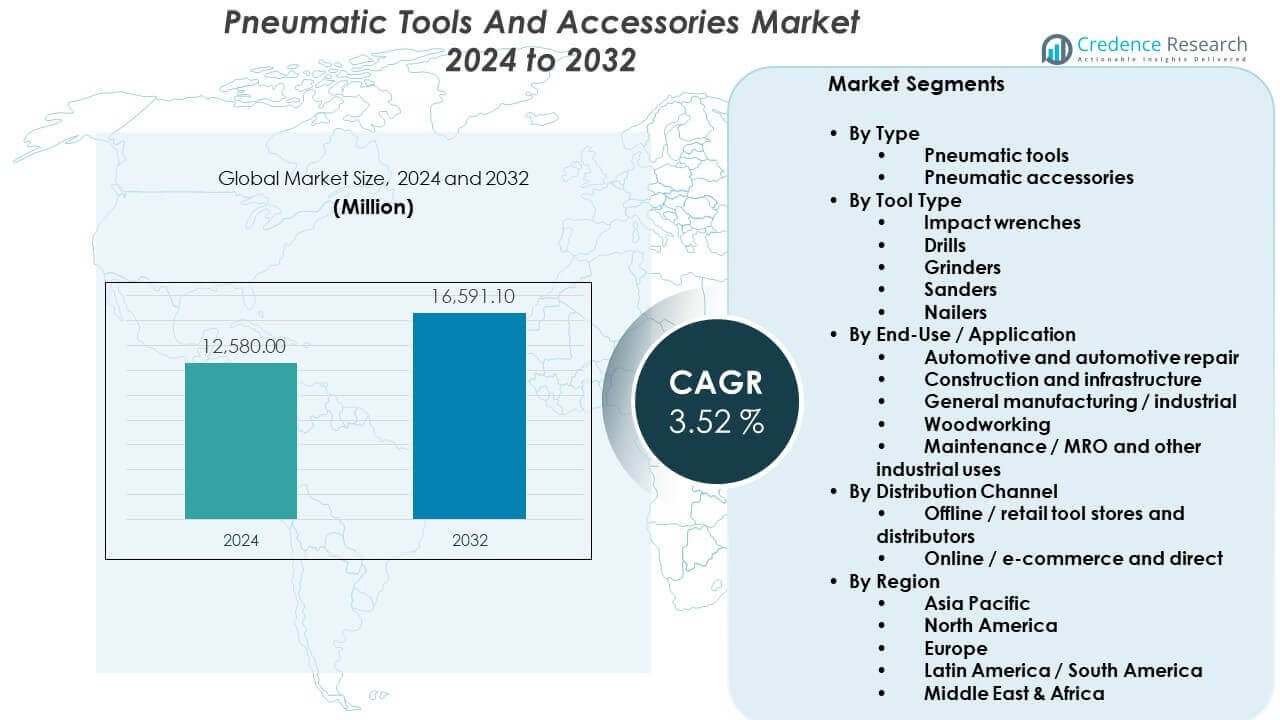
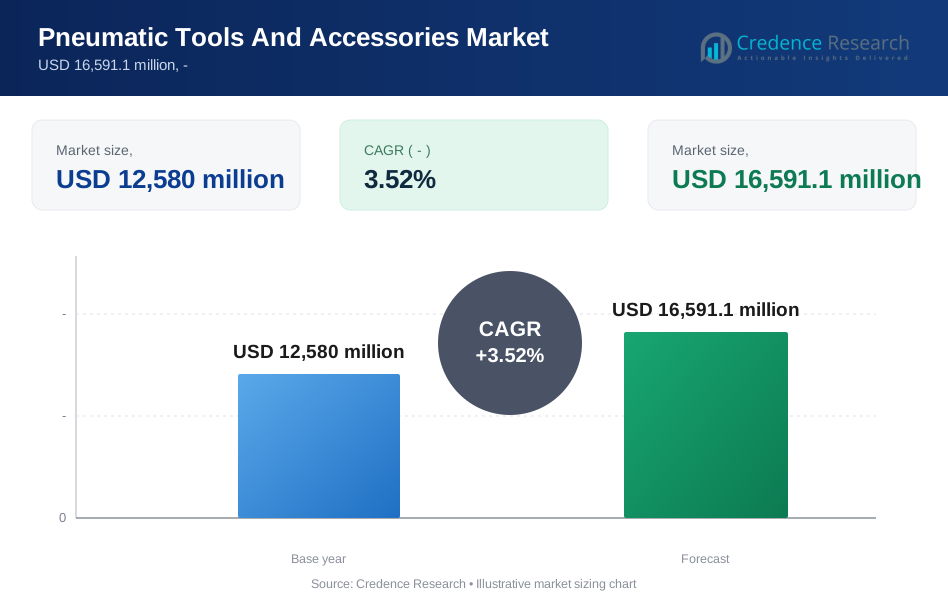
The Pneumatic tools and accessories market is projected to grow from USD 12,580 million in 2024. The market should reach USD 16,591.1 million by 2032. The market should register a CAGR of 3.52% from 2024 to 2032.
| REPORT ATTRIBUTE | DETAILS |
|---|---|
| Historical Period | 2020-2023 |
| Base Year | 2024 |
| Forecast Period | 2025-2032 |
| Pneumatic Tools And Accessories Market Size 2024 | USD 12,580 million |
| Pneumatic Tools And Accessories Market, CAGR | 3.52% |
| Pneumatic Tools And Accessories Market Size 2032 | USD 16,591.1 million |
Growth is driven by factory automation and faster assembly cycles. Plants prefer pneumatic tools for high torque and repeatable output. MRO teams adopt air tools for uptime-critical repairs. Construction and shipyards use rugged tools in harsh environments. OEMs upgrade to lighter housings, lower vibration, and safer triggers. Energy-efficient compressors and better air treatment improve performance. Accessory demand rises for hoses, couplers, FRLs, and impact sockets. Standardized fittings cut downtime and simplify tool changeovers. Service networks and rentals expand access for small contractors. Digital inventory tracking reduces losses and improves compliance.
North America and Europe lead due to large MRO budgets and safety rules. The United States and Germany drive demand in automotive and aerospace plants. Japan and South Korea sustain upgrades for precision tools and clean air systems. China remains a major buyer as factories expand and modernize. India and Southeast Asia are emerging on new manufacturing and infrastructure spending. Mexico grows through nearshoring and export-oriented assembly lines. Middle East projects lift demand for construction and energy-site maintenance tools. Across regions, distributors win by offering calibration, parts, and fast service.
Market Insights:
- The Pneumatic tools and accessories market was valued at USD 12,580 million in 2024 and is projected to reach USD 16,591.1 million by 2032, registering a CAGR of 3.52% during 2024–2032.
- Asia Pacific (38%), Europe (26%), and North America (19%) dominate global share due to large-scale manufacturing, stringent safety standards, and mature industrial infrastructure. These regions maintain steady replacement demand and advanced production facilities.
- Asia Pacific, the fastest-growing region, benefits from expanding automotive production, rapid industrialization, and infrastructure projects across China, India, and Southeast Asia, strengthening its leadership position.
- By type, Pneumatic tools account for about 70% of market share owing to widespread use in assembly, repair, and fabrication industries, while accessories maintain steady replacement-driven demand.
- By application, Automotive and general manufacturing jointly hold nearly 60% share, supported by ongoing automation, high-torque assembly needs, and continuous maintenance operations across global production hubs.
Market Drivers:
Rising Industrial Automation And High-Throughput Assembly Requirements
The Pneumatic tools and accessories market grows with faster assembly lines. Plants need repeatable torque and steady cycle time. Factories choose air tools for simple control and quick starts. Air motors tolerate stalls in many heavy fastening tasks. Tool fleets support automotive, machinery, and metal fabrication output. Sites upgrade hoses and couplers to reduce pressure drop. Maintenance teams hold regulators and filters to protect uptime. Standard tool platforms also reduce worker training time.
- For instance, Atlas Copco reports its industrial pneumatic torque tools achieve tightening accuracy within ±5%, supporting high-volume automotive assembly lines.
Expansion Of Construction, Shipbuilding, And Heavy Equipment Service Demand
The Pneumatic tools and accessories market gains from rugged field work. Contractors value tools that handle dust and rough handling. Shipyards use air tools for grinding, riveting, and fastening. Mining and energy sites rely on air tools for harsh duty cycles. Service crews prefer fast swaps through common quick-connects. Accessory demand rises for sockets, chisels, and abrasives. Fleet owners invest in tool kits to reduce repair delays. Rental channels widen access for small job sites.
- For instance, Ingersoll Rand states its 2850MAX pneumatic impact wrench delivers up to 2,847 Nm (2,100 ft-lb) of nut-busting torque for heavy equipment service, whereas the standard 285B model is rated for a maximum of 2,000 Nm (1,475 ft-lb).
Tight Safety, Ergonomics, And Compliance Expectations In Workplaces
The Pneumatic tools and accessories market supports safer job execution. Employers demand lower vibration to reduce fatigue risk. Tool makers improve triggers, guards, and anti-slip grips. Air preparation units deliver steadier tool response and control. Noise limits push mufflers and improved exhaust routing. Compliance audits increase checks for tool condition and air quality. Standard torque control reduces rework and joint failures. Buyers also prefer suppliers with strong service support.
Cost Control Focus Through Long Tool Life And Simple Maintenance
The Pneumatic tools and accessories market fits budget-led decisions. Buyers compare lifecycle cost, not only purchase price. Air tools allow quick repairs through simple part swaps. Shops stock seals, vanes, and fittings to cut downtime. Compressed air systems serve many work cells from one supply. Accessories help prevent leaks and extend hose life. Preventive checks improve reliability under high duty use. Stable uptime supports better output and capacity use.
Market Trends:
Shift Toward Smart Torque Assurance And Connected Quality Records
The Pneumatic tools and accessories market adopts data-led quality control. Plants link tool output to digital work instructions and audits. Supervisors request torque traceability for critical joints. Sensors and controllers support pass or fail decisions on the line. Quality teams use records to reduce warranty exposure. Service partners offer calibration plans and compliance reports. Line managers connect tool data to MES workflows. This trend increases demand for compatible accessories and fittings.
- For instance, Atlas Copco’s ToolsNet platform records torque data per fastening cycle and supports ISO-compliant audit trails in automotive plants.
Preference For Modular Tool Platforms And Rapid Tool Change Systems
The Pneumatic tools and accessories market favors modular work cells. Users choose common bodies with swappable heads and attachments. Quick-change chucks reduce downtime between task shifts. Standard couplers simplify tool moves across stations and sites. Purchasing teams reduce SKU counts through platform standardization. Service teams gain faster parts planning and repair flow. Tool cribs manage kits by role and job type. This pattern supports bundled accessories and starter packs.
- For instance, Chicago Pneumatic promotes modular pneumatic grinders with interchangeable heads that cut tool change time during surface prep tasks.
Higher Adoption Of Lightweight Materials And Balanced Tool Designs
The Pneumatic tools and accessories market sees design-led upgrades. Tool makers use lighter housings and better balance for control. Users demand better grip comfort during long shifts. Compact tools fit tight bays and dense equipment layouts. Low kickback and stable control improve operator confidence. Shops select tools that reduce wrist strain under torque loads. Air flow paths improve for smoother throttle response. Ergonomic claims influence buying decisions across industries.
Growth Of Rental, Distribution Services, And Managed Tool Programs
The Pneumatic tools and accessories market expands through service models. Rentals help contractors avoid large upfront tool budgets. Distributors offer tracking and scheduled maintenance services. Managed programs reduce tool loss across large sites. Vendors bundle hoses, FRLs, and spares with tool fleets. Service depots shorten repair time through local stock. Large buyers demand swap units under strict uptime targets. This shift favors suppliers with wide service coverage.
Market Challenges Analysis:
Compressed Air System Inefficiency And Site-Level Performance Variability Risks
The Pneumatic tools and accessories market depends on air system health. Many sites face leaks that waste energy and reduce tool power. Poor filtration accelerates wear and causes unstable output. Moisture and oil carryover damage seals and accessories. Pressure loss across long lines slows fastening cycles. Compressor sizing errors raise operating cost and noise. Maintenance gaps can stop entire tool fleets without warning. Buyers need audits, yet some avoid that spend.
Competition From Electric Cordless Tools And Total Cost Scrutiny Pressure
The Pneumatic tools and accessories market faces strong cordless alternatives. Battery tools win with mobility and simpler setup. Sites without air lines avoid compressor capital expense. Some buyers prefer lower noise and fewer hoses in aisles. Electric tools improve torque control and built-in data capture. Pneumatic suppliers must defend value through durability and service. Price pressure rises in commoditized accessories and fittings. Channel margins tighten when buyers consolidate suppliers.
Market Opportunities:
Expansion In Emerging Manufacturing Hubs And Infrastructure Buildouts
The Pneumatic tools and accessories market can grow in new factories. Industrial parks add assembly lines and service workshops. Infrastructure projects raise demand for rugged fastening tools. Local distributors can scale sales and service coverage. Training programs improve tool use and air system care. Kits with accessories support faster site deployment. OEM tie-ups can secure long-term supply contracts. Regional production can also reduce buyer lead times.
Aftermarket Service Growth Through Efficiency Audits And Value-Added Accessories
The Pneumatic tools and accessories market can win through service-led offers. Air leak audits help users reduce energy waste. Service plans improve uptime through scheduled parts replacement. Premium hoses and couplers reduce pressure drop and failures. Torque assurance add-ons support higher quality requirements. Tool tracking services reduce loss across large sites. Spare kits improve repair speed in remote locations. These offers lift margins beyond basic tool sales.
Market Segmentation Analysis:
By Type
The Pneumatic tools and accessories market splits into pneumatic tools and pneumatic accessories. Pneumatic tools capture core demand from fastening, drilling, cutting, and surface prep tasks. Pneumatic accessories support tool uptime through hoses, couplers, filters, regulators, lubricators, and sockets. Buyers often standardize accessory sets to reduce leaks and pressure loss. It also supports faster tool swaps and better safety control.
- For instance, Parker Hannifin specifies industrial FRL units that maintain regulated air pressure and filtration down to 5 microns for tool protection.
By Tool Type
Impact wrenches lead in high-torque fastening for wheels, frames, and heavy assemblies. Drills serve metalwork, fabrication, and repair tasks with consistent speed control. Grinders support cutting and deburring in industrial and construction work zones. Sanders drive surface finishing in woodworking and body repair shops. Nailers serve framing, furniture, and interior fit-out work where speed matters. Tool choice tracks duty cycle, torque range, and worksite constraints.
- For instance, Hilti reports its pneumatic nailers can drive up to 1,200 fasteners per hour in commercial framing applications.
By End-Use / Application
Automotive and automotive repair rely on fast cycle time and repeatable torque. Construction and infrastructure demand rugged tools that tolerate dust and rough handling. General manufacturing uses air tools for standardized work cells and high throughput. Woodworking prefers nailers and sanders for fit and finish work. Maintenance / MRO adopts tool kits to reduce downtime during critical repairs. Buyers prioritize safety, ergonomics, and service access across these uses.
By Distribution Channel
Offline retail tool stores and distributors dominate for fleet purchases, demos, and service support. Online e-commerce and direct channels grow through fast reorder, wider catalogs, and price checks. Many buyers use offline for tool selection and online for accessories. It supports shorter procurement cycles and better inventory control.
Segmentation:
By Type- Pneumatic tools
- Pneumatic accessories
- Impact wrenches
- Drills
- Grinders
- Sanders
- Nailers
- Automotive and automotive repair
- Construction and infrastructure
- General manufacturing / industrial
- Woodworking
- Maintenance / MRO and other industrial uses
- Offline / retail tool stores and distributors
- Online / e-commerce and direct
- North America
- U.S.
- Canada
- Mexico
- Europe
- Germany
- France
- U.K.
- Italy
- Spain
- Rest of Europe
- Asia Pacific
- China
- Japan
- India
- South Korea
- South-east Asia
- Rest of Asia Pacific
- Latin America
- Brazil
- Argentina
- Rest of Latin America
- Middle East & Africa
- GCC Countries
- South Africa
- Rest of the Middle East and Africa
Regional Analysis:
Global Share Split Shows Clear Leaders And Smaller Growth Pools
The Pneumatic tools and accessories market shows a defined global share structure shaped by industrial intensity and end-user adoption. Asia Pacific leads with around 38% of total market share, driven by large-scale manufacturing and high production capacity. Europe follows with 26%, supported by a mature industrial base and strict safety compliance. North America contributes 19%, where the U.S. maintains strong demand from automotive and aerospace sectors. The Middle East & Africa account for 10%, while Latin America holds 7%, reflecting expanding infrastructure and localized manufacturing growth. Industrialization pace and automation adoption levels continue to dictate regional positioning in this market.
Asia Pacific And Europe Lead Through Manufacturing Depth And Tool Renewal Cycles
Asia Pacific dominates due to its vast manufacturing infrastructure and continuous capital investments. China anchors regional demand with high-volume output in automotive, electronics, and metal fabrication. Japan and South Korea support demand through automation and advanced assembly facilities. India gains traction with infrastructure projects and growing domestic production capacity. Europe’s 26% market share remains stable due to stringent quality standards and consistent fleet renewal across Germany, Italy, and France. European buyers prefer durable tools, ergonomic designs, and reliable service networks, ensuring steady aftermarket activity. Both regions benefit from export-oriented production and efficient supply chains that sustain volume demand.
North America, South America, And Middle East & Africa Show Mixed Demand Profiles
North America maintains 19% market share, driven by industrial upgrades and steady replacement cycles. The U.S. remains the largest consumer due to its strong automotive, aerospace, and MRO sectors. Canada contributes through manufacturing and energy projects, while Mexico expands its role as a nearshoring hub for assembly operations. The Middle East & Africa hold 10%, fueled by construction, mining, and energy developments in GCC countries. Latin America, holding 7%, gains momentum through Brazil’s industrial base and infrastructure investments. Across these regions, distributor reach, service access, and local assembly capabilities influence sales performance and long-term market growth.
Key Player Analysis:
- Ingersoll Rand
- Atlas Copco
- Stanley Black & Decker (including DeWalt)
- Makita Corporation
- Bosch Power Tools / Bosch Limited
- Chicago Pneumatic (CP)
- Snap-on Incorporated
- Hilti
- Kobalt (Lowe’s brand)
- Sullair
Competitive Analysis:
The Pneumatic tools and accessories market features a concentrated group of established global players competing on product quality, durability, and service support. Ingersoll Rand leads with a broad portfolio of air-powered tools for automotive, construction, and industrial segments. Atlas Copco holds strength in high-capacity, energy-efficient solutions with strong global service networks. Stanley Black & Decker leverages multiple tool brands to serve diverse end users from professional trades to industrial buyers. Makita and Bosch combine ergonomic design with precision performance to capture specialist segments. Chicago Pneumatic and Snap-on focus on reliability and aftermarket service excellence. Hilti and Kobalt differentiate with professional-grade tools supported by distribution reach. Competitive pressure rises from local and niche brands that compete on cost and tailored applications. Market leaders invest in service, warranty, and global logistics to maintain share.
Recent Developments:
- Stanley Black & Decker (which includes DeWalt) has undergone significant portfolio restructuring alongside continuous product innovation. In December 2025, the company announced a major divestiture with a definitive agreement to sell its Consolidated Aerospace Manufacturing (CAM) business to Howmet Aerospace for $1.8 billion in cash, representing a strategic shift away from aerospace components. Simultaneously, DeWalt has aggressively expanded its cordless tool portfolio with the new 20V Max Power Pack tabless battery system, launching an entirely new suite of core tools throughout 2025. The new releases include the 20V Max circular saw (DCS590) with claims of up to 368 cuts per charge, brushless reciprocating saws, hydraulic knockout tools with up to 11 tons of force, and dual-trigger band saws, along with new generation framing nailers promising up to 72% more subfflush driving capability compared to previous models.
- Makita Corporation has significantly expanded its 2025 product lineup with over 20 new tools across its LXT and XGT battery platforms. In June and October 2025, the company released an extensive range including cordless nailers with angled and straight finish configurations delivering speeds up to twice faster than earlier models, new impact wrenches with improved torque specifications, cordless chain saws, heat guns, die grinders, and 40V max XGT compound miter saws. New offerings also encompassed cordless vacuum cleaners, dual-stage vacuum pumps, belt sanders, random orbit sanders, and hedge trimmers, demonstrating Makita's commitment to providing pneumatic tool alternatives through cordless technology.
- Bosch Power Tools announced in January 2025 a major product offensive with more than 15 new cordless products launching in Q1 2025, primarily in the 18V category, continuing a third consecutive year of over 30 cordless tool launches. The company introduced the PROFACTOR 18V SDS-max Demolition Hammer (GSH18V-5L), marking its first cordless demolition hammer with brushless motor technology and high power output, alongside new 7¼-inch angle grinders (GCS18V-230N), hand tool utility knife collections, and 18V press tool kits designed for plumbers. At the World of Concrete 2025 event in February, Bosch demonstrated its September 2025 release of the GSH 18V-5 Professional demolition hammer with enhanced power-to-weight ratio, solidifying the company's position in heavy-duty cordless applications.
Report Coverage:
The research report offers an in-depth analysis based on By Type, By Tool Type, By End-Use/Application, By Distribution Channel, By Region. It details leading market players, providing an overview of their business, product offerings, investments, revenue streams, and key applications. Additionally, the report includes insights into the competitive environment, SWOT analysis, current market trends, as well as the primary drivers and constraints. Furthermore, it discusses various factors that have driven market expansion in recent years. The report also explores market dynamics, regulatory scenarios, and technological advancements that are shaping the industry. It assesses the impact of external factors and global economic changes on market growth. Lastly, it provides strategic recommendations for new entrants and established companies to navigate the complexities of the market. [replace all segments in report coverage].
Future Outlook:
- Demand for pneumatic tools will grow with factory automation and efficiency needs.
- Manufacturers will invest in ergonomic, low-vibration designs.
- Digital integration with quality data capture will expand tool adoption.
- Aftermarket service and maintenance programs will increase recurring revenue.
- E-commerce channels will gain share over traditional retail.
- Miniaturized, portable systems will find use in tight workspaces.
- Smart torque control will support consistent assembly quality.
- Rental and managed fleets will support contractor segments.
- Emerging markets will attract more manufacturing infrastructure spend.
- Environmental and energy efficiency standards will shape tool specifications.
Request a Free Sample
Fill in your details and we'll send you a free sample report.
- Sample data tables & charts
- Research methodology
Need a Custom Version of This Report?
Tailor the scope, geography, or segments to your exact requirements.
- Custom geography or segment scope
- Direct access to our analyst team
Frequently Asked Questions
What is the current market size for Pneumatic tools and accessories market, and what is its projected size in 2032?
At what Compound Annual Growth Rate is the Pneumatic tools and accessories market projected to grow between 2025 and 2032?
Which Pneumatic tools and accessories market segment held the largest share in 2024?
What are the primary factors fueling the growth of the Pneumatic tools and accessories market?
Who are the leading companies in the Pneumatic tools and accessories market?
Which region commanded the largest share of the Pneumatic tools and accessories market in 2024?
Table of Content
Chapter 1. Report Introduction
- 1.1 Report Description & Purpose
- 1.1.1 Report Title & Market Definition
- 1.1.2 Unique Selling Propositions (USP) & Key Differentiators
- 1.1.3 Value Proposition for Stakeholders
- 1.2 Research Objectives
- 1.2.1 Market Sizing Objectives (Volume & Revenue)
- 1.2.2 Segmentation Objectives
- 1.2.3 Competitive Intelligence Objectives
- 1.2.4 Forecast & Scenario Objectives
- 1.3 Report Scope
- 1.3.1 Pneumatic Tools And Accessories Scope – Types & Subtypes Covered
- 1.3.2 Geographic Scope – Regions & Countries Covered
- 1.3.3 Historical Period, Base Year & Forecast Period (the historical period; forecast to the forecast period)
- 1.3.4 Inclusions & Exclusions
- 1.4 HS Code & Classification Framework
- 1.5 Currency, Units & Pricing Basis
- 1.6 Target Stakeholders
- 1.7 Limitations & Assumptions
Chapter 2. Executive Summary
- 2.1 Global Pneumatic Tools And Accessories Market Snapshot
- 2.1.1 Market Size – Historical (the historical period) & Forecast (the forecast period) (base year: USD 12,580 million → forecast year: USD 16,591.1 million)
- 2.1.2 Volume & Revenue – Global Totals
- 2.1.3 Key Market Highlights – Top Five Facts
- 2.2 Pneumatic Tools And Accessories Market Segmentation Snapshot
- 2.2.1 Market Split by Region – vs.
- 2.3 Competitive Snapshot
- 2.3.1 Top 10 Players by Revenue Share –
- 2.3.2 Top 10 Players by Volume Share –
- 2.3.3 Recent Strategic Developments (18-Month Summary)
- 2.4 Key Investment Highlights & Strategic Conclusions
Chapter 3. Pneumatic Tools And Accessories Market Dynamics & Industry Analysis
- 3.1 Market Overview & Context
- 3.1.1 Pneumatic Tools And Accessories Market Position in the Broader Automotive Value Chain
- 3.1.2 OEM vs. Replacement Market Dynamics
- 3.1.3 Market Maturity & Development Stage by Region
- 3.2 Pneumatic Tools And Accessories Market Drivers
- 3.3 Pneumatic Tools And Accessories Market Restraints & Challenges
- 3.4 Pneumatic Tools And Accessories Market Opportunities
- 3.5 Porter's Five Forces Analysis
- 3.5.1 Threat of New Entrants
- 3.5.2 Bargaining Power of Suppliers
- 3.5.3 Bargaining Power of Buyers
- 3.5.4 Threat of Substitutes
- 3.5.5 Competitive Rivalry – Intensity Assessment
- 3.6 Pneumatic Tools And Accessories Value Chain Analysis
- 3.6.1 Upstream – Raw Material/Input Suppliers
- 3.6.1.1 Raw Material/Input 1
- 3.6.1.2 Raw Material/Input 2
- 3.6.1.3 Raw Material/Input 3
- 3.6.2 Midstream – Production/Manufacturing/Service Delivery
- 3.6.2.1 Production/Process Overview
- 3.6.2.2 Key Facility Locations & Capacity by Manufacturer
- 3.6.3 Downstream – Distribution & End Consumer
- 3.6.3.1 Primary Channel – B2B/OEM
- 3.6.3.2 Secondary Channels – Dealer, Retail, Online, Direct
- 3.6.4 Value Chain Profitability Analysis
- 3.6.1 Upstream – Raw Material/Input Suppliers
- 3.7 PESTEL Analysis
- 3.7.1 Political Factors
- 3.7.2 Economic Factors
- 3.7.3 Social Factors
- 3.7.4 Technological Factors
- 3.7.5 Environmental Factors
- 3.7.6 Legal Factors
- 3.8 Pneumatic Tools And Accessories Supply Chain Analysis
- 3.8.1 Raw Material/Input Supply Risk Assessment
- 3.8.2 Manufacturing Concentration Risk (Geographic Exposure)
- 3.8.3 Trade Disruption Impact Analysis
- 3.9 Regulatory & Policy Landscape
Note: The regulatory and policy landscape section covers regulations based on their applicability to the market, Pneumatic Tools And Accessories category, geography, and scope of the study. Only regulatory frameworks with a material impact on operations, compliance, trade, sustainability, or market access are analyzed in detail.
Chapter 4. Key Investment Pockets & Opportunity Analysis
- 4.1 Pneumatic Tools And Accessories Market Attractiveness Analysis
- 4.1.1 By Region – Investment Attractiveness Matrix (Volume × CAGR)
- 4.2 Absolute Revenue Growth Opportunity
- 4.2.1 By Region – Absolute USD Growth Through the forecast period
- 4.3 Incremental Volume Opportunity
- 4.3.1 By Region – Incremental Volume Through the forecast period
- 4.3.2 Segment – Incremental Volume
- 4.4 Emerging Submarket Opportunity Deep Dive (Subject to Applicability)
- 4.5 Emerging Market Opportunity Scorecards
- 4.5.1 United States
- 4.5.2 Europe
- 4.5.3 Asia
- 4.5.4 Middle East & Africa
Note: Emerging Market Opportunity Scorecards will be included based on relevance and strategic importance. Regions listed are indicative and may vary depending on data availability and market dynamics.
Chapter 5. Pneumatic Tools And Accessories Import-Export Analysis & Trade Flows
- 5.1 Global Trade Overview
- 5.1.1 Global Export Value by Country (the historical period)
- 5.1.2 Global Export Volume by Country (the historical period)
- 5.1.3 Global Import Value by Country (the historical period)
- 5.1.4 Global Import Volume by Country (the historical period)
- 5.1.5 Net Trade Balance by Country (the historical period)
- 5.2 Export Analysis – Segment
- 5.2.1 Type 1 (HS Code)
- 5.2.2 Type 2 (HS Code)
- 5.2.3 Type 3 (HS Code)
- 5.2.4 Type 4 (HS Code)
- 5.2.5 Type 5 (HS Code)
- 5.3 Import Analysis – Segment
- 5.3.1 Type 1 (HS Code)
- 5.3.2 Type 2 (HS Code)
- 5.3.3 Type 3 (HS Code)
- 5.3.4 Type 4 (HS Code)
- 5.3.5 Type 5 (HS Code)
- 5.4 Average Unit Trade Prices
- 5.4.1 Average Export Price – Segment & Country
- 5.4.2 Average Import Price – Segment & Source Country
- 5.4.3 Price Trends (the historical period)
- 5.5 Key Trade Route Analysis
- 5.5.1 Trade Route 1
- 5.5.2 Trade Route 2
- 5.5.3 Trade Route 3
- 5.5.4 Trade Route 4
- 5.5.5 Trade Route 5
- 5.6 Trade Policy Impact Assessment
- 5.6.1 US Anti-Dumping & Section 301 Tariffs
- 5.6.2 EU Customs Union Impact
- 5.6.3 Major Free Trade Agreements
- 5.6.4 USMCA Rules of Origin
Note: Trade policy analysis will be included only where relevant to the Pneumatic Tools And Accessories market.
Chapter 6. Competitive Landscape & Company Benchmarking
- 6.1 Pneumatic Tools And Accessories Market Concentration & Structure
- 6.1.1 Herfindahl-Hirschman Index (HHI) – vs.
- 6.1.2 Tier 1, Tier 2 & Tier 3 Market Structure
- 6.1.3 Global, Regional & Local Player Dynamics
- 6.2 Pneumatic Tools And Accessories Market Share Analysis –
- 6.2.1 Global Revenue Share by Company
- 6.2.2 Global Volume Share by Company
- 6.2.3 Regional Revenue Share
- 6.2.4 Market Share Evolution ( vs. )
- 6.2.5 OEM Segment Share by Company
- 6.2.6 Replacement Segment Share by Company
- 6.3 Production/Delivery Capacity & Facility Analysis
- 6.3.1 Global Installed Capacity
- 6.3.2 Capacity Utilization Rates
- 6.3.3 Production/Output Volume
- 6.3.4 Facility Locations & Capacity Map
- 6.3.5 Planned Capacity Additions
- 6.4 Pneumatic Tools And Accessories Competitive Benchmarking Matrix
- 6.4.1 Revenue, Volume, CAGR & Profitability Comparison
- 6.4.2 Channel Revenue Mix
- 6.4.3 Geographic Revenue Exposure
- 6.4.4 R&D Intensity
- 6.4.5 Sustainability Maturity
- 6.5 Strategic Developments in Pneumatic Tools And Accessories (Last 24 Months)
- 6.5.1 Mergers, Acquisitions & Divestments
- 6.5.2 New Pneumatic Tools And Accessories Launches
- 6.5.3 Facility Expansions
- 6.5.4 Strategic Alliances, Joint Ventures & Partnerships
- 6.5.5 Distribution Expansion & Market Entry
- 6.5.6 Sustainability & ESG Initiatives
- 6.6 Competitive Strategy Mapping
- 6.6.1 Leader, Challenger, Follower & Niche Classification
- 6.6.2 Pricing Strategy Comparison
- 6.6.3 Channel Strategy Matrix
Note: Strategic developments are included based on their materiality and the availability of reliable information.
Chapter 7. Global Pneumatic Tools And Accessories Market – By Distribution Channel
- 7.1 Segment Overview
- 7.1.1 Volume & Revenue Split by Channel ( & )
- 7.1.2 Channel Mix Evolution (the forecast period)
Chapter 8. Regional Market Analysis – Global Overview
- 8.1 Global Regional Overview
- 8.1.1 Regional Volume Share
- 8.1.2 Regional Revenue Share
- 8.1.3 Regional Volume by Region
- 8.1.4 Regional Revenue by Region
- 8.1.5 Regional Forecast Through the forecast period
- 8.2 Cross-Regional Segment Analysis
- 8.2.1 By Distribution Channel
- 8.2.2 By Brand/Price Tier
Chapter 9. North America Pneumatic Tools And Accessories Market
- 9.1 United States
- 9.2 Canada
- 9.3 Mexico
Chapter 10. Europe Pneumatic Tools And Accessories Market
- 10.1 Germany
- 10.2 France
- 10.3 Italy
- 10.4 United Kingdom
- 10.5 Spain
- 10.6 Poland
- 10.7 Russia
- 10.8 Netherlands
- 10.9 Belgium
- 10.10 Sweden
- 10.11 Denmark
- 10.12 Norway
- 10.13 Rest of Europe
Chapter 11. Asia Pacific Pneumatic Tools And Accessories Market
- 11.1 China
- 11.2 India
- 11.3 Japan
- 11.4 South Korea
- 11.5 Thailand
- 11.6 Indonesia
- 11.7 Vietnam
- 11.8 Malaysia
- 11.9 Australia
- 11.10 Rest of Asia Pacific
Chapter 12. Latin America Pneumatic Tools And Accessories Market
- 12.1 Brazil
- 12.2 Argentina
- 12.3 Colombia
- 12.4 Chile
- 12.5 Rest of Latin America
Chapter 13. Middle East Pneumatic Tools And Accessories Market
- 13.1 Saudi Arabia
- 13.2 United Arab Emirates
- 13.3 Turkey
- 13.4 Israel
- 13.5 Iran
- 13.6 Rest of the Middle East
Chapter 14. Africa Pneumatic Tools And Accessories Market
- 14.1 South Africa
- 14.2 Egypt
- 14.3 Nigeria
- 14.4 Morocco
- 14.5 Rest of Africa
Chapter 15. Pneumatic Tools And Accessories Company Profiles
- 15.1 [Company 01]
- 15.1.1 Company Overview
- 15.1.2 Key Management Personnel
- 15.1.3 Products & Services Portfolio
- 15.1.4 Financial Performance
- 15.1.5 Key Market Focus & Geographic Presence
- 15.1.6 Recent Developments & Strategic Initiatives
Note: The company profile list is preliminary and may change based on research findings, market developments, data availability, and client requirements.
Chapter 16. Appendices
- Appendix A – List of Abbreviations & Acronyms
- Appendix B – Industry Classification Code Reference – Full Series
- Appendix C – Production & Capacity Data Tables
- Appendix D – End-Use & Demand Base Tables
- Appendix E – Consumption & Replacement Rate Assumptions
- Appendix F – ASP Reference Tables
- Appendix G – Manufacturing & Facility Database
- Appendix H – Import-Export Data Tables
- Appendix I – Regulatory Summary Tables
- Appendix J – Primary Research Participant List (Anonymized)
- Appendix K – Primary Research Questionnaire Framework
- Appendix L – Data Sources & Bibliography
- Appendix M – Market Size Divergence & Source Comparison
Chapter 17. Research Methodology
- 17.1 Research Framework & Philosophy
- 17.2 Secondary Research – Sources, Hierarchy & Data Extraction
- 17.3 Data Modeling – Bottom-Up & Top-Down Market Sizing
- 17.4 Primary Research – Stakeholder Framework, LOI & Sample Sizes
- 17.5 Forecast Methodology – Regression, Scenario & Sensitivity Analysis
- 17.6 Quality Control – Four-Layer Validation Framework
- 17.7 Limitations & Standard Assumptions
- 17.8 Disclaimer