| REPORT ATTRIBUTE | DETAILS |
|---|---|
| Historical Period | 2020-2023 |
| Base Year | 2024 |
| Forecast Period | 2025-2032 |
| Aluminium Welding Wire Market Size 2024 | USD 2,925.11 million |
| Aluminium Welding Wire Market, CAGR | 4.51% |
| Aluminium Welding Wire Market Size 2032 | USD 4,269.35 million |
Market Overview:
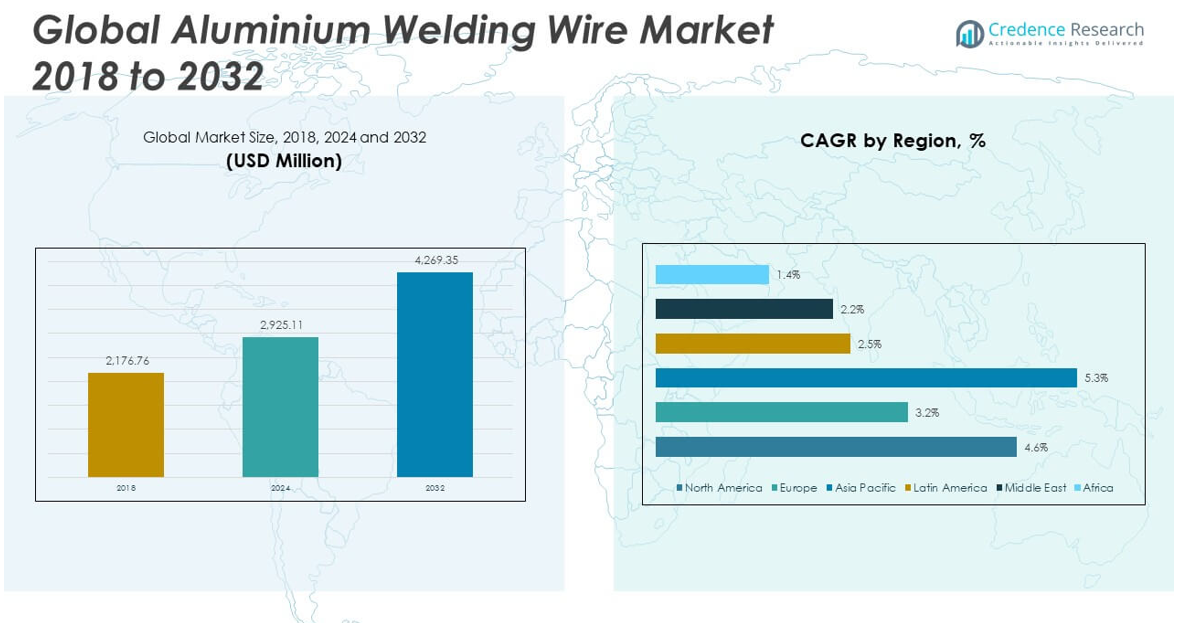
The Global Aluminium Welding Wire Market size was valued at USD 2,176.76 million in 2018 to USD 2,925.11 million in 2024 and is anticipated to reach USD 4,269.35 million by 2032, at a CAGR of 4.51% during the forecast period.
The global aluminium welding wire market is experiencing strong growth due to the increasing demand for lightweight, corrosion-resistant materials in key sectors such as automotive, aerospace, shipbuilding, and construction. As manufacturers aim to reduce overall vehicle weight to comply with stringent fuel efficiency and emission regulations, aluminium welding wires have emerged as a preferred solution for joining lightweight components without compromising strength. Additionally, the growing adoption of electric vehicles (EVs) has fueled the need for advanced welding materials compatible with aluminium structures used in battery enclosures and body frames. Technological advancements in welding processes, including MIG and TIG automation, have further enhanced welding efficiency and precision, encouraging industrial adoption. Moreover, the trend toward sustainable manufacturing and cleaner production techniques supports the use of aluminium wires due to their low fume emissions and recyclability.
Asia-Pacific dominates the global aluminium welding wire market, driven by robust industrial activity and rapid urbanization across China, India, Japan, and Southeast Asia. China holds a significant share due to its strong presence in automotive manufacturing, construction, and shipbuilding, where aluminium welding is extensively used. India is witnessing rising demand due to infrastructure development, smart city initiatives, and increasing vehicle production. Additionally, the availability of low-cost labor and raw materials enhances regional competitiveness. North America follows as a key market, supported by advanced automation in the aerospace and automotive industries, along with strict emission norms promoting aluminium usage. Europe maintains steady demand, particularly in Germany, France, and the UK, where sustainability goals and high-end manufacturing standards drive adoption. Meanwhile, Latin America, the Middle East, and Africa show moderate growth tied to construction and energy infrastructure projects, although lower automation levels and limited technological penetration slightly restrain market expansion in these regions.
Market Insights:
- The Global Aluminium Welding Wire Market was valued at USD 2,925.11 million in 2024 and is expected to reach USD 4,269.35 million by 2032, growing at a CAGR of 4.51%.
- Strong demand from automotive, aerospace, construction, and shipbuilding sectors continues to drive growth, driven by the shift toward lightweight and corrosion-resistant materials.
- Rapid advancements in MIG and TIG automation are improving weld quality, efficiency, and consistency across high-volume industrial applications.
- Rising adoption of electric vehicles and renewable energy systems is creating new opportunities for aluminium welding wire in battery enclosures, wind turbines, and solar structures.
- Market growth is restrained by volatile raw material prices and ongoing supply chain disruptions, which affect cost planning and inventory stability.
- A shortage of skilled welders and technical expertise limits adoption in precision welding applications, especially where automation and quality standards are high.
- Asia-Pacific dominates the global market with 47% share, led by China and India, followed by North America and Europe, while Latin America, the Middle East, and Africa show moderate growth.
Market Drivers:
Rising Demand for Lightweight and Corrosion-Resistant Materials in Key Industries
The Global Aluminium Welding Wire Market is expanding due to increasing use of lightweight and corrosion-resistant metals across automotive, aerospace, marine, and construction industries. Automakers rely on aluminium welding wires to manufacture lighter vehicles and meet fuel efficiency targets. In aerospace, aluminium’s high strength-to-weight ratio enables efficient structural designs without compromising safety standards. Shipbuilders also prefer aluminium for hulls and superstructures due to its corrosion resistance and durability in marine environments. Construction companies are integrating aluminium components for facades, window frames, and infrastructure elements. These applications require reliable welding materials that support structural integrity and extended lifespan.
Advancement in Welding Technologies Enhancing Process Efficiency
Technological progress is driving growth in the aluminium welding wire market by improving precision, speed, and weld quality. MIG and TIG welding techniques, widely used in industrial production, now feature advanced automation and digital control systems. These systems enable consistent welds and reduce errors during high-volume operations. Robotic welding lines have become standard in automotive and heavy equipment manufacturing, boosting efficiency and reducing labor dependence. With process innovation, manufacturers are using customised wire alloys that offer higher deposition rates and stronger bonds. It supports industries seeking productivity improvements and cost optimization.
- ESAB’s AlcoTec® brand, for example, has introduced a patented surface treatment for its 4043 and 4047 aluminium MIG welding wires, resulting in smoother feeding performance and fewer tangles directly addressing common industry challenges in robotic and long-distance feeding applications
Strict Emission Regulations and Environmental Mandates Fueling Aluminium Adoption
Government regulations targeting emission reduction and material recyclability continue to accelerate demand for aluminium welding wires. Policy frameworks in North America, Europe, and parts of Asia promote the replacement of heavier metals with aluminium to improve energy efficiency. Welded aluminium components produce less particulate matter and fume emissions than other alloys, making them compliant with stricter workplace safety standards. Sustainability targets in transportation and infrastructure projects support broader integration of aluminium-based assemblies. OEMs across multiple sectors are switching to low-carbon materials, prompting increased reliance on aluminium welding consumables. It positions the market as an enabler of cleaner and more sustainable production practices.
Growing Demand in Electric Vehicles and Renewable Energy Equipment
The rise of electric vehicles (EVs) and renewable energy installations is creating new avenues for aluminium welding wire usage. EV battery enclosures, charging stations, and lightweight frames often require high-strength aluminium welds to ensure thermal stability and performance. Wind turbine components, solar panel mounts, and power storage units also involve extensive aluminium fabrication. Manufacturers in these sectors need welding materials that offer reliability under thermal cycling and vibration. It pushes the demand for specialised wires designed for advanced energy applications. The transition toward electrified transport and green infrastructure supports consistent long-term demand for aluminium welding wire solutions.
- For example, Kobelco Welding of America Inc. provides a strong example in the EV and renewable sector with its “TRUSTARC™ ALW-5356” aluminium welding wire.
Market Trends:
Integration of Smart Welding Systems and AI-Based Monitoring Solutions
The Global Aluminium Welding Wire Market is witnessing a shift toward smart manufacturing practices that incorporate AI-driven welding technologies. Smart systems enable real-time monitoring of temperature, arc stability, and wire feed rates, ensuring consistent weld quality. AI-powered platforms predict defects, optimize welding parameters, and adjust wire consumption during operations. Manufacturers are investing in intelligent solutions to reduce waste and minimize downtime. These innovations support the production of high-precision components across aerospace, defense, and electronics sectors. It reflects a broader trend toward Industry 4.0 and data-driven process control in welding applications.
- For example, Neuron Soundware’s AI-powered wire drawing monitoring system, piloted at ESAB CZ, achieved an 85% success rate in preventing wire damage, saving 25 km of wire monthlyand delivering ROI within a year. The system uses acoustic analysis to halt production before die failure, reducing downtime and material waste while supporting predictive maintenance and sustainability goals.
Rising Preference for Spool-less and Drum Packaging for Bulk Handling
Changing packaging preferences are shaping operational strategies in the Global Aluminium Welding Wire Market. Large-scale manufacturers are increasingly shifting toward drum and spool-less packaging systems to improve wire handling and reduce downtime. These formats allow continuous welding over extended periods without frequent wire replacement. It reduces labor intervention and minimizes production interruptions in automated assembly lines. Wire manufacturers are responding by offering packaging compatible with robotic welding arms and high-speed feeders. Adoption of such solutions reflects the growing focus on operational efficiency and uninterrupted workflow.
- Voestalpine Böhler Welding supplies aluminum welding wires in drums ranging from 100 kg to 500 kg, significantly reducing downtime associated with spool changes. For example, using a 500 kg drum eliminates 26 spool changes (at 10 minutes each) compared to 18 kg spools, resulting in 260 additional minutes of net arc time and higher production output.
Growing Demand for Custom Alloy Grades and Application-Specific Wire Formulations
Customization in aluminium wire composition is emerging as a key trend in advanced fabrication markets. End users demand alloy grades tailored for specific applications such as heat exchangers, pressure vessels, and dissimilar metal welding. The Global Aluminium Welding Wire Market is responding with product variants that offer improved tensile strength, ductility, and thermal resistance. It allows OEMs to achieve better performance while meeting regulatory and design requirements. Manufacturers are developing proprietary alloy blends to serve niche applications in EVs, aviation, and oil and gas. This trend underlines the growing importance of application-specific engineering in welding solutions.
Expansion of E-Commerce Channels and Global Distribution Networks
The distribution landscape in the Global Aluminium Welding Wire Market is evolving with the rapid expansion of e-commerce platforms and digital supply chains. Industrial buyers now expect direct access to a wide range of wire types, specifications, and technical documentation online. Distributors and manufacturers are launching digital portals to support bulk orders, price comparisons, and product configuration. It accelerates procurement and supports just-in-time inventory models for OEMs and contract manufacturers. Global trade platforms enable suppliers to reach emerging markets in Southeast Asia, Africa, and Latin America. This digital shift strengthens cross-border access and enhances customer responsiveness across regions.
Market Challenges Analysis:
Fluctuating Raw Material Prices and Supply Chain Vulnerabilities
Volatility in raw material prices presents a significant challenge for the Global Aluminium Welding Wire Market. Aluminium prices often fluctuate due to global demand shifts, energy costs, trade restrictions, and geopolitical tensions. These fluctuations impact production costs and force manufacturers to adjust pricing strategies frequently. It creates uncertainty in long-term supply contracts and affects profit margins, especially for small and medium-sized enterprises. Supply chain disruptions, such as shipping delays and shortages of alloying elements like magnesium and silicon, further complicate inventory planning. The market faces pressure to maintain stable supply while navigating unpredictable sourcing conditions.
Lack of Skilled Workforce and Technical Barriers in Advanced Welding Applications
A shortage of skilled welding professionals limits the adoption of aluminium welding in precision manufacturing environments. Aluminium welding requires specialized training due to its thermal conductivity, oxide layer, and high sensitivity to contamination. The Global Aluminium Welding Wire Market faces constraints when industries struggle to find qualified technicians capable of executing high-quality welds under strict standards. It becomes more complex with the rise of automated systems that demand hybrid skills in both welding and machine operation. Technical barriers in handling thin-gauge materials and complex joint geometries also reduce application flexibility. These human and process challenges slow the pace of adoption in sectors requiring high-performance welded assemblies.
Market Opportunities:
Expansion of Renewable Energy and Sustainable Infrastructure Projects
The transition toward renewable energy and sustainable infrastructure offers strong growth potential for the Global Aluminium Welding Wire Market. Governments and private investors are increasing expenditure on wind farms, solar plants, and electric grids, all of which require lightweight and corrosion-resistant aluminium components. Welding wires play a vital role in assembling turbine housings, panel frames, battery casings, and structural supports. It creates steady demand for reliable, high-strength wire products that perform well under environmental stress. The shift toward clean technologies is opening new avenues for product development and supplier partnerships. Market players can capitalize on this trend by aligning offerings with green energy requirements.
Rising Demand from Emerging Economies and SME Manufacturers
Emerging economies in Asia, Africa, and Latin America are experiencing a surge in industrial activity, infrastructure growth, and urbanization. The Global Aluminium Welding Wire Market can benefit from this shift by serving small and mid-sized manufacturers that seek affordable, durable, and easy-to-integrate welding solutions. These markets present opportunities for tailored product portfolios, distributor expansion, and localized technical support. It allows global suppliers to diversify risk and tap into fast-growing segments outside mature economies. Expanding education and vocational training initiatives also help raise welding standards and create long-term demand. Strategic engagement with regional stakeholders enhances market penetration in these high-potential zones.
Market Segmentation Analysis:
The Global Aluminium Welding Wire Market is segmented by product, technology, application, and end-use industry.
By product, solid wires hold the largest share due to their widespread use in automated welding systems and industrial fabrication. Flux-cored wires are gaining traction in outdoor and structural applications where deep penetration and high deposition rates are critical.
- For example, ESAB’s OK Autrod 5356is a solid aluminum welding wire widely used in automated robotic welding cells for automotive and industrial fabrication. According to ESAB, this wire is available in diameters from 8 mm to 2.4 mm and is supplied on 300 mm (7 kg) or 500 mm (20 kg) spools and 300 kg drums for high-volume, automated operations.
By technology, Al-Si alloy welding wires lead the segment due to their strong performance in automotive and aerospace components requiring crack resistance and fluid weld pools. Aluminum magnesium alloy welding wires are widely used in marine and pressure vessel applications for their superior corrosion resistance. Pure aluminum welding wires serve niche markets focused on non-critical or decorative applications.
- For example, Fronius AlMg5 (ER5356)welding wire is recommended for marine vessel and pressure vessel applications due to its 5% magnesium content, which provides superior corrosion resistance in saltwater environments. Fronius states that this wire is used in the construction of aluminum hulls, tanks, and offshore structures, and is available in spools up to 18 kg or drums up to 300 kg for automated production.
By application, fabrication dominates the segment owing to consistent demand across machinery, construction, and transport manufacturing. Cladding supports protective surface layers in offshore and industrial environments, while repair and maintenance drives steady aftermarket demand.
By end-use industry, automotive and transportation hold a significant share, driven by lightweight vehicle manufacturing trends. Aerospace and construction segments also contribute heavily to market volume. Manufacturing and others collectively support demand from general engineering, consumer goods, and electrical sectors.
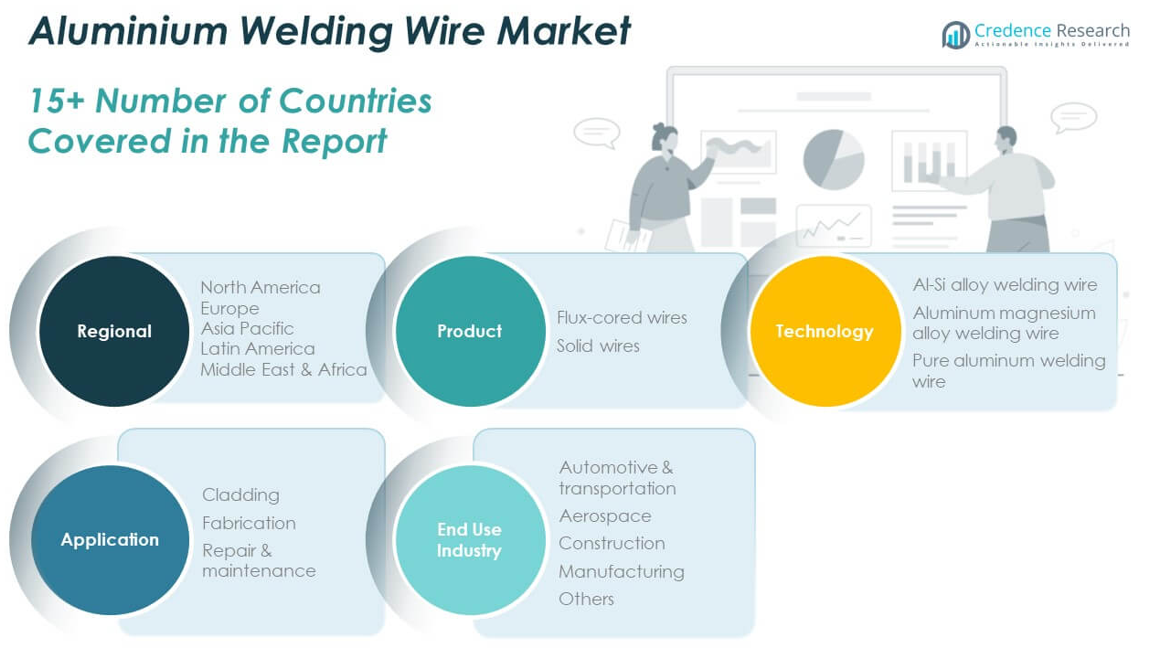
Segments
By Product Segments
- Flux-cored Wires
- Solid Wires
By Technology Segments
- Al-Si Alloy Welding Wire
- Aluminum Magnesium Alloy Welding Wire
- Pure Aluminum Welding Wire
By Application Segments
- Cladding
- Fabrication
- Repair & Maintenance
By End-Use Industry Segments
- Automotive & Transportation
- Aerospace
- Construction
- Manufacturing
- Others
By Regional Segments
- North America
- U.S.
- Canada
- Mexico
- Europe
- Germany
- France
- U.K.
- Italy
- Spain
- Rest of Europe
- Asia Pacific
- China
- Japan
- India
- South Korea
- South-east Asia
- Rest of Asia Pacific
- Latin America
- Brazil
- Argentina
- Rest of Latin America
- Middle East & Africa
- GCC Countries
- South Africa
- Rest of the Middle East and Africa
Regional Analysis:
The North America Aluminium Welding Wire Market size was valued at USD 710.37 million in 2018 to USD 941.32 million in 2024 and is anticipated to reach USD 1,379.02 million by 2032, at a CAGR of 4.6% during the forecast period. North America holds 22% of the global aluminium welding wire market share, driven by strong demand from the automotive, aerospace, and energy sectors. The region emphasizes advanced welding technologies and process automation to meet stringent quality and emission standards. The United States leads the region, with established players offering customized alloy wires for precision fabrication. It benefits from significant investments in electric vehicle infrastructure and renewable energy projects, which require lightweight and corrosion-resistant materials. Canada contributes through its growing manufacturing base and emphasis on sustainable industrial practices. The region continues to innovate in robotic welding and digital process controls to enhance competitiveness.
The Europe Aluminium Welding Wire Market size was valued at USD 383.85 million in 2018 to USD 485.90 million in 2024 and is anticipated to reach USD 640.88 million by 2032, at a CAGR of 3.2% during the forecast period. Europe accounts for 11% of the global aluminium welding wire market share, supported by strict environmental regulations and high manufacturing standards. Germany, France, and Italy lead in automotive and industrial applications, where aluminium welding plays a critical role in lightweight production. The region invests heavily in sustainable infrastructure and clean energy, creating steady demand for aluminium components. It focuses on research and development of wire alloys compatible with automated welding systems. The adoption of MIG and TIG processes across automotive and aerospace sectors remains strong. Europe also supports circular economy practices, which reinforce demand for recyclable aluminium products.
The Asia Pacific Aluminium Welding Wire Market size was valued at USD 908.69 million in 2018 to USD 1,268.28 million in 2024 and is anticipated to reach USD 1,969.13 million by 2032, at a CAGR of 5.3% during the forecast period. Asia Pacific dominates the global aluminium welding wire market with a 47% market share, led by China, India, Japan, and South Korea. The region’s rapid industrialization, urban development, and growing automotive output drive large-scale demand for aluminium welding consumables. China alone contributes a significant portion through its expansive shipbuilding, electronics, and EV sectors. It benefits from cost-effective production and strong government support for infrastructure upgrades. India’s construction and manufacturing reforms are increasing aluminium consumption in welded structures. The region continues to scale robotic welding and customized alloy applications across mid-sized enterprises and multinational firms.
The Latin America Aluminium Welding Wire Market size was valued at USD 81.52 million in 2018 to USD 107.83 million in 2024 and is anticipated to reach USD 134.50 million by 2032, at a CAGR of 2.5% during the forecast period. Latin America holds 4% of the global aluminium welding wire market share, supported by moderate industrial growth and rising demand for durable materials in construction and energy. Brazil and Mexico lead the region, driven by automotive assembly, infrastructure development, and light manufacturing. It shows increasing interest in aluminium components for corrosion-resistant applications in coastal and humid areas. The region’s shift toward renewable energy is also encouraging aluminium use in solar and wind equipment. Local manufacturers seek affordable wire solutions that balance performance with budget constraints. Regional governments continue to invest in skills development and industrial modernization.
The Middle East Aluminium Welding Wire Market size was valued at USD 59.75 million in 2018 to USD 73.26 million in 2024 and is anticipated to reach USD 89.84 million by 2032, at a CAGR of 2.2% during the forecast period. The Middle East contributes 3% to the global aluminium welding wire market share, with growth driven by oil and gas infrastructure, transportation, and construction projects. The UAE and Saudi Arabia remain focal points due to their ongoing industrial diversification and urban development plans. Aluminium welding wires are used in pipeline systems, power stations, and modular construction units. It benefits from growing interest in sustainable building materials and local manufacturing expansion. Demand is rising for high-performance wires compatible with desert climate conditions. Market players focus on reliability, localized supply chains, and corrosion-resistant alloy grades.
The Africa Aluminium Welding Wire Market size was valued at USD 32.59 million in 2018 to USD 48.53 million in 2024 and is anticipated to reach USD 55.98 million by 2032, at a CAGR of 1.4% during the forecast period. Africa accounts for 2% of the global aluminium welding wire market share, with limited but emerging demand across South Africa, Nigeria, Egypt, and Kenya. The region is gradually embracing aluminium for infrastructure projects, construction, and agricultural equipment. It faces challenges due to limited automation, low awareness, and shortage of skilled welders. Governments and international bodies are promoting industrial development, which supports gradual adoption of modern welding technologies. Aluminium welding wire usage is increasing in solar energy projects and export-focused manufacturing hubs. Market expansion depends on education, local production capabilities, and improved access to quality wire materials.
Key Player Analysis:
- Air Liquide Welding
- Drahtwerk ELISENTAL W. Erdmann GmbH & Co.
- ESAB Welding & Cutting Products
- EWM Hightec Welding GmbH
- Hilarius Haarlem Holland B.V.
- HI-TECH WIRE INDUSTRIES
- Metalli Trafilati Laminati Srl
- Novametal SA
- Safra
- The Lincoln Electric Company
Competitive Analysis:
The Global Aluminium Welding Wire Market features a moderately consolidated competitive landscape with the presence of both multinational corporations and regional suppliers. Key players include ESAB, The Lincoln Electric Company, ITW Welding, Novametal, and GARG INOX, among others. These companies compete on product quality, alloy innovation, pricing strategies, and distribution networks. It benefits from ongoing research and development efforts aimed at improving wire performance, deposition efficiency, and compatibility with automated systems. Market leaders focus on strategic partnerships, capacity expansion, and customized offerings to meet evolving industrial needs. Regional manufacturers are entering niche segments with cost-effective and application-specific solutions, intensifying competition in emerging economies. The emphasis on sustainable manufacturing, reduced emissions, and lightweight materials pushes companies to invest in clean technologies and advanced packaging formats. As demand grows across automotive, aerospace, and renewable sectors, competitive positioning will depend on technological agility and global supply chain reach.
Recent Developments:
- In February 2025, Air Liquide announced a major investment to build, own, and operate a new large-scale Air Separation Unit (ASU) on Naoshima Island, Japan. This facility, set to be operational in 2027, will supply oxygen, nitrogen, argon, and neon-gases critical for welding and semiconductor industries.
- In June 2025, EWM is being acquired by ESAB Corporation in a deal announced with the transaction expected to close in the second half of the year. The acquisition will allow EWM to leverage ESAB’s global reach and operational excellence, while ESAB will fill product gaps in heavy industrial equipment and advanced automation
Market Concentration & Characteristics:
The Global Aluminium Welding Wire Market exhibits moderate market concentration, with a mix of global leaders and regional manufacturers competing across diverse application areas. It is characterized by steady demand from end-use sectors such as automotive, aerospace, construction, and energy. The market emphasizes product consistency, alloy customization, and compatibility with advanced welding techniques. Technological adoption, particularly in automated and robotic welding, shapes product development and procurement strategies. Pricing remains sensitive to fluctuations in raw material costs and regional supply chain dynamics. Companies differentiate through innovation, technical support, and tailored packaging formats that suit high-volume industrial operations. Demand for high-performance wires and sustainable solutions continues to influence market structure and vendor strategies.
Report Coverage:
The research report offers an in-depth analysis based on product, technology, application, and end-use industry. It details leading market players, providing an overview of their business, product offerings, investments, revenue streams, and key applications. Additionally, the report includes insights into the competitive environment, SWOT analysis, current market trends, as well as the primary drivers and constraints. Furthermore, it discusses various factors that have driven market expansion in recent years. The report also explores market dynamics, regulatory scenarios, and technological advancements that are shaping the industry. It assesses the impact of external factors and global economic changes on market growth. Lastly, it provides strategic recommendations for new entrants and established companies to navigate the complexities of the market.
Future Outlook:
- Increasing demand for aluminium components in EVs will boost wire consumption in battery enclosures and lightweight frames.
- Expansion of renewable energy projects will drive usage in solar mounts, wind turbines, and power storage units.
- Technological upgrades in MIG and TIG systems will raise demand for wires compatible with automated welding.
- Growth in infrastructure investments across Asia and Africa will support market expansion in construction applications.
- Custom alloy formulations will gain traction in aerospace and defense for precision welding tasks.
- Rising adoption of e-commerce platforms will streamline wire distribution and widen global reach.
- Sustainability initiatives will encourage development of low-fume and recyclable aluminium wire products.
- Skilled workforce development programs will support higher adoption in small and mid-sized enterprises.
- Strategic partnerships between OEMs and wire manufacturers will strengthen supply chain resilience.
- Product innovation in drumless and robotic-friendly packaging formats will improve operational efficiency.

Request a Free Sample
Fill in your details and we'll send you a free sample report.
- Sample data tables & charts
- Research methodology
Market Dynamics
Lightweight and Corrosion-Resistant Material Demand
Automotive, aerospace, shipbuilding, and construction industries are increasingly using aluminium welding wire to produce lightweight, durable, and corrosion-resistant components, helping manufacturers meet fuel efficiency and emission standards.
Technological Advancements in Welding Processes
Innovations in MIG and TIG welding automation, digital controls, and robotic systems are improving weld quality, efficiency, and consistency, making aluminium welding wire more attractive for high-volume industrial applications.
Growth of Electric Vehicles and Renewable Energy
The rising adoption of electric vehicles and expansion of renewable energy infrastructure are driving demand for aluminium welding wire in battery enclosures, lightweight frames, wind turbines, and solar panel mounts, where reliable and high-strength welds are critical.
Stringent Emission and Sustainability Regulations
Government mandates on emissions and recyclability are accelerating the shift from heavier metals to aluminium, as welded aluminium components generate less fume emissions and support cleaner, more sustainable manufacturing practices.
Expansion in Emerging Markets and Infrastructure Projects
Rapid industrialization, urbanization, and infrastructure investments in Asia-Pacific, Africa, and Latin America are boosting demand for aluminium welding wire, especially as these regions modernize construction, transportation, and energy sectors.
Need a Custom Version of This Report?
Tailor the scope, geography, or segments to your exact requirements.
- Custom geography or segment scope
- Direct access to our analyst team
Frequently Asked Questions
What is the current size of the Global Aluminium Welding Wire Market?
What are the key segments within the Global Aluminium Welding Wire Market?
What are some challenges faced by the Global Aluminium Welding Wire Market?
Who are the major players in the Global Aluminium Welding Wire Market?
Table of Content
Chapter 1 Market Segmentation
- 1.1 Segmentation Framework
- 1.1.1 Product and Service Classification
- 1.1.2 Application and End-Use Classification
- 1.1.3 Technology and Solution Classification
- 1.1.4 Customer and Distribution Channel Classification
- 1.1.5 Geographic Segmentation
- 1.1.6 Market Segment Definitions and Boundaries
- 1.2 By Product
- 1.2.1 Flux-cored Wires
- 1.2.2 Solid Wires
- 1.3 By Technology
- 1.3.1 Al-Si Alloy Welding Wire
- 1.3.2 Aluminum Magnesium Alloy Welding Wire
- 1.3.3 Pure Aluminum Welding Wire
- 1.4 By Application
- 1.4.1 Cladding
- 1.4.2 Fabrication
- 1.4.3 Repair & Maintenance
- 1.5 By End-Use Industry
- 1.5.1 Automotive & Transportation
- 1.5.2 Aerospace
- 1.5.3 Construction
- 1.5.4 Manufacturing
- 1.5.5 Others
Chapter 2 Introduction
- 2.1 Report Objectives and Scope
- 2.2 Product Definition and Industry Terminology
- 2.3 Market Inclusions and Exclusions
- 2.4 Research Process
- 2.4.1 Primary Research and Expert Interviews
- 2.4.2 Secondary Research and Source Review
- 2.4.3 Top-Down and Bottom-Up Estimation
- 2.4.4 Data Triangulation and Verification
- 2.5 Market Size Measurement Basis
- 2.5.1 2024: USD 2,925.11 million → 2032: USD 4,269.35 million
- 2.6 Historical and Forecast Reference Periods
- 2.6.1 Base Year: 2024
- 2.6.2 Forecast Period: 2024-2032
- 2.7 Research Assumptions and Limitations
Chapter 3 Executive Summary
- 3.1 Market Snapshot and Key Findings
- 3.2 Base-Year Market Size, 2024
- 3.3 Forecast Market Size, 2032
- 3.4 Revenue and Volume Growth Outlook
- 3.5 Key Demand and Supply Indicators
- 3.6 Leading Market Segments
- 3.7 Fastest-Growing Market Opportunities
- 3.8 Regional Performance Highlights
- 3.9 Technology and Industry Transformation
- 3.10 Competitive Landscape Summary
- 3.11 Analyst View and Strategic Implications
Chapter 4 Global Aluminium Welding Wire Market Trends and Developments
- 4.1 Historical Industry Development
- 4.2 Recent Market Trends and Developments
- 4.3 Demand and Customer Behavior Trends
- 4.4 Technology and Product Innovation
- 4.5 Artificial Intelligence, Automation and Digitalization
- 4.6 Local Manufacturing and Supply Chain Realignment
- 4.7 Industry Partnerships, Mergers and Acquisitions
- 4.8 Sustainability and Circular Economy Developments
- 4.9 Government and Private Sector Investment Trends
- 4.10 Emerging Business Models and Commercialization
- 4.11 Industry Developments and Announcements
Chapter 5 Global Aluminium Welding Wire Market Production, Supply and Demand Analysis
- 5.1 Demand Trend and Consumption Analysis
- 5.2 Demand Forecast, 2024-2032
- 5.3 Production and Output Trend
- 5.4 Production and Output Forecast, 2024-2032
- 5.5 Installed Capacity and Capacity Utilization
- 5.6 Company-Wise Production Plants and Statistics
- 5.6.1 Installed Production Capacity
- 5.6.2 Actual Production
- 5.6.3 Planned Capacity and Expansion Targets
- 5.7 Supply Chain Structure and Procurement Trends
- 5.8 Supply-Demand Gap and Bottlenecks
- 5.9 Import Dependence and Sourcing Structure
- 5.10 Contract Manufacturing and Outsourcing
- 5.11 Regional Supply and Demand Concentration
Chapter 6 Global Aluminium Welding Wire Market Pricing Analysis
- 6.1 Pricing Structure and Measurement
- 6.2 Historical Pricing Trends
- 6.3 Pricing Outlook, 2024-2032
- 6.4 Average Selling Price and Unit Economics
- 6.5 Pricing by Product and Market Segment
- 6.6 Geographic Pricing Differences
- 6.7 Key Input, Energy, Labor and Logistics Costs
- 6.8 Contract Pricing and Purchasing Models
- 6.9 Pricing Sensitivity and Competitive Positioning
- 6.10 Price, Margin and Profitability Implications
Chapter 7 Global Aluminium Welding Wire Market Dynamics
- 7.1 Market Growth Drivers
- 7.1.1 Demand-Side Drivers
- 7.1.2 Technology and Innovation Drivers
- 7.1.3 Infrastructure and Investment Drivers
- 7.1.4 Regulatory and Policy Drivers
- 7.2 Market Restraints
- 7.2.1 Cost and Affordability Constraints
- 7.2.2 Technology and Adoption Barriers
- 7.2.3 Supply Chain and Operational Constraints
- 7.3 Market Challenges
- 7.3.1 Competitive Pressure and Margin Erosion
- 7.3.2 Skills, Infrastructure and Implementation Gaps
- 7.4 Emerging Market Opportunities
- 7.5 Market Dynamics Impact and Time-Horizon Assessment
Chapter 8 Global Aluminium Welding Wire Value Chain Analysis
- 8.1 Industry Value Chain Overview
- 8.2 Upstream Suppliers and Critical Inputs
- 8.3 Technology and Component Providers
- 8.4 Manufacturing or Service Delivery
- 8.5 Distribution, Channel Partners and Integrators
- 8.6 Downstream Applications and End Users
- 8.7 Value Addition and Profit Pools
- 8.8 Vertical Integration and Outsourcing
- 8.9 Supplier Concentration and Risk
- 8.10 Supply Chain Localization and Resilience
Chapter 9 Global Aluminium Welding Wire Market Regulations and Policies
- 9.1 Relevant Laws, Standards and Compliance Frameworks
- 9.2 Product, Service, Safety and Quality Requirements
- 9.3 Government Policies, Incentives and Subsidies
- 9.4 Imports, Exports and Trade Barriers
- 9.5 Public Procurement and Local Content Requirements
- 9.6 Environmental and Sustainability Compliance
- 9.7 Upcoming Policy Changes and Market Implications
Chapter 10 Global Aluminium Welding Wire Market Hotspots and Opportunities
- 10.1 Market Opportunity Mapping and Growth Hotspots
- 10.2 High-Growth Applications and Customer Groups
- 10.3 Underserved Markets and White-Space Opportunities
- 10.4 Emerging Technology and Product Opportunities
- 10.5 New Capacity and Investment Hotspots
- 10.6 Market Entry and Expansion Opportunities
- 10.7 Distribution and Partnership Opportunities
- 10.8 Near-Term and Long-Term Commercial Potential
- 10.9 Opportunity Attractiveness and Execution Risks
Chapter 11 Global Aluminium Welding Wire Market Outlook, 2024-2032
- 11.1 Market Size and Analysis
- 11.1.1 Revenue (Market Measurement: 2024: USD 2,925.11 million → 2032: USD 4,269.35 million)
- 11.1.2 Market Volume and Quantity Sold
- 11.1.3 Historical Market Size
- 11.1.4 Base-Year Market Size, 2024
- 11.2 Market Forecast, 2024-2032
- 11.2.1 Revenue Forecast to 2032
- 11.2.2 Volume Forecast to 2032
- 11.2.3 CAGR and Year-on-Year Growth
- 11.2.4 Incremental Revenue Opportunity
- 11.3 Forecast Assumptions and Scenario Analysis
- 11.3.1 Base-Case Forecast
- 11.3.2 Optimistic and Conservative Scenarios
- 11.3.3 Technology, Pricing and Policy Sensitivities
- 11.4 Market Attractiveness and Growth Outlook
Chapter 12 Global Aluminium Welding Wire Market Segmentation and Outlook
- 12.1 Segmentation Summary and Market Shares, 2024
- 12.2 Largest and Fastest-Growing Segments
- 12.3 By Product - Market Size and Forecast, 2024-2032
- 12.3.1 Segment Definition and Scope
- 12.3.2 Historical Market Size
- 12.3.3 Revenue Forecast, 2024-2032
- 12.3.4 Volume Forecast, 2024-2032
- 12.3.5 Base-Year Market Share, 2024
- 12.3.6 Segment CAGR and Growth Drivers
- 12.3.7 Subsegment Market Size and Forecast
- 12.3.7.1 Flux-cored Wires
- 12.3.7.2 Solid Wires
- 12.3.8 Subsegment Pricing and Adoption Trends
- 12.3.9 Leading Suppliers and Competition
- 12.3.10 Regional Demand and Opportunities
- 12.4 By Technology - Market Size and Forecast, 2024-2032
- 12.4.1 Segment Definition and Scope
- 12.4.2 Historical Market Size
- 12.4.3 Revenue Forecast, 2024-2032
- 12.4.4 Volume Forecast, 2024-2032
- 12.4.5 Base-Year Market Share, 2024
- 12.4.6 Segment CAGR and Growth Drivers
- 12.4.7 Subsegment Market Size and Forecast
- 12.4.7.1 Al-Si Alloy Welding Wire
- 12.4.7.2 Aluminum Magnesium Alloy Welding Wire
- 12.4.7.3 Pure Aluminum Welding Wire
- 12.4.8 Subsegment Pricing and Adoption Trends
- 12.4.9 Leading Suppliers and Competition
- 12.4.10 Regional Demand and Opportunities
- 12.5 By Application - Market Size and Forecast, 2024-2032
- 12.5.1 Segment Definition and Scope
- 12.5.2 Historical Market Size
- 12.5.3 Revenue Forecast, 2024-2032
- 12.5.4 Volume Forecast, 2024-2032
- 12.5.5 Base-Year Market Share, 2024
- 12.5.6 Segment CAGR and Growth Drivers
- 12.5.7 Subsegment Market Size and Forecast
- 12.5.7.1 Cladding
- 12.5.7.2 Fabrication
- 12.5.7.3 Repair & Maintenance
- 12.5.8 Subsegment Pricing and Adoption Trends
- 12.5.9 Leading Suppliers and Competition
- 12.5.10 Regional Demand and Opportunities
- 12.6 By End-Use Industry - Market Size and Forecast, 2024-2032
- 12.6.1 Segment Definition and Scope
- 12.6.2 Historical Market Size
- 12.6.3 Revenue Forecast, 2024-2032
- 12.6.4 Volume Forecast, 2024-2032
- 12.6.5 Base-Year Market Share, 2024
- 12.6.6 Segment CAGR and Growth Drivers
- 12.6.7 Subsegment Market Size and Forecast
- 12.6.7.1 Automotive & Transportation
- 12.6.7.2 Aerospace
- 12.6.7.3 Construction
- 12.6.7.4 Manufacturing
- 12.6.7.5 Others
- 12.6.8 Subsegment Pricing and Adoption Trends
- 12.6.9 Leading Suppliers and Competition
- 12.6.10 Regional Demand and Opportunities
- 12.7 Segment Growth Comparison
- 12.8 Segment Attractiveness and Priority Matrix
Chapter 13 Global Aluminium Welding Wire End-Use and Application Market Outlook
- 13.1 End-Use Industry and Customer Demand Structure
- 13.2 Leading Applications and Customer Groups
- 13.3 End-Use Market Size, Share and Forecast
- 13.4 Major End-Use Industry Deep Dives
- 13.4.1 Customer Requirements and Use Cases
- 13.4.2 Demand and Replacement Cycles
- 13.4.3 Technical and Regulatory Considerations
- 13.4.4 Purchasing and Procurement Models
- 13.4.5 Leading Vendors and Distribution Channels
- 13.4.6 Forecast and Commercial Opportunities
- 13.5 Emerging Applications and Cross-Segment Demand
- 13.6 End-Use Industry Investment Priorities
Chapter 14 Global Aluminium Welding Wire Geographic Market Outlook, 2024-2032
- 14.1 Regional Market Size and Share, 2024
- 14.2 Regional Market Forecast, 2024-2032
- 14.3 Regional Pricing, Production and Demand Differences
- 14.4 North America
- 14.4.1 United States
- 14.4.2 Canada
- 14.4.3 Mexico
- 14.5 Europe
- 14.5.1 Germany
- 14.5.2 France
- 14.5.3 Italy
- 14.5.4 United Kingdom
- 14.5.5 Spain
- 14.5.6 Poland
- 14.5.7 Russia
- 14.5.8 Netherlands
- 14.5.9 Belgium
- 14.5.10 Sweden
- 14.5.11 Denmark
- 14.5.12 Norway
- 14.5.13 Rest of Europe
- 14.6 Asia Pacific
- 14.6.1 China
- 14.6.2 India
- 14.6.3 Japan
- 14.6.4 South Korea
- 14.6.5 Thailand
- 14.6.6 Indonesia
- 14.6.7 Vietnam
- 14.6.8 Malaysia
- 14.6.9 Australia
- 14.6.10 Rest of Asia Pacific
- 14.7 Latin America
- 14.7.1 Brazil
- 14.7.2 Argentina
- 14.7.3 Colombia
- 14.7.4 Chile
- 14.7.5 Rest of Latin America
- 14.8 Middle East
- 14.8.1 Saudi Arabia
- 14.8.2 United Arab Emirates
- 14.8.3 Turkey
- 14.8.4 Israel
- 14.8.5 Iran
- 14.8.6 Rest of the Middle East
- 14.9 Africa
- 14.9.1 South Africa
- 14.9.2 Egypt
- 14.9.3 Nigeria
- 14.9.4 Morocco
- 14.9.5 Rest of Africa
- 14.10 Regional Investment, Policy and Supply Chain Differences
- 14.11 Regional Competitive Landscape
- 14.12 Geographic Growth Hotspots
Chapter 15 Global Aluminium Welding Wire Technology, Innovation and Sustainability Outlook
- 15.1 Technology Landscape and Maturity
- 15.2 Product, Process and Service Innovation
- 15.3 AI, Automation and Digital Tools in the Industry
- 15.4 Technology Adoption and Performance Benchmarking
- 15.5 Innovation Pipeline and R&D Investment
- 15.6 Patent and Intellectual Property Trends
- 15.7 Energy Efficiency and Resource Management
- 15.8 Sustainability, Recycling and Circularity
- 15.9 Technology Roadmap, 2024-2032
- 15.10 Risks of Obsolescence and Technology Substitution
Chapter 16 Global Aluminium Welding Wire Market Key Strategic Imperatives
- 16.1 Growth and Market Entry Priorities
- 16.2 High-Return Products and Segments
- 16.3 Pricing, Profitability and Cost Optimization
- 16.4 Technology Investment and Product Differentiation
- 16.5 Supply Chain Localization and Resilience
- 16.6 Distribution and Customer Acquisition
- 16.7 Partnership, Acquisition and Capacity Strategy
- 16.8 Regional Expansion Priorities
- 16.9 Short-, Medium- and Long-Term Actions
Chapter 17 Competition Outlook
- 17.1 Industry Competition Characteristics
- 17.2 Market Structure and Concentration
- 17.3 Market Share and Competitive Positioning, 2024
- 17.4 Company-Wise Revenue and Product Benchmarking
- 17.5 Production and Service Capacity Benchmarking
- 17.6 Technology, Pricing and Differentiation
- 17.7 Regional Footprint and Distribution Strength
- 17.8 Mergers, Acquisitions and Strategic Alliances
- 17.9 New Entrants and Competitive Threats
- 17.10 Porter's Five Forces and Industry Attractiveness
- 17.11 Competitive Outlook, 2024-2032
Chapter 18 Company Profiles
- 18.1 Company Coverage and Selection Criteria
- 18.2 ESAB Welding & Cutting Products
- 18.2.1 Business Description
- 18.2.2 Company Ownership and Geographic Presence
- 18.2.3 Product and Service Portfolio
- 18.2.4 Manufacturing and Operating Footprint
- 18.2.5 Production Capacity and Expansion Plans
- 18.2.6 Financial Performance and Investment
- 18.2.7 Market Share and Competitive Position
- 18.2.8 Technology and Innovation Capabilities
- 18.2.9 Strategic Alliances or Partnerships
- 18.2.10 Recent Developments
- 18.2.11 Growth Strategy and Outlook
- 18.3 The Lincoln Electric Company
- 18.4 Air Liquide Welding
- 18.5 EWM Hightec Welding GmbH
- 18.6 Novametal SA
- 18.7 Drahtwerk ELISENTAL W. Erdmann GmbH & Co.
- 18.8 Safra
- 18.9 Metalli Trafilati Laminati Srl
- 18.10 Hilarius Haarlem Holland B.V.
- 18.11 HI-TECH WIRE INDUSTRIES
- 18.12 Other Relevant Market Participants
Note: Every listed company is profiled on the structure shown under the first company. The company list is preliminary and may change based on research findings, market developments, data availability and client requirements.
Chapter 19 Disclaimer
- 19.1 Research and Forecast Disclaimer
- 19.2 Data Source and Estimation Limitations
Note: The depth of individual sections depends on data availability for this market. Volume, capacity, trade and other unit-based metrics are included where applicable.