
Wind Turbine Components Market Overview:
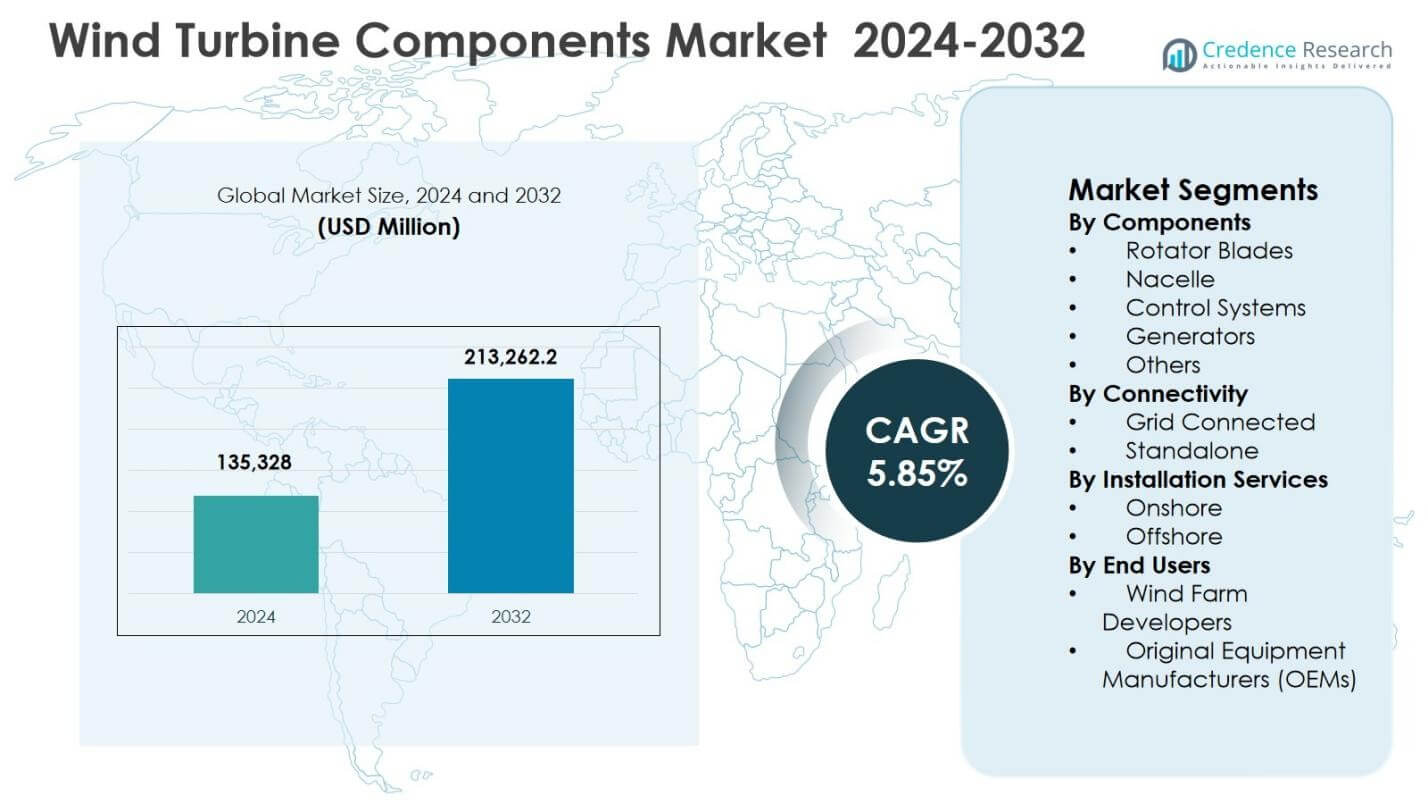
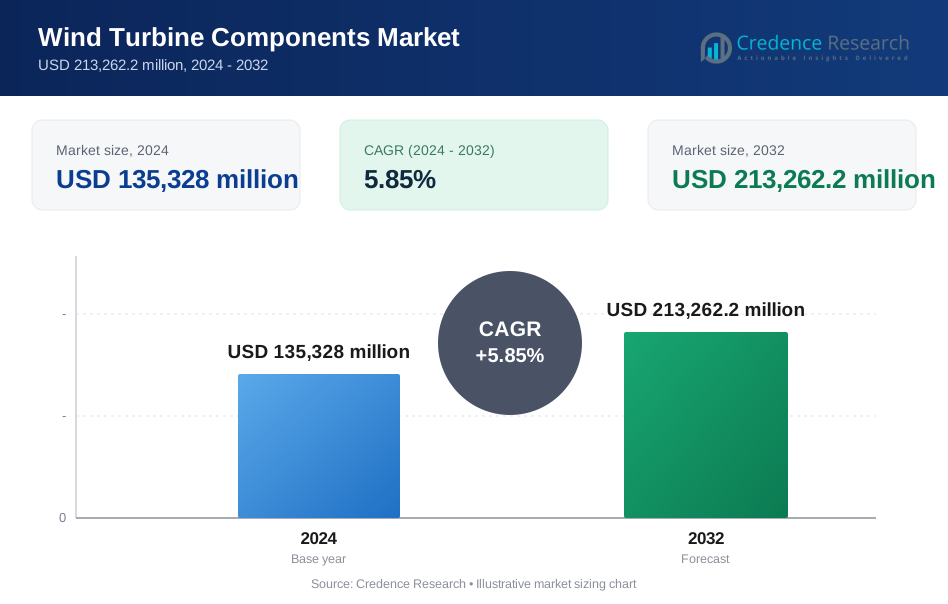
The Wind Turbine Components Market size was valued at USD 135,328 million in 2024 and is anticipated to reach USD 213,262.2 million by 2032, growing at a CAGR of 5.85% during the forecast period.
| REPORT ATTRIBUTE | DETAILS |
|---|---|
| Historical Period | 2020-2023 |
| Base Year | 2024 |
| Forecast Period | 2025-2032 |
| Wind Turbine Components Market Size 2024 | USD 135,328 million |
| Wind Turbine Components Market, CAGR | 5.85% |
| Wind Turbine Components Market Size 2032 | USD 213,262.2 million |
Wind Turbine Components Market Insights
- Market growth is driven by rising global wind power capacity additions, strong policy support for renewable energy, and technological advancements in turbine components such as rotor blades and control systems. Rotor blades held a 6% segment share in 2024, reflecting high demand for efficient energy capture.
- Key trends include the rapid expansion of offshore wind projects, increasing focus on repowering and lifecycle optimization, and wider adoption of digital monitoring systems that enhance performance and reduce operational costs.
- Major players such as Vestas Wind Systems A/S, Siemens Gamesa Renewable Energy, GE Vernova, Goldwind Science & Technology, Envision Energy, and others emphasize innovation, large-capacity components, and global footprint expansion.
- Regional analysis shows Asia Pacific leading with a 2% share, followed by Europe at 27.6% and North America at 20.1%, supported by large-scale deployments and supportive policies.
Wind Turbine Components Market Segmentation Analysis:
By Components:
The Wind Turbine Components Market, segmented by components, is primarily driven by rotor blades, which accounted for 34.6% of the market share in 2024. This dominance is supported by continuous innovation in blade design, including the adoption of advanced composites that improve aerodynamic efficiency and power output. Growing deployment of high-capacity turbines has increased demand for longer and more durable blades. The nacelle and generator segments also show steady growth due to rising investments in drivetrain efficiency, reliability, and integration of smart monitoring systems.
- For instance, Vestas launched modular nacelle designs divided into main housing and side-compartments sized for standard shipping containers, simplifying transport, installation, and lifetime upgrades.
By Connectivity:
In terms of connectivity, the grid-connected segment led the Wind Turbine Components Market with a 91.2% share in 2024, driven by the rapid development of large-scale wind power projects directly linked to national grids. Strong policy support for renewable energy integration, grid expansion, and long-term power purchase agreements has reinforced this dominance. Grid-connected systems enable efficient power distribution and revenue stability for operators. The standalone segment remains limited, serving remote and off-grid applications, but does not significantly impact overall market structure.
- For instance, Terra-Gen Power's Alta Wind Energy Center in California features 190 Vestas 3 MW turbines commissioned in 2010, connected via a 220 kV grid to Southern California Edison for broad distribution.
By Installation Services:
Based on installation services, onshore installations dominated with a 72.8% market share in 2024, supported by lower capital expenditure, simpler logistics, and shorter construction timelines. Onshore projects benefit from easier maintenance access and well-established supply chains, encouraging rapid capacity additions. Offshore installations account for the remaining share, driven by higher wind speeds and larger turbine capacities. Although offshore projects involve higher costs, increasing investments in coastal wind farms and technological advancements continue to support their long-term growth potential.
Key Growth Drivers
Rising Global Investments in Wind Power Capacity
The Wind Turbine Components Market benefits strongly from rising global investments in wind energy capacity as governments and private developers accelerate renewable deployment to meet decarbonization targets. Large-scale onshore and offshore wind projects continue to expand across Asia Pacific, Europe, and North America, driving consistent demand for blades, nacelles, generators, and control systems. Long-term power purchase agreements, favorable feed-in tariffs, and renewable energy auctions provide revenue certainty, encouraging capacity additions. This sustained project pipeline directly supports component manufacturing volumes and long-term market expansion.
- For instance, Vestas secured orders for its V236-15.0 MW offshore turbines for a project off Akita Prefecture, Japan, with deliveries starting in 2026 and commissioning in 2027; this follows over 6 GW of firm orders for the model globally.
Technological Advancements in Turbine Design and Materials
Continuous technological advancements in turbine design and materials represent a key growth driver for the Wind Turbine Components Market. Manufacturers increasingly adopt advanced composites, lightweight alloys, and modular designs to improve turbine efficiency, durability, and power output. Longer rotor blades and higher-capacity generators enable greater energy capture, especially in low-wind regions. Digital control systems and condition monitoring solutions further enhance performance and reduce downtime. These innovations support replacement demand and new installations, strengthening component sales across both mature and emerging wind markets.
- For instance, Gamesa pioneered the INNOBLADE segmented blade for its G128 onshore turbine, featuring a 62.5-meter length assembled via bolted channel fittings and pultruded carbon profiles for a 25% weight reduction to 15 metric tonnes per blade.
Strong Policy Support and Renewable Energy Mandates
Strong policy support and renewable energy mandates significantly drive growth in the Wind Turbine Components Market. Governments worldwide have implemented clean energy targets, carbon reduction commitments, and renewable portfolio standards that prioritize wind power development. Financial incentives such as tax credits, subsidies, and accelerated depreciation reduce project costs and improve investment returns. Additionally, grid modernization programs and cross-border energy initiatives support large-scale wind integration. This favorable regulatory environment ensures long-term visibility for wind projects and sustains steady demand for turbine components.
Key Trends & Opportunities
Rapid Expansion of Offshore Wind Projects
The Wind Turbine Components Market is witnessing strong opportunities from the rapid expansion of offshore wind projects. Developers are increasingly investing in offshore installations due to higher wind speeds, larger turbine capacities, and improved energy yield. This trend drives demand for specialized components such as corrosion-resistant blades, high-capacity generators, and advanced nacelle systems designed for harsh marine environments. Floating offshore wind technologies further expand deployment potential in deep-water regions, creating new growth avenues for component manufacturers with advanced engineering capabilities.
- For instance, Siemens Gamesa uses glass fiber reinforced polymer (GFRP) in its B75 turbine blades, which are 75 meters long and provide excellent fatigue resistance for decades in harsh marine conditions.
Increasing Focus on Repowering and Lifecycle Optimization
Repowering and lifecycle optimization have emerged as important trends in the Wind Turbine Components Market. Aging wind farms are being upgraded with modern blades, generators, and control systems to improve efficiency and extend operational life. This creates a recurring demand stream beyond new installations. Additionally, digitalization and predictive maintenance solutions offer opportunities to reduce operational costs and maximize asset performance. Component suppliers that integrate smart technologies and offer retrofit solutions are well positioned to capitalize on this growing aftermarket opportunity.
- For instance, Vestas provides Aerodynamic Upgrades like vortex generators and Gurney flaps on rotor blades, delivering a verified 1.7% annual energy production improvement across test sites with 20-year durability.
Key Challenges
Supply Chain Constraints and Raw Material Price Volatility
Supply chain constraints and raw material price volatility pose significant challenges to the Wind Turbine Components Market. Key inputs such as steel, copper, resins, and rare earth materials are subject to price fluctuations and supply disruptions, affecting production costs and delivery timelines. Transportation of large components like blades and nacelles also adds logistical complexity and cost pressure. These factors can impact project schedules and profit margins, forcing manufacturers to optimize sourcing strategies and improve supply chain resilience.
High Capital Requirements and Installation Complexities
High capital requirements and installation complexities remain major challenges for the Wind Turbine Components Market, particularly for offshore projects. Manufacturing large-scale components requires significant upfront investment in specialized facilities, equipment, and skilled labor. Offshore installations involve complex logistics, marine vessels, and weather-dependent construction schedules, increasing financial risk. Regulatory approvals and permitting delays further add uncertainty. These challenges can slow project execution and limit market entry for smaller players, intensifying competition among established manufacturers.
Regional Analysis
Asia Pacific
Asia Pacific dominated the Wind Turbine Components Market with a 45.2% market share in 2024, driven by large-scale wind installations across China, India, and emerging Southeast Asian economies. Strong government-led renewable energy targets, expanding domestic manufacturing capacity, and grid expansion programs continue to fuel demand for blades, nacelles, and generators. China remains the primary growth engine due to sustained onshore and offshore deployments, while India benefits from policy incentives and hybrid renewable projects. Rising electricity demand and cost-effective component production further strengthen Asia Pacific’s leadership position.
Europe
Europe accounted for a 27.6% market share in 2024 in the Wind Turbine Components Market, supported by its mature wind energy ecosystem and strong offshore wind development. Countries such as Germany, the United Kingdom, Denmark, and Spain drive demand through continuous capacity additions and repowering projects. Europe’s leadership in offshore wind technology boosts demand for advanced nacelles, high-capacity generators, and corrosion-resistant components. Stringent carbon reduction regulations and long-term renewable energy strategies ensure stable component demand, while innovation in turbine efficiency and digital monitoring reinforces regional market strength.
North America
North America held a 20.1% market share in 2024, supported by steady investments in onshore wind projects across the United States and Canada. Federal tax incentives, renewable portfolio standards, and long-term power purchase agreements drive consistent turbine deployments. The region shows strong demand for rotor blades and control systems, supported by repowering of aging wind farms. Offshore wind development along the US East Coast further supports future component demand. Advanced manufacturing capabilities and a focus on grid-scale renewable integration strengthen North America’s position in the global market.
Latin America
Latin America captured a 4.1% market share in 2024 in the Wind Turbine Components Market, driven by growing wind installations in Brazil, Mexico, and Chile. Favorable wind resources, renewable energy auctions, and declining technology costs support regional growth. Brazil leads component demand due to large onshore wind capacity additions and expanding local manufacturing. Grid expansion and energy diversification initiatives further support turbine deployment. Although the market remains smaller compared to developed regions, rising investments and supportive policies position Latin America as a steadily growing regional contributor.
Middle East & Africa
The Middle East & Africa region accounted for a 3.0% market share in 2024, supported by increasing renewable energy diversification efforts. Countries such as South Africa, Egypt, Morocco, and Saudi Arabia are investing in wind power to reduce reliance on fossil fuels. Large-scale utility projects and government-backed renewable programs drive demand for core turbine components. Infrastructure development and international partnerships further support market growth. While deployment levels remain lower than other regions, rising electricity demand and sustainability commitments continue to strengthen long-term growth prospects.
Wind Turbine Components Market Segmentations:
By Components
- Rotator Blades
- Nacelle
- Control Systems
- Generators
- Others
By Connectivity
- Grid Connected
- Standalone
By Installation Services
- Onshore
- Offshore
By End Users
- Wind Farm Developers
- Original Equipment Manufacturers (OEMs)
By Geography
- North America
- U.S.
- Canada
- Mexico
- Europe
- Germany
- France
- U.K.
- Italy
- Spain
- Rest of Europe
- Asia Pacific
- China
- Japan
- India
- South Korea
- South-east Asia
- Rest of Asia Pacific
- Latin America
- Brazil
- Argentina
- Rest of Latin America
- Middle East & Africa
- GCC Countries
- South Africa
- Rest of the Middle East and Africa
Competitive Landscape
The Wind Turbine Components Market features a consolidated structure led by key players such as Vestas Wind Systems A/S, Siemens Gamesa Renewable Energy, GE Vernova, Goldwind Science & Technology, Envision Energy, Nordex Group, Suzlon Energy, MingYang Smart Energy, Hitachi Energy, and TPI Composites. The market is characterized by strong vertical integration, long-term supply agreements, and continuous technology upgrades across blades, nacelles, generators, and control systems. Leading companies focus on scaling turbine capacity, improving component efficiency, and reducing lifecycle costs to strengthen their market positions. Strategic investments in offshore wind capabilities, advanced composite materials, and digital condition-monitoring systems remain central to competition. Regional manufacturing expansion, particularly in Asia Pacific and Europe, supports cost optimization and faster project execution. Partnerships with utilities and developers, along with repowering and aftermarket services, further enhance competitive differentiation and long-term revenue stability.
Key Player Analysis
- Envision Energy
- Vestas Wind Systems A/S
- TPI Composites
- Goldwind Science & Technology
- Siemens Gamesa Renewable Energy
- Suzlon Energy
- Hitachi Energy
- MingYang Smart Energy
- Nordex Group
- GE Vernova
Recent Developments
- In October 2025, ENERCON and Max Bögl extended their partnership to expand wind energy and sustainable tower technologies.
- In May 2025, Vestas Wind Systems A/S signed a deal with LM Wind Power to integrate a blade manufacturing facility in Poland into Vestas’s European production footprint, strengthening blade supply capacity.
- In February 2025, Senvion India partnered with Voodin Blade Technology to develop wooden wind turbine blades for its 4.2 MW platform.
Report Coverage
The research report offers an in-depth analysis based on Components, Connectivity, Installation Services, End Users and Geography. It details leading market players, providing an overview of their business, product offerings, investments, revenue streams, and key applications. Additionally, the report includes insights into the competitive environment, SWOT analysis, current market trends, as well as the primary drivers and constraints. Furthermore, it discusses various factors that have driven market expansion in recent years. The report also explores market dynamics, regulatory scenarios, and technological advancements that are shaping the industry. It assesses the impact of external factors and global economic changes on market growth. Lastly, it provides strategic recommendations for new entrants and established companies to navigate the complexities of the market.
Future Outlook
- The Wind Turbine Components Market will continue to expand as global wind power capacity additions accelerate across onshore and offshore projects.
- Manufacturers will prioritize larger and more efficient turbine components to improve energy output and reduce levelized cost of electricity.
- Offshore wind development will drive demand for high-capacity generators, advanced nacelles, and corrosion-resistant components.
- Technological innovation in blade materials and aerodynamic design will enhance turbine efficiency and durability.
- Repowering of aging wind farms will generate sustained replacement demand for modern components.
- Digital control systems and condition monitoring technologies will gain wider adoption to optimize performance and reduce downtime.
- Localization of manufacturing will increase to strengthen supply chains and reduce logistics complexity.
- Policy support and renewable energy mandates will continue to provide long-term market visibility.
- Integration of wind power with energy storage and hybrid renewable systems will influence component design requirements.
- Competitive intensity will increase as companies focus on cost reduction, lifecycle services, and aftermarket solutions.
Request a Free Sample
Fill in your details and we'll send you a free sample report.
- Sample data tables & charts
- Research methodology
Need a Custom Version of This Report?
Tailor the scope, geography, or segments to your exact requirements.
- Custom geography or segment scope
- Direct access to our analyst team
Frequently Asked Questions
What is the current market size for the Wind Turbine Components Market, and what is its projected size in 2032?
At what Compound Annual Growth Rate is the Wind Turbine Components Market projected to grow between 2024 and 2032?
Which Wind Turbine Components Market segment held the largest share in 2024?
What are the primary factors fueling the growth of the Wind Turbine Components Market?
Who are the leading companies in the Wind Turbine Components Market?
Which region commanded the largest share of the Wind Turbine Components Market in 2024?
Table of Content
Chapter 1. Report Introduction
- 1.1 Report Description & Purpose
- 1.1.1 Report Title & Market Definition
- 1.1.2 Unique Selling Propositions (USP) & Key Differentiators
- 1.1.3 Value Proposition for Stakeholders
- 1.2 Research Objectives
- 1.2.1 Market Sizing Objectives (Volume & Revenue)
- 1.2.2 Segmentation Objectives
- 1.2.3 Competitive Intelligence Objectives
- 1.2.4 Forecast & Scenario Objectives
- 1.3 Report Scope
- 1.3.1 Wind Turbine Components Scope – Types & Subtypes Covered
- 1.3.2 Geographic Scope – Regions & Countries Covered
- 1.3.3 Historical Period, Base Year & Forecast Period (2024; forecast to 2032)
- 1.3.4 Inclusions & Exclusions
- 1.4 HS Code & Classification Framework
- 1.5 Currency, Units & Pricing Basis
- 1.6 Target Stakeholders
- 1.7 Limitations & Assumptions
Chapter 2. Executive Summary
- 2.1 Global Wind Turbine Components Market Snapshot
- 2.1.1 Market Size – Historical (2024) & Forecast (2024-2032) (2024: USD 135,328 million → 2032: USD 213,262.2 million)
- 2.1.2 Volume & Revenue – Global Totals
- 2.1.3 Key Market Highlights – Top Five Facts
- 2.2 Wind Turbine Components Market Segmentation Snapshot
- 2.2.1 Market Split by Region – 2024 vs. 2032
- 2.3 Competitive Snapshot
- 2.3.1 Top 10 Players by Revenue Share – 2024
- 2.3.2 Top 10 Players by Volume Share – 2024
- 2.3.3 Recent Strategic Developments (18-Month Summary)
- 2.4 Key Investment Highlights & Strategic Conclusions
Chapter 3. Wind Turbine Components Market Dynamics & Industry Analysis
- 3.1 Market Overview & Context
- 3.1.1 Wind Turbine Components Market Position in the Broader Automotive Value Chain
- 3.1.2 OEM vs. Replacement Market Dynamics
- 3.1.3 Market Maturity & Development Stage by Region
- 3.2 Wind Turbine Components Market Drivers
- 3.3 Wind Turbine Components Market Restraints & Challenges
- 3.4 Wind Turbine Components Market Opportunities
- 3.5 Porter's Five Forces Analysis
- 3.5.1 Threat of New Entrants
- 3.5.2 Bargaining Power of Suppliers
- 3.5.3 Bargaining Power of Buyers
- 3.5.4 Threat of Substitutes
- 3.5.5 Competitive Rivalry – Intensity Assessment
- 3.6 Wind Turbine Components Value Chain Analysis
- 3.6.1 Upstream – Raw Material/Input Suppliers
- 3.6.1.1 Raw Material/Input 1
- 3.6.1.2 Raw Material/Input 2
- 3.6.1.3 Raw Material/Input 3
- 3.6.2 Midstream – Production/Manufacturing/Service Delivery
- 3.6.2.1 Production/Process Overview
- 3.6.2.2 Key Facility Locations & Capacity by Manufacturer
- 3.6.3 Downstream – Distribution & End Consumer
- 3.6.3.1 Primary Channel – B2B/OEM
- 3.6.3.2 Secondary Channels – Dealer, Retail, Online, Direct
- 3.6.4 Value Chain Profitability Analysis
- 3.6.1 Upstream – Raw Material/Input Suppliers
- 3.7 PESTEL Analysis
- 3.7.1 Political Factors
- 3.7.2 Economic Factors
- 3.7.3 Social Factors
- 3.7.4 Technological Factors
- 3.7.5 Environmental Factors
- 3.7.6 Legal Factors
- 3.8 Wind Turbine Components Supply Chain Analysis
- 3.8.1 Raw Material/Input Supply Risk Assessment
- 3.8.2 Manufacturing Concentration Risk (Geographic Exposure)
- 3.8.3 Trade Disruption Impact Analysis
- 3.9 Regulatory & Policy Landscape
Note: The regulatory and policy landscape section covers regulations based on their applicability to the market, Wind Turbine Components category, geography, and scope of the study. Only regulatory frameworks with a material impact on operations, compliance, trade, sustainability, or market access are analyzed in detail.
Chapter 4. Key Investment Pockets & Opportunity Analysis
- 4.1 Wind Turbine Components Market Attractiveness Analysis
- 4.1.1 By Region – Investment Attractiveness Matrix (Volume × CAGR)
- 4.2 Absolute Revenue Growth Opportunity
- 4.2.1 By Region – Absolute USD Growth Through 2032
- 4.3 Incremental Volume Opportunity
- 4.3.1 By Region – Incremental Volume Through 2032
- 4.3.2 Segment – Incremental Volume
- 4.4 Emerging Submarket Opportunity Deep Dive (Subject to Applicability)
- 4.5 Emerging Market Opportunity Scorecards
- 4.5.1 United States
- 4.5.2 Europe
- 4.5.3 Asia
- 4.5.4 Middle East & Africa
Note: Emerging Market Opportunity Scorecards will be included based on relevance and strategic importance. Regions listed are indicative and may vary depending on data availability and market dynamics.
Chapter 5. Wind Turbine Components Import-Export Analysis & Trade Flows
- 5.1 Global Trade Overview
- 5.1.1 Global Export Value by Country (2024)
- 5.1.2 Global Export Volume by Country (2024)
- 5.1.3 Global Import Value by Country (2024)
- 5.1.4 Global Import Volume by Country (2024)
- 5.1.5 Net Trade Balance by Country (2024)
- 5.2 Export Analysis – Segment
- 5.2.1 Type 1 (HS Code)
- 5.2.2 Type 2 (HS Code)
- 5.2.3 Type 3 (HS Code)
- 5.2.4 Type 4 (HS Code)
- 5.2.5 Type 5 (HS Code)
- 5.3 Import Analysis – Segment
- 5.3.1 Type 1 (HS Code)
- 5.3.2 Type 2 (HS Code)
- 5.3.3 Type 3 (HS Code)
- 5.3.4 Type 4 (HS Code)
- 5.3.5 Type 5 (HS Code)
- 5.4 Average Unit Trade Prices
- 5.4.1 Average Export Price – Segment & Country
- 5.4.2 Average Import Price – Segment & Source Country
- 5.4.3 Price Trends (2024)
- 5.5 Key Trade Route Analysis
- 5.5.1 Trade Route 1
- 5.5.2 Trade Route 2
- 5.5.3 Trade Route 3
- 5.5.4 Trade Route 4
- 5.5.5 Trade Route 5
- 5.6 Trade Policy Impact Assessment
- 5.6.1 US Anti-Dumping & Section 301 Tariffs
- 5.6.2 EU Customs Union Impact
- 5.6.3 Major Free Trade Agreements
- 5.6.4 USMCA Rules of Origin
Note: Trade policy analysis will be included only where relevant to the Wind Turbine Components market.
Chapter 6. Competitive Landscape & Company Benchmarking
- 6.1 Wind Turbine Components Market Concentration & Structure
- 6.1.1 Herfindahl-Hirschman Index (HHI) – vs. 2024
- 6.1.2 Tier 1, Tier 2 & Tier 3 Market Structure
- 6.1.3 Global, Regional & Local Player Dynamics
- 6.2 Wind Turbine Components Market Share Analysis – 2024
- 6.2.1 Global Revenue Share by Company
- 6.2.2 Global Volume Share by Company
- 6.2.3 Regional Revenue Share
- 6.2.4 Market Share Evolution ( vs. 2024)
- 6.2.5 OEM Segment Share by Company
- 6.2.6 Replacement Segment Share by Company
- 6.3 Production/Delivery Capacity & Facility Analysis
- 6.3.1 Global Installed Capacity
- 6.3.2 Capacity Utilization Rates
- 6.3.3 Production/Output Volume
- 6.3.4 Facility Locations & Capacity Map
- 6.3.5 Planned Capacity Additions
- 6.4 Wind Turbine Components Competitive Benchmarking Matrix
- 6.4.1 Revenue, Volume, CAGR & Profitability Comparison
- 6.4.2 Channel Revenue Mix
- 6.4.3 Geographic Revenue Exposure
- 6.4.4 R&D Intensity
- 6.4.5 Sustainability Maturity
- 6.5 Strategic Developments in Wind Turbine Components (Last 24 Months)
- 6.5.1 Mergers, Acquisitions & Divestments
- 6.5.2 New Wind Turbine Components Launches
- 6.5.3 Facility Expansions
- 6.5.4 Strategic Alliances, Joint Ventures & Partnerships
- 6.5.5 Distribution Expansion & Market Entry
- 6.5.6 Sustainability & ESG Initiatives
- 6.6 Competitive Strategy Mapping
- 6.6.1 Leader, Challenger, Follower & Niche Classification
- 6.6.2 Pricing Strategy Comparison
- 6.6.3 Channel Strategy Matrix
Note: Strategic developments are included based on their materiality and the availability of reliable information.
Chapter 7. Global Wind Turbine Components Market – By Distribution Channel
- 7.1 Segment Overview
- 7.1.1 Volume & Revenue Split by Channel (2024 & 2032)
- 7.1.2 Channel Mix Evolution (2024-2032)
Chapter 8. Regional Market Analysis – Global Overview
- 8.1 Global Regional Overview
- 8.1.1 Regional Volume Share
- 8.1.2 Regional Revenue Share
- 8.1.3 Regional Volume by Region
- 8.1.4 Regional Revenue by Region
- 8.1.5 Regional Forecast Through 2032
- 8.2 Cross-Regional Segment Analysis
- 8.2.1 By Distribution Channel
- 8.2.2 By Brand/Price Tier
Chapter 9. North America Wind Turbine Components Market
- 9.1 United States
- 9.2 Canada
- 9.3 Mexico
Chapter 10. Europe Wind Turbine Components Market
- 10.1 Germany
- 10.2 France
- 10.3 Italy
- 10.4 United Kingdom
- 10.5 Spain
- 10.6 Poland
- 10.7 Russia
- 10.8 Netherlands
- 10.9 Belgium
- 10.10 Sweden
- 10.11 Denmark
- 10.12 Norway
- 10.13 Rest of Europe
Chapter 11. Asia Pacific Wind Turbine Components Market
- 11.1 China
- 11.2 India
- 11.3 Japan
- 11.4 South Korea
- 11.5 Thailand
- 11.6 Indonesia
- 11.7 Vietnam
- 11.8 Malaysia
- 11.9 Australia
- 11.10 Rest of Asia Pacific
Chapter 12. Latin America Wind Turbine Components Market
- 12.1 Brazil
- 12.2 Argentina
- 12.3 Colombia
- 12.4 Chile
- 12.5 Rest of Latin America
Chapter 13. Middle East Wind Turbine Components Market
- 13.1 Saudi Arabia
- 13.2 United Arab Emirates
- 13.3 Turkey
- 13.4 Israel
- 13.5 Iran
- 13.6 Rest of the Middle East
Chapter 14. Africa Wind Turbine Components Market
- 14.1 South Africa
- 14.2 Egypt
- 14.3 Nigeria
- 14.4 Morocco
- 14.5 Rest of Africa
Chapter 15. Wind Turbine Components Company Profiles
- 15.1 [Company 01]
- 15.1.1 Company Overview
- 15.1.2 Key Management Personnel
- 15.1.3 Products & Services Portfolio
- 15.1.4 Financial Performance
- 15.1.5 Key Market Focus & Geographic Presence
- 15.1.6 Recent Developments & Strategic Initiatives
Note: The company profile list is preliminary and may change based on research findings, market developments, data availability, and client requirements.
Chapter 16. Appendices
- Appendix A – List of Abbreviations & Acronyms
- Appendix B – Industry Classification Code Reference – Full Series
- Appendix C – Production & Capacity Data Tables
- Appendix D – End-Use & Demand Base Tables
- Appendix E – Consumption & Replacement Rate Assumptions
- Appendix F – ASP Reference Tables
- Appendix G – Manufacturing & Facility Database
- Appendix H – Import-Export Data Tables
- Appendix I – Regulatory Summary Tables
- Appendix J – Primary Research Participant List (Anonymized)
- Appendix K – Primary Research Questionnaire Framework
- Appendix L – Data Sources & Bibliography
- Appendix M – Market Size Divergence & Source Comparison
Chapter 17. Research Methodology
- 17.1 Research Framework & Philosophy
- 17.2 Secondary Research – Sources, Hierarchy & Data Extraction
- 17.3 Data Modeling – Bottom-Up & Top-Down Market Sizing
- 17.4 Primary Research – Stakeholder Framework, LOI & Sample Sizes
- 17.5 Forecast Methodology – Regression, Scenario & Sensitivity Analysis
- 17.6 Quality Control – Four-Layer Validation Framework
- 17.7 Limitations & Standard Assumptions
- 17.8 Disclaimer
