
Actionable Insights Delivered - MIPI Camera Module Market Size
Positioned with a USD 100.5 million valuation in 2022, the MIPI Camera Module Market asserted its global eminence. Set to scale to USD 194.60 million by 2030, the market's remarkable Compound Annual Growth Rate (CAGR) of 9.90% (2022-2030) underscores its strategic growth trajectory.
Key Highlights of the Report
The global MIPI camera module market is segmented by module type, application, and region. MIPI DSI camera modules are the most popular, while MIPI CSI Camera Module is the two primary camera module segments. Autopilot is the most commonly used application, with Asia Pacific leading the market growth.
The global MIPI camera module market has several drivers. The MIPI Camera Module Market is incredibly varied, offering various services and specialties, including quantitative and qualitative research, brand research, product testing, customer satisfaction research, and competitive analysis. There are fewer signal lines on the MIPI interface than on the DVP interface. Due to the low voltage differential signal, there is less interference produced, and the anti-interference ability is also quite high. Use the MIPI interface exclusively for 800W and higher. MIPI is used for the smartphone camera interface. The MIPI Camera Module market, as a whole, is essential in assisting companies and organizations in making deft decisions based on data-driven insights. The market for MIPI Camera Modules is anticipated to continue expanding and innovating in the years to come as the demand for data-driven decision-making rises. However, the market also faces significant challenges. However, the advancement of mobile intelligent photography and imaging (MIPI) is hampered by the scarcity of high-quality research data and the infrequent chance for an in-depth exchange of viewpoints between industry and academia.
Nonetheless, the global MIPI camera module market offers significant growth opportunities, and the development of 5G networking technologies may soon provide substantially more cellular bandwidth. Another chance to give people an uninterrupted, higher-quality video conference experience outside of offices and homes, including in rural locations without WiFi.
What Are The Main Drivers Of The Global MIPI camera module Market?
The global MIPI camera module market is driven by several factors, including quantitative and qualitative research, brand research, product testing, customer satisfaction research, and competitive analysis. There are fewer signal lines on the MIPI interface than on the DVP interface. Due to the low voltage differential signal, there is less interference produced, and the anti-interference ability is also quite high. Use the MIPI interface exclusively for 800W and higher. MIPI is used for the smartphone camera interface. The MIPI Camera Module market, as a whole, is essential in assisting companies and organizations in making deft decisions based on data-driven insights. The market for MIPI Camera Modules is anticipated to continue expanding and innovating in the years to come as the demand for data-driven decision-making rises.
What Are The Major Challenges Faced By The Global MIPI camera module Market?
The global MIPI camera module market also faces several challenges, including the advancement of mobile intelligent photography and imaging (MIPI) is hampered by the scarcity of high-quality research data and the infrequent chance for an in-depth exchange of viewpoints between industry and academia.
What Are The Growth Opportunities In The Global MIPI camera module Market?
The global MIPI camera module market offers significant growth opportunities, and the development of 5G networking technologies may soon provide substantially more cellular bandwidth. Another chance to give people an uninterrupted, higher-quality video conference experience outside of offices and homes, including in rural locations without WiFi.
Executive Summary
Overview of the Global MIPI camera module Market
The global MIPI camera module market has been steadily growing in recent years, driven by The creation of standards that allow SoC designers to concentrate on what makes their work stand out rather than infrastructure-related problems that don't distinguish their ideas has been expedited by the pace of the mobile market. One of the most significant is MIPI, a group of specifications that facilitates the implementation of typical smartphone functionality, including displays and imaging equipment. The market is characterized by various camera modules and applications catering to diverse consumer preferences.
Market Definition
The MIPI Alliance created MIPI (Mobile Industry Processor Interface) as a specification and open standard for mobile application processors. Mobile phones and tablets frequently have MIPI camera modules inside, which may enable high-definition resolutions of up to 5 million pixels. To correspond to the video display and video input standards, MIPI is split into MIPI DSI and MIPI CSI. MIPI camera modules are currently widely employed in other embedded goods such as cellphones, car recorders, forensic cameras, high-definition micro cameras, and network surveillance cameras.
Market Insights
- The global demand for MIPI camera modules was valued at USD 100.5 Million in 2022 and is expected to reach USD 194.60 Million in 2030, growing at a CAGR of 9.90% between 2023 and 2030.
- MIPI DSI camera module is the leading segment by camera module and held over 43% share in terms of value in 2022, while the MIPI CSI camera module segment is likely to exhibit the fastest CAGR during the forecast period.
- The autopilot segment governs the demand for MIPI camera modules globally, holding a massive share of over 80% in 2022, and is expected to grow at a rapid CAGR.
- Asia Pacific is fueling the growth of the MIPI camera module industry with over one-third share in 2022, while Asia Pacific and Europe collectively account for just under 50% share in 2022. Europe held over 22% share in 2022.
- The camera module market is anticipated to grow over the projected period due to automation in the area. For instance, the Made in China 2025 strategy and other government initiatives in China encourage R&D in technological investments and factory automation. The 'Made in China's project aims to increase the nation's local automation equipment manufacturing because most of it is imported from other nations. At the same the advancement of mobile intelligent photography and imaging (MIPI) is hampered by the scarcity of high-quality research data, and the infrequent chance for an in-depth exchange of viewpoints between industry and academia are the main restraints.
- The 5G networking technologies development may soon provide substantially more cellular bandwidth. Another chance to give people an uninterrupted, higher-quality video conference experience outside of offices and homes, including in rural locations without WiFi, the major opportunities in the market.
Segmentation by Camera Module
- MIPI DSI camera module is the leading segment by camera module, holding over 43% share in value in 2022.
- The MIPI CSI camera module segment will likely exhibit the fastest CAGR during the forecast period.
Segmentation by Application
- The autopilot segment governs the demand for MIPI camera modules in the world, holding a massive share of over 80% in 2022, and is also expected to grow at a rapid CAGR.
- The other segment contributes to the rest of the demand for MIPI camera modules.
Segmentation by Region
- Asia Pacific is fueling the growth of the MIPI camera module industry with over one-third share in 2022.
- North America and Europe collectively account for just under 50% share in 2022, with Europe holding over 22% share in the same year.
- The rest of the World, including Latin America, The Middle East, and Africa, contributes the remainder to the demand for MIPI camera modules.
- The increasing demand for MIPI camera modules can be attributed to the OEMs choosing board cameras or protective cases from Vision Components' selection of adaptable Linux-based embedded systems for 2D and 3D image processing. An expanding selection of ultracompact MIPI camera boards that connect to various CPU boards completes the set. However, the market is restrained by the advancement of mobile intelligent photography and imaging (MIPI) is hampered by the scarcity of high-quality research data and the infrequent chance for an in-depth exchange of viewpoints between industry and academia.
The United States is one of the largest markets for MIPI camera modules in North America, with a significant market share. The market for North American camera modules is anticipated to grow during the forecast period as a result of advancements in information and communication technology (ICT), the advent of artificial intelligence (AI), and the Internet of Things (IoT). Throughout the forecast period, the expansion of the modules industry is anticipated to be fueled by the introduction of 5g technology and its applications in numerous sectors, including healthcare, retail, and others.
China is also a major market for MIPI camera modules in the Asia Pacific region, with a significant market share. Soon, the market for camera modules is anticipated to be further fueled by the rising population and smartphone adoption in APAC nations. The region's governments' activities on vehicle safety requirements have increased the need for camera modules in the automotive industry.
Overall, the increasing demand for MIPI camera modules can be attributed to the growing use of smartphones incubated by MIPI camera modules.
While the MIPI camera module market is growing, it faces challenges from the advancement of mobile intelligent photography and imaging (MIPI) is hampered by the scarcity of high-quality research data and the infrequent chance for an in-depth exchange of viewpoints between industry and academia. Manufacturers are innovating and forming partnerships to stay competitive.
End-user demand for consumer gadgets is rising.
Shorter replacement cycles, declining prices, easy access through e-commerce websites, and new technologies like wearables, virtual and augmented reality, 4K televisions, smart homes, 3D printers, autonomous vehicles, drones, and communication robots all encourage regular purchases of the same.
Due to a shortage of entertainment options outside the home and the shift to working from home, the COVID-19 pandemic in 2020 caused a substantial increase in the sales of many consumer electronics products. For use at home, at work, in the classroom, and for other purposes, almost everyone owns or is looking to buy a personal consumer electronic device, which can range from a computer to a smartphone.
Electronic devices are everywhere around us and increasingly include camera modules. Smartphones are rapidly coming equipped with two, three, and even four camera systems on a single unit, giving consumers access to previously only possible functions with high-end photographic equipment.
Benefits Offered By New and Advanced Developments
The market for terminals requires new designs with reduced power consumption, increased data transfer rate, and smaller PCB footprint as the intelligent era advances. As a result, the demand for mobile phone shooting functions is increasing. Under this immense push, pertinent designers are gradually implementing innovative Alternative solutions with better performance and price ratios. MIPI camera modules are becoming more and more popular with consumers and expanding quickly because of how well they serve the needs of the burgeoning market for mobile phone cameras.
Device miniaturization causes the more complicated design
The production of image sensors and camera modules has exploded in recent years as a result of the fast expansion of the consumer electronics and automotive industries. As end-user competition has grown, alternative designs and gadget miniaturization have also resulted. Leading smartphone manufacturers like Apple and Google have been observably improving their cameras with their flagship models, the iPhone 13 Pro and Google Pixel. Following the most recent trends, other smartphone manufacturers have constantly changed their cameras.
However, a few frequent problems that may arise during the production of camera modules due to miniaturization result in decreased quality and additional design difficulties. A few of the problems include incorrect focus, a loose lens or improper glue application, a lens abnormality, poor component contact, flaws in the SMT process, flaws in the FPC (flexible printed circuit), a flawed sensor, a mismatched sensor and lens, a device with an incompatible FOV (field of view), flaws in the SMT or FPC process, flaws in the lens assembly, and others.
Supply chain repercussions of COVID-19
Globally speaking, the COVID-19 pandemic has had an effect. In the early phases of the pandemic, companies were completely shut down, including businesses, industries, factories, offices, schools, and others, which put a strain on the economy.
Furthermore, Due to the COVID-19 outbreak, the camera modules encountered a few brand-new, unexpected obstacles in the supply chain. The drop in the shipment volume of camera modules due to production process interruptions in end-use industries, including automotive and consumer electronics, presented a challenge for the camera module business.
Image sensors are advancing and undergoing new developments.
An image sensor or imager finds and transmits the data necessary to create an image. It is utilized in electronic imaging equipment, such as optical mice, camera phones, camera modules, and digital cameras.
One of the factors influencing the adoption of image sensors is the rise in the use of high-resolution cameras with image sensors in mobile devices, the growth in the adoption of image cameras for automotive applications, and the rise in the use of image sensors in better medical imaging solutions.
The sensors' expanding use in various applications is partly due to some of their benefits, including low cost, low power consumption, excellent resolution, operations at high frame rates, and the ability to capture scenes with a wide range of lighting intensities.
New image sensors technologies such as flexible x-ray detectors, wave-front imaging, hyperspectral imaging, organic photodetectors, SWIR image sensors, event-based vision, and wave-front imaging have improved image sensors.
Cost savings, enhanced dynamic range, better temporal resolution, spatially changeable sensitivity, global shutters at high resolution, lessened undesired scattering, and flexibility are just a few advantages that these developing technologies can attain. The market's growth will likely be fueled by the adoption of these technologies as a result of the increased demand for smartphones with the most up-to-date camera functions.
Competitive Landscape
Key Players
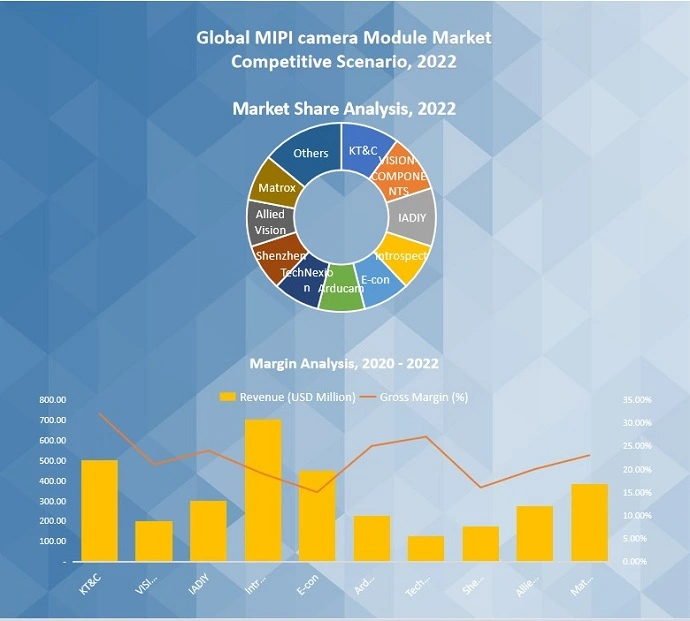
The global MIPI camera module market is highly competitive, with the presence of several key players. Some of the major players in the market and their market share are as follows:
- KT&C
- VISION-COMPONENTS
- IADIY Technology
- Introspect Technology
- E-con Systems
- Arducam
- TechNexion
- Shenzhen CM Technology
- Allied Vision
- Matrox
- PHYTIC
- Wannatek
- PathPartner
- Leopard Imaging
- Supertek
- FRAMO
These companies focus on product innovation, expanding their distribution channels, and mergers and acquisitions to stay ahead in the market.
The major players in the global MIPI camera module market constantly strive to stay ahead by introducing new products and innovations.
The first-ever MIPI CSI-2 Camera Interface Reference Design for TI AM37x/DM37x and OMAP35x Processors was released by e-con Systems. Find out everything you need about this unique 5 MP MIPI camera board.
Summary of Key Findings
- Growing The market for terminals needs new designs with reduced power consumption, greater data transmission rates, and smaller PCB footprint as the intelligent era progresses and demands more advanced mobile phone shooting capabilities driving the market growth.
- Market segmented by camera module, application, and region.
- MIPI DSI camera modules are the most popular, with MIPI CSI camera modules as primary user segments.
- Autopilot is most commonly used for applications.
- Asia Pacific is leading market growth; the market is highly competitive with key players including KT&C, VISION-COMPONENTS, IADIY Technology, Introspect Technology, E-con Systems, Arducam, TechNexion, Shenzhen CM Technology, Allied Vision, Matrox, PHYTEC, Wannatek, PathPartner, Leopard Imaging, Supertek, FRAMO.
Future Outlook
- Positive outlook for the global MIPI camera module market with significant growth potential in the Asia Pacific region
- the development of 5G networking technologies may soon provide substantially more cellular bandwidth. Another chance to give people an uninterrupted, higher-quality video conference experience outside of offices and homes, including in rural locations without WiFi. To drive growth
- Challenges from the USB 3.0 interface are that high-resolution sensors cannot be operated at fast speeds. Another drawback is that a cable can only be used up to 5 meters from the host processor. Longer cables are available. However, they all have "boosters" installed. For each unique situation, assessing how well these cables work with industrial cameras is necessary.
- Key players to focus on product innovation, expanding market reach and maintaining competitive pricing to stay ahead in the market.
Segmentation
- By Camera Module
- MIPI DSI Camera Module
- MIPI CSI Camera Module
- By Application
- Autopilot
- Drones
- Smart Cities
- Others
- By Region
- North America
- The US.
- Canada
- Mexico
- Europe
- Germany
- France
- The U.K.
- Italy
- Spain
- Rest of Europe
- Asia Pacific
- China
- Japan
- India
- South Korea
- South-east Asia
- Rest of Asia Pacific
- Latin America
- Brazil
- Argentina
- Rest of Latin America
- Middle East & Africa
- GCC Countries
- South Africa
- Rest of the Middle East and Africa

Request a Free Sample
Fill in your details and we'll send you a free sample report.
- Sample data tables & charts
- Research methodology
Market Dynamics
Proliferation of Advanced Driver Assistance Systems (ADAS) and Autopilot
The rapid adoption of autopilot and ADAS technologies in automotive applications is driving demand for high-performance MIPI camera modules, which are essential for real-time image processing and safety features in vehicles.
Growth in Consumer Electronics and Smartphone Adoption
The increasing penetration of smartphones and other consumer electronics, especially in Asia Pacific, is fueling demand for compact, high-resolution MIPI camera modules, as manufacturers seek to differentiate products with advanced imaging capabilities.
Advancements in 5G Networking Technologies
The rollout of 5G networks is enabling higher bandwidth and lower latency, supporting applications such as high-quality video conferencing and real-time surveillance, which require robust MIPI camera modules for seamless imaging performance.
Miniaturization and Innovation in Camera Module Design
Ongoing innovation in reducing power consumption, increasing data transfer rates, and shrinking PCB footprints is making MIPI camera modules more attractive for integration into a wider range of devices, from wearables to smart city infrastructure.
Government Initiatives and Industrial Automation
Policies such as 'Made in China 2025' and increased investment in factory automation are boosting the adoption of MIPI camera modules in industrial and automotive sectors, supporting market growth through enhanced R&D and local manufacturing.
Need a Custom Version of This Report?
Tailor the scope, geography, or segments to your exact requirements.
- Custom geography or segment scope
- Direct access to our analyst team
Frequently Asked Questions
What is the current size of the global MIPI camera module market?
What is the expected growth rate of the MIPI camera module market between 2023 and 2030?
Which segment is leading the market share in terms of camera modules?
Which application segment governs the demand for MIPI camera modules in the world?
Which region is fueling the growth of the MIPI camera module industry?
Who are the major players in the global MIPI camera module market?
What are the major market drivers of the MIPI camera module industry?
What are the major market restraints of the MIPI camera module industry?
What are the major market opportunities of the MIPI camera module industry?
Table of Content
Chapter 1 Market Segmentation
- 1.1 Segmentation Framework
- 1.1.1 Product and Service Classification
- 1.1.2 Application and End-Use Classification
- 1.1.3 Technology and Solution Classification
- 1.1.4 Customer and Distribution Channel Classification
- 1.1.5 Geographic Segmentation
- 1.1.6 Market Segment Definitions and Boundaries
- 1.2 By Application
- 1.2.1 Autopilot
- 1.2.2 Drones
- 1.2.3 Smart Cities
- 1.2.4 Others
- 1.3 By Camera Module
- 1.3.1 MIPI DSI Camera Module
- 1.3.2 MIPI CSI Camera Module
Chapter 2 Introduction
- 2.1 Report Objectives and Scope
- 2.2 Product Definition and Industry Terminology
- 2.3 Market Inclusions and Exclusions
- 2.4 Research Process
- 2.4.1 Primary Research and Expert Interviews
- 2.4.2 Secondary Research and Source Review
- 2.4.3 Top-Down and Bottom-Up Estimation
- 2.4.4 Data Triangulation and Verification
- 2.5 Market Size Measurement Basis
- 2.5.1 2022: USD 100.5 Million → 2030: USD 194.60 million
- 2.6 Historical and Forecast Reference Periods
- 2.6.1 Base Year: 2022
- 2.6.2 Forecast Period: 2022-2030
- 2.7 Research Assumptions and Limitations
Chapter 3 Executive Summary
- 3.1 Market Snapshot and Key Findings
- 3.2 Base-Year Market Size, 2022
- 3.3 Forecast Market Size, 2030
- 3.4 Revenue and Volume Growth Outlook
- 3.5 Key Demand and Supply Indicators
- 3.6 Leading Market Segments
- 3.7 Fastest-Growing Market Opportunities
- 3.8 Regional Performance Highlights
- 3.9 Technology and Industry Transformation
- 3.10 Competitive Landscape Summary
- 3.11 Analyst View and Strategic Implications
Chapter 4 Global MIPI Camera Module Market Trends and Developments
- 4.1 Historical Industry Development
- 4.2 Recent Market Trends and Developments
- 4.3 Demand and Customer Behavior Trends
- 4.4 Technology and Product Innovation
- 4.5 Artificial Intelligence, Automation and Digitalization
- 4.6 Local Manufacturing and Supply Chain Realignment
- 4.7 Industry Partnerships, Mergers and Acquisitions
- 4.8 Sustainability and Circular Economy Developments
- 4.9 Government and Private Sector Investment Trends
- 4.10 Emerging Business Models and Commercialization
- 4.11 Industry Developments and Announcements
Chapter 5 Global MIPI Camera Module Market Production, Supply and Demand Analysis
- 5.1 Demand Trend and Consumption Analysis
- 5.2 Demand Forecast, 2022-2030
- 5.3 Production and Output Trend
- 5.4 Production and Output Forecast, 2022-2030
- 5.5 Installed Capacity and Capacity Utilization
- 5.6 Company-Wise Production Plants and Statistics
- 5.6.1 Installed Production Capacity
- 5.6.2 Actual Production
- 5.6.3 Planned Capacity and Expansion Targets
- 5.7 Supply Chain Structure and Procurement Trends
- 5.8 Supply-Demand Gap and Bottlenecks
- 5.9 Import Dependence and Sourcing Structure
- 5.10 Contract Manufacturing and Outsourcing
- 5.11 Regional Supply and Demand Concentration
Chapter 6 Global MIPI Camera Module Market Pricing Analysis
- 6.1 Pricing Structure and Measurement
- 6.2 Historical Pricing Trends
- 6.3 Pricing Outlook, 2022-2030
- 6.4 Average Selling Price and Unit Economics
- 6.5 Pricing by Product and Market Segment
- 6.6 Geographic Pricing Differences
- 6.7 Key Input, Energy, Labor and Logistics Costs
- 6.8 Contract Pricing and Purchasing Models
- 6.9 Pricing Sensitivity and Competitive Positioning
- 6.10 Price, Margin and Profitability Implications
Chapter 7 Global MIPI Camera Module Market Dynamics
- 7.1 Market Growth Drivers
- 7.1.1 Demand-Side Drivers
- 7.1.2 Technology and Innovation Drivers
- 7.1.3 Infrastructure and Investment Drivers
- 7.1.4 Regulatory and Policy Drivers
- 7.2 Market Restraints
- 7.2.1 Cost and Affordability Constraints
- 7.2.2 Technology and Adoption Barriers
- 7.2.3 Supply Chain and Operational Constraints
- 7.3 Market Challenges
- 7.3.1 Competitive Pressure and Margin Erosion
- 7.3.2 Skills, Infrastructure and Implementation Gaps
- 7.4 Emerging Market Opportunities
- 7.5 Market Dynamics Impact and Time-Horizon Assessment
Chapter 8 Global MIPI Camera Module Value Chain Analysis
- 8.1 Industry Value Chain Overview
- 8.2 Upstream Suppliers and Critical Inputs
- 8.3 Technology and Component Providers
- 8.4 Manufacturing or Service Delivery
- 8.5 Distribution, Channel Partners and Integrators
- 8.6 Downstream Applications and End Users
- 8.7 Value Addition and Profit Pools
- 8.8 Vertical Integration and Outsourcing
- 8.9 Supplier Concentration and Risk
- 8.10 Supply Chain Localization and Resilience
Chapter 9 Global MIPI Camera Module Market Regulations and Policies
- 9.1 Relevant Laws, Standards and Compliance Frameworks
- 9.2 Product, Service, Safety and Quality Requirements
- 9.3 Government Policies, Incentives and Subsidies
- 9.4 Imports, Exports and Trade Barriers
- 9.5 Public Procurement and Local Content Requirements
- 9.6 Environmental and Sustainability Compliance
- 9.7 Upcoming Policy Changes and Market Implications
Chapter 10 Global MIPI Camera Module Market Hotspots and Opportunities
- 10.1 Market Opportunity Mapping and Growth Hotspots
- 10.2 High-Growth Applications and Customer Groups
- 10.3 Underserved Markets and White-Space Opportunities
- 10.4 Emerging Technology and Product Opportunities
- 10.5 New Capacity and Investment Hotspots
- 10.6 Market Entry and Expansion Opportunities
- 10.7 Distribution and Partnership Opportunities
- 10.8 Near-Term and Long-Term Commercial Potential
- 10.9 Opportunity Attractiveness and Execution Risks
Chapter 11 Global MIPI Camera Module Market Outlook, 2022-2030
- 11.1 Market Size and Analysis
- 11.1.1 Revenue (Market Measurement: 2022: USD 100.5 Million → 2030: USD 194.60 million)
- 11.1.2 Market Volume and Quantity Sold
- 11.1.3 Historical Market Size
- 11.1.4 Base-Year Market Size, 2022
- 11.2 Market Forecast, 2022-2030
- 11.2.1 Revenue Forecast to 2030
- 11.2.2 Volume Forecast to 2030
- 11.2.3 CAGR and Year-on-Year Growth
- 11.2.4 Incremental Revenue Opportunity
- 11.3 Forecast Assumptions and Scenario Analysis
- 11.3.1 Base-Case Forecast
- 11.3.2 Optimistic and Conservative Scenarios
- 11.3.3 Technology, Pricing and Policy Sensitivities
- 11.4 Market Attractiveness and Growth Outlook
Chapter 12 Global MIPI Camera Module Market Segmentation and Outlook
- 12.1 Segmentation Summary and Market Shares, 2022
- 12.2 Largest and Fastest-Growing Segments
- 12.3 By Application - Market Size and Forecast, 2022-2030
- 12.3.1 Segment Definition and Scope
- 12.3.2 Historical Market Size
- 12.3.3 Revenue Forecast, 2022-2030
- 12.3.4 Volume Forecast, 2022-2030
- 12.3.5 Base-Year Market Share, 2022
- 12.3.6 Segment CAGR and Growth Drivers
- 12.3.7 Subsegment Market Size and Forecast
- 12.3.7.1 Autopilot
- 12.3.7.2 Drones
- 12.3.7.3 Smart Cities
- 12.3.7.4 Others
- 12.3.8 Subsegment Pricing and Adoption Trends
- 12.3.9 Leading Suppliers and Competition
- 12.3.10 Regional Demand and Opportunities
- 12.4 By Camera Module - Market Size and Forecast, 2022-2030
- 12.4.1 Segment Definition and Scope
- 12.4.2 Historical Market Size
- 12.4.3 Revenue Forecast, 2022-2030
- 12.4.4 Volume Forecast, 2022-2030
- 12.4.5 Base-Year Market Share, 2022
- 12.4.6 Segment CAGR and Growth Drivers
- 12.4.7 Subsegment Market Size and Forecast
- 12.4.7.1 MIPI DSI Camera Module
- 12.4.7.2 MIPI CSI Camera Module
- 12.4.8 Subsegment Pricing and Adoption Trends
- 12.4.9 Leading Suppliers and Competition
- 12.4.10 Regional Demand and Opportunities
- 12.5 Segment Growth Comparison
- 12.6 Segment Attractiveness and Priority Matrix
Chapter 13 Global MIPI Camera Module End-Use and Application Market Outlook
- 13.1 End-Use Industry and Customer Demand Structure
- 13.2 Leading Applications and Customer Groups
- 13.3 End-Use Market Size, Share and Forecast
- 13.4 Major End-Use Industry Deep Dives
- 13.4.1 Customer Requirements and Use Cases
- 13.4.2 Demand and Replacement Cycles
- 13.4.3 Technical and Regulatory Considerations
- 13.4.4 Purchasing and Procurement Models
- 13.4.5 Leading Vendors and Distribution Channels
- 13.4.6 Forecast and Commercial Opportunities
- 13.5 Emerging Applications and Cross-Segment Demand
- 13.6 End-Use Industry Investment Priorities
Chapter 14 Global MIPI Camera Module Geographic Market Outlook, 2022-2030
- 14.1 Regional Market Size and Share, 2022
- 14.2 Regional Market Forecast, 2022-2030
- 14.3 Regional Pricing, Production and Demand Differences
- 14.4 North America
- 14.4.1 United States
- 14.4.2 Canada
- 14.4.3 Mexico
- 14.5 Europe
- 14.5.1 Germany
- 14.5.2 France
- 14.5.3 Italy
- 14.5.4 United Kingdom
- 14.5.5 Spain
- 14.5.6 Poland
- 14.5.7 Russia
- 14.5.8 Netherlands
- 14.5.9 Belgium
- 14.5.10 Sweden
- 14.5.11 Denmark
- 14.5.12 Norway
- 14.5.13 Rest of Europe
- 14.6 Asia Pacific
- 14.6.1 China
- 14.6.2 India
- 14.6.3 Japan
- 14.6.4 South Korea
- 14.6.5 Thailand
- 14.6.6 Indonesia
- 14.6.7 Vietnam
- 14.6.8 Malaysia
- 14.6.9 Australia
- 14.6.10 Rest of Asia Pacific
- 14.7 Latin America
- 14.7.1 Brazil
- 14.7.2 Argentina
- 14.7.3 Colombia
- 14.7.4 Chile
- 14.7.5 Rest of Latin America
- 14.8 Middle East
- 14.8.1 Saudi Arabia
- 14.8.2 United Arab Emirates
- 14.8.3 Turkey
- 14.8.4 Israel
- 14.8.5 Iran
- 14.8.6 Rest of the Middle East
- 14.9 Africa
- 14.9.1 South Africa
- 14.9.2 Egypt
- 14.9.3 Nigeria
- 14.9.4 Morocco
- 14.9.5 Rest of Africa
- 14.10 Regional Investment, Policy and Supply Chain Differences
- 14.11 Regional Competitive Landscape
- 14.12 Geographic Growth Hotspots
Chapter 15 Global MIPI Camera Module Technology, Innovation and Sustainability Outlook
- 15.1 Technology Landscape and Maturity
- 15.2 Product, Process and Service Innovation
- 15.3 AI, Automation and Digital Tools in the Industry
- 15.4 Technology Adoption and Performance Benchmarking
- 15.5 Innovation Pipeline and R&D Investment
- 15.6 Patent and Intellectual Property Trends
- 15.7 Energy Efficiency and Resource Management
- 15.8 Sustainability, Recycling and Circularity
- 15.9 Technology Roadmap, 2022-2030
- 15.10 Risks of Obsolescence and Technology Substitution
Chapter 16 Global MIPI Camera Module Market Key Strategic Imperatives
- 16.1 Growth and Market Entry Priorities
- 16.2 High-Return Products and Segments
- 16.3 Pricing, Profitability and Cost Optimization
- 16.4 Technology Investment and Product Differentiation
- 16.5 Supply Chain Localization and Resilience
- 16.6 Distribution and Customer Acquisition
- 16.7 Partnership, Acquisition and Capacity Strategy
- 16.8 Regional Expansion Priorities
- 16.9 Short-, Medium- and Long-Term Actions
Chapter 17 Competition Outlook
- 17.1 Industry Competition Characteristics
- 17.2 Market Structure and Concentration
- 17.3 Market Share and Competitive Positioning, 2022
- 17.4 Company-Wise Revenue and Product Benchmarking
- 17.5 Production and Service Capacity Benchmarking
- 17.6 Technology, Pricing and Differentiation
- 17.7 Regional Footprint and Distribution Strength
- 17.8 Mergers, Acquisitions and Strategic Alliances
- 17.9 New Entrants and Competitive Threats
- 17.10 Porter's Five Forces and Industry Attractiveness
- 17.11 Competitive Outlook, 2022-2030
Chapter 18 Company Profiles
- 18.1 Company Coverage and Selection Criteria
- 18.2 KT&C
- 18.2.1 Business Description
- 18.2.2 Company Ownership and Geographic Presence
- 18.2.3 Product and Service Portfolio
- 18.2.4 Manufacturing and Operating Footprint
- 18.2.5 Production Capacity and Expansion Plans
- 18.2.6 Financial Performance and Investment
- 18.2.7 Market Share and Competitive Position
- 18.2.8 Technology and Innovation Capabilities
- 18.2.9 Strategic Alliances or Partnerships
- 18.2.10 Recent Developments
- 18.2.11 Growth Strategy and Outlook
- 18.3 VISION-COMPONENTS
- 18.4 E-con Systems
- 18.5 Arducam
- 18.6 TechNexion
- 18.7 Allied Vision
- 18.8 Matrox
- 18.9 PHYTEC
- 18.10 Leopard Imaging
- 18.11 Shenzhen CM Technology
- 18.12 Other Relevant Market Participants
Note: Every listed company is profiled on the structure shown under the first company. The company list is preliminary and may change based on research findings, market developments, data availability and client requirements.
Chapter 19 Disclaimer
- 19.1 Research and Forecast Disclaimer
- 19.2 Data Source and Estimation Limitations
Note: The depth of individual sections depends on data availability for this market. Volume, capacity, trade and other unit-based metrics are included where applicable.

