Americas Boiler Control Market Overview:
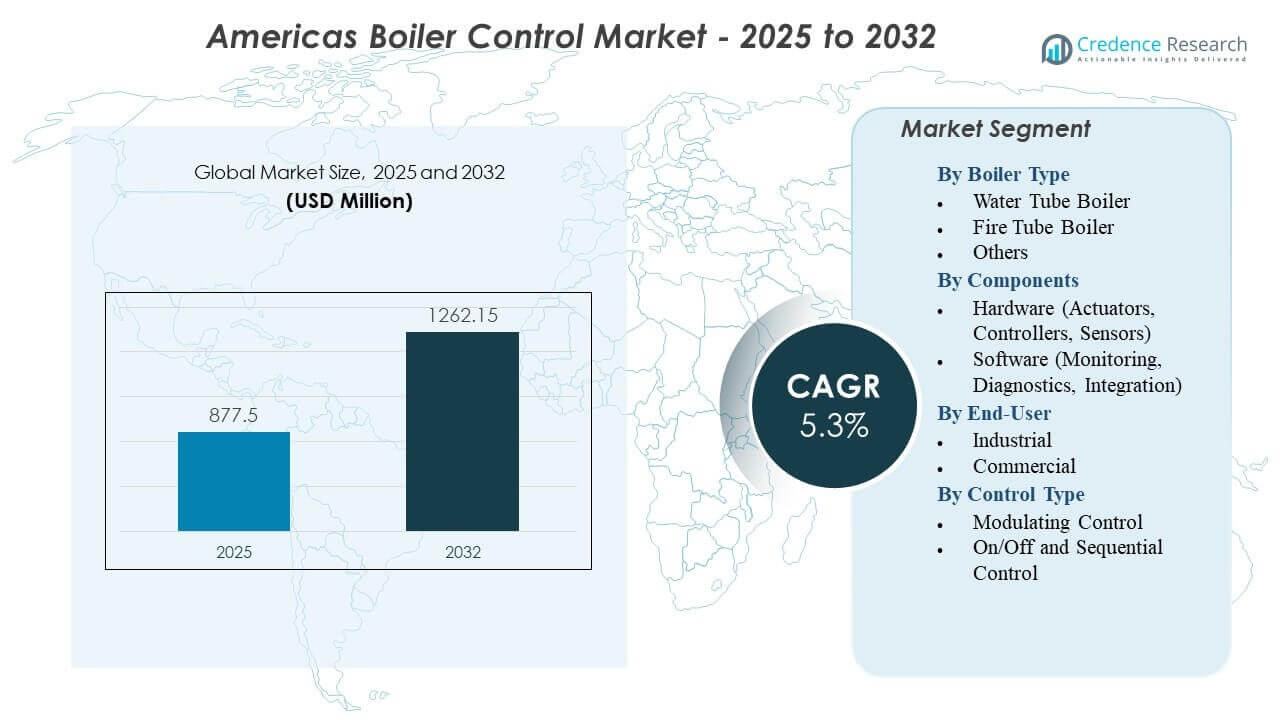
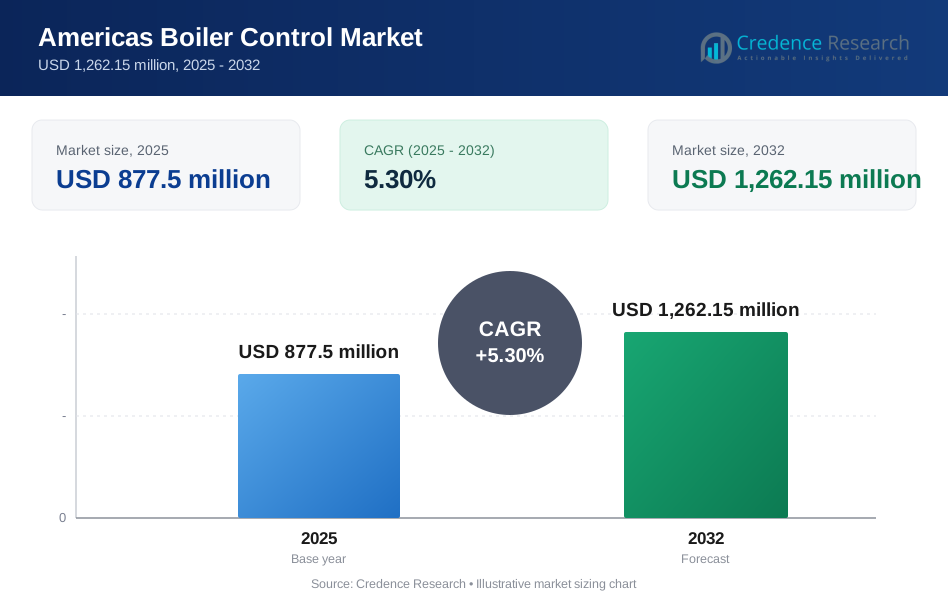
The Americas Boiler Control Market is projected to grow from USD 877.5 million in 2025 to an estimated USD 1,262.15 million by 2032, with a compound annual growth rate (CAGR) of 5.3% from 2025 to 2032.
| REPORT ATTRIBUTE | DETAILS |
|---|---|
| Historical Period | 2020-2024 |
| Base Year | 2025 |
| Forecast Period | 2026-2032 |
| Americas Boiler Control Market Size 2025 | USD 877.5 million |
| Americas Boiler Control Market, CAGR | 5.3% |
| Americas Boiler Control Market Size 2032 | USD 1,262.15 million |
Americas Boiler Control Market Insights:
- Strong demand for automation, combustion optimization, and real-time diagnostics strengthens adoption as industries work to reduce fuel use, enhance safety, and streamline maintenance.
- Restraints emerge from high upgrade costs, integration complexity across aging boiler fleets, and varying technical skill levels, slowing adoption in smaller facilities.
- North America leads the market with the highest share due to strict emission rules, a large installed base, and rapid digital transformation across industrial sectors.
- Latin America grows steadily as Brazil and Mexico expand industrial automation, while emerging economies increase investment in safer, more efficient heating and steam systems.
Americas Boiler Control Market Drivers
Growing Need For Efficient Thermal Performance And Real-Time Combustion Control
Stricter emission rules across industries push companies to improve steam generation efficiency, which strengthens demand for advanced boiler control systems. Many plants aim to stabilize fuel usage, so modern platforms help maintain steady combustion quality. The Americas Boiler Control Market benefits from upgraded digital solutions that enhance burner precision. Companies seek systems that reduce heat loss and help optimize temperature levels. Strong pressure from sustainability goals pushes operators to replace outdated analog units. Industries value consistent steam output for production stability. It supports safety improvements by preventing irregular combustion events. Many facilities also invest in automation to meet workforce shortages across technical roles.
Rising Demand For Automation-Enabled Safety And Compliance Across Industrial Plants
Industries across the region require automated safety layers to meet updated compliance frameworks. It supports seamless integration of burner management functions that reduce operator errors. Power plants and refineries adopt controls that ensure quick response to abnormal conditions. Many facilities install intelligent sensors to track pressure, fuel balance, and flame signals. Companies use automation to reduce shutdown risks linked to inconsistent handling. The Americas Boiler Control Market grows because users expect secure and reliable systems. New standards encourage facilities to improve hazard detection. Strong digital adoption in North America accelerates safety-driven upgrades across older boiler assets. Operators also value enhanced system diagnostics for smoother operation.
- For instance, Rockwell Automation’s AADvance Safety System is TÜV-certified to SIL 3 and is verified to handle high-integrity burner management applications, as detailed in Rockwell’s safety certification documentation.
Increasing Focus On Predictive Maintenance And Equipment Life Extension Strategies
Industries seek modern tools that predict component failure early, helping them avoid unexpected downtime. Predictive platforms support fleet-wide visibility, which is vital for plants with high steam usage. Advanced control systems integrate analytics that refine operating cycles. The Americas Boiler Control Market gains traction as users extend the lifespan of aging boiler fleets. Many companies prefer solutions that improve decision-making for maintenance teams. Plants value monitoring tools that detect inefficiencies before they escalate. It helps reduce repair costs related to burner faults, leaks, and flow disruptions. Adoption grows across manufacturing, food processing, chemicals, and energy facilities. Strong digital interest boosts long-term investment plans.
Growing Adoption Of Energy-Efficient Heat Generation Across Commercial And Industrial Sites
Energy conservation goals push organizations to upgrade boiler controls to support efficient heat delivery. Many commercial buildings integrate advanced systems to manage variable load conditions. Modern platforms balance fuel and airflow more accurately than legacy options. The Americas Boiler Control Market expands as users target lower operating costs. Industries with continuous steam demand prioritize solutions that improve repeatability. It helps cut excess fuel burn caused by poor calibration. Many operators also adopt O2 trim controls to meet emission targets. Growing interest in smart buildings supports wider commercial adoption. Heat-intensive industries continue to modernize boilers to meet energy goals.
- For instance, Yokogawa’s combustion control solutions have documented up to a 15% reduction in excess O₂ levels, directly improving boiler efficiency and lowering fuel consumption in industrial steam systems.
Americas Boiler Control Market Trends
Integration Of IoT, Cloud Monitoring, And Connected Boiler Ecosystems
Companies invest in connected systems that offer remote visibility into thermal operations. IoT-enabled controllers allow engineers to track performance across multiple sites. Cloud dashboards help operators analyze trends with greater accuracy. The Americas Boiler Control Market sees more deployments linked to real-time monitoring. Many plants adopt wireless sensors for easier retrofits. It helps operators respond faster to abnormal patterns. Connected ecosystems support centralized decision-making for large enterprises. Demand rises for platforms that blend automation with cloud insights. Industries continue shifting toward digitally unified heat management networks.
- For instance, Honeywell’s Thermal IQ platform provides cloud-based boiler monitoring with secure data transmission and real-time alerts, enabling remote visibility with logged performance data points at one-minute intervals as published in Honeywell’s technical documentation.
Shift Toward Low-NOx Combustion Controls Driven By Emission Regulations
Regions with strict environmental legislation adopt low-NOx burners paired with precision controls. Modern systems manage fuel-air ratios with high accuracy to cut pollutant output. Plants upgrade boilers to meet compliance rules across energy and manufacturing sectors. The Americas Boiler Control Market benefits from high interest in clean combustion. It supports new installations that focus on reducing environmental impact. Many companies select controls that maintain steady flame shape. Demand rises for systems that adjust operating points based on load conditions. Emission-focused modernization continues across industrial hubs. Strong policy influence pushes faster adoption of advanced combustion controls.
- For instance, Cleaver-Brooks’ ProFire SBR burners are verified to achieve sub-30 ppm NOx emissions without external flue-gas recirculation, as documented in Cleaver-Brooks’ certified performance sheets.
Increasing Deployment Of Modular, Scalable, And Retrofit-Friendly Control Solutions
Industries prefer modular systems that align with plant expansions and evolving energy needs. Many sites operate mixed boiler fleets, so scalable controls offer needed flexibility. Retrofit-friendly platforms support quick modernization without full replacement. The Americas Boiler Control Market grows as plants pick systems that reduce installation barriers. It allows companies to replace outdated panels in small steps. Many operators value tools that adapt to different burner types. It supports smoother upgrades for facilities with complex heating networks. Scalable design trends strengthen long-term adoption patterns. Plants continue shifting toward flexible automation frameworks.
Rising Use Of Advanced HMI Designs To Improve Operator Interaction And Decision Accuracy
Modern HMI dashboards provide clear real-time data, which improves operator decision-making. Touchscreen layouts reduce training time for new technicians. Plants demand systems that simplify alarm handling to prevent response delays. The Americas Boiler Control Market benefits from improved user interfaces that enhance workflow efficiency. Many companies adopt HMIs that display combustion metrics in intuitive formats. It helps reduce errors linked to outdated analog gauges. Operators rely on visual tools to manage fluctuating load requirements. Interest grows in HMIs that integrate process trends and diagnostics. User-centered design influences new product development across vendors.
Americas Boiler Control Market Challenges Analysis
High Integration Complexity And Cost Barriers Across Aging Industrial Boiler Fleets
Many plants operate decades-old boilers that require complex upgrades to support digital control systems. Integration challenges slow adoption because engineering teams must adapt old wiring and hardware. Companies face high upfront investment for automation upgrades that include safety loops. The Americas Boiler Control Market feels pressure from budget constraints across smaller industries. It becomes difficult for operators to align modernization needs with limited capital cycles. Many facilities also struggle with inconsistent documentation for legacy systems. It increases the time needed to ensure compliance during retrofits. Plants depend on skilled technicians who remain in short supply. This shortage complicates planning for long-term digital upgrades.
Regulatory Variability, Technical Skill Gaps, And Maintenance Burden Across The Region
Different countries maintain varying emission frameworks, creating uncertainty for manufacturers and users. The Americas Boiler Control Market must adapt solutions for multiple compliance structures. Many operators struggle to maintain advanced digital systems because training resources remain uneven. It creates gaps in handling alarms, calibration steps, and combustion tuning. Plants experience downtime when teams lack expertise to manage new automation layers. Many companies face difficulty in sourcing certified technicians for periodic inspections. It increases operational risks linked to mismanaged burner systems. Stronger workforce development is needed to support regional modernization.
Americas Boiler Control Market Opportunities
Growth Potential In Digital Retrofitting, Predictive Analytics, And Smart Thermal Optimization
Many industries look for retrofit solutions that upgrade performance without replacing core boiler hardware. Digital controls that support predictive analytics help optimize steam generation. The Americas Boiler Control Market gains an opportunity to expand across facilities with aging assets. It encourages vendors to offer packages that improve combustion stability. Companies value tools that cut operating costs with real-time tuning. Predictive models reduce failure rates and help operators plan maintenance. Many plants seek cloud-linked optimization platforms for multi-site fleets. Strong interest in automation supports growth in digital transformation programs. Demand for heat efficiency improvement continues to rise.
Expansion Across Emerging Latin American Markets And Distributed Commercial Heating Networks
Latin American countries modernize industrial facilities, creating demand for reliable control systems. Many sectors adopt automation to improve energy performance and lower emissions. The Americas Boiler Control Market sees strong opportunity across food processing, chemicals, and light manufacturing. It supports distributed heating networks that need smarter control layers. Many commercial buildings invest in systems that enhance thermal efficiency. Regional growth accelerates where governments promote cleaner industrial operations. It creates openings for vendors offering scalable and easy-to-install solutions. Strong modernization momentum strengthens long-term adoption. Commercial and industrial sectors continue seeking better thermal management frameworks.
Americas Boiler Control Market Segmentation Analysis:
By Boiler Type
Water tube boilers hold strong demand because industries rely on high-pressure steam systems for continuous operations. Many plants prefer these units for their efficiency, which strengthens adoption across large facilities. Fire tube boilers maintain steady use across commercial spaces and small industrial settings where lower pressure requirements dominate. It gains traction in retrofit projects because installation is simple. The Americas Boiler Control Market supports growth across both types through automation upgrades. Others in this category include hybrid and specialty boilers used in niche applications. These options help users meet varied operational needs. Each type benefits from rising interest in digital control modernization.
- For instance, Babcock & Wilcox’s water-tube boilers have documented operating pressures exceeding 2,000 psi in industrial service, as verified in B&W’s technical performance manuals.
By Components
Hardware leads adoption because actuators, controllers, and sensors form the core of boiler control functions. It supports precise combustion control and stable thermal output. Many facilities replace legacy hardware to meet safety and emission standards. Software gains momentum due to real-time diagnostics and monitoring features. Plants use integrated platforms to enhance decision-making and reduce downtime. The Americas Boiler Control Market benefits from demand for intelligent, connected systems. Many users prefer solutions that unify hardware and software into a single interface. Growth continues as industries shift toward data-centered thermal management.
- For instance, Siemens’ SQM40 servo actuators provide angular positioning accuracy of ±0.1°, a documented specification that enables precise fuel-air ratio control in industrial boiler systems.
By End-User
Industrial users dominate due to heavy reliance on steam in chemicals, pharmaceuticals, power generation, and food processing. These sectors require stable, automated control systems to manage operational loads. It drives consistent investment in advanced combustion and safety technologies. Commercial users expand deployment across hospitals, schools, and large buildings. They focus on energy efficiency and reliable heating performance. The Americas Boiler Control Market supports both segments through scalable platforms. Many commercial facilities adopt modern controls to reduce operating costs. Strong modernization efforts across regions continue to raise adoption levels.
By Control Type
Modulating controls lead due to their precision and ability to match heat output with changing demand. Many plants choose these systems to maintain stable fuel-air ratios. It helps improve efficiency and reduce emissions. On/Off and sequential controls continue to serve smaller or simpler boiler setups. These solutions offer cost benefits for facilities with predictable load patterns. The Americas Boiler Control Market supports both approaches depending on system size. Many operators shift toward modulation to gain tighter performance control. Demand grows as end users prioritize efficiency improvements across steam networks.
Segmentation:
By Boiler Type
- Water Tube Boiler
- Fire Tube Boiler
- Others
By Components
- Hardware (Actuators, Controllers, Sensors)
- Software (Monitoring, Diagnostics, Integration)
By End-User
- Industrial
- Commercial
By Control Type
- Modulating Control
- On/Off and Sequential Control
Regional Analysis:
North America holds the largest share of the [Americas Boiler Control Market], contributing an estimated 62–65% due to its extensive industrial base and strong adoption of advanced automation systems. The United States leads this growth with strict emission rules and a large installed boiler fleet that requires continuous upgrades. Canada strengthens regional demand through investments in energy, chemicals, and commercial heating networks. It benefits from modernization programs that target higher operational efficiency. Facilities across North America prioritize digital retrofits to reduce fuel costs and improve reliability. Strong regulatory enforcement supports stable long-term adoption across industries.
Latin America accounts for 25–28% of the market and shows steady expansion driven by industrial growth in Brazil, Mexico, Argentina, and Chile. These economies invest in process automation to support manufacturing, food processing, and energy production. It gains momentum as industries replace legacy controls to improve safety and meet environmental rules. Many regional facilities adopt modular control systems that suit mixed boiler fleets. Modernization projects across oil, gas, and chemicals strengthen the region’s demand outlook. Rising energy requirements support continuous upgrades across commercial and industrial users.
The remaining 7–10% share comes from emerging economies across Central America and the Caribbean, where adoption remains slower but continues to expand. Many facilities in these regions operate older mechanical systems, which creates long-term opportunities for vendors focused on cost-effective retrofits. It gains support from growing interest in energy-efficient heating solutions. Stakeholders in these countries gradually adopt automation to reduce operational disruptions. Demand strengthens as governments encourage cleaner and safer thermal operations. Rising urban development expands the use of automated boiler systems across commercial buildings.
Key Player Analysis:
- ABB Ltd.
- Emerson Electric Co.
- Honeywell International Inc.
- Schneider Electric
- Siemens AG
- Yokogawa Electric Corp.
- Cleaver-Brooks
- Babcock & Wilcox
- Fulton Boiler Works
- Hurst Boiler & Welding Co.
Competitive Analysis:
The competitive landscape of the [Americas Boiler Control Market] features strong participation from automation leaders, industrial boiler manufacturers, and specialized control solution providers. Companies compete on reliability, integration capability, emission control performance, and long-term system support. It drives innovation in hardware precision, advanced HMI design, and real-time monitoring tools. Major players focus on retrofit-friendly systems that support both water tube and fire tube installations. Many vendors strengthen their presence through partnerships with OEMs and service providers. Competition intensifies as users demand scalable platforms that unify combustion control, safety loops, and performance optimization. Vendors also invest in analytics-driven features to help operators reduce fuel consumption and improve maintenance planning. The market continues to shift toward digital ecosystems that deliver consistent, measurable value across industrial and commercial facilities.
Recent Developments:
- In November 2025, Watts Water Technologies Inc. completed its acquisition of Superior Boiler, a designer and manufacturer of customized steam and hot water boilers. This move expands Watts' capabilities in commercial, institutional, and industrial heating solutions, leveraging Superior's sales network for growth.
- In May 2024, Honeywell launched the SLATE Combustion Management System and Thermal IQ at BOILER 2024 in Colorado. These advanced solutions offer superior flexibility, real-time analytics, fault detection, and enhanced efficiency for boiler operations.
Report Coverage:
The research report offers an in-depth analysis based on Boiler Type, Components, End-User, and Control Type. It details leading market players, providing an overview of their business, product offerings, investments, revenue streams, and key applications. Additionally, the report includes insights into the competitive environment, SWOT analysis, current market trends, as well as the primary drivers and constraints. Furthermore, it discusses various factors that have driven market expansion in recent years. The report also explores market dynamics, regulatory scenarios, and technological advancements that are shaping the industry. It assesses the impact of external factors and global economic changes on market growth. Lastly, it provides strategic recommendations for new entrants and established companies to navigate the complexities of the market.
Future Outlook:
- Digital retrofitting will accelerate adoption across older industrial facilities as operators target higher efficiency and safer combustion control.
- Growth in predictive diagnostics will help users reduce downtime and extend boiler lifespan through real-time system insights.
- Rising interest in connected ecosystems will push demand for cloud-linked control platforms with centralized monitoring capabilities.
- Strong regulatory pressure will drive upgrades to cleaner combustion solutions, increasing demand for precision fuel-air management.
- Expanding industrial automation programs will strengthen integration of boiler controls into plant-wide digital frameworks.
- Commercial buildings will adopt smarter heating networks supported by advanced modulation control for energy optimization.
- Demand for scalable platforms will rise as facilities upgrade mixed boiler fleets across industrial corridors in the region.
- Continued modernization in Latin America will open new opportunities for flexible, retrofit-ready control solutions.
- User preference for intuitive HMIs and streamlined operator workflows will shape the design of future control architectures.
- Vendors will compete through analytics-driven innovations that deliver measurable performance improvements and stronger lifecycle value.
Request a Free Sample
Fill in your details and we'll send you a free sample report.
- Sample data tables & charts
- Research methodology
Need a Custom Version of This Report?
Tailor the scope, geography, or segments to your exact requirements.
- Custom geography or segment scope
- Direct access to our analyst team
Frequently Asked Questions
What is the current market size for the Americas Boiler Control Market, and what is its projected size in 2032?
At what Compound Annual Growth Rate is the Americas Boiler Control Market projected to grow between 2025 and 2032?
Which segment held the largest share in the Americas Boiler Control Market in 2025?
What are the primary factors fueling the growth of the Americas Boiler Control Market?
Who are the leading companies in the Americas Boiler Control Market?
Which region commanded the largest share of the Americas Boiler Control Market in 2025?
Table of Content
Chapter 1 Market Segmentation
- 1.1 Segmentation Framework
- 1.1.1 Product and Service Classification
- 1.1.2 Application and End-Use Classification
- 1.1.3 Technology and Solution Classification
- 1.1.4 Customer and Distribution Channel Classification
- 1.1.5 Geographic Segmentation
- 1.1.6 Market Segment Definitions and Boundaries
Chapter 2 Introduction
- 2.1 Report Objectives and Scope
- 2.2 Product Definition and Industry Terminology
- 2.3 Market Inclusions and Exclusions
- 2.4 Research Process
- 2.4.1 Primary Research and Expert Interviews
- 2.4.2 Secondary Research and Source Review
- 2.4.3 Top-Down and Bottom-Up Estimation
- 2.4.4 Data Triangulation and Verification
- 2.5 Market Size Measurement Basis
- 2.5.1 2025: USD 877.5 million → 2032: USD 1,262.15 million
- 2.6 Historical and Forecast Reference Periods
- 2.6.1 Base Year: 2025
- 2.6.2 Forecast Period: 2025-2032
- 2.7 Research Assumptions and Limitations
Chapter 3 Executive Summary
- 3.1 Market Snapshot and Key Findings
- 3.2 Base-Year Market Size, 2025
- 3.3 Forecast Market Size, 2032
- 3.4 Revenue and Volume Growth Outlook
- 3.5 Key Demand and Supply Indicators
- 3.6 Leading Market Segments
- 3.7 Fastest-Growing Market Opportunities
- 3.8 Regional Performance Highlights
- 3.9 Technology and Industry Transformation
- 3.10 Competitive Landscape Summary
- 3.11 Analyst View and Strategic Implications
Chapter 4 Americas Boiler Control Market Trends and Developments
- 4.1 Historical Industry Development
- 4.2 Recent Market Trends and Developments
- 4.3 Demand and Customer Behavior Trends
- 4.4 Technology and Product Innovation
- 4.5 Artificial Intelligence, Automation and Digitalization
- 4.6 Local Manufacturing and Supply Chain Realignment
- 4.7 Industry Partnerships, Mergers and Acquisitions
- 4.8 Sustainability and Circular Economy Developments
- 4.9 Government and Private Sector Investment Trends
- 4.10 Emerging Business Models and Commercialization
- 4.11 Industry Developments and Announcements
Chapter 5 Americas Boiler Control Market Production, Supply and Demand Analysis
- 5.1 Demand Trend and Consumption Analysis
- 5.2 Demand Forecast, 2025-2032
- 5.3 Production and Output Trend
- 5.4 Production and Output Forecast, 2025-2032
- 5.5 Installed Capacity and Capacity Utilization
- 5.6 Company-Wise Production Plants and Statistics
- 5.6.1 Installed Production Capacity
- 5.6.2 Actual Production
- 5.6.3 Planned Capacity and Expansion Targets
- 5.7 Supply Chain Structure and Procurement Trends
- 5.8 Supply-Demand Gap and Bottlenecks
- 5.9 Import Dependence and Sourcing Structure
- 5.10 Contract Manufacturing and Outsourcing
- 5.11 Regional Supply and Demand Concentration
Chapter 6 Americas Boiler Control Market Pricing Analysis
- 6.1 Pricing Structure and Measurement
- 6.2 Historical Pricing Trends
- 6.3 Pricing Outlook, 2025-2032
- 6.4 Average Selling Price and Unit Economics
- 6.5 Pricing by Product and Market Segment
- 6.6 Geographic Pricing Differences
- 6.7 Key Input, Energy, Labor and Logistics Costs
- 6.8 Contract Pricing and Purchasing Models
- 6.9 Pricing Sensitivity and Competitive Positioning
- 6.10 Price, Margin and Profitability Implications
Chapter 7 Americas Boiler Control Market Dynamics
- 7.1 Market Growth Drivers
- 7.1.1 Demand-Side Drivers
- 7.1.2 Technology and Innovation Drivers
- 7.1.3 Infrastructure and Investment Drivers
- 7.1.4 Regulatory and Policy Drivers
- 7.2 Market Restraints
- 7.2.1 Cost and Affordability Constraints
- 7.2.2 Technology and Adoption Barriers
- 7.2.3 Supply Chain and Operational Constraints
- 7.3 Market Challenges
- 7.3.1 Competitive Pressure and Margin Erosion
- 7.3.2 Skills, Infrastructure and Implementation Gaps
- 7.4 Emerging Market Opportunities
- 7.5 Market Dynamics Impact and Time-Horizon Assessment
Chapter 8 Americas Boiler Control Value Chain Analysis
- 8.1 Industry Value Chain Overview
- 8.2 Upstream Suppliers and Critical Inputs
- 8.3 Technology and Component Providers
- 8.4 Manufacturing or Service Delivery
- 8.5 Distribution, Channel Partners and Integrators
- 8.6 Downstream Applications and End Users
- 8.7 Value Addition and Profit Pools
- 8.8 Vertical Integration and Outsourcing
- 8.9 Supplier Concentration and Risk
- 8.10 Supply Chain Localization and Resilience
Chapter 9 Americas Boiler Control Market Regulations and Policies
- 9.1 Relevant Laws, Standards and Compliance Frameworks
- 9.2 Product, Service, Safety and Quality Requirements
- 9.3 Government Policies, Incentives and Subsidies
- 9.4 Imports, Exports and Trade Barriers
- 9.5 Public Procurement and Local Content Requirements
- 9.6 Environmental and Sustainability Compliance
- 9.7 Upcoming Policy Changes and Market Implications
Chapter 10 Americas Boiler Control Market Hotspots and Opportunities
- 10.1 Market Opportunity Mapping and Growth Hotspots
- 10.2 High-Growth Applications and Customer Groups
- 10.3 Underserved Markets and White-Space Opportunities
- 10.4 Emerging Technology and Product Opportunities
- 10.5 New Capacity and Investment Hotspots
- 10.6 Market Entry and Expansion Opportunities
- 10.7 Distribution and Partnership Opportunities
- 10.8 Near-Term and Long-Term Commercial Potential
- 10.9 Opportunity Attractiveness and Execution Risks
Chapter 11 Americas Boiler Control Market Outlook, 2025-2032
- 11.1 Market Size and Analysis
- 11.1.1 Revenue (Market Measurement: 2025: USD 877.5 million → 2032: USD 1,262.15 million)
- 11.1.2 Market Volume and Quantity Sold
- 11.1.3 Historical Market Size
- 11.1.4 Base-Year Market Size, 2025
- 11.2 Market Forecast, 2025-2032
- 11.2.1 Revenue Forecast to 2032
- 11.2.2 Volume Forecast to 2032
- 11.2.3 CAGR and Year-on-Year Growth
- 11.2.4 Incremental Revenue Opportunity
- 11.3 Forecast Assumptions and Scenario Analysis
- 11.3.1 Base-Case Forecast
- 11.3.2 Optimistic and Conservative Scenarios
- 11.3.3 Technology, Pricing and Policy Sensitivities
- 11.4 Market Attractiveness and Growth Outlook
Chapter 12 Americas Boiler Control Market Segmentation and Outlook
- 12.1 Segmentation Summary and Market Shares, 2025
- 12.2 Largest and Fastest-Growing Segments
- 12.3 Segment Growth Comparison
- 12.4 Segment Attractiveness and Priority Matrix
Chapter 13 Americas Boiler Control Geographic Market Outlook, 2025-2032
- 13.1 Domestic Market Distribution and Demand Clusters
- 13.2 State- or Province-Wise Market Size and Forecast, 2025-2032
- 13.3 City and Metropolitan Market Outlook
- 13.4 Industrial, Manufacturing and Commercial Clusters
- 13.5 Geographic Concentration of Key End Users
- 13.6 Local Pricing and Purchasing Differences
- 13.7 Domestic Production Facilities and Capacity Map
- 13.8 Local Infrastructure and Project Pipeline
- 13.9 State-Level Policy and Incentive Differences
- 13.10 Subnational Investment Hotspots and Opportunities
- 13.11 Distribution and Logistics Networks
- 13.12 Domestic Competitive Footprint
Chapter 14 Americas Boiler Control Technology, Innovation and Sustainability Outlook
- 14.1 Technology Landscape and Maturity
- 14.2 Product, Process and Service Innovation
- 14.3 AI, Automation and Digital Tools in the Industry
- 14.4 Technology Adoption and Performance Benchmarking
- 14.5 Innovation Pipeline and R&D Investment
- 14.6 Patent and Intellectual Property Trends
- 14.7 Energy Efficiency and Resource Management
- 14.8 Sustainability, Recycling and Circularity
- 14.9 Technology Roadmap, 2025-2032
- 14.10 Risks of Obsolescence and Technology Substitution
Chapter 15 Americas Boiler Control Market Key Strategic Imperatives
- 15.1 Growth and Market Entry Priorities
- 15.2 High-Return Products and Segments
- 15.3 Pricing, Profitability and Cost Optimization
- 15.4 Technology Investment and Product Differentiation
- 15.5 Supply Chain Localization and Resilience
- 15.6 Distribution and Customer Acquisition
- 15.7 Partnership, Acquisition and Capacity Strategy
- 15.8 Regional Expansion Priorities
- 15.9 Short-, Medium- and Long-Term Actions
Chapter 16 Competition Outlook
- 16.1 Industry Competition Characteristics
- 16.2 Market Structure and Concentration
- 16.3 Market Share and Competitive Positioning, 2025
- 16.4 Company-Wise Revenue and Product Benchmarking
- 16.5 Production and Service Capacity Benchmarking
- 16.6 Technology, Pricing and Differentiation
- 16.7 Regional Footprint and Distribution Strength
- 16.8 Mergers, Acquisitions and Strategic Alliances
- 16.9 New Entrants and Competitive Threats
- 16.10 Porter's Five Forces and Industry Attractiveness
- 16.11 Competitive Outlook, 2025-2032
Chapter 17 Company Profiles
- 17.1 Company Coverage and Selection Criteria
- 17.2 Leading Market Participants – Standard Profile Structure
- 17.2.1 Business Description
- 17.2.2 Company Ownership and Geographic Presence
- 17.2.3 Product and Service Portfolio
- 17.2.4 Manufacturing and Operating Footprint
- 17.2.5 Production Capacity and Expansion Plans
- 17.2.6 Financial Performance and Investment
- 17.2.7 Market Share and Competitive Position
- 17.2.8 Technology and Innovation Capabilities
- 17.2.9 Strategic Alliances or Partnerships
- 17.2.10 Recent Developments
- 17.2.11 Growth Strategy and Outlook
- 17.3 Other Relevant Market Participants
Note: Every listed company is profiled on the structure shown under the first company. The company list is preliminary and may change based on research findings, market developments, data availability and client requirements.
Chapter 18 Disclaimer
- 18.1 Research and Forecast Disclaimer
- 18.2 Data Source and Estimation Limitations
Note: The depth of individual sections depends on data availability for this market. Volume, capacity, trade and other unit-based metrics are included where applicable.