
Industrial Boilers Market Overview:
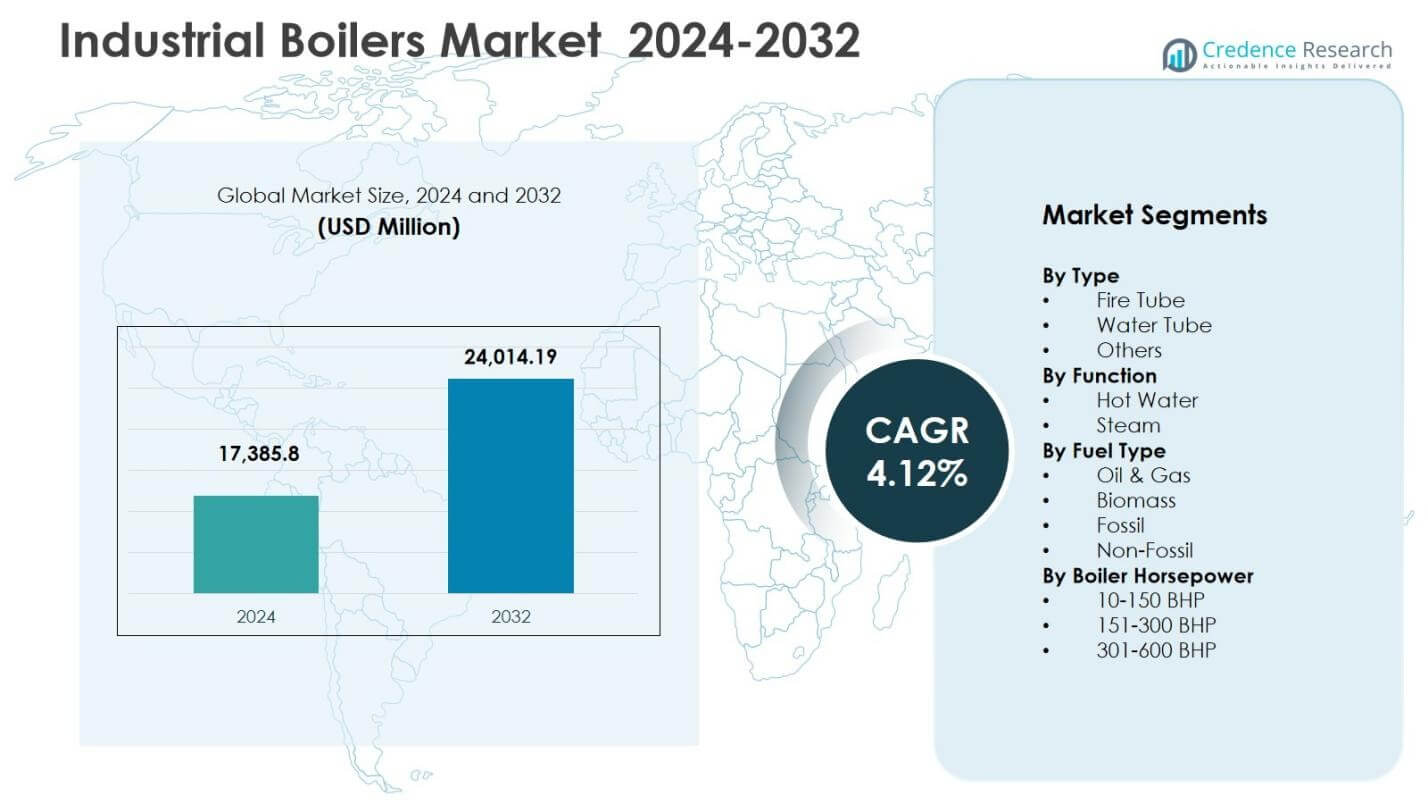
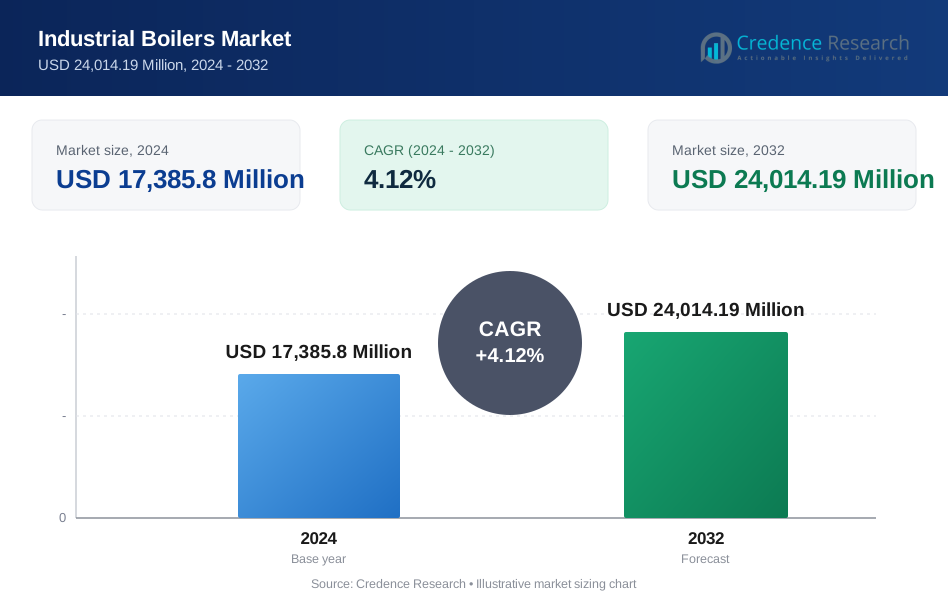
Industrial Boilers Market size was valued USD 17,385.8 Million in 2024 and is anticipated to reach USD 24,014.19 Million by 2032, at a CAGR of 4.12% during the forecast period.
| REPORT ATTRIBUTE | DETAILS |
|---|---|
| Historical Period | 2020-2023 |
| Base Year | 2024 |
| Forecast Period | 2025-2032 |
| Industrial Boilers Market Size 2024 | USD 17,385.8 million |
| Industrial Boilers Market, CAGR | 4.12% |
| Industrial Boilers Market Size 2032 | USD 24,014.19 million |
Industrial Boilers Market Insights
- Market growth is driven by rising industrial production, modernization of processing facilities, and increasing demand for high-efficiency steam systems across chemicals, power generation, food processing, and metals industries.
- Key trends include the adoption of biomass and hybrid-fuel boiler technologies, integration of digital monitoring and automation, and a strong shift toward energy-efficient and low-emission boiler solutions across large manufacturing plants.
- Major players focus on product innovation, high-capacity water-tube systems, lifecycle optimization, and strategic partnerships, with the Steam segment leading the market in 2024 with a 71.4% share due to strong demand from process-intensive industries.
- Asia-Pacific dominated the market with 38.9% share in 2024, followed by North America at 24.6% and Europe at 21.4%, while Latin America and the Middle East & Africa together accounted for the remaining regional share.
Industrial Boilers Market Segmentation Analysis:
By Type
In the Industrial Boilers Market, the Water Tube segment dominated in 2024 with a 58.3% share, driven by its high-pressure handling capability, superior thermal efficiency, and suitability for large industrial processing facilities in power generation, petrochemicals, and refining. The Fire Tube segment accounted for 33.7% as it remains preferred in small and medium-scale manufacturing plants due to lower installation and maintenance costs, while the Others segment held 8.0% supported by niche industrial applications. Growth in the dominant Water Tube category is reinforced by rising investments in high-capacity boiler systems and stricter energy-efficiency norms.
- For instance, Superior Boiler equipped a Midwest beef processing facility with four 1,500-horsepower Mohican firetube boilers, including deaerators, to enable reliable steam for production expansion with factory-tested efficiency.
By Function
The Steam segment led the Industrial Boilers Market in 2024 with a 71.4% share, supported by widespread adoption in food processing, chemicals, pulp and paper, and power generation industries where continuous steam supply is critical for process heating and turbine operations. The Hot Water segment accounted for 28.6%, driven by demand from district heating networks, commercial facilities, and light-industrial utilities. The dominance of the Steam category is primarily driven by expanding industrial output, increasing process automation, and capacity expansions across heavy-duty manufacturing sectors.
- For instance, Bosch installed its CSB steam boiler system at Polish food manufacturer Witpol Sp. z o.o., enabling production of 70 million beverage packages annually through precise steam control for cleaning, sterilization, and enzymatic processes.
By Fuel Type
The Oil & Gas segment dominated the Industrial Boilers Market in 2024 with a 46.2% share, driven by widespread fuel availability, stable combustion efficiency, and compatibility with retrofit boiler systems across refineries, chemicals, and metals industries. The Fossil segment accounted for 23.5% owing to continued use of coal-fired units in developing economies, while the Biomass segment held 18.9%, supported by decarbonization initiatives and renewable-fuel adoption in agro-processing and paper industries. The Non-Fossil segment represented 11.4%, reflecting gradual transition toward cleaner boiler operations and sustainability-focused industrial investments.
Key Growth Drivers
Rising Industrial Output and Expansion of Process Industries
The Industrial Boilers Market grows significantly as manufacturing, chemicals, refining, power generation, food processing, and pulp and paper industries expand their production capacities. Increasing investments in process automation, continuous power and heat generation, and modernization of industrial infrastructure strengthen demand for high-capacity and energy-efficient boiler systems. Emerging economies are witnessing strong industrialization momentum, particularly across Asia-Pacific, where governments promote large-scale manufacturing clusters and industrial corridors. The need for uninterrupted process heating, steam generation, and thermal stability across production lines further accelerates boiler installations, reinforcing the role of industrial boilers as a critical backbone of core industrial ecosystems.
- For instance, J.G. Boswell, a tomato processing company, uses two Cleaver-Brooks industrial watertube boilers to process approximately 4,800 tons of fresh tomatoes per day. The boilers provide flash steam cooking to mash tomatoes into paste, supporting continuous operations.
Shift Toward Energy Efficiency and Emission-Optimized Boiler Technologies
Growing emphasis on energy efficiency, operational cost optimization, and emission reduction drives industries to adopt advanced boiler systems with improved combustion performance and heat recovery capabilities. Stricter regulatory frameworks relating to carbon emissions, fuel consumption, and industrial pollution compliance compel manufacturing facilities to upgrade legacy boilers with modern, high-efficiency units. The integration of features such as condensate recovery, real-time monitoring, and automated control systems reduces fuel loss and enhances thermal efficiency. Industries increasingly invest in upgraded boiler designs to achieve sustainability goals, improve lifecycle performance, and align with global energy-transition objectives.
- For instance, Metro Group replaced 25-year-old gas burners on Scotch Marine Boilers in a Brooklyn residential building, integrating fuel-saving technology with the Building Management System to reduce fuel costs and energy consumption without full replacement.
Rising Adoption of Renewable and Alternative Fuel-Based Boiler Systems
The increasing transition toward biomass, biofuel, and hybrid fuel boiler technologies acts as a strong growth catalyst for the Industrial Boilers Market. Industries seek to reduce dependency on conventional fossil fuels while lowering operational emissions and carbon footprints. Supportive government incentives for renewable energy integration, waste-to-energy utilization, and circular-economy initiatives encourage industries to deploy biomass-fired and multi-fuel boiler configurations. Sectors such as agro-processing, food and beverage, and pulp and paper increasingly utilize organic residues and process byproducts as feedstock fuels, enabling both cost savings and environmental sustainability, while strengthening demand for alternative-fuel boiler systems.
Key Trends & Opportunities
Digitalization, Automation, and Smart Boiler Monitoring Solutions
A major emerging trend in the Industrial Boilers Market is the accelerated adoption of digital control systems, Industrial IoT-enabled monitoring platforms, and predictive maintenance technologies. Smart boiler technologies enable real-time tracking of pressure levels, temperature parameters, fuel consumption efficiency, and equipment health, reducing downtime and improving operational reliability. Remote performance monitoring and AI-driven diagnostics enhance maintenance planning and lifecycle optimization. This trend creates strong opportunities for manufacturers offering boiler automation, intelligent sensors, cloud-based analytics, and integrated efficiency-management platforms, supporting industries in achieving productivity gains and performance transparency.
- For instance, Byworth Boilers partnered with ABB to integrate the Freelance DCS into their Unity intelligent boiler-house control system, offering remote access to trended data like pressure, temperature, and water levels.
Growing Demand for Modular, Decentralized, and Compact Boiler Solutions
Industries increasingly adopt modular and compact boiler systems to support flexible plant layouts, decentralized energy supply configurations, and faster installation timelines. Modular boilers enable scalability, easier maintenance, and cost-efficient upgrades, making them highly suitable for industries undergoing phased capacity expansion or brownfield modernization. The trend toward decentralized steam and heat generation in processing clusters and distributed industrial utilities creates new opportunities for portable, skid-mounted, and containerized boiler units. Manufacturers benefit from growing demand for space-efficient boiler solutions that reduce infrastructure costs while ensuring operational reliability and energy efficiency.
- For instance, Superior Boiler supplied four 1,500-horsepower Mohican firetube boilers to a Midwest beef processing facility for expansion, each factory fire-tested for minimal on-site commissioning and reliable high-capacity steam generation.
Key Challenges
High Capital Investment and Operating Costs Associated with Boiler Systems
One of the key challenges in the Industrial Boilers Market is the substantial capital expenditure required for procurement, installation, and commissioning of large-capacity boiler systems. Additional cost burdens arise from structural reinforcements, fuel-supply infrastructure, emission-control units, and compliance-driven upgrades. Operating costs related to fuel consumption, routine maintenance, skilled labor, and periodic system inspections further increase lifecycle expenditure. These financial constraints affect small and mid-scale industrial facilities, delaying modernization initiatives and limiting adoption of advanced boiler technologies, especially in cost-sensitive markets.
Regulatory Compliance Pressure and Environmental Sustainability Constraints
Industrial boiler operators face increasing challenges in meeting stringent environmental regulations related to greenhouse-gas emissions, particulate discharge, and industrial pollutant control. Governments across major economies continue to tighten compliance requirements for combustion efficiency and emission thresholds, compelling industries to invest in costly retrofitting, filtration systems, and emission-control technologies. Non-compliance risks operational penalties, shutdown liabilities, and reputational concerns. At the same time, industries must balance productivity needs with sustainability expectations, creating operational and financial pressure as they transition from conventional fossil-fuel boilers to cleaner and regulatory-compliant alternatives.
Regional Analysis
North America
North America held a strong position in the Industrial Boilers Market in 2024, accounting for 24.6% market share, driven by the dominance of the oil and gas, chemicals, power generation, and food processing industries. The United States leads the region due to modernization of aging industrial infrastructure and adoption of energy-efficient boiler technologies supported by regulatory emission standards. Demand is reinforced by investments in refinery expansion, process heating systems, and industrial automation. Canada contributes significantly through its mining and pulp and paper sectors, while growing replacement of coal-based systems with gas-fired and hybrid boilers further strengthens regional market growth.
Europe
Europe accounted for 21.4% market share in 2024, supported by stringent environmental regulations, strong industrial base, and rapid adoption of high-efficiency and low-emission boiler systems across manufacturing and processing industries. Countries such as Germany, the United Kingdom, France, and Italy drive demand through modernization of industrial assets and transition toward cleaner fuel technologies. Energy-intensive sectors including chemicals, pharmaceuticals, and food and beverages remain major boiler consumers. The region also witnesses rising installations of biomass-based boilers under decarbonization programs and sustainability targets, reinforcing technology upgrades and boosting market opportunities across both established industries and emerging industrial clusters.
Asia-Pacific
Asia-Pacific emerged as the leading region in the Industrial Boilers Market in 2024 with 38.9% market share, driven by rapid industrialization, large-scale manufacturing expansion, and strong investments in power generation, petrochemicals, metals, and processing industries. China, India, Japan, and South Korea remain key contributors, supported by government-led industrial corridors, capacity additions, and infrastructure modernization initiatives. Rising energy demand, growth in steam-intensive industries, and development of export-oriented manufacturing facilities continue to accelerate boiler installations. The region also experiences increasing deployment of biomass and multi-fuel boilers as industries pursue cost optimization and sustainability-focused operational strategies.
Latin America
Latin America accounted for 8.1% market share in 2024, supported by industrial growth across oil refining, mining, food processing, and chemical manufacturing sectors. Brazil and Mexico lead regional demand through ongoing capacity expansion projects and modernization of existing industrial facilities. Increasing investments in process heating, power backup systems, and industrial utilities strengthen the requirement for medium-capacity boiler units. The shift toward natural gas and biomass-based boilers is gaining traction as industries prioritize fuel diversification and operational efficiency. Rising participation of regional manufacturing clusters and government initiatives to boost industrial productivity further support steady market development.
Middle East & Africa
The Middle East and Africa region held 7.0% market share in 2024, driven primarily by strong demand from oil and gas processing, petrochemicals, power generation, and desalination industries. Gulf economies invest heavily in refinery expansions, industrial utilities, and energy infrastructure, stimulating installations of high-capacity steam and water-tube boilers. Africa’s market growth is supported by developing manufacturing bases, mining operations, and food processing industries, particularly in South Africa and Nigeria. Increasing adoption of gas-fired and hybrid boiler systems, along with industrial diversification programs, reinforces future demand while promoting modernization of thermal energy systems across emerging industrial economies.
Industrial Boilers Market Segmentations:
By Type
- Fire Tube
- Water Tube
- Others
By Function
- Hot Water
- Steam
By Fuel Type
- Oil & Gas
- Biomass
- Fossil
- Non-Fossil
By Boiler Horsepower
- 10-150 BHP
- 151-300 BHP
- 301-600 BHP
By Geography
- North America
- U.S.
- Canada
- Mexico
- Europe
- Germany
- France
- U.K.
- Italy
- Spain
- Rest of Europe
- Asia Pacific
- China
- Japan
- India
- South Korea
- South-east Asia
- Rest of Asia Pacific
- Latin America
- Brazil
- Argentina
- Rest of Latin America
- Middle East & Africa
- GCC Countries
- South Africa
- Rest of the Middle East and Africa
Competitive Landscape
Competitive landscape analysis in the Industrial Boilers Market is shaped by leading players such as AMEC Foster Wheeler PLC, Siemens AG, Thermax Limited, Harbin Electric Corporation, Bharat Heavy Electricals Limited, General Electric Company, Dongfang Electric Corporation Ltd., Babcock & Wilcox Enterprises, Inc., IHI Corporation, and AC Boilers S.P.A. The market is characterized by strong focus on product efficiency, fuel flexibility, emission-control integration, and lifecycle performance optimization to meet evolving industrial energy and sustainability requirements. Players emphasize technological innovation in high-capacity water-tube and modular boiler systems, alongside digital monitoring, automation, and predictive maintenance capabilities to enhance operational reliability and reduce downtime. Strategic initiatives include capacity expansions, partnerships with industrial process operators, and modernization of legacy boiler fleets across heavy manufacturing, chemicals, refining, and power sectors. Growing demand for renewable and hybrid-fuel boiler configurations, coupled with decarbonization policies and energy-efficiency mandates, continues to influence competitive positioning and long-term growth strategies across global markets.
Key Player Analysis
- Harbin Electric Corporation
- AMEC Foster Wheeler PLC
- Dongfang Electric Corporation Ltd.
- Siemens A
- Bharat Heavy Electricals Limited
- IHI Corporation
- AC Boilers S.P.A
- Babcock & Wilcox Enterprises, Inc.
- General Electric Company
- Thermax Limited
Recent Developments
- In December 2025, Babcock & Wilcox (B&W) Canada was awarded a contract to supply advanced boiler equipment as part of a boiler refurbishment project at a Canadian pulp and paper mill and received multiple service contracts in North America.
- In April 2025, The Environmental Group Limited acquired Advanced Boilers & Combustion Pty Ltd for $5.5 million, enhancing its industrial boiler manufacturing and service capabilities with exclusive Maxitherm technology rights.
- In January 2024, Thermon Group Holdings Inc. acquired Vapor Power International, LLC, expanding its offerings in electric resistance and low-emission boiler technologies.
Report Coverage
The research report offers an in-depth analysis based on Type, Function, Fuel Type, Boiler Horsepower and Geography. It details leading market players, providing an overview of their business, product offerings, investments, revenue streams, and key applications. Additionally, the report includes insights into the competitive environment, SWOT analysis, current market trends, as well as the primary drivers and constraints. Furthermore, it discusses various factors that have driven market expansion in recent years. The report also explores market dynamics, regulatory scenarios, and technological advancements that are shaping the industry. It assesses the impact of external factors and global economic changes on market growth. Lastly, it provides strategic recommendations for new entrants and established companies to navigate the complexities of the market.
Future Outlook
- The Industrial Boilers Market will witness steady growth as process industries continue to expand and modernize their production facilities.
- Manufacturers will increasingly adopt high-efficiency and low-emission boiler technologies to meet regulatory and sustainability requirements.
- Demand for biomass-fired and hybrid-fuel boiler systems will rise as industries prioritize decarbonization and fuel diversification.
- Digitalization, remote monitoring, and predictive maintenance solutions will play a larger role in improving boiler performance and operational reliability.
- Modular and compact boiler designs will gain traction to support flexible plant layouts and faster project deployment.
- Investment in boiler upgrades and replacement of aging systems will increase across developed and emerging industrial economies.
- Asia-Pacific will remain a key growth hub due to rapid industrialization and expansion of steam-intensive manufacturing sectors.
- Collaboration between boiler manufacturers and industrial automation companies will strengthen technology integration and lifecycle efficiency.
- R&D efforts will focus on heat recovery, waste-to-energy utilization, and advanced combustion technologies.
- Sustainability-driven procurement policies and industry-wide energy transition initiatives will significantly influence future boiler adoption patterns.
Request a Free Sample
Fill in your details and we'll send you a free sample report.
- Sample data tables & charts
- Research methodology
Need a Custom Version of This Report?
Tailor the scope, geography, or segments to your exact requirements.
- Custom geography or segment scope
- Direct access to our analyst team
Frequently Asked Questions
What is the current market size for the Industrial Boilers Market, and what is its projected size in 2032?
At what Compound Annual Growth Rate is the Industrial Boilers Market projected to grow between 2024 and 2032?
Which Industrial Boilers Market segment held the largest share in 2024?
What are the primary factors fueling the growth of the Industrial Boilers Market?
Who are the leading companies in the Industrial Boilers Market?
Which region commanded the largest share of the Industrial Boilers Market in 2024?
Table of Content
Chapter 1. Report Introduction
- 1.1 Report Description & Purpose
- 1.1.1 Report Title & Market Definition
- 1.1.2 Unique Selling Propositions (USP) & Key Differentiators
- 1.1.3 Value Proposition for Stakeholders
- 1.2 Research Objectives
- 1.2.1 Market Sizing Objectives (Volume & Revenue) (Volume Where Applicable)
- 1.2.2 Segmentation Objectives
- 1.2.3 Competitive Intelligence Objectives
- 1.2.4 Forecast & Scenario Objectives
- 1.3 Report Scope
- 1.3.1 Industrial Boilers Scope – Segments & Subsegments Covered
- 1.3.2 Geographic Scope – Regions & Countries Covered
- 1.3.3 Historical Period, Base Year & Forecast Period (2024; forecast to 2032)
- 1.3.4 Inclusions & Exclusions
- 1.4 Industry Classification & Applicable Codes
- 1.5 Currency, Measurement Units & Valuation Basis
- 1.6 Target Stakeholders
- 1.7 Limitations & Assumptions
Chapter 2. Executive Summary
- 2.1 Global Industrial Boilers Market Snapshot
- 2.1.1 Market Size – Historical (2024) & Forecast (2024-2032) (2024: USD 17,385.8 Million → 2032: USD 24,014.19 Million)
- 2.1.2 Volume & Revenue – Global Totals (Volume Where Applicable)
- 2.1.3 Key Market Highlights – Top Five Facts
- 2.2 Industrial Boilers Market Segmentation Snapshot
- 2.2.1 Market Split by Region – 2024 vs. 2032
- 2.3 Competitive Snapshot
- 2.3.1 Top 10 Players by Revenue Share – 2024
- 2.3.2 Top 10 Players by Volume Share – 2024 (Volume Where Applicable)
- 2.3.3 Recent Strategic Developments (18-Month Summary)
- 2.4 Key Investment Highlights & Strategic Conclusions
Chapter 3. Industrial Boilers Market Dynamics & Industry Analysis
- 3.1 Market Overview & Context
- 3.1.1 Industrial Boilers Market Position in the Broader Industry Value Chain
- 3.1.2 Demand Structure & Purchasing Dynamics
- 3.1.3 Market Maturity & Development Stage by Region
- 3.2 Industrial Boilers Market Drivers
- 3.3 Industrial Boilers Market Restraints & Challenges
- 3.4 Industrial Boilers Market Opportunities
- 3.5 Porter's Five Forces Analysis
- 3.5.1 Threat of New Entrants
- 3.5.2 Bargaining Power of Suppliers
- 3.5.3 Bargaining Power of Buyers
- 3.5.4 Threat of Substitutes
- 3.5.5 Competitive Rivalry – Intensity Assessment
- 3.6 Industrial Boilers Value Chain Analysis
- 3.6.1 Upstream – Key Inputs, Resources & Suppliers
- 3.6.1.1 Key Input/Resource 1
- 3.6.1.2 Key Input/Resource 2
- 3.6.1.3 Key Input/Resource 3
- 3.6.2 Midstream – Core Operations & Value Creation
- 3.6.2.1 Operating Model & Process Overview
- 3.6.2.2 Key Operating Locations & Capabilities by Company
- 3.6.3 Downstream – Market Channels & End Users
- 3.6.3.1 Direct Sales & Customer Engagement Channels
- 3.6.3.2 Indirect Sales, Intermediaries & Partner Channels
- 3.6.4 Value Chain Profitability Analysis
- 3.6.1 Upstream – Key Inputs, Resources & Suppliers
- 3.7 PESTEL Analysis
- 3.7.1 Political Factors
- 3.7.2 Economic Factors
- 3.7.3 Social Factors
- 3.7.4 Technological Factors
- 3.7.5 Environmental Factors
- 3.7.6 Legal Factors
- 3.8 Industrial Boilers Supply Chain Analysis
- 3.8.1 Critical Input & Resource Availability Risk Assessment
- 3.8.2 Supplier & Operational Concentration Risk (Geographic Exposure)
- 3.8.3 Supply & Service Disruption Impact Analysis
- 3.9 Regulatory & Policy Landscape
Note: The regulatory and policy landscape section covers regulations based on their applicability to the market, Industrial Boilers category, geography, and scope of the study. Only regulatory frameworks with a material impact on operations, compliance, trade, sustainability, or market access are analyzed in detail.
Chapter 4. Key Investment Pockets & Opportunity Analysis
- 4.1 Industrial Boilers Market Attractiveness Analysis
- 4.1.1 By Region – Investment Attractiveness Matrix (Market Size × CAGR)
- 4.2 Absolute Revenue Growth Opportunity
- 4.2.1 By Region – Absolute Revenue Growth Through 2032
- 4.3 Incremental Demand Opportunity
- 4.3.1 By Region – Incremental Demand Through 2032
- 4.3.2 Segment – Incremental Demand
- 4.4 Emerging Submarket Opportunity Deep Dive (Subject to Applicability)
- 4.5 Priority Market Opportunity Scorecards
- 4.5.1 United States
- 4.5.2 Europe
- 4.5.3 Asia
- 4.5.4 Middle East & Africa
Note: Priority market opportunity scorecards reflect the geographic scope and strategic relevance of the study. Listed markets are indicative and may be adapted to the industry.
Chapter 5. Industrial Boilers Cross-Border Trade & Market Access Analysis
- 5.1 International Trade & Cross-Border Activity Overview
- 5.1.1 Global Export Value by Country (2024)
- 5.1.2 Global Export Volume by Country (2024) (Volume Where Applicable)
- 5.1.3 Global Import Value by Country (2024)
- 5.1.4 Global Import Volume by Country (2024) (Volume Where Applicable)
- 5.1.5 Net Trade Balance by Country (2024)
- 5.2 Export Analysis – Segment
- 5.2.1 Category 1 (Applicable Classification Code)
- 5.2.2 Category 2 (Applicable Classification Code)
- 5.2.3 Category 3 (Applicable Classification Code)
- 5.2.4 Category 4 (Applicable Classification Code)
- 5.2.5 Category 5 (Applicable Classification Code)
- 5.3 Import Analysis – Segment
- 5.3.1 Category 1 (Applicable Classification Code)
- 5.3.2 Category 2 (Applicable Classification Code)
- 5.3.3 Category 3 (Applicable Classification Code)
- 5.3.4 Category 4 (Applicable Classification Code)
- 5.3.5 Category 5 (Applicable Classification Code)
- 5.4 Cross-Border Pricing & Transaction Benchmarks
- 5.4.1 Export Pricing – Segment & Country
- 5.4.2 Import Pricing – Segment & Source Country
- 5.4.3 Price Trends (2024)
- 5.5 Key Cross-Border Trade & Delivery Routes
- 5.5.1 Cross-Border Trade/Delivery Route 1
- 5.5.2 Cross-Border Trade/Delivery Route 2
- 5.5.3 Cross-Border Trade/Delivery Route 3
- 5.5.4 Cross-Border Trade/Delivery Route 4
- 5.5.5 Cross-Border Trade/Delivery Route 5
- 5.6 Trade Policy & Market Access Impact Assessment
- 5.6.1 Tariff & Non-Tariff Barriers
- 5.6.2 Regional Trade & Economic Integration Frameworks
- 5.6.3 Bilateral & Multilateral Trade Agreements
- 5.6.4 Cross-Border Operating, Licensing & Localization Requirements
Note: This chapter applies where cross-border trade or delivery is relevant to Industrial Boilers. Goods, services, and digital offerings are assessed using applicable classifications and transaction measures. Import-export volumes, trade balances, and route analyses are included only where meaningful to the market.
Chapter 6. Competitive Landscape & Company Benchmarking
- 6.1 Industrial Boilers Market Concentration & Structure
- 6.1.1 Herfindahl-Hirschman Index (HHI) – vs. 2024
- 6.1.2 Leading, Mid-Sized & Emerging Player Structure
- 6.1.3 Global, Regional & Local Player Dynamics
- 6.2 Industrial Boilers Market Share Analysis – 2024
- 6.2.1 Global Revenue Share by Company
- 6.2.2 Global Volume Share by Company (Volume Where Applicable)
- 6.2.3 Regional Revenue Share
- 6.2.4 Market Share Evolution ( vs. 2024)
- 6.2.5 Company Market Share by Key Segment
- 6.2.6 Company Market Share by Customer Group
- 6.3 Operating Scale, Capacity & Infrastructure Analysis
- 6.3.1 Global Operating Scale & Supply Capacity
- 6.3.2 Resource Utilization & Operating Efficiency
- 6.3.3 Output, Service Delivery & Activity Metrics
- 6.3.4 Operating Footprint & Infrastructure Map
- 6.3.5 Planned Operational & Capacity Expansion
- 6.4 Industrial Boilers Competitive Benchmarking Matrix
- 6.4.1 Revenue, Growth, Profitability & Operating Metric Comparison
- 6.4.2 Channel Revenue Mix
- 6.4.3 Geographic Revenue Exposure
- 6.4.4 R&D Intensity
- 6.4.5 Sustainability Maturity
- 6.5 Strategic Developments in Industrial Boilers (Last 24 Months)
- 6.5.1 Mergers, Acquisitions & Divestments
- 6.5.2 New Products, Services & Solutions in Industrial Boilers
- 6.5.3 Operational & Infrastructure Expansions
- 6.5.4 Strategic Alliances, Joint Ventures & Partnerships
- 6.5.5 Distribution Expansion & Market Entry
- 6.5.6 Sustainability & ESG Initiatives
- 6.6 Competitive Strategy Mapping
- 6.6.1 Leader, Challenger, Follower & Niche Classification
- 6.6.2 Pricing Strategy Comparison
- 6.6.3 Channel Strategy Matrix
Note: Strategic developments are included based on their materiality and the availability of reliable information.
Chapter 7. Global Industrial Boilers Market – By Sales & Delivery Channel
- 7.1 Segment Overview
- 7.1.1 Volume & Revenue Split by Channel (2024 & 2032) (Volume Where Applicable)
- 7.1.2 Channel Mix Evolution (2024-2032)
Chapter 8. Regional Market Analysis – Global Overview
- 8.1 Global Regional Overview
- 8.1.1 Regional Volume Share (Volume Where Applicable)
- 8.1.2 Regional Revenue Share
- 8.1.3 Regional Volume by Region (Volume Where Applicable)
- 8.1.4 Regional Revenue by Region
- 8.1.5 Regional Forecast Through 2032
- 8.2 Cross-Regional Segment Analysis
- 8.2.1 By Sales & Delivery Channel
- 8.2.2 By Competitive Positioning & Price Tier
Chapter 9. North America Industrial Boilers Market
- 9.1 United States
- 9.2 Canada
- 9.3 Mexico
Chapter 10. Europe Industrial Boilers Market
- 10.1 Germany
- 10.2 France
- 10.3 Italy
- 10.4 United Kingdom
- 10.5 Spain
- 10.6 Poland
- 10.7 Russia
- 10.8 Netherlands
- 10.9 Belgium
- 10.10 Sweden
- 10.11 Denmark
- 10.12 Norway
- 10.13 Rest of Europe
Chapter 11. Asia Pacific Industrial Boilers Market
- 11.1 China
- 11.2 India
- 11.3 Japan
- 11.4 South Korea
- 11.5 Thailand
- 11.6 Indonesia
- 11.7 Vietnam
- 11.8 Malaysia
- 11.9 Australia
- 11.10 Rest of Asia Pacific
Chapter 12. Latin America Industrial Boilers Market
- 12.1 Brazil
- 12.2 Argentina
- 12.3 Colombia
- 12.4 Chile
- 12.5 Rest of Latin America
Chapter 13. Middle East Industrial Boilers Market
- 13.1 Saudi Arabia
- 13.2 United Arab Emirates
- 13.3 Turkey
- 13.4 Israel
- 13.5 Iran
- 13.6 Rest of the Middle East
Chapter 14. Africa Industrial Boilers Market
- 14.1 South Africa
- 14.2 Egypt
- 14.3 Nigeria
- 14.4 Morocco
- 14.5 Rest of Africa
Chapter 15. Industrial Boilers Company Profiles
- 15.1 [Company 01]
- 15.1.1 Company Overview
- 15.1.2 Key Management Personnel
- 15.1.3 Products & Services Portfolio
- 15.1.4 Financial Performance
- 15.1.5 Key Market Focus & Geographic Presence
- 15.1.6 Recent Developments & Strategic Initiatives
Note: The company profile list is preliminary and may change based on research findings, market developments, data availability, and client requirements.
Chapter 16. Appendices
- Appendix A – List of Abbreviations & Acronyms
- Appendix B – Industry Classification Code Reference – Full Series
- Appendix C – Supply, Output & Operating Capacity Data Tables
- Appendix D – End-Use & Demand Base Tables
- Appendix E – Demand, Adoption & Usage Assumptions
- Appendix F – Pricing & Revenue Metric Reference Tables
- Appendix G – Company Operations & Infrastructure Database
- Appendix H – Cross-Border Trade & Activity Data Tables (Where Applicable)
- Appendix I – Regulatory Summary Tables
- Appendix J – Primary Research Participant List (Anonymized)
- Appendix K – Primary Research Questionnaire Framework
- Appendix L – Data Sources & Bibliography
- Appendix M – Market Size Divergence & Source Comparison
Chapter 17. Research Methodology
- 17.1 Research Framework & Philosophy
- 17.2 Secondary Research – Sources, Hierarchy & Data Extraction
- 17.3 Data Modeling – Bottom-Up & Top-Down Market Sizing
- 17.4 Primary Research – Stakeholder Framework, LOI & Sample Sizes
- 17.5 Forecast Methodology – Regression, Scenario & Sensitivity Analysis
- 17.6 Quality Control – Four-Layer Validation Framework
- 17.7 Limitations & Standard Assumptions
- 17.8 Disclaimer
