Market Overview
The Anti-Graffiti Coatings Market is projected to grow from USD 119.6 million in 2024 to USD 158.7 million by 2032, registering a compound annual growth rate (CAGR) of 3.6% during the forecast period.
| REPORT ATTRIBUTE | DETAILS |
|---|---|
| Historical Period | 2020-2023 |
| Base Year | 2024 |
| Forecast Period | 2025-2032 |
| Anti-Graffiti Coatings Market Size 2024 | USD 119.6 million |
| Anti-Graffiti Coatings Market, CAGR | 3.6% |
| Anti-Graffiti Coatings Market Size 2032 | USD 158.7 million |
The Anti-Graffiti Coatings Market is witnessing steady growth driven by increasing urbanization, rising infrastructure investments, and the growing need to maintain aesthetic appeal in public and private properties. Governments and municipal bodies are actively adopting anti-graffiti solutions to reduce vandalism-related maintenance costs and preserve cultural landmarks. The construction boom across commercial and residential sectors further propels demand for protective coatings that ensure surface durability and cleanliness. Technological advancements, such as the development of eco-friendly and long-lasting coatings, are enhancing product performance and widening their application scope. Trends indicate a rising preference for water-based and non-toxic formulations due to stricter environmental regulations. Additionally, the market is seeing increased adoption in transportation infrastructure, including railways, buses, and subways, where surface protection is crucial. As consumers become more environmentally conscious, manufacturers are focusing on sustainable solutions that offer both effectiveness and compliance. This growing emphasis on aesthetics, safety, and sustainability continues to shape the trajectory of the anti-graffiti coatings market.
The Anti Graffiti Coatings Market spans key regions including North America, Europe, Asia Pacific, and the Rest of the World. North America holds the largest share due to high public infrastructure investment and regulatory enforcement, while Europe follows with strong demand for sustainable coatings and heritage preservation. Asia Pacific is the fastest-growing region, driven by rapid urban development and government-backed infrastructure projects. The Rest of the World, including Latin America and the Middle East, shows emerging potential supported by urban expansion. Leading players operating across these regions include Sherwin-Williams Company, 3M, Axalta Coating Systems, Avery Dennison Corporation, Graffiti Shield, Hydron Protective Coating, Merck Group, Dulux Group, Wacker Chemie, SEI Industrial Chemicals, Rainguard, Teknos, and Evonik Industries. These companies compete on innovation, environmental compliance, and performance, catering to the diverse needs of public infrastructure, transportation, and commercial sectors globally.
Market Insights
- The Anti Graffiti Coatings Market is expected to grow from USD 119.6 million in 2024 to USD 158.7 million by 2032, registering a CAGR of 3.6% during the forecast period.
- Rising urbanization, expanding infrastructure, and increased public investment in aesthetic preservation are key drivers of market demand.
- High costs of vandalism and surface restoration are prompting municipalities and property owners to invest in protective coatings for long-term savings.
- Water-based, low-VOC, and eco-friendly coatings are gaining popularity due to environmental regulations and consumer preference for sustainable products.
- North America holds 35% of the market, followed by Europe at 30%, Asia Pacific at 25%, and the Rest of the World with a 10% share.
- Performance inconsistencies across different substrates and lack of user awareness in emerging regions continue to challenge market penetration.
- Key players such as Sherwin-Williams, 3M, Axalta, Teknos, and Graffiti Shield compete by focusing on product innovation, regulatory compliance, and regional expansion.
Market Drivers
Increasing Urbanization and Infrastructure Development
The rapid pace of urbanization across developed and emerging economies has significantly increased the demand for surface protection solutions. Growing investments in public infrastructure, including transportation hubs, commercial complexes, and government buildings, are driving the need for coatings that can resist graffiti damage. The Anti Graffiti Coatings Market benefits from this trend by offering effective solutions that help maintain property aesthetics and reduce long-term maintenance costs. It plays a vital role in preserving public and private infrastructure. Municipalities are increasingly prioritizing clean urban landscapes, contributing to market growth. Rising construction activities and smart city initiatives continue to support the market’s expansion globally.
- For instance, Rainguard’s anti-graffiti coatings have been applied to transportation infrastructure such as train stations and bus terminals, providing a protective barrier that allows graffiti to be easily removed without damaging the underlying surfaces, thus supporting municipalities’ efforts to maintain clean urban landscapes.
Rising Costs of Vandalism and Graffiti Removal
Vandalism through graffiti incurs significant cleanup and repair expenses for property owners and public authorities. Increasing awareness regarding the economic burden of graffiti removal is pushing demand for long-lasting protective coatings. The Anti Graffiti Coatings Market addresses this issue by offering advanced formulations that allow quick and easy cleaning without surface damage. It supports budget-conscious institutions in minimizing labor and material costs. Law enforcement agencies and civic bodies are endorsing these solutions to maintain visual standards in public areas. The rising pressure to prevent defacement is a strong market driver.
- For instance, in Brussels, the Schuman Railway/Metro Station uses Solar Gard’s Graffitigard film to protect glass surfaces from scratches, acid etching, and graffiti paint, significantly reducing repair time and maintenance costs.
Government Regulations and Public Cleanliness Policies
Stricter regulations regarding public property maintenance and urban cleanliness are encouraging the use of anti-graffiti technologies. Governments are implementing policies that promote preventive approaches instead of reactive maintenance. The Anti Graffiti Coatings Market aligns well with these objectives, offering eco-friendly products that comply with environmental standards. It ensures surfaces remain clean, reducing the frequency of repainting and refurbishing. Clean city programs and anti-vandalism campaigns are creating favorable conditions for market adoption. Regulatory support is expected to reinforce product demand across regions.
Technological Advancements and Sustainable Formulations
The development of water-based, low-VOC, and high-durability anti-graffiti coatings is transforming the industry. These innovations meet environmental expectations while delivering superior performance in terms of removability and weather resistance. The Anti Graffiti Coatings Market is leveraging research to produce solutions that cater to diverse substrates such as concrete, brick, and metal. It enables faster cleaning and reduces reapplication frequency, offering long-term value. Demand for sustainable construction materials is driving adoption among eco-conscious stakeholders. Ongoing product innovation remains central to market competitiveness.
Market Trends
Growing Demand for Eco-Friendly and Non-Toxic Coatings
Environmental regulations and rising consumer awareness are pushing manufacturers to develop non-toxic and sustainable anti-graffiti coatings. Water-based and low-VOC formulations are gaining popularity across both public and private infrastructure projects. These coatings provide effective graffiti resistance while minimizing environmental impact, making them suitable for schools, hospitals, and heritage sites. The Anti Graffiti Coatings Market is responding to this trend by prioritizing green chemistry in product development. It allows cities to meet cleanliness goals without compromising on sustainability. Regulatory agencies favor eco-certified products, further driving demand.
- For instance, AkzoNobel has developed a range of water-based, low-VOC anti-graffiti coatings that are widely used on urban infrastructure, aligning with sustainability goals and reducing harmful emissions.
Adoption Across Transportation and Transit Infrastructure
Mass transit systems such as railways, buses, and metro stations are frequent targets of graffiti vandalism, creating a consistent need for protective solutions. Transport authorities are increasingly applying anti-graffiti coatings to reduce maintenance frequency and extend surface life. The Anti Graffiti Coatings Market sees strong demand from this sector, where asset appearance and longevity are critical. It provides coatings that withstand frequent cleaning and harsh outdoor conditions. Transportation hubs now integrate these coatings into regular facility upgrades. Investments in urban mobility infrastructure continue to fuel this trend.
Advancement in Nanotechnology-Based Coating Solutions
Innovations in nanotechnology are enhancing anti-graffiti coatings by improving their resistance to abrasion, chemicals, and UV exposure. These coatings form ultra-thin barriers that prevent ink and paint penetration while allowing easy surface cleaning. The Anti Graffiti Coatings Market is embracing nano-coatings to offer longer durability and reduced reapplication costs. It enables effective protection on various surfaces including glass, metal, and masonry. Manufacturers are investing in R&D to integrate nanomaterials into their product portfolios. This trend reflects growing industry focus on high-performance, low-maintenance solutions.
- For instance, Comex Group’s Deletum 3000, a nanotechnology-based anti-graffiti system developed in partnership with Universidad Nacional Autónoma de México.
Integration with Smart City Infrastructure Initiatives
Smart city development projects prioritize clean, well-maintained environments, encouraging wider adoption of anti-graffiti solutions. Authorities are incorporating these coatings into city planning to maintain aesthetics and reduce upkeep costs. The Anti Graffiti Coatings Market is aligning with urban innovation strategies that emphasize preventive maintenance. It supports city managers in achieving visual quality and operational efficiency across public assets. Integration with IoT and monitoring tools also helps track defacement incidents. Anti-graffiti technology is becoming part of smart infrastructure planning worldwide.
Market Challenges Analysis
High Initial Costs and Limited Awareness Among End Users
One of the primary challenges in the Anti Graffiti Coatings Market is the relatively high initial cost of application, which can deter adoption, especially among small businesses and local municipalities with budget constraints. Many end users remain unaware of the long-term benefits of these coatings, including reduced maintenance and surface preservation. This knowledge gap limits the market’s potential in emerging regions. The market must overcome cost-perception issues by highlighting return on investment. It also requires more educational outreach and demonstration of performance benefits to expand user base. Limited awareness continues to slow market penetration despite proven value.
- For instance, Solar Gard’s Graffitigard film was installed on glass surfaces in 34 public elevators at the European Commission Quarters in Brussels, providing a durable barrier against vandalism; however, the adoption of such solutions is sometimes limited by initial cost concerns and lack of awareness about their ease of replacement and effectiveness.
Performance Variability and Surface Compatibility Issues
Another challenge for the Anti Graffiti Coatings Market lies in performance variability across different surfaces and environmental conditions. Some coatings may not adhere well to certain materials or may degrade faster under extreme weather, leading to reduced effectiveness. It raises concerns regarding durability and reapplication frequency, impacting user confidence. Ensuring consistent quality across various substrates such as stone, brick, and metal remains complex. Manufacturers must invest in rigorous testing and customization to meet diverse requirements. Surface-specific limitations hinder broader commercial and industrial use cases.
Market Opportunities
Expansion in Emerging Economies and Infrastructure Growth
Rapid urban expansion and infrastructure development in emerging markets present significant opportunities for the Anti Graffiti Coatings Market. Governments in Asia Pacific, Latin America, and the Middle East are investing heavily in transportation, public buildings, and tourism-related structures, where surface cleanliness is a priority. The market can leverage this momentum by introducing affordable, high-performance products tailored to regional needs. It holds potential to partner with municipal bodies and contractors to integrate coatings in early construction phases. Rising focus on urban aesthetics in developing cities further supports market entry. Strategic distribution and education campaigns can help unlock this untapped demand.
Innovation in Multi-Functional and Smart Coating Solutions
Advancements in coating technologies create new avenues for growth by offering multifunctional benefits such as anti-microbial, self-cleaning, and UV-resistant properties. The Anti Graffiti Coatings Market can expand by developing smart coatings that align with smart city initiatives and sustainability goals. It has the opportunity to cater to industries demanding both protection and efficiency, such as healthcare, hospitality, and education. Integration with IoT-based monitoring tools can also enhance value proposition. Continuous innovation in environmentally safe and longer-lasting solutions will help attract environmentally conscious buyers. This shift opens new markets beyond traditional applications.
Market Segmentation Analysis:
By Product Type
The Anti Graffiti Coatings Market segments by product type into sacrificial, semi-permanent, and permanent coatings. Sacrificial coatings are cost-effective and easy to apply but require reapplication after cleaning. Semi-permanent coatings strike a balance between durability and maintenance, making them popular in public infrastructure. Permanent coatings offer high durability and long-term surface protection, attracting demand from high-traffic urban areas. The market sees growing preference for permanent solutions due to their ability to withstand repeated cleaning. Each type serves distinct end-user needs based on maintenance frequency and budget.
- For instance, Dulux Surfaceshield® S is a sacrificial treatment applied as a clear microfilm; graffiti can be removed safely with hot water, and the coating is then reapplied, making it suitable for public buildings and infrastructure.
By Substrate
The market divides substrates into porous and non-porous surfaces. Porous substrates such as brick, concrete, and stone are commonly found in heritage sites and public buildings, requiring specialized coatings that prevent deep ink penetration. Non-porous substrates like glass, metal, and painted surfaces demand smooth-adhesion coatings with quick-cleaning capabilities. The Anti Graffiti Coatings Market offers tailored formulations to ensure surface compatibility and long-lasting protection. It addresses the unique maintenance challenges of each substrate type. Market players continue to invest in substrate-specific innovations.
- For instance, Sika’s Sikagard®-850 AG is a permanent anti-graffiti coating formulated for concrete, wood, masonry, and metal, providing long-term protection for porous surfaces.
By End-Use Industry
Key end-use industries include transportation, building and construction, automotive, and others. The transportation sector leads due to high exposure to vandalism in metro systems, trains, and buses. Building and construction follow closely, with urban development projects integrating protective coatings into design plans. The automotive sector uses anti-graffiti coatings for vehicle exteriors, especially in fleet management. The Anti Graffiti Coatings Market serves these industries with customized solutions that enhance asset life and visual appeal. Demand across sectors supports sustained market expansion.
Segments:
Based on Product Type
- Sacrificial Coatings
- Semi-Permanent Coatings
- Permanent Coatings
Based on Substrate
- Porous
- Non-Porous
Based on End-Use Industry
- Transportation
- Building & Construction
- Automotive
- Others
Based on the Geography:
- North America
- U.S.
- Canada
- Mexico
- Europe
- Germany
- France
- U.K.
- Italy
- Spain
- Rest of Europe
- Asia Pacific
- China
- Japan
- India
- South Korea
- South-east Asia
- Rest of Asia Pacific
- Latin America
- Brazil
- Argentina
- Rest of Latin America
- Middle East & Africa
- GCC Countries
- South Africa
- Rest of the Middle East and Africa
Regional Analysis
North America
North America dominates the Anti Graffiti Coatings Market with a market share of 35%. Strong urban infrastructure, high spending on public maintenance, and strict cleanliness regulations drive widespread adoption. The U.S. leads the regional demand, with large-scale applications across public transport systems, schools, and government buildings. Cities prioritize preventive maintenance strategies, boosting investments in durable and eco-friendly coatings. Manufacturers benefit from well-established distribution networks and growing demand for advanced, low-VOC formulations. The market in this region continues to benefit from technological innovation and public awareness.
Europe
Europe holds a 30% share of the Anti Graffiti Coatings Market, supported by stringent environmental regulations and a strong focus on heritage preservation. Countries like Germany, France, and the UK invest heavily in maintaining the aesthetic integrity of historical sites, transportation systems, and commercial infrastructure. The region sees increasing demand for water-based and sustainable coatings that comply with EU environmental standards. Public awareness campaigns and urban renewal projects support consistent product demand. Municipalities and private contractors often integrate anti-graffiti solutions in long-term building plans. Product innovation and regulatory compliance drive competition in this region.
Asia Pacific
Asia Pacific accounts for 25% of the Anti Graffiti Coatings Market and shows the fastest growth rate due to rapid urbanization and infrastructure development. Countries like China, India, and Japan are expanding urban landscapes, creating new opportunities for protective coatings. Government investments in transportation, tourism, and public amenities support market expansion. The region faces increasing graffiti-related challenges in metropolitan areas, prompting demand for easy-to-clean, durable solutions. It attracts manufacturers focused on cost-effective, scalable products to meet diverse regional needs. Growth prospects remain strong across both residential and commercial segments.
Rest of the World
The Rest of the World region holds a 10% share in the Anti Graffiti Coatings Market. Latin America and the Middle East show emerging demand, driven by growing urban infrastructure and tourism-focused development. Adoption is slower due to limited awareness and budget constraints. However, targeted awareness campaigns and expanding construction projects are improving prospects. Governments are gradually integrating urban cleanliness standards, contributing to future market growth. Local distributors play a key role in expanding reach.
Key Player Analysis
- Hydron Protective Coating
- Graffiti Shield
- Teknos
- SEI Industrial Chemicals
- Merck Group
- Dulux Group
- Wacker Chemie
- Avery Dennison Corporation
- Sherwin-Williams Company
- 3M
- Axalta Coating Systems
- Rainguard
- Evonik Industries
Competitive Analysis
The Anti Graffiti Coatings Market features a competitive landscape shaped by innovation, product performance, and environmental compliance. Key players such as Sherwin-Williams Company, 3M, and Axalta Coating Systems focus on expanding their product lines with durable, low-VOC formulations. Companies like Graffiti Shield and Hydron Protective Coating specialize in niche protective solutions tailored for specific substrates. The market encourages R&D investment to improve ease of application and weather resistance. Strategic collaborations and acquisitions remain common, with firms aiming to strengthen regional presence and distribution networks. The Anti Graffiti Coatings Market also sees growing activity from players such as Avery Dennison Corporation, Merck Group, and Wacker Chemie, which offer coatings aligned with sustainability goals. Competitive advantage stems from product versatility, regulatory compliance, and the ability to serve multiple end-use industries. The market rewards companies that deliver long-lasting performance while addressing environmental concerns and emerging customer requirements.
Recent Developments
- On March 2023, ProCoat Solutions launched a next-generation anti-graffiti coating system designed specifically for high-traffic areas.
- In October 2023, Hempel A/S announced a joint venture focused on developing sustainable and long-lasting anti-graffiti coatings for the European market.
- In May 2025, ProtectiT Special Protection released its Anti-Graffiti Coating, which can be easily applied to concrete, brick, stone, render, wood, and most metals to provide maximum, long-lasting protection against graffiti.
- In June 2025, Sherwin-Williams updated its 2K Waterbased Anti-Graffiti Coating product data sheet, enhancing its formulation for improved performance and ease of application.
Market Concentration & Characteristics
The Anti Graffiti Coatings Market demonstrates moderate market concentration with the presence of several established players competing on performance, sustainability, and technological innovation. It features a mix of global manufacturers and regional suppliers, each offering tailored solutions for varied substrates and environmental conditions. The market is characterized by steady demand across infrastructure, transportation, and commercial sectors, driven by rising urban development and regulatory focus on cleanliness. Product differentiation primarily depends on coating longevity, environmental compliance, and ease of maintenance. The Anti Graffiti Coatings Market shows high product specialization, with companies investing in R&D to develop eco-friendly, durable, and surface-compatible formulations. It remains price-sensitive in emerging regions, where awareness and budget limitations influence adoption. Strong competition fosters continuous innovation, especially in water-based and low-VOC products. The market also sees increasing integration into smart city initiatives and preventive maintenance frameworks, reflecting its evolving role in long-term urban planning and infrastructure protection.
Report Coverage
The research report offers an in-depth analysis based on Product Type, Substrate, End-Use Industry and Geography. It details leading market players, providing an overview of their business, product offerings, investments, revenue streams, and key applications. Additionally, the report includes insights into the competitive environment, SWOT analysis, current market trends, as well as the primary drivers and constraints. Furthermore, it discusses various factors that have driven market expansion in recent years. The report also explores market dynamics, regulatory scenarios, and technological advancements that are shaping the industry. It assesses the impact of external factors and global economic changes on market growth. Lastly, it provides strategic recommendations for new entrants and established companies to navigate the complexities of the market.
Future Outlook
- Demand for eco-friendly and low-VOC anti-graffiti coatings will continue to grow due to rising environmental regulations.
- Urban development and smart city projects will increase the use of protective coatings on public infrastructure.
- Public transport systems will adopt advanced coatings to reduce maintenance costs and improve surface longevity.
- Innovation in nanotechnology will lead to more durable and easier-to-clean coating formulations.
- Manufacturers will focus on developing substrate-specific solutions for complex surfaces like brick, concrete, and glass.
- Awareness programs and training initiatives will help improve product adoption in emerging markets.
- Strategic partnerships between manufacturers and municipal bodies will drive long-term growth.
- The construction sector will integrate anti-graffiti coatings in both new projects and renovation efforts.
- Expansion into Latin America and the Middle East will offer new revenue opportunities for global players.
- Product customization and sustainability will become key competitive factors across the industry.

Request a Free Sample
Fill in your details and we'll send you a free sample report.
- Sample data tables & charts
- Research methodology
Market Dynamics
Increasing Urbanization and Infrastructure Development
Rapid urban growth and expanding infrastructure projects in both developed and emerging economies are boosting demand for anti-graffiti coatings to protect public and private assets, maintain aesthetics, and reduce long-term maintenance costs.
Rising Costs of Vandalism and Graffiti Removal
The high financial burden associated with graffiti cleanup and surface restoration is prompting municipalities and property owners to invest in protective coatings that enable easier and less costly maintenance.
Government Regulations and Public Cleanliness Policies
Stricter regulations and urban cleanliness initiatives are encouraging the adoption of anti-graffiti coatings, as governments and municipal bodies seek preventive solutions that comply with environmental standards and reduce the frequency of repainting.
Technological Advancements and Sustainable Formulations
Innovations in water-based, low-VOC, and nanotechnology-enhanced coatings are improving product performance, durability, and environmental compliance, making them more attractive to eco-conscious buyers and expanding their application scope.
Adoption in Transportation and Smart City Initiatives
The need to protect transportation infrastructure and the integration of anti-graffiti solutions into smart city projects are driving market growth, as these sectors prioritize asset longevity, cleanliness, and operational efficiency.
Need a Custom Version of This Report?
Tailor the scope, geography, or segments to your exact requirements.
- Custom geography or segment scope
- Direct access to our analyst team
Frequently Asked Questions
What is the current market size for the Anti-Graffiti Coating Market, and what is its projected size in 2032?
At what Compound Annual Growth Rate is the Anti-Graffiti Coating Market projected to grow between 2024 and 2032?
What are the primary factors fueling the growth of the Anti-Graffiti Coating Market?
Who are the major players in the Anti Graffiti Coatings Market?
Which region commanded the largest share of the Anti-Graffiti Coating Market in 2024?
Table of Content
Chapter 1 Market Segmentation
- 1.1 Segmentation Framework
- 1.1.1 Product and Service Classification
- 1.1.2 Application and End-Use Classification
- 1.1.3 Technology and Solution Classification
- 1.1.4 Customer and Distribution Channel Classification
- 1.1.5 Geographic Segmentation
- 1.1.6 Market Segment Definitions and Boundaries
- 1.2 By Substrate
- 1.2.1 Porous
- 1.2.2 Non-Porous
- 1.3 By Product Type
- 1.3.1 Sacrificial Coatings
- 1.3.2 Semi-Permanent Coatings
- 1.3.3 Permanent Coatings
- 1.4 By End-Use Industry
- 1.4.1 Transportation
- 1.4.2 Building & Construction
- 1.4.3 Automotive
- 1.4.4 Others
Chapter 2 Introduction
- 2.1 Report Objectives and Scope
- 2.2 Product Definition and Industry Terminology
- 2.3 Market Inclusions and Exclusions
- 2.4 Research Process
- 2.4.1 Primary Research and Expert Interviews
- 2.4.2 Secondary Research and Source Review
- 2.4.3 Top-Down and Bottom-Up Estimation
- 2.4.4 Data Triangulation and Verification
- 2.5 Market Size Measurement Basis
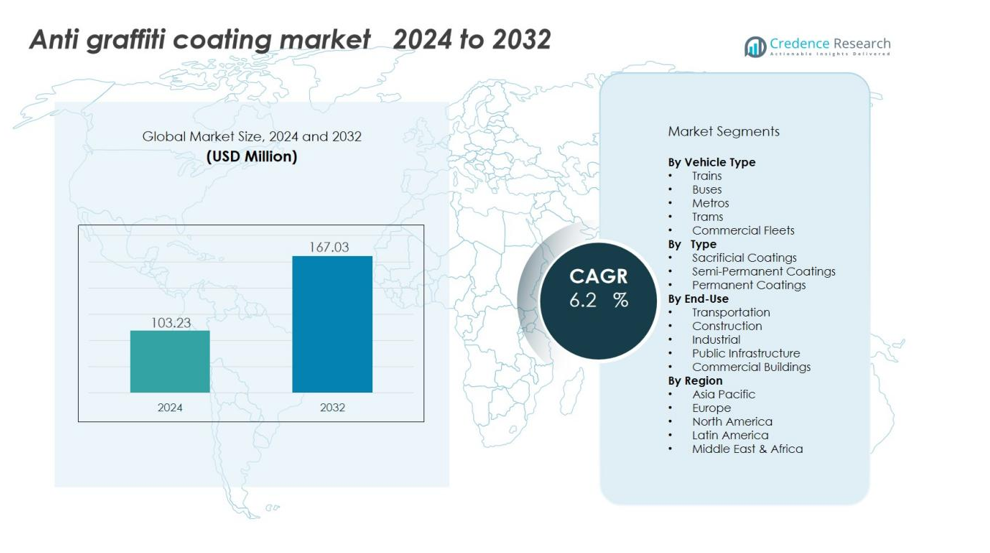
- 2.5.1 2024: USD 103.23 million → 2032: USD 167.03 million
- 2.6 Historical and Forecast Reference Periods
- 2.6.1 Base Year: 2024
- 2.6.2 Forecast Period: 2024-2032
- 2.7 Research Assumptions and Limitations
Chapter 3 Executive Summary
- 3.1 Market Snapshot and Key Findings
- 3.2 Base-Year Market Size, 2024
- 3.3 Forecast Market Size, 2032
- 3.4 Revenue and Volume Growth Outlook
- 3.5 Key Demand and Supply Indicators
- 3.6 Leading Market Segments
- 3.7 Fastest-Growing Market Opportunities
- 3.8 Regional Performance Highlights
- 3.9 Technology and Industry Transformation
- 3.10 Competitive Landscape Summary
- 3.11 Analyst View and Strategic Implications
Chapter 4 Global Anti-Graffiti Coatings Market Trends and Developments
- 4.1 Historical Industry Development
- 4.2 Recent Market Trends and Developments
- 4.3 Demand and Customer Behavior Trends
- 4.4 Technology and Product Innovation
- 4.5 Artificial Intelligence, Automation and Digitalization
- 4.6 Local Manufacturing and Supply Chain Realignment
- 4.7 Industry Partnerships, Mergers and Acquisitions
- 4.8 Sustainability and Circular Economy Developments
- 4.9 Government and Private Sector Investment Trends
- 4.10 Emerging Business Models and Commercialization
- 4.11 Industry Developments and Announcements
Chapter 5 Global Anti-Graffiti Coatings Market Production, Supply and Demand Analysis
- 5.1 Demand Trend and Consumption Analysis
- 5.2 Demand Forecast, 2024-2032
- 5.3 Production and Output Trend
- 5.4 Production and Output Forecast, 2024-2032
- 5.5 Installed Capacity and Capacity Utilization
- 5.6 Company-Wise Production Plants and Statistics
- 5.6.1 Installed Production Capacity
- 5.6.2 Actual Production
- 5.6.3 Planned Capacity and Expansion Targets
- 5.7 Supply Chain Structure and Procurement Trends
- 5.8 Supply-Demand Gap and Bottlenecks
- 5.9 Import Dependence and Sourcing Structure
- 5.10 Contract Manufacturing and Outsourcing
- 5.11 Regional Supply and Demand Concentration
Chapter 6 Global Anti-Graffiti Coatings Market Pricing Analysis
- 6.1 Pricing Structure and Measurement
- 6.2 Historical Pricing Trends
- 6.3 Pricing Outlook, 2024-2032
- 6.4 Average Selling Price and Unit Economics
- 6.5 Pricing by Product and Market Segment
- 6.6 Geographic Pricing Differences
- 6.7 Key Input, Energy, Labor and Logistics Costs
- 6.8 Contract Pricing and Purchasing Models
- 6.9 Pricing Sensitivity and Competitive Positioning
- 6.10 Price, Margin and Profitability Implications
Chapter 7 Global Anti-Graffiti Coatings Market Dynamics
- 7.1 Market Growth Drivers
- 7.1.1 Demand-Side Drivers
- 7.1.2 Technology and Innovation Drivers
- 7.1.3 Infrastructure and Investment Drivers
- 7.1.4 Regulatory and Policy Drivers
- 7.2 Market Restraints
- 7.2.1 Cost and Affordability Constraints
- 7.2.2 Technology and Adoption Barriers
- 7.2.3 Supply Chain and Operational Constraints
- 7.3 Market Challenges
- 7.3.1 Competitive Pressure and Margin Erosion
- 7.3.2 Skills, Infrastructure and Implementation Gaps
- 7.4 Emerging Market Opportunities
- 7.5 Market Dynamics Impact and Time-Horizon Assessment
Chapter 8 Global Anti-Graffiti Coatings Value Chain Analysis
- 8.1 Industry Value Chain Overview
- 8.2 Upstream Suppliers and Critical Inputs
- 8.3 Technology and Component Providers
- 8.4 Manufacturing or Service Delivery
- 8.5 Distribution, Channel Partners and Integrators
- 8.6 Downstream Applications and End Users
- 8.7 Value Addition and Profit Pools
- 8.8 Vertical Integration and Outsourcing
- 8.9 Supplier Concentration and Risk
- 8.10 Supply Chain Localization and Resilience
Chapter 9 Global Anti-Graffiti Coatings Market Regulations and Policies
- 9.1 Relevant Laws, Standards and Compliance Frameworks
- 9.2 Product, Service, Safety and Quality Requirements
- 9.3 Government Policies, Incentives and Subsidies
- 9.4 Imports, Exports and Trade Barriers
- 9.5 Public Procurement and Local Content Requirements
- 9.6 Environmental and Sustainability Compliance
- 9.7 Upcoming Policy Changes and Market Implications
Chapter 10 Global Anti-Graffiti Coatings Market Hotspots and Opportunities
- 10.1 Market Opportunity Mapping and Growth Hotspots
- 10.2 High-Growth Applications and Customer Groups
- 10.3 Underserved Markets and White-Space Opportunities
- 10.4 Emerging Technology and Product Opportunities
- 10.5 New Capacity and Investment Hotspots
- 10.6 Market Entry and Expansion Opportunities
- 10.7 Distribution and Partnership Opportunities
- 10.8 Near-Term and Long-Term Commercial Potential
- 10.9 Opportunity Attractiveness and Execution Risks
Chapter 11 Global Anti-Graffiti Coatings Market Outlook, 2024-2032
- 11.1 Market Size and Analysis
- 11.1.1 Revenue (Market Measurement: 2024: USD 103.23 million → 2032: USD 167.03 million)
- 11.1.2 Market Volume and Quantity Sold
- 11.1.3 Historical Market Size
- 11.1.4 Base-Year Market Size, 2024
- 11.2 Market Forecast, 2024-2032
- 11.2.1 Revenue Forecast to 2032
- 11.2.2 Volume Forecast to 2032
- 11.2.3 CAGR and Year-on-Year Growth
- 11.2.4 Incremental Revenue Opportunity
- 11.3 Forecast Assumptions and Scenario Analysis
- 11.3.1 Base-Case Forecast
- 11.3.2 Optimistic and Conservative Scenarios
- 11.3.3 Technology, Pricing and Policy Sensitivities
- 11.4 Market Attractiveness and Growth Outlook
Chapter 12 Global Anti-Graffiti Coatings Market Segmentation and Outlook
- 12.1 Segmentation Summary and Market Shares, 2024
- 12.2 Largest and Fastest-Growing Segments
- 12.3 By Substrate - Market Size and Forecast, 2024-2032
- 12.3.1 Segment Definition and Scope
- 12.3.2 Historical Market Size
- 12.3.3 Revenue Forecast, 2024-2032
- 12.3.4 Volume Forecast, 2024-2032
- 12.3.5 Base-Year Market Share, 2024
- 12.3.6 Segment CAGR and Growth Drivers
- 12.3.7 Subsegment Market Size and Forecast
- 12.3.7.1 Porous
- 12.3.7.2 Non-Porous
- 12.3.8 Subsegment Pricing and Adoption Trends
- 12.3.9 Leading Suppliers and Competition
- 12.3.10 Regional Demand and Opportunities
- 12.4 By Product Type - Market Size and Forecast, 2024-2032
- 12.4.1 Segment Definition and Scope
- 12.4.2 Historical Market Size
- 12.4.3 Revenue Forecast, 2024-2032
- 12.4.4 Volume Forecast, 2024-2032
- 12.4.5 Base-Year Market Share, 2024
- 12.4.6 Segment CAGR and Growth Drivers
- 12.4.7 Subsegment Market Size and Forecast
- 12.4.7.1 Sacrificial Coatings
- 12.4.7.2 Semi-Permanent Coatings
- 12.4.7.3 Permanent Coatings
- 12.4.8 Subsegment Pricing and Adoption Trends
- 12.4.9 Leading Suppliers and Competition
- 12.4.10 Regional Demand and Opportunities
- 12.5 By End-Use Industry - Market Size and Forecast, 2024-2032
- 12.5.1 Segment Definition and Scope
- 12.5.2 Historical Market Size
- 12.5.3 Revenue Forecast, 2024-2032
- 12.5.4 Volume Forecast, 2024-2032
- 12.5.5 Base-Year Market Share, 2024
- 12.5.6 Segment CAGR and Growth Drivers
- 12.5.7 Subsegment Market Size and Forecast
- 12.5.7.1 Transportation
- 12.5.7.2 Building & Construction
- 12.5.7.3 Automotive
- 12.5.7.4 Others
- 12.5.8 Subsegment Pricing and Adoption Trends
- 12.5.9 Leading Suppliers and Competition
- 12.5.10 Regional Demand and Opportunities
- 12.6 Segment Growth Comparison
- 12.7 Segment Attractiveness and Priority Matrix
Chapter 13 Global Anti-Graffiti Coatings End-Use and Application Market Outlook
- 13.1 End-Use Industry and Customer Demand Structure
- 13.2 Leading Applications and Customer Groups
- 13.3 End-Use Market Size, Share and Forecast
- 13.4 Major End-Use Industry Deep Dives
- 13.4.1 Customer Requirements and Use Cases
- 13.4.2 Demand and Replacement Cycles
- 13.4.3 Technical and Regulatory Considerations
- 13.4.4 Purchasing and Procurement Models
- 13.4.5 Leading Vendors and Distribution Channels
- 13.4.6 Forecast and Commercial Opportunities
- 13.5 Emerging Applications and Cross-Segment Demand
- 13.6 End-Use Industry Investment Priorities
Chapter 14 Global Anti-Graffiti Coatings Geographic Market Outlook, 2024-2032
- 14.1 Regional Market Size and Share, 2024
- 14.2 Regional Market Forecast, 2024-2032
- 14.3 Regional Pricing, Production and Demand Differences
- 14.4 North America
- 14.4.1 United States
- 14.4.2 Canada
- 14.4.3 Mexico
- 14.5 Europe
- 14.5.1 Germany
- 14.5.2 France
- 14.5.3 Italy
- 14.5.4 United Kingdom
- 14.5.5 Spain
- 14.5.6 Poland
- 14.5.7 Russia
- 14.5.8 Netherlands
- 14.5.9 Belgium
- 14.5.10 Sweden
- 14.5.11 Denmark
- 14.5.12 Norway
- 14.5.13 Rest of Europe
- 14.6 Asia Pacific
- 14.6.1 China
- 14.6.2 India
- 14.6.3 Japan
- 14.6.4 South Korea
- 14.6.5 Thailand
- 14.6.6 Indonesia
- 14.6.7 Vietnam
- 14.6.8 Malaysia
- 14.6.9 Australia
- 14.6.10 Rest of Asia Pacific
- 14.7 Latin America
- 14.7.1 Brazil
- 14.7.2 Argentina
- 14.7.3 Colombia
- 14.7.4 Chile
- 14.7.5 Rest of Latin America
- 14.8 Middle East
- 14.8.1 Saudi Arabia
- 14.8.2 United Arab Emirates
- 14.8.3 Turkey
- 14.8.4 Israel
- 14.8.5 Iran
- 14.8.6 Rest of the Middle East
- 14.9 Africa
- 14.9.1 South Africa
- 14.9.2 Egypt
- 14.9.3 Nigeria
- 14.9.4 Morocco
- 14.9.5 Rest of Africa
- 14.10 Regional Investment, Policy and Supply Chain Differences
- 14.11 Regional Competitive Landscape
- 14.12 Geographic Growth Hotspots
Chapter 15 Global Anti-Graffiti Coatings Technology, Innovation and Sustainability Outlook
- 15.1 Technology Landscape and Maturity
- 15.2 Product, Process and Service Innovation
- 15.3 AI, Automation and Digital Tools in the Industry
- 15.4 Technology Adoption and Performance Benchmarking
- 15.5 Innovation Pipeline and R&D Investment
- 15.6 Patent and Intellectual Property Trends
- 15.7 Energy Efficiency and Resource Management
- 15.8 Sustainability, Recycling and Circularity
- 15.9 Technology Roadmap, 2024-2032
- 15.10 Risks of Obsolescence and Technology Substitution
Chapter 16 Global Anti-Graffiti Coatings Market Key Strategic Imperatives
- 16.1 Growth and Market Entry Priorities
- 16.2 High-Return Products and Segments
- 16.3 Pricing, Profitability and Cost Optimization
- 16.4 Technology Investment and Product Differentiation
- 16.5 Supply Chain Localization and Resilience
- 16.6 Distribution and Customer Acquisition
- 16.7 Partnership, Acquisition and Capacity Strategy
- 16.8 Regional Expansion Priorities
- 16.9 Short-, Medium- and Long-Term Actions
Chapter 17 Competition Outlook
- 17.1 Industry Competition Characteristics
- 17.2 Market Structure and Concentration
- 17.3 Market Share and Competitive Positioning, 2024
- 17.4 Company-Wise Revenue and Product Benchmarking
- 17.5 Production and Service Capacity Benchmarking
- 17.6 Technology, Pricing and Differentiation
- 17.7 Regional Footprint and Distribution Strength
- 17.8 Mergers, Acquisitions and Strategic Alliances
- 17.9 New Entrants and Competitive Threats
- 17.10 Porter's Five Forces and Industry Attractiveness
- 17.11 Competitive Outlook, 2024-2032
Chapter 18 Company Profiles
- 18.1 Company Coverage and Selection Criteria
- 18.2 Sherwin-Williams Company
- 18.2.1 Business Description
- 18.2.2 Company Ownership and Geographic Presence
- 18.2.3 Product and Service Portfolio
- 18.2.4 Manufacturing and Operating Footprint
- 18.2.5 Production Capacity and Expansion Plans
- 18.2.6 Financial Performance and Investment
- 18.2.7 Market Share and Competitive Position
- 18.2.8 Technology and Innovation Capabilities
- 18.2.9 Strategic Alliances or Partnerships
- 18.2.10 Recent Developments
- 18.2.11 Growth Strategy and Outlook
- 18.3 3M
- 18.4 Axalta Coating Systems
- 18.5 Avery Dennison Corporation
- 18.6 Graffiti Shield
- 18.7 Hydron Protective Coating
- 18.8 Merck Group
- 18.9 Dulux Group
- 18.10 Wacker Chemie
- 18.11 Teknos
- 18.12 Other Relevant Market Participants
Note: Every listed company is profiled on the structure shown under the first company. The company list is preliminary and may change based on research findings, market developments, data availability and client requirements.
Chapter 19 Disclaimer
- 19.1 Research and Forecast Disclaimer
- 19.2 Data Source and Estimation Limitations
Note: The depth of individual sections depends on data availability for this market. Volume, capacity, trade and other unit-based metrics are included where applicable.