
Privacy rules turn shared model training into a market
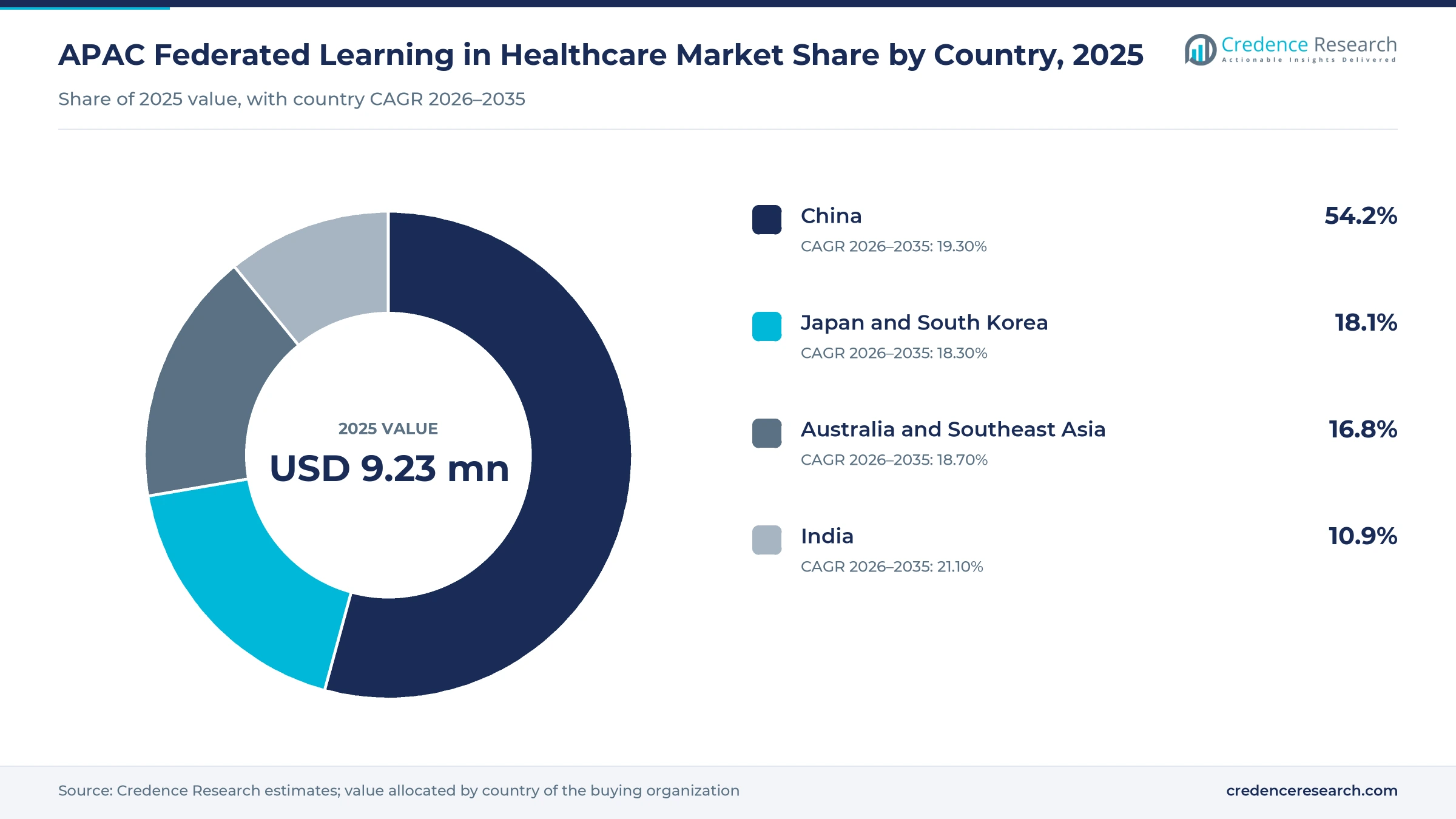
The APAC federated learning in healthcare market was valued at USD 9.23 million in 2025 and is projected to increase from USD 11.0 million in 2026 to USD 53.6 million by 2035, registering a CAGR of 19.23% during 2026–2035. Demand comes from hospitals and diagnostic providers that train imaging models across sites, drug makers that share prediction models without exposing compound data, and research institutions and insurers that analyze records under strict privacy rules. China held the largest country share, 54.2% in 2025, because its hospital base is the largest in the region and its rules restrict moving personal data abroad. India is the fastest-growing country at 21.10% a year, as national health accounts and new data protection rules favor training models where records sit. Japan, South Korea, Australia and Southeast Asia add demand through public research programs and national data platforms. Governments have also begun to fund shared federated centers, which moves the technology from single pilots toward networks of hospitals.
Which federated solutions and services does the estimate cover?
The estimate measures spending on software, managed services, integration work and security infrastructure that let healthcare organizations in the Asia-Pacific region train shared models without pooling patient data. It covers subscriptions, managed service contracts, project fees and usage-based charges paid by hospitals, diagnostic providers, drug makers, research institutions and insurers. Values are measured at the first point of sale to the buying organization.
The estimate excludes general cloud computing, hospital record systems and centralized analytics platforms that do not train models across separate data holders. The value chain runs from open frameworks and chip makers through orchestration software vendors, integrators and security providers to the hospitals, consortia and companies that run federated projects across China, Japan, South Korea, India, Australia and Southeast Asia.
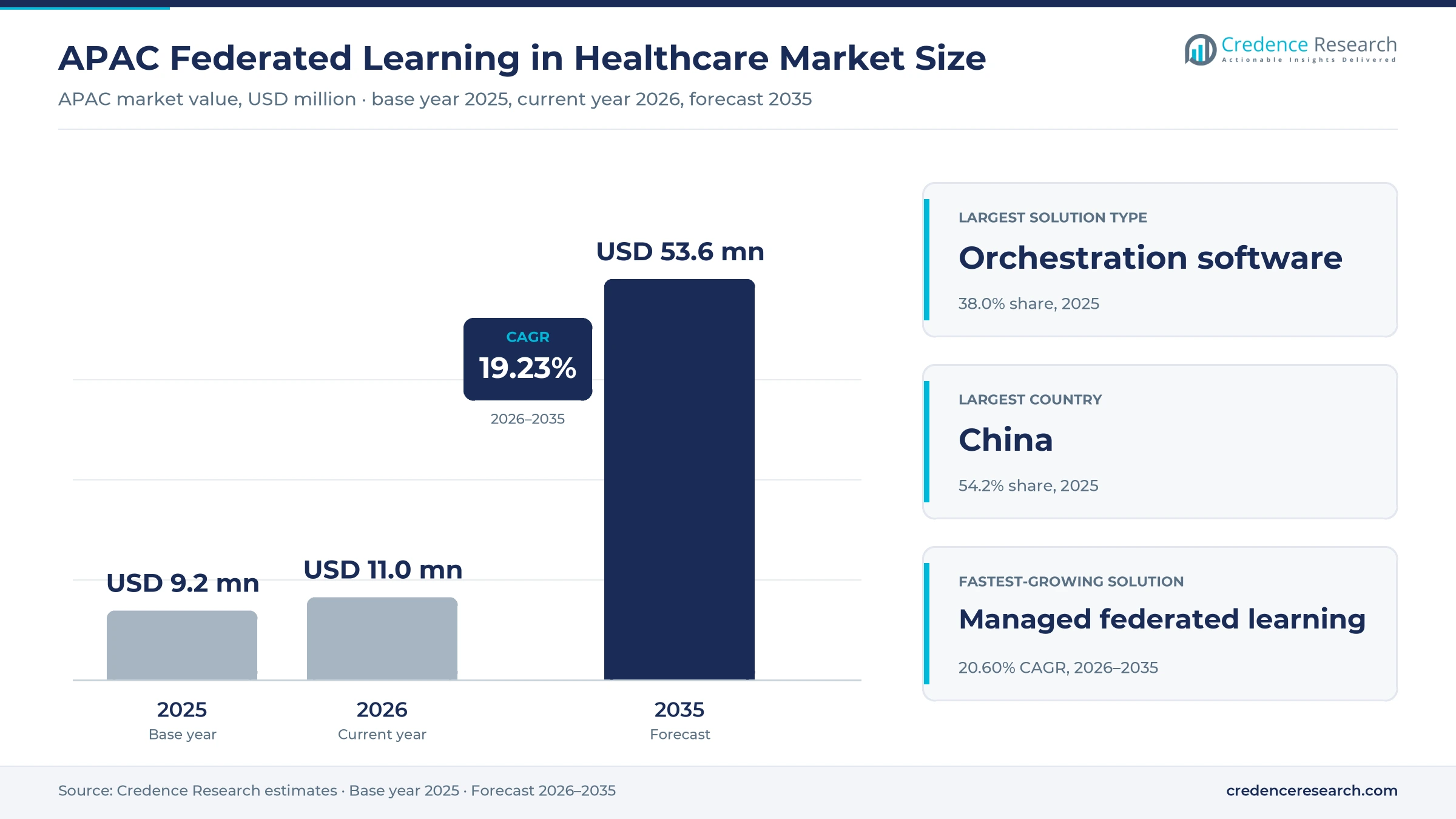
APAC Federated Learning in Healthcare Market Insights
- The APAC federated learning in healthcare market was valued at USD 9.23 million in 2025 and is projected to reach USD 53.6 million by 2035, registering a CAGR of 19.23% during 2026–2035.
- China held a 54.2% share of 2025 value, because it has the largest hospital base and strict rules on moving personal data abroad.
- Orchestration software led solution demand with 38.0% of 2025 value, because every network needs software that runs training rounds.
- Taiwan's health ministry completed a federated proof of concept with 16 major hospitals and announced a national center in January 2026.
- South Korea's K-MELLODDY program has a KRW 34.8 billion budget over five years for federated drug discovery models.
Orchestration software leads, managed services grow fastest
Why does orchestration software lead solution demand?
Based on solution type, the market is categorized into orchestration software, managed federated learning, bundled integration services and bundled security infrastructure. Orchestration Software led with 38.0% of 2025 value, because every network needs software that schedules training rounds and combines model updates. Managed Federated Learning grows fastest at 20.60% a year, as hospitals without data engineering teams hand daily operations to vendors.
Why do on-premise and private cloud setups lead deployment?
Based on deployment model, the market is categorized into on-premise and private cloud, hybrid deployment, public cloud managed service and consortium-hosted deployment. On-Premise and Private Cloud led with 44.0% of 2025 value, because hospitals keep patient data and training nodes inside their own networks. Consortium-Hosted Deployment grows fastest at 20.40% a year, as national centers in Taiwan and Australia host shared infrastructure for many members.
Why do hospitals and diagnostic providers lead customer demand?
Based on customer type, the market is categorized into hospitals and diagnostic providers, pharmaceutical companies, research institutions and health insurers. Hospitals and Diagnostic Providers led with 40.0% of 2025 value, because they hold the images and records that federated models train on. Pharmaceutical Companies grow fastest at 19.95% a year, as drug makers join consortia that protect compound data while improving toxicity and metabolism predictions.
How does medical imaging shape application demand?
Based on application, the market is categorized into medical imaging, drug discovery, clinical records and monitoring, and clinical research and genomics. Medical Imaging led with 41.0% of 2025 value, because image data is standardized and diagnostic models are easier to validate across hospitals. Clinical Research and Genomics grows fastest at 20.30% a year, as national genome studies and multisite trials seek shared analysis without moving records.
| Segment Group | Leading Sub-segment | Share, 2025 | Fastest-growing Sub-segment | CAGR, 2026–2035 |
|---|---|---|---|---|
| By Solution Type | Orchestration Software | 38.0% | Managed Federated Learning | 20.60% |
| By Deployment Model | On-Premise and Private Cloud | 44.0% | Consortium-Hosted Deployment | 20.40% |
| By Customer Type | Hospitals and Diagnostic Providers | 40.0% | Pharmaceutical Companies | 19.95% |
| By Application | Medical Imaging | 41.0% | Clinical Research and Genomics | 20.30% |
Request a Free Sample
Fill in your details and we'll send you a free sample report.
- Sample data tables & charts
- Research methodology
Data rules, multisite studies and open tools lift demand
Privacy constraints push institutions into shared training
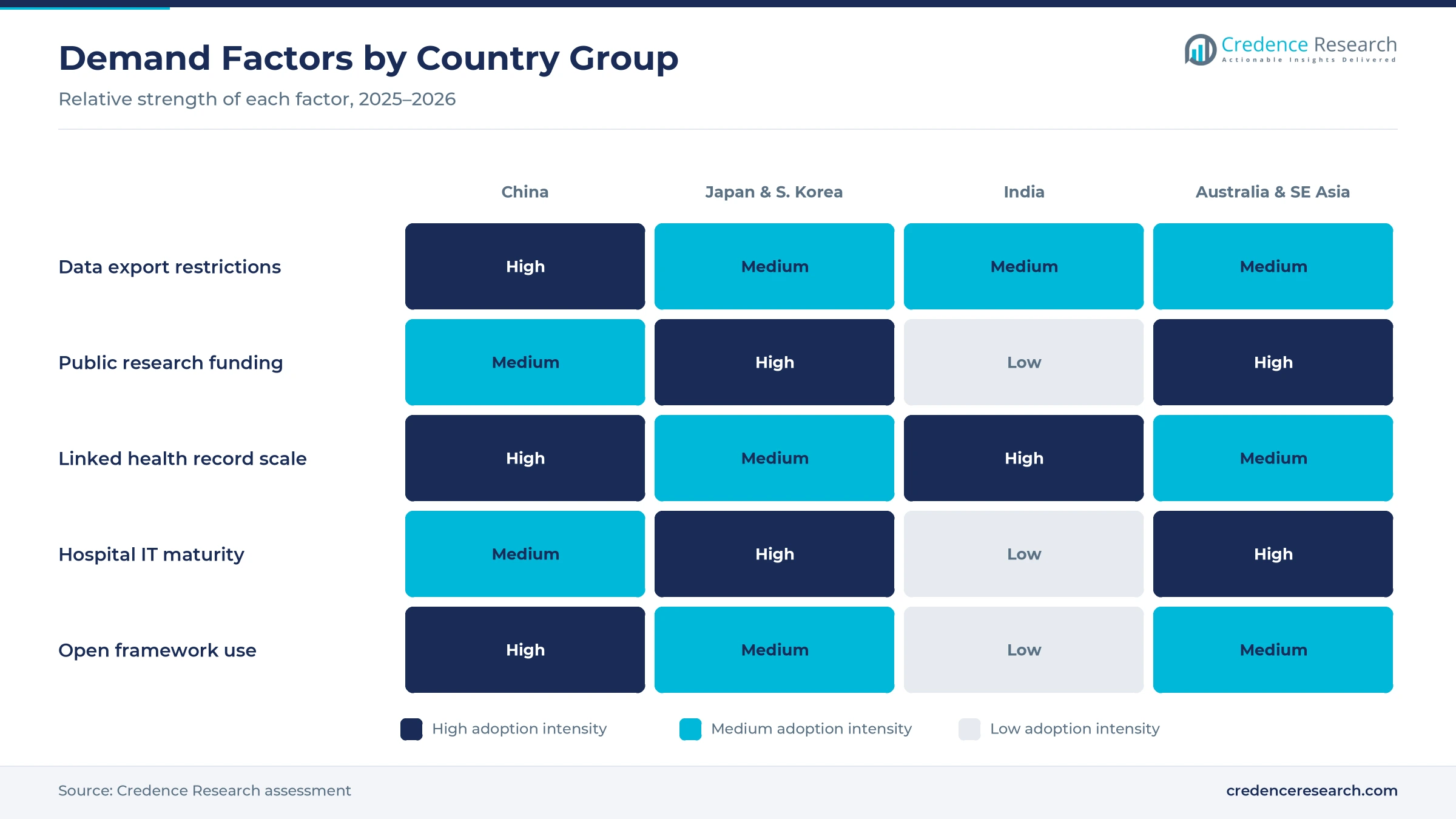
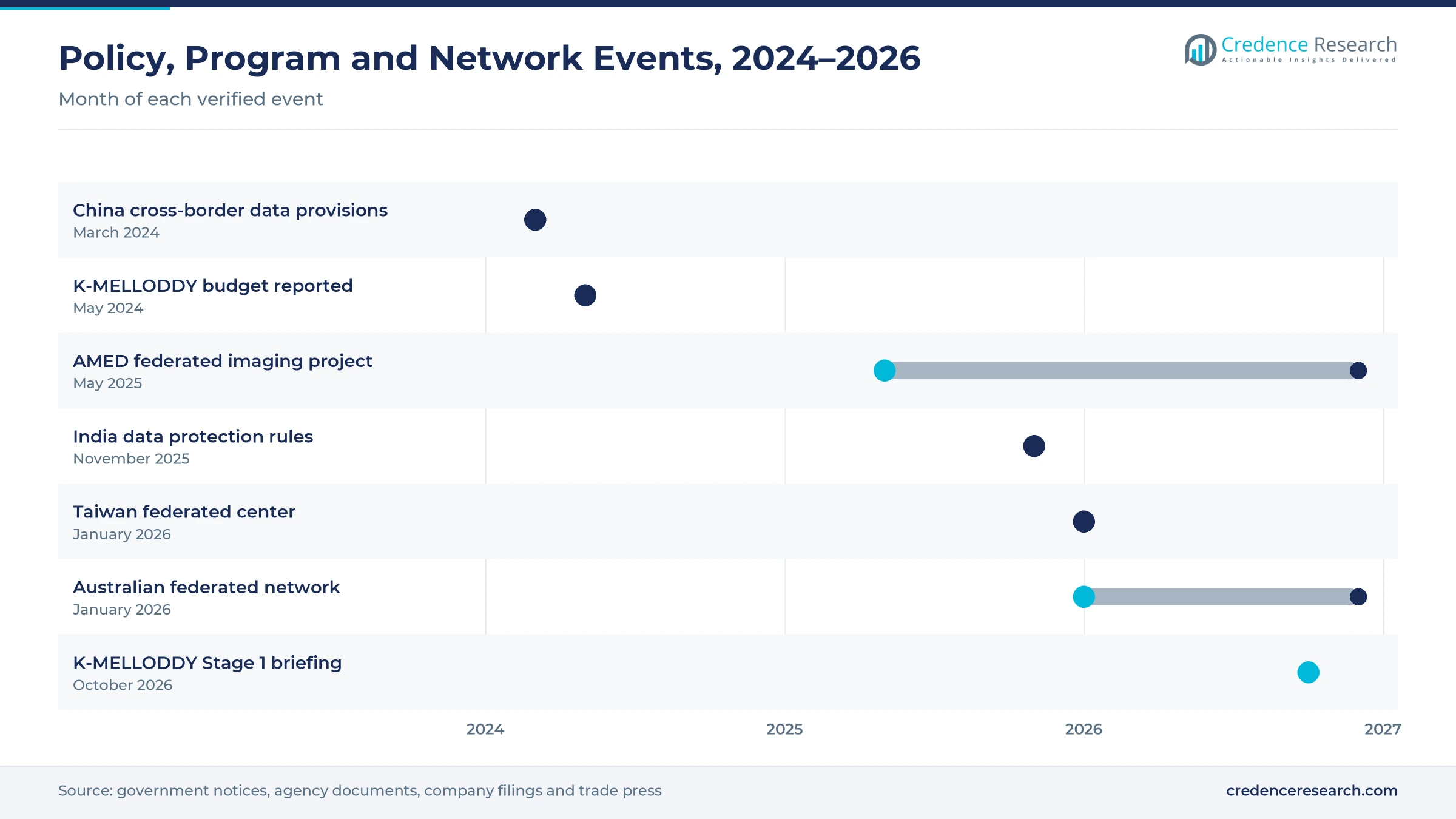
National privacy rules make it costly to pool patient records in one place, which pushes institutions toward shared training. China's Cyberspace Administration issued provisions on March 22, 2024, that require a security assessment once a processor sends abroad sensitive personal information of more than 10,000 people in a year. India notified its Digital Personal Data Protection Rules on Nov. 14, 2025, and gave organizations an 18-month phased period to comply. In January 2026, Taiwan's health ministry said its new federated center had completed a proof of concept with 16 major hospitals, as the Taipei Times reported. Because data stays on hospital servers in each case, on-premise and private cloud setups hold 44.0% of 2025 value.
Multicenter clinical models need more cases than one site
Multicenter model development lifts demand, because a single hospital rarely holds enough cases to train a reliable diagnostic model. Japan's medical research agency funds a project from May 2025 to March 2028 that pairs federated training with small-data models for image diagnosis, according to an AMED project summary. The Institute of Science Tokyo leads the work with GE HealthCare Japan and Kobe University, and the team aims for accurate models from 100 or fewer cases. The project also aims to ease a shortage of radiologists as image volumes keep rising. As a result, medical imaging held 41.0% of 2025 value, the largest application share, and vendors of medical imaging software gain a route into multisite training.
Open frameworks enable a paid service market
Open frameworks create a service market, because free software lowers entry costs while hospitals still pay for setup, security and support. WeBank contributed its FATE framework to the Linux Foundation in June 2019 under the Apache 2.0 license, with Tencent and a JD.com unit also committed to the project, as DevClass reported at the time. NVIDIA open-sourced its FLARE kit in November 2021, and its project documentation lists Taiwan's federated center, announced in January 2026, among industry use cases. Taiwan Web Service Corporation runs 5 medical imaging projects on FLARE, each with several hospitals, according to an NVIDIA blog post. In turn, managed federated learning grows at 20.60% a year, the fastest solution rate, as buyers outsource the running of these frameworks.
Drug discovery consortia protect compound data
Pharmaceutical consortia add a further driver, because drug makers want shared prediction models without exposing proprietary compound data. South Korea's K-MELLODDY program has a KRW 34.8 billion budget over five years from the science and health ministries, according to Daily Pharm. The program builds its system on data held by 20 industry, academic and research institutions, and it expects toxicity predictions to cut experiments by half. Its project group scheduled a Stage 1 results briefing for Oct. 16, 2026, covering a federated ADMET model and a platform from Evidnet, as Medigate News reported. In turn, pharmaceutical companies grow at 19.95% a year, the fastest customer rate, as AI drug discovery programs adopt shared training.
National centers and genome platforms reshape demand
Rise of national federated computing centers
The rise of national federated centers is changing how projects start, because governments now fund shared infrastructure instead of single pilots. Taiwan's health ministry plans to scale its center from 16 hospitals to 100 regional hospitals and later to all hospitals, as the Taipei Times reported in January 2026. The center will also work with Mahidol University in Thailand on joint standards for verifying AI medical products in ASEAN markets. In Australia, the Australian Research Data Commons announced on Jan. 20, 2026, a two-year network that links cancer, imaging and registry projects at UNSW, the University of Sydney and the University of Queensland. As a result, consortium-hosted deployment grows at 20.40% a year, the fastest deployment rate.
Shift to hospital network data platforms in China
A shift toward hospital network data platforms is shaping demand in China, because multisite studies need common data layers before models can train across sites. Yidu Tech counted 110 top Chinese hospitals as clients of a platform business that covers more than 4,000 hospitals at March 31, 2025, according to its annual results announcement filed with the Hong Kong exchange. The company also reported 411 clinical studies and 275 real-world studies, and it plans to enable multisite research by disease area and hospital network. Ping An built a Hive platform for federated learning that uses Intel SGX secure enclaves, according to an Intel case study. Because this hospital base is so large, China remains the largest country market in the region.
Opportunity in India's linked health records
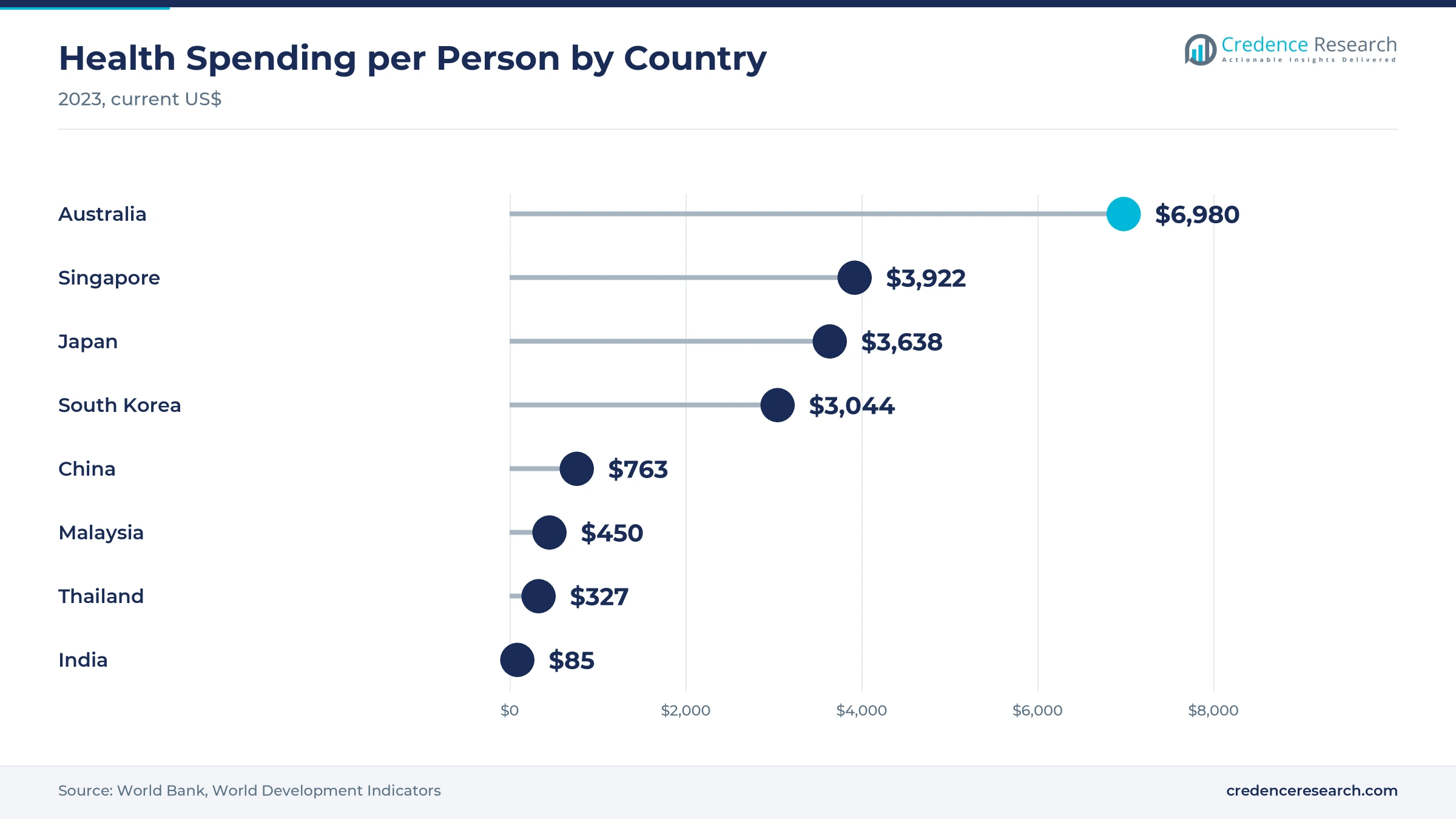
Linked health records in India open a large opportunity, because federated models can learn from records without moving them out of hospitals. More than 1.04 billion health records had been linked to more than 930 million health accounts by July 2026, according to News on AIR, the public broadcaster. The Digital Personal Data Protection Act was enacted on Aug. 11, 2023, and its rules now set consent and breach notice duties for hospitals and laboratories. Health spending was only about USD 85 per person in India in 2023, compared with about USD 3,638 in Japan, according to World Bank data, which favors low-cost shared models. As a result, India is the fastest-growing country group in the regional estimate.
Opportunity in Southeast Asian genome platforms
Genomic research platforms in Southeast Asia open room for privacy-preserving analysis, because large genome sets cannot leave national clouds. Singapore's TRUST platform, developed by the health ministry, GovTech and Synapxe, became operational in November 2022 and keeps data and compute in Singapore, according to a Lifebit case study. The PRECISE-SG100K study delivered 102,202 whole genomes into TRUST, and GSK became its fifth pharma partner in May 2026. TRUST also had 22 approved research use cases by Aug. 30, 2024, which shows steady demand from public and private researchers. In turn, clinical research and genomics grows at 20.30% a year, the fastest application rate, as privacy-enhancing technologies spread across research networks.
Data quality, security and funding gaps slow scale-up
Uneven data quality slows model training
Hospitals code diagnoses, images and lab results in different ways, so a shared model must reconcile many local formats. A model trained across such sites can perform worse than one trained on clean local data. As a result, projects spend months on data mapping before the first training round. South Korea's K-MELLODDY group set out federated training guidelines and model validation methods at a Stage 1 briefing on Oct. 16, 2026, according to Medigate News. Vendors respond with common data models, local validation tools and bundled integration services.
Security concerns raise setup costs
Shared model updates can still leak patient information if they are left unprotected, so buyers demand extra safeguards. Hospitals and insurers ask for encryption, secure enclaves and audit logs before they join a network. India's data protection rules, reported on Nov. 14, 2025, by The Tribune, require organizations to inform affected people promptly after a personal data breach. In turn, projects take longer and smaller hospitals may delay participation, while buyers add data privacy software to manage consent and access records across sites.
Skills gaps limit hospital participation
Federated projects need engineers who understand both clinical data and distributed computing, and few hospitals employ them. Many hospitals outside major cities rely on vendors or university partners instead. As a result, pilots can stall when grant funding ends and vendor support stops. The Australian Research Data Commons announced on Jan. 20, 2026, a two-year program that will build shared tools, training and a national community, according to the ARDC. Such programs should help hospital staff run projects with less outside support.
Grant-based funding slows scale-up
Most federated projects still run on research budgets rather than recurring hospital spending. South Korea's K-MELLODDY program, for example, depends on a five-year national research budget from two ministries, as Daily Pharm reported in May 2024. Payers in the region do not yet pay directly for models trained across institutions, so many networks stay at pilot scale. Vendors respond with managed service contracts, usage-based fees and consortium pricing, while governments fund shared centers such as the one in Taiwan.
China leads while India grows fastest
| Country | Value, 2025 (USD million) | Share, 2025 | CAGR, 2026–2035 |
|---|---|---|---|
| China | 5.0 | 54.2% | 19.30% |
| Japan and South Korea | 1.7 | 18.1% | 18.30% |
| Australia and Southeast Asia | 1.6 | 16.8% | 18.70% |
| India | 1.0 | 10.9% | 21.10% |
Why does China hold the largest share?
China held 54.2% of 2025 value and grows at 19.30% a year, because it combines the largest hospital base with strict rules on moving personal data. Since March 2024, exporting sensitive personal information of more than 10,000 people in a year triggers a security assessment. Yidu Tech serves 110 top hospitals through a platform business that covers more than 4,000 hospitals. WeBank's FATE framework and Ping An's Hive platform also give domestic buyers federated tools built by Chinese financial groups.
How do public programs drive Japan and South Korea?
Japan and South Korea held 18.1% of 2025 value and grow at 18.30% a year, as public research funds drive most projects. Japan's medical research agency funds a small-data federated imaging project through March 2028 with GE HealthCare Japan and two universities. South Korea's K-MELLODDY program runs from 2024 to 2028 with KRW 34.8 billion for federated drug discovery. Health spending was about USD 3,638 per person in Japan and about USD 3,044 in South Korea in 2023, which supports advanced hospital IT.
Why is India the fastest-growing country?
India held 10.9% of 2025 value and grows fastest at 21.10% a year, because its national digital health records give federated models a very large base. More than 1.04 billion health records were linked to health accounts by July 2026. The Digital Personal Data Protection Rules, notified on Nov. 14, 2025, require clear consent notices and breach alerts. These rules favor approaches that train models without moving records out of hospitals and laboratories.
What shapes demand in Australia and Southeast Asia?
Australia and Southeast Asia held 16.8% of 2025 value and grow at 18.70% a year. Australia launched a national federated machine learning network in January 2026 that links cancer, imaging and registry projects at three universities. Singapore's TRUST platform keeps data and compute inside the country and holds 102,202 whole genomes from PRECISE-SG100K. Thailand's Mahidol University will also work with Taiwan's federated center on standards for AI medical products.
Programs, rules and networks launched from 2025 to 2026
| Development | Status and market relevance |
|---|---|
| In May 2025, the Institute of Science Tokyo began an AMED-funded federated imaging project with GE HealthCare Japan and Kobe University. | Tests small-data models for hospital image diagnosis |
| In November 2025, India notified its Digital Personal Data Protection Rules with an 18-month phased compliance period. | Sets consent and breach duties for health data holders |
| In January 2026, Taiwan announced a national federated computing center after a proof of concept with 16 hospitals. | Creates shared infrastructure for hospital AI training |
| In January 2026, the Australian Research Data Commons launched a two-year federated machine learning network. | Links cancer, imaging and registry research projects |
| In October 2026, the K-MELLODDY project group scheduled a Stage 1 results briefing on federated drug discovery models. | Shows progress in shared toxicity and metabolism prediction |
Horizontal, vertical and transfer methods shape projects
- Horizontal federated learning trains one model across hospitals that hold the same kinds of records for different patients, which suits multisite imaging studies.
- Vertical federated learning links different data about the same people, such as hospital records and insurance claims, without either holder sharing raw data.
- Federated transfer learning adapts a model trained at large centers to smaller hospitals with few cases, which helps rare disease and small-data imaging work.
- Hardware secure enclaves protect model updates while they move between nodes, and Ping An uses Intel SGX enclaves in its Hive platform.
Need a Custom Version of This Report?
Tailor the scope, geography, or segments to your exact requirements.
- Custom geography or segment scope
- Direct access to our analyst team
Vendors compete on open tools, security and hospital reach
Competition combines global chip and software makers, Chinese technology and finance groups, and health data specialists. NVIDIA supplies the open FLARE kit, which its documentation links to Taiwan's national federated center and to medical imaging projects run by Taiwan Web Service Corporation. WeBank created the FATE framework and contributed it to the Linux Foundation, which gave Chinese buyers an open option backed by Tencent and a JD.com unit. Ping An built its Hive platform with Intel secure enclaves for privacy-sensitive models such as health insurance pricing. Yidu Tech works with 110 top Chinese hospitals and plans multisite research by disease area and hospital network. GE HealthCare Japan and Evidnet take part in public programs in Japan and South Korea. Companies compete on security proof, links to hospital data systems and the ability to run networks for many members, and vendors that pair open frameworks with managed services gain trust fastest with public hospital groups.
Companies profiled and their roles in this market
| Company | Type | Role in the market |
|---|---|---|
| NVIDIA | Technology company | Supplies the open FLARE kit used in Taiwan imaging projects |
| WeBank | Digital bank | Created the FATE framework hosted by the Linux Foundation |
| Ping An | Financial and health group | Runs the Hive platform with Intel secure enclaves |
| Yidu Tech | Health data company | Serves 110 top Chinese hospitals with data platforms |
| GE HealthCare Japan | Medical technology company | Partners in an AMED federated imaging project |
| Evidnet | Health data company | Presents the K-MELLODDY federated platform |
Credence Research view on privacy-preserving model demand
Credence Research's view is that the APAC federated learning in healthcare market will grow fast, because privacy rules, public research funds and open frameworks all point the same way. Orchestration software remains the largest solution, while managed services gain share as hospitals hand operations to vendors. China keeps the largest share, and India grows fastest as its health record base expands. However, uneven data quality, security concerns and grant-based funding will slow scale-up. Vendors that combine open frameworks with security proof and managed services should gain share fastest.
How the regional shared-training estimate was built
The report uses 2025 as the base year on a calendar basis, and market values come from the Credence Research model. That model combines public program budgets, hospital and research network counts, health spending statistics and company information on platforms, pilots and partnerships. Segment splits, country shares and growth rates are Credence Research estimates. Sources used are official statistics, government and agency documents, company filings and releases, trade press and project documentation, and no interviews or surveys were used.
Hospital networks carry demand toward 2035
The APAC federated learning in healthcare market is expected to reach USD 53.6 million by 2035, a 19.23% CAGR during 2026–2035, as projects move from single pilots to national networks. Growth should be strongest through 2030 while Taiwan, Australia and South Korea scale their public programs and India's data rules take full effect. After that, recurring subscriptions and managed contracts will carry more value as hospitals fund networks from operating budgets. Faster regulatory guidance on shared models would raise this outlook, while security incidents would lower it.
Frequently Asked Questions
How big is the APAC federated learning in healthcare market?
Which country leads the regional market?
Which solution type leads demand?
Why do on-premise and private cloud setups lead deployment?
Why are drug makers interested in federated models?
How do privacy rules affect adoption in the region?
Which companies are covered in the report?
What are the main challenges for vendors?
Table of Content
Chapter 1 Market Segmentation
- 1.1 Segmentation Framework
- 1.1.1 Product and Service Classification
- 1.1.2 Application and End-Use Classification
- 1.1.3 Technology and Solution Classification
- 1.1.4 Customer and Distribution Channel Classification
- 1.1.5 Geographic Segmentation
- 1.1.6 Market Segment Definitions and Boundaries
- 1.2 By Solution Type
- 1.2.1 Orchestration Software
- 1.2.2 Managed Federated Learning
- 1.2.3 Bundled Integration Services
- 1.2.4 Bundled Security Infrastructure
- 1.3 By Deployment Model
- 1.3.1 On-Premise and Private Cloud
- 1.3.2 Hybrid Deployment
- 1.3.3 Public Cloud Managed Service
- 1.3.4 Consortium-Hosted Deployment
- 1.4 By Customer Type
- 1.4.1 Hospitals and Diagnostic Providers
- 1.4.2 Pharmaceutical Companies
- 1.4.3 Research Institutions
- 1.4.4 Health Insurers
- 1.5 By Application
- 1.5.1 Medical Imaging
- 1.5.2 Drug Discovery
- 1.5.3 Clinical Records and Monitoring
- 1.5.4 Clinical Research and Genomics
- 1.6 By Country
- 1.6.1 China
- 1.6.2 Japan and South Korea
- 1.6.3 India
- 1.6.4 Australia and Southeast Asia
Chapter 2 Introduction
- 2.1 Report Objectives and Scope
- 2.2 Product Definition and Industry Terminology
- 2.3 Market Inclusions and Exclusions
- 2.4 Research Process
- 2.4.1 Primary Research and Expert Interviews
- 2.4.2 Secondary Research and Source Review
- 2.4.3 Top-Down and Bottom-Up Estimation
- 2.4.4 Data Triangulation and Verification
- 2.5 Market Size Measurement Basis
- 2.5.1 2025: USD 9.23 million → 2035: USD 53.6 million
- 2.6 Historical and Forecast Reference Periods
- 2.6.1 Historical Period: 2018-2025
- 2.6.2 Base Year: 2025
- 2.6.3 Forecast Period: 2025-2035
- 2.7 Research Assumptions and Limitations
Chapter 3 Executive Summary
- 3.1 Market Snapshot and Key Findings
- 3.2 Base-Year Market Size, 2025
- 3.3 Forecast Market Size, 2035
- 3.4 Revenue and Volume Growth Outlook
- 3.5 Key Demand and Supply Indicators
- 3.6 Leading Market Segments
- 3.7 Fastest-Growing Market Opportunities
- 3.8 Regional Performance Highlights
- 3.9 Technology and Industry Transformation
- 3.10 Competitive Landscape Summary
- 3.11 Analyst View and Strategic Implications
Chapter 4 APAC Federated Learning in Healthcare Market Trends and Developments
- 4.1 Historical Industry Development, 2018-2025
- 4.2 Recent Market Trends and Developments
- 4.3 Demand and Customer Behavior Trends
- 4.4 Technology and Product Innovation
- 4.5 Artificial Intelligence, Automation and Digitalization
- 4.6 Local Manufacturing and Supply Chain Realignment
- 4.7 Industry Partnerships, Mergers and Acquisitions
- 4.8 Sustainability and Circular Economy Developments
- 4.9 Government and Private Sector Investment Trends
- 4.10 Emerging Business Models and Commercialization
- 4.11 Industry Developments and Announcements
Chapter 5 APAC Federated Learning in Healthcare Market Production, Supply and Demand Analysis
- 5.1 Demand Trend and Consumption Analysis, 2018-2025
- 5.2 Demand Forecast, 2025-2035
- 5.3 Production and Output Trend, 2018-2025
- 5.4 Production and Output Forecast, 2025-2035
- 5.5 Installed Capacity and Capacity Utilization
- 5.6 Company-Wise Production Plants and Statistics
- 5.6.1 Installed Production Capacity
- 5.6.2 Actual Production
- 5.6.3 Planned Capacity and Expansion Targets
- 5.7 Supply Chain Structure and Procurement Trends
- 5.8 Supply-Demand Gap and Bottlenecks
- 5.9 Import Dependence and Sourcing Structure
- 5.10 Contract Manufacturing and Outsourcing
- 5.11 Regional Supply and Demand Concentration
Chapter 6 APAC Federated Learning in Healthcare Market Pricing Analysis
- 6.1 Pricing Structure and Measurement
- 6.2 Historical Pricing Trends, 2018-2025
- 6.3 Pricing Outlook, 2025-2035
- 6.4 Average Selling Price and Unit Economics
- 6.5 Pricing by Product and Market Segment
- 6.6 Geographic Pricing Differences
- 6.7 Key Input, Energy, Labor and Logistics Costs
- 6.8 Contract Pricing and Purchasing Models
- 6.9 Pricing Sensitivity and Competitive Positioning
- 6.10 Price, Margin and Profitability Implications
Chapter 7 APAC Federated Learning in Healthcare Market Dynamics
- 7.1 Market Growth Drivers
- 7.1.1 Demand-Side Drivers
- 7.1.2 Technology and Innovation Drivers
- 7.1.3 Infrastructure and Investment Drivers
- 7.1.4 Regulatory and Policy Drivers
- 7.2 Market Restraints
- 7.2.1 Cost and Affordability Constraints
- 7.2.2 Technology and Adoption Barriers
- 7.2.3 Supply Chain and Operational Constraints
- 7.3 Market Challenges
- 7.3.1 Competitive Pressure and Margin Erosion
- 7.3.2 Skills, Infrastructure and Implementation Gaps
- 7.4 Emerging Market Opportunities
- 7.5 Market Dynamics Impact and Time-Horizon Assessment
Chapter 8 APAC Federated Learning in Healthcare Value Chain Analysis
- 8.1 Industry Value Chain Overview
- 8.2 Upstream Suppliers and Critical Inputs
- 8.3 Technology and Component Providers
- 8.4 Manufacturing or Service Delivery
- 8.5 Distribution, Channel Partners and Integrators
- 8.6 Downstream Applications and End Users
- 8.7 Value Addition and Profit Pools
- 8.8 Vertical Integration and Outsourcing
- 8.9 Supplier Concentration and Risk
- 8.10 Supply Chain Localization and Resilience
Chapter 9 APAC Federated Learning in Healthcare Market Regulations and Policies
- 9.1 Relevant Laws, Standards and Compliance Frameworks
- 9.2 Product, Service, Safety and Quality Requirements
- 9.3 Government Policies, Incentives and Subsidies
- 9.4 Imports, Exports and Trade Barriers
- 9.5 Public Procurement and Local Content Requirements
- 9.6 Environmental and Sustainability Compliance
- 9.7 Upcoming Policy Changes and Market Implications
Chapter 10 APAC Federated Learning in Healthcare Market Hotspots and Opportunities
- 10.1 Market Opportunity Mapping and Growth Hotspots
- 10.2 High-Growth Applications and Customer Groups
- 10.3 Underserved Markets and White-Space Opportunities
- 10.4 Emerging Technology and Product Opportunities
- 10.5 New Capacity and Investment Hotspots
- 10.6 Market Entry and Expansion Opportunities
- 10.7 Distribution and Partnership Opportunities
- 10.8 Near-Term and Long-Term Commercial Potential
- 10.9 Opportunity Attractiveness and Execution Risks
Chapter 11 APAC Federated Learning in Healthcare Market Outlook, 2025-2035
- 11.1 Market Size and Analysis
- 11.1.1 Revenue (Market Measurement: 2025: USD 9.23 million → 2035: USD 53.6 million)
- 11.1.2 Market Volume and Quantity Sold
- 11.1.3 Historical Market Size, 2018-2025
- 11.1.4 Base-Year Market Size, 2025
- 11.2 Market Forecast, 2025-2035
- 11.2.1 Revenue Forecast to 2035
- 11.2.2 Volume Forecast to 2035
- 11.2.3 CAGR and Year-on-Year Growth
- 11.2.4 Incremental Revenue Opportunity
- 11.3 Forecast Assumptions and Scenario Analysis
- 11.3.1 Base-Case Forecast
- 11.3.2 Optimistic and Conservative Scenarios
- 11.3.3 Technology, Pricing and Policy Sensitivities
- 11.4 Market Attractiveness and Growth Outlook
Chapter 12 APAC Federated Learning in Healthcare Market Segmentation and Outlook
- 12.1 Segmentation Summary and Market Shares, 2025
- 12.2 Largest and Fastest-Growing Segments
- 12.3 By Solution Type - Market Size and Forecast, 2025-2035
- 12.3.1 Segment Definition and Scope
- 12.3.2 Historical Market Size, 2018-2025
- 12.3.3 Revenue Forecast, 2025-2035
- 12.3.4 Volume Forecast, 2025-2035
- 12.3.5 Base-Year Market Share, 2025
- 12.3.6 Segment CAGR and Growth Drivers
- 12.3.7 Subsegment Market Size and Forecast
- 12.3.7.1 Orchestration Software
- 12.3.7.2 Managed Federated Learning
- 12.3.7.3 Bundled Integration Services
- 12.3.7.4 Bundled Security Infrastructure
- 12.3.8 Subsegment Pricing and Adoption Trends
- 12.3.9 Leading Suppliers and Competition
- 12.3.10 Regional Demand and Opportunities
- 12.4 By Deployment Model - Market Size and Forecast, 2025-2035
- 12.4.1 Segment Definition and Scope
- 12.4.2 Historical Market Size, 2018-2025
- 12.4.3 Revenue Forecast, 2025-2035
- 12.4.4 Volume Forecast, 2025-2035
- 12.4.5 Base-Year Market Share, 2025
- 12.4.6 Segment CAGR and Growth Drivers
- 12.4.7 Subsegment Market Size and Forecast
- 12.4.7.1 On-Premise and Private Cloud
- 12.4.7.2 Hybrid Deployment
- 12.4.7.3 Public Cloud Managed Service
- 12.4.7.4 Consortium-Hosted Deployment
- 12.4.8 Subsegment Pricing and Adoption Trends
- 12.4.9 Leading Suppliers and Competition
- 12.4.10 Regional Demand and Opportunities
- 12.5 By Customer Type - Market Size and Forecast, 2025-2035
- 12.5.1 Segment Definition and Scope
- 12.5.2 Historical Market Size, 2018-2025
- 12.5.3 Revenue Forecast, 2025-2035
- 12.5.4 Volume Forecast, 2025-2035
- 12.5.5 Base-Year Market Share, 2025
- 12.5.6 Segment CAGR and Growth Drivers
- 12.5.7 Subsegment Market Size and Forecast
- 12.5.7.1 Hospitals and Diagnostic Providers
- 12.5.7.2 Pharmaceutical Companies
- 12.5.7.3 Research Institutions
- 12.5.7.4 Health Insurers
- 12.5.8 Subsegment Pricing and Adoption Trends
- 12.5.9 Leading Suppliers and Competition
- 12.5.10 Regional Demand and Opportunities
- 12.6 By Application - Market Size and Forecast, 2025-2035
- 12.6.1 Segment Definition and Scope
- 12.6.2 Historical Market Size, 2018-2025
- 12.6.3 Revenue Forecast, 2025-2035
- 12.6.4 Volume Forecast, 2025-2035
- 12.6.5 Base-Year Market Share, 2025
- 12.6.6 Segment CAGR and Growth Drivers
- 12.6.7 Subsegment Market Size and Forecast
- 12.6.7.1 Medical Imaging
- 12.6.7.2 Drug Discovery
- 12.6.7.3 Clinical Records and Monitoring
- 12.6.7.4 Clinical Research and Genomics
- 12.6.8 Subsegment Pricing and Adoption Trends
- 12.6.9 Leading Suppliers and Competition
- 12.6.10 Regional Demand and Opportunities
- 12.7 By Country - Market Size and Forecast, 2025-2035
- 12.7.1 Segment Definition and Scope
- 12.7.2 Historical Market Size, 2018-2025
- 12.7.3 Revenue Forecast, 2025-2035
- 12.7.4 Volume Forecast, 2025-2035
- 12.7.5 Base-Year Market Share, 2025
- 12.7.6 Segment CAGR and Growth Drivers
- 12.7.7 Subsegment Market Size and Forecast
- 12.7.7.1 China
- 12.7.7.2 Japan and South Korea
- 12.7.7.3 India
- 12.7.7.4 Australia and Southeast Asia
- 12.7.8 Subsegment Pricing and Adoption Trends
- 12.7.9 Leading Suppliers and Competition
- 12.7.10 Regional Demand and Opportunities
- 12.8 Segment Growth Comparison
- 12.9 Segment Attractiveness and Priority Matrix
Chapter 13 APAC Federated Learning in Healthcare End-Use and Application Market Outlook
- 13.1 End-Use Industry and Customer Demand Structure
- 13.2 Leading Applications and Customer Groups
- 13.3 End-Use Market Size, Share and Forecast
- 13.4 Major End-Use Industry Deep Dives
- 13.4.1 Customer Requirements and Use Cases
- 13.4.2 Demand and Replacement Cycles
- 13.4.3 Technical and Regulatory Considerations
- 13.4.4 Purchasing and Procurement Models
- 13.4.5 Leading Vendors and Distribution Channels
- 13.4.6 Forecast and Commercial Opportunities
- 13.5 Emerging Applications and Cross-Segment Demand
- 13.6 End-Use Industry Investment Priorities
Chapter 14 APAC Federated Learning in Healthcare Geographic Market Outlook, 2025-2035
- 14.1 Regional Market Size and Country-Level Shares, 2025
- 14.2 Country Market Size Comparison, 2025
- 14.3 Country Market Forecasts, 2025-2035
- 14.4 Subregional Industrial and Demand Clusters
- 14.5 Intra-Regional Pricing and Cost Differences
- 14.6 Cross-Border Trade and Supply Networks
- 14.7 Regional Supply and Demand Balances
- 14.8 Country Opportunity Comparison and Prioritization
Note: Every listed country is covered on the structure shown under the first country.
Chapter 15 APAC Federated Learning in Healthcare Technology, Innovation and Sustainability Outlook
- 15.1 Technology Landscape and Maturity
- 15.2 Product, Process and Service Innovation
- 15.3 AI, Automation and Digital Tools in the Industry
- 15.4 Technology Adoption and Performance Benchmarking
- 15.5 Innovation Pipeline and R&D Investment
- 15.6 Patent and Intellectual Property Trends
- 15.7 Energy Efficiency and Resource Management
- 15.8 Sustainability, Recycling and Circularity
- 15.9 Technology Roadmap, 2025-2035
- 15.10 Risks of Obsolescence and Technology Substitution
Chapter 16 APAC Federated Learning in Healthcare Market Key Strategic Imperatives
- 16.1 Growth and Market Entry Priorities
- 16.2 High-Return Products and Segments
- 16.3 Pricing, Profitability and Cost Optimization
- 16.4 Technology Investment and Product Differentiation
- 16.5 Supply Chain Localization and Resilience
- 16.6 Distribution and Customer Acquisition
- 16.7 Partnership, Acquisition and Capacity Strategy
- 16.8 Regional Expansion Priorities
- 16.9 Short-, Medium- and Long-Term Actions
Chapter 17 Competition Outlook
- 17.1 Industry Competition Characteristics
- 17.2 Market Structure and Concentration
- 17.3 Market Share and Competitive Positioning, 2025
- 17.4 Company-Wise Revenue and Product Benchmarking
- 17.5 Production and Service Capacity Benchmarking
- 17.6 Technology, Pricing and Differentiation
- 17.7 Regional Footprint and Distribution Strength
- 17.8 Mergers, Acquisitions and Strategic Alliances
- 17.9 New Entrants and Competitive Threats
- 17.10 Porter's Five Forces and Industry Attractiveness
- 17.11 Competitive Outlook, 2025-2035
Chapter 18 Company Profiles
- 18.1 Company Coverage and Selection Criteria
- 18.2 NVIDIA
- 18.2.1 Business Description
- 18.2.2 Company Ownership and Geographic Presence
- 18.2.3 Product and Service Portfolio
- 18.2.4 Manufacturing and Operating Footprint
- 18.2.5 Production Capacity and Expansion Plans
- 18.2.6 Financial Performance and Investment
- 18.2.7 Market Share and Competitive Position
- 18.2.8 Technology and Innovation Capabilities
- 18.2.9 Strategic Alliances or Partnerships
- 18.2.10 Recent Developments
- 18.2.11 Growth Strategy and Outlook
- 18.3 WeBank
- 18.4 Ping An
- 18.5 Owkin
- 18.6 Yidu Tech
- 18.7 Other Relevant Market Participants
Note: Every listed company is profiled on the structure shown under the first company. The company list is preliminary and may change based on research findings, market developments, data availability and client requirements.
Chapter 19 Disclaimer
- 19.1 Research and Forecast Disclaimer
- 19.2 Data Source and Estimation Limitations
Note: The depth of individual sections depends on data availability for this market. Volume, capacity, trade and other unit-based metrics are included where applicable.

