Reimbursed biologics move skin care beyond topical creams
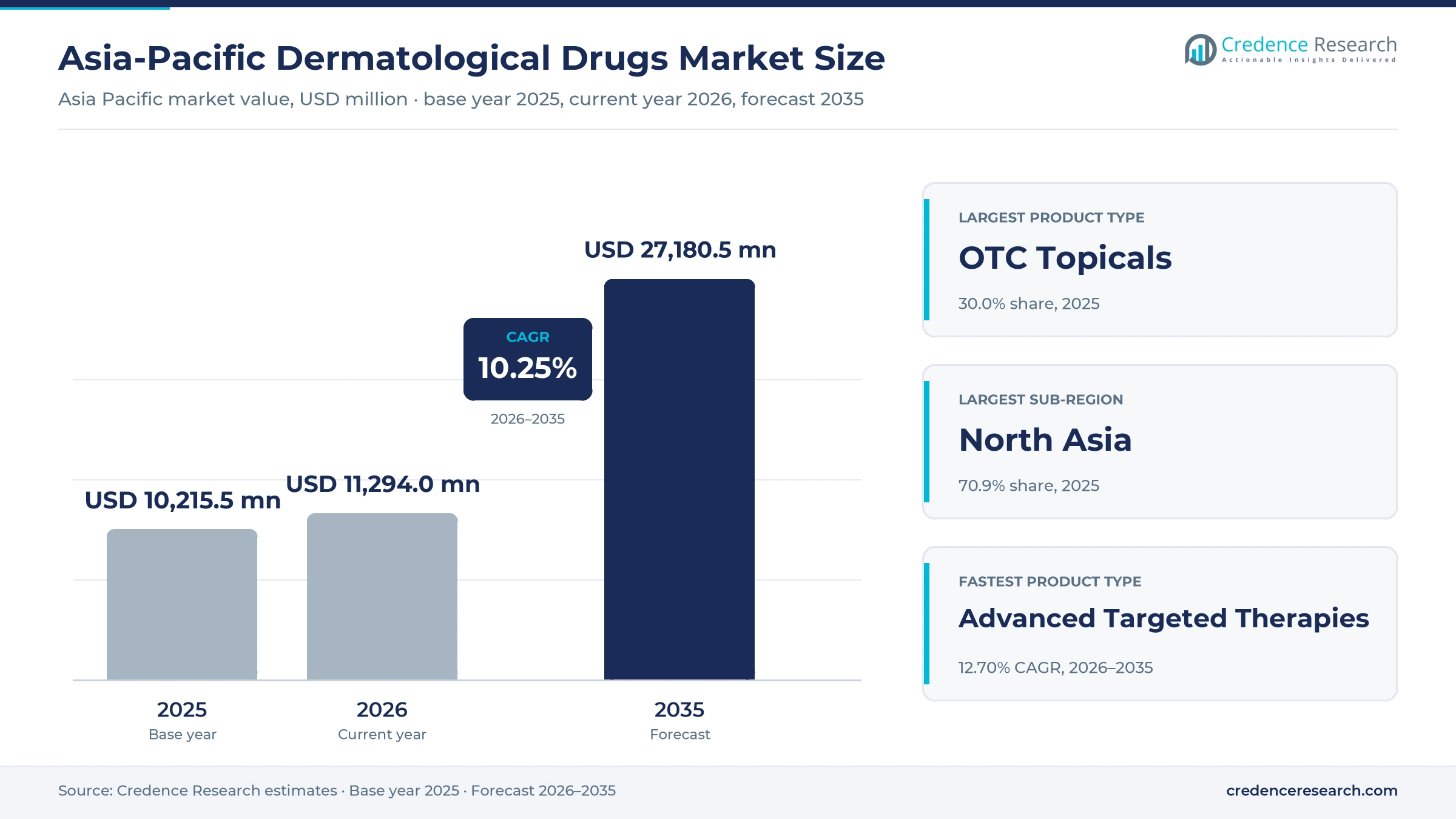
The Asia-Pacific dermatological drugs market was valued at USD 10.22 billion in 2025 and is projected to increase from USD 11.29 billion in 2026 to USD 27.18 billion by 2035, registering a CAGR of 10.25% during 2026–2035. Demand comes from patients with eczema, psoriasis, acne, skin infections, hives and hair or pigment disorders who buy creams over the counter or receive prescription topicals, tablets and injectable antibodies from dermatologists. North Asia held the largest sub-regional share, 70.9% in 2025, because Japan, China and South Korea combine large patient pools with public insurance that pays for specialty skin medicines. South Asia and frontier markets are the fastest-growing sub-region at 11.79% a year, as biologics and oral targeted agents reach India and its neighbors for the first time. Regulators are also widening the label of each new antibody, which lets one product serve several skin diseases and keeps specialist demand rising.
Which skin medicines and buyers does the regional estimate cover?
The estimate measures spending on medicines used to treat skin diseases across Asia Pacific. It covers OTC creams and ointments, prescription topicals such as corticosteroids, calcineurin inhibitors and retinoids, conventional systemic agents such as methotrexate, cyclosporine and oral antibiotics, and advanced targeted therapies such as engineered antibodies and oral JAK or IL-23 receptor agents. Values are measured at the price paid by patients, hospitals and insurers.
The estimate excludes cosmetic skin care, aesthetic injectables, energy-based devices and physician fees. The value chain runs from originators and generic makers in Europe, the United States, Japan, China and India through importers, hospital and clinic pharmacies, retail chains and online pharmacies to patients in North Asia, South Asia and frontier markets, Southeast Asia and Oceania.
Asia-Pacific Dermatological Drugs Market Insights
- The Asia-Pacific dermatological drugs market was valued at USD 10.22 billion in 2025 and is projected to reach USD 27.18 billion by 2035, registering a CAGR of 10.25% during 2026–2035.
- North Asia held a 70.9% share of 2025 value, because Japan, China and South Korea pay for biologics through public insurance.
- Inflammatory dermatoses led disease demand with a 48.0% share of 2025 value, as eczema and psoriasis need long-term treatment.
- Dupixent gained its seventh approved indication in Japan in March 2026 when bullous pemphigoid was added to a label that already covered eczema, prurigo nodularis and hives.
- China approved an oral IL-23 receptor pill for plaque psoriasis in August 2026, which adds a needle-free option for about 8.4 million patients.
Advanced targeted therapies set the pace of growth
Why are advanced targeted therapies gaining share fastest?
Based on product type, the market is categorized into OTC topicals, Prescription topicals, Conventional systemic agents and Advanced targeted therapies. OTC topicals led with a 30.0% share of 2025 value, because creams for mild eczema, fungal infections and acne sell in very large volumes through pharmacies. Advanced targeted therapies grow fastest at 12.70% a year, as insurers in Japan, China, South Korea and Australia pay for antibodies and oral agents.
How do inflammatory dermatoses dominate spending?
Based on disease area, the market is categorized into Inflammatory dermatoses, Acne and rosacea, Cutaneous infections and Urticaria and pigmentary or hair disorders. Inflammatory dermatoses led with a 48.0% share of 2025 value, because atopic dermatitis and psoriasis need years of treatment and most biologics target them. Urticaria and pigmentary or hair disorders grow fastest at 11.16% a year, as new agents reach hives, vitiligo and alopecia.
Where are skin patients treated across the region?
Based on care setting, the market is categorized into Hospital outpatient care, Specialist clinic care and Community-Managed Care. Hospital outpatient care led with a 46.0% share of 2025 value, because China and Japan route most biologic prescriptions through hospital dermatology departments. Specialist clinic care grows fastest at 10.80% a year, as private dermatology clinics in India, Southeast Asia and Australia start more patients on targeted therapy.
How are online pharmacies changing access to skin medicines?
Based on distribution channel, the market is categorized into Hospital and clinic pharmacies, Retail pharmacies and Online pharmacies. Hospital and clinic pharmacies led with a 47.0% share of 2025 value, because injectable biologics are dispensed where they are prescribed. Online pharmacies grow fastest at 12.65% a year, as buyers in China and India order OTC creams and repeat prescriptions online.
| Segment Group | Leading Sub-segment | Share, 2025 | Fastest-growing Sub-segment | CAGR, 2026–2035 |
|---|---|---|---|---|
| By Product Type | OTC topicals | 30.0% | Advanced targeted therapies | 12.70% |
| By Disease Area | Inflammatory dermatoses | 48.0% | Urticaria and pigmentary or hair disorders | 11.16% |
| By Care Setting | Hospital outpatient care | 46.0% | Specialist clinic care | 10.80% |
| By Distribution Channel | Hospital and clinic pharmacies | 47.0% | Online pharmacies | 12.65% |
Request a Free Sample
Fill in your details and we'll send you a free sample report.
- Sample data tables & charts
- Research methodology
Coverage, new indications and policy lift skin drug use
How does reimbursed specialty access widen biologic use?
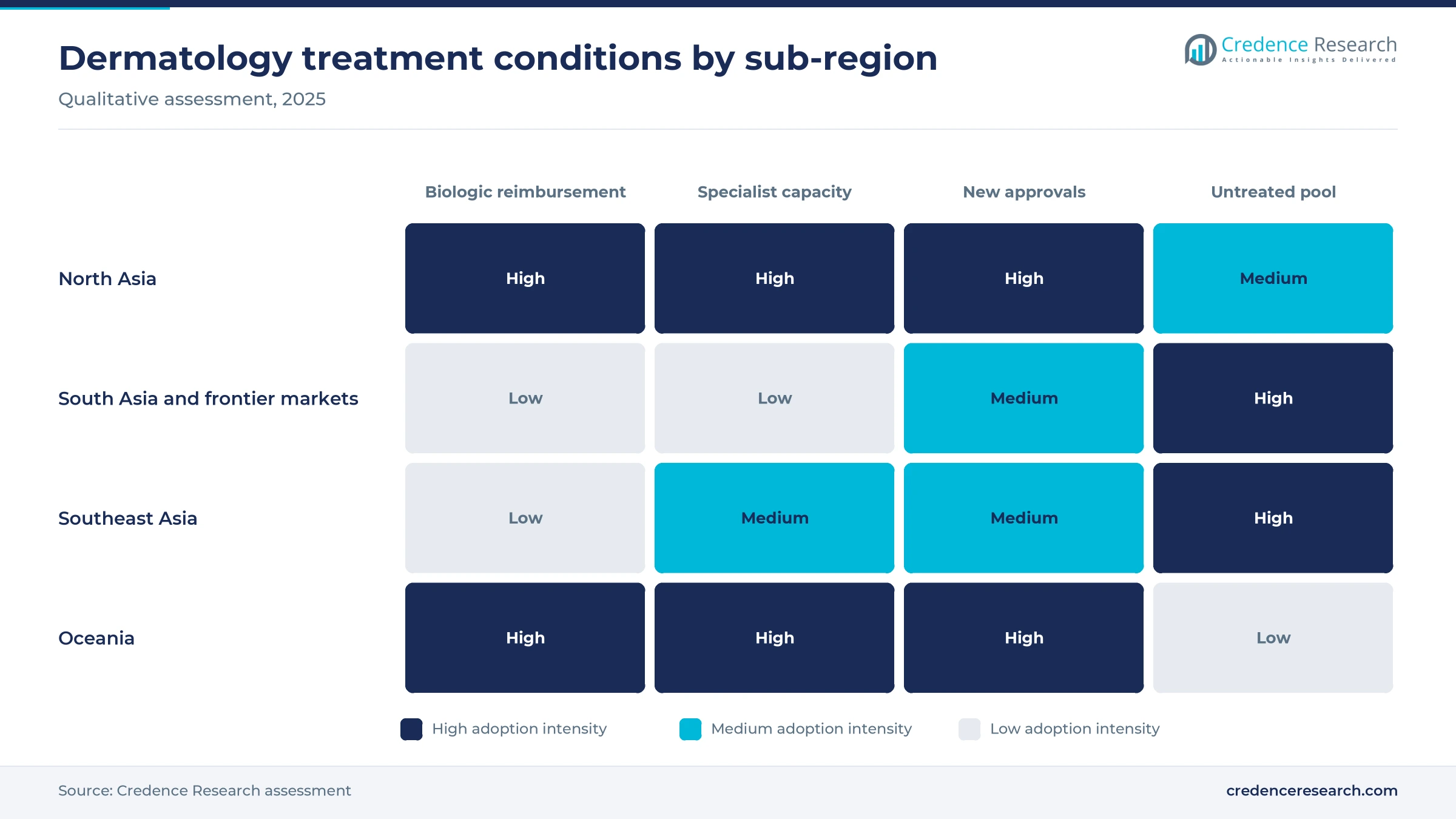
Public insurers across North Asia and Oceania now pay for most of the cost of specialty skin medicines, which turns eligible patients into long-term buyers. South Korea listed Dupixent for national insurance in January 2020, with special-case copay relief for severe atopic dermatitis from January 2021 that cut the patient copayment from 60% to 10%, according to Daily Pharm. Korean insurers have also reimbursed the JAK inhibitors Olumiant and Rinvoq for eczema since May 2022. In Australia, Rinvoq joined the PBS for severe atopic dermatitis on Feb. 1, 2022, with prescriptions limited to dermatologists and clinical immunologists, according to AusDoc. As a result, advanced targeted therapies grow fastest among product types at 12.70% a year, while hospital outpatient care holds 46.0% of 2025 value.
Why do broader dermatological indications expand demand?
Each new indication for an existing antibody brings a new group of patients to the same product, which raises spending without new launches. Japan was the first country to approve Dupixent for chronic spontaneous urticaria in February 2024, when Sanofi put the number of people aged 12 and older with uncontrolled disease there at about 110,000. Japan then approved it for bullous pemphigoid in March 2026, its seventh Japanese indication, according to Sanofi. Australia registered Galderma's Nemluvio for atopic dermatitis and prurigo nodularis on May 27, 2025, according to the TGA. AbbVie also filed in Japan in March 2026 to add vitiligo to Rinvoq, according to Pharma Japan. In turn, urticaria and pigmentary or hair disorders grow fastest among disease areas at 11.16% a year.
How is institutional skin-health priority lifting funding?
Governments and the World Health Organization now treat skin disease as a public health priority, which brings budgets and medicine lists into line with the disease burden. The Seventy-eighth World Health Assembly adopted resolution WHA78.15 on skin diseases on May 24, 2025, calling for reliable access to essential medicines, according to WHO. China added 114 medicines to its national reimbursement list in December 2025, which took the total to 3,253 drugs, according to the Shanghai government. In Malaysia, the Psoriasis Association of Malaysia backed a Ministry of Health proposal of RM29 million to widen biologic access for dermatology patients, writing in CodeBlue in March 2026. Malaysia's proposal shows how Southeast Asian budgets are starting to follow, and the sub-region grows at 11.09% a year.
Why does China's psoriasis pool attract new therapies?
China has the largest psoriasis population in the region, so every new class approved there adds meaningful demand. Johnson & Johnson said more than 8.4 million people in China have psoriasis when its oral pill Icotyde won Chinese approval for moderate-to-severe plaque psoriasis in August 2026, according to Reuters. Innovent's IL-23p19 antibody picankibart was approved for the same disease in November 2025, and FLCube estimated biologic use at about 25% of 2.1 million moderate-to-severe patients. LEO Pharma also won approval for its Enstilar foam in China in April 2026, citing about 6.5 million plaque psoriasis patients. In turn, psoriasis treatment remains the largest single use within inflammatory dermatoses, which hold 48.0% of 2025 value.
Oral agents, local biologics and India reshape demand
How are oral targeted agents shifting treatment choices?
Oral targeted agents are emerging as a needle-free alternative to injectable antibodies for many patients. Glenmark and Pfizer agreed in February 2024 to co-market the JAK1 inhibitor abrocitinib in India for moderate-to-severe atopic dermatitis, according to Indian Pharma Post. Johnson & Johnson's Icotyde pill then reached Chinese psoriasis patients after its August 2026 approval. AbbVie's oral JAK inhibitor Rinvoq is subsidized in Australia for severe eczema in patients aged 12 and older who weigh at least 40 kg, and its March 2026 Japanese vitiligo filing extends the class. As a result, targeted small molecules gain weight inside Advanced targeted therapies, and retail outlets win refills from hospital and clinic pharmacies, which held 47.0% of 2025 value.
Why are local biologics and topicals rising in China and India?
Chinese and Indian drug makers are emerging as direct competitors to imported originator brands, which shifts pricing across the region. Innovent's picankibart became a domestic IL-23p19 option for Chinese psoriasis patients in November 2025, with 80.3% of patients reaching PASI 90 at week 16 in its pivotal trial, according to FLCube. Sun Pharma launched its IL-23 antibody Ilumya in India on Dec. 1, 2025, at Rs 84,375 per injection with five injections a year, according to Business Standard. LEO Pharma filed its delgocitinib cream Anzupgo for chronic hand eczema in China in October 2025, after a 362-patient Chinese trial, according to Business Wire. In turn, Chinese hospitals gain more choice in skin-targeted biologics and topical agents, which keeps price pressure high.
Can South Asia's untreated eczema patients open room for growth?
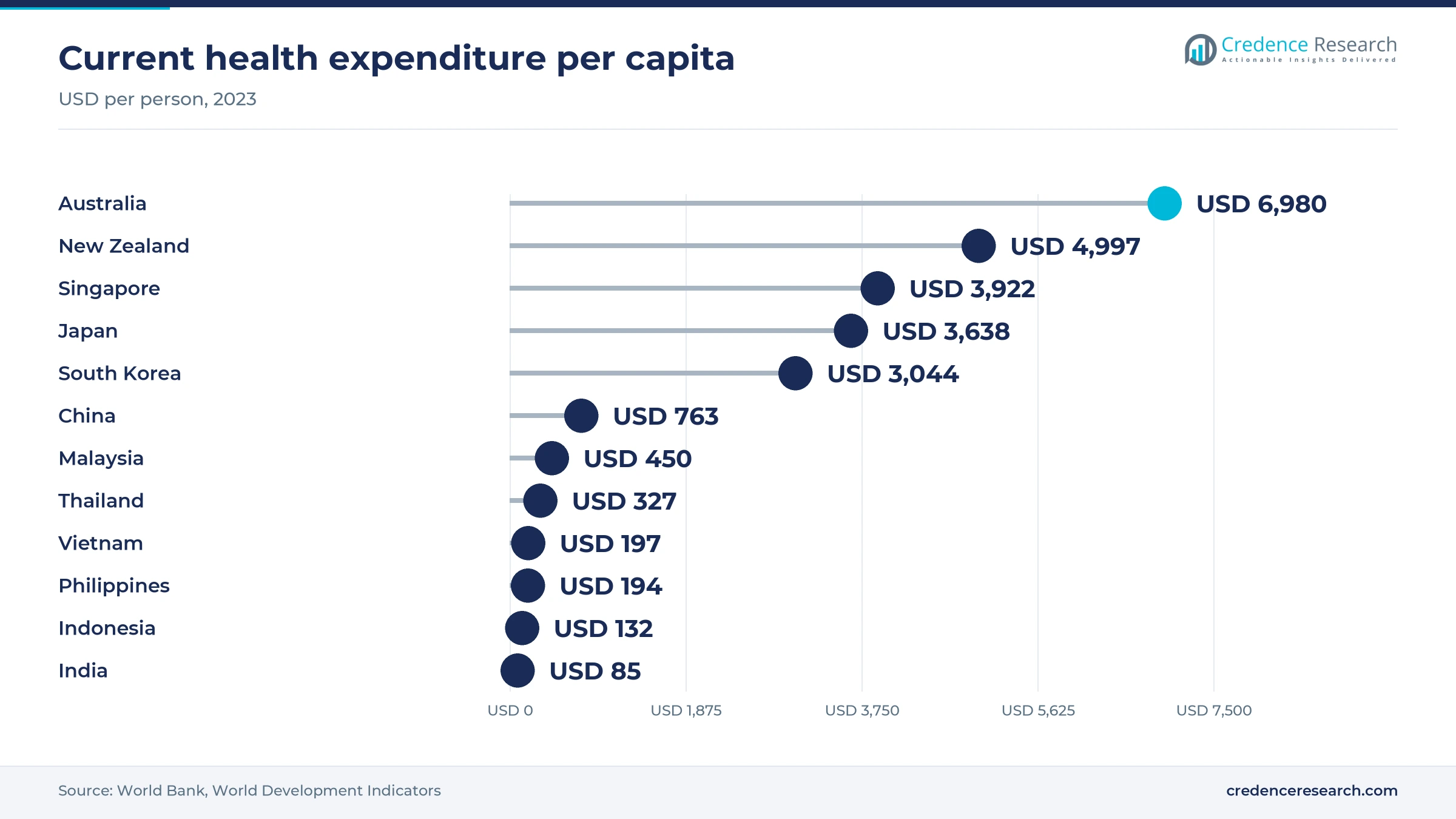
South Asia offers the largest opening in the region, because few patients with moderate-to-severe skin disease receive targeted therapy today. Sanofi said in July 2023 that adult atopic dermatitis affects 2% to 8% of people in India when Dupixent was authorized there, according to Medical Dialogues. Plaque psoriasis affects an estimated 0.44% to 2.8% of India's population, according to Business Standard. Health spending per person reached only about USD 85 in India in 2023, against USD 3,638 in Japan, according to World Bank data. As a result, South Asia and frontier markets grow fastest among sub-regions, as self-paying patients move from creams to systemic care.
Is there an opening in pediatric and early-onset eczema?
Children and adolescents form a large, undertreated group with eczema, which opens room for products with pediatric labels. Australian data cited by the TGA show current atopic dermatitis prevalence of 13.8% in children aged 0 to 4, against 5% to 10% in adults. In India, about 80% of atopic dermatitis patients develop symptoms in the first years of life, according to Indian Pharma Post. Sanofi also applied in March 2021 to extend Korean insurance coverage of Dupixent to children and adolescents, according to Daily Pharm. In turn, atopic dermatitis therapies for younger patients are set to lift specialist clinic care, which grows at 10.80% a year.
Self-pay costs, slow listings and price cuts limit uptake
How do self-pay costs slow uptake in South and Southeast Asia?
Public insurers in India and most of Southeast Asia do not cover biologics for skin disease, which leaves patients paying full prices. Ilumya costs Rs 84,375 per injection in India, and biologic treatment in Malaysia costs RM23,000 to RM50,000 per patient a year. As a result, only about 4.4% of eligible public-sector patients in Malaysia receive biologics, the association estimates. Suppliers respond with patient support programs, local partners and lower-priced domestic products.
Why do slow reimbursement listings delay new medicines?
Approval and insurance listing are separate steps in most Asian markets, which delays patient access by months or years. Dupixent was authorized in South Korea in March 2018 but was only listed for national insurance in January 2020. Its pediatric expansion was still under review in October 2022, according to Daily Pharm. In turn, patients rely on older systemic agents while they wait. Companies respond by filing early and offering price agreements to insurers.
How do price negotiations squeeze originator margins?
China's national reimbursement list grants volume in return for deep price cuts, which lowers the value of each prescription. The 2025 update added 114 medicines from a candidate pool where 88% were accepted, up from 76% a year earlier. However, the lower prices that come with listing mean volume must rise quickly to protect total sales. Originators respond by launching new indications and formulations that can be negotiated separately.
Could topical steroid misuse and OTC switching weaken outcomes?
Easy access to strong topical steroids and antifungal combination creams in pharmacies can delay correct diagnosis, which worsens chronic skin disease and resistant fungal infections. Patients in self-paying markets often treat themselves before visiting a dermatologist. As a result, cutaneous infections grow slowest among disease areas, because cheap creams dominate this segment. Dermatology societies and companies respond with education programs for pharmacists and general physicians.
North Asia leads while South Asia grows fastest
| Sub-region | Value, 2025 (USD billion) | Share, 2025 | CAGR, 2026–2035 |
|---|---|---|---|
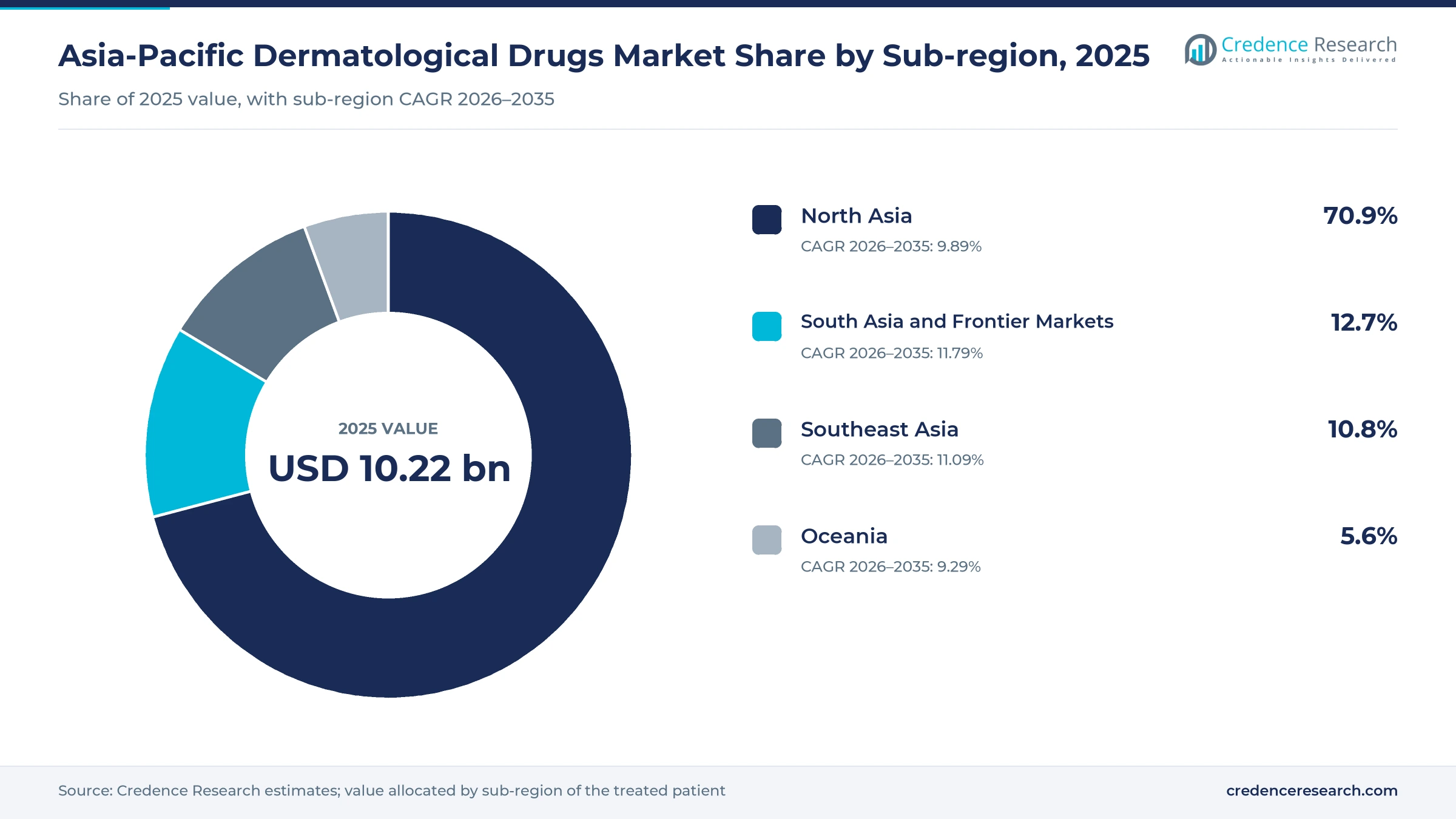
| North Asia | 7.24 | 70.9% | 9.89% |
| South Asia and frontier markets | 1.30 | 12.7% | 11.79% |
| Southeast Asia | 1.10 | 10.8% | 11.09% |
| Oceania | 0.57 | 5.6% | 9.29% |
Why does North Asia hold the largest share?
North Asia held 70.9% of 2025 value and grows at 9.89% a year. Japan spent about USD 3,638 per person on health in 2023 and South Korea about USD 3,044, while China's list now covers 3,253 drugs. Japan approved Dupixent for hives in 2024 and for bullous pemphigoid in 2026, and China approved an oral IL-23 pill in August 2026. However, price cuts in China slow value growth relative to volume.
Why are South Asia and frontier markets growing fastest?
South Asia and frontier markets held 12.7% of 2025 value and grow at 11.79% a year, the fastest rate in the region. Health spending per person was about USD 85 in India and USD 53 in Bangladesh in 2023. Sun Pharma launched Ilumya in India in December 2025, and Glenmark and Pfizer brought abrocitinib to Indian patients in 2024. Most patients there still pay for treatment themselves, which keeps generics central.
How does Southeast Asia build specialist access?
Southeast Asia held 10.8% of 2025 value and grows at 11.09% a year. Galderma runs its Asia-Pacific regional hub from Singapore, where health spending reached about USD 3,922 per person in 2023. Malaysia's health ministry proposed RM29 million in March 2026 to widen biologic access for dermatology patients. Health spending stayed near USD 327 per person in Thailand and USD 132 in Indonesia, which limits public cover for costly therapies.
What shapes demand in Oceania?
Oceania held 5.6% of 2025 value and grows at 9.29% a year. Australia spent about USD 6,980 per person on health in 2023, the highest in the region, and its PBS has subsidized Rinvoq for severe eczema since February 2022. The TGA registered Galderma's Nemluvio in May 2025, and LEO Pharma's Anzupgo cream is also approved in Australia. However, the high treatment rates already reached in Australia slow growth compared with Asian markets.
Approvals, launches and filings from 2024 to 2026
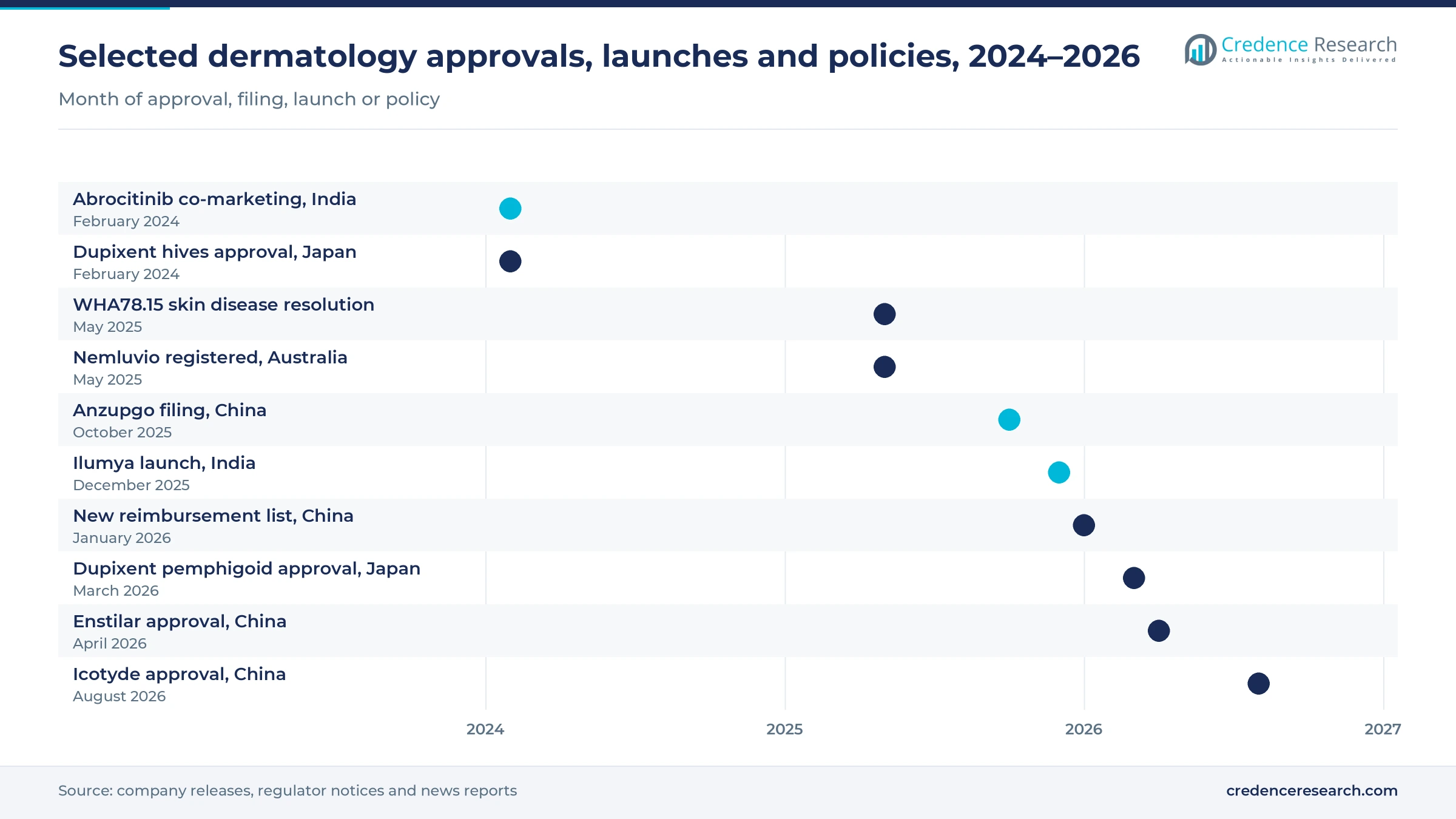
| Development | Status and market relevance |
|---|---|
| In February 2024, Japan became the first country to approve Sanofi's Dupixent for chronic spontaneous urticaria. | First approval for this indication worldwide |
| In May 2025, Australia registered Galderma's Nemluvio for atopic dermatitis and prurigo nodularis. | Adds a new antibody for itch-driven skin disease |
| In October 2025, LEO Pharma filed its Anzupgo cream for chronic hand eczema in China. | Backed by a 362-patient Chinese trial |
| In March 2026, Japan approved Dupixent for bullous pemphigoid as its seventh Japanese indication. | First targeted medicine for the disease in Japan |
| In August 2026, China approved Johnson & Johnson's oral pill Icotyde for plaque psoriasis. | Adds a needle-free IL-23 receptor option |
Antibodies and oral targeted agents widen treatment
- Conventional small molecules such as topical steroids, retinoids, antifungals and methotrexate remain the first line of care, because they are cheap and widely available.
- Engineered antibodies such as dupilumab, nemolizumab and IL-23 inhibitors block one immune signal, which gives lasting control of eczema, psoriasis and hives.
- Targeted small molecules such as JAK inhibitors and the oral IL-23 receptor pill Icotyde act inside or on immune cells, which lets patients avoid injections.
- Novel topicals such as delgocitinib cream and calcipotriol and betamethasone foam bring targeted or combined action to the skin surface with less systemic exposure.
Need a Custom Version of This Report?
Tailor the scope, geography, or segments to your exact requirements.
- Custom geography or segment scope
- Direct access to our analyst team
Global originators face new Chinese and Indian entrants
Competition in dermatological drugs across Asia Pacific combines global originators with fast-rising Chinese and Indian makers. Sanofi leads in antibodies, as Dupixent reached seven indications in Japan by March 2026 and has been available in India since 2023. AbbVie competes with the oral JAK inhibitor Rinvoq, which is reimbursed for eczema in Australia and South Korea and was filed for vitiligo in Japan. Johnson & Johnson won Chinese approval for its oral psoriasis pill Icotyde in August 2026. Galderma registered Nemluvio in Australia in 2025 and runs its Asia-Pacific hub from Singapore. LEO Pharma announced its Anzupgo filing in China in October 2025 and plans to launch Enstilar there later in 2026. Innovent and Sun Pharma add lower-priced IL-23 options, so companies compete on indications, reimbursement, price and dermatologist support.
Originators and specialists active across the region
| Company | Type | Role in the market |
|---|---|---|
| Sanofi | Originator | Dupixent approved in Japan for hives in 2024 and bullous pemphigoid in 2026, and launched in India |
| AbbVie | Originator | Rinvoq reimbursed for eczema in Australia and South Korea, filed for vitiligo in Japan in 2026 |
| Johnson & Johnson | Originator | Oral IL-23 receptor pill Icotyde approved in China for plaque psoriasis in 2026 |
| Galderma | Dermatology specialist | Nemluvio registered in Australia in 2025, Asia-Pacific hub in Singapore |
| LEO Pharma | Dermatology specialist | Enstilar approved in China in 2026 and Anzupgo filed in China in 2025 |
Reimbursement depth, not disease burden, sets the pace
Credence Research's view is that spending on dermatological drugs in Asia Pacific will grow quickly because insurers are paying for targeted therapies that were once limited to Western markets. Advanced targeted therapies grow fastest, while OTC topicals keep the largest volume base. North Asia keeps the largest share, and South Asia grows fastest as Indian patients gain access to biologics. However, deep price cuts in China and self-pay barriers in India could slow value growth. Companies that pair broad labels with early reimbursement filings should gain share.
Coverage, approvals and health spending feed the model
The report on skin disease medicines uses 2025 as the base year on a calendar basis, and market values come from the Credence Research model. That model combines health spending statistics, reimbursement decisions, regulator approvals, disease prevalence figures and company information on launches and filings. The sub-regional shares, segment splits and growth rates are Credence Research estimates. Sources used are official statistics, regulator and government notices, company releases and news reports, and no interviews or surveys were used.
Targeted therapies carry regional growth to 2035
Regional spending on dermatological drugs is expected to reach USD 27.18 billion by 2035, a 10.25% CAGR during 2026–2035, as more patients move from creams to targeted therapy. Growth should be strongest in South Asia and Southeast Asia, where few patients receive biologics today. North Asia will keep the largest share because of its insurance coverage and specialist capacity. Oral targeted agents, wider antibody labels and domestic Chinese and Indian biologics will shape prescribing, while price negotiations will keep pressure on originator margins.
Frequently Asked Questions
How big is the Asia-Pacific dermatological drugs market?
Which sub-region leads regional dermatology drug sales?
Which sub-region grows fastest?
Which product type grows fastest?
Which disease area leads spending?
What new dermatology approvals came in Japan recently?
How is China changing psoriasis treatment?
Which companies are active in the regional market?
Table of Content
Chapter 1 Market Segmentation
- 1.1 Segmentation Framework
- 1.1.1 Product and Service Classification
- 1.1.2 Application and End-Use Classification
- 1.1.3 Technology and Solution Classification
- 1.1.4 Customer and Distribution Channel Classification
- 1.1.5 Geographic Segmentation
- 1.1.6 Market Segment Definitions and Boundaries
- 1.2 By Product Type
- 1.2.1 OTC topicals
- 1.2.2 Prescription topicals
- 1.2.3 Conventional systemic agents
- 1.2.4 Advanced targeted therapies
- 1.3 By Disease Area
- 1.3.1 Inflammatory dermatoses
- 1.3.2 Acne and rosacea
- 1.3.3 Cutaneous infections
- 1.3.4 Urticaria and pigmentary or hair disorders
- 1.4 By Care Setting
- 1.4.1 Hospital outpatient care
- 1.4.2 Specialist clinic care
- 1.4.3 Community-managed care
- 1.5 By Sub-region
- 1.5.1 North Asia
- 1.5.2 South Asia and frontier markets
- 1.5.3 Southeast Asia
- 1.5.4 Oceania
Chapter 2 Introduction
- 2.1 Report Objectives and Scope
- 2.2 Product Definition and Industry Terminology
- 2.3 Market Inclusions and Exclusions
- 2.4 Research Process
- 2.4.1 Primary Research and Expert Interviews
- 2.4.2 Secondary Research and Source Review
- 2.4.3 Top-Down and Bottom-Up Estimation
- 2.4.4 Data Triangulation and Verification
- 2.5 Market Size Measurement Basis
- 2.5.1 2025: USD 10.22 billion → 2035: USD 27.18 billion
- 2.6 Historical and Forecast Reference Periods
- 2.6.1 Historical Period: 2018-2025
- 2.6.2 Base Year: 2025
- 2.6.3 Forecast Period: 2025-2035
- 2.7 Research Assumptions and Limitations
Chapter 3 Executive Summary
- 3.1 Market Snapshot and Key Findings
- 3.2 Base-Year Market Size, 2025
- 3.3 Forecast Market Size, 2035
- 3.4 Revenue and Volume Growth Outlook
- 3.5 Key Demand and Supply Indicators
- 3.6 Leading Market Segments
- 3.7 Fastest-Growing Market Opportunities
- 3.8 Regional Performance Highlights
- 3.9 Technology and Industry Transformation
- 3.10 Competitive Landscape Summary
- 3.11 Analyst View and Strategic Implications
Chapter 4 Asia-Pacific Dermatological Drugs Market Trends and Developments
- 4.1 Historical Industry Development, 2018-2025
- 4.2 Recent Market Trends and Developments
- 4.3 Demand and Customer Behavior Trends
- 4.4 Technology and Product Innovation
- 4.5 Artificial Intelligence, Automation and Digitalization
- 4.6 Local Manufacturing and Supply Chain Realignment
- 4.7 Industry Partnerships, Mergers and Acquisitions
- 4.8 Sustainability and Circular Economy Developments
- 4.9 Government and Private Sector Investment Trends
- 4.10 Emerging Business Models and Commercialization
- 4.11 Industry Developments and Announcements
Chapter 5 Asia-Pacific Dermatological Drugs Market Production, Supply and Demand Analysis
- 5.1 Demand Trend and Consumption Analysis, 2018-2025
- 5.2 Demand Forecast, 2025-2035
- 5.3 Production and Output Trend, 2018-2025
- 5.4 Production and Output Forecast, 2025-2035
- 5.5 Installed Capacity and Capacity Utilization
- 5.6 Company-Wise Production Plants and Statistics
- 5.6.1 Installed Production Capacity
- 5.6.2 Actual Production
- 5.6.3 Planned Capacity and Expansion Targets
- 5.7 Supply Chain Structure and Procurement Trends
- 5.8 Supply-Demand Gap and Bottlenecks
- 5.9 Import Dependence and Sourcing Structure
- 5.10 Contract Manufacturing and Outsourcing
- 5.11 Regional Supply and Demand Concentration
Chapter 6 Asia-Pacific Dermatological Drugs Market Pricing Analysis
- 6.1 Pricing Structure and Measurement
- 6.2 Historical Pricing Trends, 2018-2025
- 6.3 Pricing Outlook, 2025-2035
- 6.4 Average Selling Price and Unit Economics
- 6.5 Pricing by Product and Market Segment
- 6.6 Geographic Pricing Differences
- 6.7 Key Input, Energy, Labor and Logistics Costs
- 6.8 Contract Pricing and Purchasing Models
- 6.9 Pricing Sensitivity and Competitive Positioning
- 6.10 Price, Margin and Profitability Implications
Chapter 7 Asia-Pacific Dermatological Drugs Market Dynamics
- 7.1 Market Growth Drivers
- 7.1.1 Demand-Side Drivers
- 7.1.2 Technology and Innovation Drivers
- 7.1.3 Infrastructure and Investment Drivers
- 7.1.4 Regulatory and Policy Drivers
- 7.2 Market Restraints
- 7.2.1 Cost and Affordability Constraints
- 7.2.2 Technology and Adoption Barriers
- 7.2.3 Supply Chain and Operational Constraints
- 7.3 Market Challenges
- 7.3.1 Competitive Pressure and Margin Erosion
- 7.3.2 Skills, Infrastructure and Implementation Gaps
- 7.4 Emerging Market Opportunities
- 7.5 Market Dynamics Impact and Time-Horizon Assessment
Chapter 8 Asia-Pacific Dermatological Drugs Value Chain Analysis
- 8.1 Industry Value Chain Overview
- 8.2 Upstream Suppliers and Critical Inputs
- 8.3 Technology and Component Providers
- 8.4 Manufacturing or Service Delivery
- 8.5 Distribution, Channel Partners and Integrators
- 8.6 Downstream Applications and End Users
- 8.7 Value Addition and Profit Pools
- 8.8 Vertical Integration and Outsourcing
- 8.9 Supplier Concentration and Risk
- 8.10 Supply Chain Localization and Resilience
Chapter 9 Asia-Pacific Dermatological Drugs Market Regulations and Policies
- 9.1 Relevant Laws, Standards and Compliance Frameworks
- 9.2 Product, Service, Safety and Quality Requirements
- 9.3 Government Policies, Incentives and Subsidies
- 9.4 Imports, Exports and Trade Barriers
- 9.5 Public Procurement and Local Content Requirements
- 9.6 Environmental and Sustainability Compliance
- 9.7 Upcoming Policy Changes and Market Implications
Chapter 10 Asia-Pacific Dermatological Drugs Market Hotspots and Opportunities
- 10.1 Market Opportunity Mapping and Growth Hotspots
- 10.2 High-Growth Applications and Customer Groups
- 10.3 Underserved Markets and White-Space Opportunities
- 10.4 Emerging Technology and Product Opportunities
- 10.5 New Capacity and Investment Hotspots
- 10.6 Market Entry and Expansion Opportunities
- 10.7 Distribution and Partnership Opportunities
- 10.8 Near-Term and Long-Term Commercial Potential
- 10.9 Opportunity Attractiveness and Execution Risks
Chapter 11 Asia-Pacific Dermatological Drugs Market Outlook, 2025-2035
- 11.1 Market Size and Analysis
- 11.1.1 Revenue (Market Measurement: 2025: USD 10.22 billion → 2035: USD 27.18 billion)
- 11.1.2 Market Volume and Quantity Sold
- 11.1.3 Historical Market Size, 2018-2025
- 11.1.4 Base-Year Market Size, 2025
- 11.2 Market Forecast, 2025-2035
- 11.2.1 Revenue Forecast to 2035
- 11.2.2 Volume Forecast to 2035
- 11.2.3 CAGR and Year-on-Year Growth
- 11.2.4 Incremental Revenue Opportunity
- 11.3 Forecast Assumptions and Scenario Analysis
- 11.3.1 Base-Case Forecast
- 11.3.2 Optimistic and Conservative Scenarios
- 11.3.3 Technology, Pricing and Policy Sensitivities
- 11.4 Market Attractiveness and Growth Outlook
Chapter 12 Asia-Pacific Dermatological Drugs Market Segmentation and Outlook
- 12.1 Segmentation Summary and Market Shares, 2025
- 12.2 Largest and Fastest-Growing Segments
- 12.3 By Product Type - Market Size and Forecast, 2025-2035
- 12.3.1 Segment Definition and Scope
- 12.3.2 Historical Market Size, 2018-2025
- 12.3.3 Revenue Forecast, 2025-2035
- 12.3.4 Volume Forecast, 2025-2035
- 12.3.5 Base-Year Market Share, 2025
- 12.3.6 Segment CAGR and Growth Drivers
- 12.3.7 Subsegment Market Size and Forecast
- 12.3.7.1 OTC topicals
- 12.3.7.2 Prescription topicals
- 12.3.7.3 Conventional systemic agents
- 12.3.7.4 Advanced targeted therapies
- 12.3.8 Subsegment Pricing and Adoption Trends
- 12.3.9 Leading Suppliers and Competition
- 12.3.10 Regional Demand and Opportunities
- 12.4 By Disease Area - Market Size and Forecast, 2025-2035
- 12.4.1 Segment Definition and Scope
- 12.4.2 Historical Market Size, 2018-2025
- 12.4.3 Revenue Forecast, 2025-2035
- 12.4.4 Volume Forecast, 2025-2035
- 12.4.5 Base-Year Market Share, 2025
- 12.4.6 Segment CAGR and Growth Drivers
- 12.4.7 Subsegment Market Size and Forecast
- 12.4.7.1 Inflammatory dermatoses
- 12.4.7.2 Acne and rosacea
- 12.4.7.3 Cutaneous infections
- 12.4.7.4 Urticaria and pigmentary or hair disorders
- 12.4.8 Subsegment Pricing and Adoption Trends
- 12.4.9 Leading Suppliers and Competition
- 12.4.10 Regional Demand and Opportunities
- 12.5 By Care Setting - Market Size and Forecast, 2025-2035
- 12.5.1 Segment Definition and Scope
- 12.5.2 Historical Market Size, 2018-2025
- 12.5.3 Revenue Forecast, 2025-2035
- 12.5.4 Volume Forecast, 2025-2035
- 12.5.5 Base-Year Market Share, 2025
- 12.5.6 Segment CAGR and Growth Drivers
- 12.5.7 Subsegment Market Size and Forecast
- 12.5.7.1 Hospital outpatient care
- 12.5.7.2 Specialist clinic care
- 12.5.7.3 Community-managed care
- 12.5.8 Subsegment Pricing and Adoption Trends
- 12.5.9 Leading Suppliers and Competition
- 12.5.10 Regional Demand and Opportunities
- 12.6 By Sub-region - Market Size and Forecast, 2025-2035
- 12.6.1 Segment Definition and Scope
- 12.6.2 Historical Market Size, 2018-2025
- 12.6.3 Revenue Forecast, 2025-2035
- 12.6.4 Volume Forecast, 2025-2035
- 12.6.5 Base-Year Market Share, 2025
- 12.6.6 Segment CAGR and Growth Drivers
- 12.6.7 Subsegment Market Size and Forecast
- 12.6.7.1 North Asia
- 12.6.7.2 South Asia and frontier markets
- 12.6.7.3 Southeast Asia
- 12.6.7.4 Oceania
- 12.6.8 Subsegment Pricing and Adoption Trends
- 12.6.9 Leading Suppliers and Competition
- 12.6.10 Regional Demand and Opportunities
- 12.7 Segment Growth Comparison
- 12.8 Segment Attractiveness and Priority Matrix
Chapter 13 Asia-Pacific Dermatological Drugs Geographic Market Outlook, 2025-2035
- 13.1 Regional Market Size and Country-Level Shares, 2025
- 13.2 Country Market Size Comparison, 2025
- 13.3 Country Market Forecasts, 2025-2035
- 13.4 Subregional Industrial and Demand Clusters
- 13.5 Intra-Regional Pricing and Cost Differences
- 13.6 Cross-Border Trade and Supply Networks
- 13.7 Regional Supply and Demand Balances
- 13.8 Country Opportunity Comparison and Prioritization
Note: Every listed country is covered on the structure shown under the first country.
Chapter 14 Asia-Pacific Dermatological Drugs Technology, Innovation and Sustainability Outlook
- 14.1 Technology Landscape and Maturity
- 14.2 Product, Process and Service Innovation
- 14.3 AI, Automation and Digital Tools in the Industry
- 14.4 Technology Adoption and Performance Benchmarking
- 14.5 Innovation Pipeline and R&D Investment
- 14.6 Patent and Intellectual Property Trends
- 14.7 Energy Efficiency and Resource Management
- 14.8 Sustainability, Recycling and Circularity
- 14.9 Technology Roadmap, 2025-2035
- 14.10 Risks of Obsolescence and Technology Substitution
Chapter 15 Asia-Pacific Dermatological Drugs Market Key Strategic Imperatives
- 15.1 Growth and Market Entry Priorities
- 15.2 High-Return Products and Segments
- 15.3 Pricing, Profitability and Cost Optimization
- 15.4 Technology Investment and Product Differentiation
- 15.5 Supply Chain Localization and Resilience
- 15.6 Distribution and Customer Acquisition
- 15.7 Partnership, Acquisition and Capacity Strategy
- 15.8 Regional Expansion Priorities
- 15.9 Short-, Medium- and Long-Term Actions
Chapter 16 Competition Outlook
- 16.1 Industry Competition Characteristics
- 16.2 Market Structure and Concentration
- 16.3 Market Share and Competitive Positioning, 2025
- 16.4 Company-Wise Revenue and Product Benchmarking
- 16.5 Production and Service Capacity Benchmarking
- 16.6 Technology, Pricing and Differentiation
- 16.7 Regional Footprint and Distribution Strength
- 16.8 Mergers, Acquisitions and Strategic Alliances
- 16.9 New Entrants and Competitive Threats
- 16.10 Porter's Five Forces and Industry Attractiveness
- 16.11 Competitive Outlook, 2025-2035
Chapter 17 Company Profiles
- 17.1 Company Coverage and Selection Criteria
- 17.2 Sanofi
- 17.2.1 Business Description
- 17.2.2 Company Ownership and Geographic Presence
- 17.2.3 Product and Service Portfolio
- 17.2.4 Manufacturing and Operating Footprint
- 17.2.5 Production Capacity and Expansion Plans
- 17.2.6 Financial Performance and Investment
- 17.2.7 Market Share and Competitive Position
- 17.2.8 Technology and Innovation Capabilities
- 17.2.9 Strategic Alliances or Partnerships
- 17.2.10 Recent Developments
- 17.2.11 Growth Strategy and Outlook
- 17.3 AbbVie
- 17.4 Johnson & Johnson
- 17.5 Galderma
- 17.6 LEO Pharma
- 17.7 Other Relevant Market Participants
Note: Every listed company is profiled on the structure shown under the first company. The company list is preliminary and may change based on research findings, market developments, data availability and client requirements.
Chapter 18 Disclaimer
- 18.1 Research and Forecast Disclaimer
- 18.2 Data Source and Estimation Limitations
Note: The depth of individual sections depends on data availability for this market. Volume, capacity, trade and other unit-based metrics are included where applicable.