
Diabetes caseloads anchor regional gel spending
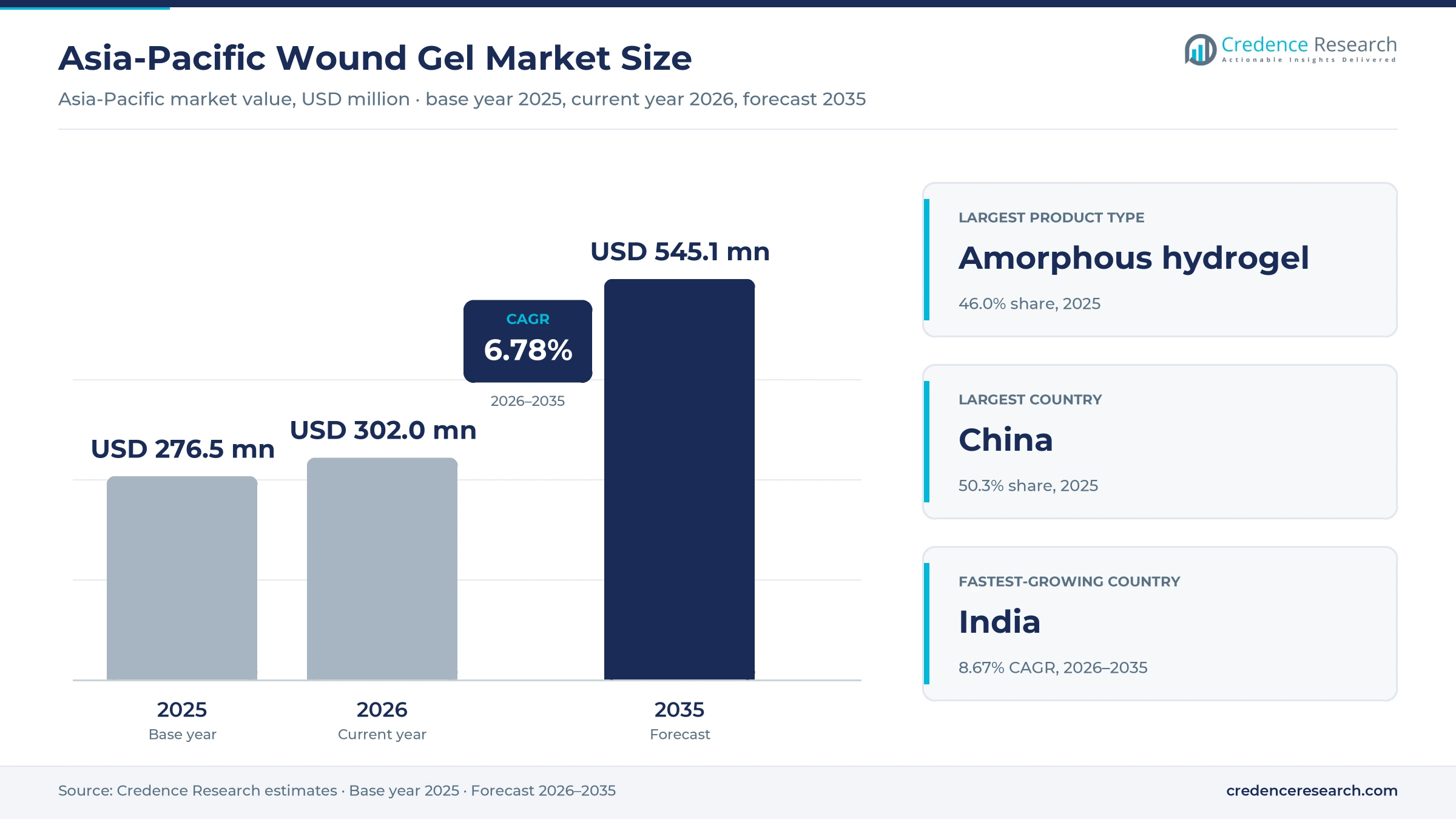
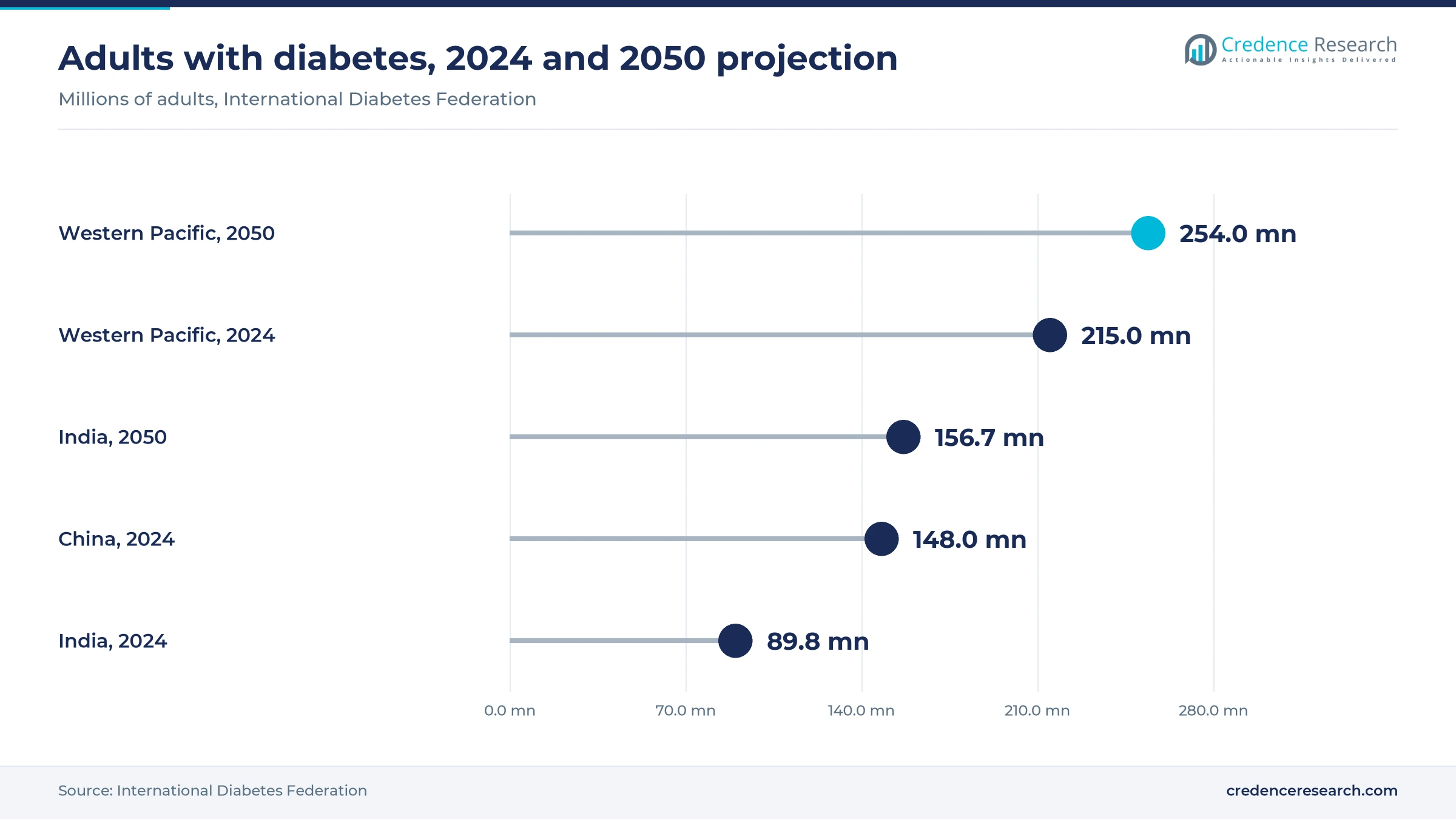
The Asia-Pacific wound gel market was valued at USD 276.5 million in 2025 and is projected to increase from USD 302.0 million in 2026 to USD 545.1 million by 2035, registering a CAGR of 6.78% during 2026–2035. Spending follows chronic ulcer caseloads, with the International Diabetes Federation counting 215 million adults with diabetes in the Western Pacific alone in 2024. China held the largest share, 50.3% in 2025, supported by hospital purchasing and a widening long-term care insurance pilot. India is the fastest-growing country at 8.67% a year, as its diabetic population is projected to reach 156.7 million by 2050. Commercial supply is also moving closer to patients, because Mölnlycke expects its Changshu plant to begin production around the end of 2026. Australia began funding free wound consumables for older people with diabetes in June 2025, which brings dressing costs into community care budgets.
What does the wound gel market in Asia-Pacific include?
The market counts amorphous hydrogel, hydrogel sheets, hydrogel-impregnated gauze and specialty wound gels sold for chronic and acute wounds. Buyers include public and private hospitals, outpatient wound clinics, long-term care operators, insurers and patients paying at pharmacies or online stores.
The estimate excludes foam, alginate and film dressings that hold no gel layer, negative pressure equipment and purely cosmetic scar gels. Value is measured at the first commercial sale to institutions, distributors and retailers, and it follows products from polymer compounding through sterile filling to clinical use.
Asia-Pacific Wound Gel Market Insights
- The market rises from USD 276.5 million in 2025 to USD 545.1 million by 2035, a 6.78% annual pace that tracks chronic ulcer caseloads and community care funding.
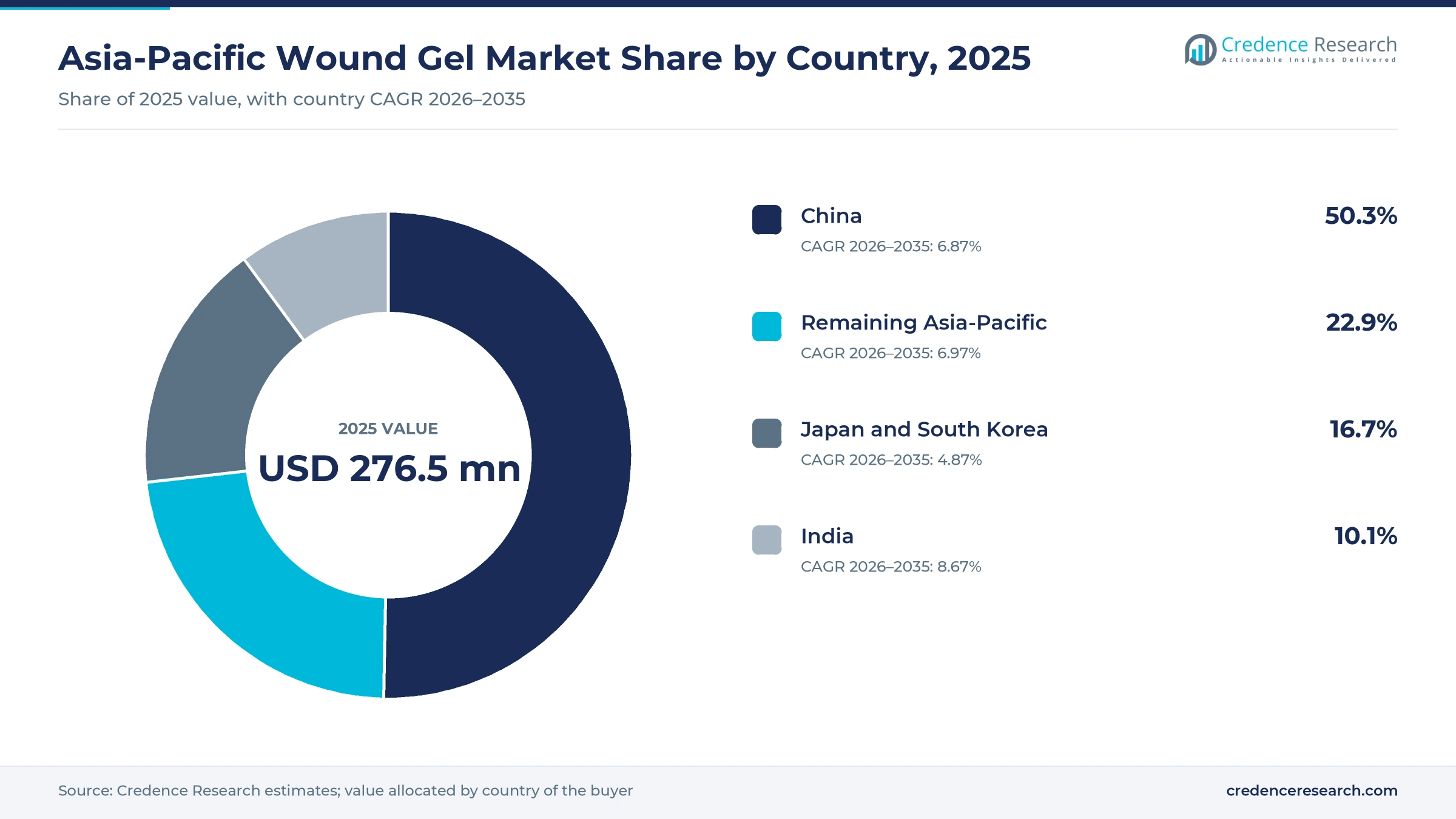
- China held 50.3% of regional value in 2025, ahead of Japan and South Korea combined at 16.7% on Credence Research estimates.
- Amorphous hydrogel led product types with 46.0% of 2025 value, helped by Japan listing irregular-type dressing materials for billing at 35 yen per gram.
- India licensed a nitric oxide-releasing collagen hydrogel for diabetic foot ulcers, launched in November 2025, which shows gels moving from moisture support toward active treatment.
- Mölnlycke and Zhende Medical announced a China joint venture on May 21, 2026, pairing global dressing lines with reach across nearly 10,000 hospitals.
Amorphous gels and diabetic foot care lead spending
Why do amorphous gels outsell sheets and gauze?
Based on product type, the market is categorized into amorphous hydrogel, hydrogel sheets, hydrogel-impregnated gauze and specialty wound gels. Amorphous hydrogel led with 46.0% of 2025 value because tube and sachet gels fit irregular wounds, and Japan’s fee schedule bills irregular-type subcutaneous dressing material at 35 yen per gram, according to the Knowlety listing updated June 2026. Specialty wound gels grow fastest at 8.31% a year as India’s Department of Atomic Energy reported the November 2025 launch of a nitric oxide-releasing collagen hydrogel dressing for diabetic foot ulcers. Sheet formats retain a place where clinicians prefer a fixed contact area.
How do diabetic foot ulcers shape gel demand?
Based on disease area, the market is categorized into diabetic foot ulcers, pressure ulcers, venous leg ulcers and acute wounds. Diabetic foot ulcers led with 40.0% of 2025 value because the International Diabetes Federation counted 147.98 million adults with diabetes in China in 2024 and 89.8 million in India. Pressure ulcers grow fastest at 7.32% a year as Japan’s Ministry of Internal Affairs and Communications reported in September 2025 that 29.4% of residents were aged 65 or older. Venous ulcers remain smaller, since a 2022 Singapore General Hospital study estimated venous-related wounds at 15 per 100,000 people in 2017.
Where is gel use moving beyond the hospital ward?
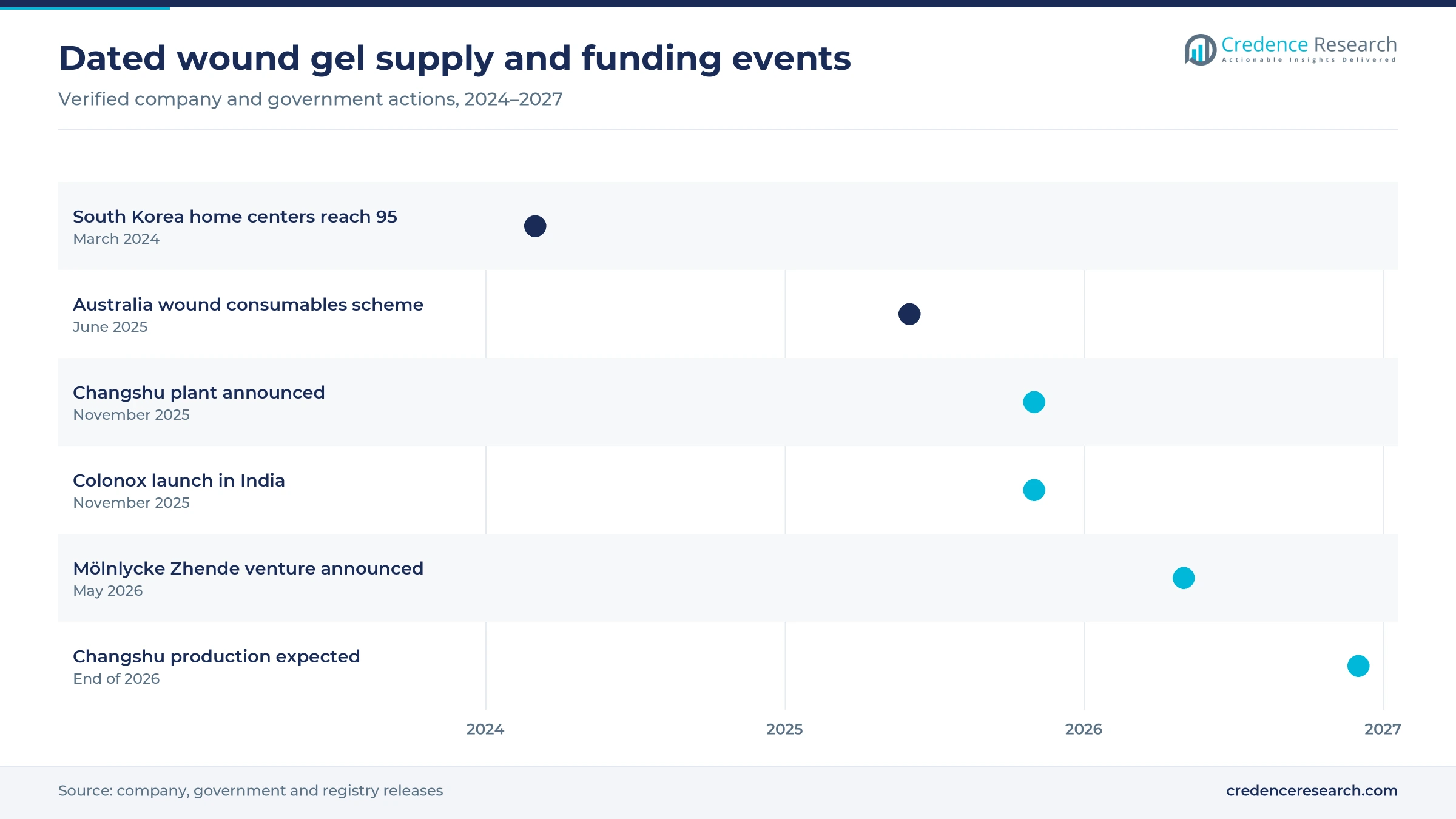
Based on care setting, the market is categorized into hospitals, outpatient wound clinics, home care and long-term care. Hospitals led with 52.0% of 2025 value because large institutional networks anchor purchasing, shown by the Mölnlycke Zhende venture targeting nearly 10,000 hospitals and 200,000 pharmacies in China. Home care grows fastest at 8.34% a year as South Korea’s health ministry had 95 long-term care home medical centers running by March 2024 and targets 250 by 2027, according to The Asia Business Daily. Outpatient clinics add steady repeat visits, while long-term care follows insurance coverage in each country.
Which sales channels reach gel buyers first?
Based on sales channel, the market is categorized into direct institutional supply, specialist medical distribution, pharmacy retail and digital medical commerce. Direct institutional supply led with 44.0% of 2025 value because hospital buyers contract with manufacturers, and Mölnlycke’s Changshu site, announced Nov. 5, 2025, shortens that supply line within China. Digital medical commerce grows fastest at 9.33% a year as Vietnam’s Pharmacity lists Prontosan gel online at 430,000 dong per 30 ml box, with add-to-cart ordering. Pharmacy retail keeps a solid base, and specialist distributors serve smaller markets such as Vietnam through firms like Globalpharma.
| Segment Group | Leading Sub-segment | Share, 2025 | Fastest-growing Sub-segment | CAGR, 2026–2035 |
|---|---|---|---|---|
| By Product Type | Amorphous hydrogel | 46.0% | Specialty wound gels | 8.31% |
| By Disease Area | Diabetic foot ulcers | 40.0% | Pressure ulcers | 7.32% |
| By Care Setting | Hospitals | 52.0% | Home care | 8.34% |
| By Sales Channel | Direct institutional supply | 44.0% | Digital medical commerce | 9.33% |
Request a Free Sample
Fill in your details and we'll send you a free sample report.
- Sample data tables & charts
- Research methodology
Ulcer caseloads and care funding lift gel volumes
Chronic-wound treatment demand follows diabetes caseloads
Chronic-wound treatment demand sets the baseline for gel volume, because each ulcer needs repeated dressing changes over months. The International Diabetes Federation projects the Western Pacific diabetic population to grow from 215 million in 2024 to 254 million by 2050, while India alone moves from 89.8 million to 156.7 million. Chemistry World puts the lifetime risk of a diabetic foot ulcer in India at 15% to 25%, which turns that population into a large recurring caseload. In turn, the 2022 Singapore General Hospital study cited treatment lasting six months to a year and recurrence of 18% to 28% within 12 months. Diabetic foot ulcers therefore hold 40.0% of value, and gel purchases often sit inside diabetic foot ulcer treatment budgets.
Community-care funding opens new access points
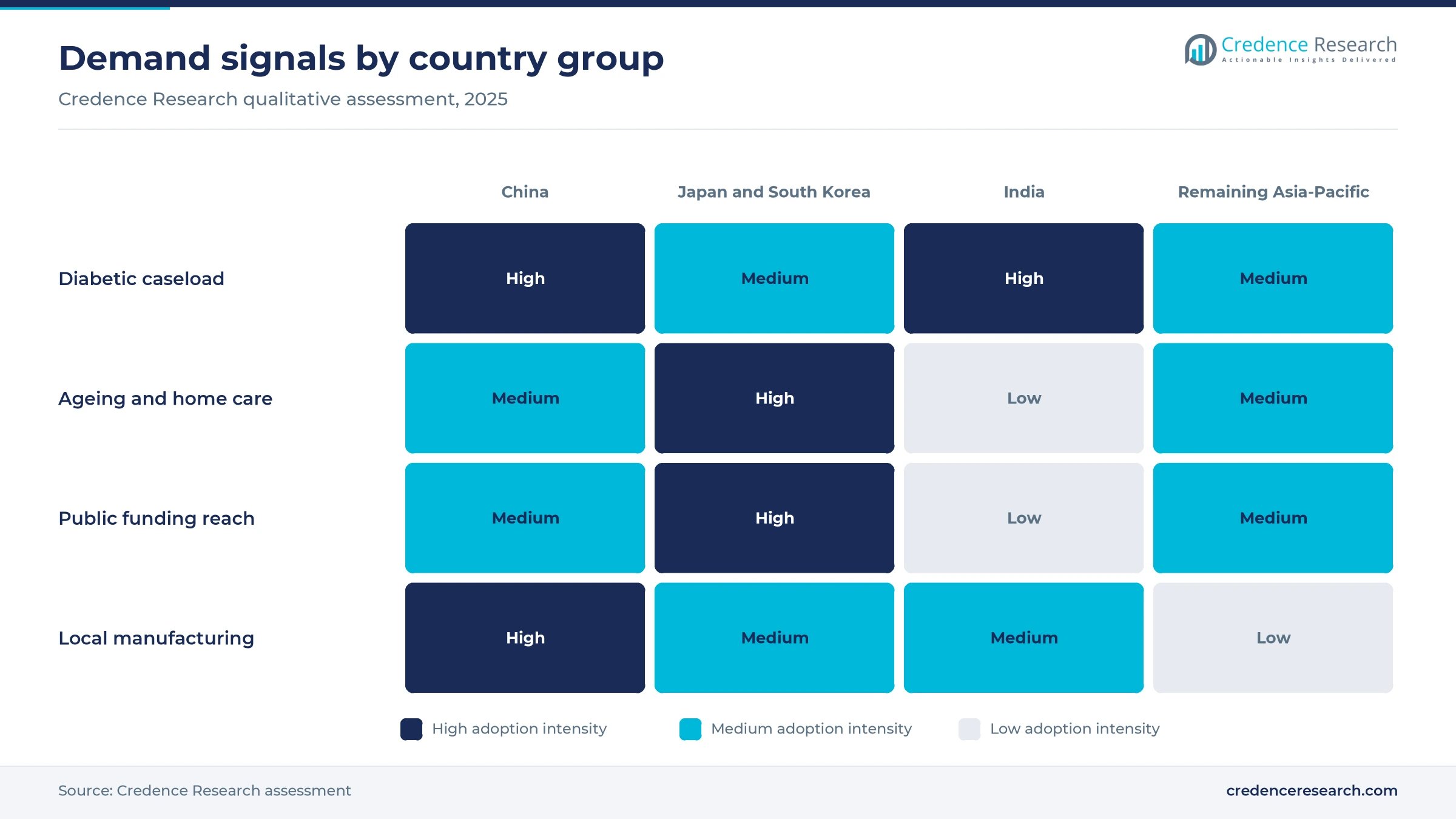
Community-care funding access moves gels out of hospital budgets and into home and clinic settings. Australia’s Chronic Wound Consumables Scheme launched in June 2025, with nearly AUD 50 million in federal funding, free home delivery and support for about 20,000 people each year, according to Diabetes Australia. China’s long-term care insurance covered more than 180 million people across 49 cities by the end of 2024, with 2.6 million people receiving benefits, according to National Healthcare Security Administration figures carried by China Daily in February 2025. South Korea’s long-term care home medical program served 3,986 recipients by March 2024, and its planned expansion to 250 centers would widen the prescribing base. Because these schemes pay for care outside the ward, Home care grows at 8.34% a year.
Established moisture-management formats keep clinician trust
Established moisture-management formats hold their place because payers and catalogs already list them by name, which lowers the effort of prescribing. Japan’s dressing billing list names hydrogel wound covering categories under its fiscal 2026 fee schedule, and it pays 10 yen per square centimeter for standard subcutaneous materials, according to Knowlety’s fee schedule listing. Australian supplier Medisa lists Intrasite, Purilon, Nu-Gel, Solosite and Solugel among hydrogel brands, and it prices a 12-box Kendall amorphous hydrogel from AUD 164.54. This familiarity supports wider use of moist dressings in routine care, since clinicians can substitute within a known format. As a result, Amorphous hydrogel retained 46.0% of regional value in 2025.
Aging households raise pressure ulcer risk at home
Population ageing adds a second caseload that sits mainly in homes and care facilities. Japan’s Ministry of Internal Affairs and Communications counted 36.19 million people aged 65 or older in September 2025, equal to 29.4% of residents. The health ministry’s 2025 survey, reported by Kyodo News in July 2026, found that 37.1% of home-care households had both the recipient and primary caregiver aged 75 or older, nearly double the 18.7% of 2001. Elsewhere, World Bank data show people aged 65 and over at 20.3% of South Korea’s population and 14.9% of China’s in 2025. In China, a January 2026 Frontiers in Medicine paper cited in-hospital pressure injury prevalence of 1.67%. Together these figures explain why Pressure ulcers grow at 7.32% a year across the region.
Bioactive gels and local plants reshape regional supply
Shift from moisture support to bioactive gels
Developers are shifting gels from passive moisture support toward active treatment, and Asian institutions are leading several of these projects. India’s Bhabha Atomic Research Centre licensed its nitric oxide technology exclusively to Cologenesis Pvt. Ltd., after Cologenesis Healthcare completed Phase II and Phase III trials, and the Department of Atomic Energy announced the commercial launch on Nov. 18, 2025. South Korea’s T&R Biofab launched a Class 2 hydrogel dressing in March 2022 using extracellular matrix extracted from porcine aorta, according to The Asia Business Daily. The Asia Business Daily also reported in June 2025 that Pukyong National University researchers were studying hydrogel-based smart materials for wound healing and sensing. This direction overlaps with bioactive dressings, and Specialty wound gels grow at 8.31% a year as a result.
Rise of regional plants and low-cost local rivals
Supply is shifting toward regional plants, which changes both lead times and price references across the market. Mölnlycke’s 10,000-square-meter Changshu site, announced Nov. 5, 2025, is expected to begin production at the end of 2026 or early 2027. Thailand’s PTT developed its Inaqua bio-cellulose dressing with Phramongkutklao Hospital and expected a price about 50% below foreign products, according to the Bangkok Post in April 2023. Zhejiang Longterm Medical Technology markets hydrocolloid dressings that form a gel on contact with exudate, listing use on pressure and venous ulcers on its MedicalExpo page. As a result, imported brands face closer competition on price, particularly in China, the largest country market in this report.
Opportunity in botanical and honey-based gels
Botanical matrices offer an opening because local raw materials and clinician interest are both visible in the region. Malaysia’s IIUM Medical Centre began a 110-participant trial on Nov. 1, 2025, comparing a Kelulut honey-infused alginate dressing, a format adjacent to gels, with a Manuka honey dressing, according to the trial registry listing. Australian pharmacy chain Amcal already sells a 30-gram Manuka+ wound gel over the counter, which shows a retail route for honey-based products. Suppliers that pair local sourcing with trial data could therefore win early formulary places, especially where public hospitals in Remaining Asia-Pacific, at 22.9% of value, seek lower-cost options.
Opportunity in Indian reimbursement and retail access
India presents the clearest opening for suppliers able to meet local price points, because public spending is rising from a low base. National Health Accounts data for 2021-22 show government spending at 48% of total health expenditure, up from 40.8% in 2017-18, according to Business Standard. Chemistry World describes a proposal for a national advanced wound care policy center that would link domestically made products to schemes such as Ayushman Bharat. The market base is also measurable, with advanced wound care valued at INR 22.16 billion in 2024 in the same article. Companies that register locally under the Medical Device Rules 2017 can therefore target India, the fastest-growing country in this report, before larger rivals build local supply there.
Price caps and import costs limit gel uptake
Fee caps limit premium gel pricing in Japan
Japan’s fee schedule caps what hospitals can bill, which limits premium pricing for suppliers there. Knowlety’s fee schedule listing shows 10 yen per square centimeter for standard subcutaneous materials and sets a two-week standard use period, extended to three weeks only when specifically necessary. Dressings used mainly for protection are folded into the procedure fee and cannot be billed separately. As a result, suppliers must show clear clinical value within that window, because a longer-wearing or costlier gel earns no extra billing once the period ends.
Imported gels stay expensive for self-paying patients
Import reliance keeps retail prices high in lower-income markets, and this hits self-paying patients directly. Vietnam’s Pharmacity sells a 30 ml box of German-made Prontosan gel at 430,000 dong, a substantial purchase for a product used repeatedly. Thailand’s PTT expected its locally made dressing to cost about 50% less than foreign products, which shows the size of the import premium. Consequently, importers face pressure from domestic substitutes and need smaller pack sizes or local filling arrangements to protect their retail volume.
Late diagnosis and out-of-pocket costs delay treatment
Late diagnosis and household payment reduce gel use in India, even though the caseload is very large. The International Diabetes Federation estimates that 43% of Indian adults with diabetes were undiagnosed in 2024, and out-of-pocket payments still made up 39.4% of total health expenditure in 2021-22. An October 2022 Wounds International consensus also cites high costs and difficulty seeing clinicians in rural areas. Patients therefore often arrive late, and suppliers rely on low-cost packs and clinic training partnerships to widen access.
Bulk buying rounds could reach dressing categories
China’s expanding bulk purchasing creates pricing risk, even though wound gels were not named in the latest national round. The National Healthcare Security Administration selected 440 products from 202 companies in preliminary results reported Jan. 15, 2026, across drug-coated balloons and urological consumables. If regulators extend this model to dressings, multinational brands would face sharp tender discounts against low-cost domestic producers. Suppliers are responding by localizing production, as Mölnlycke is doing at Changshu, which should give them more room on cost in future tenders.
China leads value while India grows fastest
| Country | Value, 2025 (USD million) | Share, 2025 | CAGR, 2026–2035 |
|---|---|---|---|
| China | 139.1 | 50.3% | 6.87% |
| Remaining Asia-Pacific | 63.3 | 22.9% | 6.97% |
| Japan and South Korea | 46.2 | 16.7% | 4.87% |
| India | 27.9 | 10.1% | 8.67% |
China leads on hospital reach and insurance pilots
China held 50.3% of 2025 value and grows at 6.87% a year, supported by the largest diabetic population in the region at 147.98 million adults. Mölnlycke values the country’s advanced wound dressing segment at about RMB 3 billion, and its venture with Zhende Medical was targeted to become operational in the third quarter of 2026. Long-term care insurance pilots add a community purchasing route over time. However, the sixth national bulk-buying round in January 2026 shows how actively regulators press on device prices, so suppliers cannot assume stable pricing.
Japan and South Korea pay within tight fee schedules
Japan and South Korea held 16.7% of 2025 value and grow at 4.87% a year, the slowest pace here because mature fee schedules restrain price growth. Japan’s list names hydrogel categories and bills them by area or weight, while a 2024 Journal of Medical Investigation interview study of eight home-visit nurses cited limits imposed by insurance systems. South Korea’s home medical program adds volume, and The Asia Business Daily reports a target of 250 centers by 2027.
India grows fastest on diabetes and public spending
India held 10.1% of 2025 value and grows at 8.67% a year, the fastest rate among the four country groups. The International Diabetes Federation counted 89.8 million adults with diabetes there in 2024, and the Department of Atomic Energy reported the launch of a locally developed collagen hydrogel in November 2025. Government spending reached 48% of India’s health expenditure in 2021-22, which supports demand in public hospitals. However, Chemistry World notes that many high-value dressings are still imported, which keeps prices out of reach for low-resource patients.
Remaining Asia-Pacific blends funded and self-pay care
Remaining Asia-Pacific held 22.9% of 2025 value and grows at 6.97% a year, combining funded and self-paying markets. Monash University estimates that chronic wounds affect more than 450,000 Australians each year at a cost above AUD 6 billion, and federal consumables funding now reaches older patients with diabetes. In Southeast Asia, Vietnam sells imported gels through pharmacy chains, while Thailand’s PTT is building a domestic dressing line. Spending therefore differs sharply between funded Australian patients and cash buyers elsewhere.
Plants, ventures and funding schemes set the pace
| Development | Status and market relevance |
|---|---|
| In May 2026, Mölnlycke and Zhende Medical announced a majority Mölnlycke-owned China joint venture for advanced wound care sales and distribution. | Announced; operation targeted for the third quarter of 2026 |
| In November 2025, Mölnlycke announced a 10,000-square-meter wound care manufacturing site in Changshu, China. | Production expected at the end of 2026 or early 2027 |
| In November 2025, India’s Department of Atomic Energy reported the launch of the ColoNoX collagen hydrogel dressing for diabetic foot ulcers by licensee Cologenesis. | Commercial, licensed by the national regulator |
| In November 2025, IIUM Medical Centre in Malaysia began a 110-participant trial of a Kelulut honey-infused alginate dressing. | Early-phase trial listed with the Manuka comparator |
| In June 2025, Australia launched its Chronic Wound Consumables Scheme for older people with diabetes. | Active, with free delivery of consumables to eligible patients |
Polymer, antimicrobial, collagen and botanical matrices
- Non-active polymer matrices remain the mainstream format, and Medisa lists Kendall amorphous hydrogel in 28-gram to 85-gram sizes for Australian buyers.
- Antimicrobial matrices add bioburden control, and B. Braun’s Prontosan gel reaches Vietnamese pharmacies, which places it alongside wider antimicrobial dressings in retail.
- Collagen matrices support bioactive claims, and India’s ColoNoX combines nitric oxide with a collagen hydrogel that absorbs exudate and reduces pain.
- Botanical matrices are still early, with Malaysia’s Kelulut honey trial comparing a local honey dressing against a Manuka reference in 110 participants.
Need a Custom Version of This Report?
Tailor the scope, geography, or segments to your exact requirements.
- Custom geography or segment scope
- Direct access to our analyst team
Global dressing makers meet low-cost local rivals
Competition splits between global dressing specialists with broad hospital contracts and regional producers competing on price. Mölnlycke is the most visible investor, with a Changshu plant under development and a majority-owned Chinese venture announced in May 2026. Prontosan gel reaches Vietnam through the local subsidiary of B. Braun and distributors such as Globalpharma, which shows how European brands use partners in smaller markets. Smith+Nephew supported the 2022 Asia-Pacific consensus on diabetic foot ulcer care published by Wounds International. Zhejiang Longterm Medical Technology lists thin hydrocolloid dressings on MedicalExpo for chronic and postoperative wounds. New local entrants such as Cologenesis in India and PTT in Thailand add pressure on price and clinical claims. Because tender rules favor cost in China and fee schedules cap prices in Japan, suppliers are competing through local production, distribution reach and evidence.
Companies profiled and their roles in this market
| Company | Type | Role in the market |
|---|---|---|
| Mölnlycke Health Care | Global dressing maker | Building a Changshu plant and forming a China venture with Zhende Medical |
| B. Braun | Global supplier | Sells Prontosan gel through its Vietnam unit and pharmacy chains |
| Smith+Nephew | Global dressing maker | Hydrogel supplier whose Intrasite gel is listed by Australian distributor Medisa |
| Zhejiang Longterm Medical Technology | Chinese manufacturer | Lists hydrocolloid dressings for chronic and postoperative wounds |
| Cologenesis Pvt. Ltd. | Indian developer | Exclusive licensee of the ColoNoX collagen hydrogel dressing |
Home funding will matter more than new chemistry
Credence Research’s view is that funding access will shape this market more than new formulations through 2030. Australia’s consumables scheme and China’s long-term care pilots show that payers are starting to pay for care outside hospitals, and those channels reward simple, familiar products. Active gels such as ColoNoX matter strategically, but they will need more outcome data before wide reimbursement follows. The most assumption-heavy estimate here is China’s gel share of advanced dressings, which sits toward the upper end of the checked range. Suppliers should therefore plan around home-care contracting before they fund new chemistry.
How Credence Research built this estimate
The report uses 2025 as the base year and forecasts values through 2035 with the Credence Research market model. Segment and country splits are Credence Research estimates informed by public diabetes statistics, fee schedules, government program data, company releases, clinical registry listings and peer-reviewed studies opened during preparation. No interviews or surveys were conducted for this edition of the report. Values were checked against top-down and bottom-up calculations from public dressing market indicators, and sub-segment shares should be read as estimates rather than audited sales data.
Community care and India shape demand to 2035
The market is forecast to reach USD 545.1 million by 2035, with the pace set by community funding and caseloads rather than by price. Demand in India is the main swing factor, because its diabetic population is projected to climb about 75% between 2024 and 2050. That growth and China’s insurance expansion carry the largest volume gains, while Japan and South Korea grow slowly under fee limits. Mölnlycke’s Changshu output, due around early 2027, will test how far local manufacture alters tender pricing. If bulk purchasing reaches dressings, value could trail volume in China. Suppliers with local filling, clear outcome evidence and home delivery capability stand best placed for the 2030s.
Frequently Asked Questions
How big is the Asia-Pacific wound gel market?
Which country leads the market in Asia-Pacific?
Which country grows fastest in this market?
Which product type holds the largest share?
Which disease area drives the most spending?
How does public funding affect wound gel access?
What limits wound gel uptake in the region?
Who are the main companies in this market?
Table of Content
Chapter 1 Market Segmentation
- 1.1 Segmentation Framework
- 1.1.1 Product and Service Classification
- 1.1.2 Application and End-Use Classification
- 1.1.3 Technology and Solution Classification
- 1.1.4 Customer and Distribution Channel Classification
- 1.1.5 Geographic Segmentation
- 1.1.6 Market Segment Definitions and Boundaries
- 1.2 By Product Type
- 1.2.1 Amorphous hydrogel
- 1.2.2 Hydrogel sheets
- 1.2.3 Hydrogel-impregnated gauze
- 1.2.4 Specialty wound gels
- 1.3 By Disease Area
- 1.3.1 Diabetic foot ulcers
- 1.3.2 Pressure ulcers
- 1.3.3 Venous leg ulcers
- 1.3.4 Acute wounds
- 1.4 By Care Setting
- 1.4.1 Hospitals
- 1.4.2 Outpatient wound clinics
- 1.4.3 Home care
- 1.4.4 Long-term care
- 1.5 By Sales Channel
- 1.5.1 Direct institutional supply
- 1.5.2 Specialist medical distribution
- 1.5.3 Pharmacy retail
- 1.5.4 Digital medical commerce
- 1.6 By Country
- 1.6.1 China
- 1.6.2 Japan and South Korea
- 1.6.3 India
- 1.6.4 Remaining Asia-Pacific
Chapter 2 Introduction
- 2.1 Report Objectives and Scope
- 2.2 Product Definition and Industry Terminology
- 2.3 Market Inclusions and Exclusions
- 2.4 Research Process
- 2.4.1 Primary Research and Expert Interviews
- 2.4.2 Secondary Research and Source Review
- 2.4.3 Top-Down and Bottom-Up Estimation
- 2.4.4 Data Triangulation and Verification
- 2.5 Market Size Measurement Basis
- 2.5.1 2025: USD 276.5 million → 2035: USD 545.1 million
- 2.6 Historical and Forecast Reference Periods
- 2.6.1 Historical Period: 2018-2025
- 2.6.2 Base Year: 2025
- 2.6.3 Forecast Period: 2025-2035
- 2.7 Research Assumptions and Limitations
Chapter 3 Executive Summary
- 3.1 Market Snapshot and Key Findings
- 3.2 Base-Year Market Size, 2025
- 3.3 Forecast Market Size, 2035
- 3.4 Revenue and Volume Growth Outlook
- 3.5 Key Demand and Supply Indicators
- 3.6 Leading Market Segments
- 3.7 Fastest-Growing Market Opportunities
- 3.8 Regional Performance Highlights
- 3.9 Technology and Industry Transformation
- 3.10 Competitive Landscape Summary
- 3.11 Analyst View and Strategic Implications
Chapter 4 Asia-Pacific Wound Gel Market Trends and Developments
- 4.1 Historical Industry Development, 2018-2025
- 4.2 Recent Market Trends and Developments
- 4.3 Demand and Customer Behavior Trends
- 4.4 Technology and Product Innovation
- 4.5 Artificial Intelligence, Automation and Digitalization
- 4.6 Local Manufacturing and Supply Chain Realignment
- 4.7 Industry Partnerships, Mergers and Acquisitions
- 4.8 Sustainability and Circular Economy Developments
- 4.9 Government and Private Sector Investment Trends
- 4.10 Emerging Business Models and Commercialization
- 4.11 Industry Developments and Announcements
Chapter 5 Asia-Pacific Wound Gel Market Production, Supply and Demand Analysis
- 5.1 Demand Trend and Consumption Analysis, 2018-2025
- 5.2 Demand Forecast, 2025-2035
- 5.3 Production and Output Trend, 2018-2025
- 5.4 Production and Output Forecast, 2025-2035
- 5.5 Installed Capacity and Capacity Utilization
- 5.6 Company-Wise Production Plants and Statistics
- 5.6.1 Installed Production Capacity
- 5.6.2 Actual Production
- 5.6.3 Planned Capacity and Expansion Targets
- 5.7 Supply Chain Structure and Procurement Trends
- 5.8 Supply-Demand Gap and Bottlenecks
- 5.9 Import Dependence and Sourcing Structure
- 5.10 Contract Manufacturing and Outsourcing
- 5.11 Regional Supply and Demand Concentration
Chapter 6 Asia-Pacific Wound Gel Market Pricing Analysis
- 6.1 Pricing Structure and Measurement
- 6.2 Historical Pricing Trends, 2018-2025
- 6.3 Pricing Outlook, 2025-2035
- 6.4 Average Selling Price and Unit Economics
- 6.5 Pricing by Product and Market Segment
- 6.6 Geographic Pricing Differences
- 6.7 Key Input, Energy, Labor and Logistics Costs
- 6.8 Contract Pricing and Purchasing Models
- 6.9 Pricing Sensitivity and Competitive Positioning
- 6.10 Price, Margin and Profitability Implications
Chapter 7 Asia-Pacific Wound Gel Market Dynamics
- 7.1 Market Growth Drivers
- 7.1.1 Demand-Side Drivers
- 7.1.2 Technology and Innovation Drivers
- 7.1.3 Infrastructure and Investment Drivers
- 7.1.4 Regulatory and Policy Drivers
- 7.2 Market Restraints
- 7.2.1 Cost and Affordability Constraints
- 7.2.2 Technology and Adoption Barriers
- 7.2.3 Supply Chain and Operational Constraints
- 7.3 Market Challenges
- 7.3.1 Competitive Pressure and Margin Erosion
- 7.3.2 Skills, Infrastructure and Implementation Gaps
- 7.4 Emerging Market Opportunities
- 7.5 Market Dynamics Impact and Time-Horizon Assessment
Chapter 8 Asia-Pacific Wound Gel Value Chain Analysis
- 8.1 Industry Value Chain Overview
- 8.2 Upstream Suppliers and Critical Inputs
- 8.3 Technology and Component Providers
- 8.4 Manufacturing or Service Delivery
- 8.5 Distribution, Channel Partners and Integrators
- 8.6 Downstream Applications and End Users
- 8.7 Value Addition and Profit Pools
- 8.8 Vertical Integration and Outsourcing
- 8.9 Supplier Concentration and Risk
- 8.10 Supply Chain Localization and Resilience
Chapter 9 Asia-Pacific Wound Gel Market Regulations and Policies
- 9.1 Relevant Laws, Standards and Compliance Frameworks
- 9.2 Product, Service, Safety and Quality Requirements
- 9.3 Government Policies, Incentives and Subsidies
- 9.4 Imports, Exports and Trade Barriers
- 9.5 Public Procurement and Local Content Requirements
- 9.6 Environmental and Sustainability Compliance
- 9.7 Upcoming Policy Changes and Market Implications
Chapter 10 Asia-Pacific Wound Gel Market Hotspots and Opportunities
- 10.1 Market Opportunity Mapping and Growth Hotspots
- 10.2 High-Growth Applications and Customer Groups
- 10.3 Underserved Markets and White-Space Opportunities
- 10.4 Emerging Technology and Product Opportunities
- 10.5 New Capacity and Investment Hotspots
- 10.6 Market Entry and Expansion Opportunities
- 10.7 Distribution and Partnership Opportunities
- 10.8 Near-Term and Long-Term Commercial Potential
- 10.9 Opportunity Attractiveness and Execution Risks
Chapter 11 Asia-Pacific Wound Gel Market Outlook, 2025-2035
- 11.1 Market Size and Analysis
- 11.1.1 Revenue (Market Measurement: 2025: USD 276.5 million → 2035: USD 545.1 million)
- 11.1.2 Market Volume and Quantity Sold
- 11.1.3 Historical Market Size, 2018-2025
- 11.1.4 Base-Year Market Size, 2025
- 11.2 Market Forecast, 2025-2035
- 11.2.1 Revenue Forecast to 2035
- 11.2.2 Volume Forecast to 2035
- 11.2.3 CAGR and Year-on-Year Growth
- 11.2.4 Incremental Revenue Opportunity
- 11.3 Forecast Assumptions and Scenario Analysis
- 11.3.1 Base-Case Forecast
- 11.3.2 Optimistic and Conservative Scenarios
- 11.3.3 Technology, Pricing and Policy Sensitivities
- 11.4 Market Attractiveness and Growth Outlook
Chapter 12 Asia-Pacific Wound Gel Market Segmentation and Outlook
- 12.1 Segmentation Summary and Market Shares, 2025
- 12.2 Largest and Fastest-Growing Segments
- 12.3 By Product Type - Market Size and Forecast, 2025-2035
- 12.3.1 Segment Definition and Scope
- 12.3.2 Historical Market Size, 2018-2025
- 12.3.3 Revenue Forecast, 2025-2035
- 12.3.4 Volume Forecast, 2025-2035
- 12.3.5 Base-Year Market Share, 2025
- 12.3.6 Segment CAGR and Growth Drivers
- 12.3.7 Subsegment Market Size and Forecast
- 12.3.7.1 Amorphous hydrogel
- 12.3.7.2 Hydrogel sheets
- 12.3.7.3 Hydrogel-impregnated gauze
- 12.3.7.4 Specialty wound gels
- 12.3.8 Subsegment Pricing and Adoption Trends
- 12.3.9 Leading Suppliers and Competition
- 12.3.10 Regional Demand and Opportunities
- 12.4 By Disease Area - Market Size and Forecast, 2025-2035
- 12.4.1 Segment Definition and Scope
- 12.4.2 Historical Market Size, 2018-2025
- 12.4.3 Revenue Forecast, 2025-2035
- 12.4.4 Volume Forecast, 2025-2035
- 12.4.5 Base-Year Market Share, 2025
- 12.4.6 Segment CAGR and Growth Drivers
- 12.4.7 Subsegment Market Size and Forecast
- 12.4.7.1 Diabetic foot ulcers
- 12.4.7.2 Pressure ulcers
- 12.4.7.3 Venous leg ulcers
- 12.4.7.4 Acute wounds
- 12.4.8 Subsegment Pricing and Adoption Trends
- 12.4.9 Leading Suppliers and Competition
- 12.4.10 Regional Demand and Opportunities
- 12.5 By Care Setting - Market Size and Forecast, 2025-2035
- 12.5.1 Segment Definition and Scope
- 12.5.2 Historical Market Size, 2018-2025
- 12.5.3 Revenue Forecast, 2025-2035
- 12.5.4 Volume Forecast, 2025-2035
- 12.5.5 Base-Year Market Share, 2025
- 12.5.6 Segment CAGR and Growth Drivers
- 12.5.7 Subsegment Market Size and Forecast
- 12.5.7.1 Hospitals
- 12.5.7.2 Outpatient wound clinics
- 12.5.7.3 Home care
- 12.5.7.4 Long-term care
- 12.5.8 Subsegment Pricing and Adoption Trends
- 12.5.9 Leading Suppliers and Competition
- 12.5.10 Regional Demand and Opportunities
- 12.6 By Sales Channel - Market Size and Forecast, 2025-2035
- 12.6.1 Segment Definition and Scope
- 12.6.2 Historical Market Size, 2018-2025
- 12.6.3 Revenue Forecast, 2025-2035
- 12.6.4 Volume Forecast, 2025-2035
- 12.6.5 Base-Year Market Share, 2025
- 12.6.6 Segment CAGR and Growth Drivers
- 12.6.7 Subsegment Market Size and Forecast
- 12.6.7.1 Direct institutional supply
- 12.6.7.2 Specialist medical distribution
- 12.6.7.3 Pharmacy retail
- 12.6.7.4 Digital medical commerce
- 12.6.8 Subsegment Pricing and Adoption Trends
- 12.6.9 Leading Suppliers and Competition
- 12.6.10 Regional Demand and Opportunities
- 12.7 By Country - Market Size and Forecast, 2025-2035
- 12.7.1 Segment Definition and Scope
- 12.7.2 Historical Market Size, 2018-2025
- 12.7.3 Revenue Forecast, 2025-2035
- 12.7.4 Volume Forecast, 2025-2035
- 12.7.5 Base-Year Market Share, 2025
- 12.7.6 Segment CAGR and Growth Drivers
- 12.7.7 Subsegment Market Size and Forecast
- 12.7.7.1 China
- 12.7.7.2 Japan and South Korea
- 12.7.7.3 India
- 12.7.7.4 Remaining Asia-Pacific
- 12.7.8 Subsegment Pricing and Adoption Trends
- 12.7.9 Leading Suppliers and Competition
- 12.7.10 Regional Demand and Opportunities
- 12.8 Segment Growth Comparison
- 12.9 Segment Attractiveness and Priority Matrix
Chapter 13 Asia-Pacific Wound Gel Geographic Market Outlook, 2025-2035
- 13.1 Regional Market Size and Country-Level Shares, 2025
- 13.2 Country Market Size Comparison, 2025
- 13.3 Country Market Forecasts, 2025-2035
- 13.4 Subregional Industrial and Demand Clusters
- 13.5 Intra-Regional Pricing and Cost Differences
- 13.6 Cross-Border Trade and Supply Networks
- 13.7 Regional Supply and Demand Balances
- 13.8 Country Opportunity Comparison and Prioritization
Note: Every listed country is covered on the structure shown under the first country.
Chapter 14 Asia-Pacific Wound Gel Technology, Innovation and Sustainability Outlook
- 14.1 Technology Landscape and Maturity
- 14.2 Product, Process and Service Innovation
- 14.3 AI, Automation and Digital Tools in the Industry
- 14.4 Technology Adoption and Performance Benchmarking
- 14.5 Innovation Pipeline and R&D Investment
- 14.6 Patent and Intellectual Property Trends
- 14.7 Energy Efficiency and Resource Management
- 14.8 Sustainability, Recycling and Circularity
- 14.9 Technology Roadmap, 2025-2035
- 14.10 Risks of Obsolescence and Technology Substitution
Chapter 15 Asia-Pacific Wound Gel Market Key Strategic Imperatives
- 15.1 Growth and Market Entry Priorities
- 15.2 High-Return Products and Segments
- 15.3 Pricing, Profitability and Cost Optimization
- 15.4 Technology Investment and Product Differentiation
- 15.5 Supply Chain Localization and Resilience
- 15.6 Distribution and Customer Acquisition
- 15.7 Partnership, Acquisition and Capacity Strategy
- 15.8 Regional Expansion Priorities
- 15.9 Short-, Medium- and Long-Term Actions
Chapter 16 Competition Outlook
- 16.1 Industry Competition Characteristics
- 16.2 Market Structure and Concentration
- 16.3 Market Share and Competitive Positioning, 2025
- 16.4 Company-Wise Revenue and Product Benchmarking
- 16.5 Production and Service Capacity Benchmarking
- 16.6 Technology, Pricing and Differentiation
- 16.7 Regional Footprint and Distribution Strength
- 16.8 Mergers, Acquisitions and Strategic Alliances
- 16.9 New Entrants and Competitive Threats
- 16.10 Porter's Five Forces and Industry Attractiveness
- 16.11 Competitive Outlook, 2025-2035
Chapter 17 Company Profiles
- 17.1 Company Coverage and Selection Criteria
- 17.2 Mölnlycke Health Care
- 17.2.1 Business Description
- 17.2.2 Company Ownership and Geographic Presence
- 17.2.3 Product and Service Portfolio
- 17.2.4 Manufacturing and Operating Footprint
- 17.2.5 Production Capacity and Expansion Plans
- 17.2.6 Financial Performance and Investment
- 17.2.7 Market Share and Competitive Position
- 17.2.8 Technology and Innovation Capabilities
- 17.2.9 Strategic Alliances or Partnerships
- 17.2.10 Recent Developments
- 17.2.11 Growth Strategy and Outlook
- 17.3 Smith+Nephew
- 17.4 Solventum
- 17.5 Convatec
- 17.6 Coloplast
- 17.7 PAUL HARTMANN
- 17.8 B. Braun
- 17.9 Lohmann & Rauscher
- 17.10 Advanced Medical Solutions
- 17.11 Zhejiang Longterm Medical Technology
- 17.12 Other Relevant Market Participants
Note: Every listed company is profiled on the structure shown under the first company. The company list is preliminary and may change based on research findings, market developments, data availability and client requirements.
Chapter 18 Disclaimer
- 18.1 Research and Forecast Disclaimer
- 18.2 Data Source and Estimation Limitations
Note: The depth of individual sections depends on data availability for this market. Volume, capacity, trade and other unit-based metrics are included where applicable.

