
| REPORT ATTRIBUTE | DETAILS |
|---|---|
| Historical Period | 2020-2023 |
| Base Year | 2024 |
| Forecast Period | 2025-2032 |
| Aromatherapy Oils Market Size 2024 | USD 1,700.0 Million |
| Aromatherapy Oils Market, CAGR | 8.10% |
| Aromatherapy Oils Market Size 2032 | USD 3,170.0 Million |
Market Overview
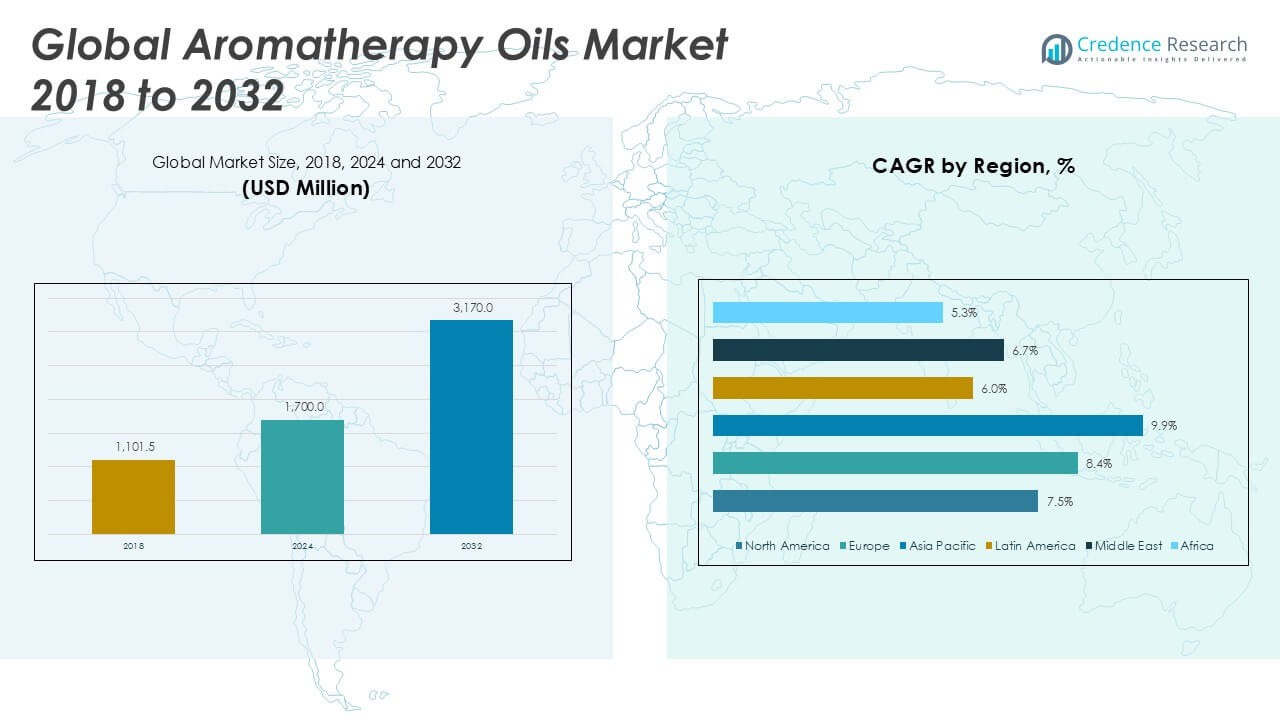
The Global Aromatherapy Oils Market is projected to grow from USD 1,700.0 million in 2024 to an estimated USD 3,170.0 million based on 2032, with a compound annual growth rate (CAGR) of 8.10% from 2025 to 2032.
Consumers increasingly prioritize self-care and preventive health, driving demand for aromatherapy oils. Brands innovate with proprietary oil blends and premium, single-origin extracts to differentiate offerings. Digital commerce gains traction as shoppers seek convenience and product information online. Sustainability trends prompt producers to adopt eco-friendly sourcing and transparent supply chains. These dynamics accelerate product launches and strategic partnerships between essential oil suppliers and cosmetic, personal care, and spa service providers.
North America leads with over 35% market share, supported by robust e-commerce penetration and established wellness culture. Asia Pacific exhibits the fastest growth, driven by expanding middle-class incomes and traditional aromatherapy practices in China, India, and Southeast Asia. Europe maintains steady growth through stringent quality standards and organic certification. Major players shaping competitive dynamics include doTERRA, Young Living, Eden’s Garden, Plant Therapy, NOW Foods, Aura Cacia, Florihana, and Rocky Mountain Oils. These companies invest in R&D, marketing collaborations, and geographic expansion to capture emerging opportunities and strengthen their global footprint.
Market Insights
- The Aromatherapy Oils Market expands from USD 1,700 million in 2024 to USD 3,170 million by 2032 at an 8.10% CAGR, reflecting strong holistic wellness demand.
- Rising consumer preference for natural stress relief and sleep support drives innovation in proprietary blends and single-origin oils.
- Strict purity and labeling regulations increase compliance costs and extend time to market for new product launches.
- Volatile botanical supply prompts companies to diversify sourcing and invest in traceable, sustainable farming partnerships.
- North America holds over 35% share, backed by robust e-commerce penetration and an established wellness culture.
- Asia Pacific leads growth with a 9.9% CAGR, fueled by rising incomes and deep-rooted aromatherapy traditions.
- Direct-to-consumer and online channels accelerate market reach and enable data-driven personalization of oil offerings.
Market Drivers
Growing Adoption of Holistic Health and Self-Care Trends
The Global Aromatherapy Oils Market benefits from rising consumer interest in natural wellness solutions. Consumers seek safe alternatives to synthetic products and adopt essential oils to support mental and physical health. It appeals to individuals pursuing stress relief, enhanced sleep quality, and mood improvement. Wellness providers incorporate aromatherapy into spa services and fitness routines. It supports preventive care approaches and elevates daily self-care rituals. Brands leverage educational campaigns to demonstrate therapeutic benefits.
- For instance, a 2024 survey by the Global Wellness Institute found that more than 72,000 spas and wellness centers worldwide offered aromatherapy services, with lavender and eucalyptus oils among the most frequently used for relaxation and stress relief.
Expansion of Digital Commerce and Evolving Distribution Channels
Online retail platforms fuel the Global Aromatherapy Oils Market by offering extensive product selections and convenient delivery. It reaches consumers through e-commerce, specialty wellness websites, and subscription services. Direct-to-consumer models enable brands to collect user data and tailor offerings. Retail partnerships with pharmacies and health stores further extend reach. It benefits from mobile shopping apps that provide product details and customer reviews. Companies optimize digital marketing strategies to boost online visibility and sales.
- For instance, more than 18,000 different aromatherapy oil products were listed on leading e-commerce platforms such as Amazon and iHerb, reflecting the wide variety and easy accessibility driving market growth.
Innovations in Product Development and Premiumization Strategies
The Global Aromatherapy Oils Market drives manufacturers to develop proprietary blends and support targeted applications such as relaxation, energy boost, and immune support. It introduces single-origin essential oils that command higher price points through perceived quality. Brands form collaborations with research institutions to validate therapeutic claims. It invests in R\&D to refine extraction methods and improve oil purity. Packaging innovations enhance user convenience and preserve oil efficacy. It launches travel-friendly formats and diffuser-compatible blends.
Emphasis on Sustainability and Transparent Supply Chains
The Global Aromatherapy Oils Market prompts companies to adopt ethical sourcing of botanical ingredients. It supports fair trade practices and traceability from harvest to shelf. Brands implement eco-friendly extraction processes that reduce solvent use and energy consumption. It communicates certifications such as organic and cruelty-free to build trust. Packaging makers use recyclable and biodegradable materials to minimize waste. It engages stakeholders in community development programs to reinforce brand reputation.
Market Trends
Rise in Personalized and Customized Oil Blends
Consumers demand tailored aromatherapy solutions. The Global Aromatherapy Oils Market responds with curated blends that target stress, focus, or sleep. It enables brands to offer user-driven mix-and-match options. Companies use customer data and feedback to refine oil compositions. It partners with wellness experts to validate blend efficacy. Brands promote customization through online configurators and mobile apps. It tracks preferences to enhance repeat purchase rates.
- For instance, a 2023 survey by a major aromatherapy brand found that over 200,000 customers used its online oil blend configurator in the first year, leading to the creation of more than 75,000 unique personalized oil blends.
Integration with Smart Diffusers and Wellness Technologies
Manufacturers incorporate IoT-enabled diffusers into product portfolios. The Global Aromatherapy Oils Market leverages smart devices to optimize aroma release schedules. It connects sensors and mobile apps that adjust output based on room conditions. Brands embed voice control compatibility for hands-free operation. It collaborates with app developers to deliver personalized aromatherapy routines. Retailers offer device-plus-oil bundles to simplify user adoption. It collects usage data to guide future product improvements.
- For instance, according to a 2022 industry report, a leading smart diffuser brand partnered with app developers to launch 5 new device models, selling over 300,000 smart diffuser units integrated with mobile app controls within 18 months of release.
Demand for Organic Certification and Clean-Label Formulations
Consumers prefer transparency in ingredient sourcing. The Global Aromatherapy Oils Market highlights USDA organic, ECOCERT, and similar certifications. It ensures supply chain traceability from farm to bottle. Brands eliminate artificial additives and synthetic fragrances. It designs packaging to display provenance and quality seals. Retailers report higher sales for certified products. It educates customers on the benefits of pure, unadulterated oils.
Expansion into Healthcare and Corporate Wellness Programs
Healthcare providers integrate aromatherapy into patient care and recovery protocols. The Global Aromatherapy Oils Market gains credibility through clinical partnerships. It supplies essential oils for hospital aromatherapy carts and therapy rooms. Corporations adopt on-site diffusers to boost employee wellbeing and productivity. It measures outcomes via employee surveys and health metrics. Brands propose subscription services for regular oil replenishment. It forges alliances with wellness consultants to develop program guidelines.
Market Challenges
Strict Regulatory Standards and Quality Control Hurdles
Strict regulations hamper market entry. The Global Aromatherapy Oils Market must adhere to diverse national guidelines. It faces complex labeling requirements across regions. Companies implement rigorous testing protocols to verify purity and potency. It negotiates lengthy approval timelines for new oil blends. Suppliers invest in quality control infrastructure to maintain compliance. It manages documentation to satisfy inspectors and auditors.
- For instance, non-compliance with certification requirements can delay product approvals by an average of 6 months, and a study by the University of Maryland Medical Center revealed that nearly 40% of commercially available essential oils failed purity tests, highlighting the regulatory and quality control challenges faced by market participants.
Supply Chain Volatility and Raw Material Scarcity
High demand strains botanical harvests. The Global Aromatherapy Oils Market relies on plant species vulnerable to climate shifts. It tracks unpredictable crop yields influenced by weather and disease. Companies secure multiple supplier partnerships to diversify sourcing. It adjusts procurement plans when shortages emerge. Brands invest in traceable supply networks to improve resilience. It communicates delays to customers to preserve trust.
Market Opportunities
Expansion into Emerging Markets and Digital Channels
The Global Aromatherapy Oils Market finds growth in Asia Pacific and Latin America, where rising incomes support wellness spending. It leverages e-commerce platforms to reach remote consumers. Brands build localized online stores to cater to regional preferences. It explores partnerships with digital marketplaces that specialize in health products. Companies implement targeted digital campaigns to educate new audiences. It monitors online sales data to optimize product assortments.
Development of Novel Therapeutic Applications and Packaging Innovations
The Global Aromatherapy Oils Market can introduce blends for niche health concerns such as respiratory support and cognitive focus. It funds clinical studies to validate new therapeutic benefits. Brands adopt advanced encapsulation methods to improve delivery and shelf life. It designs user-friendly packaging with metered droppers and travel kits. Companies explore hybrid formulations that combine oils with botanicals. It collaborates with health professionals to endorse innovative products.
Market Segmentation Analysis
By Oil Type
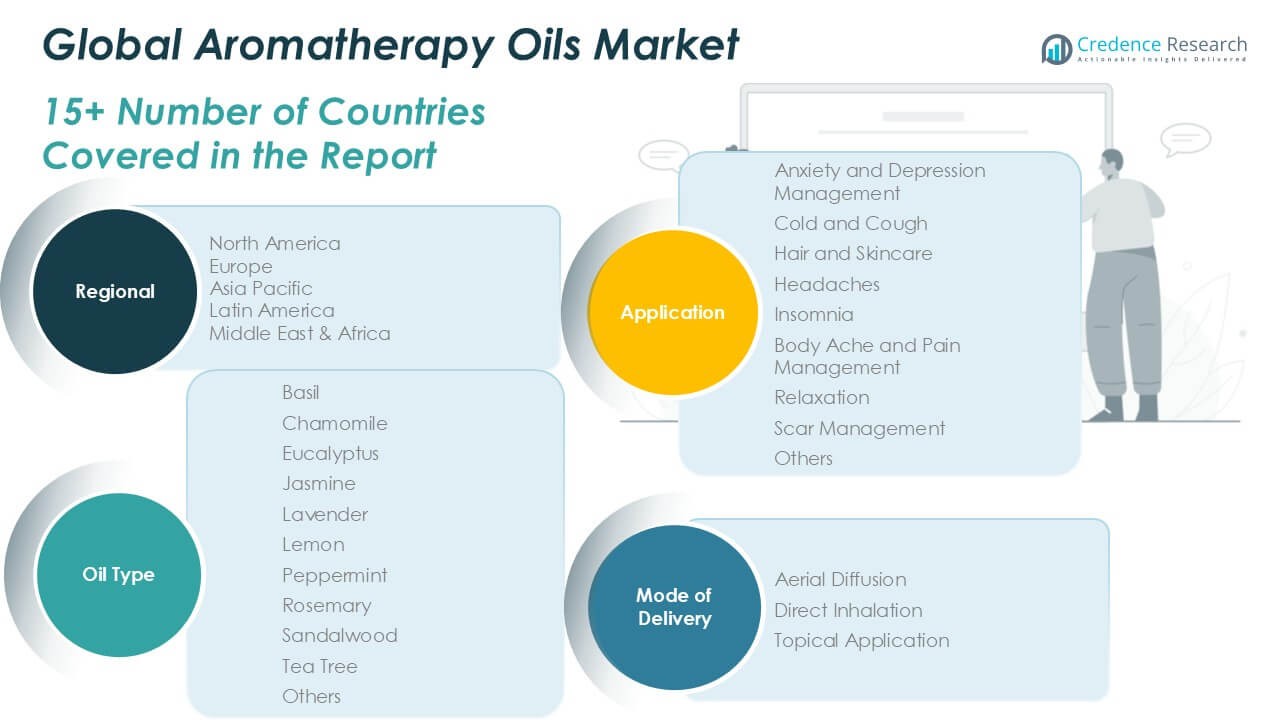
The Global Aromatherapy Oils Market divides by oil type into key variants such as basil, chamomile, eucalyptus, jasmine, lavender, lemon, peppermint, rosemary, sandalwood, tea tree, and others. It reflects volume share leadership by lavender and peppermint, driven by widespread use in stress relief and respiratory support. Revenue share skews toward premium oils like jasmine and sandalwood, which command higher price points. Companies allocate portfolio resources to single-origin extracts and proprietary blends. It tracks performance trends across oil types to guide R\&D investments and production planning.
- For instance, according to the U.S. Department of Agriculture (USDA), more than 5,000,000 tons of orange peels were processed for essential oil extraction in the United States in 2024, with a substantial portion used for D-limonene production.
By Application
The Global Aromatherapy Oils Market segments by application into anxiety and depression management, cold and cough, hair and skincare, headaches, insomnia, body ache and pain management, relaxation, scar management, and others. It records highest volume share for relaxation and anxiety relief, reflecting consumer demand for mental wellbeing. Revenue share peaks in hair and skincare applications, where product innovation supports premium pricing. Brands tailor formulations to address specific health concerns. It monitors shifting application preferences to refine marketing strategies and product pipelines.
- For instance, a 2023 industry survey by the European Chemicals Agency (ECHA) found that over 900,000 tons of technical grade D-limonene were utilized in industrial cleaning products across Europe.
By Mode of Delivery
The Global Aromatherapy Oils Market categorizes delivery modes into aerial diffusion, direct inhalation, and topical application. It witnesses dominant volume share in aerial diffusion, fueled by widespread use of diffusers and smart devices. Topical application captures substantial revenue share, supported by carrier oil formulations and massage products. Direct inhalation retains a niche but growing segment, driven by portable inhalers and roll-ons. It evaluates mode performance to optimize channel partnerships and product bundles.
Segments
Based on Oil Type
- Basil
- Chamomile
- Eucalyptus
- Jasmine
- Lavender
- Lemon
- Peppermint
- Rosemary
- Sandalwood
- Tea Tree
- Others
Based on Application
- Anxiety and Depression Management
- Cold and Cough
- Hair and Skincare
- Headaches
- Insomnia
- Body Ache and Pain Management
- Relaxation
- Scar Management
- Others
Based on Mode of Delivery
- Aerial Diffusion
- Direct Inhalation
- Topical Application
Based on Region
- North America
- U.S.
- Canada
- Mexico
- Europe
- UK
- France
- Germany
- Italy
- Spain
- Russia
- Belgium
- Netherlands
- Austria
- Sweden
- Poland
- Denmark
- Switzerland
- Rest of Europe
- Asia Pacific
- China
- Japan
- South Korea
- India
- Australia
- Thailand
- Indonesia
- Vietnam
- Malaysia
- Philippines
- Taiwan
- Rest of Asia Pacific
- Latin America
- Brazil
- Argentina
- Peru
- Chile
- Colombia
- Rest of Latin America
- Middle East
- UAE
- KSA
- Israel
- Turkey
- Iran
- Rest of Middle East
- Africa
- Egypt
- Nigeria
- Algeria
- Morocco
- Rest of Africa
Regional Analysis
North America Aromatherapy Oils Market
The Aromatherapy Oils Market in North America accounted for a 35.4% share in 2024, valued at USD 601.8 million. It should reach USD 1,039.7 million by 2032 at a CAGR of 7.5%. Consumer focus on wellness and robust e-commerce channels drive regional growth. It leverages established distribution networks across the U.S. and Canada. Brands offer region-specific blends for local preferences. It supports retail partnerships with pharmacies and health stores. Manufacturers tailor marketing to highlight clinical benefits.
Europe Aromatherapy Oils Market
The Aromatherapy Oils Market in Europe held a 27.1% share in 2024, with a market size of USD 460.7 million. It will climb to USD 808.3 million by 2032 at a CAGR of 8.4%. Strict quality standards and organic certification fuel consumer trust. It relies on specialty wellness retailers and online platforms. Companies invest in single-origin oils that command premium pricing. It aligns product portfolios with EU regulations. Brands collaborate with research bodies to validate efficacy.
Asia Pacific Aromatherapy Oils Market
The Aromatherapy Oils Market in Asia Pacific captured a 22.8% share in 2024, totaling USD 387.6 million. It projects USD 865.4 million by 2032 at a CAGR of 9.9%. Rising incomes and traditional aromatherapy practices support rapid uptake. It adapts distribution through digital marketplaces and specialty stores. Local producers expand cultivation of native botanicals. It tailors blends to regional therapeutic needs. Brands deploy mobile apps to engage tech-savvy consumers.
Latin America Aromatherapy Oils Market
The Aromatherapy Oils Market in Latin America secured a 4.1% share in 2024, valued at USD 69.7 million. It should grow to USD 145.8 million by 2032 at a CAGR of 6.0%. Urban wellness trends drive demand in Brazil and Mexico. It uses health-focused e-commerce and boutique retailers. Producers invest in community-based sourcing to ensure quality. It introduces affordable blends to broaden adoption. Brands conduct educational campaigns on holistic health.
Middle East Aromatherapy Oils Market
The Aromatherapy Oils Market in the Middle East accounted for a 6.9% share in 2024, at USD 117.3 million. It will reach USD 234.6 million by 2032 at a CAGR of 6.7%. Growing spa culture and luxury hospitality boost consumption. It partners with wellness resorts to showcase premium oils. Companies source exotic ingredients to meet high-end demand. It supports captive distribution through branded boutiques. Brands emphasize certification and purity to build trust.
Africa Aromatherapy Oils Market
The Aromatherapy Oils Market in Africa held a 3.7% share in 2024, totaling USD 62.9 million. It projects USD 76.1 million by 2032 at a CAGR of 5.3%. Urbanization and rising disposable income underpin market entry. It leverages e-commerce to serve under-penetrated regions. Suppliers develop value-priced blends to attract first-time users. It supports local distillation projects to improve supply resilience. Brands highlight traditional botanical heritage in marketing.
Key players
- doTERRA International, LLC
- Young Living Essential Oils
- Edens Garden
- Plant Therapy Essential Oils
- Mountain Rose Herbs
- NOW Foods
- Rocky Mountain Oils, LLC
- G Baldwin & Co
- Neal’s Yard Remedies
- Biolandes SAS
- Aromaaz International
- India Essential Oils
- AOS Products Pvt. Ltd.
- Herbal Concepts
Competitive Analysis
The Aromatherapy Oils Market features competition between heritage brands and agile newcomers. It competes on product purity, range of single-origin oils, and proprietary blends. Established players leverage extensive distribution networks and robust R\&D to validate therapeutic claims. Smaller brands differentiate through direct-to-consumer channels and personalized offerings. It balances price sensitivity against premium positioning-luxury oils command higher margins, while value blends drive volume. Companies invest in certifications and transparent supply chains to reinforce trust. It tracks competitor promotions and adapts marketing to highlight unique extraction methods. Brand loyalty emerges where efficacy and ethical sourcing converge. It monitors emerging entrants harnessing social media and subscription models to capture niche segments. Partnerships with spa chains and wellness platforms further intensify rivalry and broaden market access.
Recent Developments
- During the 2024-2025 period, Edens Garden, a company specializing in essential oils, expanded its product offerings, focusing on purity and sustainable practices in its essential oil and blend production. They continued to emphasize the quality of their oils, ensuring they are 100% pure therapeutic grade and free from pesticides, synthetic chemicals, herbicides, GMOs, and other harmful substances. Edens Garden is a family-owned, women-operated company committed to making natural wellness affordable and accessible.
- In October 2024, NOW Foods conducted a consumer survey which indicated that 56% of respondents planned to prioritize energy-boosting supplements in 2025. This finding reflects a notable trend towards increased interest in wellness products, particularly those that enhance energy levels to manage busy lifestyles. The survey also highlighted other significant wellness priorities, such as fitness support (37%), better sleep (36%), and weight management (31%).
Market Concentration and Characteristics
The Aromatherapy Oils Market displays moderate concentration, with the top four companies-doTERRA, Young Living, Edens Garden and Plant Therapy-holding roughly 40% of global revenue. It features numerous small and medium players that capture niche segments through unique botanical sources and direct-to-consumer channels. Large firms leverage extensive R\&D, certification credentials and established distribution networks to maintain scale advantages. It confronts low to medium entry barriers, where compliance with quality standards and sustainable sourcing dictate competitiveness. Brand differentiation relies on proprietary extraction techniques and targeted formulations. It balances premium and value tiers, with high-margin single-origin oils coexisting alongside affordable blends. This structure encourages collaboration between major and emerging players to expand market reach.
Report Coverage
The research report offers an in-depth analysis based on Oil Type, Application, Mode of Delivery and Region. It details leading market players, providing an overview of their business, product offerings, investments, revenue streams, and key applications. Additionally, the report includes insights into the competitive environment, SWOT analysis, current market trends, as well as the primary drivers and constraints. Furthermore, it discusses various factors that have driven market expansion in recent years. The report also explores market dynamics, regulatory scenarios, and technological advancements that are shaping the industry. It assesses the impact of external factors and global economic changes on market growth. Lastly, it provides strategic recommendations for new entrants and established companies to navigate the complexities of the market.
Future Outlook
- The Aromatherapy Oils Market will gain credibility through expanded clinical research validating specific health benefits. Companies will partner with academic institutions to publish efficacy studies and secure regulatory endorsements.
- The Aromatherapy Oils Market will diversify product portfolios with advanced delivery systems such as encapsulation and transdermal patches. It will enhance bioavailability, extend shelf life and meet consumer demand for precision dosing.
- The Aromatherapy Oils Market will harness digital health technologies by integrating sensors and mobile apps. It will offer personalized aromatherapy regimens, track usage data and optimize user outcomes.
- The Aromatherapy Oils Market will strengthen sustainable sourcing by investing in regenerative agriculture and fair-trade partnerships. It will secure raw material supply, protect biodiversity and meet ethical consumer expectations.
- The Aromatherapy Oils Market will expand distribution via direct-to-consumer subscription models and curated wellness boxes. It will increase customer retention, leverage data analytics and refine targeted marketing strategies.
- The Aromatherapy Oils Market will explore novel therapeutic niches, including cognitive support and immune modulation. It will fund pilot studies with healthcare providers and develop specialized formulations for clinical use.
- The Aromatherapy Oils Market will deepen collaborations with hospitality and spa chains to showcase experiential aromatherapy. It will design exclusive scent profiles, elevate brand visibility and drive on-premise sales.
- The Aromatherapy Oils Market will respond to regulatory shifts by obtaining international certifications such as COSMOS and ISO. It will standardize quality protocols, simplify cross-border trade and build consumer confidence.
- The Aromatherapy Oils Market will leverage social commerce and influencer partnerships to engage younger demographics. It will co-create limited-edition blends, generate user-driven content and accelerate viral adoption.
- The Aromatherapy Oils Market will integrate with corporate wellness programs to support employee wellbeing. It will offer packaged solutions for office diffusers, measure productivity gains and position oils as workplace essentials.
Request a Free Sample
Fill in your details and we'll send you a free sample report.
- Sample data tables & charts
- Research methodology
Need a Custom Version of This Report?
Tailor the scope, geography, or segments to your exact requirements.
- Custom geography or segment scope
- Direct access to our analyst team
Frequently Asked Questions
What factors drive growth in the Aromatherapy Oils Market?
Which region leads the Aromatherapy Oils Market, and which shows the fastest expansion?
How do digital commerce and sustainability shape the Aromatherapy Oils Market?
What challenges do players face in the Aromatherapy Oils Market?
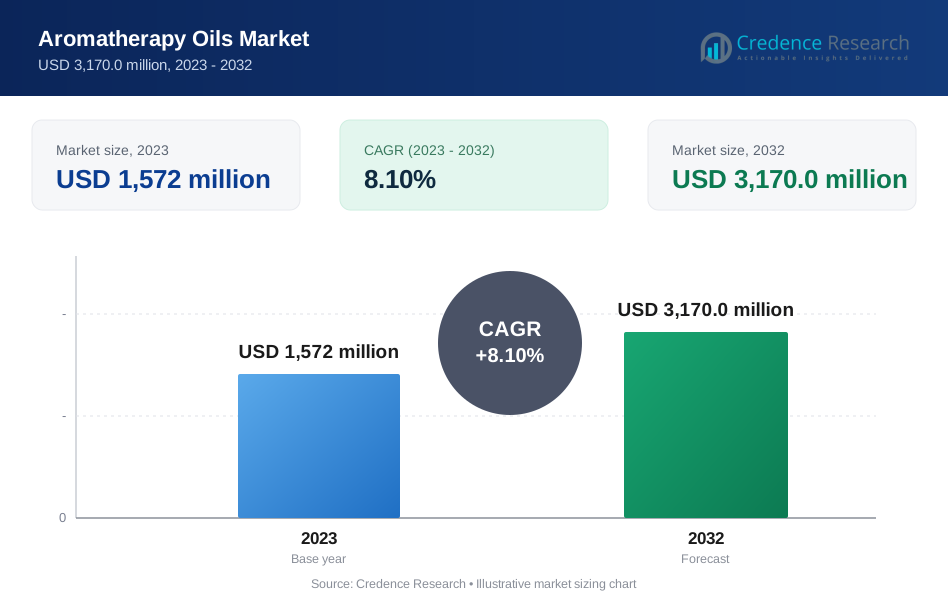
What was the market size in 2023, what is the forecast for 2032, and what is the CAGR?
Table of Content
Chapter 1. Report Introduction
- 1.1 Report Description & Purpose
- 1.1.1 Report Title & Market Definition
- 1.1.2 Unique Selling Propositions (USP) & Key Differentiators
- 1.1.3 Value Proposition for Stakeholders
- 1.2 Research Objectives
- 1.2.1 Market Sizing Objectives (Volume & Revenue) (Volume Where Applicable)
- 1.2.2 Segmentation Objectives
- 1.2.3 Competitive Intelligence Objectives
- 1.2.4 Forecast & Scenario Objectives
- 1.3 Report Scope
- 1.3.1 Aromatherapy Oils Scope – Segments & Subsegments Covered
- 1.3.2 Geographic Scope – Regions & Countries Covered
- 1.3.3 Historical Period, Base Year & Forecast Period (2023; forecast to 2032)
- 1.3.4 Inclusions & Exclusions
- 1.4 Industry Classification & Applicable Codes
- 1.5 Currency, Measurement Units & Valuation Basis
- 1.6 Target Stakeholders
- 1.7 Limitations & Assumptions
Chapter 2. Executive Summary
- 2.1 Global Aromatherapy Oils Market Snapshot
- 2.1.1 Market Size – Historical (2023) & Forecast (2023-2032) (2023: USD 1,572 million → 2032: USD 3,170.0 million)
- 2.1.2 Volume & Revenue – Global Totals (Volume Where Applicable)
- 2.1.3 Key Market Highlights – Top Five Facts
- 2.2 Aromatherapy Oils Market Segmentation Snapshot
- 2.2.1 Market Split by Region – 2023 vs. 2032
- 2.3 Competitive Snapshot
- 2.3.1 Top 10 Players by Revenue Share – 2023
- 2.3.2 Top 10 Players by Volume Share – 2023 (Volume Where Applicable)
- 2.3.3 Recent Strategic Developments (18-Month Summary)
- 2.4 Key Investment Highlights & Strategic Conclusions
Chapter 3. Aromatherapy Oils Market Dynamics & Industry Analysis
- 3.1 Market Overview & Context
- 3.1.1 Aromatherapy Oils Market Position in the Broader Industry Value Chain
- 3.1.2 Demand Structure & Purchasing Dynamics
- 3.1.3 Market Maturity & Development Stage by Region
- 3.2 Aromatherapy Oils Market Drivers
- 3.3 Aromatherapy Oils Market Restraints & Challenges
- 3.4 Aromatherapy Oils Market Opportunities
- 3.5 Porter's Five Forces Analysis
- 3.5.1 Threat of New Entrants
- 3.5.2 Bargaining Power of Suppliers
- 3.5.3 Bargaining Power of Buyers
- 3.5.4 Threat of Substitutes
- 3.5.5 Competitive Rivalry – Intensity Assessment
- 3.6 Aromatherapy Oils Value Chain Analysis
- 3.6.1 Upstream – Key Inputs, Resources & Suppliers
- 3.6.1.1 Key Input/Resource 1
- 3.6.1.2 Key Input/Resource 2
- 3.6.1.3 Key Input/Resource 3
- 3.6.2 Midstream – Core Operations & Value Creation
- 3.6.2.1 Operating Model & Process Overview
- 3.6.2.2 Key Operating Locations & Capabilities by Company
- 3.6.3 Downstream – Market Channels & End Users
- 3.6.3.1 Direct Sales & Customer Engagement Channels
- 3.6.3.2 Indirect Sales, Intermediaries & Partner Channels
- 3.6.4 Value Chain Profitability Analysis
- 3.6.1 Upstream – Key Inputs, Resources & Suppliers
- 3.7 PESTEL Analysis
- 3.7.1 Political Factors
- 3.7.2 Economic Factors
- 3.7.3 Social Factors
- 3.7.4 Technological Factors
- 3.7.5 Environmental Factors
- 3.7.6 Legal Factors
- 3.8 Aromatherapy Oils Supply Chain Analysis
- 3.8.1 Critical Input & Resource Availability Risk Assessment
- 3.8.2 Supplier & Operational Concentration Risk (Geographic Exposure)
- 3.8.3 Supply & Service Disruption Impact Analysis
- 3.9 Regulatory & Policy Landscape
Note: The regulatory and policy landscape section covers regulations based on their applicability to the market, Aromatherapy Oils category, geography, and scope of the study. Only regulatory frameworks with a material impact on operations, compliance, trade, sustainability, or market access are analyzed in detail.
Chapter 4. Key Investment Pockets & Opportunity Analysis
- 4.1 Aromatherapy Oils Market Attractiveness Analysis
- 4.1.1 By Region – Investment Attractiveness Matrix (Market Size × CAGR)
- 4.2 Absolute Revenue Growth Opportunity
- 4.2.1 By Region – Absolute Revenue Growth Through 2032
- 4.3 Incremental Demand Opportunity
- 4.3.1 By Region – Incremental Demand Through 2032
- 4.3.2 Segment – Incremental Demand
- 4.4 Emerging Submarket Opportunity Deep Dive (Subject to Applicability)
- 4.5 Priority Market Opportunity Scorecards
- 4.5.1 United States
- 4.5.2 Europe
- 4.5.3 Asia
- 4.5.4 Middle East & Africa
Note: Priority market opportunity scorecards reflect the geographic scope and strategic relevance of the study. Listed markets are indicative and may be adapted to the industry.
Chapter 5. Aromatherapy Oils Cross-Border Trade & Market Access Analysis
- 5.1 International Trade & Cross-Border Activity Overview
- 5.1.1 Global Export Value by Country (2023)
- 5.1.2 Global Export Volume by Country (2023) (Volume Where Applicable)
- 5.1.3 Global Import Value by Country (2023)
- 5.1.4 Global Import Volume by Country (2023) (Volume Where Applicable)
- 5.1.5 Net Trade Balance by Country (2023)
- 5.2 Export Analysis – Segment
- 5.2.1 Category 1 (Applicable Classification Code)
- 5.2.2 Category 2 (Applicable Classification Code)
- 5.2.3 Category 3 (Applicable Classification Code)
- 5.2.4 Category 4 (Applicable Classification Code)
- 5.2.5 Category 5 (Applicable Classification Code)
- 5.3 Import Analysis – Segment
- 5.3.1 Category 1 (Applicable Classification Code)
- 5.3.2 Category 2 (Applicable Classification Code)
- 5.3.3 Category 3 (Applicable Classification Code)
- 5.3.4 Category 4 (Applicable Classification Code)
- 5.3.5 Category 5 (Applicable Classification Code)
- 5.4 Cross-Border Pricing & Transaction Benchmarks
- 5.4.1 Export Pricing – Segment & Country
- 5.4.2 Import Pricing – Segment & Source Country
- 5.4.3 Price Trends (2023)
- 5.5 Key Cross-Border Trade & Delivery Routes
- 5.5.1 Cross-Border Trade/Delivery Route 1
- 5.5.2 Cross-Border Trade/Delivery Route 2
- 5.5.3 Cross-Border Trade/Delivery Route 3
- 5.5.4 Cross-Border Trade/Delivery Route 4
- 5.5.5 Cross-Border Trade/Delivery Route 5
- 5.6 Trade Policy & Market Access Impact Assessment
- 5.6.1 Tariff & Non-Tariff Barriers
- 5.6.2 Regional Trade & Economic Integration Frameworks
- 5.6.3 Bilateral & Multilateral Trade Agreements
- 5.6.4 Cross-Border Operating, Licensing & Localization Requirements
Note: This chapter applies where cross-border trade or delivery is relevant to Aromatherapy Oils. Goods, services, and digital offerings are assessed using applicable classifications and transaction measures. Import-export volumes, trade balances, and route analyses are included only where meaningful to the market.
Chapter 6. Competitive Landscape & Company Benchmarking
- 6.1 Aromatherapy Oils Market Concentration & Structure
- 6.1.1 Herfindahl-Hirschman Index (HHI) – vs. 2023
- 6.1.2 Leading, Mid-Sized & Emerging Player Structure
- 6.1.3 Global, Regional & Local Player Dynamics
- 6.2 Aromatherapy Oils Market Share Analysis – 2023
- 6.2.1 Global Revenue Share by Company
- 6.2.2 Global Volume Share by Company (Volume Where Applicable)
- 6.2.3 Regional Revenue Share
- 6.2.4 Market Share Evolution ( vs. 2023)
- 6.2.5 Company Market Share by Key Segment
- 6.2.6 Company Market Share by Customer Group
- 6.3 Operating Scale, Capacity & Infrastructure Analysis
- 6.3.1 Global Operating Scale & Supply Capacity
- 6.3.2 Resource Utilization & Operating Efficiency
- 6.3.3 Output, Service Delivery & Activity Metrics
- 6.3.4 Operating Footprint & Infrastructure Map
- 6.3.5 Planned Operational & Capacity Expansion
- 6.4 Aromatherapy Oils Competitive Benchmarking Matrix
- 6.4.1 Revenue, Growth, Profitability & Operating Metric Comparison
- 6.4.2 Channel Revenue Mix
- 6.4.3 Geographic Revenue Exposure
- 6.4.4 R&D Intensity
- 6.4.5 Sustainability Maturity
- 6.5 Strategic Developments in Aromatherapy Oils (Last 24 Months)
- 6.5.1 Mergers, Acquisitions & Divestments
- 6.5.2 New Products, Services & Solutions in Aromatherapy Oils
- 6.5.3 Operational & Infrastructure Expansions
- 6.5.4 Strategic Alliances, Joint Ventures & Partnerships
- 6.5.5 Distribution Expansion & Market Entry
- 6.5.6 Sustainability & ESG Initiatives
- 6.6 Competitive Strategy Mapping
- 6.6.1 Leader, Challenger, Follower & Niche Classification
- 6.6.2 Pricing Strategy Comparison
- 6.6.3 Channel Strategy Matrix
Note: Strategic developments are included based on their materiality and the availability of reliable information.
Chapter 7. Global Aromatherapy Oils Market – By Sales & Delivery Channel
- 7.1 Segment Overview
- 7.1.1 Volume & Revenue Split by Channel (2023 & 2032) (Volume Where Applicable)
- 7.1.2 Channel Mix Evolution (2023-2032)
Chapter 8. Regional Market Analysis – Global Overview
- 8.1 Global Regional Overview
- 8.1.1 Regional Volume Share (Volume Where Applicable)
- 8.1.2 Regional Revenue Share
- 8.1.3 Regional Volume by Region (Volume Where Applicable)
- 8.1.4 Regional Revenue by Region
- 8.1.5 Regional Forecast Through 2032
- 8.2 Cross-Regional Segment Analysis
- 8.2.1 By Sales & Delivery Channel
- 8.2.2 By Competitive Positioning & Price Tier
Chapter 9. North America Aromatherapy Oils Market
- 9.1 United States
- 9.2 Canada
- 9.3 Mexico
Chapter 10. Europe Aromatherapy Oils Market
- 10.1 Germany
- 10.2 France
- 10.3 Italy
- 10.4 United Kingdom
- 10.5 Spain
- 10.6 Poland
- 10.7 Russia
- 10.8 Netherlands
- 10.9 Belgium
- 10.10 Sweden
- 10.11 Denmark
- 10.12 Norway
- 10.13 Rest of Europe
Chapter 11. Asia Pacific Aromatherapy Oils Market
- 11.1 China
- 11.2 India
- 11.3 Japan
- 11.4 South Korea
- 11.5 Thailand
- 11.6 Indonesia
- 11.7 Vietnam
- 11.8 Malaysia
- 11.9 Australia
- 11.10 Rest of Asia Pacific
Chapter 12. Latin America Aromatherapy Oils Market
- 12.1 Brazil
- 12.2 Argentina
- 12.3 Colombia
- 12.4 Chile
- 12.5 Rest of Latin America
Chapter 13. Middle East Aromatherapy Oils Market
- 13.1 Saudi Arabia
- 13.2 United Arab Emirates
- 13.3 Turkey
- 13.4 Israel
- 13.5 Iran
- 13.6 Rest of the Middle East
Chapter 14. Africa Aromatherapy Oils Market
- 14.1 South Africa
- 14.2 Egypt
- 14.3 Nigeria
- 14.4 Morocco
- 14.5 Rest of Africa
Chapter 15. Aromatherapy Oils Company Profiles
- 15.1 [Company 01]
- 15.1.1 Company Overview
- 15.1.2 Key Management Personnel
- 15.1.3 Products & Services Portfolio
- 15.1.4 Financial Performance
- 15.1.5 Key Market Focus & Geographic Presence
- 15.1.6 Recent Developments & Strategic Initiatives
Note: The company profile list is preliminary and may change based on research findings, market developments, data availability, and client requirements.
Chapter 16. Appendices
- Appendix A – List of Abbreviations & Acronyms
- Appendix B – Industry Classification Code Reference – Full Series
- Appendix C – Supply, Output & Operating Capacity Data Tables
- Appendix D – End-Use & Demand Base Tables
- Appendix E – Demand, Adoption & Usage Assumptions
- Appendix F – Pricing & Revenue Metric Reference Tables
- Appendix G – Company Operations & Infrastructure Database
- Appendix H – Cross-Border Trade & Activity Data Tables (Where Applicable)
- Appendix I – Regulatory Summary Tables
- Appendix J – Primary Research Participant List (Anonymized)
- Appendix K – Primary Research Questionnaire Framework
- Appendix L – Data Sources & Bibliography
- Appendix M – Market Size Divergence & Source Comparison
Chapter 17. Research Methodology
- 17.1 Research Framework & Philosophy
- 17.2 Secondary Research – Sources, Hierarchy & Data Extraction
- 17.3 Data Modeling – Bottom-Up & Top-Down Market Sizing
- 17.4 Primary Research – Stakeholder Framework, LOI & Sample Sizes
- 17.5 Forecast Methodology – Regression, Scenario & Sensitivity Analysis
- 17.6 Quality Control – Four-Layer Validation Framework
- 17.7 Limitations & Standard Assumptions
- 17.8 Disclaimer
