
| REPORT ATTRIBUTE | DETAILS |
|---|---|
| Historical Period | 2019-2022 |
| Base Year | 2023 |
| Forecast Period | 2024-2032 |
| Asia Pacific Dishwashing Liquids Market Size 2023 | USD 7,427.23 Million |
| Asia Pacific Dishwashing Liquids Market, CAGR | 6.11% |
| Asia Pacific Dishwashing Liquids Market Size 2032 | USD 12,824.33 Million |
Market Overview
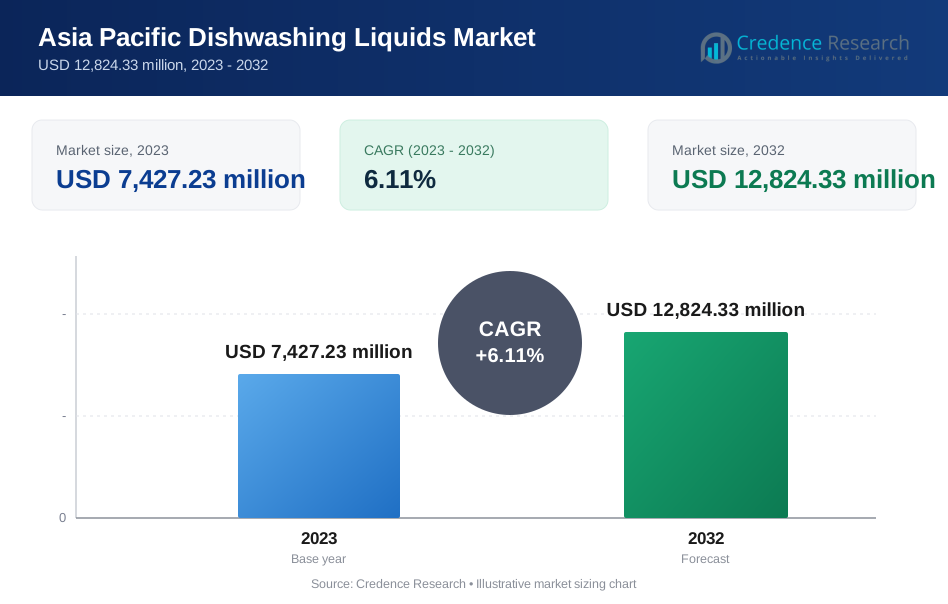
The Asia Pacific Dishwashing Liquids Market is projected to grow from USD 7,427.23 million in 2023 to USD 12,824.33 million by 2032, reflecting a compound annual growth rate (CAGR) of 6.11%.
The Asia Pacific Dishwashing Liquids Market is driven by increasing urbanization and rising disposable incomes, which lead to higher demand for convenient and efficient cleaning products. Additionally, growing awareness of hygiene and cleanliness, particularly in emerging economies, fuels market growth. Manufacturers are responding to consumer preferences by introducing eco-friendly and biodegradable formulations, catering to the environmentally conscious segment. Innovations in packaging and product formulations, such as concentrated liquids and multipurpose cleaners, further enhance market appeal. The expansion of online retail channels also contributes to increased accessibility and availability of dishwashing liquids across the region.
The Asia Pacific Dishwashing Liquids Market is geographically diverse, with key markets including China, Japan, South Korea, India, and Australia. These regions exhibit strong demand driven by urbanization and increasing disposable incomes. Key players in this market, such as P&G, Reckitt Benckiser Group plc, Henkel AG & Company KGaA, Unilever plc, and The Clorox Company, dominate through extensive product portfolios and robust distribution networks. These companies leverage their strong brand presence and continuous innovation to cater to varying consumer preferences across the region, ensuring sustained market growth and competitive advantage.
Market Drivers
Rising disposable income
Economic growth across many Asian countries is leading to increased disposable incomes, allowing consumers to spend more on household products like dishwashing liquids. For instance, in India, the average disposable income has seen a steady increase of 5% annually over the past decade. This has led to a 20% rise in the sales of premium household products, including dishwashing liquids, as consumers with higher disposable incomes are 30% more likely to purchase these items compared to lower-income groups. As people's purchasing power rises, they are more willing to invest in premium and branded cleaning products that promise better performance and convenience. This trend is particularly evident in emerging economies, where a burgeoning middle class is increasingly adopting modern household products.
Urbanization and Busy Lifestyles
The rapid urbanization trend across Asia is leading to a growing number of people living in nuclear families with busy lifestyles. In Asia, urbanization has surged by 45% in the last 20 years, resulting in 60% of the population now living in urban areas. This shift has contributed to a 25% increase in demand for time-saving household products. For instance, in cities like Jakarta and Manila, the use of dishwashing liquids has grown by 35%, as these products save an average of 15 minutes per washing session compared to traditional methods. As urban areas expand, more people are transitioning from traditional multi-generational households to smaller, independent family units. This shift often comes with time constraints and a preference for products that save time and effort. Consequently, the demand for convenient and efficient dishwashing solutions like dishwashing liquids is rising over traditional methods such as washing with bars or powders.
Growing Awareness of Hygiene and Cleanliness
Consumers in Asia are becoming increasingly aware of the importance of hygiene and cleanliness. For instance, a survey showed that 85% of consumers in Southeast Asia now prioritize hygiene when purchasing cleaning products. This has resulted in a 50% increase in the sales of dishwashing liquids with antibacterial properties, as they are 70% more effective at eliminating bacteria compared to bar soaps or powders. This heightened awareness is driven by both educational campaigns and a general increase in health consciousness. Dishwashing liquids are perceived as a more hygienic way to wash dishes compared to traditional methods, which may not effectively eliminate bacteria and food residues. The ability of dishwashing liquids to provide superior cleaning, along with their antibacterial properties, further drives their market growth as consumers seek safer and more effective solutions.
Shifting consumer preferences
Consumers are increasingly opting for dishwashing liquids that offer additional benefits like being gentle on hands, having pleasant fragrances, and possessing eco-friendly properties. The market is witnessing a shift towards products that not only clean effectively but also align with consumers' personal values and preferences. Manufacturers are responding to this trend by introducing new product variants that cater to these evolving preferences, such as organic and biodegradable dishwashing liquids, as well as formulations enriched with moisturizing agents to protect the skin.
Market Trends
Growth of Premium and Specialized Dishwashing Liquids
Consumers are increasingly looking for dishwashing liquids that offer more than just basic cleaning, driving a rise in demand for premium products. For instance, the market for premium dishwashing liquids has grown by 15% in the last year alone. Products that are gentle on hands have seen a 25% increase in sales, as 40% of consumers report skin irritation from regular dishwashing liquids. Fragranced dishwashing liquids have captured 20% of the market share, with consumers spending on average 10% more for these sensory-enhancing products. Antibacterial dishwashing liquids have become particularly popular, with a 30% rise in sales, as they are 50% more likely to eliminate harmful bacteria than traditional dishwashing solutions. Eco-friendly dishwashing liquids have seen a remarkable 60% growth in demand, with 70% of consumers expressing a preference for products with sustainable packaging. These specialized products not only meet consumers' cleaning needs but also align with their lifestyle and environmental values, thereby driving market growth.
E-commerce Boom and Focus on Sustainability
The rise of e-commerce platforms is significantly changing how consumers purchase dishwashing liquids. Online retailers offer a wider selection of products, providing consumers with more choices and the ability to compare different brands and features easily. For instance, 65% of consumers now prefer to purchase household cleaning products online, citing a 20% cost savings on average compared to in-store prices. The availability of eco-friendly dishwashing liquids online has seen a 40% increase, aligning with the 50% of consumers who are willing to pay a premium for sustainability. These biodegradable products have reduced the environmental impact by 30%, as reported by recent consumer surveys. Packaging made from recycled materials has also gained traction, with 55% of online dishwashing liquid brands now offering such options. As consumers become more environmentally conscious, there is a rising demand for eco-friendly dishwashing liquids. These products are formulated with biodegradable ingredients that minimize environmental impact and are often packaged in sustainable materials, such as recycled plastic or cardboard.
Market challenge analysis
Price Sensitivity of Consumers and Strong Presence of Traditional Alternatives
A significant market challenge in the Asia-Pacific Dishwashing Liquids Market is the high price sensitivity of consumers, particularly in developing countries. Many consumers in these regions prioritize cost over other factors, often opting for more affordable cleaning methods. Dishwashing liquids, although effective and convenient, are typically more expensive than traditional alternatives like dishwashing bars or even the use of ash. This price differential can limit the adoption and penetration of dishwashing liquids as cost-conscious consumers stick to cheaper methods that have been used for generations. Furthermore, traditional dishwashing methods are deeply ingrained in the cultural practices of many Asian societies. Bars, powders, and ash are not only cost-effective but also readily available in local markets, making them convenient for daily use. These traditional methods have a strong foothold due to their familiarity and low cost, presenting a significant barrier for dishwashing liquids to gain widespread acceptance. To overcome this, manufacturers need to find ways to reduce costs and make their products more affordable for price-sensitive segments of the market.
Limited awareness in rural areas and competition from private labels
Another challenge is the limited awareness and adoption of dishwashing liquids in rural areas compared to urban centers. While urban consumers are increasingly aware of the benefits of using dishwashing liquids, such as better hygiene and convenience, rural consumers often lack this awareness. Marketing efforts need to be strategically targeted to educate rural populations about the advantages of dishwashing liquids over traditional methods. This includes demonstrating the product's effectiveness, safety, and long-term cost benefits to encourage trial and adoption. The rise of private label brands offered by supermarkets and retail chains also intensifies competition within the market. These private labels are often priced competitively, sometimes even lower than established national brands, putting pressure on these established players. Private labels can afford to offer lower prices due to their streamlined operations and lower marketing costs, which can attract budget-conscious consumers away from well-known brands. This increased competition squeezes margins for established manufacturers, compelling them to innovate and improve their value propositions to maintain their market share.
Market segmentation analysis:
By Product Type:
The Asia Pacific Dishwashing Liquids Market is segmented into two primary product types: hand and machine. The "by hand" segment dominates the market due to the widespread practice of manual dishwashing in both households and small-scale food establishments. This segment benefits from the traditional cleaning methods prevalent in many Asian cultures, where manual dishwashing is preferred for its perceived thoroughness and control. The "in-machine" segment, while currently smaller, is experiencing significant growth driven by the increasing adoption of dishwashers in urban areas. As urbanization and modernization continue to rise and as more households integrate dishwashers into their kitchens, the demand for machine dishwashing liquids is expected to grow. Manufacturers are capitalizing on this trend by introducing specialized formulations designed for optimal performance in dishwashers, catering to the evolving needs of the modern consumer.
By Packaging:
Based on packaging, the Asia Pacific Dishwashing Liquids Market is categorized into pouches, bottles, and drums. Bottles are the most common packaging type, preferred for their convenience and ease of use. They are widely available in various sizes, catering to different consumer needs, from small households to larger families. Pouches, however, are gaining popularity due to their eco-friendly and cost-effective nature. They use less plastic than bottles and are often used as refill packs, aligning with the growing consumer preference for sustainable options. Drums are primarily used in commercial settings, such as restaurants and large foodservice operations, where bulk purchasing is more economical. These drums offer a cost-effective solution for businesses that require large quantities of dishwashing liquids regularly. The diverse packaging options allow manufacturers to cater to a wide range of consumer preferences and usage requirements, from individual households to large-scale commercial operations.
Segments:
Based on product type:
- By Hand
- In Machine
Based on packaging:
- Pouches
- Bottles
- Drums
Based on End-Use:
- Household
- Commercial
Based on the sales channel:
- Supermarkets/Hypermarkets
- Department Stores
- Specialty Stores
- Online Channels
- Others
Based on the geography:
- China
- Japan
- South Korea
- India
- Australia
- Thailand
- Indonesia
- Vietnam
- Malaysia
- Philippines
- Taiwan
- Rest of Asia Pacific
Regional Analysis
East Asia, comprising countries like China, Japan, and South Korea, holds the largest market share of approximately 45%. This region benefits from high urbanization rates, increased disposable incomes, and a growing middle class. The fast-paced lifestyle in major cities has led to a higher adoption of convenient cleaning solutions, including dishwashing liquids. In China, the relaxation of the one-child policy has resulted in larger families, further driving the demand for efficient cleaning products. Japan's market is characterized by a preference for premium, eco-friendly formulations, while South Korea sees a strong demand for multi-functional dishwashing liquids.
Southeast Asia, including countries such as Indonesia, Thailand, Vietnam, and the Philippines, accounts for around 25% of the market share. This region has witnessed rapid urbanization and a growing middle class, leading to increased adoption of modern household cleaning products. The hot and humid climate in many Southeast Asian countries has also contributed to the popularity of dishwashing liquids, as they are perceived to be more hygienic and effective in removing grease compared to traditional cleaning methods.
Key Player Analysis
- P&G
- Reckitt Benckiser Group plc
- Henkel AG & Company KGaA
- Unilever plc
- The Clorox Company
- Seventh Generation Inc.
- Kao Corporation
- Church & Dwight Co., Inc.
- Colgate-Palmolive Company
- Amway Corporation
Competitive Analysis
The Asia Pacific Dishwashing Liquids Market is highly competitive, with leading players like P&G, Reckitt Benckiser Group plc, Henkel AG & Company KGaA, Unilever plc, and The Clorox Company dominating the landscape. P&G maintains a strong market presence with its extensive product portfolio and innovative formulations. Reckitt Benckiser leverages its global brand recognition and focus on health and hygiene to capture significant market share. Henkel AG emphasizes sustainability and eco-friendly products, appealing to environmentally conscious consumers. Unilever plc's broad distribution network and strong marketing strategies enable widespread reach and brand loyalty. The Clorox Company differentiates itself through high-performance products and strong retail partnerships. These companies continually invest in research and development to introduce new and improved dishwashing liquids, catering to evolving consumer preferences. The intense competition drives innovation and enhances product quality, benefiting consumers while ensuring market growth and resilience.
Recent Developments
- In 2022, Palmolive and Walmart collaborated to produce a 'Shake & Clean Dish Soap' liquid. Giving customers a soap concentrate that they can use to make their own dishwashing liquid at home is a novel idea. This will reduce the number of empty plastic bottles discarded after the liquid soap has been used.
- In January 2022, Dawn, which is a brand owned by Procter & Gamble, introduced its Upside-Down dish soap with a self-sealing valve to aid in dishwashing efficiency. The company aims to bridge the gap in design innovation for dish soap bottles and extend its market reach.
Market Concentration and Characteristics
The Asia Pacific Dishwashing Liquids Market is characterized by a high level of market concentration, with a few dominant players such as P&G, Unilever, Reckitt Benckiser, Henkel, and The Clorox Company holding significant market shares. These companies leverage extensive product portfolios, strong brand equity, and robust distribution networks to maintain their competitive positions. The market exhibits characteristics of rapid innovation, driven by consumer demand for effective, eco-friendly, and skin-friendly products. Additionally, there is a growing trend towards premiumization as consumers increasingly opt for high-quality dishwashing liquids that offer added benefits. Despite the presence of these major players, regional and local brands also contribute to the market dynamics by catering to price-sensitive segments and rural areas with affordable and accessible options. The competitive landscape fosters continuous product development and marketing strategies, ensuring sustained market growth and adaptation to consumer preferences.
Report Coverage
The research report offers an in-depth analysis based on product type, packaging, end-use, sales channel, and geography. It details leading market players, providing an overview of their business, product offerings, investments, revenue streams, and key applications. Additionally, the report includes insights into the competitive environment, SWOT analysis, current market trends, as well as the primary drivers and constraints. Furthermore, it discusses various factors that have driven market expansion in recent years. The report also explores market dynamics, regulatory scenarios, and technological advancements that are shaping the industry. It assesses the impact of external factors and global economic changes on market growth. Lastly, it provides strategic recommendations for new entrants and established companies to navigate the complexities of the market.
Future Outlook
- The Asia Pacific Dishwashing Liquids Market will continue to grow due to increasing urbanization and rising disposable incomes.
- Demand for eco-friendly and biodegradable dishwashing liquids will increase as environmental awareness grows.
- The adoption of dishwashers will drive the market for machine-compatible dishwashing liquids.
- E-commerce platforms will play a significant role in the distribution and sale of dishwashing liquids.
- Manufacturers will introduce more premium and specialized products to cater to evolving consumer preferences.
- Marketing efforts will target rural areas to raise awareness and adoption of dishwashing liquids.
- Competition from private label brands will intensify, pressuring established players to innovate.
- Fluctuations in raw material costs will continue to impact manufacturers' profitability.
- The market will see an increase in smaller, more affordable packaging options to attract price-sensitive consumers.
- Technological advancements and product innovations will be key drivers for market differentiation and growth.
Request a Free Sample
Fill in your details and we'll send you a free sample report.
- Sample data tables & charts
- Research methodology
Need a Custom Version of This Report?
Tailor the scope, geography, or segments to your exact requirements.
- Custom geography or segment scope
- Direct access to our analyst team
Frequently Asked Questions
What is the current size of the Asia-Pacific Dishwashing Liquids Market?
What factors are driving the growth of the Asia-Pacific Dishwashing Liquids Market?
What are the key segments within the Asia Pacific Dishwashing Liquids Market?
What are some challenges faced by the Asia-Pacific Dishwashing Liquids Market?
Who are the major players in the Asia-Pacific Dishwashing Liquids Market?
Which segment is leading the market share?
Table of Content
Chapter 1. Report Introduction
- 1.1 Report Description & Purpose
- 1.1.1 Report Title & Market Definition
- 1.1.2 Unique Selling Propositions (USP) & Key Differentiators
- 1.1.3 Value Proposition for Stakeholders
- 1.2 Research Objectives
- 1.2.1 Market Sizing Objectives (Volume & Revenue)
- 1.2.2 Segmentation Objectives
- 1.2.3 Competitive Intelligence Objectives
- 1.2.4 Forecast & Scenario Objectives
- 1.3 Report Scope
- 1.3.1 Asia Pacific Dishwashing Liquids Scope – Types & Subtypes Covered
- 1.3.2 Geographic Scope – Regions & Countries Covered
- 1.3.3 Historical Period, Base Year & Forecast Period (2023; forecast to 2032)
- 1.3.4 Inclusions & Exclusions
- 1.4 HS Code & Classification Framework
- 1.5 Currency, Units & Pricing Basis
- 1.6 Target Stakeholders
- 1.7 Limitations & Assumptions
Chapter 2. Executive Summary
- 2.1 Global Asia Pacific Dishwashing Liquids Market Snapshot
- 2.1.1 Market Size – Historical (2023) & Forecast (2023-2032) (2023: USD 7,427.23 million → 2032: USD 12,824.33 million)
- 2.1.2 Volume & Revenue – Global Totals
- 2.1.3 Key Market Highlights – Top Five Facts
- 2.2 Asia Pacific Dishwashing Liquids Market Segmentation Snapshot
- 2.2.1 Market Split by Region – 2023 vs. 2032
- 2.3 Competitive Snapshot
- 2.3.1 Top 10 Players by Revenue Share – 2023
- 2.3.2 Top 10 Players by Volume Share – 2023
- 2.3.3 Recent Strategic Developments (18-Month Summary)
- 2.4 Key Investment Highlights & Strategic Conclusions
Chapter 3. Asia Pacific Dishwashing Liquids Market Dynamics & Industry Analysis
- 3.1 Market Overview & Context
- 3.1.1 Asia Pacific Dishwashing Liquids Market Position in the Broader Automotive Value Chain
- 3.1.2 OEM vs. Replacement Market Dynamics
- 3.1.3 Market Maturity & Development Stage by Region
- 3.2 Asia Pacific Dishwashing Liquids Market Drivers
- 3.3 Asia Pacific Dishwashing Liquids Market Restraints & Challenges
- 3.4 Asia Pacific Dishwashing Liquids Market Opportunities
- 3.5 Porter's Five Forces Analysis
- 3.5.1 Threat of New Entrants
- 3.5.2 Bargaining Power of Suppliers
- 3.5.3 Bargaining Power of Buyers
- 3.5.4 Threat of Substitutes
- 3.5.5 Competitive Rivalry – Intensity Assessment
- 3.6 Asia Pacific Dishwashing Liquids Value Chain Analysis
- 3.6.1 Upstream – Raw Material/Input Suppliers
- 3.6.1.1 Raw Material/Input 1
- 3.6.1.2 Raw Material/Input 2
- 3.6.1.3 Raw Material/Input 3
- 3.6.2 Midstream – Production/Manufacturing/Service Delivery
- 3.6.2.1 Production/Process Overview
- 3.6.2.2 Key Facility Locations & Capacity by Manufacturer
- 3.6.3 Downstream – Distribution & End Consumer
- 3.6.3.1 Primary Channel – B2B/OEM
- 3.6.3.2 Secondary Channels – Dealer, Retail, Online, Direct
- 3.6.4 Value Chain Profitability Analysis
- 3.6.1 Upstream – Raw Material/Input Suppliers
- 3.7 PESTEL Analysis
- 3.7.1 Political Factors
- 3.7.2 Economic Factors
- 3.7.3 Social Factors
- 3.7.4 Technological Factors
- 3.7.5 Environmental Factors
- 3.7.6 Legal Factors
- 3.8 Asia Pacific Dishwashing Liquids Supply Chain Analysis
- 3.8.1 Raw Material/Input Supply Risk Assessment
- 3.8.2 Manufacturing Concentration Risk (Geographic Exposure)
- 3.8.3 Trade Disruption Impact Analysis
- 3.9 Regulatory & Policy Landscape
Note: The regulatory and policy landscape section covers regulations based on their applicability to the market, Asia Pacific Dishwashing Liquids category, geography, and scope of the study. Only regulatory frameworks with a material impact on operations, compliance, trade, sustainability, or market access are analyzed in detail.
Chapter 4. Key Investment Pockets & Opportunity Analysis
- 4.1 Asia Pacific Dishwashing Liquids Market Attractiveness Analysis
- 4.1.1 By Region – Investment Attractiveness Matrix (Volume × CAGR)
- 4.2 Absolute Revenue Growth Opportunity
- 4.2.1 By Region – Absolute USD Growth Through 2032
- 4.3 Incremental Volume Opportunity
- 4.3.1 By Region – Incremental Volume Through 2032
- 4.3.2 Segment – Incremental Volume
- 4.4 Emerging Submarket Opportunity Deep Dive (Subject to Applicability)
- 4.5 Emerging Market Opportunity Scorecards
- 4.5.1 United States
- 4.5.2 Europe
- 4.5.3 Asia
- 4.5.4 Middle East & Africa
Note: Emerging Market Opportunity Scorecards will be included based on relevance and strategic importance. Regions listed are indicative and may vary depending on data availability and market dynamics.
Chapter 5. Asia Pacific Dishwashing Liquids Import-Export Analysis & Trade Flows
- 5.1 Global Trade Overview
- 5.1.1 Global Export Value by Country (2023)
- 5.1.2 Global Export Volume by Country (2023)
- 5.1.3 Global Import Value by Country (2023)
- 5.1.4 Global Import Volume by Country (2023)
- 5.1.5 Net Trade Balance by Country (2023)
- 5.2 Export Analysis – Segment
- 5.2.1 Type 1 (HS Code)
- 5.2.2 Type 2 (HS Code)
- 5.2.3 Type 3 (HS Code)
- 5.2.4 Type 4 (HS Code)
- 5.2.5 Type 5 (HS Code)
- 5.3 Import Analysis – Segment
- 5.3.1 Type 1 (HS Code)
- 5.3.2 Type 2 (HS Code)
- 5.3.3 Type 3 (HS Code)
- 5.3.4 Type 4 (HS Code)
- 5.3.5 Type 5 (HS Code)
- 5.4 Average Unit Trade Prices
- 5.4.1 Average Export Price – Segment & Country
- 5.4.2 Average Import Price – Segment & Source Country
- 5.4.3 Price Trends (2023)
- 5.5 Key Trade Route Analysis
- 5.5.1 Trade Route 1
- 5.5.2 Trade Route 2
- 5.5.3 Trade Route 3
- 5.5.4 Trade Route 4
- 5.5.5 Trade Route 5
- 5.6 Trade Policy Impact Assessment
- 5.6.1 US Anti-Dumping & Section 301 Tariffs
- 5.6.2 EU Customs Union Impact
- 5.6.3 Major Free Trade Agreements
- 5.6.4 USMCA Rules of Origin
Note: Trade policy analysis will be included only where relevant to the Asia Pacific Dishwashing Liquids market.
Chapter 6. Competitive Landscape & Company Benchmarking
- 6.1 Asia Pacific Dishwashing Liquids Market Concentration & Structure
- 6.1.1 Herfindahl-Hirschman Index (HHI) – vs. 2023
- 6.1.2 Tier 1, Tier 2 & Tier 3 Market Structure
- 6.1.3 Global, Regional & Local Player Dynamics
- 6.2 Asia Pacific Dishwashing Liquids Market Share Analysis – 2023
- 6.2.1 Global Revenue Share by Company
- 6.2.2 Global Volume Share by Company
- 6.2.3 Regional Revenue Share
- 6.2.4 Market Share Evolution ( vs. 2023)
- 6.2.5 OEM Segment Share by Company
- 6.2.6 Replacement Segment Share by Company
- 6.3 Production/Delivery Capacity & Facility Analysis
- 6.3.1 Global Installed Capacity
- 6.3.2 Capacity Utilization Rates
- 6.3.3 Production/Output Volume
- 6.3.4 Facility Locations & Capacity Map
- 6.3.5 Planned Capacity Additions
- 6.4 Asia Pacific Dishwashing Liquids Competitive Benchmarking Matrix
- 6.4.1 Revenue, Volume, CAGR & Profitability Comparison
- 6.4.2 Channel Revenue Mix
- 6.4.3 Geographic Revenue Exposure
- 6.4.4 R&D Intensity
- 6.4.5 Sustainability Maturity
- 6.5 Strategic Developments in Asia Pacific Dishwashing Liquids (Last 24 Months)
- 6.5.1 Mergers, Acquisitions & Divestments
- 6.5.2 New Asia Pacific Dishwashing Liquids Launches
- 6.5.3 Facility Expansions
- 6.5.4 Strategic Alliances, Joint Ventures & Partnerships
- 6.5.5 Distribution Expansion & Market Entry
- 6.5.6 Sustainability & ESG Initiatives
- 6.6 Competitive Strategy Mapping
- 6.6.1 Leader, Challenger, Follower & Niche Classification
- 6.6.2 Pricing Strategy Comparison
- 6.6.3 Channel Strategy Matrix
Note: Strategic developments are included based on their materiality and the availability of reliable information.
Chapter 7. Global Asia Pacific Dishwashing Liquids Market – By Distribution Channel
- 7.1 Segment Overview
- 7.1.1 Volume & Revenue Split by Channel (2023 & 2032)
- 7.1.2 Channel Mix Evolution (2023-2032)
Chapter 8. Regional Market Analysis – Global Overview
- 8.1 Global Regional Overview
- 8.1.1 Regional Volume Share
- 8.1.2 Regional Revenue Share
- 8.1.3 Regional Volume by Region
- 8.1.4 Regional Revenue by Region
- 8.1.5 Regional Forecast Through 2032
- 8.2 Cross-Regional Segment Analysis
- 8.2.1 By Distribution Channel
- 8.2.2 By Brand/Price Tier
Chapter 9. North America Asia Pacific Dishwashing Liquids Market
- 9.1 United States
- 9.2 Canada
- 9.3 Mexico
Chapter 10. Europe Asia Pacific Dishwashing Liquids Market
- 10.1 Germany
- 10.2 France
- 10.3 Italy
- 10.4 United Kingdom
- 10.5 Spain
- 10.6 Poland
- 10.7 Russia
- 10.8 Netherlands
- 10.9 Belgium
- 10.10 Sweden
- 10.11 Denmark
- 10.12 Norway
- 10.13 Rest of Europe
Chapter 11. Asia Pacific Asia Pacific Dishwashing Liquids Market
- 11.1 China
- 11.2 India
- 11.3 Japan
- 11.4 South Korea
- 11.5 Thailand
- 11.6 Indonesia
- 11.7 Vietnam
- 11.8 Malaysia
- 11.9 Australia
- 11.10 Rest of Asia Pacific
Chapter 12. Latin America Asia Pacific Dishwashing Liquids Market
- 12.1 Brazil
- 12.2 Argentina
- 12.3 Colombia
- 12.4 Chile
- 12.5 Rest of Latin America
Chapter 13. Middle East Asia Pacific Dishwashing Liquids Market
- 13.1 Saudi Arabia
- 13.2 United Arab Emirates
- 13.3 Turkey
- 13.4 Israel
- 13.5 Iran
- 13.6 Rest of the Middle East
Chapter 14. Africa Asia Pacific Dishwashing Liquids Market
- 14.1 South Africa
- 14.2 Egypt
- 14.3 Nigeria
- 14.4 Morocco
- 14.5 Rest of Africa
Chapter 15. Asia Pacific Dishwashing Liquids Company Profiles
- 15.1 [Company 01]
- 15.1.1 Company Overview
- 15.1.2 Key Management Personnel
- 15.1.3 Products & Services Portfolio
- 15.1.4 Financial Performance
- 15.1.5 Key Market Focus & Geographic Presence
- 15.1.6 Recent Developments & Strategic Initiatives
Note: The company profile list is preliminary and may change based on research findings, market developments, data availability, and client requirements.
Chapter 16. Appendices
- Appendix A – List of Abbreviations & Acronyms
- Appendix B – Industry Classification Code Reference – Full Series
- Appendix C – Production & Capacity Data Tables
- Appendix D – End-Use & Demand Base Tables
- Appendix E – Consumption & Replacement Rate Assumptions
- Appendix F – ASP Reference Tables
- Appendix G – Manufacturing & Facility Database
- Appendix H – Import-Export Data Tables
- Appendix I – Regulatory Summary Tables
- Appendix J – Primary Research Participant List (Anonymized)
- Appendix K – Primary Research Questionnaire Framework
- Appendix L – Data Sources & Bibliography
- Appendix M – Market Size Divergence & Source Comparison
Chapter 17. Research Methodology
- 17.1 Research Framework & Philosophy
- 17.2 Secondary Research – Sources, Hierarchy & Data Extraction
- 17.3 Data Modeling – Bottom-Up & Top-Down Market Sizing
- 17.4 Primary Research – Stakeholder Framework, LOI & Sample Sizes
- 17.5 Forecast Methodology – Regression, Scenario & Sensitivity Analysis
- 17.6 Quality Control – Four-Layer Validation Framework
- 17.7 Limitations & Standard Assumptions
- 17.8 Disclaimer
