
Export orders and tourism shape Vietnamese craft demand
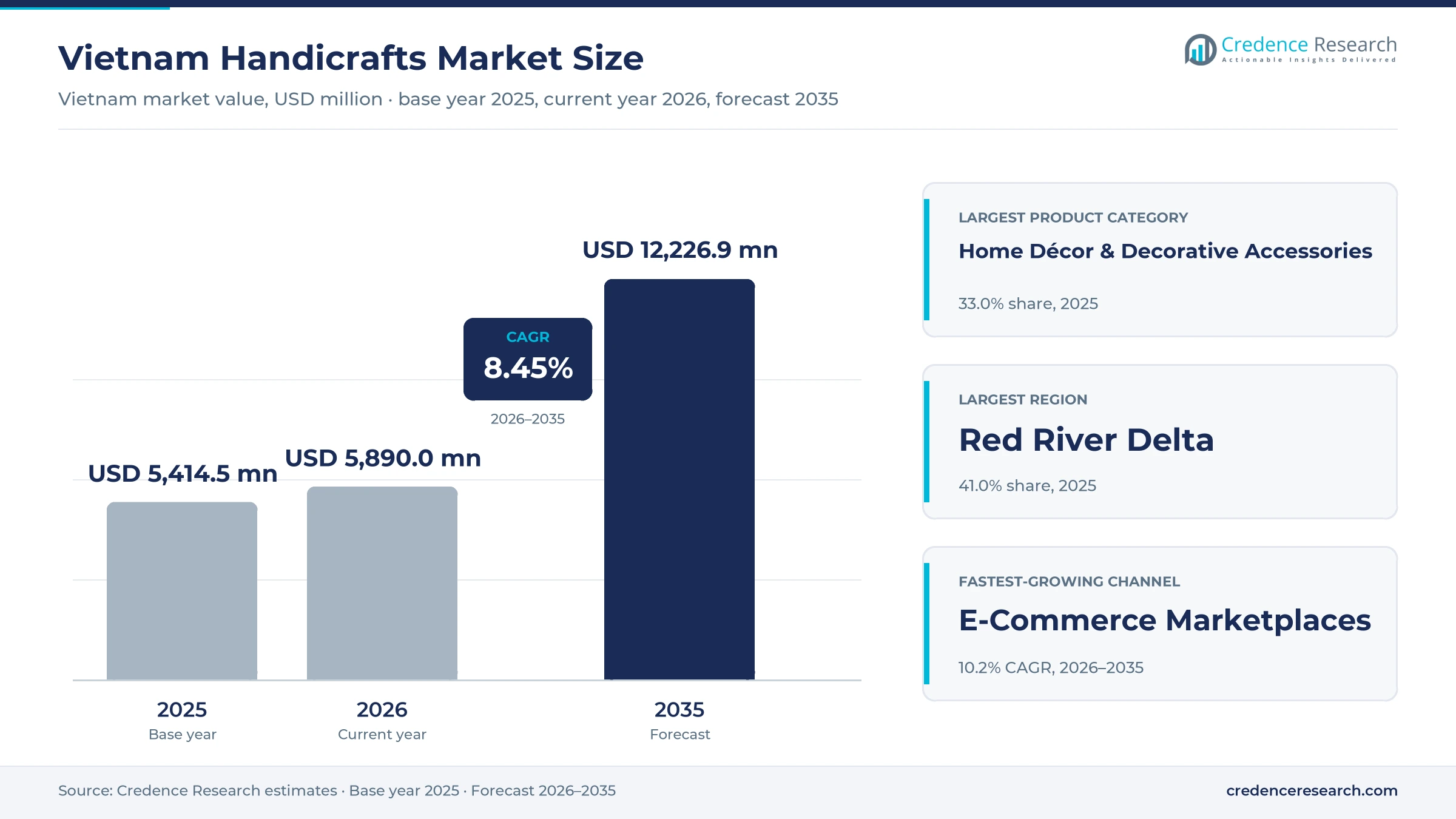
The Vietnam handicrafts market was valued at USD 5.41 billion in 2025 and is projected to increase from USD 5.89 billion in 2026 to USD 12.23 billion by 2035, registering a CAGR of 8.45% during 2026–2035. Export orders for baskets, lacquerware, ceramics and woven décor from U.S., Japanese and European importers carry most of the value, while record foreign arrivals and Lunar New Year gifting lift spending inside the country. The Red River Delta held the largest regional share, 41.0% in 2025, because Hanoi and its neighboring provinces host the densest cluster of ceramic, lacquer, silk and wood-carving villages. The Mekong River Delta is the fastest-growing region at 9.3% a year as water hyacinth and other plant-fiber weaving scales up for buyers seeking renewable materials. The main commercial change is the U.S. reciprocal tariff in force since August 2025, which has pushed exporters to court buyers in Europe and Japan and to test direct online sales.
Which products and buyers define Vietnamese craft demand?
The market covers handmade and hand-finished goods made in Vietnam and valued at their first commercial sale, which means export prices for shipped goods and retail prices for domestic and tourist purchases. It spans woven bamboo, rattan, seagrass and water hyacinth items, lacquer and wood carvings, ceramics and tableware, embroidered textiles and silk, and artisan jewelry and gifts. Buyers range from overseas importers placing container orders to hotels furnishing lobbies, companies ordering Lunar New Year gift sets and visitors buying in craft villages.
Factory-made wood furniture is excluded, since that industry is tracked separately and its 2025 exports of more than USD 17.2 billion would dwarf the craft trade. The value chain runs from household workshops and cooperatives in craft villages through collectors and small workshops to exporters, trading houses, galleries and online stores, with most of the margin captured at the design, finishing and export stages.
Vietnam Handicrafts Market Insights
- The market is projected to rise from USD 5.41 billion in 2025 to USD 12.23 billion by 2035 at an 8.45% CAGR, supported by export orders, tourism spending and online sales.
- The Red River Delta led with 41.0% of 2025 value, anchored by Hanoi's more than 1,350 craft villages and their ceramic, lacquer and silk clusters.
- Home Décor & Decorative Accessories held 33.0% of 2025 value, while Basketry & Storage is the fastest-growing product category at 9.4% a year.
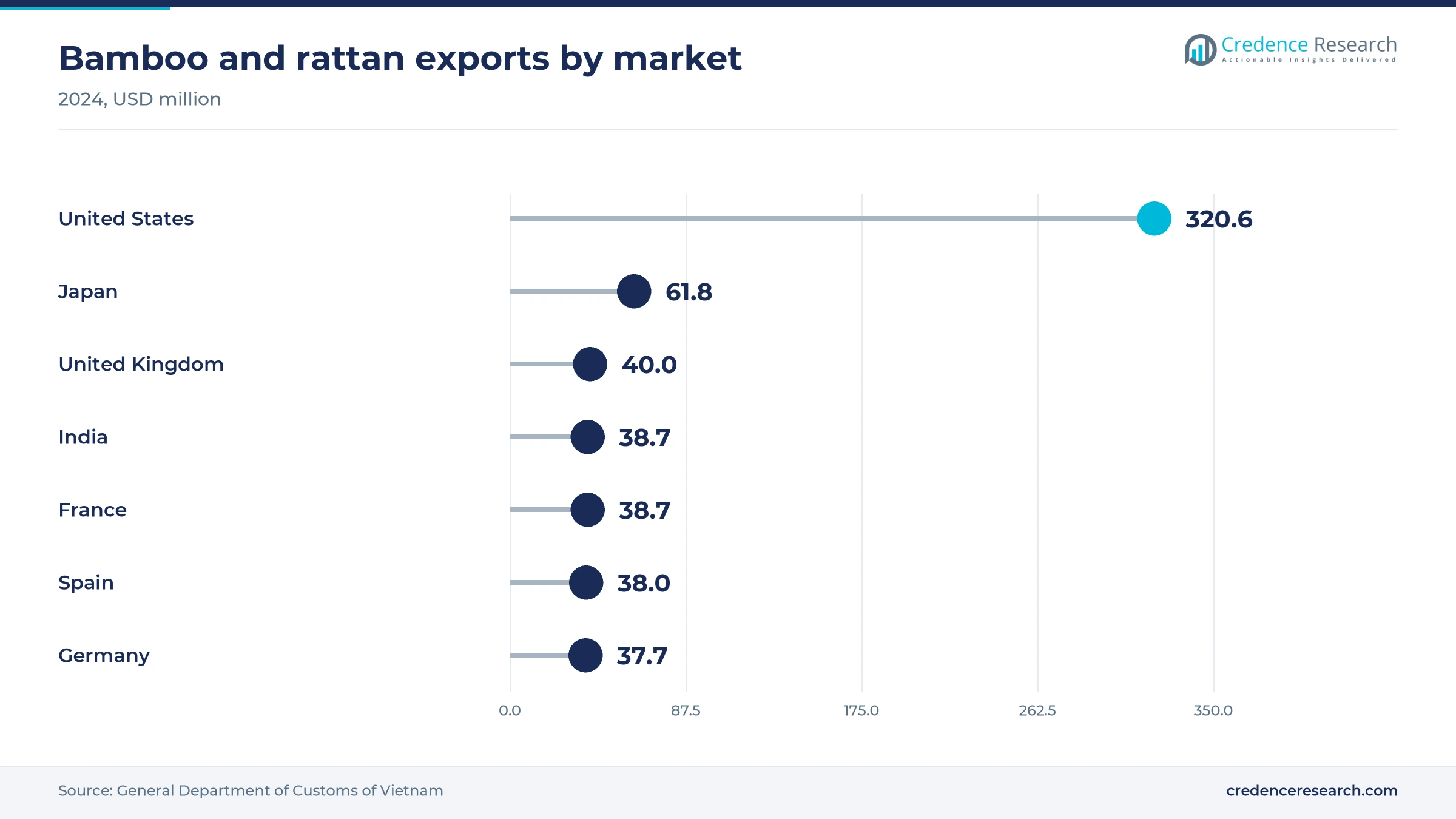
- Bamboo and rattan exports reached USD 900.1 million in 2025, up 11.9%, while ceramic product exports slipped 1.3%, tilting the export mix toward natural fibers.
- Production is fragmented across hundreds of thousands of household units, so exporters that control design, certification and buyer relationships capture most of the margin.
Décor leads as baskets and online channels grow fastest
Why does décor lead while baskets grow fastest?
Based on product category, the market is categorized into home décor and decorative accessories, basketry and storage, ceramics and tableware, handcrafted textiles and embroidery, and artisan jewelry and giftware. Home Décor & Decorative Accessories led with 33.0% of 2025 value because lacquer, wood-carving and decorative ceramic villages earn the largest revenues; Vietnam+ reported in September 2026 that Bat Trang alone takes in VND 2-3 trillion a year. Basketry & Storage grows fastest at 9.4% a year as importers restock storage baskets made from natural fibers, a demand visible in the 11.9% rise in 2025 bamboo and rattan exports. Buyers should expect capacity to tighten first in woven lines.
Which materials carry the most craft value?
Based on material, the market is categorized into bamboo and rattan, seagrass and water hyacinth, wood and lacquer, ceramics and stone, and textiles and natural fibers. Bamboo & Rattan led with 31.0% of 2025 value because the raw material base is deep; the agriculture ministry counted about 1.5 million hectares of bamboo and 647 bamboo and rattan craft villages in August 2022, which keeps bamboo products cheap to source. Seagrass & Water Hyacinth grows fastest at 9.7% a year as Mekong cooperatives scale up; the My Hiep weaving cooperative in Dong Thap grew from 150 linked households to more than 300, Vietnam Agriculture reported in April 2026. The shift rewards exporters that already hold Mekong supply contracts.
How do export buyers and tourists split demand?
Based on customer type, the market is categorized into export wholesalers and importers, domestic households, hospitality and commercial buyers, tourists and gift buyers, and corporate gifting buyers. Export Wholesalers & Importers led with 44.0% of 2025 value because Vietnamese handicrafts reach 163 countries and territories and meet nearly 10% of global demand, according to the agriculture ministry in October 2024. Tourists & Gift Buyers grow fastest at 9.4% a year as arrivals from the largest source markets climb; the National Statistics Office counted about 5.3 million Chinese and 4.3 million South Korean visitors in 2025. Village shops and airport outlets gain most from this mix.
Why do trading houses still dominate distribution?
Based on distribution channel, the market is categorized into export trading houses, direct B2B and OEM, specialty retail and galleries, e-commerce marketplaces and craft villages and tourism outlets. Export Trading Houses led with 30.0% of 2025 value because only 145 craft villages have their own export products, Industry and Trade Magazine reported in September 2025, so most village output reaches importers through consolidators. E-Commerce Marketplaces grow fastest at 10.2% a year as about half of handicraft businesses already sell online and the sector's e-commerce sales rose 18% in 2024, The Investor reported. Producers that list directly capture margin that consolidators now hold.
| Segment Group | Leading Sub-segment | Share, 2025 | Fastest-growing Sub-segment | CAGR, 2026–2035 |
|---|---|---|---|---|
| By Product Category | Home Décor & Decorative Accessories | 33.0% | Basketry & Storage | 9.4% |
| By Material | Bamboo & Rattan | 31.0% | Seagrass & Water Hyacinth | 9.7% |
| By Customer Type | Export Wholesalers & Importers | 44.0% | Tourists & Gift Buyers | 9.4% |
| By Distribution Channel | Export Trading Houses | 30.0% | E-Commerce Marketplaces | 10.2% |
Fiber prices and village labor set craft costs
Pricing for Vietnamese crafts works at two levels of the trade. Export goods are quoted per piece or per set on FOB terms, built from fiber, labor, finishing and packing, with exporters adding a design and compliance margin; village wages of VND 7-8 million a month in Hanoi keep the labor share modest. Retail prices for tourists and domestic buyers run two to four times the export price for comparable pieces, Credence Research estimates, because they include design, storytelling and location. Fiber is the most volatile input; dried water hyacinth has traded from just over VND 10,000 per kilogram at its lows to more than double that in 2026, so exporters on fixed contracts carry the most risk.
| Offer or input | Typical price or fee | Basis |
|---|---|---|
| Dried water hyacinth, high grade, Dong Thap | VND 24,000-25,000 per kg | Vietnam Agriculture, April 2026 |
| Craft village labor, Hanoi | VND 7-8 million per worker a month | Vietnam+, September 2026 |
| Seagrass or rattan storage basket set, export | USD 8-25 per set FOB | Credence Research estimate from fiber, labor and packing costs |
| Glazed ceramic tableware, village retail | USD 2-10 per piece | Credence Research estimate from village retail prices |
| Brocade or embroidered textile piece, retail | USD 15-60 per piece | Credence Research estimate from social enterprise retail prices |
Request a Free Sample
Fill in your details and we'll send you a free sample report.
- Sample data tables & charts
- Research methodology
Tourists, green sourcing and online sales lift craft demand
Tourism recovery expands cultural and gift purchases
Record foreign arrivals are widening the domestic sales base for crafts that were once sold mainly abroad. Vietnam welcomed nearly 21.2 million international visitors in 2025, up 20.4% from 2024, according to the National Statistics Office. Revenue from travel and tourism services rose 20.2% to VND 93.9 trillion in the same year, which signals more organized tours that stop at pottery, silk and lacquer villages. Arrivals were also 17.8% above the pre-pandemic 2019 level, the same release said, which points to new demand rather than a rebound. For sellers, the implication is that retail formats in villages, airports and heritage towns now deserve the design attention once reserved for export catalogs.
Export demand for natural and sustainable materials
Importers in the U.S., Europe and Japan are shifting home-goods orders toward plant fibers that can be marketed as renewable and low-carbon. Vietnam's exports of bamboo and rattan products reached USD 900.1 million in 2025, according to the General Department of Customs, a gain that outpaced most other craft lines. Speakers at an August 2025 workshop in Ho Chi Minh City named green consumption as the first of three trends lifting European demand for rattan and bamboo, The Investor reported. The Vietnam Handicraft Exporters Association said in September 2025 that rattan and bamboo could take 10% to 15% of the global market. Suppliers that can document sustainable harvesting hold pricing power in the categories growing fastest, which makes traceable fiber supply a commercial asset rather than a compliance cost.
Digital commerce improves buyer and consumer access
Online channels are shortening the distance between village workshops and end buyers at home and abroad. Vietnam's e-commerce market was put at about USD 31 billion in 2025, up 25.5% and equal to about one-tenth of retail sales of goods and services, according to the trade ministry's e-commerce department. The agriculture trade promotion center plans a national handicraft pavilion on digital platforms with 3D, AR and VR virtual fairs, Industry and Trade Magazine reported in September 2025. Yet exporters' association vice chairman Le Ba Ngoc said village e-commerce is still mostly social media posts or basic websites, which leaves room for online home decor sellers that add photography, logistics and returns. Exporters that build marketplace storefronts can reach small retailers that never attend fairs.
Craft-village programs and trade promotion fund sellers
Public programs are lowering the cost for small producers of reaching buyers. The national craft village preservation and development program for 2021-2030 targets 301 tourism-linked craft villages and USD 6 billion in handicraft exports, Vietnam+ reported in July 2022. The Ministry of Industry and Trade ran nine handicraft trade promotion projects with nearly VND 16 billion of support between 2021 and 2025, taking firms to Ambiente Frankfurt, Maison et Objet and New York Now. The One Commune One Product scheme now certifies more than 16,000 products, handicrafts among them, according to Viet Nam News. These programs widen the pool of rated, fair-ready suppliers that importers can audit, which supports volume growth beyond the largest exporters.
Certified supply and craft tourism reshape the sector
Shift toward certified and traceable supply chains
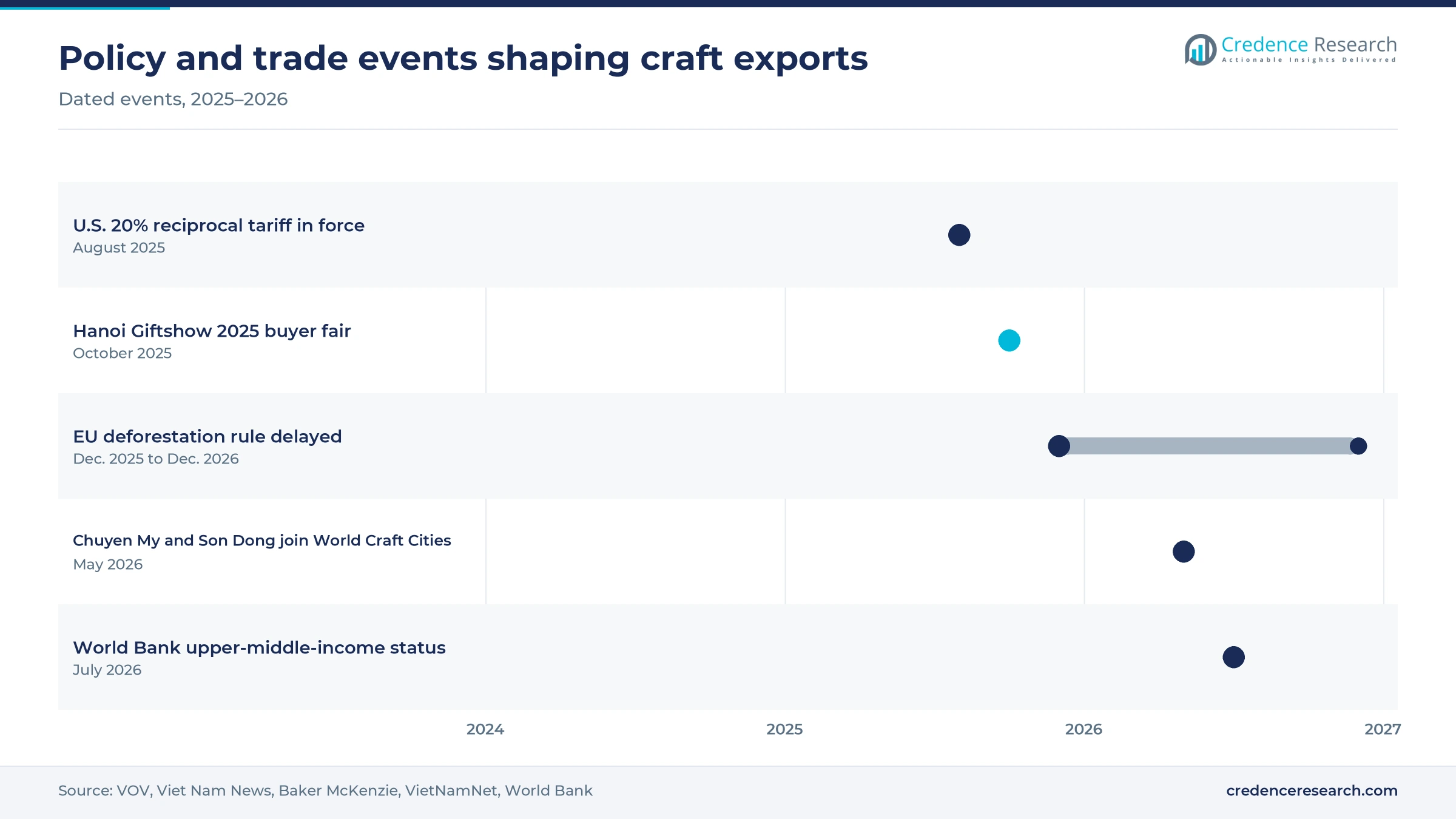
Buyers are moving from informal sourcing to documented supply chains, and certification is becoming a cost of entry. The EU agreed on Dec. 4, 2025, to apply its deforestation regulation from Dec. 30, 2026, for large and medium operators and from June 30, 2027, for small ones, according to Baker McKenzie, and many wood products fall within its scope. Fewer than 20% of Vietnamese bamboo and rattan businesses met standard conformity requirements in 2022, the agriculture ministry said at the time. Hanoi's Truong Son Company opened the door to EU orders after adopting FSC standards, Vietnam+ reported in December 2025. Exporters that fund certification now will face fewer competitors for European orders, while uncertified workshops risk being pushed into lower-paying domestic channels.
Rise of craft-village tourism and heritage branding
Craft villages are turning into destinations, which lets producers sell experiences and higher-margin pieces on site. Bat Trang ceramics and Van Phuc silk joined the World Craft Cities network in 2024, and Chuyen My mother-of-pearl inlay and Son Dong wood carving followed on May 8, 2026, VietNamNet reported, leaving the country second only to Iran by member count. Vietnam had about 1,975 recognized craft villages at the end of 2025, out of roughly 5,400 villages with craft activity. Thai brocade weaving in Nghe An was added to the national intangible heritage list in 2025. Heritage labels support premium pricing for tourists and give exporters a provenance story that importers reuse in their own marketing.
Opportunity in hotel fit-outs and premium tableware
Rising incomes and hotel spending open a premium tier that imported mass-produced décor cannot easily fill. Vietnam's GDP grew 8% in 2025 and GDP per capita reached USD 5,066, according to the World Bank, which reclassified the country as upper-middle income in July 2026. Accommodation and food services revenue reached VND 843.1 trillion in 2025, the National Statistics Office reported, giving hotels and restaurants budget for locally made lighting, lacquer panels and ceramic tableware. Minh Long I already runs a porcelain complex of about 120,000 square meters in Binh Duong, The Investor reported in January 2025. Workshops that can deliver consistent specifications at project scale stand to win hospitality contracts that run for several years.
Opportunity in Mekong water hyacinth weaving
Mekong producers can turn an invasive river weed into export-grade décor with modest capital. A Can Tho company founded by engineer Ha Anh Truong works with more than 1,000 households and over 10 craft villages and ships water hyacinth goods to nine countries, VietNamNet reported in June 2026. In Dong Thap, Dong Thap Artex exports water hyacinth products to the U.S., Australia, Japan and France, and high-grade dried water hyacinth fetched VND 24,000-25,000 per kilogram in April 2026, according to Vietnam Agriculture. Those firm prices show that buyers are already competing for fiber supply. Investors can back drying, dyeing and design capacity close to these growing areas, where the raw material is abundant and household weavers are already trained.
Tariffs, materials and design gaps squeeze craft margins
U.S. tariff exposure concentrates export risk
Heavy reliance on one market leaves exporters exposed to U.S. trade policy. The United States bought USD 266 million, or 46.3%, of Vietnam's rattan, bamboo, sedge and carpet exports in the first eight months of 2025, customs data cited by VOV show, just as a 20% reciprocal tariff took effect on Aug. 7, 2025. U.S. buyers placed smaller and fewer orders from July, VOV reported. Exporters are responding by courting Japan, the U.K. and the EU and by absorbing part of the duty in thinner margins.
Unstable raw material supply raises input costs
Village workshops rely on scattered and uncertified raw material sources, which makes costs and quality hard to plan. Hanoi's craft villages alone need about 6,800 tons of rattan and bamboo, 620,000 tons of clay and kaolin and 4,000 tons of lacquer a year, Hanoi Times reported; purchase prices also swing with supply volumes. Some special materials, such as zircon and metal oxides for glazes, are imported at high cost. Producers that sign contracts with growing zones in Thanh Hoa and Da Nang can stabilize input costs.
Southern ceramic clusters lose production capacity
Traditional ceramics in the south have lost capacity to cheaper industrial ware and weaker orders. The number of production facilities in Binh Duong's ceramic cluster has fallen 70% to 80% from its peak, and many facilities report sales down 50%, the Binh Duong Ceramics Association said in October 2024, according to Viet Nam News. Lost kilns and skilled workers are hard to rebuild, which limits how quickly the Southeast can meet a rebound in tableware demand. Surviving producers are moving toward branded, design-led lines and hotel contracts.
Design gaps and low-cost rivals cap prices
Weak design capability keeps many Vietnamese pieces at the price-sensitive end of importers' ranges. VnEconomy reported in October 2025 that the sector faces low-cost industrial goods from China, India and Indonesia, that some products are overly elaborate or copy foreign designs, and that weak market insight keeps prices low. Hanoi plans to train at least 80% of craft village workers under its 2025-2030 plan, VTV reported in March 2025. Firms that hire in-house designers and track buyer trends can raise unit prices without adding volume.
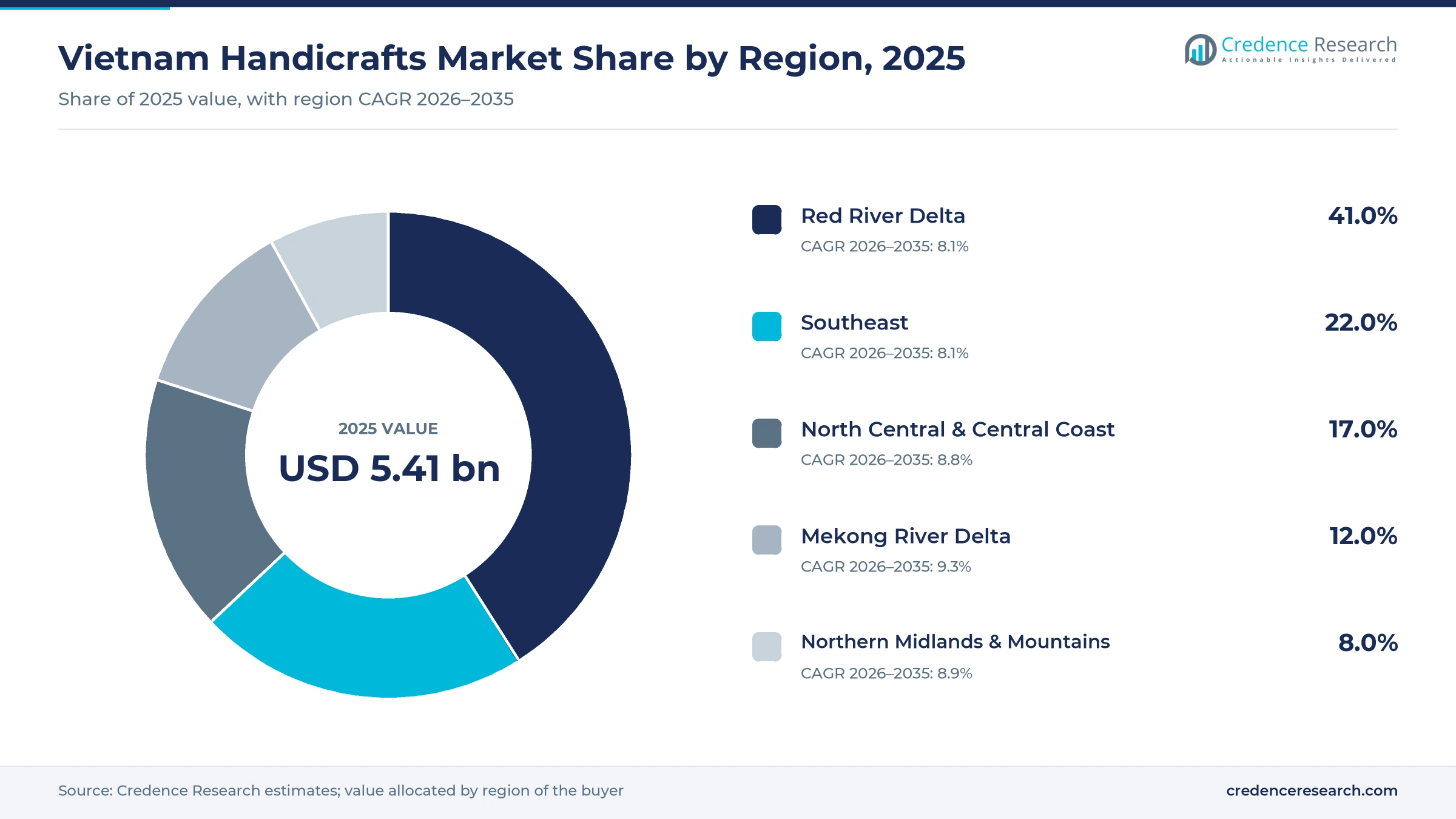
Red River Delta leads as Mekong weaving grows fastest
| Region | Value, 2025 (USD billion) | Share, 2025 | CAGR, 2026–2035 |
|---|---|---|---|
| Red River Delta | 2.22 | 41.0% | 8.1% |
| Southeast | 1.19 | 22.0% | 8.1% |
| North Central & Central Coast | 0.92 | 17.0% | 8.8% |
| Mekong River Delta | 0.65 | 12.0% | 9.3% |
| Northern Midlands & Mountains | 0.43 | 8.0% | 8.9% |
Red River Delta anchors ceramic, lacquer and silk villages
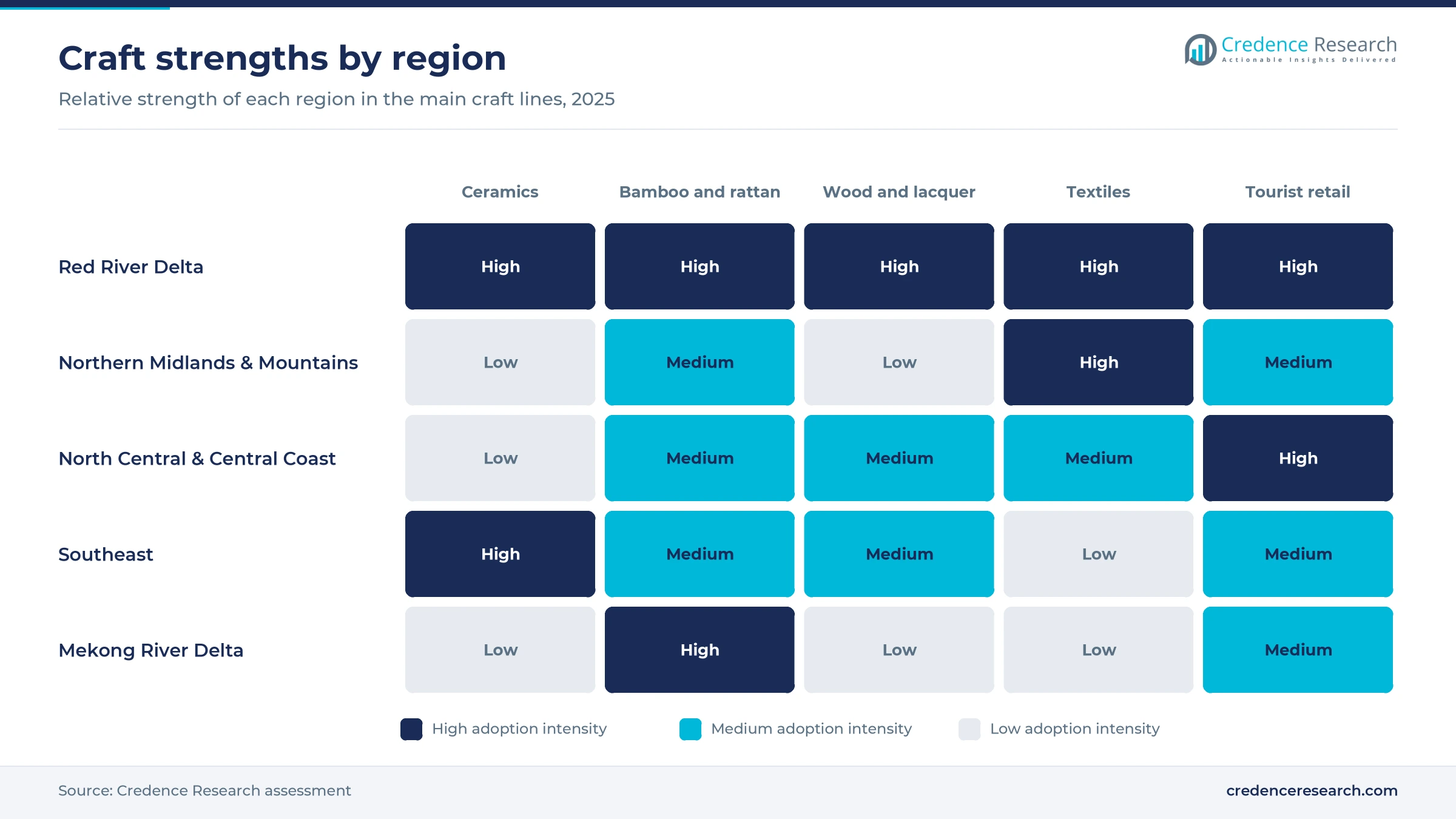
The Red River Delta held 41.0% of 2025 value and grows at 8.1% a year, the largest base in the country. Hanoi alone has more than 1,350 craft villages, about 45% of the national total, with roughly 176,000 households in traditional production, Hanoi Times reported in October 2025. Bac Ninh's Dong Ky wood carving, Ninh Binh's La Xuyen carving and Hanoi's Bat Trang ceramics give buyers one-stop sourcing within a short drive of the capital's trade fairs. Growth trails the national rate slightly because the cluster is already mature.
Southeast relies on trading houses and branded porcelain
The Southeast held 22.0% of 2025 value and grows at 8.1% a year, led by Ho Chi Minh City trading houses and Binh Duong ceramics. Minh Long I's porcelain works in Binh Duong and the export consolidators of Ho Chi Minh City give the region its branded and trading strengths. The region also hosts sourcing events for European buyers, such as the August 2025 workshop on exporting contemporary lifestyle products to Europe. Its growth sits below the national rate because southern traditional ceramics are still shrinking, as noted in the challenges above.
Central regions combine sedge, brocade and raw materials
The North Central and Central Coast region held 17.0% of 2025 value and grows at 8.8% a year. Thanh Hoa's Nga Son sedge mats are among the export brands promoted by the trade ministry, and the region's textile heritage gained a national listing in 2025, as noted earlier. Hanoi producers have also proposed sourcing bamboo from Thanh Hoa and rattan from Da Nang, which makes the region a supplier of fiber as well as finished goods. Growth runs above the national rate as central tourism expands.
Mekong River Delta grows on water hyacinth weaving
The Mekong River Delta held 12.0% of 2025 value and is the fastest-growing region at 9.3% a year. Dong Thap, Can Tho and An Giang weavers turn water hyacinth and other plant fibers into baskets, mats and bags for export, with cooperatives linking hundreds of households to foreign buyers. The region's abundant fiber supply makes it the natural base for new natural-fiber capacity. Exporters in Ho Chi Minh City increasingly source finished pieces here to meet rising orders for renewable home goods.
Northern mountains supply brocade and ethnic textiles
The Northern Midlands and Mountains held 8.0% of 2025 value and grow at 8.9% a year. Output centers on brocade, indigo textiles, embroidery and silver work from Mong, Dao, Thai and Nung communities, much of it sold through social enterprises. Lao Cai, where Bac Ha's handwoven brocade draws tourists and locals, welcomed more than 5.6 million visitors in the first half of 2025, up 37% from a year earlier, Vietnam+ reported in July 2025. Small volumes limit share, but fair-trade buyers pay premiums for documented origin.
Fairs and village data show where craft trade is heading
| Development | Status and market relevance |
|---|---|
| In August 2025, the OCOPEX fair in Hanoi hosted a forum that described handicrafts as one of the country's top ten high-value export products. | Policy signal; positions crafts alongside larger export industries for promotion budgets |
| In October 2025, the 15th Hanoi Giftshow opened with more than 450 booths and an expected 18,000 onsite and online visitors, showing lacquerware, rattan, ceramics and silk. | Annual buyer fair; the main domestic venue where exporters meet foreign buyers |
| In December 2025, a workshop in Ninh Binh put national craft sector output at about VND 75 trillion and set out plans for craft villages to reach global buyers. | Sector benchmark; frames growth targets for the 2026-2030 period |
| In September 2026, Vietnam+ reported that Hanoi handicrafts reach 89 countries and territories and that its 337 recognized craft villages earn more than VND 25 trillion a year. | Regional benchmark; confirms the Red River Delta as the largest production base |
Automation, certification and drying upgrade craft output
- Automated porcelain lines at Minh Long I prepare clay and glaze, make molds and decorate pieces on one system and fire them once at 1,380°C, which gives hotel buyers consistent specifications.
- Forest certification and traceability systems such as FSC chain of custody let exporters prove legal and renewable sourcing to EU buyers before the deforestation rule applies.
- Virtual fairs and 3D catalogs let foreign buyers inspect samples without travel, cutting the cost of winning small accounts for village producers.
- Controlled fiber drying reduces mold and color variation in water hyacinth and seagrass, problems that otherwise depend on long spells of hot weather during harvest.
Need a Custom Version of This Report?
Tailor the scope, geography, or segments to your exact requirements.
- Custom geography or segment scope
- Direct access to our analyst team
Brands, export houses and workshops split the craft trade
Competition is split between a few branded manufacturers, a layer of export trading houses and hundreds of thousands of household workshops. Minh Long I competes on brand, technical ceramics and hotel and retail distribution, while exporters such as Ngoc Dong Ha Nam Handicraft Export Company consolidate woven and handmade goods for shipment abroad. Social enterprises like Craft Link compete on provenance and fair-trade channels, including the Ten Thousand Villages stores in North America. Rivalry centers on design, lead time and certification rather than price alone, because importers can switch to suppliers in China, India, Indonesia or the Philippines for basic items. Fairs such as Ambiente, Maison et Objet and Hanoi Giftshow remain the main venues for winning new accounts, and platforms such as Amazon, Alibaba and Etsy are adding a second route to buyers.
Who controls the supply side of Vietnamese crafts?
Supply is highly fragmented at the production stage and more concentrated at the export stage. The agriculture ministry counted 774,392 handicraft production facilities and more than 1.4 million craft village workers in October 2024, most of them household units with a few looms or kilns. A smaller group of exporters, trading houses and brand owners such as Minh Long I control design, quality control, certification and buyer relationships, and they capture most of the margin. Barriers to entry are low for making but high for exporting, because importers demand audits, FSC or BSCI certificates and reliable lead times.
Companies profiled and their roles in this market
| Company | Type | Role in the market |
|---|---|---|
| Minh Long I Company Limited | Porcelain manufacturer | Branded tableware and gifts made in Binh Duong for hotels, retail and export to Japan, France and Germany |
| Craft Link | Social enterprise | Hanoi nonprofit that markets ethnic minority textiles and crafts, sold abroad through fair-trade retailers |
| Ngoc Dong Ha Nam Handicraft Export Company | Exporter | Consolidates and ships woven and handmade home goods from northern provinces |
Certified capacity matters more than headline export claims
Credence Research's view is that the Vietnam handicrafts market's main constraint is not demand but the definition of what is sold. Official export figures differ widely; the agriculture ministry expected handicraft exports of about USD 2 billion in 2024, while VnEconomy cited about USD 3.5 billion for 2023, because some counts include wooden and industrial décor. Buyers should judge suppliers on certified, traceable capacity rather than headline export claims. The strongest positions belong to exporters that pair Mekong and northern fiber supply with in-house design and an online wholesale presence, since those three assets protect margins against tariffs and low-cost rivals.
Customs, village and tourism data anchor the estimates
The report uses 2025 as the base year and forecasts to 2035. Market values come from the Credence Research model, which combines official export statistics from the General Department of Customs, craft village output data from government and provincial sources, tourism arrival and spending data from the National Statistics Office, and e-commerce statistics from the Ministry of Industry and Trade. Segment and regional splits are Credence Research estimates based on craft village counts, export product mix and tourism flows. Prices come from published commodity reports and Credence Research estimates. No interviews or surveys were conducted for this edition of the report.
Natural fibers and tourism retail gain share to 2035
Between 2026 and 2035 the Vietnam handicrafts market grows from USD 5.89 billion to USD 12.23 billion at an 8.45% CAGR, as natural-fiber goods, tourism retail and online sales take a larger share of value. Export customers stay the largest group, but domestic and tourist spending gains weight as incomes rise. The Mekong River Delta and the central regions add capacity faster than the mature northern clusters, while southern ceramics stabilize at a smaller, more design-led base. Certification and diversification away from the U.S. are the two moves that decide whether exporters reach the upper end of the range.
Tariffs and certification decide the 2035 range
The range of outcomes depends mainly on U.S. trade policy and on how fast producers certify their supply chains. In the base case, shipments to the U.S. hold steady under the current tariff and growth comes from tourism, e-commerce and European demand. The downside assumes higher U.S. duties and slow compliance with the EU deforestation rule, which would push small workshops out of export channels. The upside requires importers to move more natural-fiber sourcing to Vietnam and faster online sales to small foreign retailers.
| Scenario | CAGR, 2026–2035 | Value, 2035 | What has to hold |
|---|---|---|---|
| Downside | 6.6% | USD 10.51 billion | Higher U.S. duties, slow EU compliance and weaker tourism push export orders below current levels |
| Base | 8.45% | USD 12.23 billion | Current tariffs hold, tourism keeps rising and online sales keep expanding at recent rates |
| Upside | 9.8% | USD 13.72 billion | Importers shift more natural-fiber sourcing to Vietnam and certified exporters win European share |
Frequently Asked Questions
How big is the Vietnam handicrafts market?
Which region leads Vietnamese handicraft sales?
Which product category is largest?
Which material grows fastest?
How do U.S. tariffs affect Vietnamese craft exporters?
What role does tourism play in the market?
How important is e-commerce for handicrafts?
Which companies are active in the Vietnam handicrafts market?
Table of Content
Chapter 1 Market Segmentation
- 1.1 Segmentation Framework
- 1.1.1 Product and Service Classification
- 1.1.2 Application and End-Use Classification
- 1.1.3 Technology and Solution Classification
- 1.1.4 Customer and Distribution Channel Classification
- 1.1.5 Geographic Segmentation
- 1.1.6 Market Segment Definitions and Boundaries
- 1.2 By Product Category
- 1.2.1 Home Décor & Decorative Accessories
- 1.2.2 Basketry & Storage
- 1.2.3 Ceramics & Tableware
- 1.2.4 Handcrafted Textiles & Embroidery
- 1.2.5 Artisan Jewellery & Giftware
- 1.3 By Material
- 1.3.1 Bamboo & Rattan
- 1.3.2 Seagrass & Water Hyacinth
- 1.3.3 Wood & Lacquer
- 1.3.4 Ceramics & Stone
- 1.3.5 Textiles & Natural Fibres
- 1.4 By Customer Type
- 1.4.1 Export Wholesalers & Importers
- 1.4.2 Domestic Households
- 1.4.3 Hospitality & Commercial Buyers
- 1.4.4 Tourists & Gift Buyers
- 1.4.5 Corporate Gifting Buyers
Chapter 2 Introduction
- 2.1 Report Objectives and Scope
- 2.2 Product Definition and Industry Terminology
- 2.3 Market Inclusions and Exclusions
- 2.4 Research Process
- 2.4.1 Primary Research and Expert Interviews
- 2.4.2 Secondary Research and Source Review
- 2.4.3 Top-Down and Bottom-Up Estimation
- 2.4.4 Data Triangulation and Verification
- 2.5 Market Size Measurement Basis
- 2.5.1 2025: USD 5.41 billion → 2035: USD 12.23 billion
- 2.6 Historical and Forecast Reference Periods
- 2.6.1 Historical Period: 2018-2025
- 2.6.2 Base Year: 2025
- 2.6.3 Forecast Period: 2025-2035
- 2.7 Research Assumptions and Limitations
Chapter 3 Executive Summary
- 3.1 Market Snapshot and Key Findings
- 3.2 Base-Year Market Size, 2025
- 3.3 Forecast Market Size, 2035
- 3.4 Revenue and Volume Growth Outlook
- 3.5 Key Demand and Supply Indicators
- 3.6 Leading Market Segments
- 3.7 Fastest-Growing Market Opportunities
- 3.8 Regional Performance Highlights
- 3.9 Technology and Industry Transformation
- 3.10 Competitive Landscape Summary
- 3.11 Analyst View and Strategic Implications
Chapter 4 Vietnam Handicrafts Market Trends and Developments
- 4.1 Historical Industry Development, 2018-2025
- 4.2 Recent Market Trends and Developments
- 4.3 Demand and Customer Behavior Trends
- 4.4 Technology and Product Innovation
- 4.5 Artificial Intelligence, Automation and Digitalization
- 4.6 Local Manufacturing and Supply Chain Realignment
- 4.7 Industry Partnerships, Mergers and Acquisitions
- 4.8 Sustainability and Circular Economy Developments
- 4.9 Government and Private Sector Investment Trends
- 4.10 Emerging Business Models and Commercialization
- 4.11 Industry Developments and Announcements
Chapter 5 Vietnam Handicrafts Market Production, Supply and Demand Analysis
- 5.1 Demand Trend and Consumption Analysis, 2018-2025
- 5.2 Demand Forecast, 2025-2035
- 5.3 Production and Output Trend, 2018-2025
- 5.4 Production and Output Forecast, 2025-2035
- 5.5 Installed Capacity and Capacity Utilization
- 5.6 Company-Wise Production Plants and Statistics
- 5.6.1 Installed Production Capacity
- 5.6.2 Actual Production
- 5.6.3 Planned Capacity and Expansion Targets
- 5.7 Supply Chain Structure and Procurement Trends
- 5.8 Supply-Demand Gap and Bottlenecks
- 5.9 Import Dependence and Sourcing Structure
- 5.10 Contract Manufacturing and Outsourcing
- 5.11 Regional Supply and Demand Concentration
Chapter 6 Vietnam Handicrafts Market Pricing Analysis
- 6.1 Pricing Structure and Measurement
- 6.2 Historical Pricing Trends, 2018-2025
- 6.3 Pricing Outlook, 2025-2035
- 6.4 Average Selling Price and Unit Economics
- 6.5 Pricing by Product and Market Segment
- 6.6 Geographic Pricing Differences
- 6.7 Key Input, Energy, Labor and Logistics Costs
- 6.8 Contract Pricing and Purchasing Models
- 6.9 Pricing Sensitivity and Competitive Positioning
- 6.10 Price, Margin and Profitability Implications
Chapter 7 Vietnam Handicrafts Market Dynamics
- 7.1 Market Growth Drivers
- 7.1.1 Demand-Side Drivers
- 7.1.2 Technology and Innovation Drivers
- 7.1.3 Infrastructure and Investment Drivers
- 7.1.4 Regulatory and Policy Drivers
- 7.2 Market Restraints
- 7.2.1 Cost and Affordability Constraints
- 7.2.2 Technology and Adoption Barriers
- 7.2.3 Supply Chain and Operational Constraints
- 7.3 Market Challenges
- 7.3.1 Competitive Pressure and Margin Erosion
- 7.3.2 Skills, Infrastructure and Implementation Gaps
- 7.4 Emerging Market Opportunities
- 7.5 Market Dynamics Impact and Time-Horizon Assessment
Chapter 8 Vietnam Handicrafts Value Chain Analysis
- 8.1 Industry Value Chain Overview
- 8.2 Upstream Suppliers and Critical Inputs
- 8.3 Technology and Component Providers
- 8.4 Manufacturing or Service Delivery
- 8.5 Distribution, Channel Partners and Integrators
- 8.6 Downstream Applications and End Users
- 8.7 Value Addition and Profit Pools
- 8.8 Vertical Integration and Outsourcing
- 8.9 Supplier Concentration and Risk
- 8.10 Supply Chain Localization and Resilience
Chapter 9 Vietnam Handicrafts Market Regulations and Policies
- 9.1 Relevant Laws, Standards and Compliance Frameworks
- 9.2 Product, Service, Safety and Quality Requirements
- 9.3 Government Policies, Incentives and Subsidies
- 9.4 Imports, Exports and Trade Barriers
- 9.5 Public Procurement and Local Content Requirements
- 9.6 Environmental and Sustainability Compliance
- 9.7 Upcoming Policy Changes and Market Implications
Chapter 10 Vietnam Handicrafts Market Hotspots and Opportunities
- 10.1 Market Opportunity Mapping and Growth Hotspots
- 10.2 High-Growth Applications and Customer Groups
- 10.3 Underserved Markets and White-Space Opportunities
- 10.4 Emerging Technology and Product Opportunities
- 10.5 New Capacity and Investment Hotspots
- 10.6 Market Entry and Expansion Opportunities
- 10.7 Distribution and Partnership Opportunities
- 10.8 Near-Term and Long-Term Commercial Potential
- 10.9 Opportunity Attractiveness and Execution Risks
Chapter 11 Vietnam Handicrafts Market Outlook, 2025-2035
- 11.1 Market Size and Analysis
- 11.1.1 Revenue (Market Measurement: 2025: USD 5.41 billion → 2035: USD 12.23 billion)
- 11.1.2 Market Volume and Quantity Sold
- 11.1.3 Historical Market Size, 2018-2025
- 11.1.4 Base-Year Market Size, 2025
- 11.2 Market Forecast, 2025-2035
- 11.2.1 Revenue Forecast to 2035
- 11.2.2 Volume Forecast to 2035
- 11.2.3 CAGR and Year-on-Year Growth
- 11.2.4 Incremental Revenue Opportunity
- 11.3 Forecast Assumptions and Scenario Analysis
- 11.3.1 Base-Case Forecast
- 11.3.2 Optimistic and Conservative Scenarios
- 11.3.3 Technology, Pricing and Policy Sensitivities
- 11.4 Market Attractiveness and Growth Outlook
Chapter 12 Vietnam Handicrafts Market Segmentation and Outlook
- 12.1 Segmentation Summary and Market Shares, 2025
- 12.2 Largest and Fastest-Growing Segments
- 12.3 By Product Category - Market Size and Forecast, 2025-2035
- 12.3.1 Segment Definition and Scope
- 12.3.2 Historical Market Size, 2018-2025
- 12.3.3 Revenue Forecast, 2025-2035
- 12.3.4 Volume Forecast, 2025-2035
- 12.3.5 Base-Year Market Share, 2025
- 12.3.6 Segment CAGR and Growth Drivers
- 12.3.7 Subsegment Market Size and Forecast
- 12.3.7.1 Home Décor & Decorative Accessories
- 12.3.7.2 Basketry & Storage
- 12.3.7.3 Ceramics & Tableware
- 12.3.7.4 Handcrafted Textiles & Embroidery
- 12.3.7.5 Artisan Jewellery & Giftware
- 12.3.8 Subsegment Pricing and Adoption Trends
- 12.3.9 Leading Suppliers and Competition
- 12.3.10 Regional Demand and Opportunities
- 12.4 By Material - Market Size and Forecast, 2025-2035
- 12.4.1 Segment Definition and Scope
- 12.4.2 Historical Market Size, 2018-2025
- 12.4.3 Revenue Forecast, 2025-2035
- 12.4.4 Volume Forecast, 2025-2035
- 12.4.5 Base-Year Market Share, 2025
- 12.4.6 Segment CAGR and Growth Drivers
- 12.4.7 Subsegment Market Size and Forecast
- 12.4.7.1 Bamboo & Rattan
- 12.4.7.2 Seagrass & Water Hyacinth
- 12.4.7.3 Wood & Lacquer
- 12.4.7.4 Ceramics & Stone
- 12.4.7.5 Textiles & Natural Fibres
- 12.4.8 Subsegment Pricing and Adoption Trends
- 12.4.9 Leading Suppliers and Competition
- 12.4.10 Regional Demand and Opportunities
- 12.5 By Customer Type - Market Size and Forecast, 2025-2035
- 12.5.1 Segment Definition and Scope
- 12.5.2 Historical Market Size, 2018-2025
- 12.5.3 Revenue Forecast, 2025-2035
- 12.5.4 Volume Forecast, 2025-2035
- 12.5.5 Base-Year Market Share, 2025
- 12.5.6 Segment CAGR and Growth Drivers
- 12.5.7 Subsegment Market Size and Forecast
- 12.5.7.1 Export Wholesalers & Importers
- 12.5.7.2 Domestic Households
- 12.5.7.3 Hospitality & Commercial Buyers
- 12.5.7.4 Tourists & Gift Buyers
- 12.5.7.5 Corporate Gifting Buyers
- 12.5.8 Subsegment Pricing and Adoption Trends
- 12.5.9 Leading Suppliers and Competition
- 12.5.10 Regional Demand and Opportunities
- 12.6 Segment Growth Comparison
- 12.7 Segment Attractiveness and Priority Matrix
Chapter 13 Vietnam Handicrafts End-Use and Application Market Outlook
- 13.1 End-Use Industry and Customer Demand Structure
- 13.2 Leading Applications and Customer Groups
- 13.3 End-Use Market Size, Share and Forecast
- 13.4 Major End-Use Industry Deep Dives
- 13.4.1 Customer Requirements and Use Cases
- 13.4.2 Demand and Replacement Cycles
- 13.4.3 Technical and Regulatory Considerations
- 13.4.4 Purchasing and Procurement Models
- 13.4.5 Leading Vendors and Distribution Channels
- 13.4.6 Forecast and Commercial Opportunities
- 13.5 Emerging Applications and Cross-Segment Demand
- 13.6 End-Use Industry Investment Priorities
Chapter 14 Vietnam Handicrafts Geographic Market Outlook, 2025-2035
- 14.1 Domestic Market Distribution and Demand Clusters
- 14.2 State- or Province-Wise Market Size and Forecast, 2025-2035
- 14.3 City and Metropolitan Market Outlook
- 14.4 Industrial, Manufacturing and Commercial Clusters
- 14.5 Geographic Concentration of Key End Users
- 14.6 Local Pricing and Purchasing Differences
- 14.7 Domestic Production Facilities and Capacity Map
- 14.8 Local Infrastructure and Project Pipeline
- 14.9 State-Level Policy and Incentive Differences
- 14.10 Subnational Investment Hotspots and Opportunities
- 14.11 Distribution and Logistics Networks
- 14.12 Domestic Competitive Footprint
Chapter 15 Vietnam Handicrafts Technology, Innovation and Sustainability Outlook
- 15.1 Technology Landscape and Maturity
- 15.2 Product, Process and Service Innovation
- 15.3 AI, Automation and Digital Tools in the Industry
- 15.4 Technology Adoption and Performance Benchmarking
- 15.5 Innovation Pipeline and R&D Investment
- 15.6 Patent and Intellectual Property Trends
- 15.7 Energy Efficiency and Resource Management
- 15.8 Sustainability, Recycling and Circularity
- 15.9 Technology Roadmap, 2025-2035
- 15.10 Risks of Obsolescence and Technology Substitution
Chapter 16 Vietnam Handicrafts Market Key Strategic Imperatives
- 16.1 Growth and Market Entry Priorities
- 16.2 High-Return Products and Segments
- 16.3 Pricing, Profitability and Cost Optimization
- 16.4 Technology Investment and Product Differentiation
- 16.5 Supply Chain Localization and Resilience
- 16.6 Distribution and Customer Acquisition
- 16.7 Partnership, Acquisition and Capacity Strategy
- 16.8 Regional Expansion Priorities
- 16.9 Short-, Medium- and Long-Term Actions
Chapter 17 Competition Outlook
- 17.1 Industry Competition Characteristics
- 17.2 Market Structure and Concentration
- 17.3 Market Share and Competitive Positioning, 2025
- 17.4 Company-Wise Revenue and Product Benchmarking
- 17.5 Production and Service Capacity Benchmarking
- 17.6 Technology, Pricing and Differentiation
- 17.7 Regional Footprint and Distribution Strength
- 17.8 Mergers, Acquisitions and Strategic Alliances
- 17.9 New Entrants and Competitive Threats
- 17.10 Porter's Five Forces and Industry Attractiveness
- 17.11 Competitive Outlook, 2025-2035
Chapter 18 Company Profiles
- 18.1 Company Coverage and Selection Criteria
- 18.2 Minh Long I Company Limited
- 18.2.1 Business Description
- 18.2.2 Company Ownership and Geographic Presence
- 18.2.3 Product and Service Portfolio
- 18.2.4 Manufacturing and Operating Footprint
- 18.2.5 Production Capacity and Expansion Plans
- 18.2.6 Financial Performance and Investment
- 18.2.7 Market Share and Competitive Position
- 18.2.8 Technology and Innovation Capabilities
- 18.2.9 Strategic Alliances or Partnerships
- 18.2.10 Recent Developments
- 18.2.11 Growth Strategy and Outlook
- 18.3 Vietnam Handicraft Company Limited
- 18.4 Vietnam Craft Joint Stock Company
- 18.5 Artex Thang Long Joint Stock Company
- 18.6 HNH Craft
- 18.7 Viettimecraft
- 18.8 FE Handicraft
- 18.9 Craft Link
- 18.10 Ngoc Dong Ha Nam Handicraft Export Company
- 18.11 Mai Thi Handicraft
- 18.12 Other Relevant Market Participants
Note: Every listed company is profiled on the structure shown under the first company. The company list is preliminary and may change based on research findings, market developments, data availability and client requirements.
Chapter 19 Disclaimer
- 19.1 Research and Forecast Disclaimer
- 19.2 Data Source and Estimation Limitations
Note: The depth of individual sections depends on data availability for this market. Volume, capacity, trade and other unit-based metrics are included where applicable.

