
Wealthy households and flagship clusters carry spending
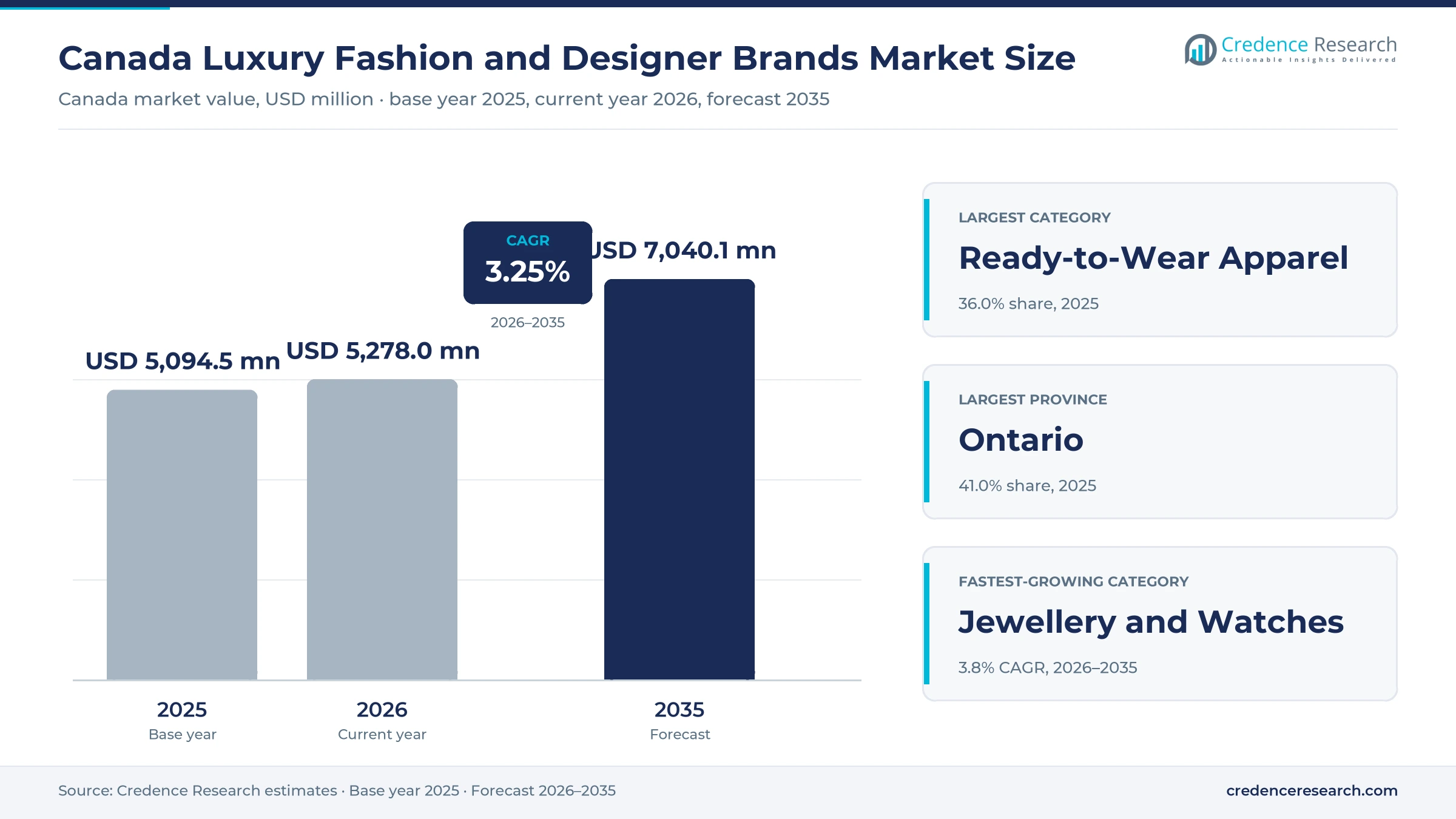
The Canada luxury fashion and designer brands market was valued at USD 5.09 billion in 2025 and is projected to increase from USD 5.28 billion in 2026 to USD 7.04 billion by 2035, registering a CAGR of 3.25% during 2026–2035. Spending rests on concentrated household wealth, a dense cluster of flagships in Toronto, Vancouver and Montreal, and visitors from Europe and Asia. Ontario held the largest provincial share, 41.0% in 2025, because Bloor-Yorkville and Yorkdale Shopping Centre host the largest group of brand-owned stores in the country. British Columbia is the fastest-growing province at 3.7% a year as Oakridge Park in Vancouver, opened on May 28, 2026, adds space for brands such as Chanel, Prada and Louis Vuitton. The exit of Hudson’s Bay in 2025 moved designer sales toward brand boutiques, Holt Renfrew and Harry Rosen.
Which products and buyers make up designer spending in Canada?
The market counts ready-to-wear apparel, handbags and small leather goods, footwear, jewellery and watches, and fashion accessories sold under luxury and designer labels to buyers in Canada. Buyers range from salaried professionals buying an accessible-luxury handbag to resident high-net-worth families commissioning couture and fine watches. Products reach them through mono-brand boutiques, luxury department stores, multi-brand designer retailers, brand websites and airport stores.
Value is counted at retail selling prices before sales tax, including brand-owned, franchise, concession and consignment formats. The estimate excludes beauty and fragrance, eyewear sold through optical chains, mass-market apparel and secondhand sales by private individuals. Sales to visitors are counted when they take place in Canada, while purchases Canadians make abroad are excluded.
Canada Luxury Fashion and Designer Brands Market Insights
- Designer spending grows from USD 5.09 billion in 2025 to USD 7.04 billion by 2035, a 3.25% pace led by jewellery, watches and brand-owned stores.
- Ontario led with 41.0% of 2025 value, while British Columbia grows fastest at 3.7% a year as Oakridge Park fills with new flagships.
- Ready-to-Wear Apparel held 36.0% of 2025 value, because coats, suits and seasonal collections are replaced more often than bags or watches.
- All remaining Hudson’s Bay stores closed on June 1, 2025, moving designer sales toward brand boutiques, Holt Renfrew and Harry Rosen.
- The wealthiest 20% of Canadian households held 65.7% of national net worth at the end of 2025, a base that keeps spending steady.
Apparel, accessible tiers and boutiques hold most value
Why does ready-to-wear carry the largest share of value?
Based on product category, the market is categorized into ready-to-wear apparel, handbags and small leather goods, footwear, jewellery and watches, and fashion accessories. Ready-to-Wear Apparel led with 36.0% of 2025 value because Canadian winters require coats, knitwear and layered outfits that are replaced each season. Sales at clothing, shoes, jewelry, luggage and leather goods retailers rose 9.6% in 2025, against 4.0% for all retail, according to Statistics Canada. Jewellery and Watches grow fastest at 3.8% a year as Royalmount in Montreal opened with 14 jewellery and watch brands, including a TimeVallée store run by Richemont and Maison Birks, Luxury Briefing reported in October 2024.
How do accessible and couture tiers split the value?
Based on price tier, the market is categorized into accessible luxury, premium luxury, high luxury and ultra-luxury / couture. Accessible Luxury led with 38.0% of 2025 value because median after-tax family income was C$75,500 in 2024, according to Statistics Canada, so most buyers trade up one item at a time. Ralph Lauren also ran 12 outlet stores in Canada, Retail Insider reported in September 2023, which widens entry pricing. Ultra-Luxury / Couture grows fastest at 4.2% a year as Loro Piana opened on Bloor Street West and Brunello Cucinelli agreed in September 2026 to take space in an 11,000-square-foot concourse at the Fairmont Château Whistler, Retail Insider reported.
Which buyers hold the most value, and which grow fastest?
Based on customer type, the market is categorized into affluent domestic consumers, resident HNWIs, international tourists and corporate gift buyers. Affluent Domestic Consumers led with 58.0% of 2025 value because professionals in Toronto, Vancouver, Calgary and Montreal buy across apparel, bags and shoes every year. Resident HNWIs grow fastest at 3.9% a year as the wealth gap between the top 20% and the bottom 40% of households widened 0.6 points to 62.7 percentage points in 2025, Statistics Canada reported. Corporate buyers are smaller, since the tax-free employee gift limit is C$500 a year, including taxes, under Canada Revenue Agency policy.
Why do brand boutiques lead, and why is online gaining?
Based on distribution channel, the market is categorized into mono-brand boutiques, luxury department stores, multi-brand designer retailers, brand e-commerce platforms and travel retail. Mono-Brand Boutiques led with 40.0% of 2025 value because the large houses now run their own flagships, such as an 11,000-square-foot Saint Laurent store at Yorkdale and a 12,000-square-foot Gucci store planned there as the brand’s largest in Canada, Retail Insider reported. Brand E-Commerce Platforms grow fastest at 4.1% a year as retail e-commerce reached 6.1% of all retail sales in December 2025, according to Statistics Canada, and buyers use brand sites to reserve items before visiting a store.
| Segment Group | Leading Sub-segment | Share, 2025 | Fastest-growing Sub-segment | CAGR, 2026–2035 |
|---|---|---|---|---|
| By Product Category | Ready-to-Wear Apparel | 36.0% | Jewellery and Watches | 3.8% |
| By Price Tier | Accessible Luxury | 38.0% | Ultra-Luxury / Couture | 4.2% |
| By Customer Type | Affluent Domestic Consumers | 58.0% | Resident HNWIs | 3.9% |
| By Distribution Channel | Mono-Brand Boutiques | 40.0% | Brand E-Commerce Platforms | 4.1% |
Price points run from premium parkas to five-figure bags
Pricing works per item, and the large houses set national price lists that follow their U.S. and euro lists, with currency moves passed through in yearly increases. Chanel raised its U.S. Classic Flap prices again in 2025, and Canadian shoppers compare local tags against that reference before deciding where to buy. Brand-level margins are wide, since Italian authorities said in 2024 that some Dior bags cost about USD 57 to make and sold for nearly USD 2,800, Retail Insider reported. Those margins pay for flagship rent and service, and they explain why brands prefer to own their stores rather than sell wholesale.
| Product or price element | Typical price or fee | Basis |
|---|---|---|
| Canada Goose Expedition Parka | C$1,995 including duties | Mytheresa Canada listing, viewed November 2026 |
| Chanel Classic Flap bag, medium | USD 11,300 after the 2025 increase, from USD 10,800 | PurseBlog price report, 2025 |
| Dior handbag production cost against shelf price | About USD 57 to make, near USD 2,800 retail | Milan court findings, June 2024, reported by Retail Insider |
| Tax-free employee gift limit | C$500 a year including taxes | Canada Revenue Agency policy summarized by BLG, November 2022 |
Request a Free Sample
Fill in your details and we'll send you a free sample report.
- Sample data tables & charts
- Research methodology
Wealth, new malls and visitors lift designer demand
Affluent household wealth supports premium spend
Concentrated household wealth gives designer brands a deep base of buyers who keep spending when incomes elsewhere stall. The wealthiest 20% of households held 65.7% of Canada’s total net worth at the end of 2025, with average net worth of about C$3.5 million per household, according to Statistics Canada. Average wealth per adult reached US$399,886 in 2025, placing Canada 13th worldwide in the UBS Global Wealth Report, BNN Bloomberg reported in July 2026. Wealth held in housing and investment portfolios supports large single purchases such as watches and leather goods, which supports the faster growth of resident HNWI spending noted above. Brands that offer private appointments and early access can capture this group without discounting.
Luxury retail clusters improve brand economics
New shopping districts let brands open larger stores where wealthy buyers already shop, so each visit yields more sales for less marketing spend. Royalmount opened in Montreal in September 2024 as an 824,000-square-foot precinct with more than 170 stores, Retail Insider reported. Oakridge Park in Vancouver followed on May 28, 2026, and it will eventually hold about 100 boutiques and concepts. Chanel opened a boutique there of about 13,000 square feet, its largest in Canada, after first considering about 5,000 square feet. Clusters like these concentrate flagship investment, and they keep mono-brand boutiques the leading channel.
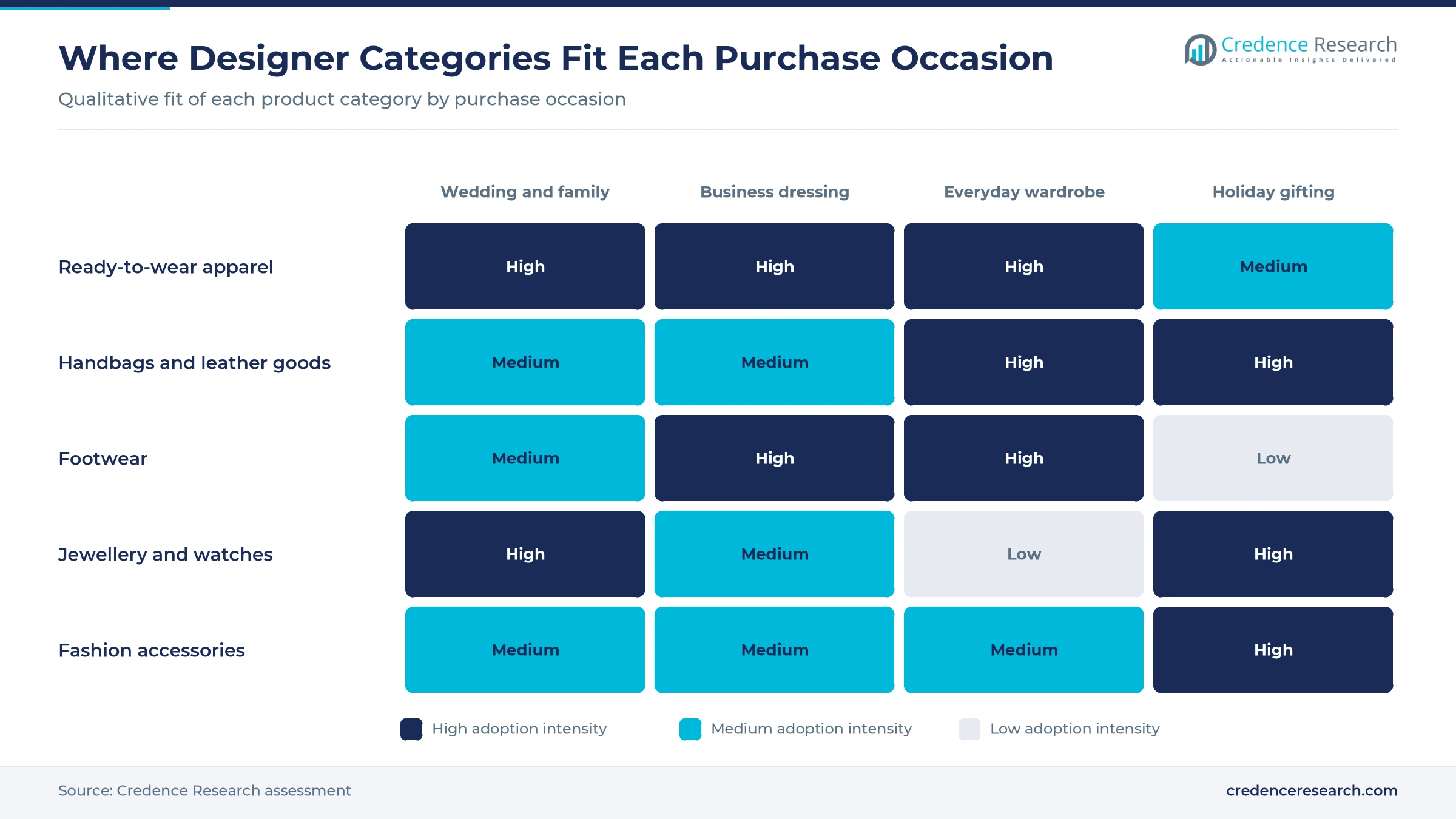
Omnichannel selling and tourism expand addressable demand
Visitors and online buyers widen the market beyond the resident population, especially for handbags and outerwear made by Canadian labels. Overseas-resident arrivals reached 6.8 million in 2025, up 7.5% from 2024, while U.S.-resident arrivals fell 2.9% to 22.8 million, according to Statistics Canada. Ralph Lauren launched RalphLauren.ca alongside its first full-price luxury store at Yorkdale, a store of nearly 5,500 square feet offering private styling and made-to-measure, Retail Insider reported in September 2023. Brand websites now let buyers check stock and book fittings before visiting, a habit that drives growth in Brand E-Commerce Platforms. Stores in Toronto and Vancouver gain most because they serve visitors and residents at once.
Canadian retailers and labels reinvest at home
Canadian retailers and labels are reinvesting in their home market, so local supply stays strong as foreign houses expand. Canada Goose reported growth in its home market in the fourth quarter of fiscal 2026, which ended March 29, 2026, and keeps selling mainly through its own stores and website. Harry Rosen moved in September 2026 from its five-level Bloor Street store into a 38,000-square-foot, three-level building at 153 Cumberland Street, part of a C$50 million, five-year store program, Retail Insider reported. Holt Renfrew renovated its Bloor Street flagship and added a Mercedes-Benz Studio of about 2,250 square feet in June 2026. Domestic investment keeps Ready-to-Wear Apparel sales strong in the menswear and outerwear categories.
Brands take control of retail as watch boutiques spread
Shift from department stores to brand-run stores
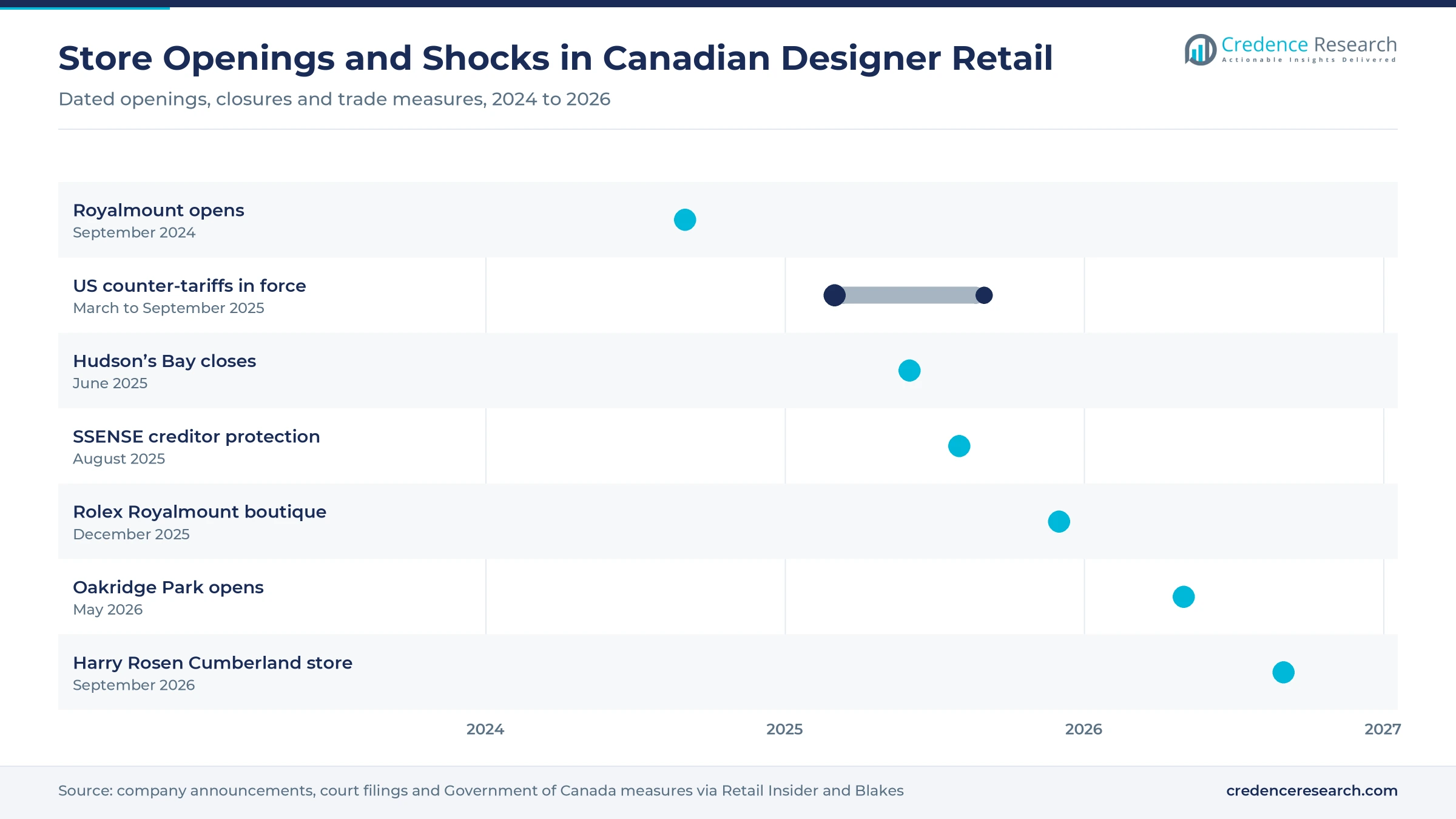
Designer selling is moving from department store floors to stores that brands run themselves. All remaining Hudson’s Bay stores closed on June 1, 2025, and about 8,347 employees were terminated, according to court filings reported by Retail Insider. Holt Renfrew then dropped plans for a second Vancouver store in the former 140,000-square-foot Hudson’s Bay space at Oakridge Park. Fendi opened its only standalone Canadian store at Oakridge Park in August 2026, after closing a temporary Yorkdale unit. This shift moves pricing, stock and client data into brand hands, and it raises the cost of entry for labels that relied on wholesale accounts.
Rise of Swiss watch and jewellery boutiques
Watch and jewellery houses are opening larger stores of their own, as buyers seek allocation and service they cannot get from general retailers. Rolex opened a boutique of nearly 5,500 square feet at Royalmount in December 2025, the largest Rolex store in Canada, operated with Raffi Jewellers. Tiffany & Co. is building a two-level flagship of about 15,000 square feet at 66 Bloor Street West, expected in early 2027. Van Cleef & Arpels is moving at Yorkdale into a 1,905-square-foot unit, about 18% larger than its current space. The expansion of Swiss watch boutiques supports Jewellery and Watches growth through 2035.
Opening in airport and resort stores as visitors return
Airport and resort stores offer an opening because overseas visitors are rising while U.S. traffic softens. Overseas-resident arrivals rose 14.1% year on year in December 2025 to 509,500, according to Statistics Canada. Canadian residents also made 14.2 million overseas trips in 2025, up 9.2%, adding departure traffic at international terminals. Burberry already runs a store in Terminal 1 at Toronto Pearson International Airport, a model other houses can follow in Vancouver and Montreal. Brands that pair airport stores with premium travel partners can reach visitors who skip city shopping districts, adding to spending by international tourists.
Opening in authenticated resale and consignment
Authenticated resale offers an opening, since buyers now weigh the future resale value of a bag before they buy it new. Vancouver-based Mine & Yours runs a Toronto store at 79 Yorkville Avenue that sells mostly Hermès, Chanel, Louis Vuitton and Gucci handbags, Retail Insider reported in May 2026. The same report said online platforms handle about 70% of resale transactions. A strong resale market also lowers the real cost of ownership, which makes a first purchase of a high-priced bag easier to justify for first-time buyers. Consignment stores that guarantee authenticity can recruit younger buyers into fine jewelry and leather goods, and brands that run buy-back programs could keep part of that second sale.
Online stress, tariffs and scarce space pressure sellers
Can multi-brand online retailers stay solvent?
Multi-brand online retail carries thin margins and high returns, and its largest Canadian player came under court protection. Montreal-based SSENSE sought protection under the Companies’ Creditors Arrangement Act in late August 2025, after a dispute with its main lenders, FashionUnited reported. Its founder cited the U.S. decision to end duty-free entry for parcels under US$800, which raised costs for U.S. buyers. Brands that rely on such retailers face late payments, so many now favor their own websites.
How much do tariff swings disrupt pricing?
Trade disputes with the United States added sudden cost swings for importers of U.S.-made designer goods. Canada imposed 25% retaliatory tariffs on an initial list of U.S. imports worth about C$29.8 billion on March 4, 2025, and removed them on Sept. 1, 2025, law firm Blakes reported. Retailers carrying U.S.-made goods on the list had to reprice stock twice in six months, while European goods were unaffected. Buyers who plan seasons a year ahead now ask suppliers for landed-cost guarantees, which shifts risk to brands.
Does the lack of a tourist tax refund cost sales?
Canada offers no sales tax refund to most foreign shoppers, which makes designer goods dearer for visitors than in Europe. The GST/HST Visitor Rebate Program ended on April 1, 2007, according to TaxTips.ca, and only tour packages and conventions qualify for rebates today. Visitors therefore pay full federal and provincial sales tax on designer purchases, so large purchases tend to move to markets with refund schemes, and that limits spending by international tourists in Canada.
Is scarce prime space raising entry costs?
Prime storefronts in the main luxury districts are scarce, and that pushes up the cost of entry for new labels. Chrome Hearts paid C$12.65 million in July 2026 for a building of about 7,076 square feet at 121 Scollard Street in Yorkville for its first Canadian store, Retail Insider reported. Brokers in Vancouver describe demand as extremely high with little available inventory. Smaller labels therefore enter through concessions or pop-ups, while large houses outbid them for corner sites.
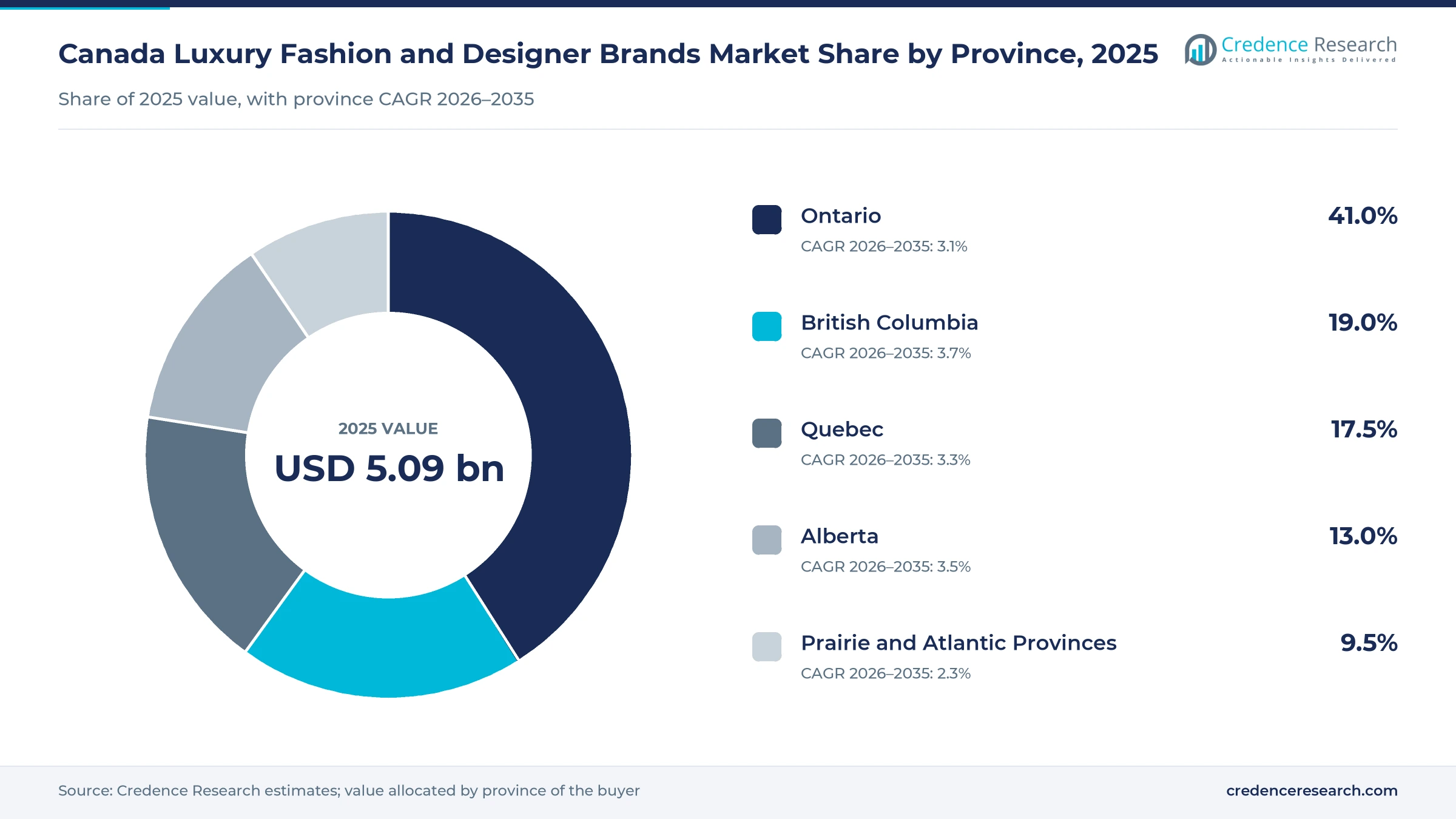
Ontario leads while British Columbia grows fastest
| Province | Value, 2025 (USD billion) | Share, 2025 | CAGR, 2026–2035 |
|---|---|---|---|
| Ontario | 2.09 | 41.0% | 3.1% |
| British Columbia | 0.97 | 19.0% | 3.7% |
| Quebec | 0.89 | 17.5% | 3.3% |
| Alberta | 0.66 | 13.0% | 3.5% |
| Prairie and Atlantic Provinces | 0.48 | 9.5% | 2.3% |
Ontario leads on Toronto’s two designer districts
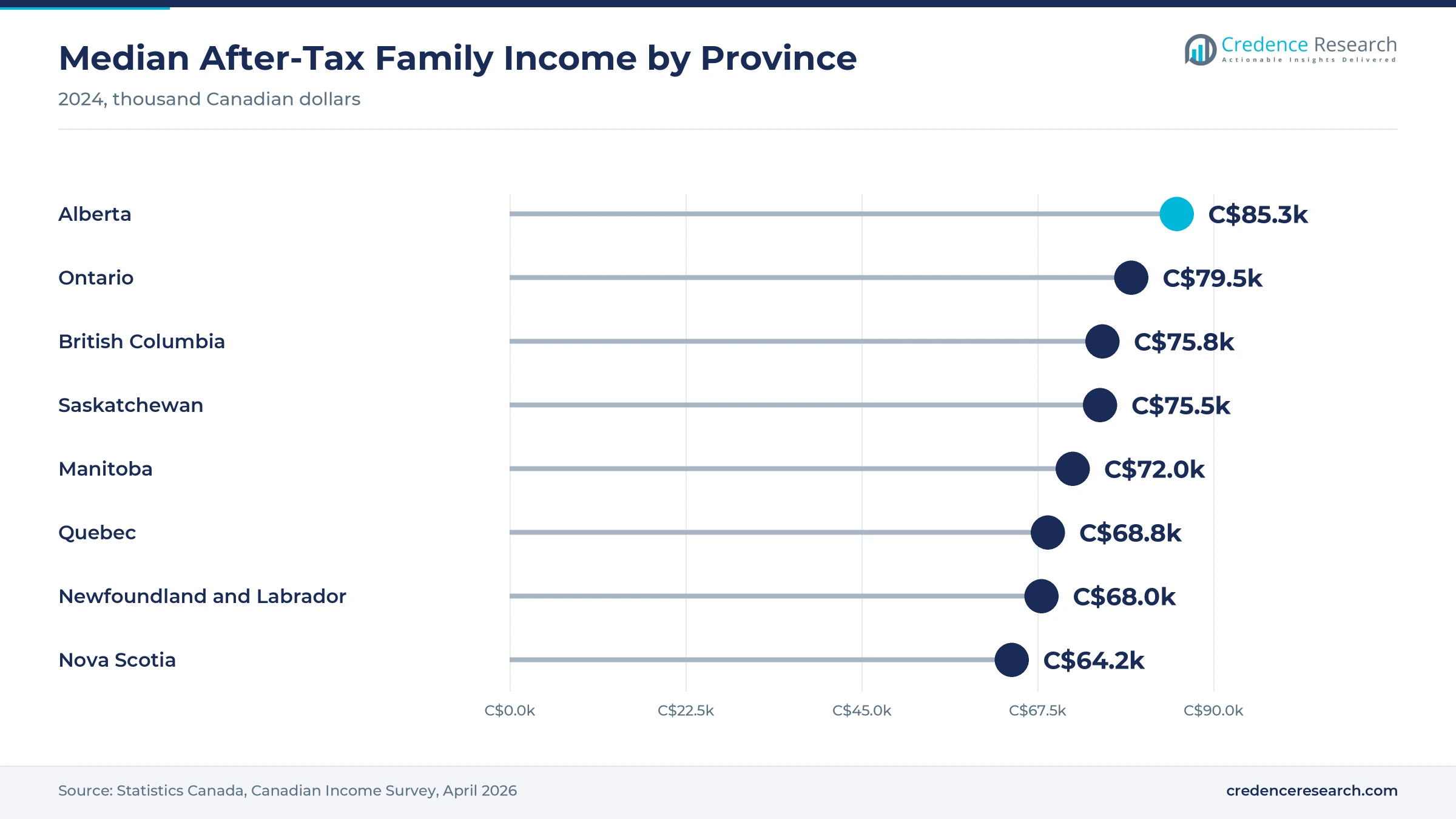
Ontario held a 41.0% share of 2025 value and grows at 3.1% a year. Median after-tax family income in Ontario was C$79,500 in 2024, second among the provinces after Alberta, according to Statistics Canada. Bloor-Yorkville and Yorkdale host most brand flagships, and Moncler is taking a concession of about 3,000 square feet inside Holt Renfrew on Bloor Street, in space that Fendi left. Toronto also serves as the testing ground for brands entering Canada, so new labels usually open there before moving west or east.
British Columbia grows fastest on Oakridge Park and Alberni Street
British Columbia held a 19.0% share of 2025 value and grows fastest at 3.7% a year. Downtown Vancouver already has one of the country’s densest groups of mono-brand watch stores on Alberni Street, where Rolex, Tudor and Chopard trade side by side, and Longines is preparing its first Canadian boutique of just over 1,000 square feet nearby, Retail Insider reported in July 2026. Median after-tax family income in the province was C$75,800 in 2024. Visitors from Asia add to resident demand, and that mix underpins the province’s growth lead.
Quebec gains new brand stores through Royalmount
Quebec held a 17.5% share of 2025 value and grows at 3.3% a year. Balenciaga opened a 4,000-square-foot store at Royalmount in July 2025, its first in Quebec and fifth standalone store in Canada, Retail Insider reported. Hermès sells in Montreal through a concession at Holt Renfrew Ogilvy rather than a standalone store. Median after-tax family income in Quebec was C$68,800 in 2024, below the national level, so Montreal relies on a smaller group of high-income buyers and visitors.
Alberta draws new houses on the highest provincial incomes
Alberta held a 13.0% share of 2025 value and grows at 3.5% a year. Median after-tax family income in Alberta was C$85,300 in 2024, the highest of any province, according to Statistics Canada. Hermès has secured a store of 5,000 to 6,000 square feet at 407 8th Avenue SW on Calgary’s Stephen Avenue, expected to open in 2028 as its only location in Alberta, Retail Insider reported in June 2026. Upscale retail in Calgary otherwise centers on CF Chinook Centre and Holt Renfrew.
Prairie and Atlantic provinces buy through travel and online
Prairie and Atlantic provinces held a 9.5% share of 2025 value and grow at 2.3% a year. Median after-tax family income was C$64,200 in Nova Scotia, C$72,000 in Manitoba and C$75,500 in Saskatchewan in 2024, according to Statistics Canada. Few houses run standalone stores in Winnipeg, Regina or Halifax, so buyers shop on brand websites or during trips to Toronto and Montreal. Department store concessions and appointment selling serve most local demand.
Mall openings and a department store exit mark 2024 to 2026
| Development | Status and market relevance |
|---|---|
| In September 2024, Royalmount opened in Montreal with more than 170 stores, including Louis Vuitton, Gucci and Moncler. | Open; Quebec’s largest new designer cluster |
| In June 2025, Hudson’s Bay closed all remaining stores after its creditor protection filing in March 2025. | Closed; designer floor space shifted to brands and Holt Renfrew |
| In November 2025, Chanel opened a two-level boutique of about 10,635 square feet at Yorkdale Shopping Centre. | Open; expands brand-owned space in Toronto |
| In June 2026, Prada opened a boutique of about 7,000 square feet at Oakridge Park in Vancouver. | Open; part of the new Vancouver flagship cluster |
| In September 2026, Harry Rosen moved its Toronto flagship to a 38,000-square-foot building on Cumberland Street. | Open; menswear specialist invests in a smaller, newer flagship |
Clienteling, authentication and data tools shape selling
- Clienteling software lets sales associates track a client’s sizes, past orders and wish lists across stores, which supports private appointment selling.
- Stock visibility across stores and websites allows buyers to reserve an item online and collect or try it in a boutique the same day.
- Authentication and serial tracking helps consignment sellers and brands confirm that a bag or watch is genuine before resale or repair.
- Made-to-measure tools capture body measurements and fabric choices digitally, which shortens tailoring lead times for suits and outerwear.
Need a Custom Version of This Report?
Tailor the scope, geography, or segments to your exact requirements.
- Custom geography or segment scope
- Direct access to our analyst team
Global houses lead through their own boutiques
Competition in Canada is led by European luxury groups that sell mainly through their own boutiques, while Holt Renfrew and Harry Rosen are the main Canadian multi-brand sellers and Canada Goose is the leading Canadian label. LVMH sells Louis Vuitton, Dior, Loro Piana, Fendi and Tiffany & Co. in Toronto, Vancouver and Montreal. Kering runs Gucci, Saint Laurent and Balenciaga stores, including a large new Gucci store due at Yorkdale in November 2026. Chanel and Hermès keep tight control of their store networks and prices, while Prada Group sells Prada and Miu Miu at Oakridge Park. Richemont sells Cartier and Van Cleef & Arpels through boutiques and Maison Birks. Burberry, Ralph Lauren and Moncler cover outerwear, tailoring and accessible luxury. Canada Goose competes on premium parkas sold through its own stores and website. Houses compete on store quality, service and allocation of scarce products rather than on price.
How is supply organized, and where do margins sit?
Supply is led by a small group of European houses that design, make and sell through their own stores, alongside two domestic specialists and a few multi-brand sellers. LVMH, Kering, Chanel, Hermès and Prada control most handbag and leather goods value, while Richemont and Rolex lead watches and jewellery. Holt Renfrew and Harry Rosen are the main department and specialty sellers since Hudson’s Bay closed. Entry barriers sit in brand equity and in access to prime space rather than in production. Margins are highest at the brand level and thinnest for multi-brand online retailers.
European houses and Holt Renfrew anchor designer supply
| Company | Type | Role in the market |
|---|---|---|
| LVMH Moët Hennessy Louis Vuitton SE | Luxury group | Louis Vuitton, Dior, Loro Piana, Fendi and Tiffany & Co. boutiques in major Canadian cities |
| Kering SA | Luxury group | Gucci, Saint Laurent and Balenciaga stores at Yorkdale and Royalmount |
| Chanel | Luxury house | Ready-to-wear, handbags and accessories through Yorkdale, Oakridge Park and other boutiques |
| Hermès International SCA | Luxury house | Leather goods and apparel through Toronto and Vancouver stores and a Montreal concession |
| Prada Group | Luxury group | Prada and Miu Miu boutiques, including a 7,000-square-foot Oakridge Park store |
| Burberry Group plc | Luxury brand | Outerwear and accessories through city stores and a Toronto Pearson airport store |
| Compagnie Financière Richemont SA | Luxury group | Cartier, Van Cleef & Arpels and other watch and jewellery brands |
| Ralph Lauren Corporation | Designer brand | Full-price Yorkdale store, 12 outlet stores and the RalphLauren.ca website |
| Moncler Group | Luxury brand | Down outerwear through boutiques and a Holt Renfrew Bloor Street concession |
| Canada Goose Holdings Inc. | Canadian luxury label | Premium parkas and outerwear sold through own stores, website and retailers |
| Rolex SA | Watchmaker | Watches through boutiques run with Raffi Jewellers and authorized retailers, including Royalmount |
Owned retail and space will decide share to 2035
Credence Research’s view is that control of retail space, not new product launches alone, will decide which houses gain share in Canada to 2035. The closure of Hudson’s Bay and the opening of Royalmount and Oakridge Park moved designer sales into brand-run stores, where houses control price, stock and client data. Brands that secure corner sites in Yorkville, Yorkdale and Vancouver before space runs out will hold an advantage that late entrants cannot buy back. The most useful investments are private appointment selling, airport stores and early leases in Calgary.
Wealth, store and visitor data anchor the estimate
The report uses 2025 as the base year and forecasts values to 2035. Market values come from the Credence Research model, and segment and provincial splits are Credence Research estimates. The Canada estimate was cross-checked against household wealth data, visitor arrivals, retail sales by store type and published store openings. Evidence comes from Statistics Canada releases, Canada Revenue Agency policy, company filings and releases, legal commentary and national trade press. No interviews or surveys were conducted for this report, and beauty products and private resale are excluded.
Mix and store quality, not volume, carry value to 2035
Canadian designer spending should rise from USD 5.28 billion in 2026 to USD 7.04 billion by 2035, with most growth coming from trading up, new flagships and online reservations rather than from more buyers. Jewellery and Watches should grow at 3.8% a year as watch and jewellery houses open larger stores. British Columbia should gain share as Oakridge Park fills and visitors from Asia return. The main risks are a fall in housing and equity wealth, further trade disputes with the United States and the lack of a tourist tax refund.
What separates the downside, base and upside paths to 2035?
The range of outcomes depends mainly on household wealth and on how well new flagships convert visitors and residents. A downside path follows if a housing or equity downturn cuts wealth among top households and U.S. traffic keeps falling. The base case assumes steady wealth, gradual store openings and stable trade terms. An upside path needs Oakridge Park and Yorkdale to fill quickly, overseas visitors to keep rising and more brands to add stores in Calgary and Montreal.
| Scenario | CAGR, 2026–2035 | Value, 2035 | What has to hold |
|---|---|---|---|
| Downside | 2.0% | USD 6.34 billion | Housing and equity prices fall and U.S. visitor numbers keep declining through the forecast period |
| Base | 3.25% | USD 7.04 billion | Household wealth grows steadily and new flagships open at the pace announced to date |
| Upside | 4.2% | USD 7.68 billion | New clusters fill quickly, overseas arrivals keep rising and more houses open in Calgary and Montreal |
Frequently Asked Questions
How big is the Canada luxury fashion and designer brands market?
Which province leads designer sales in Canada?
Which province grows fastest?
Which product category holds the largest share?
How did the closure of Hudson’s Bay affect designer brands?
Who buys designer goods in Canada?
What is the biggest risk for designer brands in Canada?
Which companies are active in the market?
Table of Content
Chapter 1 Market Segmentation
- 1.1 Segmentation Framework
- 1.1.1 Product and Service Classification
- 1.1.2 Application and End-Use Classification
- 1.1.3 Technology and Solution Classification
- 1.1.4 Customer and Distribution Channel Classification
- 1.1.5 Geographic Segmentation
- 1.1.6 Market Segment Definitions and Boundaries
- 1.2 By Product Category
- 1.2.1 Ready-to-Wear Apparel
- 1.2.2 Handbags and Small Leather Goods
- 1.2.3 Jewellery and Watches
- 1.2.4 Footwear
- 1.2.5 Fashion Accessories
- 1.3 By Price Tier
- 1.3.1 Accessible Luxury
- 1.3.2 Premium Luxury
- 1.3.3 High Luxury
- 1.3.4 Ultra-Luxury / Couture
- 1.4 By Customer Type
- 1.4.1 Affluent Domestic Consumers
- 1.4.2 Resident HNWIs
- 1.4.3 International Tourists
- 1.4.4 Corporate Gift Buyers
- 1.5 By Province
- 1.5.1 Ontario
- 1.5.2 British Columbia
- 1.5.3 Quebec
- 1.5.4 Alberta
- 1.5.5 Prairie and Atlantic Provinces
Chapter 2 Introduction
- 2.1 Report Objectives and Scope
- 2.2 Product Definition and Industry Terminology
- 2.3 Market Inclusions and Exclusions
- 2.4 Research Process
- 2.4.1 Primary Research and Expert Interviews
- 2.4.2 Secondary Research and Source Review
- 2.4.3 Top-Down and Bottom-Up Estimation
- 2.4.4 Data Triangulation and Verification
- 2.5 Market Size Measurement Basis
- 2.5.1 2025: USD 5.09 billion → 2035: USD 7.04 billion
- 2.6 Historical and Forecast Reference Periods
- 2.6.1 Historical Period: 2018-2025
- 2.6.2 Base Year: 2025
- 2.6.3 Forecast Period: 2025-2035
- 2.7 Research Assumptions and Limitations
Chapter 3 Executive Summary
- 3.1 Market Snapshot and Key Findings
- 3.2 Base-Year Market Size, 2025
- 3.3 Forecast Market Size, 2035
- 3.4 Revenue and Volume Growth Outlook
- 3.5 Key Demand and Supply Indicators
- 3.6 Leading Market Segments
- 3.7 Fastest-Growing Market Opportunities
- 3.8 Regional Performance Highlights
- 3.9 Technology and Industry Transformation
- 3.10 Competitive Landscape Summary
- 3.11 Analyst View and Strategic Implications
Chapter 4 Canada Luxury Fashion and Designer Brands Market Trends and Developments
- 4.1 Historical Industry Development, 2018-2025
- 4.2 Recent Market Trends and Developments
- 4.3 Demand and Customer Behavior Trends
- 4.4 Technology and Product Innovation
- 4.5 Artificial Intelligence, Automation and Digitalization
- 4.6 Local Manufacturing and Supply Chain Realignment
- 4.7 Industry Partnerships, Mergers and Acquisitions
- 4.8 Sustainability and Circular Economy Developments
- 4.9 Government and Private Sector Investment Trends
- 4.10 Emerging Business Models and Commercialization
- 4.11 Industry Developments and Announcements
Chapter 5 Canada Luxury Fashion and Designer Brands Market Production, Supply and Demand Analysis
- 5.1 Demand Trend and Consumption Analysis, 2018-2025
- 5.2 Demand Forecast, 2025-2035
- 5.3 Production and Output Trend, 2018-2025
- 5.4 Production and Output Forecast, 2025-2035
- 5.5 Installed Capacity and Capacity Utilization
- 5.6 Company-Wise Production Plants and Statistics
- 5.6.1 Installed Production Capacity
- 5.6.2 Actual Production
- 5.6.3 Planned Capacity and Expansion Targets
- 5.7 Supply Chain Structure and Procurement Trends
- 5.8 Supply-Demand Gap and Bottlenecks
- 5.9 Import Dependence and Sourcing Structure
- 5.10 Contract Manufacturing and Outsourcing
- 5.11 Regional Supply and Demand Concentration
Chapter 6 Canada Luxury Fashion and Designer Brands Market Pricing Analysis
- 6.1 Pricing Structure and Measurement
- 6.2 Historical Pricing Trends, 2018-2025
- 6.3 Pricing Outlook, 2025-2035
- 6.4 Average Selling Price and Unit Economics
- 6.5 Pricing by Product and Market Segment
- 6.6 Geographic Pricing Differences
- 6.7 Key Input, Energy, Labor and Logistics Costs
- 6.8 Contract Pricing and Purchasing Models
- 6.9 Pricing Sensitivity and Competitive Positioning
- 6.10 Price, Margin and Profitability Implications
Chapter 7 Canada Luxury Fashion and Designer Brands Market Dynamics
- 7.1 Market Growth Drivers
- 7.1.1 Demand-Side Drivers
- 7.1.2 Technology and Innovation Drivers
- 7.1.3 Infrastructure and Investment Drivers
- 7.1.4 Regulatory and Policy Drivers
- 7.2 Market Restraints
- 7.2.1 Cost and Affordability Constraints
- 7.2.2 Technology and Adoption Barriers
- 7.2.3 Supply Chain and Operational Constraints
- 7.3 Market Challenges
- 7.3.1 Competitive Pressure and Margin Erosion
- 7.3.2 Skills, Infrastructure and Implementation Gaps
- 7.4 Emerging Market Opportunities
- 7.5 Market Dynamics Impact and Time-Horizon Assessment
Chapter 8 Canada Luxury Fashion and Designer Brands Value Chain Analysis
- 8.1 Industry Value Chain Overview
- 8.2 Upstream Suppliers and Critical Inputs
- 8.3 Technology and Component Providers
- 8.4 Manufacturing or Service Delivery
- 8.5 Distribution, Channel Partners and Integrators
- 8.6 Downstream Applications and End Users
- 8.7 Value Addition and Profit Pools
- 8.8 Vertical Integration and Outsourcing
- 8.9 Supplier Concentration and Risk
- 8.10 Supply Chain Localization and Resilience
Chapter 9 Canada Luxury Fashion and Designer Brands Market Regulations and Policies
- 9.1 Relevant Laws, Standards and Compliance Frameworks
- 9.2 Product, Service, Safety and Quality Requirements
- 9.3 Government Policies, Incentives and Subsidies
- 9.4 Imports, Exports and Trade Barriers
- 9.5 Public Procurement and Local Content Requirements
- 9.6 Environmental and Sustainability Compliance
- 9.7 Upcoming Policy Changes and Market Implications
Chapter 10 Canada Luxury Fashion and Designer Brands Market Hotspots and Opportunities
- 10.1 Market Opportunity Mapping and Growth Hotspots
- 10.2 High-Growth Applications and Customer Groups
- 10.3 Underserved Markets and White-Space Opportunities
- 10.4 Emerging Technology and Product Opportunities
- 10.5 New Capacity and Investment Hotspots
- 10.6 Market Entry and Expansion Opportunities
- 10.7 Distribution and Partnership Opportunities
- 10.8 Near-Term and Long-Term Commercial Potential
- 10.9 Opportunity Attractiveness and Execution Risks
Chapter 11 Canada Luxury Fashion and Designer Brands Market Outlook, 2025-2035
- 11.1 Market Size and Analysis
- 11.1.1 Revenue (Market Measurement: 2025: USD 5.09 billion → 2035: USD 7.04 billion)
- 11.1.2 Market Volume and Quantity Sold
- 11.1.3 Historical Market Size, 2018-2025
- 11.1.4 Base-Year Market Size, 2025
- 11.2 Market Forecast, 2025-2035
- 11.2.1 Revenue Forecast to 2035
- 11.2.2 Volume Forecast to 2035
- 11.2.3 CAGR and Year-on-Year Growth
- 11.2.4 Incremental Revenue Opportunity
- 11.3 Forecast Assumptions and Scenario Analysis
- 11.3.1 Base-Case Forecast
- 11.3.2 Optimistic and Conservative Scenarios
- 11.3.3 Technology, Pricing and Policy Sensitivities
- 11.4 Market Attractiveness and Growth Outlook
Chapter 12 Canada Luxury Fashion and Designer Brands Market Segmentation and Outlook
- 12.1 Segmentation Summary and Market Shares, 2025
- 12.2 Largest and Fastest-Growing Segments
- 12.3 By Product Category - Market Size and Forecast, 2025-2035
- 12.3.1 Segment Definition and Scope
- 12.3.2 Historical Market Size, 2018-2025
- 12.3.3 Revenue Forecast, 2025-2035
- 12.3.4 Volume Forecast, 2025-2035
- 12.3.5 Base-Year Market Share, 2025
- 12.3.6 Segment CAGR and Growth Drivers
- 12.3.7 Subsegment Market Size and Forecast
- 12.3.7.1 Ready-to-Wear Apparel
- 12.3.7.2 Handbags and Small Leather Goods
- 12.3.7.3 Jewellery and Watches
- 12.3.7.4 Footwear
- 12.3.7.5 Fashion Accessories
- 12.3.8 Subsegment Pricing and Adoption Trends
- 12.3.9 Leading Suppliers and Competition
- 12.3.10 Regional Demand and Opportunities
- 12.4 By Price Tier - Market Size and Forecast, 2025-2035
- 12.4.1 Segment Definition and Scope
- 12.4.2 Historical Market Size, 2018-2025
- 12.4.3 Revenue Forecast, 2025-2035
- 12.4.4 Volume Forecast, 2025-2035
- 12.4.5 Base-Year Market Share, 2025
- 12.4.6 Segment CAGR and Growth Drivers
- 12.4.7 Subsegment Market Size and Forecast
- 12.4.7.1 Accessible Luxury
- 12.4.7.2 Premium Luxury
- 12.4.7.3 High Luxury
- 12.4.7.4 Ultra-Luxury / Couture
- 12.4.8 Subsegment Pricing and Adoption Trends
- 12.4.9 Leading Suppliers and Competition
- 12.4.10 Regional Demand and Opportunities
- 12.5 By Customer Type - Market Size and Forecast, 2025-2035
- 12.5.1 Segment Definition and Scope
- 12.5.2 Historical Market Size, 2018-2025
- 12.5.3 Revenue Forecast, 2025-2035
- 12.5.4 Volume Forecast, 2025-2035
- 12.5.5 Base-Year Market Share, 2025
- 12.5.6 Segment CAGR and Growth Drivers
- 12.5.7 Subsegment Market Size and Forecast
- 12.5.7.1 Affluent Domestic Consumers
- 12.5.7.2 Resident HNWIs
- 12.5.7.3 International Tourists
- 12.5.7.4 Corporate Gift Buyers
- 12.5.8 Subsegment Pricing and Adoption Trends
- 12.5.9 Leading Suppliers and Competition
- 12.5.10 Regional Demand and Opportunities
- 12.6 By Province - Market Size and Forecast, 2025-2035
- 12.6.1 Segment Definition and Scope
- 12.6.2 Historical Market Size, 2018-2025
- 12.6.3 Revenue Forecast, 2025-2035
- 12.6.4 Volume Forecast, 2025-2035
- 12.6.5 Base-Year Market Share, 2025
- 12.6.6 Segment CAGR and Growth Drivers
- 12.6.7 Subsegment Market Size and Forecast
- 12.6.7.1 Ontario
- 12.6.7.2 British Columbia
- 12.6.7.3 Quebec
- 12.6.7.4 Alberta
- 12.6.7.5 Prairie and Atlantic Provinces
- 12.6.8 Subsegment Pricing and Adoption Trends
- 12.6.9 Leading Suppliers and Competition
- 12.6.10 Regional Demand and Opportunities
- 12.7 Segment Growth Comparison
- 12.8 Segment Attractiveness and Priority Matrix
Chapter 13 Canada Luxury Fashion and Designer Brands End-Use and Application Market Outlook
- 13.1 End-Use Industry and Customer Demand Structure
- 13.2 Leading Applications and Customer Groups
- 13.3 End-Use Market Size, Share and Forecast
- 13.4 Major End-Use Industry Deep Dives
- 13.4.1 Customer Requirements and Use Cases
- 13.4.2 Demand and Replacement Cycles
- 13.4.3 Technical and Regulatory Considerations
- 13.4.4 Purchasing and Procurement Models
- 13.4.5 Leading Vendors and Distribution Channels
- 13.4.6 Forecast and Commercial Opportunities
- 13.5 Emerging Applications and Cross-Segment Demand
- 13.6 End-Use Industry Investment Priorities
Chapter 14 Canada Luxury Fashion and Designer Brands Geographic Market Outlook, 2025-2035
- 14.1 Domestic Market Distribution and Demand Clusters
- 14.2 State- or Province-Wise Market Size and Forecast, 2025-2035
- 14.3 City and Metropolitan Market Outlook
- 14.4 Industrial, Manufacturing and Commercial Clusters
- 14.5 Geographic Concentration of Key End Users
- 14.6 Local Pricing and Purchasing Differences
- 14.7 Domestic Production Facilities and Capacity Map
- 14.8 Local Infrastructure and Project Pipeline
- 14.9 State-Level Policy and Incentive Differences
- 14.10 Subnational Investment Hotspots and Opportunities
- 14.11 Distribution and Logistics Networks
- 14.12 Domestic Competitive Footprint
Chapter 15 Canada Luxury Fashion and Designer Brands Technology, Innovation and Sustainability Outlook
- 15.1 Technology Landscape and Maturity
- 15.2 Product, Process and Service Innovation
- 15.3 AI, Automation and Digital Tools in the Industry
- 15.4 Technology Adoption and Performance Benchmarking
- 15.5 Innovation Pipeline and R&D Investment
- 15.6 Patent and Intellectual Property Trends
- 15.7 Energy Efficiency and Resource Management
- 15.8 Sustainability, Recycling and Circularity
- 15.9 Technology Roadmap, 2025-2035
- 15.10 Risks of Obsolescence and Technology Substitution
Chapter 16 Canada Luxury Fashion and Designer Brands Market Key Strategic Imperatives
- 16.1 Growth and Market Entry Priorities
- 16.2 High-Return Products and Segments
- 16.3 Pricing, Profitability and Cost Optimization
- 16.4 Technology Investment and Product Differentiation
- 16.5 Supply Chain Localization and Resilience
- 16.6 Distribution and Customer Acquisition
- 16.7 Partnership, Acquisition and Capacity Strategy
- 16.8 Regional Expansion Priorities
- 16.9 Short-, Medium- and Long-Term Actions
Chapter 17 Competition Outlook
- 17.1 Industry Competition Characteristics
- 17.2 Market Structure and Concentration
- 17.3 Market Share and Competitive Positioning, 2025
- 17.4 Company-Wise Revenue and Product Benchmarking
- 17.5 Production and Service Capacity Benchmarking
- 17.6 Technology, Pricing and Differentiation
- 17.7 Regional Footprint and Distribution Strength
- 17.8 Mergers, Acquisitions and Strategic Alliances
- 17.9 New Entrants and Competitive Threats
- 17.10 Porter's Five Forces and Industry Attractiveness
- 17.11 Competitive Outlook, 2025-2035
Chapter 18 Company Profiles
- 18.1 Company Coverage and Selection Criteria
- 18.2 LVMH Moët Hennessy Louis Vuitton SE
- 18.2.1 Business Description
- 18.2.2 Company Ownership and Geographic Presence
- 18.2.3 Product and Service Portfolio
- 18.2.4 Manufacturing and Operating Footprint
- 18.2.5 Production Capacity and Expansion Plans
- 18.2.6 Financial Performance and Investment
- 18.2.7 Market Share and Competitive Position
- 18.2.8 Technology and Innovation Capabilities
- 18.2.9 Strategic Alliances or Partnerships
- 18.2.10 Recent Developments
- 18.2.11 Growth Strategy and Outlook
- 18.3 Kering SA
- 18.4 Chanel
- 18.5 Hermès International SCA
- 18.6 Prada Group
- 18.7 Burberry Group plc
- 18.8 Compagnie Financière Richemont SA
- 18.9 Ralph Lauren Corporation
- 18.10 Moncler Group
- 18.11 Canada Goose Holdings Inc.
- 18.12 Rolex SA
- 18.13 Other Relevant Market Participants
Note: Every listed company is profiled on the structure shown under the first company. The company list is preliminary and may change based on research findings, market developments, data availability and client requirements.
Chapter 19 Disclaimer
- 19.1 Research and Forecast Disclaimer
- 19.2 Data Source and Estimation Limitations
Note: The depth of individual sections depends on data availability for this market. Volume, capacity, trade and other unit-based metrics are included where applicable.

