
Starch, noodle and dairy lines anchor regional enzyme demand
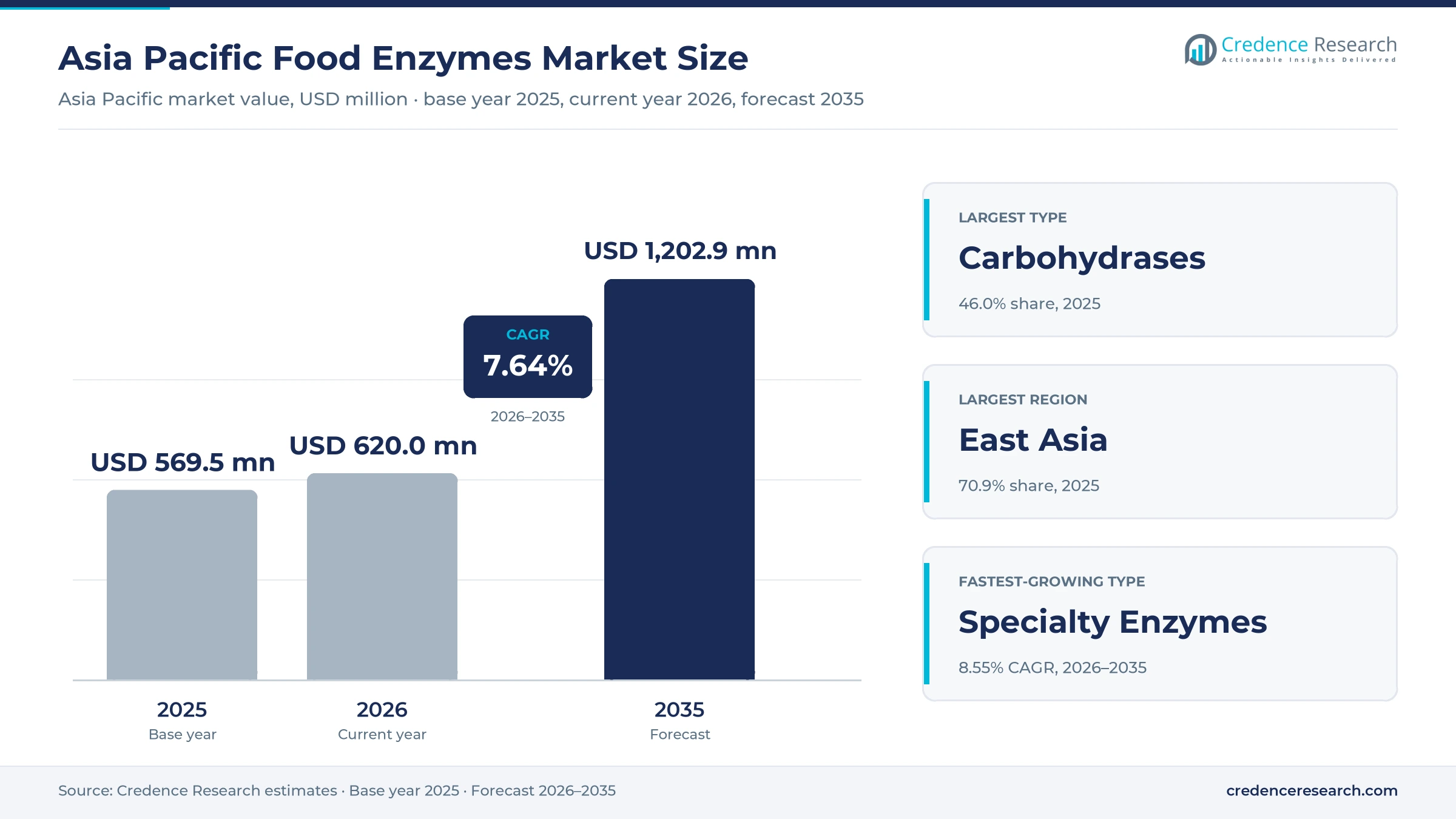
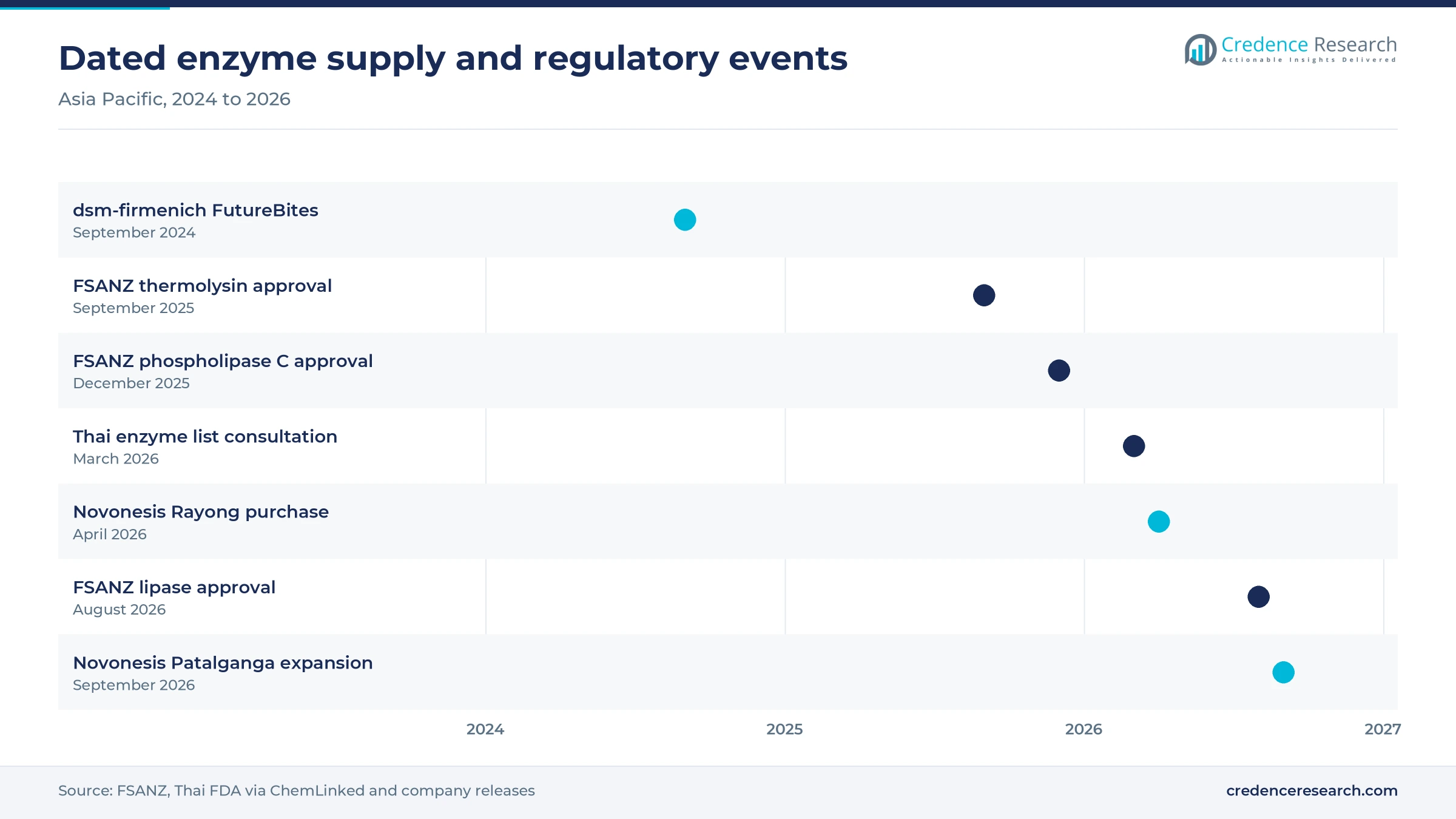
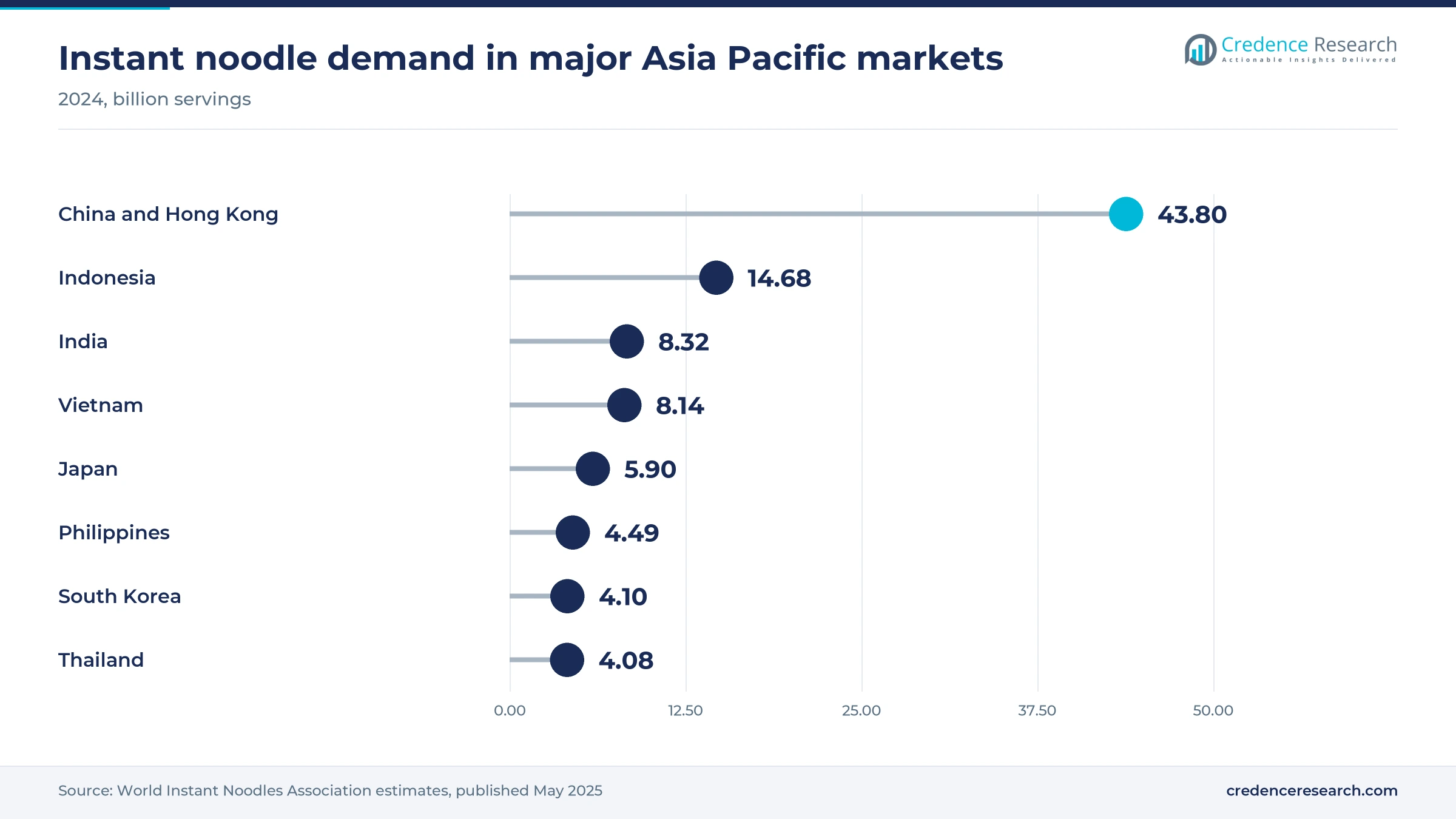
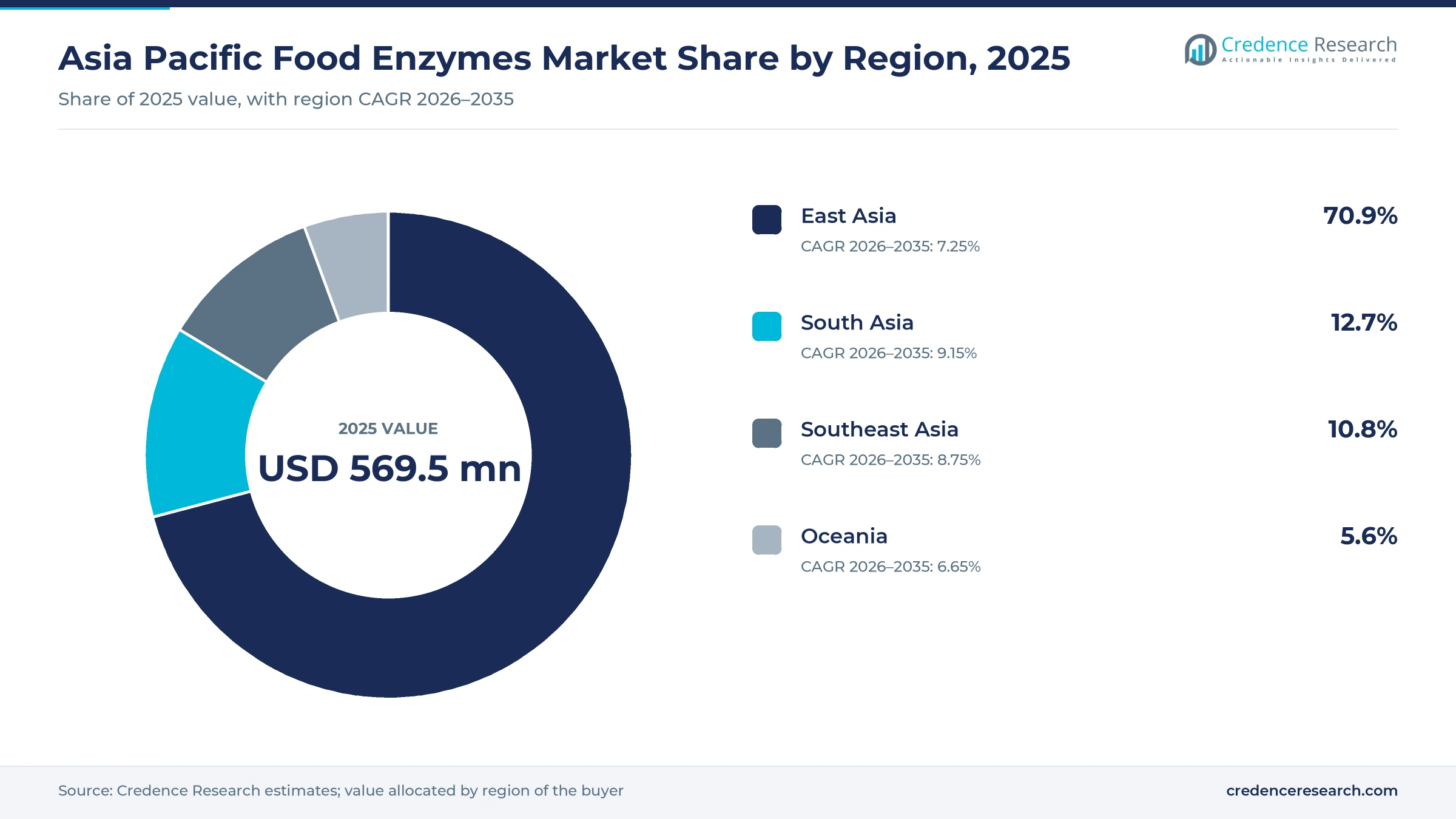
The Asia Pacific food enzymes market was valued at USD 569.5 million in 2025 and is projected to increase from USD 620.0 million in 2026 to USD 1.20 billion by 2035, registering a CAGR of 7.64% during 2026–2035. Demand comes from starch saccharification, baking, noodle, dairy and brewing lines that use enzymes to lift yield and hold product quality steady. East Asia held the largest share, 70.9% in 2025, because China and Hong Kong alone accounted for 43.27 billion of the world's 124.21 billion instant noodle servings in 2025. South Asia is the fastest-growing area at 9.15% a year, helped by Indian milk output of 247.87 million metric tons in 2024-25, reported in Basic Animal Husbandry Statistics 2025. Supply is also moving closer to buyers across the region. Novonesis announced a EUR 600 million enzyme plant expansion at Patalganga in September 2026, after buying a Rayong fermentation site in Thailand in April 2026. Regulators keep widening permitted uses, as the Aug. 5, 2026, FSANZ approval of a new triacylglycerol lipase shows.
Which enzyme preparations do regional processors buy, and how?
The market covers carbohydrase, protease, lipase and specialty enzyme preparations sold to food and beverage processors in East Asia, South Asia, Southeast Asia and Oceania. Large manufacturers usually buy directly from producers under technical supply terms, while smaller plants often buy through technical distributors or receive enzymes inside formulated ingredient blends.
The estimate excludes animal feed enzymes, detergent and biofuel enzymes, digestive enzyme supplements and laboratory reagents. The value chain runs from strain development and fermentation or extraction, through formulation and regulatory clearance, to application support at the processing line.
Asia Pacific Food Enzymes Market Insights
- The market grows from USD 569.5 million in 2025 to USD 1.20 billion by 2035, a 7.64% CAGR during 2026–2035, on starch, noodle and dairy processing volumes.
- East Asia held 70.9% of 2025 value, supported by Chinese and Japanese processing scale, while South Asia grows fastest at 9.15% a year.
- Carbohydrases led product types with 46.0% of 2025 value because starch conversion absorbs large enzyme volumes across the region.
- Novonesis announced a EUR 600 million expansion at Patalganga in September 2026, with full operation expected in 2030, moving more capacity closer to customers in the Middle East, India and Africa.
- Competition centers on local pilot plants and regulatory clearances, shown by IFF sites in Shanghai and Singapore and repeated FSANZ enzyme approvals during 2025 and 2026.
Carbohydrases and microbial supply set the market structure
Why do carbohydrases lead, and which enzymes grow fastest?
Based on product type, the market is categorized into carbohydrases, proteases, lipases and specialty enzymes. Carbohydrases led with 46.0% of 2025 value because starch conversion absorbs large enzyme volumes, and the Japanese agriculture ministry alone forecast 1.658 million tons of saccharified product demand for starch year 2024. Specialty Enzymes form the fastest-growing group at 8.55% a year as newer activities reach commercial scale. The $53.4 million Angel Yeast project at Yichang, sized at 5,000 tons a year, names nuclease, deaminase and glutaminase alongside lactase and protease, according to Baking Business. Amano Enzyme extended that direction in June 2026 with its ProBoost Neutra pea protein enzyme.
Which food applications buy the most enzyme value?
Based on application, the market is categorized into bakery and confectionery, dairy, beverages and savory and ingredient processing. Savory and Ingredient Processing led with 35.0% of 2025 value because oil, protein and starch lines use enzymes at industrial scale. FSANZ approved a phospholipase C for vegetable oil degumming on Dec. 10, 2025, and a thermolysin for protein hydrolysis on Sept. 17, 2025. Azelis India also carries dsm-firmenich bakery enzymes nationwide for makers of bakery ingredients and finished goods. Dairy grows fastest at 8.31% a year as processors hydrolyze lactose and milk fat for new formats, a use FSANZ widened on Aug. 5, 2026.
Why does microbial fermentation dominate enzyme production?
Based on technology, the market is categorized into microbial fermentation, plant extraction and animal extraction. Microbial Fermentation led with 88.0% of 2025 value because the newest approved activities come from production strains, including Komagataella phaffii and Bacillus licheniformis in FSANZ decisions of 2025 and 2026. Microbial Fermentation also grows fastest at 7.72% a year as capacity follows that shift, shown by the roughly $50 million Novonesis purchase of the Meihua site at Rayong, reported by Chemical Engineering in April 2026. Animal extraction stays small because the OECD-FAO Agricultural Outlook 2024-2033 notes that many South Asian consumers are vegetarian and that some reject pork.
How do processors in the region source their enzymes?
Based on distribution channel, the market is categorized into direct manufacturer sales, technical distributor sales and ingredient formulator sales. Direct Manufacturer Sales led with 58.0% of 2025 value because large processors buy straight from producers that keep technical teams nearby, as IFF does beside its Singapore dairy and beverage pilot plant, described in a July 2025 release. Technical Distributor Sales grows fastest at 8.10% a year as mid-sized processors seek local application support. Azelis India became sole distributor of dsm-firmenich food enzymes and cultures across India in October 2023, according to Nuffoods Spectrum, and DKSH took on DSM enzymes in South Korea under an April 2014 agreement.
| Segment Group | Leading Sub-segment | Share, 2025 | Fastest-growing Sub-segment | CAGR, 2026–2035 |
|---|---|---|---|---|
| By Product Type | Carbohydrases | 46.0% | Specialty Enzymes | 8.55% |
| By Application | Savory and Ingredient Processing | 35.0% | Dairy | 8.31% |
| By Technology | Microbial Fermentation | 88.0% | Microbial Fermentation | 7.72% |
| By Distribution Channel | Direct Manufacturer Sales | 58.0% | Technical Distributor Sales | 8.10% |
Request a Free Sample
Fill in your details and we'll send you a free sample report.
- Sample data tables & charts
- Research methodology
Processing scale and lactose-free dairy drive enzyme use
Processing efficiency and product consistency lift enzyme use
Processors adopt enzymes because a small dose can raise yield and hold texture steady on continuous lines, which matters most where volumes are very large. The World Instant Noodles Association counted 124.21 billion servings of world demand in 2025, with China and Hong Kong at 43.27 billion and Indonesia at 14.54 billion. Japan's agriculture ministry forecast 1.658 million tons of saccharified products for starch year 2024, a category built on carbohydrase conversion. Protein processors gained a further option when FSANZ approved an IFF thermolysin on Sept. 17, 2025, for dairy, egg, meat, fish, yeast and brewing uses. As a result, Carbohydrases held 46.0% of 2025 value, and Savory and Ingredient Processing remained the largest outlet.
Lactose-free dairy and controlled hydrolysis widen enzyme demand
Dairy processors are widening the enzyme steps they apply before milk reaches shoppers. The 5,000-ton Angel Yeast project at Yichang named lactase among its outputs, which signals Chinese supply for lactose-free dairy lines. Controlled hydrolysis is also widening, because FSANZ approved a Chr. Hansen triacylglycerol lipase on Aug. 5, 2026, for dairy products and plant-based analogues, which gives processors a cleared lipase across both conventional and alternative dairy lines. Chinese demand is shifting toward cream too, with imports up 9% to 290,000 tons in 2024, according to Dairy News 7x7 citing Yicai Global. These combined shifts help Dairy reach 8.31% a year through 2035.
Localized application development brings enzyme work closer
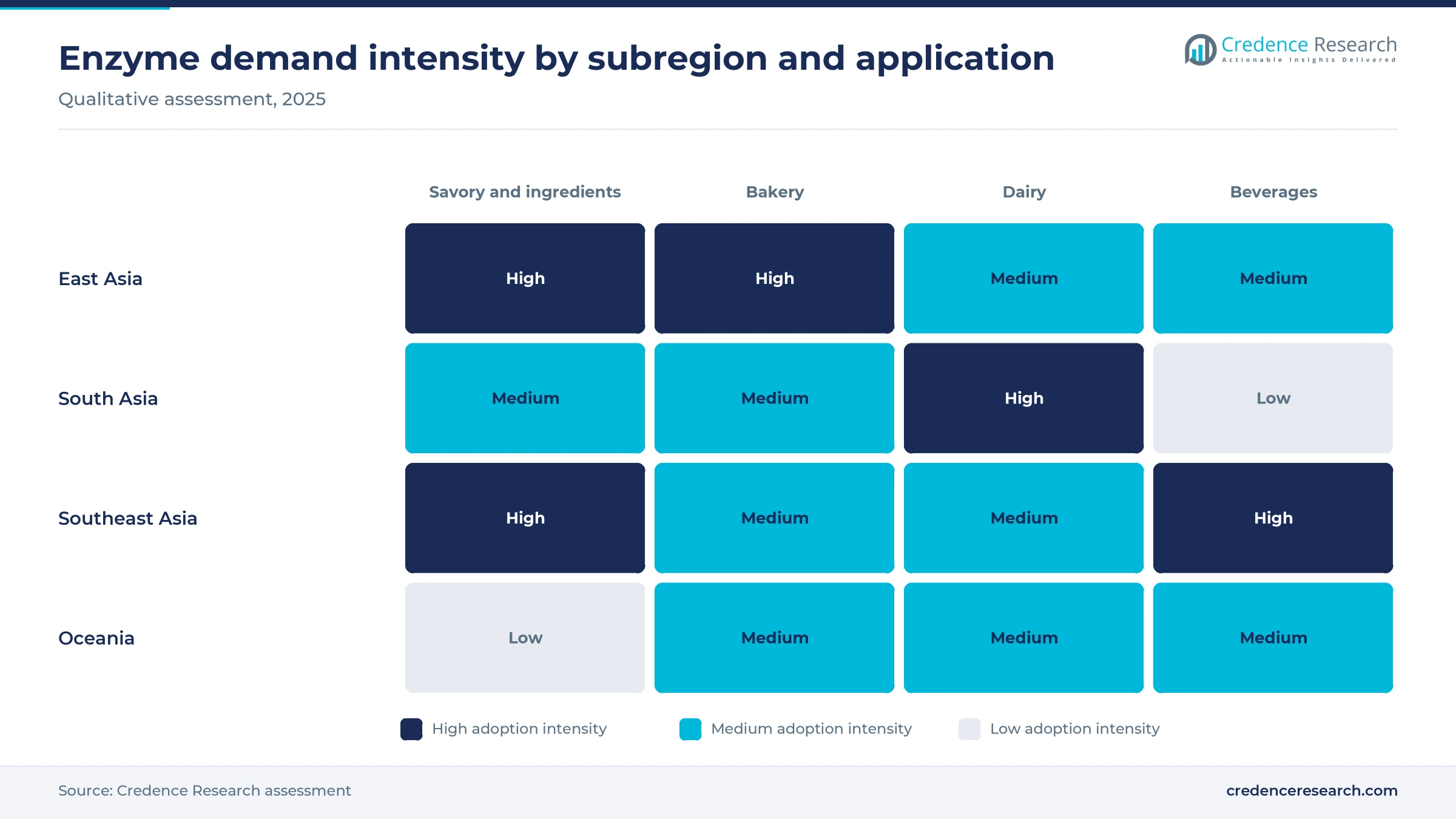
Suppliers are building pilot capacity near customers because noodle, dairy and beverage recipes differ sharply across the region. IFF described its 16,000-square-meter Shanghai Creative Center in July 2024 as its largest Asian site, with a culinary demo kitchen and an instant noodle pilot line. The IFF site in Singapore houses what the company calls the largest dairy and beverage pilot plant in Southeast Asia, according to a July 2025 release. In turn, dsm-firmenich unveiled its FutureBites Food Design Studio in Tuas on Sept. 18, 2024, within an investment of close to S$30 million backed by the Singapore Economic Development Board. Amano Enzyme and VNU University of Science co-hosted an enzyme technology workshop in Hanoi on Oct. 24, 2025, drawing about 60 faculty and students.
Urban diets in East and South Asia raise processed food output
Diet change supports enzyme volumes over the forecast because processed foods depend on consistent raw material conversion. The OECD-FAO Agricultural Outlook 2024-2033 projects that 73% of people in its Developed and East Asia region will live in cities by 2033, up from 55% in 2010, and that per capita dairy consumption there will rise 12%. It also expects urbanization in South and Southeast Asia to exceed 47% by 2033, from 41% in 2021-2023. A later OECD-FAO edition, reported by Dairy News Today in August 2025, gives India and Southeast Asia 39% of the global consumption increase to 2034, against 13% for China. That pattern explains why South Asia grows fastest in the region, while East Asia remains the largest area by value.
Fermentation and animal-free launches shift supply
Animal-free and non-GMO enzyme positioning is rising
Clean-label and animal-free positioning is shaping new enzyme launches because plant protein makers need taste correction without heavy reformulation. Amano Enzyme unveiled ProBoost Neutra at Bridge2Food, reported on June 10, 2026, as a non-GMO pea protein enzyme that reduces off-notes and fits existing wet fractionation lines. The same Japanese company earlier supplied Umamizyme Pulse, an animal-free savory enzyme used in a frozen vegan pizza launched at 180 Woolworths stores in Australia in March 2021. The dsm-firmenich FutureBites studio in Singapore also serves as a global center for plant-based foods tailored to Asian tastes. Those moves support Specialty Enzymes, which grow at 8.55% a year, while animal extraction remains the smallest technology route.
Regional fermentation capacity is shifting supply toward Asia
Producers are placing fermentation closer to Asian buyers, and the largest announcements of 2026 show how quickly that shift is moving. Novonesis announced a EUR 600 million expansion at Patalganga in September 2026, with full operation expected in 2030 and food and beverage enzymes among its outputs. Its chief operating officer said the project brings the company closer to customers in key growth markets. Chemical Engineering reported in April 2026 that Novonesis paid around $50 million for the Meihua fermentation site at Rayong in Thailand. In China, Angel Yeast began a $53.4 million project at Yichang with 5,000 tons of yearly enzyme capacity, according to Baking Business. As these sites ramp up, Microbial Fermentation holds 88.0% of 2025 value.
South Asian dairy processing offers an opening for suppliers
South Asia offers a clear opportunity because its dairy and packaged food base is growing from a small share of regional enzyme value. India produced 247.87 million metric tons of milk in 2024-25, up 3.58%, according to Basic Animal Husbandry Statistics 2025 reported by Rural Voice. FAO also named Asia the main driver of global milk growth in a June 2025 outlook projecting 992.7 million metric tons worldwide. Indian instant noodle demand reached 9.60 billion servings in 2025, according to the World Instant Noodles Association. The national Azelis India arrangement for dsm-firmenich dairy and bakery enzymes gives smaller plants access, and suppliers of dairy ingredients can use similar routes. South Asia holds 12.7% of 2025 value, so gains from this base matter.
Southeast Asian beverage and taste localization opens demand
Southeast Asian beverage and savory producers offer a second opening because local recipes reward tailored enzyme systems. Vietnam brewed about 2.55 billion liters of beer in the first seven months of 2025, up 2.4%, according to its National Office of Statistics. Kerry opened a 538,195-square-foot taste plant with a pilot plant and sampling hub at Karawang, Indonesia, by June 2023, according to Food Business News, and it estimates the regional taste market at close to EUR 1 billion. The Thai FDA opened consultation on March 24, 2026, on amending the permitted enzyme list under Notification No. 443, according to ChemLinked, which could change options for local formulators. Southeast Asia holds 10.8% of 2025 value and grows at 8.75% a year.
Halal timing and import rules test regional suppliers
Halal timing keeps enzyme exporters uncertain in Indonesia
The Indonesian halal timetable creates uncertainty for enzyme exporters selling into its food sector. Tilleke & Gibbins reported on Oct. 20, 2026, that deadlines for imported food and beverages are expected to move two years to Oct. 18, 2028, although the amending regulation is still to be issued. Suppliers using animal-source preparations face the hardest documentation work among exporters. However, LPPOM MUI still encourages businesses to begin certification early, so exporters that prepare now can reduce the risk of a late rush.
Fragmented enzyme rules raise dossier costs across the region
Each major market keeps its own enzyme permissions, which forces suppliers to file market by market. India added a list of enzymes from genetically modified microorganisms through an Oct. 27, 2022, gazette notification, according to USDA. China's National Health Commission cleared one such source in an Aug. 5, 2024, announcement, also reported by USDA. Thailand then opened another enzyme list consultation on March 24, 2026. Smaller producers feel this most because each dossier ties up regulatory staff, so many lean on technical distributors for registration support.
Sudden import rule changes can interrupt ingredient deliveries
Import procedures can change quickly, which exposes ingredient supply chains in Southeast Asia. Vietnam News reported on Feb. 5, 2026, that Decree 46 took effect Jan. 26 without a transition period, and more than 1,800 containers were stranded at Cat Lai Port as of Feb. 4. The government then paused the decree until April 15, 2026, and reverted to Decree 15. Importers of food ingredients therefore face clearance risk when rules shift, although safety stock and early registration reduce that exposure.
Softer Chinese milk volumes limit near-term dairy enzyme gains
The decline in Chinese liquid milk narrows a key outlet for dairy enzymes in the largest national market. Dairy News 7x7, citing Yicai Global, reported that 2024 liquid milk output fell 2.8% to 27.4 million tons, the first drop in five years, while per capita dairy consumption fell 5.6% to 41.5 kg. FAO also projected lower Chinese milk output for 2025 on cost pressure. Suppliers selling on volume therefore face weaker orders, although they can respond by targeting cream and other premium dairy processing.
Chinese scale leads while Indian demand sets the pace
| Region | Value, 2025 (USD million) | Share, 2025 | CAGR, 2026–2035 |
|---|---|---|---|
| East Asia | 403.8 | 70.9% | 7.25% |
| South Asia | 72.3 | 12.7% | 9.15% |
| Southeast Asia | 61.5 | 10.8% | 8.75% |
| Oceania | 31.9 | 5.6% | 6.65% |
East Asia holds the largest processing base
East Asia held 70.9% of 2025 value and grows at 7.25% a year. China and Hong Kong accounted for 43.27 billion instant noodle servings in 2025, according to the World Instant Noodles Association, which keeps flour, oil and seasoning lines running at large scale. Japan adds regional know-how through Amano Enzyme, founded in 1899, and through its large saccharified products sector. Growth runs below the regional average because the OECD-FAO Outlook expects population to decline over the decade in its Developed and East Asia region.
South Asia grows fastest from a smaller base
South Asia held 12.7% of 2025 value and grows at 9.15% a year, the fastest rate in the region. India dominates this area, and its instant noodle demand reached 9.60 billion servings in 2025. The Novonesis expansion at Patalganga targets customers in India, the Middle East and Africa, with full operation expected in 2030. Azelis India now covers all four Indian regions for dsm-firmenich enzymes. Vegetarian diets noted by the OECD-FAO Outlook also favor microbial and plant enzymes over animal sources.
Southeast Asia gains supply and pilot capacity
Southeast Asia held 10.8% of 2025 value and grows at 8.75% a year. Novonesis bought the Rayong fermentation site in Thailand in 2026, Amano Enzyme opened a sales and research office in Pathum Thani in February 2019 to serve the area and India, and Kerry operates the Karawang taste plant in Indonesia. Indonesian instant noodle demand of 14.54 billion servings in 2025 adds savory volume, while makers of frozen bakery products add dough conditioning needs.
Oceania sets a closely watched approval pathway
Oceania held 5.6% of 2025 value and grows at 6.65% a year, the slowest pace in the region. Its influence exceeds its share because FSANZ publishes detailed enzyme assessments for Australia and New Zealand. FSANZ approved at least three enzyme uses between September 2025 and August 2026, covering an IFF thermolysin, a Novozymes phospholipase C and a Novonesis group lipase. Local volume remains limited, with Australian instant noodle demand at 0.54 billion servings in 2024, according to the World Instant Noodles Association.
New plants and approvals since 2024
| Development | Status and market relevance |
|---|---|
| In September 2026, Novonesis announced a EUR 600 million expansion of its enzyme facility at Patalganga, India. | Full operation is expected in 2030, with food and beverage enzymes among the outputs. |
| In August 2026, FSANZ approved a triacylglycerol lipase from Chr. Hansen, part of the Novonesis group. | The variation takes effect on gazettal and covers dairy products and plant-based analogues. |
| In June 2026, Amano Enzyme unveiled ProBoost Neutra at Bridge2Food, as reported by Vegconomist. | The non-GMO pea protein enzyme can be added to existing wet fractionation lines. |
| In April 2026, Novonesis acquired a fermentation production site at Rayong, Thailand, from Meihua. | The roughly $50 million deal adds Southeast Asian fermentation capacity. |
| In September 2024, dsm-firmenich unveiled its FutureBites Food Design Studio in Tuas, Singapore. | The site is a regional research hub built within a close to S$30 million investment. |
Production strains and add-on enzymes widen process options
- Recombinant production strains carry target genes in efficient hosts, as in the FSANZ lipase file using Komagataella phaffii with a Yarrowia lipolytica gene.
- Protein hydrolysis enzymes open dairy, egg, meat, fish and brewing uses, as the Anoxybacillus caldiproteolyticus thermolysin approval of September 2025 shows.
- Add-on process enzymes fit existing lines without major capital spending, which is how Amano Enzyme positions ProBoost Neutra for wet fractionation of pea protein.
- Efficient fermentation plants lower operating emissions, and the Patalganga design includes freshwater recycling and integrated heat pumps aimed at reducing Scope 1 and 2 emissions.
Need a Custom Version of This Report?
Tailor the scope, geography, or segments to your exact requirements.
- Custom geography or segment scope
- Direct access to our analyst team
Global producers compete through local pilot capacity
Competition in food enzymes centers on strain portfolios, regulatory clearances and technical support near the processing line. Novonesis combines fermentation scale with new capacity at Patalganga and Rayong, and its group companies hold recent FSANZ approvals for lipase and phospholipase C. Amano Enzyme, founded in 1899 in Japan, competes through specialty and plant protein enzymes, supported by its Pathum Thani office. IFF pairs its FSANZ thermolysin approval with pilot capacity in Shanghai and Singapore, which helps customers test recipes before committing to scale. dsm-firmenich relies on Singapore research and on Azelis India as its national distributor for enzymes and cultures. Kerry Group competes mainly through taste and formulated solutions from its Karawang plant and pilot line in Indonesia. Regional producers such as Angel Yeast add pressure in China through large fermentation projects and broad activity ranges.
Companies profiled and their roles in this market
| Company | Type | Role in the market |
|---|---|---|
| Novonesis | Enzyme producer | Expanding Patalganga by EUR 600 million and acquired a Rayong fermentation site in 2026 |
| Amano Enzyme | Specialty enzyme producer | Japanese supplier with a Pathum Thani office and the ProBoost Neutra launch in 2026 |
| IFF | Ingredient and enzyme supplier | Runs Shanghai and Singapore application sites and holds a 2025 FSANZ thermolysin approval |
| dsm-firmenich | Ingredient and enzyme supplier | Operates FutureBites in Singapore and sells food enzymes in India through Azelis |
| Kerry Group | Taste and formulation supplier | Operates the Karawang plant, pilot line and sampling hub in Indonesia |
Local capacity will decide share by 2035
Credence Research's view is that local capacity and local application support will decide share in food enzymes more than catalog breadth by 2035. Novonesis has made the clearest move with Patalganga and Rayong, while IFF and dsm-firmenich have invested in pilot and design sites that shorten recipe testing. East Asia will remain the largest profit pool, yet Chinese liquid milk data argue against assuming easy dairy gains there. The most useful near-term bets are Indian dairy and packaged foods, Southeast Asian beverages and premium Chinese dairy processing.
How the regional enzyme estimates were built
The report uses 2025 as the base year and forecasts values to 2035 in USD. Market values come from the Credence Research model, and regional, product, application, technology and channel splits are Credence Research estimates informed by public data. Sources used include regulator documents from FSANZ, statistics from OECD-FAO, FAO, the Japanese agriculture ministry and Indian animal husbandry authorities, association data from the World Instant Noodles Association, company releases and trade press. No primary interviews or surveys were conducted for this edition.
South Asia and dairy lift the regional outlook to 2035
The market is projected to reach USD 1.20 billion by 2035, growing at 7.64% during 2026–2035, with South Asia leading growth and East Asia keeping the largest share. Patalganga should add supply close to South Asian buyers after 2030, and Rayong strengthens fermentation capacity for Southeast Asia. Dairy should gain share as lactose and milk fat hydrolysis spread into new formats, while starch conversion keeps carbohydrases on top. Regulation will remain a pacing factor, particularly the Indonesian halal timetable and the Thai enzyme list review.
Frequently Asked Questions
How big is the Asia Pacific food enzymes market?
Which subregion leads the market?
Which subregion grows fastest?
Which enzyme type holds the largest share?
Why does lactose-free dairy matter for enzyme suppliers?
Which production technology dominates?
What are the main market challenges?
Who are the key companies in the market?
Table of Content
Chapter 1 Market Segmentation
- 1.1 Segmentation Framework
- 1.1.1 Product and Service Classification
- 1.1.2 Application and End-Use Classification
- 1.1.3 Technology and Solution Classification
- 1.1.4 Customer and Distribution Channel Classification
- 1.1.5 Geographic Segmentation
- 1.1.6 Market Segment Definitions and Boundaries
- 1.2 By Product Type
- 1.2.1 Carbohydrases
- 1.2.2 Proteases
- 1.2.3 Lipases
- 1.2.4 Specialty Enzymes
- 1.3 By Application
- 1.3.1 Savory and Ingredient Processing
- 1.3.2 Bakery and Confectionery
- 1.3.3 Dairy
- 1.3.4 Beverages
- 1.4 By Technology
- 1.4.1 Microbial Fermentation
- 1.4.2 Plant Extraction
- 1.4.3 Animal Extraction
Chapter 2 Introduction
- 2.1 Report Objectives and Scope
- 2.2 Product Definition and Industry Terminology
- 2.3 Market Inclusions and Exclusions
- 2.4 Research Process
- 2.4.1 Primary Research and Expert Interviews
- 2.4.2 Secondary Research and Source Review
- 2.4.3 Top-Down and Bottom-Up Estimation
- 2.4.4 Data Triangulation and Verification
- 2.5 Market Size Measurement Basis
- 2.5.1 2025: USD 569.5 million → 2035: USD 1.20 billion
- 2.6 Historical and Forecast Reference Periods
- 2.6.1 Historical Period: 2018-2025
- 2.6.2 Base Year: 2025
- 2.6.3 Forecast Period: 2025-2035
- 2.7 Research Assumptions and Limitations
Chapter 3 Executive Summary
- 3.1 Market Snapshot and Key Findings
- 3.2 Base-Year Market Size, 2025
- 3.3 Forecast Market Size, 2035
- 3.4 Revenue and Volume Growth Outlook
- 3.5 Key Demand and Supply Indicators
- 3.6 Leading Market Segments
- 3.7 Fastest-Growing Market Opportunities
- 3.8 Regional Performance Highlights
- 3.9 Technology and Industry Transformation
- 3.10 Competitive Landscape Summary
- 3.11 Analyst View and Strategic Implications
Chapter 4 Asia Pacific Food Enzymes Market Trends and Developments
- 4.1 Historical Industry Development, 2018-2025
- 4.2 Recent Market Trends and Developments
- 4.3 Demand and Customer Behavior Trends
- 4.4 Technology and Product Innovation
- 4.5 Artificial Intelligence, Automation and Digitalization
- 4.6 Local Manufacturing and Supply Chain Realignment
- 4.7 Industry Partnerships, Mergers and Acquisitions
- 4.8 Sustainability and Circular Economy Developments
- 4.9 Government and Private Sector Investment Trends
- 4.10 Emerging Business Models and Commercialization
- 4.11 Industry Developments and Announcements
Chapter 5 Asia Pacific Food Enzymes Market Production, Supply and Demand Analysis
- 5.1 Demand Trend and Consumption Analysis, 2018-2025
- 5.2 Demand Forecast, 2025-2035
- 5.3 Production and Output Trend, 2018-2025
- 5.4 Production and Output Forecast, 2025-2035
- 5.5 Installed Capacity and Capacity Utilization
- 5.6 Company-Wise Production Plants and Statistics
- 5.6.1 Installed Production Capacity
- 5.6.2 Actual Production
- 5.6.3 Planned Capacity and Expansion Targets
- 5.7 Supply Chain Structure and Procurement Trends
- 5.8 Supply-Demand Gap and Bottlenecks
- 5.9 Import Dependence and Sourcing Structure
- 5.10 Contract Manufacturing and Outsourcing
- 5.11 Regional Supply and Demand Concentration
Chapter 6 Asia Pacific Food Enzymes Market Pricing Analysis
- 6.1 Pricing Structure and Measurement
- 6.2 Historical Pricing Trends, 2018-2025
- 6.3 Pricing Outlook, 2025-2035
- 6.4 Average Selling Price and Unit Economics
- 6.5 Pricing by Product and Market Segment
- 6.6 Geographic Pricing Differences
- 6.7 Key Input, Energy, Labor and Logistics Costs
- 6.8 Contract Pricing and Purchasing Models
- 6.9 Pricing Sensitivity and Competitive Positioning
- 6.10 Price, Margin and Profitability Implications
Chapter 7 Asia Pacific Food Enzymes Market Dynamics
- 7.1 Market Growth Drivers
- 7.1.1 Demand-Side Drivers
- 7.1.2 Technology and Innovation Drivers
- 7.1.3 Infrastructure and Investment Drivers
- 7.1.4 Regulatory and Policy Drivers
- 7.2 Market Restraints
- 7.2.1 Cost and Affordability Constraints
- 7.2.2 Technology and Adoption Barriers
- 7.2.3 Supply Chain and Operational Constraints
- 7.3 Market Challenges
- 7.3.1 Competitive Pressure and Margin Erosion
- 7.3.2 Skills, Infrastructure and Implementation Gaps
- 7.4 Emerging Market Opportunities
- 7.5 Market Dynamics Impact and Time-Horizon Assessment
Chapter 8 Asia Pacific Food Enzymes Value Chain Analysis
- 8.1 Industry Value Chain Overview
- 8.2 Upstream Suppliers and Critical Inputs
- 8.3 Technology and Component Providers
- 8.4 Manufacturing or Service Delivery
- 8.5 Distribution, Channel Partners and Integrators
- 8.6 Downstream Applications and End Users
- 8.7 Value Addition and Profit Pools
- 8.8 Vertical Integration and Outsourcing
- 8.9 Supplier Concentration and Risk
- 8.10 Supply Chain Localization and Resilience
Chapter 9 Asia Pacific Food Enzymes Market Regulations and Policies
- 9.1 Relevant Laws, Standards and Compliance Frameworks
- 9.2 Product, Service, Safety and Quality Requirements
- 9.3 Government Policies, Incentives and Subsidies
- 9.4 Imports, Exports and Trade Barriers
- 9.5 Public Procurement and Local Content Requirements
- 9.6 Environmental and Sustainability Compliance
- 9.7 Upcoming Policy Changes and Market Implications
Chapter 10 Asia Pacific Food Enzymes Market Hotspots and Opportunities
- 10.1 Market Opportunity Mapping and Growth Hotspots
- 10.2 High-Growth Applications and Customer Groups
- 10.3 Underserved Markets and White-Space Opportunities
- 10.4 Emerging Technology and Product Opportunities
- 10.5 New Capacity and Investment Hotspots
- 10.6 Market Entry and Expansion Opportunities
- 10.7 Distribution and Partnership Opportunities
- 10.8 Near-Term and Long-Term Commercial Potential
- 10.9 Opportunity Attractiveness and Execution Risks
Chapter 11 Asia Pacific Food Enzymes Market Outlook, 2025-2035
- 11.1 Market Size and Analysis
- 11.1.1 Revenue (Market Measurement: 2025: USD 569.5 million → 2035: USD 1.20 billion)
- 11.1.2 Market Volume and Quantity Sold
- 11.1.3 Historical Market Size, 2018-2025
- 11.1.4 Base-Year Market Size, 2025
- 11.2 Market Forecast, 2025-2035
- 11.2.1 Revenue Forecast to 2035
- 11.2.2 Volume Forecast to 2035
- 11.2.3 CAGR and Year-on-Year Growth
- 11.2.4 Incremental Revenue Opportunity
- 11.3 Forecast Assumptions and Scenario Analysis
- 11.3.1 Base-Case Forecast
- 11.3.2 Optimistic and Conservative Scenarios
- 11.3.3 Technology, Pricing and Policy Sensitivities
- 11.4 Market Attractiveness and Growth Outlook
Chapter 12 Asia Pacific Food Enzymes Market Segmentation and Outlook
- 12.1 Segmentation Summary and Market Shares, 2025
- 12.2 Largest and Fastest-Growing Segments
- 12.3 By Product Type - Market Size and Forecast, 2025-2035
- 12.3.1 Segment Definition and Scope
- 12.3.2 Historical Market Size, 2018-2025
- 12.3.3 Revenue Forecast, 2025-2035
- 12.3.4 Volume Forecast, 2025-2035
- 12.3.5 Base-Year Market Share, 2025
- 12.3.6 Segment CAGR and Growth Drivers
- 12.3.7 Subsegment Market Size and Forecast
- 12.3.7.1 Carbohydrases
- 12.3.7.2 Proteases
- 12.3.7.3 Lipases
- 12.3.7.4 Specialty Enzymes
- 12.3.8 Subsegment Pricing and Adoption Trends
- 12.3.9 Leading Suppliers and Competition
- 12.3.10 Regional Demand and Opportunities
- 12.4 By Application - Market Size and Forecast, 2025-2035
- 12.4.1 Segment Definition and Scope
- 12.4.2 Historical Market Size, 2018-2025
- 12.4.3 Revenue Forecast, 2025-2035
- 12.4.4 Volume Forecast, 2025-2035
- 12.4.5 Base-Year Market Share, 2025
- 12.4.6 Segment CAGR and Growth Drivers
- 12.4.7 Subsegment Market Size and Forecast
- 12.4.7.1 Savory and Ingredient Processing
- 12.4.7.2 Bakery and Confectionery
- 12.4.7.3 Dairy
- 12.4.7.4 Beverages
- 12.4.8 Subsegment Pricing and Adoption Trends
- 12.4.9 Leading Suppliers and Competition
- 12.4.10 Regional Demand and Opportunities
- 12.5 By Technology - Market Size and Forecast, 2025-2035
- 12.5.1 Segment Definition and Scope
- 12.5.2 Historical Market Size, 2018-2025
- 12.5.3 Revenue Forecast, 2025-2035
- 12.5.4 Volume Forecast, 2025-2035
- 12.5.5 Base-Year Market Share, 2025
- 12.5.6 Segment CAGR and Growth Drivers
- 12.5.7 Subsegment Market Size and Forecast
- 12.5.7.1 Microbial Fermentation
- 12.5.7.2 Plant Extraction
- 12.5.7.3 Animal Extraction
- 12.5.8 Subsegment Pricing and Adoption Trends
- 12.5.9 Leading Suppliers and Competition
- 12.5.10 Regional Demand and Opportunities
- 12.6 Segment Growth Comparison
- 12.7 Segment Attractiveness and Priority Matrix
Chapter 13 Asia Pacific Food Enzymes End-Use and Application Market Outlook
- 13.1 End-Use Industry and Customer Demand Structure
- 13.2 Leading Applications and Customer Groups
- 13.3 End-Use Market Size, Share and Forecast
- 13.4 Major End-Use Industry Deep Dives
- 13.4.1 Customer Requirements and Use Cases
- 13.4.2 Demand and Replacement Cycles
- 13.4.3 Technical and Regulatory Considerations
- 13.4.4 Purchasing and Procurement Models
- 13.4.5 Leading Vendors and Distribution Channels
- 13.4.6 Forecast and Commercial Opportunities
- 13.5 Emerging Applications and Cross-Segment Demand
- 13.6 End-Use Industry Investment Priorities
Chapter 14 Asia Pacific Food Enzymes Geographic Market Outlook, 2025-2035
- 14.1 Regional Market Size and Country-Level Shares, 2025
- 14.2 Country Market Size Comparison, 2025
- 14.3 Country Market Forecasts, 2025-2035
- 14.4 Subregional Industrial and Demand Clusters
- 14.5 Intra-Regional Pricing and Cost Differences
- 14.6 Cross-Border Trade and Supply Networks
- 14.7 Regional Supply and Demand Balances
- 14.8 Country Opportunity Comparison and Prioritization
Note: Every listed country is covered on the structure shown under the first country.
Chapter 15 Asia Pacific Food Enzymes Technology, Innovation and Sustainability Outlook
- 15.1 Technology Landscape and Maturity
- 15.2 Product, Process and Service Innovation
- 15.3 AI, Automation and Digital Tools in the Industry
- 15.4 Technology Adoption and Performance Benchmarking
- 15.5 Innovation Pipeline and R&D Investment
- 15.6 Patent and Intellectual Property Trends
- 15.7 Energy Efficiency and Resource Management
- 15.8 Sustainability, Recycling and Circularity
- 15.9 Technology Roadmap, 2025-2035
- 15.10 Risks of Obsolescence and Technology Substitution
Chapter 16 Asia Pacific Food Enzymes Market Key Strategic Imperatives
- 16.1 Growth and Market Entry Priorities
- 16.2 High-Return Products and Segments
- 16.3 Pricing, Profitability and Cost Optimization
- 16.4 Technology Investment and Product Differentiation
- 16.5 Supply Chain Localization and Resilience
- 16.6 Distribution and Customer Acquisition
- 16.7 Partnership, Acquisition and Capacity Strategy
- 16.8 Regional Expansion Priorities
- 16.9 Short-, Medium- and Long-Term Actions
Chapter 17 Competition Outlook
- 17.1 Industry Competition Characteristics
- 17.2 Market Structure and Concentration
- 17.3 Market Share and Competitive Positioning, 2025
- 17.4 Company-Wise Revenue and Product Benchmarking
- 17.5 Production and Service Capacity Benchmarking
- 17.6 Technology, Pricing and Differentiation
- 17.7 Regional Footprint and Distribution Strength
- 17.8 Mergers, Acquisitions and Strategic Alliances
- 17.9 New Entrants and Competitive Threats
- 17.10 Porter's Five Forces and Industry Attractiveness
- 17.11 Competitive Outlook, 2025-2035
Chapter 18 Company Profiles
- 18.1 Company Coverage and Selection Criteria
- 18.2 Novonesis
- 18.2.1 Business Description
- 18.2.2 Company Ownership and Geographic Presence
- 18.2.3 Product and Service Portfolio
- 18.2.4 Manufacturing and Operating Footprint
- 18.2.5 Production Capacity and Expansion Plans
- 18.2.6 Financial Performance and Investment
- 18.2.7 Market Share and Competitive Position
- 18.2.8 Technology and Innovation Capabilities
- 18.2.9 Strategic Alliances or Partnerships
- 18.2.10 Recent Developments
- 18.2.11 Growth Strategy and Outlook
- 18.3 Amano Enzyme
- 18.4 IFF
- 18.5 dsm-firmenich
- 18.6 Kerry Group
- 18.7 Other Relevant Market Participants
Note: Every listed company is profiled on the structure shown under the first company. The company list is preliminary and may change based on research findings, market developments, data availability and client requirements.
Chapter 19 Disclaimer
- 19.1 Research and Forecast Disclaimer
- 19.2 Data Source and Estimation Limitations
Note: The depth of individual sections depends on data availability for this market. Volume, capacity, trade and other unit-based metrics are included where applicable.

