Premixed flavor systems for Asia Pacific kitchens
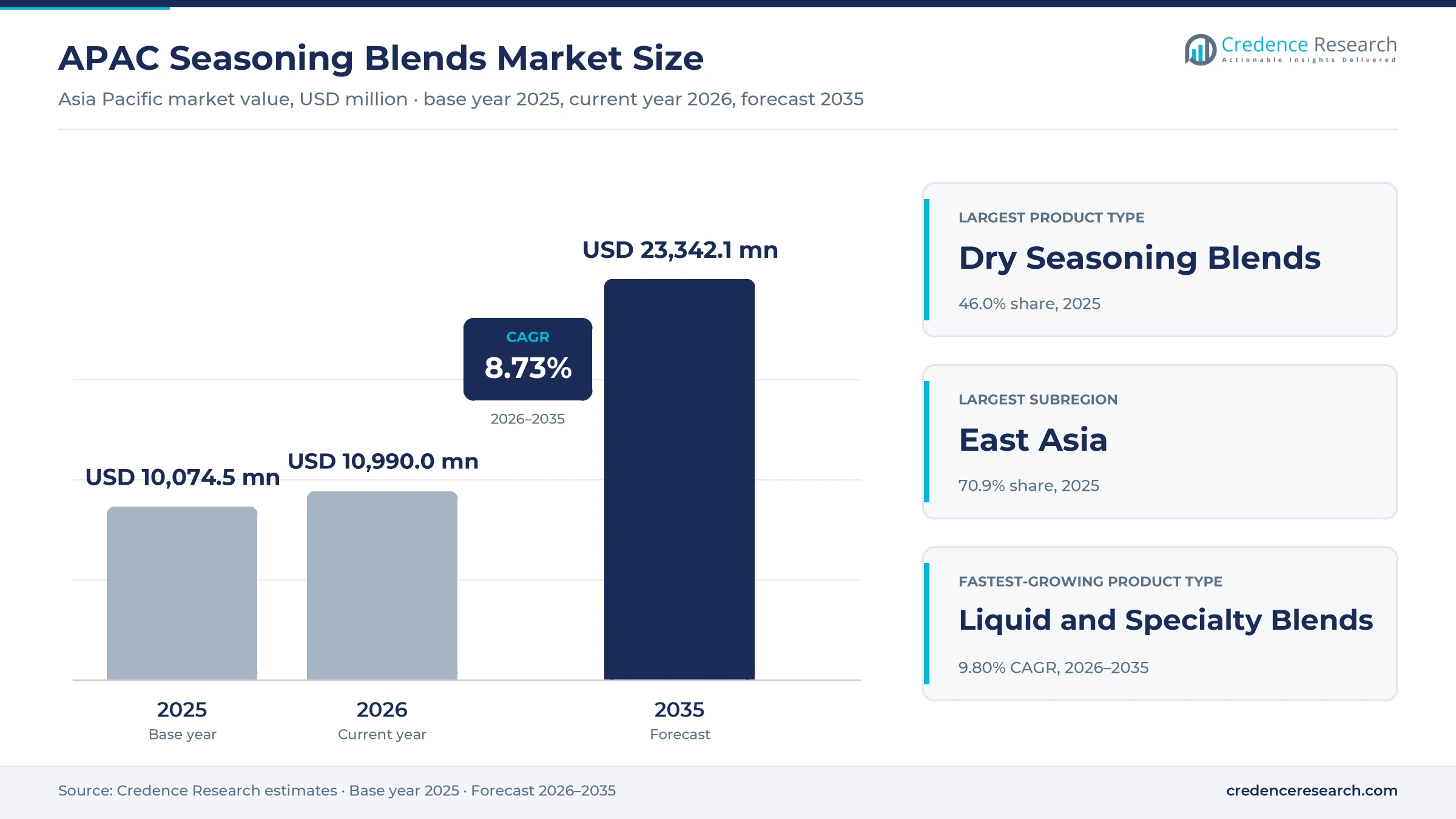
The APAC seasoning blends market was valued at USD 10.07 billion in 2025 and is projected to increase from USD 10.99 billion in 2026 to USD 23.34 billion by 2035, registering a CAGR of 8.73% during 2026–2035. Demand comes from households that cook rice, noodle, curry and soup dishes every day, restaurant chains that need the same taste in every outlet and food manufacturers that coat snacks and ready meals. East Asia held the largest share, 70.9% in 2025, because China, Japan and South Korea combine large populations with dense modern retail and foodservice networks. South Asia is the fastest-growing subregion at 10.33% a year, as packaged masala and curry blends reach more urban households. Digital grocery is the main commercial change, because online sales of physical goods made up 26.1% of China's retail sales of consumer goods in 2025. Leading makers are also adding capacity, and Ajinomoto Philippines plans a new seasoning factory in Tarlac that should start operations by April 2028.
Which premixed flavor products does the regional estimate cover?
The estimate measures spending on premixed seasoning products sold across East Asia, South Asia, Southeast Asia and Oceania. It covers dry seasoning blends, paste seasoning blends, bouillon and stock blends, and liquid and specialty blends. Values are measured at manufacturer selling prices for products bought by households, foodservice operators and food manufacturers through modern retail, traditional retail, foodservice supply and industrial supply channels.
The estimate excludes single whole or ground spices, table salt, soy sauce and other standalone sauces sold for direct use. The value chain runs from growers and ingredient suppliers through blenders, flavor houses and contract formulators to brand owners, retailer private labels and distributors that place packs in stores, online platforms, restaurant kitchens and factories.
APAC Seasoning Blends Market Insights
- The APAC seasoning blends market was valued at USD 10.07 billion in 2025 and is projected to reach USD 23.34 billion by 2035, registering a CAGR of 8.73% during 2026–2035.
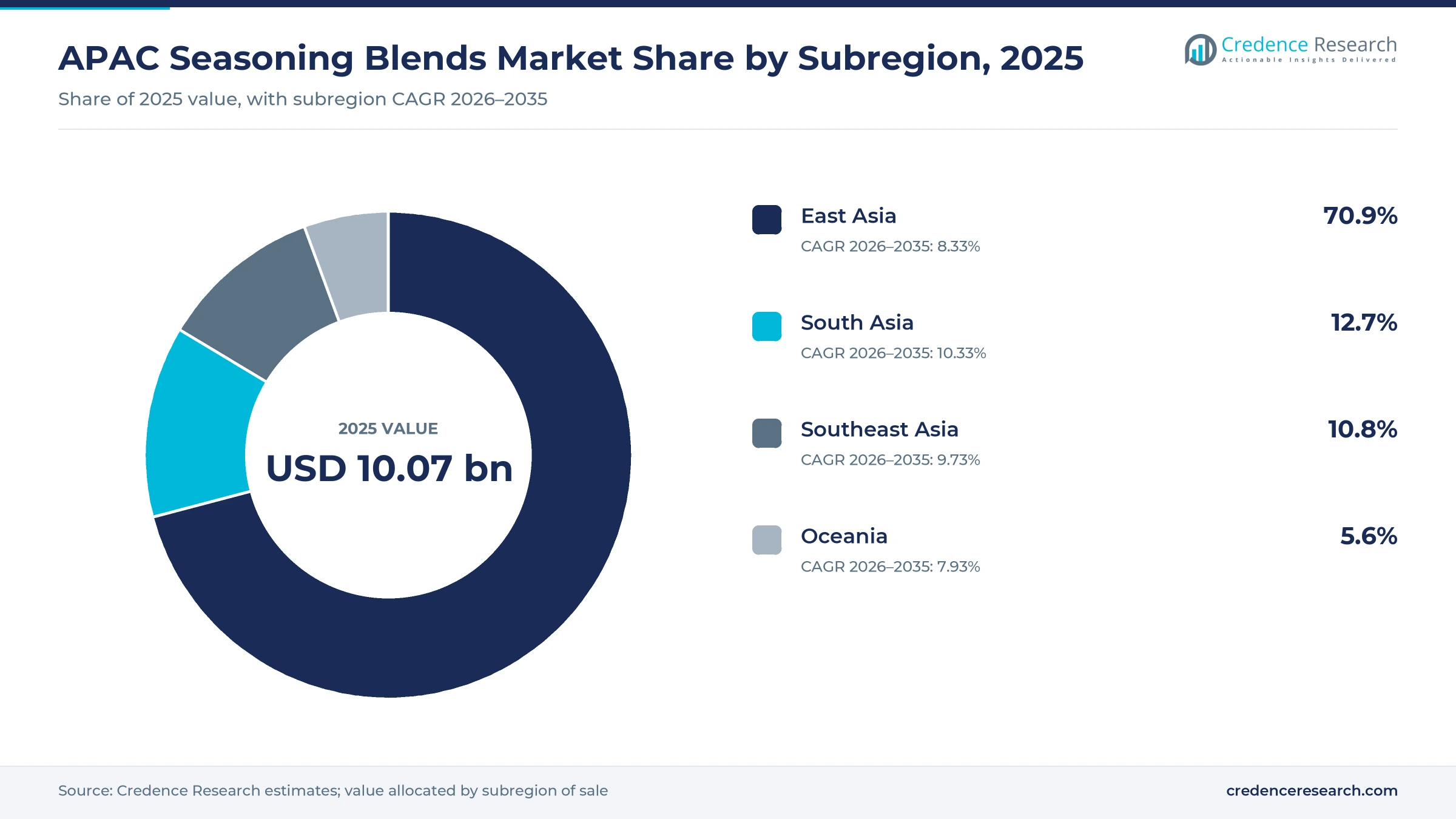
- East Asia held a 70.9% share of 2025 regional value, because China, Japan and South Korea have the largest packaged food and foodservice networks in the region.
- Dry seasoning blends led product demand with a 46.0% share of 2025 value, because powdered mixes are cheap to ship, store well and suit small sachets.
- The chain rate of Chinese catering rose to 23% in 2024 from 19% in 2021, which increases demand for blends that keep recipes consistent across outlets.
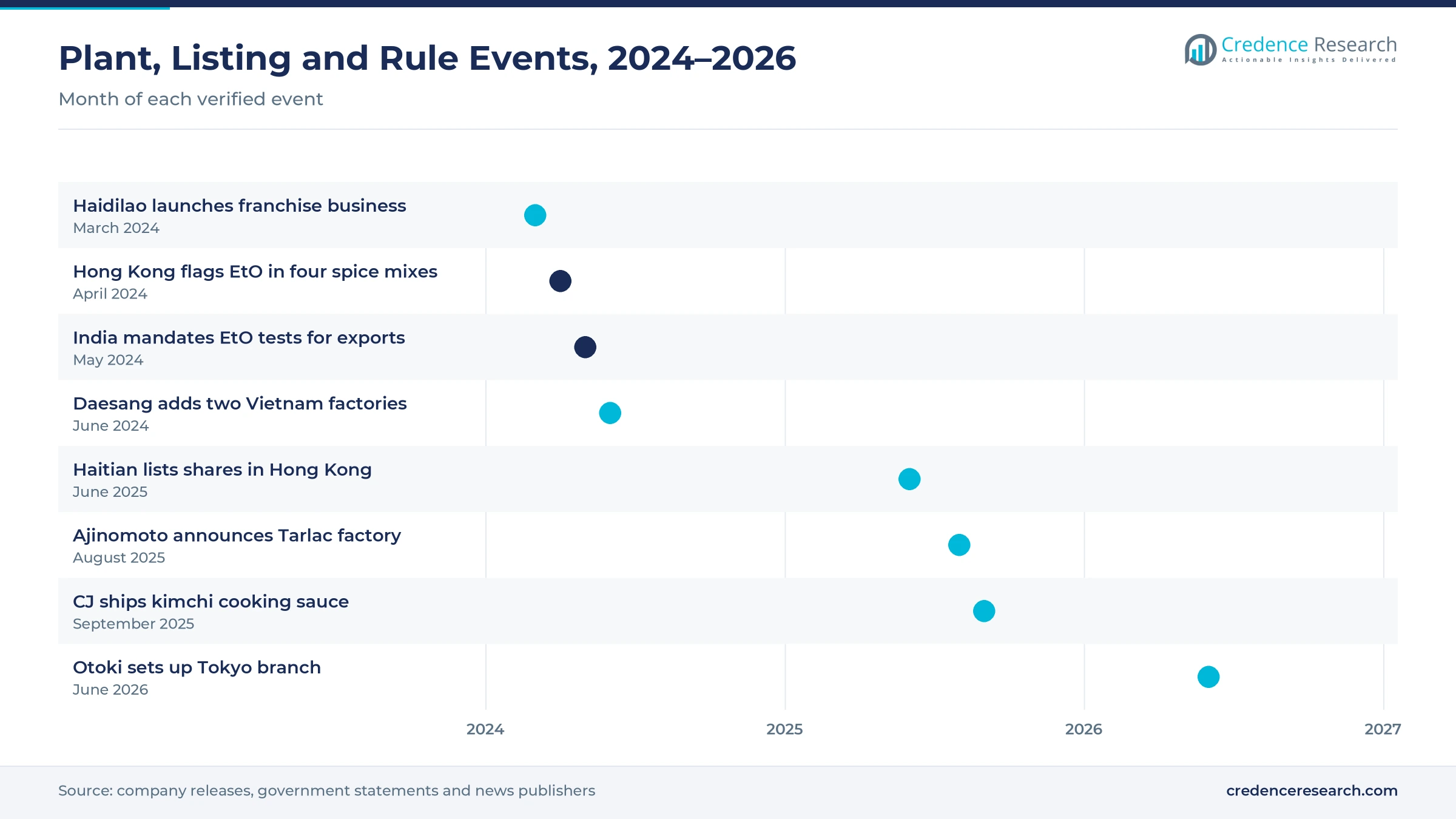
- Ajinomoto Philippines announced a factory worth about PHP 9.1 billion in Tarlac in August 2025, with operations expected to start by April 2028.
Dry blends lead while liquid formats grow fastest
Why do dry blends keep the largest share?
Based on product type, the market is categorized into dry seasoning blends, paste seasoning blends, bouillon and stock blends, and liquid and specialty blends. Dry Seasoning Blends led with a 46.0% share of 2025 value, because powders cost little to ship and keep well in humid climates. Liquid and Specialty Blends grow fastest at 9.80% a year, as cooking sauces and fermented bases gain shelf space in modern stores.
Which cooking uses drive the most blend demand?
Based on application, the market is categorized into meal preparation, protein seasoning, soups and broths, and snack and convenience-food flavoring. Meal Preparation led with a 44.0% share of 2025 value, because daily rice, noodle and curry dishes use blends at nearly every meal. Snack and Convenience-Food Flavoring grows fastest at 9.61% a year, as packaged snack and ready-meal makers add regional flavors.
How fast is foodservice demand rising?
Based on end user, the market is categorized into households, foodservice operators and food manufacturers. Households led with a 55.0% share of 2025 value, because home cooking still accounts for most meals across the region. Foodservice Operators grow fastest at 9.47% a year, as chain restaurants buy premixed bases that keep recipes consistent across outlets.
Which channels place blends in front of buyers?
Based on distribution channel, the market is categorized into modern retail, traditional retail, foodservice supply and industrial supply. Modern Retail led with a 38.0% share of 2025 value, because supermarkets and online grocers carry the widest branded ranges. Foodservice Supply grows fastest at 9.40% a year, as restaurant chains sign direct supply contracts with blend makers.
| Segment Group | Leading Sub-segment | Share, 2025 | Fastest-growing Sub-segment | CAGR, 2026–2035 |
|---|---|---|---|---|
| By Product Type | Dry Seasoning Blends | 46.0% | Liquid and Specialty Blends | 9.80% |
| By Application | Meal Preparation | 44.0% | Snack and Convenience-Food Flavoring | 9.61% |
| By End User | Households | 55.0% | Foodservice Operators | 9.47% |
| By Distribution Channel | Modern Retail | 38.0% | Foodservice Supply | 9.40% |
Request a Free Sample
Fill in your details and we'll send you a free sample report.
- Sample data tables & charts
- Research methodology
Online grocery, chain kitchens and local recipes lift sales
Digital grocery reach widens access to packaged blends
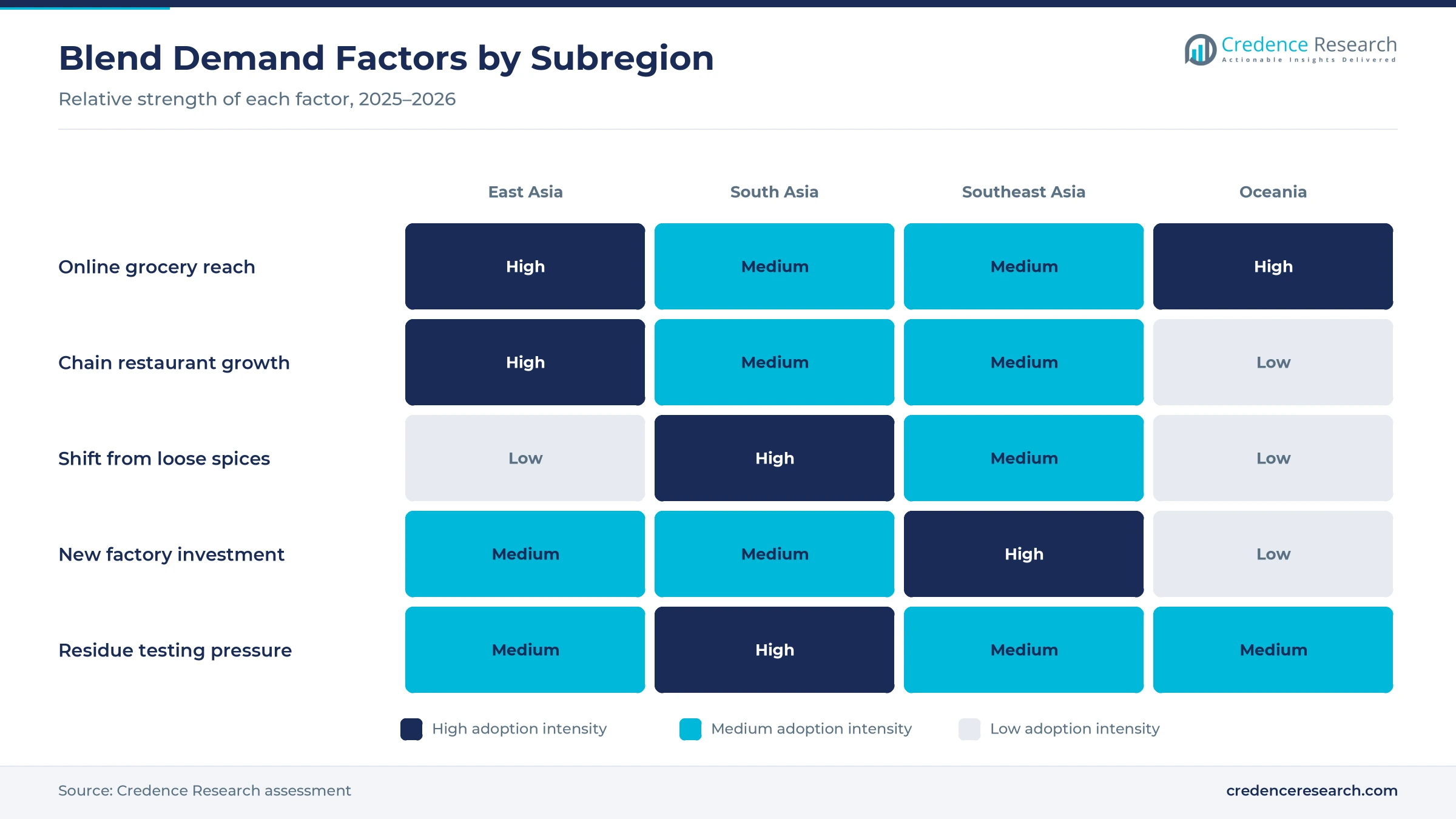
Digital grocery channels put branded blends in front of shoppers who once relied on a nearby market stall, which widens the reach of packaged formats. China's online retail sales of physical goods reached 13,092.3 billion yuan in 2025, or 26.1% of total retail sales of consumer goods, according to the National Bureau of Statistics of China. In India, Blinkit ended the December 2025 quarter with 2,027 dark stores after adding 211 in three months, YourStory reported. In New Zealand, e-commerce reached 14.8% of sales at the Woolworths food business in the quarter to April 2025, Retail Insight Network reported. As a result, modern retail leads distribution with 38.0% of 2025 value, because online grocers stock the full branded range.
Chain kitchens standardize recipes with premixed bases
Restaurant chains standardize recipes across hundreds of outlets, and premixed bases let them keep the same taste without skilled cooks in every kitchen. China's catering industry income reached 5,798.2 billion yuan in 2025, up 3.2% from 2024, the statistics bureau reported. The chain rate of Chinese catering rose to 23% in 2024 from 19% in 2021, China Daily reported from a white paper by the China Chain Store & Franchise Association and Meituan. That report named standardization and supply chain capability as core drivers of lower risk for chain brands. CJ CheilJedang began shipping an all-purpose kimchi cooking sauce for restaurants, caterers and hotels in September 2025, with an 18-month room-temperature shelf life, the company said. Consequently, foodservice operators grow fastest among end users at 9.47% a year.
Local-recipe convenience formats suit smaller households
Makers adapt blends to local dishes and smaller households, which turns long home recipes into single-step packs. CJ CheilJedang launched Baeksul Broth 1-Minute Ring, a coin-style broth seasoning that dissolves in boiling water within one minute, in December 2023, and cumulative sales reached about 10 million packs by September 2025, Asia Economy reported. Japan's National Institute of Population and Social Security Research projects that single-person households will rise from about 38% of all households in 2020 to 44.3% by 2050, The Star reported. Unilever Philippines said in July 2024 that it is studying liquid cooking sauces and mini-meal products for Knorr, which its Cavite plant can make, BusinessWorld reported. As a result, liquid and specialty blends grow fastest among product types at 9.80% a year.
Seasoning makers add plants and capital near demand
Leading makers are adding plants and capital close to fast-growing demand, which shortens supply lines for blends sold in small sachets. Ajinomoto Philippines announced a factory worth about PHP 9.1 billion at TARI Estate in Tarlac in August 2025 to make flavored seasonings, cooking sauces and breading mixes such as AJI-GINISA and Crispy Fry, the company stated. Foshan Haitian Flavouring & Food raised about HK$10.1 billion through its Hong Kong listing in June 2025 to develop products, expand capacity and strengthen its overseas supply chain, China Daily Hong Kong reported. Daesang completed second factories in Hai Duong and Hung Yen in Vietnam in June 2024 with a 30 billion won investment. Therefore, Southeast Asia grows at 9.73% a year, faster than the regional average.
Residue testing and Korean formats reshape the category
Rise of residue testing for curry and masala blends
Food regulators are raising testing standards for packaged spice blends, and that shift raises compliance costs for exporters and domestic brands alike. Hong Kong's Centre for Food Safety flagged ethylene oxide in three MDH curry and masala blends and in Everest Fish Curry Masala on April 5, 2024, Business Today reported. The Singapore Food Agency also recalled Everest Fish Curry Masala because ethylene oxide exceeded permitted levels. India then made ethylene oxide testing mandatory for Indian spice shipments to Singapore and Hong Kong from May 6, 2024, while the Food Safety and Standards Authority of India ordered sampling at spice plants nationwide, BW Businessworld reported. As a result, makers of dry blends now budget for residue tests on every export lot and tighten checks on raw spice suppliers.
Korean flavor formats emerge across regional markets
Korean seasoning formats are emerging across Asia Pacific, because Korean food makers now sell broths, sauces and pastes beyond their home market. Otoki, formerly Ottogi, set up a Tokyo branch in June 2026, with operations planned from September, as its fourth overseas operation after New Zealand, the United States and Vietnam, Korea JoongAng Daily reported. Otoki plans to focus on ramyeon, Korean sauces and sesame oil in Japan. CJ CheilJedang exports Baeksul Broth 1-Minute Ring to 11 countries and plans to enter the mainstream Japanese market, Asia Economy reported. Its kimchi cooking sauce reached Japan and Guam among 12 countries in 2025. Consequently, Korean pastes and liquid bases gain shelf space beside Asian sauces and condiments in Japanese and Southeast Asian stores.
Opening in less urbanized South and Southeast Asia
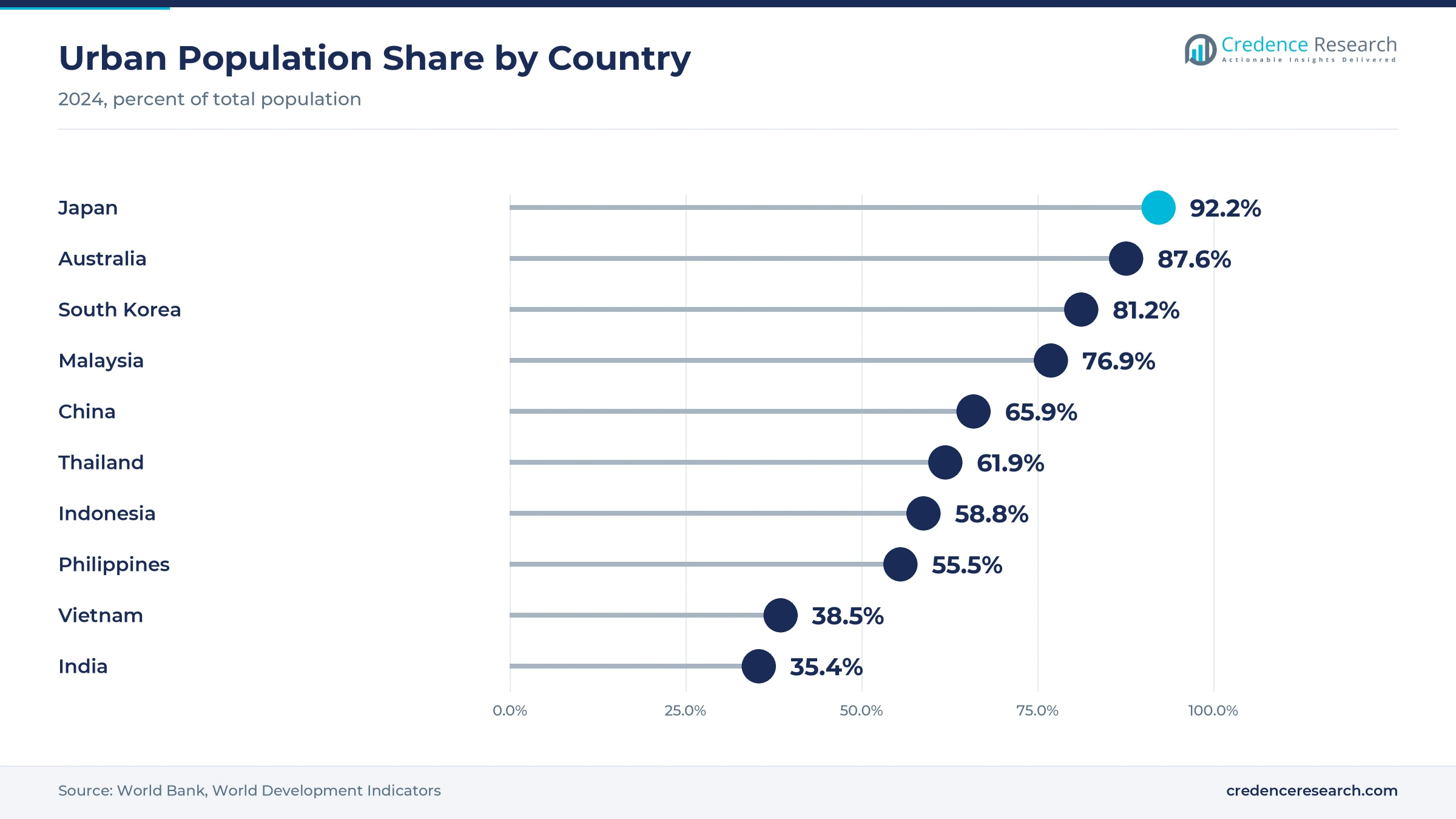
Less urbanized countries offer the largest opening, because packaged blends gain users as households move to cities and cook in smaller kitchens. Only 35.4% of India's population and 38.5% of Vietnam's lived in urban areas in 2024, compared with 92.2% in Japan, according to the World Bank. India's population reached about 1.45 billion in 2024 and Indonesia's about 283.5 million, so even small shifts toward packaged blends add large volumes. Blinkit plans to reach 3,000 dark stores in India by March 2027, YourStory reported, which brings branded packs to more urban neighborhoods. As a result, South Asia grows fastest among the four subregions, ahead of the regional average through 2035.
Opening in chain-restaurant supply contracts in China
China's chain restaurants open a supply opportunity for blend makers that can deliver consistent pastes and powders at scale. The 2025 Top 100 China Catering Franchise Brands list covered 295,000 brands, up 26.2% from 2024, while chain brands with 500 to 1,000 stores grew 93.6%, China Daily reported. Haidilao launched a franchise business in March 2024, which adds outlets that cook to a common menu. McCormick said in January 2025 that food-away-from-home demand in Asia Pacific was still slow, although it expected a slight and gradual recovery in China, Just Food reported. Because chains buy centrally, a single contract can supply hundreds of kitchens. Therefore, foodservice supply grows fastest among channels at 9.40% a year.
Recalls, soft Chinese demand and costs test suppliers
Contamination recalls damage trust in spice-mix brands
Residue findings in exported curry and masala blends showed how one failed test can damage a brand across several markets at once. Because recalls are public, shoppers may switch to rival brands or loose spices even when other products pass. Exporters then pay for extra testing, hold shipments and rework supplier checks. Makers respond with steam sterilization instead of fumigation, batch-level test reports and closer control of raw spice sourcing.
Uneven Chinese consumer demand weighs on volumes
Chinese consumer demand has been uneven, and that matters because East Asia carries most regional value. McCormick said in January 2025 that its Asia Pacific results were affected by China, where the environment remained challenged. As a result, suppliers face slower premium sales and heavier promotion in supermarkets. Makers respond by shifting effort toward chain restaurants, value packs and online channels, where volumes have held up better.
Fragmented traditional retail raises distribution costs
Traditional retail across South and Southeast Asia runs through millions of small shops, so reaching them requires many distributors and frequent small deliveries. Consequently, brand owners carry high selling costs and limited control over shelf placement and stock rotation. Small sachets help reach these shops, although they lower revenue per delivery. Makers respond with distributor apps, van sales routes and wholesale platforms that consolidate orders from small stores.
Raw spice and packaging costs squeeze margins
Blend makers buy chilies, garlic, pepper, turmeric and other crops whose prices move with harvests and weather, while sachet film and cartons follow oil and pulp prices. As a result, margins narrow when input costs rise faster than shelf prices can adjust. Economy brands feel this most, because shoppers resist price increases on small packs. Makers respond with forward buying, recipe changes and smaller pack sizes at the same price point.
East Asia leads while South Asia grows fastest
| Subregion | Value, 2025 (USD billion) | Share, 2025 | CAGR, 2026–2035 |
|---|---|---|---|
| East Asia | 7.14 | 70.9% | 8.33% |
| South Asia | 1.28 | 12.7% | 10.33% |
| Southeast Asia | 1.09 | 10.8% | 9.73% |
| Oceania | 0.56 | 5.6% | 7.93% |
East Asia anchors regional value through China
East Asia held 70.9% of 2025 value and grows at 8.33% a year, slightly below the regional pace, because its markets are already large. China combines online sales of physical goods worth 13,092.3 billion yuan in 2025 with catering income of 5,798.2 billion yuan. Japan and South Korea add mature demand, with 92.2% and 81.2% of their populations living in cities in 2024. CJ CheilJedang, Otoki and Daesang compete with Ajinomoto and Foshan Haitian Flavouring & Food for shelf and kitchen space.
South Asia grows fastest on packaged masala
South Asia held 12.7% of 2025 value and grows at 10.33% a year, the fastest pace in the region, because packaged masala and curry blends are still replacing home-ground spices. India had about 1.45 billion people in 2024, but only 35.4% lived in urban areas, which leaves a long runway for packaged formats. MDH and Everest lead branded spice mixes, while quick-commerce networks such as Blinkit carry branded packs into more neighborhoods every quarter.
Southeast Asia draws new seasoning factories
Southeast Asia held 10.8% of 2025 value and grows at 9.73% a year, above the regional pace, because manufacturers are building capacity close to buyers. Ajinomoto Philippines plans a new factory in Tarlac for operations by April 2028, while Daesang added two factories in northern Vietnam in 2024. In the Philippines, Knorr sells beef, shrimp, pork and chicken bouillon cubes alongside liquid seasonings, the Inquirer reported. Urban shares of only 58.8% in Indonesia and 55.5% in the Philippines in 2024 leave room for packaged formats to reach new city households.
Oceania relies on mature, high-income households
Oceania held 5.6% of 2025 value and grows at 7.93% a year, the slowest pace in the region, because Australia and New Zealand are already highly urban and well supplied. Australia had 87.6% of its population in urban areas in 2024. Online grocery is the main channel shift, and e-commerce reached 14.8% of sales at the Woolworths food business in New Zealand in early 2025. Otoki already runs an operation in New Zealand, which brings Korean sauces and seasonings to local shelves.
New plants, listings and foodservice launches
| Development | Status and market relevance |
|---|---|
| In June 2026, Otoki set up a Tokyo branch, planned to start operations in September, as its fourth overseas operation. | Brings Korean sauces and seasonings into mainstream Japanese retail |
| In September 2025, CJ CheilJedang began distributing an all-purpose kimchi cooking sauce to foodservice buyers in 12 countries. | Gives restaurants a shelf-stable base that keeps flavor consistent |
| In August 2025, Ajinomoto Philippines announced a factory worth about PHP 9.1 billion in Tarlac for seasonings and cooking sauces. | Adds Southeast Asian capacity, with operations expected by April 2028 |
| In June 2025, Foshan Haitian Flavouring & Food listed shares in Hong Kong to fund products, capacity and its overseas supply chain. | Strengthens the export reach of a leading Chinese flavor maker |
| In May 2024, India made ethylene oxide testing mandatory for spice exports to Singapore and Hong Kong. | Raises compliance standards for exported curry and masala blends |
Fast-dissolving broths and shelf-stable ferments
- Compressed broth tablets dissolve fully in boiling water within about a minute, which suits busy households that cook soups and stews in small batches.
- Shelf-stable fermentation lets makers sell kimchi and other fermented bases at room temperature, as CJ CheilJedang does with an 18-month shelf life for restaurant buyers.
- Residue testing for ethylene oxide checks each export lot of spice blends against destination limits, which has become mandatory for Indian shipments to Singapore and Hong Kong.
- Centrally made recipe bases give chain restaurants measured pastes and powders, which cut preparation time and keep taste consistent between outlets.
Need a Custom Version of This Report?
Tailor the scope, geography, or segments to your exact requirements.
- Custom geography or segment scope
- Direct access to our analyst team
Regional flavor houses and global brands compete
Competition splits between regional flavor houses with deep local brands and global food groups with wide portfolios. Ajinomoto sells umami seasoning, a leading flavor enhancer, alongside seasoning mixes such as AJI-GINISA in the Philippines. Foshan Haitian Flavouring & Food listed in Hong Kong in 2025 to strengthen its overseas supply chain. CJ CheilJedang, Otoki and Daesang bring Korean broths, sauces and pastes to Japan, Vietnam and other markets. Unilever sells Knorr bouillon cubes and liquid seasonings in the Philippines, while McCormick serves consumer and foodservice buyers in China. MDH and Everest lead branded masala blends sold across India and export markets. Buyers weigh taste, price per sachet, distribution reach and safety testing when they choose a brand.
Companies profiled and their roles in this market
| Company | Type | Role in the market |
|---|---|---|
| Ajinomoto Co., Inc. | Seasoning and flavor maker | Umami seasoning and AJI-GINISA mixes; new Tarlac factory planned in the Philippines |
| Foshan Haitian Flavouring & Food Co., Ltd. | Condiment and seasoning maker | Chinese condiment leader that listed in Hong Kong in June 2025 |
| CJ CheilJedang Corporation | Food and seasoning maker | Baeksul broth tablets and a kimchi cooking sauce for foodservice |
| Ottogi Corporation | Food and seasoning maker | Trades as Otoki; operations in New Zealand, Vietnam and a new Tokyo branch |
| Daesang Corporation | Food and seasoning maker | Two factories added in northern Vietnam in 2024 |
| Unilever PLC | Consumer goods group | Knorr bouillon cubes and liquid seasonings in the Philippines |
| McCormick & Company, Incorporated | Spice and flavor maker | Consumer and food-away-from-home business in China |
| MDH Spices | Spice blend maker | Branded curry and masala blends from India |
| Everest Spices | Spice blend maker | Branded masala blends, including Fish Curry Masala, from India |
Credence Research view on regional flavor premixes
Credence Research's view is that regional demand is moving from loose spices and home recipes toward premixed blends that save time and keep taste consistent. East Asia stays the value base, although its growth is slightly below the regional pace. South Asia will grow fastest, because packaged masala still has room to replace home grinding as cities expand. Foodservice is the strongest growth channel, as chains buy centrally made bases. Suppliers that combine local recipes, verified residue testing and reach into online grocery should gain share through 2035.
How the regional blend estimate was built
The report uses 2025 as the base year and forecasts values to 2035 in USD billion from the Credence Research market model. Subregion, product type, application, end user and distribution channel splits are Credence Research estimates based on population and urbanization data, retail and catering statistics, company product and plant information and trade press. Sources include the World Bank, the National Bureau of Statistics of China, company releases and news publishers. No interviews or surveys were conducted for this edition of the regional report.
Digital retail and foodservice carry growth to 2035
The APAC seasoning blends market is projected to grow from USD 10.99 billion in 2026 to USD 23.34 billion by 2035, an 8.73% CAGR during 2026–2035, as online grocery, chain restaurants and local convenience formats keep demand rising. Growth should be strongest in South Asia while packaged masala replaces home-ground spices in growing cities. Later in the period, liquid and fermented bases should take more value from dry powders in modern stores. Faster recovery in Chinese consumer spending would raise this outlook, while further contamination recalls or sharp crop price swings would lower it.
Frequently Asked Questions
How big is the APAC seasoning blends market?
Which product type leads regional demand?
Which subregion leads the market?
Why is foodservice demand growing quickly?
How does online grocery affect the market?
How did the 2024 spice recalls affect blend makers?
Who are the leading companies in the region?
What are the main challenges for blend makers?
Table of Content
Chapter 1 Market Segmentation
- 1.1 Segmentation Framework
- 1.1.1 Product and Service Classification
- 1.1.2 Application and End-Use Classification
- 1.1.3 Technology and Solution Classification
- 1.1.4 Customer and Distribution Channel Classification
- 1.1.5 Geographic Segmentation
- 1.1.6 Market Segment Definitions and Boundaries
- 1.2 By Product Type
- 1.2.1 Dry Seasoning Blends
- 1.2.2 Paste Seasoning Blends
- 1.2.3 Bouillon and Stock Blends
- 1.2.4 Liquid and Specialty Blends
- 1.3 By Application
- 1.3.1 Meal Preparation
- 1.3.2 Protein Seasoning
- 1.3.3 Soups and Broths
- 1.3.4 Snack and Convenience-Food Flavoring
- 1.4 By End User
- 1.4.1 Households
- 1.4.2 Foodservice Operators
- 1.4.3 Food Manufacturers
- 1.5 By Subregion
- 1.5.1 East Asia
- 1.5.2 South Asia
- 1.5.3 Southeast Asia
- 1.5.4 Oceania
Chapter 2 Introduction
- 2.1 Report Objectives and Scope
- 2.2 Product Definition and Industry Terminology
- 2.3 Market Inclusions and Exclusions
- 2.4 Research Process
- 2.4.1 Primary Research and Expert Interviews
- 2.4.2 Secondary Research and Source Review
- 2.4.3 Top-Down and Bottom-Up Estimation
- 2.4.4 Data Triangulation and Verification
- 2.5 Market Size Measurement Basis
- 2.5.1 2025: USD 10.07 billion → 2035: USD 23.34 billion
- 2.6 Historical and Forecast Reference Periods
- 2.6.1 Historical Period: 2018-2025
- 2.6.2 Base Year: 2025
- 2.6.3 Forecast Period: 2025-2035
- 2.7 Research Assumptions and Limitations
Chapter 3 Executive Summary
- 3.1 Market Snapshot and Key Findings
- 3.2 Base-Year Market Size, 2025
- 3.3 Forecast Market Size, 2035
- 3.4 Revenue and Volume Growth Outlook
- 3.5 Key Demand and Supply Indicators
- 3.6 Leading Market Segments
- 3.7 Fastest-Growing Market Opportunities
- 3.8 Regional Performance Highlights
- 3.9 Technology and Industry Transformation
- 3.10 Competitive Landscape Summary
- 3.11 Analyst View and Strategic Implications
Chapter 4 APAC Seasoning Blends Market Trends and Developments
- 4.1 Historical Industry Development, 2018-2025
- 4.2 Recent Market Trends and Developments
- 4.3 Demand and Customer Behavior Trends
- 4.4 Technology and Product Innovation
- 4.5 Artificial Intelligence, Automation and Digitalization
- 4.6 Local Manufacturing and Supply Chain Realignment
- 4.7 Industry Partnerships, Mergers and Acquisitions
- 4.8 Sustainability and Circular Economy Developments
- 4.9 Government and Private Sector Investment Trends
- 4.10 Emerging Business Models and Commercialization
- 4.11 Industry Developments and Announcements
Chapter 5 APAC Seasoning Blends Market Production, Supply and Demand Analysis
- 5.1 Demand Trend and Consumption Analysis, 2018-2025
- 5.2 Demand Forecast, 2025-2035
- 5.3 Production and Output Trend, 2018-2025
- 5.4 Production and Output Forecast, 2025-2035
- 5.5 Installed Capacity and Capacity Utilization
- 5.6 Company-Wise Production Plants and Statistics
- 5.6.1 Installed Production Capacity
- 5.6.2 Actual Production
- 5.6.3 Planned Capacity and Expansion Targets
- 5.7 Supply Chain Structure and Procurement Trends
- 5.8 Supply-Demand Gap and Bottlenecks
- 5.9 Import Dependence and Sourcing Structure
- 5.10 Contract Manufacturing and Outsourcing
- 5.11 Regional Supply and Demand Concentration
Chapter 6 APAC Seasoning Blends Market Pricing Analysis
- 6.1 Pricing Structure and Measurement
- 6.2 Historical Pricing Trends, 2018-2025
- 6.3 Pricing Outlook, 2025-2035
- 6.4 Average Selling Price and Unit Economics
- 6.5 Pricing by Product and Market Segment
- 6.6 Geographic Pricing Differences
- 6.7 Key Input, Energy, Labor and Logistics Costs
- 6.8 Contract Pricing and Purchasing Models
- 6.9 Pricing Sensitivity and Competitive Positioning
- 6.10 Price, Margin and Profitability Implications
Chapter 7 APAC Seasoning Blends Market Dynamics
- 7.1 Market Growth Drivers
- 7.1.1 Demand-Side Drivers
- 7.1.2 Technology and Innovation Drivers
- 7.1.3 Infrastructure and Investment Drivers
- 7.1.4 Regulatory and Policy Drivers
- 7.2 Market Restraints
- 7.2.1 Cost and Affordability Constraints
- 7.2.2 Technology and Adoption Barriers
- 7.2.3 Supply Chain and Operational Constraints
- 7.3 Market Challenges
- 7.3.1 Competitive Pressure and Margin Erosion
- 7.3.2 Skills, Infrastructure and Implementation Gaps
- 7.4 Emerging Market Opportunities
- 7.5 Market Dynamics Impact and Time-Horizon Assessment
Chapter 8 APAC Seasoning Blends Value Chain Analysis
- 8.1 Industry Value Chain Overview
- 8.2 Upstream Suppliers and Critical Inputs
- 8.3 Technology and Component Providers
- 8.4 Manufacturing or Service Delivery
- 8.5 Distribution, Channel Partners and Integrators
- 8.6 Downstream Applications and End Users
- 8.7 Value Addition and Profit Pools
- 8.8 Vertical Integration and Outsourcing
- 8.9 Supplier Concentration and Risk
- 8.10 Supply Chain Localization and Resilience
Chapter 9 APAC Seasoning Blends Market Regulations and Policies
- 9.1 Relevant Laws, Standards and Compliance Frameworks
- 9.2 Product, Service, Safety and Quality Requirements
- 9.3 Government Policies, Incentives and Subsidies
- 9.4 Imports, Exports and Trade Barriers
- 9.5 Public Procurement and Local Content Requirements
- 9.6 Environmental and Sustainability Compliance
- 9.7 Upcoming Policy Changes and Market Implications
Chapter 10 APAC Seasoning Blends Market Hotspots and Opportunities
- 10.1 Market Opportunity Mapping and Growth Hotspots
- 10.2 High-Growth Applications and Customer Groups
- 10.3 Underserved Markets and White-Space Opportunities
- 10.4 Emerging Technology and Product Opportunities
- 10.5 New Capacity and Investment Hotspots
- 10.6 Market Entry and Expansion Opportunities
- 10.7 Distribution and Partnership Opportunities
- 10.8 Near-Term and Long-Term Commercial Potential
- 10.9 Opportunity Attractiveness and Execution Risks
Chapter 11 APAC Seasoning Blends Market Outlook, 2025-2035
- 11.1 Market Size and Analysis
- 11.1.1 Revenue (Market Measurement: 2025: USD 10.07 billion → 2035: USD 23.34 billion)
- 11.1.2 Market Volume and Quantity Sold
- 11.1.3 Historical Market Size, 2018-2025
- 11.1.4 Base-Year Market Size, 2025
- 11.2 Market Forecast, 2025-2035
- 11.2.1 Revenue Forecast to 2035
- 11.2.2 Volume Forecast to 2035
- 11.2.3 CAGR and Year-on-Year Growth
- 11.2.4 Incremental Revenue Opportunity
- 11.3 Forecast Assumptions and Scenario Analysis
- 11.3.1 Base-Case Forecast
- 11.3.2 Optimistic and Conservative Scenarios
- 11.3.3 Technology, Pricing and Policy Sensitivities
- 11.4 Market Attractiveness and Growth Outlook
Chapter 12 APAC Seasoning Blends Market Segmentation and Outlook
- 12.1 Segmentation Summary and Market Shares, 2025
- 12.2 Largest and Fastest-Growing Segments
- 12.3 By Product Type - Market Size and Forecast, 2025-2035
- 12.3.1 Segment Definition and Scope
- 12.3.2 Historical Market Size, 2018-2025
- 12.3.3 Revenue Forecast, 2025-2035
- 12.3.4 Volume Forecast, 2025-2035
- 12.3.5 Base-Year Market Share, 2025
- 12.3.6 Segment CAGR and Growth Drivers
- 12.3.7 Subsegment Market Size and Forecast
- 12.3.7.1 Dry Seasoning Blends
- 12.3.7.2 Paste Seasoning Blends
- 12.3.7.3 Bouillon and Stock Blends
- 12.3.7.4 Liquid and Specialty Blends
- 12.3.8 Subsegment Pricing and Adoption Trends
- 12.3.9 Leading Suppliers and Competition
- 12.3.10 Regional Demand and Opportunities
- 12.4 By Application - Market Size and Forecast, 2025-2035
- 12.4.1 Segment Definition and Scope
- 12.4.2 Historical Market Size, 2018-2025
- 12.4.3 Revenue Forecast, 2025-2035
- 12.4.4 Volume Forecast, 2025-2035
- 12.4.5 Base-Year Market Share, 2025
- 12.4.6 Segment CAGR and Growth Drivers
- 12.4.7 Subsegment Market Size and Forecast
- 12.4.7.1 Meal Preparation
- 12.4.7.2 Protein Seasoning
- 12.4.7.3 Soups and Broths
- 12.4.7.4 Snack and Convenience-Food Flavoring
- 12.4.8 Subsegment Pricing and Adoption Trends
- 12.4.9 Leading Suppliers and Competition
- 12.4.10 Regional Demand and Opportunities
- 12.5 By End User - Market Size and Forecast, 2025-2035
- 12.5.1 Segment Definition and Scope
- 12.5.2 Historical Market Size, 2018-2025
- 12.5.3 Revenue Forecast, 2025-2035
- 12.5.4 Volume Forecast, 2025-2035
- 12.5.5 Base-Year Market Share, 2025
- 12.5.6 Segment CAGR and Growth Drivers
- 12.5.7 Subsegment Market Size and Forecast
- 12.5.7.1 Households
- 12.5.7.2 Foodservice Operators
- 12.5.7.3 Food Manufacturers
- 12.5.8 Subsegment Pricing and Adoption Trends
- 12.5.9 Leading Suppliers and Competition
- 12.5.10 Regional Demand and Opportunities
- 12.6 By Subregion - Market Size and Forecast, 2025-2035
- 12.6.1 Segment Definition and Scope
- 12.6.2 Historical Market Size, 2018-2025
- 12.6.3 Revenue Forecast, 2025-2035
- 12.6.4 Volume Forecast, 2025-2035
- 12.6.5 Base-Year Market Share, 2025
- 12.6.6 Segment CAGR and Growth Drivers
- 12.6.7 Subsegment Market Size and Forecast
- 12.6.7.1 East Asia
- 12.6.7.2 South Asia
- 12.6.7.3 Southeast Asia
- 12.6.7.4 Oceania
- 12.6.8 Subsegment Pricing and Adoption Trends
- 12.6.9 Leading Suppliers and Competition
- 12.6.10 Regional Demand and Opportunities
- 12.7 Segment Growth Comparison
- 12.8 Segment Attractiveness and Priority Matrix
Chapter 13 APAC Seasoning Blends End-Use and Application Market Outlook
- 13.1 End-Use Industry and Customer Demand Structure
- 13.2 Leading Applications and Customer Groups
- 13.3 End-Use Market Size, Share and Forecast
- 13.4 Major End-Use Industry Deep Dives
- 13.4.1 Customer Requirements and Use Cases
- 13.4.2 Demand and Replacement Cycles
- 13.4.3 Technical and Regulatory Considerations
- 13.4.4 Purchasing and Procurement Models
- 13.4.5 Leading Vendors and Distribution Channels
- 13.4.6 Forecast and Commercial Opportunities
- 13.5 Emerging Applications and Cross-Segment Demand
- 13.6 End-Use Industry Investment Priorities
Chapter 14 APAC Seasoning Blends Geographic Market Outlook, 2025-2035
- 14.1 Regional Market Size and Country-Level Shares, 2025
- 14.2 Country Market Size Comparison, 2025
- 14.3 Country Market Forecasts, 2025-2035
- 14.4 Subregional Industrial and Demand Clusters
- 14.5 Intra-Regional Pricing and Cost Differences
- 14.6 Cross-Border Trade and Supply Networks
- 14.7 Regional Supply and Demand Balances
- 14.8 Country Opportunity Comparison and Prioritization
Note: Every listed country is covered on the structure shown under the first country.
Chapter 15 APAC Seasoning Blends Technology, Innovation and Sustainability Outlook
- 15.1 Technology Landscape and Maturity
- 15.2 Product, Process and Service Innovation
- 15.3 AI, Automation and Digital Tools in the Industry
- 15.4 Technology Adoption and Performance Benchmarking
- 15.5 Innovation Pipeline and R&D Investment
- 15.6 Patent and Intellectual Property Trends
- 15.7 Energy Efficiency and Resource Management
- 15.8 Sustainability, Recycling and Circularity
- 15.9 Technology Roadmap, 2025-2035
- 15.10 Risks of Obsolescence and Technology Substitution
Chapter 16 APAC Seasoning Blends Market Key Strategic Imperatives
- 16.1 Growth and Market Entry Priorities
- 16.2 High-Return Products and Segments
- 16.3 Pricing, Profitability and Cost Optimization
- 16.4 Technology Investment and Product Differentiation
- 16.5 Supply Chain Localization and Resilience
- 16.6 Distribution and Customer Acquisition
- 16.7 Partnership, Acquisition and Capacity Strategy
- 16.8 Regional Expansion Priorities
- 16.9 Short-, Medium- and Long-Term Actions
Chapter 17 Competition Outlook
- 17.1 Industry Competition Characteristics
- 17.2 Market Structure and Concentration
- 17.3 Market Share and Competitive Positioning, 2025
- 17.4 Company-Wise Revenue and Product Benchmarking
- 17.5 Production and Service Capacity Benchmarking
- 17.6 Technology, Pricing and Differentiation
- 17.7 Regional Footprint and Distribution Strength
- 17.8 Mergers, Acquisitions and Strategic Alliances
- 17.9 New Entrants and Competitive Threats
- 17.10 Porter's Five Forces and Industry Attractiveness
- 17.11 Competitive Outlook, 2025-2035
Chapter 18 Company Profiles
- 18.1 Company Coverage and Selection Criteria
- 18.2 Ajinomoto Co., Inc.
- 18.2.1 Business Description
- 18.2.2 Company Ownership and Geographic Presence
- 18.2.3 Product and Service Portfolio
- 18.2.4 Manufacturing and Operating Footprint
- 18.2.5 Production Capacity and Expansion Plans
- 18.2.6 Financial Performance and Investment
- 18.2.7 Market Share and Competitive Position
- 18.2.8 Technology and Innovation Capabilities
- 18.2.9 Strategic Alliances or Partnerships
- 18.2.10 Recent Developments
- 18.2.11 Growth Strategy and Outlook
- 18.3 Foshan Haitian Flavouring & Food Co., Ltd.
- 18.4 Unilever PLC
- 18.5 CJ CheilJedang Corporation
- 18.6 McCormick & Company, Incorporated
- 18.7 Ottogi Corporation
- 18.8 PT Indofood Sukses Makmur Tbk
- 18.9 Daesang Corporation
- 18.10 MDH Spices
- 18.11 Everest Spices
- 18.12 Other Relevant Market Participants
Note: Every listed company is profiled on the structure shown under the first company. The company list is preliminary and may change based on research findings, market developments, data availability and client requirements.
Chapter 19 Disclaimer
- 19.1 Research and Forecast Disclaimer
- 19.2 Data Source and Estimation Limitations
Note: The depth of individual sections depends on data availability for this market. Volume, capacity, trade and other unit-based metrics are included where applicable.