
Local crushing is redrawing the Vietnamese supply base
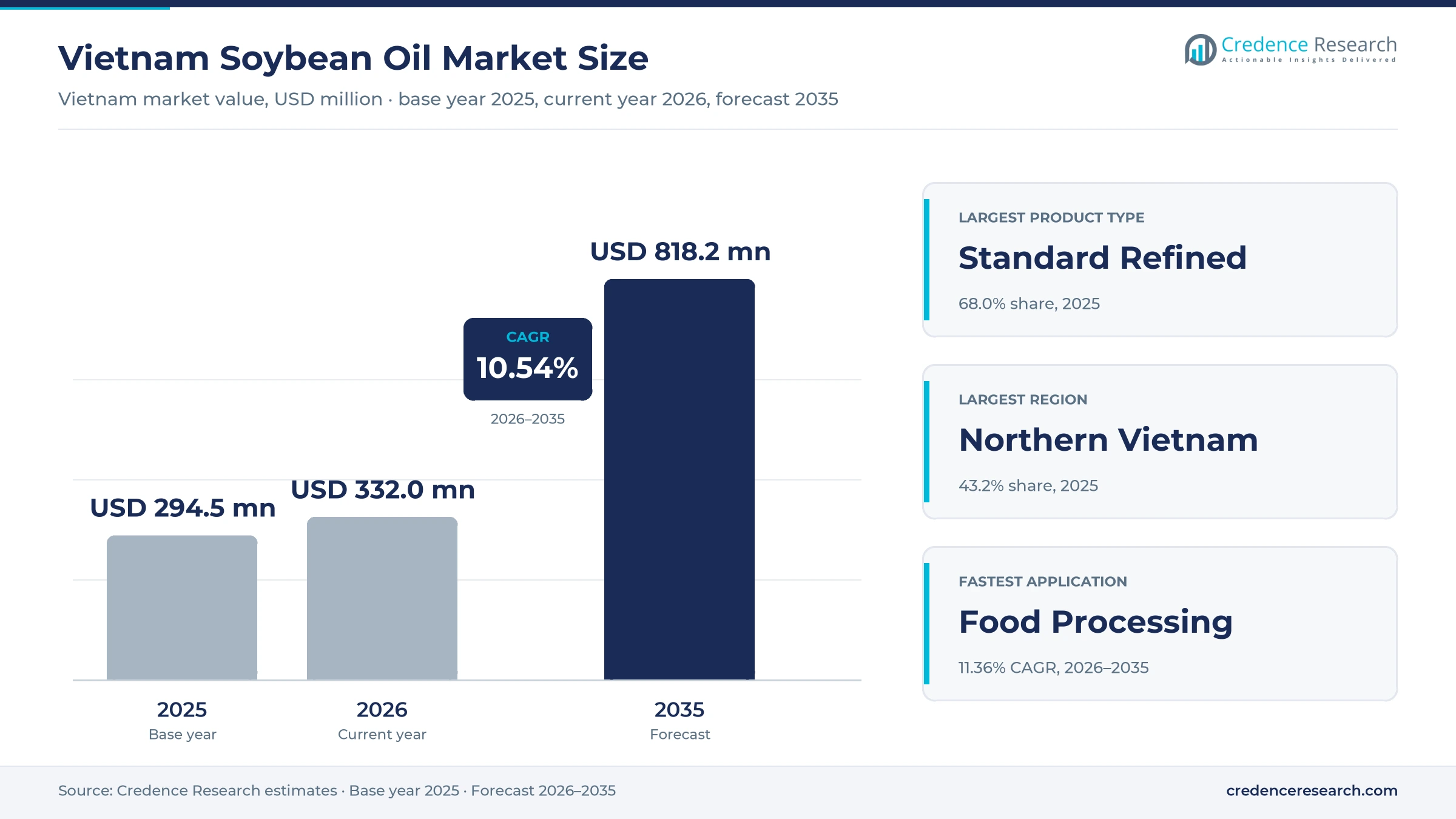
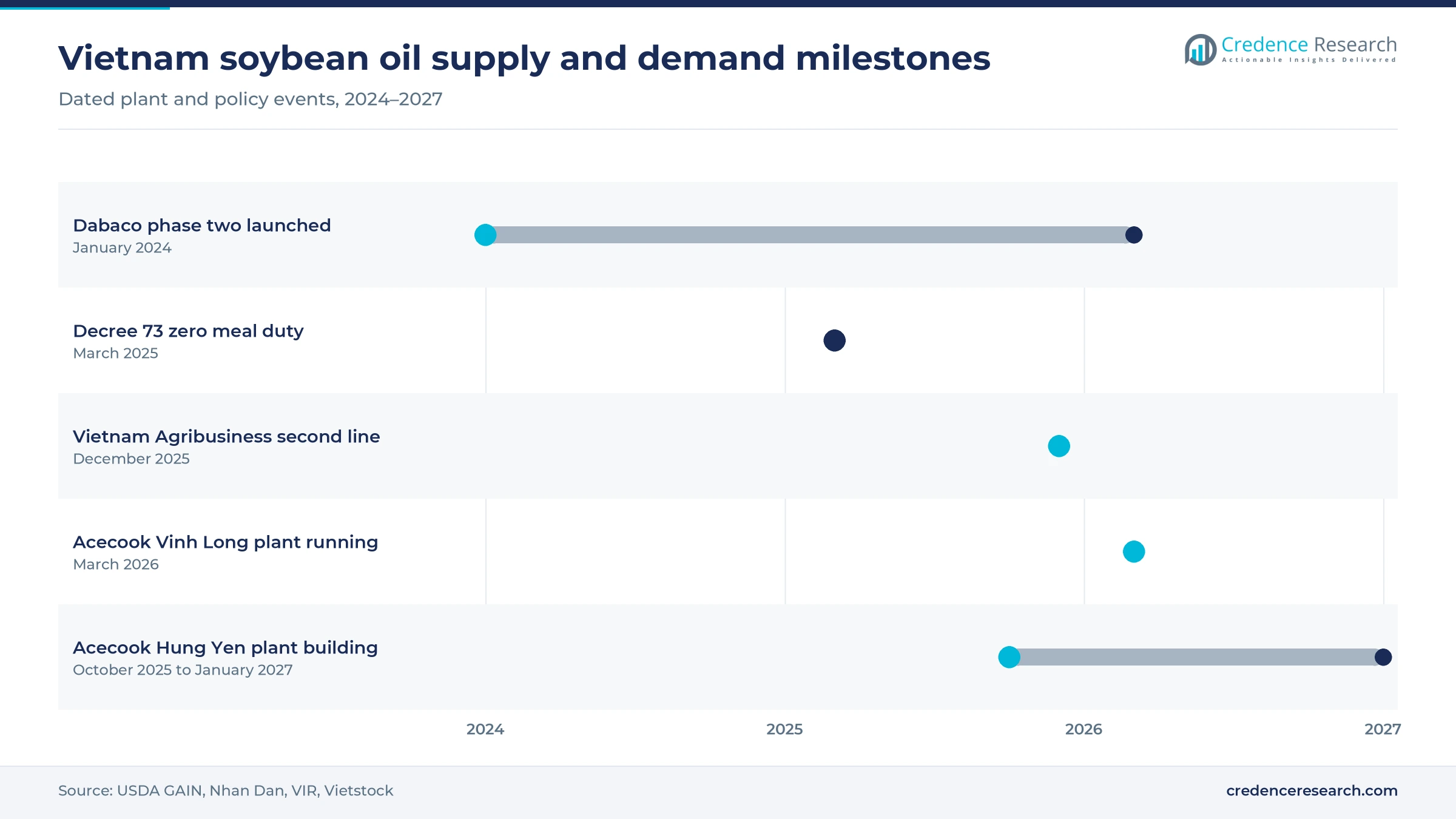
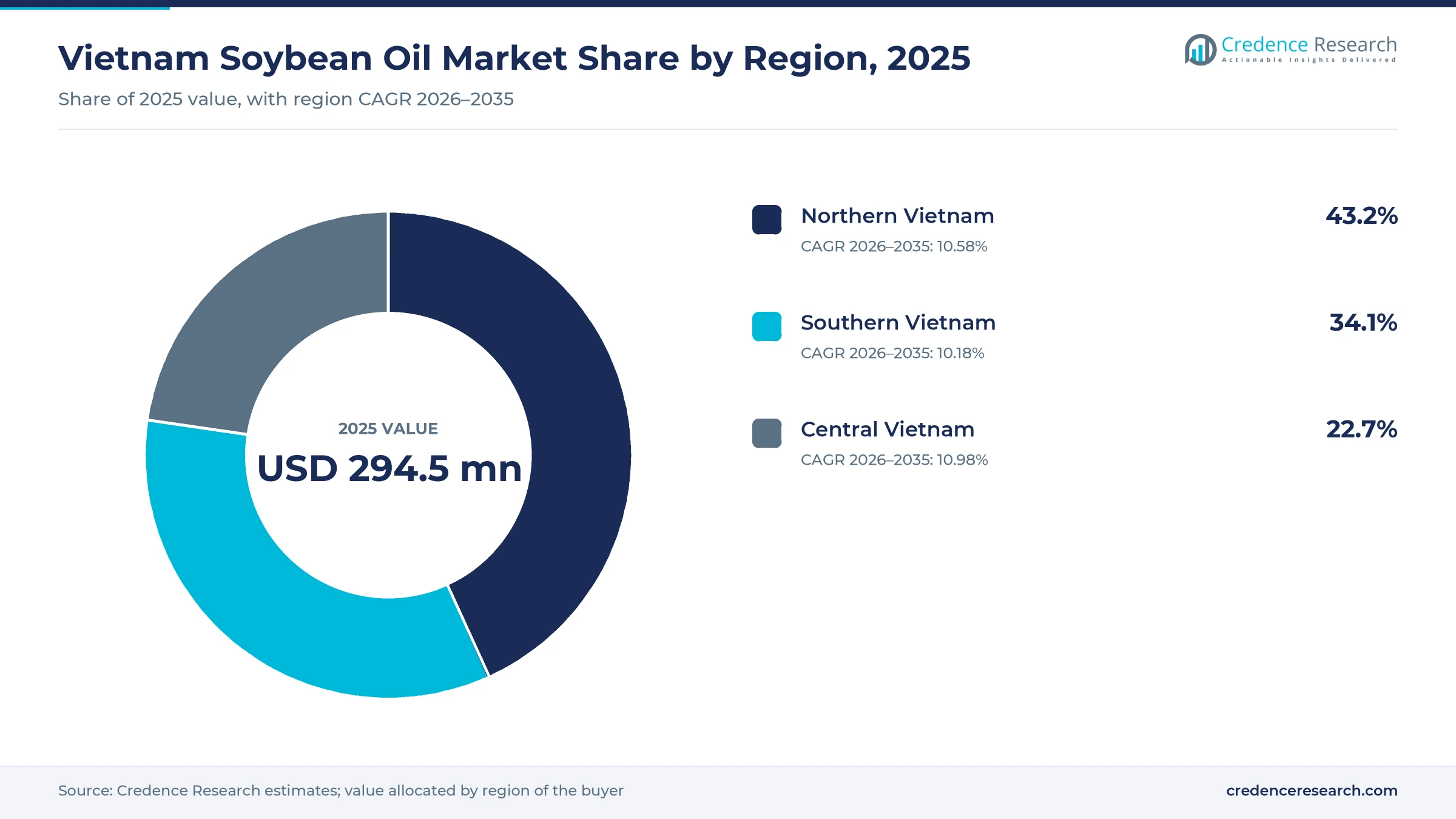
The Vietnam soybean oil market was valued at USD 294.5 million in 2025 and is projected to increase from USD 332.0 million in 2026 to USD 818.2 million by 2035, registering a CAGR of 10.54% during 2026–2035. Household kitchens and food factories drive purchases, while new crushing lines in Bac Ninh and Ho Chi Minh City are replacing purchased crude with domestic output. Northern Vietnam held the largest regional share, 43.2% in 2025, supported by the Red River Delta consumer base and by refining capacity in Quang Ninh and Bac Ninh. Central Vietnam is the fastest-growing region at 10.98% a year, as grocery chains and tourism spending expand there. A notable commercial change came in December 2025, when Vietnam Agribusiness, the Bunge and Wilmar joint venture, opened a second crushing line at Phu My. That line brought its combined capacity to 7,800 tons of soybeans a day and changed the crude supply available to refiners.
What does the soybean oil market in Vietnam actually count?
The estimate counts crude, standard refined and specialty refined soybean oil sold for use inside Vietnam, valued at the first selling point of the crusher, refiner, packer or importer. Buyers include households through retail, food factories on contract, foodservice operators through wholesalers and a small group of technical manufacturers.
It excludes whole soybeans, soybean meal, lecithin, palm and other vegetable oils, blended oils in which soybean is not the main ingredient, and soybean oil exported from Vietnam. The value chain runs from imported beans through crushing and refining to bottling and distribution, so bean prices, meal sales and palm prices all shape what buyers pay.
Vietnam Soybean Oil Market Insights
- The Vietnam soybean oil market grows from USD 294.5 million in 2025 to USD 818.2 million by 2035, a 10.54% CAGR across 2026–2035 on food manufacturing and domestic crude supply.
- Northern Vietnam led with 43.2% of 2025 value, helped by large Hanoi and Red River Delta demand and by refining in Quang Ninh and Bac Ninh.
- Standard Refined Soybean Oil held 68.0% of 2025 value because bottled grades carry retail brands and meet the vitamin A rule for consumer oil.
- Dabaco completed its second Bac Ninh phase in March 2026, adding a northern integrated producer alongside the expanded Vietnam Agribusiness complex in the south.
- Competition centers on the Wilmar-linked CALOFIC brands, the Kido group through Tuong An and Vocarimex, and new crushers that own their crude supply.
Refined bottles lead while contract buyers set the pace
Why do standard refined grades outsell crude and specialty oil?
Based on product type, the market is categorized into crude soybean oil, standard refined soybean oil and specialty refined soybean oil. Standard Refined Soybean Oil led with 68.0% of 2025 value because bottled consumer oil must be refined and, under Decree 09/2016 effective in March 2016, fortified with vitamin A according to Vietnam News Agency. CALOFIC alone runs refineries in Quang Ninh and Ho Chi Minh City with 2,300 tons a day of capacity, according to The Investor. Specialty Refined Soybean Oil grows fastest at 12.14% a year, as producers such as Dabaco adopt Desmet Nano refining technology that supports differentiated grades.
Which uses take the most oil, and where is growth strongest?
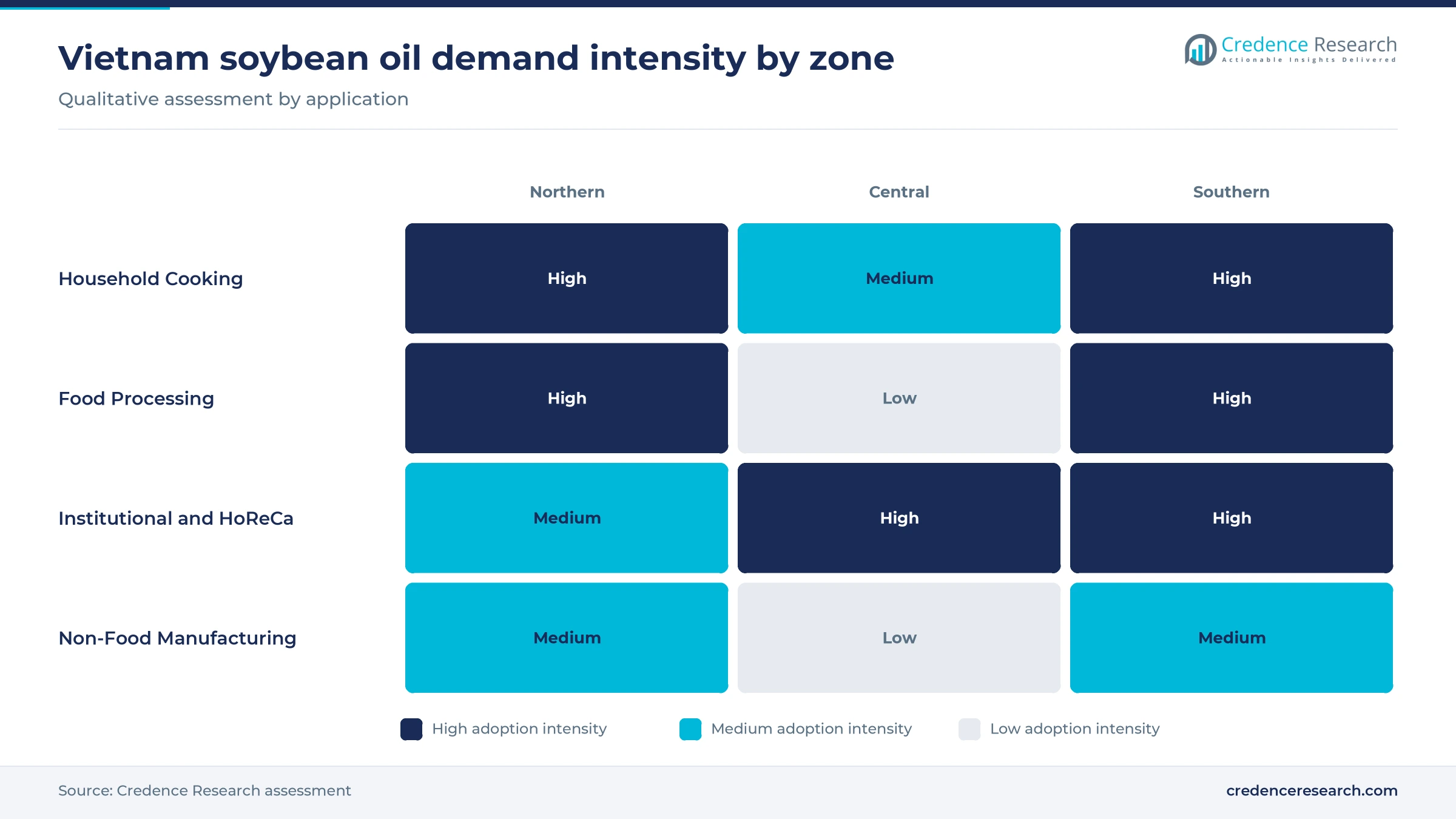
Based on application, the market is categorized into household cooking, food processing, institutional and HoReCa, and non-food manufacturing. Household Cooking led with 46.0% of 2025 value because Vietnam counted 101.1 million residents in the April 2024 census, according to Nhan Dan, which gives retail bottles the widest buyer base of any use. Food Processing grows fastest at 11.36% a year, as Acecook Vietnam opened a factory in Vinh Long in March 2026 designed for 27,600 tons a year of semi-finished items such as seasoning oil packets, according to Vietstock, which does not name the oil used. Smaller demand from soy-based chemicals remains specialized and accounts for only a small part of purchases.
How do crushers and crude buyers divide the refining business?
Based on operating model, the market is categorized into integrated crushing and refining, purchased-crude refining and finished-oil import and packing. Purchased-Crude Refining led with 52.0% of 2025 value because established refiners such as Vocarimex historically traded raw material and sold refined oil to affiliates, according to VietnamCredit. Integrated Crushing and Refining grows fastest at 11.59% a year, as Dabaco expects more than 100 million liters of refined oil annually from seed it crushes itself in Bac Ninh.
How does soybean oil reach households, foodservice and factories?
Based on distribution channel, the market is categorized into direct contract sales, distributors and wholesalers, physical retail and e-commerce. Physical Retail led with 40.0% of 2025 value because WinCommerce alone ran about 4,600 outlets after adding around 800 stores in 2025, according to a Ministry of Industry and Trade report cited by The Investor. E-Commerce grows fastest at 13.42% a year, as gross merchandise value on four major platforms rose 34.75% to VND 429.7 trillion in 2025, according to Market data published by The Investor in January 2026.
| Segment Group | Leading Sub-segment | Share, 2025 | Fastest-growing Sub-segment | CAGR, 2026–2035 |
|---|---|---|---|---|
| By Product Type | Standard Refined Soybean Oil | 68.0% | Specialty Refined Soybean Oil | 12.14% |
| By Application | Household Cooking | 46.0% | Food Processing | 11.36% |
| By Operating Model | Purchased-Crude Refining | 52.0% | Integrated Crushing and Refining | 11.59% |
| By Distribution Channel | Physical Retail | 40.0% | E-Commerce | 13.42% |
Request a Free Sample
Fill in your details and we'll send you a free sample report.
- Sample data tables & charts
- Research methodology
Noodle lines, feed mills and foodservice lift offtake
Food manufacturing procurement widens the contract base
Food factories are adding the volume commitments that refiners want most, because contract tons are steadier than retail promotions. The World Instant Noodles Association counted 8.1 billion servings in Vietnam for 2024, or 81 packs a person, the highest rate worldwide, according to VnExpress. Makers of instant noodles are building accordingly, since Acecook Vietnam began running its largest factory, in Vinh Long, in March 2026 after investing over USD 200 million. Vietnam Investment Review reported in October 2025 that a further Acecook plant in Hung Yen will add 750 million packs a year from January 2027. These plants show factory scale rather than a stated soybean oil purchase, so the link to this market is a Credence Research inference. Food processing, the fastest application at 11.36% a year, also benefits because industrial oil is exempt from the vitamin A rule.
Crushing and feed-sector linkage secures local crude
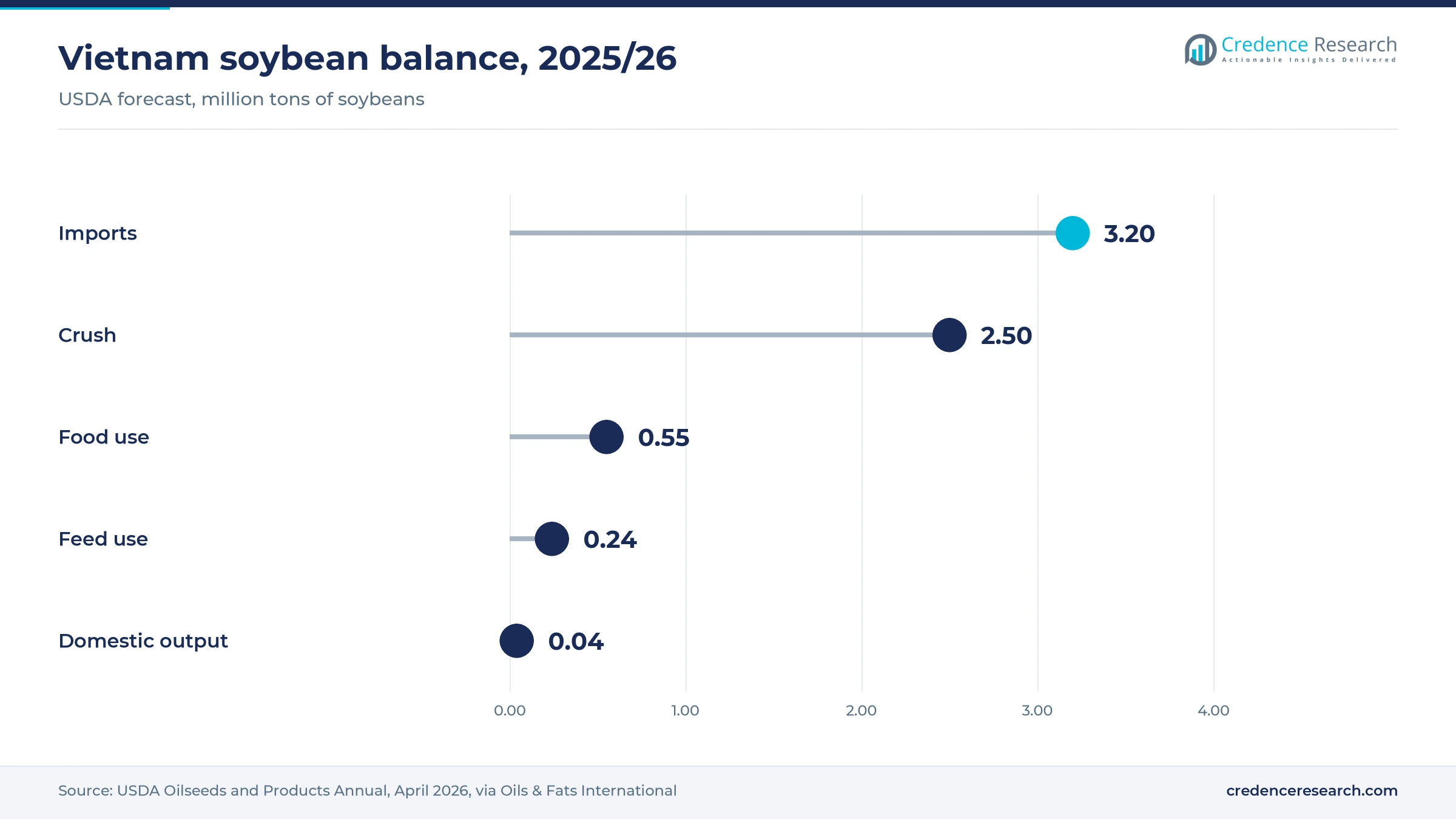
Crude supply now follows feed demand, because a crusher cannot sell meal without also producing oil. USDA forecasts cited by Oils & Fats International put the soybean crush at 2.5 million tons in 2025/26 and 3 million tons in 2026/27, against meal demand of 7.4 million and 7.8 million tons. Vietnam Agribusiness reported in December 2025 that both Phu My lines can process up to 2.6 million tons of soybeans a year, yielding more than 500,000 tons of crude oil and meal for about 30% of national feed demand. Global Ag Media, citing USDA, puts total feed demand at 29.5 million tons in 2026, up from 28.7 million.
Packaged product differentiation supports better margins
Packaging and formulation give refiners a way to earn more than the crude price, which is why brands stay central to this market. Decree 09/2016 requires vitamin A in vegetable oil containing soybean oil, according to Vietnam News Agency, and Food Compliance International reported in July 2024 that a Health Ministry draft amendment would keep that rule, which sets a common technical floor for bottled products. CALOFIC builds on that floor with the Neptune, Simply and Meizan brands, according to The Investor. In addition, Nhan Dan reported in March 2026 that Dabaco uses Desmet refining and extraction technology in a plant costing over VND 3 trillion across two phases. Specialty refined oil, the fastest product group at 12.14% a year, captures this premium.
Tourism and foodservice recovery raises kitchen volumes
Restaurants and hotels buy oil in large formats and repeat orders often, so visitor numbers translate quickly into purchase volumes. The National Statistics Office reported nearly 21.2 million foreign visitors in 2025, up 20.4% and 17.8% above 2019. The same release put accommodation and food services revenue near VND 843.1 trillion, up 14.6% and about 12% of consumer retail and services sales. Da Nang illustrates the local effect, because its culture and tourism department counted about 17.3 million visitors in 2025 and VND 60 trillion of tourism revenue, according to VietNamNet. This demand reaches distributors first, and the central zone around Da Nang is the clearest beneficiary.
Crude self-sufficiency and new retail routes reshape sales
Shift toward domestic crude replaces purchased supply
The clearest shift is that crude increasingly originates at Vietnamese crushers rather than abroad. Vietnam Customs data cited by Oils & Fats International showed soybean imports of 2.61 million tons in 2025, up 17.6%, and USDA expects 3.8 million tons in 2026/27. New plants explain that increase, since Vietnam Agribusiness added a 4,000-ton-a-day line for over USD 100 million in December 2025. Dabaco followed in March 2026 with a second Bac Ninh phase that handles 1,000 tons of seed a day. As a result, integrated producers grow at 11.59% a year in the Credence Research segment model, while refiners that buy crude must negotiate with rivals that also sell bottled oil.
Rising United States share reshapes bean origin mix
Bean origins moved noticeably during 2025, and that shift affects both crude costs and oil traceability. Vietnam Customs figures reported by Oils & Fats International showed Brazil at 57.2% and the United States at 33.4% through August 2025, in its October 2025 article. By December, the full-year split had narrowed to 45.8% for Brazil and 43.5% for the United States, with United States volumes up 23.8%. Early 2026 kept the pace, since imports rose 70% in the first two months. Landed prices still vary by origin and shipment month, so contract timing matters to buyers. Refiners therefore gain a second reliable origin and more room to time purchases.
Opportunity in northern grocery expansion for bottled brands
Northern modern grocery offers an opening for bottled brands that can win shelf space before new formats mature. Mobile World Group brought Bach Hoa Xanh to the north through a Ninh Binh store in November 2025 and plans about 1,000 new stores a year from 2026, according to The Investor. The chain had 2,290 stores at the end of September 2025. WinCommerce added around 800 outlets during 2025, and the Ministry of Industry and Trade report on retail showed the Red River Delta at 31.3% of national retail sales. Producers with a northern refinery, such as CALOFIC in Quang Ninh and Dabaco in Bac Ninh, can serve this expansion at lower freight cost.
Opportunity in online household packs and repeat baskets
Online selling is a small base with room for branded cooking oil, particularly in larger household packs that are heavy to carry home. Market data published by The Investor showed 3.94 billion products sold on Shopee, TikTok Shop, Lazada and Tiki in 2025, up 15.23%. Items priced from VND 100,000 to VND 200,000 led with 25.3% of sales, a band that suits multi-liter bottles. TikTok Shop also reached 41.31% of platform value, up from 29%, which rewards brands able to demonstrate recipes on video. Delivery habits formed through online food delivery apps help as well, and e-commerce grows at 13.42% a year on Credence Research estimates.
Palm spreads and imported beans squeeze refiner margins
Why does the palm price gap matter so much?
Palm oil is the constant alternative, so a wider price gap pushes value-conscious buyers away from soybean oil. World Bank Pink Sheet data show soybean oil averaging USD 1,140 a ton in 2025 against USD 1,007 for palm. By April 2026 the spread had grown to USD 476, at USD 1,624 and USD 1,148. Vietnam Briefing estimates palm at about 70% of edible oil demand, which shows how much substitution room exists. Refiners typically respond through blended products, retail promotions and smaller packs.
How exposed are refiners to imported beans?
Almost every crushed bean comes from abroad, which leaves crushers exposed to freight, currency and origin risk. Oils & Fats International, citing USDA, puts domestic soybean output at 41,000 tons in 2025/26 and 40,000 tons in 2026/27, from about 25,000 hectares. Imports are forecast at 3.2 million tons for 2025/26, and USDA notes that local beans remain less competitive. Crushers and refiners that lack hedging programs carry these swings directly, so larger groups increasingly secure origin diversity and forward cover.
Can swine disease disrupt the crush equation?
Oil output depends on meal sales, so livestock disease reaches the oil business through crusher margins. Vietnam News Service, citing the Ministry of Agriculture and Environment, reported in August 2025 that more than 330,000 pigs had been culled, with active outbreaks in 34 provinces and cities. Although the loss was about 0.9% of the herd, regional feed orders can fall quickly. Crushers facing weak meal offtake may slow lines or price oil harder, so refiners with diversified crude contracts are better protected.
Will cheaper imported meal pressure crusher returns?
Duty-free imported meal limits what domestic crushers can charge, which forces more of their return onto oil. Decree 73/2025 cut the most-favored-nation rate on meal to zero on March 31, 2025, according to a USDA GAIN report. USDA still forecasted 6.2 million tons of meal imports for 2025/26 in its September 2025 update, as reported by Oils & Fats International. New crushers therefore compete directly with imported meal, and any shortfall in those returns can reduce their flexibility on crude oil pricing.
The north leads as central provinces gain fastest
| Region | Value, 2025 (USD million) | Share, 2025 | CAGR, 2026–2035 |
|---|---|---|---|
| Northern Vietnam | 127.2 | 43.2% | 10.58% |
| Southern Vietnam | 100.4 | 34.1% | 10.18% |
| Central Vietnam | 66.9 | 22.7% | 10.98% |
Northern Vietnam leads on population and new refining
Northern Vietnam held 43.2% of 2025 value and grows at 10.58% a year, supported by Hanoi and its 8.69 million residents in the 2024 census reported by Nhan Dan. The Ministry of Industry and Trade report placed the Red River Delta at 31.3% of national retail sales, the highest of any region. Supply is also close, because CALOFIC refines in Quang Ninh and Dabaco started its second phase in Bac Ninh in March 2026, which shortens freight to northern food factories.
Southern Vietnam combines crushing scale with factory demand
Southern Vietnam held 34.1% of 2025 value and grows at 10.18% a year, the slowest pace of the three because modern retail is already dense. Ho Chi Minh City counted 9.52 million residents in the 2024 census and hosts the Phu My crushing complex. Acecook Vietnam also strengthened southern factory demand when its Vinh Long plant began operating in March 2026 with nine initial lines. The region therefore supplies crude to other zones while keeping a large base of bulk buyers.
Central Vietnam gains from retail and tourism spending
Central Vietnam held 22.7% of 2025 value and is the fastest-growing zone at 10.98% a year, as modern grocery and tourism expand from a smaller base. The Investor reported in November 2025 that more than half of Bach Hoa Xanh openings were in central Vietnam, with most of those stores profitable after logistics costs. Da Nang also welcomed 7.6 million international visitors in 2025, up 25%, which lifts hotel and restaurant purchases. Distribution from northern and southern refineries remains the main cost.
Plant openings and tariff moves from 2025 to 2026
| Development | Status and market relevance |
|---|---|
| In March 2026, Dabaco inaugurated the second phase of its Bac Ninh vegetable oil plant, which processes 1,000 tons of seed a day. | Operating; output at full capacity is expected above 100 million liters of refined oil a year |
| In March 2026, Acecook Vietnam began operating its Vinh Long factory after investing over USD 200 million. | Operating; nine of 17 planned lines run in the first phase |
| In December 2025, Vietnam Agribusiness inaugurated its second crushing line at Phu My 1 Industrial Park. | Operating; combined crude oil output is estimated above 500,000 tons a year |
| In October 2025, Acecook Vietnam started building a Hung Yen plant valued at about USD 88 million. | Under construction; operations are expected in January 2027 |
| In March 2025, Decree 73/2025 removed most-favored-nation duties on soybean meal lines. | In force; it raises competition for domestic crushers |
Extraction, refining and fortification set product quality
- Zero Influence extraction is the Desmet process chosen for the Dabaco plant, which aims to protect seed quality during oil recovery.
- Nano refining is the Desmet refining technology at Bac Ninh, which suits producers targeting differentiated bottled grades.
- Vitamin A fortification applies to consumer vegetable oil under Decree 09/2016, while oil for industrial food processing stays outside the requirement.
- Co-product recovery matters to crush returns, as Dabaco expects 5,500 tons of lecithin a year for feed mills.
Need a Custom Version of This Report?
Tailor the scope, geography, or segments to your exact requirements.
- Custom geography or segment scope
- Direct access to our analyst team
Wilmar, Kido and Dabaco anchor the competitive field
Competition is split between refiners with strong brands and crushers with their own crude. CALOFIC, controlled by Wilmar since Kido sold its remaining 24% stake in 2022, sells Neptune, Simply and Meizan from refineries in Quang Ninh and Ho Chi Minh City. Wilmar also shares Vietnam Agribusiness with Bunge, which gives the group a reach from beans to bottles. Kido owns Vocarimex and Tuong An, with Kido handling retail distribution and Tuong An handling production. Vocarimex itself trades raw material and refines oil for group companies. Dabaco, better known for feed and livestock, entered as an integrated northern producer with captive meal demand. Rivalry now centers on crude access, freight to northern factories and shelf space in fast-growing grocery chains.
Companies profiled and their roles in this market
| Company | Type | Role in the market |
|---|---|---|
| CALOFIC | Refiner and brand owner | Neptune, Simply and Meizan; plants in Quang Ninh and Ho Chi Minh City |
| Vietnam Agribusiness (Bunge and Wilmar) | Crusher | Two Phu My lines processing up to 2.6 million tons of beans a year |
| Dabaco Vegetable Oil | Integrated crusher and refiner | Bac Ninh plant with 1,500 tons of seed a day |
| Tuong An Vegetable Oil | Refiner and brand owner | Kido group production arm for cooking oil |
| Vocarimex | Raw material trader and refiner | Kido subsidiary supplying refined oil to group companies |
Crush economics will decide who wins the bottle
Credence Research's view is that the market's winners will be decided upstream. Vietnam Agribusiness and Dabaco now produce crude that older refiners once bought from traders, which moves bargaining power toward companies that also sell meal. Refiners without crushing assets still hold valuable brands and shelf space, and these strengths should keep them relevant in the household channel. However, the next contract rounds with noodle, sauce and snack makers will favor suppliers that offer secure domestic crude, consistent specifications and northern logistics. A persistently wide palm spread is the main threat to this view.
How the estimates were built and what they cover
The report uses 2025 as the base year and 2026 to 2035 as the forecast period. Market values come from the Credence Research model and were checked against World Bank prices, USDA crush forecasts and publicly reported volumes. Regional shares follow the Credence Research regional model, and segment shares and growth rates are Credence Research estimates informed by plant capacity, retail and foodservice statistics. Sources are government statistics, customs data reported by trade publications, USDA reports, World Bank price data and company announcements carried by national media. No interviews or surveys were conducted for this particular market estimate.
Domestic crude supply frames demand through 2035
Through 2035, Vietnam should rely increasingly on crude oil from its own crushers, even though nearly all of the beans will still arrive from abroad. Meal demand and feed mills will continue to set crush volumes, while food factories such as the new Acecook plants deepen contract sales. Retail expansion in the north and center should widen the reach of bottled brands, and e-commerce will add convenience sales from a low base. The market reaches USD 818.2 million by 2035, although palm price gaps and livestock disease can still interrupt progress in individual years.
Frequently Asked Questions
How big is the Vietnam soybean oil market?
Which region leads soybean oil demand in Vietnam?
Which region grows fastest?
What is the largest product type?
Which application grows fastest?
Who are the main companies in this market?
How is crushing changing the supply base?
What is the largest risk for producers?
Table of Content
Chapter 1 Market Segmentation
- 1.1 Segmentation Framework
- 1.1.1 Product and Service Classification
- 1.1.2 Application and End-Use Classification
- 1.1.3 Technology and Solution Classification
- 1.1.4 Customer and Distribution Channel Classification
- 1.1.5 Geographic Segmentation
- 1.1.6 Market Segment Definitions and Boundaries
- 1.2 By Product Type
- 1.2.1 Crude Soybean Oil
- 1.2.2 Standard Refined Soybean Oil
- 1.2.3 Specialty Refined Soybean Oil
- 1.3 By Application
- 1.3.1 Household Cooking
- 1.3.2 Food Processing
- 1.3.3 Institutional and HoReCa
- 1.3.4 Non-Food Manufacturing
- 1.4 By Operating Model
- 1.4.1 Integrated Crushing and Refining
- 1.4.2 Purchased-Crude Refining
- 1.4.3 Finished-Oil Import and Packing
Chapter 2 Introduction
- 2.1 Report Objectives and Scope
- 2.2 Product Definition and Industry Terminology
- 2.3 Market Inclusions and Exclusions
- 2.4 Research Process
- 2.4.1 Primary Research and Expert Interviews
- 2.4.2 Secondary Research and Source Review
- 2.4.3 Top-Down and Bottom-Up Estimation
- 2.4.4 Data Triangulation and Verification
- 2.5 Market Size Measurement Basis
- 2.5.1 2025: USD 294.5 million → 2035: USD 818.2 million
- 2.6 Historical and Forecast Reference Periods
- 2.6.1 Historical Period: 2018-2025
- 2.6.2 Base Year: 2025
- 2.6.3 Forecast Period: 2025-2035
- 2.7 Research Assumptions and Limitations
Chapter 3 Executive Summary
- 3.1 Market Snapshot and Key Findings
- 3.2 Base-Year Market Size, 2025
- 3.3 Forecast Market Size, 2035
- 3.4 Revenue and Volume Growth Outlook
- 3.5 Key Demand and Supply Indicators
- 3.6 Leading Market Segments
- 3.7 Fastest-Growing Market Opportunities
- 3.8 Regional Performance Highlights
- 3.9 Technology and Industry Transformation
- 3.10 Competitive Landscape Summary
- 3.11 Analyst View and Strategic Implications
Chapter 4 Vietnam Soybean Oil Market Trends and Developments
- 4.1 Historical Industry Development, 2018-2025
- 4.2 Recent Market Trends and Developments
- 4.3 Demand and Customer Behavior Trends
- 4.4 Technology and Product Innovation
- 4.5 Artificial Intelligence, Automation and Digitalization
- 4.6 Local Manufacturing and Supply Chain Realignment
- 4.7 Industry Partnerships, Mergers and Acquisitions
- 4.8 Sustainability and Circular Economy Developments
- 4.9 Government and Private Sector Investment Trends
- 4.10 Emerging Business Models and Commercialization
- 4.11 Industry Developments and Announcements
Chapter 5 Vietnam Soybean Oil Market Production, Supply and Demand Analysis
- 5.1 Demand Trend and Consumption Analysis, 2018-2025
- 5.2 Demand Forecast, 2025-2035
- 5.3 Production and Output Trend, 2018-2025
- 5.4 Production and Output Forecast, 2025-2035
- 5.5 Installed Capacity and Capacity Utilization
- 5.6 Company-Wise Production Plants and Statistics
- 5.6.1 Installed Production Capacity
- 5.6.2 Actual Production
- 5.6.3 Planned Capacity and Expansion Targets
- 5.7 Supply Chain Structure and Procurement Trends
- 5.8 Supply-Demand Gap and Bottlenecks
- 5.9 Import Dependence and Sourcing Structure
- 5.10 Contract Manufacturing and Outsourcing
- 5.11 Regional Supply and Demand Concentration
Chapter 6 Vietnam Soybean Oil Market Pricing Analysis
- 6.1 Pricing Structure and Measurement
- 6.2 Historical Pricing Trends, 2018-2025
- 6.3 Pricing Outlook, 2025-2035
- 6.4 Average Selling Price and Unit Economics
- 6.5 Pricing by Product and Market Segment
- 6.6 Geographic Pricing Differences
- 6.7 Key Input, Energy, Labor and Logistics Costs
- 6.8 Contract Pricing and Purchasing Models
- 6.9 Pricing Sensitivity and Competitive Positioning
- 6.10 Price, Margin and Profitability Implications
Chapter 7 Vietnam Soybean Oil Market Dynamics
- 7.1 Market Growth Drivers
- 7.1.1 Demand-Side Drivers
- 7.1.2 Technology and Innovation Drivers
- 7.1.3 Infrastructure and Investment Drivers
- 7.1.4 Regulatory and Policy Drivers
- 7.2 Market Restraints
- 7.2.1 Cost and Affordability Constraints
- 7.2.2 Technology and Adoption Barriers
- 7.2.3 Supply Chain and Operational Constraints
- 7.3 Market Challenges
- 7.3.1 Competitive Pressure and Margin Erosion
- 7.3.2 Skills, Infrastructure and Implementation Gaps
- 7.4 Emerging Market Opportunities
- 7.5 Market Dynamics Impact and Time-Horizon Assessment
Chapter 8 Vietnam Soybean Oil Value Chain Analysis
- 8.1 Industry Value Chain Overview
- 8.2 Upstream Suppliers and Critical Inputs
- 8.3 Technology and Component Providers
- 8.4 Manufacturing or Service Delivery
- 8.5 Distribution, Channel Partners and Integrators
- 8.6 Downstream Applications and End Users
- 8.7 Value Addition and Profit Pools
- 8.8 Vertical Integration and Outsourcing
- 8.9 Supplier Concentration and Risk
- 8.10 Supply Chain Localization and Resilience
Chapter 9 Vietnam Soybean Oil Market Regulations and Policies
- 9.1 Relevant Laws, Standards and Compliance Frameworks
- 9.2 Product, Service, Safety and Quality Requirements
- 9.3 Government Policies, Incentives and Subsidies
- 9.4 Imports, Exports and Trade Barriers
- 9.5 Public Procurement and Local Content Requirements
- 9.6 Environmental and Sustainability Compliance
- 9.7 Upcoming Policy Changes and Market Implications
Chapter 10 Vietnam Soybean Oil Market Hotspots and Opportunities
- 10.1 Market Opportunity Mapping and Growth Hotspots
- 10.2 High-Growth Applications and Customer Groups
- 10.3 Underserved Markets and White-Space Opportunities
- 10.4 Emerging Technology and Product Opportunities
- 10.5 New Capacity and Investment Hotspots
- 10.6 Market Entry and Expansion Opportunities
- 10.7 Distribution and Partnership Opportunities
- 10.8 Near-Term and Long-Term Commercial Potential
- 10.9 Opportunity Attractiveness and Execution Risks
Chapter 11 Vietnam Soybean Oil Market Outlook, 2025-2035
- 11.1 Market Size and Analysis
- 11.1.1 Revenue (Market Measurement: 2025: USD 294.5 million → 2035: USD 818.2 million)
- 11.1.2 Market Volume and Quantity Sold
- 11.1.3 Historical Market Size, 2018-2025
- 11.1.4 Base-Year Market Size, 2025
- 11.2 Market Forecast, 2025-2035
- 11.2.1 Revenue Forecast to 2035
- 11.2.2 Volume Forecast to 2035
- 11.2.3 CAGR and Year-on-Year Growth
- 11.2.4 Incremental Revenue Opportunity
- 11.3 Forecast Assumptions and Scenario Analysis
- 11.3.1 Base-Case Forecast
- 11.3.2 Optimistic and Conservative Scenarios
- 11.3.3 Technology, Pricing and Policy Sensitivities
- 11.4 Market Attractiveness and Growth Outlook
Chapter 12 Vietnam Soybean Oil Market Segmentation and Outlook
- 12.1 Segmentation Summary and Market Shares, 2025
- 12.2 Largest and Fastest-Growing Segments
- 12.3 By Product Type - Market Size and Forecast, 2025-2035
- 12.3.1 Segment Definition and Scope
- 12.3.2 Historical Market Size, 2018-2025
- 12.3.3 Revenue Forecast, 2025-2035
- 12.3.4 Volume Forecast, 2025-2035
- 12.3.5 Base-Year Market Share, 2025
- 12.3.6 Segment CAGR and Growth Drivers
- 12.3.7 Subsegment Market Size and Forecast
- 12.3.7.1 Crude Soybean Oil
- 12.3.7.2 Standard Refined Soybean Oil
- 12.3.7.3 Specialty Refined Soybean Oil
- 12.3.8 Subsegment Pricing and Adoption Trends
- 12.3.9 Leading Suppliers and Competition
- 12.3.10 Regional Demand and Opportunities
- 12.4 By Application - Market Size and Forecast, 2025-2035
- 12.4.1 Segment Definition and Scope
- 12.4.2 Historical Market Size, 2018-2025
- 12.4.3 Revenue Forecast, 2025-2035
- 12.4.4 Volume Forecast, 2025-2035
- 12.4.5 Base-Year Market Share, 2025
- 12.4.6 Segment CAGR and Growth Drivers
- 12.4.7 Subsegment Market Size and Forecast
- 12.4.7.1 Household Cooking
- 12.4.7.2 Food Processing
- 12.4.7.3 Institutional and HoReCa
- 12.4.7.4 Non-Food Manufacturing
- 12.4.8 Subsegment Pricing and Adoption Trends
- 12.4.9 Leading Suppliers and Competition
- 12.4.10 Regional Demand and Opportunities
- 12.5 By Operating Model - Market Size and Forecast, 2025-2035
- 12.5.1 Segment Definition and Scope
- 12.5.2 Historical Market Size, 2018-2025
- 12.5.3 Revenue Forecast, 2025-2035
- 12.5.4 Volume Forecast, 2025-2035
- 12.5.5 Base-Year Market Share, 2025
- 12.5.6 Segment CAGR and Growth Drivers
- 12.5.7 Subsegment Market Size and Forecast
- 12.5.7.1 Integrated Crushing and Refining
- 12.5.7.2 Purchased-Crude Refining
- 12.5.7.3 Finished-Oil Import and Packing
- 12.5.8 Subsegment Pricing and Adoption Trends
- 12.5.9 Leading Suppliers and Competition
- 12.5.10 Regional Demand and Opportunities
- 12.6 Segment Growth Comparison
- 12.7 Segment Attractiveness and Priority Matrix
Chapter 13 Vietnam Soybean Oil End-Use and Application Market Outlook
- 13.1 End-Use Industry and Customer Demand Structure
- 13.2 Leading Applications and Customer Groups
- 13.3 End-Use Market Size, Share and Forecast
- 13.4 Major End-Use Industry Deep Dives
- 13.4.1 Customer Requirements and Use Cases
- 13.4.2 Demand and Replacement Cycles
- 13.4.3 Technical and Regulatory Considerations
- 13.4.4 Purchasing and Procurement Models
- 13.4.5 Leading Vendors and Distribution Channels
- 13.4.6 Forecast and Commercial Opportunities
- 13.5 Emerging Applications and Cross-Segment Demand
- 13.6 End-Use Industry Investment Priorities
Chapter 14 Vietnam Soybean Oil Geographic Market Outlook, 2025-2035
- 14.1 Domestic Market Distribution and Demand Clusters
- 14.2 State- or Province-Wise Market Size and Forecast, 2025-2035
- 14.3 City and Metropolitan Market Outlook
- 14.4 Industrial, Manufacturing and Commercial Clusters
- 14.5 Geographic Concentration of Key End Users
- 14.6 Local Pricing and Purchasing Differences
- 14.7 Domestic Production Facilities and Capacity Map
- 14.8 Local Infrastructure and Project Pipeline
- 14.9 State-Level Policy and Incentive Differences
- 14.10 Subnational Investment Hotspots and Opportunities
- 14.11 Distribution and Logistics Networks
- 14.12 Domestic Competitive Footprint
Chapter 15 Vietnam Soybean Oil Technology, Innovation and Sustainability Outlook
- 15.1 Technology Landscape and Maturity
- 15.2 Product, Process and Service Innovation
- 15.3 AI, Automation and Digital Tools in the Industry
- 15.4 Technology Adoption and Performance Benchmarking
- 15.5 Innovation Pipeline and R&D Investment
- 15.6 Patent and Intellectual Property Trends
- 15.7 Energy Efficiency and Resource Management
- 15.8 Sustainability, Recycling and Circularity
- 15.9 Technology Roadmap, 2025-2035
- 15.10 Risks of Obsolescence and Technology Substitution
Chapter 16 Vietnam Soybean Oil Market Key Strategic Imperatives
- 16.1 Growth and Market Entry Priorities
- 16.2 High-Return Products and Segments
- 16.3 Pricing, Profitability and Cost Optimization
- 16.4 Technology Investment and Product Differentiation
- 16.5 Supply Chain Localization and Resilience
- 16.6 Distribution and Customer Acquisition
- 16.7 Partnership, Acquisition and Capacity Strategy
- 16.8 Regional Expansion Priorities
- 16.9 Short-, Medium- and Long-Term Actions
Chapter 17 Competition Outlook
- 17.1 Industry Competition Characteristics
- 17.2 Market Structure and Concentration
- 17.3 Market Share and Competitive Positioning, 2025
- 17.4 Company-Wise Revenue and Product Benchmarking
- 17.5 Production and Service Capacity Benchmarking
- 17.6 Technology, Pricing and Differentiation
- 17.7 Regional Footprint and Distribution Strength
- 17.8 Mergers, Acquisitions and Strategic Alliances
- 17.9 New Entrants and Competitive Threats
- 17.10 Porter's Five Forces and Industry Attractiveness
- 17.11 Competitive Outlook, 2025-2035
Chapter 18 Company Profiles
- 18.1 Company Coverage and Selection Criteria
- 18.2 CALOFIC
- 18.2.1 Business Description
- 18.2.2 Company Ownership and Geographic Presence
- 18.2.3 Product and Service Portfolio
- 18.2.4 Manufacturing and Operating Footprint
- 18.2.5 Production Capacity and Expansion Plans
- 18.2.6 Financial Performance and Investment
- 18.2.7 Market Share and Competitive Position
- 18.2.8 Technology and Innovation Capabilities
- 18.2.9 Strategic Alliances or Partnerships
- 18.2.10 Recent Developments
- 18.2.11 Growth Strategy and Outlook
- 18.3 Tuong An Vegetable Oil
- 18.4 Vocarimex
- 18.5 Dabaco Vegetable Oil
- 18.6 Other Relevant Market Participants
Note: Every listed company is profiled on the structure shown under the first company. The company list is preliminary and may change based on research findings, market developments, data availability and client requirements.
Chapter 19 Disclaimer
- 19.1 Research and Forecast Disclaimer
- 19.2 Data Source and Estimation Limitations
Note: The depth of individual sections depends on data availability for this market. Volume, capacity, trade and other unit-based metrics are included where applicable.

