
Plastic presses follow new plants in China and India
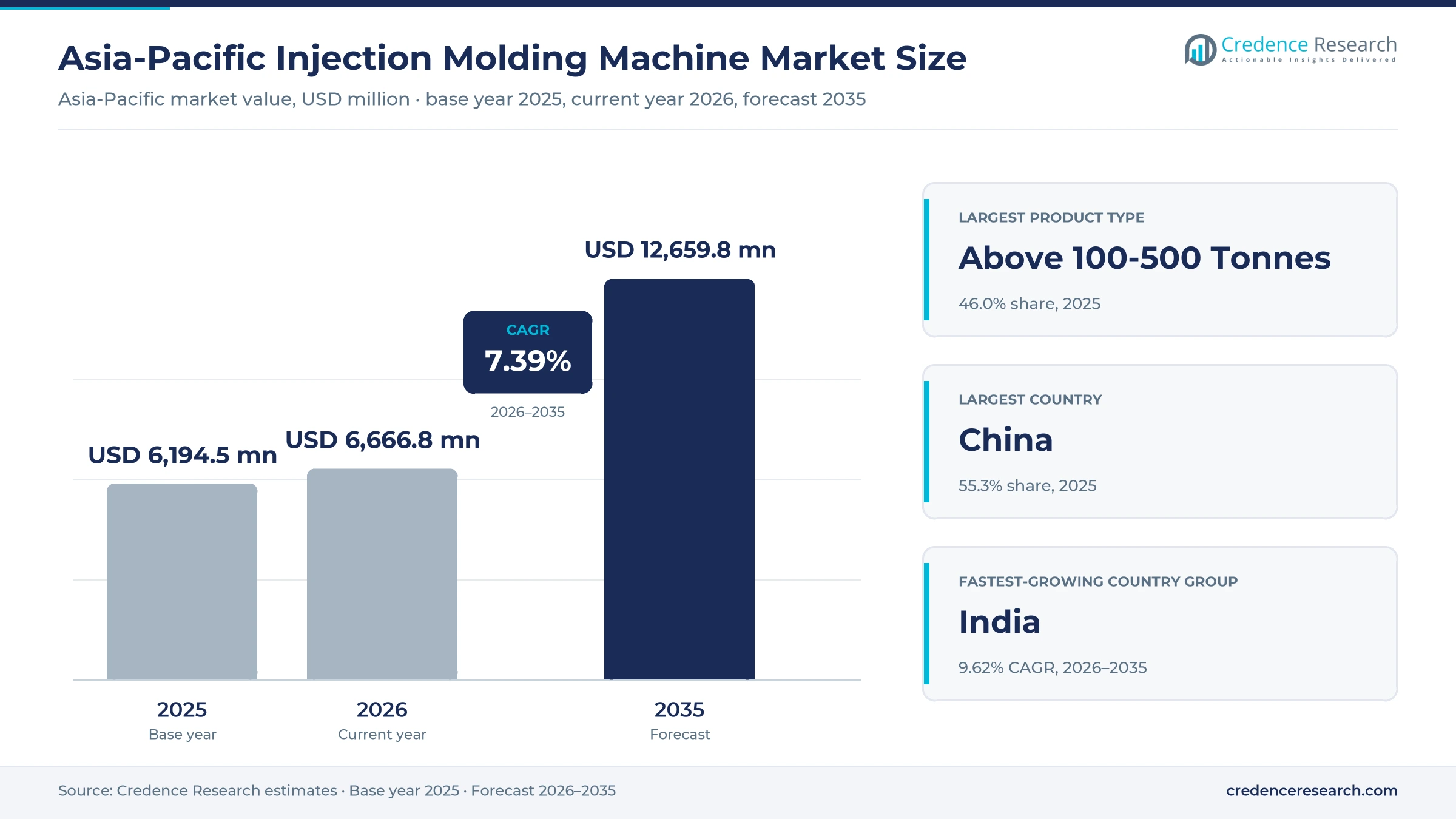
The Asia-Pacific injection molding machine market was valued at USD 6.19 billion in 2025 and is projected to increase from USD 6.58 billion in 2026 to USD 11.30 billion by 2035, registering a CAGR of 6.20% during 2026–2035. Demand comes from contract molders, appliance and electronics makers, automotive suppliers and packaging converters that buy presses for new lines or to replace older hydraulic units. China held the largest share, 55.3% in 2025, because it hosts the largest builders and the deepest base of plastic part production. India is the fastest-growing country group at 8.43% a year, as global builders open local assembly plants and molders add capacity for vehicles and appliances. Technology is also changing, because buyers now favor servo-hydraulic and all-electric drives that cut energy use and improve repeatability. As a result, value per machine is rising even where unit volumes grow slowly.
Which plastic processing presses are counted?
The estimate measures the value of new injection molding machines sold to processors in China, Northeast Asia, India and Southeast Asia and Remaining Markets. It covers presses from 25 tons to more than 2,000 tons of clamping force with hydraulic, all-electric and hybrid drives, sold directly by builders, through dealers or as part of turnkey projects.
The estimate excludes molds, robots, auxiliary equipment sold separately, used and rebuilt machines and die-casting machines for metal parts. The value chain runs from castings, screws, servo motors and controls through machine builders and dealers to molders that supply packaging, consumer, automotive, electronics and medical customers.
Asia-Pacific Injection Molding Machine Market Insights
- The Asia-Pacific injection molding machine market was valued at USD 6.19 billion in 2025 and is projected to reach USD 11.30 billion by 2035, registering a CAGR of 6.20% during 2026–2035.
- China held 55.3% of 2025 value, because the country builds most of the region's presses and produced 16.524 million new energy vehicles in 2025.
- Presses above 100 to 500 tons led with 46.0% of 2025 value, as they serve packaging, appliance and general technical parts.
- Shibaura Machine India opened a second Chennai factory in July 2024, with capacity rising in phases from about 1,200 to 4,000 units a year.
- All-electric machines are the fastest-growing technology at 7.72% a year, as medical and electronics molders seek precision through 2035.
Mid-size presses, auto parts and hydraulic drives lead
Why do mid-size presses carry the most value?
Based on product type, the market is categorized into 25-100 Tonnes, Above 100-500 Tonnes, Above 500-2,000 Tonnes and Above 2,000 Tonnes. Above 100-500 Tonnes led with 46.0% of 2025 value, because this class molds caps, containers, housings and appliance parts in high volumes. Above 2,000 Tonnes grows fastest at 7.97% a year, as automakers order large two-platen machines for bumpers, battery covers and instrument panels.
How do automotive and electronics parts shape demand?
Based on end-use industry, the market is categorized into Packaging, Consumer Goods, Automotive and Electronics and Technical Products. Automotive and Electronics led with 33.0% of 2025 value, because vehicle, appliance and device makers buy many presses for connectors, housings and trim parts. Technical Products grows fastest at 7.04% a year, as medical and industrial molders process engineering plastics to tight tolerances.
How quickly are all-electric presses gaining ground?
Based on technology, the market is categorized into Hydraulic, All-Electric and Hybrid. Hydraulic led with 47.0% of 2025 value, because Chinese and Indian molders still buy many servo-hydraulic toggle and two-platen presses at lower prices. All-Electric grows fastest at 7.72% a year, as electronics, medical and packaging molders choose electric drives for repeatability, clean operation and lower power bills.
Why do contract molders buy the most presses?
Based on customer type, the market is categorized into Contract Molders, Captive Manufacturers and Dedicated Packaging Converters. Contract Molders led with 46.0% of 2025 value, because brand owners in appliances, electronics and vehicles outsource many plastic parts to independent molders. Contract Molders grows fastest at 6.49% a year, as these molders add capacity near new assembly plants in India and Southeast Asia.
| Segment Group | Leading Sub-segment | Share, 2025 | Fastest-growing Sub-segment | CAGR, 2026–2035 |
|---|---|---|---|---|
| By Product Type | Above 100-500 Tonnes | 46.0% | Above 2,000 Tonnes | 7.97% |
| By End-Use Industry | Automotive and Electronics | 33.0% | Technical Products | 7.04% |
| By Technology | Hydraulic | 47.0% | All-Electric | 7.72% |
| By Customer Type | Contract Molders | 46.0% | Contract Molders | 6.49% |
Request a Free Sample
Fill in your details and we'll send you a free sample report.
- Sample data tables & charts
- Research methodology
Local plants, EV parts and precision molding lift demand
How does local manufacturing capacity lift press demand?
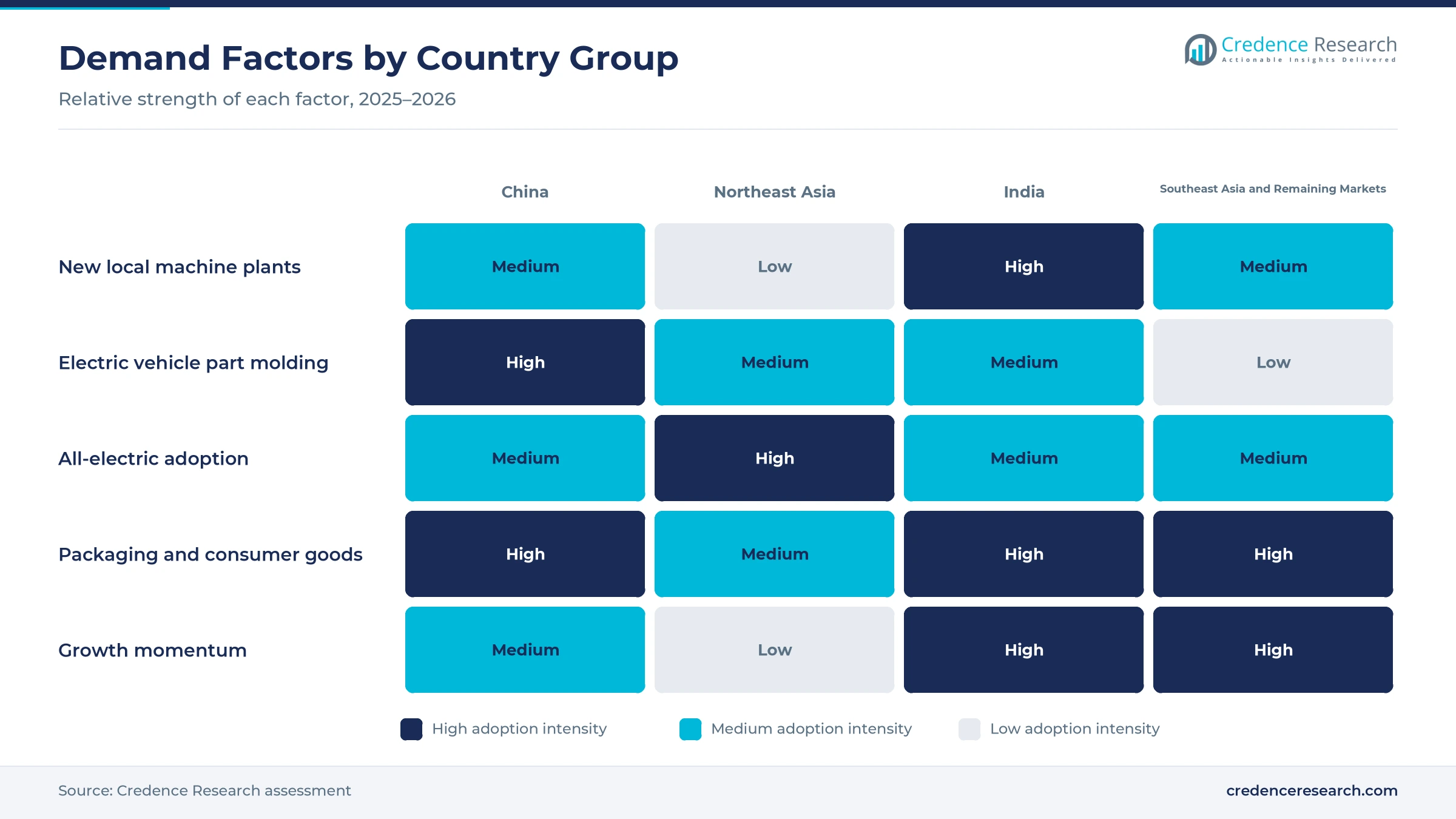
Machine builders are moving assembly closer to molders in India and other fast-growing markets, which shortens delivery times and lowers landed prices. Shibaura Machine India opened a second factory at Chembarambakkam near Chennai on July 12, 2024, with an investment of 225 crore rupees, according to a company release carried by ThePrint. The company said capacity will rise in phases from about 1,200 to 4,000 units a year. Nissei Plastic Industrial selected a site in the Sanand Industrial Estate in Gujarat in September 2025 to build about 30 electric machines a month, according to PlasticsToday. Haitian India also runs a factory in Kadi, Gujarat, on about 51,800 square meters. As a result, contract molders in India can buy locally built presses with shorter lead times and local service.
How does EV production raise tonnage and precision needs?
Electric vehicle programs need larger and more complex plastic parts, such as battery covers, connectors and lighting modules, which raises demand for high-tonnage and precision presses. China produced 16.524 million new energy vehicles in 2025, up 25.1%, according to the National Bureau of Statistics of China. The same release showed value added in automobile manufacturing rising 11.5% for the year. Haitian International said new energy vehicle demand helped lift its first-half 2025 sales, while its Jupiter two-platen series was a main growth driver. Sumitomo Heavy Industries also showed an all-electric press molding automotive connectors at Chinaplas 2024 in Shanghai. Therefore, automotive and electronics led end uses with 33.0% of 2025 value.
Why do precision and medical molders favor electric drives?
Medical, optical and electronics molders need tight shot-to-shot repeatability and clean operation, so they favor all-electric presses with closed-loop control. Sumitomo Heavy Industries said in April 2024 that its Ningbo subsidiary would show an SE50EV-S-SHR all-electric machine for cleanroom medical molding at Chinaplas 2024. Toyo presented its all-electric Si-7 platform for K 2025 with live trials in packaging and medical applications, and Plastech reported energy use more than 80% below conventional hydraulic systems. Haitian International said its Zhafir and Niigata electric series delivered 2,044 machines in the first half of 2025, up 4.6%. As a result, all-electric machines grow fastest by technology at 7.72% a year, and technical products also gain share.
Which molders keep mid-size toggle machines in demand?
Packaging and household goods molders run high-cavitation molds at short cycles, which keeps demand steady for fast toggle and hybrid presses in the mid-tonnage class. YIZUMI showed an SPET-D machine molding a 20-gram PET tea cup in a four-cavity mold on a 25-second cycle at VietnamPlas 2025 in Ho Chi Minh City in September 2025. Sumitomo's Ningbo unit displayed 48-cavity container cap molding on a 2.7-second cycle at Chinaplas 2024. Haitian also said consumer goods and household appliances drove its first-half 2025 growth, when it sold more than 29,400 machines. Therefore, these mid-size presses remain the core of regional unit sales for packaging and household goods molders.
Electric drives, smart controls and two-platen growth
How is the shift to servo drives changing press sales?
Molders across the region are shifting from fixed-pump hydraulic presses toward servo-hydraulic and all-electric drives to cut power bills and improve repeatability. Haitian said its servo-hydraulic Mars toggle series and Jupiter two-platen series were the main growth drivers in the first half of 2025. Nissei plans to build electric machines at its new Sanand site in India at a targeted 30 units a month, which brings Japanese electric technology closer to Indian buyers. Toyo also markets its Si-7 platform on energy savings of more than 80% against conventional hydraulic machines. As a result, hydraulic machines still led with 47.0% of 2025 value, but their share is expected to decline steadily through 2035.
Why is the rise of AI-assisted press controls notable?
Machine builders are adding cloud connectivity and AI-assisted setup, because many molders in China and Southeast Asia lack enough skilled process technicians. Chen Hsong planned to launch its iChen Smart Family, including an AI Molder for setup, troubleshooting and process stabilization, at K 2025 in October 2025. China's output of industrial robots reached 773,000 sets in 2025, up 28%, according to national statistics, which points to deeper automation of molding cells. Chinaplas 2026 in Shanghai showed more than 3,800 machines running live across 16 halls and drew 350,189 professional visitors, according to Plastech. Therefore, buyers now compare suppliers on software, robot integration and remote service as well as clamping force.
Can Southeast Asian service networks open new demand?
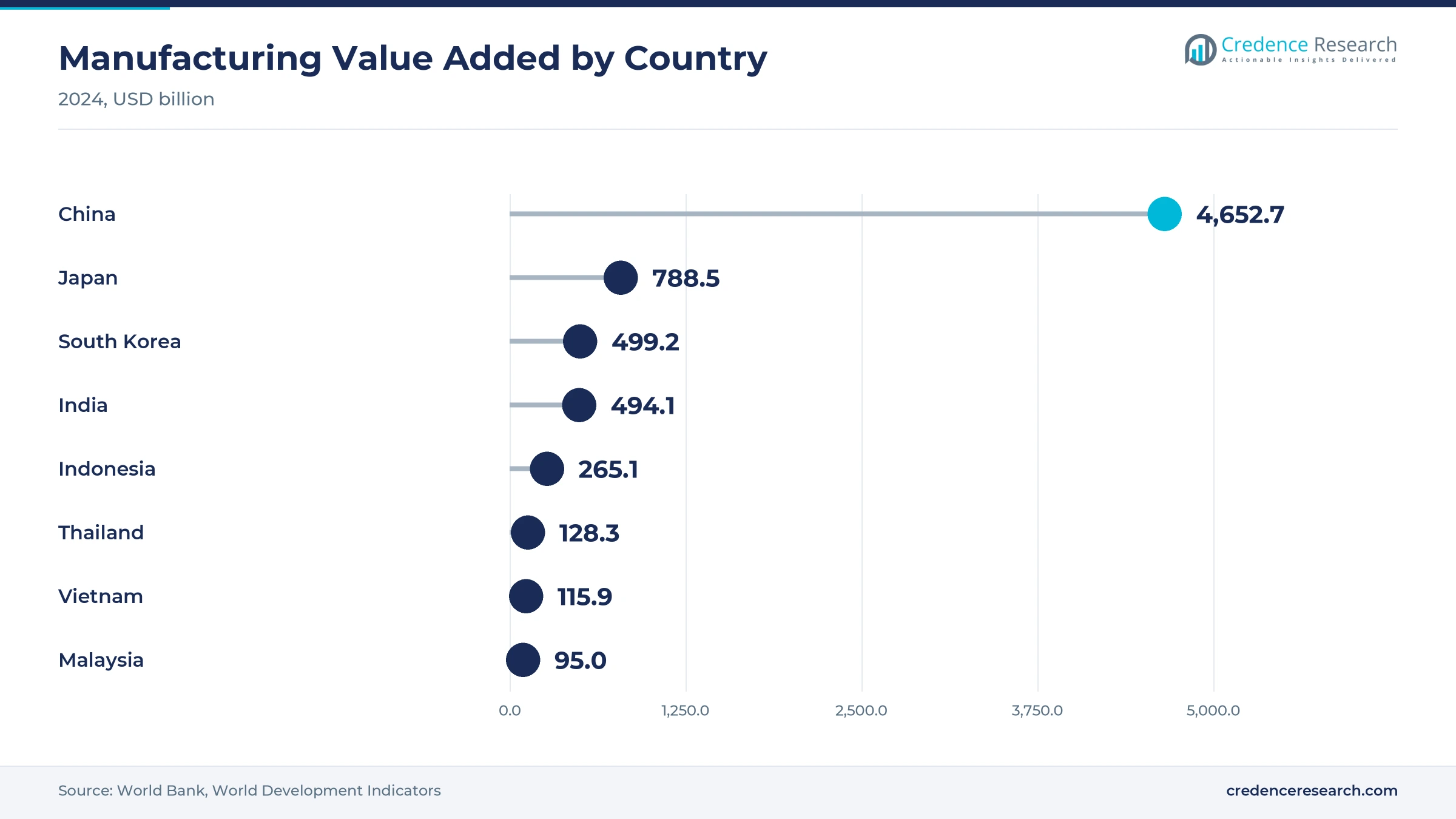
Southeast Asia offers an opening for suppliers that build local service, spare parts and application support close to electronics and consumer goods plants. YIZUMI entered Vietnam in 2010, set up a subsidiary in Bac Ninh in 2018, opened a technical service center in Binh Duong in 2022 and expanded its service network to four cities in 2024. LK Technology says its localized sales and service network covers Thailand, Vietnam and Malaysia. Vietnam's manufacturing value added reached about USD 115.9 billion in 2024, while Thailand recorded about USD 128.3 billion, according to World Bank data. As a result, Southeast Asia and Remaining Markets grows at 7.63% a year, second only to India.
Can bigger single-piece parts create a new sales opening?
Large two-platen and multi-material machines offer an opening, because automakers and appliance makers want fewer assembly steps and larger single-piece parts. ENGEL and Electronica Plastic Machines planned to show a 6,500 kN two-platen machine made in India at Plastindia 2026 in New Delhi on Feb. 5-10, 2026, according to Plastech. Shibaura Machine India said its new Chennai factory can build extra-large machines of up to 3,500 tons. Chen Hsong's new DMZ multi-material series uses a servo-driven turntable with 0.005-degree positioning accuracy to raise multi-color yields. Therefore, machines above 2,000 tons grow fastest by product type at 7.97% a year, although from a small base.
Price competition and cautious molders slow orders
How does price competition among builders squeeze margins?
China's domestic machine demand has been soft while builders keep adding capacity, which intensifies price competition for standard hydraulic presses. China's exports of plastic articles slipped 0.8% in 2025, according to the National Bureau of Statistics of China, which limits new capacity spending by some export-oriented molders. As a result, smaller builders face pressure on margins and payment terms. Leading suppliers respond by moving into electric, two-platen and automotive machines, where engineering content and service support defend higher prices.
Why do trade frictions make orders uneven?
Many molders in China and Southeast Asia serve export customers, so tariffs and shifting sourcing rules can delay purchases of new presses. Electronics and appliance brands that move assembly between countries often pause tooling decisions until volumes are confirmed. In turn, machine builders see orders swing between China, Vietnam, Thailand and India from one year to the next. Suppliers reduce this risk by running service centers in several countries and by offering financing that matches each customer's ramp-up schedule.
How do scarce process engineers slow press upgrades?
Modern electric and multi-material presses need trained process engineers, and many contract molders in India and Southeast Asia struggle to hire them. Poorly set machines waste resin, raise scrap rates and erode the energy savings that justify a premium purchase. As a result, some buyers stay with familiar hydraulic models even when electric presses would cut running costs. Builders address this gap through application centers, training programs and AI-assisted setup tools such as the AI Molder from Chen Hsong.
How do resin costs affect equipment budgets?
Resin price swings and thin converter margins make molders cautious about capital spending, especially in packaging and consumer goods. When polymer prices rise faster than selling prices, converters delay replacing older presses and run them for longer. In turn, machine orders become uneven across quarters and across country groups. Suppliers respond with leasing, trade-in programs and energy audits that show the payback period for electric and servo-hydraulic upgrades, which helps buyers justify new equipment.
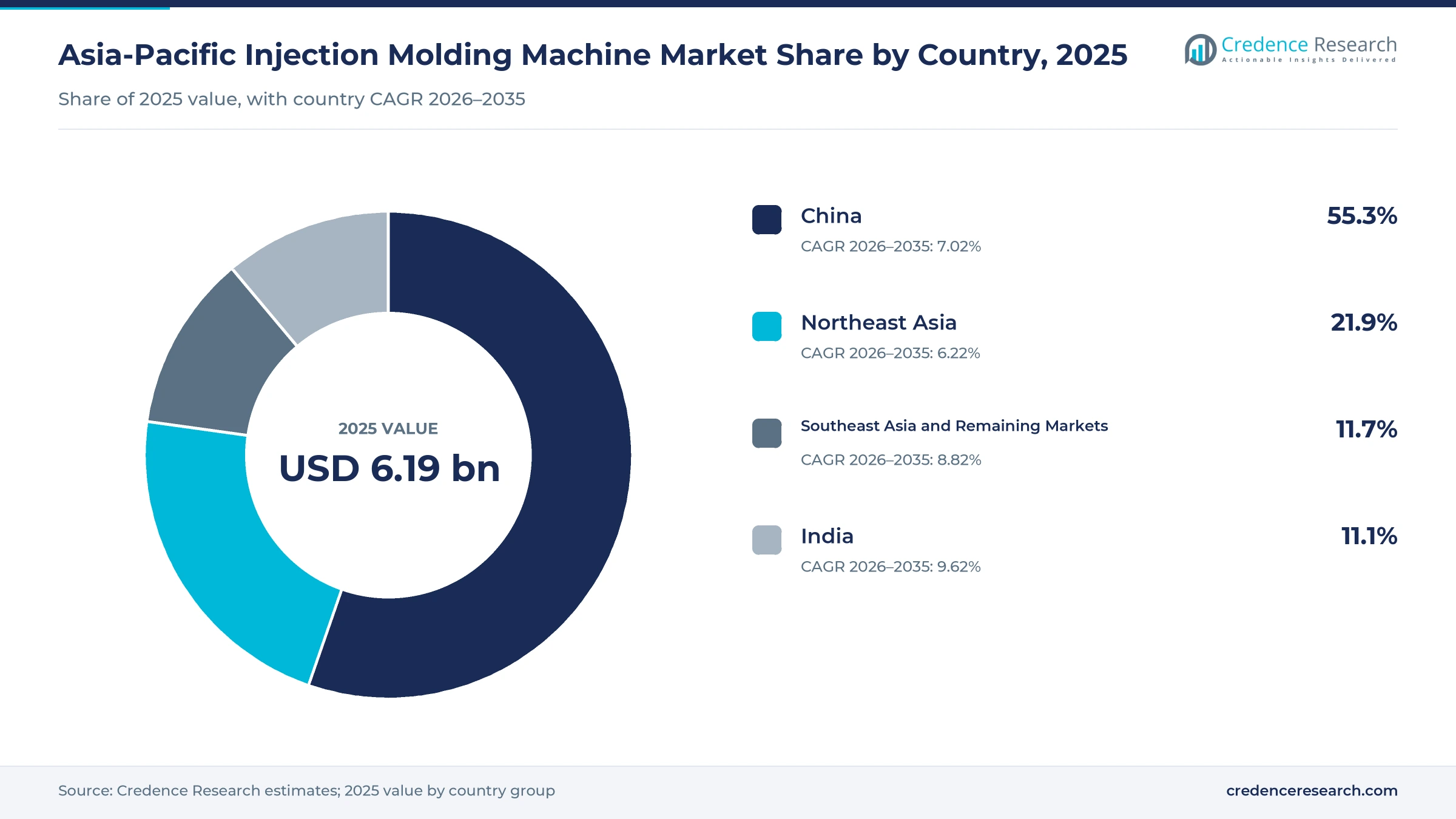
China leads while India and Southeast Asia grow fastest
| Country | Value, 2025 (USD billion) | Share, 2025 | CAGR, 2026–2035 |
|---|---|---|---|
| China | 3.43 | 55.3% | 5.83% |
| Northeast Asia | 1.36 | 21.9% | 5.03% |
| Southeast Asia and Remaining Markets | 0.72 | 11.7% | 7.63% |
| India | 0.69 | 11.1% | 8.43% |
Why does China hold the largest share?
China held 55.3% of 2025 value and grows at 5.83% a year, slightly below the regional rate. National statistics show value added in general-purpose machinery manufacturing rising 8.0% in 2025, while new energy vehicle output reached 16.524 million. Chinese builders such as Haitian, YIZUMI, Chen Hsong and LK Technology compete with local plants of Sumitomo in Shanghai and Ningbo and KraussMaffei in Haiyan. Growth is slower because replacement demand is maturing, although electric and two-platen machines gain share.
How does Northeast Asia sustain precision demand?
Northeast Asia held 21.9% of 2025 value and grows at 5.03% a year, the slowest rate in the region. Japan and South Korea recorded manufacturing value added of about USD 788.5 billion and USD 499.2 billion in 2024, according to World Bank data. Japanese builders such as Sumitomo Heavy Industries, Nissei and Shibaura Machine are strong in all-electric presses for precision electronic, optical and automotive parts. Haitian is also establishing a production site in Japan, which shows rising competition.
Why is India the fastest-growing country group?
India held 11.1% of 2025 value and grows fastest at 8.43% a year. The country recorded manufacturing value added of about USD 494.1 billion in 2024, according to World Bank data, and global builders are adding local assembly. Shibaura Machine India near Chennai, Haitian India in Kadi, the Nissei project in Sanand and Electronica Plastic Machines in Pune all target faster local delivery. Demand for automotive plastics and appliance parts supports mid-size presses.
How do Southeast Asia and other markets add volume?
Southeast Asia and Remaining Markets held 11.7% of 2025 value and grows at 7.63% a year. Indonesia and Malaysia recorded manufacturing value added of about USD 265.1 billion and USD 95.0 billion in 2024, according to World Bank data. YIZUMI and LK Technology have built service networks in the subregion, which supports electronics, packaging and household goods molders. As a result, the group gains share as brand owners spread production beyond China.
New factories and machine launches from 2024 to 2026
| Development | Status and market relevance |
|---|---|
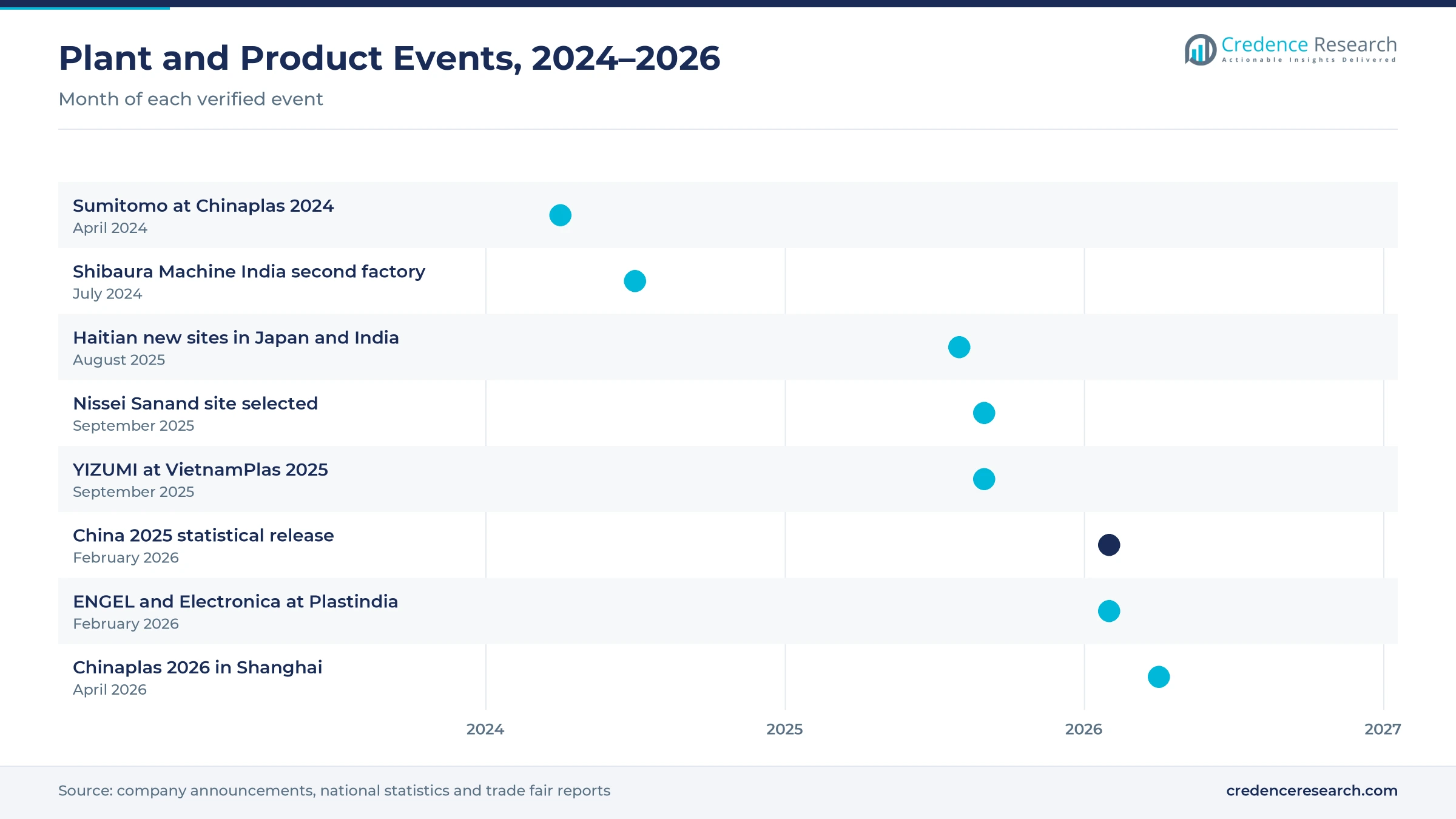
| In April 2024, Sumitomo Heavy Industries showed six injection molding machines from its Shanghai and Ningbo subsidiaries at Chinaplas 2024. | Included cleanroom medical and automotive connector molding |
| In July 2024, Shibaura Machine India opened its second factory near Chennai with an investment of 225 crore rupees. | Capacity rising in phases to 4,000 units a year |
| In August 2025, Haitian International said new production sites in Japan, Serbia and India were being established. | First-half sales exceeded 29,400 machines |
| In September 2025, Nissei Plastic Industrial selected a site in the Sanand Industrial Estate in Gujarat for an India factory. | Targets about 30 electric machines a month |
| In February 2026, ENGEL and Electronica Plastic Machines planned an India-made 6,500 kN two-platen machine for Plastindia 2026. | Shown alongside an all-electric press developed for India |
Servo, all-electric and two-platen designs spread
- Servo-hydraulic drives run the pump only when the press needs pressure, and they remain the volume choice in China and India because they cost less than electric machines.
- All-electric drives use servo motors on every axis for clean, repeatable cycles, which suits cleanroom work for medical device contract manufacturing.
- Two-platen clamps save floor space on large presses, and Electronica now builds a 6,500 kN version in India for technical parts.
- Cloud and AI controls help technicians set up molds, track energy use and fix defects, as Chen Hsong shows with its AI Molder.
Need a Custom Version of This Report?
Tailor the scope, geography, or segments to your exact requirements.
- Custom geography or segment scope
- Direct access to our analyst team
Chinese volume builders face Japanese and European rivals
Competition combines high-volume Chinese builders with Japanese electric specialists and European technology groups that run local plants. Haitian International sells servo-hydraulic Mars, two-platen Jupiter and electric Zhafir machines and is adding a production site in India. YIZUMI and Chen Hsong compete on cost, multi-material designs and digital tools, while LK Technology serves Thailand, Vietnam and Malaysia through local sales and service. Sumitomo Heavy Industries, Nissei and Shibaura Machine compete on all-electric precision, and Shibaura and Nissei are expanding in India. ENGEL works in India with Electronica Plastic Machines, and KraussMaffei builds machines in Haiyan, China, alongside its extrusion lines business. Suppliers compete on energy use, precision, delivery time, financing and the depth of local application and service teams.
Companies profiled and their roles in this market
| Company | Type | Role in the market |
|---|---|---|
| Haitian International | Chinese volume builder | Reported more than 29,400 machines sold in the first half of 2025 and new sites in Japan and India |
| YIZUMI | Chinese machine builder | Runs a Vietnam subsidiary in Bac Ninh and a technical service center in Binh Duong |
| Sumitomo Heavy Industries, Plastics Machinery Division | Japanese all-electric specialist | Operates subsidiaries in Shanghai and Ningbo serving medical and automotive molders |
| ENGEL | European technology group | Works with Electronica Plastic Machines in Pune on machines made for India |
| Chen Hsong | Chinese machine builder | Planned DMZ multi-material machines and an AI Molder for K 2025 in October 2025 |
| KraussMaffei | European technology group | Has built MX-series injection molding machines at its plant in Haiyan, China, since 2013 |
| Nissei Plastic Industrial | Japanese electric specialist | Selected a Sanand, Gujarat, site in September 2025 for electric machine production |
| L.K. Technology, Injection Molding Division | Chinese machine builder | Has sales and service in India and a network covering Thailand, Vietnam and Malaysia |
| Shibaura Machine, Injection Molding Business | Japanese machine builder | Opened a second Chennai factory in July 2024 that can build machines up to 3,500 tons |
Credence Research view on regional press demand
Credence Research's view is that Asia-Pacific press demand will grow faster than consumer markets because builders are localizing production and molders are upgrading to electric and servo drives. China remains the anchor because it hosts the largest builders and part producers, while India adds the most new capacity. Large two-platen machines for vehicle parts and all-electric presses for medical and electronics work raise value per unit. Suppliers that combine local assembly, application support and connected controls are best placed as processors expand across the region.
How the regional estimate was built
The report uses 2025 as the base year and presents market values in USD billion through 2035. Market values come from the Credence Research model, and country, product type, end-use industry, technology and customer type splits are Credence Research estimates. Country shares follow the Credence Research regional model, checked against manufacturing value added, vehicle output and the location of machine builders in each group. Inputs include national statistics, World Bank data, company press releases, trade fair reports and industry media. No interviews or surveys were used in preparing these estimates.
India, large presses and electric drives lead to 2035
The Asia-Pacific injection molding machine market is expected to reach USD 11.30 billion by 2035, a 6.20% CAGR during 2026–2035, as builders localize production and molders add capacity for vehicles, appliances, packaging and medical devices. India and Southeast Asia and Remaining Markets should gain the most share, while China stays the largest country market. All-electric drives, presses above 2,000 tons and technical products are expected to grow faster than the regional average. A prolonged slowdown in Chinese domestic demand would lower this outlook, while faster electric vehicle programs would raise it.
Frequently Asked Questions
How big is the Asia-Pacific injection molding machine market?
Which country group leads regional demand?
Which country group grows fastest?
Which clamping force class holds the largest share?
Which drive technology grows fastest?
How does electric vehicle production affect demand?
Which customer type buys the most presses?
Who are the main companies in the market?
Table of Content
Chapter 1 Market Segmentation
- 1.1 Segmentation Framework
- 1.1.1 Product and Service Classification
- 1.1.2 Application and End-Use Classification
- 1.1.3 Technology and Solution Classification
- 1.1.4 Customer and Distribution Channel Classification
- 1.1.5 Geographic Segmentation
- 1.1.6 Market Segment Definitions and Boundaries
- 1.2 By Product Type
- 1.2.1 25-100 Tonnes
- 1.2.2 Above 100-500 Tonnes
- 1.2.3 Above 500-2,000 Tonnes
- 1.2.4 Above 2,000 Tonnes
- 1.3 By End-Use Industry
- 1.3.1 Packaging
- 1.3.2 Consumer Goods
- 1.3.3 Automotive and Electronics
- 1.3.4 Technical Products
- 1.4 By Technology
- 1.4.1 Hydraulic
- 1.4.2 All-Electric
- 1.4.3 Hybrid
- 1.5 By Customer Type
- 1.5.1 Contract Molders
- 1.5.2 Captive Manufacturers
- 1.5.3 Dedicated Packaging Converters
- 1.6 By Country
- 1.6.1 China
- 1.6.2 Northeast Asia
- 1.6.3 India
- 1.6.4 Southeast Asia and Remaining Markets
Chapter 2 Introduction
- 2.1 Report Objectives and Scope
- 2.2 Product Definition and Industry Terminology
- 2.3 Market Inclusions and Exclusions
- 2.4 Research Process
- 2.4.1 Primary Research and Expert Interviews
- 2.4.2 Secondary Research and Source Review
- 2.4.3 Top-Down and Bottom-Up Estimation
- 2.4.4 Data Triangulation and Verification
- 2.5 Market Size Measurement Basis
- 2.5.1 2025: USD 6.19 billion → 2035: USD 11.30 billion
- 2.6 Historical and Forecast Reference Periods
- 2.6.1 Historical Period: 2018-2025
- 2.6.2 Base Year: 2025
- 2.6.3 Forecast Period: 2025-2035
- 2.7 Research Assumptions and Limitations
Chapter 3 Executive Summary
- 3.1 Market Snapshot and Key Findings
- 3.2 Base-Year Market Size, 2025
- 3.3 Forecast Market Size, 2035
- 3.4 Revenue and Volume Growth Outlook
- 3.5 Key Demand and Supply Indicators
- 3.6 Leading Market Segments
- 3.7 Fastest-Growing Market Opportunities
- 3.8 Regional Performance Highlights
- 3.9 Technology and Industry Transformation
- 3.10 Competitive Landscape Summary
- 3.11 Analyst View and Strategic Implications
Chapter 4 Asia-Pacific Injection Molding Machine Market Trends and Developments
- 4.1 Historical Industry Development, 2018-2025
- 4.2 Recent Market Trends and Developments
- 4.3 Demand and Customer Behavior Trends
- 4.4 Technology and Product Innovation
- 4.5 Artificial Intelligence, Automation and Digitalization
- 4.6 Local Manufacturing and Supply Chain Realignment
- 4.7 Industry Partnerships, Mergers and Acquisitions
- 4.8 Sustainability and Circular Economy Developments
- 4.9 Government and Private Sector Investment Trends
- 4.10 Emerging Business Models and Commercialization
- 4.11 Industry Developments and Announcements
Chapter 5 Asia-Pacific Injection Molding Machine Market Production, Supply and Demand Analysis
- 5.1 Demand Trend and Consumption Analysis, 2018-2025
- 5.2 Demand Forecast, 2025-2035
- 5.3 Production and Output Trend, 2018-2025
- 5.4 Production and Output Forecast, 2025-2035
- 5.5 Installed Capacity and Capacity Utilization
- 5.6 Company-Wise Production Plants and Statistics
- 5.6.1 Installed Production Capacity
- 5.6.2 Actual Production
- 5.6.3 Planned Capacity and Expansion Targets
- 5.7 Supply Chain Structure and Procurement Trends
- 5.8 Supply-Demand Gap and Bottlenecks
- 5.9 Import Dependence and Sourcing Structure
- 5.10 Contract Manufacturing and Outsourcing
- 5.11 Regional Supply and Demand Concentration
Chapter 6 Asia-Pacific Injection Molding Machine Market Pricing Analysis
- 6.1 Pricing Structure and Measurement
- 6.2 Historical Pricing Trends, 2018-2025
- 6.3 Pricing Outlook, 2025-2035
- 6.4 Average Selling Price and Unit Economics
- 6.5 Pricing by Product and Market Segment
- 6.6 Geographic Pricing Differences
- 6.7 Key Input, Energy, Labor and Logistics Costs
- 6.8 Contract Pricing and Purchasing Models
- 6.9 Pricing Sensitivity and Competitive Positioning
- 6.10 Price, Margin and Profitability Implications
Chapter 7 Asia-Pacific Injection Molding Machine Market Dynamics
- 7.1 Market Growth Drivers
- 7.1.1 Demand-Side Drivers
- 7.1.2 Technology and Innovation Drivers
- 7.1.3 Infrastructure and Investment Drivers
- 7.1.4 Regulatory and Policy Drivers
- 7.2 Market Restraints
- 7.2.1 Cost and Affordability Constraints
- 7.2.2 Technology and Adoption Barriers
- 7.2.3 Supply Chain and Operational Constraints
- 7.3 Market Challenges
- 7.3.1 Competitive Pressure and Margin Erosion
- 7.3.2 Skills, Infrastructure and Implementation Gaps
- 7.4 Emerging Market Opportunities
- 7.5 Market Dynamics Impact and Time-Horizon Assessment
Chapter 8 Asia-Pacific Injection Molding Machine Value Chain Analysis
- 8.1 Industry Value Chain Overview
- 8.2 Upstream Suppliers and Critical Inputs
- 8.3 Technology and Component Providers
- 8.4 Manufacturing or Service Delivery
- 8.5 Distribution, Channel Partners and Integrators
- 8.6 Downstream Applications and End Users
- 8.7 Value Addition and Profit Pools
- 8.8 Vertical Integration and Outsourcing
- 8.9 Supplier Concentration and Risk
- 8.10 Supply Chain Localization and Resilience
Chapter 9 Asia-Pacific Injection Molding Machine Market Regulations and Policies
- 9.1 Relevant Laws, Standards and Compliance Frameworks
- 9.2 Product, Service, Safety and Quality Requirements
- 9.3 Government Policies, Incentives and Subsidies
- 9.4 Imports, Exports and Trade Barriers
- 9.5 Public Procurement and Local Content Requirements
- 9.6 Environmental and Sustainability Compliance
- 9.7 Upcoming Policy Changes and Market Implications
Chapter 10 Asia-Pacific Injection Molding Machine Market Hotspots and Opportunities
- 10.1 Market Opportunity Mapping and Growth Hotspots
- 10.2 High-Growth Applications and Customer Groups
- 10.3 Underserved Markets and White-Space Opportunities
- 10.4 Emerging Technology and Product Opportunities
- 10.5 New Capacity and Investment Hotspots
- 10.6 Market Entry and Expansion Opportunities
- 10.7 Distribution and Partnership Opportunities
- 10.8 Near-Term and Long-Term Commercial Potential
- 10.9 Opportunity Attractiveness and Execution Risks
Chapter 11 Asia-Pacific Injection Molding Machine Market Outlook, 2025-2035
- 11.1 Market Size and Analysis
- 11.1.1 Revenue (Market Measurement: 2025: USD 6.19 billion → 2035: USD 11.30 billion)
- 11.1.2 Market Volume and Quantity Sold
- 11.1.3 Historical Market Size, 2018-2025
- 11.1.4 Base-Year Market Size, 2025
- 11.2 Market Forecast, 2025-2035
- 11.2.1 Revenue Forecast to 2035
- 11.2.2 Volume Forecast to 2035
- 11.2.3 CAGR and Year-on-Year Growth
- 11.2.4 Incremental Revenue Opportunity
- 11.3 Forecast Assumptions and Scenario Analysis
- 11.3.1 Base-Case Forecast
- 11.3.2 Optimistic and Conservative Scenarios
- 11.3.3 Technology, Pricing and Policy Sensitivities
- 11.4 Market Attractiveness and Growth Outlook
Chapter 12 Asia-Pacific Injection Molding Machine Market Segmentation and Outlook
- 12.1 Segmentation Summary and Market Shares, 2025
- 12.2 Largest and Fastest-Growing Segments
- 12.3 By Product Type - Market Size and Forecast, 2025-2035
- 12.3.1 Segment Definition and Scope
- 12.3.2 Historical Market Size, 2018-2025
- 12.3.3 Revenue Forecast, 2025-2035
- 12.3.4 Volume Forecast, 2025-2035
- 12.3.5 Base-Year Market Share, 2025
- 12.3.6 Segment CAGR and Growth Drivers
- 12.3.7 Subsegment Market Size and Forecast
- 12.3.7.1 25-100 Tonnes
- 12.3.7.2 Above 100-500 Tonnes
- 12.3.7.3 Above 500-2,000 Tonnes
- 12.3.7.4 Above 2,000 Tonnes
- 12.3.8 Subsegment Pricing and Adoption Trends
- 12.3.9 Leading Suppliers and Competition
- 12.3.10 Regional Demand and Opportunities
- 12.4 By End-Use Industry - Market Size and Forecast, 2025-2035
- 12.4.1 Segment Definition and Scope
- 12.4.2 Historical Market Size, 2018-2025
- 12.4.3 Revenue Forecast, 2025-2035
- 12.4.4 Volume Forecast, 2025-2035
- 12.4.5 Base-Year Market Share, 2025
- 12.4.6 Segment CAGR and Growth Drivers
- 12.4.7 Subsegment Market Size and Forecast
- 12.4.7.1 Packaging
- 12.4.7.2 Consumer Goods
- 12.4.7.3 Automotive and Electronics
- 12.4.7.4 Technical Products
- 12.4.8 Subsegment Pricing and Adoption Trends
- 12.4.9 Leading Suppliers and Competition
- 12.4.10 Regional Demand and Opportunities
- 12.5 By Technology - Market Size and Forecast, 2025-2035
- 12.5.1 Segment Definition and Scope
- 12.5.2 Historical Market Size, 2018-2025
- 12.5.3 Revenue Forecast, 2025-2035
- 12.5.4 Volume Forecast, 2025-2035
- 12.5.5 Base-Year Market Share, 2025
- 12.5.6 Segment CAGR and Growth Drivers
- 12.5.7 Subsegment Market Size and Forecast
- 12.5.7.1 Hydraulic
- 12.5.7.2 All-Electric
- 12.5.7.3 Hybrid
- 12.5.8 Subsegment Pricing and Adoption Trends
- 12.5.9 Leading Suppliers and Competition
- 12.5.10 Regional Demand and Opportunities
- 12.6 By Customer Type - Market Size and Forecast, 2025-2035
- 12.6.1 Segment Definition and Scope
- 12.6.2 Historical Market Size, 2018-2025
- 12.6.3 Revenue Forecast, 2025-2035
- 12.6.4 Volume Forecast, 2025-2035
- 12.6.5 Base-Year Market Share, 2025
- 12.6.6 Segment CAGR and Growth Drivers
- 12.6.7 Subsegment Market Size and Forecast
- 12.6.7.1 Contract Molders
- 12.6.7.2 Captive Manufacturers
- 12.6.7.3 Dedicated Packaging Converters
- 12.6.8 Subsegment Pricing and Adoption Trends
- 12.6.9 Leading Suppliers and Competition
- 12.6.10 Regional Demand and Opportunities
- 12.7 By Country - Market Size and Forecast, 2025-2035
- 12.7.1 Segment Definition and Scope
- 12.7.2 Historical Market Size, 2018-2025
- 12.7.3 Revenue Forecast, 2025-2035
- 12.7.4 Volume Forecast, 2025-2035
- 12.7.5 Base-Year Market Share, 2025
- 12.7.6 Segment CAGR and Growth Drivers
- 12.7.7 Subsegment Market Size and Forecast
- 12.7.7.1 China
- 12.7.7.2 Northeast Asia
- 12.7.7.3 India
- 12.7.7.4 Southeast Asia and Remaining Markets
- 12.7.8 Subsegment Pricing and Adoption Trends
- 12.7.9 Leading Suppliers and Competition
- 12.7.10 Regional Demand and Opportunities
- 12.8 Segment Growth Comparison
- 12.9 Segment Attractiveness and Priority Matrix
Chapter 13 Asia-Pacific Injection Molding Machine End-Use and Application Market Outlook
- 13.1 End-Use Industry and Customer Demand Structure
- 13.2 Leading Applications and Customer Groups
- 13.3 End-Use Market Size, Share and Forecast
- 13.4 Major End-Use Industry Deep Dives
- 13.4.1 Customer Requirements and Use Cases
- 13.4.2 Demand and Replacement Cycles
- 13.4.3 Technical and Regulatory Considerations
- 13.4.4 Purchasing and Procurement Models
- 13.4.5 Leading Vendors and Distribution Channels
- 13.4.6 Forecast and Commercial Opportunities
- 13.5 Emerging Applications and Cross-Segment Demand
- 13.6 End-Use Industry Investment Priorities
Chapter 14 Asia-Pacific Injection Molding Machine Geographic Market Outlook, 2025-2035
- 14.1 Regional Market Size and Country-Level Shares, 2025
- 14.2 Country Market Size Comparison, 2025
- 14.3 Country Market Forecasts, 2025-2035
- 14.4 Subregional Industrial and Demand Clusters
- 14.5 Intra-Regional Pricing and Cost Differences
- 14.6 Cross-Border Trade and Supply Networks
- 14.7 Regional Supply and Demand Balances
- 14.8 Country Opportunity Comparison and Prioritization
Note: Every listed country is covered on the structure shown under the first country.
Chapter 15 Asia-Pacific Injection Molding Machine Technology, Innovation and Sustainability Outlook
- 15.1 Technology Landscape and Maturity
- 15.2 Product, Process and Service Innovation
- 15.3 AI, Automation and Digital Tools in the Industry
- 15.4 Technology Adoption and Performance Benchmarking
- 15.5 Innovation Pipeline and R&D Investment
- 15.6 Patent and Intellectual Property Trends
- 15.7 Energy Efficiency and Resource Management
- 15.8 Sustainability, Recycling and Circularity
- 15.9 Technology Roadmap, 2025-2035
- 15.10 Risks of Obsolescence and Technology Substitution
Chapter 16 Asia-Pacific Injection Molding Machine Market Key Strategic Imperatives
- 16.1 Growth and Market Entry Priorities
- 16.2 High-Return Products and Segments
- 16.3 Pricing, Profitability and Cost Optimization
- 16.4 Technology Investment and Product Differentiation
- 16.5 Supply Chain Localization and Resilience
- 16.6 Distribution and Customer Acquisition
- 16.7 Partnership, Acquisition and Capacity Strategy
- 16.8 Regional Expansion Priorities
- 16.9 Short-, Medium- and Long-Term Actions
Chapter 17 Competition Outlook
- 17.1 Industry Competition Characteristics
- 17.2 Market Structure and Concentration
- 17.3 Market Share and Competitive Positioning, 2025
- 17.4 Company-Wise Revenue and Product Benchmarking
- 17.5 Production and Service Capacity Benchmarking
- 17.6 Technology, Pricing and Differentiation
- 17.7 Regional Footprint and Distribution Strength
- 17.8 Mergers, Acquisitions and Strategic Alliances
- 17.9 New Entrants and Competitive Threats
- 17.10 Porter's Five Forces and Industry Attractiveness
- 17.11 Competitive Outlook, 2025-2035
Chapter 18 Company Profiles
- 18.1 Company Coverage and Selection Criteria
- 18.2 Haitian International
- 18.2.1 Business Description
- 18.2.2 Company Ownership and Geographic Presence
- 18.2.3 Product and Service Portfolio
- 18.2.4 Manufacturing and Operating Footprint
- 18.2.5 Production Capacity and Expansion Plans
- 18.2.6 Financial Performance and Investment
- 18.2.7 Market Share and Competitive Position
- 18.2.8 Technology and Innovation Capabilities
- 18.2.9 Strategic Alliances or Partnerships
- 18.2.10 Recent Developments
- 18.2.11 Growth Strategy and Outlook
- 18.3 YIZUMI
- 18.4 Sumitomo Heavy Industries, Plastics Machinery Division
- 18.5 ENGEL
- 18.6 Chen Hsong
- 18.7 KraussMaffei
- 18.8 Nissei Plastic Industrial
- 18.9 L.K. Technology, Injection Molding Division
- 18.10 Shibaura Machine, Injection Molding Business
- 18.11 TOYO INNOVEX
- 18.12 Other Relevant Market Participants
Note: Every listed company is profiled on the structure shown under the first company. The company list is preliminary and may change based on research findings, market developments, data availability and client requirements.
Chapter 19 Disclaimer
- 19.1 Research and Forecast Disclaimer
- 19.2 Data Source and Estimation Limitations
Note: The depth of individual sections depends on data availability for this market. Volume, capacity, trade and other unit-based metrics are included where applicable.

