
Pipe, film and compound lines anchor regional demand
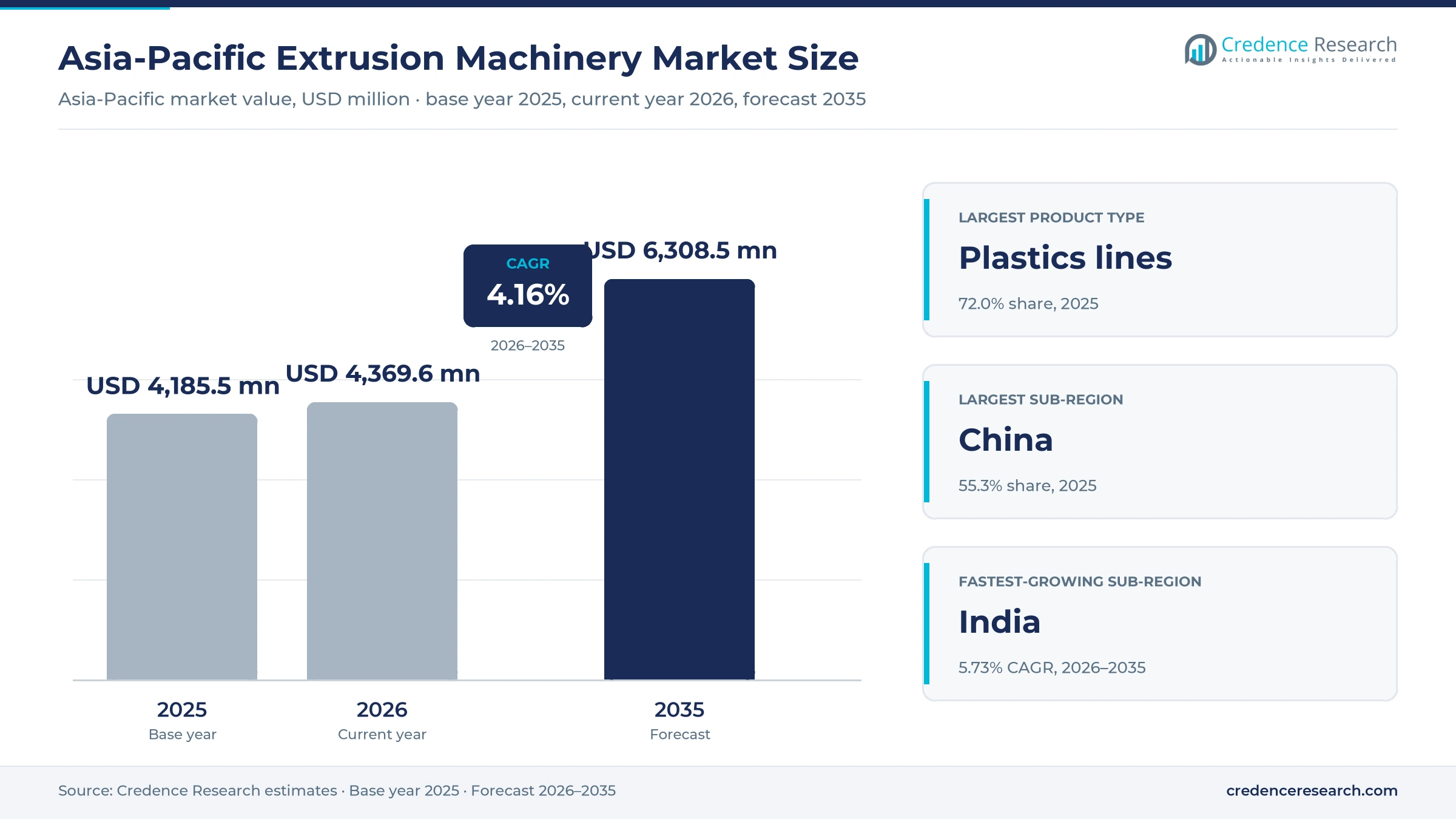
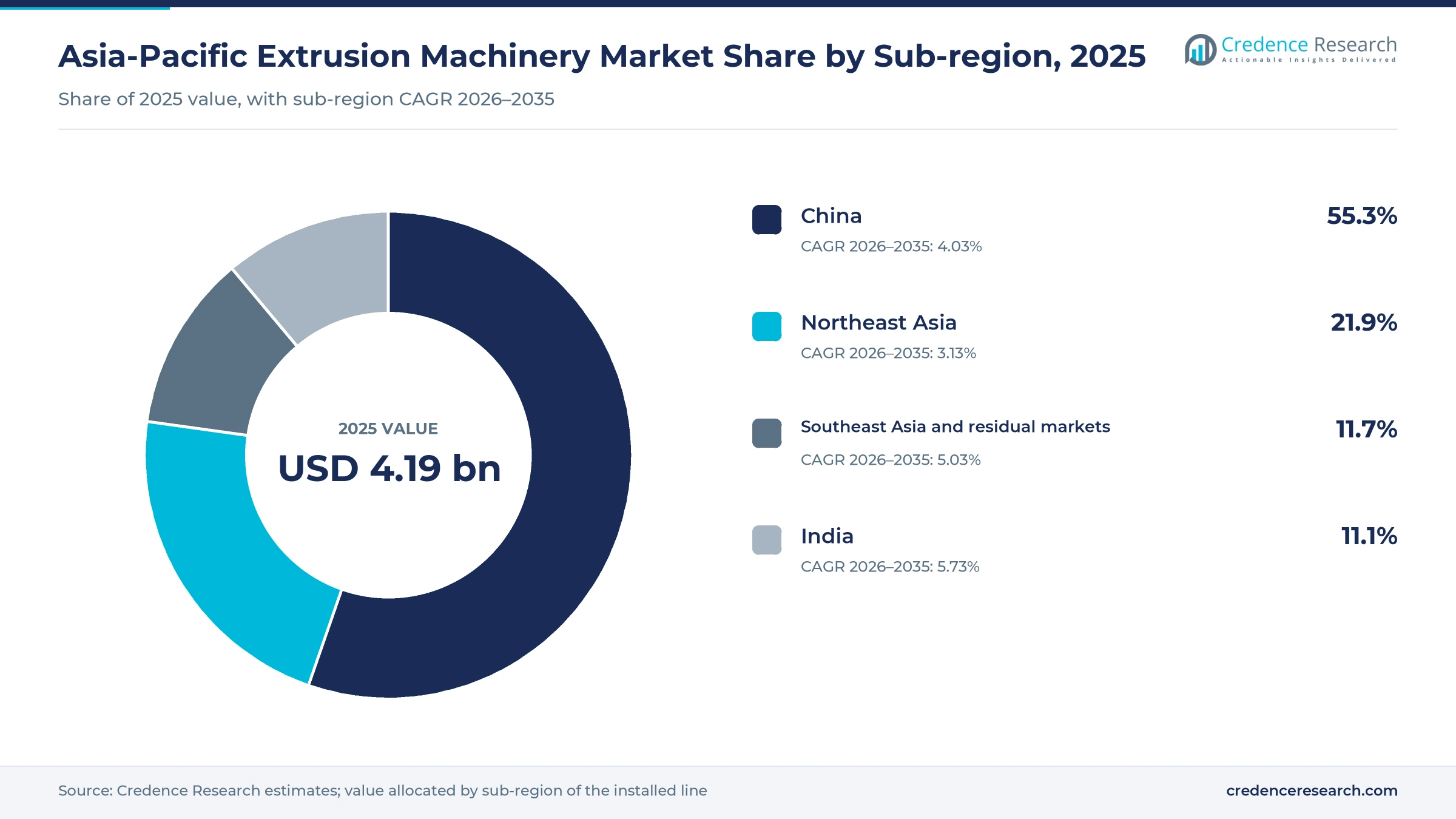
The Asia-Pacific extrusion machinery market was valued at USD 4.19 billion in 2025 and is projected to increase from USD 4.37 billion in 2026 to USD 6.31 billion by 2035, registering a CAGR of 4.16% during 2026–2035. Demand comes from pipe and profile makers serving housing and water networks, film and sheet converters supplying packaging, and compounders that prepare engineering plastics for vehicles and electronics. China held the largest sub-regional share, 55.3% in 2025, because it combines the deepest base of plastics processors with domestic builders that supply complete lines at short notice. India is the fastest-growing sub-region at 5.73% a year, as water supply programs, packaging demand and new recycled-content rules bring fresh capacity. India set recycled-content targets for rigid plastic packaging that rise from 30% in 2025-26 to 60% from 2028-29, which pushes converters toward extruders with better melt filtration, degassing and process control.
Which extrusion equipment does the regional estimate cover?
The estimate measures spending on new extrusion machinery installed across China, Northeast Asia, India and Southeast Asia and residual markets. It covers plastics, metal, rubber and hybrid extrusion machinery, including single-screw and twin-screw extruders, complete pipe, profile, film and sheet lines, compounding and pelletizing systems and metal extrusion presses. Values are measured at the price paid by the buyer, whether through direct OEM sales, authorized distributors or system integrators.
The estimate excludes used machinery, spare parts sold separately, molds and dies bought apart from a line, and injection or blow molding equipment. The value chain runs from screw, barrel and gearbox makers through machine builders and integrators to integrated converters, independent processors and research and pilot facilities that run the lines.
Asia-Pacific Extrusion Machinery Market Insights
- The Asia-Pacific extrusion machinery market was valued at USD 4.19 billion in 2025 and is projected to reach USD 6.31 billion by 2035, registering a CAGR of 4.16% during 2026–2035.
- China held a 55.3% share of 2025 value, because the country accounted for 32% of global plastics and rubber machinery sales in 2024.
- Plastics extrusion machinery led product demand with a 72.0% share of 2025 value, because pipe, film and compounding lines dominate installed capacity.
- India notified recycled-content targets on March 31, 2026, that lift rigid plastic packaging from 30% recycled material in 2025-26 to 60% from 2028-29.
- JWELL Machinery opened six exhibition zones at Chinaplas 2026 in Shanghai, including a dedicated recycling and upcycling zone for its extrusion lines.
Plastics lines lead while hybrid machines grow fastest
Why do plastics lines lead product demand?
Based on product type, the market is categorized into plastics, metal, rubber and hybrid extrusion machinery. Plastics extrusion machinery led with 72.0% of 2025 value, because pipe, film, sheet and compounding lines form most of the installed base in China and India. Hybrid extrusion machinery grows fastest at 5.69% a year, as processors want machines that switch between virgin resin, recyclate and filled compounds on one line.
How does construction shape end-use demand?
Based on end-use industry, the market is categorized into construction, packaging, engineered manufacturing and healthcare and specialty processing. Construction led with 36.0% of 2025 value, because PVC and HDPE pipe, window profiles and aluminum sections need large lines. Healthcare and specialty processing grows fastest at 5.07% a year, as medical tubing and fine wire coating need precise small extruders.
Why does single-screw technology still lead?
Based on technology, the market is categorized into single-screw, twin-screw and non-screw and multi-screw technology. Single-screw technology led with 60.0% of 2025 value, because single-screw extruders run most pipe, film and sheet lines at low cost per ton. Twin-screw technology grows fastest at 4.94% a year, as compounding, recycling and filled polymers need intensive mixing.
How do buyers purchase extrusion lines?
Based on sales channel, the market is categorized into direct OEM sales, authorized distributor sales and system integrator sales. Direct OEM sales led with 58.0% of 2025 value, because large converters negotiate complete lines with the builder. System integrator sales grow fastest at 4.95% a year, as smaller processors buy turnkey lines with feeders, dryers and downstream units.
| Segment Group | Leading Sub-segment | Share, 2025 | Fastest-growing Sub-segment | CAGR, 2026–2035 |
|---|---|---|---|---|
| By Product Type | Plastics extrusion machinery | 72.0% | Hybrid extrusion machinery | 5.69% |
| By End-Use Industry | Construction | 36.0% | Healthcare and specialty processing | 5.07% |
| By Technology | Single-screw technology | 60.0% | Twin-screw technology | 4.94% |
| By Sales Channel | Direct OEM sales | 58.0% | System integrator sales | 4.95% |
Request a Free Sample
Fill in your details and we'll send you a free sample report.
- Sample data tables & charts
- Research methodology
EV materials, recycled feed and local supply lift orders
Electric vehicle materials lift compounding and press orders
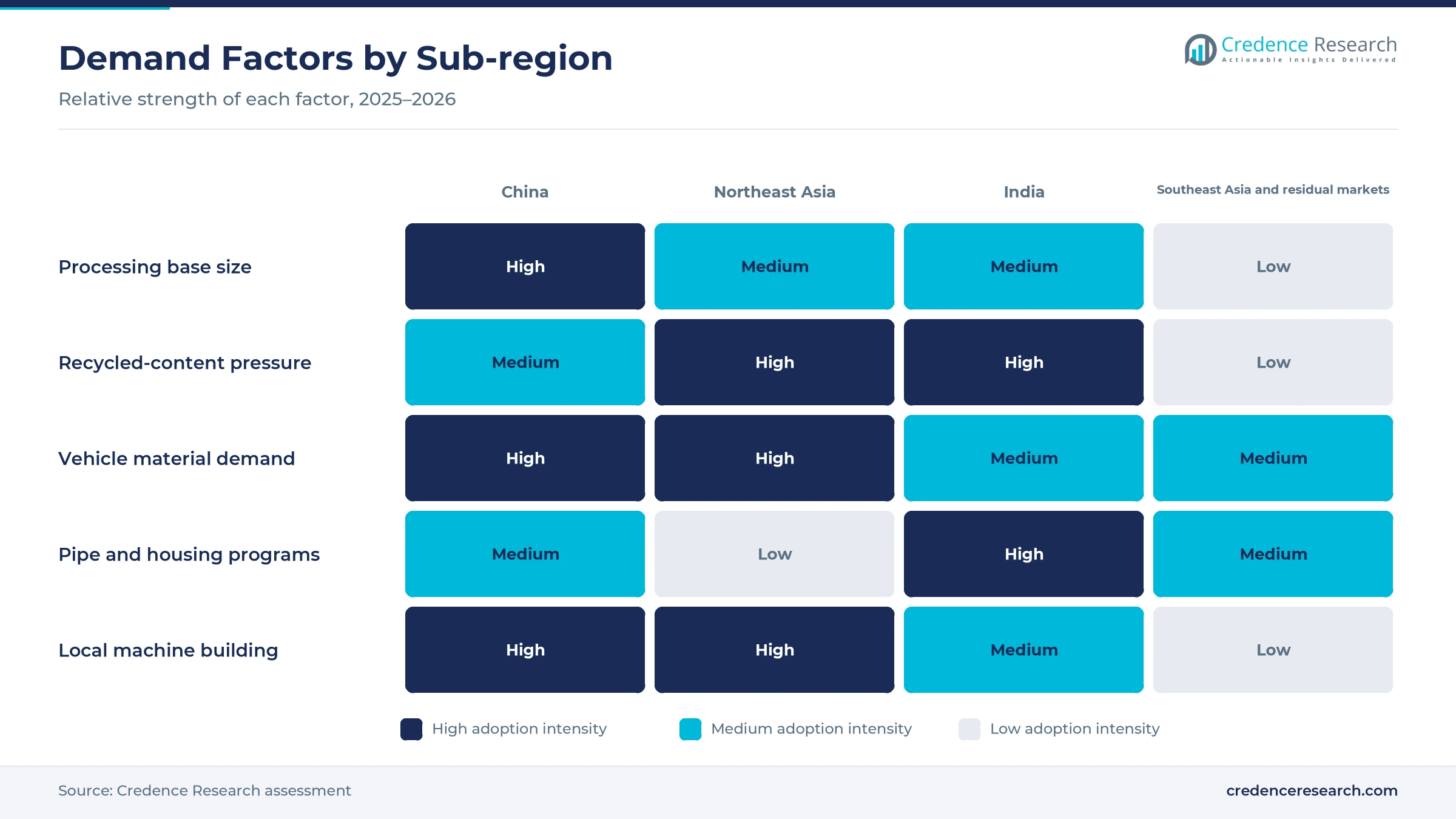
Advanced automotive materials raise demand for compounding lines and metal presses, because electric models use more engineered polymers and aluminum sections. China produced 16.524 million new energy vehicles in 2025, up 25.1%, while automobile manufacturing value added rose 11.5%, according to the National Bureau of Statistics of China. Battery housings, cable insulation and lightweight trim need glass-filled, flame-retardant and conductive compounds that twin-screw extruders prepare. SMS group also supplied a 28 MN direct-indirect press to Shandong Weiqiao Lightweight Materials, sized for about 10,000 tons a year of aluminum profiles and thin-walled tubes mainly for vehicles. As a result, twin-screw technology grows fastest among technologies at 4.94% a year.
Recycled-content rules require new melt processing lines
Recycled-material requirements push converters to replace older extruders with lines that filter, degas and stabilize mixed feed. India's Plastic Waste Management (Amendment) Rules, 2026, notified on March 31, 2026, set recycled content for rigid plastic packaging at 30% for 2025-26, 40% for 2026-27 and 60% from 2028-29, as summarized by Corporate Professionals. Recycled packaging must also meet IS 14534:2023 and food-contact rules, which raises the bar for melt quality. Coperion is building a 5,500 kg/h PET bottle-to-bottle plant for Magpet Polymer in India, with Herbold handling washing and Coperion supplying extrusion. Because of these rules, Indian converters need lines that can filter and degas mixed feed, which older single-screw machines often cannot do.
Regional sourcing moves machine building closer to buyers
Manufacturing localization favors builders with plants, service teams and spare parts inside the region. China's share of global plastics and rubber machinery sales rose from 4% in 2000 to 32% in 2024, according to VDMA figures reported by dpa. Rajoo Engineers broke ground on an 80-acre advanced manufacturing park on Feb. 5, 2025, in India. Coperion manufactures its WZK diverter valves at its Coperion Ideal site in Noida, which marks 30 years of operation in India, so recycling and compounding plants can source key handling parts locally. KraussMaffei's plant in Jiaxing, China, covers 58,000 square meters and keeps 37,000 square meters of reserved land for expansion.
Water supply and housing programs keep pipe lines busy
Water and housing programs sustain orders for pipe and profile lines, which explains why construction leads end-use demand with 36.0% of 2025 value. India has provided tap water connections to more than 15 crore rural households under the Jal Jeevan Mission, Jal Shakti Minister C R Patil told the Lok Sabha on Dec. 4, 2025. Each connection relies on distribution networks built from plastic pipes, mainly PVC and HDPE. Kabra ExtrusionTechnik showed PVC, HDPE, oriented PVC and CPVC pipe lines at Plastindia 2026, and the company reports more than 17,700 installations across 105 countries. As a result, pipe makers remain among the most frequent buyers of new single-screw lines across the country.
Recycling-ready lines and standard twin-screw models emerge
Shift toward recycling-ready lines at regional trade shows
Builders now present recycling as a core line type rather than an add-on, which changes what processors expect from new machines. JWELL Machinery opened six zones at Chinaplas 2026 in Shanghai on April 22, 2026, including a recycling and upcycling zone beside its pipe, film and sheet equipment. Coperion planned to show a ZSK 58 Mc18 twin-screw extruder rated up to 2,500 kg/h at Plastindia 2026, alongside feeders for recyclate flakes, as reported by PolyformNext. Japan's plastics resource circulation law, in force since April 1, 2022, under a Cabinet order reported by METI, keeps Japanese buyers focused on plastic recycling.
Rise of standardized twin-screw models with shorter lead times
Twin-screw builders are standardizing mid-range models, because processors increasingly want reliable machines delivered within months rather than fully custom systems. The Japan Steel Works introduced its TEX-alpha R series, which Plastics Machinery & Manufacturing reported on Jan. 24, 2024, with five models from 47 mm to 96.5 mm screw diameter, and its engineering manager said customers can receive a machine in four or five months. The series lists masterbatch, polyolefin, glass-filled and recycling uses, which matches the main compounding jobs in the region. Shibaura Machine also sells its TEM compounders as standard TEM-S, TEM-SS and TEM-SX models, and its U.S. licensee NFM extended its license for 10 years in May 2024. Hence standardized twin-screw models are likely to win more mid-sized compounding orders in China and India.
Opportunity in medical tubing and specialty wire lines
Healthcare and specialty processing offers an opening for builders of small, precise extruders and it grows fastest among end uses at 5.07% a year. Everplast Machinery presented a medical tube line with output of 2 to 80 kg/h for normal, spiral, breathing and oxygen tubes on the VietnamPlas exhibitor platform in June 2025. Shibaura Machine India entered the cable and wire extrusion segment with auxiliary equipment at Cable & Wire Fair 2025 in New Delhi. Davis-Standard installed a lab-line extrusion system at Thai Polyethylene in Rayong, which supports pilot work on high value-added film products.
Opening in Indian and Southeast Asian capacity build-outs
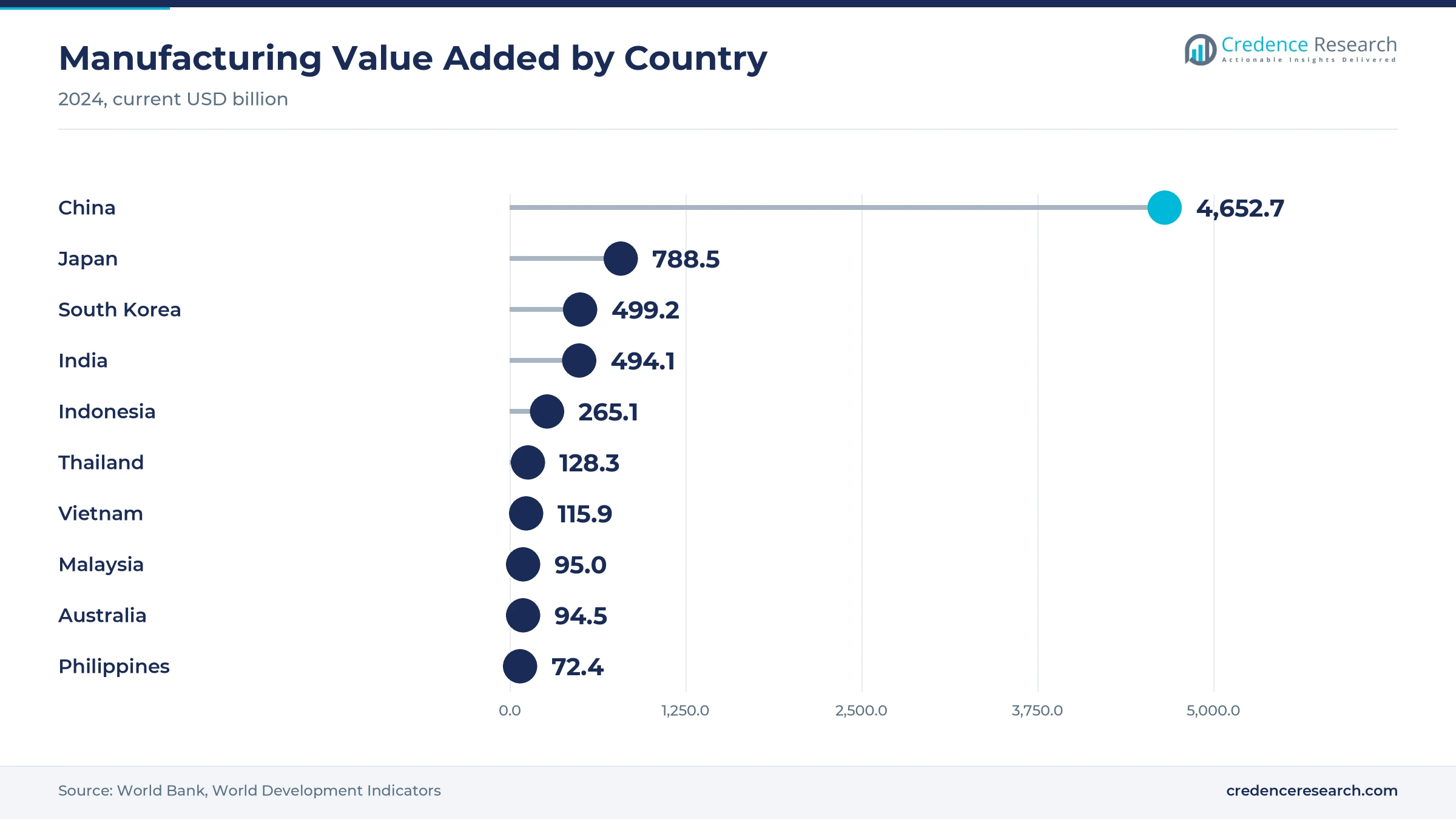
New processing capacity in India and Southeast Asia gives builders room to win first-time buyers and later retrofit business. Vietnam's manufacturing value added rose from USD 104.6 billion in 2023 to USD 115.9 billion in 2024, according to the World Bank. Plastindia 2026 opened at Bharat Mandapam in New Delhi on Feb. 5, 2026, with more than 2,000 exhibitors, according to its national executive chairman. Hindalco is building a fully automated 34,000-ton aluminum extrusion plant with three presses in Silvassa, which supports metal press demand. As a result, Southeast Asia and residual markets grow at 5.03% a year.
Price rivalry, mixed recyclate and uneven capital spending
Price rivalry from domestic builders squeezes margins
Domestic builders in China and India now offer complete pipe, film and sheet lines at prices that imported machines struggle to match. European plastics and rubber machinery exports to China fell 20% to 2.9 billion euros in 2024, according to VDMA data published by Extrusion magazine. As a result, European and Japanese suppliers must justify higher prices through output per hour, energy use and uptime guarantees. Suppliers respond with local assembly, standardized models and service contracts that lower the total cost over the life of a line.
Mixed recyclate raises wear and quality risk
Recycled feed often carries moisture, paper, metal and mixed polymers, which wears screws and barrels faster than virgin resin. Because of this, processors that move to recycled content face more downtime, higher filter costs and wider variation in film or pipe quality. Food-contact packaging adds further testing before recycled material can be used. Builders answer with melt filtration, vacuum degassing and wear-resistant screws, although these options add cost that smaller converters find hard to fund.
Uneven capital spending delays new line orders
Extrusion lines are long-lived capital goods, so processors delay orders when resin prices swing or end markets slow. In China, floor space of newly started buildings fell 20.4% to 587.70 million square meters in 2025, according to the National Bureau of Statistics of China, which delays pipe and profile line orders. This timing risk hits builders that depend on a few large orders each year. Suppliers reduce the risk by building service, retrofit and spare parts revenue that holds up when new line orders soften.
Skilled operators and service coverage remain thin
Modern extrusion lines need trained operators, process engineers and service technicians, and these skills are scarce in many fast-growing markets. Consequently, processors in smaller Indian cities and parts of Southeast Asia wait longer for commissioning and repairs, which lowers line uptime. Imported machines also face slower spare parts delivery than local builds. Builders respond with regional service centers, remote monitoring, operator training programs and local partners that hold common spare parts.
China leads while India grows fastest across the region
| Sub-region | Value, 2025 (USD billion) | Share, 2025 | CAGR, 2026–2035 |
|---|---|---|---|
| China | 2.31 | 55.3% | 4.03% |
| Northeast Asia | 0.92 | 21.9% | 3.13% |
| Southeast Asia and residual markets | 0.49 | 11.7% | 5.03% |
| India | 0.46 | 11.1% | 5.73% |
China combines scale, local builders and fast delivery
China held 55.3% of 2025 value and grows at 4.03% a year, because it hosts the region's largest pipe, film and compounding base. Value added in rubber and plastic products rose 5.4% in 2025, while manufacturing value added grew 6.4%, according to the National Bureau of Statistics of China. JWELL Machinery runs factories in Suzhou, Taicang, Haining and Changzhou, which shortens delivery for domestic buyers. KraussMaffei also completes, assembles and commissions conical twin-screw pipe extruders in Haiyan, China, using core components from Germany, which serves local PVC pipe makers.
Northeast Asia relies on precision and replacement demand
Northeast Asia held 21.9% of 2025 value and grows at 3.13% a year, the slowest pace in the region, because Japan, South Korea and Taiwan replace lines more than they add capacity. Japan's manufacturing value added was about USD 788.5 billion in 2024 and South Korea's about USD 499.2 billion, which keeps demand high for precise compounding and film lines. The Japan Steel Works planned a chemical recycling center at its Hiroshima Plant to support customers using its TEX twin-screw extruders, and Shibaura Machine owns the TEM co-rotating twin-screw design.
India adds pipe, packaging and recycling capacity fastest
India held 11.1% of 2025 value and grows fastest at 5.73% a year, because water programs, packaging and new recycled-content rules all require new lines. Domestic builders such as Kabra ExtrusionTechnik and Rajoo Engineers supply pipe, blown film and sheet lines, with Rajoo based in Rajkot and Kabra running research in Daman. Coperion's Noida site has served the market for three decades with dosing and handling systems. India's manufacturing value added reached about USD 494.1 billion in 2024, close to South Korea, which shows the size of its processing base.
Southeast Asia gains film, pipe and medical tube lines
Southeast Asia and residual markets held 11.7% of 2025 value and grow at 5.03% a year, as Vietnam, Thailand and Indonesia attract packaging and component plants. Vietnam imported 6.82 million tons of plastic raw materials in 2023, according to figures cited at HanoiPlas 2024. Indonesia's manufacturing value added reached about USD 265.1 billion in 2024 and Thailand's about USD 128.3 billion, which supports steady demand for film, sheet and pipe lines across the area.
Factory expansions, trade show launches and new rules
| Development | Status and market relevance |
|---|---|
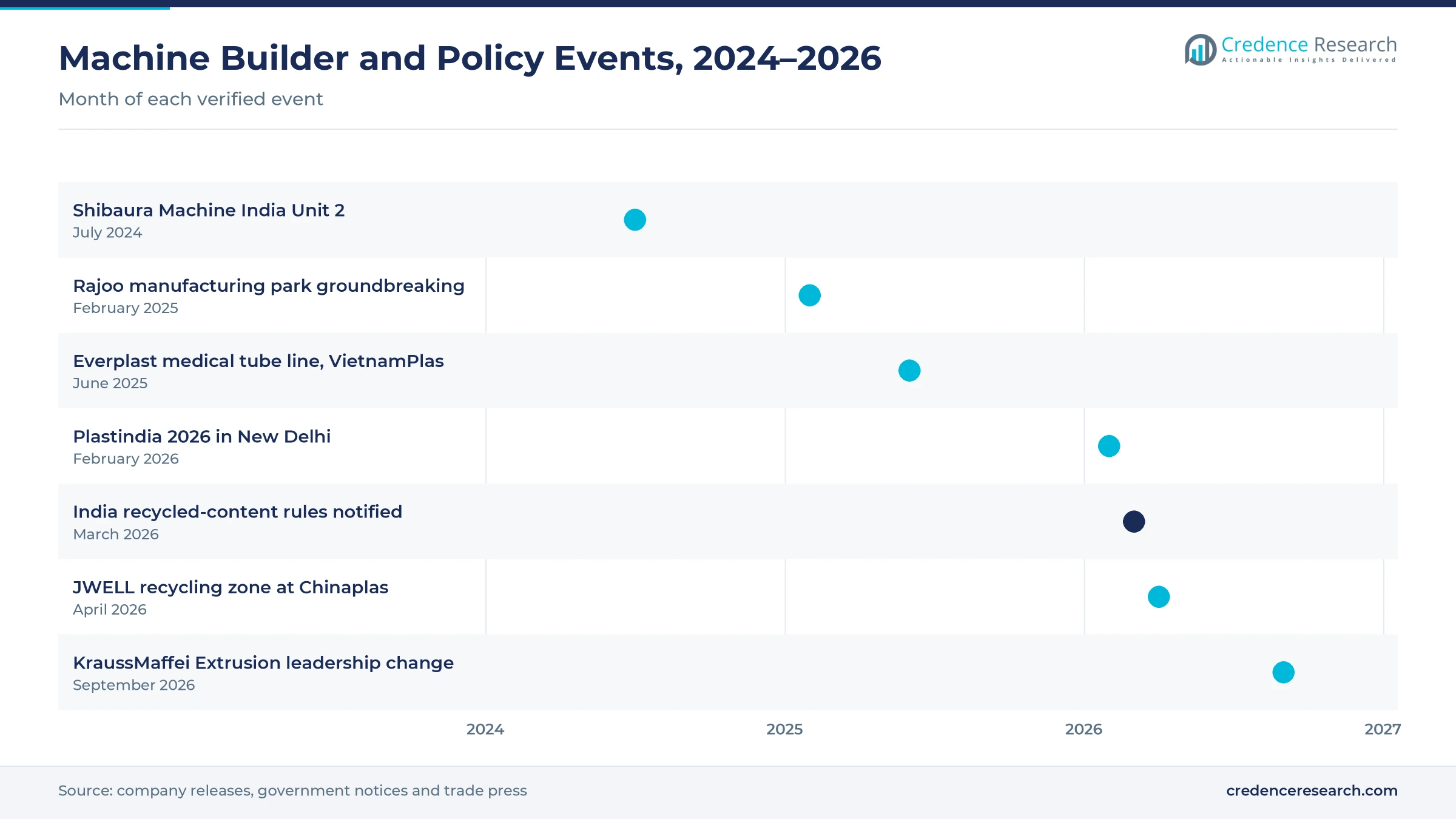
| In September 2026, KraussMaffei named Ren Xinting, who leads its China business, as managing director of KraussMaffei Extrusion effective Sept. 1, 2026. | Links extrusion leadership more closely to China and wider Asia |
| In April 2026, JWELL Machinery opened six exhibition zones at Chinaplas 2026 in Shanghai, including a recycling and upcycling zone. | Shows recycling lines becoming a core product for Chinese builders |
| In March 2026, India notified the Plastic Waste Management (Amendment) Rules, 2026, with recycled-content targets rising to 60% for rigid packaging. | Raises demand for recycling and melt filtration equipment |
| In February 2026, Kabra ExtrusionTechnik presented PVC, HDPE, oriented PVC and CPVC pipe extrusion lines at Plastindia 2026 in New Delhi. | Targets water and building pipe makers in India |
| In February 2025, Rajoo Engineers broke ground on an 80-acre advanced manufacturing park in India. | Expands domestic machine-building capacity over several phases |
Screw design, press size and melt filtration shape buying
- Single-screw extruders remain the workhorse for pipe, profile, film and sheet lines, because they deliver steady output at low cost per ton.
- Twin-screw extruders mix fillers, glass fiber, flame retardants and recyclate intensively, which makes them central to compounding and pelletizing.
- Direct-indirect presses shape aluminum billets into profiles and thin-walled tubes, which serves vehicle frames, battery housings and window systems.
- Melt filtration and degassing units remove contaminants and moisture from recycled feed, which helps converters meet recycled-content and food-contact rules.
Need a Custom Version of This Report?
Tailor the scope, geography, or segments to your exact requirements.
- Custom geography or segment scope
- Direct access to our analyst team
Local builders and global specialists compete on delivery
Competition splits between Chinese and Indian builders that sell complete lines at short delivery times and Japanese and European specialists that compete on precision, mixing performance and process know-how. JWELL Machinery covers pipe, profile, film, sheet, blow molding and recycling equipment from several plants in eastern China. Kabra ExtrusionTechnik and Rajoo Engineers serve Indian pipe and film makers with local service. The Japan Steel Works and Shibaura Machine focus on twin-screw compounding, while Coperion pairs extruders with feeders and bulk handling for polyolefin and recycling plants. KraussMaffei Extrusion assembles pipe extruders in China, Davis-Standard supplies film and coating lines to petrochemical customers such as Thai Polyethylene, and SMS group builds large aluminum presses. Everplast Machinery targets medical tubing and profile lines with smaller, precise extrusion systems. Buyers weigh price against uptime, energy use and service reach.
Companies profiled and their roles in this market
| Company | Type | Role in the market |
|---|---|---|
| The Japan Steel Works | Twin-screw specialist | TEX series compounding extruders, including standardized TEX-alpha R models |
| KraussMaffei Extrusion | Line builder | Pipe and profile extruders assembled in Haiyan, China |
| JWELL Machinery | Domestic line builder | Pipe, film, sheet and recycling lines from four plants in China |
| Shibaura Machine | Twin-screw specialist | TEM twin-screw compounders and extrusion auxiliaries in India |
| Davis-Standard | Film and coating lines | Lab and production lines for petrochemical customers in Thailand |
| Coperion | Compounding systems | ZSK extruders and a PET bottle-to-bottle plant in India |
| SMS group | Metal press builder | Direct-indirect aluminum presses for automotive profiles in China |
| Kabra ExtrusionTechnik | Domestic line builder | PVC, HDPE and oriented PVC pipe lines and blown film plants |
| Rajoo Engineers | Domestic line builder | Blown film and sheet lines, new 80-acre manufacturing park |
| Everplast Machinery | Specialty line builder | Medical tube and profile extrusion lines |
Credence Research view on regional extruder demand
Credence Research's view is that the region's extrusion demand is moving from pure capacity additions toward lines that process recycled and engineered materials. China will stay the largest buyer, but its builders now export more lines and compete hard on price at home. India offers the strongest growth, because water programs, packaging and recycled-content rules arrive at the same time. Suppliers that combine standardized twin-screw models, reliable melt filtration and local service should gain share, while builders that rely only on low prices risk losing larger converters.
How the regional extruder estimate was built
The report uses 2025 as the base year and forecasts values to 2035 in USD million from the Credence Research market model. Sub-regional, product, end-use, technology and channel splits are Credence Research estimates based on manufacturing value added, plastics and vehicle output statistics, trade show programs, company announcements and government rules. Sources include the National Bureau of Statistics of China, the World Bank, the Ministry of Economy, Trade and Industry of Japan, Indian government releases and company news. No interviews or surveys were conducted for this edition of the regional report.
Recycled feed, vehicles and pipes carry growth to 2035
The Asia-Pacific extrusion machinery market is projected to grow from USD 4.37 billion in 2026 to USD 6.31 billion by 2035, a 4.16% CAGR during 2026–2035, as recycled feed, vehicle materials and water networks keep processors investing. Growth should be steady through 2030 while India phases in higher recycled-content targets and Chinese builders expand recycling lines. After that, replacement of older single-screw lines in China and Northeast Asia should add volume. Faster recycling rules or stronger vehicle output would raise this outlook, while weak housing demand or deep price cuts would lower it.
Frequently Asked Questions
How big is the Asia-Pacific extrusion machinery market?
Which product type leads regional demand?
Which sub-region leads the regional market?
How do recycled-content rules affect extruder demand?
Why do vehicle materials matter for extrusion machinery?
Which end-use industry leads the market?
Who are the leading companies in the region?
What are the main challenges for suppliers?
Table of Content
Chapter 1 Market Segmentation
- 1.1 Segmentation Framework
- 1.1.1 Product and Service Classification
- 1.1.2 Application and End-Use Classification
- 1.1.3 Technology and Solution Classification
- 1.1.4 Customer and Distribution Channel Classification
- 1.1.5 Geographic Segmentation
- 1.1.6 Market Segment Definitions and Boundaries
- 1.2 By Product Type
- 1.2.1 Plastics extrusion machinery
- 1.2.2 Metal extrusion machinery
- 1.2.3 Rubber extrusion machinery
- 1.2.4 Hybrid extrusion machinery
- 1.3 By End-Use Industry
- 1.3.1 Construction
- 1.3.2 Packaging
- 1.3.3 Engineered manufacturing
- 1.3.4 Healthcare and specialty processing
- 1.4 By Technology
- 1.4.1 Single-screw technology
- 1.4.2 Twin-screw technology
- 1.4.3 Non-screw and multi-screw technology
- 1.5 By Sales Channel
- 1.5.1 Direct OEM sales
- 1.5.2 Authorized distributor sales
- 1.5.3 System integrator sales
- 1.6 By Sub-region
- 1.6.1 China
- 1.6.2 Northeast Asia
- 1.6.3 India
- 1.6.4 Southeast Asia and residual markets
Chapter 2 Introduction
- 2.1 Report Objectives and Scope
- 2.2 Product Definition and Industry Terminology
- 2.3 Market Inclusions and Exclusions
- 2.4 Research Process
- 2.4.1 Primary Research and Expert Interviews
- 2.4.2 Secondary Research and Source Review
- 2.4.3 Top-Down and Bottom-Up Estimation
- 2.4.4 Data Triangulation and Verification
- 2.5 Market Size Measurement Basis
- 2.5.1 2025: USD 4.19 billion → 2035: USD 6.31 billion
- 2.6 Historical and Forecast Reference Periods
- 2.6.1 Historical Period: 2018-2025
- 2.6.2 Base Year: 2025
- 2.6.3 Forecast Period: 2025-2035
- 2.7 Research Assumptions and Limitations
Chapter 3 Executive Summary
- 3.1 Market Snapshot and Key Findings
- 3.2 Base-Year Market Size, 2025
- 3.3 Forecast Market Size, 2035
- 3.4 Revenue and Volume Growth Outlook
- 3.5 Key Demand and Supply Indicators
- 3.6 Leading Market Segments
- 3.7 Fastest-Growing Market Opportunities
- 3.8 Regional Performance Highlights
- 3.9 Technology and Industry Transformation
- 3.10 Competitive Landscape Summary
- 3.11 Analyst View and Strategic Implications
Chapter 4 Asia-Pacific Extrusion Machinery Market Trends and Developments
- 4.1 Historical Industry Development, 2018-2025
- 4.2 Recent Market Trends and Developments
- 4.3 Demand and Customer Behavior Trends
- 4.4 Technology and Product Innovation
- 4.5 Artificial Intelligence, Automation and Digitalization
- 4.6 Local Manufacturing and Supply Chain Realignment
- 4.7 Industry Partnerships, Mergers and Acquisitions
- 4.8 Sustainability and Circular Economy Developments
- 4.9 Government and Private Sector Investment Trends
- 4.10 Emerging Business Models and Commercialization
- 4.11 Industry Developments and Announcements
Chapter 5 Asia-Pacific Extrusion Machinery Market Production, Supply and Demand Analysis
- 5.1 Demand Trend and Consumption Analysis, 2018-2025
- 5.2 Demand Forecast, 2025-2035
- 5.3 Production and Output Trend, 2018-2025
- 5.4 Production and Output Forecast, 2025-2035
- 5.5 Installed Capacity and Capacity Utilization
- 5.6 Company-Wise Production Plants and Statistics
- 5.6.1 Installed Production Capacity
- 5.6.2 Actual Production
- 5.6.3 Planned Capacity and Expansion Targets
- 5.7 Supply Chain Structure and Procurement Trends
- 5.8 Supply-Demand Gap and Bottlenecks
- 5.9 Import Dependence and Sourcing Structure
- 5.10 Contract Manufacturing and Outsourcing
- 5.11 Regional Supply and Demand Concentration
Chapter 6 Asia-Pacific Extrusion Machinery Market Pricing Analysis
- 6.1 Pricing Structure and Measurement
- 6.2 Historical Pricing Trends, 2018-2025
- 6.3 Pricing Outlook, 2025-2035
- 6.4 Average Selling Price and Unit Economics
- 6.5 Pricing by Product and Market Segment
- 6.6 Geographic Pricing Differences
- 6.7 Key Input, Energy, Labor and Logistics Costs
- 6.8 Contract Pricing and Purchasing Models
- 6.9 Pricing Sensitivity and Competitive Positioning
- 6.10 Price, Margin and Profitability Implications
Chapter 7 Asia-Pacific Extrusion Machinery Market Dynamics
- 7.1 Market Growth Drivers
- 7.1.1 Demand-Side Drivers
- 7.1.2 Technology and Innovation Drivers
- 7.1.3 Infrastructure and Investment Drivers
- 7.1.4 Regulatory and Policy Drivers
- 7.2 Market Restraints
- 7.2.1 Cost and Affordability Constraints
- 7.2.2 Technology and Adoption Barriers
- 7.2.3 Supply Chain and Operational Constraints
- 7.3 Market Challenges
- 7.3.1 Competitive Pressure and Margin Erosion
- 7.3.2 Skills, Infrastructure and Implementation Gaps
- 7.4 Emerging Market Opportunities
- 7.5 Market Dynamics Impact and Time-Horizon Assessment
Chapter 8 Asia-Pacific Extrusion Machinery Value Chain Analysis
- 8.1 Industry Value Chain Overview
- 8.2 Upstream Suppliers and Critical Inputs
- 8.3 Technology and Component Providers
- 8.4 Manufacturing or Service Delivery
- 8.5 Distribution, Channel Partners and Integrators
- 8.6 Downstream Applications and End Users
- 8.7 Value Addition and Profit Pools
- 8.8 Vertical Integration and Outsourcing
- 8.9 Supplier Concentration and Risk
- 8.10 Supply Chain Localization and Resilience
Chapter 9 Asia-Pacific Extrusion Machinery Market Regulations and Policies
- 9.1 Relevant Laws, Standards and Compliance Frameworks
- 9.2 Product, Service, Safety and Quality Requirements
- 9.3 Government Policies, Incentives and Subsidies
- 9.4 Imports, Exports and Trade Barriers
- 9.5 Public Procurement and Local Content Requirements
- 9.6 Environmental and Sustainability Compliance
- 9.7 Upcoming Policy Changes and Market Implications
Chapter 10 Asia-Pacific Extrusion Machinery Market Hotspots and Opportunities
- 10.1 Market Opportunity Mapping and Growth Hotspots
- 10.2 High-Growth Applications and Customer Groups
- 10.3 Underserved Markets and White-Space Opportunities
- 10.4 Emerging Technology and Product Opportunities
- 10.5 New Capacity and Investment Hotspots
- 10.6 Market Entry and Expansion Opportunities
- 10.7 Distribution and Partnership Opportunities
- 10.8 Near-Term and Long-Term Commercial Potential
- 10.9 Opportunity Attractiveness and Execution Risks
Chapter 11 Asia-Pacific Extrusion Machinery Market Outlook, 2025-2035
- 11.1 Market Size and Analysis
- 11.1.1 Revenue (Market Measurement: 2025: USD 4.19 billion → 2035: USD 6.31 billion)
- 11.1.2 Market Volume and Quantity Sold
- 11.1.3 Historical Market Size, 2018-2025
- 11.1.4 Base-Year Market Size, 2025
- 11.2 Market Forecast, 2025-2035
- 11.2.1 Revenue Forecast to 2035
- 11.2.2 Volume Forecast to 2035
- 11.2.3 CAGR and Year-on-Year Growth
- 11.2.4 Incremental Revenue Opportunity
- 11.3 Forecast Assumptions and Scenario Analysis
- 11.3.1 Base-Case Forecast
- 11.3.2 Optimistic and Conservative Scenarios
- 11.3.3 Technology, Pricing and Policy Sensitivities
- 11.4 Market Attractiveness and Growth Outlook
Chapter 12 Asia-Pacific Extrusion Machinery Market Segmentation and Outlook
- 12.1 Segmentation Summary and Market Shares, 2025
- 12.2 Largest and Fastest-Growing Segments
- 12.3 By Product Type - Market Size and Forecast, 2025-2035
- 12.3.1 Segment Definition and Scope
- 12.3.2 Historical Market Size, 2018-2025
- 12.3.3 Revenue Forecast, 2025-2035
- 12.3.4 Volume Forecast, 2025-2035
- 12.3.5 Base-Year Market Share, 2025
- 12.3.6 Segment CAGR and Growth Drivers
- 12.3.7 Subsegment Market Size and Forecast
- 12.3.7.1 Plastics extrusion machinery
- 12.3.7.2 Metal extrusion machinery
- 12.3.7.3 Rubber extrusion machinery
- 12.3.7.4 Hybrid extrusion machinery
- 12.3.8 Subsegment Pricing and Adoption Trends
- 12.3.9 Leading Suppliers and Competition
- 12.3.10 Regional Demand and Opportunities
- 12.4 By End-Use Industry - Market Size and Forecast, 2025-2035
- 12.4.1 Segment Definition and Scope
- 12.4.2 Historical Market Size, 2018-2025
- 12.4.3 Revenue Forecast, 2025-2035
- 12.4.4 Volume Forecast, 2025-2035
- 12.4.5 Base-Year Market Share, 2025
- 12.4.6 Segment CAGR and Growth Drivers
- 12.4.7 Subsegment Market Size and Forecast
- 12.4.7.1 Construction
- 12.4.7.2 Packaging
- 12.4.7.3 Engineered manufacturing
- 12.4.7.4 Healthcare and specialty processing
- 12.4.8 Subsegment Pricing and Adoption Trends
- 12.4.9 Leading Suppliers and Competition
- 12.4.10 Regional Demand and Opportunities
- 12.5 By Technology - Market Size and Forecast, 2025-2035
- 12.5.1 Segment Definition and Scope
- 12.5.2 Historical Market Size, 2018-2025
- 12.5.3 Revenue Forecast, 2025-2035
- 12.5.4 Volume Forecast, 2025-2035
- 12.5.5 Base-Year Market Share, 2025
- 12.5.6 Segment CAGR and Growth Drivers
- 12.5.7 Subsegment Market Size and Forecast
- 12.5.7.1 Single-screw technology
- 12.5.7.2 Twin-screw technology
- 12.5.7.3 Non-screw and multi-screw technology
- 12.5.8 Subsegment Pricing and Adoption Trends
- 12.5.9 Leading Suppliers and Competition
- 12.5.10 Regional Demand and Opportunities
- 12.6 By Sales Channel - Market Size and Forecast, 2025-2035
- 12.6.1 Segment Definition and Scope
- 12.6.2 Historical Market Size, 2018-2025
- 12.6.3 Revenue Forecast, 2025-2035
- 12.6.4 Volume Forecast, 2025-2035
- 12.6.5 Base-Year Market Share, 2025
- 12.6.6 Segment CAGR and Growth Drivers
- 12.6.7 Subsegment Market Size and Forecast
- 12.6.7.1 Direct OEM sales
- 12.6.7.2 Authorized distributor sales
- 12.6.7.3 System integrator sales
- 12.6.8 Subsegment Pricing and Adoption Trends
- 12.6.9 Leading Suppliers and Competition
- 12.6.10 Regional Demand and Opportunities
- 12.7 By Sub-region - Market Size and Forecast, 2025-2035
- 12.7.1 Segment Definition and Scope
- 12.7.2 Historical Market Size, 2018-2025
- 12.7.3 Revenue Forecast, 2025-2035
- 12.7.4 Volume Forecast, 2025-2035
- 12.7.5 Base-Year Market Share, 2025
- 12.7.6 Segment CAGR and Growth Drivers
- 12.7.7 Subsegment Market Size and Forecast
- 12.7.7.1 China
- 12.7.7.2 Northeast Asia
- 12.7.7.3 India
- 12.7.7.4 Southeast Asia and residual markets
- 12.7.8 Subsegment Pricing and Adoption Trends
- 12.7.9 Leading Suppliers and Competition
- 12.7.10 Regional Demand and Opportunities
- 12.8 Segment Growth Comparison
- 12.9 Segment Attractiveness and Priority Matrix
Chapter 13 Asia-Pacific Extrusion Machinery End-Use and Application Market Outlook
- 13.1 End-Use Industry and Customer Demand Structure
- 13.2 Leading Applications and Customer Groups
- 13.3 End-Use Market Size, Share and Forecast
- 13.4 Major End-Use Industry Deep Dives
- 13.4.1 Customer Requirements and Use Cases
- 13.4.2 Demand and Replacement Cycles
- 13.4.3 Technical and Regulatory Considerations
- 13.4.4 Purchasing and Procurement Models
- 13.4.5 Leading Vendors and Distribution Channels
- 13.4.6 Forecast and Commercial Opportunities
- 13.5 Emerging Applications and Cross-Segment Demand
- 13.6 End-Use Industry Investment Priorities
Chapter 14 Asia-Pacific Extrusion Machinery Geographic Market Outlook, 2025-2035
- 14.1 Regional Market Size and Country-Level Shares, 2025
- 14.2 Country Market Size Comparison, 2025
- 14.3 Country Market Forecasts, 2025-2035
- 14.4 Subregional Industrial and Demand Clusters
- 14.5 Intra-Regional Pricing and Cost Differences
- 14.6 Cross-Border Trade and Supply Networks
- 14.7 Regional Supply and Demand Balances
- 14.8 Country Opportunity Comparison and Prioritization
Note: Every listed country is covered on the structure shown under the first country.
Chapter 15 Asia-Pacific Extrusion Machinery Technology, Innovation and Sustainability Outlook
- 15.1 Technology Landscape and Maturity
- 15.2 Product, Process and Service Innovation
- 15.3 AI, Automation and Digital Tools in the Industry
- 15.4 Technology Adoption and Performance Benchmarking
- 15.5 Innovation Pipeline and R&D Investment
- 15.6 Patent and Intellectual Property Trends
- 15.7 Energy Efficiency and Resource Management
- 15.8 Sustainability, Recycling and Circularity
- 15.9 Technology Roadmap, 2025-2035
- 15.10 Risks of Obsolescence and Technology Substitution
Chapter 16 Asia-Pacific Extrusion Machinery Market Key Strategic Imperatives
- 16.1 Growth and Market Entry Priorities
- 16.2 High-Return Products and Segments
- 16.3 Pricing, Profitability and Cost Optimization
- 16.4 Technology Investment and Product Differentiation
- 16.5 Supply Chain Localization and Resilience
- 16.6 Distribution and Customer Acquisition
- 16.7 Partnership, Acquisition and Capacity Strategy
- 16.8 Regional Expansion Priorities
- 16.9 Short-, Medium- and Long-Term Actions
Chapter 17 Competition Outlook
- 17.1 Industry Competition Characteristics
- 17.2 Market Structure and Concentration
- 17.3 Market Share and Competitive Positioning, 2025
- 17.4 Company-Wise Revenue and Product Benchmarking
- 17.5 Production and Service Capacity Benchmarking
- 17.6 Technology, Pricing and Differentiation
- 17.7 Regional Footprint and Distribution Strength
- 17.8 Mergers, Acquisitions and Strategic Alliances
- 17.9 New Entrants and Competitive Threats
- 17.10 Porter's Five Forces and Industry Attractiveness
- 17.11 Competitive Outlook, 2025-2035
Chapter 18 Company Profiles
- 18.1 Company Coverage and Selection Criteria
- 18.2 The Japan Steel Works
- 18.2.1 Business Description
- 18.2.2 Company Ownership and Geographic Presence
- 18.2.3 Product and Service Portfolio
- 18.2.4 Manufacturing and Operating Footprint
- 18.2.5 Production Capacity and Expansion Plans
- 18.2.6 Financial Performance and Investment
- 18.2.7 Market Share and Competitive Position
- 18.2.8 Technology and Innovation Capabilities
- 18.2.9 Strategic Alliances or Partnerships
- 18.2.10 Recent Developments
- 18.2.11 Growth Strategy and Outlook
- 18.3 KraussMaffei Extrusion
- 18.4 JWELL Machinery
- 18.5 Shibaura Machine
- 18.6 Davis-Standard
- 18.7 Coperion
- 18.8 SMS group
- 18.9 Kabra ExtrusionTechnik
- 18.10 Rajoo Engineers
- 18.11 Everplast Machinery
- 18.12 Other Relevant Market Participants
Note: Every listed company is profiled on the structure shown under the first company. The company list is preliminary and may change based on research findings, market developments, data availability and client requirements.
Chapter 19 Disclaimer
- 19.1 Research and Forecast Disclaimer
- 19.2 Data Source and Estimation Limitations
Note: The depth of individual sections depends on data availability for this market. Volume, capacity, trade and other unit-based metrics are included where applicable.

