
Parcels, snacks and new Indian lines reshape regional supply
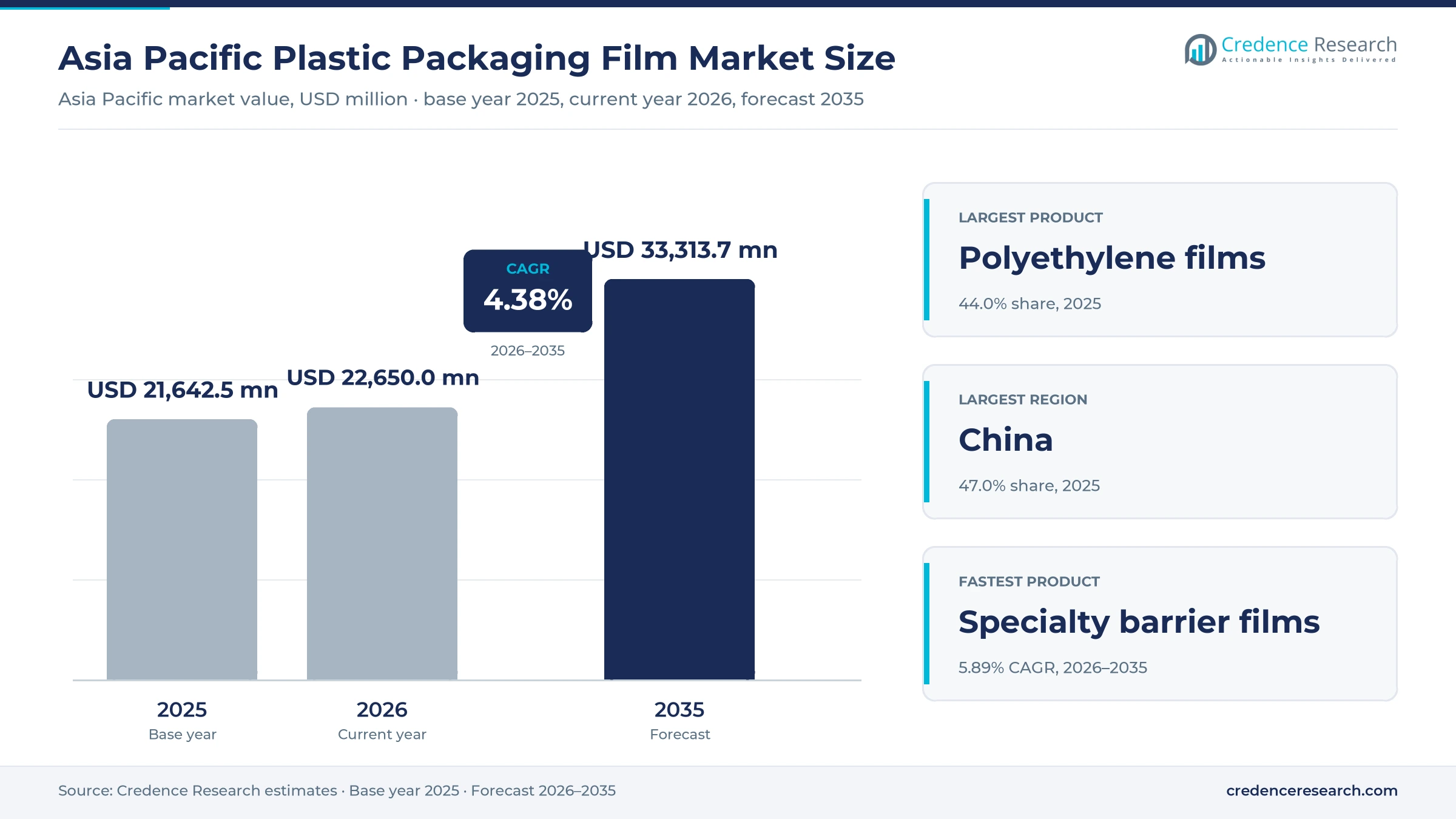
The Asia Pacific plastic packaging film market was valued at USD 21.64 billion in 2025 and is projected to increase from USD 22.65 billion in 2026 to USD 33.31 billion by 2035, registering a CAGR of 4.38% during 2026–2035. Demand comes from food brands, parcel networks and converters that need thin, printable film with reliable barrier performance. China held the largest regional share, 47.0% in 2025, because its film output and parcel volumes are the largest in the region. India is the fastest-growing region at 6.09% a year, as several producers have approved new polypropylene and polyester lines due by 2028. Food-contact rules also became stricter in 2025, when Japan enforced its synthetic resin positive list on June 1 and India amended its packaging regulations on March 28. As a result, suppliers with documented resin compliance and barrier capability hold a stronger position with brand owners than commodity sellers do.
What does this market count, and what sits outside it?
The market counts plastic film sold for packaging use, including polypropylene, polyethylene, polyester and specialty barrier grades made by oriented, blown or cast extrusion. Buyers include independent converters, brand-owner packaging operations and industrial wrapping users, and they purchase through direct contracts, distributors and sales agents.
The estimate excludes finished pouches and printed laminates, rigid sheet for thermoforming, nonpackaging films for electronics and solar uses, and paper or foil substrates. The value chain runs from resin producers through film makers to converters, who then print and laminate the film for food, healthcare, logistics and industrial customers.
Asia Pacific Plastic Packaging Film Market Insights
- The market moves from USD 21.64 billion in 2025 to USD 33.31 billion by 2035 at a 4.38% CAGR, with volume growth outweighing weak resin-linked pricing through most of the period.
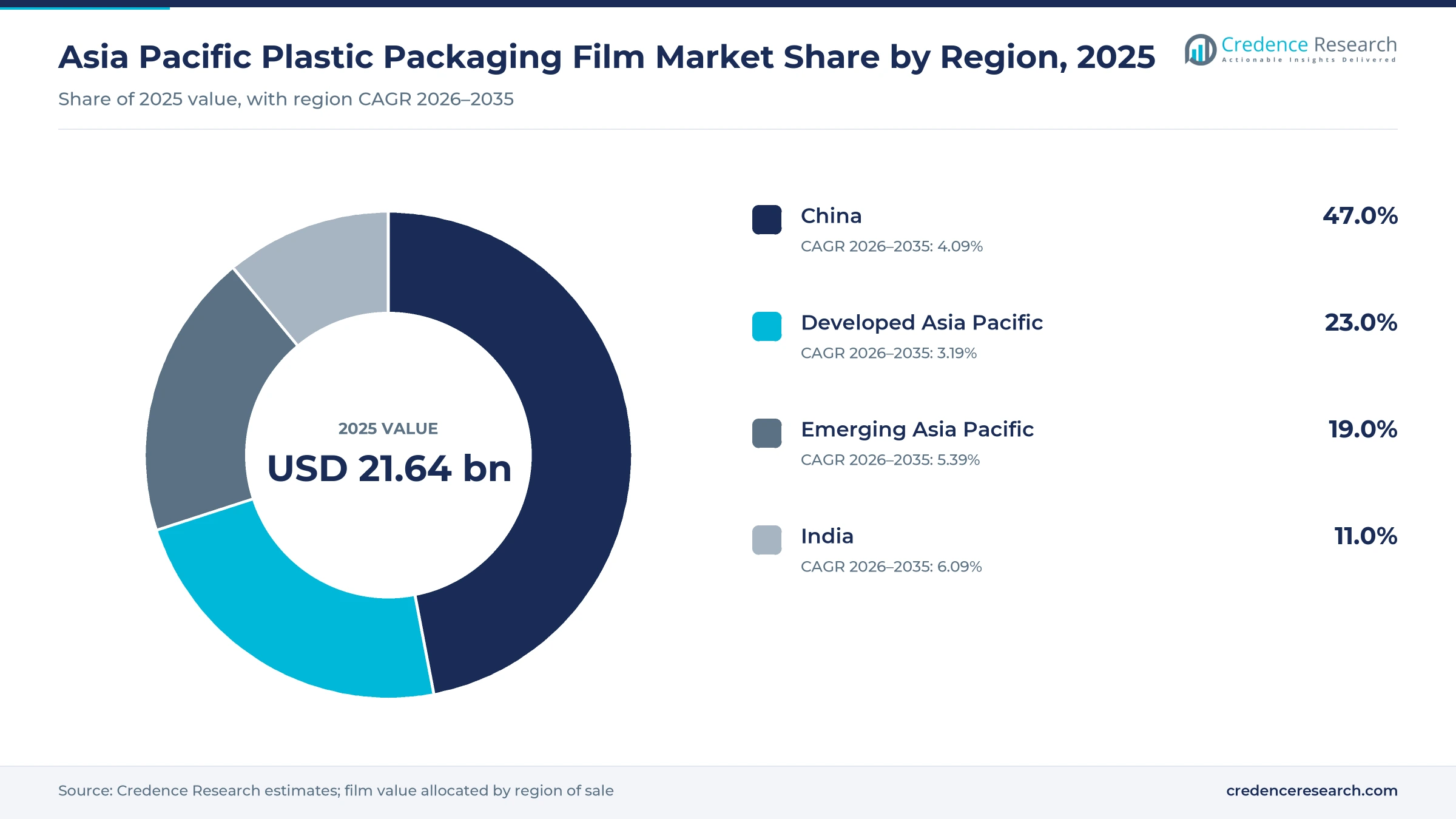
- China held 47.0% of 2025 value, supported by film output that the National Bureau of Statistics put at 9.178 million tons in the first half of 2025.
- Polyethylene films led with 44.0% of 2025 value, because stretch, shrink and liner uses depend on low-cost resin widely produced across the region.
- Japan enforced its positive list for synthetic resin packaging on June 1, 2025, which turned resin documentation into a condition of sale for film suppliers.
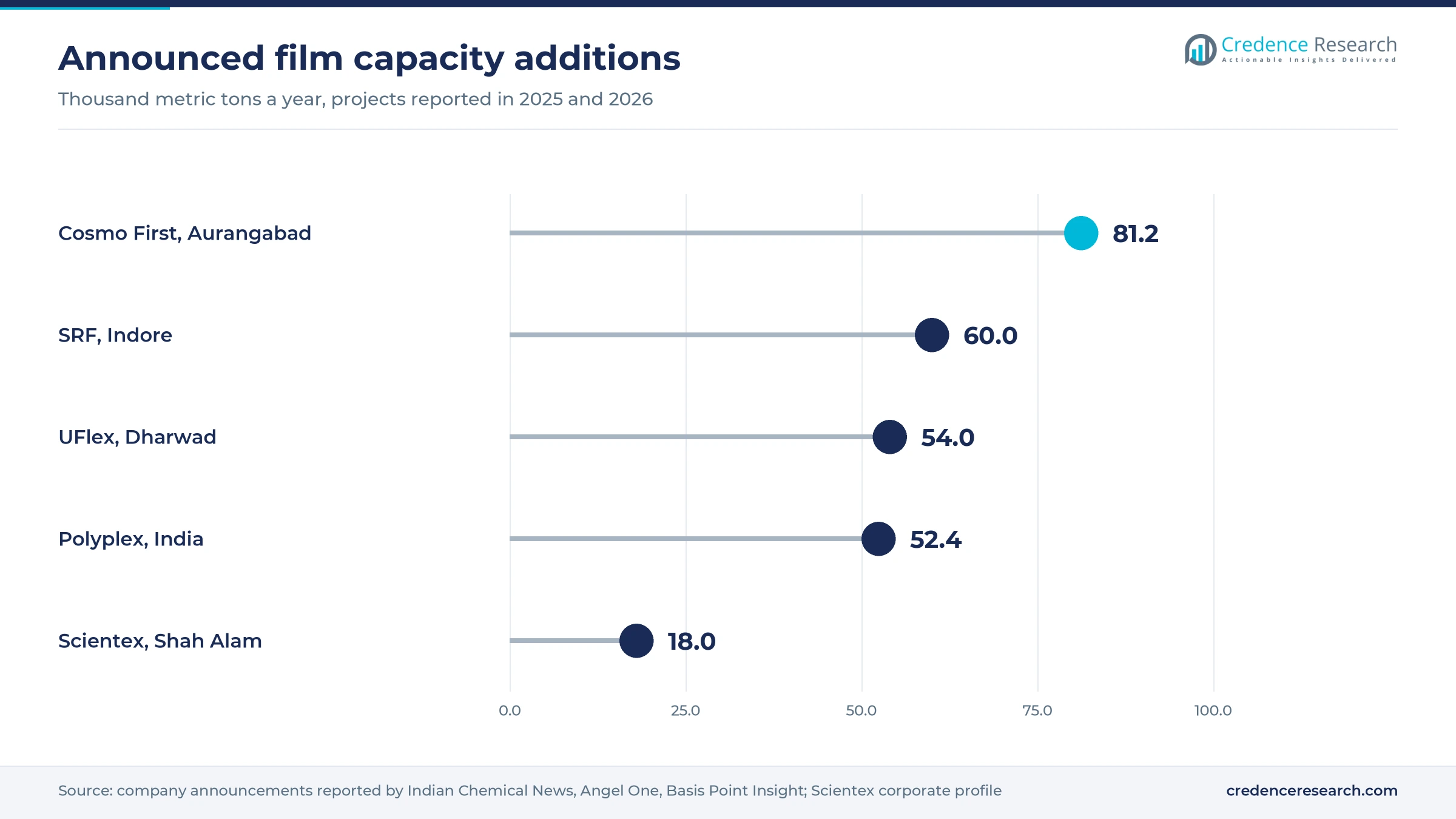
- Indian producers approved or commissioned about 247,600 tons a year of new film capacity during 2025, which raises competition for regional converter contracts through 2028.
Polyethylene leads while barrier grades grow fastest
Why does polyethylene lead while barrier grades grow fastest?
Based on product type, the market is categorized into polypropylene films, polyethylene films, polyester films and specialty barrier films. Polyethylene films led with 44.0% of 2025 value because resin is abundant, with Argus reporting LLDPE film at USD 920 to USD 950 per ton in Southeast Asia in August 2025. Volume grades of biaxially oriented polypropylene follow in lamination work. Specialty barrier films grow fastest at 5.89% a year, as JPFL Films began domestic biaxially oriented polyamide production at Nashik on Jan. 1, 2025, according to its Indian trade petition.
Which buyers set the pace for film volumes?
Based on end-use industry, the market is categorized into food and beverage, healthcare and personal care, e-commerce and logistics, and industrial and agricultural packaging. Food and beverage led with 52.0% of 2025 value because food output is expanding, and India Briefing reports that production-linked incentives added about 3.4 million metric tons of annual processing capacity. E-commerce and logistics grow fastest at 5.62% a year, as the State Post Bureau expects China to handle about 214 billion parcels in 2026. Agricultural film remains a smaller line, at 405,000 tons of Chinese output in the first half of 2025.
Where does film do the most work in the pack?
Based on application, the market is categorized into primary containment, load unitization and protective overwrapping. Primary containment led with 58.0% of 2025 value because food-contact packs carry the strictest material rules, and India amended its packaging regulations on March 28, 2025, according to SGS. Load unitization grows fastest at 5.03% a year, as stretch wrap makers add automated capacity. Scientex states in its August 2026 corporate profile that its newly commissioned Shah Alam plant in Malaysia has a first-phase capacity of 18,000 metric tons a year.
Which extrusion route is winning new investment?
Based on technology, the market is categorized into oriented film extrusion, blown film extrusion and non-oriented cast extrusion. Blown film extrusion led with 48.0% of 2025 value because stretch, liner and bag grades rely on low-density polyethylene and related resins, which new plants such as Long Son in Vietnam now supply. Non-oriented cast extrusion grows fastest at 5.47% a year, as SRF agreed in March 2025 to buy a seven-layer cast line from Kanpur Plastipacks for INR 49.25 crore, according to Packaging South Asia.
| Segment Group | Leading Sub-segment | Share, 2025 | Fastest-growing Sub-segment | CAGR, 2026–2035 |
|---|---|---|---|---|
| By Product Type | Polyethylene films | 44.0% | Specialty barrier films | 5.89% |
| By End-Use Industry | Food and beverage | 52.0% | E-commerce and logistics | 5.62% |
| By Application | Primary containment | 58.0% | Load unitization | 5.03% |
| By Technology | Blown film extrusion | 48.0% | Non-oriented cast extrusion | 5.47% |
Request a Free Sample
Fill in your details and we'll send you a free sample report.
- Sample data tables & charts
- Research methodology
Parcel growth and qualified local supply lift film demand
Packaged food and digital retail throughput
Parcel and packaged-food volumes are the clearest demand signal because each shipment consumes liners, mailers or overwrap. China handled about 199 billion parcels in 2025, up 13.7% from the previous year, according to the State Post Bureau. Daily volume peaked at 777 million parcels in the first 11 months of 2025, according to Xinhua. The e-Conomy SEA 2025 report, published by Temasek in November 2025, projected Southeast Asian e-commerce value at USD 185 billion for 2025. In turn, these flows support the E-commerce and logistics segment and its 5.62% annual growth. Food brands add steadier volume because every snack pack and sachet needs a printable, sealable film structure.
Regional manufacturing and supply capability
New regional lines shorten lead times and give converters more local supply options than imports can provide. Cosmo First added 81,200 metric tons a year of polypropylene film capacity at Aurangabad, according to Indian Chemical News in June 2025. SRF approved a 60,000 metric ton line at Indore in July 2025, which would raise its nameplate capacity by 55%. UFlex approved a 54,000 ton film unit at Dharwad, Karnataka, in November 2025 for commissioning in 2027-28. China remains the regional base, with film output rising 5.5% to 9.178 million tons in the first half of 2025, based on National Bureau of Statistics data. This supply depth keeps China as the largest source of value and supports converter sourcing inside the region.
Qualified food-contact and barrier materials
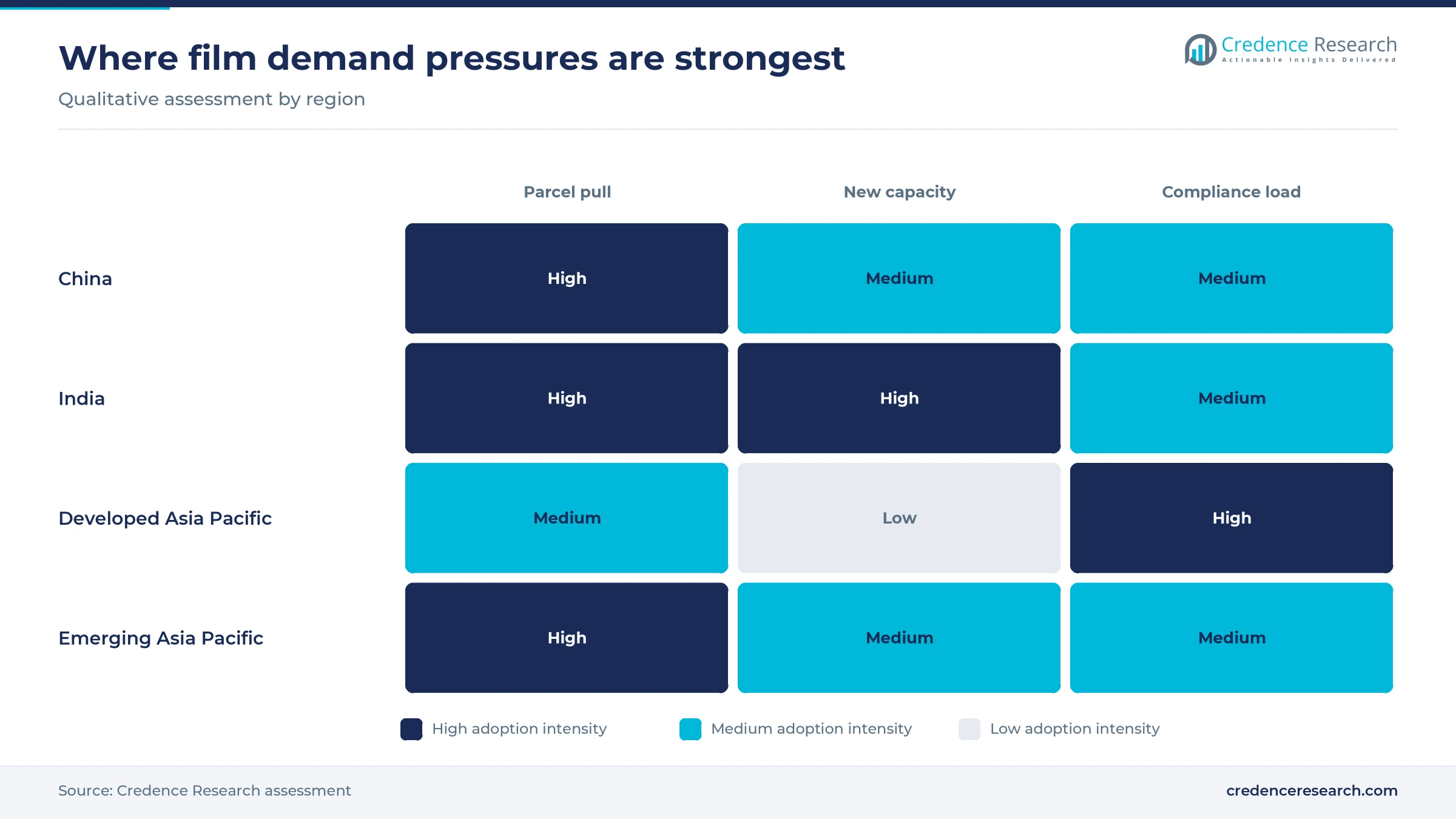
Regulated food-contact applications reward film makers that can document resin and additive compliance for each grade they sell. Japan's amended synthetic resin positive list took effect on June 1, 2025, and New Zealand trade officials warned exporters to keep material specifications ready for Japanese customers. India amended its packaging regulations on March 28, 2025, permitting recycled polyethylene terephthalate in food use once standards are notified, according to SGS. APR Bharat said in March 2026 that 17 Indian plants had received final authorization, covering about 300,000 metric tons a year. Because barrier grades carry this qualification work, Specialty barrier films can grow at 5.89% a year.
Export pull for regional film producers
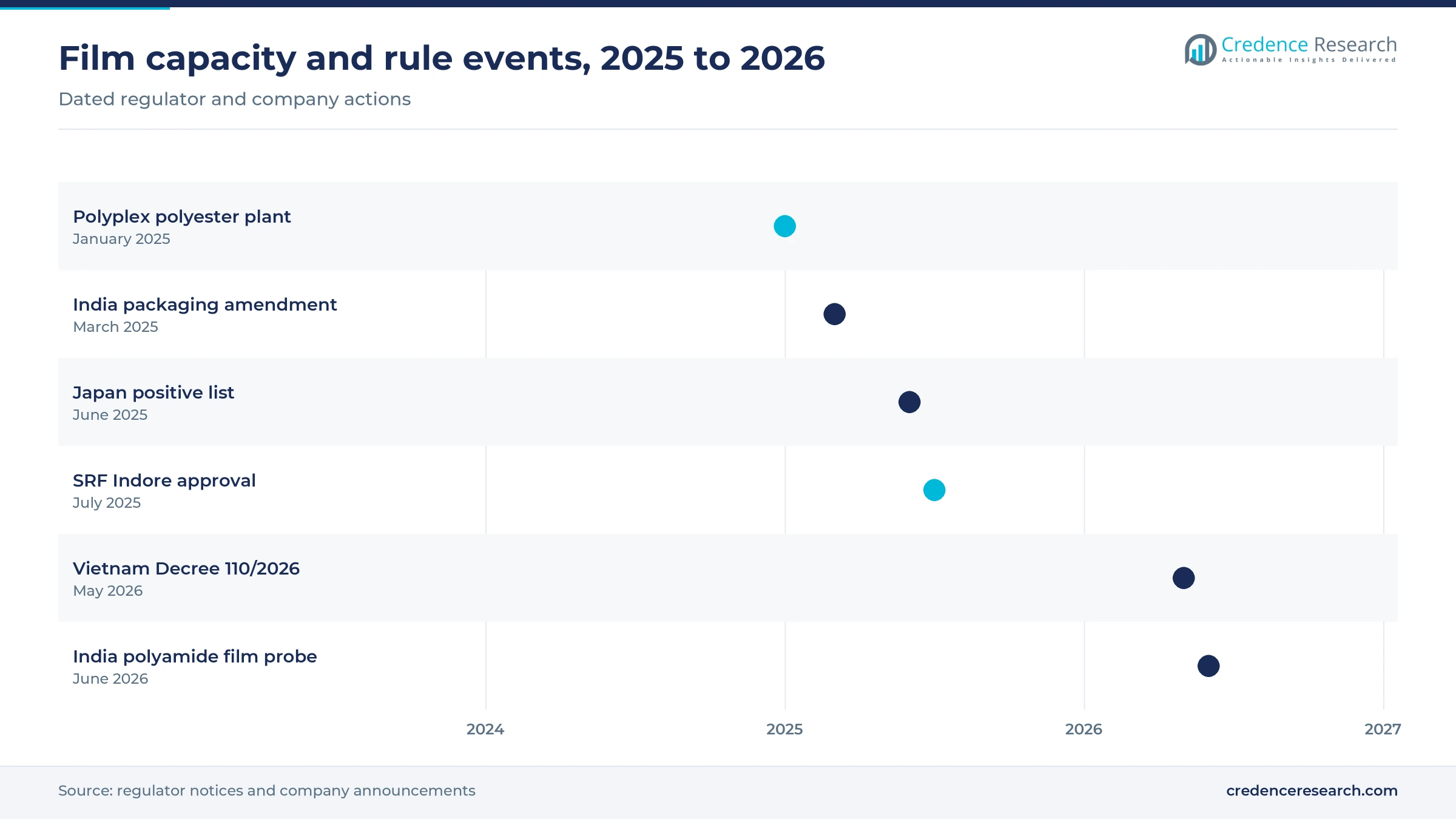
Export sales give Asian film makers a second demand base and help them run new lines at higher utilization. Indian exports of plastic films and sheets rose 15.9% to USD 2,028 million in fiscal 2024-25, according to Plastics Export Promotion Council data reported by Outlook Business. Vietnam, another export base, shipped about USD 10 billion of plastic products in 2025, according to Viet Nam News. Polyplex also cited full utilization of its 90,000 metric ton film capacity when it announced a further polyester plant in January 2025, as Angel One reported. As a result, capacity plans in India rest on overseas orders as well as domestic buyers, which helps explain its lead in regional growth.
Cast laminates and low-carbon lamination gain ground
Shift toward metalized cast polypropylene laminates
Indian snack and food brands are moving toward cast polypropylene laminates because these structures offer useful barrier properties for food packs. SRF plans to install the seven-layer cast line it agreed to buy in March 2025 at Indore, according to Packaging South Asia, which linked the purchase to brand-owner interest in cast-based laminates. Super Plastic Coats paired a seven-layer cast line with a 3.65-meter Bobst metallizer at an 80,000-square-foot plant in Samba, Jammu and Kashmir, as the same publication reported in November 2025. PrintWeek also reported that JPFL Films planned cast capacity of up to 18,000 tons a year at Nashik. This equipment wave supports Non-oriented cast extrusion, which grows at 5.47% a year, the fastest route in the Credence Research estimate.
Rise of electron beam and solvent-free lamination
Japanese film and chemical makers are redesigning lamination because the step carries a measurable share of pack emissions. NEDO, Mitsui Chemicals and Toray reported on May 27, 2026, an inline process that cuts lamination emissions by about 61%, or about 1,290 tons of carbon dioxide a year. The partners said film production accounts for 52% of film packaging emissions in Japan, printing for 32% and lamination for 16%. Their process uses electron-beam curable, solvent-free laminating adhesives, with social implementation planned for 2027 in food and household goods. As a result, buyers in Developed Asia Pacific at 23.0% of value may soon request low-carbon specifications from film suppliers.
Opening in recycled-content film for Indian brand owners
Indian recycled-content targets create an opening for film makers that can supply certified grades to brand owners. The Plastic Waste Management Amendment Rules set targets of 5% for the plastic component of multilayer packaging in fiscal 2025-26, rising to 10% in fiscal 2027-28, according to Packaging Insights in April 2026. Rigid-category targets climb from 30% to 60% by fiscal 2028-29, which keeps recycled resin in strong demand across packaging. Packaging Insights reported in May 2026 that shortfalls against the 30% food-contact target for 2025-26 can be carried forward for up to three consecutive years, and that the national food regulator has authorized 17 recycled PET plants. Producers of polyester substrates stand to benefit first, because recycled polyethylene terephthalate already has authorized food-grade supply.
Opening for Southeast Asian film converters on local resin
New polyethylene plants give Southeast Asian film makers an opening to replace imported film with local production at lower delivered cost. Argus reported that the 1 million ton Long Son plant in Vietnam started in August 2025, after the 750,000 ton PRefChem plant in Malaysia began in late June. The same report put converter operating rates at about 60% to 70%, which leaves room to add volume without new lines, although Argus tied those rates to tariffs and weaker regional consumption. The e-Conomy SEA 2025 report estimated that video commerce made up about 25% of regional online sales value in 2025, a channel that needs mailers and overwrap. Emerging Asia Pacific therefore grows at 5.39% a year in the Credence Research estimate, above the regional average.
Resin gluts, trade cases and compliance squeeze margins
Why are commodity margins so thin?
Abundant polyethylene lowers selling prices faster than producers can cut costs, and this compresses value growth for standard grades. Argus reported HDPE film at USD 900 to USD 930 per ton in Southeast Asia on Aug. 29, 2025, the lowest level since September 2020. South Korean producers agreed to cut 2.7 million to 3.7 million tons a year of cracking capacity in response. Converters gain cheaper input, although film makers holding inventory can face losses. Longer contracts with resin-indexed pricing can limit that exposure for both sides.
Why do trade cases complicate regional sourcing?
Trade remedies raise uncertainty for buyers that source film across borders within the region. India opened an anti-dumping investigation into biaxially oriented polyamide film from China and Thailand on June 24, 2026, after a petition by JPFL Films. Indonesia extended duties on polyester film from India, China and Thailand from Feb. 16, 2021, for five years, with rates reaching 10.6% under PMK 11/2021. Exporters therefore face changing landed costs, so many are adding local plants or dual sourcing to protect their customers.
Who carries the extra paperwork burden?
Regulatory documentation weighs most on small exporters that lack dedicated teams and resin traceability systems. Packaging imported into Japan on or after June 1, 2025, must meet positive list requirements, according to New Zealand trade officials. Vietnam added another layer through Decree 110/2026, in force from May 25, 2026, which sets recycling duties for packaging producers and importers. Smaller exporters must therefore document resins for each market separately, which raises costs unless resin suppliers share compliance data.
Is a supply overhang likely by 2028?
Indian expansions could exceed near-term demand if several lines start within the same two-year window. Four projects at Cosmo First, SRF, UFlex and Polyplex total about 247,600 tons a year, and three are due by fiscal 2027-28. China adds pressure as well, because the National Bureau of Statistics showed total plastic products output falling 0.2% in 2025, as Blooming Trade Data reported. Producers could respond by steering output toward specialty grades, staged commissioning and export contracts to protect utilization.
China anchors output as India adds capacity fastest
| Region | Value, 2025 (USD billion) | Share, 2025 | CAGR, 2026–2035 |
|---|---|---|---|
| China | 10.17 | 47.0% | 4.09% |
| Developed Asia Pacific | 4.98 | 23.0% | 3.19% |
| Emerging Asia Pacific | 4.11 | 19.0% | 5.39% |
| India | 2.38 | 11.0% | 6.09% |
China sets regional scale and export pricing
China held 47.0% of 2025 value and grows at 4.09% a year in the Credence Research estimate, reflecting a large and maturing base. Film revenue reached RMB 205.9 billion in the first half of 2025, up 6.9%, according to National Bureau of Statistics data reported by Adsale. Guangdong and Zhejiang together produced about 34.7% of national plastic products output in that period, which concentrates converter demand near coastal ports. Domestic parcel growth supports volumes, although export pricing remains the main swing factor for regional film makers.
Developed Asia Pacific competes on specifications
Developed Asia Pacific held 23.0% of 2025 value and grows at 3.19% a year, the slowest pace among the regions in the Credence Research estimate. Japan, South Korea, Australia and New Zealand buy higher-specification film, so value depends more on barrier and compliance features than on tonnage. Consumer Affairs Agency guidance published May 9, 2025, reinforced Japanese positive list obligations ahead of full enforcement, according to Packaging Law. As a result, local producers such as Toray and Toyobo compete mainly on qualified grades and process technology.
Emerging Asia Pacific gains local polyester and polyethylene
Emerging Asia Pacific held 19.0% of 2025 value and grows at 5.39% a year as local supply deepens. Toyobo committed about JPY 10 billion to double polyester film capacity at its Indonesian venture with Trias Sentosa, according to Packaging Gateway, and machinery supplier Brückner scheduled startup for autumn 2025. Vietnam imported 9.66 million tons of plastic raw materials worth USD 12.5 billion in 2025, according to Viet Nam News. This resin flow gives regional converters a large base for further film production.
India adds capacity faster than any other region
India held 11.0% of 2025 value and grows at 6.09% a year, the fastest pace among the four regions in the Credence Research estimate. Polyplex announced a USD 65 million polyester plant with 52,400 metric tons of annual capacity in January 2025, due in the first half of fiscal 2027-28. Healthcare adds a further pull, because Pharmexcil reported pharmaceutical exports of USD 30.47 billion in fiscal 2024-25, up 9.4%. Processed food exports of USD 7.89 billion in the same year, reported by India Briefing, add further demand for export-grade film.
Line approvals and rule changes from 2025 to 2026
| Development | Status and market relevance |
|---|---|
| In January 2025, Polyplex announced a new polyester film plant in India with 52,400 metric tons of annual nameplate capacity. | Due in the first half of fiscal 2027-28; adds polyester supply for food and label converters |
| In June 2025, Cosmo First reported a new polypropylene film line at Aurangabad rated at 81,200 metric tons a year. | In service; lifts its total capacity about 40% to 277,000 metric tons a year |
| In July 2025, SRF approved a polypropylene film plant at Indore with 60,000 metric tons of annual capacity for INR 490 crore. | Completion expected within 24 months; existing lines were at full utilization |
| In May 2026, NEDO, Mitsui Chemicals and Toray announced an inline electron beam lamination process that cuts related emissions about 61%. | Social implementation targeted for 2027, starting with food and household packs |
| In June 2026, India opened an anti-dumping investigation into biaxially oriented polyamide film from China and Thailand. | Under way; the period of investigation covers calendar 2025 |
Extrusion route decides barrier, cost and recyclability
- Oriented film extrusion stretches polypropylene or polyester in two directions, and Brückner lists line speeds up to 700 meters a minute on the Indonesian polyester line.
- Blown film extrusion forms polyethylene bubbles for stretch, liner and bag grades, and it remains the widest route in the Credence Research value estimate.
- Non-oriented cast extrusion produces clear, sealable film and recent Indian installations use seven-layer Filmex lines paired with metallizers.
- Electron beam lamination replaces solvent drying with inline curing, which removes much of the roughly five-day heat-curing period used by conventional adhesives.
Need a Custom Version of This Report?
Tailor the scope, geography, or segments to your exact requirements.
- Custom geography or segment scope
- Direct access to our analyst team
Indian expanders challenge Japanese barrier specialists
Competition in packaging film splits between large Indian producers, which are adding oriented polypropylene and polyester tonnage, and Japanese groups that defend barrier and process know-how. Cosmo First, SRF, UFlex and Polyplex all approved or commissioned Indian capacity during 2025, so converter contracts should become more contested as those lines arrive. Toray pairs film expertise with process research, as its May 2026 lamination project with Mitsui Chemicals shows, while Toyobo extends its polyester reach through its Indonesian venture with PT Trias Sentosa. Scientex competes in Malaysia through stretch wrap and cast film, and its corporate profile describes a combined 24,000 metric tons a year of cast capacity at Tanjung Kling and Jasin. Jindal Poly Films serves converters from Nashik, where Packworld reports a cast line of 15,000 metric tons a year. Purchasing decisions increasingly turn on food-contact documentation, barrier consistency and delivery reliability as much as on price per ton.
Companies profiled and their roles in this market
| Company | Type | Role in the market |
|---|---|---|
| Cosmo First | Film producer | Commissioned a polypropylene line at Aurangabad, reported in June 2025 |
| SRF | Film producer | Expanding polypropylene capacity at Indore and adding a cast line |
| UFlex | Integrated packaging group | Approved a 54,000 ton film unit at Dharwad, Karnataka |
| Polyplex Corporation | Polyester film producer | Building a new polyester plant in India |
| Jindal Poly Films | Film producer | Runs a cast polypropylene line at Nashik |
| Toray Industries | Film and materials group | Co-developed electron beam lamination with Mitsui Chemicals |
| Toyobo | Polyester film producer | Doubling output at its Indonesian venture |
| PT Trias Sentosa | Indonesian film producer | Partner in the PT Trias Toyobo Astria polyester venture |
| Scientex Berhad | Malaysian packaging group | Commissioned the Shah Alam stretch film plant |
Value will favor qualified grades over commodity tonnage
Credence Research's view is that packaging film value will move toward qualified grades faster than tonnage alone suggests. Resin prices near multi-year lows limit pricing power for commodity stretch and liner film, while food-contact rules in Japan and India reward documented supply. Indian capacity also raises the risk of a tighter pricing period around 2028, when several approved lines should reach the market. Buyers therefore gain negotiating leverage on standard polypropylene and polyester grades. Producers that hold barrier, cast and recycled-content capability should protect margins better than single-product suppliers through the forecast period.
How the regional estimate was built and checked
The report uses 2025 as the base year and forecasts values through 2035. Market values come from the Credence Research model, and segment and regional splits are Credence Research estimates. The packaging film size was checked against National Bureau of Statistics film output and revenue data, published price reports and company capacity announcements. Sources include government statistics, regulator notices, trade bodies, company announcements and trade press. No interviews or surveys were conducted for this edition of the report.
Capacity arriving by 2028 tests pricing through 2035
The market should reach USD 33.31 billion by 2035, growing at a 4.38% CAGR over 2026–2035, with the first test arriving around 2028 as new Indian lines ramp up. Parcel growth and packaged food should keep volumes moving, although resin oversupply is likely to hold commodity pricing down for several more years. Recycled-content targets in India and new recycling duties in Vietnam will push buyers toward documented suppliers during this period. As a result, specialty barrier and cast grades should take a larger share of value by the end of the forecast.
Frequently Asked Questions
How big is the Asia Pacific plastic packaging film market?
Which region leads the market?
Which region grows fastest?
Which product type holds the largest share?
Which product type is growing fastest?
How do food-contact rules affect film suppliers?
What is the main challenge for film makers?
Which companies are active in the market?
Table of Content
Chapter 1 Market Segmentation
- 1.1 Segmentation Framework
- 1.1.1 Product and Service Classification
- 1.1.2 Application and End-Use Classification
- 1.1.3 Technology and Solution Classification
- 1.1.4 Customer and Distribution Channel Classification
- 1.1.5 Geographic Segmentation
- 1.1.6 Market Segment Definitions and Boundaries
- 1.2 By Product Type
- 1.2.1 Polypropylene films
- 1.2.2 Polyethylene films
- 1.2.3 Polyester films
- 1.2.4 Specialty barrier films
- 1.3 By End-Use Industry
- 1.3.1 Food and beverage
- 1.3.2 Healthcare and personal care
- 1.3.3 E-commerce and logistics
- 1.3.4 Industrial and agricultural packaging
- 1.4 By Application
- 1.4.1 Primary containment
- 1.4.2 Load unitization
- 1.4.3 Protective overwrapping
- 1.5 By Technology
- 1.5.1 Oriented film extrusion
- 1.5.2 Blown film extrusion
- 1.5.3 Non-oriented cast extrusion
Chapter 2 Introduction
- 2.1 Report Objectives and Scope
- 2.2 Product Definition and Industry Terminology
- 2.3 Market Inclusions and Exclusions
- 2.4 Research Process
- 2.4.1 Primary Research and Expert Interviews
- 2.4.2 Secondary Research and Source Review
- 2.4.3 Top-Down and Bottom-Up Estimation
- 2.4.4 Data Triangulation and Verification
- 2.5 Market Size Measurement Basis
- 2.5.1 2025: USD 21.64 billion → 2035: USD 33.31 billion
- 2.6 Historical and Forecast Reference Periods
- 2.6.1 Historical Period: 2018-2025
- 2.6.2 Base Year: 2025
- 2.6.3 Forecast Period: 2025-2035
- 2.7 Research Assumptions and Limitations
Chapter 3 Executive Summary
- 3.1 Market Snapshot and Key Findings
- 3.2 Base-Year Market Size, 2025
- 3.3 Forecast Market Size, 2035
- 3.4 Revenue and Volume Growth Outlook
- 3.5 Key Demand and Supply Indicators
- 3.6 Leading Market Segments
- 3.7 Fastest-Growing Market Opportunities
- 3.8 Regional Performance Highlights
- 3.9 Technology and Industry Transformation
- 3.10 Competitive Landscape Summary
- 3.11 Analyst View and Strategic Implications
Chapter 4 Asia Pacific Plastic Packaging Film Market Trends and Developments
- 4.1 Historical Industry Development, 2018-2025
- 4.2 Recent Market Trends and Developments
- 4.3 Demand and Customer Behavior Trends
- 4.4 Technology and Product Innovation
- 4.5 Artificial Intelligence, Automation and Digitalization
- 4.6 Local Manufacturing and Supply Chain Realignment
- 4.7 Industry Partnerships, Mergers and Acquisitions
- 4.8 Sustainability and Circular Economy Developments
- 4.9 Government and Private Sector Investment Trends
- 4.10 Emerging Business Models and Commercialization
- 4.11 Industry Developments and Announcements
Chapter 5 Asia Pacific Plastic Packaging Film Market Production, Supply and Demand Analysis
- 5.1 Demand Trend and Consumption Analysis, 2018-2025
- 5.2 Demand Forecast, 2025-2035
- 5.3 Production and Output Trend, 2018-2025
- 5.4 Production and Output Forecast, 2025-2035
- 5.5 Installed Capacity and Capacity Utilization
- 5.6 Company-Wise Production Plants and Statistics
- 5.6.1 Installed Production Capacity
- 5.6.2 Actual Production
- 5.6.3 Planned Capacity and Expansion Targets
- 5.7 Supply Chain Structure and Procurement Trends
- 5.8 Supply-Demand Gap and Bottlenecks
- 5.9 Import Dependence and Sourcing Structure
- 5.10 Contract Manufacturing and Outsourcing
- 5.11 Regional Supply and Demand Concentration
Chapter 6 Asia Pacific Plastic Packaging Film Market Pricing Analysis
- 6.1 Pricing Structure and Measurement
- 6.2 Historical Pricing Trends, 2018-2025
- 6.3 Pricing Outlook, 2025-2035
- 6.4 Average Selling Price and Unit Economics
- 6.5 Pricing by Product and Market Segment
- 6.6 Geographic Pricing Differences
- 6.7 Key Input, Energy, Labor and Logistics Costs
- 6.8 Contract Pricing and Purchasing Models
- 6.9 Pricing Sensitivity and Competitive Positioning
- 6.10 Price, Margin and Profitability Implications
Chapter 7 Asia Pacific Plastic Packaging Film Market Dynamics
- 7.1 Market Growth Drivers
- 7.1.1 Demand-Side Drivers
- 7.1.2 Technology and Innovation Drivers
- 7.1.3 Infrastructure and Investment Drivers
- 7.1.4 Regulatory and Policy Drivers
- 7.2 Market Restraints
- 7.2.1 Cost and Affordability Constraints
- 7.2.2 Technology and Adoption Barriers
- 7.2.3 Supply Chain and Operational Constraints
- 7.3 Market Challenges
- 7.3.1 Competitive Pressure and Margin Erosion
- 7.3.2 Skills, Infrastructure and Implementation Gaps
- 7.4 Emerging Market Opportunities
- 7.5 Market Dynamics Impact and Time-Horizon Assessment
Chapter 8 Asia Pacific Plastic Packaging Film Value Chain Analysis
- 8.1 Industry Value Chain Overview
- 8.2 Upstream Suppliers and Critical Inputs
- 8.3 Technology and Component Providers
- 8.4 Manufacturing or Service Delivery
- 8.5 Distribution, Channel Partners and Integrators
- 8.6 Downstream Applications and End Users
- 8.7 Value Addition and Profit Pools
- 8.8 Vertical Integration and Outsourcing
- 8.9 Supplier Concentration and Risk
- 8.10 Supply Chain Localization and Resilience
Chapter 9 Asia Pacific Plastic Packaging Film Market Regulations and Policies
- 9.1 Relevant Laws, Standards and Compliance Frameworks
- 9.2 Product, Service, Safety and Quality Requirements
- 9.3 Government Policies, Incentives and Subsidies
- 9.4 Imports, Exports and Trade Barriers
- 9.5 Public Procurement and Local Content Requirements
- 9.6 Environmental and Sustainability Compliance
- 9.7 Upcoming Policy Changes and Market Implications
Chapter 10 Asia Pacific Plastic Packaging Film Market Hotspots and Opportunities
- 10.1 Market Opportunity Mapping and Growth Hotspots
- 10.2 High-Growth Applications and Customer Groups
- 10.3 Underserved Markets and White-Space Opportunities
- 10.4 Emerging Technology and Product Opportunities
- 10.5 New Capacity and Investment Hotspots
- 10.6 Market Entry and Expansion Opportunities
- 10.7 Distribution and Partnership Opportunities
- 10.8 Near-Term and Long-Term Commercial Potential
- 10.9 Opportunity Attractiveness and Execution Risks
Chapter 11 Asia Pacific Plastic Packaging Film Market Outlook, 2025-2035
- 11.1 Market Size and Analysis
- 11.1.1 Revenue (Market Measurement: 2025: USD 21.64 billion → 2035: USD 33.31 billion)
- 11.1.2 Market Volume and Quantity Sold
- 11.1.3 Historical Market Size, 2018-2025
- 11.1.4 Base-Year Market Size, 2025
- 11.2 Market Forecast, 2025-2035
- 11.2.1 Revenue Forecast to 2035
- 11.2.2 Volume Forecast to 2035
- 11.2.3 CAGR and Year-on-Year Growth
- 11.2.4 Incremental Revenue Opportunity
- 11.3 Forecast Assumptions and Scenario Analysis
- 11.3.1 Base-Case Forecast
- 11.3.2 Optimistic and Conservative Scenarios
- 11.3.3 Technology, Pricing and Policy Sensitivities
- 11.4 Market Attractiveness and Growth Outlook
Chapter 12 Asia Pacific Plastic Packaging Film Market Segmentation and Outlook
- 12.1 Segmentation Summary and Market Shares, 2025
- 12.2 Largest and Fastest-Growing Segments
- 12.3 By Product Type - Market Size and Forecast, 2025-2035
- 12.3.1 Segment Definition and Scope
- 12.3.2 Historical Market Size, 2018-2025
- 12.3.3 Revenue Forecast, 2025-2035
- 12.3.4 Volume Forecast, 2025-2035
- 12.3.5 Base-Year Market Share, 2025
- 12.3.6 Segment CAGR and Growth Drivers
- 12.3.7 Subsegment Market Size and Forecast
- 12.3.7.1 Polypropylene films
- 12.3.7.2 Polyethylene films
- 12.3.7.3 Polyester films
- 12.3.7.4 Specialty barrier films
- 12.3.8 Subsegment Pricing and Adoption Trends
- 12.3.9 Leading Suppliers and Competition
- 12.3.10 Regional Demand and Opportunities
- 12.4 By End-Use Industry - Market Size and Forecast, 2025-2035
- 12.4.1 Segment Definition and Scope
- 12.4.2 Historical Market Size, 2018-2025
- 12.4.3 Revenue Forecast, 2025-2035
- 12.4.4 Volume Forecast, 2025-2035
- 12.4.5 Base-Year Market Share, 2025
- 12.4.6 Segment CAGR and Growth Drivers
- 12.4.7 Subsegment Market Size and Forecast
- 12.4.7.1 Food and beverage
- 12.4.7.2 Healthcare and personal care
- 12.4.7.3 E-commerce and logistics
- 12.4.7.4 Industrial and agricultural packaging
- 12.4.8 Subsegment Pricing and Adoption Trends
- 12.4.9 Leading Suppliers and Competition
- 12.4.10 Regional Demand and Opportunities
- 12.5 By Application - Market Size and Forecast, 2025-2035
- 12.5.1 Segment Definition and Scope
- 12.5.2 Historical Market Size, 2018-2025
- 12.5.3 Revenue Forecast, 2025-2035
- 12.5.4 Volume Forecast, 2025-2035
- 12.5.5 Base-Year Market Share, 2025
- 12.5.6 Segment CAGR and Growth Drivers
- 12.5.7 Subsegment Market Size and Forecast
- 12.5.7.1 Primary containment
- 12.5.7.2 Load unitization
- 12.5.7.3 Protective overwrapping
- 12.5.8 Subsegment Pricing and Adoption Trends
- 12.5.9 Leading Suppliers and Competition
- 12.5.10 Regional Demand and Opportunities
- 12.6 By Technology - Market Size and Forecast, 2025-2035
- 12.6.1 Segment Definition and Scope
- 12.6.2 Historical Market Size, 2018-2025
- 12.6.3 Revenue Forecast, 2025-2035
- 12.6.4 Volume Forecast, 2025-2035
- 12.6.5 Base-Year Market Share, 2025
- 12.6.6 Segment CAGR and Growth Drivers
- 12.6.7 Subsegment Market Size and Forecast
- 12.6.7.1 Oriented film extrusion
- 12.6.7.2 Blown film extrusion
- 12.6.7.3 Non-oriented cast extrusion
- 12.6.8 Subsegment Pricing and Adoption Trends
- 12.6.9 Leading Suppliers and Competition
- 12.6.10 Regional Demand and Opportunities
- 12.7 Segment Growth Comparison
- 12.8 Segment Attractiveness and Priority Matrix
Chapter 13 Asia Pacific Plastic Packaging Film End-Use and Application Market Outlook
- 13.1 End-Use Industry and Customer Demand Structure
- 13.2 Leading Applications and Customer Groups
- 13.3 End-Use Market Size, Share and Forecast
- 13.4 Major End-Use Industry Deep Dives
- 13.4.1 Customer Requirements and Use Cases
- 13.4.2 Demand and Replacement Cycles
- 13.4.3 Technical and Regulatory Considerations
- 13.4.4 Purchasing and Procurement Models
- 13.4.5 Leading Vendors and Distribution Channels
- 13.4.6 Forecast and Commercial Opportunities
- 13.5 Emerging Applications and Cross-Segment Demand
- 13.6 End-Use Industry Investment Priorities
Chapter 14 Asia Pacific Plastic Packaging Film Geographic Market Outlook, 2025-2035
- 14.1 Regional Market Size and Country-Level Shares, 2025
- 14.2 Country Market Size Comparison, 2025
- 14.3 Country Market Forecasts, 2025-2035
- 14.4 Subregional Industrial and Demand Clusters
- 14.5 Intra-Regional Pricing and Cost Differences
- 14.6 Cross-Border Trade and Supply Networks
- 14.7 Regional Supply and Demand Balances
- 14.8 Country Opportunity Comparison and Prioritization
Note: Every listed country is covered on the structure shown under the first country.
Chapter 15 Asia Pacific Plastic Packaging Film Technology, Innovation and Sustainability Outlook
- 15.1 Technology Landscape and Maturity
- 15.2 Product, Process and Service Innovation
- 15.3 AI, Automation and Digital Tools in the Industry
- 15.4 Technology Adoption and Performance Benchmarking
- 15.5 Innovation Pipeline and R&D Investment
- 15.6 Patent and Intellectual Property Trends
- 15.7 Energy Efficiency and Resource Management
- 15.8 Sustainability, Recycling and Circularity
- 15.9 Technology Roadmap, 2025-2035
- 15.10 Risks of Obsolescence and Technology Substitution
Chapter 16 Asia Pacific Plastic Packaging Film Market Key Strategic Imperatives
- 16.1 Growth and Market Entry Priorities
- 16.2 High-Return Products and Segments
- 16.3 Pricing, Profitability and Cost Optimization
- 16.4 Technology Investment and Product Differentiation
- 16.5 Supply Chain Localization and Resilience
- 16.6 Distribution and Customer Acquisition
- 16.7 Partnership, Acquisition and Capacity Strategy
- 16.8 Regional Expansion Priorities
- 16.9 Short-, Medium- and Long-Term Actions
Chapter 17 Competition Outlook
- 17.1 Industry Competition Characteristics
- 17.2 Market Structure and Concentration
- 17.3 Market Share and Competitive Positioning, 2025
- 17.4 Company-Wise Revenue and Product Benchmarking
- 17.5 Production and Service Capacity Benchmarking
- 17.6 Technology, Pricing and Differentiation
- 17.7 Regional Footprint and Distribution Strength
- 17.8 Mergers, Acquisitions and Strategic Alliances
- 17.9 New Entrants and Competitive Threats
- 17.10 Porter's Five Forces and Industry Attractiveness
- 17.11 Competitive Outlook, 2025-2035
Chapter 18 Company Profiles
- 18.1 Company Coverage and Selection Criteria
- 18.2 Toray Industries
- 18.2.1 Business Description
- 18.2.2 Company Ownership and Geographic Presence
- 18.2.3 Product and Service Portfolio
- 18.2.4 Manufacturing and Operating Footprint
- 18.2.5 Production Capacity and Expansion Plans
- 18.2.6 Financial Performance and Investment
- 18.2.7 Market Share and Competitive Position
- 18.2.8 Technology and Innovation Capabilities
- 18.2.9 Strategic Alliances or Partnerships
- 18.2.10 Recent Developments
- 18.2.11 Growth Strategy and Outlook
- 18.3 UFlex
- 18.4 Polyplex Corporation
- 18.5 Jindal Poly Films
- 18.6 SRF
- 18.7 Toyobo
- 18.8 Cosmo First
- 18.9 Scientex Berhad
- 18.10 Futamura Chemical
- 18.11 PT Trias Sentosa
- 18.12 Other Relevant Market Participants
Note: Every listed company is profiled on the structure shown under the first company. The company list is preliminary and may change based on research findings, market developments, data availability and client requirements.
Chapter 19 Disclaimer
- 19.1 Research and Forecast Disclaimer
- 19.2 Data Source and Estimation Limitations
Note: The depth of individual sections depends on data availability for this market. Volume, capacity, trade and other unit-based metrics are included where applicable.

