
Market Overview:
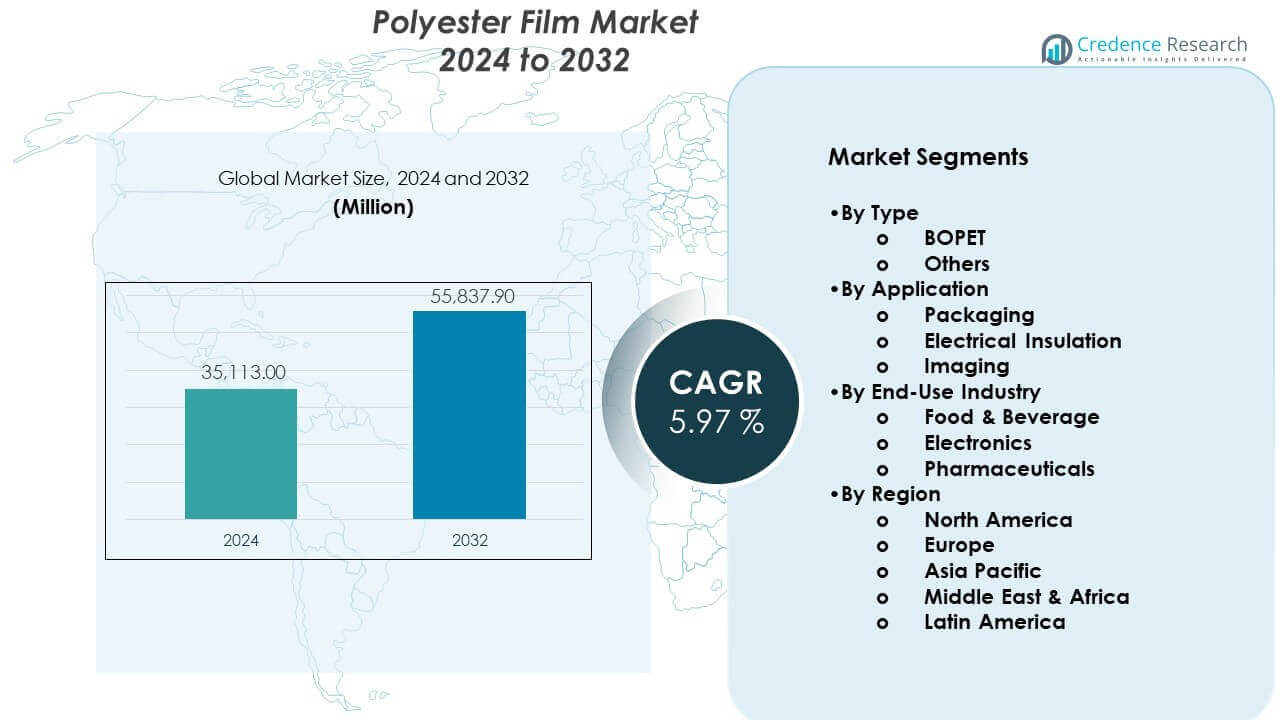
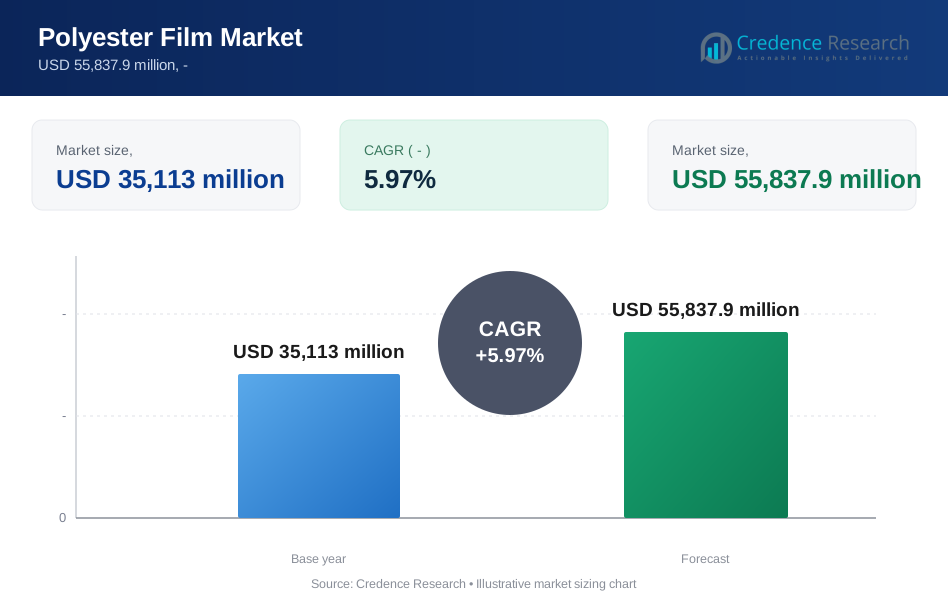
The Polyester film market is projected to grow from USD 35,113 million in 2024 to USD 55,837.9 million by 2032, registering a CAGR of 5.97% during the forecast period.
| REPORT ATTRIBUTE | DETAILS |
|---|---|
| Historical Period | 2020-2023 |
| Base Year | 2024 |
| Forecast Period | 2025-2032 |
| Polyester Film Market Size 2024 | USD 35,113 Million |
| Polyester Film Market, CAGR | 5.97% |
| Polyester Film Market Size 2032 | USD 55,837.9 Million |
Market growth is driven by rising demand for flexible packaging across food and beverage industries. Polyester film offers durability, moisture resistance, and heat tolerance. Electronics manufacturers rely on polyester film for insulation and display components. Lightweight material properties support cost efficiency and logistics savings. Recycling advancements improve sustainability acceptance. Industrial laminates and labels increase steady demand. E-commerce growth raises protective packaging needs. Urban lifestyles favor packaged products. Technology upgrades improve film quality and output consistency.
Asia Pacific leads the market due to strong manufacturing and packaging industries. China dominates production and consumption through electronics and consumer goods output. India shows rapid growth from expanding food packaging and retail sectors. Japan supports demand through advanced electronics manufacturing. North America remains a mature market with stable industrial use. The United States leads innovation and high-value applications. Europe emphasizes sustainable film solutions. Germany and France remain key markets. Latin America and Southeast Asia emerge with rising packaged food consumption.
Market Insights:
- The Polyester film market was valued at USD 35,113 million in 2024 and is projected to reach USD 55,837.9 million by 2032, growing at a CAGR of 5.97% during the forecast period.
- Asia Pacific leads with about 45% share due to large packaging and electronics manufacturing, followed by Europe at nearly 25% driven by regulated packaging demand, and North America at around 20 supported by stable food and industrial usage.
- Asia Pacific is also the fastest-growing region with roughly 45% share, supported by capacity expansion, export-oriented production, and rising packaged food consumption in China and India.
- By type, BOPET dominates with nearly 70% share due to superior strength, clarity, and wide use across packaging and electrical insulation applications.
- By application and end-use, packaging accounts for about 60% share, while food and beverage contributes close to 50% of end-use demand, driven by flexible packaging adoption and shelf-life requirements.
Market Drivers:
Rising Demand From Flexible Packaging And Consumer Goods Applications
The Polyester film market benefits from steady growth in flexible packaging demand across food and consumer goods sectors. Brands rely on polyester film for strength, barrier protection, and shelf stability. It supports safe transport and longer product life. Urban lifestyles increase packaged food consumption. Retail and modern trade expansion lift packaging volumes. Lightweight film lowers logistics and handling costs. Manufacturers prefer materials with stable quality. This driver supports sustained demand across consumer-focused industries.
- For instance, Toray Industries’ Lumirror™ polyester films achieve oxygen transmission rates below 100 cc/m²/day at 23°C, supporting extended shelf life in food packaging.
Strong Adoption In Electrical, Electronics, And Industrial Insulation Uses
Electrical and electronics industries depend on polyester film for insulation and protection. The Polyester film market gains momentum from rising electronics output. It delivers thermal stability and mechanical strength. Motors, transformers, and cables require reliable insulation layers. Industrial automation raises equipment demand. Producers value consistent electrical performance. Long service life reduces replacement needs. This driver ensures steady industrial consumption.
- For instance, DuPont Teijin Films’ Mylar® electrical-grade films operate continuously at 150°C with dielectric strength exceeding 200 kV/mm, supporting long-term insulation performance in motors and transformers.
Cost Efficiency And Balanced Material Performance Across End Uses
Polyester film offers a strong balance of cost and performance. The Polyester film market benefits from wide material availability and scale production. It provides clarity, chemical resistance, and dimensional stability. Manufacturers achieve cost control through large-volume output. Converters favor materials with low defect rates. End users gain reliability across applications. Stable pricing supports planning decisions. This driver strengthens long-term adoption.
Growth In Manufacturing Capacity And Export-Oriented Production Hubs
Global manufacturing expansion supports polyester film demand. The Polyester film market aligns with export-led packaging growth. Producers serve multinational consumer goods companies. Trade flows increase packaged product movement. Industrial supply chains rely on durable films. Capacity expansion improves supply security. Regional hubs attract investment. This driver reinforces global market stability.
Market Trends:
Shift Toward Thinner Films With Improved Strength And Efficiency
Producers focus on thinner polyester films with maintained strength. The Polyester film market reflects demand for material efficiency. Down-gauging reduces material usage. Packaging designs favor lightweight structures. Advanced extrusion improves consistency. Cost control remains a priority. Brand owners support material reduction goals. This trend reshapes product design standards.
- For instance, Mitsubishi Polyester Film developed Hostaphan® ultra-thin films below 8 microns while maintaining tensile strength above 200 MPa, enabling material reduction without performance loss.
Growing Preference For High-Quality Printing And Visual Appeal
Demand for premium packaging drives printing-focused film use. The Polyester film market benefits from branding needs. Smooth surfaces support high-resolution printing. Label and graphic applications expand steadily. Retail competition raises visual standards. Ink adhesion improves shelf impact. Film stability ensures print accuracy. This trend increases value-added demand.
- For instance, Cosmo Films’ coated BOPET label films achieve surface energy above 38 dynes/cm, enabling high-definition gravure and flexographic printing with consistent color reproduction.
Rising Customization For Application-Specific Film Grades
Manufacturers develop customized polyester film grades. The Polyester film market shows growing product differentiation. Packaging and industrial users demand tailored properties. Heat resistance and barrier levels vary by use. Producers invest in grade development. Collaboration improves fit for applications. Specialty films support margin growth. This trend expands product portfolios.
Adoption Of Automation And Digital Quality Monitoring
Automation improves production efficiency and consistency. The Polyester film market adopts digital inspection tools. Sensors detect defects during production. Process control reduces waste. Producers improve delivery reliability. Data-driven operations support scale output. Automation enhances cost control. This trend strengthens operational performance.
Market Challenges Analysis:
Impact Of Raw Material Price Volatility On Cost Structures
Raw material price swings affect polyester film production costs. The Polyester film market faces margin pressure from feedstock changes. Petrochemical supply cycles influence pricing. Cost planning becomes complex. Smaller producers face higher risk exposure. Competitive pricing limits cost pass-through. Inventory strategies require careful management. This challenge pressures profitability.
Environmental Regulations And Sustainability Compliance Pressures
Environmental scrutiny impacts polyester film usage. The Polyester film market faces stricter waste and recycling rules. Compliance increases operational costs. Recycling systems remain uneven globally. Brand owners demand eco-friendly materials. Producers invest in sustainable solutions. Policy uncertainty affects planning. This challenge demands strategic adjustment.
Market Opportunities:
Development Of Recyclable And Sustainable Polyester Film Solutions
Sustainability creates strong growth opportunities for producers. The Polyester film market benefits from recyclable material innovation. Brands seek compliant packaging inputs. New grades balance performance and recyclability. Circular economy goals drive adoption. Early movers gain market trust. Regulatory alignment improves access. This opportunity supports future growth.
Expansion Across Emerging Markets And New Application Areas
Emerging economies drive new demand for polyester film. The Polyester film market gains from industrial and retail growth. Food processing expansion raises packaging needs. Electronics assembly boosts insulation use. Urbanization supports consumer goods sales. Local production attracts investment. New applications widen demand scope. This opportunity strengthens long-term potential.
Market Segmentation Analysis:
By Type
BOPET dominates due to high tensile strength, thermal stability, and clarity. The Polyester film market depends on BOPET for packaging and electrical applications that require consistent performance. It supports large-scale manufacturing with uniform thickness. Producers prefer BOPET for cost efficiency and reliability. Other polyester film types serve specialized industrial needs. These variants address coating, adhesion, or surface treatment requirements. Niche demand supports limited but stable adoption. Type diversification improves application flexibility.
- For instance, Jindal Poly Films produces BOPET films with tensile strength above 230 MPa, meeting high-speed packaging and electrical insulation standards.
By Application
Packaging leads application demand due to extensive use in food and consumer goods. The Polyester film market gains strength from flexible packaging formats that require durability and barrier protection. Polyester film supports shelf life and product safety. Electrical insulation follows with steady use in motors and electronic components. It ensures protection against heat and electrical stress. Imaging applications rely on dimensional stability and smooth surfaces. Print quality drives film selection. Application diversity supports demand balance.
- For instance, Polyplex Corporation supplies BOPET films with thickness tolerance within ±1.5%, supporting precision imaging and graphic applications.
By End-Use Industry
Food and beverage remains the largest end-use industry due to packaged product growth. The Polyester film market aligns with hygiene and storage requirements. Electronics drives consistent demand for insulation and component protection. Film stability supports device reliability. Pharmaceuticals use polyester film for secure and compliant packaging. Material purity remains critical in this segment. Regulated environments favor proven materials. End-use diversity strengthens market resilience.
Segmentation:
- By Type
- BOPET
- Others
- By Application
- Packaging
- Electrical Insulation
- Imaging
- By End-Use Industry
- Food & Beverage
- Electronics
- Pharmaceuticals
- By Region
- North America
- U.S.
- Canada
- Mexico
- Europe
- Germany
- France
- U.K.
- Italy
- Spain
- Rest of Europe
- Asia Pacific
- China
- Japan
- India
- South Korea
- South-east Asia
- Rest of Asia Pacific
- Latin America
- Brazil
- Argentina
- Rest of Latin America
- Middle East & Africa
- GCC Countries
- South Africa
- Rest of the Middle East and Africa
- North America
Regional Analysis:
Asia Pacific
Asia Pacific holds the largest share of the Polyester film market, accounting for about 45% of global demand. China leads due to strong packaging, electronics, and industrial manufacturing bases. India follows with rapid growth in flexible packaging and export-oriented film production. Japan supports demand through advanced electronics and imaging applications. Large-scale capacity expansion strengthens regional supply. Cost-effective production supports global exports. Rising consumer goods demand sustains regional leadership.
Europe
Europe accounts for nearly 25% of the Polyester film market share. Germany and France lead due to strong packaging and industrial sectors. The region emphasizes high-quality and sustainable film solutions. Food and pharmaceutical packaging drive stable demand. Electronics and insulation applications support volume consistency. Strict regulatory standards influence material selection. Innovation in recyclable film grades supports regional competitiveness.
North America And Rest Of The World
North America holds around 20% share of the Polyester film market, led by the United States. Strong demand comes from packaging, labeling, and electrical insulation uses. High consumption of packaged food supports steady volume. Latin America contributes close to 6% with growing food packaging demand. Middle East & Africa together account for about 4%. Infrastructure growth supports industrial film use. Emerging regions show gradual demand expansion.
Key Player Analysis:
- DuPont Teijin Films
- Toray Industries
- Mitsubishi Polyester Film
- Polyplex Corporation
- Jindal Poly Films
- Kolon Industries
- UFlex
- SRF Limited
- Cosmo Films
- Ester Industries
Competitive Analysis:
The Polyester film market shows a moderately consolidated competitive structure with strong global and regional players. Leading manufacturers compete on product quality, capacity scale, and cost efficiency. It benefits from firms with integrated raw material sourcing and global distribution networks. Companies focus on BOPET leadership due to high demand across packaging and electrical uses. Expansion into specialty and coated films supports margin stability. Technology upgrades improve thickness control and output consistency. Regional players strengthen positions through export-oriented production. Competitive intensity remains high in Asia Pacific due to capacity additions. Innovation and operational efficiency shape long-term positioning.
Recent Developments:
- Polyplex Corporation, a leading polyester film manufacturer, unveiled ambitious expansion plans in November 2025. The company announced capital expenditure exceeding ₹1,000 crores for capacity expansion initiatives in specialty films and packaging solutions, with facilities planned in both the United States and India. Despite challenging market conditions characterized by oversupply and tepid demand, management expressed confidence in long-term market potential. For Q2 of the current fiscal year, Polyplex reported consolidated revenue of ₹1,79,404.00 lakhs, representing a 3.17% year-on-year increase, though net profit declined 71.87% year-on-year to ₹2,470.00 lakhs. The company is targeting 12-15% revenue compound annual growth rate through a value-added product mix and emphasizing sustainability initiatives, including increased use of recycled PET and adoption of green energy solutions. This strategic approach reflects Polyplex's determination to navigate current market headwinds while positioning itself for long-term growth in the specialty films segment.
- Toray Industries announced a significant strategic partnership in September 2025. The company officially entered into a joint venture with MAS Holdings, South Asia's largest apparel manufacturer, creating "Toray MAS Apparel India". The official signing ceremony took place in June 2025 at the MAS Head Office in Colombo, with Teruo Funahashi, Managing Director of Toray Hong Kong, and Suren Fernando, Group CEO of MAS Holdings, representing their respective organizations. The joint venture will establish a new manufacturing facility at MAS Apparel Park Bhuinpur in Odisha, India, with groundbreaking having taken place in March 2025 and operations expected to commence in early 2026. This facility aims to cater to both current and potential customers in the region, supporting growing demand for high-quality, innovative textile solutions. The facility incorporates sustainability measures including rooftop solar PV systems, energy-efficient technologies, and advanced water and wastewater management systems.
- Additionally, in October 2025, Toray Industries announced the sale of its remaining 30% stake in LG Toray Hungary Battery Separator Kft to LG Chem for approximately ¥30 billion. This followed an earlier agreement to sell a 20% portion after June 30, 2025, with LG Chem assuming primary responsibility for management and operations. The Toray Group will continue to serve customer needs through its facilities in Japan and South Korea for battery separator film-related products.
Report Coverage:
The research report offers an in-depth analysis based on By Type, By Application, By End-Use Industry, and By Region. It details leading market players, providing an overview of their business, product offerings, investments, revenue streams, and key applications. Additionally, the report includes insights into the competitive environment, SWOT analysis, current market trends, as well as the primary drivers and constraints. Furthermore, it discusses various factors that have driven market expansion in recent years. The report also explores market dynamics, regulatory scenarios, and technological advancements that are shaping the industry. It assesses the impact of external factors and global economic changes on market growth. Lastly, it provides strategic recommendations for new entrants and established companies to navigate the complexities of the market.
Future Outlook:
- Demand will increase steadily from flexible packaging across food and consumer goods industries.
- BOPET will continue to dominate due to strength, clarity, and cost efficiency.
- Sustainability-focused polyester films will gain wider adoption across packaging formats.
- Electronics and electrical insulation applications will support stable volume growth.
- Custom and application-specific film grades will see higher market acceptance.
- Asia Pacific will retain leadership due to large-scale manufacturing and exports.
- Automation will improve production efficiency and quality consistency.
- Recycling-compatible films will gain preference among brand owners.
- Export-oriented production hubs will attract new capacity investments.
- Strategic partnerships will support technology upgrades and market reach.
Request a Free Sample
Fill in your details and we'll send you a free sample report.
- Sample data tables & charts
- Research methodology
Need a Custom Version of This Report?
Tailor the scope, geography, or segments to your exact requirements.
- Custom geography or segment scope
- Direct access to our analyst team
Frequently Asked Questions
At what Compound Annual Growth Rate is the Polyester film market projected to grow between 2025 and 2032?
Which Polyester film market segment held the largest share in 2024?
What are the primary factors fueling the growth of the Polyester film market?
Who are the leading companies in the Polyester film market?
Which region commanded the largest share of the Polyester film market in 2024?
Table of Content
Chapter 1. Report Introduction
- 1.1 Report Description & Purpose
- 1.1.1 Report Title & Market Definition
- 1.1.2 Unique Selling Propositions (USP) & Key Differentiators
- 1.1.3 Value Proposition for Stakeholders
- 1.2 Research Objectives
- 1.2.1 Market Sizing Objectives (Volume & Revenue)
- 1.2.2 Segmentation Objectives
- 1.2.3 Competitive Intelligence Objectives
- 1.2.4 Forecast & Scenario Objectives
- 1.3 Report Scope
- 1.3.1 Polyester Film Scope – Types & Subtypes Covered
- 1.3.2 Geographic Scope – Regions & Countries Covered
- 1.3.3 Historical Period, Base Year & Forecast Period (the historical period; forecast to the forecast period)
- 1.3.4 Inclusions & Exclusions
- 1.4 HS Code & Classification Framework
- 1.5 Currency, Units & Pricing Basis
- 1.6 Target Stakeholders
- 1.7 Limitations & Assumptions
Chapter 2. Executive Summary
- 2.1 Global Polyester Film Market Snapshot
- 2.1.1 Market Size – Historical (the historical period) & Forecast (the forecast period) (base year: USD 35,113 million → forecast year: USD 55,837.9 million)
- 2.1.2 Volume & Revenue – Global Totals
- 2.1.3 Key Market Highlights – Top Five Facts
- 2.2 Polyester Film Market Segmentation Snapshot
- 2.2.1 Market Split by Region – vs.
- 2.3 Competitive Snapshot
- 2.3.1 Top 10 Players by Revenue Share –
- 2.3.2 Top 10 Players by Volume Share –
- 2.3.3 Recent Strategic Developments (18-Month Summary)
- 2.4 Key Investment Highlights & Strategic Conclusions
Chapter 3. Polyester Film Market Dynamics & Industry Analysis
- 3.1 Market Overview & Context
- 3.1.1 Polyester Film Market Position in the Broader Automotive Value Chain
- 3.1.2 OEM vs. Replacement Market Dynamics
- 3.1.3 Market Maturity & Development Stage by Region
- 3.2 Polyester Film Market Drivers
- 3.3 Polyester Film Market Restraints & Challenges
- 3.4 Polyester Film Market Opportunities
- 3.5 Porter's Five Forces Analysis
- 3.5.1 Threat of New Entrants
- 3.5.2 Bargaining Power of Suppliers
- 3.5.3 Bargaining Power of Buyers
- 3.5.4 Threat of Substitutes
- 3.5.5 Competitive Rivalry – Intensity Assessment
- 3.6 Polyester Film Value Chain Analysis
- 3.6.1 Upstream – Raw Material/Input Suppliers
- 3.6.1.1 Raw Material/Input 1
- 3.6.1.2 Raw Material/Input 2
- 3.6.1.3 Raw Material/Input 3
- 3.6.2 Midstream – Production/Manufacturing/Service Delivery
- 3.6.2.1 Production/Process Overview
- 3.6.2.2 Key Facility Locations & Capacity by Manufacturer
- 3.6.3 Downstream – Distribution & End Consumer
- 3.6.3.1 Primary Channel – B2B/OEM
- 3.6.3.2 Secondary Channels – Dealer, Retail, Online, Direct
- 3.6.4 Value Chain Profitability Analysis
- 3.6.1 Upstream – Raw Material/Input Suppliers
- 3.7 PESTEL Analysis
- 3.7.1 Political Factors
- 3.7.2 Economic Factors
- 3.7.3 Social Factors
- 3.7.4 Technological Factors
- 3.7.5 Environmental Factors
- 3.7.6 Legal Factors
- 3.8 Polyester Film Supply Chain Analysis
- 3.8.1 Raw Material/Input Supply Risk Assessment
- 3.8.2 Manufacturing Concentration Risk (Geographic Exposure)
- 3.8.3 Trade Disruption Impact Analysis
- 3.9 Regulatory & Policy Landscape
Note: The regulatory and policy landscape section covers regulations based on their applicability to the market, Polyester Film category, geography, and scope of the study. Only regulatory frameworks with a material impact on operations, compliance, trade, sustainability, or market access are analyzed in detail.
Chapter 4. Key Investment Pockets & Opportunity Analysis
- 4.1 Polyester Film Market Attractiveness Analysis
- 4.1.1 By Region – Investment Attractiveness Matrix (Volume × CAGR)
- 4.2 Absolute Revenue Growth Opportunity
- 4.2.1 By Region – Absolute USD Growth Through the forecast period
- 4.3 Incremental Volume Opportunity
- 4.3.1 By Region – Incremental Volume Through the forecast period
- 4.3.2 Segment – Incremental Volume
- 4.4 Emerging Submarket Opportunity Deep Dive (Subject to Applicability)
- 4.5 Emerging Market Opportunity Scorecards
- 4.5.1 United States
- 4.5.2 Europe
- 4.5.3 Asia
- 4.5.4 Middle East & Africa
Note: Emerging Market Opportunity Scorecards will be included based on relevance and strategic importance. Regions listed are indicative and may vary depending on data availability and market dynamics.
Chapter 5. Polyester Film Import-Export Analysis & Trade Flows
- 5.1 Global Trade Overview
- 5.1.1 Global Export Value by Country (the historical period)
- 5.1.2 Global Export Volume by Country (the historical period)
- 5.1.3 Global Import Value by Country (the historical period)
- 5.1.4 Global Import Volume by Country (the historical period)
- 5.1.5 Net Trade Balance by Country (the historical period)
- 5.2 Export Analysis – Segment
- 5.2.1 Type 1 (HS Code)
- 5.2.2 Type 2 (HS Code)
- 5.2.3 Type 3 (HS Code)
- 5.2.4 Type 4 (HS Code)
- 5.2.5 Type 5 (HS Code)
- 5.3 Import Analysis – Segment
- 5.3.1 Type 1 (HS Code)
- 5.3.2 Type 2 (HS Code)
- 5.3.3 Type 3 (HS Code)
- 5.3.4 Type 4 (HS Code)
- 5.3.5 Type 5 (HS Code)
- 5.4 Average Unit Trade Prices
- 5.4.1 Average Export Price – Segment & Country
- 5.4.2 Average Import Price – Segment & Source Country
- 5.4.3 Price Trends (the historical period)
- 5.5 Key Trade Route Analysis
- 5.5.1 Trade Route 1
- 5.5.2 Trade Route 2
- 5.5.3 Trade Route 3
- 5.5.4 Trade Route 4
- 5.5.5 Trade Route 5
- 5.6 Trade Policy Impact Assessment
- 5.6.1 US Anti-Dumping & Section 301 Tariffs
- 5.6.2 EU Customs Union Impact
- 5.6.3 Major Free Trade Agreements
- 5.6.4 USMCA Rules of Origin
Note: Trade policy analysis will be included only where relevant to the Polyester Film market.
Chapter 6. Competitive Landscape & Company Benchmarking
- 6.1 Polyester Film Market Concentration & Structure
- 6.1.1 Herfindahl-Hirschman Index (HHI) – vs.
- 6.1.2 Tier 1, Tier 2 & Tier 3 Market Structure
- 6.1.3 Global, Regional & Local Player Dynamics
- 6.2 Polyester Film Market Share Analysis –
- 6.2.1 Global Revenue Share by Company
- 6.2.2 Global Volume Share by Company
- 6.2.3 Regional Revenue Share
- 6.2.4 Market Share Evolution ( vs. )
- 6.2.5 OEM Segment Share by Company
- 6.2.6 Replacement Segment Share by Company
- 6.3 Production/Delivery Capacity & Facility Analysis
- 6.3.1 Global Installed Capacity
- 6.3.2 Capacity Utilization Rates
- 6.3.3 Production/Output Volume
- 6.3.4 Facility Locations & Capacity Map
- 6.3.5 Planned Capacity Additions
- 6.4 Polyester Film Competitive Benchmarking Matrix
- 6.4.1 Revenue, Volume, CAGR & Profitability Comparison
- 6.4.2 Channel Revenue Mix
- 6.4.3 Geographic Revenue Exposure
- 6.4.4 R&D Intensity
- 6.4.5 Sustainability Maturity
- 6.5 Strategic Developments in Polyester Film (Last 24 Months)
- 6.5.1 Mergers, Acquisitions & Divestments
- 6.5.2 New Polyester Film Launches
- 6.5.3 Facility Expansions
- 6.5.4 Strategic Alliances, Joint Ventures & Partnerships
- 6.5.5 Distribution Expansion & Market Entry
- 6.5.6 Sustainability & ESG Initiatives
- 6.6 Competitive Strategy Mapping
- 6.6.1 Leader, Challenger, Follower & Niche Classification
- 6.6.2 Pricing Strategy Comparison
- 6.6.3 Channel Strategy Matrix
Note: Strategic developments are included based on their materiality and the availability of reliable information.
Chapter 7. Global Polyester Film Market – By Distribution Channel
- 7.1 Segment Overview
- 7.1.1 Volume & Revenue Split by Channel ( & )
- 7.1.2 Channel Mix Evolution (the forecast period)
Chapter 8. Regional Market Analysis – Global Overview
- 8.1 Global Regional Overview
- 8.1.1 Regional Volume Share
- 8.1.2 Regional Revenue Share
- 8.1.3 Regional Volume by Region
- 8.1.4 Regional Revenue by Region
- 8.1.5 Regional Forecast Through the forecast period
- 8.2 Cross-Regional Segment Analysis
- 8.2.1 By Distribution Channel
- 8.2.2 By Brand/Price Tier
Chapter 9. North America Polyester Film Market
- 9.1 United States
- 9.2 Canada
- 9.3 Mexico
Chapter 10. Europe Polyester Film Market
- 10.1 Germany
- 10.2 France
- 10.3 Italy
- 10.4 United Kingdom
- 10.5 Spain
- 10.6 Poland
- 10.7 Russia
- 10.8 Netherlands
- 10.9 Belgium
- 10.10 Sweden
- 10.11 Denmark
- 10.12 Norway
- 10.13 Rest of Europe
Chapter 11. Asia Pacific Polyester Film Market
- 11.1 China
- 11.2 India
- 11.3 Japan
- 11.4 South Korea
- 11.5 Thailand
- 11.6 Indonesia
- 11.7 Vietnam
- 11.8 Malaysia
- 11.9 Australia
- 11.10 Rest of Asia Pacific
Chapter 12. Latin America Polyester Film Market
- 12.1 Brazil
- 12.2 Argentina
- 12.3 Colombia
- 12.4 Chile
- 12.5 Rest of Latin America
Chapter 13. Middle East Polyester Film Market
- 13.1 Saudi Arabia
- 13.2 United Arab Emirates
- 13.3 Turkey
- 13.4 Israel
- 13.5 Iran
- 13.6 Rest of the Middle East
Chapter 14. Africa Polyester Film Market
- 14.1 South Africa
- 14.2 Egypt
- 14.3 Nigeria
- 14.4 Morocco
- 14.5 Rest of Africa
Chapter 15. Polyester Film Company Profiles
- 15.1 [Company 01]
- 15.1.1 Company Overview
- 15.1.2 Key Management Personnel
- 15.1.3 Products & Services Portfolio
- 15.1.4 Financial Performance
- 15.1.5 Key Market Focus & Geographic Presence
- 15.1.6 Recent Developments & Strategic Initiatives
Note: The company profile list is preliminary and may change based on research findings, market developments, data availability, and client requirements.
Chapter 16. Appendices
- Appendix A – List of Abbreviations & Acronyms
- Appendix B – Industry Classification Code Reference – Full Series
- Appendix C – Production & Capacity Data Tables
- Appendix D – End-Use & Demand Base Tables
- Appendix E – Consumption & Replacement Rate Assumptions
- Appendix F – ASP Reference Tables
- Appendix G – Manufacturing & Facility Database
- Appendix H – Import-Export Data Tables
- Appendix I – Regulatory Summary Tables
- Appendix J – Primary Research Participant List (Anonymized)
- Appendix K – Primary Research Questionnaire Framework
- Appendix L – Data Sources & Bibliography
- Appendix M – Market Size Divergence & Source Comparison
Chapter 17. Research Methodology
- 17.1 Research Framework & Philosophy
- 17.2 Secondary Research – Sources, Hierarchy & Data Extraction
- 17.3 Data Modeling – Bottom-Up & Top-Down Market Sizing
- 17.4 Primary Research – Stakeholder Framework, LOI & Sample Sizes
- 17.5 Forecast Methodology – Regression, Scenario & Sensitivity Analysis
- 17.6 Quality Control – Four-Layer Validation Framework
- 17.7 Limitations & Standard Assumptions
- 17.8 Disclaimer
