State plastic bans move café lids into certified fiber
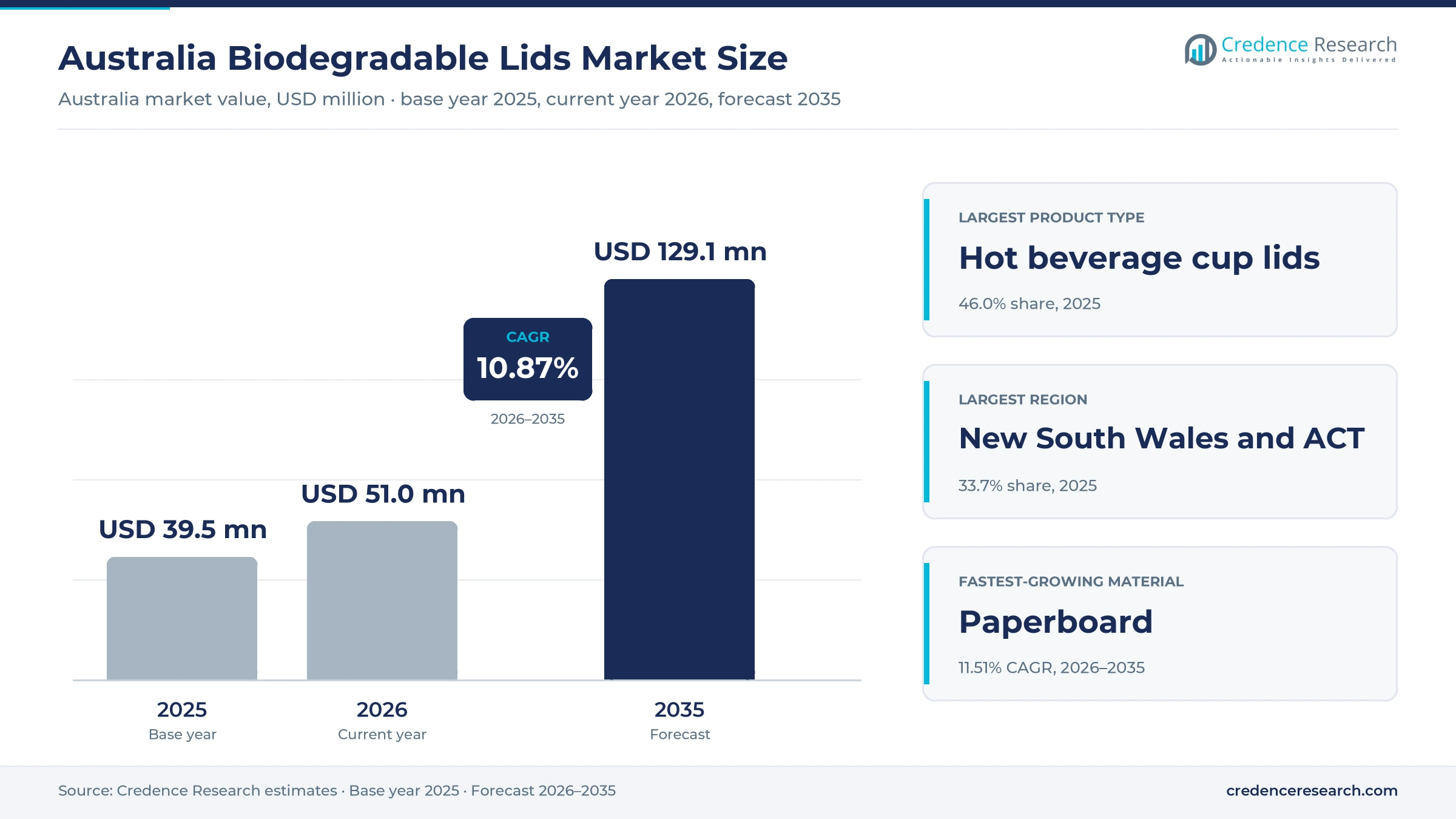
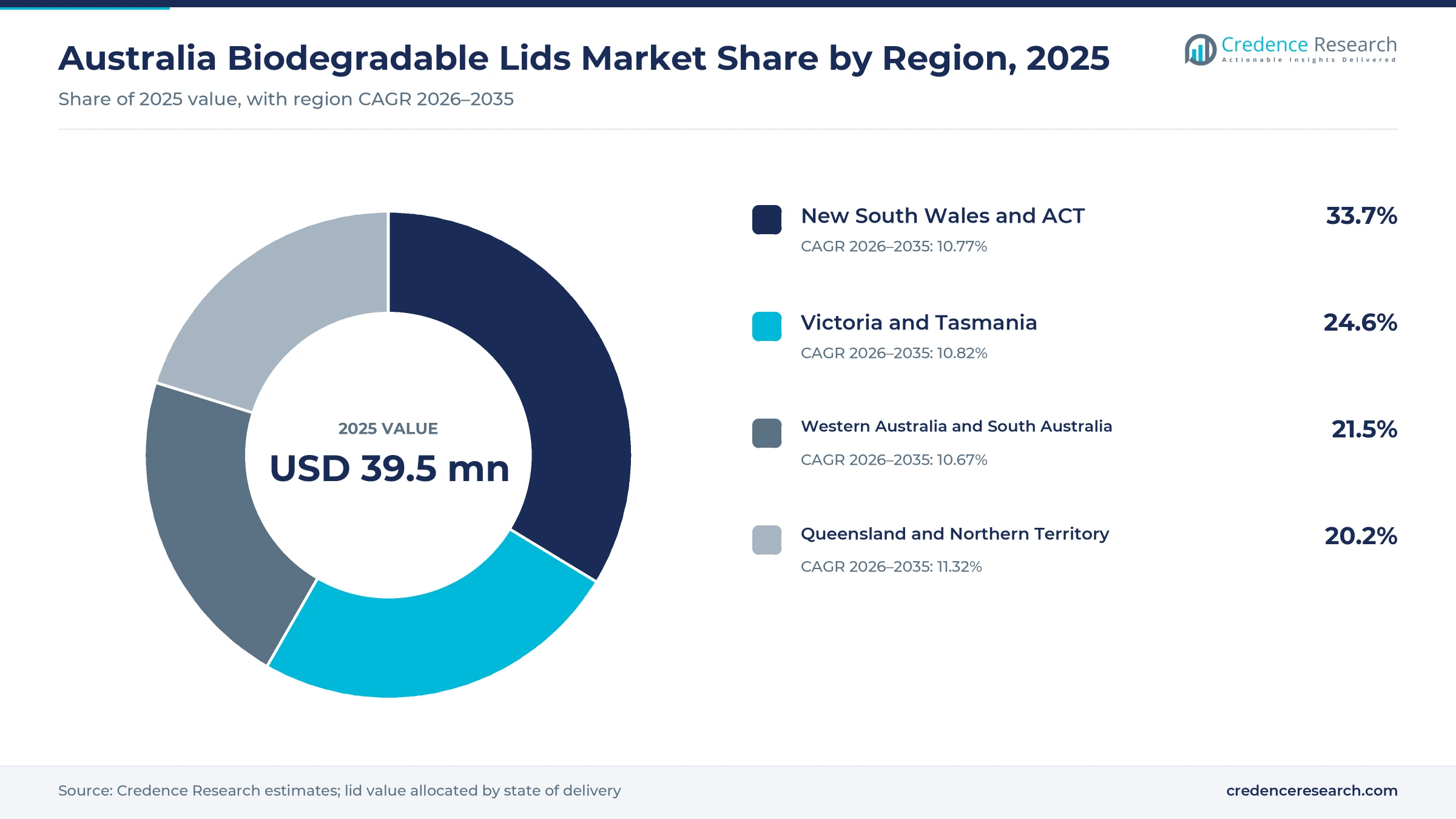
The Australia biodegradable lids market was valued at USD 39.5 million in 2025 and is projected to increase from USD 51.0 million in 2026 to USD 129.1 million by 2035, registering a CAGR of 10.87% during 2026–2035. Demand comes from cafés, coffee chains, quick-service restaurants and caterers that must replace plastic cup and container lids with certified compostable or plant-based lids. New South Wales and ACT held the largest regional share, 33.7% in 2025, because Sydney and Canberra host dense café and office catering networks. Queensland and Northern Territory is the fastest-growing region at 11.32% a year, as Queensland prepares future bans on disposable coffee cups and lids. State rules are also changing quickly, because Western Australia and South Australia both removed plastic beverage lids from sale during 2024. As a result, suppliers are widening molded fiber ranges from coffee cups into bowls, trays and takeaway containers.
Which lids and food service buyers does the estimate cover?
The estimate measures the value of hot beverage cup lids, cold beverage cup lids and food container lids sold in Australia that are made from molded plant fiber, paperboard or certified compostable polymers. Values are stated at supplier and wholesaler selling prices that cafés, restaurants, caterers and chains pay for cartons of lids.
The estimate excludes conventional plastic lids, reusable lids sold with keep cups, and cups, bowls or containers sold without lids. The value chain runs from fiber molders and compostable resin makers, mostly overseas, through Australian brand owners, food service wholesalers and online trade stores to outlets across every state and territory.
Australia Biodegradable Lids Market Insights
- The Australia biodegradable lids market was valued at USD 39.5 million in 2025 and is projected to reach USD 129.1 million by 2035, registering a CAGR of 10.87% during 2026–2035.
- New South Wales and ACT held a 33.7% share of 2025 value, because Sydney and Canberra host dense café and catering networks.
- Hot beverage cup lids led with a 46.0% share of 2025 value, because coffee service generates steady weekly reorders of a few standard sizes.
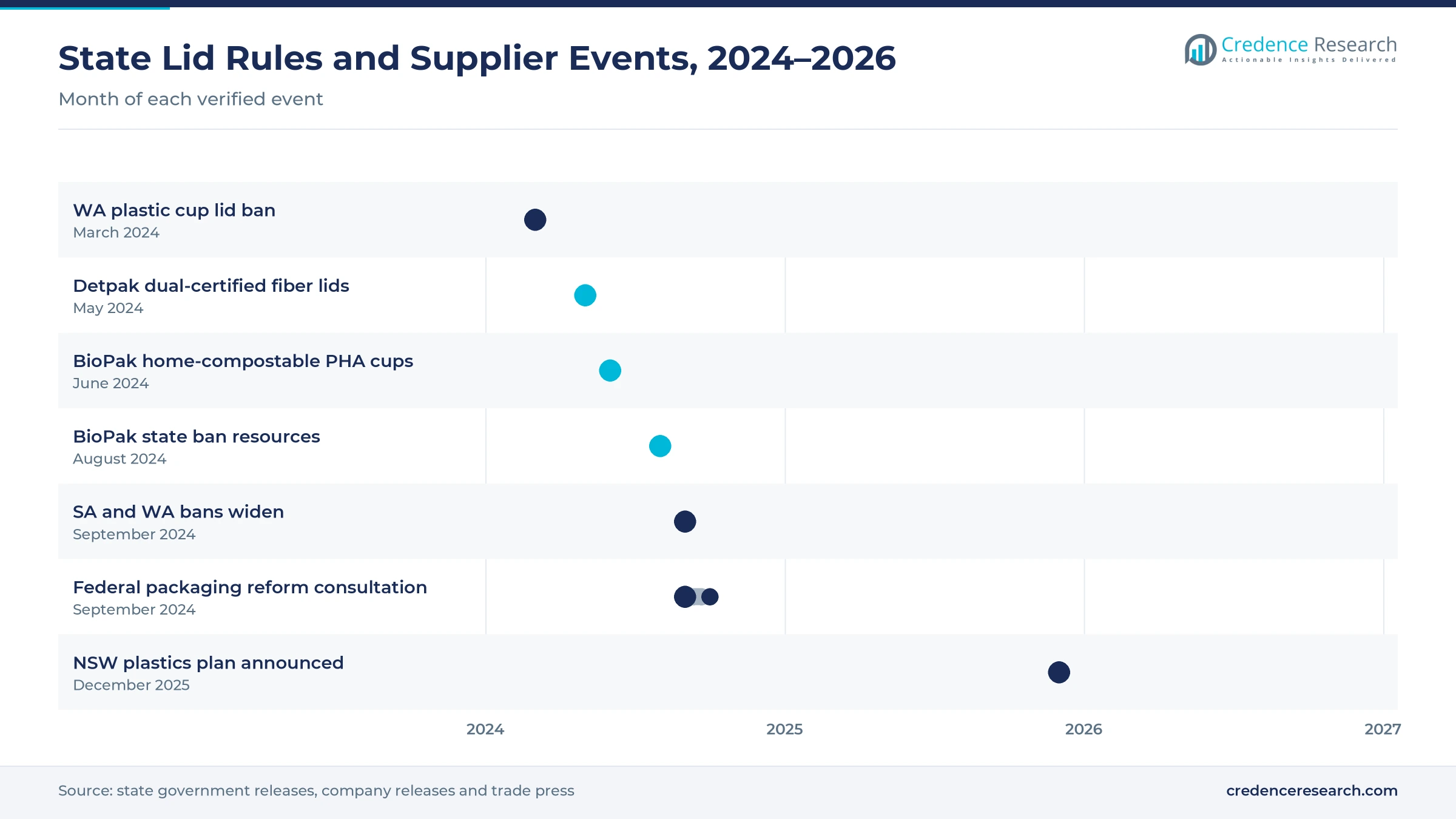
- Western Australia banned plastic cup lids for hot and cold drinks from March 1, 2024, and South Australia banned plastic coffee cup lids from Sept. 1, 2024.
- BioPak, Detpak and Vegware Australia compete with certified fiber and compostable lids, while dual certification wins favor with chains that serve several states.
Hot cup lids lead while container lids grow fastest
Why do hot beverage cup lids lead demand?
Based on product type, the market is categorized into hot beverage cup lids, cold beverage cup lids and container lids. Hot Beverage Cup Lids led with a 46.0% share of 2025 value, because cafés reorder a few standard coffee lid sizes every week. Container Lids grow fastest at 11.38% a year, as state bans now cover plastic lids for takeaway bowls, trays and containers.
How does molded plant fiber dominate lid materials?
Based on material, the market is categorized into moulded plant fibre, paperboard and compostable polymers. Moulded Plant Fibre led with 48.0% of 2025 value, because pulp lids are plastic-free and suit both hot drinks and food containers. Paperboard grows fastest at 11.51% a year, as folded board lids replace polymer lids on bowls and noodle boxes.
Why do cafés and coffee chains lead lid purchases?
Based on end user, the market is categorized into cafés and coffee chains, quick-service restaurants, takeaway restaurants and contract catering. Cafés and Coffee Chains led with 44.0% of 2025 value, because takeaway coffee needs a lid on almost every cup sold. Takeaway Restaurants grow fastest at 11.28% a year, as container lid bans reach curries, noodles, salads and desserts.
Why does dual certification lead buyer preference?
Based on certification status, the market is categorized into industrial certification only, home certification only and dual certification. Dual Certification led with 47.0% of 2025 value, because chains want one lid that suits commercial and home composting. Dual Certification also grows fastest at 11.43% a year, as buyers phase out lids certified only for industrial sites.
| Segment Group | Leading Sub-segment | Share, 2025 | Fastest-growing Sub-segment | CAGR, 2026–2035 |
|---|---|---|---|---|
| By Product Type | Hot Beverage Cup Lids | 46.0% | Container Lids | 11.38% |
| By Material | Moulded Plant Fibre | 48.0% | Paperboard | 11.51% |
| By End User | Cafés and Coffee Chains | 44.0% | Takeaway Restaurants | 11.28% |
| By Certification Status | Dual Certification | 47.0% | Dual Certification | 11.43% |
Request a Free Sample
Fill in your details and we'll send you a free sample report.
- Sample data tables & charts
- Research methodology
State bans, weekly reorders and container ranges lift sales
How does state procurement conversion lift lid demand?
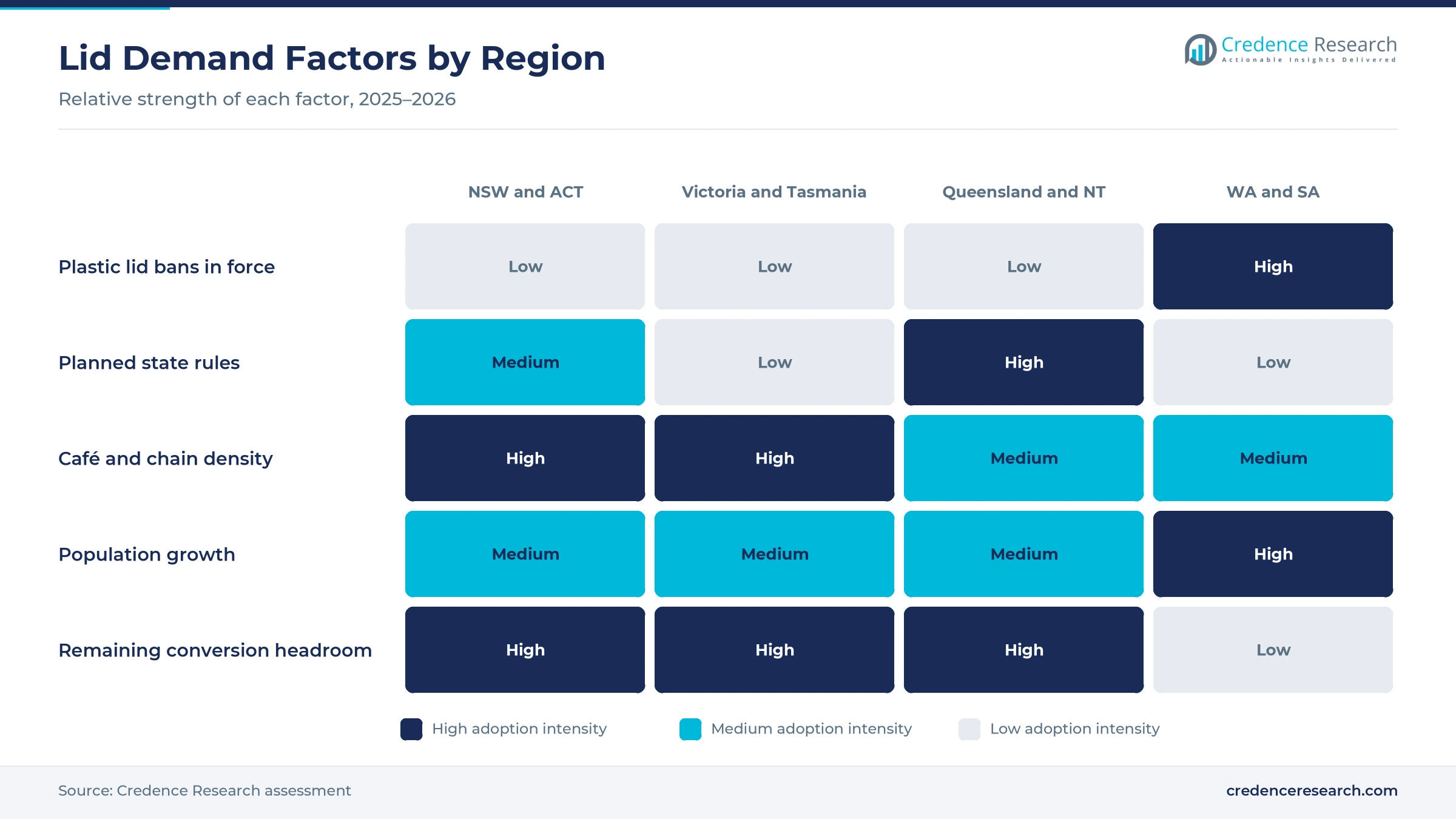
State-specific procurement conversion lifts lid demand, because each plastics ban forces cafés and caterers to replace their lid stock with certified alternatives. Western Australia banned plastic cup lids for hot and cold drinks from March 1, 2024, according to the state environment department. The same plan added plastic lids for takeaway bowls, trays and containers from Sept. 1, 2024, which moved a second product family into compliant formats. South Australia banned plastic beverage containers, including coffee cups, lids and beverage plugs, from Sept. 1, 2024, according to state business guidance. As a result, Western Australia and South Australia held 21.5% of 2025 value, because operators there had already switched most lid purchases.
Why does standardized beverage-lid replenishment steady orders?
Standardized beverage-lid replenishment keeps orders steady, because cafés reorder the same few lid sizes every week regardless of menu changes. The Western Australian environment minister said the state coffee cup ban would keep more than 154 million cups from landfill each year, which shows the scale of daily lid use in one state. Clean Up Australia volunteers also collected 13,000 takeaway coffee cups in the 2023 financial year, which keeps public pressure on cafés. Detpak markets hot and cold cup fiber lids certified to the commercial AS 4736 and home AS 5810 compostable standards, according to its product flyer. In turn, hot beverage cup lids held 46.0% of 2025 value, as coffee service drives most repeat orders.
How does expansion into food containers widen lid supply?
Portfolio expansion into food containers widens the market, because suppliers that won cup lid contracts now sell matching lids for bowls, trays and takeaway boxes. BioPak promoted BioCane lids for paper bowls and containers in August 2024, ahead of the Sept. 1, 2024, bans, and said they cost half as much as paper lids, according to Australian Manufacturing. BioPak also promoted plant fiber lids for ice cream cups, which serve delivery operators that need sealed portions. Western Australia also banned plastic trays for takeaway food from March 1, 2024, which pulled restaurants into fiber formats six months before container lids followed. As a result, container lids grow fastest at 11.38% a year, as outlets match lids and bases across compostable foodservice packaging ranges.
Why does national packaging reform support certified lids?
National packaging reform supports certified lids, because food service chains want packs that meet future federal rules as well as state bans. The federal climate and environment department opened a public consultation on packaging regulation reform on Sept. 27, 2024. Australia placed about 6.98 million metric tons of packaging on the market in 2021-22, yet the plastic recycling rate reached only 20%, according to the Australian Packaging Covenant Organisation. The same report showed that problematic single-use plastic packaging had fallen 33% from the 2017-18 baseline, which leaves further room for replacement. In turn, dual certification grows at 11.43% a year, the fastest certification rate, as buyers prefer lids that suit both commercial and home composting.
Fiber lids and home composting reshape lid specifications
How is the shift toward molded fiber lids changing cafés?
The shift toward molded fiber lids is changing café purchasing, because operators want plastic-free lids that still seal well on hot cups. BioPak sent sample packs of its pulp-based lids to 15,000 cafés in June 2023, each with 10 small and 10 large lids, and said the lids were certified home compostable. BioPak also told South Australian businesses in August 2024 that they would need plant fiber coffee cup lids once plastic lids were phased out. Detpak then marketed fiber hot and cold cup lids with dual certification from May 2024. As a result, moulded plant fibre held 48.0% of 2025 value, because fiber lids now replace polystyrene and polymer lids across most coffee service.
Why is the rise of home composting certification notable?
The rise of home composting certification is reshaping lid specifications, because many households and small outlets have no access to commercial composting. BioPak unveiled home-compostable PHA-lined cups in June 2024, certified to the Australian AS 5810 standard and the French NF T51-800 standard in 8-ounce, 12-ounce and 16-ounce sizes. Detpak fiber lids carry both commercial AS 4736 and home AS 5810 certification, which lets one lid suit several waste streams. South Australian guidance also lists certified compostable bioplastic food and beverage containers as approved alternatives. In turn, dual certification held 47.0% of 2025 value, as chains standardize on lids that meet both tests and match their paper cups in every state.
Is there an opening in New South Wales ahead of its plan?
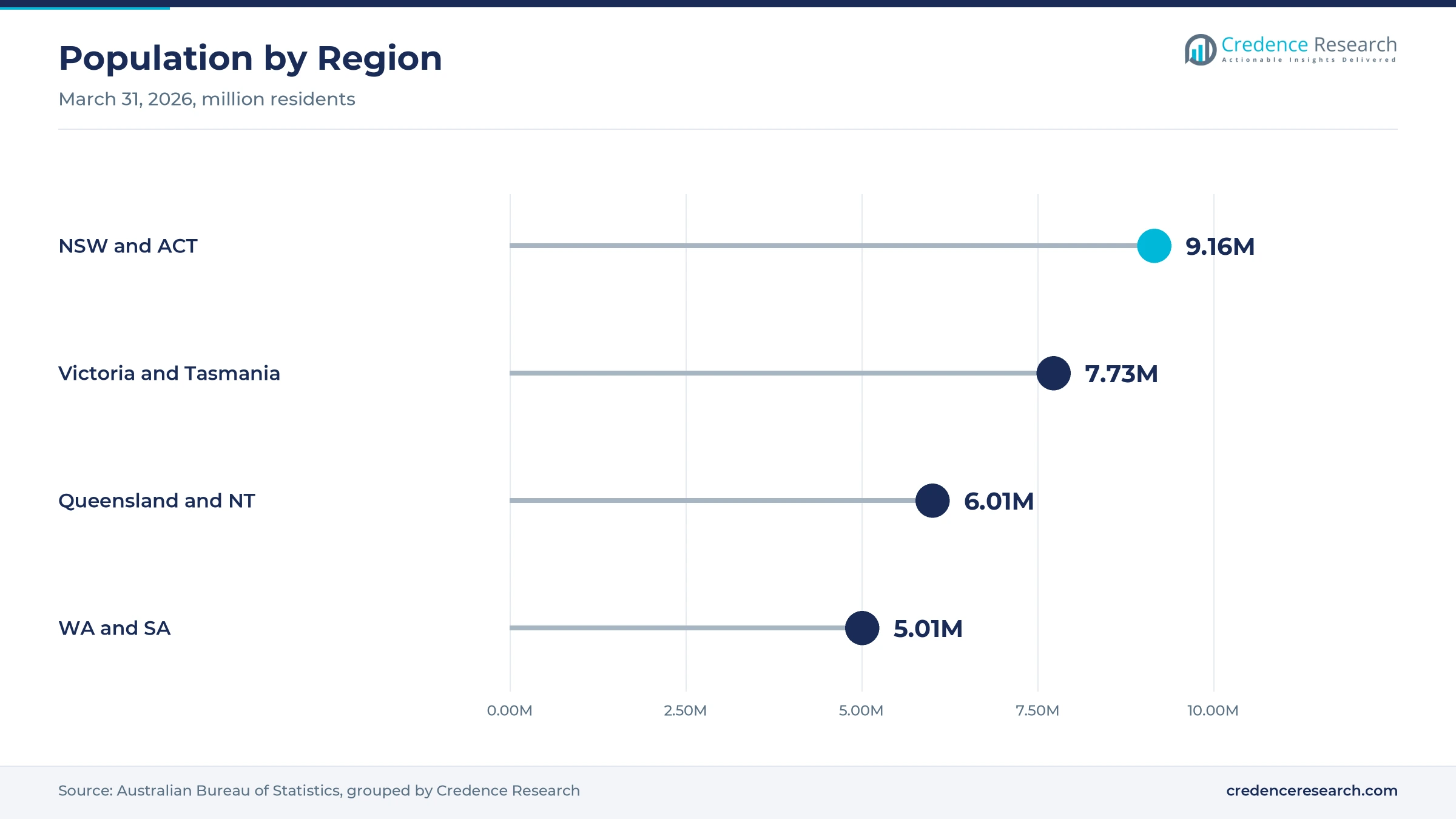
New South Wales offers an opening for lid suppliers, because the state has announced a new round of plastics measures for food service. The state government announced its plan on Dec. 1, 2025, requiring takeaway businesses to accept reusable cups by 2028 and large food service businesses to offer reusable options by 2030. The same plan said plastic makes up about 74% of litter in waterways and that less than 16% of plastic waste is recycled. The state also had about 8.67 million residents at March 31, 2026, the largest population of any state. As a result, New South Wales and ACT remain the largest regional market, and early supply contracts there can lock in volume before rules tighten.
Can Queensland quick-service chains open room to grow?
Queensland quick-service chains open room to grow, because the state has signaled future bans on disposable coffee cups and lids. Queensland released a five-year plastics roadmap in July 2022 that listed disposable coffee cups and lids among planned bans. Queensland also added about 90,100 residents in the year to March 31, 2026, growth of 1.6%, according to the Australian Bureau of Statistics. Urban residents made up about 87.7% of the national population in 2025, according to World Bank data, which concentrates takeaway demand in cities such as Brisbane and the Gold Coast. In turn, Queensland and Northern Territory is the fastest-growing region, as quick-service chains convert lids before rules apply.
Price gaps and composting access slow lid conversion
How do price gaps slow conversion at small cafés?
Price gaps slow conversion at small cafés, because certified lids usually cost more per unit than the plastic lids they replace. Independent operators feel this most, since they buy in smaller cartons and cannot negotiate supply contracts. As a result, some outlets delay switching in states without bans. Suppliers respond with lower-cost fiber formats and bundled cup and lid pricing. Over time, larger production runs should narrow the gap with plastic.
Why do composting access gaps limit end-of-life value?
Composting access gaps limit end-of-life value, because many councils do not collect food packaging with garden or food organics. Lids certified only for industrial composting then often reach landfill, which weakens their environmental case with buyers. In turn, some chains question paying more for lids that are rarely composted. Suppliers respond with home-compostable and dual-certified designs that suit more waste streams. Wider council organics collection would strengthen the case for certified lids.
How do performance concerns affect hot drink lids?
Performance concerns affect hot drink lids, because fiber lids must resist steam, avoid leaks and fit cups from several makers. Cafés that receive complaints about taste or spills may switch suppliers quickly or revert to sipper-free service. As a result, suppliers test lid fit across cup sizes before chain rollouts. Click-on rims and water-based barrier coatings have improved sealing on most cup sizes. Continued design work should reduce returns and protect repeat orders.
Why does the state rule patchwork raise supply costs?
The state rule patchwork raises supply costs, because bans differ by item and date across Western Australia, South Australia, Queensland and New South Wales. National chains must track several lists and hold different stock in each state. In turn, wholesalers carry more product lines and face higher inventory risk. Suppliers respond with state guides and lids that comply everywhere. A national approach under federal packaging reform would simplify purchasing for chains.
New South Wales and ACT lead while Queensland grows fastest
| Region | Value, 2025 (USD million) | Share, 2025 | CAGR, 2026–2035 |
|---|---|---|---|
| New South Wales and ACT | 13.3 | 33.7% | 10.77% |
| Victoria and Tasmania | 9.7 | 24.6% | 10.82% |
| Western Australia and South Australia | 8.5 | 21.5% | 10.67% |
| Queensland and Northern Territory | 8.0 | 20.2% | 11.32% |
Why do New South Wales and ACT hold the largest share?
New South Wales and ACT held 33.7% of 2025 value and grow at 10.77% a year, because Sydney and Canberra host dense café, office catering and quick-service networks. New South Wales had about 8.67 million residents at March 31, 2026, while the ACT had about 490,000. The state plan announced in December 2025 requires takeaway outlets to accept reusable cups by 2028, which keeps sustainability high on buyer agendas.
How do Victoria and Tasmania sustain lid demand?
Victoria and Tasmania held 24.6% of 2025 value and grow at 10.82% a year, because Melbourne has one of the largest café cultures in the country. Victoria added about 109,500 residents in the year to March 31, 2026, the largest increase of any state. In turn, coffee chains and caterers in Melbourne keep ordering certified cup lids, even though most demand comes from voluntary switching rather than lid bans.
Why is Queensland and Northern Territory the fastest-growing region?
Queensland and Northern Territory held 20.2% of 2025 value and grow fastest at 11.32% a year, because Queensland plans future bans on disposable coffee cups and lids. Queensland had about 5.74 million residents at March 31, 2026, after growing 1.6% over the year. As a result, chains in Brisbane, the Gold Coast and Darwin are converting lids early to avoid rushed changes.
How do Western Australia and South Australia lead conversion?
Western Australia and South Australia held 21.5% of 2025 value and grow at 10.67% a year, because both states already ban plastic beverage lids. Western Australia recorded the fastest state population growth at 2.1% in the year to March 2026. However, growth there is slower than in other regions, since most lid conversion happened during 2024.
State bans and supplier launches marked 2024 and 2025
| Development | Status and market relevance |
|---|---|
| In March 2024, Western Australia banned plastic coffee cups and plastic cup lids for hot and cold drinks. | Moved all café lid purchases in the state into certified alternatives |
| In September 2024, South Australia banned plastic cup lids and Western Australia banned plastic container lids. | Extended conversion from beverage lids to food container lids |
| In September 2025, South Australia banned plastic soy sauce fish and straws or cutlery attached to pre-packaged food and drinks. | Extended state rules to more takeaway packaging items |
| In December 2025, New South Wales announced a plastics plan requiring outlets to accept reusable cups by 2028. | Signals further change in the largest regional market |
| In February 2026, the federal climate and environment department released updated guidance on national packaging regulation reform. | Points to national rules that packaging be recyclable, reusable or compostable |
Molded fiber and certified coatings shape lid design
- Molded pulp forming presses wet sugarcane bagasse or wood fiber into lids with click-on rims, which removes plastic from hot drink service.
- Water-based barrier coatings help fiber and paperboard lids resist steam and grease, which keeps lids rigid during delivery.
- PHA and PLA polymers give clear or flexible compostable lids for cold drinks and salads, which suits outlets that need product visibility.
- Certification testing checks lids against the AS 4736 commercial and AS 5810 home composting standards, which supports claims under state rules.
Need a Custom Version of This Report?
Tailor the scope, geography, or segments to your exact requirements.
- Custom geography or segment scope
- Direct access to our analyst team
Suppliers compete on certification, fit and price
Competition centers on certification, lid fit, price and national distribution through food service wholesalers. BioPak competes with pulp-based cup lids, BioCane container lids and home-compostable PHA-lined cups, and it publishes guides that help businesses prepare for state bans. Detpak offers hot and cold cup fiber lids certified to both commercial and home composting standards, which suits chains that operate across several states. Vegware Australia sells compostable hot cup lids and PLA cold cups through its Australian online store, which reaches smaller cafés directly. Rivals also compete on cup and lid compatibility, because cafés want lids that fit cups from more than one supplier. Larger suppliers win national chain contracts with full ranges of cups, lids, containers and compostable tableware, while smaller importers compete on price in states without bans. The Western Australian ban on plastic cup lids from March 1, 2024, gave certified suppliers the first statewide shift in lid demand.
Companies profiled and their roles in this market
| Company | Type | Role in the market |
|---|---|---|
| BioPak | Brand owner and supplier | Sells pulp cup lids, BioCane container lids and home-compostable cups |
| Detpak | Packaging manufacturer | Offers fiber hot and cold cup lids with commercial and home certification |
| Vegware Australia | Compostable packaging supplier | Sells compostable hot cup lids and PLA cold cups online |
Credence Research view on Australian lid conversion
Credence Research's view is that Australian lid demand will grow quickly because state bans keep moving cafés and restaurants away from plastic lids. Hot cup lids keep the largest share, while container lids grow fastest as bans reach bowls and trays. Molded fiber leads materials, and dual certification gains favor with chains. Queensland should grow fastest among the regions as its planned bans approach. However, price gaps and limited composting access will slow voluntary switching in some states. Suppliers with certified ranges, reliable lid fit and national distribution should gain share fastest.
State rules and supplier releases anchor the lid model
The report uses 2025 as the base year on a calendar basis, and market values come from the Credence Research model. That model combines state plastics rules, national packaging data, population statistics, World Bank urbanization data and supplier product releases. Segment splits and regional growth rates are Credence Research estimates, while regional shares follow the client-defined split. Sources used are official statistics, government releases, trade press and company releases, and no interviews or surveys were used.
Wider bans and container lids carry growth to 2035
Lid sales are expected to reach USD 129.1 million by 2035, a 10.87% CAGR during 2026–2035, as state bans, container lid conversion and national packaging reform keep orders rising. Growth should stay strong through 2028 as Queensland and New South Wales act on their plans. After that, price parity with plastic and council composting access will set the pace. Faster national rules would raise this outlook, while delays in state bans would lower it. Container lids and dual-certified designs are expected to gain the most share over the period.
Frequently Asked Questions
How big is the Australia biodegradable lids market?
Which product type leads lid demand in Australia?
Which region leads the Australia biodegradable lids market?
Which material leads the market?
Which state rules affect lid demand?
Why does dual certification matter to buyers?
Who are the leading lid suppliers in Australia?
What are the main challenges for lid suppliers?
Table of Content
Chapter 1 Market Segmentation
- 1.1 Segmentation Framework
- 1.1.1 Product and Service Classification
- 1.1.2 Application and End-Use Classification
- 1.1.3 Technology and Solution Classification
- 1.1.4 Customer and Distribution Channel Classification
- 1.1.5 Geographic Segmentation
- 1.1.6 Market Segment Definitions and Boundaries
- 1.2 By Product Type
- 1.2.1 Hot Beverage Cup Lids
- 1.2.2 Cold Beverage Cup Lids
- 1.2.3 Container Lids
- 1.3 By Material
- 1.3.1 Moulded Plant Fibre
- 1.3.2 Paperboard
- 1.3.3 Compostable Polymers
- 1.4 By End User
- 1.4.1 Cafés and Coffee Chains
- 1.4.2 Quick-Service Restaurants
- 1.4.3 Takeaway Restaurants
- 1.4.4 Contract Catering
- 1.5 By Certification Status
- 1.5.1 Industrial Certification Only
- 1.5.2 Home Certification Only
- 1.5.3 Dual Certification
Chapter 2 Introduction
- 2.1 Report Objectives and Scope
- 2.2 Product Definition and Industry Terminology
- 2.3 Market Inclusions and Exclusions
- 2.4 Research Process
- 2.4.1 Primary Research and Expert Interviews
- 2.4.2 Secondary Research and Source Review
- 2.4.3 Top-Down and Bottom-Up Estimation
- 2.4.4 Data Triangulation and Verification
- 2.5 Market Size Measurement Basis
- 2.5.1 2025: USD 39.5 million → 2035: USD 129.1 million
- 2.6 Historical and Forecast Reference Periods
- 2.6.1 Historical Period: 2018-2025
- 2.6.2 Base Year: 2025
- 2.6.3 Forecast Period: 2025-2035
- 2.7 Research Assumptions and Limitations
Chapter 3 Executive Summary
- 3.1 Market Snapshot and Key Findings
- 3.2 Base-Year Market Size, 2025
- 3.3 Forecast Market Size, 2035
- 3.4 Revenue and Volume Growth Outlook
- 3.5 Key Demand and Supply Indicators
- 3.6 Leading Market Segments
- 3.7 Fastest-Growing Market Opportunities
- 3.8 Regional Performance Highlights
- 3.9 Technology and Industry Transformation
- 3.10 Competitive Landscape Summary
- 3.11 Analyst View and Strategic Implications
Chapter 4 Australia Biodegradable Lids Market Trends and Developments
- 4.1 Historical Industry Development, 2018-2025
- 4.2 Recent Market Trends and Developments
- 4.3 Demand and Customer Behavior Trends
- 4.4 Technology and Product Innovation
- 4.5 Artificial Intelligence, Automation and Digitalization
- 4.6 Local Manufacturing and Supply Chain Realignment
- 4.7 Industry Partnerships, Mergers and Acquisitions
- 4.8 Sustainability and Circular Economy Developments
- 4.9 Government and Private Sector Investment Trends
- 4.10 Emerging Business Models and Commercialization
- 4.11 Industry Developments and Announcements
Chapter 5 Australia Biodegradable Lids Market Production, Supply and Demand Analysis
- 5.1 Demand Trend and Consumption Analysis, 2018-2025
- 5.2 Demand Forecast, 2025-2035
- 5.3 Production and Output Trend, 2018-2025
- 5.4 Production and Output Forecast, 2025-2035
- 5.5 Installed Capacity and Capacity Utilization
- 5.6 Company-Wise Production Plants and Statistics
- 5.6.1 Installed Production Capacity
- 5.6.2 Actual Production
- 5.6.3 Planned Capacity and Expansion Targets
- 5.7 Supply Chain Structure and Procurement Trends
- 5.8 Supply-Demand Gap and Bottlenecks
- 5.9 Import Dependence and Sourcing Structure
- 5.10 Contract Manufacturing and Outsourcing
- 5.11 Regional Supply and Demand Concentration
Chapter 6 Australia Biodegradable Lids Market Pricing Analysis
- 6.1 Pricing Structure and Measurement
- 6.2 Historical Pricing Trends, 2018-2025
- 6.3 Pricing Outlook, 2025-2035
- 6.4 Average Selling Price and Unit Economics
- 6.5 Pricing by Product and Market Segment
- 6.6 Geographic Pricing Differences
- 6.7 Key Input, Energy, Labor and Logistics Costs
- 6.8 Contract Pricing and Purchasing Models
- 6.9 Pricing Sensitivity and Competitive Positioning
- 6.10 Price, Margin and Profitability Implications
Chapter 7 Australia Biodegradable Lids Market Dynamics
- 7.1 Market Growth Drivers
- 7.1.1 Demand-Side Drivers
- 7.1.2 Technology and Innovation Drivers
- 7.1.3 Infrastructure and Investment Drivers
- 7.1.4 Regulatory and Policy Drivers
- 7.2 Market Restraints
- 7.2.1 Cost and Affordability Constraints
- 7.2.2 Technology and Adoption Barriers
- 7.2.3 Supply Chain and Operational Constraints
- 7.3 Market Challenges
- 7.3.1 Competitive Pressure and Margin Erosion
- 7.3.2 Skills, Infrastructure and Implementation Gaps
- 7.4 Emerging Market Opportunities
- 7.5 Market Dynamics Impact and Time-Horizon Assessment
Chapter 8 Australia Biodegradable Lids Value Chain Analysis
- 8.1 Industry Value Chain Overview
- 8.2 Upstream Suppliers and Critical Inputs
- 8.3 Technology and Component Providers
- 8.4 Manufacturing or Service Delivery
- 8.5 Distribution, Channel Partners and Integrators
- 8.6 Downstream Applications and End Users
- 8.7 Value Addition and Profit Pools
- 8.8 Vertical Integration and Outsourcing
- 8.9 Supplier Concentration and Risk
- 8.10 Supply Chain Localization and Resilience
Chapter 9 Australia Biodegradable Lids Market Regulations and Policies
- 9.1 Relevant Laws, Standards and Compliance Frameworks
- 9.2 Product, Service, Safety and Quality Requirements
- 9.3 Government Policies, Incentives and Subsidies
- 9.4 Imports, Exports and Trade Barriers
- 9.5 Public Procurement and Local Content Requirements
- 9.6 Environmental and Sustainability Compliance
- 9.7 Upcoming Policy Changes and Market Implications
Chapter 10 Australia Biodegradable Lids Market Hotspots and Opportunities
- 10.1 Market Opportunity Mapping and Growth Hotspots
- 10.2 High-Growth Applications and Customer Groups
- 10.3 Underserved Markets and White-Space Opportunities
- 10.4 Emerging Technology and Product Opportunities
- 10.5 New Capacity and Investment Hotspots
- 10.6 Market Entry and Expansion Opportunities
- 10.7 Distribution and Partnership Opportunities
- 10.8 Near-Term and Long-Term Commercial Potential
- 10.9 Opportunity Attractiveness and Execution Risks
Chapter 11 Australia Biodegradable Lids Market Outlook, 2025-2035
- 11.1 Market Size and Analysis
- 11.1.1 Revenue (Market Measurement: 2025: USD 39.5 million → 2035: USD 129.1 million)
- 11.1.2 Market Volume and Quantity Sold
- 11.1.3 Historical Market Size, 2018-2025
- 11.1.4 Base-Year Market Size, 2025
- 11.2 Market Forecast, 2025-2035
- 11.2.1 Revenue Forecast to 2035
- 11.2.2 Volume Forecast to 2035
- 11.2.3 CAGR and Year-on-Year Growth
- 11.2.4 Incremental Revenue Opportunity
- 11.3 Forecast Assumptions and Scenario Analysis
- 11.3.1 Base-Case Forecast
- 11.3.2 Optimistic and Conservative Scenarios
- 11.3.3 Technology, Pricing and Policy Sensitivities
- 11.4 Market Attractiveness and Growth Outlook
Chapter 12 Australia Biodegradable Lids Market Segmentation and Outlook
- 12.1 Segmentation Summary and Market Shares, 2025
- 12.2 Largest and Fastest-Growing Segments
- 12.3 By Product Type - Market Size and Forecast, 2025-2035
- 12.3.1 Segment Definition and Scope
- 12.3.2 Historical Market Size, 2018-2025
- 12.3.3 Revenue Forecast, 2025-2035
- 12.3.4 Volume Forecast, 2025-2035
- 12.3.5 Base-Year Market Share, 2025
- 12.3.6 Segment CAGR and Growth Drivers
- 12.3.7 Subsegment Market Size and Forecast
- 12.3.7.1 Hot Beverage Cup Lids
- 12.3.7.2 Cold Beverage Cup Lids
- 12.3.7.3 Container Lids
- 12.3.8 Subsegment Pricing and Adoption Trends
- 12.3.9 Leading Suppliers and Competition
- 12.3.10 Regional Demand and Opportunities
- 12.4 By Material - Market Size and Forecast, 2025-2035
- 12.4.1 Segment Definition and Scope
- 12.4.2 Historical Market Size, 2018-2025
- 12.4.3 Revenue Forecast, 2025-2035
- 12.4.4 Volume Forecast, 2025-2035
- 12.4.5 Base-Year Market Share, 2025
- 12.4.6 Segment CAGR and Growth Drivers
- 12.4.7 Subsegment Market Size and Forecast
- 12.4.7.1 Moulded Plant Fibre
- 12.4.7.2 Paperboard
- 12.4.7.3 Compostable Polymers
- 12.4.8 Subsegment Pricing and Adoption Trends
- 12.4.9 Leading Suppliers and Competition
- 12.4.10 Regional Demand and Opportunities
- 12.5 By End User - Market Size and Forecast, 2025-2035
- 12.5.1 Segment Definition and Scope
- 12.5.2 Historical Market Size, 2018-2025
- 12.5.3 Revenue Forecast, 2025-2035
- 12.5.4 Volume Forecast, 2025-2035
- 12.5.5 Base-Year Market Share, 2025
- 12.5.6 Segment CAGR and Growth Drivers
- 12.5.7 Subsegment Market Size and Forecast
- 12.5.7.1 Cafés and Coffee Chains
- 12.5.7.2 Quick-Service Restaurants
- 12.5.7.3 Takeaway Restaurants
- 12.5.7.4 Contract Catering
- 12.5.8 Subsegment Pricing and Adoption Trends
- 12.5.9 Leading Suppliers and Competition
- 12.5.10 Regional Demand and Opportunities
- 12.6 By Certification Status - Market Size and Forecast, 2025-2035
- 12.6.1 Segment Definition and Scope
- 12.6.2 Historical Market Size, 2018-2025
- 12.6.3 Revenue Forecast, 2025-2035
- 12.6.4 Volume Forecast, 2025-2035
- 12.6.5 Base-Year Market Share, 2025
- 12.6.6 Segment CAGR and Growth Drivers
- 12.6.7 Subsegment Market Size and Forecast
- 12.6.7.1 Industrial Certification Only
- 12.6.7.2 Home Certification Only
- 12.6.7.3 Dual Certification
- 12.6.8 Subsegment Pricing and Adoption Trends
- 12.6.9 Leading Suppliers and Competition
- 12.6.10 Regional Demand and Opportunities
- 12.7 Segment Growth Comparison
- 12.8 Segment Attractiveness and Priority Matrix
Chapter 13 Australia Biodegradable Lids End-Use and Application Market Outlook
- 13.1 End-Use Industry and Customer Demand Structure
- 13.2 Leading Applications and Customer Groups
- 13.3 End-Use Market Size, Share and Forecast
- 13.4 Major End-Use Industry Deep Dives
- 13.4.1 Customer Requirements and Use Cases
- 13.4.2 Demand and Replacement Cycles
- 13.4.3 Technical and Regulatory Considerations
- 13.4.4 Purchasing and Procurement Models
- 13.4.5 Leading Vendors and Distribution Channels
- 13.4.6 Forecast and Commercial Opportunities
- 13.5 Emerging Applications and Cross-Segment Demand
- 13.6 End-Use Industry Investment Priorities
Chapter 14 Australia Biodegradable Lids Geographic Market Outlook, 2025-2035
- 14.1 Domestic Market Distribution and Demand Clusters
- 14.2 State- or Province-Wise Market Size and Forecast, 2025-2035
- 14.3 City and Metropolitan Market Outlook
- 14.4 Industrial, Manufacturing and Commercial Clusters
- 14.5 Geographic Concentration of Key End Users
- 14.6 Local Pricing and Purchasing Differences
- 14.7 Domestic Production Facilities and Capacity Map
- 14.8 Local Infrastructure and Project Pipeline
- 14.9 State-Level Policy and Incentive Differences
- 14.10 Subnational Investment Hotspots and Opportunities
- 14.11 Distribution and Logistics Networks
- 14.12 Domestic Competitive Footprint
Chapter 15 Australia Biodegradable Lids Technology, Innovation and Sustainability Outlook
- 15.1 Technology Landscape and Maturity
- 15.2 Product, Process and Service Innovation
- 15.3 AI, Automation and Digital Tools in the Industry
- 15.4 Technology Adoption and Performance Benchmarking
- 15.5 Innovation Pipeline and R&D Investment
- 15.6 Patent and Intellectual Property Trends
- 15.7 Energy Efficiency and Resource Management
- 15.8 Sustainability, Recycling and Circularity
- 15.9 Technology Roadmap, 2025-2035
- 15.10 Risks of Obsolescence and Technology Substitution
Chapter 16 Australia Biodegradable Lids Market Key Strategic Imperatives
- 16.1 Growth and Market Entry Priorities
- 16.2 High-Return Products and Segments
- 16.3 Pricing, Profitability and Cost Optimization
- 16.4 Technology Investment and Product Differentiation
- 16.5 Supply Chain Localization and Resilience
- 16.6 Distribution and Customer Acquisition
- 16.7 Partnership, Acquisition and Capacity Strategy
- 16.8 Regional Expansion Priorities
- 16.9 Short-, Medium- and Long-Term Actions
Chapter 17 Competition Outlook
- 17.1 Industry Competition Characteristics
- 17.2 Market Structure and Concentration
- 17.3 Market Share and Competitive Positioning, 2025
- 17.4 Company-Wise Revenue and Product Benchmarking
- 17.5 Production and Service Capacity Benchmarking
- 17.6 Technology, Pricing and Differentiation
- 17.7 Regional Footprint and Distribution Strength
- 17.8 Mergers, Acquisitions and Strategic Alliances
- 17.9 New Entrants and Competitive Threats
- 17.10 Porter's Five Forces and Industry Attractiveness
- 17.11 Competitive Outlook, 2025-2035
Chapter 18 Company Profiles
- 18.1 Company Coverage and Selection Criteria
- 18.2 BioPak
- 18.2.1 Business Description
- 18.2.2 Company Ownership and Geographic Presence
- 18.2.3 Product and Service Portfolio
- 18.2.4 Manufacturing and Operating Footprint
- 18.2.5 Production Capacity and Expansion Plans
- 18.2.6 Financial Performance and Investment
- 18.2.7 Market Share and Competitive Position
- 18.2.8 Technology and Innovation Capabilities
- 18.2.9 Strategic Alliances or Partnerships
- 18.2.10 Recent Developments
- 18.2.11 Growth Strategy and Outlook
- 18.3 Detpak
- 18.4 Vegware Australia
- 18.5 Oji Foodservice Packaging
- 18.6 PAC Trading
- 18.7 Other Relevant Market Participants
Note: Every listed company is profiled on the structure shown under the first company. The company list is preliminary and may change based on research findings, market developments, data availability and client requirements.
Chapter 19 Disclaimer
- 19.1 Research and Forecast Disclaimer
- 19.2 Data Source and Estimation Limitations
Note: The depth of individual sections depends on data availability for this market. Volume, capacity, trade and other unit-based metrics are included where applicable.