Dose-by-dose packs for older patients across the region
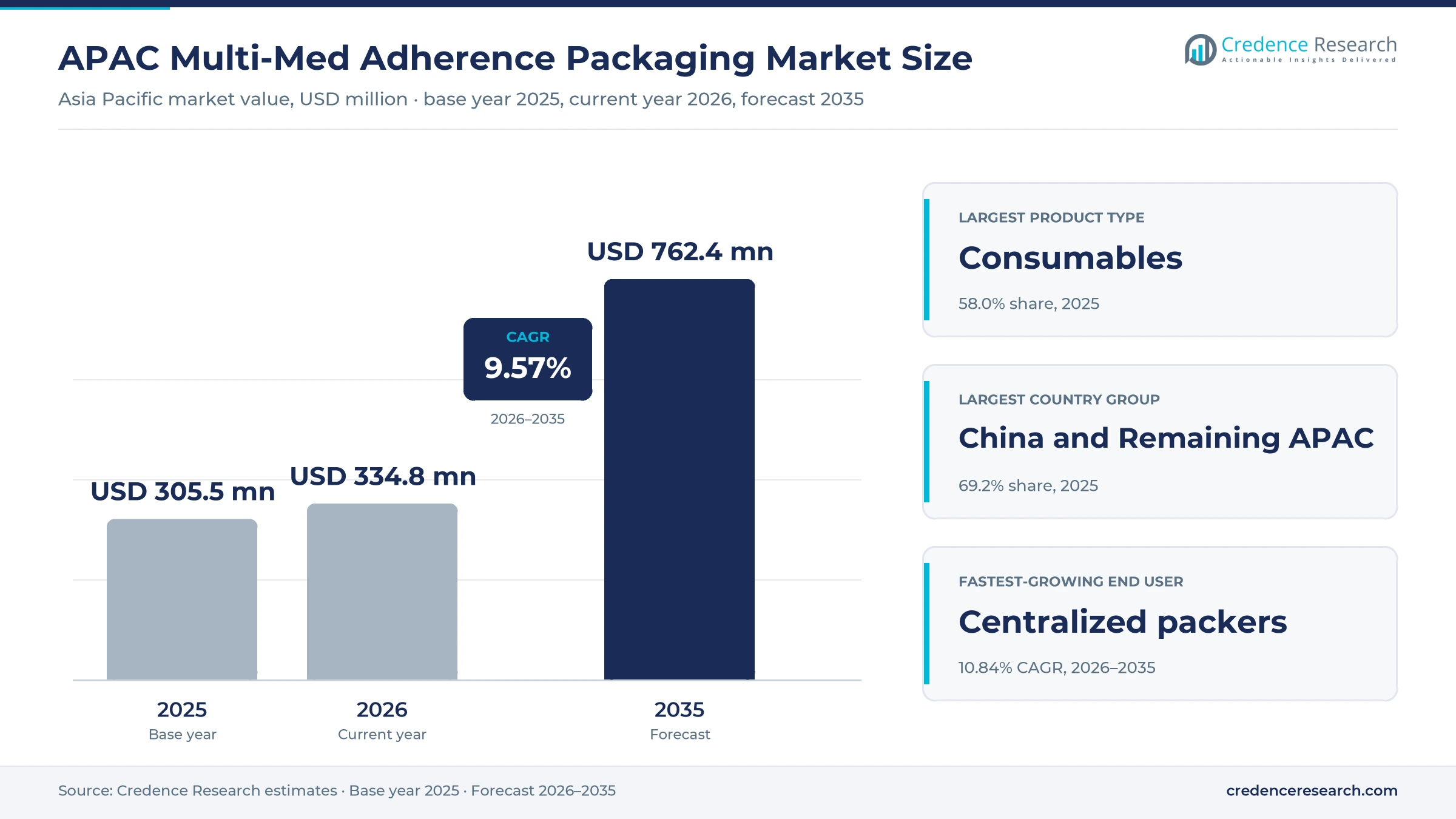
The APAC multi-med adherence packaging market was valued at USD 305.5 million in 2025 and is projected to increase from USD 334.8 million in 2026 to USD 762.4 million by 2035, registering a CAGR of 9.57% during 2026–2035. Demand comes from community pharmacies that pack weekly doses for older patients living at home, residential aged care homes that need sorted packs for every resident, and hospitals that discharge patients on changed regimens. China and Remaining Asia-Pacific held the largest share, 69.2% in 2025, because China serves the region's largest older population through a vast hospital and pharmacy network. The same group also grows fastest at 9.91% a year, as care funding widens. In March 2026, China formally launched a national long-term care insurance program after pilots covered more than 3.3 million disabled people, which widens funded care for residents who take many daily medicines.
Which dose packing products does the regional estimate cover?
The estimate measures spending on packs that sort several medicines by day and time for one patient, including blister cards, strip pouches and sealed trays, together with the machines that fill them and the software sold with those machines. It covers Japan, South Korea, Australia, New Zealand, China and the remaining Asia Pacific markets. Values are measured at the price paid by pharmacies, packing centers and care institutions through direct supplier sales, specialist distributors and framework purchasing.
The estimate excludes single-drug unit-dose packaging made by drug manufacturers, ordinary pill organizers sold at retail, and pharmacy dispensing fees or government service payments. The value chain runs from film, foil and card suppliers and machine makers through distributors to community pharmacies, centralized packing providers and hospital or aged care pharmacies that prepare packs for patients.
APAC Multi-Med Adherence Packaging Market Insights
- The APAC multi-med adherence packaging market was valued at USD 305.5 million in 2025 and is projected to reach USD 762.4 million by 2035, registering a CAGR of 9.57% during 2026–2035.
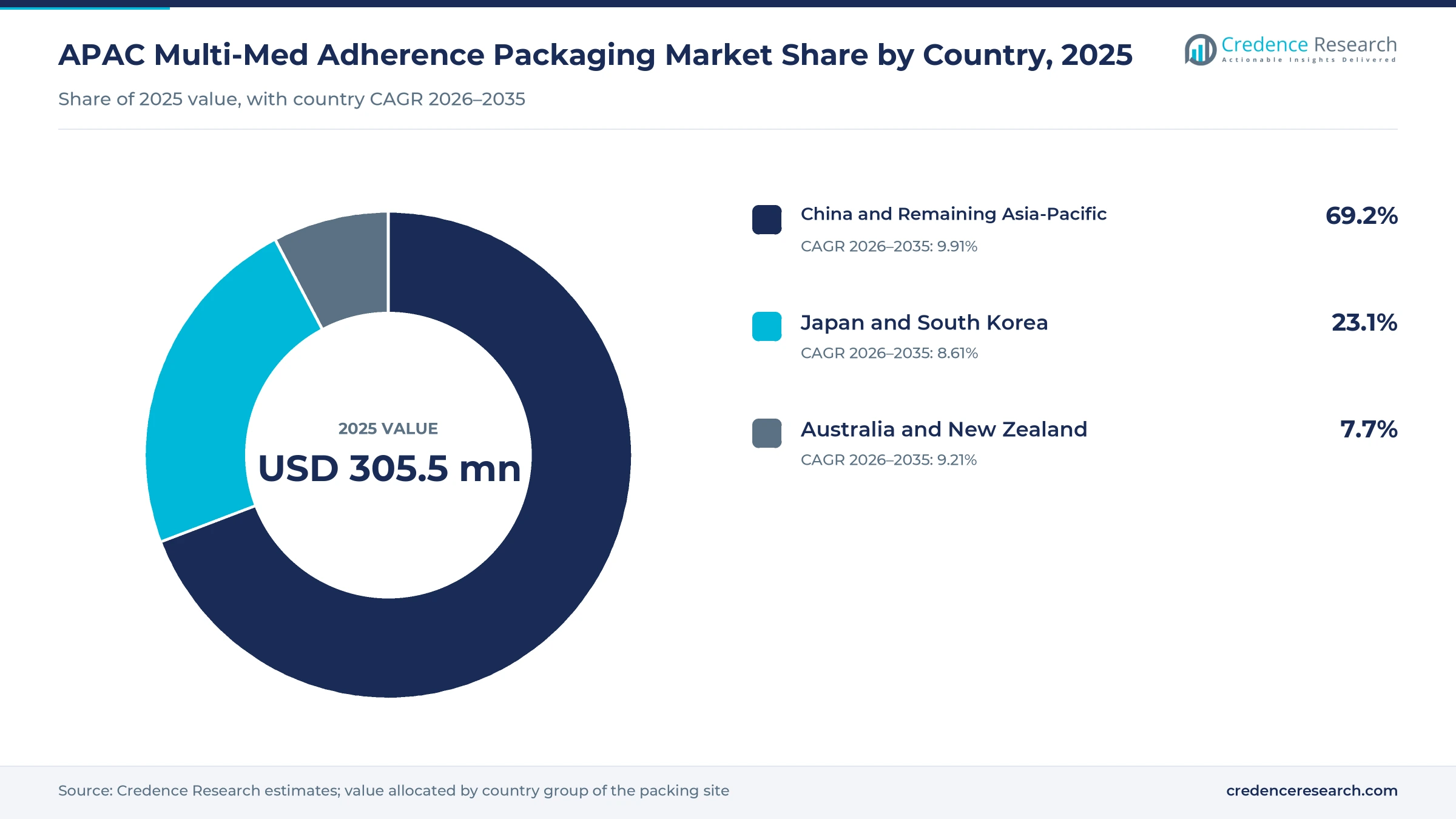
- China and Remaining Asia-Pacific held a 69.2% share of 2025 value, because China has the region's largest older population and pharmacy network.
- Packaging consumables led product demand with a 58.0% share of 2025 value, because every packed week uses new cards, pouches or trays.
- Australia pays pharmacies AUD 6.17 for each weekly dose aid service to an eligible patient, which keeps community packing volumes steady.
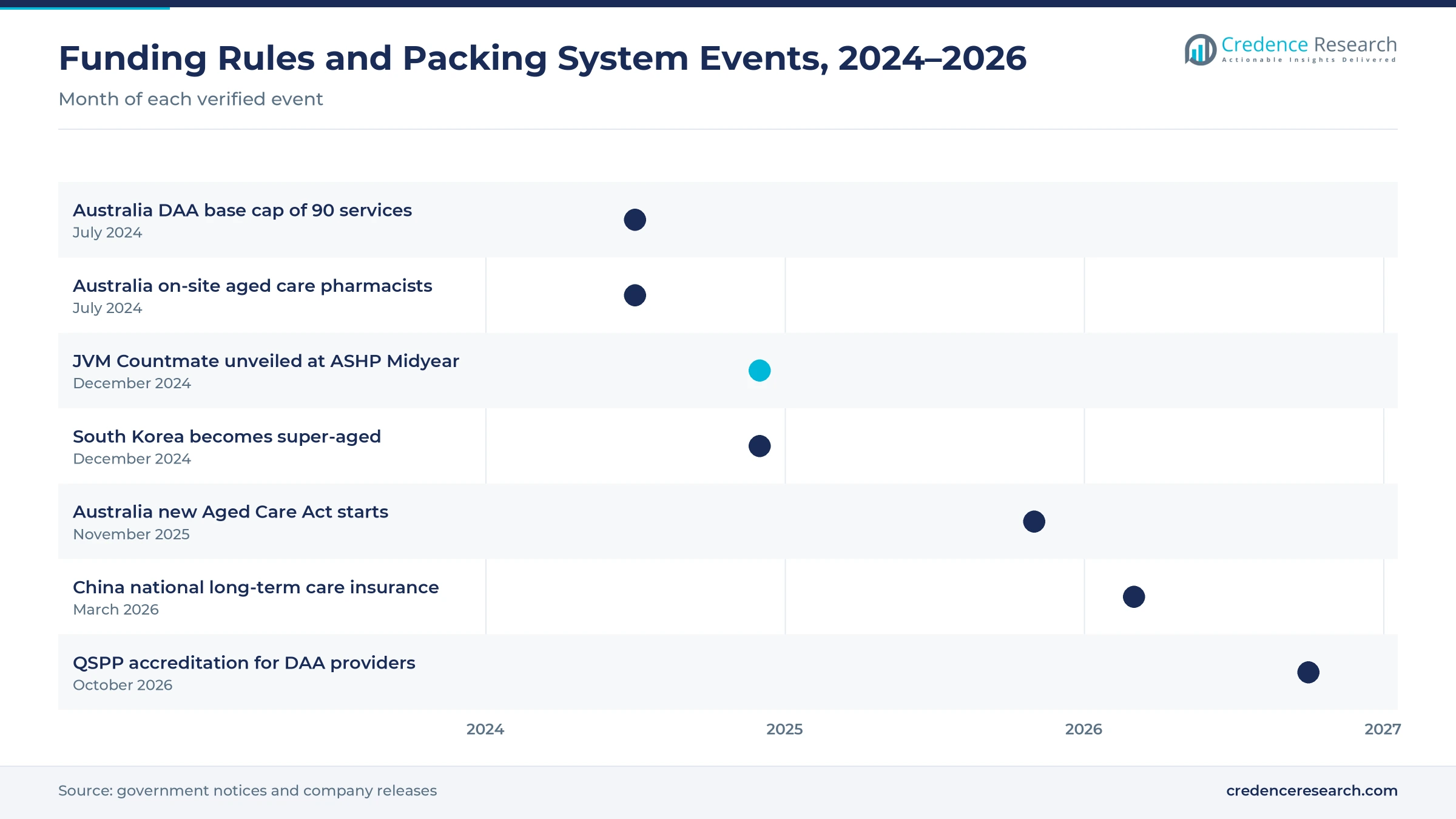
- Australia has funded on-site pharmacists in residential aged care since July 1, 2024, paying up to AUD 141,323.52 a year for each full-time position.
Consumables lead while centralized packers grow fastest
Why do consumables lead product demand?
Based on product type, the market is categorized into packaging consumables, packaging equipment and bundled packaging software. Packaging Consumables led with a 58.0% share of 2025 value, because every packed week uses new blister cards, pouch rolls or trays. Bundled Packaging Software grows fastest at 10.82% a year, as packers link machines to prescription records, checking images and care home ordering tools.
How does care setting shape pack demand?
Based on care setting, the market is categorized into community and home care, residential long-term care and hospital outpatient and discharge care. Community and Home Care led with a 48.0% share of 2025 value, because most older patients on several medicines still live at home. Hospital Outpatient and Discharge Care grows fastest at 10.16% a year, as hospitals send patients home with sorted supplies after regimen changes.
Why are centralized packers gaining share?
Based on end user, the market is categorized into community pharmacy operators, centralized packing providers and care institution pharmacies. Community Pharmacy Operators led with a 52.0% share of 2025 value, because local pharmacies pack for their own patients each week. Centralized Packing Providers grow fastest at 10.84% a year, as pharmacy groups move packing into robot hubs that serve many stores.
How fast is automated packing spreading?
Based on technology, the market is categorized into manual packaging, assisted packaging and automated packaging. Automated Packaging led with a 42.0% share of 2025 value, because Japanese, Korean and Chinese pharmacies and hospitals already run tablet packaging machines at scale. Automated Packaging grows fastest at 10.80% a year, as pharmacies replace hand-filled cards with robots that fill and check each dose.
| Segment Group | Leading Sub-segment | Share, 2025 | Fastest-growing Sub-segment | CAGR, 2026–2035 |
|---|---|---|---|---|
| By Product Type | Packaging Consumables | 58.0% | Bundled Packaging Software | 10.82% |
| By Care Setting | Community and Home Care | 48.0% | Hospital Outpatient and Discharge Care | 10.16% |
| By End User | Community Pharmacy Operators | 52.0% | Centralized Packing Providers | 10.84% |
| By Technology | Automated Packaging | 42.0% | Automated Packaging | 10.80% |
Request a Free Sample
Fill in your details and we'll send you a free sample report.
- Sample data tables & charts
- Research methodology
Aging, robots and funded dose aids lift pack volumes
Aging and complex regimens raise pack volumes
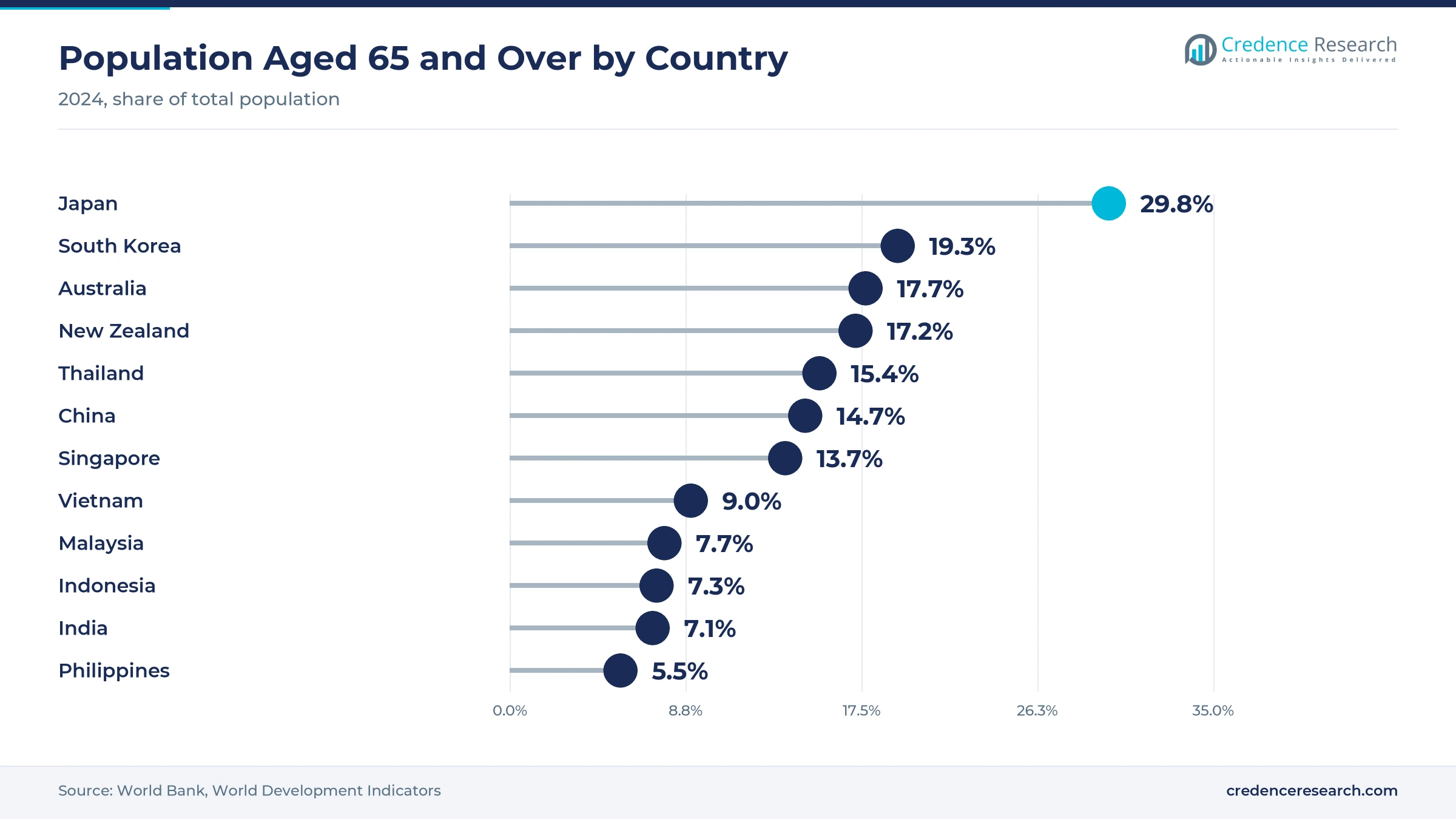
Aging populations raise the number of patients who take several medicines at set times each day, which is the core use case for multi-dose packs. Japan had about 36.19 million people aged 65 and over in September 2025, or 29.4% of the population, according to the Ministry of Internal Affairs and Communications. South Korea became a super-aged society on Dec. 23, 2024, when 10,244,550 residents, or 20% of the population, were 65 or older, the Ministry of the Interior and Safety reported. China had 323.38 million people aged 60 and above at the end of 2025, according to the National Bureau of Statistics of China. As a result, more patients need doses sorted in advance.
Pharmacy workflow automation speeds dose packing
Pharmacies adopt packing robots because manual filling of weekly blister cards is slow and ties up pharmacists who are needed for clinical work. myPak Solutions states that its Yuyama-built Alpaca UC and Blient units fill 25 to 40 multidose packs an hour, compared with seven to eight packs an hour by hand. Omnicell Australia lists the JVM 208DO pouch system at up to 50 pouches a minute for pharmacies that pack for up to 300 patients a week. Japan, home to Yuyama, TOSHO and Takazono, had 63,203 pharmacies at the end of fiscal 2024, up 375 from a year earlier, according to the Ministry of Health, Labour and Welfare. As a result, automated packaging grows fastest among technologies at 10.80% a year.
Funded dose administration support sustains demand
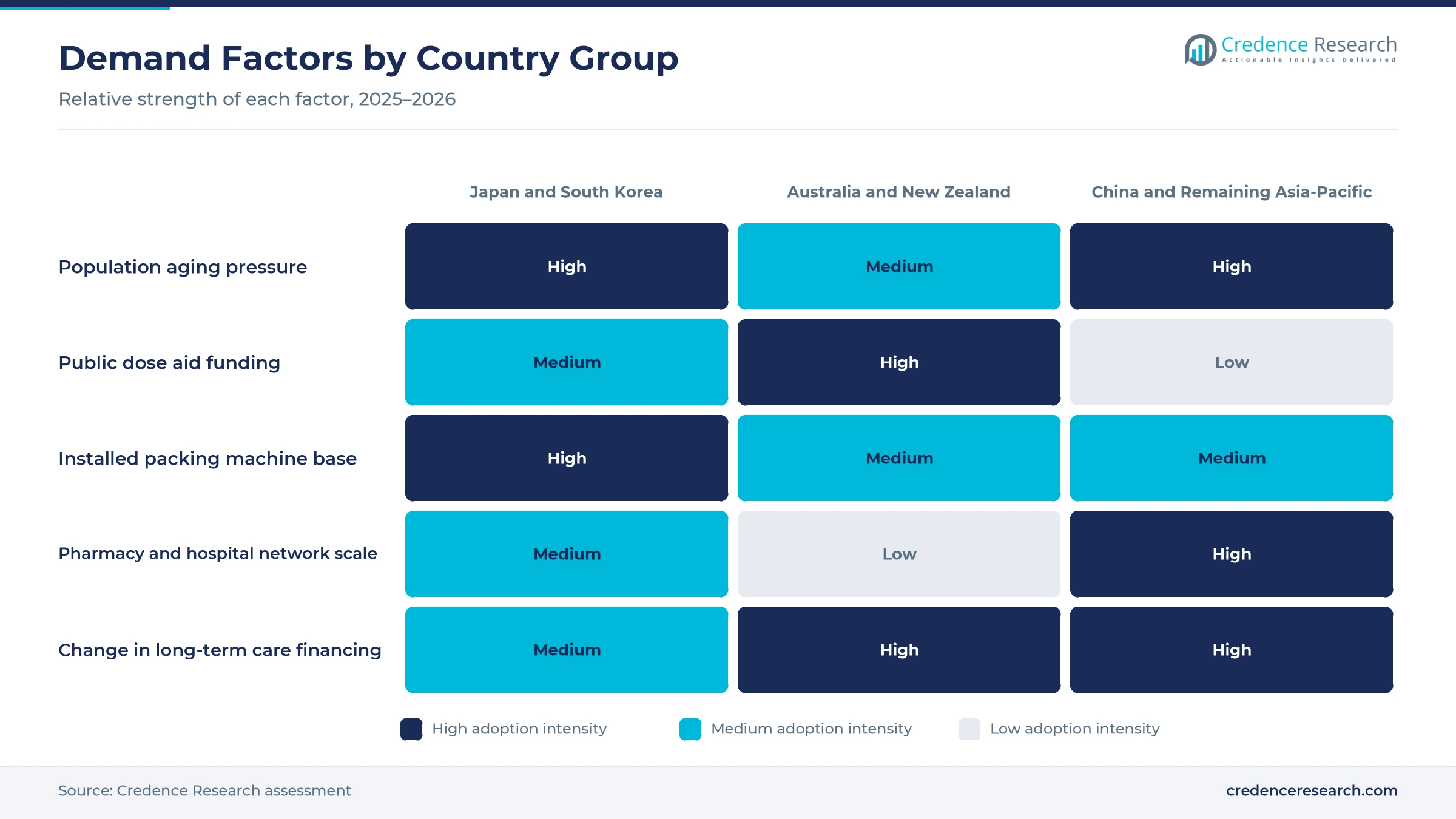
Australia funds dose administration aids directly, which gives pharmacies a stable reason to pack medicines for older people living at home. Under the federal Dose Administration Aids Program, pharmacies receive AUD 6.17 for each weekly service to an eligible patient, and new participants have had a base cap of 90 services a week since July 1, 2024, according to the Pharmacy Programs Administrator. The government has also funded on-site pharmacists in residential aged care homes since July 1, 2024, paying up to AUD 141,323.52 a year for each full-time position, the federal health department states. In addition, 196,000 people lived in permanent residential aged care on June 30, 2025, according to GEN aged care data. Consequently, Australia and New Zealand hold 7.7% of 2025 value despite their small populations.
Long-term care financing widens funded patients
New long-term care financing in China and South Korea widens the number of frail patients whose daily medicines are managed by care staff. China launched a national long-term care insurance program in March 2026, after pilots that began in 2016 covered more than 3.3 million disabled people, Asia News Network reported. The National Medical Products Administration counted 385,594 chain pharmacy stores and 281,366 single-store pharmacies at the end of 2023, according to The Paper, giving chains wide reach for packing. South Korea has run a National Health Insurance Service polypharmacy pilot since 2018, and a lawmaker cited a cut of more than 20% in emergency visits and readmission risk, Daily Pharm reported in August 2026. As a result, packing demand in China rises faster than in Japan and South Korea.
Pouch rolls and camera checks emerge in packing
Shift from blister cards toward pouch rolls
High-volume packers are moving from sealed blister cards toward strip pouches, because pouch machines fill faster and use rolls that are easier to stock. TOSHO packs each intake moment into a small plastic bag and has more than 5,000 such systems operating worldwide, with sales in Taiwan, Australia and Thailand, according to its European partner Simac. BD Rowa offers pouch packaging robots alongside blister packing robots in Australia, its distribution partner Goldx states. Omnicell Australia offers the JVM 208DO pouch packer with five pouch sizes and printed barcodes for up to 300 patients a week. JVM sells pouch rolls as consumables after each installation, Daily Pharm reported in March 2026. Because of this shift, packaging consumables keep the largest product share at 58.0% of 2025 value.
Rise of camera checks in automated dose packing
Automated packing now comes with camera inspection, because pharmacies need proof that each pouch holds the right tablets before it leaves the counter. JVM unveiled Countmate, a vial-filling system with built-in cameras, at the ASHP Midyear conference held Dec. 9 to 12, 2024, BioSpectrum Asia reported on Feb. 15, 2025. Omnicell Australia offers the optional Vizen EX inspection system with the JVM 208DO, while its 72DOB and 208DOB blister models check RFID or barcodes before sealing 35 to 40 trays an hour. The 208DO also recognizes its tablet canisters automatically, which reduces loading errors at the packing bench. As a result, buyers increasingly pair pharmacy automation with software that records every check.
Opportunity in centralized packing hubs
Centralized packing hubs offer an opening, because one site with robots can serve many stores that lack space or staff for packing. Sigma Healthcare merged with the Chemist Warehouse Group in February 2025 and supports more than 1,200 aligned pharmacies, which creates scale for shared packing services. myPak Solutions was formed in 2018 as a joint venture of Arrow Pharmaceuticals and Douglas Pharmaceuticals, whose managing director said Douglas led dose aid supply in New Zealand, Pharmacy Daily reported. These hubs work much like central fill operations that prepare prescriptions for many stores from one site. Consequently, centralized packing providers grow fastest among end users at 10.84% a year.
Opening in hospital discharge and transition packs
Hospital discharge offers an opening, because patients often leave with changed regimens and need a clear supply until their community pharmacy takes over. Webstercare introduced its Webster-pak interim pack for short-term discharge medicines after feedback from hospital pharmacists, Pharmacy Daily reported in December 2017. China had about 38,000 hospitals and 1.107 million medical and health institutions at the end of 2025, according to the national statistics communique, which shows the scale of potential discharge volume. South Korea has also folded its polypharmacy pilot into the second phase of its Integrated Community Care Project. As a result, hospital outpatient and discharge care grows fastest among care settings at 10.16% a year.
Fee caps, stability limits and waste weigh on packers
Fee caps limit returns on community packing
Australia pays AUD 6.17 per weekly dose aid service and gives new participants a base cap of 90 services a week, so community pharmacies earn thin margins on each pack. As a result, smaller pharmacies hesitate to buy robots or hire packing staff, even when demand from older patients rises. Patients outside funded programs also pay out of pocket, which limits uptake among lower-income households. Packers respond by moving volume to shared hubs, charging service fees for unfunded patients and using assisted machines that cost less than full robots.
Drug stability limits what can be repacked
Some medicines absorb moisture, react to light or must stay in their original packs, which limits what can go into a multi-dose card or pouch. Because of this, pharmacists must check stability data for each product and keep some doses outside the pack, which adds work and confuses patients. Prescription changes in the middle of a week also force packs to be remade. Suppliers answer with better barrier films, clear labels and software that flags products unsuitable for repacking.
Robot costs and space strain small pharmacies
Fully automated pouch and blister robots need capital, floor space and trained staff, which many independent pharmacies in China and Southeast Asia lack. Consequently, these pharmacies keep packing by hand, which limits speed and raises the risk of errors. Omnicell Australia lists a footprint of 0.62 square meters and a height of up to 2.15 meters for its JVM packers, space that many small dispensaries cannot spare. Machine makers respond with smaller assisted units, distributor leasing and remote support, while pharmacy groups centralize packing in one larger site.
Plastic waste from weekly packs draws scrutiny
Weekly blister cards and pouch strips create a steady stream of mixed plastic, foil and paper waste, because each pack is used once. As a result, care homes and pharmacies face questions from regulators and families about disposal and recycling. Mixed-material cards are hard to recycle in most local systems. Suppliers respond with paper-based cards, mono-material films and thinner pouch rolls, although these options must still protect medicines from moisture.
China and the wider region lead on scale and growth
| Country | Value, 2025 (USD million) | Share, 2025 | CAGR, 2026–2035 |
|---|---|---|---|
| China and Remaining Asia-Pacific | 211.4 | 69.2% | 9.91% |
| Japan and South Korea | 70.6 | 23.1% | 8.61% |
| Australia and New Zealand | 23.5 | 7.7% | 9.21% |
China and the wider region lead on scale
China and Remaining Asia-Pacific held a 69.2% share of 2025 value and grows at 9.91% a year, because China has the region's largest older population and pharmacy base. China had 223.65 million people aged 65 and above at the end of 2025, or 15.9% of its population. Long-term care insurance coverage for disabled residents widens the pool of patients whose medicines are packed by care staff. In Thailand, where TOSHO also sells pouch systems, people aged 65 and over made up 15.4% of the population in 2024, according to the World Bank.
Japan and South Korea rely on mature machine bases
Japan and South Korea held a 23.1% share of 2025 value and grow at 8.61% a year, the slowest pace in the region, because most pharmacies and hospitals already run packing machines. Japan is the largest buyer in this group and home to the machine makers Yuyama, TOSHO and Takazono. Demand for dispensing robots in Japan now comes mainly from replacement. In South Korea, where pouch dispensing is common, JVM supplies pouch packers and plans to launch its new ATDPS DOC3 system.
Australia and New Zealand run funded dose aid programs
Australia and New Zealand held a 7.7% share of 2025 value and grow at 9.21% a year, supported by long-running public funding for dose aids. Australia's new Aged Care Act and Support at Home program started on Nov. 1, 2025, and 293,000 people used home care on June 30, 2025. Webstercare, myPak Solutions, Omnicell and BD Rowa supply packs, robots and software to pharmacies that serve aged care services and older people living at home.
Funding rules, care reforms and new packing systems
| Development | Status and market relevance |
|---|---|
| In October 2026, the Quality and Safety Pharmacy Program replaced the Quality Care Pharmacy Program as the accreditation required for providers in Australia's Dose Administration Aids Program. | Raises quality requirements for funded community packing |
| In March 2026, Daily Pharm reported that JVM plans to launch its new ATDPS DOC3 system while expanding global sales of its MENITH robotic dispensing system. | Extends the Korean maker's packing range |
| In March 2026, China formally launched a national long-term care insurance program after pilots covered more than 3.3 million disabled people. | Widens funded care for frail residents on many medicines |
| In November 2025, Australia's new Aged Care Act and Support at Home program started. | Resets care funding for older people living at home |
| In December 2024, JVM unveiled Countmate, a vial-filling system with built-in cameras, at the ASHP Midyear conference in New Orleans. | Shows a Korean packing machine maker adding image checks |
Pouch strips, blister robots and checks shape choice
- Strip pouch packagers seal each dose time into a printed pouch on a roll, which suits high-volume hospital and hub packing.
- Blister card filling robots drop tablets from canisters into weekly cards before sealing, which suits patients and care homes used to card formats.
- Camera and barcode inspection checks each pouch or card against the prescription before release, which cuts errors and records proof of accuracy.
- Packing and signing software links prescriptions, pack production and care home administration records, as Webstercare does with its MedSig signing platform.
Need a Custom Version of This Report?
Tailor the scope, geography, or segments to your exact requirements.
- Custom geography or segment scope
- Direct access to our analyst team
Japanese and Korean machine makers face local packers
Competition splits between Japanese and Korean machine makers that sell pouch and blister robots and local suppliers that sell cards, consumables and packing services. Yuyama supplies the Alpaca UC and Blient blister units that myPak Solutions sells in Australia. TOSHO, based in Tokyo, runs more than 76 service points in Japan and sells its pouch systems in Taiwan, Australia and Thailand. Takazono, based in Osaka, makes powder and tablet packaging machines with tablet inspection support. JVM, a Hanmi Pharmaceutical affiliate, makes pouch and blister robots that Omnicell distributes in Australia. BD offers BD Rowa pouch and blister packing robots through Australian partners. Webstercare supplies Webster-pak cards and the MedSig platform to pharmacies serving aged care homes. Buyers weigh fill speed, accuracy checks, consumable costs and local service when they choose a supplier.
Companies profiled and their roles in this market
| Company | Type | Role in the market |
|---|---|---|
| Yuyama | Machine maker | Alpaca UC and Blient blister units sold by myPak Solutions in Australia |
| TOSHO | Machine maker | Pouch packaging systems sold in Japan, Taiwan, Australia and Thailand |
| Takazono | Machine maker | Powder and tablet packaging machines with inspection support, Osaka |
| JVM | Machine maker | Pouch and blister robots, pouch roll consumables, Hanmi affiliate |
| Omnicell | Distributor and integrator | Sells JVM 72DOB, 208DOB and 208DO systems in Australia |
| BD | Automation supplier | BD Rowa pouch and blister packing robots in Australia |
| Webstercare | Consumables and software supplier | Webster-pak cards and MedSig signing platform |
| myPak Solutions | Consumables and automation supplier | Blister cards and Yuyama-built packing units in Australia |
Credence Research view on regional dose packing
Credence Research's view is that regional dose packing is moving from hand-filled cards toward robot-filled pouches and cards with camera checks. China will stay the largest and fastest-growing area, because long-term care insurance, hospital scale and pharmacy chains arrive together. Japan and South Korea remain the technology base, since their machine makers supply much of the region. Australia and New Zealand show how steady public funding for dose aids sustains community packing demand. Suppliers that pair reliable consumables with automated packing and software should gain share, while card-only suppliers risk losing hubs that want complete systems.
How the regional dose packing estimate was built
The report uses 2025 as the base year and forecasts values to 2035 in USD million from the Credence Research market model. Country group, product, care setting, end user and technology splits are Credence Research estimates based on population and health statistics, public funding rules, pharmacy counts, company product information and trade press. Sources include the National Bureau of Statistics of China, the World Bank, the Ministry of Health, Labour and Welfare of Japan, the Australian Pharmacy Programs Administrator and health department, and company news. No interviews or surveys were conducted for this edition of the regional report.
Long-term care funding carries growth to 2035
The APAC multi-med adherence packaging market is projected to grow from USD 334.8 million in 2026 to USD 762.4 million by 2035, a 9.57% CAGR during 2026–2035, as aging, long-term care funding and pharmacy automation keep pack volumes rising. Growth should be strongest while China builds its national long-term care insurance system over the next three years. After that, replacement of older packing machines in Japan and South Korea and wider robot use in Australian hubs should add value. Faster care funding would raise this outlook, while tighter fee caps or slow automation at small pharmacies would lower it.
Frequently Asked Questions
How big is the APAC multi-med adherence packaging market?
Which product type leads regional demand?
Which country group leads the regional market?
How does Australia support dose packing?
Why is automated packing growing fastest?
Which end user grows fastest?
Who are the leading companies in the region?
What are the main challenges for packers?
Table of Content
Chapter 1 Market Segmentation
- 1.1 Segmentation Framework
- 1.1.1 Product and Service Classification
- 1.1.2 Application and End-Use Classification
- 1.1.3 Technology and Solution Classification
- 1.1.4 Customer and Distribution Channel Classification
- 1.1.5 Geographic Segmentation
- 1.1.6 Market Segment Definitions and Boundaries
- 1.2 By Product Type
- 1.2.1 Packaging Consumables
- 1.2.2 Packaging Equipment
- 1.2.3 Bundled Packaging Software
- 1.3 By Care Setting
- 1.3.1 Community and Home Care
- 1.3.2 Residential Long-Term Care
- 1.3.3 Hospital Outpatient and Discharge Care
- 1.4 By End User
- 1.4.1 Community Pharmacy Operators
- 1.4.2 Centralized Packing Providers
- 1.4.3 Care Institution Pharmacies
- 1.5 By Technology
- 1.5.1 Manual Packaging
- 1.5.2 Assisted Packaging
- 1.5.3 Automated Packaging
- 1.6 By Country
- 1.6.1 Japan and South Korea
- 1.6.2 Australia and New Zealand
- 1.6.3 China and Remaining Asia-Pacific
Chapter 2 Introduction
- 2.1 Report Objectives and Scope
- 2.2 Product Definition and Industry Terminology
- 2.3 Market Inclusions and Exclusions
- 2.4 Research Process
- 2.4.1 Primary Research and Expert Interviews
- 2.4.2 Secondary Research and Source Review
- 2.4.3 Top-Down and Bottom-Up Estimation
- 2.4.4 Data Triangulation and Verification
- 2.5 Market Size Measurement Basis
- 2.5.1 2025: USD 305.5 million → 2035: USD 762.4 million
- 2.6 Historical and Forecast Reference Periods
- 2.6.1 Historical Period: 2018-2025
- 2.6.2 Base Year: 2025
- 2.6.3 Forecast Period: 2025-2035
- 2.7 Research Assumptions and Limitations
Chapter 3 Executive Summary
- 3.1 Market Snapshot and Key Findings
- 3.2 Base-Year Market Size, 2025
- 3.3 Forecast Market Size, 2035
- 3.4 Revenue and Volume Growth Outlook
- 3.5 Key Demand and Supply Indicators
- 3.6 Leading Market Segments
- 3.7 Fastest-Growing Market Opportunities
- 3.8 Regional Performance Highlights
- 3.9 Technology and Industry Transformation
- 3.10 Competitive Landscape Summary
- 3.11 Analyst View and Strategic Implications
Chapter 4 APAC Multi-Med Adherence Packaging Market Trends and Developments
- 4.1 Historical Industry Development, 2018-2025
- 4.2 Recent Market Trends and Developments
- 4.3 Demand and Customer Behavior Trends
- 4.4 Technology and Product Innovation
- 4.5 Artificial Intelligence, Automation and Digitalization
- 4.6 Local Manufacturing and Supply Chain Realignment
- 4.7 Industry Partnerships, Mergers and Acquisitions
- 4.8 Sustainability and Circular Economy Developments
- 4.9 Government and Private Sector Investment Trends
- 4.10 Emerging Business Models and Commercialization
- 4.11 Industry Developments and Announcements
Chapter 5 APAC Multi-Med Adherence Packaging Market Production, Supply and Demand Analysis
- 5.1 Demand Trend and Consumption Analysis, 2018-2025
- 5.2 Demand Forecast, 2025-2035
- 5.3 Production and Output Trend, 2018-2025
- 5.4 Production and Output Forecast, 2025-2035
- 5.5 Installed Capacity and Capacity Utilization
- 5.6 Company-Wise Production Plants and Statistics
- 5.6.1 Installed Production Capacity
- 5.6.2 Actual Production
- 5.6.3 Planned Capacity and Expansion Targets
- 5.7 Supply Chain Structure and Procurement Trends
- 5.8 Supply-Demand Gap and Bottlenecks
- 5.9 Import Dependence and Sourcing Structure
- 5.10 Contract Manufacturing and Outsourcing
- 5.11 Regional Supply and Demand Concentration
Chapter 6 APAC Multi-Med Adherence Packaging Market Pricing Analysis
- 6.1 Pricing Structure and Measurement
- 6.2 Historical Pricing Trends, 2018-2025
- 6.3 Pricing Outlook, 2025-2035
- 6.4 Average Selling Price and Unit Economics
- 6.5 Pricing by Product and Market Segment
- 6.6 Geographic Pricing Differences
- 6.7 Key Input, Energy, Labor and Logistics Costs
- 6.8 Contract Pricing and Purchasing Models
- 6.9 Pricing Sensitivity and Competitive Positioning
- 6.10 Price, Margin and Profitability Implications
Chapter 7 APAC Multi-Med Adherence Packaging Market Dynamics
- 7.1 Market Growth Drivers
- 7.1.1 Demand-Side Drivers
- 7.1.2 Technology and Innovation Drivers
- 7.1.3 Infrastructure and Investment Drivers
- 7.1.4 Regulatory and Policy Drivers
- 7.2 Market Restraints
- 7.2.1 Cost and Affordability Constraints
- 7.2.2 Technology and Adoption Barriers
- 7.2.3 Supply Chain and Operational Constraints
- 7.3 Market Challenges
- 7.3.1 Competitive Pressure and Margin Erosion
- 7.3.2 Skills, Infrastructure and Implementation Gaps
- 7.4 Emerging Market Opportunities
- 7.5 Market Dynamics Impact and Time-Horizon Assessment
Chapter 8 APAC Multi-Med Adherence Packaging Value Chain Analysis
- 8.1 Industry Value Chain Overview
- 8.2 Upstream Suppliers and Critical Inputs
- 8.3 Technology and Component Providers
- 8.4 Manufacturing or Service Delivery
- 8.5 Distribution, Channel Partners and Integrators
- 8.6 Downstream Applications and End Users
- 8.7 Value Addition and Profit Pools
- 8.8 Vertical Integration and Outsourcing
- 8.9 Supplier Concentration and Risk
- 8.10 Supply Chain Localization and Resilience
Chapter 9 APAC Multi-Med Adherence Packaging Market Regulations and Policies
- 9.1 Relevant Laws, Standards and Compliance Frameworks
- 9.2 Product, Service, Safety and Quality Requirements
- 9.3 Government Policies, Incentives and Subsidies
- 9.4 Imports, Exports and Trade Barriers
- 9.5 Public Procurement and Local Content Requirements
- 9.6 Environmental and Sustainability Compliance
- 9.7 Upcoming Policy Changes and Market Implications
Chapter 10 APAC Multi-Med Adherence Packaging Market Hotspots and Opportunities
- 10.1 Market Opportunity Mapping and Growth Hotspots
- 10.2 High-Growth Applications and Customer Groups
- 10.3 Underserved Markets and White-Space Opportunities
- 10.4 Emerging Technology and Product Opportunities
- 10.5 New Capacity and Investment Hotspots
- 10.6 Market Entry and Expansion Opportunities
- 10.7 Distribution and Partnership Opportunities
- 10.8 Near-Term and Long-Term Commercial Potential
- 10.9 Opportunity Attractiveness and Execution Risks
Chapter 11 APAC Multi-Med Adherence Packaging Market Outlook, 2025-2035
- 11.1 Market Size and Analysis
- 11.1.1 Revenue (Market Measurement: 2025: USD 305.5 million → 2035: USD 762.4 million)
- 11.1.2 Market Volume and Quantity Sold
- 11.1.3 Historical Market Size, 2018-2025
- 11.1.4 Base-Year Market Size, 2025
- 11.2 Market Forecast, 2025-2035
- 11.2.1 Revenue Forecast to 2035
- 11.2.2 Volume Forecast to 2035
- 11.2.3 CAGR and Year-on-Year Growth
- 11.2.4 Incremental Revenue Opportunity
- 11.3 Forecast Assumptions and Scenario Analysis
- 11.3.1 Base-Case Forecast
- 11.3.2 Optimistic and Conservative Scenarios
- 11.3.3 Technology, Pricing and Policy Sensitivities
- 11.4 Market Attractiveness and Growth Outlook
Chapter 12 APAC Multi-Med Adherence Packaging Market Segmentation and Outlook
- 12.1 Segmentation Summary and Market Shares, 2025
- 12.2 Largest and Fastest-Growing Segments
- 12.3 By Product Type - Market Size and Forecast, 2025-2035
- 12.3.1 Segment Definition and Scope
- 12.3.2 Historical Market Size, 2018-2025
- 12.3.3 Revenue Forecast, 2025-2035
- 12.3.4 Volume Forecast, 2025-2035
- 12.3.5 Base-Year Market Share, 2025
- 12.3.6 Segment CAGR and Growth Drivers
- 12.3.7 Subsegment Market Size and Forecast
- 12.3.7.1 Packaging Consumables
- 12.3.7.2 Packaging Equipment
- 12.3.7.3 Bundled Packaging Software
- 12.3.8 Subsegment Pricing and Adoption Trends
- 12.3.9 Leading Suppliers and Competition
- 12.3.10 Regional Demand and Opportunities
- 12.4 By Care Setting - Market Size and Forecast, 2025-2035
- 12.4.1 Segment Definition and Scope
- 12.4.2 Historical Market Size, 2018-2025
- 12.4.3 Revenue Forecast, 2025-2035
- 12.4.4 Volume Forecast, 2025-2035
- 12.4.5 Base-Year Market Share, 2025
- 12.4.6 Segment CAGR and Growth Drivers
- 12.4.7 Subsegment Market Size and Forecast
- 12.4.7.1 Community and Home Care
- 12.4.7.2 Residential Long-Term Care
- 12.4.7.3 Hospital Outpatient and Discharge Care
- 12.4.8 Subsegment Pricing and Adoption Trends
- 12.4.9 Leading Suppliers and Competition
- 12.4.10 Regional Demand and Opportunities
- 12.5 By End User - Market Size and Forecast, 2025-2035
- 12.5.1 Segment Definition and Scope
- 12.5.2 Historical Market Size, 2018-2025
- 12.5.3 Revenue Forecast, 2025-2035
- 12.5.4 Volume Forecast, 2025-2035
- 12.5.5 Base-Year Market Share, 2025
- 12.5.6 Segment CAGR and Growth Drivers
- 12.5.7 Subsegment Market Size and Forecast
- 12.5.7.1 Community Pharmacy Operators
- 12.5.7.2 Centralized Packing Providers
- 12.5.7.3 Care Institution Pharmacies
- 12.5.8 Subsegment Pricing and Adoption Trends
- 12.5.9 Leading Suppliers and Competition
- 12.5.10 Regional Demand and Opportunities
- 12.6 By Technology - Market Size and Forecast, 2025-2035
- 12.6.1 Segment Definition and Scope
- 12.6.2 Historical Market Size, 2018-2025
- 12.6.3 Revenue Forecast, 2025-2035
- 12.6.4 Volume Forecast, 2025-2035
- 12.6.5 Base-Year Market Share, 2025
- 12.6.6 Segment CAGR and Growth Drivers
- 12.6.7 Subsegment Market Size and Forecast
- 12.6.7.1 Manual Packaging
- 12.6.7.2 Assisted Packaging
- 12.6.7.3 Automated Packaging
- 12.6.8 Subsegment Pricing and Adoption Trends
- 12.6.9 Leading Suppliers and Competition
- 12.6.10 Regional Demand and Opportunities
- 12.7 By Country - Market Size and Forecast, 2025-2035
- 12.7.1 Segment Definition and Scope
- 12.7.2 Historical Market Size, 2018-2025
- 12.7.3 Revenue Forecast, 2025-2035
- 12.7.4 Volume Forecast, 2025-2035
- 12.7.5 Base-Year Market Share, 2025
- 12.7.6 Segment CAGR and Growth Drivers
- 12.7.7 Subsegment Market Size and Forecast
- 12.7.7.1 Japan and South Korea
- 12.7.7.2 Australia and New Zealand
- 12.7.7.3 China and Remaining Asia-Pacific
- 12.7.8 Subsegment Pricing and Adoption Trends
- 12.7.9 Leading Suppliers and Competition
- 12.7.10 Regional Demand and Opportunities
- 12.8 Segment Growth Comparison
- 12.9 Segment Attractiveness and Priority Matrix
Chapter 13 APAC Multi-Med Adherence Packaging End-Use and Application Market Outlook
- 13.1 End-Use Industry and Customer Demand Structure
- 13.2 Leading Applications and Customer Groups
- 13.3 End-Use Market Size, Share and Forecast
- 13.4 Major End-Use Industry Deep Dives
- 13.4.1 Customer Requirements and Use Cases
- 13.4.2 Demand and Replacement Cycles
- 13.4.3 Technical and Regulatory Considerations
- 13.4.4 Purchasing and Procurement Models
- 13.4.5 Leading Vendors and Distribution Channels
- 13.4.6 Forecast and Commercial Opportunities
- 13.5 Emerging Applications and Cross-Segment Demand
- 13.6 End-Use Industry Investment Priorities
Chapter 14 APAC Multi-Med Adherence Packaging Geographic Market Outlook, 2025-2035
- 14.1 Regional Market Size and Country-Level Shares, 2025
- 14.2 Country Market Size Comparison, 2025
- 14.3 Country Market Forecasts, 2025-2035
- 14.4 Subregional Industrial and Demand Clusters
- 14.5 Intra-Regional Pricing and Cost Differences
- 14.6 Cross-Border Trade and Supply Networks
- 14.7 Regional Supply and Demand Balances
- 14.8 Country Opportunity Comparison and Prioritization
Note: Every listed country is covered on the structure shown under the first country.
Chapter 15 APAC Multi-Med Adherence Packaging Technology, Innovation and Sustainability Outlook
- 15.1 Technology Landscape and Maturity
- 15.2 Product, Process and Service Innovation
- 15.3 AI, Automation and Digital Tools in the Industry
- 15.4 Technology Adoption and Performance Benchmarking
- 15.5 Innovation Pipeline and R&D Investment
- 15.6 Patent and Intellectual Property Trends
- 15.7 Energy Efficiency and Resource Management
- 15.8 Sustainability, Recycling and Circularity
- 15.9 Technology Roadmap, 2025-2035
- 15.10 Risks of Obsolescence and Technology Substitution
Chapter 16 APAC Multi-Med Adherence Packaging Market Key Strategic Imperatives
- 16.1 Growth and Market Entry Priorities
- 16.2 High-Return Products and Segments
- 16.3 Pricing, Profitability and Cost Optimization
- 16.4 Technology Investment and Product Differentiation
- 16.5 Supply Chain Localization and Resilience
- 16.6 Distribution and Customer Acquisition
- 16.7 Partnership, Acquisition and Capacity Strategy
- 16.8 Regional Expansion Priorities
- 16.9 Short-, Medium- and Long-Term Actions
Chapter 17 Competition Outlook
- 17.1 Industry Competition Characteristics
- 17.2 Market Structure and Concentration
- 17.3 Market Share and Competitive Positioning, 2025
- 17.4 Company-Wise Revenue and Product Benchmarking
- 17.5 Production and Service Capacity Benchmarking
- 17.6 Technology, Pricing and Differentiation
- 17.7 Regional Footprint and Distribution Strength
- 17.8 Mergers, Acquisitions and Strategic Alliances
- 17.9 New Entrants and Competitive Threats
- 17.10 Porter's Five Forces and Industry Attractiveness
- 17.11 Competitive Outlook, 2025-2035
Chapter 18 Company Profiles
- 18.1 Company Coverage and Selection Criteria
- 18.2 Yuyama
- 18.2.1 Business Description
- 18.2.2 Company Ownership and Geographic Presence
- 18.2.3 Product and Service Portfolio
- 18.2.4 Manufacturing and Operating Footprint
- 18.2.5 Production Capacity and Expansion Plans
- 18.2.6 Financial Performance and Investment
- 18.2.7 Market Share and Competitive Position
- 18.2.8 Technology and Innovation Capabilities
- 18.2.9 Strategic Alliances or Partnerships
- 18.2.10 Recent Developments
- 18.2.11 Growth Strategy and Outlook
- 18.3 TOSHO
- 18.4 JVM
- 18.5 Webstercare
- 18.6 BD
- 18.7 Omnicell
- 18.8 myPak Solutions
- 18.9 Takazono
- 18.10 Other Relevant Market Participants
Note: Every listed company is profiled on the structure shown under the first company. The company list is preliminary and may change based on research findings, market developments, data availability and client requirements.
Chapter 19 Disclaimer
- 19.1 Research and Forecast Disclaimer
- 19.2 Data Source and Estimation Limitations
Note: The depth of individual sections depends on data availability for this market. Volume, capacity, trade and other unit-based metrics are included where applicable.