
ICU growth and airway disease drive regional catheter demand
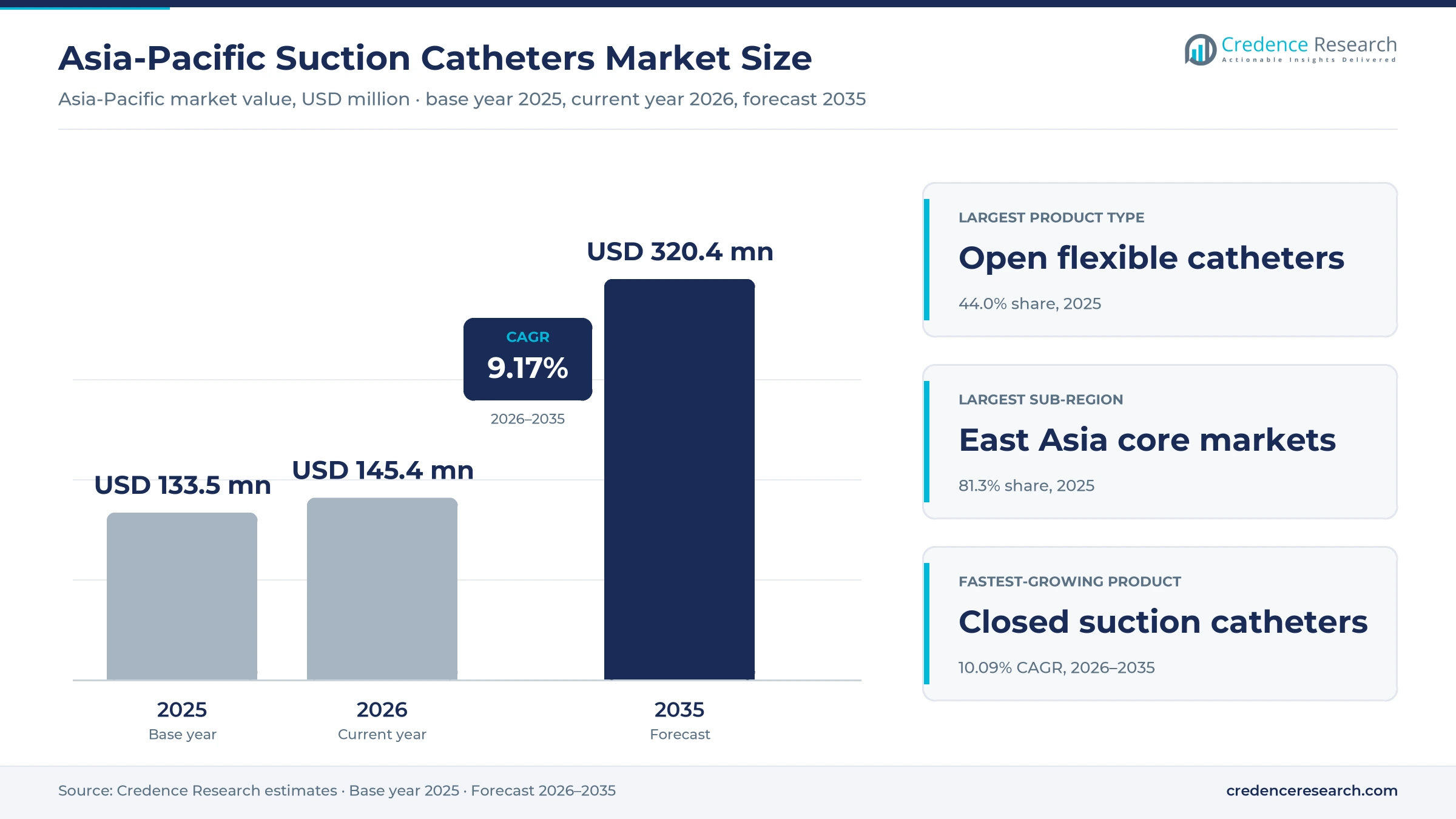
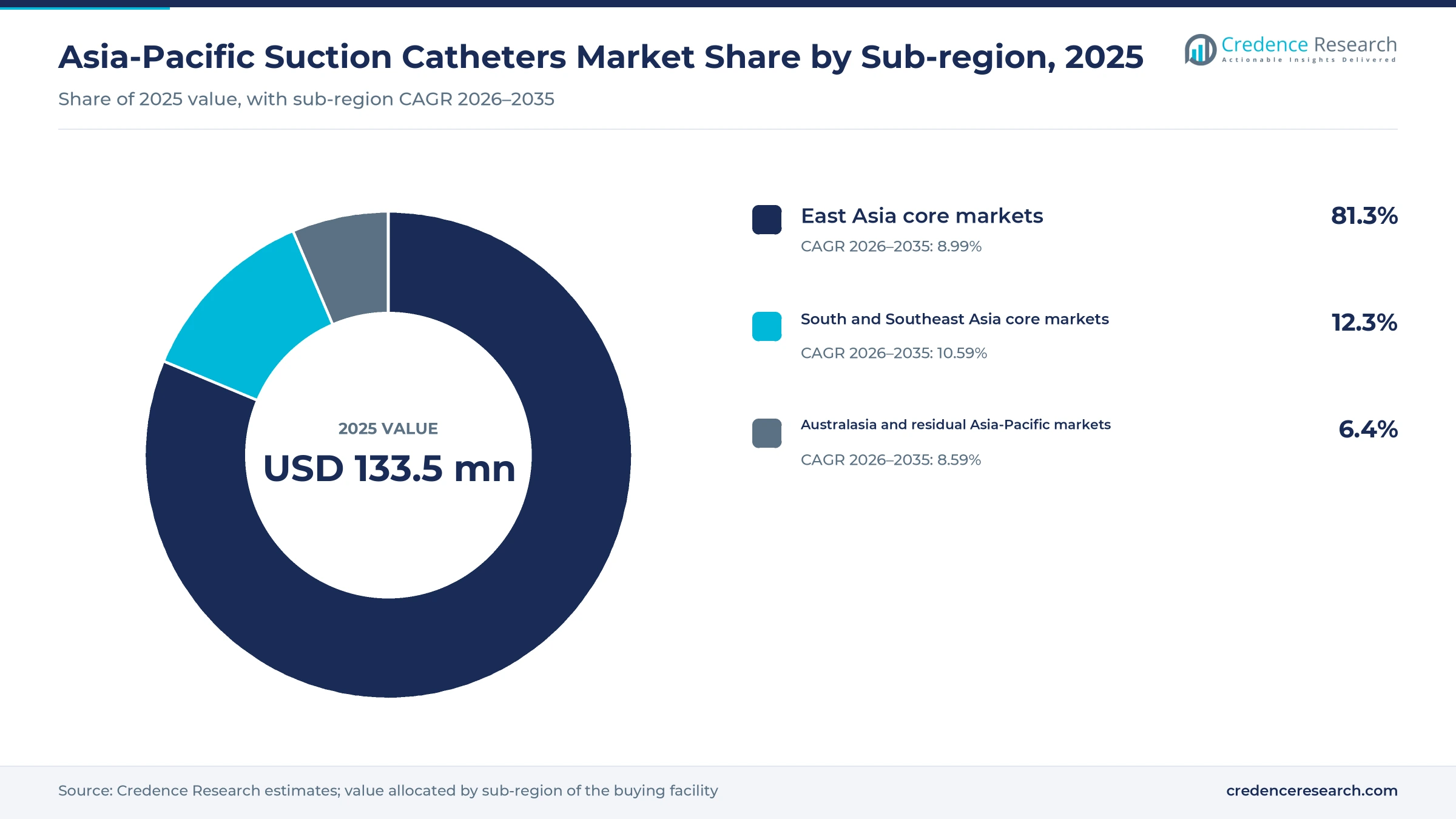
The Asia-Pacific suction catheters market was valued at USD 133.5 million in 2025 and is projected to increase from USD 145.4 million in 2026 to USD 320.4 million by 2035, registering a CAGR of 9.17% during 2026–2035. Demand comes from intensive care units that clear secretions from ventilated patients, operating rooms that use rigid Yankauer tips during surgery, and neonatal wards that suction newborn airways. East Asia core markets held the largest sub-regional share, 81.3% in 2025, because China, Japan and South Korea run the largest hospital and critical care networks in the region. South and Southeast Asia core markets are the fastest-growing sub-region at 10.59% a year, as India builds local device supply and, with Indonesia, treats a heavy load of tuberculosis and pneumonia. China set a goal in May 2024 of 15 intensive care beds for every 100,000 people by the end of 2025, which widens the base of patients who need airway suction.
Which airway suction products does the regional estimate cover?
The estimate measures spending on single-use catheters that remove secretions from the mouth, throat, trachea and bronchi across Asia-Pacific. It covers closed suction catheters attached to ventilator circuits, open flexible catheters passed through an airway for each pass, and rigid Yankauer catheters used in the mouth and throat during surgery. Values are measured at the price paid by hospitals, clinics, home-care providers and emergency services.
The estimate excludes suction pumps, wall vacuum regulators, collection canisters, endotracheal tubes and urinary or vascular catheters. The value chain runs from PVC and silicone compounders through catheter makers and distributors to the hospitals and home-care providers that treat patients in East Asia core markets, South and Southeast Asia core markets, and Australasia and residual Asia-Pacific markets.
Asia-Pacific Suction Catheters Market Insights
- The Asia-Pacific suction catheters market was valued at USD 133.5 million in 2025 and is projected to reach USD 320.4 million by 2035, registering a CAGR of 9.17% during 2026–2035.
- East Asia core markets held 81.3% of 2025 value, because China alone targeted 15 intensive care beds per 100,000 people by end-2025.
- Open flexible suction catheters led product demand with a 44.0% share of 2025 value, because low unit prices suit high-volume public hospitals.
- A 2022 meta-analysis of 10 randomized trials found open suction raised ventilator-associated pneumonia odds by 57% compared with closed suction systems.
- India had commissioned 22 greenfield medical device projects under its incentive scheme by September 2025, which covers critical care and anesthesia devices.
Open catheters lead value, closed systems grow fastest
Why do open flexible catheters still lead product value?
Based on product type, the market is categorized into closed suction catheters, open flexible suction catheters and airway Yankauer suction catheters. Open flexible suction catheters led with a 44.0% share of 2025 value, because public hospitals in China and India buy them in large volumes at low unit prices. Closed suction catheters grow fastest at 10.09% a year, as intensive care units adopt sealed systems for ventilated patients.
How do hospitals shape care setting demand?
Based on care setting, the market is categorized into hospitals, ambulatory care centers and home care and emergency services. Hospitals led with 82.0% of 2025 value, because intensive care, surgery and neonatal care all take place in inpatient wards. Home care and emergency services grow fastest at 10.35% a year, as more patients with tracheostomies and chronic lung disease receive airway care at home.
Why do adult patients account for most catheter use?
Based on end user, the market is categorized into adult patients, pediatric patients and neonatal patients. Adult patients led with a 74.0% share of 2025 value, because older adults make up most ventilated and surgical cases in the region. Neonatal patients grow fastest at 9.34% a year, because most preterm births occur in southern Asia, and preterm babies need small-bore catheters.
Which conditions create the most suction procedures?
Based on disease area, the market is categorized into acute respiratory disease, chronic respiratory disease, postoperative airway care and neurological and trauma airway care. Acute respiratory disease led with a 38.0% share of 2025 value, because pneumonia and acute lung injury fill most ventilator beds. Chronic respiratory disease grows fastest at 9.84% a year, as long-term COPD care moves into homes.
| Segment Group | Leading Sub-segment | Share, 2025 | Fastest-growing Sub-segment | CAGR, 2026–2035 |
|---|---|---|---|---|
| By Product Type | Open flexible suction catheters | 44.0% | Closed suction catheters | 10.09% |
| By Care Setting | Hospitals | 82.0% | Home care and emergency services | 10.35% |
| By End User | Adult patients | 74.0% | Neonatal patients | 9.34% |
| By Disease Area | Acute respiratory disease | 38.0% | Chronic respiratory disease | 9.84% |
Request a Free Sample
Fill in your details and we'll send you a free sample report.
- Sample data tables & charts
- Research methodology
Lung disease, closed design and local plants lift demand
How does persistent respiratory disease widen suction demand?
A large and lasting burden of lung disease keeps intensive care units and wards busy with patients who cannot clear their own secretions. Chronic obstructive pulmonary disease caused 3.4 million deaths in 2023 and ranks as the third leading cause of death worldwide, according to the World Health Organization. A national survey reported in The Lancet estimated that 99.9 million adults in China had COPD, including 13.7% of people aged 40 and over, Tulane University reported. India accounted for 26% of the global tuberculosis burden in 2023, a year with a record 8.2 million new diagnoses, while Indonesia accounted for 10%, Medical Dialogues reported from WHO data. As a result, chronic respiratory disease grows at 9.84% a year.
Why does differentiated closed suction design matter?
Closed suction systems stay attached to the ventilator circuit, which lets nurses clear the airway without disconnecting the patient or exposing staff to secretions. A 2022 meta-analysis of 10 randomized trials in the Indian Journal of Critical Care Medicine found that open suction raised the odds of ventilator-associated pneumonia by 57%, according to the published review. In Australian and New Zealand adult units, 28.4% of patients were invasively ventilated on their first day in 2023 and 2024, which gives closed systems a large base of eligible patients. ICU Medical also sells Portex tracheostomy tubes with a Suctionaid option for suction above the cuff. In turn, closed suction catheters grow fastest at 10.09% a year.
How do domestic manufacturing and product qualification help?
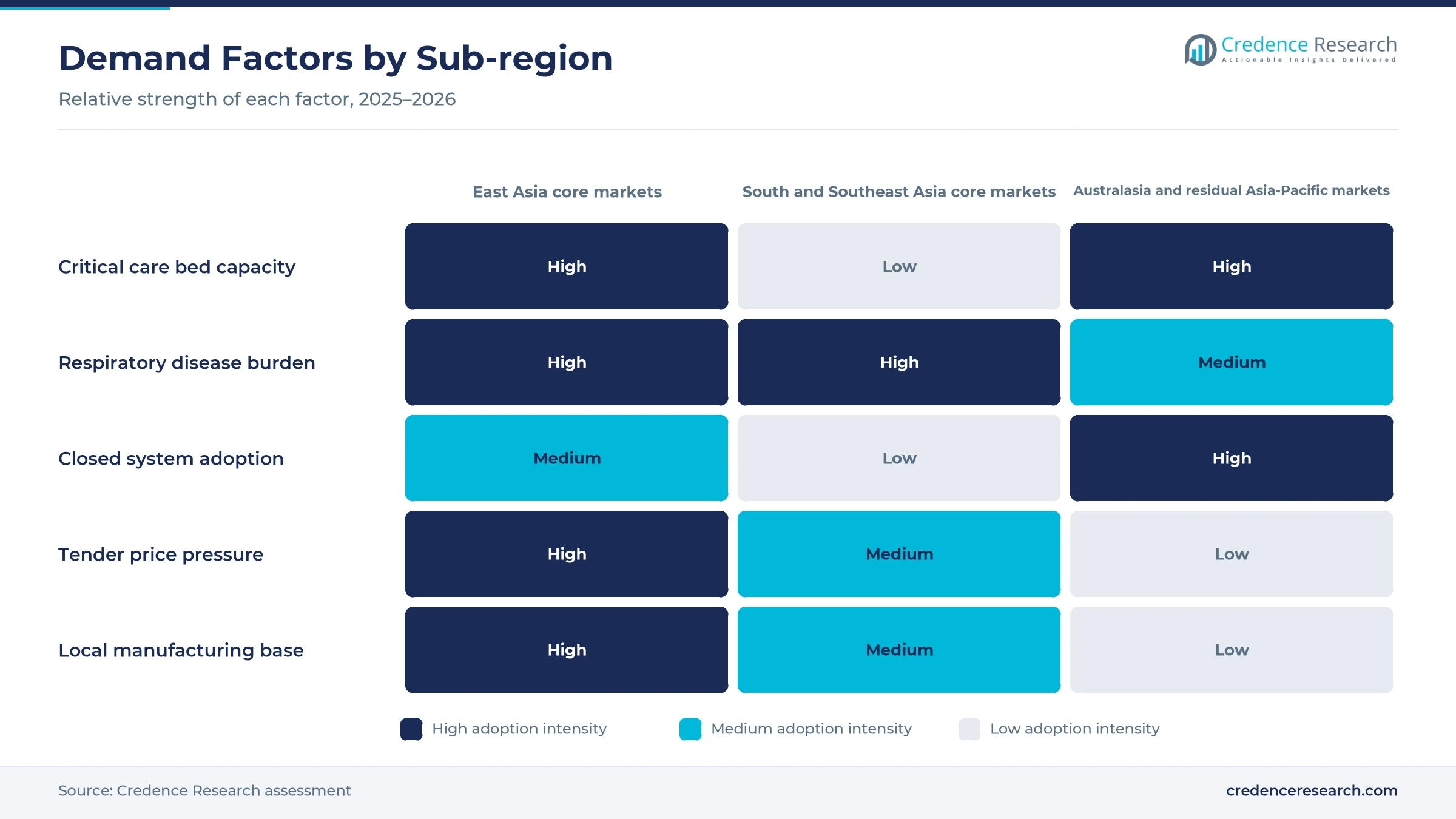
Governments across the region favor locally made consumables, which gives domestic catheter makers better access to public hospital tenders. India had commissioned 22 greenfield projects under its medical device incentive scheme by September 2025, a scheme that covers anesthesia, cardio-respiratory and critical care devices, according to the Press Information Bureau. India also made licensing mandatory for Class A and B devices on Oct. 1, 2022, which raised the bar for product qualification. Well Lead Medical said in its 2025 annual report that domestic substitution and government procurement rules favored local makers in China. As a result, qualified local suppliers win share in East Asia and South Asia.
Why does expanding critical care capacity raise volumes?
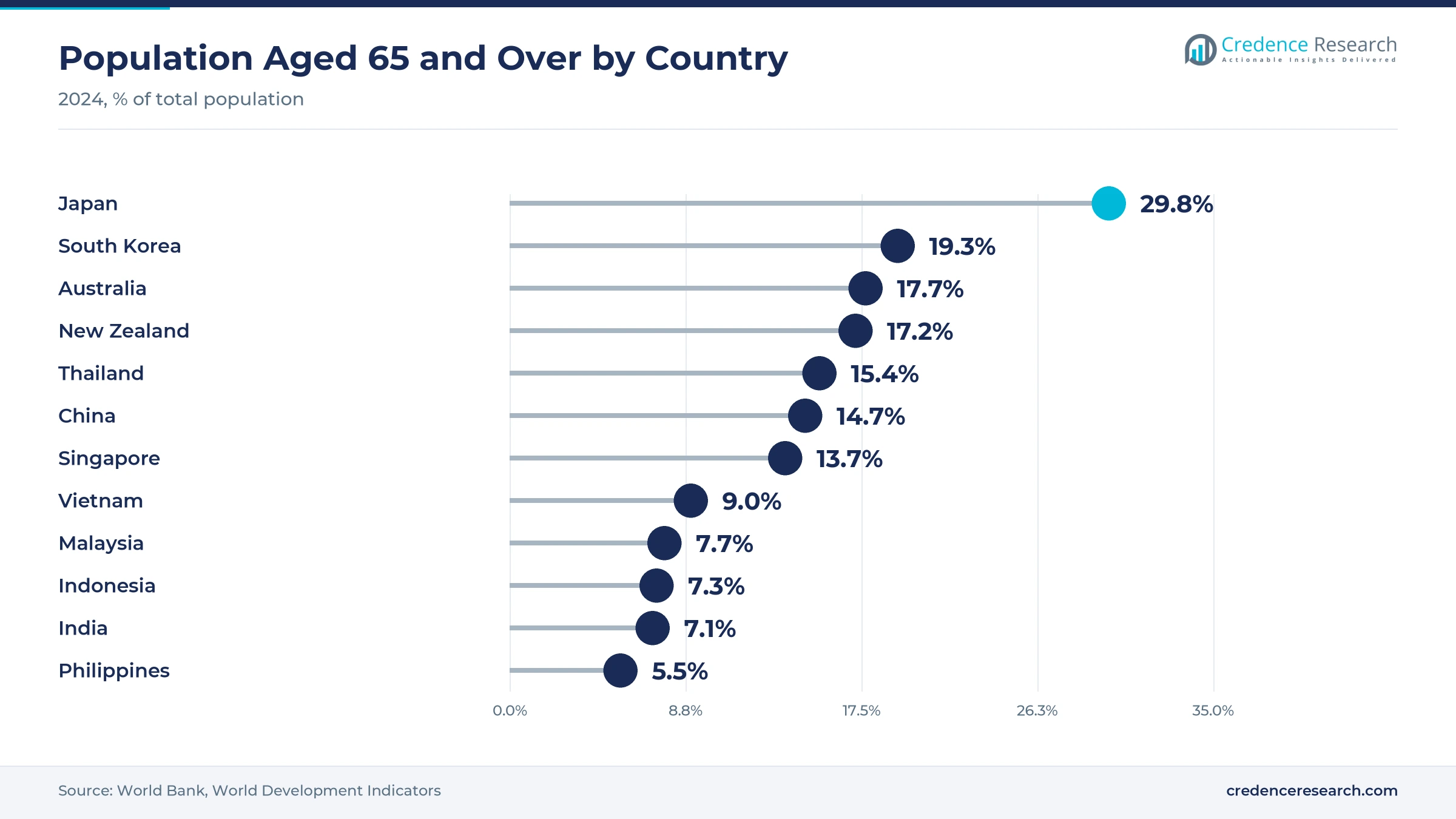
More intensive care beds mean more ventilated patients, and each ventilated patient needs airway suction several times a day. China issued guidelines on May 6, 2024, that target 15 intensive care beds and 10 convertible beds per 100,000 people by the end of 2025, according to the State Council. Australia and New Zealand reported 228,115 adult and pediatric intensive care admissions from 216 units in 2023 and 2024, and 32.4% of those patients were invasively ventilated. People aged 65 and over also made up 29.8% of Japan's population in 2024, World Bank data show. In turn, hospitals hold 82.0% of 2025 value, because ventilated patients stay in inpatient wards.
Closed systems, home airway care and India output rise
How is the shift to closed systems changing ICU buying?
Intensive care units in the region are moving from single-pass open catheters toward closed systems that stay in place for one or more days. The 2022 meta-analysis in the Indian Journal of Critical Care Medicine pooled 10 randomized trials and found 57% higher pneumonia odds with open suction, although its authors called for larger trials. AirLife completed its purchase of the Avanos respiratory health business in 2023, which brought the BALLARD, MICROCUFF and endOclear brands under one owner. The company runs manufacturing and distribution sites in Asia as well as North America and Europe. As a result, closed suction catheters gain share from open flexible suction catheters, which still lead with 44.0% of 2025 value.
Why is airway care at home on the rise?
Patients with tracheostomies, neuromuscular disease and advanced COPD increasingly receive airway care at home, which creates steady demand for catheters bought through retail and home-care channels. Indian pharmacy chain Apollo Pharmacy lists a Poly Medicure suction catheter made of DEHP-free PVC at Rs 81, which shows how low-cost units reach families directly. Japan recorded only 686,061 births in 2024, Nippon.com reported from health ministry data, which tilts Japanese airway care further toward older patients. The World Health Organization also counts COPD as the seventh leading cause of poor health worldwide. In turn, home care and emergency services grow fastest at 10.35% a year.
Can India's device incentive scheme open new supply?
India is building a domestic base for medical consumables, which opens room for local catheter makers to replace imports and to export. The incentive scheme carries a budget of Rs 34.20 billion and pays companies on extra sales from fiscal 2022-23 to fiscal 2026-27, the Press Information Bureau reported in December 2025. The same release said 194 manufacturers had been allotted land in three medical device parks by September 2025. Poly Medicure, based in New Delhi, sells suction catheters and Yankauer suction sets and also holds an Australian listing for a tracheal suction catheter. As a result, South and Southeast Asia core markets grow faster than any other sub-region in the forecast.
Is there room for growth in neonatal airway care?
Small and sick newborns need gentle, small-bore catheters and neonatal units are expanding fastest in South Asia. An estimated 13.4 million babies were born preterm in 2020, and most preterm births occur in southern Asia and sub-Saharan Africa, according to the World Health Organization. Preterm birth complications caused about 900,000 deaths among children under 5 in 2019, which shows how many newborns need intensive support. Pediatric intensive care units in Australia and New Zealand intubated 32.3% of admissions in 2023 and 2024, ANZICS data show. In turn, neonatal patients grow at 9.34% a year, faster than any other end user group.
Tender prices, weak evidence and uneven ICUs slow uptake
How do tender prices squeeze catheter margins?
Public procurement in China pushes down the price of basic consumables, which limits margins on simple open catheters. Well Lead Medical said its respiratory product sales fell in 2025 as regional volume-based procurement and price linkage cut prices sharply. As a result, suppliers of commodity catheters must win much larger volumes to grow revenue. Companies respond by moving toward closed systems, oral care suction kits and export markets.
Why does mixed clinical evidence slow closed system uptake?
Closed suction systems cost more per unit than open catheters, and the evidence on pneumonia prevention is not uniform. Only three of the 10 trials in the 2022 meta-analysis showed a significant reduction in pneumonia. In turn, budget holders in public hospitals hesitate to switch every ventilated bed to closed systems. Suppliers respond with local outcome data, nurse training and multi-day systems that lower the cost per patient day.
How does uneven critical care capacity limit demand?
Intensive care capacity varies widely across the region, which caps catheter use in lower-income countries. China aimed for 15 intensive care beds per 100,000 people by 2025, while many lower-income health systems in Southeast Asia have thinner capacity. As a result, many ventilated patients in smaller hospitals depend on shared vacuum units and basic equipment. Governments respond by funding new critical care blocks, but staffing and equipment budgets take years to catch up.
Why do regulatory demands raise market entry costs?
Each country sets its own licensing rules for airway devices, which raises costs for companies that sell across borders. India required licenses for Class C and D devices from Oct. 1, 2023, and Australia's register lists a Poly Medicure tracheal suction catheter as a Class IIa device. In turn, small exporters register in fewer markets and rely on local sponsors. Larger makers respond by spreading registrations through distributors that already hold licenses.
East Asia dominates, South Asia and ASEAN grow fastest
| Sub-region | Value, 2025 (USD million) | Share, 2025 | CAGR, 2026–2035 |
|---|---|---|---|
| East Asia core markets | 108.5 | 81.3% | 8.99% |
| South and Southeast Asia core markets | 16.4 | 12.3% | 10.59% |
| Australasia and residual Asia-Pacific markets | 8.5 | 6.4% | 8.59% |
Why do East Asia core markets hold the largest share?
China, Japan and South Korea run the largest hospital and intensive care networks in the region, and China targeted 15 intensive care beds per 100,000 people by the end of 2025. As a result, East Asia core markets held 81.3% of 2025 value and grow at 8.99% a year. Japan's older population also keeps demand for ventilator care and airway management devices high, while tender pricing in China restrains growth in value. People aged 65 and over made up 19.3% of South Korea's population in 2024, which adds steady demand.
Why are South and Southeast Asia growing fastest?
India and Indonesia together accounted for 36% of the global tuberculosis burden in 2023, and India is expanding local device manufacturing. South and Southeast Asia core markets held a 12.3% share of 2025 value and grow at 10.59% a year. Local makers such as Poly Medicure supply low-cost catheters, while hospitals buying more endotracheal tubes create matching demand for airway suction. The Philippines also accounted for 6.8% of the global tuberculosis burden in 2023, matching the share of China.
What shapes demand in Australasia and the residual region?
Australasia and residual Asia-Pacific markets held a 6.4% share of 2025 value and grow at 8.59% a year. Australian and New Zealand adult units reported 205,525 admissions in 2023 and 2024, and 31.0% of those patients were ventilated at some point. Hospitals there also pair catheters with airway clearance systems for patients with cystic fibrosis and bronchiectasis. New Zealand units ventilated 40.3% of adult patients at some point, a higher rate than Australian units.
ICU targets, factory incentives and supplier deals
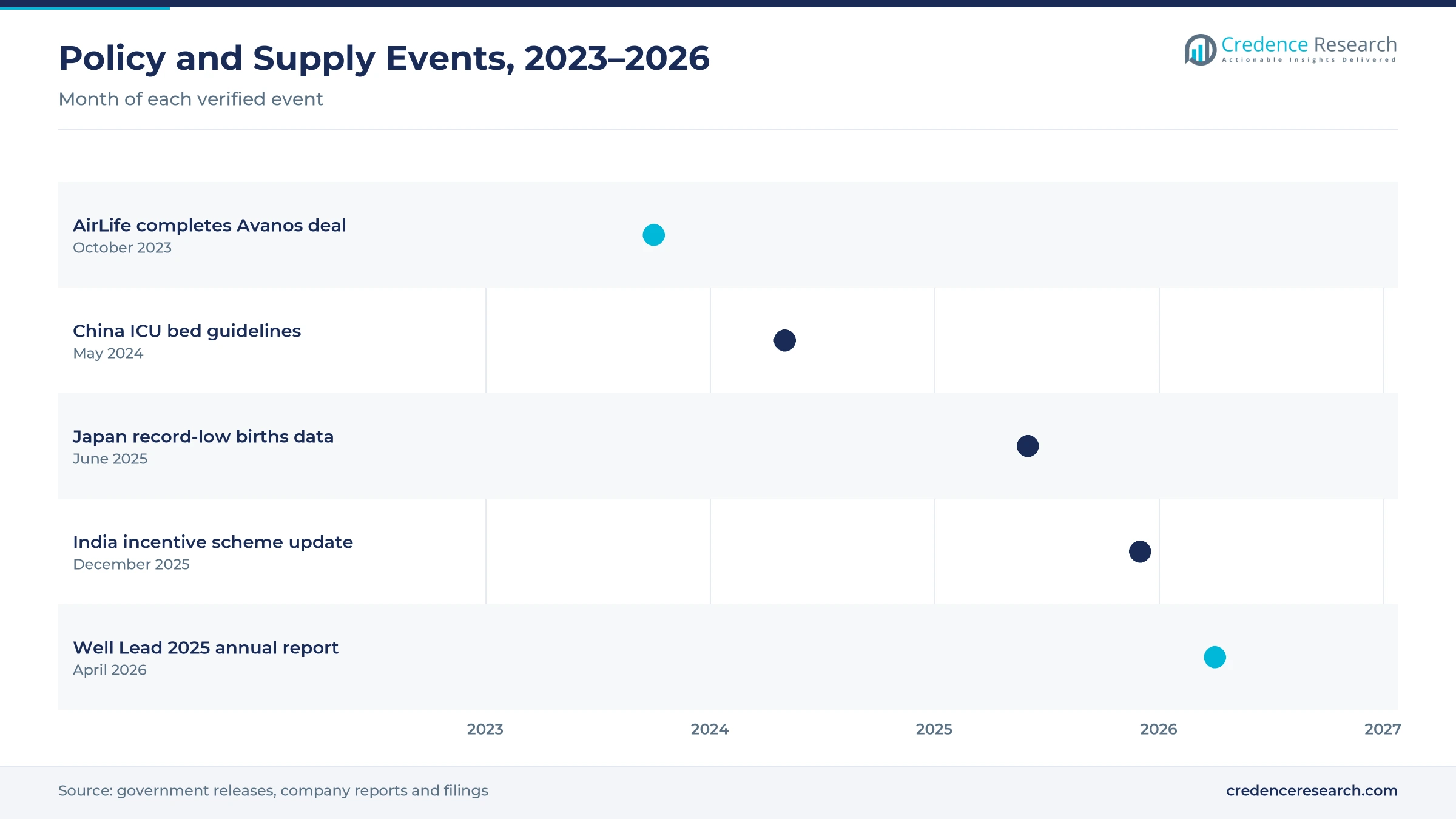
| Development | Status and market relevance |
|---|---|
| In October 2023, AirLife completed its purchase of the Avanos respiratory health business, including the BALLARD closed suction brand. | Brings a leading closed suction brand under a supplier with Asian sites |
| In May 2024, China issued guidelines targeting 15 intensive care beds per 100,000 people by the end of 2025. | Expands the base of ventilated patients |
| In June 2025, Japan's health ministry reported 686,061 births for 2024, a record low. | Shifts airway care demand toward older patients |
| In December 2025, India reported 22 greenfield medical device projects commissioned under its incentive scheme as of September 2025. | Strengthens local supply of critical care consumables |
| In April 2026, Well Lead Medical reported that procurement and price linkage cut its respiratory product prices in 2025. | Signals price pressure on commodity catheters in China |
PVC tubing, closed sleeves and vacuum controls shape use
- Latex-free PVC tubing remains the standard for open catheters, and DEHP-free grades now reach Indian pharmacy shelves at low prices.
- Closed suction sleeves keep the catheter inside a protective cover attached to the ventilator, which lets nurses clear the airway without disconnecting the circuit.
- Silicone construction offers softer, more flexible tubing for neonatal and long-term tracheostomy patients who need gentle suction.
- Vacuum control ports such as thumb-controlled interrupters let clinicians start and stop suction precisely, which limits airway trauma during each pass.
Need a Custom Version of This Report?
Tailor the scope, geography, or segments to your exact requirements.
- Custom geography or segment scope
- Direct access to our analyst team
Local makers and global airway brands compete on price
Competition in airway suction combines Chinese and Indian consumable makers with global critical care brands. Well Lead Medical, founded in 1998 and based in Guangzhou, makes suction catheters and Yankauer handles and sells to more than 100 countries and regions, including Japan. Device Technologies distributes Well Lead's airway management range in Australia and New Zealand. AirLife owns the BALLARD closed suction brand and runs manufacturing sites in China after taking over a Vyaire facility in Shenzhen. ICU Medical, which acquired Smiths Medical on Jan. 6, 2022, sells Portex airway products and runs service centers in Taipei and Rydalmere, Australia. Amsino International, established in California in 1993, operates FDA-qualified manufacturing and research sites in China. Poly Medicure supplies suction catheters and Yankauer sets from its manufacturing base in India. Companies compete on unit price, closed system design, local registrations and distributor reach.
Companies profiled and their roles in this market
| Company | Type | Role in the market |
|---|---|---|
| Well Lead Medical | Chinese consumables maker | Makes suction catheters and Yankauer handles in Guangzhou for domestic and export sale |
| AirLife | Respiratory consumables maker | Owns the BALLARD closed suction brand and runs a facility in Shenzhen |
| ICU Medical | Global device maker | Sells Portex airway products with service centers in Taipei and Australia |
| Amsino International | Consumables maker | Runs FDA-qualified manufacturing and research sites in China |
| Poly Medicure | Indian device maker | Sells suction catheters and Yankauer sets, with an Australian listing |
Credence Research view on regional airway suction demand
Credence Research's view is that suction catheter demand in Asia-Pacific will grow steadily because critical care capacity is expanding and lung disease remains common. Open flexible catheters stay the largest product group, while closed systems grow fastest as intensive care units focus on infection control. East Asia keeps the largest share, and South and Southeast Asia grow fastest as India builds local supply. However, tender pricing in China will hold down unit values. Suppliers that pair low-cost local production with closed system designs should gain share fastest.
How the regional airway suction estimate was built
The report uses 2025 as the base year on a calendar basis, and market values come from the Credence Research model. That model combines intensive care capacity, ventilation rates, disease burden statistics, unit prices and company information on products and distribution. Segment splits and sub-regional growth rates are Credence Research estimates, while sub-regional shares follow the client-defined split. Sources used are official statistics, government releases, clinical registry reports, peer-reviewed studies, company filings and news reports, and no interviews or surveys were used.
ICU capacity and closed systems carry growth to 2035
Regional suction catheter value is expected to reach USD 320.4 million by 2035, a 9.17% CAGR during 2026–2035, as more intensive care beds and older patients raise airway care needs. Growth should be steady through 2030 while China fills its critical care targets and India adds local production. After that, wider use of closed systems and home airway care should lift value per patient. Faster adoption of closed systems would raise this outlook, while deeper tender price cuts in China or slower critical care growth in Southeast Asia would lower it.
Frequently Asked Questions
How big is the Asia-Pacific suction catheters market?
Which product type leads regional demand?
Which sub-region leads the regional market?
How does respiratory disease affect demand?
Why are closed suction systems gaining ground?
Which care setting grows fastest?
Who are the leading companies in the region?
What are the main challenges for suppliers?
Table of Content
Chapter 1 Market Segmentation
- 1.1 Segmentation Framework
- 1.1.1 Product and Service Classification
- 1.1.2 Application and End-Use Classification
- 1.1.3 Technology and Solution Classification
- 1.1.4 Customer and Distribution Channel Classification
- 1.1.5 Geographic Segmentation
- 1.1.6 Market Segment Definitions and Boundaries
- 1.2 By Product Type
- 1.2.1 Closed suction catheters
- 1.2.2 Open flexible suction catheters
- 1.2.3 Airway Yankauer suction catheters
- 1.3 By Care Setting
- 1.3.1 Hospitals
- 1.3.2 Ambulatory care centers
- 1.3.3 Home care and emergency services
- 1.4 By End User
- 1.4.1 Adult patients
- 1.4.2 Pediatric patients
- 1.4.3 Neonatal patients
- 1.5 By Disease Area
- 1.5.1 Acute respiratory disease
- 1.5.2 Chronic respiratory disease
- 1.5.3 Postoperative airway care
- 1.5.4 Neurological and trauma airway care
- 1.6 By Sub-region
- 1.6.1 East Asia core markets
- 1.6.2 South and Southeast Asia core markets
- 1.6.3 Australasia and residual Asia-Pacific markets
Chapter 2 Introduction
- 2.1 Report Objectives and Scope
- 2.2 Product Definition and Industry Terminology
- 2.3 Market Inclusions and Exclusions
- 2.4 Research Process
- 2.4.1 Primary Research and Expert Interviews
- 2.4.2 Secondary Research and Source Review
- 2.4.3 Top-Down and Bottom-Up Estimation
- 2.4.4 Data Triangulation and Verification
- 2.5 Market Size Measurement Basis
- 2.5.1 2025: USD 133.5 million → 2035: USD 320.4 million
- 2.6 Historical and Forecast Reference Periods
- 2.6.1 Historical Period: 2018-2025
- 2.6.2 Base Year: 2025
- 2.6.3 Forecast Period: 2025-2035
- 2.7 Research Assumptions and Limitations
Chapter 3 Executive Summary
- 3.1 Market Snapshot and Key Findings
- 3.2 Base-Year Market Size, 2025
- 3.3 Forecast Market Size, 2035
- 3.4 Revenue and Volume Growth Outlook
- 3.5 Key Demand and Supply Indicators
- 3.6 Leading Market Segments
- 3.7 Fastest-Growing Market Opportunities
- 3.8 Regional Performance Highlights
- 3.9 Technology and Industry Transformation
- 3.10 Competitive Landscape Summary
- 3.11 Analyst View and Strategic Implications
Chapter 4 Asia-Pacific Suction Catheters Market Trends and Developments
- 4.1 Historical Industry Development, 2018-2025
- 4.2 Recent Market Trends and Developments
- 4.3 Demand and Customer Behavior Trends
- 4.4 Technology and Product Innovation
- 4.5 Artificial Intelligence, Automation and Digitalization
- 4.6 Local Manufacturing and Supply Chain Realignment
- 4.7 Industry Partnerships, Mergers and Acquisitions
- 4.8 Sustainability and Circular Economy Developments
- 4.9 Government and Private Sector Investment Trends
- 4.10 Emerging Business Models and Commercialization
- 4.11 Industry Developments and Announcements
Chapter 5 Asia-Pacific Suction Catheters Market Production, Supply and Demand Analysis
- 5.1 Demand Trend and Consumption Analysis, 2018-2025
- 5.2 Demand Forecast, 2025-2035
- 5.3 Production and Output Trend, 2018-2025
- 5.4 Production and Output Forecast, 2025-2035
- 5.5 Installed Capacity and Capacity Utilization
- 5.6 Company-Wise Production Plants and Statistics
- 5.6.1 Installed Production Capacity
- 5.6.2 Actual Production
- 5.6.3 Planned Capacity and Expansion Targets
- 5.7 Supply Chain Structure and Procurement Trends
- 5.8 Supply-Demand Gap and Bottlenecks
- 5.9 Import Dependence and Sourcing Structure
- 5.10 Contract Manufacturing and Outsourcing
- 5.11 Regional Supply and Demand Concentration
Chapter 6 Asia-Pacific Suction Catheters Market Pricing Analysis
- 6.1 Pricing Structure and Measurement
- 6.2 Historical Pricing Trends, 2018-2025
- 6.3 Pricing Outlook, 2025-2035
- 6.4 Average Selling Price and Unit Economics
- 6.5 Pricing by Product and Market Segment
- 6.6 Geographic Pricing Differences
- 6.7 Key Input, Energy, Labor and Logistics Costs
- 6.8 Contract Pricing and Purchasing Models
- 6.9 Pricing Sensitivity and Competitive Positioning
- 6.10 Price, Margin and Profitability Implications
Chapter 7 Asia-Pacific Suction Catheters Market Dynamics
- 7.1 Market Growth Drivers
- 7.1.1 Demand-Side Drivers
- 7.1.2 Technology and Innovation Drivers
- 7.1.3 Infrastructure and Investment Drivers
- 7.1.4 Regulatory and Policy Drivers
- 7.2 Market Restraints
- 7.2.1 Cost and Affordability Constraints
- 7.2.2 Technology and Adoption Barriers
- 7.2.3 Supply Chain and Operational Constraints
- 7.3 Market Challenges
- 7.3.1 Competitive Pressure and Margin Erosion
- 7.3.2 Skills, Infrastructure and Implementation Gaps
- 7.4 Emerging Market Opportunities
- 7.5 Market Dynamics Impact and Time-Horizon Assessment
Chapter 8 Asia-Pacific Suction Catheters Value Chain Analysis
- 8.1 Industry Value Chain Overview
- 8.2 Upstream Suppliers and Critical Inputs
- 8.3 Technology and Component Providers
- 8.4 Manufacturing or Service Delivery
- 8.5 Distribution, Channel Partners and Integrators
- 8.6 Downstream Applications and End Users
- 8.7 Value Addition and Profit Pools
- 8.8 Vertical Integration and Outsourcing
- 8.9 Supplier Concentration and Risk
- 8.10 Supply Chain Localization and Resilience
Chapter 9 Asia-Pacific Suction Catheters Market Regulations and Policies
- 9.1 Relevant Laws, Standards and Compliance Frameworks
- 9.2 Product, Service, Safety and Quality Requirements
- 9.3 Government Policies, Incentives and Subsidies
- 9.4 Imports, Exports and Trade Barriers
- 9.5 Public Procurement and Local Content Requirements
- 9.6 Environmental and Sustainability Compliance
- 9.7 Upcoming Policy Changes and Market Implications
Chapter 10 Asia-Pacific Suction Catheters Market Hotspots and Opportunities
- 10.1 Market Opportunity Mapping and Growth Hotspots
- 10.2 High-Growth Applications and Customer Groups
- 10.3 Underserved Markets and White-Space Opportunities
- 10.4 Emerging Technology and Product Opportunities
- 10.5 New Capacity and Investment Hotspots
- 10.6 Market Entry and Expansion Opportunities
- 10.7 Distribution and Partnership Opportunities
- 10.8 Near-Term and Long-Term Commercial Potential
- 10.9 Opportunity Attractiveness and Execution Risks
Chapter 11 Asia-Pacific Suction Catheters Market Outlook, 2025-2035
- 11.1 Market Size and Analysis
- 11.1.1 Revenue (Market Measurement: 2025: USD 133.5 million → 2035: USD 320.4 million)
- 11.1.2 Market Volume and Quantity Sold
- 11.1.3 Historical Market Size, 2018-2025
- 11.1.4 Base-Year Market Size, 2025
- 11.2 Market Forecast, 2025-2035
- 11.2.1 Revenue Forecast to 2035
- 11.2.2 Volume Forecast to 2035
- 11.2.3 CAGR and Year-on-Year Growth
- 11.2.4 Incremental Revenue Opportunity
- 11.3 Forecast Assumptions and Scenario Analysis
- 11.3.1 Base-Case Forecast
- 11.3.2 Optimistic and Conservative Scenarios
- 11.3.3 Technology, Pricing and Policy Sensitivities
- 11.4 Market Attractiveness and Growth Outlook
Chapter 12 Asia-Pacific Suction Catheters Market Segmentation and Outlook
- 12.1 Segmentation Summary and Market Shares, 2025
- 12.2 Largest and Fastest-Growing Segments
- 12.3 By Product Type - Market Size and Forecast, 2025-2035
- 12.3.1 Segment Definition and Scope
- 12.3.2 Historical Market Size, 2018-2025
- 12.3.3 Revenue Forecast, 2025-2035
- 12.3.4 Volume Forecast, 2025-2035
- 12.3.5 Base-Year Market Share, 2025
- 12.3.6 Segment CAGR and Growth Drivers
- 12.3.7 Subsegment Market Size and Forecast
- 12.3.7.1 Closed suction catheters
- 12.3.7.2 Open flexible suction catheters
- 12.3.7.3 Airway Yankauer suction catheters
- 12.3.8 Subsegment Pricing and Adoption Trends
- 12.3.9 Leading Suppliers and Competition
- 12.3.10 Regional Demand and Opportunities
- 12.4 By Care Setting - Market Size and Forecast, 2025-2035
- 12.4.1 Segment Definition and Scope
- 12.4.2 Historical Market Size, 2018-2025
- 12.4.3 Revenue Forecast, 2025-2035
- 12.4.4 Volume Forecast, 2025-2035
- 12.4.5 Base-Year Market Share, 2025
- 12.4.6 Segment CAGR and Growth Drivers
- 12.4.7 Subsegment Market Size and Forecast
- 12.4.7.1 Hospitals
- 12.4.7.2 Ambulatory care centers
- 12.4.7.3 Home care and emergency services
- 12.4.8 Subsegment Pricing and Adoption Trends
- 12.4.9 Leading Suppliers and Competition
- 12.4.10 Regional Demand and Opportunities
- 12.5 By End User - Market Size and Forecast, 2025-2035
- 12.5.1 Segment Definition and Scope
- 12.5.2 Historical Market Size, 2018-2025
- 12.5.3 Revenue Forecast, 2025-2035
- 12.5.4 Volume Forecast, 2025-2035
- 12.5.5 Base-Year Market Share, 2025
- 12.5.6 Segment CAGR and Growth Drivers
- 12.5.7 Subsegment Market Size and Forecast
- 12.5.7.1 Adult patients
- 12.5.7.2 Pediatric patients
- 12.5.7.3 Neonatal patients
- 12.5.8 Subsegment Pricing and Adoption Trends
- 12.5.9 Leading Suppliers and Competition
- 12.5.10 Regional Demand and Opportunities
- 12.6 By Disease Area - Market Size and Forecast, 2025-2035
- 12.6.1 Segment Definition and Scope
- 12.6.2 Historical Market Size, 2018-2025
- 12.6.3 Revenue Forecast, 2025-2035
- 12.6.4 Volume Forecast, 2025-2035
- 12.6.5 Base-Year Market Share, 2025
- 12.6.6 Segment CAGR and Growth Drivers
- 12.6.7 Subsegment Market Size and Forecast
- 12.6.7.1 Acute respiratory disease
- 12.6.7.2 Chronic respiratory disease
- 12.6.7.3 Postoperative airway care
- 12.6.7.4 Neurological and trauma airway care
- 12.6.8 Subsegment Pricing and Adoption Trends
- 12.6.9 Leading Suppliers and Competition
- 12.6.10 Regional Demand and Opportunities
- 12.7 By Sub-region - Market Size and Forecast, 2025-2035
- 12.7.1 Segment Definition and Scope
- 12.7.2 Historical Market Size, 2018-2025
- 12.7.3 Revenue Forecast, 2025-2035
- 12.7.4 Volume Forecast, 2025-2035
- 12.7.5 Base-Year Market Share, 2025
- 12.7.6 Segment CAGR and Growth Drivers
- 12.7.7 Subsegment Market Size and Forecast
- 12.7.7.1 East Asia core markets
- 12.7.7.2 South and Southeast Asia core markets
- 12.7.7.3 Australasia and residual Asia-Pacific markets
- 12.7.8 Subsegment Pricing and Adoption Trends
- 12.7.9 Leading Suppliers and Competition
- 12.7.10 Regional Demand and Opportunities
- 12.8 Segment Growth Comparison
- 12.9 Segment Attractiveness and Priority Matrix
Chapter 13 Asia-Pacific Suction Catheters End-Use and Application Market Outlook
- 13.1 End-Use Industry and Customer Demand Structure
- 13.2 Leading Applications and Customer Groups
- 13.3 End-Use Market Size, Share and Forecast
- 13.4 Major End-Use Industry Deep Dives
- 13.4.1 Customer Requirements and Use Cases
- 13.4.2 Demand and Replacement Cycles
- 13.4.3 Technical and Regulatory Considerations
- 13.4.4 Purchasing and Procurement Models
- 13.4.5 Leading Vendors and Distribution Channels
- 13.4.6 Forecast and Commercial Opportunities
- 13.5 Emerging Applications and Cross-Segment Demand
- 13.6 End-Use Industry Investment Priorities
Chapter 14 Asia-Pacific Suction Catheters Geographic Market Outlook, 2025-2035
- 14.1 Regional Market Size and Country-Level Shares, 2025
- 14.2 Country Market Size Comparison, 2025
- 14.3 Country Market Forecasts, 2025-2035
- 14.4 Subregional Industrial and Demand Clusters
- 14.5 Intra-Regional Pricing and Cost Differences
- 14.6 Cross-Border Trade and Supply Networks
- 14.7 Regional Supply and Demand Balances
- 14.8 Country Opportunity Comparison and Prioritization
Note: Every listed country is covered on the structure shown under the first country.
Chapter 15 Asia-Pacific Suction Catheters Technology, Innovation and Sustainability Outlook
- 15.1 Technology Landscape and Maturity
- 15.2 Product, Process and Service Innovation
- 15.3 AI, Automation and Digital Tools in the Industry
- 15.4 Technology Adoption and Performance Benchmarking
- 15.5 Innovation Pipeline and R&D Investment
- 15.6 Patent and Intellectual Property Trends
- 15.7 Energy Efficiency and Resource Management
- 15.8 Sustainability, Recycling and Circularity
- 15.9 Technology Roadmap, 2025-2035
- 15.10 Risks of Obsolescence and Technology Substitution
Chapter 16 Asia-Pacific Suction Catheters Market Key Strategic Imperatives
- 16.1 Growth and Market Entry Priorities
- 16.2 High-Return Products and Segments
- 16.3 Pricing, Profitability and Cost Optimization
- 16.4 Technology Investment and Product Differentiation
- 16.5 Supply Chain Localization and Resilience
- 16.6 Distribution and Customer Acquisition
- 16.7 Partnership, Acquisition and Capacity Strategy
- 16.8 Regional Expansion Priorities
- 16.9 Short-, Medium- and Long-Term Actions
Chapter 17 Competition Outlook
- 17.1 Industry Competition Characteristics
- 17.2 Market Structure and Concentration
- 17.3 Market Share and Competitive Positioning, 2025
- 17.4 Company-Wise Revenue and Product Benchmarking
- 17.5 Production and Service Capacity Benchmarking
- 17.6 Technology, Pricing and Differentiation
- 17.7 Regional Footprint and Distribution Strength
- 17.8 Mergers, Acquisitions and Strategic Alliances
- 17.9 New Entrants and Competitive Threats
- 17.10 Porter's Five Forces and Industry Attractiveness
- 17.11 Competitive Outlook, 2025-2035
Chapter 18 Company Profiles
- 18.1 Company Coverage and Selection Criteria
- 18.2 ICU Medical
- 18.2.1 Business Description
- 18.2.2 Company Ownership and Geographic Presence
- 18.2.3 Product and Service Portfolio
- 18.2.4 Manufacturing and Operating Footprint
- 18.2.5 Production Capacity and Expansion Plans
- 18.2.6 Financial Performance and Investment
- 18.2.7 Market Share and Competitive Position
- 18.2.8 Technology and Innovation Capabilities
- 18.2.9 Strategic Alliances or Partnerships
- 18.2.10 Recent Developments
- 18.2.11 Growth Strategy and Outlook
- 18.3 Well Lead Medical
- 18.4 AirLife
- 18.5 Amsino International
- 18.6 Poly Medicure
- 18.7 Other Relevant Market Participants
Note: Every listed company is profiled on the structure shown under the first company. The company list is preliminary and may change based on research findings, market developments, data availability and client requirements.
Chapter 19 Disclaimer
- 19.1 Research and Forecast Disclaimer
- 19.2 Data Source and Estimation Limitations
Note: The depth of individual sections depends on data availability for this market. Volume, capacity, trade and other unit-based metrics are included where applicable.

