
At-Home Fitness Equipment Market Overview:
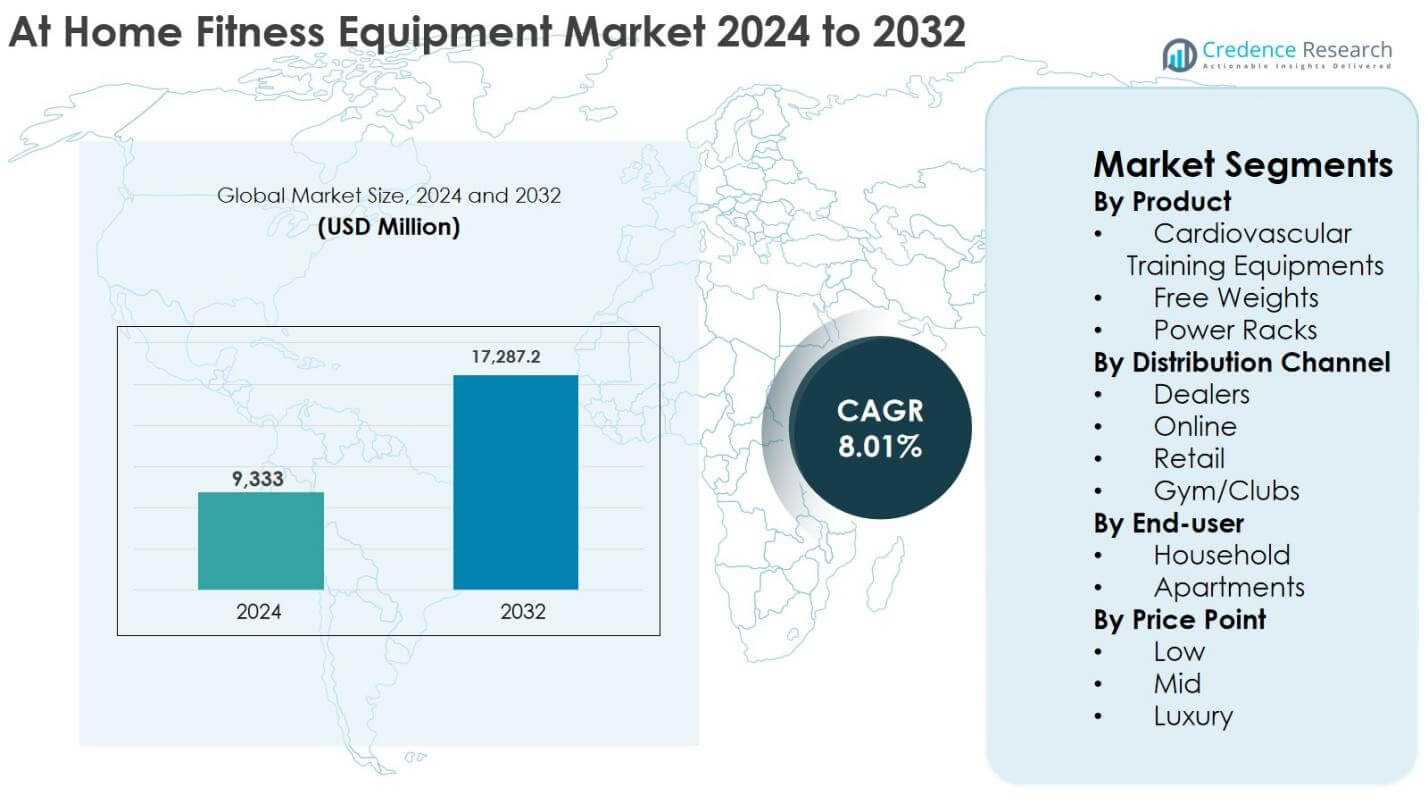
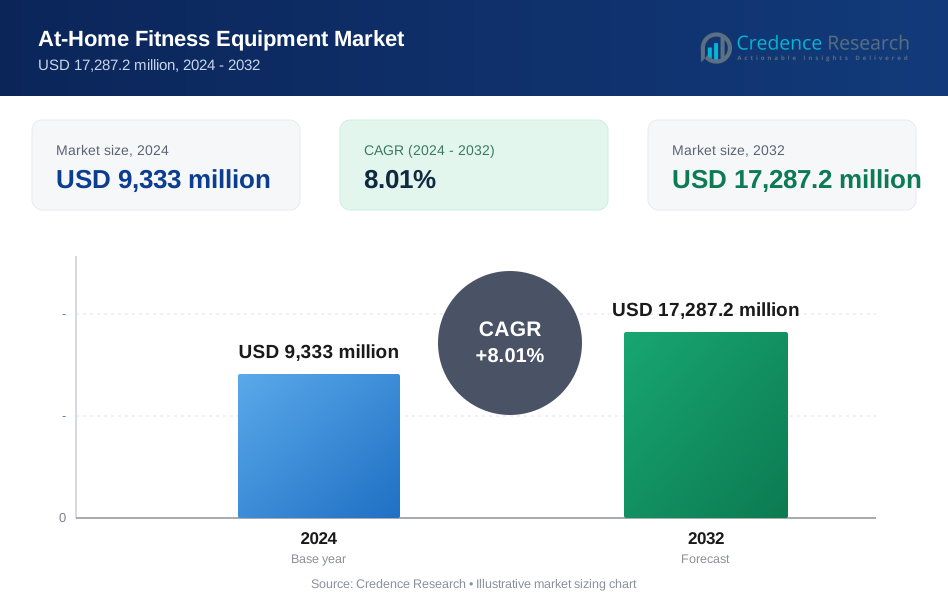
At Home Fitness Equipment market size was valued at USD 9,333 million in 2024 and is anticipated to reach USD 17,287.2 million by 2032, growing at a CAGR of 8.01% during the forecast period.
| REPORT ATTRIBUTE | DETAILS |
|---|---|
| Historical Period | 2020-2023 |
| Base Year | 2024 |
| Forecast Period | 2025-2032 |
| At Home Fitness Equipment Market Size 2024 | USD 9,333 million |
| At Home Fitness Equipment Market, CAGR | 8.01% |
| At Home Fitness Equipment Market Size 2032 | USD 17,287.2 million |
At-Home Fitness Equipment Market Insights
- Rising health awareness, preventive fitness adoption, and flexible workout preferences drive market growth, with consumers increasingly investing in durable and smart equipment to manage lifestyle-related conditions and maintain long-term fitness routines.
- Cardiovascular training equipment dominates the product segment with 46.8% share, followed by free weights at 29.4%, while power racks account for 23.8%, reflecting balanced demand across endurance and strength training solutions.
- Market competition remains strong, driven by innovation in connected equipment, subscription-based fitness platforms, compact designs, and direct-to-consumer sales strategies that enhance user engagement and brand differentiation.
- North America leads with 38.6% regional share, followed by Europe at 27.4%, Asia Pacific at 23.1%, Latin America at 6.5%, and Middle East & Africa at 4.4%, highlighting mature demand in developed regions and rapid growth potential in emerging markets.
At-Home Fitness Equipment Market Segmentation Analysis:
By Product
In the At Home Fitness Equipment market, cardiovascular training equipment dominated the product segment, accounting for 46.8% market share in 2024, driven by rising consumer focus on weight management, cardiovascular health, and convenience-based workouts. Products such as treadmills, stationary bikes, and rowing machines benefit from strong adoption due to digital integration, virtual training platforms, and compact designs suitable for home use. Free weights followed with 29.4% share, supported by affordability and versatility, while power racks held 23.8% share, gaining traction among advanced users seeking strength and resistance training at home.
- For instance, Peloton's Bike+ stationary bike features a 23.8-inch swivel touchscreen and auto-resistance that adjusts to instructor cues, enabling seamless transitions to strength or yoga workouts with real-time metrics like cadence and power.
By Distribution Channel
Online distribution emerged as the dominant channel in the At Home Fitness Equipment market, capturing 41.2% market share in 2024, fueled by e-commerce penetration, direct-to-consumer models, and access to product customization and financing options. Consumers increasingly prefer online platforms for price transparency and doorstep delivery. Retail channels accounted for 26.7% share, benefiting from product trials and brand presence, while dealers held 19.3% share due to commercial partnerships. Gym and club channels represented 12.8% share, primarily supporting premium and connected equipment installations.
- For instance, NordicTrack and ProForm (iFIT brands) promote treadmills and bikes via their online stores with personalized configuration, extended warranties, and installment plans, reducing reliance on third-party retail showrooms.
By End-User
Household users represented the leading end-user segment in the At Home Fitness Equipment market, accounting for 63.5% market share in 2024, driven by growing health awareness, flexible workout schedules, and increased adoption of smart fitness solutions. Rising disposable income and space-efficient equipment designs further support household demand. Apartments followed with 36.5% share, supported by urbanization and shared fitness spaces in residential complexes. Demand in this segment is reinforced by compact, low-noise equipment and subscription-based digital fitness programs that cater to space-constrained living environments.
Key Growth Drivers
Rising Health Awareness and Preventive Fitness Adoption
The At Home Fitness Equipment market is significantly driven by rising health awareness and the growing focus on preventive fitness among consumers across age groups. Increasing prevalence of lifestyle-related conditions such as obesity, cardiovascular diseases, diabetes, and stress disorders has encouraged individuals to adopt regular workout routines at home. Busy work schedules and flexible working models make home fitness solutions more practical than gym memberships. Elderly users increasingly prefer low-impact equipment for mobility improvement and rehabilitation. Additionally, wellness-driven government initiatives, employer-sponsored fitness programs, and insurance-linked preventive healthcare incentives further support sustained demand. As fitness becomes a long-term lifestyle priority rather than a temporary trend, consumers continue to invest in durable equipment and periodic upgrades, reinforcing steady market growth.
- For instance, the World Health Organization estimates that more than 1 billion adults worldwide are living with obesity, and physical inactivity contributes to roughly 6–10% of major noncommunicable diseases, which is pushing more consumers toward regular home-based exercise to manage weight and cardiometabolic risk.
Digital Integration and Smart Fitness Ecosystems
Digital integration plays a critical role in accelerating growth in the At Home Fitness Equipment market. Smart equipment featuring AI-based coaching, real-time performance tracking, and personalized workout recommendations significantly enhances user engagement and workout effectiveness. Integration with mobile applications, wearable devices, and cloud-based platforms allows users to monitor progress and maintain consistency. Subscription-driven content models, including live classes and on-demand training sessions, improve customer retention while generating recurring revenue for manufacturers. These connected ecosystems transform traditional fitness equipment into interactive wellness solutions. As digital adoption rises across younger and tech-savvy demographics, demand for intelligent, connected fitness systems continues to strengthen market expansion.
- For instance, NordicTrack and ProForm machines powered by the iFIT platform use trainer-controlled incline and resistance, heart-rate based guidance, and progressive workout programs delivered via touchscreens and mobile integration, turning traditional treadmills and bikes into interactive coaching systems
Urbanization and Demand for Space-Efficient Equipment
Rapid urbanization and shrinking residential spaces are driving demand for compact and space-efficient fitness equipment. Consumers living in apartments increasingly favor foldable treadmills, adjustable dumbbells, and multifunctional strength systems that optimize limited space. Manufacturers focus on ergonomic designs, low-noise functionality, and easy storage features to suit urban living conditions. Rising disposable income in metropolitan areas further enables spending on premium, aesthetically designed equipment that blends with modern interiors. Shared fitness spaces within residential complexes also support adoption of versatile and durable equipment. These structural shifts in housing patterns and urban lifestyles continue to support long-term growth in the At Home Fitness Equipment market.
Key Trends & Opportunities
Expansion of Subscription-Based and Hybrid Fitness Models
Subscription-based fitness models are emerging as a key trend and opportunity in the At Home Fitness Equipment market. Equipment integrated with live classes, virtual trainers, and performance analytics enhances user motivation and long-term engagement. Hybrid fitness models that combine home workouts with occasional gym or studio sessions are expanding the consumer base. This approach allows manufacturers to position equipment as part of a continuous fitness journey rather than a one-time purchase. Opportunities also exist in tiered subscriptions, family plans, and corporate wellness offerings. These models help brands diversify revenue streams, improve customer lifetime value, and strengthen long-term brand loyalty.
- For instance, Peloton’s Bike, Tread, and Row hardware is tightly bundled with a monthly subscription that unlocks live and on-demand classes, performance metrics, and leaderboards, and the company consistently reports that subscription revenue now exceeds its hardware revenue, underscoring the strength of its recurring model
Rising Demand for Customized and Premium Home Gym Solutions
Customization and premiumization are gaining traction as consumers seek personalized fitness experiences at home. Adjustable resistance systems, modular equipment configurations, and personalized training programs allow users to tailor workouts to specific fitness goals. High-income households increasingly invest in premium materials, smart upgrades, and visually appealing home gym setups. Manufacturers are leveraging this trend by offering bespoke equipment, accessory ecosystems, and long-term service packages. As personalization becomes a key purchasing factor, brands that deliver flexibility, performance, and design appeal gain strong differentiation, creating significant growth opportunities within the market.
- For instance, Tonal’s wall-mounted digital strength system offers adaptive, AI-controlled resistance up to 200 pounds, individualized programs, and detailed performance analytics, effectively letting users personalize progressive strength training without multiple separate machines.
Key Challenges
High Initial Investment and Pricing Pressure
High upfront costs remain a major challenge in the At Home Fitness Equipment market, particularly for smart and connected equipment. Premium pricing restricts adoption among price-sensitive consumers and limits penetration in emerging economies. Although financing options, installment plans, and bundled subscriptions help reduce affordability barriers, economic uncertainty often delays purchasing decisions. Consumers may also opt for lower-cost alternatives such as digital fitness applications without equipment. Manufacturers face the challenge of balancing innovation, quality, and affordability while maintaining margins. Addressing pricing pressure without compromising technological advancement remains critical for achieving mass-market adoption.
Sustaining Long-Term User Engagement and Equipment Utilization
Maintaining consistent user engagement and equipment utilization presents a significant challenge for the market. Many consumers experience declining motivation after initial usage, leading to underutilized equipment. Space constraints, changing fitness preferences, and competition from outdoor activities or digital-only fitness solutions further impact usage rates. To address this, manufacturers must continuously update content, introduce gamification features, and build interactive fitness communities. Failure to sustain engagement can weaken brand loyalty and reduce replacement demand. Ensuring long-term motivation and consistent usage is essential for sustaining growth in the At Home Fitness Equipment market.
Regional Analysis
North America
North America led the At Home Fitness Equipment market, accounting for 38.6% market share in 2024, driven by high health awareness, strong disposable income levels, and widespread adoption of smart fitness technologies. The United States dominates regional demand due to a mature fitness culture, strong presence of connected equipment brands, and high penetration of subscription-based digital workout platforms. Consumers increasingly invest in premium, technology-enabled equipment for personalized training experiences. The region also benefits from advanced e-commerce infrastructure and financing options, supporting higher average selling prices and frequent equipment upgrades across households.
Europe
Europe held 27.4% market share in 2024 in the At Home Fitness Equipment market, supported by rising preventive healthcare awareness and growing adoption of home-based fitness routines. Countries such as Germany, the United Kingdom, and France contribute significantly due to strong wellness trends and increasing urbanization. Demand for compact, energy-efficient, and aesthetically designed equipment is high, reflecting smaller living spaces. Government-backed health initiatives and corporate wellness programs further support market growth. Moderate but steady replacement cycles and preference for durable, high-quality equipment continue to sustain regional demand.
Asia Pacific
Asia Pacific accounted for 23.1% market share in 2024 and represents the fastest-growing region in the At Home Fitness Equipment market. Rapid urbanization, rising disposable incomes, and increasing health consciousness across countries such as China, India, Japan, and Australia are driving adoption. Younger populations and growing digital fitness engagement support demand for connected and app-integrated equipment. Expanding middle-class households and improving e-commerce accessibility further accelerate sales. The region also benefits from cost-competitive manufacturing and increasing availability of affordable fitness solutions tailored to space-constrained urban homes.
Latin America
Latin America captured 6.5% market share in 2024, driven by growing awareness of fitness and lifestyle-related health issues. Brazil and Mexico lead regional demand due to increasing urban populations and rising adoption of home-based exercise routines. Price sensitivity remains a key factor, supporting demand for mid-range and multifunctional equipment. Expanding online retail channels and flexible payment options are improving market accessibility. While gym culture remains strong, economic volatility encourages consumers to invest in long-term at-home fitness solutions, supporting gradual market expansion across the region.
Middle East & Africa
The Middle East & Africa region accounted for 4.4% market share in 2024 in the At Home Fitness Equipment market. Growth is supported by rising health awareness, increasing obesity rates, and expanding residential infrastructure in Gulf countries. Demand is concentrated in urban areas, with preference for premium and smart fitness equipment among high-income households. Government-led wellness initiatives and luxury residential developments further support adoption. In Africa, market growth remains gradual due to affordability constraints, but improving digital access and urbanization are expected to create long-term opportunities.
At-Home Fitness Equipment Market Segmentations:
By Product
- Cardiovascular Training Equipments
- Free Weights
- Power Racks
By Distribution Channel
- Dealers
- Online
- Retail
- Gym/Clubs
By End-user
- Household
- Apartments
By Price Point
- Low
- Mid
- Luxury
By Geography
- North America
- U.S.
- Canada
- Mexico
- Europe
- Germany
- France
- U.K.
- Italy
- Spain
- Rest of Europe
- Asia Pacific
- China
- Japan
- India
- South Korea
- South-east Asia
- Rest of Asia Pacific
- Latin America
- Brazil
- Argentina
- Rest of Latin America
- Middle East & Africa
- GCC Countries
- South Africa
- Rest of the Middle East and Africa
Competitive Landscape
The competitive landscape of the At Home Fitness Equipment market is characterized by the presence of established global brands and emerging innovators competing on technology integration, product diversification, and brand positioning. Leading players such as Peloton, ICON Health & Fitness (NordicTrack), Precor, and Keiser Corporation focus on smart, connected equipment and subscription-based ecosystems to enhance user engagement. Premium and design-driven brands such as NOHRD and Louis Vuitton address high-end consumers seeking aesthetic and lifestyle-oriented fitness solutions. Companies including Bowflex, Preform, and Corepump strengthen competition through compact designs and digital compatibility. Continuous product launches, content partnerships, and direct-to-consumer strategies remain central to sustaining market presence and differentiation.
Key Player Analysis
- NOHRD
- Peloton
- Precor
- Corepump
- Louis Vuitton
- NordicTrack
- Keiser Corporation
- ICON
- Preform
- Bowflex
Recent Developments
- In May 2024, Sunny Health & Fitness, a U.S.-based provider of at-home fitness equipment, introduced its new Smart Stepper lineup, featuring advanced connected-fitness capabilities designed to enhance the home workout experience.
- In December 2023, IKEA unveiled DAJLIEN, a limited-edition home training collection comprising 19 versatile products aimed at encouraging everyday movement and helping consumers build healthy routines at home.
Report Coverage
The research report offers an in-depth analysis based on Product, Distribution Channel, End-User, Price Point and Geography. It details leading market players, providing an overview of their business, product offerings, investments, revenue streams, and key applications. Additionally, the report includes insights into the competitive environment, SWOT analysis, current market trends, as well as the primary drivers and constraints. Furthermore, it discusses various factors that have driven market expansion in recent years. The report also explores market dynamics, regulatory scenarios, and technological advancements that are shaping the industry. It assesses the impact of external factors and global economic changes on market growth. Lastly, it provides strategic recommendations for new entrants and established companies to navigate the complexities of the market.
Future Outlook
- The At Home Fitness Equipment market will continue to expand due to sustained health awareness and long-term adoption of home-based workout routines.
- Demand for smart and connected fitness equipment will increase as consumers seek personalized and data-driven training experiences.
- Subscription-based digital fitness platforms will strengthen customer engagement and recurring revenue models for manufacturers.
- Compact, foldable, and space-efficient equipment will gain wider adoption, particularly in urban and apartment-based households.
- Product innovation will focus on multifunctional designs that combine cardiovascular and strength training capabilities.
- Integration with wearable devices and health monitoring applications will become a standard feature across product ranges.
- Premium and aesthetically designed home gym solutions will see higher adoption among high-income consumers.
- E-commerce and direct-to-consumer channels will play a larger role in improving market accessibility and brand reach.
- Emerging markets will contribute faster growth supported by urbanization, rising disposable income, and digital fitness adoption.
- Strategic partnerships, content upgrades, and continuous innovation will remain critical to sustaining long-term market growth.
Request a Free Sample
Fill in your details and we'll send you a free sample report.
- Sample data tables & charts
- Research methodology
Need a Custom Version of This Report?
Tailor the scope, geography, or segments to your exact requirements.
- Custom geography or segment scope
- Direct access to our analyst team
Frequently Asked Questions
What is the current market size for At Home Fitness Equipment market, and what is its projected size in 2032?
At what Compound Annual Growth Rate is the At Home Fitness Equipment market projected to grow between 2024 and 2032?
Which At Home Fitness Equipment market segment held the largest share in 2024?
What are the primary factors fueling the growth of the At Home Fitness Equipment market?
Who are the leading companies in the At Home Fitness Equipment market?
Which region commanded the largest share of the At Home Fitness Equipment market in 2024?
Table of Content
Chapter 1. Report Introduction
- 1.1 Report Description & Purpose
- 1.1.1 Report Title & Market Definition
- 1.1.2 Unique Selling Propositions (USP) & Key Differentiators
- 1.1.3 Value Proposition for Stakeholders
- 1.2 Research Objectives
- 1.2.1 Market Sizing Objectives (Volume & Revenue)
- 1.2.2 Segmentation Objectives
- 1.2.3 Competitive Intelligence Objectives
- 1.2.4 Forecast & Scenario Objectives
- 1.3 Report Scope
- 1.3.1 At-Home Fitness Equipment Scope – Types & Subtypes Covered
- 1.3.2 Geographic Scope – Regions & Countries Covered
- 1.3.3 Historical Period, Base Year & Forecast Period (2024; forecast to 2032)
- 1.3.4 Inclusions & Exclusions
- 1.4 HS Code & Classification Framework
- 1.5 Currency, Units & Pricing Basis
- 1.6 Target Stakeholders
- 1.7 Limitations & Assumptions
Chapter 2. Executive Summary
- 2.1 Global At-Home Fitness Equipment Market Snapshot
- 2.1.1 Market Size – Historical (2024) & Forecast (2024-2032) (2024: USD 9,333 million → 2032: USD 17,287.2 million)
- 2.1.2 Volume & Revenue – Global Totals
- 2.1.3 Key Market Highlights – Top Five Facts
- 2.2 At-Home Fitness Equipment Market Segmentation Snapshot
- 2.2.1 Market Split by Region – 2024 vs. 2032
- 2.3 Competitive Snapshot
- 2.3.1 Top 10 Players by Revenue Share – 2024
- 2.3.2 Top 10 Players by Volume Share – 2024
- 2.3.3 Recent Strategic Developments (18-Month Summary)
- 2.4 Key Investment Highlights & Strategic Conclusions
Chapter 3. At-Home Fitness Equipment Market Dynamics & Industry Analysis
- 3.1 Market Overview & Context
- 3.1.1 At-Home Fitness Equipment Market Position in the Broader Automotive Value Chain
- 3.1.2 OEM vs. Replacement Market Dynamics
- 3.1.3 Market Maturity & Development Stage by Region
- 3.2 At-Home Fitness Equipment Market Drivers
- 3.3 At-Home Fitness Equipment Market Restraints & Challenges
- 3.4 At-Home Fitness Equipment Market Opportunities
- 3.5 Porter's Five Forces Analysis
- 3.5.1 Threat of New Entrants
- 3.5.2 Bargaining Power of Suppliers
- 3.5.3 Bargaining Power of Buyers
- 3.5.4 Threat of Substitutes
- 3.5.5 Competitive Rivalry – Intensity Assessment
- 3.6 At-Home Fitness Equipment Value Chain Analysis
- 3.6.1 Upstream – Raw Material/Input Suppliers
- 3.6.1.1 Raw Material/Input 1
- 3.6.1.2 Raw Material/Input 2
- 3.6.1.3 Raw Material/Input 3
- 3.6.2 Midstream – Production/Manufacturing/Service Delivery
- 3.6.2.1 Production/Process Overview
- 3.6.2.2 Key Facility Locations & Capacity by Manufacturer
- 3.6.3 Downstream – Distribution & End Consumer
- 3.6.3.1 Primary Channel – B2B/OEM
- 3.6.3.2 Secondary Channels – Dealer, Retail, Online, Direct
- 3.6.4 Value Chain Profitability Analysis
- 3.6.1 Upstream – Raw Material/Input Suppliers
- 3.7 PESTEL Analysis
- 3.7.1 Political Factors
- 3.7.2 Economic Factors
- 3.7.3 Social Factors
- 3.7.4 Technological Factors
- 3.7.5 Environmental Factors
- 3.7.6 Legal Factors
- 3.8 At-Home Fitness Equipment Supply Chain Analysis
- 3.8.1 Raw Material/Input Supply Risk Assessment
- 3.8.2 Manufacturing Concentration Risk (Geographic Exposure)
- 3.8.3 Trade Disruption Impact Analysis
- 3.9 Regulatory & Policy Landscape
Note: The regulatory and policy landscape section covers regulations based on their applicability to the market, At-Home Fitness Equipment category, geography, and scope of the study. Only regulatory frameworks with a material impact on operations, compliance, trade, sustainability, or market access are analyzed in detail.
Chapter 4. Key Investment Pockets & Opportunity Analysis
- 4.1 At-Home Fitness Equipment Market Attractiveness Analysis
- 4.1.1 By Region – Investment Attractiveness Matrix (Volume × CAGR)
- 4.2 Absolute Revenue Growth Opportunity
- 4.2.1 By Region – Absolute USD Growth Through 2032
- 4.3 Incremental Volume Opportunity
- 4.3.1 By Region – Incremental Volume Through 2032
- 4.3.2 Segment – Incremental Volume
- 4.4 Emerging Submarket Opportunity Deep Dive (Subject to Applicability)
- 4.5 Emerging Market Opportunity Scorecards
- 4.5.1 United States
- 4.5.2 Europe
- 4.5.3 Asia
- 4.5.4 Middle East & Africa
Note: Emerging Market Opportunity Scorecards will be included based on relevance and strategic importance. Regions listed are indicative and may vary depending on data availability and market dynamics.
Chapter 5. At-Home Fitness Equipment Import-Export Analysis & Trade Flows
- 5.1 Global Trade Overview
- 5.1.1 Global Export Value by Country (2024)
- 5.1.2 Global Export Volume by Country (2024)
- 5.1.3 Global Import Value by Country (2024)
- 5.1.4 Global Import Volume by Country (2024)
- 5.1.5 Net Trade Balance by Country (2024)
- 5.2 Export Analysis – Segment
- 5.2.1 Type 1 (HS Code)
- 5.2.2 Type 2 (HS Code)
- 5.2.3 Type 3 (HS Code)
- 5.2.4 Type 4 (HS Code)
- 5.2.5 Type 5 (HS Code)
- 5.3 Import Analysis – Segment
- 5.3.1 Type 1 (HS Code)
- 5.3.2 Type 2 (HS Code)
- 5.3.3 Type 3 (HS Code)
- 5.3.4 Type 4 (HS Code)
- 5.3.5 Type 5 (HS Code)
- 5.4 Average Unit Trade Prices
- 5.4.1 Average Export Price – Segment & Country
- 5.4.2 Average Import Price – Segment & Source Country
- 5.4.3 Price Trends (2024)
- 5.5 Key Trade Route Analysis
- 5.5.1 Trade Route 1
- 5.5.2 Trade Route 2
- 5.5.3 Trade Route 3
- 5.5.4 Trade Route 4
- 5.5.5 Trade Route 5
- 5.6 Trade Policy Impact Assessment
- 5.6.1 US Anti-Dumping & Section 301 Tariffs
- 5.6.2 EU Customs Union Impact
- 5.6.3 Major Free Trade Agreements
- 5.6.4 USMCA Rules of Origin
Note: Trade policy analysis will be included only where relevant to the At-Home Fitness Equipment market.
Chapter 6. Competitive Landscape & Company Benchmarking
- 6.1 At-Home Fitness Equipment Market Concentration & Structure
- 6.1.1 Herfindahl-Hirschman Index (HHI) – vs. 2024
- 6.1.2 Tier 1, Tier 2 & Tier 3 Market Structure
- 6.1.3 Global, Regional & Local Player Dynamics
- 6.2 At-Home Fitness Equipment Market Share Analysis – 2024
- 6.2.1 Global Revenue Share by Company
- 6.2.2 Global Volume Share by Company
- 6.2.3 Regional Revenue Share
- 6.2.4 Market Share Evolution ( vs. 2024)
- 6.2.5 OEM Segment Share by Company
- 6.2.6 Replacement Segment Share by Company
- 6.3 Production/Delivery Capacity & Facility Analysis
- 6.3.1 Global Installed Capacity
- 6.3.2 Capacity Utilization Rates
- 6.3.3 Production/Output Volume
- 6.3.4 Facility Locations & Capacity Map
- 6.3.5 Planned Capacity Additions
- 6.4 At-Home Fitness Equipment Competitive Benchmarking Matrix
- 6.4.1 Revenue, Volume, CAGR & Profitability Comparison
- 6.4.2 Channel Revenue Mix
- 6.4.3 Geographic Revenue Exposure
- 6.4.4 R&D Intensity
- 6.4.5 Sustainability Maturity
- 6.5 Strategic Developments in At-Home Fitness Equipment (Last 24 Months)
- 6.5.1 Mergers, Acquisitions & Divestments
- 6.5.2 New At-Home Fitness Equipment Launches
- 6.5.3 Facility Expansions
- 6.5.4 Strategic Alliances, Joint Ventures & Partnerships
- 6.5.5 Distribution Expansion & Market Entry
- 6.5.6 Sustainability & ESG Initiatives
- 6.6 Competitive Strategy Mapping
- 6.6.1 Leader, Challenger, Follower & Niche Classification
- 6.6.2 Pricing Strategy Comparison
- 6.6.3 Channel Strategy Matrix
Note: Strategic developments are included based on their materiality and the availability of reliable information.
Chapter 7. Global At-Home Fitness Equipment Market – By Distribution Channel
- 7.1 Segment Overview
- 7.1.1 Volume & Revenue Split by Channel (2024 & 2032)
- 7.1.2 Channel Mix Evolution (2024-2032)
Chapter 8. Regional Market Analysis – Global Overview
- 8.1 Global Regional Overview
- 8.1.1 Regional Volume Share
- 8.1.2 Regional Revenue Share
- 8.1.3 Regional Volume by Region
- 8.1.4 Regional Revenue by Region
- 8.1.5 Regional Forecast Through 2032
- 8.2 Cross-Regional Segment Analysis
- 8.2.1 By Distribution Channel
- 8.2.2 By Brand/Price Tier
Chapter 9. North America At-Home Fitness Equipment Market
- 9.1 United States
- 9.2 Canada
- 9.3 Mexico
Chapter 10. Europe At-Home Fitness Equipment Market
- 10.1 Germany
- 10.2 France
- 10.3 Italy
- 10.4 United Kingdom
- 10.5 Spain
- 10.6 Poland
- 10.7 Russia
- 10.8 Netherlands
- 10.9 Belgium
- 10.10 Sweden
- 10.11 Denmark
- 10.12 Norway
- 10.13 Rest of Europe
Chapter 11. Asia Pacific At-Home Fitness Equipment Market
- 11.1 China
- 11.2 India
- 11.3 Japan
- 11.4 South Korea
- 11.5 Thailand
- 11.6 Indonesia
- 11.7 Vietnam
- 11.8 Malaysia
- 11.9 Australia
- 11.10 Rest of Asia Pacific
Chapter 12. Latin America At-Home Fitness Equipment Market
- 12.1 Brazil
- 12.2 Argentina
- 12.3 Colombia
- 12.4 Chile
- 12.5 Rest of Latin America
Chapter 13. Middle East At-Home Fitness Equipment Market
- 13.1 Saudi Arabia
- 13.2 United Arab Emirates
- 13.3 Turkey
- 13.4 Israel
- 13.5 Iran
- 13.6 Rest of the Middle East
Chapter 14. Africa At-Home Fitness Equipment Market
- 14.1 South Africa
- 14.2 Egypt
- 14.3 Nigeria
- 14.4 Morocco
- 14.5 Rest of Africa
Chapter 15. At-Home Fitness Equipment Company Profiles
- 15.1 [Company 01]
- 15.1.1 Company Overview
- 15.1.2 Key Management Personnel
- 15.1.3 Products & Services Portfolio
- 15.1.4 Financial Performance
- 15.1.5 Key Market Focus & Geographic Presence
- 15.1.6 Recent Developments & Strategic Initiatives
Note: The company profile list is preliminary and may change based on research findings, market developments, data availability, and client requirements.
Chapter 16. Appendices
- Appendix A – List of Abbreviations & Acronyms
- Appendix B – Industry Classification Code Reference – Full Series
- Appendix C – Production & Capacity Data Tables
- Appendix D – End-Use & Demand Base Tables
- Appendix E – Consumption & Replacement Rate Assumptions
- Appendix F – ASP Reference Tables
- Appendix G – Manufacturing & Facility Database
- Appendix H – Import-Export Data Tables
- Appendix I – Regulatory Summary Tables
- Appendix J – Primary Research Participant List (Anonymized)
- Appendix K – Primary Research Questionnaire Framework
- Appendix L – Data Sources & Bibliography
- Appendix M – Market Size Divergence & Source Comparison
Chapter 17. Research Methodology
- 17.1 Research Framework & Philosophy
- 17.2 Secondary Research – Sources, Hierarchy & Data Extraction
- 17.3 Data Modeling – Bottom-Up & Top-Down Market Sizing
- 17.4 Primary Research – Stakeholder Framework, LOI & Sample Sizes
- 17.5 Forecast Methodology – Regression, Scenario & Sensitivity Analysis
- 17.6 Quality Control – Four-Layer Validation Framework
- 17.7 Limitations & Standard Assumptions
- 17.8 Disclaimer
