
Rising wealth and new stores widen high-end spending
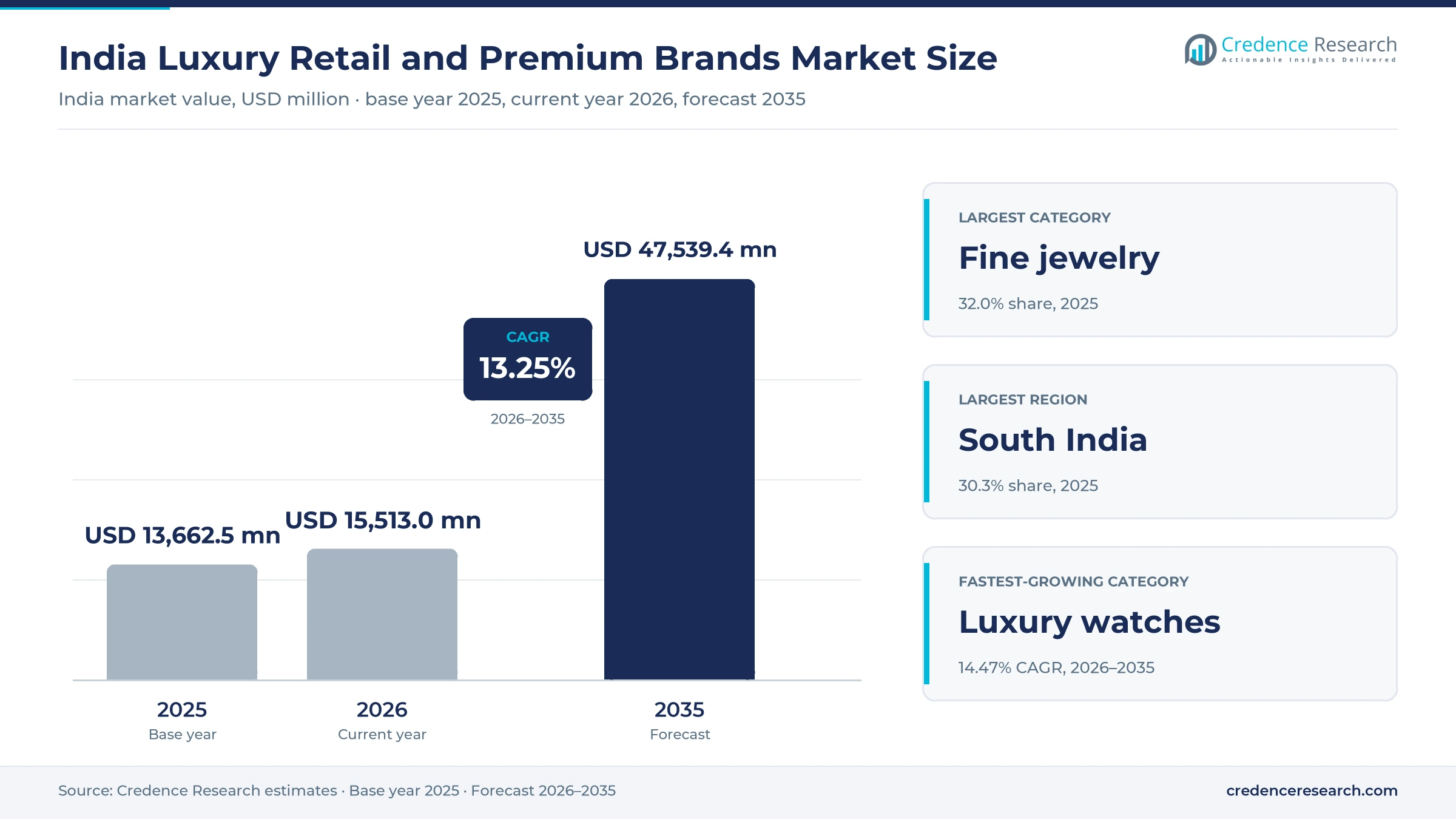
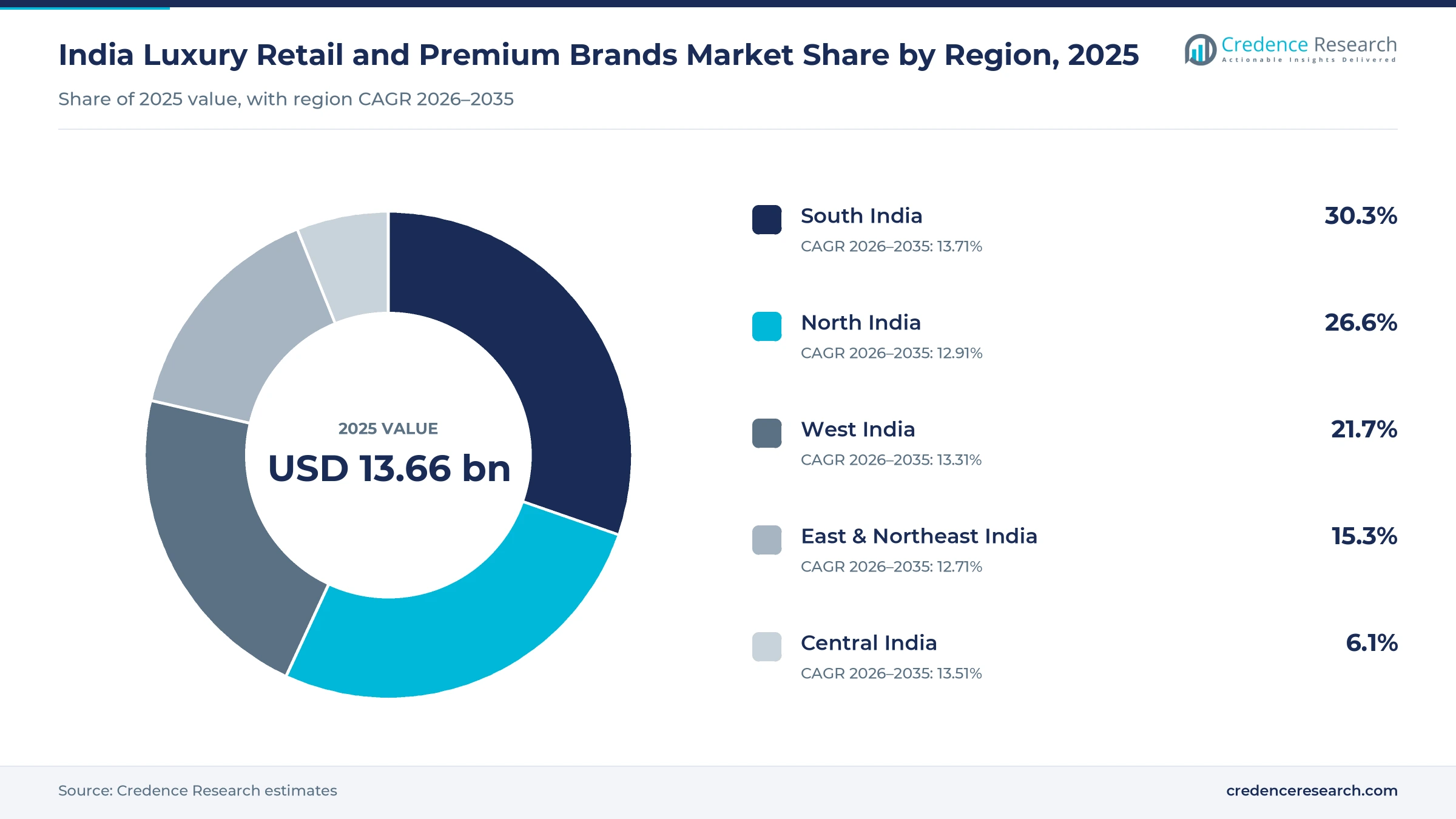
The India luxury retail and premium brands market was valued at USD 13.66 billion in 2025 and is projected to increase from USD 15.51 billion in 2026 to USD 47.54 billion by 2035, registering a CAGR of 13.25% during 2026–2035. Demand comes from wealthy and mass-affluent households that buy jewelry, designer clothing, watches and leather goods for weddings, festivals and gifting, as well as for everyday wardrobes. South India held the largest regional share, 30.3% in 2025, because its technology hubs and high state incomes support a deep base of affluent buyers. South India is also the fastest-growing region at 13.71% a year, as new boutiques open in Hyderabad and Bengaluru. In turn, the India-EFTA trade agreement that took effect in October 2025 began cutting import duties on Swiss watches, which lowers shelf prices for one of the fastest growing categories.
Which high-end goods and stores does the estimate count?
The estimate measures retail spending in India on high-end apparel and couture, fine jewelry, watches, leather goods and footwear, and prestige beauty and fragrance. It counts sales through brand boutiques, department stores, multi-brand designer stores, brand websites and airport travel retail. Values are stated in USD million at current prices and include purchases by resident households, nonresident Indians, foreign tourists and corporate buyers.
The estimate excludes mass-market jewelry and apparel, luxury cars, real estate, hospitality and secondhand resale. The value chain runs from global fashion houses and Indian designers through importers, franchise partners and mall owners to the boutiques and online stores where customers buy.
India Luxury Retail and Premium Brands Market Insights
- The India luxury retail and premium brands market was valued at USD 13.66 billion in 2025 and is projected to reach USD 47.54 billion by 2035, at a 13.25% CAGR during 2026–2035.
- South India held a 30.3% share of 2025 value, because its southern states report some of the highest per capita incomes in the country.
- Fine jewelry led product categories with a 32.0% share of 2025 value, as weddings and festivals anchor high-value gold and diamond purchases.
- The India-EFTA trade agreement entered into force on Oct. 1, 2025, and import duties on Swiss watches have since been cut twice.
- Luxury department stores grow fastest among channels at 14.82% a year during 2026–2035, as large multi-brand formats open in Mumbai.
Fine jewelry leads while watches gain fastest
Why does fine jewelry hold the largest share?
Based on product category, the market is categorized into ready-to-wear and couture apparel, fine jewellery, luxury watches, leather goods and footwear, and prestige beauty and fragrance. Fine jewellery led with a 32.0% share of 2025 value, because brides and families buy gold and diamonds as both ornament and savings. Luxury Watches grow fastest at 14.47% a year as import duties fall.
Which store formats capture most high-end spending?
Based on distribution channel, the market is categorized into mono-brand boutiques, luxury department stores, multi-brand designer retailers, brand e-commerce platforms and travel retail. Mono-Brand Boutiques led with a 38.0% share of 2025 value, because global houses prefer controlled spaces in a few prime malls. Luxury Department Stores grow fastest at 14.82% a year as large formats arrive.
Who are the main buyers of high-end goods?
Based on customer type, the market is categorized into resident HNWIs, mass-affluent consumers, NRIs and diaspora visitors, international tourists and corporate gift buyers. Resident HNWIs led with a 40.5% share of 2025 value, because they buy across every category and price tier. Mass-Affluent Consumers grow fastest at 13.99% a year, as rising salaries bring first-time buyers into accessible tiers.
How much spending depends on weddings and festivals?
Based on purchase occasion, the market is categorized into wedding and family celebrations, festive and gifting purchases, business and formal dressing, everyday premium wardrobe and travel and milestone purchases. Wedding and Family Celebrations led with a 37.0% share of 2025 value, because families concentrate spending on bridal wear and jewelry. Everyday Premium Wardrobe grows fastest at 14.17% a year as young professionals buy for work and leisure.
| Segment Group | Leading Sub-segment | Share, 2025 | Fastest-growing Sub-segment | CAGR, 2026–2035 |
|---|---|---|---|---|
| By Product Category | Fine Jewellery | 32.0% | Luxury Watches | 14.47% |
| By Distribution Channel | Mono-Brand Boutiques | 38.0% | Luxury Department Stores | 14.82% |
| By Customer Type | Resident HNWIs | 40.5% | Mass-Affluent Consumers | 13.99% |
| By Purchase Occasion | Wedding and Family Celebrations | 37.0% | Everyday Premium Wardrobe | 14.17% |
Request a Free Sample
Fill in your details and we'll send you a free sample report.
- Sample data tables & charts
- Research methodology
Income growth, new malls and wider reach lift spending
How does wealth creation widen the base of luxury households?
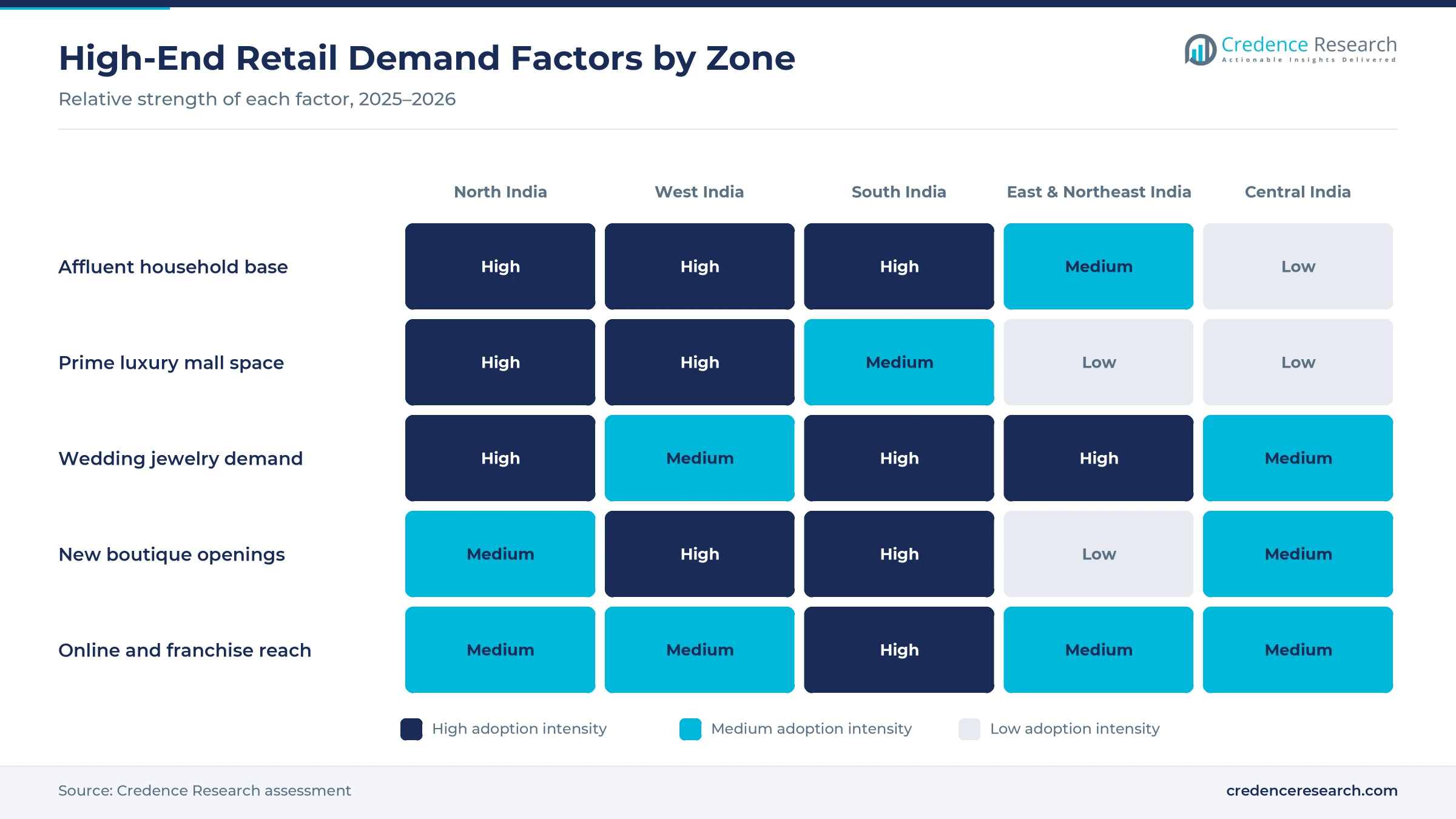
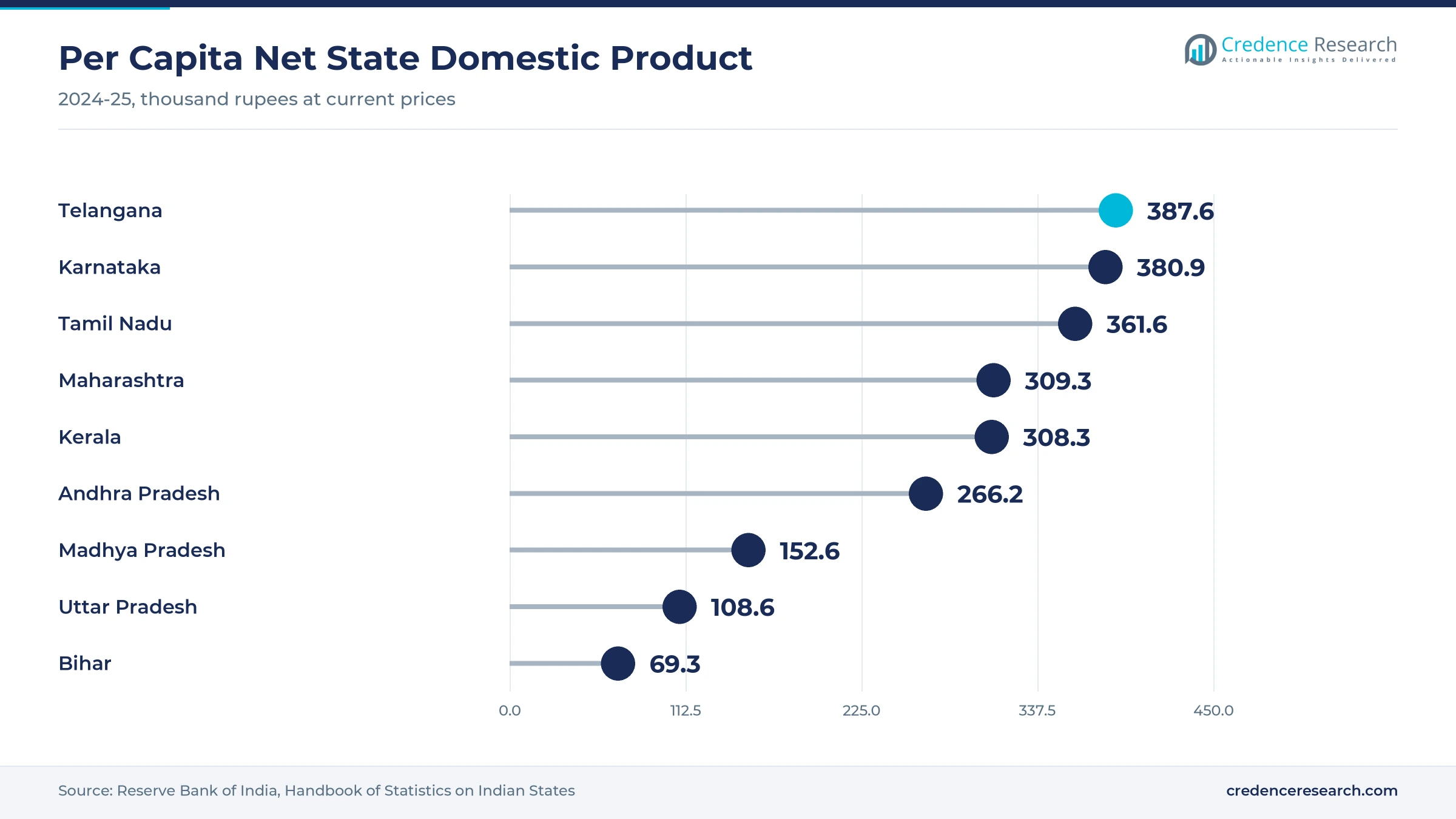
Wealth creation widens the base of luxury households, because rising incomes push more families above the spending threshold for high-end goods. Per capita net national income reached 2,05,324 rupees at current prices in 2024-25, and private final consumption grew 12.0% at current prices, according to the Ministry of Statistics. Real GDP then grew an estimated 7.7% in 2025-26, according to provisional estimates released on June 5, 2026. Telangana and Karnataka recorded per capita state incomes above 3.8 lakh rupees in 2024-25, according to state data compiled by the central bank. As a result, mass-affluent consumers grow fastest among buyer groups at 13.99% a year.
Why do new premium stores unlock domestic spending?
New premium stores unlock domestic spending, because many affluent Indians still buy abroad when brands lack local boutiques. India had only three true luxury malls in March 2026, two DLF centers in New Delhi and Jio World Plaza in Mumbai, according to a Reuters report. DLF plans to double the 160,000 square feet of leasable space at the Emporio, with the expansion likely operational by the end of 2028. Galeries Lafayette opened a five-floor, 90,000-square-foot Mumbai store with Aditya Birla Fashion and Retail in November 2025, carrying more than 250 brands. Consequently, more global labels can sell in India instead of losing buyers who shop abroad.
How do smaller cities and online channels broaden the buyer base?
Smaller cities and online channels broaden the buyer base, because affluent families outside the metros now expect the same brands and service. Ethos had 73 watch boutiques on March 31, 2025, and reached 92 across India after opening in Srinagar in March 2026, according to a stock exchange filing. Titan ran 779 Tanishq, Mia and Zoya jewelry stores in September 2025, with studded jewelry growing faster than plain gold. Brand e-commerce platforms let buyers in smaller cities browse full collections before they visit a boutique in the nearest metro. In turn, Central India grows at 13.51% a year as stores reach new cities.
Why do weddings and festivals sustain high-value purchases?
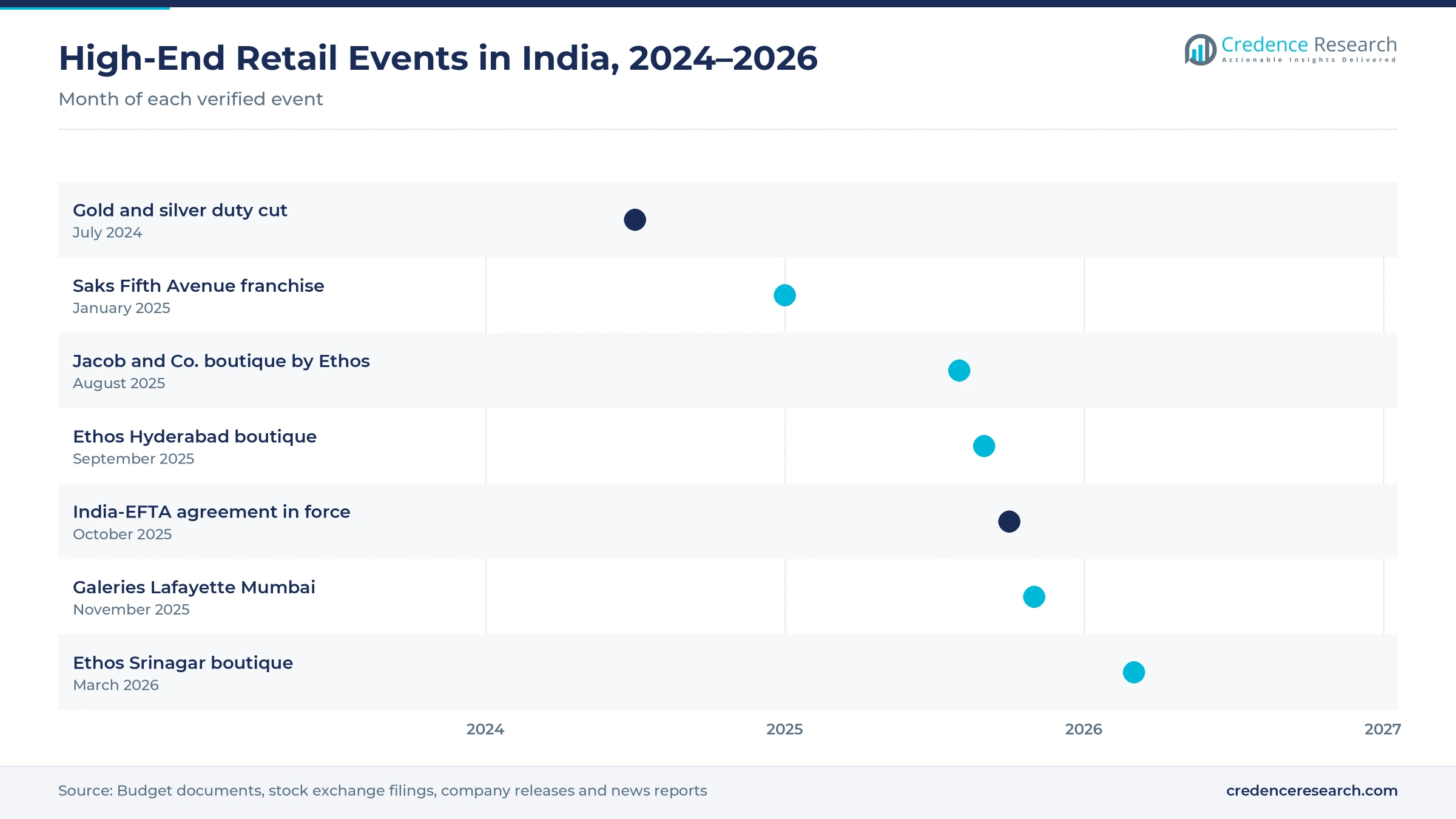
Weddings and festivals sustain high-value purchases, because Indian families spend heavily on jewelry, bridal wear and gifts during a few peak months. About 46 lakh weddings were expected between Nov. 1 and Dec. 14, 2025, generating an estimated 6.50 lakh crore rupees of trade, according to a national traders body. Jewelry was expected to take 15% of that wedding spending and apparel and sarees 10%. The Union Budget of July 23, 2024, also cut customs duty on gold and silver to 6% and on platinum to 6.4%. As a result, wedding and family celebrations led purchase occasions with a 37.0% share of 2025 value.
Lower duties and new store formats reshape the market
Why is the shift to lower watch duties gathering pace?
The shift to lower watch duties is gathering pace, because the India-EFTA trade agreement phases out tariffs on Swiss watches over five years. The agreement entered into force on Oct. 1, 2025, after 16 years of talks, and duties on watches were cut on that date and again at the start of 2026, according to Swissinfo. Switzerland exported 295 million Swiss francs of watches to India in 2025, 35% more than in 2023. Ethos also opened a Jacob and Co. boutique at Jio World Plaza in August 2025. Consequently, luxury watches grow fastest among product categories at 14.47% a year as high-end timepiece prices fall.
How is the rise of large multi-brand stores changing retail?
The rise of large multi-brand stores is changing retail, because one location can now introduce hundreds of labels that lack their own boutiques. Galeries Lafayette brought more than 250 brands into a 90,000-square-foot Mumbai store in late 2025. Reliance Brands also agreed a franchise to bring Saks Fifth Avenue to India in January 2025. Chanel had one fashion store and seven fragrance and beauty boutiques in India in March 2026, while Patek Philippe and Loro Piana had no physical stores. Golden Goose, by contrast, opened three Indian stores in two years. As a result, luxury department stores grow fastest among channels at 14.82% a year, because they give brands a lower-risk way to test demand before opening their own boutiques in Indian cities over the next few years.
Can Indian couture houses capture a larger opening?
Indian couture houses can capture a larger opening, because weddings keep bridal wear and heirloom jewelry at the center of high-end spending. Apparel and sarees were expected to take 10% of wedding season trade in late 2025, while jewelry took 15%. Ready-to-wear and couture apparel held a large share of 2025 value, supported by designers who sell bridal collections through flagship stores and appointments. North India held 26.6% of 2025 value, with Delhi a hub for bridal shopping. As a result, designers that pair couture with gemstone and jewelry collections can raise spend per customer.
Where does visitor and diaspora spending create an opening?
Visitor and diaspora spending creates an opening, because many buyers arrive in India during wedding and festival months with high budgets. India received 9.95 million foreign tourist arrivals in 2024, up 4.52% from 2023, and 20.57 million international tourist arrivals including nonresident Indians, according to tourism ministry data. Diaspora visitors often time purchases around family weddings, when they buy bridal jewelry and couture in Mumbai and Delhi stores. Travel retail at airports also serves outbound travelers before long international trips. Consequently, brands that offer tax-free shopping, appointments and shipping can win more of this spending in the coming decade.
Scarce space, high duties and counterfeits limit growth
How does scarce prime retail space slow brand entry?
Scarce prime retail space slows brand entry, because global houses only open in malls with suitable neighbors and footfall. DLF said in March 2026 that it had no availability at its luxury centers, while about 15 top brands waited for space. As a result, some labels delay entry by years or sell only through partners. Developers respond with planned luxury malls in Mumbai, Hyderabad and Gurgaon, although these are still years from opening.
Why do high import duties push buyers abroad?
High import duties push buyers abroad, because duties of 35% to 40% on many luxury goods make Indian shelf prices higher than in Dubai, London or Singapore. Affluent travelers then buy bags, watches and clothing on trips overseas. Consequently, domestic stores lose some of their best and most loyal customers to foreign shops. Trade agreements with EFTA and the United Kingdom are starting to lower duties on selected goods, which may bring some spending home.
What risk do counterfeit goods pose to brands?
Counterfeit goods pose a risk to brands, because copies of popular bags, shoes and watches sell widely online and in street markets. First-time buyers may struggle to tell genuine items from fakes. In turn, brand value and trust can suffer, especially in smaller cities. Brands respond with authentication services, serial numbers, controlled online stores and legal action against sellers of copies. However, enforcement across thousands of online listings remains slow and costly for most brands.
Can demand outside the metros support full boutiques?
Demand outside the metros cannot always support full boutiques, because affluent buyers in smaller cities are fewer and more spread out. Rents, staff and stock for a mono-brand store can exceed sales in a new market for several years. As a result, brands rely on franchise partners, multi-brand retailers and trunk shows outside the main cities. However, these models give brands less control over pricing, display and service standards in each city.
South India leads and grows fastest among regions
| Region | Value, 2025 (USD billion) | Share, 2025 | CAGR, 2026–2035 |
|---|---|---|---|
| South India | 4.14 | 30.3% | 13.71% |
| North India | 3.63 | 26.6% | 12.91% |
| West India | 2.96 | 21.7% | 13.31% |
| East & Northeast India | 2.09 | 15.3% | 12.71% |
| Central India | 0.83 | 6.1% | 13.51% |
High state incomes keep South India ahead
South India held a 30.3% share of 2025 value and grows fastest at 13.71% a year. Telangana, Karnataka and Tamil Nadu recorded per capita state incomes between 3.6 lakh and 3.9 lakh rupees in 2024-25, well above most other states. Ethos opened its second exclusive watch boutique at Nexus Mall in Hyderabad in September 2025. As a result, Hyderabad, Bengaluru and Chennai attract a growing share of new luxury store openings.
Delhi malls and bridal demand support North India
North India held a 26.6% share of 2025 value and grows at 12.91% a year. New Delhi hosts two of the three true luxury malls in the country, the DLF Emporio and the Chanakya, and DLF plans to double the Emporio by late 2028. Delhi is also a center for bridal couture and jewelry shopping. However, slower growth in some northern states holds the zone below the national rate.
Mumbai flagships anchor West India
West India held a 21.7% share of 2025 value and grows at 13.31% a year. Mumbai hosts Jio World Plaza, the Galeries Lafayette store and the Jacob and Co. boutique opened by Ethos in 2025. Maharashtra recorded per capita state income above 3 lakh rupees in 2024-25. In turn, Mumbai remains the first choice for brands entering India, including those that Reliance Brands brings through franchise agreements.
Kolkata and the Northeast build a smaller base
East and Northeast India held a 15.3% share of 2025 value and grows at 12.71% a year. Kolkata remains the main luxury center in the zone, with strong demand for jewelry and bridal wear. However, lower average incomes in several eastern states limit the number of boutiques. As a result, brands serve the zone through department stores, franchise partners and online shopping channels.
Central India gains from tier 2 cities
Central India held a 6.1% share of 2025 value and grows at 13.51% a year. Madhya Pradesh recorded per capita state income of about 1.5 lakh rupees in 2024-25, below the southern states. Even so, cities such as Indore and Bhopal draw jewelry and watch chains that expand beyond the metros. In turn, the zone grows from a small base as franchise stores open.
Store openings, trade deals and franchises, 2024–2026
| Development | Status and market relevance |
|---|---|
| In July 2024, the Union Budget cut customs duty on gold and silver to 6% and on platinum to 6.4%. | Lowers input costs for jewelers |
| In January 2025, Reliance Brands agreed a franchise arrangement to bring Saks Fifth Avenue to India. | Adds a department store format |
| In August 2025, Ethos opened a Jacob and Co. boutique at Jio World Plaza in Mumbai. | Extends high-end watch retail |
| In October 2025, the India-EFTA trade agreement entered into force and began cutting duties on Swiss watches. | Lowers watch shelf prices |
| In November 2025, Galeries Lafayette opened its first Indian store in Mumbai with Aditya Birla Fashion and Retail. | Brings more than 250 brands to one store |
Clienteling, online stores and appointments compete
- Clienteling apps let boutique staff track preferences and purchase history, so they can invite top buyers to private previews.
- Brand online stores show full collections to buyers in smaller cities, who often order online or book a store visit after browsing.
- Private appointment selling serves bridal and couture customers in closed salons, where families can view jewelry and outfits together.
- Authentication and traceability tools give buyers proof of origin through certificates and serial numbers, which builds trust against copies.
Need a Custom Version of This Report?
Tailor the scope, geography, or segments to your exact requirements.
- Custom geography or segment scope
- Direct access to our analyst team
Global houses and local groups compete for prime space
Competition runs between global fashion and jewelry houses, Indian couture designers and the local groups that operate franchises and multi-brand stores. Reliance Brands operates many global labels through franchise partnerships and agreed to bring Saks Fifth Avenue to India in January 2025. Ethos runs more than 90 watch boutiques and opened a Jacob and Co. store at Jio World Plaza. Titan sells fine jewelry through Tanishq, Mia and Zoya stores across the country. Louis Vuitton gained its first Mumbai store outside a hotel at Jio World Plaza. Brands compete on prime locations, wedding collections, personal service and after-sales care rather than on price, because affluent buyers value exclusivity. Many also sell to buyers of women's apparel at lower price tiers.
Which retailers and brands have verified activity in India?
| Company | Type | Role in the market |
|---|---|---|
| Reliance Brands Limited | Franchise operator | Saks Fifth Avenue franchise agreed, January 2025 |
| Ethos Limited | Multi-brand watch retailer | 92 boutiques after Srinagar opening, March 2026 |
| Titan Company Limited (Zoya) | Jewelry retailer | 779 Tanishq, Mia and Zoya stores, September 2025 |
| Louis Vuitton | Global fashion house | Store at Jio World Plaza, Mumbai |
Credence Research sees store supply setting the pace
Credence Research's view is that high-end retail spending in India will grow strongly through 2035, because household wealth is rising faster than the supply of prime store space. Fine jewelry should keep the largest share, while watches and department stores add value fastest as duties fall and large formats open. South India will stay the largest zone, although Mumbai and Delhi remain the entry points for most global brands. However, scarce space and high duties will reward brands that work with strong local partners.
Household income, store counts and prices anchor the model
The report uses 2025 as the base year, with values in USD million at current prices. Market values come from the Credence Research model, which combines household income bands, store counts by city, average selling prices by category and seasonal purchase patterns. The five zones and their 2025 shares follow the client brief, while zone growth rates and the splits by product category, channel, customer type and purchase occasion are Credence Research estimates. Sources used are official statistics, budget and trade documents, stock exchange filings, company announcements, trade body releases and news reports, and no interviews or surveys were used.
Wealth and store supply shape spending through 2035
The India luxury retail and premium brands market is expected to reach USD 47.54 billion by 2035, a 13.25% CAGR during 2026–2035, as rising wealth and new store space bring more buyers into high-end categories. Spending is projected to rise from USD 15.51 billion in 2026 as new boutiques and department stores open. Growth should be strongest in watches, department stores and South India, while fine jewelry keeps the largest category share. In contrast, slow mall development and high duties could delay some brand entries.
Frequently Asked Questions
How big is the India luxury retail and premium brands market?
Which region leads demand?
Which region grows fastest?
Which product category holds the largest share?
Which channel grows fastest?
How do trade agreements affect luxury prices?
Who are the leading companies in this market?
What are the main risks to growth?
Table of Content
Chapter 1 Market Segmentation
- 1.1 Segmentation Framework
- 1.1.1 Product and Service Classification
- 1.1.2 Application and End-Use Classification
- 1.1.3 Technology and Solution Classification
- 1.1.4 Customer and Distribution Channel Classification
- 1.1.5 Geographic Segmentation
- 1.1.6 Market Segment Definitions and Boundaries
- 1.2 By Product Category
- 1.2.1 Ready-to-Wear & Couture Apparel
- 1.2.2 Fine Jewellery
- 1.2.3 Luxury Watches
- 1.2.4 Leather Goods & Footwear
- 1.2.5 Prestige Beauty & Fragrance
- 1.3 By Customer Type
- 1.3.1 Resident HNWIs
- 1.3.2 Mass-Affluent Consumers
- 1.3.3 NRIs and Diaspora Visitors
- 1.3.4 International Tourists
- 1.3.5 Corporate Gift Buyers
- 1.4 By Purchase Occasion
- 1.4.1 Wedding and Family Celebrations
- 1.4.2 Festive and Gifting Purchases
- 1.4.3 Business and Formal Dressing
- 1.4.4 Everyday Premium Wardrobe
- 1.4.5 Travel and Milestone Purchases
Chapter 2 Introduction
- 2.1 Report Objectives and Scope
- 2.2 Product Definition and Industry Terminology
- 2.3 Market Inclusions and Exclusions
- 2.4 Research Process
- 2.4.1 Primary Research and Expert Interviews
- 2.4.2 Secondary Research and Source Review
- 2.4.3 Top-Down and Bottom-Up Estimation
- 2.4.4 Data Triangulation and Verification
- 2.5 Market Size Measurement Basis
- 2.5.1 2025: USD 13.66 billion → 2035: USD 47.54 billion
- 2.6 Historical and Forecast Reference Periods
- 2.6.1 Historical Period: 2018-2025
- 2.6.2 Base Year: 2025
- 2.6.3 Forecast Period: 2025-2035
- 2.7 Research Assumptions and Limitations
Chapter 3 Executive Summary
- 3.1 Market Snapshot and Key Findings
- 3.2 Base-Year Market Size, 2025
- 3.3 Forecast Market Size, 2035
- 3.4 Revenue and Volume Growth Outlook
- 3.5 Key Demand and Supply Indicators
- 3.6 Leading Market Segments
- 3.7 Fastest-Growing Market Opportunities
- 3.8 Regional Performance Highlights
- 3.9 Technology and Industry Transformation
- 3.10 Competitive Landscape Summary
- 3.11 Analyst View and Strategic Implications
Chapter 4 India Luxury Retail and Premium Brands Market Trends and Developments
- 4.1 Historical Industry Development, 2018-2025
- 4.2 Recent Market Trends and Developments
- 4.3 Demand and Customer Behavior Trends
- 4.4 Technology and Product Innovation
- 4.5 Artificial Intelligence, Automation and Digitalization
- 4.6 Local Manufacturing and Supply Chain Realignment
- 4.7 Industry Partnerships, Mergers and Acquisitions
- 4.8 Sustainability and Circular Economy Developments
- 4.9 Government and Private Sector Investment Trends
- 4.10 Emerging Business Models and Commercialization
- 4.11 Industry Developments and Announcements
Chapter 5 India Luxury Retail and Premium Brands Market Production, Supply and Demand Analysis
- 5.1 Demand Trend and Consumption Analysis, 2018-2025
- 5.2 Demand Forecast, 2025-2035
- 5.3 Production and Output Trend, 2018-2025
- 5.4 Production and Output Forecast, 2025-2035
- 5.5 Installed Capacity and Capacity Utilization
- 5.6 Company-Wise Production Plants and Statistics
- 5.6.1 Installed Production Capacity
- 5.6.2 Actual Production
- 5.6.3 Planned Capacity and Expansion Targets
- 5.7 Supply Chain Structure and Procurement Trends
- 5.8 Supply-Demand Gap and Bottlenecks
- 5.9 Import Dependence and Sourcing Structure
- 5.10 Contract Manufacturing and Outsourcing
- 5.11 Regional Supply and Demand Concentration
Chapter 6 India Luxury Retail and Premium Brands Market Pricing Analysis
- 6.1 Pricing Structure and Measurement
- 6.2 Historical Pricing Trends, 2018-2025
- 6.3 Pricing Outlook, 2025-2035
- 6.4 Average Selling Price and Unit Economics
- 6.5 Pricing by Product and Market Segment
- 6.6 Geographic Pricing Differences
- 6.7 Key Input, Energy, Labor and Logistics Costs
- 6.8 Contract Pricing and Purchasing Models
- 6.9 Pricing Sensitivity and Competitive Positioning
- 6.10 Price, Margin and Profitability Implications
Chapter 7 India Luxury Retail and Premium Brands Market Dynamics
- 7.1 Market Growth Drivers
- 7.1.1 Demand-Side Drivers
- 7.1.2 Technology and Innovation Drivers
- 7.1.3 Infrastructure and Investment Drivers
- 7.1.4 Regulatory and Policy Drivers
- 7.2 Market Restraints
- 7.2.1 Cost and Affordability Constraints
- 7.2.2 Technology and Adoption Barriers
- 7.2.3 Supply Chain and Operational Constraints
- 7.3 Market Challenges
- 7.3.1 Competitive Pressure and Margin Erosion
- 7.3.2 Skills, Infrastructure and Implementation Gaps
- 7.4 Emerging Market Opportunities
- 7.5 Market Dynamics Impact and Time-Horizon Assessment
Chapter 8 India Luxury Retail and Premium Brands Value Chain Analysis
- 8.1 Industry Value Chain Overview
- 8.2 Upstream Suppliers and Critical Inputs
- 8.3 Technology and Component Providers
- 8.4 Manufacturing or Service Delivery
- 8.5 Distribution, Channel Partners and Integrators
- 8.6 Downstream Applications and End Users
- 8.7 Value Addition and Profit Pools
- 8.8 Vertical Integration and Outsourcing
- 8.9 Supplier Concentration and Risk
- 8.10 Supply Chain Localization and Resilience
Chapter 9 India Luxury Retail and Premium Brands Market Regulations and Policies
- 9.1 Relevant Laws, Standards and Compliance Frameworks
- 9.2 Product, Service, Safety and Quality Requirements
- 9.3 Government Policies, Incentives and Subsidies
- 9.4 Imports, Exports and Trade Barriers
- 9.5 Public Procurement and Local Content Requirements
- 9.6 Environmental and Sustainability Compliance
- 9.7 Upcoming Policy Changes and Market Implications
Chapter 10 India Luxury Retail and Premium Brands Market Hotspots and Opportunities
- 10.1 Market Opportunity Mapping and Growth Hotspots
- 10.2 High-Growth Applications and Customer Groups
- 10.3 Underserved Markets and White-Space Opportunities
- 10.4 Emerging Technology and Product Opportunities
- 10.5 New Capacity and Investment Hotspots
- 10.6 Market Entry and Expansion Opportunities
- 10.7 Distribution and Partnership Opportunities
- 10.8 Near-Term and Long-Term Commercial Potential
- 10.9 Opportunity Attractiveness and Execution Risks
Chapter 11 India Luxury Retail and Premium Brands Market Outlook, 2025-2035
- 11.1 Market Size and Analysis
- 11.1.1 Revenue (Market Measurement: 2025: USD 13.66 billion → 2035: USD 47.54 billion)
- 11.1.2 Market Volume and Quantity Sold
- 11.1.3 Historical Market Size, 2018-2025
- 11.1.4 Base-Year Market Size, 2025
- 11.2 Market Forecast, 2025-2035
- 11.2.1 Revenue Forecast to 2035
- 11.2.2 Volume Forecast to 2035
- 11.2.3 CAGR and Year-on-Year Growth
- 11.2.4 Incremental Revenue Opportunity
- 11.3 Forecast Assumptions and Scenario Analysis
- 11.3.1 Base-Case Forecast
- 11.3.2 Optimistic and Conservative Scenarios
- 11.3.3 Technology, Pricing and Policy Sensitivities
- 11.4 Market Attractiveness and Growth Outlook
Chapter 12 India Luxury Retail and Premium Brands Market Segmentation and Outlook
- 12.1 Segmentation Summary and Market Shares, 2025
- 12.2 Largest and Fastest-Growing Segments
- 12.3 By Product Category - Market Size and Forecast, 2025-2035
- 12.3.1 Segment Definition and Scope
- 12.3.2 Historical Market Size, 2018-2025
- 12.3.3 Revenue Forecast, 2025-2035
- 12.3.4 Volume Forecast, 2025-2035
- 12.3.5 Base-Year Market Share, 2025
- 12.3.6 Segment CAGR and Growth Drivers
- 12.3.7 Subsegment Market Size and Forecast
- 12.3.7.1 Ready-to-Wear & Couture Apparel
- 12.3.7.2 Fine Jewellery
- 12.3.7.3 Luxury Watches
- 12.3.7.4 Leather Goods & Footwear
- 12.3.7.5 Prestige Beauty & Fragrance
- 12.3.8 Subsegment Pricing and Adoption Trends
- 12.3.9 Leading Suppliers and Competition
- 12.3.10 Regional Demand and Opportunities
- 12.4 By Customer Type - Market Size and Forecast, 2025-2035
- 12.4.1 Segment Definition and Scope
- 12.4.2 Historical Market Size, 2018-2025
- 12.4.3 Revenue Forecast, 2025-2035
- 12.4.4 Volume Forecast, 2025-2035
- 12.4.5 Base-Year Market Share, 2025
- 12.4.6 Segment CAGR and Growth Drivers
- 12.4.7 Subsegment Market Size and Forecast
- 12.4.7.1 Resident HNWIs
- 12.4.7.2 Mass-Affluent Consumers
- 12.4.7.3 NRIs and Diaspora Visitors
- 12.4.7.4 International Tourists
- 12.4.7.5 Corporate Gift Buyers
- 12.4.8 Subsegment Pricing and Adoption Trends
- 12.4.9 Leading Suppliers and Competition
- 12.4.10 Regional Demand and Opportunities
- 12.5 By Purchase Occasion - Market Size and Forecast, 2025-2035
- 12.5.1 Segment Definition and Scope
- 12.5.2 Historical Market Size, 2018-2025
- 12.5.3 Revenue Forecast, 2025-2035
- 12.5.4 Volume Forecast, 2025-2035
- 12.5.5 Base-Year Market Share, 2025
- 12.5.6 Segment CAGR and Growth Drivers
- 12.5.7 Subsegment Market Size and Forecast
- 12.5.7.1 Wedding and Family Celebrations
- 12.5.7.2 Festive and Gifting Purchases
- 12.5.7.3 Business and Formal Dressing
- 12.5.7.4 Everyday Premium Wardrobe
- 12.5.7.5 Travel and Milestone Purchases
- 12.5.8 Subsegment Pricing and Adoption Trends
- 12.5.9 Leading Suppliers and Competition
- 12.5.10 Regional Demand and Opportunities
- 12.6 Segment Growth Comparison
- 12.7 Segment Attractiveness and Priority Matrix
Chapter 13 India Luxury Retail and Premium Brands End-Use and Application Market Outlook
- 13.1 End-Use Industry and Customer Demand Structure
- 13.2 Leading Applications and Customer Groups
- 13.3 End-Use Market Size, Share and Forecast
- 13.4 Major End-Use Industry Deep Dives
- 13.4.1 Customer Requirements and Use Cases
- 13.4.2 Demand and Replacement Cycles
- 13.4.3 Technical and Regulatory Considerations
- 13.4.4 Purchasing and Procurement Models
- 13.4.5 Leading Vendors and Distribution Channels
- 13.4.6 Forecast and Commercial Opportunities
- 13.5 Emerging Applications and Cross-Segment Demand
- 13.6 End-Use Industry Investment Priorities
Chapter 14 India Luxury Retail and Premium Brands Geographic Market Outlook, 2025-2035
- 14.1 Domestic Market Distribution and Demand Clusters
- 14.2 State- or Province-Wise Market Size and Forecast, 2025-2035
- 14.3 City and Metropolitan Market Outlook
- 14.4 Industrial, Manufacturing and Commercial Clusters
- 14.5 Geographic Concentration of Key End Users
- 14.6 Local Pricing and Purchasing Differences
- 14.7 Domestic Production Facilities and Capacity Map
- 14.8 Local Infrastructure and Project Pipeline
- 14.9 State-Level Policy and Incentive Differences
- 14.10 Subnational Investment Hotspots and Opportunities
- 14.11 Distribution and Logistics Networks
- 14.12 Domestic Competitive Footprint
Chapter 15 India Luxury Retail and Premium Brands Technology, Innovation and Sustainability Outlook
- 15.1 Technology Landscape and Maturity
- 15.2 Product, Process and Service Innovation
- 15.3 AI, Automation and Digital Tools in the Industry
- 15.4 Technology Adoption and Performance Benchmarking
- 15.5 Innovation Pipeline and R&D Investment
- 15.6 Patent and Intellectual Property Trends
- 15.7 Energy Efficiency and Resource Management
- 15.8 Sustainability, Recycling and Circularity
- 15.9 Technology Roadmap, 2025-2035
- 15.10 Risks of Obsolescence and Technology Substitution
Chapter 16 India Luxury Retail and Premium Brands Market Key Strategic Imperatives
- 16.1 Growth and Market Entry Priorities
- 16.2 High-Return Products and Segments
- 16.3 Pricing, Profitability and Cost Optimization
- 16.4 Technology Investment and Product Differentiation
- 16.5 Supply Chain Localization and Resilience
- 16.6 Distribution and Customer Acquisition
- 16.7 Partnership, Acquisition and Capacity Strategy
- 16.8 Regional Expansion Priorities
- 16.9 Short-, Medium- and Long-Term Actions
Chapter 17 Competition Outlook
- 17.1 Industry Competition Characteristics
- 17.2 Market Structure and Concentration
- 17.3 Market Share and Competitive Positioning, 2025
- 17.4 Company-Wise Revenue and Product Benchmarking
- 17.5 Production and Service Capacity Benchmarking
- 17.6 Technology, Pricing and Differentiation
- 17.7 Regional Footprint and Distribution Strength
- 17.8 Mergers, Acquisitions and Strategic Alliances
- 17.9 New Entrants and Competitive Threats
- 17.10 Porter's Five Forces and Industry Attractiveness
- 17.11 Competitive Outlook, 2025-2035
Chapter 18 Company Profiles
- 18.1 Company Coverage and Selection Criteria
- 18.2 Reliance Brands Limited
- 18.2.1 Business Description
- 18.2.2 Company Ownership and Geographic Presence
- 18.2.3 Product and Service Portfolio
- 18.2.4 Manufacturing and Operating Footprint
- 18.2.5 Production Capacity and Expansion Plans
- 18.2.6 Financial Performance and Investment
- 18.2.7 Market Share and Competitive Position
- 18.2.8 Technology and Innovation Capabilities
- 18.2.9 Strategic Alliances or Partnerships
- 18.2.10 Recent Developments
- 18.2.11 Growth Strategy and Outlook
- 18.3 Ethos Limited
- 18.4 Louis Vuitton
- 18.5 Sabyasachi
- 18.6 Hermès
- 18.7 Tarun Tahiliani
- 18.8 Titan Company Limited (Zoya)
- 18.9 Manish Malhotra
- 18.10 Gucci
- 18.11 Christian Dior
- 18.12 Other Relevant Market Participants
Note: Every listed company is profiled on the structure shown under the first company. The company list is preliminary and may change based on research findings, market developments, data availability and client requirements.
Chapter 19 Disclaimer
- 19.1 Research and Forecast Disclaimer
- 19.2 Data Source and Estimation Limitations
Note: The depth of individual sections depends on data availability for this market. Volume, capacity, trade and other unit-based metrics are included where applicable.

