
Form Fill Seal Machine Market Overview:
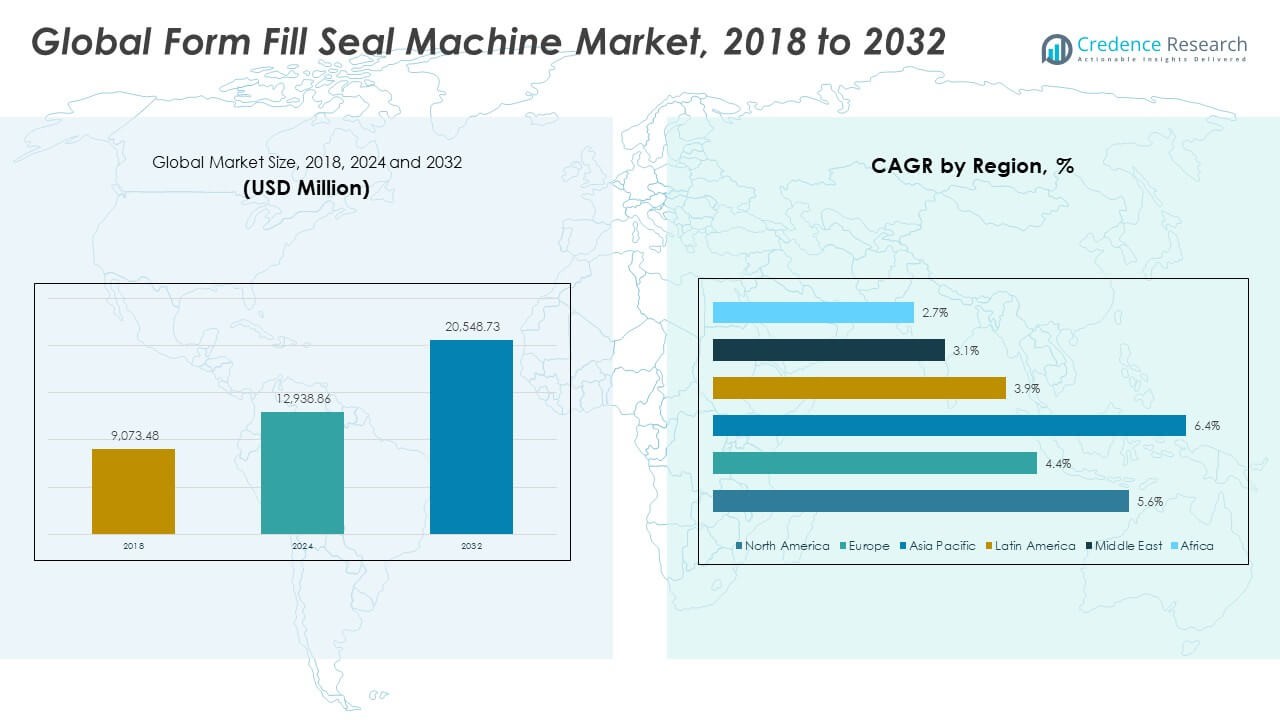
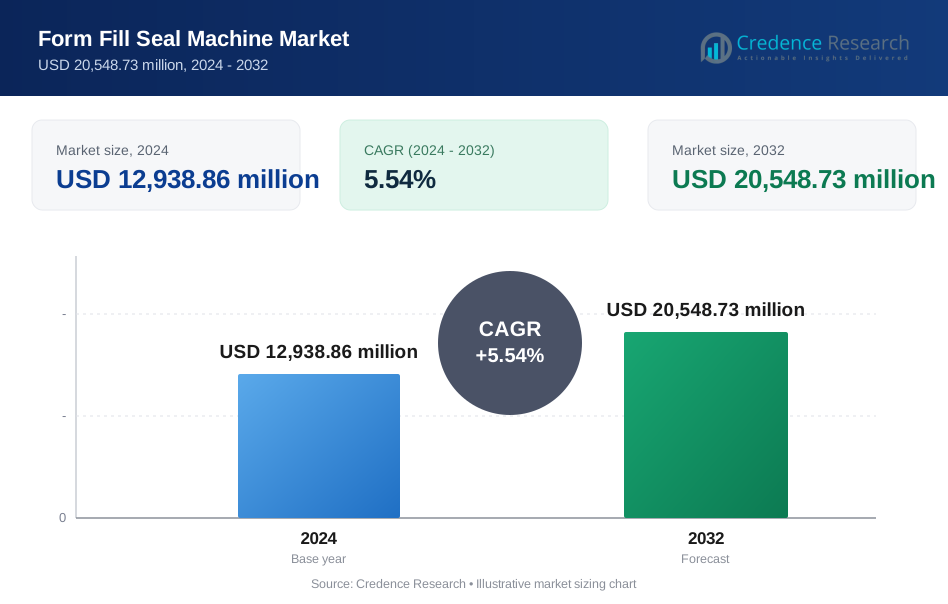
The Global Form Fill Seal Machine Market size was valued at USD 9,073.48 million in 2018 to USD 12,938.86 million in 2024 and is anticipated to reach USD 20,548.73 million by 2032, at a CAGR of 5.54% during the forecast period.
| REPORT ATTRIBUTE | DETAILS |
|---|---|
| Historical Period | 2020-2023 |
| Base Year | 2024 |
| Forecast Period | 2025-2032 |
| Form Fill Seal Machine Market Size 2024 | USD 12,938.86 Million |
| Form Fill Seal Machine Market , CAGR | 5.54% |
| Form Fill Seal Machine Market Size 2032 | USD 20,548.73 Million |
Market growth is driven by rising demand for efficient packaging automation across food, beverage, pharmaceutical, and personal care industries. Manufacturers adopt form fill seal (FFS) machines to improve packaging speed, minimize waste, and enhance product shelf life. The demand for flexible packaging solutions, eco-friendly materials, and precision filling systems fuels innovation. Companies are investing in advanced sealing technologies and digital controls to optimize productivity and reduce downtime.
Regionally, North America and Europe dominate the market due to established manufacturing infrastructure and high adoption of automation technologies. Asia-Pacific is rapidly emerging as a key growth hub, supported by expanding food processing, pharmaceutical, and e-commerce sectors. Countries like China, India, and Japan are major contributors due to industrialization and increased demand for packaged goods. Latin America and the Middle East & Africa show gradual adoption as industries modernize packaging systems.
Form Fill Seal Machine Market Insights:
- The Global Fragrant Drawer Liners Market was valued at USD 67.30 million in 2018, reached USD 98.82 million in 2024, and is projected to attain USD 157.72 million by 2032, growing at a CAGR of 5.6% during the forecast period.
- North America (42.2%), Europe (27.5%), and Asia Pacific (20.5%) collectively dominate global revenue, supported by strong home décor culture, premium brand presence, and growing consumer awareness of lifestyle-based fragrance products.
- Asia Pacific, the fastest-growing region with a 20.5% share, benefits from rising urbanization, expanding middle-class income, and increasing adoption of home fragrance goods through e-commerce platforms and domestic manufacturing.
- By Material Type, fabric liners accounted for 68% of total sales in 2024, driven by superior scent retention and elegant texture, while plastic liners captured 32% due to their moisture resistance and affordability.
- By Sales Channel, offline retail held 60% of the market through specialty stores and home décor boutiques, while online channels contributed 40%, expanding through direct-to-consumer platforms and digital marketing.
Form Fill Seal Machine Market Drivers:
Rising Adoption of Automated Packaging Solutions Across Food, Beverage, and Pharmaceutical Industries
The Global Form Fill Seal Machine Market benefits from the growing need for packaging efficiency and cost control. Food and beverage manufacturers use form fill seal machines to ensure consistent product quality and faster throughput. Pharmaceutical companies rely on these systems to maintain hygiene and minimize contamination risk. Automation reduces labor dependency while improving precision and production speed. It also helps meet the rising demand for single-serve and convenience packaging formats. Energy-efficient models lower operational costs and enhance productivity. Packaging firms prefer machines capable of handling multiple materials and product types. This broad applicability makes form fill seal systems a key investment in modern production lines.
- For instance, Syntegon'sSigpack HRM flow wrapping system achieves output rates up to 1,500 packages per minute, using high-precision direct drive technology and push-button format changes, which supports leading food producers with fast and consistent throughput.
Technological Advancements Enhancing Precision, Sustainability, and Flexibility in Packaging Operations
The market grows due to continued innovation in servo-driven controls, robotic integration, and smart sensors. These technologies enable high-speed packaging with minimal material waste. Machine learning algorithms are improving filling accuracy and sealing consistency. The shift toward biodegradable and recyclable films drives redesigns in machine configurations. Compact and modular designs offer flexibility for varied production capacities. Manufacturers also upgrade control interfaces for easier operation and reduced maintenance. IoT connectivity allows predictive maintenance and real-time performance monitoring. This technological evolution ensures consistent product output and strengthens the market's competitiveness.
- For instance, Rovema’s BVC 400 Vertical Form Fill Seal Machine operates at up to 150 cycles per minute with product detection Sense & Seal®, reducing defective bags, and delivers high machine efficiency in food industry automation.
Increasing Demand for Flexible Packaging Formats and Shelf-Ready Designs
Demand for flexible pouches, sachets, and stick packs fuels the need for form fill seal systems. It allows manufacturers to optimize packaging space and reduce material usage. Retailers prefer these packaging types for improved shelf visibility and lightweight handling. The food industry adopts flexible solutions to extend shelf life and support portion control. E-commerce growth encourages packaging that ensures durability during transport. Form fill seal machines support both horizontal and vertical configurations, addressing diverse packaging needs. Their versatility allows quick changeovers between product types. This adaptability makes them ideal for dynamic consumer markets.
Focus on Operational Efficiency and Cost Reduction Through Automation
Manufacturers across industries seek to improve packaging line performance without increasing costs. The Global Form Fill Seal Machine Market supports this by delivering continuous, automated processes that cut downtime. It helps reduce human errors, material waste, and rework rates. Remote monitoring capabilities enhance production oversight. Integration with automated conveyor and labeling systems ensures smooth operations. These machines also enable scalability for seasonal demand variations. By reducing energy use and labor costs, companies enhance profitability. Automation helps businesses meet production goals efficiently and sustain quality output.
Form Fill Seal Machine Market Trends:
Growing Integration of Smart Packaging Technologies and Digital Monitoring Systems
The market is witnessing increased adoption of connected and data-driven packaging systems. Form fill seal machines now feature embedded sensors that monitor real-time sealing pressure, temperature, and speed. Integration with cloud-based analytics platforms supports performance tracking and process optimization. Digital twin technology enables virtual testing before production runs. Manufacturers use AI-driven systems for predictive maintenance, minimizing equipment failures. Smart packaging solutions enhance traceability and ensure product integrity. The trend aligns with Industry 4.0, allowing seamless communication across production lines. This integration boosts operational visibility and enables proactive decision-making.
- For instance, Ishida’s AirScan leak detection solution uses advanced laser technology to sense CO₂ leaking from sealed trays in modified atmosphere packaging (MAP), with sensitivity to detect leaks as small and 100% pack verification throughput.
Rising Preference for Sustainable and Eco-Friendly Packaging Materials
Growing environmental awareness is driving a shift toward recyclable and biodegradable packaging films. Companies are redesigning form fill seal machines to handle bio-based plastics and compostable laminates. Equipment manufacturers focus on reducing film waste and improving energy efficiency. Regulatory mandates in Europe and North America encourage eco-conscious packaging innovation. Brands seek sustainable solutions that meet consumer demand and compliance standards. Machine customization enables compatibility with thinner and high-barrier films. The adoption of renewable packaging materials supports long-term brand credibility. Sustainability continues to shape new design and material development in the market.
- For instance, Mondi’s BarrierPack Recyclable all-polyethylene film is certified for 95% recyclability, and has been implemented by major grocery chains such as Tesco for pouch applications, supporting the transition to fully recyclable mono-material packaging.
Expansion of Application Scope Across Emerging Industries
The Global Form Fill Seal Machine Market is expanding into non-food sectors, including personal care, pet food, and household products. Manufacturers recognize the benefits of hygienic packaging and extended shelf stability. Advanced sealing technology supports diverse viscosities and product types. E-commerce growth increases demand for compact, tamper-proof packaging. The pharmaceutical and nutraceutical industries use these systems to maintain dosage accuracy. Integration with coding and labeling units ensures regulatory compliance. It enables consistent branding and product safety in competitive markets. This diversification enhances revenue stability across multiple end-use segments.
Shift Toward High-Speed, Modular, and Customizable Machine Designs
The industry is transitioning to modular machines that provide scalability and faster changeovers. Manufacturers prefer compact units suitable for space-constrained facilities. High-speed sealing and filling modules meet large-scale production requirements. Customizable layouts allow easy adaptation for various package formats. Advanced servo technology improves synchronization and precision during operation. Machine builders are integrating robotics to enhance pick-and-place efficiency. User-friendly touch interfaces simplify control and monitoring. This trend reflects the market’s focus on flexibility, productivity, and low maintenance.
Form Fill Seal Machine Market Challenges Analysis:
High Capital Investment and Complexity of Machine Integration
The Global Form Fill Seal Machine Market faces high initial investment requirements that limit adoption among small and mid-sized enterprises. Complex installation procedures and the need for skilled operators increase operational costs. Many businesses hesitate to replace traditional packaging lines due to budget constraints. Integration with existing systems demands technical expertise and customization, raising setup time. Machine downtime during installation can disrupt production schedules. The advanced electronics and sensors used in modern systems require specialized maintenance. Limited awareness about return on investment slows modernization in developing regions. These barriers restrict market penetration in cost-sensitive industries.
Maintenance Costs, Material Compatibility, and Regulatory Constraints
Regular calibration and part replacement contribute to recurring maintenance expenses. Machines designed for specific film materials may face issues with emerging eco-friendly alternatives. This compatibility challenge creates adjustment delays and additional costs. Strict packaging safety and labeling regulations require continuous equipment updates. The shortage of trained technicians complicates servicing and troubleshooting. Supply chain disruptions affect component availability, delaying production. Operational inefficiencies caused by inadequate maintenance can reduce throughput. The need to balance compliance, reliability, and cost efficiency remains a critical challenge for manufacturers.
Form Fill Seal Machine Market Opportunities:
Growing Demand for Flexible, Sustainable, and Smart Packaging in Developing Regions
The Global Form Fill Seal Machine Market is gaining momentum in Asia-Pacific, Latin America, and Africa due to rapid industrialization and packaging modernization. Rising consumption of packaged foods and pharmaceuticals fuels automation investments. Companies view flexible and recyclable packaging as essential for environmental goals. Affordable modular machines attract small-scale manufacturers. Demand for smart and connected packaging creates scope for innovation. Governments promoting local manufacturing boost domestic machine production. Emerging economies provide strong opportunities for capacity expansion and market entry.
Adoption of Industry 4.0 and Expansion into Niche End-Use Segments
Manufacturers are adopting Industry 4.0 principles to digitalize production and improve equipment uptime. Real-time data analytics supports predictive maintenance and performance optimization. Integration with robotics enhances precision and speed in packaging operations. The adoption of form fill seal technology in pet care, cosmetics, and nutraceuticals opens untapped market segments. Demand for hygienic and portion-controlled packaging continues to rise. Machine builders focusing on customization and automation-ready models gain a competitive edge. The growing alignment between digitalization and sustainability is creating lasting growth prospects.
Form Fill Seal Machine Market Segmentation Analysis:
By Technology Segment
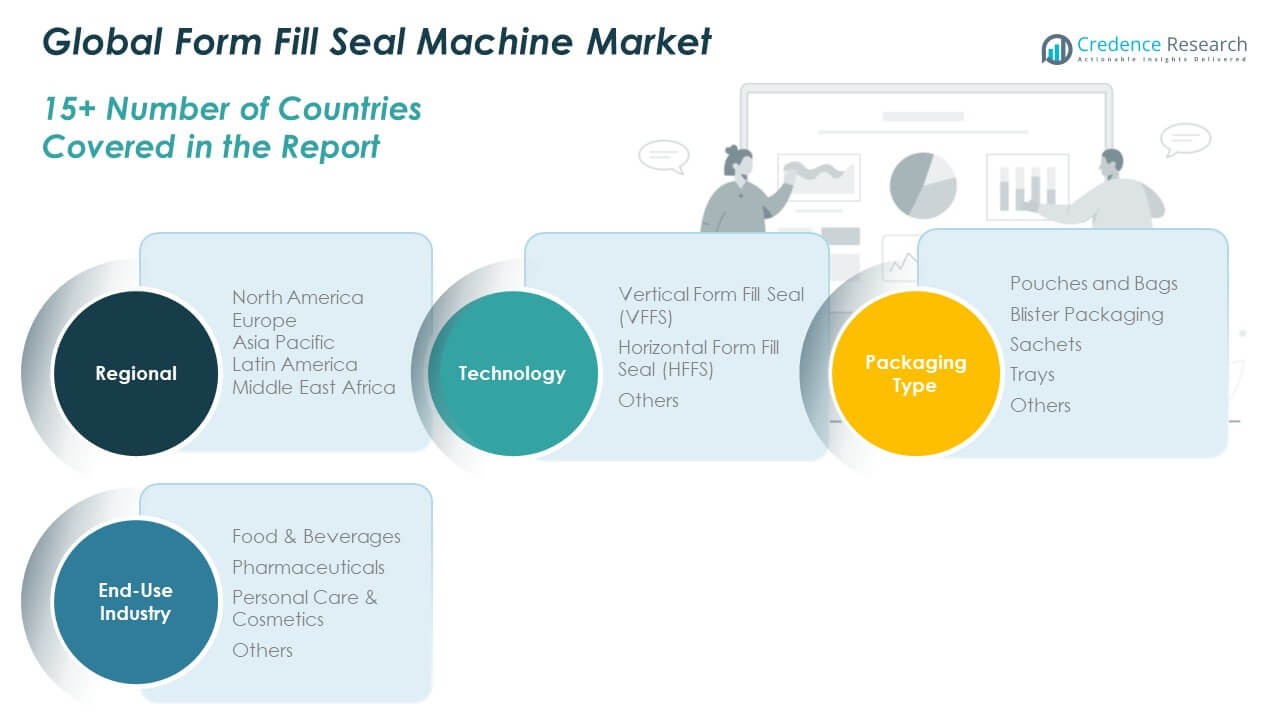
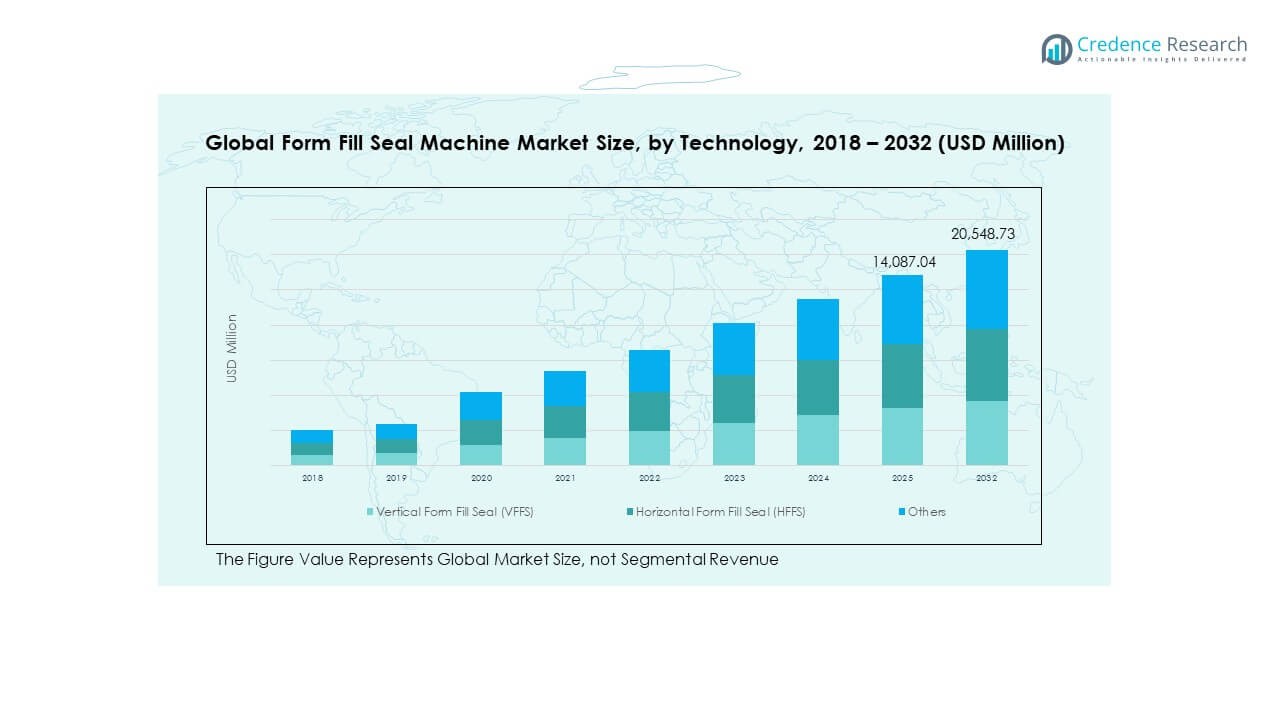
The Global Form Fill Seal Machine Market is categorized into Vertical Form Fill Seal (VFFS), Horizontal Form Fill Seal (HFFS), and Others. VFFS systems hold a significant share due to their efficiency in packaging granular, powder, and liquid products in compact formats. They are widely used in food, beverage, and pharmaceutical sectors for high-speed operations. HFFS machines are gaining popularity for their precision and ability to handle larger or complex packages. They provide flexibility for diverse product shapes and materials. The “Others” segment includes specialized machines for customized or hybrid packaging requirements across niche industries.
- For instance, Rovema’s BVC series VFFS machines are designed for frozen foods and granular applications, providing broad flexibility in product sizes and shapes and offering high efficiency with dual axis servo technology.
By Packaging Type Segment
The market is segmented into Pouches and Bags, Blister Packaging, Sachets, Trays, and Others. Pouches and bags dominate due to their versatility, cost-effectiveness, and lightweight structure. Blister packaging is essential for protecting sensitive products such as pharmaceuticals and cosmetics. Sachets cater to single-serve and sample-size demands in food and personal care applications. Trays offer durability for frozen foods and ready meals, ensuring product safety during transport. The remaining segment serves customized packaging needs across various industries.
- For instance, Mondi's BarrierPack solutions enable recyclable pouch production for household and personal care goods, meeting the increasing market demand for sustainability in flexible packaging.
By End-Use Industry Segment
Key end-use industries include Food & Beverages, Pharmaceuticals, Personal Care & Cosmetics, and Others. The food and beverage sector leads due to growing demand for convenient and shelf-stable packaging. Pharmaceuticals rely on these machines for hygienic, tamper-proof sealing. Personal care brands favor flexible packaging to enhance presentation and usability. Other sectors adopt the technology to improve efficiency and maintain consistent product quality.
Segmentation:
By Technology Segment
- Vertical Form Fill Seal (VFFS)
- Horizontal Form Fill Seal (HFFS)
- Others
By Packaging Type Segment
- Pouches and Bags
- Blister Packaging
- Sachets
- Trays
- Others
By End-Use Industry Segment
- Food & Beverages
- Pharmaceuticals
- Personal Care & Cosmetics
- Others
By Region
- North America (U.S., Canada, Mexico)
- Europe (UK, France, Germany, Italy, Spain, Russia, Rest of Europe)
- Asia Pacific (China, Japan, South Korea, India, Australia, Southeast Asia, Rest of APAC)
- Latin America (Brazil, Argentina, Rest of Latin America)
- Middle East (GCC Countries, Israel, Turkey, Rest of Middle East)
- Africa (South Africa, Egypt, Rest of Africa)
Regional Analysis:
North America
The North America Global Form Fill Seal Machine Market size was valued at USD 2,697.96 million in 2018 to USD 3,788.64 million in 2024 and is anticipated to reach USD 6,041.54 million by 2032, at a CAGR of 5.6% during the forecast period. North America holds a 29.3% share of the global market, driven by high automation adoption across food, beverage, and pharmaceutical sectors. Strong manufacturing infrastructure and demand for advanced packaging machinery support regional leadership. The U.S. dominates due to its established consumer goods industry and investment in smart manufacturing technologies. Canada and Mexico show steady growth through modernization of packaging facilities. Companies focus on sustainable packaging and digital monitoring systems to enhance efficiency. Continuous innovation in sealing and filling technology strengthens regional competitiveness. The rise in e-commerce and demand for convenience packaging sustains consistent equipment demand.
Europe
The Europe Global Form Fill Seal Machine Market size was valued at USD 1,781.54 million in 2018 to USD 2,408.16 million in 2024 and is anticipated to reach USD 3,495.71 million by 2032, at a CAGR of 4.4% during the forecast period. Europe accounts for 18.6% of the global market, supported by strong regulatory standards and advanced packaging innovation. The region emphasizes eco-friendly and recyclable packaging materials, promoting machine adaptation to sustainable films. Germany, Italy, and the UK lead due to robust industrial bases and packaging machinery exports. Demand from pharmaceutical, dairy, and personal care industries remains strong. Automation and robotic integration improve production speed and reduce labor dependency. Energy-efficient equipment gains traction under EU sustainability initiatives. Continuous R&D in sealing precision and digital interfaces drives competitiveness.
Asia Pacific
The Asia Pacific Global Form Fill Seal Machine Market size was valued at USD 3,777.70 million in 2018 to USD 5,595.80 million in 2024 and is anticipated to reach USD 9,454.88 million by 2032, at a CAGR of 6.4% during the forecast period. Asia Pacific leads with a 43.2% market share, supported by rapid industrialization, expanding food processing sectors, and population growth. China, India, and Japan are major contributors due to their large-scale manufacturing capabilities. Growing demand for packaged food and pharmaceuticals fuels machine adoption. Local producers emphasize cost-efficient automation to serve domestic and export markets. Governments promote automation under industrial modernization policies. The expansion of retail and e-commerce increases packaging volumes across product categories. Advancements in low-cost servo technology and digital controls support market penetration.
Latin America
The Latin America Global Form Fill Seal Machine Market size was valued at USD 429.59 million in 2018 to USD 605.00 million in 2024 and is anticipated to reach USD 850.68 million by 2032, at a CAGR of 3.9% during the forecast period. Latin America holds a 6.6% share, driven by the growth of food processing and beverage packaging sectors. Brazil and Mexico dominate regional demand through expanding FMCG production. Economic reforms encourage investment in automation technologies. The pharmaceutical sector is adopting advanced packaging systems to ensure quality and compliance. Regional manufacturers seek energy-efficient equipment to manage operational costs. Infrastructure development and industrial recovery create favorable conditions for growth. Multinational companies strengthen presence through distribution partnerships and after-sales networks.
Middle East
The Middle East Global Form Fill Seal Machine Market size was valued at USD 238.04 million in 2018 to USD 308.31 million in 2024 and is anticipated to reach USD 407.44 million by 2032, at a CAGR of 3.1% during the forecast period. The region accounts for 3.1% of the global market, led by GCC countries and Turkey. Rising investments in food manufacturing and packaging modernization drive market expansion. Demand for high-speed filling systems grows within beverage and personal care sectors. Governments support local manufacturing diversification under industrial transformation programs. The market benefits from imports of advanced European and Asian machinery. Flexible packaging gains preference for its shelf appeal and portability. Increased focus on automation aligns with regional sustainability goals.
Africa
The Africa Global Form Fill Seal Machine Market size was valued at USD 148.66 million in 2018 to USD 232.96 million in 2024 and is anticipated to reach USD 298.47 million by 2032, at a CAGR of 2.7% during the forecast period. Africa represents 2.6% of the global market, showing gradual adoption due to infrastructure limitations. South Africa leads regional demand, followed by Egypt and Nigeria. Food and beverage industries drive growth through modernization of production facilities. Governments are encouraging industrial automation to support domestic manufacturing. Rising population and urbanization increase the need for packaged goods. Imports of low-cost machinery from Asia are common among local producers. Awareness of packaging hygiene and product safety improves market potential. Regional progress depends on logistics efficiency and access to skilled technical labor.
Key Player Analysis:
- Robert Bosch GmbH
- JBT Corporation
- Haver & Boecker OHG
- Arpac LLC
- KHS GmbH
- Krones AG
- Scholle IPN Corporation
- Pro Mach Inc.
- GEA Group AG
- IMA Industria Macchine Automatiche S.p.A.
Competitive Analysis:
The Global Form Fill Seal Machine Market remains moderately fragmented with a few large players setting the industry pace while numerous niche manufacturers serve regional needs. Key companies focus on expanding capabilities through acquisitions, product innovation and global footprint extension. They build advanced machines with servo-driven automation, IoT integration and energy-efficient sealing systems to meet evolving packaging demands. Firms also offer aftermarket service, spare parts and retrofit solutions to maintain long-term customer ties. Strong competition drives pricing pressure and pushes continual improvement in machine reliability, flexibility and sustainability. Market entrants face high capital investment, technical complexity and the challenge of differentiating through value-added services. Partnerships between machine builders and material film suppliers emerge to jointly address the compatibility of new packaging substrates. Overall, leading players leverage scale, global service networks and technological edge to capture value and shape the competitive landscape.
Recent Developments:
- In October 2024, ProMach Inc. announced the acquisition of HMC Products, a leader in manufacturing, refurbishing, and servicing horizontal form fill seal (HFFS) machines. This move marks ProMach’s fourth acquisition of the year, intending to expand its flexible packaging solutions and deliver improved lead times and support for customers globally.
- In January 2025, JBT Corporation completed the settlement on its takeover of Marel hf., culminating in the creation of JBT Marel Corporation. This merger unites both companies to deliver enhanced operational scale, deeper application expertise, and a broader range of technology solutions for food and beverage packaging and processing.
Report Coverage:
The research report offers an in-depth analysis based on technology, packaging type, and end-use industry segments. It details leading market players, providing an overview of their business, product offerings, investments, revenue streams, and key applications. Additionally, the report includes insights into the competitive environment, SWOT analysis, current market trends, as well as the primary drivers and constraints. Furthermore, it discusses various factors that have driven market expansion in recent years. The report also explores market dynamics, regulatory scenarios, and technological advancements that are shaping the industry. It assesses the impact of external factors and global economic changes on market growth. Lastly, it provides strategic recommendations for new entrants and established companies to navigate the complexities of the market.
Future Outlook:
- Growing demand for flexible packaging formats will drive increased adoption of form-fill-seal machines.
- Rising regulatory pressure on packaging waste will push innovation in machines compatible with sustainable films.
- Expanding e-commerce and single-serve product formats will elevate the need for automated, high-speed packaging lines.
- Asia-Pacific and other emerging regions will present strong growth opportunities for machine suppliers.
- Integration of IoT, predictive maintenance and digital monitoring will become standard features in new equipment.
- Small and medium-sized enterprises (SMEs) will seek compact, modular machines to reduce automation entry barriers.
- Collaboration between machine manufacturers and material film suppliers will grow to address compatibility and sustainability.
- Retrofit and upgrade markets will gain momentum as companies extend lifecycle of existing equipment.
- Machine builders will diversify into niche end-use segments like personal care, pet food and nutraceutical packaging.
- Service, spare-parts and aftermarket business models will become a key competitive differentiator for equipment suppliers.
Request a Free Sample
Fill in your details and we'll send you a free sample report.
- Sample data tables & charts
- Research methodology
Need a Custom Version of This Report?
Tailor the scope, geography, or segments to your exact requirements.
- Custom geography or segment scope
- Direct access to our analyst team
Frequently Asked Questions
What is the current market size for the Global Form Fill Seal Machine Market, and what is its projected size in 2032?
At what Compound Annual Growth Rate is the Global Form Fill Seal Machine Market projected to grow between 2025 and 2032?
Which market segment held the largest share in 2024?
What are the primary factors fueling the growth of the Global Form Fill Seal Machine Market?
Who are the leading companies in the Global Form Fill Seal Machine Market?
Which region commanded the largest share of the Global Form Fill Seal Machine Market in 2024?
Table of Content
Chapter 1. Report Introduction
- 1.1 Report Description & Purpose
- 1.1.1 Report Title & Market Definition
- 1.1.2 Unique Selling Propositions (USP) & Key Differentiators
- 1.1.3 Value Proposition for Stakeholders
- 1.2 Research Objectives
- 1.2.1 Market Sizing Objectives (Volume & Revenue)
- 1.2.2 Segmentation Objectives
- 1.2.3 Competitive Intelligence Objectives
- 1.2.4 Forecast & Scenario Objectives
- 1.3 Report Scope
- 1.3.1 Form Fill Seal Machine Scope – Types & Subtypes Covered
- 1.3.2 Geographic Scope – Regions & Countries Covered
- 1.3.3 Historical Period, Base Year & Forecast Period (2024; forecast to 2032)
- 1.3.4 Inclusions & Exclusions
- 1.4 HS Code & Classification Framework
- 1.5 Currency, Units & Pricing Basis
- 1.6 Target Stakeholders
- 1.7 Limitations & Assumptions
Chapter 2. Executive Summary
- 2.1 Global Form Fill Seal Machine Market Snapshot
- 2.1.1 Market Size – Historical (2024) & Forecast (2024-2032) (2024: USD 12,938.86 million → 2032: USD 20,548.73 million)
- 2.1.2 Volume & Revenue – Global Totals
- 2.1.3 Key Market Highlights – Top Five Facts
- 2.2 Form Fill Seal Machine Market Segmentation Snapshot
- 2.2.1 Market Split by Region – 2024 vs. 2032
- 2.3 Competitive Snapshot
- 2.3.1 Top 10 Players by Revenue Share – 2024
- 2.3.2 Top 10 Players by Volume Share – 2024
- 2.3.3 Recent Strategic Developments (18-Month Summary)
- 2.4 Key Investment Highlights & Strategic Conclusions
Chapter 3. Form Fill Seal Machine Market Dynamics & Industry Analysis
- 3.1 Market Overview & Context
- 3.1.1 Form Fill Seal Machine Market Position in the Broader Automotive Value Chain
- 3.1.2 OEM vs. Replacement Market Dynamics
- 3.1.3 Market Maturity & Development Stage by Region
- 3.2 Form Fill Seal Machine Market Drivers
- 3.3 Form Fill Seal Machine Market Restraints & Challenges
- 3.4 Form Fill Seal Machine Market Opportunities
- 3.5 Porter's Five Forces Analysis
- 3.5.1 Threat of New Entrants
- 3.5.2 Bargaining Power of Suppliers
- 3.5.3 Bargaining Power of Buyers
- 3.5.4 Threat of Substitutes
- 3.5.5 Competitive Rivalry – Intensity Assessment
- 3.6 Form Fill Seal Machine Value Chain Analysis
- 3.6.1 Upstream – Raw Material/Input Suppliers
- 3.6.1.1 Raw Material/Input 1
- 3.6.1.2 Raw Material/Input 2
- 3.6.1.3 Raw Material/Input 3
- 3.6.2 Midstream – Production/Manufacturing/Service Delivery
- 3.6.2.1 Production/Process Overview
- 3.6.2.2 Key Facility Locations & Capacity by Manufacturer
- 3.6.3 Downstream – Distribution & End Consumer
- 3.6.3.1 Primary Channel – B2B/OEM
- 3.6.3.2 Secondary Channels – Dealer, Retail, Online, Direct
- 3.6.4 Value Chain Profitability Analysis
- 3.6.1 Upstream – Raw Material/Input Suppliers
- 3.7 PESTEL Analysis
- 3.7.1 Political Factors
- 3.7.2 Economic Factors
- 3.7.3 Social Factors
- 3.7.4 Technological Factors
- 3.7.5 Environmental Factors
- 3.7.6 Legal Factors
- 3.8 Form Fill Seal Machine Supply Chain Analysis
- 3.8.1 Raw Material/Input Supply Risk Assessment
- 3.8.2 Manufacturing Concentration Risk (Geographic Exposure)
- 3.8.3 Trade Disruption Impact Analysis
- 3.9 Regulatory & Policy Landscape
Note: The regulatory and policy landscape section covers regulations based on their applicability to the market, Form Fill Seal Machine category, geography, and scope of the study. Only regulatory frameworks with a material impact on operations, compliance, trade, sustainability, or market access are analyzed in detail.
Chapter 4. Key Investment Pockets & Opportunity Analysis
- 4.1 Form Fill Seal Machine Market Attractiveness Analysis
- 4.1.1 By Region – Investment Attractiveness Matrix (Volume × CAGR)
- 4.2 Absolute Revenue Growth Opportunity
- 4.2.1 By Region – Absolute USD Growth Through 2032
- 4.3 Incremental Volume Opportunity
- 4.3.1 By Region – Incremental Volume Through 2032
- 4.3.2 Segment – Incremental Volume
- 4.4 Emerging Submarket Opportunity Deep Dive (Subject to Applicability)
- 4.5 Emerging Market Opportunity Scorecards
- 4.5.1 United States
- 4.5.2 Europe
- 4.5.3 Asia
- 4.5.4 Middle East & Africa
Note: Emerging Market Opportunity Scorecards will be included based on relevance and strategic importance. Regions listed are indicative and may vary depending on data availability and market dynamics.
Chapter 5. Form Fill Seal Machine Import-Export Analysis & Trade Flows
- 5.1 Global Trade Overview
- 5.1.1 Global Export Value by Country (2024)
- 5.1.2 Global Export Volume by Country (2024)
- 5.1.3 Global Import Value by Country (2024)
- 5.1.4 Global Import Volume by Country (2024)
- 5.1.5 Net Trade Balance by Country (2024)
- 5.2 Export Analysis – Segment
- 5.2.1 Type 1 (HS Code)
- 5.2.2 Type 2 (HS Code)
- 5.2.3 Type 3 (HS Code)
- 5.2.4 Type 4 (HS Code)
- 5.2.5 Type 5 (HS Code)
- 5.3 Import Analysis – Segment
- 5.3.1 Type 1 (HS Code)
- 5.3.2 Type 2 (HS Code)
- 5.3.3 Type 3 (HS Code)
- 5.3.4 Type 4 (HS Code)
- 5.3.5 Type 5 (HS Code)
- 5.4 Average Unit Trade Prices
- 5.4.1 Average Export Price – Segment & Country
- 5.4.2 Average Import Price – Segment & Source Country
- 5.4.3 Price Trends (2024)
- 5.5 Key Trade Route Analysis
- 5.5.1 Trade Route 1
- 5.5.2 Trade Route 2
- 5.5.3 Trade Route 3
- 5.5.4 Trade Route 4
- 5.5.5 Trade Route 5
- 5.6 Trade Policy Impact Assessment
- 5.6.1 US Anti-Dumping & Section 301 Tariffs
- 5.6.2 EU Customs Union Impact
- 5.6.3 Major Free Trade Agreements
- 5.6.4 USMCA Rules of Origin
Note: Trade policy analysis will be included only where relevant to the Form Fill Seal Machine market.
Chapter 6. Competitive Landscape & Company Benchmarking
- 6.1 Form Fill Seal Machine Market Concentration & Structure
- 6.1.1 Herfindahl-Hirschman Index (HHI) – vs. 2024
- 6.1.2 Tier 1, Tier 2 & Tier 3 Market Structure
- 6.1.3 Global, Regional & Local Player Dynamics
- 6.2 Form Fill Seal Machine Market Share Analysis – 2024
- 6.2.1 Global Revenue Share by Company
- 6.2.2 Global Volume Share by Company
- 6.2.3 Regional Revenue Share
- 6.2.4 Market Share Evolution ( vs. 2024)
- 6.2.5 OEM Segment Share by Company
- 6.2.6 Replacement Segment Share by Company
- 6.3 Production/Delivery Capacity & Facility Analysis
- 6.3.1 Global Installed Capacity
- 6.3.2 Capacity Utilization Rates
- 6.3.3 Production/Output Volume
- 6.3.4 Facility Locations & Capacity Map
- 6.3.5 Planned Capacity Additions
- 6.4 Form Fill Seal Machine Competitive Benchmarking Matrix
- 6.4.1 Revenue, Volume, CAGR & Profitability Comparison
- 6.4.2 Channel Revenue Mix
- 6.4.3 Geographic Revenue Exposure
- 6.4.4 R&D Intensity
- 6.4.5 Sustainability Maturity
- 6.5 Strategic Developments in Form Fill Seal Machine (Last 24 Months)
- 6.5.1 Mergers, Acquisitions & Divestments
- 6.5.2 New Form Fill Seal Machine Launches
- 6.5.3 Facility Expansions
- 6.5.4 Strategic Alliances, Joint Ventures & Partnerships
- 6.5.5 Distribution Expansion & Market Entry
- 6.5.6 Sustainability & ESG Initiatives
- 6.6 Competitive Strategy Mapping
- 6.6.1 Leader, Challenger, Follower & Niche Classification
- 6.6.2 Pricing Strategy Comparison
- 6.6.3 Channel Strategy Matrix
Note: Strategic developments are included based on their materiality and the availability of reliable information.
Chapter 7. Global Form Fill Seal Machine Market – By Distribution Channel
- 7.1 Segment Overview
- 7.1.1 Volume & Revenue Split by Channel (2024 & 2032)
- 7.1.2 Channel Mix Evolution (2024-2032)
Chapter 8. Regional Market Analysis – Global Overview
- 8.1 Global Regional Overview
- 8.1.1 Regional Volume Share
- 8.1.2 Regional Revenue Share
- 8.1.3 Regional Volume by Region
- 8.1.4 Regional Revenue by Region
- 8.1.5 Regional Forecast Through 2032
- 8.2 Cross-Regional Segment Analysis
- 8.2.1 By Distribution Channel
- 8.2.2 By Brand/Price Tier
Chapter 9. North America Form Fill Seal Machine Market
- 9.1 United States
- 9.2 Canada
- 9.3 Mexico
Chapter 10. Europe Form Fill Seal Machine Market
- 10.1 Germany
- 10.2 France
- 10.3 Italy
- 10.4 United Kingdom
- 10.5 Spain
- 10.6 Poland
- 10.7 Russia
- 10.8 Netherlands
- 10.9 Belgium
- 10.10 Sweden
- 10.11 Denmark
- 10.12 Norway
- 10.13 Rest of Europe
Chapter 11. Asia Pacific Form Fill Seal Machine Market
- 11.1 China
- 11.2 India
- 11.3 Japan
- 11.4 South Korea
- 11.5 Thailand
- 11.6 Indonesia
- 11.7 Vietnam
- 11.8 Malaysia
- 11.9 Australia
- 11.10 Rest of Asia Pacific
Chapter 12. Latin America Form Fill Seal Machine Market
- 12.1 Brazil
- 12.2 Argentina
- 12.3 Colombia
- 12.4 Chile
- 12.5 Rest of Latin America
Chapter 13. Middle East Form Fill Seal Machine Market
- 13.1 Saudi Arabia
- 13.2 United Arab Emirates
- 13.3 Turkey
- 13.4 Israel
- 13.5 Iran
- 13.6 Rest of the Middle East
Chapter 14. Africa Form Fill Seal Machine Market
- 14.1 South Africa
- 14.2 Egypt
- 14.3 Nigeria
- 14.4 Morocco
- 14.5 Rest of Africa
Chapter 15. Form Fill Seal Machine Company Profiles
- 15.1 [Company 01]
- 15.1.1 Company Overview
- 15.1.2 Key Management Personnel
- 15.1.3 Products & Services Portfolio
- 15.1.4 Financial Performance
- 15.1.5 Key Market Focus & Geographic Presence
- 15.1.6 Recent Developments & Strategic Initiatives
Note: The company profile list is preliminary and may change based on research findings, market developments, data availability, and client requirements.
Chapter 16. Appendices
- Appendix A – List of Abbreviations & Acronyms
- Appendix B – Industry Classification Code Reference – Full Series
- Appendix C – Production & Capacity Data Tables
- Appendix D – End-Use & Demand Base Tables
- Appendix E – Consumption & Replacement Rate Assumptions
- Appendix F – ASP Reference Tables
- Appendix G – Manufacturing & Facility Database
- Appendix H – Import-Export Data Tables
- Appendix I – Regulatory Summary Tables
- Appendix J – Primary Research Participant List (Anonymized)
- Appendix K – Primary Research Questionnaire Framework
- Appendix L – Data Sources & Bibliography
- Appendix M – Market Size Divergence & Source Comparison
Chapter 17. Research Methodology
- 17.1 Research Framework & Philosophy
- 17.2 Secondary Research – Sources, Hierarchy & Data Extraction
- 17.3 Data Modeling – Bottom-Up & Top-Down Market Sizing
- 17.4 Primary Research – Stakeholder Framework, LOI & Sample Sizes
- 17.5 Forecast Methodology – Regression, Scenario & Sensitivity Analysis
- 17.6 Quality Control – Four-Layer Validation Framework
- 17.7 Limitations & Standard Assumptions
- 17.8 Disclaimer
