
Food Oil Absorbing Sheet Market Overview:
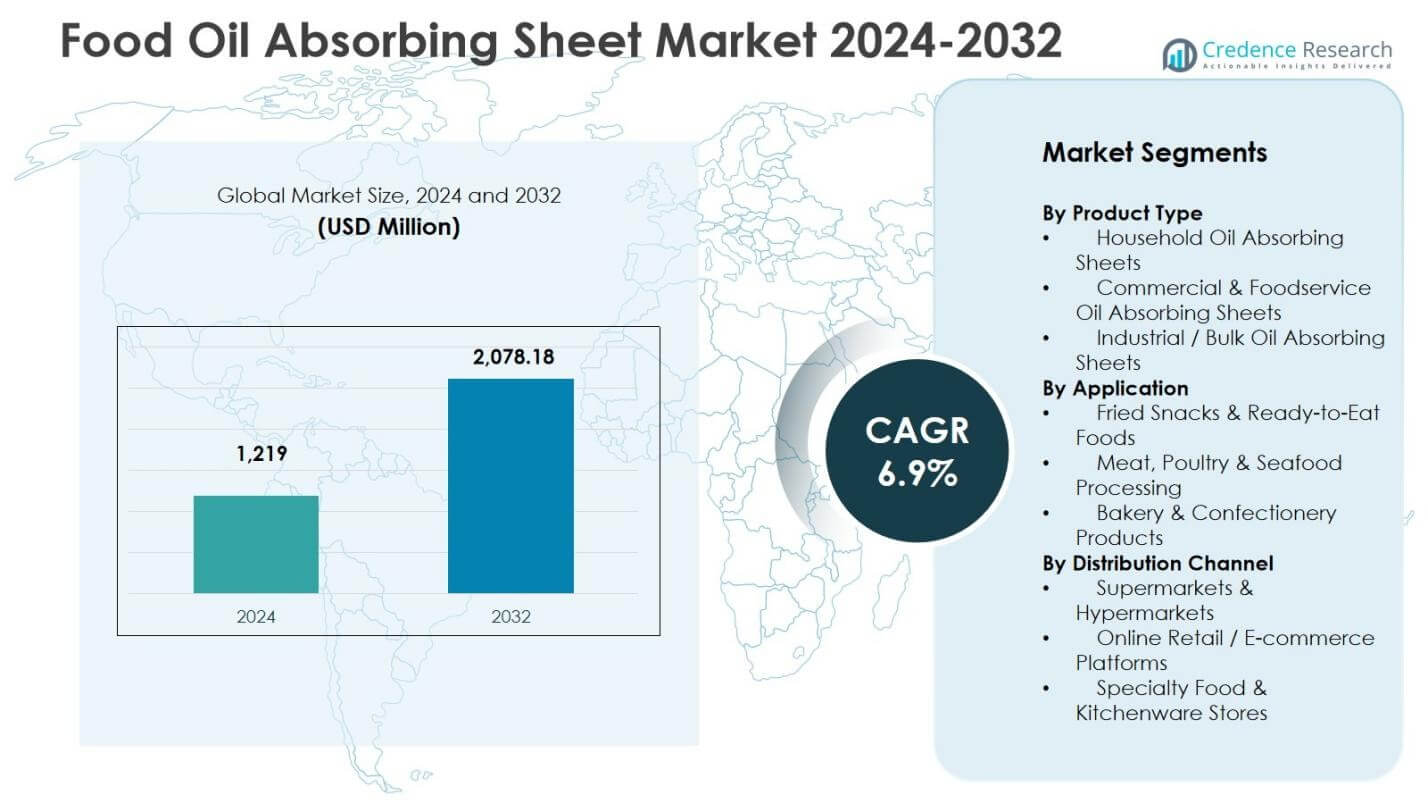
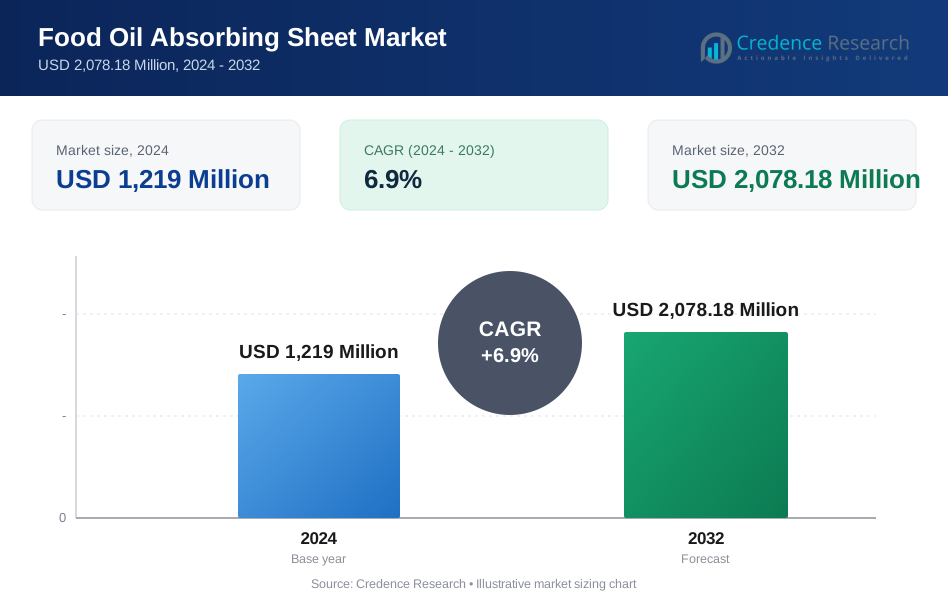
Food Oil Absorbing Sheet Market size was valued at USD 1,219 Million in 2024 and is anticipated to reach USD 2,078.18 Million by 2032, at a CAGR of 6.9% during the forecast period.
| REPORT ATTRIBUTE | DETAILS |
|---|---|
| Historical Period | 2020-2023 |
| Base Year | 2024 |
| Forecast Period | 2025-2032 |
| Food Oil Absorbing Sheet Market Size 2024 | USD 1,219 million |
| Food Oil Absorbing Sheet Market, CAGR | 6.9% |
| Food Oil Absorbing Sheet Market Size 2032 | USD 2,078.18 million |
Food Oil Absorbing Sheet Market Insights
- The market overview highlights rising demand from households, quick-service restaurants, and snack manufacturers, with the Household Oil Absorbing Sheets segment leading at 52.3% share in 2024 due to growing awareness of low-oil cooking and product quality enhancement in fried foods.
- Market drivers include increasing health consciousness, expansion of ready-to-eat and fried snack production, and wider adoption of oil-absorption solutions across food processing, bakery, and seafood applications to improve texture, shelf stability, and hygiene standards.
- Market trends reflect innovation in biodegradable and fiber-based absorbing materials, broader e-commerce distribution, and product development focused on high-absorption capacity, while major players enhance portfolios and strengthen partnerships across foodservice and industrial segments.
- Regional analysis shows North America leading with 32.4% share in 2024, followed by Europe at 28.1% and Asia-Pacific at 24.6%, supported by strong consumption of fried foods and increasing adoption in residential and commercial kitchens across these regions.
Food Oil Absorbing Sheet Market Segmentation Analysis:
By Product Type:
The Food Oil Absorbing Sheet Market by product type is driven by rising demand across home kitchens, restaurants, and industrial food processing environments. Household Oil Absorbing Sheets emerged as the dominant sub-segment, accounting for 52.3% share in 2024, supported by increasing consumer focus on low-oil cooking, convenience in fried-food preparation, and growing awareness of fat reduction in daily diets. Commercial & Foodservice Oil Absorbing Sheets gained traction in quick-service restaurants due to hygiene and quality-control needs, while Industrial / Bulk Oil Absorbing Sheets served large-scale processors seeking improved oil retention efficiency and product consistency.
- For instance, Sunkea provides hollow-carved 6-inch oil absorbing paper (40g white silicon coated on both sides), packaged 100 sheets per bag for fried foods in home use.
By Application:
In the application segment, Fried Snacks & Ready-to-Eat Foods represented the leading sub-segment with 46.7% market share in 2024, driven by strong consumption of fried products, expanding snack manufacturing, and the need to enhance product texture while reducing surface oil. Meat, Poultry & Seafood Processing contributed significantly as processors adopted oil-absorption solutions to improve shelf stability and product safety. Bakery & Confectionery Products also utilized absorbing sheets to manage residual grease in pastries and coated products, supporting quality enhancement and clean-label positioning across premium food categories.
- For instance, Ecolab's Nalco Water provides specialized filtration and separation solutions for meat, poultry, and seafood processors. These systems optimize water reuse and remove excess oils to enhance product safety and operational efficiency.
By Distribution Channel:
Across distribution channels, Supermarkets & Hypermarkets accounted for the dominant share of 41.5% in 2024, reflecting strong product visibility, private-label expansion, and higher consumer adoption of kitchen utility products in organized retail formats. Online Retail / E-commerce Platforms gained momentum due to doorstep delivery, broader SKU availability, and the rising influence of digital cooking and wellness trends. Specialty Food & Kitchenware Stores continued to serve niche, premium, and professional buyers seeking high-performance oil-absorbing solutions tailored for culinary applications and small foodservice establishments.
Key Growth Drivers
Rising Health and Wellness Awareness
The Food Oil Absorbing Sheet Market is experiencing strong growth as consumers increasingly prioritize low-fat diets and healthier eating habits. The growing awareness of lifestyle-related disorders such as obesity and cardiovascular diseases is encouraging households and foodservice operators to reduce excess surface oil in fried foods. Food manufacturers also adopt oil-absorbing solutions to enhance product quality, retain crispness, and align with clean-label positioning. The trend toward home cooking, especially in urban markets, further supports demand for convenient oil-reduction tools. Together, these factors position oil-absorbing sheets as a practical solution for delivering healthier fried food consumption without compromising taste or texture.
- For instance, Purajan Japan offers Japanese Tempura Paper, made from 100% specially processed pulp in 8.6 x 7.8-inch sheets (70 per pack), designed to effectively absorb excess oil from tempura and other fried foods while preserving crispness.
Expansion of Processed and Ready-to-Eat Food Production
Rising consumption of fried snacks, bakery items, and convenience foods is a major demand catalyst for oil-absorbing sheets across commercial and industrial environments. Large-scale snack manufacturers and quick-service restaurants increasingly integrate oil-absorption solutions to enhance appearance, reduce greasiness, and improve shelf stability of products. The global expansion of food processing facilities, particularly in Asia-Pacific and emerging economies, amplifies adoption across production lines. In addition, the growth of private-label snack brands and frozen food categories drives continuous use of oil-control materials for quality consistency, operational efficiency, and compliance with food-safety standards in mass-production settings.
- For instance, Palsgaard's OilBinder 01, a vegetable oil-based stabilizer, binds excess liquid oil in confectionery products like hazelnut spreads with 30-60% oil content. It forms a crystal network during cooling to prevent separation, improving stability and shelf life without trans fats.
Increasing Adoption in Commercial Kitchens and Foodservice
Foodservice establishments such as cafés, quick-service restaurants, catering units, and institutional kitchens are adopting oil-absorbing sheets to maintain hygiene standards and product quality. These sheets support operational efficiency by reducing oil residue, improving fry-station cleanliness, and minimizing food handling time. Rising demand for texture-enhanced fried products and high-volume production environments encourages kitchen operators to prefer oil-control materials over conventional draining methods. Growing investments in modern kitchen infrastructure, along with heightened emphasis on food presentation and consistency, further accelerate market penetration in commercial settings, making the segment a key growth contributor across developed and emerging markets.
Key Trends & Opportunities
Sustainability-Focused Product Innovation and Eco-Friendly Materials
A major trend shaping the Food Oil Absorbing Sheet Market is the increasing shift toward biodegradable, compostable, and fiber-based materials that align with sustainability goals. Manufacturers are investing in plant-based pulp, non-woven natural fibers, and chemical-free coatings to minimize environmental impact and appeal to eco-conscious consumers. This trend creates strong opportunities for premium and value-added product lines targeting clean-label packaging and green kitchen solutions. Partnerships between material science companies and packaging innovators are expanding innovation pipelines, enabling sheets with enhanced absorption capacity, heat resistance, and food-safety compliance. The sustainability transition also strengthens brand differentiation and regulatory alignment across global markets.
- For instance, Ahlstrom produces Genuine Vegetable Parchment (GVP) from 100% cellulose fibers sourced from responsibly managed forests, offering a complete grease barrier, superior temperature resistance up to 220°C, and full biodegradability with home and industrial compost certifications.
Growing Penetration of E-Commerce and Direct-to-Consumer Brands
Digital retail expansion is opening new growth opportunities as consumers increasingly purchase kitchen utility and food-preparation accessories online. E-commerce platforms enable wider SKU availability, brand discovery, and multi-pack purchasing formats, supporting strong adoption among households and small food businesses. Direct-to-consumer brands leverage targeted marketing, health-focused messaging, and subscription-based kitchen supplies to build recurring demand. Online distribution also supports customization, such as size-specific sheets and value bundles for home and professional use. The rise of culinary influencers, food-wellness communities, and cross-border retail accessibility continues to amplify digital-channel sales momentum in the market.
- For instance, Blue Apron enhances online sales via its Market platform, selling curated kitchen tools and accessories like those used in their test kitchens, alongside meal kits with pre-measured ingredients.
Key Challenges
Price Sensitivity and Availability of Low-Cost Alternatives
One of the key challenges in the Food Oil Absorbing Sheet Market is consumer price sensitivity and the widespread availability of traditional substitutes such as paper towels, tissue sheets, or cloth-based draining methods. In price-conscious markets, households and small eateries may perceive dedicated oil-absorbing sheets as non-essential, limiting rapid penetration of premium offerings. Manufacturers must balance cost efficiency and performance enhancement to maintain competitiveness. Additionally, procurement decisions in institutional kitchens are often influenced by bulk-supply economics, creating pressure on margins and increasing the need for value-driven product positioning across key end-use segments.
Regulatory Compliance and Food-Safety Standard Requirements
Meeting stringent food-contact safety regulations and material compliance standards remains a significant challenge for producers, particularly in regions with evolving packaging and hygiene frameworks. Manufacturers must ensure that oil-absorbing sheets are free from harmful chemicals, allergens, and migration risks while maintaining high absorption performance. Certification requirements, testing procedures, and labeling norms increase production complexity and operating costs, especially for small and mid-scale suppliers. Global expansion further complicates compliance due to variations in regional standards, creating barriers to market entry and requiring continuous investment in quality control, documentation, and regulatory monitoring.
Regional Analysis
North America
North America held a significant position in the Food Oil Absorbing Sheet Market, accounting for 32.4% market share in 2024, driven by strong consumer preference for low-oil cooking practices and the widespread penetration of convenience food categories. Rising health awareness, coupled with higher adoption of oil-control solutions in household kitchens and quick-service restaurants, continues to support market growth across the United States and Canada. Increasing demand from commercial foodservice chains, expanding retail availability, and the presence of established food processing facilities further strengthen regional consumption, while innovation in eco-friendly and premium-grade absorbing materials enhances product uptake.
Europe
Europe accounted for 28.1% market share in 2024, supported by stringent food-safety regulations, consumer inclination toward healthier diets, and strong demand from bakery, confectionery, and snack processing industries. The region benefits from well-established organized retail networks and high adoption of standardized food quality practices across restaurants and institutional kitchens. Growth is further reinforced by sustainability initiatives that encourage the use of biodegradable and fiber-based oil absorption materials. Increasing popularity of ready-to-eat fried snacks and premium culinary offerings across Western and Central Europe continues to stimulate demand for efficient oil-absorption solutions across both household and commercial segments.
Asia-Pacific
Asia-Pacific dominated the market with 24.6% market share in 2024, driven by rapid expansion of food processing industries, high consumption of fried snacks, and rising urban household adoption of convenience-oriented kitchen solutions. Strong growth in countries such as China, Japan, India, and South Korea is supported by increasing restaurant penetration, quick-service outlet expansion, and changing dietary patterns. Manufacturers benefit from large-scale production capabilities and growing preference for grease-control solutions in tempura, street-food, and packaged snack applications. Rising e-commerce availability and improving consumer awareness regarding oil-reduction practices further accelerate product demand across residential and commercial environments.
Latin America
Latin America accounted for 8.7% market share in 2024, supported by growing consumption of fried snacks, expanding fast-food chains, and increasing awareness of oil-reduction practices in urban households and foodservice outlets. The region experiences rising adoption of oil absorbing sheets in bakery, meat processing, and snack manufacturing applications, particularly in Brazil, Mexico, and Argentina. Retail modernization and improving access to organized distribution channels strengthen product visibility across supermarkets and online platforms. Although price sensitivity remains a constraint in certain markets, rising demand for hygiene-focused and quality-enhancing food preparation materials continues to drive gradual adoption across residential and commercial segments.
Middle East & Africa
The Middle East & Africa region accounted for 6.2% market share in 2024, driven by increasing consumption of fried and ready-to-eat foods, expanding restaurant culture, and the adoption of oil-absorption solutions in hospitality and catering environments. Growth is supported by rising disposable income, urban lifestyle transformation, and ongoing development of food processing and quick-service sectors in Gulf economies and key African urban centers. Adoption is further influenced by the need to improve product presentation, reduce surface grease, and enhance food hygiene standards. Gradual retail expansion and improving awareness of kitchen utility products contribute to sustained market growth across the region.
Food Oil Absorbing Sheet Market Segmentations:
By Product Type
- Household Oil Absorbing Sheets
- Commercial & Foodservice Oil Absorbing Sheets
- Industrial / Bulk Oil Absorbing Sheets
By Application
- Fried Snacks & Ready-to-Eat Foods
- Meat, Poultry & Seafood Processing
- Bakery & Confectionery Products
By Distribution Channel
- Supermarkets & Hypermarkets
- Online Retail / E-commerce Platforms
- Specialty Food & Kitchenware Stores
By Geography
- North America
- U.S.
- Canada
- Mexico
- Europe
- Germany
- France
- U.K.
- Italy
- Spain
- Rest of Europe
- Asia Pacific
- China
- Japan
- India
- South Korea
- South-east Asia
- Rest of Asia Pacific
- Latin America
- Brazil
- Argentina
- Rest of Latin America
- Middle East & Africa
- GCC Countries
- South Africa
- Rest of the Middle East and Africa
Competitive Landscape
Competitive landscape analysis in the Food Oil Absorbing Sheet Market is shaped by the presence of key players such as Purajan Japan, Tikusan, SakeInn, Shenzhen Beite Purification Technology Co., Ltd., Novipax, Sealed Air Corporation, Brady Corporation, Ahlstrom, Nippon Paper Industries, and Koch Industries, who focus on material innovation, absorption efficiency, and food-safety compliance to strengthen market positioning. The market remains moderately fragmented, with companies expanding portfolios across household, foodservice, and industrial applications to address diverse end-use requirements. Manufacturers increasingly invest in biodegradable fibers, sustainable coatings, and high-capacity absorption technologies to align with health-centric and eco-friendly consumption trends. Strategic initiatives include capacity expansion, regional distribution partnerships, and collaboration with food processors and packaging converters to enhance product reach. Pricing competitiveness and performance differentiation remain core priorities, while emerging players emphasize niche segments and e-commerce distribution. Continuous innovation, regulatory alignment, and brand credibility collectively define the competitive direction of the global market.
Key Player Analysis
- Purajan Japan
- Tikusan
- SakeInn
- Shenzhen Beite Purification Technology Co., Ltd.
- Novipax
- Sealed Air Corporation
- Brady Corporation
- Ahlstrom
- Nippon Paper Industries
- Koch Industries (Matador / Absorbent Products Division)
Recent Developments
- In June 2025, BiOrigin Specialty Products launched BioGuard™ oil & grease resistant food-safe paper, a new paper solution that improves oil and grease resistance in food service wrappers and bags while remaining recyclable, enhancing food packaging performance.
- In 2024, Shenzhen Beite Purification Technology Co., Ltd expanded its consumables lineup by adding food-grade oil-absorbing paper products to its offerings, reinforcing its commitment to cleanroom and specialty absorbent materials.
Report Coverage
The research report offers an in-depth analysis based on Product Type, Application, Distribution Channel and Geography. It details leading market players, providing an overview of their business, product offerings, investments, revenue streams, and key applications. Additionally, the report includes insights into the competitive environment, SWOT analysis, current market trends, as well as the primary drivers and constraints. Furthermore, it discusses various factors that have driven market expansion in recent years. The report also explores market dynamics, regulatory scenarios, and technological advancements that are shaping the industry. It assesses the impact of external factors and global economic changes on market growth. Lastly, it provides strategic recommendations for new entrants and established companies to navigate the complexities of the market.
Future Outlook
- The market will experience steady growth as health-conscious consumers increasingly adopt low-oil cooking and fried-food preparation practices.
- Manufacturers will expand production of biodegradable and fiber-based oil absorbing sheets to align with sustainability and eco-friendly material trends.
- Food processing companies and quick-service restaurants will increase adoption to enhance product texture, reduce greasiness, and improve quality consistency.
- E-commerce and direct-to-consumer channels will strengthen market penetration through wider product visibility and subscription-based kitchen utility offerings.
- Technological improvements will enhance absorption capacity, heat resistance, and safety compliance across household and commercial applications.
- Premium and specialty product variants will gain traction among professional kitchens, bakery units, and high-end culinary segments.
- Emerging economies will witness rising demand due to urbanization, organized retail expansion, and increasing consumption of fried snack products.
- Strategic partnerships between material science companies and packaging manufacturers will support continuous product innovation.
- Government focus on food hygiene and safety standards will encourage wider adoption across processing and foodservice sectors.
- Market competition will intensify as regional and global players invest in product differentiation, brand positioning, and distribution expansion.
Request a Free Sample
Fill in your details and we'll send you a free sample report.
- Sample data tables & charts
- Research methodology
Need a Custom Version of This Report?
Tailor the scope, geography, or segments to your exact requirements.
- Custom geography or segment scope
- Direct access to our analyst team
Frequently Asked Questions
What is the current market size for the Food Oil Absorbing Sheet Market, and what is its projected size in 2032?
At what Compound Annual Growth Rate is the Food Oil Absorbing Sheet Market projected to grow between 2024 and 2032?
Which Food Oil Absorbing Sheet Market segment held the largest share in 2024?
What are the primary factors fueling the growth of the Food Oil Absorbing Sheet Market?
Who are the leading companies in the Food Oil Absorbing Sheet Market?
Which region commanded the largest share of the Food Oil Absorbing Sheet Market in 2024?
Table of Content
Chapter 1. Report Introduction
- 1.1 Report Description & Purpose
- 1.1.1 Report Title & Market Definition
- 1.1.2 Unique Selling Propositions (USP) & Key Differentiators
- 1.1.3 Value Proposition for Stakeholders
- 1.2 Research Objectives
- 1.2.1 Market Sizing Objectives (Volume & Revenue)
- 1.2.2 Segmentation Objectives
- 1.2.3 Competitive Intelligence Objectives
- 1.2.4 Forecast & Scenario Objectives
- 1.3 Report Scope
- 1.3.1 Food Oil Absorbing Sheet Scope – Types & Subtypes Covered
- 1.3.2 Geographic Scope – Regions & Countries Covered
- 1.3.3 Historical Period, Base Year & Forecast Period (2024; forecast to 2032)
- 1.3.4 Inclusions & Exclusions
- 1.4 HS Code & Classification Framework
- 1.5 Currency, Units & Pricing Basis
- 1.6 Target Stakeholders
- 1.7 Limitations & Assumptions
Chapter 2. Executive Summary
- 2.1 Global Food Oil Absorbing Sheet Market Snapshot
- 2.1.1 Market Size – Historical (2024) & Forecast (2024-2032) (2024: USD 1,219 Million → 2032: USD 2,078.18 Million)
- 2.1.2 Volume & Revenue – Global Totals
- 2.1.3 Key Market Highlights – Top Five Facts
- 2.2 Food Oil Absorbing Sheet Market Segmentation Snapshot
- 2.2.1 Market Split by Region – 2024 vs. 2032
- 2.3 Competitive Snapshot
- 2.3.1 Top 10 Players by Revenue Share – 2024
- 2.3.2 Top 10 Players by Volume Share – 2024
- 2.3.3 Recent Strategic Developments (18-Month Summary)
- 2.4 Key Investment Highlights & Strategic Conclusions
Chapter 3. Food Oil Absorbing Sheet Market Dynamics & Industry Analysis
- 3.1 Market Overview & Context
- 3.1.1 Food Oil Absorbing Sheet Market Position in the Broader Automotive Value Chain
- 3.1.2 OEM vs. Replacement Market Dynamics
- 3.1.3 Market Maturity & Development Stage by Region
- 3.2 Food Oil Absorbing Sheet Market Drivers
- 3.3 Food Oil Absorbing Sheet Market Restraints & Challenges
- 3.4 Food Oil Absorbing Sheet Market Opportunities
- 3.5 Porter's Five Forces Analysis
- 3.5.1 Threat of New Entrants
- 3.5.2 Bargaining Power of Suppliers
- 3.5.3 Bargaining Power of Buyers
- 3.5.4 Threat of Substitutes
- 3.5.5 Competitive Rivalry – Intensity Assessment
- 3.6 Food Oil Absorbing Sheet Value Chain Analysis
- 3.6.1 Upstream – Raw Material/Input Suppliers
- 3.6.1.1 Raw Material/Input 1
- 3.6.1.2 Raw Material/Input 2
- 3.6.1.3 Raw Material/Input 3
- 3.6.2 Midstream – Production/Manufacturing/Service Delivery
- 3.6.2.1 Production/Process Overview
- 3.6.2.2 Key Facility Locations & Capacity by Manufacturer
- 3.6.3 Downstream – Distribution & End Consumer
- 3.6.3.1 Primary Channel – B2B/OEM
- 3.6.3.2 Secondary Channels – Dealer, Retail, Online, Direct
- 3.6.4 Value Chain Profitability Analysis
- 3.6.1 Upstream – Raw Material/Input Suppliers
- 3.7 PESTEL Analysis
- 3.7.1 Political Factors
- 3.7.2 Economic Factors
- 3.7.3 Social Factors
- 3.7.4 Technological Factors
- 3.7.5 Environmental Factors
- 3.7.6 Legal Factors
- 3.8 Food Oil Absorbing Sheet Supply Chain Analysis
- 3.8.1 Raw Material/Input Supply Risk Assessment
- 3.8.2 Manufacturing Concentration Risk (Geographic Exposure)
- 3.8.3 Trade Disruption Impact Analysis
- 3.9 Regulatory & Policy Landscape
Note: The regulatory and policy landscape section covers regulations based on their applicability to the market, Food Oil Absorbing Sheet category, geography, and scope of the study. Only regulatory frameworks with a material impact on operations, compliance, trade, sustainability, or market access are analyzed in detail.
Chapter 4. Key Investment Pockets & Opportunity Analysis
- 4.1 Food Oil Absorbing Sheet Market Attractiveness Analysis
- 4.1.1 By Region – Investment Attractiveness Matrix (Volume × CAGR)
- 4.2 Absolute Revenue Growth Opportunity
- 4.2.1 By Region – Absolute USD Growth Through 2032
- 4.3 Incremental Volume Opportunity
- 4.3.1 By Region – Incremental Volume Through 2032
- 4.3.2 Segment – Incremental Volume
- 4.4 Emerging Submarket Opportunity Deep Dive (Subject to Applicability)
- 4.5 Emerging Market Opportunity Scorecards
- 4.5.1 United States
- 4.5.2 Europe
- 4.5.3 Asia
- 4.5.4 Middle East & Africa
Note: Emerging Market Opportunity Scorecards will be included based on relevance and strategic importance. Regions listed are indicative and may vary depending on data availability and market dynamics.
Chapter 5. Food Oil Absorbing Sheet Import-Export Analysis & Trade Flows
- 5.1 Global Trade Overview
- 5.1.1 Global Export Value by Country (2024)
- 5.1.2 Global Export Volume by Country (2024)
- 5.1.3 Global Import Value by Country (2024)
- 5.1.4 Global Import Volume by Country (2024)
- 5.1.5 Net Trade Balance by Country (2024)
- 5.2 Export Analysis – Segment
- 5.2.1 Type 1 (HS Code)
- 5.2.2 Type 2 (HS Code)
- 5.2.3 Type 3 (HS Code)
- 5.2.4 Type 4 (HS Code)
- 5.2.5 Type 5 (HS Code)
- 5.3 Import Analysis – Segment
- 5.3.1 Type 1 (HS Code)
- 5.3.2 Type 2 (HS Code)
- 5.3.3 Type 3 (HS Code)
- 5.3.4 Type 4 (HS Code)
- 5.3.5 Type 5 (HS Code)
- 5.4 Average Unit Trade Prices
- 5.4.1 Average Export Price – Segment & Country
- 5.4.2 Average Import Price – Segment & Source Country
- 5.4.3 Price Trends (2024)
- 5.5 Key Trade Route Analysis
- 5.5.1 Trade Route 1
- 5.5.2 Trade Route 2
- 5.5.3 Trade Route 3
- 5.5.4 Trade Route 4
- 5.5.5 Trade Route 5
- 5.6 Trade Policy Impact Assessment
- 5.6.1 US Anti-Dumping & Section 301 Tariffs
- 5.6.2 EU Customs Union Impact
- 5.6.3 Major Free Trade Agreements
- 5.6.4 USMCA Rules of Origin
Note: Trade policy analysis will be included only where relevant to the Food Oil Absorbing Sheet market.
Chapter 6. Competitive Landscape & Company Benchmarking
- 6.1 Food Oil Absorbing Sheet Market Concentration & Structure
- 6.1.1 Herfindahl-Hirschman Index (HHI) – vs. 2024
- 6.1.2 Tier 1, Tier 2 & Tier 3 Market Structure
- 6.1.3 Global, Regional & Local Player Dynamics
- 6.2 Food Oil Absorbing Sheet Market Share Analysis – 2024
- 6.2.1 Global Revenue Share by Company
- 6.2.2 Global Volume Share by Company
- 6.2.3 Regional Revenue Share
- 6.2.4 Market Share Evolution ( vs. 2024)
- 6.2.5 OEM Segment Share by Company
- 6.2.6 Replacement Segment Share by Company
- 6.3 Production/Delivery Capacity & Facility Analysis
- 6.3.1 Global Installed Capacity
- 6.3.2 Capacity Utilization Rates
- 6.3.3 Production/Output Volume
- 6.3.4 Facility Locations & Capacity Map
- 6.3.5 Planned Capacity Additions
- 6.4 Food Oil Absorbing Sheet Competitive Benchmarking Matrix
- 6.4.1 Revenue, Volume, CAGR & Profitability Comparison
- 6.4.2 Channel Revenue Mix
- 6.4.3 Geographic Revenue Exposure
- 6.4.4 R&D Intensity
- 6.4.5 Sustainability Maturity
- 6.5 Strategic Developments in Food Oil Absorbing Sheet (Last 24 Months)
- 6.5.1 Mergers, Acquisitions & Divestments
- 6.5.2 New Food Oil Absorbing Sheet Launches
- 6.5.3 Facility Expansions
- 6.5.4 Strategic Alliances, Joint Ventures & Partnerships
- 6.5.5 Distribution Expansion & Market Entry
- 6.5.6 Sustainability & ESG Initiatives
- 6.6 Competitive Strategy Mapping
- 6.6.1 Leader, Challenger, Follower & Niche Classification
- 6.6.2 Pricing Strategy Comparison
- 6.6.3 Channel Strategy Matrix
Note: Strategic developments are included based on their materiality and the availability of reliable information.
Chapter 7. Global Food Oil Absorbing Sheet Market – By Distribution Channel
- 7.1 Segment Overview
- 7.1.1 Volume & Revenue Split by Channel (2024 & 2032)
- 7.1.2 Channel Mix Evolution (2024-2032)
Chapter 8. Regional Market Analysis – Global Overview
- 8.1 Global Regional Overview
- 8.1.1 Regional Volume Share
- 8.1.2 Regional Revenue Share
- 8.1.3 Regional Volume by Region
- 8.1.4 Regional Revenue by Region
- 8.1.5 Regional Forecast Through 2032
- 8.2 Cross-Regional Segment Analysis
- 8.2.1 By Distribution Channel
- 8.2.2 By Brand/Price Tier
Chapter 9. North America Food Oil Absorbing Sheet Market
- 9.1 United States
- 9.2 Canada
- 9.3 Mexico
Chapter 10. Europe Food Oil Absorbing Sheet Market
- 10.1 Germany
- 10.2 France
- 10.3 Italy
- 10.4 United Kingdom
- 10.5 Spain
- 10.6 Poland
- 10.7 Russia
- 10.8 Netherlands
- 10.9 Belgium
- 10.10 Sweden
- 10.11 Denmark
- 10.12 Norway
- 10.13 Rest of Europe
Chapter 11. Asia Pacific Food Oil Absorbing Sheet Market
- 11.1 China
- 11.2 India
- 11.3 Japan
- 11.4 South Korea
- 11.5 Thailand
- 11.6 Indonesia
- 11.7 Vietnam
- 11.8 Malaysia
- 11.9 Australia
- 11.10 Rest of Asia Pacific
Chapter 12. Latin America Food Oil Absorbing Sheet Market
- 12.1 Brazil
- 12.2 Argentina
- 12.3 Colombia
- 12.4 Chile
- 12.5 Rest of Latin America
Chapter 13. Middle East Food Oil Absorbing Sheet Market
- 13.1 Saudi Arabia
- 13.2 United Arab Emirates
- 13.3 Turkey
- 13.4 Israel
- 13.5 Iran
- 13.6 Rest of the Middle East
Chapter 14. Africa Food Oil Absorbing Sheet Market
- 14.1 South Africa
- 14.2 Egypt
- 14.3 Nigeria
- 14.4 Morocco
- 14.5 Rest of Africa
Chapter 15. Food Oil Absorbing Sheet Company Profiles
- 15.1 [Company 01]
- 15.1.1 Company Overview
- 15.1.2 Key Management Personnel
- 15.1.3 Products & Services Portfolio
- 15.1.4 Financial Performance
- 15.1.5 Key Market Focus & Geographic Presence
- 15.1.6 Recent Developments & Strategic Initiatives
Note: The company profile list is preliminary and may change based on research findings, market developments, data availability, and client requirements.
Chapter 16. Appendices
- Appendix A – List of Abbreviations & Acronyms
- Appendix B – Industry Classification Code Reference – Full Series
- Appendix C – Production & Capacity Data Tables
- Appendix D – End-Use & Demand Base Tables
- Appendix E – Consumption & Replacement Rate Assumptions
- Appendix F – ASP Reference Tables
- Appendix G – Manufacturing & Facility Database
- Appendix H – Import-Export Data Tables
- Appendix I – Regulatory Summary Tables
- Appendix J – Primary Research Participant List (Anonymized)
- Appendix K – Primary Research Questionnaire Framework
- Appendix L – Data Sources & Bibliography
- Appendix M – Market Size Divergence & Source Comparison
Chapter 17. Research Methodology
- 17.1 Research Framework & Philosophy
- 17.2 Secondary Research – Sources, Hierarchy & Data Extraction
- 17.3 Data Modeling – Bottom-Up & Top-Down Market Sizing
- 17.4 Primary Research – Stakeholder Framework, LOI & Sample Sizes
- 17.5 Forecast Methodology – Regression, Scenario & Sensitivity Analysis
- 17.6 Quality Control – Four-Layer Validation Framework
- 17.7 Limitations & Standard Assumptions
- 17.8 Disclaimer
