
Renovators turn to steel and glass sliding panels
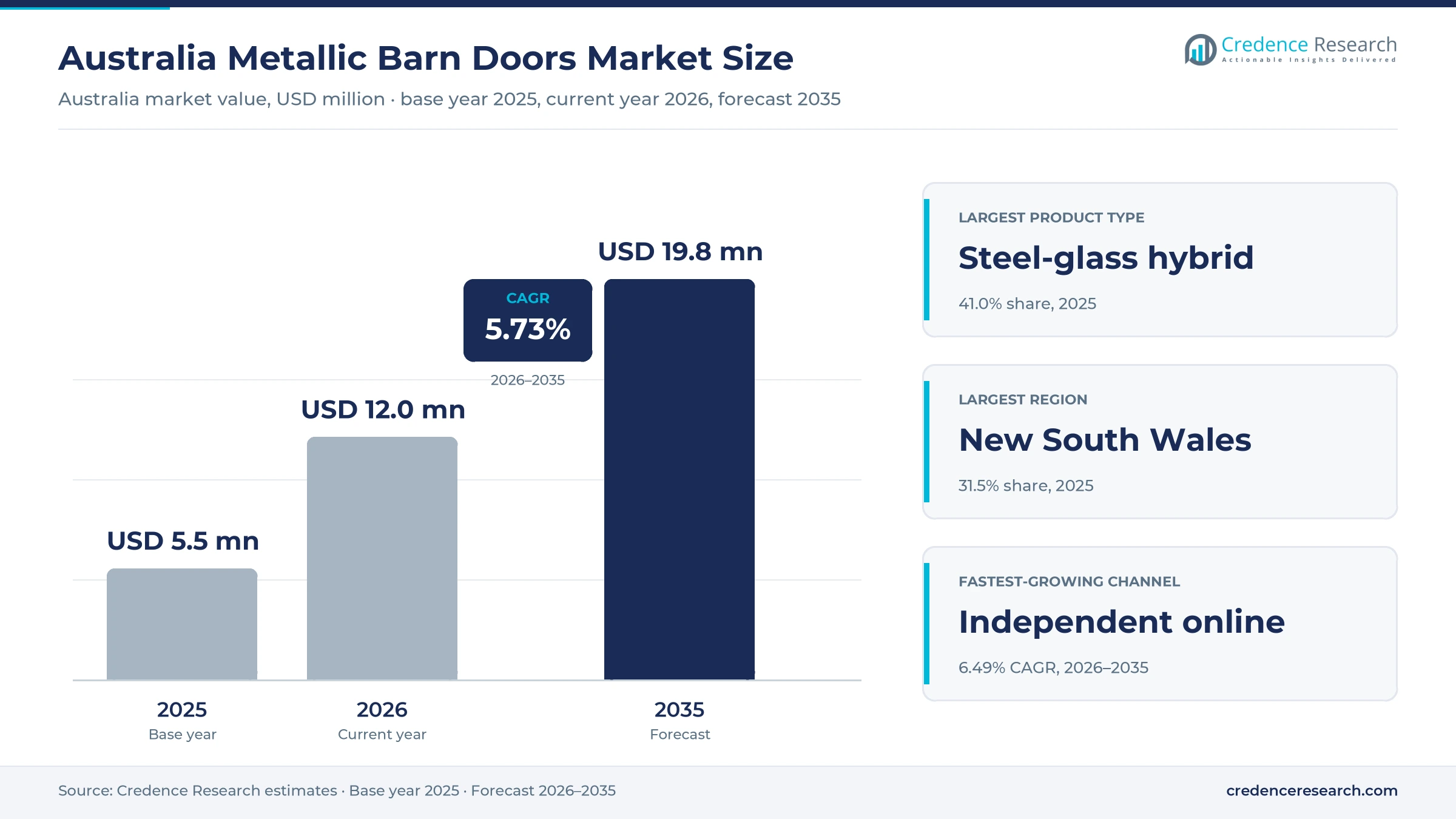
The Australia metallic barn doors market was valued at USD 5.5 million in 2025 and is projected to increase from USD 12.0 million in 2026 to USD 19.8 million by 2035, registering a CAGR of 5.73% during 2026–2035. Demand comes from homeowners who renovate living areas, bedrooms and ensuites, from builders who fit glazed interior panels in new homes, and from hotels, offices and shops that use sliding steel screens to divide space. New South Wales held the largest regional share, 31.5% in 2025, because Sydney has the largest housing stock and the highest renovation spending. Western Australia is the fastest-growing region at 6.09% a year, as the state recorded the fastest population growth in the country. In turn, the expanded Home Guarantee Scheme that began on Oct. 1, 2025, is bringing more first-home buyers into the market, and many of them update interiors soon after they move in.
Which sliding steel and aluminum panels does the estimate cover?
The estimate measures the value of top-hung sliding panels with steel, aluminum or iron frames that are sold and installed inside homes and commercial buildings in Australia. It covers steel frames with clear or reeded glass, solid steel panels, aluminum framed panels and decorative iron designs, together with the tracks, rollers and handles sold as part of a complete kit.
The estimate excludes timber and PVC panels, external garage and security doors, and hardware sold on its own without a panel. The value chain runs from steel, aluminum and glass suppliers through local fabricators and hardware brands to specialist retailers, hardware chains, online sellers, builders, installers and the households and businesses that buy the finished product in every state and territory.
Australia Metallic Barn Doors Market Insights
- The Australia metallic barn doors market was valued at USD 5.5 million in 2025 and is projected to reach USD 19.8 million by 2035, registering a CAGR of 5.73% during 2026–2035.
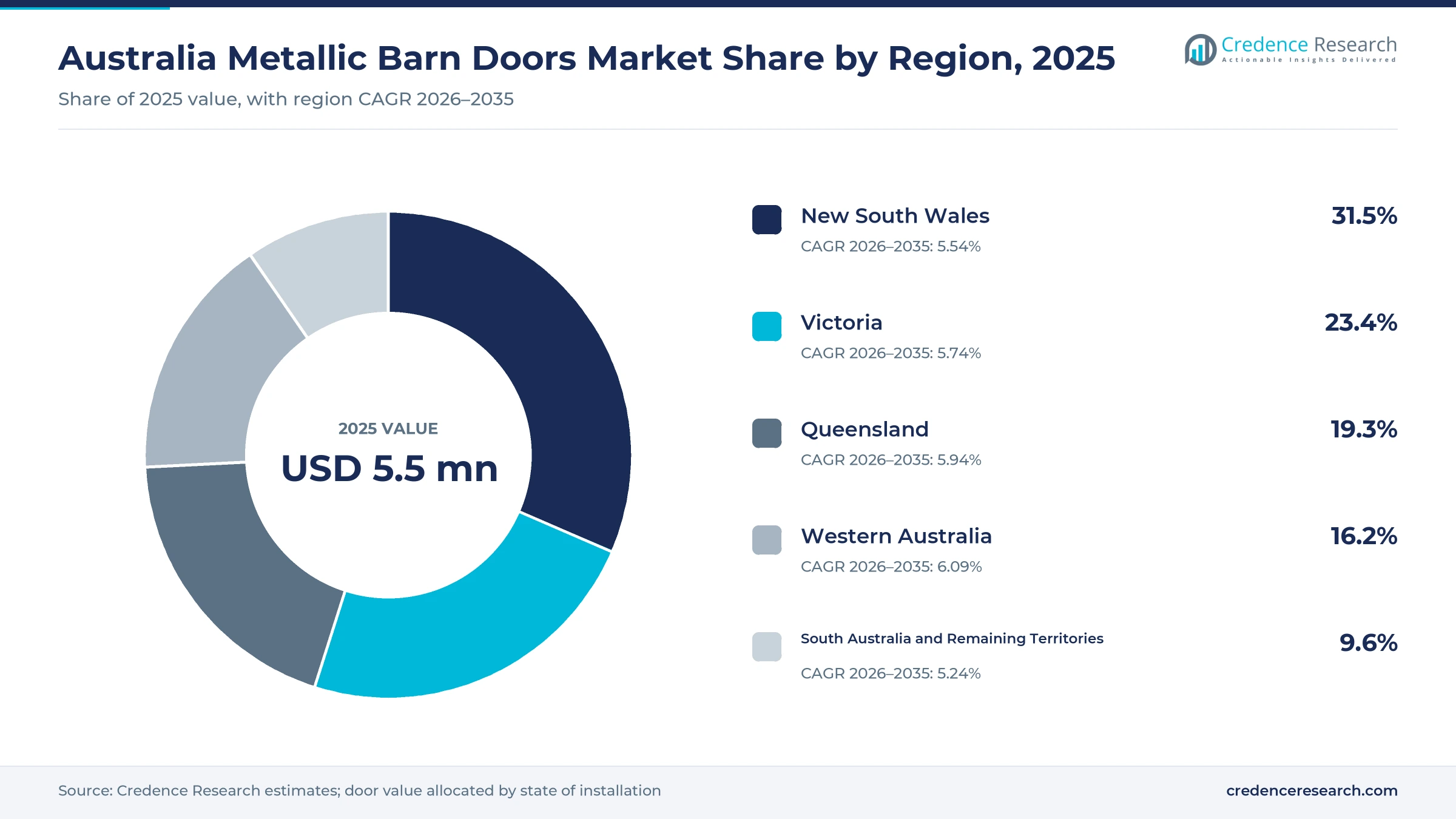
- New South Wales held a 31.5% share of 2025 value, because Sydney has the largest housing stock and the highest renovation spending.
- Steel-glass hybrid doors led with a 41.0% share of 2025 value, because buyers want sliding panels that divide rooms but still pass light.
- Residential alterations and additions reached $4,119.0 million in the June 2026 quarter, up 12.6% from a year earlier, which supports retrofit demand.
- The National Housing Accord targets 1.2 million new homes over five years from July 1, 2024, which widens the new build pipeline for interior panels.
Steel-glass panels lead while online sellers grow fastest
Why do steel-glass hybrid panels lead product demand?
Based on product type, the market is categorized into steel-glass hybrid doors, opaque steel doors, aluminium doors and decorative iron doors. Steel-Glass Hybrid Doors led with a 41.0% share of 2025 value, because buyers want panels that divide rooms but still pass daylight. Steel-Glass Hybrid Doors also grow fastest at 6.15% a year, as architects specify slim black steel frames with clear or reeded glass.
How do room separation and ensuite access split demand?
Based on application, the market is categorized into room separation, wardrobe and storage access, bathroom and ensuite access, and service-area screening. Room Separation led with a 38.0% share of 2025 value, because open-plan homes use sliding panels to close off living areas and studies. Bathroom and Ensuite Access grows fastest at 6.19% a year, as ensuite renovations favor panels that need no swing clearance.
Why do households dominate end-user demand?
Based on end user, the market is categorized into residential households, hospitality operators, office occupiers and retail operators. Residential Households led with a 72.0% share of 2025 value, because renovation and new home fit-outs account for most installations. Hospitality Operators grow fastest at 6.35% a year, as hotels, restaurants and bars use steel and glass screens to create flexible dining and guest spaces.
How are sales channels changing for sliding steel panels?
Based on distribution channel, the market is categorized into specialist door retailers, building-materials retailers, direct manufacturer sales and independent online sellers. Specialist Door Retailers led with 37.0% of 2025 value, because buyers want measuring, design advice and installation. Independent Online Sellers grow fastest at 6.49% a year, as complete kits ship to homes in regional areas.
| Segment Group | Leading Sub-segment | Share, 2025 | Fastest-growing Sub-segment | CAGR, 2026–2035 |
|---|---|---|---|---|
| By Product Type | Steel-Glass Hybrid Doors | 41.0% | Steel-Glass Hybrid Doors | 6.15% |
| By Application | Room Separation | 38.0% | Bathroom and Ensuite Access | 6.19% |
| By End User | Residential Households | 72.0% | Hospitality Operators | 6.35% |
| By Distribution Channel | Specialist Door Retailers | 37.0% | Independent Online Sellers | 6.49% |
Request a Free Sample
Fill in your details and we'll send you a free sample report.
- Sample data tables & charts
- Research methodology
Renovation spending and glazed interiors lift demand
How does the residential retrofit opportunity lift demand?
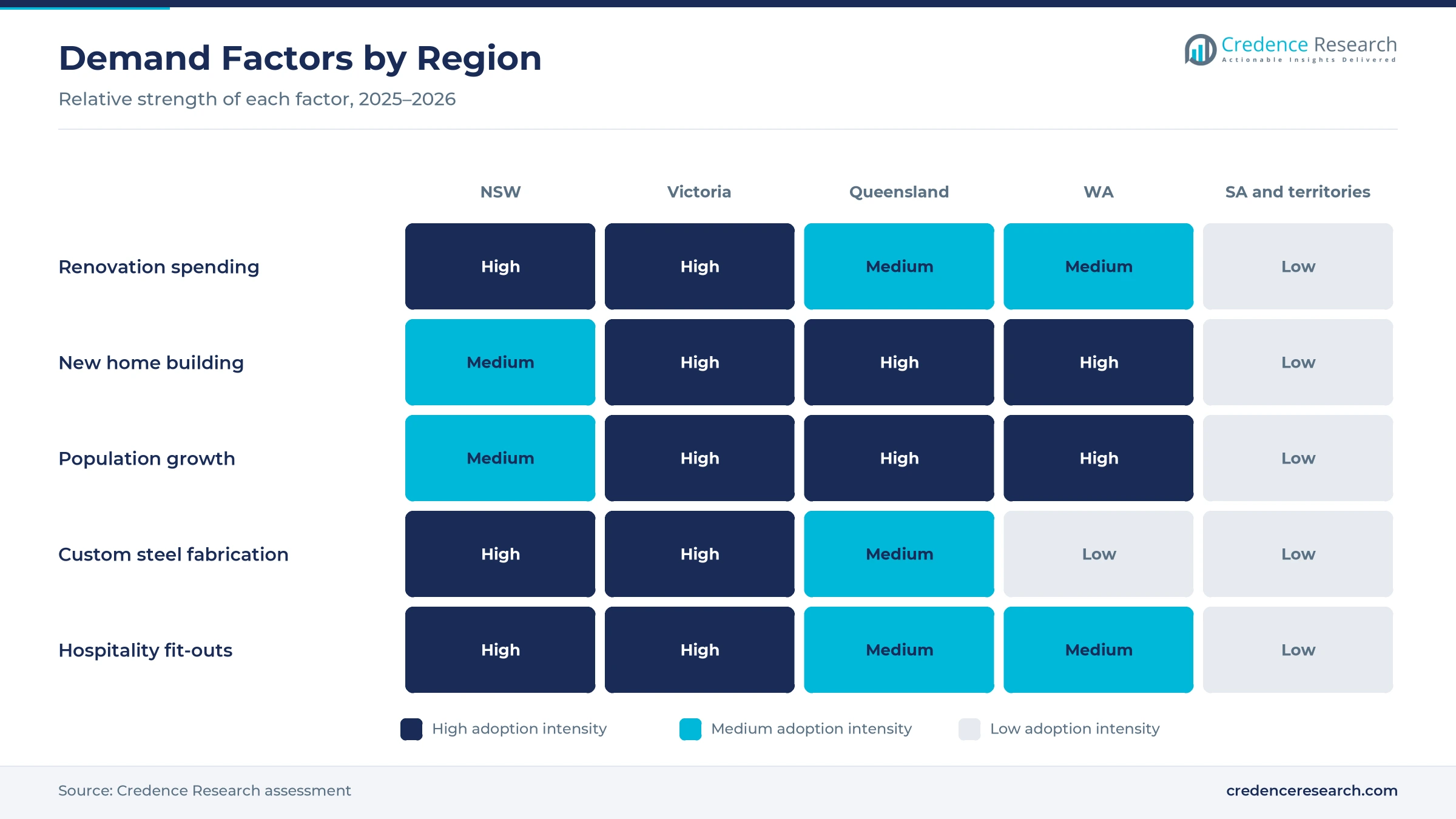
The residential retrofit opportunity lifts demand, because owners who renovate often replace swinging interior panels with sliding steel designs. Residential alterations and additions reached $4,119.0 million in the June 2026 quarter in chain volume terms, according to the Australian Bureau of Statistics. That value rose 1.3% from the March 2026 quarter and 12.6% from the June 2025 quarter, showing that renovation work is accelerating. Sliding panels also need no clearance for a swing, which frees floor space in smaller rooms and hallways. As a result, residential households keep a 72.0% share of 2025 value, as owners fund home improvement projects across living areas, bedrooms and ensuites.
Why does glazed interior specification raise value per opening?
Glazed interior specification raises value per opening, because steel frames with safety glass cost more than solid timber or PVC panels. Zen Doors & Windows, listed in Alexandria, Sydney, offers internal frames made from cold-formed galvanized steel with 6mm clear or 5mm reeded toughened glass. Its doors are tested to AS2047-2014 and carry a 5-year warranty. Olax Doors and Windows in Melbourne, profiled by Australian Design Review on Aug. 14, 2024, supplies custom steel and glass doors in sliding, pivot and bifold formats. Steel Window Design also makes steel frames in its Melbourne factory with a 30mm profile. In turn, steel-glass hybrid doors hold a 41.0% share of 2025 value, the largest product share.
How does broader distribution reach widen the buyer base?
Broader distribution reach widens the buyer base, because hardware chains and online sellers now stock complete sliding kits for owners who install their own panels. Bunnings advises that sliding panels should weigh less than 80kg and lists products from $119 to $495 in its guide. The chain also sells a Rolltrak stainless steel 304 top-mount track set that is 2000mm long and rated for 100kg wooden panels at $249. These ranges put matching track and handle hardware within reach of more owners. As a result, independent online sellers grow at 6.49% a year, the fastest channel rate, as buyers in regional areas order complete kits online.
Why does the national housing pipeline support new installations?
The national housing pipeline supports new installations, because builders fit interior panels in every new house and apartment. The National Housing Accord targets 1.2 million new well-located homes over five years from July 1, 2024, and the government will invest $3.5 billion in payments to states, territories and local councils. Dwelling commencements rose 14.4% from a year earlier to 52,201 in the June 2026 quarter, while completions rose 15.9% to 47,168. In turn, residential building activity adds new openings for steel and glass panels, especially in compact apartments and townhouses where floor space is tight.
Infill housing and first-home buying reshape demand
How is the shift to denser infill housing changing demand?
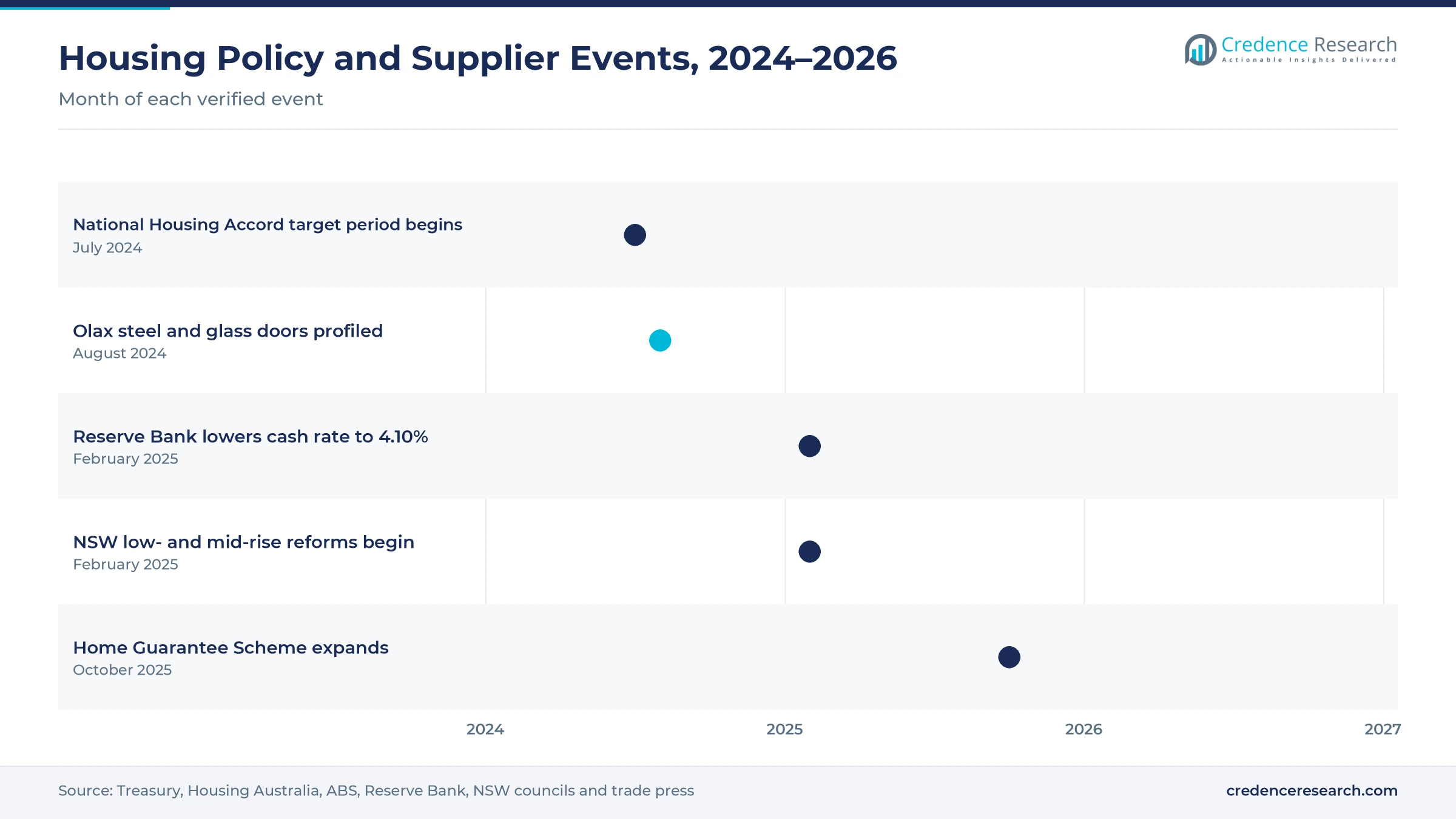
The shift to denser infill housing is changing demand, because townhouses, terraces and low-rise apartments use compact floor plans that favor sliding panels. New South Wales low- and mid-rise housing reforms began on Feb. 28, 2025, allowing dual occupancies, terraces, townhouses and manor houses within 800 meters of shops, services and transport hubs. The reforms also allow apartment buildings of up to six stories in some medium density zones. Urban residents made up 87.7% of the population in 2025, up from 87.5% in 2023, according to World Bank data. As a result, room separation keeps a 38.0% share of 2025 value, as compact homes use sliding panels to divide living areas.
Why is the rise of first-home buying notable for interiors?
The rise of first-home buying is notable, because new owners often update interiors soon after they move in. The Home Guarantee Scheme expanded on Oct. 1, 2025, removing caps on places and income limits so eligible first-home buyers can purchase with a 5% deposit. Price caps also rose to $1,500,000 from $900,000 in Sydney and to $1,000,000 from $700,000 in Brisbane and other Queensland centers. The Reserve Bank also lowered the cash rate to 4.10% on Feb. 18, 2025, its first cut since November 2020, in a decision announced that day. In turn, steel-glass hybrid doors grow at 6.15% a year, as new owners choose modern finishes.
Can ensuite and bathroom access open a new revenue path?
Ensuite and bathroom access opens a revenue path, because sliding panels save space in small wet areas where a swinging door blocks vanities and showers. Bathroom and ensuite access grows at 6.19% a year, the fastest application rate, as owners renovate ensuites alongside bathroom fittings and tapware. Reeded 5mm toughened glass adds privacy while still passing light, which suits ensuites that have no window. The Australian Bureau of Statistics also counted 219,883 dwellings under construction in the March 2025 quarter, of which 86,341 were new houses. As a result, suppliers that offer reeded glass, soft-close rollers and moisture-resistant finishes can win more bathroom projects in new homes.
Is there room to grow hospitality and commercial fit-outs?
Hospitality and commercial fit-outs have room to grow, because hotels, restaurants and offices use steel and glass screens to create flexible rooms. Hospitality operators grow at 6.35% a year, the fastest end-user rate, as venues divide dining areas for private functions. Olax Doors and Windows targets single residential, retail and hospitality projects, and its founder brings more than 15 years of building experience. The total value of building work done reached $45,834.8 million in the June 2026 quarter, up 10.0% from a year earlier. In turn, direct manufacturer sales gain share, as fit-out contractors order custom steel screens straight from local fabricators.
Weight, installation and price pressure test suppliers
How do panel weight and wall strength limit installations?
Panel weight and wall strength limit installations, because steel and glass panels are heavier than hollow timber designs. Hardware chains advise that sliding panels should weigh less than 80kg, since heavier panels can damage frames and walls. As a result, some owners need extra framing or a stronger header before installation, which raises project cost. Suppliers respond with lighter aluminum frames, thinner glass options and heavy-duty tracks rated for larger panels.
Why do installation skills and wall space slow adoption?
Installation skills and wall space slow adoption, because top-hung panels need level tracks and a clear wall to slide across when open. Many rooms lack enough free wall space beside the opening, which rules out a single sliding panel. In turn, owners turn to bi-parting or bifold systems that cost more and need careful fitting. Retailers respond with measuring services, installation guides and trained installers in the main capital cities.
How does price pressure from basic kits squeeze margins?
Price pressure from basic kits squeezes margins, because online sellers offer steel track kits and ready-made panels at low prices. Buyers compare these kits with custom steel and glass panels that cost far more and take weeks to make. As a result, local fabricators must justify higher prices through design, compliance and service. Many respond with standard sizes, faster lead times and warranty terms that set their products apart from imports.
Why do compliance rules and building costs weigh on projects?
Compliance rules and building costs weigh on projects, because glazed panels must use safety glass and meet Australian standards for frames and glazing. Testing and certification add time and cost before a new design reaches buyers. In turn, small fabricators find it harder to launch new ranges quickly. Higher building costs and interest rates also delay some renovation projects, while suppliers respond with certified standard designs and staged payment options.
Sydney renovation leads as perth growth outpaces states
| Region | Value, 2025 (USD million) | Share, 2025 | CAGR, 2026–2035 |
|---|---|---|---|
| New South Wales | 1.7 | 31.5% | 5.54% |
| Victoria | 1.3 | 23.4% | 5.74% |
| Queensland | 1.1 | 19.3% | 5.94% |
| Western Australia | 0.9 | 16.2% | 6.09% |
| South Australia and Remaining Territories | 0.5 | 9.6% | 5.24% |
Why does Sydney renovation give New South Wales the top share?
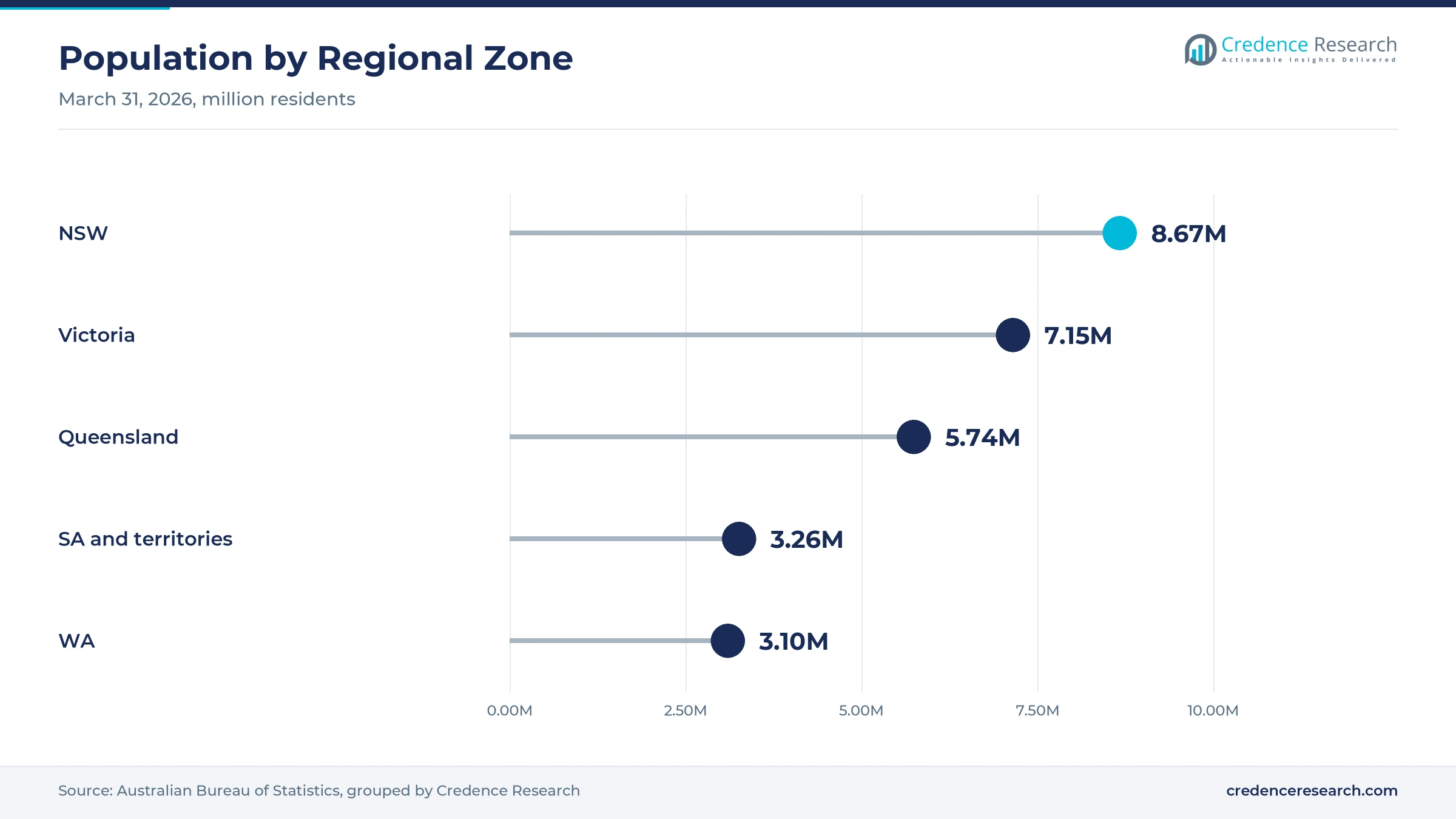
New South Wales held a 31.5% share of 2025 value and grows at 5.54% a year, because Sydney has the largest housing stock and many high-value renovation projects. The state had about 8.67 million residents at March 31, 2026, the largest population in the country. However, growth is slower than in Western Australia, because the state population rose 1.1% over the year while new infill reforms are still being rolled out.
How does Victoria support sliding steel panel demand?
Victoria held a 23.4% share of 2025 value and grows at 5.74% a year, because Melbourne is home to many custom steel fabricators and design-led renovation projects. The state had about 7.15 million residents at March 31, 2026, and its population grew 1.6% over the year. This growth adds households that buy and renovate homes, which supports demand for steel and glass sliding panels in living areas and bedrooms.
Why does Queensland add steady new-home demand?
Queensland held a 19.3% share of 2025 value and grows at 5.94% a year, because strong population growth keeps new home building active. The state added about 90,100 residents in the year to March 2026, reaching about 5.74 million people. Higher first-home price caps in Brisbane and regional centers also help more buyers enter the market, which supports interior fit-outs in new houses and townhouses.
Why is Western Australia the fastest-growing region?
Western Australia held a 16.2% share of 2025 value and grows fastest at 6.09% a year, because the state recorded the fastest population growth in the country at 2.1% in the year to March 2026. Perth builders are adding new homes to keep up with demand, and many buyers choose modern steel and glass finishes.
What drives demand in South Australia and the territories?
South Australia and the remaining territories held a 9.6% share of 2025 value and grow at 5.24% a year, because smaller populations limit project volumes. South Australia grew 1.0% and Tasmania 0.6% in the year to March 2026, while Canberra adds steady renovation work.
Housing policy and supplier milestones from 2024 to 2026
| Development | Status and market relevance |
|---|---|
| In August 2024, Australian Design Review profiled Olax Doors and Windows of Melbourne. | Highlighted custom steel and glass sliding and pivot doors |
| In February 2025, the Reserve Bank lowered the cash rate to 4.10%. | Eased borrowing costs for renovation and home buying |
| In February 2025, New South Wales low- and mid-rise housing reforms began. | Opened more sites for terraces, townhouses and low-rise apartments |
| In October 2025, the Home Guarantee Scheme expanded to all eligible first-home buyers. | Removed caps on places and income limits |
| In October 2026, the Australian Bureau of Statistics released June quarter building data. | Showed alterations and additions up 12.6% from a year earlier |
Track systems shape how sliding panels fit each room
- Single-track sliding systems carry one panel along a top-mounted rail, which suits openings with clear wall space on one side.
- Bi-parting sliding systems split the opening between two panels that move apart, which suits wide living areas and pantries.
- Bypass sliding systems run two or more panels on parallel tracks, which suits wardrobes where wall space is limited.
- Bifold sliding systems fold panels against each other as they move, which opens wide spans with little wall space needed.
Need a Custom Version of This Report?
Tailor the scope, geography, or segments to your exact requirements.
- Custom geography or segment scope
- Direct access to our analyst team
Custom steel fabricators and hardware brands split demand
Competition is split between local custom steel fabricators that make made-to-measure steel and glass panels and hardware brands that sell tracks and complete kits through retail chains. Zen Doors & Windows, listed in Alexandria, supplies galvanized steel frames with toughened glass tested to AS2047-2014. Olax Doors and Windows and Steel Window Design both make steel frames in Melbourne for architects, builders and owners. Rolltrak supplies stainless steel sliding tracks through Bunnings stores, which reaches owners who install their own panels. AUBarndoor, Rustica, Aust Doors Co, Ideal Barn Doors, Urban X Steel and Premium Sliding Doors also compete for retail and project business. Rivals compete on design range, glass options, compliance, lead times, installation support and price. Because custom panels take weeks to make, fabricators win business through showrooms and architects, while kit sellers build volume through hardware chains and online stores in every state.
Companies profiled and their roles in this market
| Company | Type | Role in the market |
|---|---|---|
| Zen Doors & Windows | Steel frame supplier | Galvanized steel internal frames with toughened glass, listed in Alexandria |
| Olax Doors and Windows | Custom steel fabricator | Melbourne maker of sliding, pivot and bifold steel and glass doors |
| Steel Window Design | Custom steel fabricator | Makes steel frames at its Melbourne factory for delivery Australia-wide |
| Rolltrak | Track hardware brand | Stainless steel top-mount track sets sold through Bunnings |
Credence Research view on Australian sliding steel panels
Credence Research's view is that Australian demand for sliding steel and glass panels will grow steadily because renovation spending and new housing both support interior fit-outs. Steel-glass hybrid designs remain the core of the market, while ensuite applications and hospitality projects add faster growth. Hardware chains and online sellers are widening access through complete kits, which brings more owners into the category. Suppliers that combine certified glass, reliable tracks and fast lead times should gain share fastest, especially in growing states.
How the Australian sliding steel panel estimate was built
The report uses 2025 as the base year on a calendar basis, and market values come from the Credence Research model. That model combines building activity statistics, population data, housing policy settings, World Bank urbanization data and supplier product information on steel, aluminum and glass sliding panels. Segment splits and regional growth rates are Credence Research estimates, while regional shares follow the client-defined split. Sources used are public reports, official statistics, trade press, retailer product pages and company websites, and no interviews or surveys were used.
Renovation and new housing carry growth to 2035
Door value is expected to reach USD 19.8 million by 2035, a 5.73% CAGR during 2026–2035, as renovation spending, new housing and glazed interior design support demand. Growth should stay firm through 2030 while the housing accord lifts new home building. After that, ensuite renovations, hospitality fit-outs and online kit sales will carry more growth. Lower interest rates would lift renovation demand, while weaker building activity would slow it. Suppliers with certified designs and strong distribution are expected to gain the most.
Frequently Asked Questions
How big is the Australia metallic barn doors market?
Which product type leads Australian sliding steel panel demand?
Which region leads the Australia metallic barn doors market?
How fast is residential renovation work growing in Australia?
How does the National Housing Accord affect demand?
Which application is growing fastest?
Who are the leading companies in Australian sliding steel panels?
What are the main challenges for suppliers?
Table of Content
Chapter 1 Market Segmentation
- 1.1 Segmentation Framework
- 1.1.1 Product and Service Classification
- 1.1.2 Application and End-Use Classification
- 1.1.3 Technology and Solution Classification
- 1.1.4 Customer and Distribution Channel Classification
- 1.1.5 Geographic Segmentation
- 1.1.6 Market Segment Definitions and Boundaries
- 1.2 By Product Type
- 1.2.1 Steel-Glass Hybrid Doors
- 1.2.2 Opaque Steel Doors
- 1.2.3 Aluminium Doors
- 1.2.4 Decorative Iron Doors
- 1.3 By Application
- 1.3.1 Room Separation
- 1.3.2 Wardrobe and Storage Access
- 1.3.3 Bathroom and Ensuite Access
- 1.3.4 Service-Area Screening
- 1.4 By End User
- 1.4.1 Residential Households
- 1.4.2 Hospitality Operators
- 1.4.3 Office Occupiers
- 1.4.4 Retail Operators
Chapter 2 Introduction
- 2.1 Report Objectives and Scope
- 2.2 Product Definition and Industry Terminology
- 2.3 Market Inclusions and Exclusions
- 2.4 Research Process
- 2.4.1 Primary Research and Expert Interviews
- 2.4.2 Secondary Research and Source Review
- 2.4.3 Top-Down and Bottom-Up Estimation
- 2.4.4 Data Triangulation and Verification
- 2.5 Market Size Measurement Basis
- 2.5.1 2025: USD 5.5 million → 2035: USD 19.8 million
- 2.6 Historical and Forecast Reference Periods
- 2.6.1 Historical Period: 2018-2025
- 2.6.2 Base Year: 2025
- 2.6.3 Forecast Period: 2025-2035
- 2.7 Research Assumptions and Limitations
Chapter 3 Executive Summary
- 3.1 Market Snapshot and Key Findings
- 3.2 Base-Year Market Size, 2025
- 3.3 Forecast Market Size, 2035
- 3.4 Revenue and Volume Growth Outlook
- 3.5 Key Demand and Supply Indicators
- 3.6 Leading Market Segments
- 3.7 Fastest-Growing Market Opportunities
- 3.8 Regional Performance Highlights
- 3.9 Technology and Industry Transformation
- 3.10 Competitive Landscape Summary
- 3.11 Analyst View and Strategic Implications
Chapter 4 Australia Metallic Barn Doors Market Trends and Developments
- 4.1 Historical Industry Development, 2018-2025
- 4.2 Recent Market Trends and Developments
- 4.3 Demand and Customer Behavior Trends
- 4.4 Technology and Product Innovation
- 4.5 Artificial Intelligence, Automation and Digitalization
- 4.6 Local Manufacturing and Supply Chain Realignment
- 4.7 Industry Partnerships, Mergers and Acquisitions
- 4.8 Sustainability and Circular Economy Developments
- 4.9 Government and Private Sector Investment Trends
- 4.10 Emerging Business Models and Commercialization
- 4.11 Industry Developments and Announcements
Chapter 5 Australia Metallic Barn Doors Market Production, Supply and Demand Analysis
- 5.1 Demand Trend and Consumption Analysis, 2018-2025
- 5.2 Demand Forecast, 2025-2035
- 5.3 Production and Output Trend, 2018-2025
- 5.4 Production and Output Forecast, 2025-2035
- 5.5 Installed Capacity and Capacity Utilization
- 5.6 Company-Wise Production Plants and Statistics
- 5.6.1 Installed Production Capacity
- 5.6.2 Actual Production
- 5.6.3 Planned Capacity and Expansion Targets
- 5.7 Supply Chain Structure and Procurement Trends
- 5.8 Supply-Demand Gap and Bottlenecks
- 5.9 Import Dependence and Sourcing Structure
- 5.10 Contract Manufacturing and Outsourcing
- 5.11 Regional Supply and Demand Concentration
Chapter 6 Australia Metallic Barn Doors Market Pricing Analysis
- 6.1 Pricing Structure and Measurement
- 6.2 Historical Pricing Trends, 2018-2025
- 6.3 Pricing Outlook, 2025-2035
- 6.4 Average Selling Price and Unit Economics
- 6.5 Pricing by Product and Market Segment
- 6.6 Geographic Pricing Differences
- 6.7 Key Input, Energy, Labor and Logistics Costs
- 6.8 Contract Pricing and Purchasing Models
- 6.9 Pricing Sensitivity and Competitive Positioning
- 6.10 Price, Margin and Profitability Implications
Chapter 7 Australia Metallic Barn Doors Market Dynamics
- 7.1 Market Growth Drivers
- 7.1.1 Demand-Side Drivers
- 7.1.2 Technology and Innovation Drivers
- 7.1.3 Infrastructure and Investment Drivers
- 7.1.4 Regulatory and Policy Drivers
- 7.2 Market Restraints
- 7.2.1 Cost and Affordability Constraints
- 7.2.2 Technology and Adoption Barriers
- 7.2.3 Supply Chain and Operational Constraints
- 7.3 Market Challenges
- 7.3.1 Competitive Pressure and Margin Erosion
- 7.3.2 Skills, Infrastructure and Implementation Gaps
- 7.4 Emerging Market Opportunities
- 7.5 Market Dynamics Impact and Time-Horizon Assessment
Chapter 8 Australia Metallic Barn Doors Value Chain Analysis
- 8.1 Industry Value Chain Overview
- 8.2 Upstream Suppliers and Critical Inputs
- 8.3 Technology and Component Providers
- 8.4 Manufacturing or Service Delivery
- 8.5 Distribution, Channel Partners and Integrators
- 8.6 Downstream Applications and End Users
- 8.7 Value Addition and Profit Pools
- 8.8 Vertical Integration and Outsourcing
- 8.9 Supplier Concentration and Risk
- 8.10 Supply Chain Localization and Resilience
Chapter 9 Australia Metallic Barn Doors Market Regulations and Policies
- 9.1 Relevant Laws, Standards and Compliance Frameworks
- 9.2 Product, Service, Safety and Quality Requirements
- 9.3 Government Policies, Incentives and Subsidies
- 9.4 Imports, Exports and Trade Barriers
- 9.5 Public Procurement and Local Content Requirements
- 9.6 Environmental and Sustainability Compliance
- 9.7 Upcoming Policy Changes and Market Implications
Chapter 10 Australia Metallic Barn Doors Market Hotspots and Opportunities
- 10.1 Market Opportunity Mapping and Growth Hotspots
- 10.2 High-Growth Applications and Customer Groups
- 10.3 Underserved Markets and White-Space Opportunities
- 10.4 Emerging Technology and Product Opportunities
- 10.5 New Capacity and Investment Hotspots
- 10.6 Market Entry and Expansion Opportunities
- 10.7 Distribution and Partnership Opportunities
- 10.8 Near-Term and Long-Term Commercial Potential
- 10.9 Opportunity Attractiveness and Execution Risks
Chapter 11 Australia Metallic Barn Doors Market Outlook, 2025-2035
- 11.1 Market Size and Analysis
- 11.1.1 Revenue (Market Measurement: 2025: USD 5.5 million → 2035: USD 19.8 million)
- 11.1.2 Market Volume and Quantity Sold
- 11.1.3 Historical Market Size, 2018-2025
- 11.1.4 Base-Year Market Size, 2025
- 11.2 Market Forecast, 2025-2035
- 11.2.1 Revenue Forecast to 2035
- 11.2.2 Volume Forecast to 2035
- 11.2.3 CAGR and Year-on-Year Growth
- 11.2.4 Incremental Revenue Opportunity
- 11.3 Forecast Assumptions and Scenario Analysis
- 11.3.1 Base-Case Forecast
- 11.3.2 Optimistic and Conservative Scenarios
- 11.3.3 Technology, Pricing and Policy Sensitivities
- 11.4 Market Attractiveness and Growth Outlook
Chapter 12 Australia Metallic Barn Doors Market Segmentation and Outlook
- 12.1 Segmentation Summary and Market Shares, 2025
- 12.2 Largest and Fastest-Growing Segments
- 12.3 By Product Type - Market Size and Forecast, 2025-2035
- 12.3.1 Segment Definition and Scope
- 12.3.2 Historical Market Size, 2018-2025
- 12.3.3 Revenue Forecast, 2025-2035
- 12.3.4 Volume Forecast, 2025-2035
- 12.3.5 Base-Year Market Share, 2025
- 12.3.6 Segment CAGR and Growth Drivers
- 12.3.7 Subsegment Market Size and Forecast
- 12.3.7.1 Steel-Glass Hybrid Doors
- 12.3.7.2 Opaque Steel Doors
- 12.3.7.3 Aluminium Doors
- 12.3.7.4 Decorative Iron Doors
- 12.3.8 Subsegment Pricing and Adoption Trends
- 12.3.9 Leading Suppliers and Competition
- 12.3.10 Regional Demand and Opportunities
- 12.4 By Application - Market Size and Forecast, 2025-2035
- 12.4.1 Segment Definition and Scope
- 12.4.2 Historical Market Size, 2018-2025
- 12.4.3 Revenue Forecast, 2025-2035
- 12.4.4 Volume Forecast, 2025-2035
- 12.4.5 Base-Year Market Share, 2025
- 12.4.6 Segment CAGR and Growth Drivers
- 12.4.7 Subsegment Market Size and Forecast
- 12.4.7.1 Room Separation
- 12.4.7.2 Wardrobe and Storage Access
- 12.4.7.3 Bathroom and Ensuite Access
- 12.4.7.4 Service-Area Screening
- 12.4.8 Subsegment Pricing and Adoption Trends
- 12.4.9 Leading Suppliers and Competition
- 12.4.10 Regional Demand and Opportunities
- 12.5 By End User - Market Size and Forecast, 2025-2035
- 12.5.1 Segment Definition and Scope
- 12.5.2 Historical Market Size, 2018-2025
- 12.5.3 Revenue Forecast, 2025-2035
- 12.5.4 Volume Forecast, 2025-2035
- 12.5.5 Base-Year Market Share, 2025
- 12.5.6 Segment CAGR and Growth Drivers
- 12.5.7 Subsegment Market Size and Forecast
- 12.5.7.1 Residential Households
- 12.5.7.2 Hospitality Operators
- 12.5.7.3 Office Occupiers
- 12.5.7.4 Retail Operators
- 12.5.8 Subsegment Pricing and Adoption Trends
- 12.5.9 Leading Suppliers and Competition
- 12.5.10 Regional Demand and Opportunities
- 12.6 Segment Growth Comparison
- 12.7 Segment Attractiveness and Priority Matrix
Chapter 13 Australia Metallic Barn Doors End-Use and Application Market Outlook
- 13.1 End-Use Industry and Customer Demand Structure
- 13.2 Leading Applications and Customer Groups
- 13.3 End-Use Market Size, Share and Forecast
- 13.4 Major End-Use Industry Deep Dives
- 13.4.1 Customer Requirements and Use Cases
- 13.4.2 Demand and Replacement Cycles
- 13.4.3 Technical and Regulatory Considerations
- 13.4.4 Purchasing and Procurement Models
- 13.4.5 Leading Vendors and Distribution Channels
- 13.4.6 Forecast and Commercial Opportunities
- 13.5 Emerging Applications and Cross-Segment Demand
- 13.6 End-Use Industry Investment Priorities
Chapter 14 Australia Metallic Barn Doors Geographic Market Outlook, 2025-2035
- 14.1 Domestic Market Distribution and Demand Clusters
- 14.2 State- or Province-Wise Market Size and Forecast, 2025-2035
- 14.3 City and Metropolitan Market Outlook
- 14.4 Industrial, Manufacturing and Commercial Clusters
- 14.5 Geographic Concentration of Key End Users
- 14.6 Local Pricing and Purchasing Differences
- 14.7 Domestic Production Facilities and Capacity Map
- 14.8 Local Infrastructure and Project Pipeline
- 14.9 State-Level Policy and Incentive Differences
- 14.10 Subnational Investment Hotspots and Opportunities
- 14.11 Distribution and Logistics Networks
- 14.12 Domestic Competitive Footprint
Chapter 15 Australia Metallic Barn Doors Technology, Innovation and Sustainability Outlook
- 15.1 Technology Landscape and Maturity
- 15.2 Product, Process and Service Innovation
- 15.3 AI, Automation and Digital Tools in the Industry
- 15.4 Technology Adoption and Performance Benchmarking
- 15.5 Innovation Pipeline and R&D Investment
- 15.6 Patent and Intellectual Property Trends
- 15.7 Energy Efficiency and Resource Management
- 15.8 Sustainability, Recycling and Circularity
- 15.9 Technology Roadmap, 2025-2035
- 15.10 Risks of Obsolescence and Technology Substitution
Chapter 16 Australia Metallic Barn Doors Market Key Strategic Imperatives
- 16.1 Growth and Market Entry Priorities
- 16.2 High-Return Products and Segments
- 16.3 Pricing, Profitability and Cost Optimization
- 16.4 Technology Investment and Product Differentiation
- 16.5 Supply Chain Localization and Resilience
- 16.6 Distribution and Customer Acquisition
- 16.7 Partnership, Acquisition and Capacity Strategy
- 16.8 Regional Expansion Priorities
- 16.9 Short-, Medium- and Long-Term Actions
Chapter 17 Competition Outlook
- 17.1 Industry Competition Characteristics
- 17.2 Market Structure and Concentration
- 17.3 Market Share and Competitive Positioning, 2025
- 17.4 Company-Wise Revenue and Product Benchmarking
- 17.5 Production and Service Capacity Benchmarking
- 17.6 Technology, Pricing and Differentiation
- 17.7 Regional Footprint and Distribution Strength
- 17.8 Mergers, Acquisitions and Strategic Alliances
- 17.9 New Entrants and Competitive Threats
- 17.10 Porter's Five Forces and Industry Attractiveness
- 17.11 Competitive Outlook, 2025-2035
Chapter 18 Company Profiles
- 18.1 Company Coverage and Selection Criteria
- 18.2 AUBarndoor
- 18.2.1 Business Description
- 18.2.2 Company Ownership and Geographic Presence
- 18.2.3 Product and Service Portfolio
- 18.2.4 Manufacturing and Operating Footprint
- 18.2.5 Production Capacity and Expansion Plans
- 18.2.6 Financial Performance and Investment
- 18.2.7 Market Share and Competitive Position
- 18.2.8 Technology and Innovation Capabilities
- 18.2.9 Strategic Alliances or Partnerships
- 18.2.10 Recent Developments
- 18.2.11 Growth Strategy and Outlook
- 18.3 Rustica
- 18.4 Rolltrak
- 18.5 Steel Window Design
- 18.6 Zen Doors & Windows
- 18.7 Aust Doors Co
- 18.8 Ideal Barn Doors
- 18.9 Olax Doors
- 18.10 Urban X Steel
- 18.11 Premium Sliding Doors
- 18.12 Other Relevant Market Participants
Note: Every listed company is profiled on the structure shown under the first company. The company list is preliminary and may change based on research findings, market developments, data availability and client requirements.
Chapter 19 Disclaimer
- 19.1 Research and Forecast Disclaimer
- 19.2 Data Source and Estimation Limitations
Note: The depth of individual sections depends on data availability for this market. Volume, capacity, trade and other unit-based metrics are included where applicable.

