
Flexible Office Market Overview:
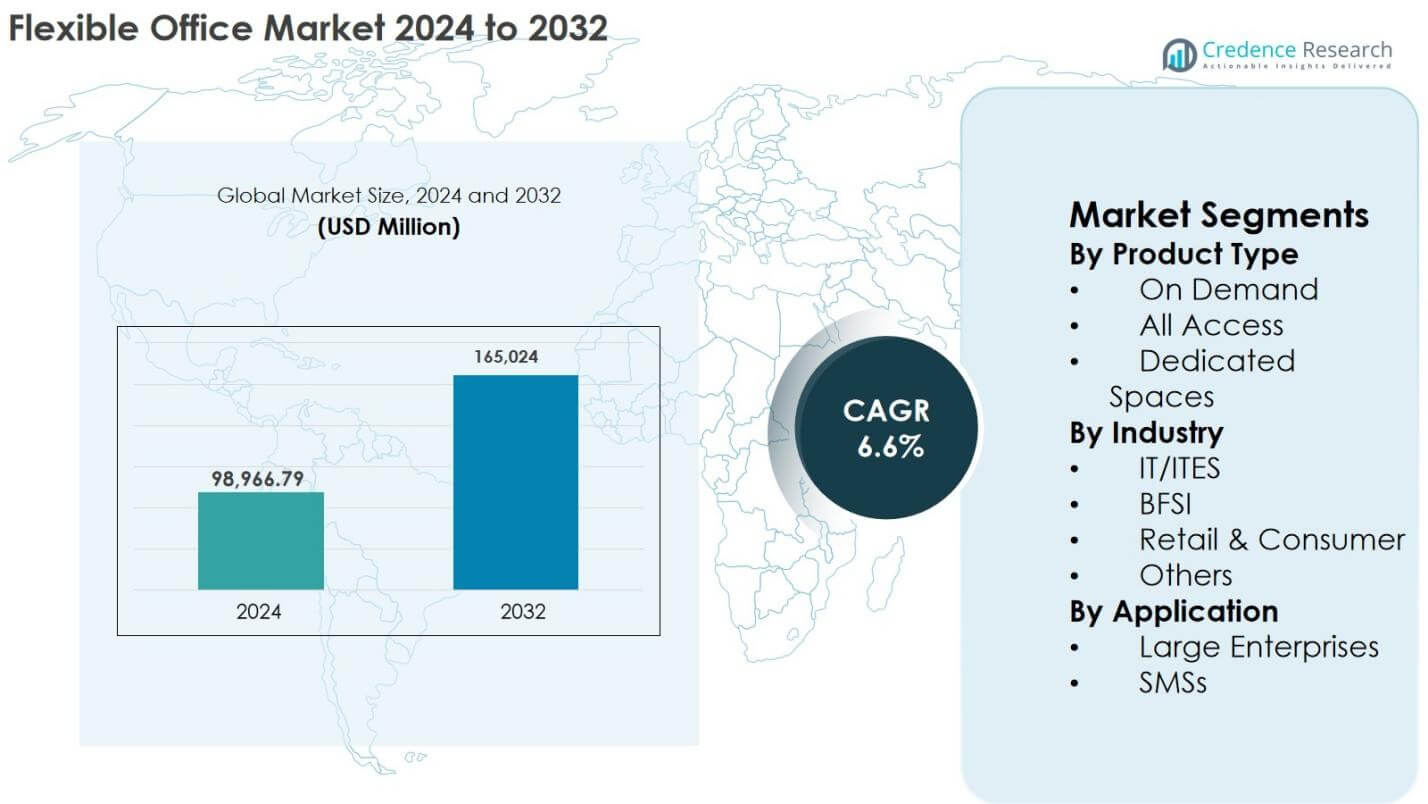
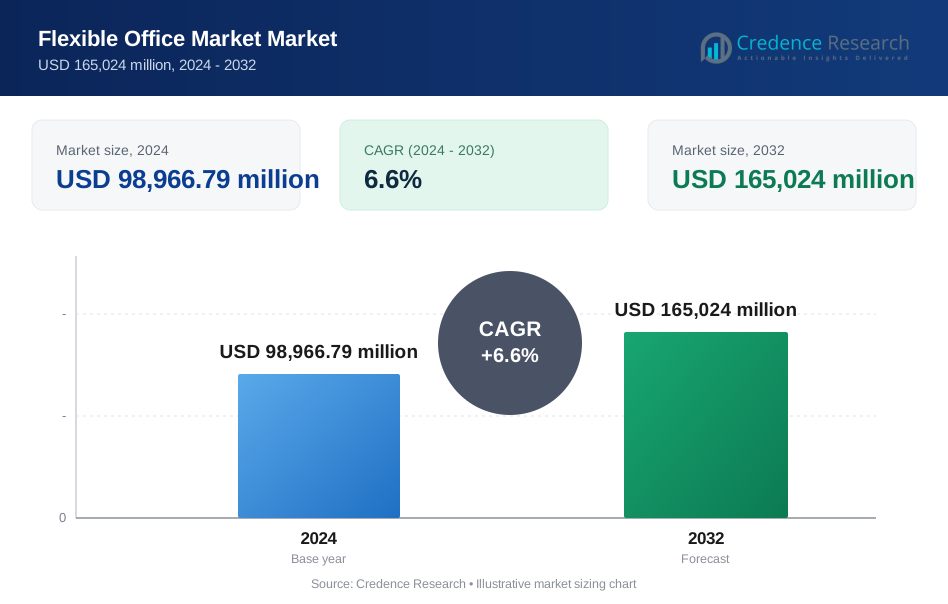
Flexible Office market size was valued at USD 98,966.79 million in 2024 and is anticipated to reach USD 165,024 million by 2032, growing at a CAGR of 6.6% during the forecast period.
| REPORT ATTRIBUTE | DETAILS |
|---|---|
| Historical Period | 2020-2023 |
| Base Year | 2024 |
| Forecast Period | 2025-2032 |
| Flexible Office Market Size 2024 | USD 98,966.79 million |
| Flexible Office Market, CAGR | 6.6% |
| Flexible Office Market Size 2032 | USD 165,024 million |
Flexible Office Market Insights
- Market growth is driven by rapid adoption of hybrid work models, corporate real estate cost optimization, and rising demand from large enterprises and SMEs seeking scalable, asset-light workspace solutions.
- Key trends include rising demand for enterprise-grade managed offices, customized layouts, and expansion into Tier-II cities, while global and regional operators intensify competition through network expansion and service differentiation.
- Market restraints include pricing pressure from high operator density, occupancy volatility due to short-term contracts, and sensitivity to economic slowdowns affecting enterprise space utilization.
- Regionally, North America leads with 38.6% share, followed by Europe at 29.4% and Asia Pacific at 24.1%, while by segment, All Access product type holds 44.8% share, IT/ITES industry accounts for 46.2%, and large enterprises dominate applications with 58.6% share.
Flexible Office Market Segmentation Analysis:
By Product Type:
The Flexible Office market, by product type, is led by All Access, which accounted for around 44.8% market share in 2024, driven by enterprise demand for network-based workspace access across multiple cities. All-access models offer scalability, cost predictability, and mobility benefits, making them attractive for hybrid and distributed workforces. On-demand spaces are gaining traction among freelancers and startups due to short-term flexibility, while dedicated spaces continue to see steady adoption from enterprises seeking branding, data security, and operational control. Rising workforce mobility and the corporate shift toward asset-light real estate strategies remain the primary growth drivers.
- For instance, IWG’s HQ and Regus brands allow users to book meeting rooms or day offices by the hour or day via their app, enabling small teams to access professional space only when needed.
By Industry:
By industry, IT/ITES dominated the Flexible Office market with 46.2% share in 2024, supported by strong adoption from technology firms embracing hybrid work and rapid team scaling. IT/ITES companies prefer flexible offices to optimize costs, access skilled talent across regions, and reduce long-term lease liabilities. BFSI follows, driven by fintech expansion and project-based teams, while retail & consumer segments adopt flexible offices for regional hubs and sales teams. Increased digitalization, workforce decentralization, and the need for agile expansion models continue to drive cross-industry demand.
- For instance, Microsoft expanded its use of flexible workspaces through providers like WeWork to support distributed engineering and sales teams in multiple cities, allowing staff to work closer to clients and home locations.
By Application:
In terms of application, large enterprises held the dominant position with about 58.6% market share in 2024, fueled by multinational corporations restructuring real estate portfolios toward flexible, hub-and-spoke models. Large enterprises leverage flexible offices to support hybrid work, mergers, and temporary project teams without capital-intensive commitments. SMEs are witnessing faster growth due to affordability, plug-and-play infrastructure, and reduced administrative burden. Key drivers include cost optimization, faster market entry, and the growing preference for flexible occupancy models aligned with uncertain business environments.
Key Growth Drivers
Expansion of Hybrid and Distributed Work Models
The widespread adoption of hybrid and distributed work models is a major growth driver for the Flexible Office market. Organizations are redesigning workplace strategies to combine remote work with collaborative physical environments, increasing reliance on flexible office solutions. Enterprises favor flexible offices to support rotating teams, regional hubs, and project-based operations without committing to long-term leases. These spaces help maintain productivity, collaboration, and employee engagement while aligning with evolving workforce expectations. As companies adopt hub-and-spoke and decentralized models, flexible offices provide the agility required to adapt quickly to changing operational and workforce needs.
- For instance, Deloitte has used coworking and flexible office locations in several markets to host project teams near client sites, enabling agile deployment without expanding permanent real estate footprints.
Corporate Real Estate Cost Optimization
Rising commercial rents and underutilized traditional office spaces are pushing companies to optimize real estate costs, driving growth in the Flexible Office market. Flexible offices convert fixed real estate expenses into variable operating costs, enabling businesses to scale space usage based on demand. This model reduces capital expenditure, minimizes long-term liabilities, and improves balance-sheet efficiency. Large enterprises benefit from portfolio rationalization, while SMEs gain access to premium infrastructure without upfront investments. In an uncertain economic environment, the ability to control costs while maintaining workspace quality remains a strong adoption driver.
- For instance, Salesforce disclosed in 2022 that it would reduce its office footprint and sublease or exit certain locations as part of a shift toward more flexible, hybrid workspace use to control costs.
Growth of SMEs, Startups, and Project-Based Teams
The increasing number of SMEs, startups, and project-based teams significantly supports Flexible Office market growth. These organizations prioritize speed, flexibility, and minimal setup time, which flexible offices readily provide. Plug-and-play infrastructure, bundled services, and short-term contracts enable rapid business launch and expansion. Consulting firms, digital agencies, and innovation teams also rely on flexible spaces for temporary assignments and client-facing operations. As SMEs and startups scale across multiple locations, flexible offices are increasingly viewed as long-term strategic assets rather than transitional solutions.
Key Trends & Opportunities
Enterprise-Grade Customization and Managed Office Solutions
A key trend in the Flexible Office market is the shift toward enterprise-grade, customized, and fully managed office solutions. Large organizations increasingly demand branded spaces, customized layouts, enhanced cybersecurity, and compliance-ready infrastructure. Flexible office providers offering end-to-end management, IT integration, and tailored services are securing long-term enterprise contracts. This trend enables premium pricing, higher retention, and stronger client relationships. As flexible offices evolve into substitutes for conventional corporate offices, customization and service differentiation present significant growth opportunities.
- For instance, WeWork’s “Headquarters by WeWork” and “WeWork Workplace” offerings have focused on tailored, private offices and integrated workplace management tools for enterprises, positioning flexible sites as extensions of corporate campuses.
Expansion into Tier-II Cities and Secondary Business Hubs
Expansion into Tier-II cities and emerging business hubs represents a strong opportunity for the Flexible Office market. Workforce decentralization, remote hiring, and lower operational costs are encouraging companies to establish offices beyond major metropolitan areas. Flexible office providers are addressing this demand by launching scalable workspaces in secondary cities, supporting regional growth strategies. This trend improves talent access, reduces employee commute times, and enhances retention, positioning flexible offices as enablers of distributed business models.
- For instance, Awfis in India has rolled out centers in cities such as Bhubaneswar, Kochi, and Indore, explicitly targeting demand from enterprises and SMEs building satellite offices closer to emerging talent pools.
Key Challenges
Intense Competition and Pricing Pressure
The Flexible Office market faces intense competition from global, regional, and local operators, leading to pricing pressure and margin compression. Providers compete aggressively on location, amenities, and pricing, increasing customer acquisition costs and tenant churn. Smaller players struggle to achieve scale and operational efficiency, while larger operators face challenges in balancing rapid expansion with profitability. Sustaining differentiation through enterprise-focused offerings, service quality, and operational excellence is critical to addressing this challenge.
Occupancy Volatility and Economic Sensitivity
Occupancy volatility linked to economic conditions remains a key challenge in the Flexible Office market. Demand is highly sensitive to business confidence, employment trends, and corporate spending cycles. Economic slowdowns can result in reduced utilization, downsizing, or contract cancellations due to short-term lease structures. While flexibility attracts customers, it also exposes operators to revenue fluctuations. Managing utilization rates, ensuring cash-flow stability, and balancing short-term demand with long-term commitments are ongoing operational challenges.
Regional Analysis
North America
North America dominated the Flexible Office market with 38.6% market share in 2024, driven by early adoption of hybrid work models and strong presence of multinational enterprises. The United States leads regional demand due to high concentration of technology firms, consulting companies, and financial institutions adopting hub-and-spoke workplace strategies. Flexible offices are widely used to optimize real estate portfolios, support distributed teams, and reduce long-term leasing risks. High workforce mobility, advanced digital infrastructure, and mature coworking ecosystems further support market expansion across major metropolitan and secondary business hubs.
Europe
Europe accounted for 29.4% market share in 2024, supported by strong adoption across the UK, Germany, France, and the Netherlands. Organizations in the region increasingly prefer flexible offices to comply with evolving labor practices, sustainability goals, and cost-efficiency mandates. Hybrid work policies across professional services, IT, and BFSI sectors are accelerating demand. The presence of global flexible office operators and rising interest from large enterprises for managed office solutions strengthen market growth. Additionally, regulatory support for flexible employment models supports long-term adoption across Western and Northern Europe.
Asia Pacific
Asia Pacific held 24.1% market share in 2024 and represents the fastest-growing region in the Flexible Office market. Rapid urbanization, startup expansion, and growing SME activity across China, India, Southeast Asia, and Australia are key demand drivers. Enterprises are increasingly adopting flexible offices to access regional talent, support expansion into Tier-II cities, and manage cost pressures. The region benefits from rising digitalization, expanding service sectors, and favorable demographics. As multinational corporations decentralize operations, Asia Pacific continues to attract significant investment in flexible workspace infrastructure.
Latin America
Latin America captured about 4.6% market share in 2024, with Brazil and Mexico serving as primary growth markets. Flexible offices are gaining traction among startups, technology firms, and professional service providers seeking affordable and scalable workspace solutions. Economic volatility and high traditional office leasing costs encourage businesses to adopt flexible occupancy models. Growth is supported by increasing entrepreneurship, foreign investment, and expansion of global flexible office providers. Although the market remains comparatively smaller, improving business confidence and urban development are expected to drive steady regional growth.
Middle East & Africa
The Middle East & Africa region accounted for 3.3% market share in 2024, led by the UAE, Saudi Arabia, and South Africa. Demand is driven by diversification initiatives, growth of professional services, and rising SME activity in major business hubs. Flexible offices support multinational entry, project-based work, and startup ecosystems, particularly in smart city developments. Government-led economic reforms and investments in commercial infrastructure are strengthening regional adoption. While still emerging, increasing workforce flexibility and regional business expansion are expected to support gradual market growth.
Flexible Office Market Segmentations:
By Product Type
- On Demand
- All Access
- Dedicated Spaces
By Industry
- IT/ITES
- BFSI
- Retail & Consumer
- Others
By Application
- Large Enterprises
- SMSs
By Geography
- North America
- U.S.
- Canada
- Mexico
- Europe
- Germany
- France
- U.K.
- Italy
- Spain
- Rest of Europe
- Asia Pacific
- China
- Japan
- India
- South Korea
- South-east Asia
- Rest of Asia Pacific
- Latin America
- Brazil
- Argentina
- Rest of Latin America
- Middle East & Africa
- GCC Countries
- South Africa
- Rest of the Middle East and Africa
Competitive Landscape
The Flexible Office market is characterized by a mix of global operators, real estate service providers, and regional specialists competing on scale, location coverage, service quality, and enterprise-focused offerings. Major players such as IWG and WeWork Companies LLC leverage extensive global networks and brand recognition to serve multinational enterprises and large teams. Premium operators like Industrious and Servcorp focus on high-end managed solutions for corporates. Real estate-led platforms including Flex by JLL and Newmark integrate flexible offices into broader corporate real estate strategies. Technology-driven marketplaces such as LiquidSpace and regional specialists like BHIVE Workspace and Hubble intensify competition. Differentiation increasingly depends on customization, enterprise contracts, and geographic expansion.
Key Player Analysis
- LiquidSpace
- Servcorp
- Newmark
- BHIVE Workspace
- IWG
- Hubble
- WeWork Companies LLC
- Flex by JLL
- Desana
- Industrious
Recent Developments
- In May 2025 Industrious partnered with Brightline to launch on-the-go workspaces in train stations, blending travel and flexible work environments to meet the needs of hybrid professionals and remote workers.
- In January 2025 Yardi acquired flexible workspace platforms Deskpass (US) and Hubble (UK) to enhance its flexible office booking and listing offerings for hybrid workplace users globally.
Report Coverage
The research report offers an in-depth analysis based on Product Type, Industry, Application, and Geography. It details leading market players, providing an overview of their business, product offerings, investments, revenue streams, and key applications. Additionally, the report includes insights into the competitive environment, SWOT analysis, current market trends, as well as the primary drivers and constraints. Furthermore, it discusses various factors that have driven market expansion in recent years. The report also explores market dynamics, regulatory scenarios, and technological advancements that are shaping the industry. It assesses the impact of external factors and global economic changes on market growth. Lastly, it provides strategic recommendations for new entrants and established companies to navigate the complexities of the market.
Future Outlook
- Flexible Office market adoption will accelerate as hybrid and distributed work models become permanent across enterprises.
- Large enterprises will increasingly shift from long-term leases to flexible, managed workspace portfolios.
- Demand for enterprise-grade customization, branding, and IT-integrated office solutions will continue to rise.
- Expansion into Tier-II cities and secondary business hubs will support broader geographic market penetration.
- SMEs and startups will remain key growth contributors due to scalability and lower entry barriers.
- Technology-enabled space booking, analytics, and utilization optimization will gain importance among operators.
- Operators will focus on long-term enterprise contracts to stabilize occupancy and recurring revenue.
- Consolidation through partnerships and acquisitions will increase as competition intensifies.
- Sustainability-focused workspace designs will become a key differentiator for flexible office providers.
- Market growth will remain resilient but sensitive to macroeconomic conditions and corporate spending cycles.
Request a Free Sample
Fill in your details and we'll send you a free sample report.
- Sample data tables & charts
- Research methodology
Need a Custom Version of This Report?
Tailor the scope, geography, or segments to your exact requirements.
- Custom geography or segment scope
- Direct access to our analyst team
Frequently Asked Questions
What is the current market size for the Flexible Office market, and what is its projected size in 2032?
At what Compound Annual Growth Rate is the Flexible Office market projected to grow between 2024 and 2032?
Which Flexible Office market segment held the largest share in 2024?
What are the primary factors fueling the growth of the Flexible Office market?
Who are the leading companies in the Flexible Office market?
Which region commanded the largest share of the Flexible Office market in 2024?
Table of Content
Chapter 1. Report Introduction
- 1.1 Report Description & Purpose
- 1.1.1 Report Title & Market Definition
- 1.1.2 Unique Selling Propositions (USP) & Key Differentiators
- 1.1.3 Value Proposition for Stakeholders
- 1.2 Research Objectives
- 1.2.1 Market Sizing Objectives (Volume & Revenue)
- 1.2.2 Segmentation Objectives
- 1.2.3 Competitive Intelligence Objectives
- 1.2.4 Forecast & Scenario Objectives
- 1.3 Report Scope
- 1.3.1 Flexible Office Market Scope – Types & Subtypes Covered
- 1.3.2 Geographic Scope – Regions & Countries Covered
- 1.3.3 Historical Period, Base Year & Forecast Period (2024; forecast to 2032)
- 1.3.4 Inclusions & Exclusions
- 1.4 HS Code & Classification Framework
- 1.5 Currency, Units & Pricing Basis
- 1.6 Target Stakeholders
- 1.7 Limitations & Assumptions
Chapter 2. Executive Summary
- 2.1 Global Flexible Office Market Market Snapshot
- 2.1.1 Market Size – Historical (2024) & Forecast (2024-2032) (2024: USD 98,966.79 million → 2032: USD 165,024 million)
- 2.1.2 Volume & Revenue – Global Totals
- 2.1.3 Key Market Highlights – Top Five Facts
- 2.2 Flexible Office Market Market Segmentation Snapshot
- 2.2.1 Market Split by Region – 2024 vs. 2032
- 2.3 Competitive Snapshot
- 2.3.1 Top 10 Players by Revenue Share – 2024
- 2.3.2 Top 10 Players by Volume Share – 2024
- 2.3.3 Recent Strategic Developments (18-Month Summary)
- 2.4 Key Investment Highlights & Strategic Conclusions
Chapter 3. Flexible Office Market Market Dynamics & Industry Analysis
- 3.1 Market Overview & Context
- 3.1.1 Flexible Office Market Market Position in the Broader Automotive Value Chain
- 3.1.2 OEM vs. Replacement Market Dynamics
- 3.1.3 Market Maturity & Development Stage by Region
- 3.2 Flexible Office Market Market Drivers
- 3.3 Flexible Office Market Market Restraints & Challenges
- 3.4 Flexible Office Market Market Opportunities
- 3.5 Porter's Five Forces Analysis
- 3.5.1 Threat of New Entrants
- 3.5.2 Bargaining Power of Suppliers
- 3.5.3 Bargaining Power of Buyers
- 3.5.4 Threat of Substitutes
- 3.5.5 Competitive Rivalry – Intensity Assessment
- 3.6 Flexible Office Market Value Chain Analysis
- 3.6.1 Upstream – Raw Material/Input Suppliers
- 3.6.1.1 Raw Material/Input 1
- 3.6.1.2 Raw Material/Input 2
- 3.6.1.3 Raw Material/Input 3
- 3.6.2 Midstream – Production/Manufacturing/Service Delivery
- 3.6.2.1 Production/Process Overview
- 3.6.2.2 Key Facility Locations & Capacity by Manufacturer
- 3.6.3 Downstream – Distribution & End Consumer
- 3.6.3.1 Primary Channel – B2B/OEM
- 3.6.3.2 Secondary Channels – Dealer, Retail, Online, Direct
- 3.6.4 Value Chain Profitability Analysis
- 3.6.1 Upstream – Raw Material/Input Suppliers
- 3.7 PESTEL Analysis
- 3.7.1 Political Factors
- 3.7.2 Economic Factors
- 3.7.3 Social Factors
- 3.7.4 Technological Factors
- 3.7.5 Environmental Factors
- 3.7.6 Legal Factors
- 3.8 Flexible Office Market Supply Chain Analysis
- 3.8.1 Raw Material/Input Supply Risk Assessment
- 3.8.2 Manufacturing Concentration Risk (Geographic Exposure)
- 3.8.3 Trade Disruption Impact Analysis
- 3.9 Regulatory & Policy Landscape
Note: The regulatory and policy landscape section covers regulations based on their applicability to the market, Flexible Office Market category, geography, and scope of the study. Only regulatory frameworks with a material impact on operations, compliance, trade, sustainability, or market access are analyzed in detail.
Chapter 4. Key Investment Pockets & Opportunity Analysis
- 4.1 Flexible Office Market Market Attractiveness Analysis
- 4.1.1 By Region – Investment Attractiveness Matrix (Volume × CAGR)
- 4.2 Absolute Revenue Growth Opportunity
- 4.2.1 By Region – Absolute USD Growth Through 2032
- 4.3 Incremental Volume Opportunity
- 4.3.1 By Region – Incremental Volume Through 2032
- 4.3.2 Segment – Incremental Volume
- 4.4 Emerging Submarket Opportunity Deep Dive (Subject to Applicability)
- 4.5 Emerging Market Opportunity Scorecards
- 4.5.1 United States
- 4.5.2 Europe
- 4.5.3 Asia
- 4.5.4 Middle East & Africa
Note: Emerging Market Opportunity Scorecards will be included based on relevance and strategic importance. Regions listed are indicative and may vary depending on data availability and market dynamics.
Chapter 5. Flexible Office Market Import-Export Analysis & Trade Flows
- 5.1 Global Trade Overview
- 5.1.1 Global Export Value by Country (2024)
- 5.1.2 Global Export Volume by Country (2024)
- 5.1.3 Global Import Value by Country (2024)
- 5.1.4 Global Import Volume by Country (2024)
- 5.1.5 Net Trade Balance by Country (2024)
- 5.2 Export Analysis – Segment
- 5.2.1 Type 1 (HS Code)
- 5.2.2 Type 2 (HS Code)
- 5.2.3 Type 3 (HS Code)
- 5.2.4 Type 4 (HS Code)
- 5.2.5 Type 5 (HS Code)
- 5.3 Import Analysis – Segment
- 5.3.1 Type 1 (HS Code)
- 5.3.2 Type 2 (HS Code)
- 5.3.3 Type 3 (HS Code)
- 5.3.4 Type 4 (HS Code)
- 5.3.5 Type 5 (HS Code)
- 5.4 Average Unit Trade Prices
- 5.4.1 Average Export Price – Segment & Country
- 5.4.2 Average Import Price – Segment & Source Country
- 5.4.3 Price Trends (2024)
- 5.5 Key Trade Route Analysis
- 5.5.1 Trade Route 1
- 5.5.2 Trade Route 2
- 5.5.3 Trade Route 3
- 5.5.4 Trade Route 4
- 5.5.5 Trade Route 5
- 5.6 Trade Policy Impact Assessment
- 5.6.1 US Anti-Dumping & Section 301 Tariffs
- 5.6.2 EU Customs Union Impact
- 5.6.3 Major Free Trade Agreements
- 5.6.4 USMCA Rules of Origin
Note: Trade policy analysis will be included only where relevant to the Flexible Office Market market.
Chapter 6. Competitive Landscape & Company Benchmarking
- 6.1 Flexible Office Market Market Concentration & Structure
- 6.1.1 Herfindahl-Hirschman Index (HHI) – vs. 2024
- 6.1.2 Tier 1, Tier 2 & Tier 3 Market Structure
- 6.1.3 Global, Regional & Local Player Dynamics
- 6.2 Flexible Office Market Market Share Analysis – 2024
- 6.2.1 Global Revenue Share by Company
- 6.2.2 Global Volume Share by Company
- 6.2.3 Regional Revenue Share
- 6.2.4 Market Share Evolution ( vs. 2024)
- 6.2.5 OEM Segment Share by Company
- 6.2.6 Replacement Segment Share by Company
- 6.3 Production/Delivery Capacity & Facility Analysis
- 6.3.1 Global Installed Capacity
- 6.3.2 Capacity Utilization Rates
- 6.3.3 Production/Output Volume
- 6.3.4 Facility Locations & Capacity Map
- 6.3.5 Planned Capacity Additions
- 6.4 Flexible Office Market Competitive Benchmarking Matrix
- 6.4.1 Revenue, Volume, CAGR & Profitability Comparison
- 6.4.2 Channel Revenue Mix
- 6.4.3 Geographic Revenue Exposure
- 6.4.4 R&D Intensity
- 6.4.5 Sustainability Maturity
- 6.5 Strategic Developments in Flexible Office Market (Last 24 Months)
- 6.5.1 Mergers, Acquisitions & Divestments
- 6.5.2 New Flexible Office Market Launches
- 6.5.3 Facility Expansions
- 6.5.4 Strategic Alliances, Joint Ventures & Partnerships
- 6.5.5 Distribution Expansion & Market Entry
- 6.5.6 Sustainability & ESG Initiatives
- 6.6 Competitive Strategy Mapping
- 6.6.1 Leader, Challenger, Follower & Niche Classification
- 6.6.2 Pricing Strategy Comparison
- 6.6.3 Channel Strategy Matrix
Note: Strategic developments are included based on their materiality and the availability of reliable information.
Chapter 7. Global Flexible Office Market Market – By Distribution Channel
- 7.1 Segment Overview
- 7.1.1 Volume & Revenue Split by Channel (2024 & 2032)
- 7.1.2 Channel Mix Evolution (2024-2032)
Chapter 8. Regional Market Analysis – Global Overview
- 8.1 Global Regional Overview
- 8.1.1 Regional Volume Share
- 8.1.2 Regional Revenue Share
- 8.1.3 Regional Volume by Region
- 8.1.4 Regional Revenue by Region
- 8.1.5 Regional Forecast Through 2032
- 8.2 Cross-Regional Segment Analysis
- 8.2.1 By Distribution Channel
- 8.2.2 By Brand/Price Tier
Chapter 9. North America Flexible Office Market Market
- 9.1 United States
- 9.2 Canada
- 9.3 Mexico
Chapter 10. Europe Flexible Office Market Market
- 10.1 Germany
- 10.2 France
- 10.3 Italy
- 10.4 United Kingdom
- 10.5 Spain
- 10.6 Poland
- 10.7 Russia
- 10.8 Netherlands
- 10.9 Belgium
- 10.10 Sweden
- 10.11 Denmark
- 10.12 Norway
- 10.13 Rest of Europe
Chapter 11. Asia Pacific Flexible Office Market Market
- 11.1 China
- 11.2 India
- 11.3 Japan
- 11.4 South Korea
- 11.5 Thailand
- 11.6 Indonesia
- 11.7 Vietnam
- 11.8 Malaysia
- 11.9 Australia
- 11.10 Rest of Asia Pacific
Chapter 12. Latin America Flexible Office Market Market
- 12.1 Brazil
- 12.2 Argentina
- 12.3 Colombia
- 12.4 Chile
- 12.5 Rest of Latin America
Chapter 13. Middle East Flexible Office Market Market
- 13.1 Saudi Arabia
- 13.2 United Arab Emirates
- 13.3 Turkey
- 13.4 Israel
- 13.5 Iran
- 13.6 Rest of the Middle East
Chapter 14. Africa Flexible Office Market Market
- 14.1 South Africa
- 14.2 Egypt
- 14.3 Nigeria
- 14.4 Morocco
- 14.5 Rest of Africa
Chapter 15. Flexible Office Market Company Profiles
- 15.1 [Company 01]
- 15.1.1 Company Overview
- 15.1.2 Key Management Personnel
- 15.1.3 Products & Services Portfolio
- 15.1.4 Financial Performance
- 15.1.5 Key Market Focus & Geographic Presence
- 15.1.6 Recent Developments & Strategic Initiatives
Note: The company profile list is preliminary and may change based on research findings, market developments, data availability, and client requirements.
Chapter 16. Appendices
- Appendix A – List of Abbreviations & Acronyms
- Appendix B – Industry Classification Code Reference – Full Series
- Appendix C – Production & Capacity Data Tables
- Appendix D – End-Use & Demand Base Tables
- Appendix E – Consumption & Replacement Rate Assumptions
- Appendix F – ASP Reference Tables
- Appendix G – Manufacturing & Facility Database
- Appendix H – Import-Export Data Tables
- Appendix I – Regulatory Summary Tables
- Appendix J – Primary Research Participant List (Anonymized)
- Appendix K – Primary Research Questionnaire Framework
- Appendix L – Data Sources & Bibliography
- Appendix M – Market Size Divergence & Source Comparison
Chapter 17. Research Methodology
- 17.1 Research Framework & Philosophy
- 17.2 Secondary Research – Sources, Hierarchy & Data Extraction
- 17.3 Data Modeling – Bottom-Up & Top-Down Market Sizing
- 17.4 Primary Research – Stakeholder Framework, LOI & Sample Sizes
- 17.5 Forecast Methodology – Regression, Scenario & Sensitivity Analysis
- 17.6 Quality Control – Four-Layer Validation Framework
- 17.7 Limitations & Standard Assumptions
- 17.8 Disclaimer
