Latch support and sore-nipple care anchor Australian demand
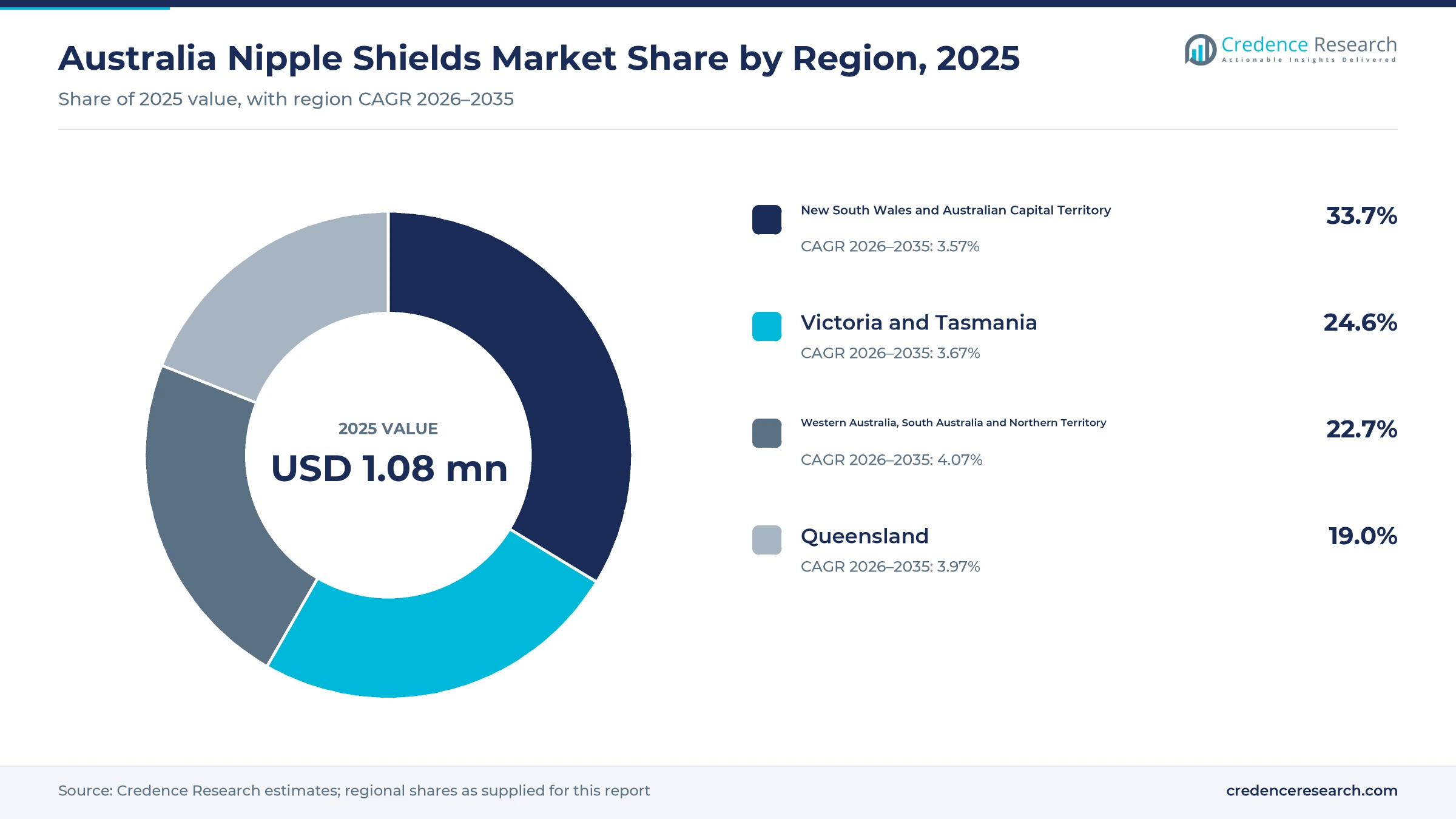
The Australia nipple shields market was valued at USD 1.08 million in 2025 and is projected to increase from USD 1.12 million in 2026 to USD 1.57 million by 2035, registering a CAGR of 3.79% during 2026–2035. Demand comes from breastfeeding mothers who need help with latch or sore nipples in the first weeks after birth, and from maternity wards and lactation consultants who recommend and fit the devices. New South Wales and Australian Capital Territory held the largest regional share, 33.7% in 2025, because the zone registers the most births in the country. Western Australia, South Australia and Northern Territory is the fastest-growing zone at 4.07% a year, helped by the quickest population growth of any state in Western Australia. Meanwhile, the Senate agreed in August 2026 to a Select Committee on Women's Health that will examine the cost and accessibility of infant feeding supports. As a result, spending is expected to rise steadily rather than quickly, closely following births and the reach of professional feeding advice.
What does the Australian estimate count and exclude?
The estimate counts retail and institutional spending on nipple shields and nipple-protection cups sold in Australia, including thin contact shields with a cut-out, standard butterfly-shaped shields, entry-level silicone shields and silver nipple cups worn between feeds. It covers purchases by households through pharmacies, online stores and baby retailers, as well as purchases by hospitals and lactation practices through clinical supply channels.
The estimate excludes breast pumps, pump flanges sold as breast shields, breast pads, nipple creams and hydrogel dressings, which are separate feeding accessory categories. The value chain runs from manufacturers such as Medela, Philips and Pigeon through Australian sponsors and distributors to pharmacy chains, online stores, hospitals and the mothers who use the products.
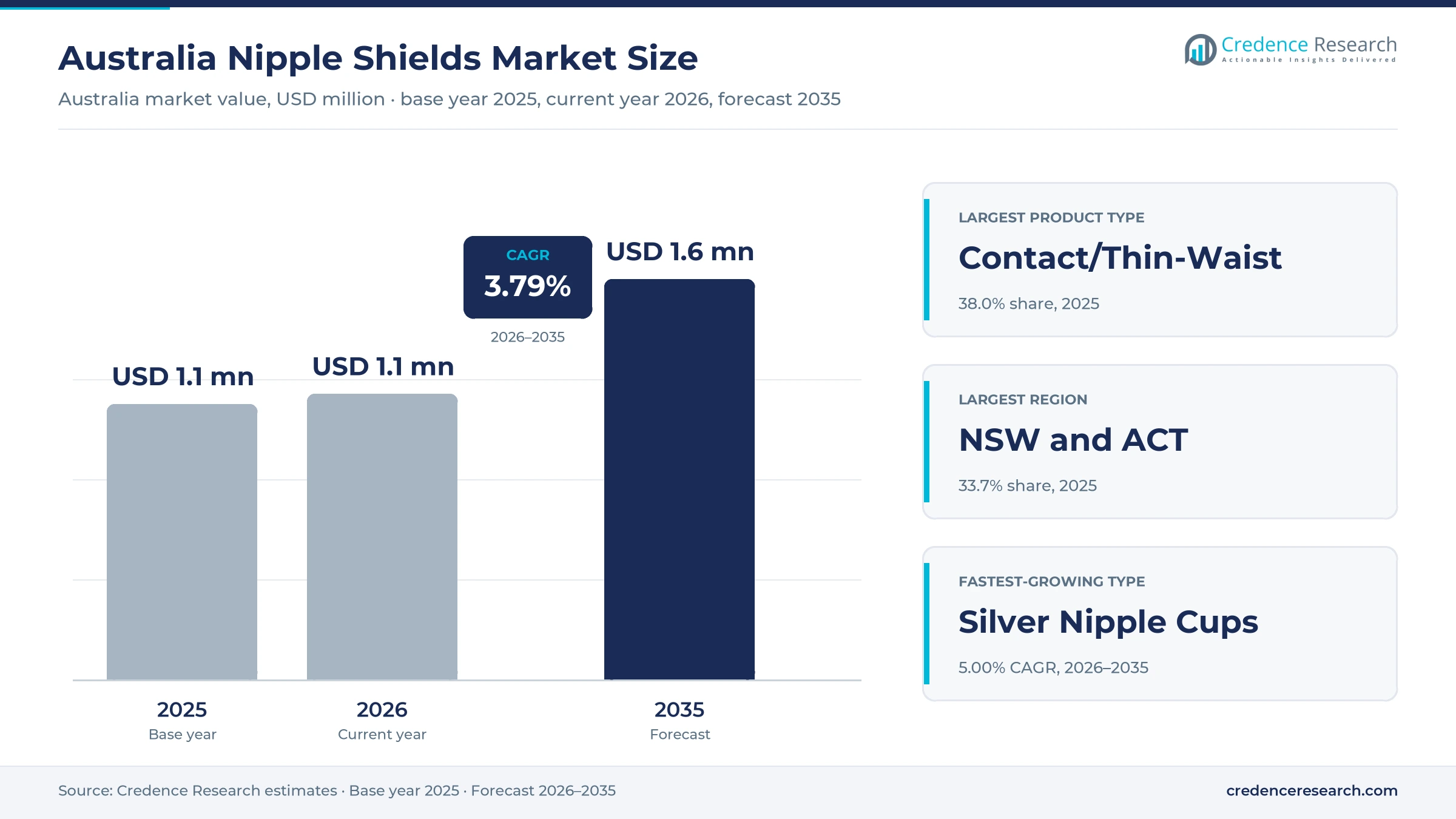
Australia Nipple Shields Market Insights
- The market was valued at USD 1.08 million in 2025 and is projected to reach USD 1.57 million by 2035, registering a CAGR of 3.79% during 2026–2035.
- New South Wales and Australian Capital Territory held 33.7% of 2025 value, as the zone registered about 93,000 of the 292,318 births recorded in 2024.
- Contact/thin-waist shields led with 38.0% of 2025 value, and Medela sells its Contact range in Australia in 16mm, 20mm and 24mm sizes.
- Registered births rose 1.9% to 292,318 in 2024, according to the ABS, after falling 4.6% in 2023 from 299,697 births in 2022.
- The Australian Breastfeeding Association reported almost 60,000 Helpline calls and web chats in the 12 months to August 2026, showing steady demand for feeding advice.
Contact designs lead while silver cups grow fastest
Why do contact designs hold the largest share?
Based on product type, the market is categorized into contact/thin-waist shields, standard/butterfly shields, economy/entry-level silicone shields and silver nipple cups. Contact/Thin-Waist Shields led with a 38.0% share of 2025 value, because thin designs with a cut-out keep skin contact and are the type most often fitted by lactation consultants. Silver Nipple Cups grow fastest at 5.00% a year, as mothers buy 925 silver cups for between-feed care at about AUD 85 a pair.
Which feeding problems generate the most purchases?
Based on application, the market is categorized into latch assistance, feeding-time nipple protection and between-feed nipple care. Latch Assistance led with a 52.0% share of 2025 value, because babies who struggle to attach, premature babies and flat or inverted nipples are the main reasons hospitals suggest a shield. Between-Feed Nipple Care grows fastest at 4.84% a year, as silver cups and other covers are used to protect damaged skin between feeds.
How do households, hospitals and lactation practices differ?
Based on customer type, the market is categorized into household purchasers, hospital procurement teams and independent lactation practices. Household Purchasers led with a 78.0% share of 2025 value, because most mothers buy their own pair or a second size after leaving hospital. Independent Lactation Practices grow fastest at 4.70% a year, as more families pay private lactation consultants who fit and supply the devices during home visits.
Where do Australian families buy these products?
Based on distribution channel, the market is categorized into online, pharmacy, specialty baby retail and hospital and clinical supply. Pharmacy led with a 40.0% share of 2025 value, because chains such as Chemist Warehouse and TerryWhite Chemmart stock Medela and Philips Avent shields beside other feeding products. Online grows fastest at 4.85% a year, as brand stores and baby e-retailers list sizes that pharmacies rarely keep.
| Segment Group | Leading Sub-segment | Share, 2025 | Fastest-growing Sub-segment | CAGR, 2026–2035 |
|---|---|---|---|---|
| By Product Type | Contact/Thin-Waist Shields | 38.0% | Silver Nipple Cups | 5.00% |
| By Application | Latch Assistance | 52.0% | Between-Feed Nipple Care | 4.84% |
| By Customer Type | Household Purchasers | 78.0% | Independent Lactation Practices | 4.70% |
| By Distribution Channel | Pharmacy | 40.0% | Online | 4.85% |
Request a Free Sample
Fill in your details and we'll send you a free sample report.
- Sample data tables & charts
- Research methodology
Births, lactation advice and better fit sustain demand
How does professional advice steer first purchases?
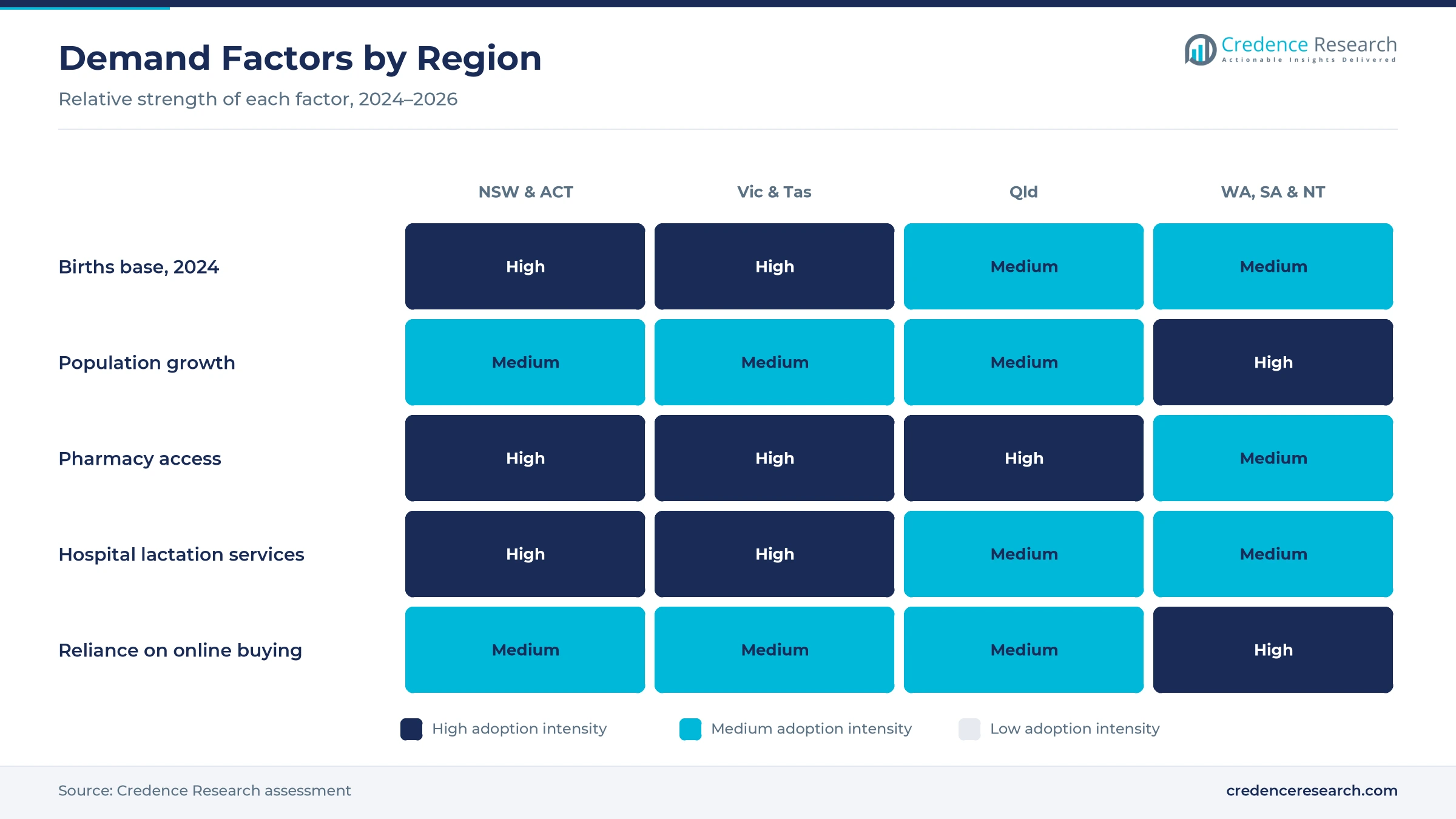
Professional advice is the gatekeeper for this category, because most mothers start using a shield only after a midwife or lactation consultant suggests one. The Australian Breastfeeding Association stresses that the right fit matters and recommends help from a lactation consultant, breastfeeding counselor or doctor in its guidance on nipple shields. Its volunteers handled almost 60,000 Helpline calls and web chats in the 12 months to August 2026, and it has more than 650 volunteer counselors and educators. Children's Health Queensland also advises a face-to-face consultation before a mother starts using a shield. As a result, latch assistance held a 52.0% share of 2025 value, because guided use for attachment problems remains the main route into the category.
Why do thinner, better-fitting designs lift spending per user?
Mothers pay more for designs that preserve skin contact and fit well, which lifts spending per user. Medela's Contact shields are made from ultra-thin silicone with an open section for skin contact and come with a carry case, according to Medela Australia. Chemist Warehouse listed the 20mm Contact two-pack at AUD 32.49 in October 2026, while TerryWhite Chemmart listed the Philips Avent butterfly-shaped two-pack, sized for nipples up to 21mm, at AUD 26.95. Entry-level options cost far less, such as a Chicco silicone shield at AUD 8.79 from Baby Kingdom. In turn, contact/thin-waist shields held a 38.0% share of 2025 value, the largest product group, because buyers trade up to designs that hospitals recommend.
How does a three-size range widen the fit for buyers?
Offering 3 sizes widens the share of mothers who can find a usable fit, which supports replacement and second purchases. Medela lists its Contact range in Australia as S/16mm, M/20mm and L/24mm, so a consultant can move a mother up or down one size. Pigeon Australia sells a Natural Fit shield for 16mm to 20mm nipples at AUD 21.70, and Chemist Warehouse stocks a 17mm Pigeon shield at AUD 20.69. Because sizing advice differs between hospitals and brands, some mothers buy a second size after a first fitting fails. Therefore, pharmacies that stock all 3 Contact sizes, rather than a single medium pack, capture more of the follow-up spending in each catchment.
Do births and maternal age set the buyer pool?
Registered births set the ceiling for demand, because every user is a mother in the first months after delivery. The ABS recorded 292,318 registered births in 2024, up 1.9% from 286,998 in 2023, after a fall from 299,697 in 2022. The median age of mothers reached 32.1 years, and older first-time mothers often need extra early feeding support in hospital. Breastfeeding starts almost universally, with 96% of infants aged 0 to 3 ever breastfed in the 2020–21 National Health Survey reported by the AIHW. As a result, unit demand tracks birth numbers closely, and modest births growth keeps the market expanding at a steady pace rather than a fast one.
Online buying and between-feed care reshape the category
Is buying shifting from pharmacy shelves to online stores?
Online retailers are taking a larger part of family spending, because they list every size and brand that a single pharmacy rarely stocks. Pigeon Australia sells its Natural Fit shield from its own website, and NUK Australia lists nipple shields in its breastfeeding aids range. Baby Kingdom, an Australian online baby retailer, lists NUK, Chicco and Pigeon shields side by side, with a NUK large two-pack at AUD 17.49. Medela also launched a campaign in October 2025 for its wearable breast pumps that covered purchases through participating Australian e-tailers. Therefore, online sales grow at 4.85% a year, the fastest channel, while pharmacies remain the main outlet for same-day purchases.
Why is clinical use moving toward short, monitored episodes?
Hospitals now treat the device as a brief aid with follow-up, a shift driven by research that still questions how shields affect milk removal. A University of Western Australia team concluded that nipple shield use may reduce milk removal in a 2020 study in BMC Pregnancy and Childbirth, after recruiting mothers through the Australian Breastfeeding Association and King Edward Memorial Hospital between 2016 and 2018. Danish national cohort data published in PLOS ONE in 2019 found shields used by 54% of mother and preterm infant pairs, which shows how common hospital use can be. Children's Health Queensland asks mothers who go home with a shield to stay in close contact with a child health nurse or lactation consultant, which keeps use tied to follow-up care.
Can between-feed silver cups open a premium niche?
Healing products worn after feeds offer higher margins, because silver cups sell at several times the price of a silicone shield. Silverette nursing cups made from 925 silver list at AUD 85 a pair through EcoNaps, compared with less than AUD 35 for leading silicone two-packs in pharmacies. Nipple pain is one of the most common reasons mothers stop breastfeeding earlier than planned, according to the University of Western Australia researchers, which gives healing products a clear use case. As a result, silver nipple cups grow at 5.00% a year, the fastest product type, and between-feed nipple care grows at 4.84%, well above the market average.
Will postpartum policy reviews widen funded feeding support?
Government scrutiny of care after birth is a second opening, because publicly funded help brings more mothers into contact with people who fit shields. The Senate agreed on Aug. 19, 2026, to a Select Committee on Women's Health that will examine the cost and accessibility of infant feeding supports. The Australian Breastfeeding Association noted that the last comprehensive national infant feeding survey was run in 2010, although the 2019 national strategy recommended one every five years. The strategy also set a goal of at least 50% of babies exclusively breastfed for the first six months by 2025, against 35% in 2020–21. Therefore, suppliers that train midwives on breastfeeding accessories stand to gain from any new postpartum funding.
Mixed clinical advice and short use cycles cap volumes
Why does mixed clinical advice limit wider use?
Clinicians remain divided on the device, which holds back volumes because some see it as a delay to direct breastfeeding. The Australian Breastfeeding Association states that breastfeeding experts hold different opinions about nipple shields and when or if they should be tried. Danish research in Maternal and Child Nutrition linked shield use with a threefold higher risk of earlier cessation of exclusive breastfeeding among first-time mothers. As a result, many midwives present the device as a later option, which caps unit sales per birth.
How do short use cycles cap repeat purchases?
Most mothers only need a shield for a short time, as the Australian Breastfeeding Association notes, which limits repeat buying. The Royal Women's Hospital in Melbourne encourages mothers to start moving off the device after a week or two of use. Reusable silicone shields can also be washed and used again, unlike consumables such as breast pads. Consequently, a typical buyer purchases only one or two packs, which limits lifetime value and keeps the category small.
Do sizing errors and conflicting fit advice hurt trust?
A poorly matched device can cause more nipple damage, as the Australian Breastfeeding Association warns, which erodes confidence in the category. Advice also conflicts, since the Royal Women's Hospital suggests most women use a large shield whatever their nipple size, while Philips Avent describes its standard shield as fitting nipples up to 21mm. When a first fitting fails, some families give up on the device instead of trying another size. Clear fitting charts and pharmacist training help reduce these losses.
How does slow birth growth pressure suppliers?
Volumes depend almost entirely on new mothers each year, so a nearly flat number of births limits how far suppliers can expand. Australia's total fertility rate was 1.481 babies per woman in 2024, according to the ABS, so births rise only slowly with population. Western Australia also recorded a 4.7% drop in registered births in 2024, partly because a 2023 registration backlog was cleared. Therefore, brands compete for share in a nearly flat pool of buyers, which limits price increases and rewards efficient pharmacy distribution.
NSW and ACT lead while the western zone grows fastest
| Region | Value, 2025 (USD million) | Share, 2025 | CAGR, 2026–2035 |
|---|---|---|---|
| New South Wales and Australian Capital Territory | 0.364 | 33.7% | 3.57% |
| Victoria and Tasmania | 0.266 | 24.6% | 3.67% |
| Western Australia, South Australia and Northern Territory | 0.245 | 22.7% | 4.07% |
| Queensland | 0.205 | 19.0% | 3.97% |
Why do New South Wales and the ACT lead spending?
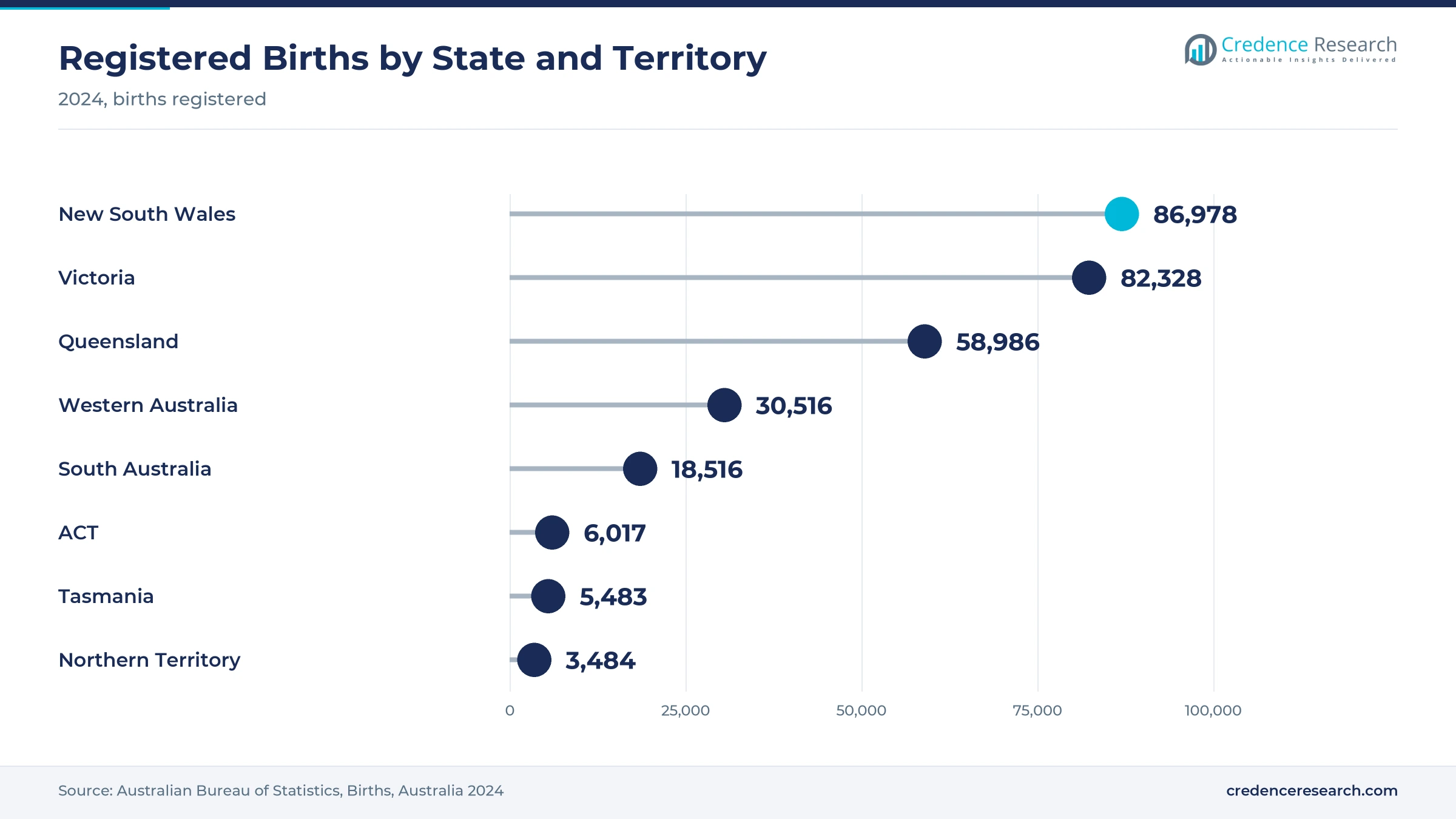
New South Wales and Australian Capital Territory held a 33.7% share of 2025 value and grows at 3.57% a year. The zone registered 86,978 births in New South Wales and 6,017 in the ACT in 2024, the largest combined total in the country. Sydney and Canberra also host large maternity hospitals and private lactation practices that fit and supply shields. As a result, the zone accounts for the most pharmacy and hospital purchases, although its growth rate stays below the national rate.
How do Victoria and Tasmania compare?
Victoria and Tasmania held a 24.6% share of 2025 value and grows at 3.67% a year. Victoria registered 82,328 births in 2024, and its population grew 1.6% in the year to March 2026, the second-fastest rate among the states according to the ABS. Tasmania grew 0.6%, the slowest rate, and registered 5,483 births. Melbourne's Royal Women's Hospital publishes its own shield guidance, which shapes how midwives in the zone introduce the devices to new mothers.
What supports demand in Queensland?
Queensland held a 19.0% share of 2025 value and grows at 3.97% a year. The state registered 58,986 births in 2024, while its total fertility rate eased to 1.505 that year from 1.544 in 2023, according to the Queensland Government Statistician's Office. Children's Health Queensland gives families a dedicated fact sheet on shield use, cleaning and follow-up with child health nurses. Therefore, regional demand in Queensland is steady and closely tied to its child health services.
Why is the western zone growing fastest?
Western Australia, South Australia and Northern Territory held a 22.7% share of 2025 value and grows at 4.07% a year, the fastest zone. Western Australia had the fastest population growth in the country, 2.1% in the year to March 2026, and registered 30,516 births in 2024. South Australia registered 18,516 births and the Northern Territory 3,484. Perth's King Edward Memorial Hospital and the Breastfeeding Centre of Western Australia also support local research on shield use.
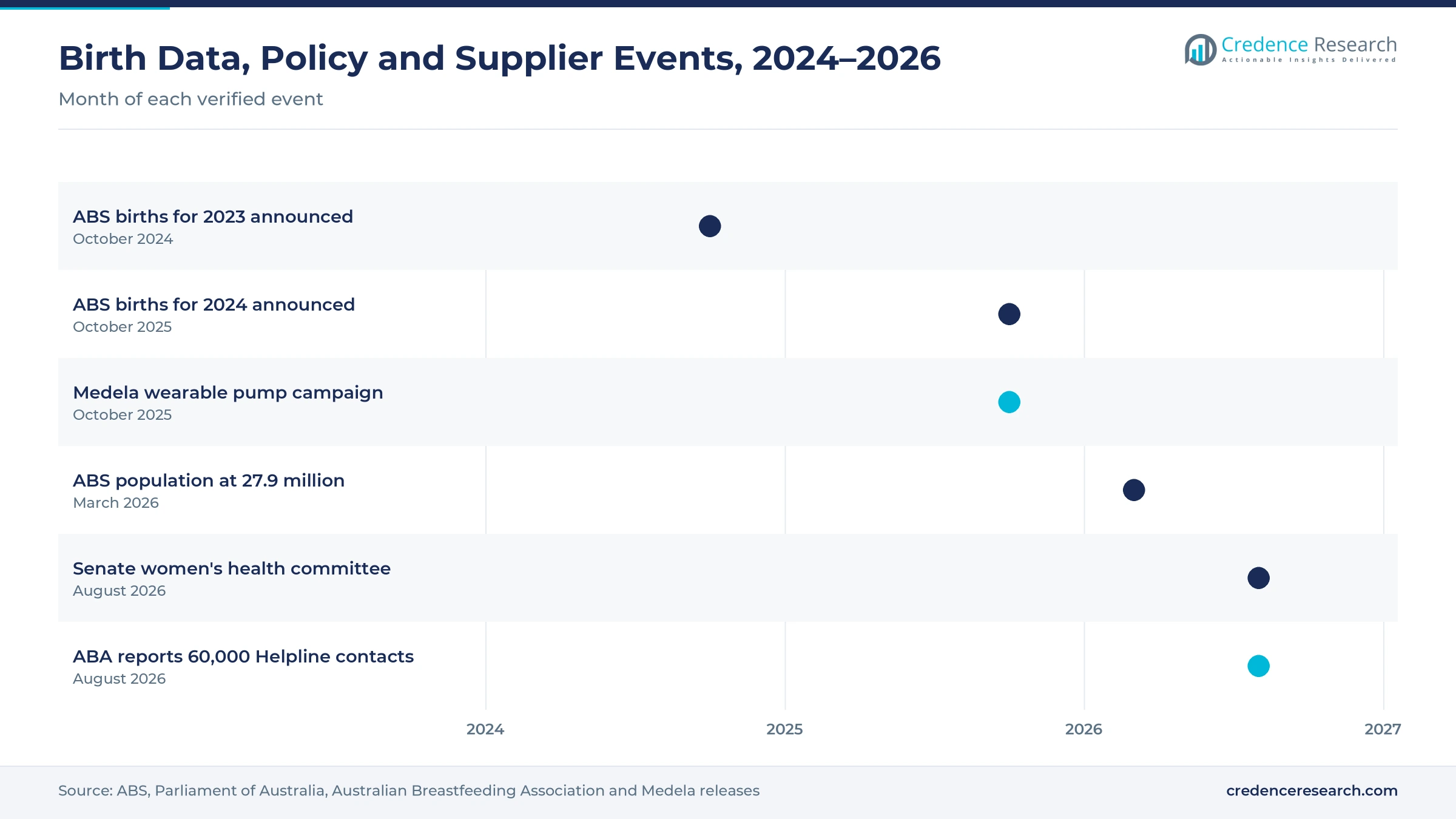
Birth data, pump campaigns and policy moves, 2024–2026
| Development | Status and market relevance |
|---|---|
| In October 2024, the ABS announced 286,998 registered births for 2023, a 4.6% decrease from 2022. | Set a lower base of new mothers for feeding accessory demand |
| In October 2025, the ABS announced 292,318 registered births for 2024, an increase of 1.9% from 2023. | Restored modest growth in the pool of potential shield users |
| In October 2025, Medela AG launched its With You, Every Step of the Way campaign, covering purchases through participating Australian e-tailers. | Centered on the Magic InBra and Motion InBra wearable pumps sold beside feeding accessories |
| In August 2026, the Senate agreed to a Select Committee on Women's Health covering the cost and accessibility of infant feeding supports. | Could widen funded postpartum lactation support |
| In August 2026, the Australian Breastfeeding Association announced almost 60,000 Helpline calls and web chats over the prior 12 months. | Shows steady demand for professional feeding advice |
Thinner silicone, cut-out shapes and silver cups ahead
- Ultra-thin silicone replaces the hard plastic and thick rubber of older shields, which the Australian Breastfeeding Association links with poorer milk removal and lower supply.
- Cut-out contact shapes leave part of the breast uncovered so the baby's nose or chin touches the skin, as in Medela Contact and Philips Avent butterfly designs.
- Silver nursing cups use 925 silver worn between feeds, which gives premium brands such as Silverette a niche alongside other nursing accessories sold online.
- Wider size ranges from 16mm to 24mm let lactation consultants match the device to the nipple rather than defaulting to one medium size.
Need a Custom Version of This Report?
Tailor the scope, geography, or segments to your exact requirements.
- Custom geography or segment scope
- Direct access to our analyst team
Feeding brands compete for pharmacy and hospital shelves
Competition is concentrated among international feeding brands that sell through Australian pharmacies, baby retailers and their own websites. Medela Australia Pty Ltd sponsors a reusable nipple shield entered on the Australian Register of Therapeutic Goods as a Class 1 device, and Medela sells its Contact shields in three sizes. Philips sells the Avent butterfly-shaped shield through its Australian website and pharmacy chains such as TerryWhite Chemmart. Pigeon Australia sells its Natural Fit shield online, and Chemist Warehouse stocks a 17mm Pigeon shield. NUK lists nipple shields in its Australian breastfeeding aids range, while Chicco silicone shields reach families through baby retailers such as Baby Kingdom. Specialist brands such as Silverette add silver cups at higher prices. Brands compete on thinness, size range, hospital recommendations and shelf presence, and pump makers can place shields beside their breast pump ranges.
Companies profiled and their roles in this market
| Company | Type | Role in the market |
|---|---|---|
| Medela | Breastfeeding device specialist | Contact shields in 16mm, 20mm and 24mm; reusable shield on the ARTG as a Class 1 device |
| Philips Avent | Consumer health brand | Ultra-thin butterfly-shaped shield sold through Philips Australia and pharmacy chains |
| Pigeon | Baby-care brand | Natural Fit shield for 16mm to 20mm nipples sold by Pigeon Australia and Chemist Warehouse |
| NUK | Baby-care brand | Silicone shields listed in its Australian breastfeeding aids range |
| Chicco | Baby-care brand | Entry-priced silicone shield sold through Australian baby retailers |
Credence Research view on a small, steady category
Credence Research's view is that the Australian category will grow steadily but slowly, because it depends on births, guided use and short treatment periods rather than repeat consumption. Professional advice decides most first purchases, so brands that train midwives and lactation consultants hold an advantage over those that compete on shelf price alone. Thin contact designs should keep the largest share, while silver cups and online sales add value at the margin. However, mixed clinical evidence and a low fertility rate will keep growth close to the pace of population increase.
Births, uptake and shelf prices behind the estimate
The report uses 2025 as the base year for every value, share and growth rate. Market values come from the Credence Research model, which links registered births by zone, breastfeeding initiation, an estimated share of mothers who buy a shield or cup, packs per buyer and observed Australian shelf prices. Zone shares were supplied for this report, and segment splits and growth rates are Credence Research estimates. Sources used are ABS birth and population statistics, AIHW breastfeeding data, TGA register entries, hospital and Australian Breastfeeding Association guidance, published research and retailer price listings, and no interviews or surveys were used.
Steady births and guided use shape demand to 2035
Spending is expected to reach USD 1.57 million by 2035, a 3.79% CAGR during 2026–2035, as births edge higher and guided use stays a routine part of early feeding support. Growth should remain steady rather than fast, because each mother uses the products for only a few weeks. Silver cups, online sales and private lactation services should add value at the margin, while designs and prices keep following trends in the worldwide latch-support device category. New funding after the Senate inquiry would lift demand, whereas weaker birth numbers would slow it.
Frequently Asked Questions
How big is the Australia nipple shields market?
Which region leads spending in Australia?
Which product type holds the largest share?
Why do Australian mothers use nipple shields?
How many births drive demand?
Which region grows fastest through 2035?
Which companies compete in this market?
What are the main risks for suppliers?
Table of Content
Chapter 1 Market Segmentation
- 1.1 Segmentation Framework
- 1.1.1 Product and Service Classification
- 1.1.2 Application and End-Use Classification
- 1.1.3 Technology and Solution Classification
- 1.1.4 Customer and Distribution Channel Classification
- 1.1.5 Geographic Segmentation
- 1.1.6 Market Segment Definitions and Boundaries
- 1.2 By Product Type
- 1.2.1 Contact/Thin-Waist Shields
- 1.2.2 Standard/Butterfly Shields
- 1.2.3 Economy/Entry-Level Silicone Shields
- 1.2.4 Silver Nipple Cups
- 1.3 By Application
- 1.3.1 Latch Assistance
- 1.3.2 Feeding-Time Nipple Protection
- 1.3.3 Between-Feed Nipple Care
- 1.4 By Customer Type
- 1.4.1 Household Purchasers
- 1.4.2 Hospital Procurement Teams
- 1.4.3 Independent Lactation Practices
Chapter 2 Introduction
- 2.1 Report Objectives and Scope
- 2.2 Product Definition and Industry Terminology
- 2.3 Market Inclusions and Exclusions
- 2.4 Research Process
- 2.4.1 Primary Research and Expert Interviews
- 2.4.2 Secondary Research and Source Review
- 2.4.3 Top-Down and Bottom-Up Estimation
- 2.4.4 Data Triangulation and Verification
- 2.5 Market Size Measurement Basis
- 2.5.1 2025: USD 1.08 million → 2035: USD 1.57 million
- 2.6 Historical and Forecast Reference Periods
- 2.6.1 Historical Period: 2018-2025
- 2.6.2 Base Year: 2025
- 2.6.3 Forecast Period: 2025-2035
- 2.7 Research Assumptions and Limitations
Chapter 3 Executive Summary
- 3.1 Market Snapshot and Key Findings
- 3.2 Base-Year Market Size, 2025
- 3.3 Forecast Market Size, 2035
- 3.4 Revenue and Volume Growth Outlook
- 3.5 Key Demand and Supply Indicators
- 3.6 Leading Market Segments
- 3.7 Fastest-Growing Market Opportunities
- 3.8 Regional Performance Highlights
- 3.9 Technology and Industry Transformation
- 3.10 Competitive Landscape Summary
- 3.11 Analyst View and Strategic Implications
Chapter 4 Australia Nipple Shields Market Trends and Developments
- 4.1 Historical Industry Development, 2018-2025
- 4.2 Recent Market Trends and Developments
- 4.3 Demand and Customer Behavior Trends
- 4.4 Technology and Product Innovation
- 4.5 Artificial Intelligence, Automation and Digitalization
- 4.6 Local Manufacturing and Supply Chain Realignment
- 4.7 Industry Partnerships, Mergers and Acquisitions
- 4.8 Sustainability and Circular Economy Developments
- 4.9 Government and Private Sector Investment Trends
- 4.10 Emerging Business Models and Commercialization
- 4.11 Industry Developments and Announcements
Chapter 5 Australia Nipple Shields Market Production, Supply and Demand Analysis
- 5.1 Demand Trend and Consumption Analysis, 2018-2025
- 5.2 Demand Forecast, 2025-2035
- 5.3 Production and Output Trend, 2018-2025
- 5.4 Production and Output Forecast, 2025-2035
- 5.5 Installed Capacity and Capacity Utilization
- 5.6 Company-Wise Production Plants and Statistics
- 5.6.1 Installed Production Capacity
- 5.6.2 Actual Production
- 5.6.3 Planned Capacity and Expansion Targets
- 5.7 Supply Chain Structure and Procurement Trends
- 5.8 Supply-Demand Gap and Bottlenecks
- 5.9 Import Dependence and Sourcing Structure
- 5.10 Contract Manufacturing and Outsourcing
- 5.11 Regional Supply and Demand Concentration
Chapter 6 Australia Nipple Shields Market Pricing Analysis
- 6.1 Pricing Structure and Measurement
- 6.2 Historical Pricing Trends, 2018-2025
- 6.3 Pricing Outlook, 2025-2035
- 6.4 Average Selling Price and Unit Economics
- 6.5 Pricing by Product and Market Segment
- 6.6 Geographic Pricing Differences
- 6.7 Key Input, Energy, Labor and Logistics Costs
- 6.8 Contract Pricing and Purchasing Models
- 6.9 Pricing Sensitivity and Competitive Positioning
- 6.10 Price, Margin and Profitability Implications
Chapter 7 Australia Nipple Shields Market Dynamics
- 7.1 Market Growth Drivers
- 7.1.1 Demand-Side Drivers
- 7.1.2 Technology and Innovation Drivers
- 7.1.3 Infrastructure and Investment Drivers
- 7.1.4 Regulatory and Policy Drivers
- 7.2 Market Restraints
- 7.2.1 Cost and Affordability Constraints
- 7.2.2 Technology and Adoption Barriers
- 7.2.3 Supply Chain and Operational Constraints
- 7.3 Market Challenges
- 7.3.1 Competitive Pressure and Margin Erosion
- 7.3.2 Skills, Infrastructure and Implementation Gaps
- 7.4 Emerging Market Opportunities
- 7.5 Market Dynamics Impact and Time-Horizon Assessment
Chapter 8 Australia Nipple Shields Value Chain Analysis
- 8.1 Industry Value Chain Overview
- 8.2 Upstream Suppliers and Critical Inputs
- 8.3 Technology and Component Providers
- 8.4 Manufacturing or Service Delivery
- 8.5 Distribution, Channel Partners and Integrators
- 8.6 Downstream Applications and End Users
- 8.7 Value Addition and Profit Pools
- 8.8 Vertical Integration and Outsourcing
- 8.9 Supplier Concentration and Risk
- 8.10 Supply Chain Localization and Resilience
Chapter 9 Australia Nipple Shields Market Regulations and Policies
- 9.1 Relevant Laws, Standards and Compliance Frameworks
- 9.2 Product, Service, Safety and Quality Requirements
- 9.3 Government Policies, Incentives and Subsidies
- 9.4 Imports, Exports and Trade Barriers
- 9.5 Public Procurement and Local Content Requirements
- 9.6 Environmental and Sustainability Compliance
- 9.7 Upcoming Policy Changes and Market Implications
Chapter 10 Australia Nipple Shields Market Hotspots and Opportunities
- 10.1 Market Opportunity Mapping and Growth Hotspots
- 10.2 High-Growth Applications and Customer Groups
- 10.3 Underserved Markets and White-Space Opportunities
- 10.4 Emerging Technology and Product Opportunities
- 10.5 New Capacity and Investment Hotspots
- 10.6 Market Entry and Expansion Opportunities
- 10.7 Distribution and Partnership Opportunities
- 10.8 Near-Term and Long-Term Commercial Potential
- 10.9 Opportunity Attractiveness and Execution Risks
Chapter 11 Australia Nipple Shields Market Outlook, 2025-2035
- 11.1 Market Size and Analysis
- 11.1.1 Revenue (Market Measurement: 2025: USD 1.08 million → 2035: USD 1.57 million)
- 11.1.2 Market Volume and Quantity Sold
- 11.1.3 Historical Market Size, 2018-2025
- 11.1.4 Base-Year Market Size, 2025
- 11.2 Market Forecast, 2025-2035
- 11.2.1 Revenue Forecast to 2035
- 11.2.2 Volume Forecast to 2035
- 11.2.3 CAGR and Year-on-Year Growth
- 11.2.4 Incremental Revenue Opportunity
- 11.3 Forecast Assumptions and Scenario Analysis
- 11.3.1 Base-Case Forecast
- 11.3.2 Optimistic and Conservative Scenarios
- 11.3.3 Technology, Pricing and Policy Sensitivities
- 11.4 Market Attractiveness and Growth Outlook
Chapter 12 Australia Nipple Shields Market Segmentation and Outlook
- 12.1 Segmentation Summary and Market Shares, 2025
- 12.2 Largest and Fastest-Growing Segments
- 12.3 By Product Type - Market Size and Forecast, 2025-2035
- 12.3.1 Segment Definition and Scope
- 12.3.2 Historical Market Size, 2018-2025
- 12.3.3 Revenue Forecast, 2025-2035
- 12.3.4 Volume Forecast, 2025-2035
- 12.3.5 Base-Year Market Share, 2025
- 12.3.6 Segment CAGR and Growth Drivers
- 12.3.7 Subsegment Market Size and Forecast
- 12.3.7.1 Contact/Thin-Waist Shields
- 12.3.7.2 Standard/Butterfly Shields
- 12.3.7.3 Economy/Entry-Level Silicone Shields
- 12.3.7.4 Silver Nipple Cups
- 12.3.8 Subsegment Pricing and Adoption Trends
- 12.3.9 Leading Suppliers and Competition
- 12.3.10 Regional Demand and Opportunities
- 12.4 By Application - Market Size and Forecast, 2025-2035
- 12.4.1 Segment Definition and Scope
- 12.4.2 Historical Market Size, 2018-2025
- 12.4.3 Revenue Forecast, 2025-2035
- 12.4.4 Volume Forecast, 2025-2035
- 12.4.5 Base-Year Market Share, 2025
- 12.4.6 Segment CAGR and Growth Drivers
- 12.4.7 Subsegment Market Size and Forecast
- 12.4.7.1 Latch Assistance
- 12.4.7.2 Feeding-Time Nipple Protection
- 12.4.7.3 Between-Feed Nipple Care
- 12.4.8 Subsegment Pricing and Adoption Trends
- 12.4.9 Leading Suppliers and Competition
- 12.4.10 Regional Demand and Opportunities
- 12.5 By Customer Type - Market Size and Forecast, 2025-2035
- 12.5.1 Segment Definition and Scope
- 12.5.2 Historical Market Size, 2018-2025
- 12.5.3 Revenue Forecast, 2025-2035
- 12.5.4 Volume Forecast, 2025-2035
- 12.5.5 Base-Year Market Share, 2025
- 12.5.6 Segment CAGR and Growth Drivers
- 12.5.7 Subsegment Market Size and Forecast
- 12.5.7.1 Household Purchasers
- 12.5.7.2 Hospital Procurement Teams
- 12.5.7.3 Independent Lactation Practices
- 12.5.8 Subsegment Pricing and Adoption Trends
- 12.5.9 Leading Suppliers and Competition
- 12.5.10 Regional Demand and Opportunities
- 12.6 Segment Growth Comparison
- 12.7 Segment Attractiveness and Priority Matrix
Chapter 13 Australia Nipple Shields End-Use and Application Market Outlook
- 13.1 End-Use Industry and Customer Demand Structure
- 13.2 Leading Applications and Customer Groups
- 13.3 End-Use Market Size, Share and Forecast
- 13.4 Major End-Use Industry Deep Dives
- 13.4.1 Customer Requirements and Use Cases
- 13.4.2 Demand and Replacement Cycles
- 13.4.3 Technical and Regulatory Considerations
- 13.4.4 Purchasing and Procurement Models
- 13.4.5 Leading Vendors and Distribution Channels
- 13.4.6 Forecast and Commercial Opportunities
- 13.5 Emerging Applications and Cross-Segment Demand
- 13.6 End-Use Industry Investment Priorities
Chapter 14 Australia Nipple Shields Geographic Market Outlook, 2025-2035
- 14.1 Domestic Market Distribution and Demand Clusters
- 14.2 State- or Province-Wise Market Size and Forecast, 2025-2035
- 14.3 City and Metropolitan Market Outlook
- 14.4 Industrial, Manufacturing and Commercial Clusters
- 14.5 Geographic Concentration of Key End Users
- 14.6 Local Pricing and Purchasing Differences
- 14.7 Domestic Production Facilities and Capacity Map
- 14.8 Local Infrastructure and Project Pipeline
- 14.9 State-Level Policy and Incentive Differences
- 14.10 Subnational Investment Hotspots and Opportunities
- 14.11 Distribution and Logistics Networks
- 14.12 Domestic Competitive Footprint
Chapter 15 Australia Nipple Shields Technology, Innovation and Sustainability Outlook
- 15.1 Technology Landscape and Maturity
- 15.2 Product, Process and Service Innovation
- 15.3 AI, Automation and Digital Tools in the Industry
- 15.4 Technology Adoption and Performance Benchmarking
- 15.5 Innovation Pipeline and R&D Investment
- 15.6 Patent and Intellectual Property Trends
- 15.7 Energy Efficiency and Resource Management
- 15.8 Sustainability, Recycling and Circularity
- 15.9 Technology Roadmap, 2025-2035
- 15.10 Risks of Obsolescence and Technology Substitution
Chapter 16 Australia Nipple Shields Market Key Strategic Imperatives
- 16.1 Growth and Market Entry Priorities
- 16.2 High-Return Products and Segments
- 16.3 Pricing, Profitability and Cost Optimization
- 16.4 Technology Investment and Product Differentiation
- 16.5 Supply Chain Localization and Resilience
- 16.6 Distribution and Customer Acquisition
- 16.7 Partnership, Acquisition and Capacity Strategy
- 16.8 Regional Expansion Priorities
- 16.9 Short-, Medium- and Long-Term Actions
Chapter 17 Competition Outlook
- 17.1 Industry Competition Characteristics
- 17.2 Market Structure and Concentration
- 17.3 Market Share and Competitive Positioning, 2025
- 17.4 Company-Wise Revenue and Product Benchmarking
- 17.5 Production and Service Capacity Benchmarking
- 17.6 Technology, Pricing and Differentiation
- 17.7 Regional Footprint and Distribution Strength
- 17.8 Mergers, Acquisitions and Strategic Alliances
- 17.9 New Entrants and Competitive Threats
- 17.10 Porter's Five Forces and Industry Attractiveness
- 17.11 Competitive Outlook, 2025-2035
Chapter 18 Company Profiles
- 18.1 Company Coverage and Selection Criteria
- 18.2 Medela
- 18.2.1 Business Description
- 18.2.2 Company Ownership and Geographic Presence
- 18.2.3 Product and Service Portfolio
- 18.2.4 Manufacturing and Operating Footprint
- 18.2.5 Production Capacity and Expansion Plans
- 18.2.6 Financial Performance and Investment
- 18.2.7 Market Share and Competitive Position
- 18.2.8 Technology and Innovation Capabilities
- 18.2.9 Strategic Alliances or Partnerships
- 18.2.10 Recent Developments
- 18.2.11 Growth Strategy and Outlook
- 18.3 Philips Avent
- 18.4 Pigeon
- 18.5 NUK
- 18.6 Chicco
- 18.7 Other Relevant Market Participants
Note: Every listed company is profiled on the structure shown under the first company. The company list is preliminary and may change based on research findings, market developments, data availability and client requirements.
Chapter 19 Disclaimer
- 19.1 Research and Forecast Disclaimer
- 19.2 Data Source and Estimation Limitations
Note: The depth of individual sections depends on data availability for this market. Volume, capacity, trade and other unit-based metrics are included where applicable.