
| REPORT ATTRIBUTE | DETAILS |
|---|---|
| Historical Period | 2020-2023 |
| Base Year | 2024 |
| Forecast Period | 2025-2032 |
| Automatic Identification And Data Capture (AIDC) Market Size 2024 | USD 52,902.25 Million |
| Automatic Identification And Data Capture (AIDC) Market, CAGR | 11% |
| Automatic Identification And Data Capture (AIDC) Market Size 2032 | USD 121,915.23 Million |
Market Overview
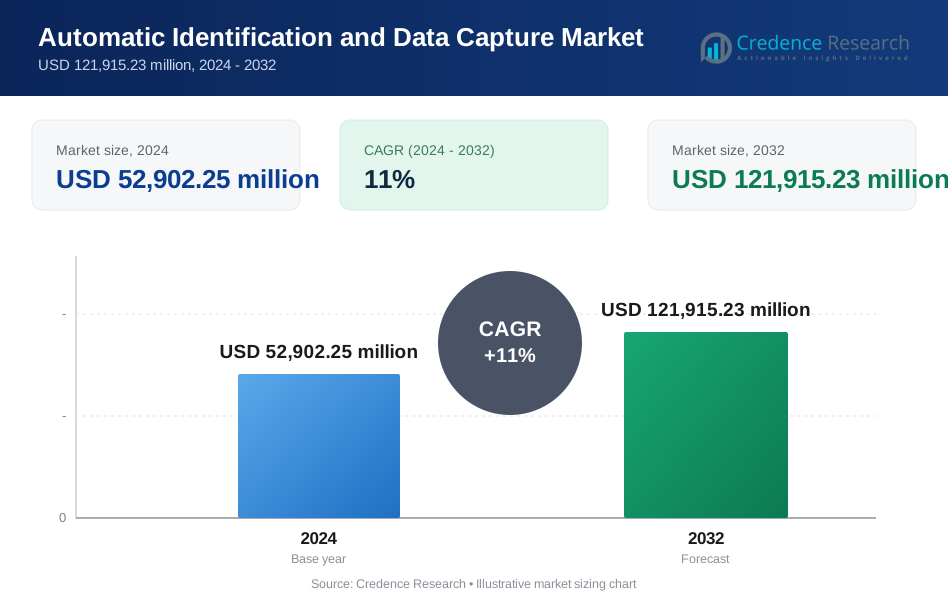
The Automatic Identification And Data Capture (AIDC) Market is projected to grow from USD 52,902.25 million in 2024 to an estimated USD 121,915.23 million by 2032, with a compound annual growth rate (CAGR) of 11% from 2024 to 2032.
Key drivers of the AIDC market include the increasing need for businesses to enhance operational efficiency, reduce errors, and improve inventory management. Technologies such as barcode scanning, radio frequency identification (RFID), and biometric systems are gaining widespread adoption across various industries, including retail, healthcare, logistics, and manufacturing. The growing trend of digital transformation, along with the rise of e-commerce, is driving the demand for real-time data capture solutions to improve customer service and streamline supply chains. Additionally, the adoption of automation in warehouses and distribution centers is further fueling the growth of the AIDC market.
Regionally, North America and Europe are expected to dominate the AIDC market due to the presence of advanced technology infrastructure, along with widespread adoption of AIDC solutions in retail, logistics, and healthcare sectors. The United States and European countries are also witnessing significant investments in smart manufacturing and Industry 4.0, further boosting the market. In Asia Pacific, countries like China, Japan, and India are anticipated to experience substantial growth, driven by the increasing adoption of AIDC technologies in logistics and transportation, along with the rapid growth of e-commerce and retail sectors. Latin America and the Middle East & Africa regions are also expected to contribute to the growth of the AIDC market, as businesses in these regions invest in data capture technologies to improve operational efficiency and meet regulatory requirements. From a regional perspective, North America holds a dominant position due to the early adoption of automation and strong technological infrastructure. The Asia-Pacific region, however, is projected to witness the fastest growth, attributed to the rapid industrialization, booming e-commerce, and rising investments in digital technologies across China, India, and Southeast Asia. Meanwhile, Europe maintains a strong market share, driven by strict regulatory mandates and a mature logistics ecosystem. These regional dynamics are shaping a competitive landscape where innovation, customization, and scalability are critical for market success.
Market Insights:
- The global Automatic Identification and Data Capture (AIDC) market is projected to grow from USD 52,902.25 million in 2024 to USD 121,915.23 million by 2032, with an 11% CAGR during the forecast period.
- Increasing demand for operational efficiency, inventory management, and real-time data capture solutions across industries like retail, logistics, and healthcare are key drivers of market growth.
- The rise of barcode scanning, RFID, biometric systems, and automation technologies in warehouses are significantly boosting the adoption of AIDC solutions.
- The expansion of e-commerce and digital transformation across sectors is accelerating the need for efficient data capture and management systems.
- High initial investment costs for implementing AIDC technologies and data privacy concerns may limit market expansion in certain regions.
- North America and Europe dominate the AIDC market, driven by advanced technological infrastructure, regulatory compliance needs, and strong adoption across logistics and healthcare sectors.
- Asia Pacific, particularly China, Japan, and India, is expected to witness rapid growth, fueled by industrial expansion, e-commerce growth, and increasing investments in logistics and transportation sectors.
Market Drivers
Rising Demand for Efficient Supply Chain and Inventory Management Solutions
The AIDC market is experiencing strong growth due to the increasing need for efficient supply chain and inventory tracking systems. Businesses are under constant pressure to minimize operational costs and improve real-time decision-making, which has fueled the adoption of barcodes, RFID tags, and mobile computing solutions. For instance, Amazon’s investment in AIDC systems, including robotic systems and RFID tags, has led to a 20% increase in warehouse efficiency and a 10% reduction in labor costs. These technologies streamline operations by automating identification and data capture, reducing human error, and enhancing overall productivity. In industries such as retail, logistics, and manufacturing, where inventory accuracy and speed are vital, AIDC solutions are increasingly becoming indispensable. As organizations move toward digital-first strategies, integrating automated identification systems into existing infrastructure has become a critical requirement.
Growing Emphasis on Data Accuracy and Security in Regulated Industries
Industries like healthcare, pharmaceuticals, and finance are adopting AIDC technologies to ensure data integrity, traceability, and compliance with regulatory frameworks. These sectors demand highly accurate and secure data management practices, which traditional manual systems often fail to deliver. Technologies like biometric verification, smart cards, and secure RFID solutions are being increasingly deployed to meet these standards. The need for robust patient identification, medication tracking, and adherence to serialization requirements in pharmaceuticals has led to heightened implementation of AIDC tools. The ongoing emphasis on minimizing data breaches, reducing identity fraud, and improving patient safety continues to support sustained demand.
Acceleration of E-commerce and Omnichannel Retailing
The rise of e-commerce and omnichannel business models has created an urgent need for real-time inventory visibility, order accuracy, and seamless logistics management. Retailers are increasingly leveraging AIDC solutions to optimize fulfillment processes, automate point-of-sale systems, and manage high-volume transactions across multiple channels. For instance, Amazon’s investment in AIDC systems, including robotic systems and RFID tags, has led to a 20% increase in warehouse efficiency and a 10% reduction in labor costs. Barcode scanners, mobile POS systems, and warehouse automation tools are integral in ensuring smooth operations and enhancing customer satisfaction. The adoption of cloud-integrated AIDC solutions further enables centralized inventory monitoring and data synchronization across platforms, leading to improved responsiveness and operational agility.
Technological Advancements and Integration with IoT and AI
Ongoing technological developments in AIDC components such as 2D barcodes, RFID chips, and biometric sensors are significantly enhancing the efficiency and accuracy of data capture. The integration of AIDC systems with Internet of Things (IoT) devices and artificial intelligence (AI) platforms is transforming the way organizations collect, analyze, and utilize data. Real-time analytics powered by AI combined with sensor-based data capture is enabling predictive maintenance, intelligent inventory planning, and advanced security features. These innovations are paving the way for the adoption of smart manufacturing and intelligent warehousing solutions, further accelerating the market's growth trajectory.
Market Trends
Increasing Adoption of Biometric Authentication Across Industries
Biometric technologies such as facial recognition, fingerprint scanning, and iris recognition are gaining significant traction across sectors, including banking, travel, healthcare, and government. These technologies provide a secure and convenient method of identity verification, reducing reliance on passwords and PINs. Enhanced accuracy and declining hardware costs have encouraged organizations to deploy biometric solutions for both physical and logical access control. The use of multimodal biometric systems is also expanding, offering an extra layer of security and higher authentication reliability, particularly in sectors requiring stringent identity verification protocols.
Expansion of RFID and Smart Label Applications
RFID technology is witnessing widespread adoption in retail, logistics, and asset management due to its ability to capture large volumes of data without line-of-sight requirements. For instance, the International Monetary Fund (IMF) noted that IoT-enabled AIDC systems are improving logistics management by providing real-time tracking and predictive analytics, which help businesses reduce delivery times and improve customer satisfaction. Advancements in RFID tags, including passive ultra-high frequency (UHF) and active RFID systems, are enabling businesses to automate tracking processes with greater accuracy and speed. Smart labels embedded with sensors are being used to monitor product conditions such as temperature and humidity, especially in food and pharmaceutical supply chains. These solutions offer real-time insights into product status and location, helping companies reduce losses, ensure compliance, and enhance customer satisfaction.
Integration of AIDC with Mobile and Cloud Technologies
Mobile computing devices such as tablets and handheld scanners are becoming key enablers of AIDC solutions, providing flexibility and accessibility for field operations and remote workforce management. The integration of AIDC systems with cloud platforms allows for centralized data storage, real-time updates, and seamless accessibility across departments and locations. Cloud-based AIDC solutions support scalability and reduce IT overhead, making them attractive to small and medium enterprises. This trend is leading to the development of robust, scalable AIDC platforms that support dynamic business environments and evolving customer demands.
Emphasis on Contactless and Touch-Free Solutions Post-Pandemic The COVID-19 pandemic has significantly accelerated the adoption of contactless AIDC solutions in both public and private sectors. Organizations are prioritizing hygiene and safety by shifting to touch-free systems such as QR code scanners, mobile-based authentication, and contactless biometric terminals. For instance, the World Trade Organization (WTO) highlighted that AIDC technologies in the logistics industry have helped reduce carbon emissions by optimizing route planning and reducing the need for manual intervention. These technologies are being increasingly implemented in high-traffic areas such as airports, hospitals, and retail stores to minimize physical contact and streamline operations. The ongoing emphasis on public health and operational safety is expected to drive the development and implementation of contactless identification systems for the foreseeable future.
Market Challenges Analysis:
High Initial Implementation Costs:
One of the key challenges facing the widespread adoption of Automatic Identification and Data Capture (AIDC) technologies is the high initial cost associated with implementing these systems. While AIDC solutions offer long-term efficiency improvements, businesses, especially small and medium-sized enterprises (SMEs), may be deterred by the upfront capital required for system setup. The cost of hardware, such as RFID tags, barcode scanners, and biometric devices, coupled with the software integration needed for real-time data analysis, can be substantial. According to a report by the World Bank, small businesses in emerging markets face difficulties in financing these technologies, which may result in delays or limited adoption. Additionally, integrating AIDC into existing legacy systems may involve high costs for software customization and training. Even larger enterprises, while more financially equipped, may hesitate to invest in these solutions if the expected return on investment (ROI) is not clear in the short term. The complexity of AIDC solutions, especially when integrating them across multiple departments and supply chain processes, further complicates the cost structure. In many industries, adopting AIDC systems requires significant infrastructural changes, such as the installation of IoT sensors, network upgrades, and the integration of cloud computing for real-time data analysis.
Data Privacy and Security Concerns:
Another significant challenge in the AIDC market is the growing concern over data privacy and security. As AIDC technologies collect vast amounts of sensitive information—ranging from personal data in healthcare to business logistics and consumer purchasing patterns—there is an increasing risk of data breaches and unauthorized access. This has raised concerns among companies and consumers alike, particularly in industries that handle highly sensitive information, such as healthcare and finance. The International Monetary Fund (IMF) has highlighted that regulatory frameworks for data protection, such as the EU’s General Data Protection Regulation (GDPR), create complex compliance requirements for businesses adopting AIDC technologies. Companies must ensure that their systems not only meet local regulatory standards but also implement robust cybersecurity measures to protect the collected data from potential breaches. The challenges surrounding data privacy and security can further complicate AIDC system adoption, particularly for organizations in highly regulated industries. Failure to ensure compliance with data protection laws can result in severe penalties, reputational damage, and loss of consumer trust. Furthermore, as AIDC systems become more interconnected with the Internet of Things (IoT) and cloud-based services, the potential for cyberattacks increases.
Market Opportunities:
Emerging markets present significant growth opportunities for the Automatic Identification and Data Capture (AIDC) market. As countries in Asia-Pacific, Latin America, and Africa continue to experience rapid industrialization and urbanization, the demand for efficient supply chain management and real-time data tracking is on the rise. Governments in these regions are increasingly investing in infrastructure development, which opens avenues for AIDC technologies to streamline operations across various sectors, including logistics, retail, and healthcare. The World Bank reports that emerging markets are rapidly adopting digital solutions to enhance operational efficiency, with a growing need for automated systems to manage inventories, optimize manufacturing processes, and improve customer service. The potential for AIDC adoption in these regions is substantial, as businesses look to leverage automation to stay competitive in a fast-growing, globalized economy. Furthermore, small and medium-sized enterprises (SMEs) in emerging markets are beginning to recognize the cost-saving and efficiency benefits of AIDC technologies. With the increasing availability of affordable solutions, many businesses in sectors such as retail, manufacturing, and agriculture are incorporating AIDC to enhance productivity.
The integration of AIDC technologies with Artificial Intelligence (AI) presents a promising opportunity for market growth. By combining AIDC systems with AI-powered analytics, businesses can gain deeper insights into their operations, optimize supply chains, and improve decision-making. The World Economic Forum (WEF) has highlighted how AI-driven AIDC systems can enhance predictive maintenance, minimize operational downtime, and improve inventory forecasting. For example, AI algorithms can analyze data from RFID tags and barcode scanners to predict when equipment will require maintenance, reducing costly downtime in manufacturing plants. This fusion of AIDC with AI offers significant opportunities for industries such as manufacturing, logistics, and retail, where real-time data and automation are crucial for improving efficiency. As companies increasingly adopt AI technologies to complement their AIDC systems, they can unlock new capabilities, such as automated anomaly detection and smarter route planning. In logistics, for example, AI can analyze data collected from AIDC systems to optimize delivery routes, improving fuel efficiency and reducing costs.
Market Segmentation Analysis:
By Type
The AIDC market can be segmented by type into barcode scanning, RFID (Radio Frequency Identification), optical character recognition (OCR), biometric systems, and voice recognition. Barcode scanning remains the most widely adopted AIDC type, primarily due to its low cost and broad applicability in retail, logistics, and inventory management. RFID technology is gaining traction due to its ability to track items in real time, enabling enhanced supply chain management. Biometric systems, driven by security concerns, are increasingly used in sectors like banking, healthcare, and access control.
By Technology
The AIDC market can also be segmented by technology into barcode technology, RFID, biometric recognition, voice recognition, and sensor-based AIDC systems. Barcode technology remains the most dominant and cost-effective solution, used extensively in retail, warehousing, and logistics for inventory management. RFID is being rapidly adopted in logistics and manufacturing due to its ability to provide real-time tracking without direct line-of-sight, which is essential for efficient asset management and supply chain optimization. Biometric technology is seeing an increased demand for access control, security, and authentication applications, especially in healthcare and finance.
By End-User
The AIDC market is segmented by end-user industries into retail, logistics and transportation, healthcare, manufacturing, and others. The retail sector leads the adoption of AIDC technologies, particularly for inventory management, point-of-sale systems, and customer experience enhancement. Logistics and transportation companies are increasingly adopting RFID and barcode scanning technologies to optimize supply chains, track shipments, and ensure timely deliveries. Healthcare is another key sector driving AIDC growth, with applications in patient tracking, medication management, and equipment monitoring to improve safety and operational efficiency. Manufacturing industries are incorporating AIDC for quality control, asset management, and production monitoring
Segmentations:
By Product
- Smart cards
- RFID systems
- Barcoding solutions
- Biometric systems
- Magnetic stripe cards
- Optical character recognition (OCR) systems
- Voice-directed WMS
- Heads-up displays
- Wearables
- VR solutions
- Google Glass
By Offerings
- Hardware
- Software
- Services
By Vertical:
- Manufacturing
- Retail
- Transportation & Logistics
- Hospitality
- Banking & Finance
- Healthcare
- Government
- Commercial
- Energy & power
Based on Region:
- North America
- U.S.
- Canada
- Mexico
- Europe
- Germany
- France
- U.K.
- Italy
- Spain
- Rest of Europe
- Asia Pacific
- China
- Japan
- India
- South Korea
- South-east Asia
- Rest of Asia Pacific
- Latin America
- Brazil
- Argentina
- Rest of Latin America
- Middle East & Africa
- GCC Countries
- South Africa
- Rest of the Middle East and Africa
Regional Analysis:
North America
North America is a dominant region in the AIDC market, holding the largest market share due to the advanced technological infrastructure, high adoption rates of automation, and early implementation of AIDC solutions across various industries. The region is projected to maintain its leading position in the market, with the United States contributing significantly to the growth, owing to its robust retail, logistics, and healthcare sectors. The adoption of barcode scanning, RFID, and biometric technologies is widespread across industries in North America, including logistics, healthcare, retail, and manufacturing. According to recent estimates, North America holds around 35% of the global AIDC market share. The demand for AIDC solutions in the United States is particularly high, driven by the need for supply chain optimization and real-time tracking systems.
Europe
Europe is another major region in the global AIDC market, accounting for approximately 30% of the market share. The adoption of AIDC technologies in Europe is largely driven by strong regulatory frameworks, demand for operational efficiency, and an emphasis on supply chain management across key industries such as automotive, retail, logistics, and healthcare. Countries like Germany, the United Kingdom, France, and the Netherlands are leading the charge in AIDC adoption, with an increasing shift towards cloud-based AIDC solutions and real-time data management systems. In Europe, AIDC adoption is highly influenced by the push for digitization and automation in manufacturing industries.
Asia Pacific
Asia Pacific is the fastest-growing region for AIDC technologies, driven by rapid industrialization, technological advancements, and a growing middle class. This region is projected to witness the highest in the coming years and currently holds about 25% of the global market share. Key countries in the region, such as China, India, Japan, South Korea, and Singapore, are at the forefront of AIDC adoption, with significant investments in automation, smart logistics, and digital transformation. China and India are particularly noteworthy in their adoption of RFID, barcode scanning, and biometric systems. The logistics sector in China is increasingly using RFID technology for real-time tracking of goods, while Indian retailers are integrating barcode scanning and RFID for better inventory management and supply chain optimization. The rise of e-commerce in both countries is also contributing to the growth of AIDC technologies, as retailers and logistics companies adopt advanced data capture systems to meet the demands of faster, more efficient delivery.
Key Player Analysis:
- NEC Corporation
- Cognex Corporation
- Datalogic S.p.A.
- Honeywell International Inc.
- Nordic ID Oyj
- Panasonic Holdings Corporation
- Radley, LLC
- SICK AG
- Toshiba Tec Corporation
- Zebra Technologies Corp.
Competitive Analysis:
The Automatic Identification and Data Capture (AIDC) market is highly competitive, with numerous players striving to capitalize on the growing demand for efficient data management and operational automation across various industries. Key players include technology giants such as Zebra Technologies, Honeywell International, and Datalogic, which dominate the market through their innovative AIDC solutions, including barcode scanners, RFID systems, and biometric recognition technologies. These companies are investing heavily in research and development to offer advanced and integrated AIDC solutions that improve real-time tracking, inventory management, and supply chain optimization. Additionally, many of these players are expanding their market reach through strategic partnerships, mergers, and acquisitions. For instance, Zebra Technologies’ acquisition of Antcor and the strategic partnerships of Honeywell with global logistics companies have strengthened their position in the market. Smaller players, including startup companies and regional providers, are also emerging, offering specialized AIDC technologies tailored to specific industries like healthcare, retail, and logistics. While established companies lead the market, there is significant competition from new entrants offering cost-effective, innovative solutions that cater to the growing demand for digital transformation. Furthermore, the shift toward cloud-based AIDC solutions, AI integration, and automation in industries such as manufacturing and warehousing has spurred additional innovation. The overall competitive landscape is dynamic, driven by rapid technological advancements and the increasing need for companies to streamline operations, enhance efficiency, and meet evolving regulatory requirements.
Recent Developments:
- In May 2024, Datalogic introduced the Magellan 900i, an imaging-based entry-level scanner designed to replace the company’s GPS44XX series. The scanner offers advanced reading capabilities for both 2D and 1D barcodes, including those displayed on smartphones. Compared to the GPS44XX series, the Magellan 900i delivers a 30% improvement in scanning performance, featuring an expanded Field of View (FoV) for efficient barcode reading from various sources. This solution serves industries such as retail, manufacturing, healthcare, transportation, and logistics.
- In March 2024, Cognex Corporation launched the 380 Modular Vision Tunnel, part of its Modular Vision Tunnel portfolio, which incorporates the DataMan 380 barcode reader. The product enhances traceability and throughput by leveraging the advanced capabilities of the DataMan 380. Designed to maximize depth of field, minimize footprint, and read the smallest codes, it achieves a read rate of over 99% with four readers per tunnel.
Market Concentration & Characteristics:
The Automatic Identification and Data Capture (AIDC) market exhibits moderate to high concentration, with a few large players dominating the market while a number of smaller companies and regional players continue to offer niche solutions. Leading companies such as Zebra Technologies, Honeywell International, and Datalogic hold significant market share, primarily due to their established product portfolios, global reach, and strong R&D capabilities. These industry leaders offer a broad range of AIDC technologies, including barcode scanners, RFID solutions, and biometric systems, catering to diverse sectors such as retail, logistics, healthcare, and manufacturing. Their ability to invest heavily in innovation and maintain extensive distribution networks solidifies their position in the market. However, the market also features a growing number of specialized, smaller players focusing on specific verticals or regional markets, driving competition and introducing innovative, cost-effective solutions. The increasing trend toward automation, digital transformation, and the integration of AI with AIDC technologies is spurring new entrants, particularly in the areas of cloud-based solutions and IoT-enabled AIDC applications. This trend has led to a more fragmented competitive landscape where companies are vying for differentiation based on features, cost-efficiency, and tailored industry solutions. Furthermore, partnerships and collaborations between AIDC providers and industry-specific players, such as logistics firms and healthcare providers, are becoming more common. This dynamic market characteristic reflects both the consolidation among major players and the growing opportunities for smaller firms to address the unique needs of specific sectors or regions.
Report Coverage:
The research report offers an in-depth analysis based on product, Offerings and vertical. It details leading market players, providing an overview of their business, product offerings, investments, revenue streams, and key applications. Additionally, the report includes insights into the competitive environment, SWOT analysis, current market trends, as well as the primary drivers and constraints. Furthermore, it discusses various factors that have driven market expansion in recent years. The report also explores market dynamics, regulatory scenarios, and technological advancements that are shaping the industry. It assesses the impact of external factors and global economic changes on market growth. Lastly, it provides strategic recommendations for new entrants and established companies to navigate the complexities of the market.
Future Outlook:
- The AIDC market will continue to expand as businesses increasingly prioritize operational efficiency, inventory management, and real-time data tracking solutions.
- Advancements in barcode scanning, RFID, and biometric technologies will drive further adoption of AIDC solutions across diverse industries.
- Automation in warehouses, manufacturing, and distribution centers will remain a key factor fueling market growth, enhancing the demand for AIDC systems.
- The e-commerce sector’s rapid expansion will require enhanced data capture systems, accelerating the adoption of AIDC technologies to manage supply chains more effectively.
- As industries digitalize, the need for integrated AIDC systems that support Industry 4.0 initiatives will grow significantly, particularly in manufacturing and logistics.
- The increasing importance of data security and privacy regulations will spur the development of secure AIDC solutions, ensuring compliance and protecting sensitive information.
- The retail sector will continue to adopt AIDC technologies to streamline customer experiences, optimize inventory management, and reduce operational costs.
- In the healthcare industry, AIDC will play a critical role in improving patient safety, inventory control, and the traceability of medical products.
- Governments worldwide will likely support the adoption of AIDC technologies through regulations and policies aimed at improving efficiency and reducing costs.
- The global shift toward sustainability and green logistics will drive the integration of AIDC systems to improve supply chain transparency and reduce environmental impact.
Request a Free Sample
Fill in your details and we'll send you a free sample report.
- Sample data tables & charts
- Research methodology
Need a Custom Version of This Report?
Tailor the scope, geography, or segments to your exact requirements.
- Custom geography or segment scope
- Direct access to our analyst team
Frequently Asked Questions
What is the projected growth of the AIDC market from 2024 to 2032?
What are the main drivers of the AIDC market growth?
Which industries are leading the adoption of AIDC technologies?
Which regions are expected to dominate the AIDC market?
How is e-commerce affecting the AIDC market?
Table of Content
Chapter 1. Report Introduction
- 1.1 Report Description & Purpose
- 1.1.1 Report Title & Market Definition
- 1.1.2 Unique Selling Propositions (USP) & Key Differentiators
- 1.1.3 Value Proposition for Stakeholders
- 1.2 Research Objectives
- 1.2.1 Market Sizing Objectives (Volume & Revenue)
- 1.2.2 Segmentation Objectives
- 1.2.3 Competitive Intelligence Objectives
- 1.2.4 Forecast & Scenario Objectives
- 1.3 Report Scope
- 1.3.1 Automatic Identification and Data Capture Scope – Types & Subtypes Covered
- 1.3.2 Geographic Scope – Regions & Countries Covered
- 1.3.3 Historical Period, Base Year & Forecast Period (2024; forecast to 2032)
- 1.3.4 Inclusions & Exclusions
- 1.4 HS Code & Classification Framework
- 1.5 Currency, Units & Pricing Basis
- 1.6 Target Stakeholders
- 1.7 Limitations & Assumptions
Chapter 2. Executive Summary
- 2.1 Global Automatic Identification and Data Capture Market Snapshot
- 2.1.1 Market Size – Historical (2024) & Forecast (2024-2032) (2024: USD 52,902.25 million → 2032: USD 121,915.23 million)
- 2.1.2 Volume & Revenue – Global Totals
- 2.1.3 Key Market Highlights – Top Five Facts
- 2.2 Automatic Identification and Data Capture Market Segmentation Snapshot
- 2.2.1 Market Split by Region – 2024 vs. 2032
- 2.3 Competitive Snapshot
- 2.3.1 Top 10 Players by Revenue Share – 2024
- 2.3.2 Top 10 Players by Volume Share – 2024
- 2.3.3 Recent Strategic Developments (18-Month Summary)
- 2.4 Key Investment Highlights & Strategic Conclusions
Chapter 3. Automatic Identification and Data Capture Market Dynamics & Industry Analysis
- 3.1 Market Overview & Context
- 3.1.1 Automatic Identification and Data Capture Market Position in the Broader Automotive Value Chain
- 3.1.2 OEM vs. Replacement Market Dynamics
- 3.1.3 Market Maturity & Development Stage by Region
- 3.2 Automatic Identification and Data Capture Market Drivers
- 3.3 Automatic Identification and Data Capture Market Restraints & Challenges
- 3.4 Automatic Identification and Data Capture Market Opportunities
- 3.5 Porter's Five Forces Analysis
- 3.5.1 Threat of New Entrants
- 3.5.2 Bargaining Power of Suppliers
- 3.5.3 Bargaining Power of Buyers
- 3.5.4 Threat of Substitutes
- 3.5.5 Competitive Rivalry – Intensity Assessment
- 3.6 Automatic Identification and Data Capture Value Chain Analysis
- 3.6.1 Upstream – Raw Material/Input Suppliers
- 3.6.1.1 Raw Material/Input 1
- 3.6.1.2 Raw Material/Input 2
- 3.6.1.3 Raw Material/Input 3
- 3.6.2 Midstream – Production/Manufacturing/Service Delivery
- 3.6.2.1 Production/Process Overview
- 3.6.2.2 Key Facility Locations & Capacity by Manufacturer
- 3.6.3 Downstream – Distribution & End Consumer
- 3.6.3.1 Primary Channel – B2B/OEM
- 3.6.3.2 Secondary Channels – Dealer, Retail, Online, Direct
- 3.6.4 Value Chain Profitability Analysis
- 3.6.1 Upstream – Raw Material/Input Suppliers
- 3.7 PESTEL Analysis
- 3.7.1 Political Factors
- 3.7.2 Economic Factors
- 3.7.3 Social Factors
- 3.7.4 Technological Factors
- 3.7.5 Environmental Factors
- 3.7.6 Legal Factors
- 3.8 Automatic Identification and Data Capture Supply Chain Analysis
- 3.8.1 Raw Material/Input Supply Risk Assessment
- 3.8.2 Manufacturing Concentration Risk (Geographic Exposure)
- 3.8.3 Trade Disruption Impact Analysis
- 3.9 Regulatory & Policy Landscape
Note: The regulatory and policy landscape section covers regulations based on their applicability to the market, Automatic Identification and Data Capture category, geography, and scope of the study. Only regulatory frameworks with a material impact on operations, compliance, trade, sustainability, or market access are analyzed in detail.
Chapter 4. Key Investment Pockets & Opportunity Analysis
- 4.1 Automatic Identification and Data Capture Market Attractiveness Analysis
- 4.1.1 By Region – Investment Attractiveness Matrix (Volume × CAGR)
- 4.2 Absolute Revenue Growth Opportunity
- 4.2.1 By Region – Absolute USD Growth Through 2032
- 4.3 Incremental Volume Opportunity
- 4.3.1 By Region – Incremental Volume Through 2032
- 4.3.2 Segment – Incremental Volume
- 4.4 Emerging Submarket Opportunity Deep Dive (Subject to Applicability)
- 4.5 Emerging Market Opportunity Scorecards
- 4.5.1 United States
- 4.5.2 Europe
- 4.5.3 Asia
- 4.5.4 Middle East & Africa
Note: Emerging Market Opportunity Scorecards will be included based on relevance and strategic importance. Regions listed are indicative and may vary depending on data availability and market dynamics.
Chapter 5. Automatic Identification and Data Capture Import-Export Analysis & Trade Flows
- 5.1 Global Trade Overview
- 5.1.1 Global Export Value by Country (2024)
- 5.1.2 Global Export Volume by Country (2024)
- 5.1.3 Global Import Value by Country (2024)
- 5.1.4 Global Import Volume by Country (2024)
- 5.1.5 Net Trade Balance by Country (2024)
- 5.2 Export Analysis – Segment
- 5.2.1 Type 1 (HS Code)
- 5.2.2 Type 2 (HS Code)
- 5.2.3 Type 3 (HS Code)
- 5.2.4 Type 4 (HS Code)
- 5.2.5 Type 5 (HS Code)
- 5.3 Import Analysis – Segment
- 5.3.1 Type 1 (HS Code)
- 5.3.2 Type 2 (HS Code)
- 5.3.3 Type 3 (HS Code)
- 5.3.4 Type 4 (HS Code)
- 5.3.5 Type 5 (HS Code)
- 5.4 Average Unit Trade Prices
- 5.4.1 Average Export Price – Segment & Country
- 5.4.2 Average Import Price – Segment & Source Country
- 5.4.3 Price Trends (2024)
- 5.5 Key Trade Route Analysis
- 5.5.1 Trade Route 1
- 5.5.2 Trade Route 2
- 5.5.3 Trade Route 3
- 5.5.4 Trade Route 4
- 5.5.5 Trade Route 5
- 5.6 Trade Policy Impact Assessment
- 5.6.1 US Anti-Dumping & Section 301 Tariffs
- 5.6.2 EU Customs Union Impact
- 5.6.3 Major Free Trade Agreements
- 5.6.4 USMCA Rules of Origin
Note: Trade policy analysis will be included only where relevant to the Automatic Identification and Data Capture market.
Chapter 6. Competitive Landscape & Company Benchmarking
- 6.1 Automatic Identification and Data Capture Market Concentration & Structure
- 6.1.1 Herfindahl-Hirschman Index (HHI) – vs. 2024
- 6.1.2 Tier 1, Tier 2 & Tier 3 Market Structure
- 6.1.3 Global, Regional & Local Player Dynamics
- 6.2 Automatic Identification and Data Capture Market Share Analysis – 2024
- 6.2.1 Global Revenue Share by Company
- 6.2.2 Global Volume Share by Company
- 6.2.3 Regional Revenue Share
- 6.2.4 Market Share Evolution ( vs. 2024)
- 6.2.5 OEM Segment Share by Company
- 6.2.6 Replacement Segment Share by Company
- 6.3 Production/Delivery Capacity & Facility Analysis
- 6.3.1 Global Installed Capacity
- 6.3.2 Capacity Utilization Rates
- 6.3.3 Production/Output Volume
- 6.3.4 Facility Locations & Capacity Map
- 6.3.5 Planned Capacity Additions
- 6.4 Automatic Identification and Data Capture Competitive Benchmarking Matrix
- 6.4.1 Revenue, Volume, CAGR & Profitability Comparison
- 6.4.2 Channel Revenue Mix
- 6.4.3 Geographic Revenue Exposure
- 6.4.4 R&D Intensity
- 6.4.5 Sustainability Maturity
- 6.5 Strategic Developments in Automatic Identification and Data Capture (Last 24 Months)
- 6.5.1 Mergers, Acquisitions & Divestments
- 6.5.2 New Automatic Identification and Data Capture Launches
- 6.5.3 Facility Expansions
- 6.5.4 Strategic Alliances, Joint Ventures & Partnerships
- 6.5.5 Distribution Expansion & Market Entry
- 6.5.6 Sustainability & ESG Initiatives
- 6.6 Competitive Strategy Mapping
- 6.6.1 Leader, Challenger, Follower & Niche Classification
- 6.6.2 Pricing Strategy Comparison
- 6.6.3 Channel Strategy Matrix
Note: Strategic developments are included based on their materiality and the availability of reliable information.
Chapter 7. Global Automatic Identification and Data Capture Market – By Distribution Channel
- 7.1 Segment Overview
- 7.1.1 Volume & Revenue Split by Channel (2024 & 2032)
- 7.1.2 Channel Mix Evolution (2024-2032)
Chapter 8. Regional Market Analysis – Global Overview
- 8.1 Global Regional Overview
- 8.1.1 Regional Volume Share
- 8.1.2 Regional Revenue Share
- 8.1.3 Regional Volume by Region
- 8.1.4 Regional Revenue by Region
- 8.1.5 Regional Forecast Through 2032
- 8.2 Cross-Regional Segment Analysis
- 8.2.1 By Distribution Channel
- 8.2.2 By Brand/Price Tier
Chapter 9. North America Automatic Identification and Data Capture Market
- 9.1 United States
- 9.2 Canada
- 9.3 Mexico
Chapter 10. Europe Automatic Identification and Data Capture Market
- 10.1 Germany
- 10.2 France
- 10.3 Italy
- 10.4 United Kingdom
- 10.5 Spain
- 10.6 Poland
- 10.7 Russia
- 10.8 Netherlands
- 10.9 Belgium
- 10.10 Sweden
- 10.11 Denmark
- 10.12 Norway
- 10.13 Rest of Europe
Chapter 11. Asia Pacific Automatic Identification and Data Capture Market
- 11.1 China
- 11.2 India
- 11.3 Japan
- 11.4 South Korea
- 11.5 Thailand
- 11.6 Indonesia
- 11.7 Vietnam
- 11.8 Malaysia
- 11.9 Australia
- 11.10 Rest of Asia Pacific
Chapter 12. Latin America Automatic Identification and Data Capture Market
- 12.1 Brazil
- 12.2 Argentina
- 12.3 Colombia
- 12.4 Chile
- 12.5 Rest of Latin America
Chapter 13. Middle East Automatic Identification and Data Capture Market
- 13.1 Saudi Arabia
- 13.2 United Arab Emirates
- 13.3 Turkey
- 13.4 Israel
- 13.5 Iran
- 13.6 Rest of the Middle East
Chapter 14. Africa Automatic Identification and Data Capture Market
- 14.1 South Africa
- 14.2 Egypt
- 14.3 Nigeria
- 14.4 Morocco
- 14.5 Rest of Africa
Chapter 15. Automatic Identification and Data Capture Company Profiles
- 15.1 [Company 01]
- 15.1.1 Company Overview
- 15.1.2 Key Management Personnel
- 15.1.3 Products & Services Portfolio
- 15.1.4 Financial Performance
- 15.1.5 Key Market Focus & Geographic Presence
- 15.1.6 Recent Developments & Strategic Initiatives
Note: The company profile list is preliminary and may change based on research findings, market developments, data availability, and client requirements.
Chapter 16. Appendices
- Appendix A – List of Abbreviations & Acronyms
- Appendix B – Industry Classification Code Reference – Full Series
- Appendix C – Production & Capacity Data Tables
- Appendix D – End-Use & Demand Base Tables
- Appendix E – Consumption & Replacement Rate Assumptions
- Appendix F – ASP Reference Tables
- Appendix G – Manufacturing & Facility Database
- Appendix H – Import-Export Data Tables
- Appendix I – Regulatory Summary Tables
- Appendix J – Primary Research Participant List (Anonymized)
- Appendix K – Primary Research Questionnaire Framework
- Appendix L – Data Sources & Bibliography
- Appendix M – Market Size Divergence & Source Comparison
Chapter 17. Research Methodology
- 17.1 Research Framework & Philosophy
- 17.2 Secondary Research – Sources, Hierarchy & Data Extraction
- 17.3 Data Modeling – Bottom-Up & Top-Down Market Sizing
- 17.4 Primary Research – Stakeholder Framework, LOI & Sample Sizes
- 17.5 Forecast Methodology – Regression, Scenario & Sensitivity Analysis
- 17.6 Quality Control – Four-Layer Validation Framework
- 17.7 Limitations & Standard Assumptions
- 17.8 Disclaimer
