
| REPORT ATTRIBUTE | DETAILS |
|---|---|
| Historical Period | 2020-2023 |
| Base Year | 2024 |
| Forecast Period | 2025-2032 |
| Automotive Ambient Lighting Market Size 2024 | USD 1690 million |
| Automotive Ambient Lighting Market, CAGR | 10.9% |
| Automotive Ambient Lighting Market Size 2032 | USD 3867 million |
Market Overview:
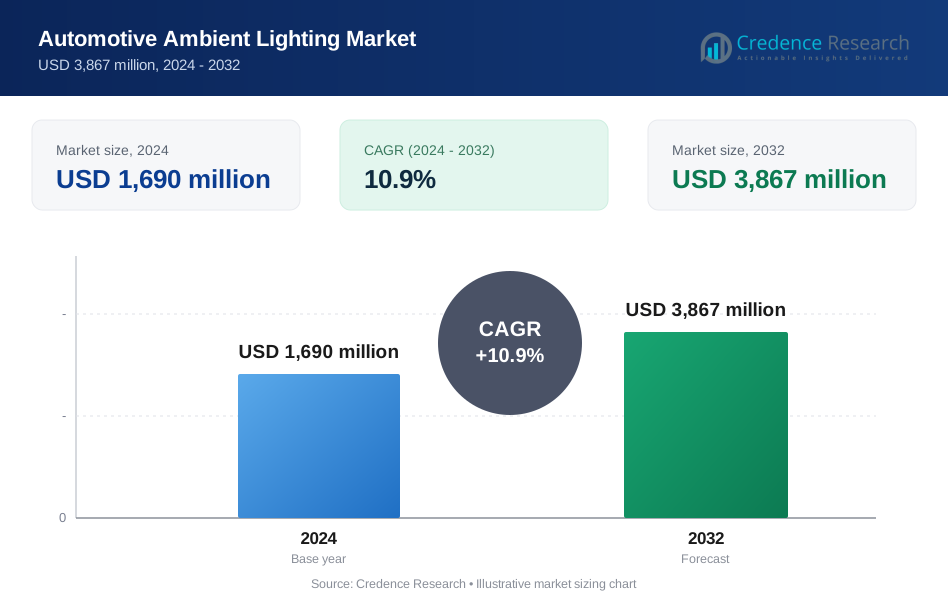
The Automotive Ambient Lighting Market is projected to grow from USD 1690 million in 2024 to an estimated USD 3867 million by 2032, with a compound annual growth rate (CAGR) of 10.9% from 2024 to 2032.
Key drivers contributing to the growth of this market include increasing demand for premium and personalized in-car experiences. Consumers now view ambient lighting not only as an aesthetic enhancement but also as a feature that improves driving comfort and interior perception. Automakers are capitalizing on this trend by integrating advanced lighting systems, especially in mid-range and luxury vehicles. Technological advancements, particularly in LED and OLED technologies, have enabled energy-efficient, versatile, and durable lighting solutions, expanding the scope of design and customization. Additionally, ambient lighting improves nighttime visibility and enhances driver safety by making vehicle controls more intuitive. The rise of electric vehicles (EVs), which emphasize innovative and futuristic interiors, further amplifies demand for ambient lighting systems. This synergy between technological capability and evolving consumer preferences continues to drive market expansion.
Regionally, Asia-Pacific leads the automotive ambient lighting market, supported by large-scale automobile production, rapid urbanization, and rising adoption of in-car advanced features, particularly in China, Japan, and South Korea. The presence of major automotive manufacturers and increasing consumer spending on vehicle enhancements sustain the region's dominance. North America is also witnessing strong growth due to high consumer demand for luxury vehicles and advanced features. The region benefits from strong R&D capabilities and a mature automotive sector focused on innovation. Europe maintains a significant share owing to its regulatory emphasis on vehicle safety and efficiency, combined with a longstanding tradition of automotive excellence. Meanwhile, markets in Latin America, the Middle East, and Africa are gradually emerging, driven by increasing vehicle ownership and rising awareness of automotive innovations. These regional dynamics collectively contribute to the upward trajectory of the global automotive ambient lighting market.
Market Insights:
- The automotive ambient lighting market is projected to grow from USD 1,690 million in 2024 to USD 3,867 million by 2032, registering a CAGR of 10.9%.
- Increasing consumer demand for personalized in-car experiences drives the adoption of ambient lighting across mid-range and luxury vehicles.
- LED and OLED technologies lead market innovation, enabling energy-efficient, flexible, and visually appealing interior lighting solutions.
- Ambient lighting enhances safety by illuminating key interior zones and integrating with alert systems for improved driver awareness.
- Electric vehicle growth accelerates demand, with ambient lighting supporting futuristic interior designs and interactive vehicle features.
- High integration costs and design complexity challenge adoption in low-cost vehicle segments and price-sensitive markets.
- Asia-Pacific leads the global market with 42% share, followed by Europe and North America, while Latin America and the Middle East & Africa show emerging growth.
Market Drivers:
Increased Consumer Focus on Enhanced In-Car Experiences Drives Demand for Ambient Lighting
Consumers are prioritizing comfort, personalization, and visual appeal when selecting vehicles, prompting manufacturers to adopt ambient lighting as a key feature. Interior lighting significantly improves the perceived value of vehicles by enhancing cabin aesthetics and creating a refined driving atmosphere. The growing popularity of customizable lighting options, including color selection and mood settings, supports this shift in consumer preference. The Automotive Ambient Lighting Market benefits from this trend, with automakers offering ambient lighting even in mid-range vehicle segments. Luxury vehicle buyers, in particular, expect high-end lighting systems that reflect lifestyle and personality. This focus on the emotional and experiential aspect of driving pushes OEMs to integrate ambient lighting solutions across various models.
- For example, Tesla’s updated Model Y, launched in China in October 2023, features new ambient LED lighting strips that span the entire dashboard, reflecting the brand’s commitment to immersive, customizable interiors.
Rapid Technological Advancements Enable Superior Design and Energy Efficiency
Technological developments in LED, OLED, and fiber-optic lighting solutions are revolutionizing automotive interior designs. These technologies provide low power consumption, longer life cycles, and flexible design integration, making them ideal for modern vehicle interiors. Automakers use these innovations to implement complex lighting patterns and dynamic effects that enhance the brand identity and user experience. The Automotive Ambient Lighting Market capitalizes on these advancements to meet evolving aesthetic and functional requirements. Advanced lighting systems also allow smoother dimming, intelligent color transitions, and better integration with infotainment and driver assistance systems. It positions ambient lighting as both a design and technology differentiator in the competitive automotive landscape.
- For instance, ams OSRAM and Valeo announced a collaboration in December 2024 to integrate OSIRE E3731i intelligent RGB LEDs into vehicle interiors, enabling dynamic ambient lighting that responds to navigation cues and driver assistance alerts, thereby enhancing both user experience and safety
Safety and Functionality Remain Central to Ambient Lighting Integration
Beyond aesthetics, ambient lighting improves visibility and enhances driver awareness during night driving or in low-light environments. It provides subtle illumination to dashboards, door handles, cup holders, and footwells, helping users navigate the cabin without distractions. Many manufacturers now link ambient lighting with vehicle alerts and warnings, using visual cues to signal door ajar notifications, navigation prompts, or driver fatigue alerts. The Automotive Ambient Lighting Market aligns with safety priorities by embedding lighting systems that support safer and more intuitive driving. Regulatory bodies also recognize the safety benefits of ambient lighting, encouraging further integration into vehicle designs. It serves not only decorative purposes but also supports practical and safety-related functions.
Rising Electric Vehicle Adoption Promotes Innovation in Interior Lighting
Electric vehicles often feature futuristic interiors designed to differentiate them from traditional fuel-based vehicles. Ambient lighting plays a vital role in shaping this futuristic image, enabling automakers to deliver sleek, minimalistic, and high-tech interiors. The Automotive Ambient Lighting Market benefits from this shift, as EV makers emphasize smart lighting features to enhance driver interaction and convey vehicle status. Innovations include ambient lights synchronized with charging status, driving modes, or climate control. EV platforms also offer more design flexibility, allowing manufacturers to experiment with new lighting placements and effects. It opens new growth opportunities by making ambient lighting a core component of next-generation vehicle interiors.
Market Trends:
OEMs Prioritize Customization to Enhance Vehicle Brand Identity and Buyer Appeal
Automakers are increasingly using ambient lighting as a tool for brand differentiation and consumer engagement. Many manufacturers offer signature lighting schemes that reflect brand themes or performance features, contributing to brand recognition and loyalty. Customization options, such as selectable color palettes and lighting patterns, allow buyers to personalize their driving experience. The Automotive Ambient Lighting Market reflects this shift by offering modular systems that can adapt to user preferences and vehicle segments. Ambient lighting has evolved from static, single-color systems to dynamic, interactive elements that align with brand positioning. It enhances vehicle desirability and strengthens emotional connections between users and their vehicles.
- For instance, Volkswagen offers a configurable ambient lighting system with up to 30 selectable colors in models like the Passat and Golf, allowing owners to personalize footwell and interior lighting to their preference.
Integration with Smart Vehicle Ecosystems Transforms Lighting into an Interactive Interface
Ambient lighting now functions beyond aesthetics, becoming an integrated part of the vehicle’s smart ecosystem. Manufacturers are connecting lighting systems to infotainment, navigation, and driver assistance technologies to create responsive, context-aware environments. Features such as lights that change with music beats, react to driving modes, or provide visual warnings are gaining traction. The Automotive Ambient Lighting Market supports this trend through intelligent control modules and software-driven lighting profiles. Integration with voice assistants and gesture controls further expands ambient lighting’s role in user interaction. It demonstrates the convergence of lighting with digital technologies, elevating its value in the overall in-car experience.
- The 2025 Porsche Taycan, for example, features ambient lighting that can be controlled via smartphone apps and responds dynamically to music and infotainment cues, enhancing user interaction.
Sustainability Trends Push Development of Energy-Efficient and Eco-Friendly Lighting Systems
Environmental concerns and fuel efficiency targets are driving the adoption of low-energy lighting systems, particularly LEDs and OLEDs. Automakers are phasing out older incandescent systems in favor of compact, energy-saving alternatives that reduce power consumption without compromising illumination quality. The Automotive Ambient Lighting Market aligns with sustainability goals by promoting durable materials and reduced lifecycle emissions. Recyclable components, low-heat emission technologies, and modular lighting units support this shift toward greener designs. It helps manufacturers meet environmental regulations while appealing to environmentally conscious consumers. The trend reinforces ambient lighting’s relevance in a sustainability-focused automotive sector.
Premium and Mid-Range Vehicles Lead the Expansion of Advanced Lighting Features
High-end ambient lighting features are no longer exclusive to luxury vehicles. Automakers are equipping mid-range and even entry-level models with sophisticated lighting solutions to attract wider demographics. Color-changing lights, synchronized animations, and welcome scenarios are now accessible in mainstream vehicles. The Automotive Ambient Lighting Market benefits from this democratization, as volume sales rise through broader integration across price segments. Competitive pressure compels brands to enhance standard offerings with ambient lighting, especially in emerging markets. It underscores the growing perception of ambient lighting as a standard feature rather than a luxury add-on.
Market Challenges Analysis:
High System Costs and Complex Integration Limit Adoption in Low-Cost Vehicle Segments
Cost remains a major barrier to the widespread adoption of ambient lighting systems, particularly in price-sensitive markets. Advanced lighting features require high-quality components, software integration, and specialized design, which increase manufacturing expenses. Many budget vehicle manufacturers hesitate to implement ambient lighting due to concerns over pricing competitiveness. The Automotive Ambient Lighting Market feels the impact of these limitations, especially in developing regions where affordability drives purchasing decisions. Integration also demands compatibility with other electronic systems, which raises engineering complexity and extends development cycles. It restricts the scalability of ambient lighting across all vehicle classes.
- For instance, Hyundai and other automakers typically reserve advanced ambient lighting features for higher-end models due to cost constraints.
Durability, Regulatory Compliance, and Standardization Present Design Challenges
Ambient lighting systems must maintain durability under varying temperature, humidity, and vibration conditions. Ensuring consistent performance and longevity in harsh automotive environments poses significant technical hurdles for manufacturers. Strict regulations concerning driver distraction and lighting intensity require continuous compliance, limiting design freedom and innovation. The Automotive Ambient Lighting Market faces these constraints while aiming to balance aesthetics, safety, and efficiency. Lack of standardization across regions and automakers adds to the complexity, increasing costs for suppliers and slowing time-to-market. It makes achieving global design uniformity and performance consistency more difficult.
Market Opportunities:
Electric and autonomous vehicles offer greater flexibility in interior design, encouraging innovative use of ambient lighting. With fewer mechanical constraints, automakers can experiment with lighting zones, dynamic effects, and responsive features that enhance user experience. The Automotive Ambient Lighting Market stands to benefit from these shifts, as manufacturers explore lighting applications that convey vehicle status, support user interaction, and elevate interior aesthetics. EV startups and tech-driven brands prioritize lighting to define their identity and attract younger, tech-savvy buyers. It enables suppliers to introduce advanced solutions tailored for these high-growth segments. Rising demand for futuristic interiors further amplifies this opportunity.
Growing consumer interest in smart cabins and personalized driving experiences creates strong demand for customizable lighting features. Automakers are integrating ambient lighting with gesture control, voice commands, and health-monitoring systems to offer enriched user engagement. The Automotive Ambient Lighting Market leverages these trends to develop intelligent systems that adapt to driver mood, time of day, or environmental conditions. Customization options allow manufacturers to offer tiered features that appeal across different vehicle classes. It opens the door for premium upgrades, subscription-based features, and brand-exclusive designs. Evolving buyer expectations for immersive experiences drive innovation in this space.
Market Segmentation Analysis:
The Automotive Ambient Lighting Market
By product type is categorized into dashboard, footwell, door and window, center console, roof, and other lighting applications such as trunk and glovebox. Dashboard ambient lighting dominates due to its integration with digital displays and instrument clusters, enhancing both aesthetics and driver focus. Door and window lighting contributes to cabin luxury and ease of use during entry and exit. Footwell and center console lighting improve visibility and passenger comfort, especially during night driving. Roof lighting systems, often paired with panoramic sunroofs, create immersive cabin experiences. The "others" category, including trunk and glovebox lighting, continues to grow as automakers focus on complete interior illumination.
By technology, the market is led by LED lighting, valued for its energy efficiency, long lifespan, and flexible design capabilities. LED solutions are widely adopted across all vehicle segments. OLED is emerging in high-end models, offering ultra-thin, bendable lighting designs that enhance luxury appeal. Laser lighting provides high-intensity, focused beams but remains limited to niche applications. Xenon and halogen technologies are declining due to higher power consumption and limited adaptability to evolving vehicle architectures. The Automotive Ambient Lighting Market actively shifts toward advanced, sustainable technologies that meet both regulatory requirements and design expectations.
By Vehicle type segmentation includes passenger cars and commercial vehicles. Passenger cars dominate the market share, with ambient lighting increasingly seen in both mid-range and luxury models. Consumers seek personalized and immersive in-cabin experiences, driving the demand in this segment. Commercial vehicles are gradually integrating ambient lighting to enhance driver comfort and reflect brand identity, especially in premium buses and executive fleets. Automakers focus on delivering value-added lighting systems across diverse vehicle categories to enhance market penetration.
By sales channel, the market is split between OEM and aftermarket. OEMs account for the majority of installations, as ambient lighting is integrated during vehicle assembly and aligns with the vehicle's electrical architecture and design. OEM-supplied lighting systems offer superior performance, reliability, and warranty coverage. The aftermarket segment caters to customization needs and budget-conscious consumers, offering flexible retrofit options. However, it faces challenges in integration quality and compatibility. The OEM channel continues to dominate as automakers embed ambient lighting into brand identity and user experience.
Segmentation:
By Product Type
- Dashboard Ambient Lighting
- Footwell Ambient Lighting
- Door and Window Ambient Lighting
- Center Console Ambient Lighting
- Roof Ambient Lighting
- Others (Trunk, Glovebox, etc.)
. By Technology
- LED (Light Emitting Diode)
- OLED (Organic LED)
- Laser
- Xenon
- Halogen
By Vehicle Type
- Passenger Cars
- Commercial Vehicles
By Sales Channel
- OEM (Original Equipment Manufacturer)
- Aftermarket
By Region
- North America
- U.S.
- Canada
- Mexico
- Europe
- UK
- France
- Germany
- Italy
- Spain
- Russia
- Belgium
- Netherlands
- Austria
- Sweden
- Poland
- Denmark
- Switzerland
- Rest of Europe
- Asia Pacific
- China
- Japan
- South Korea
- India
- Australia
- Thailand
- Indonesia
- Vietnam
- Malaysia
- Philippines
- Taiwan
- Rest of Asia Pacific
- Latin America
- Brazil
- Argentina
- Peru
- Chile
- Colombia
- Rest of Latin America
- Middle East
- UAE
- KSA
- Israel
- Turkey
- Iran
- Rest of Middle East
- Africa
- Egypt
- Nigeria
- Algeria
- Morocco
- Rest of Africa
Regional Analysis:
Asia Pacific holds the largest share in the Automotive Ambient Lighting Market, accounting for nearly 42% of global revenue in 2024. Strong vehicle production hubs in China, Japan, South Korea, and India contribute to this dominance. High demand for mid-range and premium vehicles with enhanced comfort features supports ambient lighting integration across multiple segments. Government incentives for electric vehicles and the growing adoption of connected cars further boost market prospects. Leading automakers in the region focus on incorporating advanced lighting systems to cater to tech-savvy urban consumers. It strengthens Asia Pacific’s leadership position in both manufacturing and consumption of automotive ambient lighting systems.
Europe follows with approximately 29% market share, driven by the region’s focus on automotive innovation, regulatory compliance, and safety. OEMs in Germany, France, and Italy lead the way in integrating ambient lighting with advanced driver assistance and infotainment systems. The region’s luxury vehicle segment remains a major growth driver, with ambient lighting being a standard feature in most premium models. Strict EU regulations encourage energy-efficient lighting solutions, favoring the adoption of LED-based ambient lighting systems. The Automotive Ambient Lighting Market benefits from Europe’s long-standing emphasis on quality, safety, and user experience. It maintains steady growth through continuous design advancements and OEM collaborations.
North America holds around 21% of the global market share, supported by strong consumer demand for high-tech, comfort-oriented vehicles. The U.S. automotive industry drives innovation through partnerships with technology companies that focus on smart cabin features. Growing electric vehicle adoption and rising preference for feature-rich SUVs and trucks fuel demand for ambient lighting systems. Automakers incorporate lighting not just for aesthetics but also to enhance driver interaction and brand identity. The Automotive Ambient Lighting Market in North America remains competitive, with OEMs emphasizing personalized and connected in-car environments. It continues to gain momentum through design differentiation and customer-centric innovation.
Key Player Analysis:
- ams-OSRAM AG
- Dräxlmaier Group
- Grupo Antolin
- HELLA GmbH & Co. KGaA (Faurecia SE)
- Koito Manufacturing Co. Ltd.
- Koninklijke Philips N.V. / Philips Lighting
- Marelli Holdings Co. Ltd
- Robert Bosch GmbH
- Stanley Electric Co. Ltd.
- Valeo
Competitive Analysis:
The Automotive Ambient Lighting Market features a competitive landscape marked by innovation, strategic partnerships, and expanding product portfolios. Leading players such as Hella GmbH & Co. KGaA, Valeo S.A., OSRAM GmbH, and Grupo Antolin dominate the market by offering advanced, customizable lighting solutions tailored to OEM specifications. These companies focus on energy efficiency, seamless integration, and smart lighting systems to strengthen their market presence. Emerging players and tier-2 suppliers are entering with cost-effective, design-flexible offerings targeting mid-range vehicle segments. The market sees continuous investment in R&D to enhance performance, user experience, and software compatibility. It reflects growing demand for intelligent and personalized cabin environments across vehicle classes. Competitive intensity rises as global automakers demand scalable, reliable solutions to differentiate models in a crowded market. The Automotive Ambient Lighting Market evolves rapidly, driven by technological progress and the strategic positioning of key suppliers within the broader automotive value chain.
Recent Developments:
- In December 2024, ams OSRAM and Valeo officially announced a strategic cooperation to transform vehicle interiors into dynamic environments. This partnership centers on the integration of the innovative Open System Protocol (OSP) technology and the OSIRE E3731i intelligent RGB LEDs, enabling highly customizable and responsive ambient lighting solutions for automotive interiors. The collaboration is confirmed by multiple official press releases and industry news outlets, establishing its authenticity.
- In July 2023, Marelli launched the h-Digi® microLED, a next-generation digital lighting solution for automotive front lighting. This product, developed in partnership with ams OSRAM, is based on the EVIYOS 2.0 light source and offers high-resolution, adaptive, and dynamic headlight operation. The launch and its technological details are validated by Marelli’s official press release and corroborated by several independent industry sources.
- In May 2022, HELLA introduced the Slim Light System, a new generation of ambient vehicle lighting that combines advanced lighting solutions with sensor technology to enhance interior comfort, safety, and communication between occupants and the vehicle. This product launch is supported by HELLA’s official press release and additional industry reporting
Market Concentration & Characteristics:
The Automotive Ambient Lighting Market demonstrates moderate to high market concentration, with a few established players holding significant shares due to their technological expertise, global OEM partnerships, and expansive product lines. It exhibits characteristics of a technology-driven and design-intensive sector where innovation, customization, and integration capabilities shape competitive advantage. Leading firms invest heavily in research and development to meet evolving consumer expectations and regulatory standards. The market favors suppliers that offer flexible production, scalable solutions, and strong aftersales support. Entry barriers remain substantial due to high capital requirements, stringent quality standards, and complex integration with in-vehicle systems. It continues to evolve with trends in smart mobility, EV adoption, and personalized interiors.
Report Coverage:
The research report offers an in-depth analysis based on Product Type, Technology, Vehicle Type and Sales Channel. It details leading market players, providing an overview of their business, product offerings, investments, revenue streams, and key applications. Additionally, the report includes insights into the competitive environment, SWOT analysis, current market trends, as well as the primary drivers and constraints. Furthermore, it discusses various factors that have driven market expansion in recent years. The report also explores market dynamics, regulatory scenarios, and technological advancements that are shaping the industry. It assesses the impact of external factors and global economic changes on market growth. Lastly, it provides strategic recommendations for new entrants and established companies to navigate the complexities of the market.
Future Outlook:
- Increasing EV adoption will drive demand for innovative ambient lighting systems that enhance futuristic cabin designs.
- OEMs will continue integrating ambient lighting with ADAS and infotainment systems to improve user experience.
- Cost optimization and modular lighting solutions will enable broader adoption across entry and mid-level vehicle segments.
- Growth in autonomous vehicles will create new opportunities for dynamic interior lighting tied to passenger activities.
- Advancements in LED, OLED, and fiber-optic technologies will support energy efficiency and design flexibility.
- Personalization features, including app-based controls and driver recognition, will become standard offerings.
- Rising consumer preference for smart cabins will push suppliers to innovate with AI-driven lighting responses.
- Global regulatory trends will favor low-energy, compliant lighting solutions that support sustainable mobility.
- Collaborations between lighting manufacturers and automotive tech firms will accelerate product development cycles.
- Emerging markets in Latin America and Southeast Asia will provide new revenue streams for ambient lighting suppliers.
Request a Free Sample
Fill in your details and we'll send you a free sample report.
- Sample data tables & charts
- Research methodology
Need a Custom Version of This Report?
Tailor the scope, geography, or segments to your exact requirements.
- Custom geography or segment scope
- Direct access to our analyst team
Frequently Asked Questions
What is the current size of the Automotive Ambient Lighting Market?
What factors are driving the growth of the Automotive Ambient Lighting Market?
What are some challenges faced by the Automotive Ambient Lighting Market?
Who are the major players in the Automotive Ambient Lighting Market?
Table of Content
Chapter 1. Report Introduction
- 1.1 Report Description & Purpose
- 1.1.1 Report Title & Market Definition
- 1.1.2 Unique Selling Propositions (USP) & Key Differentiators
- 1.1.3 Value Proposition for Stakeholders
- 1.2 Research Objectives
- 1.2.1 Market Sizing Objectives (Volume & Revenue) (Volume Where Applicable)
- 1.2.2 Segmentation Objectives
- 1.2.3 Competitive Intelligence Objectives
- 1.2.4 Forecast & Scenario Objectives
- 1.3 Report Scope
- 1.3.1 Automotive Ambient Lighting Scope – Segments & Subsegments Covered
- 1.3.2 Geographic Scope – Regions & Countries Covered
- 1.3.3 Historical Period, Base Year & Forecast Period (2024; forecast to 2032)
- 1.3.4 Inclusions & Exclusions
- 1.4 Industry Classification & Applicable Codes
- 1.5 Currency, Measurement Units & Valuation Basis
- 1.6 Target Stakeholders
- 1.7 Limitations & Assumptions
Chapter 2. Executive Summary
- 2.1 Global Automotive Ambient Lighting Market Snapshot
- 2.1.1 Market Size – Historical (2024) & Forecast (2024-2032) (2024: USD 1,690 million → 2032: USD 3,867 million)
- 2.1.2 Volume & Revenue – Global Totals (Volume Where Applicable)
- 2.1.3 Key Market Highlights – Top Five Facts
- 2.2 Automotive Ambient Lighting Market Segmentation Snapshot
- 2.2.1 Market Split by Region – 2024 vs. 2032
- 2.3 Competitive Snapshot
- 2.3.1 Top 10 Players by Revenue Share – 2024
- 2.3.2 Top 10 Players by Volume Share – 2024 (Volume Where Applicable)
- 2.3.3 Recent Strategic Developments (18-Month Summary)
- 2.4 Key Investment Highlights & Strategic Conclusions
Chapter 3. Automotive Ambient Lighting Market Dynamics & Industry Analysis
- 3.1 Market Overview & Context
- 3.1.1 Automotive Ambient Lighting Market Position in the Broader Industry Value Chain
- 3.1.2 Demand Structure & Purchasing Dynamics
- 3.1.3 Market Maturity & Development Stage by Region
- 3.2 Automotive Ambient Lighting Market Drivers
- 3.3 Automotive Ambient Lighting Market Restraints & Challenges
- 3.4 Automotive Ambient Lighting Market Opportunities
- 3.5 Porter's Five Forces Analysis
- 3.5.1 Threat of New Entrants
- 3.5.2 Bargaining Power of Suppliers
- 3.5.3 Bargaining Power of Buyers
- 3.5.4 Threat of Substitutes
- 3.5.5 Competitive Rivalry – Intensity Assessment
- 3.6 Automotive Ambient Lighting Value Chain Analysis
- 3.6.1 Upstream – Key Inputs, Resources & Suppliers
- 3.6.1.1 Key Input/Resource 1
- 3.6.1.2 Key Input/Resource 2
- 3.6.1.3 Key Input/Resource 3
- 3.6.2 Midstream – Core Operations & Value Creation
- 3.6.2.1 Operating Model & Process Overview
- 3.6.2.2 Key Operating Locations & Capabilities by Company
- 3.6.3 Downstream – Market Channels & End Users
- 3.6.3.1 Direct Sales & Customer Engagement Channels
- 3.6.3.2 Indirect Sales, Intermediaries & Partner Channels
- 3.6.4 Value Chain Profitability Analysis
- 3.6.1 Upstream – Key Inputs, Resources & Suppliers
- 3.7 PESTEL Analysis
- 3.7.1 Political Factors
- 3.7.2 Economic Factors
- 3.7.3 Social Factors
- 3.7.4 Technological Factors
- 3.7.5 Environmental Factors
- 3.7.6 Legal Factors
- 3.8 Automotive Ambient Lighting Supply Chain Analysis
- 3.8.1 Critical Input & Resource Availability Risk Assessment
- 3.8.2 Supplier & Operational Concentration Risk (Geographic Exposure)
- 3.8.3 Supply & Service Disruption Impact Analysis
- 3.9 Regulatory & Policy Landscape
Note: The regulatory and policy landscape section covers regulations based on their applicability to the market, Automotive Ambient Lighting category, geography, and scope of the study. Only regulatory frameworks with a material impact on operations, compliance, trade, sustainability, or market access are analyzed in detail.
Chapter 4. Key Investment Pockets & Opportunity Analysis
- 4.1 Automotive Ambient Lighting Market Attractiveness Analysis
- 4.1.1 By Region – Investment Attractiveness Matrix (Market Size × CAGR)
- 4.2 Absolute Revenue Growth Opportunity
- 4.2.1 By Region – Absolute Revenue Growth Through 2032
- 4.3 Incremental Demand Opportunity
- 4.3.1 By Region – Incremental Demand Through 2032
- 4.3.2 Segment – Incremental Demand
- 4.4 Emerging Submarket Opportunity Deep Dive (Subject to Applicability)
- 4.5 Priority Market Opportunity Scorecards
- 4.5.1 United States
- 4.5.2 Europe
- 4.5.3 Asia
- 4.5.4 Middle East & Africa
Note: Priority market opportunity scorecards reflect the geographic scope and strategic relevance of the study. Listed markets are indicative and may be adapted to the industry.
Chapter 5. Automotive Ambient Lighting Cross-Border Trade & Market Access Analysis
- 5.1 International Trade & Cross-Border Activity Overview
- 5.1.1 Global Export Value by Country (2024)
- 5.1.2 Global Export Volume by Country (2024) (Volume Where Applicable)
- 5.1.3 Global Import Value by Country (2024)
- 5.1.4 Global Import Volume by Country (2024) (Volume Where Applicable)
- 5.1.5 Net Trade Balance by Country (2024)
- 5.2 Export Analysis – Segment
- 5.2.1 Category 1 (Applicable Classification Code)
- 5.2.2 Category 2 (Applicable Classification Code)
- 5.2.3 Category 3 (Applicable Classification Code)
- 5.2.4 Category 4 (Applicable Classification Code)
- 5.2.5 Category 5 (Applicable Classification Code)
- 5.3 Import Analysis – Segment
- 5.3.1 Category 1 (Applicable Classification Code)
- 5.3.2 Category 2 (Applicable Classification Code)
- 5.3.3 Category 3 (Applicable Classification Code)
- 5.3.4 Category 4 (Applicable Classification Code)
- 5.3.5 Category 5 (Applicable Classification Code)
- 5.4 Cross-Border Pricing & Transaction Benchmarks
- 5.4.1 Export Pricing – Segment & Country
- 5.4.2 Import Pricing – Segment & Source Country
- 5.4.3 Price Trends (2024)
- 5.5 Key Cross-Border Trade & Delivery Routes
- 5.5.1 Cross-Border Trade/Delivery Route 1
- 5.5.2 Cross-Border Trade/Delivery Route 2
- 5.5.3 Cross-Border Trade/Delivery Route 3
- 5.5.4 Cross-Border Trade/Delivery Route 4
- 5.5.5 Cross-Border Trade/Delivery Route 5
- 5.6 Trade Policy & Market Access Impact Assessment
- 5.6.1 Tariff & Non-Tariff Barriers
- 5.6.2 Regional Trade & Economic Integration Frameworks
- 5.6.3 Bilateral & Multilateral Trade Agreements
- 5.6.4 Cross-Border Operating, Licensing & Localization Requirements
Note: This chapter applies where cross-border trade or delivery is relevant to Automotive Ambient Lighting. Goods, services, and digital offerings are assessed using applicable classifications and transaction measures. Import-export volumes, trade balances, and route analyses are included only where meaningful to the market.
Chapter 6. Competitive Landscape & Company Benchmarking
- 6.1 Automotive Ambient Lighting Market Concentration & Structure
- 6.1.1 Herfindahl-Hirschman Index (HHI) – vs. 2024
- 6.1.2 Leading, Mid-Sized & Emerging Player Structure
- 6.1.3 Global, Regional & Local Player Dynamics
- 6.2 Automotive Ambient Lighting Market Share Analysis – 2024
- 6.2.1 Global Revenue Share by Company
- 6.2.2 Global Volume Share by Company (Volume Where Applicable)
- 6.2.3 Regional Revenue Share
- 6.2.4 Market Share Evolution ( vs. 2024)
- 6.2.5 Company Market Share by Key Segment
- 6.2.6 Company Market Share by Customer Group
- 6.3 Operating Scale, Capacity & Infrastructure Analysis
- 6.3.1 Global Operating Scale & Supply Capacity
- 6.3.2 Resource Utilization & Operating Efficiency
- 6.3.3 Output, Service Delivery & Activity Metrics
- 6.3.4 Operating Footprint & Infrastructure Map
- 6.3.5 Planned Operational & Capacity Expansion
- 6.4 Automotive Ambient Lighting Competitive Benchmarking Matrix
- 6.4.1 Revenue, Growth, Profitability & Operating Metric Comparison
- 6.4.2 Channel Revenue Mix
- 6.4.3 Geographic Revenue Exposure
- 6.4.4 R&D Intensity
- 6.4.5 Sustainability Maturity
- 6.5 Strategic Developments in Automotive Ambient Lighting (Last 24 Months)
- 6.5.1 Mergers, Acquisitions & Divestments
- 6.5.2 New Products, Services & Solutions in Automotive Ambient Lighting
- 6.5.3 Operational & Infrastructure Expansions
- 6.5.4 Strategic Alliances, Joint Ventures & Partnerships
- 6.5.5 Distribution Expansion & Market Entry
- 6.5.6 Sustainability & ESG Initiatives
- 6.6 Competitive Strategy Mapping
- 6.6.1 Leader, Challenger, Follower & Niche Classification
- 6.6.2 Pricing Strategy Comparison
- 6.6.3 Channel Strategy Matrix
Note: Strategic developments are included based on their materiality and the availability of reliable information.
Chapter 7. Global Automotive Ambient Lighting Market – By Sales & Delivery Channel
- 7.1 Segment Overview
- 7.1.1 Volume & Revenue Split by Channel (2024 & 2032) (Volume Where Applicable)
- 7.1.2 Channel Mix Evolution (2024-2032)
Chapter 8. Regional Market Analysis – Global Overview
- 8.1 Global Regional Overview
- 8.1.1 Regional Volume Share (Volume Where Applicable)
- 8.1.2 Regional Revenue Share
- 8.1.3 Regional Volume by Region (Volume Where Applicable)
- 8.1.4 Regional Revenue by Region
- 8.1.5 Regional Forecast Through 2032
- 8.2 Cross-Regional Segment Analysis
- 8.2.1 By Sales & Delivery Channel
- 8.2.2 By Competitive Positioning & Price Tier
Chapter 9. North America Automotive Ambient Lighting Market
- 9.1 United States
- 9.2 Canada
- 9.3 Mexico
Chapter 10. Europe Automotive Ambient Lighting Market
- 10.1 Germany
- 10.2 France
- 10.3 Italy
- 10.4 United Kingdom
- 10.5 Spain
- 10.6 Poland
- 10.7 Russia
- 10.8 Netherlands
- 10.9 Belgium
- 10.10 Sweden
- 10.11 Denmark
- 10.12 Norway
- 10.13 Rest of Europe
Chapter 11. Asia Pacific Automotive Ambient Lighting Market
- 11.1 China
- 11.2 India
- 11.3 Japan
- 11.4 South Korea
- 11.5 Thailand
- 11.6 Indonesia
- 11.7 Vietnam
- 11.8 Malaysia
- 11.9 Australia
- 11.10 Rest of Asia Pacific
Chapter 12. Latin America Automotive Ambient Lighting Market
- 12.1 Brazil
- 12.2 Argentina
- 12.3 Colombia
- 12.4 Chile
- 12.5 Rest of Latin America
Chapter 13. Middle East Automotive Ambient Lighting Market
- 13.1 Saudi Arabia
- 13.2 United Arab Emirates
- 13.3 Turkey
- 13.4 Israel
- 13.5 Iran
- 13.6 Rest of the Middle East
Chapter 14. Africa Automotive Ambient Lighting Market
- 14.1 South Africa
- 14.2 Egypt
- 14.3 Nigeria
- 14.4 Morocco
- 14.5 Rest of Africa
Chapter 15. Automotive Ambient Lighting Company Profiles
- 15.1 [Company 01]
- 15.1.1 Company Overview
- 15.1.2 Key Management Personnel
- 15.1.3 Products & Services Portfolio
- 15.1.4 Financial Performance
- 15.1.5 Key Market Focus & Geographic Presence
- 15.1.6 Recent Developments & Strategic Initiatives
Note: The company profile list is preliminary and may change based on research findings, market developments, data availability, and client requirements.
Chapter 16. Appendices
- Appendix A – List of Abbreviations & Acronyms
- Appendix B – Industry Classification Code Reference – Full Series
- Appendix C – Supply, Output & Operating Capacity Data Tables
- Appendix D – End-Use & Demand Base Tables
- Appendix E – Demand, Adoption & Usage Assumptions
- Appendix F – Pricing & Revenue Metric Reference Tables
- Appendix G – Company Operations & Infrastructure Database
- Appendix H – Cross-Border Trade & Activity Data Tables (Where Applicable)
- Appendix I – Regulatory Summary Tables
- Appendix J – Primary Research Participant List (Anonymized)
- Appendix K – Primary Research Questionnaire Framework
- Appendix L – Data Sources & Bibliography
- Appendix M – Market Size Divergence & Source Comparison
Chapter 17. Research Methodology
- 17.1 Research Framework & Philosophy
- 17.2 Secondary Research – Sources, Hierarchy & Data Extraction
- 17.3 Data Modeling – Bottom-Up & Top-Down Market Sizing
- 17.4 Primary Research – Stakeholder Framework, LOI & Sample Sizes
- 17.5 Forecast Methodology – Regression, Scenario & Sensitivity Analysis
- 17.6 Quality Control – Four-Layer Validation Framework
- 17.7 Limitations & Standard Assumptions
- 17.8 Disclaimer
