
Automotive Interior Market Overview:
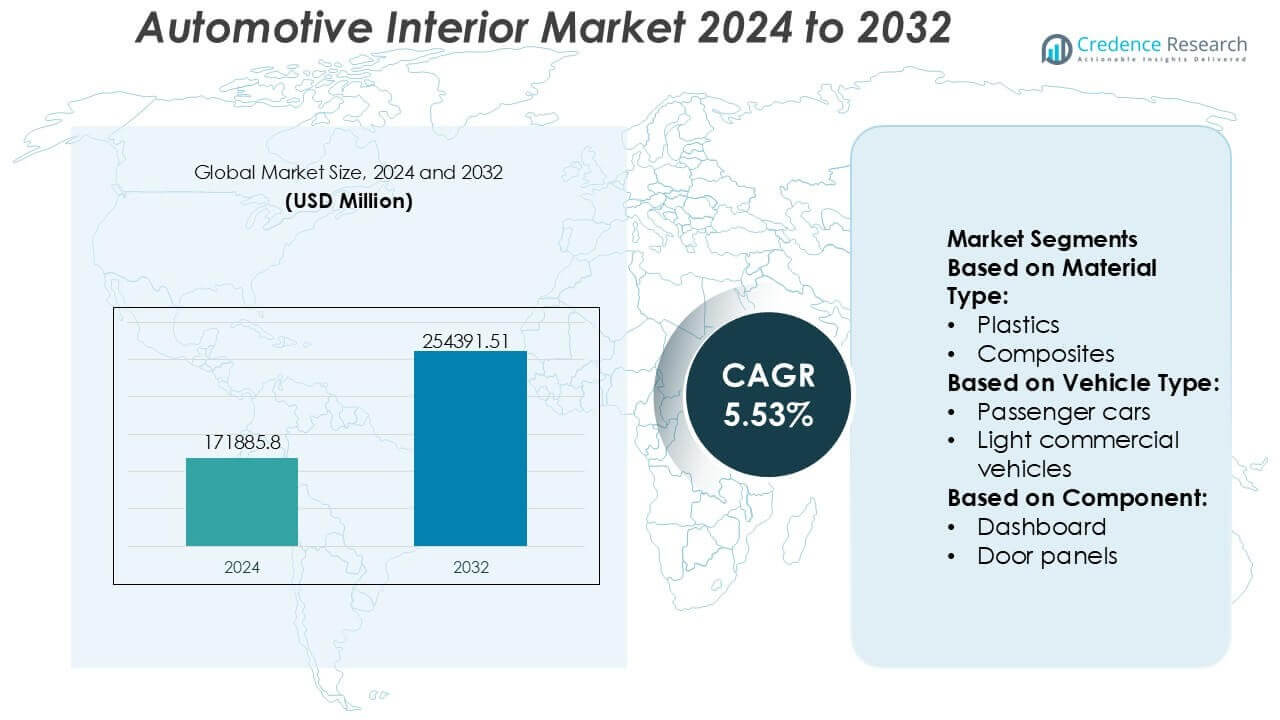
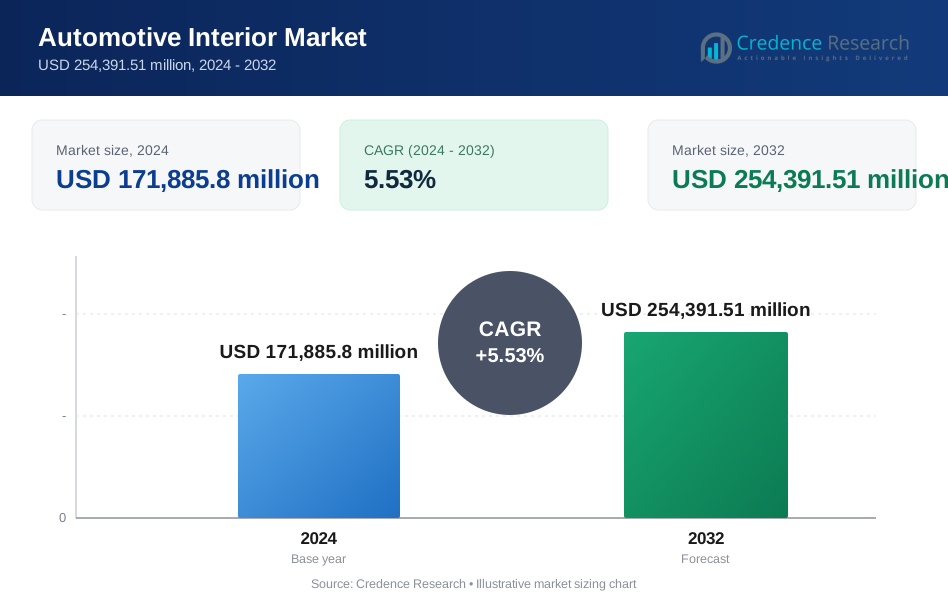
Automotive Interior Market size was valued USD 171885.8 million in 2024 and is anticipated to reach USD 254391.51 million by 2032, at a CAGR of 5.53% during the forecast period.
| REPORT ATTRIBUTE | DETAILS |
|---|---|
| Historical Period | 2020-2023 |
| Base Year | 2024 |
| Forecast Period | 2025-2032 |
| Automotive Interior Market Size 2024 | USD 171885.8 million |
| Automotive Interior Market, CAGR | 5.53% |
| Automotive Interior Market Size 2032 | USD 254391.51 million |
Automotive Interior Market Insights
- Market growth is primarily driven by OEM focus on premium cabin experiences, higher adoption of digital dashboards, advanced seating systems, and lightweight interior materials that improve fuel efficiency and electric vehicle range.
- Key market trends include growing use of sustainable and recyclable materials, integration of smart surfaces and ambient lighting, and rising demand for modular interior systems, with seating and dashboard components collectively accounting for over 40% segment share.
- The competitive landscape is shaped by global Tier-1 suppliers leveraging scale, vertical integration, and long-term OEM partnerships to deliver complete interior systems across passenger and commercial vehicles.
- Asia-Pacific leads the market with a dominant 34% regional share, driven by high vehicle manufacturing volumes in China, Japan, India, and South Korea, while Europe and North America follow with strong demand for premium and technology-rich interiors.
Automotive Interior Market Segmentation Analysis:
By Material Type
By material type, plastics dominate the automotive interior market, accounting for approximately 44% market share, driven by their lightweight properties, design flexibility, cost efficiency, and compatibility with mass production. Automakers increasingly prefer advanced thermoplastics and polymer blends to meet fuel-efficiency targets and emission regulations while enabling complex interior geometries. Plastics also support integration of soft-touch coatings, ambient lighting, and embedded electronics. Leather and fabric follow, supported by premium vehicle demand, while composites gain traction for structural stiffness and weight reduction in dashboards and door panels.
- For instance, TOYODA GOSEI CO., LTD. has developed interior-grade polypropylene and elastomer-based materials that achieve wall thickness reductions to 1.5 millimeters while maintaining impact performance exceeding 30 joules, and its low-VOC interior resin formulations record volatile organic compound emissions below 50 micrograms per gram in standardized cabin air tests.
By Vehicle Type
By vehicle type, passenger cars lead the automotive interior market with nearly 71% market share, supported by high global production volumes and strong consumer focus on comfort, aesthetics, and in-cabin technology. Growing adoption of digital cockpits, premium seating, and advanced infotainment systems in sedans, SUVs, and hatchbacks accelerates interior value per vehicle. Light commercial vehicles show steady growth as fleet operators prioritize ergonomic cabins and durability, while heavy commercial vehicles adopt functional interiors emphasizing safety, long service life, and regulatory compliance rather than design complexity.
- For instance, Antolin has engineered complete cockpit modules integrating instrument panels, center consoles, and door panels with mass reductions of 3.2 kilograms per vehicle, while its overhead systems incorporate LED ambient lighting modules rated for over 15,000 operating hours and decorative surfaces capable of withstanding more than 200,000 abrasion cycles under standardized durability testing.
By Component
By component, seats represent the dominant sub-segment, holding around 32% market share, driven by their high material intensity and direct impact on comfort, safety, and vehicle differentiation. Automakers invest in lightweight seat frames, advanced foam structures, ventilation, heating, and power-adjustment systems to enhance driving experience. Dashboards and door panels follow, supported by digital displays and soft-touch materials, while center consoles gain importance due to connectivity and storage features. Floor mats, headliners, and pillars grow steadily with customization and noise-reduction requirements.
Key Growth Drivers
- Rising Demand for Enhanced Comfort and Premium In-Cabin Experience
Automotive OEMs increasingly differentiate vehicles through interior comfort, aesthetics, and perceived quality, making interior systems a core value driver. Consumers expect improved seating ergonomics, soft-touch surfaces, advanced lighting, and refined cabin layouts across mid-range and premium segments. The growing preference for SUVs and premium passenger cars further amplifies demand for larger, more feature-rich interiors. Automakers respond by integrating advanced materials, customizable trims, and noise-reduction solutions, positioning interior upgrades as a key factor influencing purchase decisions and brand loyalty.
- For instance, SEIREN CO. LTD. has developed synthetic leather and fabric interior materials with abrasion resistance exceeding 100,000 Martindale cycles, sound-absorbing textile layers achieving noise reduction of up to 6 decibels in cabin tests, and heat-resistant interior surface materials validated for continuous exposure at 120 degrees Celsius without dimensional deformation.
- Integration of Advanced Electronics and Smart Interior Technologies
The rapid integration of digital displays, human–machine interfaces, ambient lighting, and connected cabin technologies strongly drives the automotive interior market. Interior components increasingly support infotainment, driver assistance, and personalization features, transforming cabins into intelligent user environments. Touchscreens, digital clusters, head-up displays, and sensor-enabled controls require redesigned dashboards, consoles, and panels. As vehicles evolve toward connected and semi-autonomous platforms, interiors must support intuitive interaction, boosting demand for technologically advanced interior architectures and modular electronic integration.
- For instance, Yanfeng has developed smart cockpit platforms integrating curved display panels up to 27 inches, ambient lighting systems supporting over 1,000 color combinations, and capacitive touch surfaces validated for more than 1,000,000 activation cycles, while its cockpit domain controllers process data streams with response latencies below 10 milliseconds to ensure real-time user interaction.
- Growth in Vehicle Production and Electrification Trends
Rising global vehicle production, particularly in emerging economies, directly supports demand for interior components across passenger and commercial vehicles. Simultaneously, the shift toward electric vehicles reshapes interior design priorities by enabling flatter floors, reconfigured seating layouts, and increased cabin space. Automakers leverage electrification to introduce minimalist interiors, lightweight materials, and new storage concepts. These structural and design changes drive replacement of conventional interior systems, creating sustained growth opportunities for interior material suppliers and component manufacturers.
Key Trends & Opportunities
- Lightweight and Sustainable Interior Materials
Automotive interior manufacturers increasingly adopt lightweight and sustainable materials to support fuel efficiency targets and emission regulations. Recycled plastics, bio-based composites, vegan leather, and low-VOC fabrics gain traction as OEMs align interior design with sustainability goals. These materials reduce vehicle weight while meeting durability and aesthetic standards. The trend creates opportunities for suppliers offering innovative material formulations, circular-economy solutions, and scalable manufacturing processes that balance sustainability, performance, and cost efficiency.
- For instance, DK SCHWEIZER has commercialized recycled polyester interior fabrics containing up to 32 grams of recovered PET per square meter, achieved VOC emissions below 40 micrograms per cubic meter in chamber testing, and validated lightweight nonwoven door-panel substrates that reduce component mass by 1.8 kilograms per vehicle while meeting abrasion resistance of 60,000 Martindale cycles.
- Customization and Modular Interior Design
Personalization has emerged as a strong opportunity within the automotive interior market, with buyers seeking interiors tailored to individual preferences. Modular dashboards, interchangeable trims, configurable ambient lighting, and customizable seating layouts enable OEMs to offer multiple interior variants on shared platforms. This approach reduces development costs while expanding customer choice. Suppliers capable of delivering flexible, modular interior components gain competitive advantage as automakers pursue mass customization strategies across global vehicle platforms.
- For instance, Asahi Kasei Corporation has developed thermoplastic elastomer and polyamide interior materials that support clip-in modular assemblies with repeated attachment durability exceeding 5,000 assembly cycles, heat resistance up to 150 degrees Celsius, and dimensional stability maintained within 0.2 millimeters under thermal cycling tests used for configurable dashboard and door-trim systems.
- Expansion of Advanced Seating and Wellness Features
Advanced seating systems incorporating heating, ventilation, massage, and posture-support functions represent a growing opportunity. Consumers increasingly associate interior value with health, comfort, and long-distance driving convenience. Smart seating integrated with sensors and memory functions enhances user experience and supports premium positioning. As ride-sharing, autonomous driving, and long-range electric vehicles gain traction, demand for comfort-centric and wellness-oriented interior solutions continues to expand.
Key Challenges
- Cost Pressure and Material Price Volatility
Automotive interior manufacturers face persistent cost pressures due to fluctuations in raw material prices, including plastics, metals, foams, and specialty fabrics. At the same time, OEMs demand high-quality interiors at competitive prices, compressing supplier margins. Balancing advanced features, premium finishes, and cost targets remains challenging, particularly for mid-range vehicles. Suppliers must continuously optimize sourcing strategies, production efficiency, and material utilization to maintain profitability without compromising quality.
- Complexity in Design Integration and Regulatory Compliance
The increasing complexity of automotive interiors creates integration challenges across mechanical, electronic, and aesthetic elements. Interior components must comply with safety, flammability, durability, and environmental regulations across multiple regions. Coordinating design changes with evolving regulations and vehicle architectures extends development cycles and raises validation costs. Failure to meet regulatory or quality standards can delay vehicle launches, making compliance management and cross-functional integration critical challenges for interior system suppliers.
Regional Analysis
North America
North America holds approximately 32% market share in the Automotive Interior Market, driven by strong demand for premium vehicles, SUVs, and electric models with advanced interior features. Automakers emphasize high-quality materials, digital cockpits, and enhanced comfort to meet consumer expectations for luxury and safety. Stringent safety regulations accelerate adoption of advanced seating systems, airbags, and smart interior components. The presence of leading OEMs and Tier-1 suppliers supports rapid integration of lightweight materials, sustainable trims, and connected interior technologies, reinforcing North America’s strong position in both value-added and technologically advanced automotive interior solutions.
Europe
Europe accounts for nearly 27% market share, supported by a strong premium car segment and strict regulatory focus on safety, sustainability, and emissions reduction. European automakers prioritize eco-friendly interior materials, lightweight composites, and ergonomic designs to comply with environmental standards and enhance vehicle efficiency. High adoption of luxury interiors, ambient lighting, and advanced infotainment systems sustains market growth. Additionally, rising electric vehicle penetration accelerates demand for redesigned cabin layouts and smart interior architectures, positioning Europe as a key innovation hub for high-quality and sustainable automotive interior technologies.
Asia-Pacific
Asia-Pacific leads the Automotive Interior Market with around 34% market share, driven by high vehicle production volumes in China, Japan, South Korea, and India. Rapid urbanization, rising disposable incomes, and expanding middle-class populations fuel demand for comfort-enhanced and aesthetically appealing interiors. Cost-efficient manufacturing and strong local supply chains support large-scale adoption of plastics, fabrics, and modular interior components. Increasing penetration of connected vehicles and electric mobility further boosts demand for digital displays, smart dashboards, and lightweight interior solutions, making Asia-Pacific the dominant growth engine for the global market.
Latin America
Latin America represents about 4% market share, with growth driven by gradual recovery in vehicle production and rising demand for affordable passenger cars. Automakers focus on cost-effective interior materials, durable fabrics, and simplified designs to address price-sensitive consumers. Expanding local manufacturing in Brazil and Mexico supports steady adoption of standardized interior components. While premium features see limited penetration, increasing regulatory emphasis on safety and comfort drives gradual integration of improved seating systems and basic infotainment, supporting moderate but stable growth across the regional automotive interior landscape.
Middle East & Africa
Middle East & Africa holds roughly 3% market share, supported by demand for durable and climate-resistant automotive interiors. Extreme temperature conditions encourage use of heat-resistant materials, premium leather, and enhanced cabin cooling features, particularly in the Middle East. Growth in passenger vehicle imports and gradual expansion of local assembly operations support market development. While overall vehicle production remains limited, rising preference for SUVs and luxury vehicles in select countries drives demand for premium interior trims and advanced comfort features, contributing to steady long-term market expansion.
Automotive Interior Market Segmentations:
By Material Type:
- Plastics
- Composites
By Vehicle Type:
- Passenger cars
- Light commercial vehicles
By Component:
- Dashboard
- Door panels
By Geography
- North America
- U.S.
- Canada
- Mexico
- Europe
- Germany
- France
- U.K.
- Italy
- Spain
- Rest of Europe
- Asia Pacific
- China
- Japan
- India
- South Korea
- South-east Asia
- Rest of Asia Pacific
- Latin America
- Brazil
- Argentina
- Rest of Latin America
- Middle East & Africa
- GCC Countries
- South Africa
- Rest of the Middle East and Africa
Competitive Landscape
The Automotive Interior Market players such as TOYODA GOSEI CO., LTD., Antolin, SEIREN CO. LTD., Yanfeng, DK SCHWEIZER, Asahi Kasei Corporation, FORVIA HELLA, Lear Corp., TOYOTA BOSHOKU CORPORATION, DRÄXLMAIER Group. The Automotive Interior Market is characterized by intense competition driven by continuous innovation, platform-based vehicle development, and rising OEM expectations for integrated cabin solutions. Suppliers compete on their ability to deliver lightweight structures, sustainable materials, and modular interior systems that support electrification and digital cockpits. Strong emphasis on cost optimization, global manufacturing footprints, and just-in-time delivery strengthens supplier positioning across high-volume and premium vehicle segments. Differentiation increasingly comes from advanced surface treatments, smart lighting, acoustic comfort solutions, and digitally enabled interiors that enhance user experience. Strategic investments in automation, material science, and regional capacity expansion further intensify competition, as suppliers align closely with automakers to support evolving design, safety, and comfort requirements.
Key Player Analysis
- TOYODA GOSEI CO., LTD.
- Antolin
- SEIREN CO. LTD.
- Yanfeng
- DK SCHWEIZER
- Asahi Kasei Corporation
- FORVIA HELLA
- Lear Corp.
- TOYOTA BOSHOKU CORPORATION
- DRÄXLMAIER Group
Recent Developments
- In September 2024, Toyoda Gosei Co., Ltd. announced on the development of a system that allows automotive developers to experience vehicle interior sounds with different combinations of sealing parts (weatherstrips). This innovative system helps achieve a quieter and more comfortable cabin space.
- In July 2024, Antolin and MIT ADT University announced a partnership for joint automotive interior design projects, offering students experiential learning with industry experts to develop innovative, future-ready vehicle interior solutions, blending academic learning with real-world application.
- In May 2024, Yanfeng (an automotive supplier) and Trinseo (a materials solutions provider) announced a strategic partnership to accelerate the development of circular interior materials, focusing on advanced recycling tech (mechanical/dissolution) to meet automaker goals and the 2030 End-of-Life Vehicle (ELV) regulations, delivering high-quality, sustainable solutions for the automotive industry's circular economy transition.
Report Coverage
The research report offers an in-depth analysis based on Material Type, Vehicle Type, Component and Geography. It details leading market players, providing an overview of their business, product offerings, investments, revenue streams, and key applications. Additionally, the report includes insights into the competitive environment, SWOT analysis, current market trends, as well as the primary drivers and constraints. Furthermore, it discusses various factors that have driven market expansion in recent years. The report also explores market dynamics, regulatory scenarios, and technological advancements that are shaping the industry. It assesses the impact of external factors and global economic changes on market growth. Lastly, it provides strategic recommendations for new entrants and established companies to navigate the complexities of the market.
Future Outlook
- Automotive interiors will increasingly integrate digital cockpits, large-format displays, and intuitive human machine interfaces to enhance user experience.
- Lightweight and sustainable materials will gain wider adoption to support fuel efficiency and electric vehicle range optimization.
- Cabin designs will evolve toward modular and flexible layouts to accommodate electrification and autonomous driving features.
- Smart surfaces, ambient lighting, and haptic feedback technologies will become standard differentiators across vehicle segments.
- Demand for premium comfort features will expand beyond luxury vehicles into mid-range passenger cars.
- Suppliers will increase investments in recyclable, bio-based, and low-emission interior materials to meet regulatory requirements.
- Advanced acoustic solutions will see higher adoption to improve cabin quietness, especially in electric vehicles.
- Localization of interior component manufacturing will strengthen to improve supply chain resilience and cost efficiency.
- Software-defined interiors will enable over-the-air updates and customizable in-cabin experiences.
- Collaboration between automakers and interior suppliers will deepen to accelerate innovation and reduce development cycles.
Request a Free Sample
Fill in your details and we'll send you a free sample report.
- Sample data tables & charts
- Research methodology
Need a Custom Version of This Report?
Tailor the scope, geography, or segments to your exact requirements.
- Custom geography or segment scope
- Direct access to our analyst team
Frequently Asked Questions
What is the current market size for the Automotive Interior Market, and what is its projected size in 2032?
At what Compound Annual Growth Rate is the Automotive Interior Market projected to grow between 2024 and 2032?
Which Automotive Interior Market segment held the largest share in 2024?
What are the primary factors fueling the growth of the Automotive Interior Market?
Who are the leading companies in the Automotive Interior Market?
Which region commanded the largest share of the Automotive Interior Market in 2024?
Table of Content
Chapter 1. Report Introduction
- 1.1 Report Description & Purpose
- 1.1.1 Report Title & Market Definition
- 1.1.2 Unique Selling Propositions (USP) & Key Differentiators
- 1.1.3 Value Proposition for Stakeholders
- 1.2 Research Objectives
- 1.2.1 Market Sizing Objectives (Volume & Revenue)
- 1.2.2 Segmentation Objectives
- 1.2.3 Competitive Intelligence Objectives
- 1.2.4 Forecast & Scenario Objectives
- 1.3 Report Scope
- 1.3.1 Automotive Interior Scope – Types & Subtypes Covered
- 1.3.2 Geographic Scope – Regions & Countries Covered
- 1.3.3 Historical Period, Base Year & Forecast Period (2024; forecast to 2032)
- 1.3.4 Inclusions & Exclusions
- 1.4 HS Code & Classification Framework
- 1.5 Currency, Units & Pricing Basis
- 1.6 Target Stakeholders
- 1.7 Limitations & Assumptions
Chapter 2. Executive Summary
- 2.1 Global Automotive Interior Market Snapshot
- 2.1.1 Market Size – Historical (2024) & Forecast (2024-2032) (2024: USD 171,885.8 million → 2032: USD 254,391.51 million)
- 2.1.2 Volume & Revenue – Global Totals
- 2.1.3 Key Market Highlights – Top Five Facts
- 2.2 Automotive Interior Market Segmentation Snapshot
- 2.2.1 Market Split by Region – 2024 vs. 2032
- 2.3 Competitive Snapshot
- 2.3.1 Top 10 Players by Revenue Share – 2024
- 2.3.2 Top 10 Players by Volume Share – 2024
- 2.3.3 Recent Strategic Developments (18-Month Summary)
- 2.4 Key Investment Highlights & Strategic Conclusions
Chapter 3. Automotive Interior Market Dynamics & Industry Analysis
- 3.1 Market Overview & Context
- 3.1.1 Automotive Interior Market Position in the Broader Automotive Value Chain
- 3.1.2 OEM vs. Replacement Market Dynamics
- 3.1.3 Market Maturity & Development Stage by Region
- 3.2 Automotive Interior Market Drivers
- 3.3 Automotive Interior Market Restraints & Challenges
- 3.4 Automotive Interior Market Opportunities
- 3.5 Porter's Five Forces Analysis
- 3.5.1 Threat of New Entrants
- 3.5.2 Bargaining Power of Suppliers
- 3.5.3 Bargaining Power of Buyers
- 3.5.4 Threat of Substitutes
- 3.5.5 Competitive Rivalry – Intensity Assessment
- 3.6 Automotive Interior Value Chain Analysis
- 3.6.1 Upstream – Raw Material/Input Suppliers
- 3.6.1.1 Raw Material/Input 1
- 3.6.1.2 Raw Material/Input 2
- 3.6.1.3 Raw Material/Input 3
- 3.6.2 Midstream – Production/Manufacturing/Service Delivery
- 3.6.2.1 Production/Process Overview
- 3.6.2.2 Key Facility Locations & Capacity by Manufacturer
- 3.6.3 Downstream – Distribution & End Consumer
- 3.6.3.1 Primary Channel – B2B/OEM
- 3.6.3.2 Secondary Channels – Dealer, Retail, Online, Direct
- 3.6.4 Value Chain Profitability Analysis
- 3.6.1 Upstream – Raw Material/Input Suppliers
- 3.7 PESTEL Analysis
- 3.7.1 Political Factors
- 3.7.2 Economic Factors
- 3.7.3 Social Factors
- 3.7.4 Technological Factors
- 3.7.5 Environmental Factors
- 3.7.6 Legal Factors
- 3.8 Automotive Interior Supply Chain Analysis
- 3.8.1 Raw Material/Input Supply Risk Assessment
- 3.8.2 Manufacturing Concentration Risk (Geographic Exposure)
- 3.8.3 Trade Disruption Impact Analysis
- 3.9 Regulatory & Policy Landscape
Note: The regulatory and policy landscape section covers regulations based on their applicability to the market, Automotive Interior category, geography, and scope of the study. Only regulatory frameworks with a material impact on operations, compliance, trade, sustainability, or market access are analyzed in detail.
Chapter 4. Key Investment Pockets & Opportunity Analysis
- 4.1 Automotive Interior Market Attractiveness Analysis
- 4.1.1 By Region – Investment Attractiveness Matrix (Volume × CAGR)
- 4.2 Absolute Revenue Growth Opportunity
- 4.2.1 By Region – Absolute USD Growth Through 2032
- 4.3 Incremental Volume Opportunity
- 4.3.1 By Region – Incremental Volume Through 2032
- 4.3.2 Segment – Incremental Volume
- 4.4 Emerging Submarket Opportunity Deep Dive (Subject to Applicability)
- 4.5 Emerging Market Opportunity Scorecards
- 4.5.1 United States
- 4.5.2 Europe
- 4.5.3 Asia
- 4.5.4 Middle East & Africa
Note: Emerging Market Opportunity Scorecards will be included based on relevance and strategic importance. Regions listed are indicative and may vary depending on data availability and market dynamics.
Chapter 5. Automotive Interior Import-Export Analysis & Trade Flows
- 5.1 Global Trade Overview
- 5.1.1 Global Export Value by Country (2024)
- 5.1.2 Global Export Volume by Country (2024)
- 5.1.3 Global Import Value by Country (2024)
- 5.1.4 Global Import Volume by Country (2024)
- 5.1.5 Net Trade Balance by Country (2024)
- 5.2 Export Analysis – Segment
- 5.2.1 Type 1 (HS Code)
- 5.2.2 Type 2 (HS Code)
- 5.2.3 Type 3 (HS Code)
- 5.2.4 Type 4 (HS Code)
- 5.2.5 Type 5 (HS Code)
- 5.3 Import Analysis – Segment
- 5.3.1 Type 1 (HS Code)
- 5.3.2 Type 2 (HS Code)
- 5.3.3 Type 3 (HS Code)
- 5.3.4 Type 4 (HS Code)
- 5.3.5 Type 5 (HS Code)
- 5.4 Average Unit Trade Prices
- 5.4.1 Average Export Price – Segment & Country
- 5.4.2 Average Import Price – Segment & Source Country
- 5.4.3 Price Trends (2024)
- 5.5 Key Trade Route Analysis
- 5.5.1 Trade Route 1
- 5.5.2 Trade Route 2
- 5.5.3 Trade Route 3
- 5.5.4 Trade Route 4
- 5.5.5 Trade Route 5
- 5.6 Trade Policy Impact Assessment
- 5.6.1 US Anti-Dumping & Section 301 Tariffs
- 5.6.2 EU Customs Union Impact
- 5.6.3 Major Free Trade Agreements
- 5.6.4 USMCA Rules of Origin
Note: Trade policy analysis will be included only where relevant to the Automotive Interior market.
Chapter 6. Competitive Landscape & Company Benchmarking
- 6.1 Automotive Interior Market Concentration & Structure
- 6.1.1 Herfindahl-Hirschman Index (HHI) – vs. 2024
- 6.1.2 Tier 1, Tier 2 & Tier 3 Market Structure
- 6.1.3 Global, Regional & Local Player Dynamics
- 6.2 Automotive Interior Market Share Analysis – 2024
- 6.2.1 Global Revenue Share by Company
- 6.2.2 Global Volume Share by Company
- 6.2.3 Regional Revenue Share
- 6.2.4 Market Share Evolution ( vs. 2024)
- 6.2.5 OEM Segment Share by Company
- 6.2.6 Replacement Segment Share by Company
- 6.3 Production/Delivery Capacity & Facility Analysis
- 6.3.1 Global Installed Capacity
- 6.3.2 Capacity Utilization Rates
- 6.3.3 Production/Output Volume
- 6.3.4 Facility Locations & Capacity Map
- 6.3.5 Planned Capacity Additions
- 6.4 Automotive Interior Competitive Benchmarking Matrix
- 6.4.1 Revenue, Volume, CAGR & Profitability Comparison
- 6.4.2 Channel Revenue Mix
- 6.4.3 Geographic Revenue Exposure
- 6.4.4 R&D Intensity
- 6.4.5 Sustainability Maturity
- 6.5 Strategic Developments in Automotive Interior (Last 24 Months)
- 6.5.1 Mergers, Acquisitions & Divestments
- 6.5.2 New Automotive Interior Launches
- 6.5.3 Facility Expansions
- 6.5.4 Strategic Alliances, Joint Ventures & Partnerships
- 6.5.5 Distribution Expansion & Market Entry
- 6.5.6 Sustainability & ESG Initiatives
- 6.6 Competitive Strategy Mapping
- 6.6.1 Leader, Challenger, Follower & Niche Classification
- 6.6.2 Pricing Strategy Comparison
- 6.6.3 Channel Strategy Matrix
Note: Strategic developments are included based on their materiality and the availability of reliable information.
Chapter 7. Global Automotive Interior Market – By Distribution Channel
- 7.1 Segment Overview
- 7.1.1 Volume & Revenue Split by Channel (2024 & 2032)
- 7.1.2 Channel Mix Evolution (2024-2032)
Chapter 8. Regional Market Analysis – Global Overview
- 8.1 Global Regional Overview
- 8.1.1 Regional Volume Share
- 8.1.2 Regional Revenue Share
- 8.1.3 Regional Volume by Region
- 8.1.4 Regional Revenue by Region
- 8.1.5 Regional Forecast Through 2032
- 8.2 Cross-Regional Segment Analysis
- 8.2.1 By Distribution Channel
- 8.2.2 By Brand/Price Tier
Chapter 9. North America Automotive Interior Market
- 9.1 United States
- 9.2 Canada
- 9.3 Mexico
Chapter 10. Europe Automotive Interior Market
- 10.1 Germany
- 10.2 France
- 10.3 Italy
- 10.4 United Kingdom
- 10.5 Spain
- 10.6 Poland
- 10.7 Russia
- 10.8 Netherlands
- 10.9 Belgium
- 10.10 Sweden
- 10.11 Denmark
- 10.12 Norway
- 10.13 Rest of Europe
Chapter 11. Asia Pacific Automotive Interior Market
- 11.1 China
- 11.2 India
- 11.3 Japan
- 11.4 South Korea
- 11.5 Thailand
- 11.6 Indonesia
- 11.7 Vietnam
- 11.8 Malaysia
- 11.9 Australia
- 11.10 Rest of Asia Pacific
Chapter 12. Latin America Automotive Interior Market
- 12.1 Brazil
- 12.2 Argentina
- 12.3 Colombia
- 12.4 Chile
- 12.5 Rest of Latin America
Chapter 13. Middle East Automotive Interior Market
- 13.1 Saudi Arabia
- 13.2 United Arab Emirates
- 13.3 Turkey
- 13.4 Israel
- 13.5 Iran
- 13.6 Rest of the Middle East
Chapter 14. Africa Automotive Interior Market
- 14.1 South Africa
- 14.2 Egypt
- 14.3 Nigeria
- 14.4 Morocco
- 14.5 Rest of Africa
Chapter 15. Automotive Interior Company Profiles
- 15.1 [Company 01]
- 15.1.1 Company Overview
- 15.1.2 Key Management Personnel
- 15.1.3 Products & Services Portfolio
- 15.1.4 Financial Performance
- 15.1.5 Key Market Focus & Geographic Presence
- 15.1.6 Recent Developments & Strategic Initiatives
Note: The company profile list is preliminary and may change based on research findings, market developments, data availability, and client requirements.
Chapter 16. Appendices
- Appendix A – List of Abbreviations & Acronyms
- Appendix B – Industry Classification Code Reference – Full Series
- Appendix C – Production & Capacity Data Tables
- Appendix D – End-Use & Demand Base Tables
- Appendix E – Consumption & Replacement Rate Assumptions
- Appendix F – ASP Reference Tables
- Appendix G – Manufacturing & Facility Database
- Appendix H – Import-Export Data Tables
- Appendix I – Regulatory Summary Tables
- Appendix J – Primary Research Participant List (Anonymized)
- Appendix K – Primary Research Questionnaire Framework
- Appendix L – Data Sources & Bibliography
- Appendix M – Market Size Divergence & Source Comparison
Chapter 17. Research Methodology
- 17.1 Research Framework & Philosophy
- 17.2 Secondary Research – Sources, Hierarchy & Data Extraction
- 17.3 Data Modeling – Bottom-Up & Top-Down Market Sizing
- 17.4 Primary Research – Stakeholder Framework, LOI & Sample Sizes
- 17.5 Forecast Methodology – Regression, Scenario & Sensitivity Analysis
- 17.6 Quality Control – Four-Layer Validation Framework
- 17.7 Limitations & Standard Assumptions
- 17.8 Disclaimer
