Automotive Radar Market Overview:
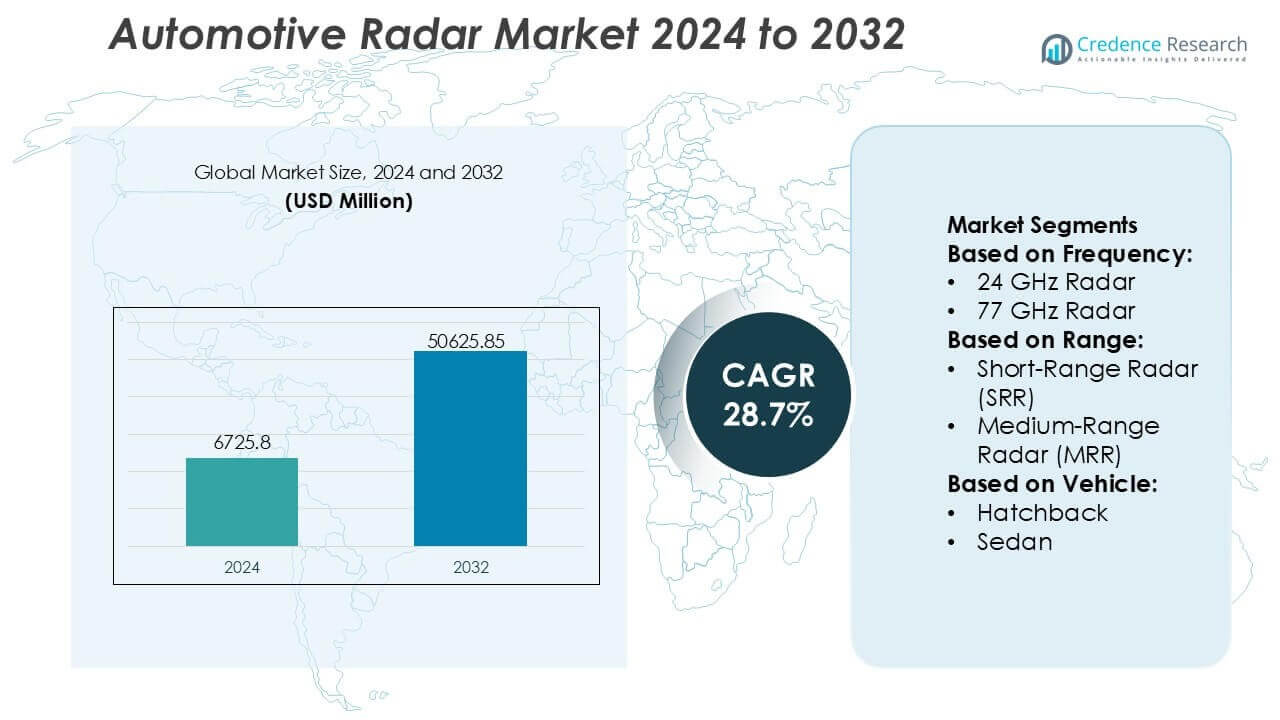
Automotive Radar Market size was valued USD 6725.8 million in 2024 and is anticipated to reach USD 50625.85 million by 2032, at a CAGR of 28.7% during the forecast period.
| REPORT ATTRIBUTE | DETAILS |
|---|---|
| Historical Period | 2020-2023 |
| Base Year | 2024 |
| Forecast Period | 2025-2032 |
| Automotive Radar Market Size 2024 | USD 6725.8 million |
| Automotive Radar Market, CAGR | 28.7% |
| Automotive Radar Market Size 2032 | USD 50625.85 million |
Automotive Radar Market Insights
- Market growth is primarily driven by rising adoption of advanced driver-assistance systems, tightening vehicle safety regulations, and increasing demand for adaptive cruise control, collision avoidance, and autonomous driving functionalities.
- Key market trends include the shift toward 77 GHz and 79 GHz radar technologies, with 77 GHz radar emerging as the dominant segment, accounting for around 58% share, supported by its balance of range, resolution, and cost efficiency.
- The competitive landscape is characterized by innovation in radar SoCs, software-defined radar platforms, and AI-based signal processing, alongside strong OEM partnerships and global manufacturing scale.
- Regionally, Asia-Pacific leads with an exact 42% market share, driven by high vehicle production volumes, rapid ADAS adoption, and strong automotive electronics ecosystems in China, Japan, and South Korea.
Automotive Radar Market Segmentation Analysis:
By Frequency
By frequency, 77 GHz radar represents the dominant sub-segment in the automotive radar market, accounting for around 54% market share. Its leadership is driven by higher resolution, longer detection range, and superior performance in adaptive cruise control, automatic emergency braking, and highway pilot functions. OEMs increasingly favor 77 GHz systems due to global spectrum harmonization and better integration with advanced driver-assistance architectures. While 24 GHz radar remains in use for basic short-range applications, regulatory phase-outs limit growth. 79 GHz radar is gaining traction in next-generation platforms, supported by wider bandwidth and improved object separation.
- For instance, NXP Semiconductors’ S32R45 imaging radar platform, when paired with TEF82xx transceivers, supports operation across 76–81 GHz with 4 GHz instantaneous bandwidth. By cascading up to four transceivers, the system delivers nearly 2,000 virtual channels, enabling sub-degree angular resolution and detection ranges exceeding 300 meters for long-range automotive radar.
By Range
By range, Short-Range Radar (SRR) dominates the market with an estimated 42% share, driven by its extensive deployment in blind-spot detection, rear cross-traffic alert, and parking assistance systems. SRR benefits from high installation volumes per vehicle, often requiring multiple sensors to ensure 360-degree coverage. Medium-Range Radar (MRR) follows, supported by lane-change assist and intersection safety features, while Long-Range Radar (LRR) plays a critical role in adaptive cruise control and forward-collision warning. Increasing ADAS content per vehicle and regulatory safety mandates continue to reinforce SRR’s leading position.
- For instance, Robert Bosch GmbH’s latest corner radar sensor operates in the 76–81 GHz band, achieves a horizontal field of view of up to 150°, detects objects from 0.2 meters to beyond 160 meters, and updates target data at cycle times below 50 milliseconds, while integrating on-chip radar signal processing and automotive-grade packaging to meet functional safety requirements defined under ISO 26262.
By Vehicle
By vehicle type, Passenger vehicles account for the dominant share at approximately 68%, supported by high global production volumes and rapid penetration of ADAS features across mass-market and premium models. Within this segment, SUVs lead adoption due to higher average selling prices and greater inclusion of radar-based safety and convenience systems as standard. Sedans follow, particularly in mid- to high-end variants, while hatchbacks show selective adoption focused on cost-efficient safety packages. Rising consumer awareness of safety ratings and OEM differentiation strategies continue to drive radar integration across passenger vehicle platforms.
Key Growth Drivers
Rising Adoption of ADAS and Vehicle Safety Regulations
The automotive radar market is strongly driven by the accelerating adoption of advanced driver assistance systems (ADAS) across passenger and commercial vehicles. Regulatory bodies in North America, Europe, and parts of Asia are mandating safety features such as automatic emergency braking, adaptive cruise control, and blind-spot detection, all of which rely heavily on radar sensors. Radar’s ability to operate reliably in poor weather, fog, and low-light conditions makes it indispensable compared with camera-only systems. OEMs increasingly integrate multi-radar architectures to meet safety ratings and regulatory compliance.
- For instance, Autoliv Inc. has validated radar-based Automatic Emergency Braking integration within its active safety portfolio through test programs involving collision avoidance scenarios at closing speeds above 60 km/h, while its perception and control algorithms process radar update cycles below 50 milliseconds and interface with electronic control units certified to ISO 26262 ASIL-D, enabling rapid actuation of braking systems within tens of milliseconds after threat detection, as documented in Autoliv’s recent technical safety disclosures.
Growth in Vehicle Electrification and Autonomous Driving
The transition toward electric vehicles and higher levels of driving automation is another major growth driver for the automotive radar market. Electric and software-defined vehicles are designed with centralized electronic architectures that support multiple high-resolution radar sensors. As automakers move from Level 2 to Level 3 and beyond, long-range and imaging radar become critical for object detection, speed measurement, and situational awareness at highway speeds. Radar also complements lidar and cameras, supporting sensor fusion strategies essential for safe and scalable autonomous driving systems.
- For instance, Texas Instruments Incorporated’s AWR2944 automotive radar sensor integrates a 76–81 GHz transceiver with four transmitters and four receivers, delivers up to 15 TOPS of on-chip DSP and hardware acceleration, supports raw data bandwidth above 15 Gbps through high-speed CSI-2 interfaces, and enables detection ranges beyond 300 meters, as documented in TI’s automotive radar reference designs for advanced ADAS and autonomous driving platforms.
Increasing Demand for Passenger Vehicles in Emerging Markets
Rising vehicle production and sales in emerging economies significantly contribute to automotive radar market growth. Expanding middle-class populations, urbanization, and improving road infrastructure are increasing demand for passenger cars equipped with modern safety and comfort features. Automakers are progressively offering radar-based features in mid-range and even entry-level vehicles to differentiate products and comply with evolving safety norms. Cost reductions in 77 GHz and 79 GHz radar modules further enable broader penetration, making radar systems more accessible across vehicle segments and regions.
Key Trends & Opportunities
Shift Toward High-Resolution 77 GHz and 79 GHz Radar
A key trend in the automotive radar market is the rapid shift from legacy 24 GHz systems to high-frequency 77 GHz and 79 GHz radar. These higher bands offer improved resolution, longer detection range, and better object classification, supporting complex ADAS and automated driving functions. The global phase-out of 24 GHz radar in several regions creates opportunities for suppliers specializing in advanced radar chipsets and software. Continuous innovation in antenna design, signal processing, and imaging radar opens new avenues for performance differentiation.
- For instance, ZF Friedrichshafen AG’s latest full-range imaging radar operates across the 76–81 GHz spectrum, uses a 4 GHz bandwidth, integrates a 192-virtual-channel antenna configuration, and achieves angular resolution down to 0.5°, while detecting vehicles and vulnerable road users at distances exceeding 350 meters and updating object tracks at cycle times below 50 milliseconds, as detailed in ZF’s publicly released ADAS technology documentation and product briefings.
Integration of Radar with AI-Driven Sensor Fusion
The growing integration of radar with artificial intelligence and sensor fusion platforms presents a major opportunity. Automakers increasingly combine radar data with inputs from cameras and lidar to create robust perception systems. AI-enabled radar processing improves target recognition, reduces false positives, and enhances performance in dense traffic environments. This trend supports the development of centralized vehicle computing architectures and software-defined vehicles, creating opportunities for radar suppliers that offer not only hardware but also advanced algorithms and embedded software solutions.
- For instance, Continental AG’s latest 77–81 GHz imaging radar integrates 12 transmit and 16 receive channels, generates more than 200 virtual channels, and operates with a bandwidth of 4 GHz, enabling angular resolution below 1°.
Expansion of Radar Applications Beyond Safety
Beyond core safety functions, automotive radar is increasingly used for comfort and convenience applications. Interior radar systems enable features such as occupant detection, child presence monitoring, and gesture recognition. Exterior short-range radar supports automated parking and low-speed maneuvering. These emerging applications expand the addressable market for radar technology and allow OEMs to introduce new value-added features without significant changes to vehicle design. This diversification strengthens long-term growth prospects for radar suppliers.
Key Challenges
High System Complexity and Integration Costs
Despite strong growth, the automotive radar market faces challenges related to system complexity and integration costs. Advanced radar solutions require precise calibration, complex signal processing, and seamless integration with vehicle electronic architectures. Combining multiple radar sensors with cameras and other systems increases development time and validation efforts for OEMs. Cost pressures are particularly acute in mass-market vehicles, where automakers must balance advanced functionality with strict pricing targets. These factors can slow adoption in lower-priced vehicle segments.
Interference, Standardization, and Performance Limitations
Radar interference and standardization issues pose another challenge for market participants. As the number of radar-equipped vehicles increases, mutual interference between sensors becomes a growing concern, potentially affecting detection accuracy. Differences in regional spectrum regulations and technical standards add complexity for global deployments. Additionally, while radar excels in range and speed detection, it has limitations in object shape recognition compared with cameras and lidar. Addressing these challenges requires continued investment in interference mitigation, software innovation, and global standard alignment.
Regional Analysis
North America
North America represents a leading regional market for automotive radar, accounting for around 34% market share, driven by early adoption of advanced driver assistance systems (ADAS) and strong regulatory emphasis on vehicle safety. High penetration of adaptive cruise control, blind-spot detection, and automatic emergency braking across passenger vehicles supports sustained demand. The presence of major OEMs, semiconductor suppliers, and Tier-1 radar module manufacturers accelerates innovation and large-scale deployment. Additionally, rapid integration of 77 GHz and 79 GHz radar in mid-range vehicles, supported by consumer preference for safety features, continues to reinforce North America’s dominant position.
Europe
Europe holds approximately 28% market share in the automotive radar market, supported by stringent safety regulations and widespread adoption of Euro NCAP standards. OEMs across the region increasingly integrate multi-radar architectures to meet requirements for autonomous emergency braking, lane-keeping assistance, and pedestrian detection. Strong demand for premium and luxury vehicles further boosts radar penetration rates. The region also benefits from a mature automotive supply chain and strong R&D capabilities in radar signal processing and sensor fusion. Continuous upgrades toward higher-resolution imaging radar strengthen Europe’s competitive position.
Asia-Pacific
Asia-Pacific accounts for about 30% market share and represents the fastest-growing regional market for automotive radar. Growth is driven by high vehicle production volumes in China, Japan, and South Korea, along with rapid adoption of ADAS in mass-market passenger cars. Government initiatives promoting vehicle safety, combined with increasing consumer awareness, support radar integration even in entry-level models. Local semiconductor manufacturing, cost-efficient radar module production, and strong demand for 77 GHz radar systems contribute to scale advantages. Expanding electric vehicle production further accelerates radar adoption across the region.
Latin America
Latin America holds nearly 5% market share in the automotive radar market, reflecting gradual adoption of safety technologies across key automotive hubs such as Brazil and Mexico. Demand is primarily driven by the increasing localization of vehicle manufacturing and the introduction of ADAS features in mid-range passenger vehicles. While penetration remains lower than in developed regions, improving regulatory frameworks and rising consumer safety awareness are encouraging OEMs to integrate basic radar-based systems. Expansion of global OEM assembly plants and component sourcing within the region is expected to support steady market development.
Middle East & Africa
The Middle East & Africa region accounts for around 3% market share, characterized by early-stage adoption of automotive radar technologies. Growth is supported by rising sales of premium vehicles, particularly in Gulf countries, where advanced safety and driver-assistance features are increasingly standard. Infrastructure development, improving road safety regulations, and gradual modernization of vehicle fleets contribute to adoption. However, limited local manufacturing and cost sensitivity constrain large-scale deployment. Over time, increased imports of ADAS-equipped vehicles and regulatory alignment with global safety standards are expected to drive incremental growth.
Automotive Radar Market Segmentations:
By Frequency:
- 24 GHz Radar
- 77 GHz Radar
By Range:
- Short-Range Radar (SRR)
- Medium-Range Radar (MRR)
By Vehicle:
- Hatchback
- Sedan
By Geography
- North America
- U.S.
- Canada
- Mexico
- Europe
- Germany
- France
- U.K.
- Italy
- Spain
- Rest of Europe
- Asia Pacific
- China
- Japan
- India
- South Korea
- South-east Asia
- Rest of Asia Pacific
- Latin America
- Brazil
- Argentina
- Rest of Latin America
- Middle East & Africa
- GCC Countries
- South Africa
- Rest of the Middle East and Africa
Competitive Landscape
The competitive landscape of the automotive radar market players such as NXP Semiconductors, Robert Bosch GmbH, Autoliv Inc., Texas Instruments Incorporated, ZF Friedrichshafen AG, Continental AG, Infineon Technologies AG, Valeo, HELLA GmbH & Co. KGaA. The automotive radar market features an intensely competitive landscape characterized by rapid technological advancement, high entry barriers, and strong alignment with global vehicle safety regulations. Competition centers on radar performance parameters such as detection range, angular resolution, object classification accuracy, and robustness under adverse weather conditions. Manufacturers increasingly prioritize 77 GHz and 79 GHz radar architectures to support advanced driver-assistance systems and higher levels of driving automation. Continuous investments in semiconductor integration, software-defined radar platforms, and AI-enabled signal processing enhance system scalability and reduce total system cost. Collaboration across the automotive value chain accelerates validation and deployment, while long-term OEM supply agreements reinforce competitive positioning. Additionally, adherence to automotive-grade reliability standards, functional safety requirements, and global regulatory compliance remains critical, shaping product roadmaps and sustaining differentiation in a market driven by safety, automation, and vehicle intelligence.
Key Player Analysis
- NXP Semiconductors
- Robert Bosch GmbH
- Autoliv Inc.
- Texas Instruments Incorporated
- ZF Friedrichshafen AG
- Continental AG
- Infineon Technologies AG
- Valeo
- HELLA GmbH & Co. KGaA
- Denso Corporation
Recent Developments
- In April 2025, HiRain Technologies, a leading provider of intelligent driving system to the Chinese automotive market, announced the launch of the LRR615 is the first radar system in China to feature a high-density waveguide antenna, enhancing image clarity, increasing sensitivity, and significantly.
- In January 2025, Texas Instruments has introduced integrated automotive chips to enable safer, more immersive driving experiences at any vehicle price point. TI's edge AI-enabled AWRL6844 60GHz mmWave radar sensor enables engineers to incorporate three in-cabin sensing features to replace multiple.
- In January 2025, Arbe will showcase its groundbreaking ultra-high-definition radar that is revolutionizing vehicle safety and autonomy at CES 2025 its ultra-high-definition perception radar featuring a 48x48 MIMO array, capable of detecting tens of thousands of points per frame.
Report Coverage
The research report offers an in-depth analysis based on Frequency, Range, Vehicle and Geography. It details leading market players, providing an overview of their business, product offerings, investments, revenue streams, and key applications. Additionally, the report includes insights into the competitive environment, SWOT analysis, current market trends, as well as the primary drivers and constraints. Furthermore, it discusses various factors that have driven market expansion in recent years. The report also explores market dynamics, regulatory scenarios, and technological advancements that are shaping the industry. It assesses the impact of external factors and global economic changes on market growth. Lastly, it provides strategic recommendations for new entrants and established companies to navigate the complexities of the market.

Request a Free Sample
Fill in your details and we'll send you a free sample report.
- Sample data tables & charts
- Research methodology
Need a Custom Version of This Report?
Tailor the scope, geography, or segments to your exact requirements.
- Custom geography or segment scope
- Direct access to our analyst team
Frequently Asked Questions
What is the current market size for the Automotive Radar Market, and what is its projected size in 2032?
At what Compound Annual Growth Rate is the Automotive Radar Market projected to grow between 2024 and 2032?
Which Automotive Radar Market segment held the largest share in 2024?
What are the primary factors fueling the growth of the Automotive Radar Market?
Who are the leading companies in the Automotive Radar Market?
Which region commanded the largest share of the Automotive Radar Market in 2024?
Table of Content
Chapter 1 Market Segmentation
- 1.1 Segmentation Framework
- 1.1.1 Product and Service Classification
- 1.1.2 Application and End-Use Classification
- 1.1.3 Technology and Solution Classification
- 1.1.4 Customer and Distribution Channel Classification
- 1.1.5 Geographic Segmentation
- 1.1.6 Market Segment Definitions and Boundaries
Chapter 2 Introduction
- 2.1 Report Objectives and Scope
- 2.2 Product Definition and Industry Terminology
- 2.3 Market Inclusions and Exclusions
- 2.4 Research Process
- 2.4.1 Primary Research and Expert Interviews
- 2.4.2 Secondary Research and Source Review
- 2.4.3 Top-Down and Bottom-Up Estimation
- 2.4.4 Data Triangulation and Verification
- 2.5 Market Size Measurement Basis
- 2.5.1 2024: USD 6,725.8 million → 2032: USD 50,625.85 million
- 2.6 Historical and Forecast Reference Periods
- 2.6.1 Base Year: 2024
- 2.6.2 Forecast Period: 2024-2032
- 2.7 Research Assumptions and Limitations
Chapter 3 Executive Summary
- 3.1 Market Snapshot and Key Findings
- 3.2 Base-Year Market Size, 2024
- 3.3 Forecast Market Size, 2032
- 3.4 Revenue and Volume Growth Outlook
- 3.5 Key Demand and Supply Indicators
- 3.6 Leading Market Segments
- 3.7 Fastest-Growing Market Opportunities
- 3.8 Regional Performance Highlights
- 3.9 Technology and Industry Transformation
- 3.10 Competitive Landscape Summary
- 3.11 Analyst View and Strategic Implications
Chapter 4 Global Automotive Radar Market Trends and Developments
- 4.1 Historical Industry Development
- 4.2 Recent Market Trends and Developments
- 4.3 Demand and Customer Behavior Trends
- 4.4 Technology and Product Innovation
- 4.5 Artificial Intelligence, Automation and Digitalization
- 4.6 Local Manufacturing and Supply Chain Realignment
- 4.7 Industry Partnerships, Mergers and Acquisitions
- 4.8 Sustainability and Circular Economy Developments
- 4.9 Government and Private Sector Investment Trends
- 4.10 Emerging Business Models and Commercialization
- 4.11 Industry Developments and Announcements
Chapter 5 Global Automotive Radar Market Production, Supply and Demand Analysis
- 5.1 Demand Trend and Consumption Analysis
- 5.2 Demand Forecast, 2024-2032
- 5.3 Production and Output Trend
- 5.4 Production and Output Forecast, 2024-2032
- 5.5 Installed Capacity and Capacity Utilization
- 5.6 Company-Wise Production Plants and Statistics
- 5.6.1 Installed Production Capacity
- 5.6.2 Actual Production
- 5.6.3 Planned Capacity and Expansion Targets
- 5.7 Supply Chain Structure and Procurement Trends
- 5.8 Supply-Demand Gap and Bottlenecks
- 5.9 Import Dependence and Sourcing Structure
- 5.10 Contract Manufacturing and Outsourcing
- 5.11 Regional Supply and Demand Concentration
Chapter 6 Global Automotive Radar Market Pricing Analysis
- 6.1 Pricing Structure and Measurement
- 6.2 Historical Pricing Trends
- 6.3 Pricing Outlook, 2024-2032
- 6.4 Average Selling Price and Unit Economics
- 6.5 Pricing by Product and Market Segment
- 6.6 Geographic Pricing Differences
- 6.7 Key Input, Energy, Labor and Logistics Costs
- 6.8 Contract Pricing and Purchasing Models
- 6.9 Pricing Sensitivity and Competitive Positioning
- 6.10 Price, Margin and Profitability Implications
Chapter 7 Global Automotive Radar Market Dynamics
- 7.1 Market Growth Drivers
- 7.1.1 Demand-Side Drivers
- 7.1.2 Technology and Innovation Drivers
- 7.1.3 Infrastructure and Investment Drivers
- 7.1.4 Regulatory and Policy Drivers
- 7.2 Market Restraints
- 7.2.1 Cost and Affordability Constraints
- 7.2.2 Technology and Adoption Barriers
- 7.2.3 Supply Chain and Operational Constraints
- 7.3 Market Challenges
- 7.3.1 Competitive Pressure and Margin Erosion
- 7.3.2 Skills, Infrastructure and Implementation Gaps
- 7.4 Emerging Market Opportunities
- 7.5 Market Dynamics Impact and Time-Horizon Assessment
Chapter 8 Global Automotive Radar Value Chain Analysis
- 8.1 Industry Value Chain Overview
- 8.2 Upstream Suppliers and Critical Inputs
- 8.3 Technology and Component Providers
- 8.4 Manufacturing or Service Delivery
- 8.5 Distribution, Channel Partners and Integrators
- 8.6 Downstream Applications and End Users
- 8.7 Value Addition and Profit Pools
- 8.8 Vertical Integration and Outsourcing
- 8.9 Supplier Concentration and Risk
- 8.10 Supply Chain Localization and Resilience
Chapter 9 Global Automotive Radar Market Regulations and Policies
- 9.1 Relevant Laws, Standards and Compliance Frameworks
- 9.2 Product, Service, Safety and Quality Requirements
- 9.3 Government Policies, Incentives and Subsidies
- 9.4 Imports, Exports and Trade Barriers
- 9.5 Public Procurement and Local Content Requirements
- 9.6 Environmental and Sustainability Compliance
- 9.7 Upcoming Policy Changes and Market Implications
Chapter 10 Global Automotive Radar Market Hotspots and Opportunities
- 10.1 Market Opportunity Mapping and Growth Hotspots
- 10.2 High-Growth Applications and Customer Groups
- 10.3 Underserved Markets and White-Space Opportunities
- 10.4 Emerging Technology and Product Opportunities
- 10.5 New Capacity and Investment Hotspots
- 10.6 Market Entry and Expansion Opportunities
- 10.7 Distribution and Partnership Opportunities
- 10.8 Near-Term and Long-Term Commercial Potential
- 10.9 Opportunity Attractiveness and Execution Risks
Chapter 11 Global Automotive Radar Market Outlook, 2024-2032
- 11.1 Market Size and Analysis
- 11.1.1 Revenue (Market Measurement: 2024: USD 6,725.8 million → 2032: USD 50,625.85 million)
- 11.1.2 Market Volume and Quantity Sold
- 11.1.3 Historical Market Size
- 11.1.4 Base-Year Market Size, 2024
- 11.2 Market Forecast, 2024-2032
- 11.2.1 Revenue Forecast to 2032
- 11.2.2 Volume Forecast to 2032
- 11.2.3 CAGR and Year-on-Year Growth
- 11.2.4 Incremental Revenue Opportunity
- 11.3 Forecast Assumptions and Scenario Analysis
- 11.3.1 Base-Case Forecast
- 11.3.2 Optimistic and Conservative Scenarios
- 11.3.3 Technology, Pricing and Policy Sensitivities
- 11.4 Market Attractiveness and Growth Outlook
Chapter 12 Global Automotive Radar Market Segmentation and Outlook
- 12.1 Segmentation Summary and Market Shares, 2024
- 12.2 Largest and Fastest-Growing Segments
- 12.3 Segment Growth Comparison
- 12.4 Segment Attractiveness and Priority Matrix
Chapter 13 Global Automotive Radar Geographic Market Outlook, 2024-2032
- 13.1 Regional Market Size and Share, 2024
- 13.2 Regional Market Forecast, 2024-2032
- 13.3 Regional Pricing, Production and Demand Differences
- 13.4 North America
- 13.4.1 United States
- 13.4.2 Canada
- 13.4.3 Mexico
- 13.5 Europe
- 13.5.1 Germany
- 13.5.2 France
- 13.5.3 Italy
- 13.5.4 United Kingdom
- 13.5.5 Spain
- 13.5.6 Poland
- 13.5.7 Russia
- 13.5.8 Netherlands
- 13.5.9 Belgium
- 13.5.10 Sweden
- 13.5.11 Denmark
- 13.5.12 Norway
- 13.5.13 Rest of Europe
- 13.6 Asia Pacific
- 13.6.1 China
- 13.6.2 India
- 13.6.3 Japan
- 13.6.4 South Korea
- 13.6.5 Thailand
- 13.6.6 Indonesia
- 13.6.7 Vietnam
- 13.6.8 Malaysia
- 13.6.9 Australia
- 13.6.10 Rest of Asia Pacific
- 13.7 Latin America
- 13.7.1 Brazil
- 13.7.2 Argentina
- 13.7.3 Colombia
- 13.7.4 Chile
- 13.7.5 Rest of Latin America
- 13.8 Middle East
- 13.8.1 Saudi Arabia
- 13.8.2 United Arab Emirates
- 13.8.3 Turkey
- 13.8.4 Israel
- 13.8.5 Iran
- 13.8.6 Rest of the Middle East
- 13.9 Africa
- 13.9.1 South Africa
- 13.9.2 Egypt
- 13.9.3 Nigeria
- 13.9.4 Morocco
- 13.9.5 Rest of Africa
- 13.10 Regional Investment, Policy and Supply Chain Differences
- 13.11 Regional Competitive Landscape
- 13.12 Geographic Growth Hotspots
Chapter 14 Global Automotive Radar Technology, Innovation and Sustainability Outlook
- 14.1 Technology Landscape and Maturity
- 14.2 Product, Process and Service Innovation
- 14.3 AI, Automation and Digital Tools in the Industry
- 14.4 Technology Adoption and Performance Benchmarking
- 14.5 Innovation Pipeline and R&D Investment
- 14.6 Patent and Intellectual Property Trends
- 14.7 Energy Efficiency and Resource Management
- 14.8 Sustainability, Recycling and Circularity
- 14.9 Technology Roadmap, 2024-2032
- 14.10 Risks of Obsolescence and Technology Substitution
Chapter 15 Global Automotive Radar Market Key Strategic Imperatives
- 15.1 Growth and Market Entry Priorities
- 15.2 High-Return Products and Segments
- 15.3 Pricing, Profitability and Cost Optimization
- 15.4 Technology Investment and Product Differentiation
- 15.5 Supply Chain Localization and Resilience
- 15.6 Distribution and Customer Acquisition
- 15.7 Partnership, Acquisition and Capacity Strategy
- 15.8 Regional Expansion Priorities
- 15.9 Short-, Medium- and Long-Term Actions
Chapter 16 Competition Outlook
- 16.1 Industry Competition Characteristics
- 16.2 Market Structure and Concentration
- 16.3 Market Share and Competitive Positioning, 2024
- 16.4 Company-Wise Revenue and Product Benchmarking
- 16.5 Production and Service Capacity Benchmarking
- 16.6 Technology, Pricing and Differentiation
- 16.7 Regional Footprint and Distribution Strength
- 16.8 Mergers, Acquisitions and Strategic Alliances
- 16.9 New Entrants and Competitive Threats
- 16.10 Porter's Five Forces and Industry Attractiveness
- 16.11 Competitive Outlook, 2024-2032
Chapter 17 Company Profiles
- 17.1 Company Coverage and Selection Criteria
- 17.2 Leading Market Participants – Standard Profile Structure
- 17.2.1 Business Description
- 17.2.2 Company Ownership and Geographic Presence
- 17.2.3 Product and Service Portfolio
- 17.2.4 Manufacturing and Operating Footprint
- 17.2.5 Production Capacity and Expansion Plans
- 17.2.6 Financial Performance and Investment
- 17.2.7 Market Share and Competitive Position
- 17.2.8 Technology and Innovation Capabilities
- 17.2.9 Strategic Alliances or Partnerships
- 17.2.10 Recent Developments
- 17.2.11 Growth Strategy and Outlook
- 17.3 Other Relevant Market Participants
Note: Every listed company is profiled on the structure shown under the first company. The company list is preliminary and may change based on research findings, market developments, data availability and client requirements.
Chapter 18 Disclaimer
- 18.1 Research and Forecast Disclaimer
- 18.2 Data Source and Estimation Limitations
Note: The depth of individual sections depends on data availability for this market. Volume, capacity, trade and other unit-based metrics are included where applicable.