Rider fleets turn app orders into fast doorstep drops
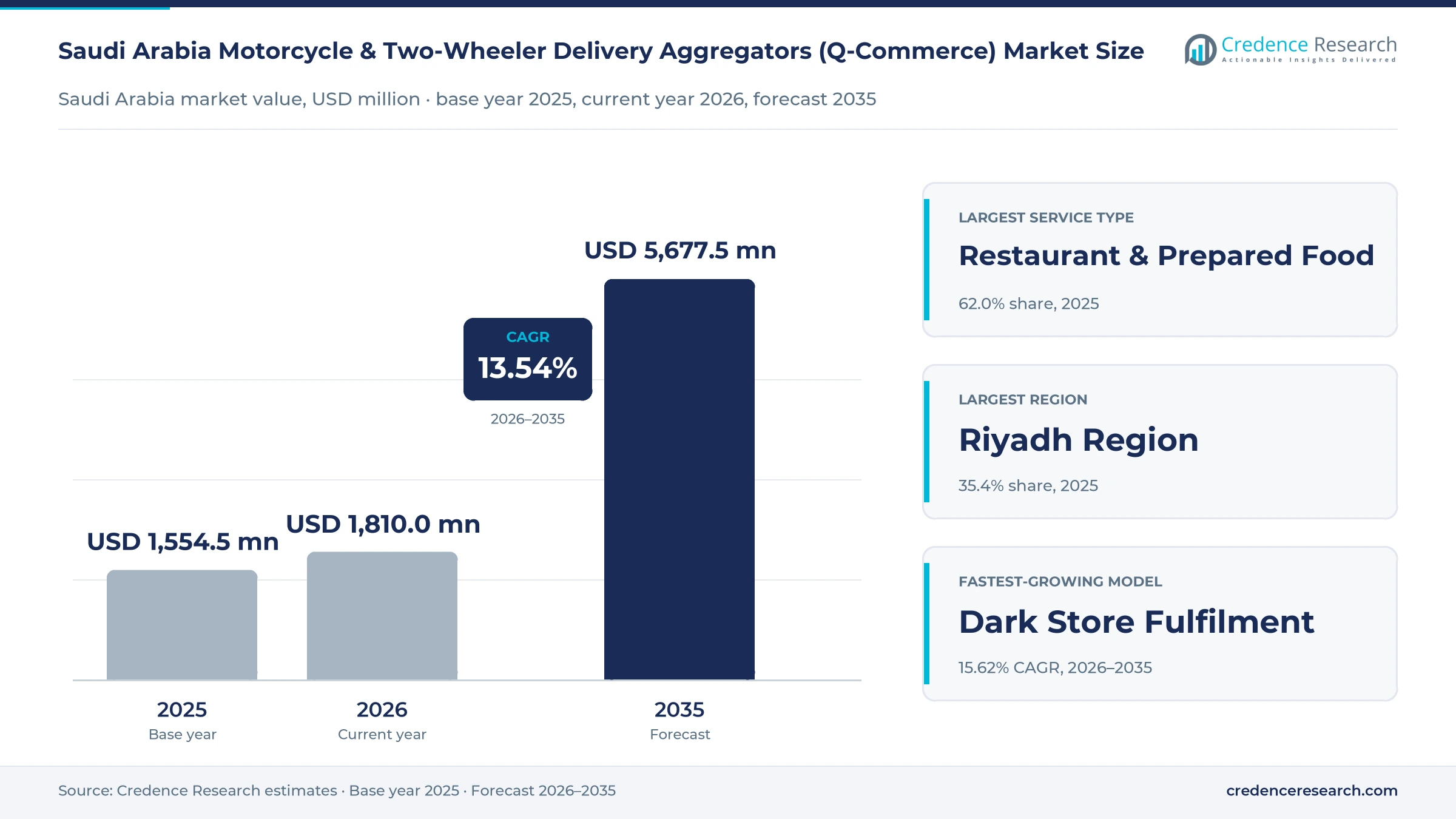
The Saudi Arabia motorcycle and two-wheeler delivery aggregators (Q-commerce) market was valued at USD 1.55 billion in 2025 and is projected to increase from USD 1.81 billion in 2026 to USD 5.68 billion by 2035, registering a CAGR of 13.54% during 2026–2035. Demand comes from a young, fully connected population that orders meals, groceries and medicines through apps many times a week, and from merchants that rely on aggregators for last-minute reach. The Riyadh Region held the largest regional share, 35.4% in 2025, because the capital generates the largest pool of app orders, offices and dense housing. Madinah and emerging regions form the fastest-growing area at 14.36% a year, as platforms launch in smaller cities. In turn, the Transport General Authority moved commercial motorcycle cargo delivery from a pilot setup to formal executive regulations in 2026, which gives fleets clearer rules for licensing and investment.
Which rider-based delivery services does the estimate cover?
The estimate measures the value that delivery aggregators and quick commerce platforms earn in Saudi Arabia from orders fulfilled by motorcycles, scooters and electric two-wheelers. It covers restaurant meals, groceries, pharmacy items and small retail parcels, including commissions, delivery fees, subscriptions and merchant services.
The estimate excludes car-based delivery, parcel courier networks, the value of the goods themselves and in-store retail sales. The value chain runs from merchants and dark stores through aggregator apps and rider fleets to households, students, office workers and visitors.
Saudi Arabia Motorcycle & Two-Wheeler Delivery Aggregators (Q-Commerce) Market Insights
- The market was valued at USD 1.55 billion in 2025 and is projected to reach USD 5.68 billion by 2035, registering a CAGR of 13.54% during 2026–2035.
- The Riyadh Region held a 35.4% share of 2025 value, because the capital produces the largest volume of app orders, offices and dense housing.
- Restaurant and prepared food delivery led with a 62.0% share of 2025 value, because meals remain the most frequent app order nationwide.
- Licensed delivery providers executed 288.1 million orders in 2024, and the sector processed more than 124 million orders in the fourth quarter of 2025 alone.
- Electronic payments accounted for 79% of retail payments in 2024, up from 70% in 2023, which removes cash friction from doorstep delivery.
Restaurant meals lead while grocery runs grow fastest
Why do restaurant meals hold the largest share?
Based on service type, the market is categorized into restaurant and prepared food delivery, grocery and convenience delivery, pharmacy and wellness delivery, and specialty retail and errand delivery. Restaurant & Prepared Food Delivery led with a 62.0% share of 2025 value, because meals are the most frequent app order for families and office workers. Grocery & Convenience Delivery grows fastest at 15.05% a year, as platforms add supermarket ranges and their own dark stores in large cities.
How quickly are electric bikes entering rider fleets?
Based on mode of transport, the market is categorized into conventional motorcycles, motor scooters, electric two-wheelers and mixed fleet. Conventional Motorcycles led with a 52.0% share of 2025 value, because riders favor robust bikes for long, hot trips across wide cities. Electric Two-Wheelers grow fastest at 18.00% a year, as fleet owners test lower running costs on short urban routes.
How are dark stores changing fulfilment?
Based on delivery model, the market is categorized into platform-managed delivery, merchant-managed delivery, hybrid fulfilment and dark store fulfilment. Platform-Managed Delivery led with a 55.0% share of 2025 value, because aggregators control rider pools, routing and customer service for most orders. Dark Store Fulfilment grows fastest at 15.62% a year, as quick commerce players stock fast-moving goods close to homes.
Which delivery windows win the most orders?
Based on delivery speed, the market is categorized into under 20 minutes, 20-45 minutes, 46-90 minutes and same-day scheduled. 20-45 Minutes led with a 52.0% share of 2025 value, because most restaurant orders fall into this window. Under 20 Minutes grows fastest at 15.66% a year, as dark stores and dense rider networks shorten trips for groceries and daily essentials.
| Segment Group | Leading Sub-segment | Share, 2025 | Fastest-growing Sub-segment | CAGR, 2026–2035 |
|---|---|---|---|---|
| By Service Type | Restaurant & Prepared Food Delivery | 62.0% | Grocery & Convenience Delivery | 15.05% |
| By Mode of Transport | Conventional Motorcycles | 52.0% | Electric Two-Wheelers | 18.00% |
| By Delivery Model | Platform-Managed Delivery | 55.0% | Dark Store Fulfilment | 15.62% |
| By Delivery Speed | 20-45 Minutes | 52.0% | Under 20 Minutes | 15.66% |
Request a Free Sample
Fill in your details and we'll send you a free sample report.
- Sample data tables & charts
- Research methodology
Order volumes, cashless habits and new categories lift use
How do high-frequency orders lift rider demand?
High-frequency delivery demand lifts rider volumes, because Saudi households now use apps for daily meals, snacks and top-up shopping rather than occasional treats. Licensed delivery providers executed 288.1 million orders in 2024, according to Argaam citing the statistics authority. The fourth quarter of 2024 recorded about 77.6 million orders, the highest quarter of the year, which shows steady momentum. The sector then processed more than 124 million orders in the fourth quarter of 2025, a 60% rise on the same quarter a year earlier, according to Sharikat Mubasher citing the transport authority. As a result, restaurant and prepared food delivery keeps a 62.0% share of 2025 value.
Why do connectivity and cashless payments speed adoption?
Digital connectivity and cashless commerce speed adoption, because every order starts on a smartphone and ends with a card or wallet payment. Internet use reached 100% of the population in 2024, according to the World Bank, which means nearly every adult can order through an app. Electronic payments accounted for 79% of retail payments in 2024, up from 70% in 2023, the Saudi Central Bank said. Non-cash payment transactions reached 12.6 billion in 2024, compared with 10.8 billion in 2023, which removes cash handling from doorstep drops. In turn, riders complete trips faster and platforms can sell subscriptions, which lifts repeat orders and keeps riders busy through the whole day.
How does multi-category quick commerce widen the order basket?
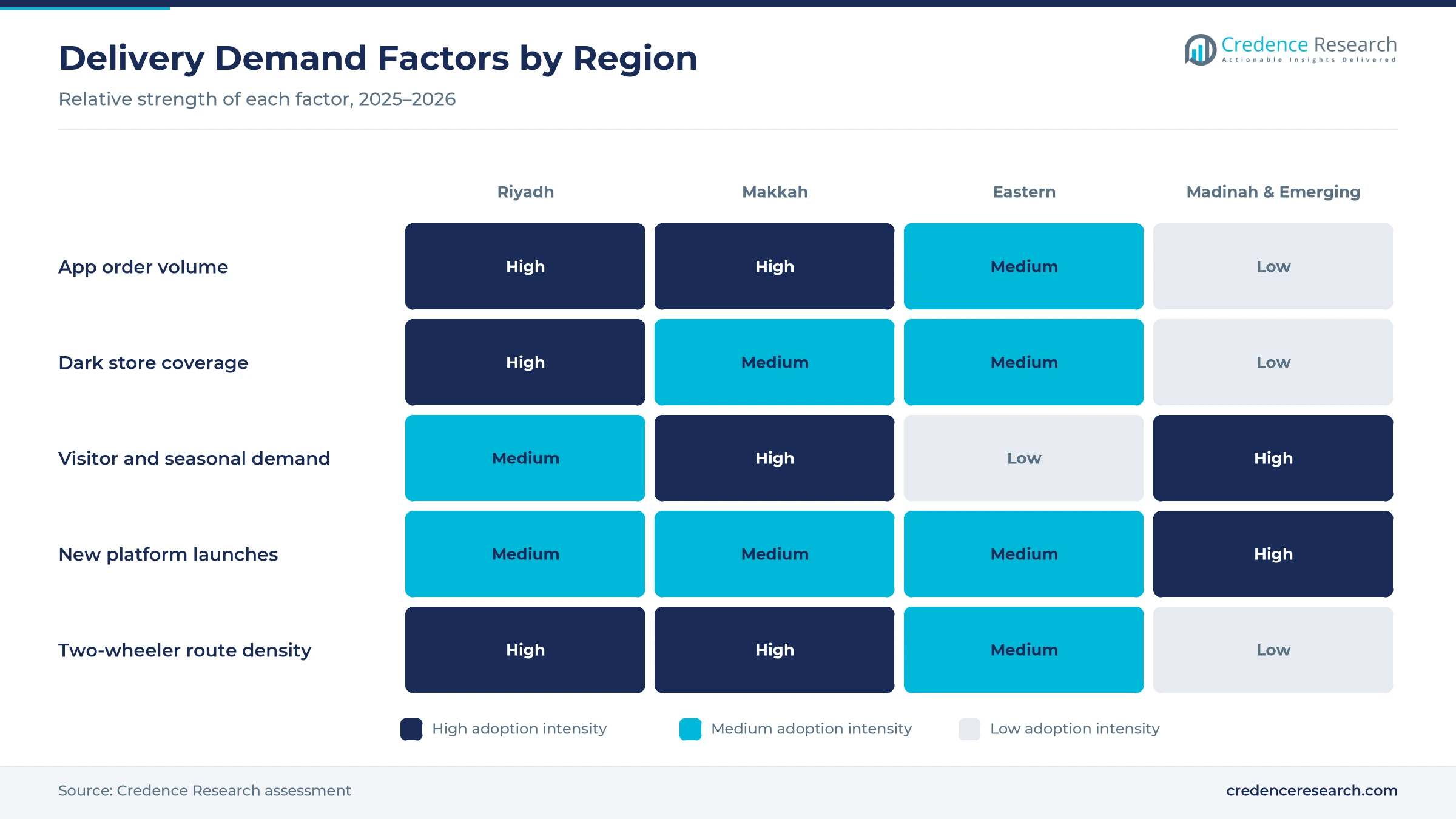
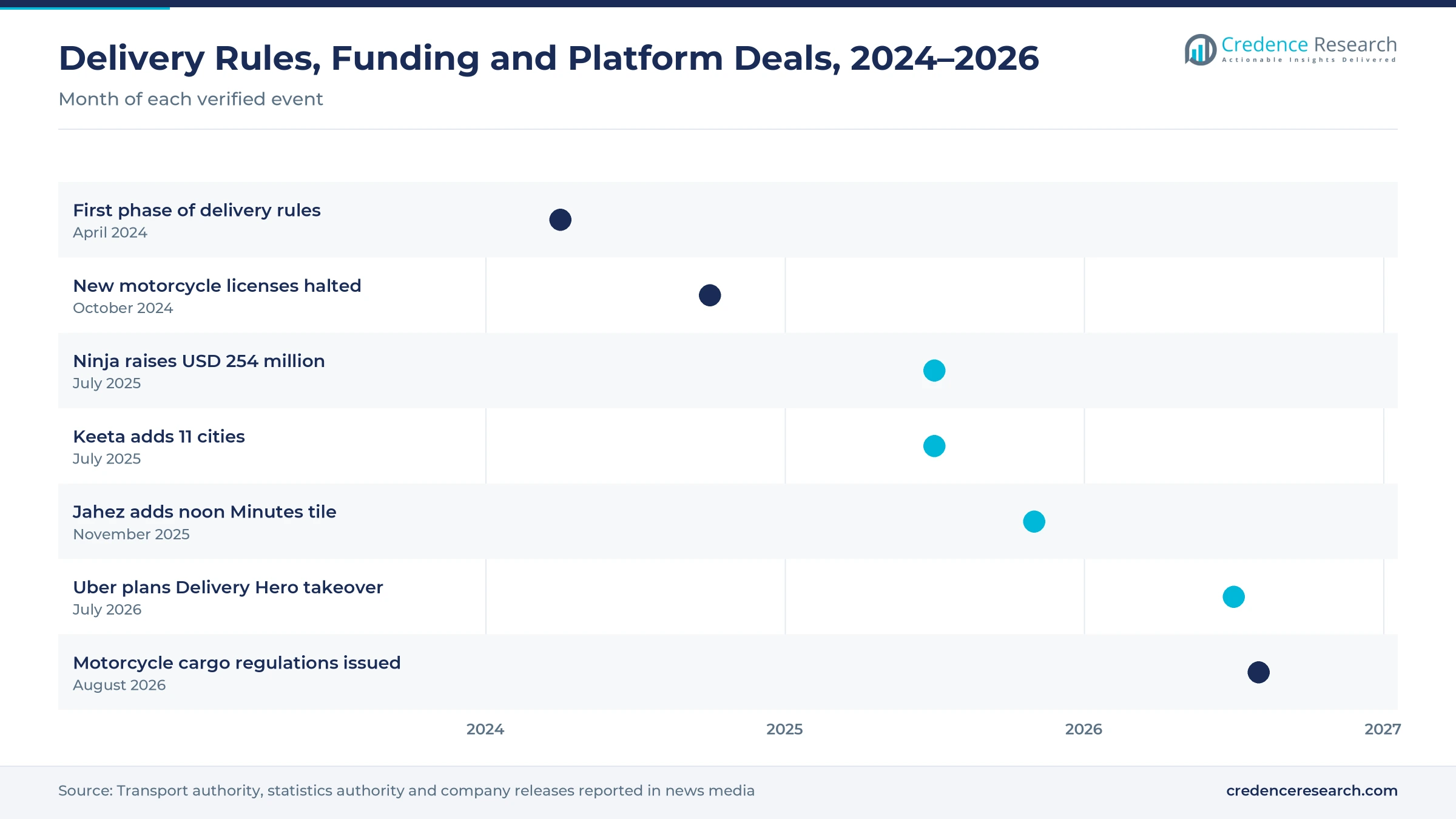
Multi-category quick commerce widens the order basket, because platforms now sell groceries, pharmacy items and household goods alongside restaurant meals. Ninja, a Saudi quick commerce company, raised USD 254 million in July 2025 and became a unicorn, which funds more dark stores. Jahez added a noon Minutes tile in its app in November 2025, giving users direct access to rapid grocery delivery from dark stores across major cities. Keeta reported more than 50,000 restaurant partners and over 38,000 riders in 2025, according to Zawya. As a result, grocery and convenience delivery grows at 15.05% a year, the fastest service type.
Why does formal motorcycle regulation support investment?
Formal motorcycle regulation supports investment, because clear licensing rules let fleets buy bikes, hire riders and sign long contracts with aggregators. The Transport General Authority began its first phase of delivery rules in April 2024, requiring non-Saudi drivers to join licensed companies and confining self-employment to Saudis in four regions. The authority then halted new motorcycle delivery licenses in October 2024 while it prepared permanent rules. It issued executive regulations for commercial motorcycle cargo delivery in 2026, moving the activity from a pilot to a full framework, according to Ajel. In turn, platform-managed delivery keeps a 55.0% share of 2025 value as licensed fleets scale.
Dark stores, platform deals and greener bikes reshape riding
How is the shift to dark stores shortening delivery times?
The shift to dark-store fulfilment is shortening delivery times, because small urban warehouses place groceries and essentials within a short ride of most homes. Ninja raised USD 254 million in July 2025 to expand its quick commerce network. Jahez and noon linked their apps in November 2025, so noon Minutes dark stores now serve Jahez users across major Saudi cities. Keeta reported an average delivery time of about 30 minutes in 2025, which sets a benchmark for meal delivery and for hyperlocal grocery services. As a result, dark store fulfilment grows at 15.62% a year, and the under 20 minutes window grows at 15.66% a year, the fastest delivery speed band.
Why is the rise of platform consolidation significant?
The rise of platform consolidation is significant, because larger groups can fund rider incentives, subscriptions and technology across more cities at once. Uber announced a planned takeover of Delivery Hero in July 2026, which would bring HungerStation under its control alongside other Gulf assets. Jahez chose a partnership with noon in November 2025 instead of building its own grocery network from scratch. Keeta grew to 23 Saudi cities in 2025 and recorded more than 150 million orders in its first year of operation. Subscribers reportedly generate over 60% of order value in key Saudi segments, which rewards platforms with scale. In turn, smaller apps face higher rider and marketing costs, and merchants depend on a few large platforms for order volume across 2026–2035.
Can electric two-wheelers open a lower-cost fleet model?
Electric two-wheelers offer a lower-cost fleet model, because short urban trips suit battery bikes that cut fuel and servicing costs per order. Motorcycles numbered only about 19,000 in the fourth quarter of 2024, against 181,300 delivery drivers, which shows how much of the fleet still uses cars. The new motorcycle cargo regulations issued in 2026 give operators a clear path to license two-wheeler fleets. Riyadh alone recorded 130.4 million orders in 2024, which creates dense routes where battery range is rarely a problem. As a result, electric two-wheelers grow at 18.00% a year, and fleets may add battery scooters and e-bikes through leasing.
Is expansion into smaller cities an opening for new orders?
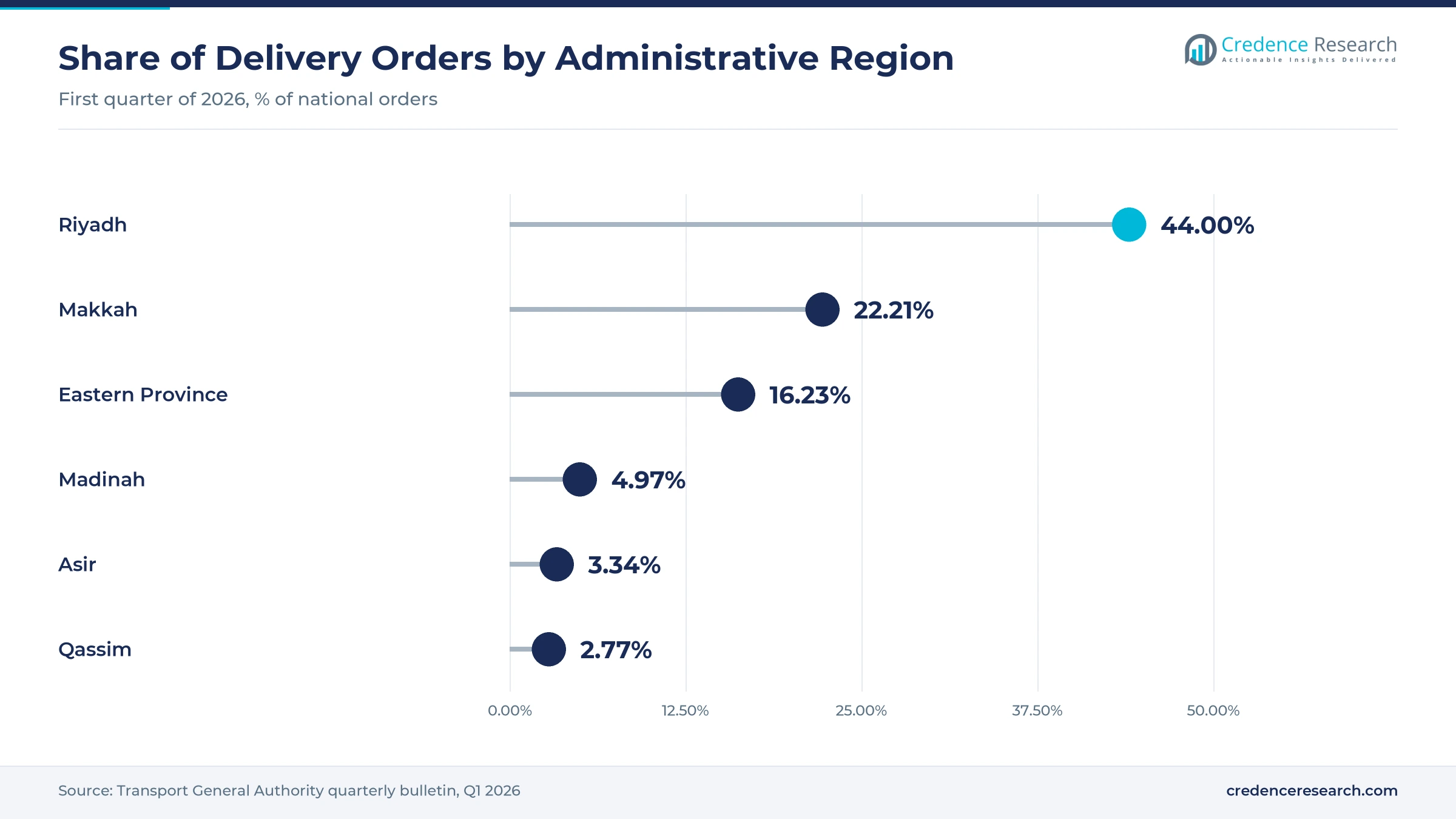
Expansion into smaller cities offers an opening for new orders, because towns outside the three largest regions still have fewer app choices and lower delivery coverage. Keeta added 11 cities in July 2025, including Hail, Tabuk, Abha, Jazan, Najran, Buraydah and Yanbu, reaching 20 Saudi cities. It onboarded almost 7,500 merchants and deployed more than 18,000 additional riders during that launch phase. Madinah held about 4.97% of national orders in the first quarter of 2026, which leaves room for growth around the holy city. In turn, Madinah and emerging regions grow faster than the national market as platforms add riders and merchants there.
Licensing, rider costs and thin margins test platforms
How do licensing pauses limit fleet growth?
Licensing pauses limit fleet growth, because operators cannot add motorcycles quickly when the transport authority freezes new permits. As a result, platforms lean on cars during peak hours, which raises cost per order. Smaller fleet companies feel this most, since they lack spare licensed capacity. Operators respond by planning shifts carefully, sharing riders across apps and preparing paperwork early under the new executive regulations for motorcycle cargo delivery.
Why do rider rules and costs pressure margins?
Rider rules and costs pressure margins, because uniforms, face verification, insurance and Saudization limits all add expense per rider. In turn, aggregators must raise fees or cut incentives, which can slow order growth. Freelance riders in the four regions reserved for Saudis face tighter entry, which narrows the labor pool. Platforms respond with training programs, better route planning and higher pay at peak times to keep riders active and compliant.
How does heavy discounting squeeze platform economics?
Heavy discounting squeezes platform economics, because new entrants fund vouchers and free delivery to win market share from established apps. As a result, average order values fall while rider costs stay fixed for each trip. Restaurants also push back on commission levels when promotions erode their own margins. Platforms respond with subscriptions, advertising tools for merchants and tighter targeting of discounts toward new or lapsed users.
Why do heat and road safety strain two-wheeler operations?
Heat and road safety strain two-wheeler operations, because summer temperatures and fast urban traffic raise risks for riders on long shifts. In turn, platforms see more missed shifts and slower trips during the hottest hours of the day. Authorities enforce uniforms, vehicle standards and safety tools for transported goods. Operators respond with rest points, cooling gear, helmet checks and route planning that keeps riders off the busiest highways.
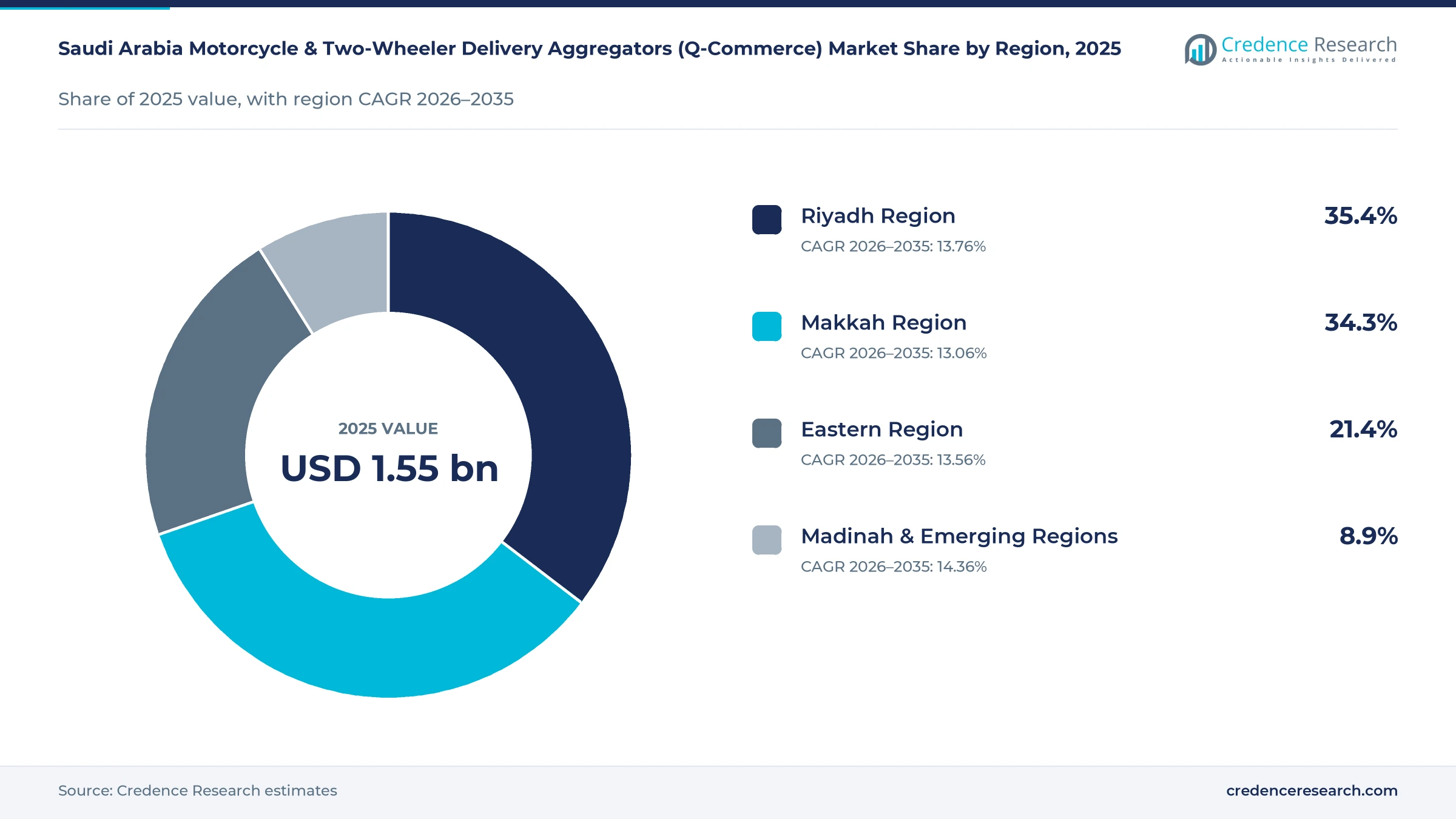
Riyadh leads while Madinah and emerging cities grow fastest
| Region | Value, 2025 (USD billion) | Share, 2025 | CAGR, 2026–2035 |
|---|---|---|---|
| Riyadh Region | 0.55 | 35.4% | 13.76% |
| Makkah Region | 0.53 | 34.3% | 13.06% |
| Eastern Region | 0.33 | 21.4% | 13.56% |
| Madinah & Emerging Regions | 0.14 | 8.9% | 14.36% |
Why does the Riyadh Region hold the largest share?
The Riyadh Region held a 35.4% share of 2025 value and grows at 13.76% a year, because the capital has the most offices, students and dense housing. Riyadh recorded 130.4 million delivery orders in 2024, more than any other region. It accounted for 44% of national orders in the first quarter of 2026. As a result, new formats such as rapid grocery and pharmacy delivery usually launch in the capital first.
How does the Makkah Region serve residents and pilgrims?
The Makkah Region held a 34.3% share of 2025 value and grows at 13.06% a year, because Jeddah, Makkah and Taif combine large resident populations with millions of visitors. Makkah recorded 65.4 million delivery orders in 2024 and held 22.21% of national orders in early 2026. In turn, demand from hotels and seasonal visitors keeps riders busy around fast-food chains and grocery outlets.
Why is the Eastern Region a steady order base?
The Eastern Region held a 21.4% share of 2025 value and grows at 13.56% a year, because Dammam, Khobar and Jubail host industrial workers and young families. The region held 16.23% of national orders in the first quarter of 2026, up from a smaller share in 2024. Keeta already serves the Greater Dammam area and added Al Jubail and Hafar Al Batin in 2025, which widens coverage.
How are Madinah and emerging cities adding the fastest growth?
Madinah and emerging regions held 8.9% of 2025 value and grow fastest at 14.36% a year, because platforms are moving into cities with fewer delivery choices. Madinah recorded 8.6 million orders in 2024, while Aseer recorded 43.26 million and Qassim 9.47 million. Keeta added Abha, Tabuk, Hail, Jazan and Najran in 2025, which shows how quickly coverage is spreading.
Rules, funding rounds and platform deals since 2024
| Development | Status and market relevance |
|---|---|
| In April 2024, the Transport General Authority began the first phase of delivery rules, requiring non-Saudi drivers to join licensed companies. | Formalizes rider employment across the sector |
| In July 2025, Ninja raised USD 254 million and reached unicorn status to expand its quick commerce network. | Funds more dark stores and riders |
| In July 2025, Keeta expanded to 11 more Saudi cities, reaching 20 cities with more than 18,000 additional riders. | Extends app delivery into smaller cities |
| In November 2025, Jahez integrated noon Minutes into its app, giving users direct access to rapid grocery delivery. | Adds quick commerce without new dark stores |
| In August 2026, the Transport General Authority issued executive regulations for commercial motorcycle cargo delivery. | Moves motorcycle delivery from a pilot to a full framework |
Routing, rider checks and app tiles speed each drop
- Dispatch and routing engines match each order to the nearest rider and plan routes, which cuts waiting time at restaurants and dark stores and lets one rider carry stacked orders on the same route.
- Rider face verification links each driver to the transport authority system, which confirms identity, supports licensing rules and reduces the risk of unregistered riders.
- Cross-app integration lets one platform show another's service as a tile, which widens choice for users without the cost of building new warehouses.
- Subscription and wallet tools store payment details and free-delivery benefits, which lift repeat orders, cut cash handling and give platforms better data on demand.
Need a Custom Version of This Report?
Tailor the scope, geography, or segments to your exact requirements.
- Custom geography or segment scope
- Direct access to our analyst team
Local apps and global groups compete on speed and reach
Competition is led by a few large aggregators and fast-growing quick commerce players. HungerStation, owned by Delivery Hero, is the largest aggregator, and Uber announced a planned takeover of Delivery Hero in July 2026. Jahez operates across more than 100 cities with over 50,000 restaurant stores and partners with noon, whose noon Minutes service runs dark stores in major cities. Keeta, launched by Meituan, reached 23 cities in 2025 with more than 38,000 riders and recorded over 150 million orders in its first year. Ninja focuses on rapid grocery delivery from its own dark stores. Rivals compete on delivery speed, merchant choice, subscription benefits, discounts and rider availability. Because licensing and Saudization rules shape rider supply, platforms with licensed fleets and broad city coverage tend to win the most orders.
Which platforms shape Saudi rider delivery?
| Company | Type | Role in the market |
|---|---|---|
| HungerStation | Aggregator | Largest Saudi aggregator, owned by Delivery Hero, set to come under Uber after a planned 2026 takeover |
| Jahez | Aggregator | Serves more than 100 cities and added a noon Minutes tile in November 2025 |
| Keeta | Aggregator | Reached 23 cities in 2025 with more than 38,000 riders and 50,000 restaurant partners |
| Ninja | Quick commerce | Raised USD 254 million in July 2025 to expand dark-store grocery delivery |
| noon Minutes | Quick commerce | Runs dark stores across major Saudi cities and serves Jahez users through an app tile |
Credence Research view on Saudi rider-based quick delivery
Credence Research's view is that Saudi rider-based delivery will grow through faster drops, wider baskets and smaller cities rather than through higher fees. Restaurant meals remain the largest value pool, while grocery, dark stores and sub-20-minute windows add the fastest growth. The new motorcycle cargo regulations and Saudization rules will raise standards and costs. Platforms with licensed fleets, strong subscriptions and broad city coverage should gain the most, while discounting and rider costs keep pressure on margins.
How the Saudi rider-delivery estimate was built
The report uses 2025 as the base year on a calendar basis, and market values come from the Credence Research model. That model combines official delivery order statistics, payment data, connectivity data and company releases. Regional shares follow the client zone definitions, while segment splits and growth rates are Credence Research estimates. Sources used are official statistics, regulator and central bank releases, World Bank data and company releases reported in news media, and no interviews or surveys were used.
Faster drops and smaller cities carry growth to 2035
The Saudi Arabia motorcycle and two-wheeler delivery aggregators (Q-commerce) market is expected to reach USD 5.68 billion by 2035, a 13.54% CAGR during 2026–2035, as app orders, dark stores and smaller cities keep demand rising. Growth should be strongest in grocery delivery, dark store fulfilment, electric two-wheelers and Madinah and emerging regions, because these areas gain most from new platforms and formal fleet rules. Riyadh will keep the lead, while rider costs and discounting could slow some operators.
Frequently Asked Questions
How big is the Saudi Arabia motorcycle and two-wheeler delivery aggregators market?
Which service type leads Saudi rider delivery?
Which region leads the Saudi market?
How many delivery orders does Saudi Arabia record?
What rules govern motorcycle delivery in Saudi Arabia?
How fast are dark stores growing in Saudi quick commerce?
Who are the leading companies in Saudi rider delivery?
What are the main challenges for Saudi delivery aggregators?
Table of Content
Chapter 1 Market Segmentation
- 1.1 Segmentation Framework
- 1.1.1 Product and Service Classification
- 1.1.2 Application and End-Use Classification
- 1.1.3 Technology and Solution Classification
- 1.1.4 Customer and Distribution Channel Classification
- 1.1.5 Geographic Segmentation
- 1.1.6 Market Segment Definitions and Boundaries
- 1.2 By Service Type
- 1.2.1 Restaurant & Prepared Food Delivery
- 1.2.2 Grocery & Convenience Delivery
- 1.2.3 Pharmacy & Wellness Delivery
- 1.2.4 Specialty Retail & Errand Delivery
- 1.3 By Mode of Transport
- 1.3.1 Conventional Motorcycles
- 1.3.2 Motor Scooters
- 1.3.3 Electric Two-Wheelers
- 1.3.4 Mixed Fleet
- 1.4 By Delivery Model
- 1.4.1 Platform-Managed Delivery
- 1.4.2 Merchant-Managed Delivery
- 1.4.3 Hybrid Fulfilment
- 1.4.4 Dark Store Fulfilment
- 1.5 By Delivery Speed
- 1.5.1 Under 20 Minutes
- 1.5.2 20-45 Minutes
- 1.5.3 46-90 Minutes
- 1.5.4 Same-Day Scheduled
Chapter 2 Introduction
- 2.1 Report Objectives and Scope
- 2.2 Product Definition and Industry Terminology
- 2.3 Market Inclusions and Exclusions
- 2.4 Research Process
- 2.4.1 Primary Research and Expert Interviews
- 2.4.2 Secondary Research and Source Review
- 2.4.3 Top-Down and Bottom-Up Estimation
- 2.4.4 Data Triangulation and Verification
- 2.5 Market Size Measurement Basis
- 2.5.1 2025: USD 1.55 billion → 2035: USD 5.68 billion
- 2.6 Historical and Forecast Reference Periods
- 2.6.1 Historical Period: 2018-2025
- 2.6.2 Base Year: 2025
- 2.6.3 Forecast Period: 2025-2035
- 2.7 Research Assumptions and Limitations
Chapter 3 Executive Summary
- 3.1 Market Snapshot and Key Findings
- 3.2 Base-Year Market Size, 2025
- 3.3 Forecast Market Size, 2035
- 3.4 Revenue and Volume Growth Outlook
- 3.5 Key Demand and Supply Indicators
- 3.6 Leading Market Segments
- 3.7 Fastest-Growing Market Opportunities
- 3.8 Regional Performance Highlights
- 3.9 Technology and Industry Transformation
- 3.10 Competitive Landscape Summary
- 3.11 Analyst View and Strategic Implications
Chapter 4 Saudi Arabia Motorcycle & Two-Wheeler Delivery Aggregators (Q-Commerce) Market Trends and Developments
- 4.1 Historical Industry Development, 2018-2025
- 4.2 Recent Market Trends and Developments
- 4.3 Demand and Customer Behavior Trends
- 4.4 Technology and Product Innovation
- 4.5 Artificial Intelligence, Automation and Digitalization
- 4.6 Local Manufacturing and Supply Chain Realignment
- 4.7 Industry Partnerships, Mergers and Acquisitions
- 4.8 Sustainability and Circular Economy Developments
- 4.9 Government and Private Sector Investment Trends
- 4.10 Emerging Business Models and Commercialization
- 4.11 Industry Developments and Announcements
Chapter 5 Saudi Arabia Motorcycle & Two-Wheeler Delivery Aggregators (Q-Commerce) Market Production, Supply and Demand Analysis
- 5.1 Demand Trend and Consumption Analysis, 2018-2025
- 5.2 Demand Forecast, 2025-2035
- 5.3 Production and Output Trend, 2018-2025
- 5.4 Production and Output Forecast, 2025-2035
- 5.5 Installed Capacity and Capacity Utilization
- 5.6 Company-Wise Production Plants and Statistics
- 5.6.1 Installed Production Capacity
- 5.6.2 Actual Production
- 5.6.3 Planned Capacity and Expansion Targets
- 5.7 Supply Chain Structure and Procurement Trends
- 5.8 Supply-Demand Gap and Bottlenecks
- 5.9 Import Dependence and Sourcing Structure
- 5.10 Contract Manufacturing and Outsourcing
- 5.11 Regional Supply and Demand Concentration
Chapter 6 Saudi Arabia Motorcycle & Two-Wheeler Delivery Aggregators (Q-Commerce) Market Pricing Analysis
- 6.1 Pricing Structure and Measurement
- 6.2 Historical Pricing Trends, 2018-2025
- 6.3 Pricing Outlook, 2025-2035
- 6.4 Average Selling Price and Unit Economics
- 6.5 Pricing by Product and Market Segment
- 6.6 Geographic Pricing Differences
- 6.7 Key Input, Energy, Labor and Logistics Costs
- 6.8 Contract Pricing and Purchasing Models
- 6.9 Pricing Sensitivity and Competitive Positioning
- 6.10 Price, Margin and Profitability Implications
Chapter 7 Saudi Arabia Motorcycle & Two-Wheeler Delivery Aggregators (Q-Commerce) Market Dynamics
- 7.1 Market Growth Drivers
- 7.1.1 Demand-Side Drivers
- 7.1.2 Technology and Innovation Drivers
- 7.1.3 Infrastructure and Investment Drivers
- 7.1.4 Regulatory and Policy Drivers
- 7.2 Market Restraints
- 7.2.1 Cost and Affordability Constraints
- 7.2.2 Technology and Adoption Barriers
- 7.2.3 Supply Chain and Operational Constraints
- 7.3 Market Challenges
- 7.3.1 Competitive Pressure and Margin Erosion
- 7.3.2 Skills, Infrastructure and Implementation Gaps
- 7.4 Emerging Market Opportunities
- 7.5 Market Dynamics Impact and Time-Horizon Assessment
Chapter 8 Saudi Arabia Motorcycle & Two-Wheeler Delivery Aggregators (Q-Commerce) Value Chain Analysis
- 8.1 Industry Value Chain Overview
- 8.2 Upstream Suppliers and Critical Inputs
- 8.3 Technology and Component Providers
- 8.4 Manufacturing or Service Delivery
- 8.5 Distribution, Channel Partners and Integrators
- 8.6 Downstream Applications and End Users
- 8.7 Value Addition and Profit Pools
- 8.8 Vertical Integration and Outsourcing
- 8.9 Supplier Concentration and Risk
- 8.10 Supply Chain Localization and Resilience
Chapter 9 Saudi Arabia Motorcycle & Two-Wheeler Delivery Aggregators (Q-Commerce) Market Regulations and Policies
- 9.1 Relevant Laws, Standards and Compliance Frameworks
- 9.2 Product, Service, Safety and Quality Requirements
- 9.3 Government Policies, Incentives and Subsidies
- 9.4 Imports, Exports and Trade Barriers
- 9.5 Public Procurement and Local Content Requirements
- 9.6 Environmental and Sustainability Compliance
- 9.7 Upcoming Policy Changes and Market Implications
Chapter 10 Saudi Arabia Motorcycle & Two-Wheeler Delivery Aggregators (Q-Commerce) Market Hotspots and Opportunities
- 10.1 Market Opportunity Mapping and Growth Hotspots
- 10.2 High-Growth Applications and Customer Groups
- 10.3 Underserved Markets and White-Space Opportunities
- 10.4 Emerging Technology and Product Opportunities
- 10.5 New Capacity and Investment Hotspots
- 10.6 Market Entry and Expansion Opportunities
- 10.7 Distribution and Partnership Opportunities
- 10.8 Near-Term and Long-Term Commercial Potential
- 10.9 Opportunity Attractiveness and Execution Risks
Chapter 11 Saudi Arabia Motorcycle & Two-Wheeler Delivery Aggregators (Q-Commerce) Market Outlook, 2025-2035
- 11.1 Market Size and Analysis
- 11.1.1 Revenue (Market Measurement: 2025: USD 1.55 billion → 2035: USD 5.68 billion)
- 11.1.2 Market Volume and Quantity Sold
- 11.1.3 Historical Market Size, 2018-2025
- 11.1.4 Base-Year Market Size, 2025
- 11.2 Market Forecast, 2025-2035
- 11.2.1 Revenue Forecast to 2035
- 11.2.2 Volume Forecast to 2035
- 11.2.3 CAGR and Year-on-Year Growth
- 11.2.4 Incremental Revenue Opportunity
- 11.3 Forecast Assumptions and Scenario Analysis
- 11.3.1 Base-Case Forecast
- 11.3.2 Optimistic and Conservative Scenarios
- 11.3.3 Technology, Pricing and Policy Sensitivities
- 11.4 Market Attractiveness and Growth Outlook
Chapter 12 Saudi Arabia Motorcycle & Two-Wheeler Delivery Aggregators (Q-Commerce) Market Segmentation and Outlook
- 12.1 Segmentation Summary and Market Shares, 2025
- 12.2 Largest and Fastest-Growing Segments
- 12.3 By Service Type - Market Size and Forecast, 2025-2035
- 12.3.1 Segment Definition and Scope
- 12.3.2 Historical Market Size, 2018-2025
- 12.3.3 Revenue Forecast, 2025-2035
- 12.3.4 Volume Forecast, 2025-2035
- 12.3.5 Base-Year Market Share, 2025
- 12.3.6 Segment CAGR and Growth Drivers
- 12.3.7 Subsegment Market Size and Forecast
- 12.3.7.1 Restaurant & Prepared Food Delivery
- 12.3.7.2 Grocery & Convenience Delivery
- 12.3.7.3 Pharmacy & Wellness Delivery
- 12.3.7.4 Specialty Retail & Errand Delivery
- 12.3.8 Subsegment Pricing and Adoption Trends
- 12.3.9 Leading Suppliers and Competition
- 12.3.10 Regional Demand and Opportunities
- 12.4 By Mode of Transport - Market Size and Forecast, 2025-2035
- 12.4.1 Segment Definition and Scope
- 12.4.2 Historical Market Size, 2018-2025
- 12.4.3 Revenue Forecast, 2025-2035
- 12.4.4 Volume Forecast, 2025-2035
- 12.4.5 Base-Year Market Share, 2025
- 12.4.6 Segment CAGR and Growth Drivers
- 12.4.7 Subsegment Market Size and Forecast
- 12.4.7.1 Conventional Motorcycles
- 12.4.7.2 Motor Scooters
- 12.4.7.3 Electric Two-Wheelers
- 12.4.7.4 Mixed Fleet
- 12.4.8 Subsegment Pricing and Adoption Trends
- 12.4.9 Leading Suppliers and Competition
- 12.4.10 Regional Demand and Opportunities
- 12.5 By Delivery Model - Market Size and Forecast, 2025-2035
- 12.5.1 Segment Definition and Scope
- 12.5.2 Historical Market Size, 2018-2025
- 12.5.3 Revenue Forecast, 2025-2035
- 12.5.4 Volume Forecast, 2025-2035
- 12.5.5 Base-Year Market Share, 2025
- 12.5.6 Segment CAGR and Growth Drivers
- 12.5.7 Subsegment Market Size and Forecast
- 12.5.7.1 Platform-Managed Delivery
- 12.5.7.2 Merchant-Managed Delivery
- 12.5.7.3 Hybrid Fulfilment
- 12.5.7.4 Dark Store Fulfilment
- 12.5.8 Subsegment Pricing and Adoption Trends
- 12.5.9 Leading Suppliers and Competition
- 12.5.10 Regional Demand and Opportunities
- 12.6 By Delivery Speed - Market Size and Forecast, 2025-2035
- 12.6.1 Segment Definition and Scope
- 12.6.2 Historical Market Size, 2018-2025
- 12.6.3 Revenue Forecast, 2025-2035
- 12.6.4 Volume Forecast, 2025-2035
- 12.6.5 Base-Year Market Share, 2025
- 12.6.6 Segment CAGR and Growth Drivers
- 12.6.7 Subsegment Market Size and Forecast
- 12.6.7.1 Under 20 Minutes
- 12.6.7.2 20-45 Minutes
- 12.6.7.3 46-90 Minutes
- 12.6.7.4 Same-Day Scheduled
- 12.6.8 Subsegment Pricing and Adoption Trends
- 12.6.9 Leading Suppliers and Competition
- 12.6.10 Regional Demand and Opportunities
- 12.7 Segment Growth Comparison
- 12.8 Segment Attractiveness and Priority Matrix
Chapter 13 Saudi Arabia Motorcycle & Two-Wheeler Delivery Aggregators (Q-Commerce) Geographic Market Outlook, 2025-2035
- 13.1 Domestic Market Distribution and Demand Clusters
- 13.2 State- or Province-Wise Market Size and Forecast, 2025-2035
- 13.3 City and Metropolitan Market Outlook
- 13.4 Industrial, Manufacturing and Commercial Clusters
- 13.5 Geographic Concentration of Key End Users
- 13.6 Local Pricing and Purchasing Differences
- 13.7 Domestic Production Facilities and Capacity Map
- 13.8 Local Infrastructure and Project Pipeline
- 13.9 State-Level Policy and Incentive Differences
- 13.10 Subnational Investment Hotspots and Opportunities
- 13.11 Distribution and Logistics Networks
- 13.12 Domestic Competitive Footprint
Chapter 14 Saudi Arabia Motorcycle & Two-Wheeler Delivery Aggregators (Q-Commerce) Technology, Innovation and Sustainability Outlook
- 14.1 Technology Landscape and Maturity
- 14.2 Product, Process and Service Innovation
- 14.3 AI, Automation and Digital Tools in the Industry
- 14.4 Technology Adoption and Performance Benchmarking
- 14.5 Innovation Pipeline and R&D Investment
- 14.6 Patent and Intellectual Property Trends
- 14.7 Energy Efficiency and Resource Management
- 14.8 Sustainability, Recycling and Circularity
- 14.9 Technology Roadmap, 2025-2035
- 14.10 Risks of Obsolescence and Technology Substitution
Chapter 15 Saudi Arabia Motorcycle & Two-Wheeler Delivery Aggregators (Q-Commerce) Market Key Strategic Imperatives
- 15.1 Growth and Market Entry Priorities
- 15.2 High-Return Products and Segments
- 15.3 Pricing, Profitability and Cost Optimization
- 15.4 Technology Investment and Product Differentiation
- 15.5 Supply Chain Localization and Resilience
- 15.6 Distribution and Customer Acquisition
- 15.7 Partnership, Acquisition and Capacity Strategy
- 15.8 Regional Expansion Priorities
- 15.9 Short-, Medium- and Long-Term Actions
Chapter 16 Competition Outlook
- 16.1 Industry Competition Characteristics
- 16.2 Market Structure and Concentration
- 16.3 Market Share and Competitive Positioning, 2025
- 16.4 Company-Wise Revenue and Product Benchmarking
- 16.5 Production and Service Capacity Benchmarking
- 16.6 Technology, Pricing and Differentiation
- 16.7 Regional Footprint and Distribution Strength
- 16.8 Mergers, Acquisitions and Strategic Alliances
- 16.9 New Entrants and Competitive Threats
- 16.10 Porter's Five Forces and Industry Attractiveness
- 16.11 Competitive Outlook, 2025-2035
Chapter 17 Company Profiles
- 17.1 Company Coverage and Selection Criteria
- 17.2 HungerStation
- 17.2.1 Business Description
- 17.2.2 Company Ownership and Geographic Presence
- 17.2.3 Product and Service Portfolio
- 17.2.4 Manufacturing and Operating Footprint
- 17.2.5 Production Capacity and Expansion Plans
- 17.2.6 Financial Performance and Investment
- 17.2.7 Market Share and Competitive Position
- 17.2.8 Technology and Innovation Capabilities
- 17.2.9 Strategic Alliances or Partnerships
- 17.2.10 Recent Developments
- 17.2.11 Growth Strategy and Outlook
- 17.3 Jahez
- 17.4 Keeta
- 17.5 Ninja
- 17.6 Mrsool
- 17.7 ToYou
- 17.8 Nana
- 17.9 noon Minutes
- 17.10 Careem
- 17.11 The Chefz
- 17.12 Other Relevant Market Participants
Note: Every listed company is profiled on the structure shown under the first company. The company list is preliminary and may change based on research findings, market developments, data availability and client requirements.
Chapter 18 Disclaimer
- 18.1 Research and Forecast Disclaimer
- 18.2 Data Source and Estimation Limitations
Note: The depth of individual sections depends on data availability for this market. Volume, capacity, trade and other unit-based metrics are included where applicable.