
Autonomous Off-road Vehicles and Machinery Market Overview
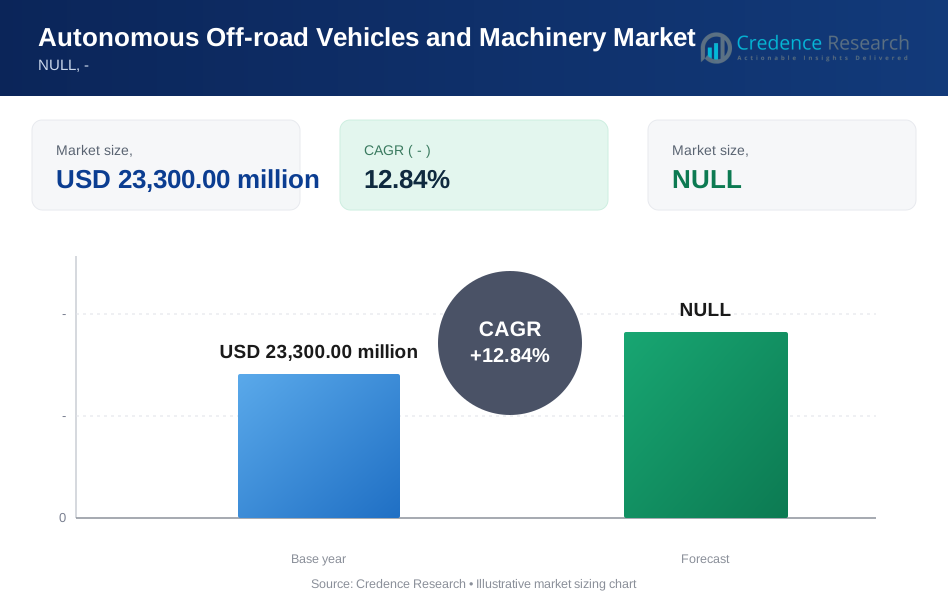
The autonomous off-road vehicle and machinery market is poised for remarkable growth, with its valuation standing at USD 23,300.00 million as of 2023. This sector is forecast to witness a significant upsurge, reaching an estimated valuation of USD 69,107.25 million by the year 2032. This expansion represents a compound annual growth rate (CAGR) of 12.84%.
In the year 2023, the market was predominantly led by North America, which accounted for nearly 40% of the global market share. This regional dominance is primarily attributed to the advanced technological infrastructure in the region and the high adoption rate of autonomous technologies in off-road applications.
Concurrently, the Asia-Pacific region is identified as the most rapidly expanding market for autonomous off-road vehicles and machinery. This region is projected to experience a CAGR exceeding 14% during the forecast period. The growth trajectory in Asia Pacific is fueled by escalating investments in autonomous technologies, an increasing emphasis on the automation of agricultural and mining operations, and the expanding foothold of key market players. The accelerated development in emerging economies such as China and India, along with continual technological advancements, is expected to significantly contribute to the growth of the autonomous off-road vehicles and machinery market in the Asia Pacific.
Market Drivers
The market for autonomous off-road vehicles and machinery is being significantly driven by a shortage of skilled truck drivers and machine operators. This scarcity is catalyzing the development and adoption of autonomous technologies in construction and off-road applications, promising increased efficiency and notable cost savings. Concurrently, the requirement for robust connectivity is paramount for the effective operation of these autonomous vehicles, both off- and on-road. Especially in confined spaces, the deployment of Wi-Fi and other wireless communication systems is essential to ensure uninterrupted and smooth operation. These factors, stemming from operational efficiencies and technological necessities, play a critical role in shaping market dynamics.
The market is influenced by broader socio-economic trends and technological advancements. Factors such as rapid urbanization, an escalating demand for adventure and outdoor activities, and the continuous development of advanced technologies are expanding the application spectrum for autonomous off-road vehicles. Simultaneously, the integration of sophisticated technologies like LIDAR, radar, cameras, GPS, and ultrasound is revolutionizing the sector, enabling precise navigation and control in complex terrains. Additionally, evolving government regulations and insurance policies are guiding the market's trajectory. These regulations are instrumental in ensuring the safe and efficient utilization of autonomous off-road vehicles, thereby fostering a conducive environment for sustained market growth.
Several key factors are driving growth in the autonomous off-road vehicles and machinery market. Forklifts have remained one of the most prominent segments, holding over 15% of the market share in 2023, while automated guided vehicles (AGVs) are likely to see the fastest growth rate going forward. Key growth drivers include higher efficiency and productivity, as autonomous equipment can operate 24/7 without human limitations. Reducing labor costs is another benefit, as these machines eliminate the need for human operators for some tasks. However, high upfront investment costs, including purchasing the equipment, integrating technologies, and training personnel, pose challenges, especially for companies with older machinery fleets. Still, huge growth potential exists in emerging economies.
Market Restraints
The autonomous off-road vehicle and machinery market is facing a multitude of restraints and challenges that are impeding its growth. Key among these is the lack of adequate infrastructure, such as connectivity and GPS, especially in remote areas, which hampers the effective functioning and adoption of these vehicles. Coupled with this is the high cost of development and deployment, making it a challenging proposition for small and medium-sized enterprises. Regulatory hurdles further complicate the landscape, with varying laws and regulations across regions posing significant adoption challenges. Technical issues, such as ensuring sensor reliability and efficient obstacle detection in complex environments, add to the list of challenges. Moreover, the market faces stiff competition from traditional off-road vehicles like trucks and tractors, which are well-established and often preferred by customers. These combined factors—infrastructural deficiencies, high costs, regulatory complexities, technical challenges, and strong competition from traditional vehicles—collectively create a formidable set of obstacles for the growth and widespread acceptance of autonomous off-road vehicles.
Opportunities
The autonomous off-road vehicle and machinery market offers several key opportunities:
- Enhanced Efficiency and Productivity: These vehicles can significantly boost efficiency and productivity in various sectors like agriculture, construction, and mining.
- Sustainability: By reducing fuel consumption and emissions and minimizing the need for manual labor, autonomous off-road vehicles contribute to achieving sustainability goals.
- Wide Range of Applications: Their application extends across multiple domains, including military, utility, and recreational activities, attracting a diverse customer base.
- Innovation through New Product Development: Companies are focusing on developing new products to gain a competitive advantage, leading to innovative and cost-effective solutions.
- Electric Drive Systems: The integration of electric drive systems in off-road vehicles presents new growth avenues for the market.
- Demand for Adventure and Outdoor Activities: The rising demand for adventure and outdoor activities propels market growth, as these vehicles offer safer and more convenient exploration of rough terrain.
Interesting Facts About Autonomous Off-Road Vehicles and the Machinery Market
- Autonomous off-road vehicles are increasingly utilized in various sectors such as construction, farming, heavy industry, and freight rail, showcasing their versatility and utility.
- All autonomous vehicles need robust connectivity for optimal operation, with solutions like Wi-Fi or other wireless systems being critical in confined areas.
- In farming, these vehicles are used for tasks like weed removal and precise chemical application, reducing reliance on fertilizers, herbicides, and insecticides, thus contributing to sustainability.
- Essential components include sensors such as LIDARs, radars, cameras, GPS, and ultrasound, alongside a central processing unit for vehicle control, ensuring accurate navigation and functionality.
- By automating driving tasks, these vehicles enhance safety, boost productivity, and improve the work-life balance of operators, allowing them to focus on other critical tasks.
Competitive Landscape
Key Players
- Caterpillar Inc
- Komatsu Ltd
- Sandvik AB
- John Deere
- Liebherr Group
- Jungheinrich AG
- Daifuku Co. Ltd.
- KION Group
- NAVYA
- EasyMile
Regional Analysis
North America has dominated the global autonomous off-road vehicles and machinery market, capturing almost 40% of the market share in 2023. The substantial infrastructure investment and construction activity in countries like the United States and Canada have driven strong demand for this equipment. Additionally, the presence of several major manufacturers has facilitated the rapid adoption of autonomous technology.
Going forward, Asia Pacific is forecast to be the fastest-growing market, with an expected compound annual growth rate of over 14% during the forecast period. Rapid urbanization and significant infrastructure projects in China, India, and Southeast Asia will drive demand. The construction industry is a particularly significant market for this equipment in Asia Pacific, growing at the fastest CAGR of over 15% over the forecast timeframe. Strong economic growth and government initiatives around smart city development have created massive needs for construction machinery across the region.
Other factors contributing to the high growth expectations in Asia Pacific include supportive regulatory environments for autonomous vehicles, the availability of affordable sensors, and a growing skilled workforce to operate and maintain the equipment. Market penetration of autonomous technology in off-road vehicles and machinery is still in its early stages in Asia Pacific, signaling substantial room for adoption in the years ahead.
Segmentation
Type Segment Analysis
- Tractors,
- Harvesters,
- Haul Trucks,
- Excavators,
- Loaders and dozers,
- Graders,
- Drill,
- Rigs,
- Compactors,
- UGVs,
- AGVs,
- Shuttles,
- Forklifts,
- Cranes
Application Segment Analysis
- Construction,
- Mining and quarrying,
- Defense and Military,
- Agriculture,
- Airport Handling and Logistics,
- Indoor Manufacturing Handling and Logistics,
- E-Commerce and Warehouse Logistics
- North America
- The U.S
- Canada
- Mexico
- Europe
- Germany
- France
- The U.K.
- Italy
- Spain
- Rest of Europe
- Asia Pacific
- China
- Japan
- India
- South Korea
- South-east Asia
- Rest of Asia Pacific
- Latin America
- Brazil
- Argentina
- Rest of Latin America
- Middle East & Africa
- GCC Countries
- South Africa
- Rest of Middle
Request a Free Sample
Fill in your details and we'll send you a free sample report.
- Sample data tables & charts
- Research methodology
Need a Custom Version of This Report?
Tailor the scope, geography, or segments to your exact requirements.
- Custom geography or segment scope
- Direct access to our analyst team
Frequently Asked Questions
What is the current market valuation of the autonomous off-road vehicle and machinery sector, and what growth is expected in the coming years?
Which region currently leads the market for autonomous off-road vehicles and machinery, and what factors contribute to its dominance?
Which region is emerging as the fastest-growing market for autonomous off-road vehicles and machinery?
What are the key drivers for the growth of the autonomous off-road vehicles and machinery market in the Asia Pacific region?
Table of Content
Chapter 1. Report Introduction
- 1.1 Report Description & Purpose
- 1.1.1 Report Title & Market Definition
- 1.1.2 Unique Selling Propositions (USP) & Key Differentiators
- 1.1.3 Value Proposition for Stakeholders
- 1.2 Research Objectives
- 1.2.1 Market Sizing Objectives (Volume & Revenue)
- 1.2.2 Segmentation Objectives
- 1.2.3 Competitive Intelligence Objectives
- 1.2.4 Forecast & Scenario Objectives
- 1.3 Report Scope
- 1.3.1 Autonomous Off-road Vehicles and Machinery Scope – Types & Subtypes Covered
- 1.3.2 Geographic Scope – Regions & Countries Covered
- 1.3.3 Historical Period, Base Year & Forecast Period (the historical period; forecast to the forecast period)
- 1.3.4 Inclusions & Exclusions
- 1.4 HS Code & Classification Framework
- 1.5 Currency, Units & Pricing Basis
- 1.6 Target Stakeholders
- 1.7 Limitations & Assumptions
Chapter 2. Executive Summary
- 2.1 Global Autonomous Off-road Vehicles and Machinery Market Snapshot
- 2.1.1 Market Size – Historical (the historical period) & Forecast (the forecast period) (base year: USD 23,300.00 million → forecast year: NULL)
- 2.1.2 Volume & Revenue – Global Totals
- 2.1.3 Key Market Highlights – Top Five Facts
- 2.2 Autonomous Off-road Vehicles and Machinery Market Segmentation Snapshot
- 2.2.1 Market Split by Region – vs.
- 2.3 Competitive Snapshot
- 2.3.1 Top 10 Players by Revenue Share –
- 2.3.2 Top 10 Players by Volume Share –
- 2.3.3 Recent Strategic Developments (18-Month Summary)
- 2.4 Key Investment Highlights & Strategic Conclusions
Chapter 3. Autonomous Off-road Vehicles and Machinery Market Dynamics & Industry Analysis
- 3.1 Market Overview & Context
- 3.1.1 Autonomous Off-road Vehicles and Machinery Market Position in the Broader Automotive Value Chain
- 3.1.2 OEM vs. Replacement Market Dynamics
- 3.1.3 Market Maturity & Development Stage by Region
- 3.2 Autonomous Off-road Vehicles and Machinery Market Drivers
- 3.3 Autonomous Off-road Vehicles and Machinery Market Restraints & Challenges
- 3.4 Autonomous Off-road Vehicles and Machinery Market Opportunities
- 3.5 Porter's Five Forces Analysis
- 3.5.1 Threat of New Entrants
- 3.5.2 Bargaining Power of Suppliers
- 3.5.3 Bargaining Power of Buyers
- 3.5.4 Threat of Substitutes
- 3.5.5 Competitive Rivalry – Intensity Assessment
- 3.6 Autonomous Off-road Vehicles and Machinery Value Chain Analysis
- 3.6.1 Upstream – Raw Material/Input Suppliers
- 3.6.1.1 Raw Material/Input 1
- 3.6.1.2 Raw Material/Input 2
- 3.6.1.3 Raw Material/Input 3
- 3.6.2 Midstream – Production/Manufacturing/Service Delivery
- 3.6.2.1 Production/Process Overview
- 3.6.2.2 Key Facility Locations & Capacity by Manufacturer
- 3.6.3 Downstream – Distribution & End Consumer
- 3.6.3.1 Primary Channel – B2B/OEM
- 3.6.3.2 Secondary Channels – Dealer, Retail, Online, Direct
- 3.6.4 Value Chain Profitability Analysis
- 3.6.1 Upstream – Raw Material/Input Suppliers
- 3.7 PESTEL Analysis
- 3.7.1 Political Factors
- 3.7.2 Economic Factors
- 3.7.3 Social Factors
- 3.7.4 Technological Factors
- 3.7.5 Environmental Factors
- 3.7.6 Legal Factors
- 3.8 Autonomous Off-road Vehicles and Machinery Supply Chain Analysis
- 3.8.1 Raw Material/Input Supply Risk Assessment
- 3.8.2 Manufacturing Concentration Risk (Geographic Exposure)
- 3.8.3 Trade Disruption Impact Analysis
- 3.9 Regulatory & Policy Landscape
Note: The regulatory and policy landscape section covers regulations based on their applicability to the market, Autonomous Off-road Vehicles and Machinery category, geography, and scope of the study. Only regulatory frameworks with a material impact on operations, compliance, trade, sustainability, or market access are analyzed in detail.
Chapter 4. Key Investment Pockets & Opportunity Analysis
- 4.1 Autonomous Off-road Vehicles and Machinery Market Attractiveness Analysis
- 4.1.1 By Region – Investment Attractiveness Matrix (Volume × CAGR)
- 4.2 Absolute Revenue Growth Opportunity
- 4.2.1 By Region – Absolute USD Growth Through the forecast period
- 4.3 Incremental Volume Opportunity
- 4.3.1 By Region – Incremental Volume Through the forecast period
- 4.3.2 Segment – Incremental Volume
- 4.4 Emerging Submarket Opportunity Deep Dive (Subject to Applicability)
- 4.5 Emerging Market Opportunity Scorecards
- 4.5.1 United States
- 4.5.2 Europe
- 4.5.3 Asia
- 4.5.4 Middle East & Africa
Note: Emerging Market Opportunity Scorecards will be included based on relevance and strategic importance. Regions listed are indicative and may vary depending on data availability and market dynamics.
Chapter 5. Autonomous Off-road Vehicles and Machinery Import-Export Analysis & Trade Flows
- 5.1 Global Trade Overview
- 5.1.1 Global Export Value by Country (the historical period)
- 5.1.2 Global Export Volume by Country (the historical period)
- 5.1.3 Global Import Value by Country (the historical period)
- 5.1.4 Global Import Volume by Country (the historical period)
- 5.1.5 Net Trade Balance by Country (the historical period)
- 5.2 Export Analysis – Segment
- 5.2.1 Type 1 (HS Code)
- 5.2.2 Type 2 (HS Code)
- 5.2.3 Type 3 (HS Code)
- 5.2.4 Type 4 (HS Code)
- 5.2.5 Type 5 (HS Code)
- 5.3 Import Analysis – Segment
- 5.3.1 Type 1 (HS Code)
- 5.3.2 Type 2 (HS Code)
- 5.3.3 Type 3 (HS Code)
- 5.3.4 Type 4 (HS Code)
- 5.3.5 Type 5 (HS Code)
- 5.4 Average Unit Trade Prices
- 5.4.1 Average Export Price – Segment & Country
- 5.4.2 Average Import Price – Segment & Source Country
- 5.4.3 Price Trends (the historical period)
- 5.5 Key Trade Route Analysis
- 5.5.1 Trade Route 1
- 5.5.2 Trade Route 2
- 5.5.3 Trade Route 3
- 5.5.4 Trade Route 4
- 5.5.5 Trade Route 5
- 5.6 Trade Policy Impact Assessment
- 5.6.1 US Anti-Dumping & Section 301 Tariffs
- 5.6.2 EU Customs Union Impact
- 5.6.3 Major Free Trade Agreements
- 5.6.4 USMCA Rules of Origin
Note: Trade policy analysis will be included only where relevant to the Autonomous Off-road Vehicles and Machinery market.
Chapter 6. Competitive Landscape & Company Benchmarking
- 6.1 Autonomous Off-road Vehicles and Machinery Market Concentration & Structure
- 6.1.1 Herfindahl-Hirschman Index (HHI) – vs.
- 6.1.2 Tier 1, Tier 2 & Tier 3 Market Structure
- 6.1.3 Global, Regional & Local Player Dynamics
- 6.2 Autonomous Off-road Vehicles and Machinery Market Share Analysis –
- 6.2.1 Global Revenue Share by Company
- 6.2.2 Global Volume Share by Company
- 6.2.3 Regional Revenue Share
- 6.2.4 Market Share Evolution ( vs. )
- 6.2.5 OEM Segment Share by Company
- 6.2.6 Replacement Segment Share by Company
- 6.3 Production/Delivery Capacity & Facility Analysis
- 6.3.1 Global Installed Capacity
- 6.3.2 Capacity Utilization Rates
- 6.3.3 Production/Output Volume
- 6.3.4 Facility Locations & Capacity Map
- 6.3.5 Planned Capacity Additions
- 6.4 Autonomous Off-road Vehicles and Machinery Competitive Benchmarking Matrix
- 6.4.1 Revenue, Volume, CAGR & Profitability Comparison
- 6.4.2 Channel Revenue Mix
- 6.4.3 Geographic Revenue Exposure
- 6.4.4 R&D Intensity
- 6.4.5 Sustainability Maturity
- 6.5 Strategic Developments in Autonomous Off-road Vehicles and Machinery (Last 24 Months)
- 6.5.1 Mergers, Acquisitions & Divestments
- 6.5.2 New Autonomous Off-road Vehicles and Machinery Launches
- 6.5.3 Facility Expansions
- 6.5.4 Strategic Alliances, Joint Ventures & Partnerships
- 6.5.5 Distribution Expansion & Market Entry
- 6.5.6 Sustainability & ESG Initiatives
- 6.6 Competitive Strategy Mapping
- 6.6.1 Leader, Challenger, Follower & Niche Classification
- 6.6.2 Pricing Strategy Comparison
- 6.6.3 Channel Strategy Matrix
Note: Strategic developments are included based on their materiality and the availability of reliable information.
Chapter 7. Global Autonomous Off-road Vehicles and Machinery Market – By Distribution Channel
- 7.1 Segment Overview
- 7.1.1 Volume & Revenue Split by Channel ( & )
- 7.1.2 Channel Mix Evolution (the forecast period)
Chapter 8. Regional Market Analysis – Global Overview
- 8.1 Global Regional Overview
- 8.1.1 Regional Volume Share
- 8.1.2 Regional Revenue Share
- 8.1.3 Regional Volume by Region
- 8.1.4 Regional Revenue by Region
- 8.1.5 Regional Forecast Through the forecast period
- 8.2 Cross-Regional Segment Analysis
- 8.2.1 By Distribution Channel
- 8.2.2 By Brand/Price Tier
Chapter 9. North America Autonomous Off-road Vehicles and Machinery Market
- 9.1 United States
- 9.2 Canada
- 9.3 Mexico
Chapter 10. Europe Autonomous Off-road Vehicles and Machinery Market
- 10.1 Germany
- 10.2 France
- 10.3 Italy
- 10.4 United Kingdom
- 10.5 Spain
- 10.6 Poland
- 10.7 Russia
- 10.8 Netherlands
- 10.9 Belgium
- 10.10 Sweden
- 10.11 Denmark
- 10.12 Norway
- 10.13 Rest of Europe
Chapter 11. Asia Pacific Autonomous Off-road Vehicles and Machinery Market
- 11.1 China
- 11.2 India
- 11.3 Japan
- 11.4 South Korea
- 11.5 Thailand
- 11.6 Indonesia
- 11.7 Vietnam
- 11.8 Malaysia
- 11.9 Australia
- 11.10 Rest of Asia Pacific
Chapter 12. Latin America Autonomous Off-road Vehicles and Machinery Market
- 12.1 Brazil
- 12.2 Argentina
- 12.3 Colombia
- 12.4 Chile
- 12.5 Rest of Latin America
Chapter 13. Middle East Autonomous Off-road Vehicles and Machinery Market
- 13.1 Saudi Arabia
- 13.2 United Arab Emirates
- 13.3 Turkey
- 13.4 Israel
- 13.5 Iran
- 13.6 Rest of the Middle East
Chapter 14. Africa Autonomous Off-road Vehicles and Machinery Market
- 14.1 South Africa
- 14.2 Egypt
- 14.3 Nigeria
- 14.4 Morocco
- 14.5 Rest of Africa
Chapter 15. Autonomous Off-road Vehicles and Machinery Company Profiles
- 15.1 [Company 01]
- 15.1.1 Company Overview
- 15.1.2 Key Management Personnel
- 15.1.3 Products & Services Portfolio
- 15.1.4 Financial Performance
- 15.1.5 Key Market Focus & Geographic Presence
- 15.1.6 Recent Developments & Strategic Initiatives
Note: The company profile list is preliminary and may change based on research findings, market developments, data availability, and client requirements.
Chapter 16. Appendices
- Appendix A – List of Abbreviations & Acronyms
- Appendix B – Industry Classification Code Reference – Full Series
- Appendix C – Production & Capacity Data Tables
- Appendix D – End-Use & Demand Base Tables
- Appendix E – Consumption & Replacement Rate Assumptions
- Appendix F – ASP Reference Tables
- Appendix G – Manufacturing & Facility Database
- Appendix H – Import-Export Data Tables
- Appendix I – Regulatory Summary Tables
- Appendix J – Primary Research Participant List (Anonymized)
- Appendix K – Primary Research Questionnaire Framework
- Appendix L – Data Sources & Bibliography
- Appendix M – Market Size Divergence & Source Comparison
Chapter 17. Research Methodology
- 17.1 Research Framework & Philosophy
- 17.2 Secondary Research – Sources, Hierarchy & Data Extraction
- 17.3 Data Modeling – Bottom-Up & Top-Down Market Sizing
- 17.4 Primary Research – Stakeholder Framework, LOI & Sample Sizes
- 17.5 Forecast Methodology – Regression, Scenario & Sensitivity Analysis
- 17.6 Quality Control – Four-Layer Validation Framework
- 17.7 Limitations & Standard Assumptions
- 17.8 Disclaimer
