
Parcels, imports and grain push shippers to operators
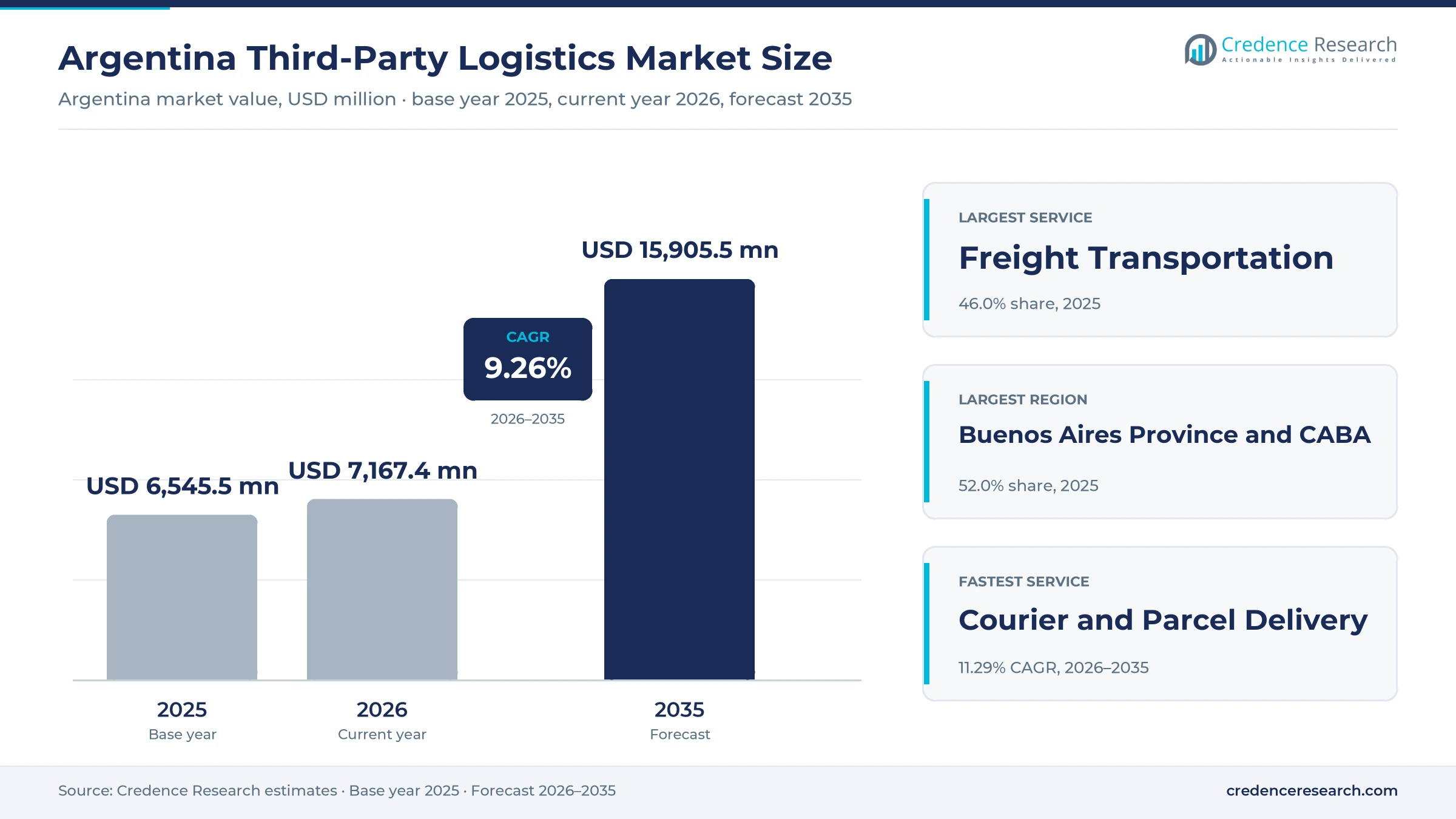
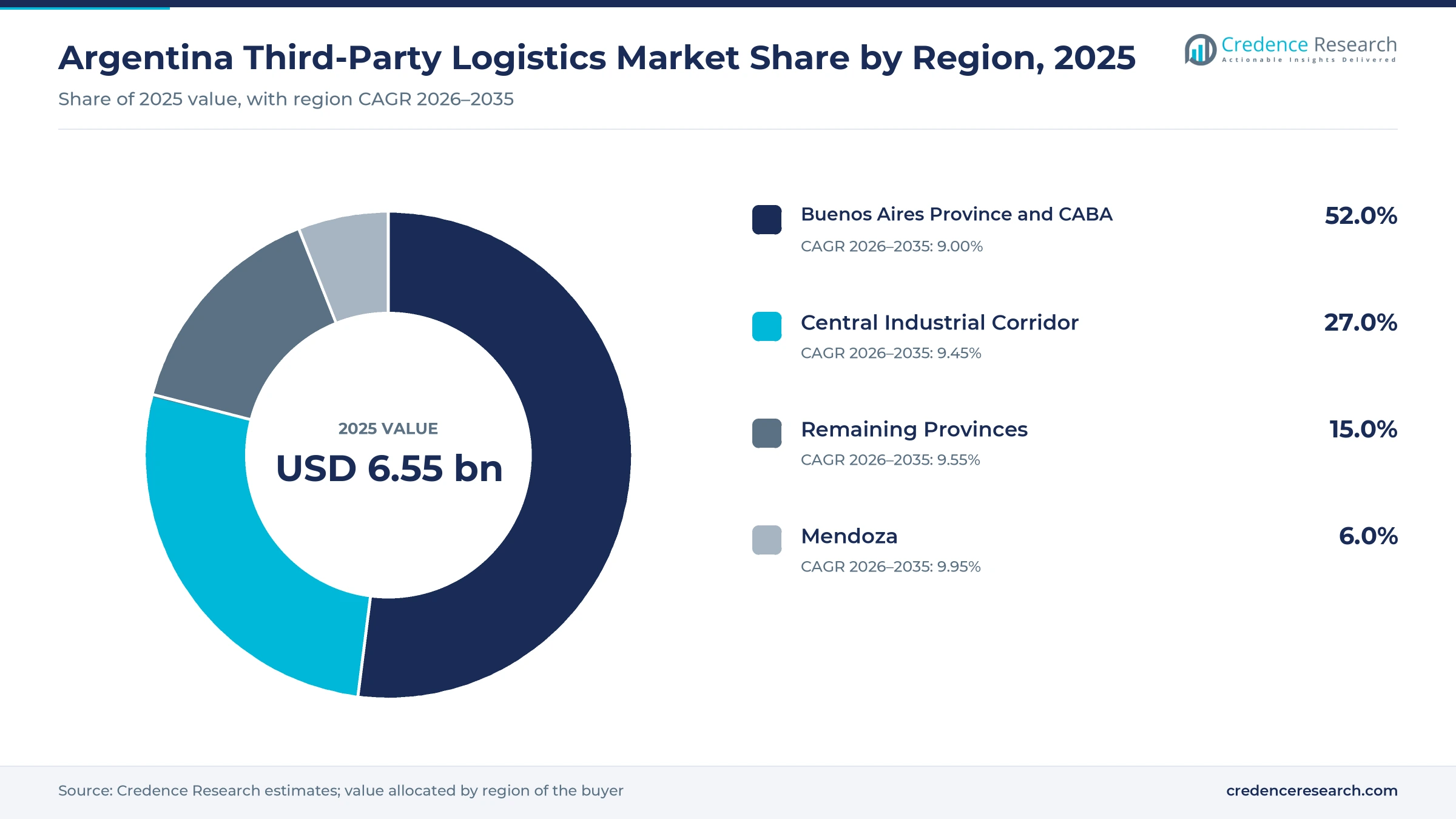
The Argentina third-party logistics market was valued at USD 6.55 billion in 2025 and is projected to increase from USD 7.17 billion in 2026 to USD 15.91 billion by 2035, registering a CAGR of 9.26% during 2026–2035. Demand comes from marketplaces, importers, consumer goods makers, laboratories and grain shippers that hand freight, storage and parcel work to outside operators rather than running their own networks. Buenos Aires Province and CABA held the largest regional share, 52.0% in 2025, because the metropolitan area concentrates online orders, premium warehouses and the main import gateways. Mendoza is the fastest-growing region at 9.95% a year, helped by the Cristo Redentor crossing into Chile and new copper project traffic. Commercially, the most important change is the build-out of automated sorting hubs around Buenos Aires, while a 50-year national tender for the Belgrano Cargas rail network could widen intermodal options for operators later in the forecast period.
Which fees and buyers define this outsourced work?
The third-party logistics market counts fees that shippers pay to outside operators for road and multimodal freight, warehousing, distribution, parcel delivery and specialist handling such as temperature-controlled medicine work. Buyers contract through direct enterprise agreements, competitive tenders, digital bookings and subcontracts from forwarders, and many large accounts combine several of these routes.
The estimate excludes fleets and warehouses that shippers run for themselves, along with the value of the goods moved. Real estate rents paid by operators are treated as a cost inside their fees, so landlords such as logistics park developers are not counted separately in the market value.
Argentina Third-Party Logistics Market Insights
- The market grows from USD 6.55 billion in 2025 to USD 15.91 billion by 2035, a 9.26% CAGR, as shippers move more parcel, storage and import work to outside operators.
- Buenos Aires Province and CABA held 52.0% of 2025 value because online orders, premium warehouse stock and import gateways cluster around the metropolitan area.
- Freight Transportation led service types with 46.0% in 2025 because road haulage still carries most of the country's bulk and consumer cargo.
- Andreani finished a USD 30 million automation program at General Pacheco by April 2026, which raised the benchmark for parcel sorting among national operators.
- The offer deadline for the Belgrano, San Martín and Urquiza rail lots was set for Nov. 11, 2026, opening a possible intermodal route for contract operators.
Trucking leads while parcel delivery gains fastest
Which service type earns the most, and what grows fastest?
Based on service type, the market is categorized into freight transportation, warehousing and distribution, courier and parcel delivery, and specialist logistics. Freight Transportation led with 46.0% of 2025 value because road haulage remains the default for bulk cargo, and the Bolsa de Comercio de Rosario estimated 138 million metric tons of grain moving by truck in the 2025/26 campaign. Courier and Parcel Delivery grows fastest at 11.29% a year as parcel flows scale, and Forbes Argentina reported in May 2026 that Andreani handles about 5 million shipments a month.
Which industries buy the most outside logistics work?
Based on end-use industry, the market is categorized into consumer goods and retail, e-commerce, automotive and manufacturing, and healthcare and agribusiness. Consumer Goods and Retail led with 38.0% of 2025 value because national brands outsource at scale, and TASA Logística's named accounts include Unilever, Quilmes and PepsiCo, according to El Cronista. E-commerce grows fastest at 11.33% a year as CACE counted 1,338,952 new online buyers in 2025. Health work also matters, since a Ministry of Health tender for vaccine and medicine storage reached ARS 78.27 billion in August 2025, Diario Jornada reported.
Which customers anchor operator contracts?
Based on customer type, the market is categorized into multinational shippers, domestic brands and retailers, digital merchants and dedicated trade accounts. Multinational Shippers led with 40.0% of 2025 value because global brands buy multi-site contracts, and Urbano named Adidas and Zara among its roughly 350 clients, according to El Cronista in October 2024. Digital Merchants grow fastest at 11.20% a year as smaller sellers gain direct access, and Forbes Argentina reported in May 2026 that Andreani now takes shipments from merchants selling through Tienda Nube, social media or WhatsApp.
How much of the work now runs on digital systems?
Based on technology, the market is categorized into integrated digital execution, standalone software execution, manual execution and automation-led execution. Integrated Digital Execution led with 42.0% of 2025 value because large operators tie routing to order systems, and Andreani has used route optimization for about two years, Forbes Argentina reported in May 2026. Automation-Led Execution grows fastest at 11.75% a year as equipment spreads beyond parcels, and Revista Mercado reported in March 2026 that Droguería Sur installed three BD Rowa robots at Bahía Blanca, joining more than 200 in Argentine pharmacies and distribution centers.
| Segment Group | Leading Sub-segment | Share, 2025 | Fastest-growing Sub-segment | CAGR, 2026–2035 |
|---|---|---|---|---|
| By Service Type | Freight Transportation | 46.0% | Courier and Parcel Delivery | 11.29% |
| By End-Use Industry | Consumer Goods and Retail | 38.0% | E-commerce | 11.33% |
| By Customer Type | Multinational Shippers | 40.0% | Digital Merchants | 11.20% |
| By Technology | Integrated Digital Execution | 42.0% | Automation-Led Execution | 11.75% |
Request a Free Sample
Fill in your details and we'll send you a free sample report.
- Sample data tables & charts
- Research methodology
Merchants, importers and grain corridors drive volumes
Merchant fulfillment expansion lifts parcel and storage work
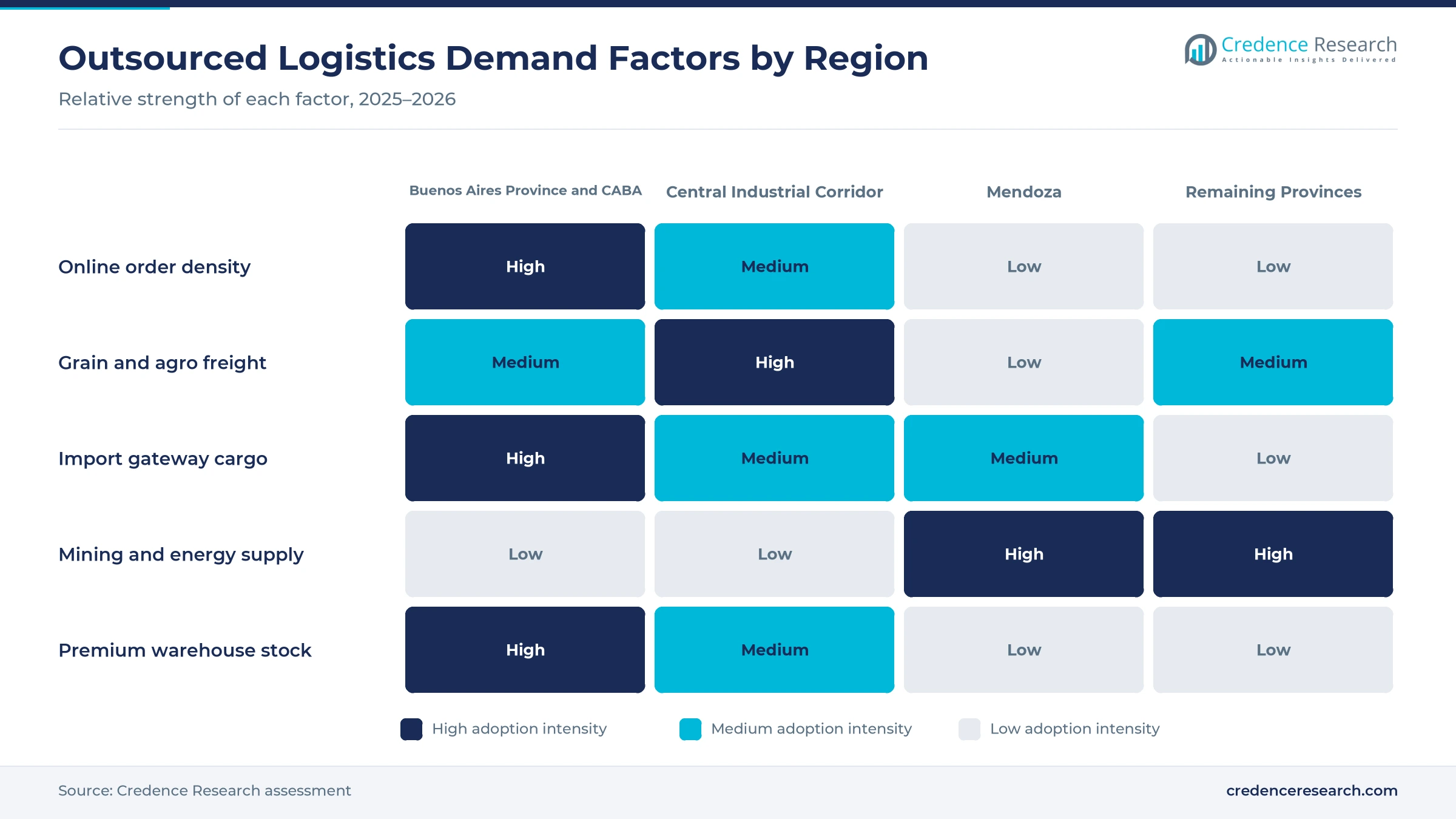
Online sellers are moving storage, picking and delivery to outside operators because units are growing far faster than orders, which raises picking and storage work. CACE, the national electronic commerce chamber, counted 645 million units sold in 2025, up 28%, across 253 million orders, up 3%. As a result, online retail platforms need national reach, and Mercado Libre said in March 2026 that it would spend USD 3.4 billion in Argentina that year, with part going to storage centers, according to Forbes Argentina. Loginter is the operating partner at its Don Torcuato site, which started in April 2026 and handles up to 1.5 million parcels a month, El Economista reported. In turn, Digital Merchants grow at 11.20% a year in the Credence Research estimate.
Import-linked logistics recovery adds inbound cargo
Imports rebounded after trade and customs rules eased, which gave forwarders and contract operators more inbound cargo to clear, store and distribute. INDEC reported imports of USD 75.79 billion in 2025, up 24.7%, while purchases of consumer goods and vehicles rose 66.2%, according to Diario de Cuyo. The courier limit also moved from USD 1,000 to USD 3,000 per shipment, and Aeropuertos Argentina Cargas reported a 177% jump in arriving packages that January, El Cronista said in April 2025. Because of this flow, Oscar Andreani told La Nación in April 2026 that Chinese marketplaces were growing 30% or more, against 5% to 10% for its other business, and Forbes Argentina reported that goods can now arrive in 15 to 18 days.
Agricultural corridor activity sustains heavy freight demand
Grain sets the largest seasonal freight peak in the country, and that peak forces shippers to book outside hauling and storage capacity well ahead of harvest. The Bolsa de Comercio de Rosario estimated a 163 million metric ton crop for 2025/26, with 150 million metric tons moved, and transport used 1,487 million liters of diesel. Truck arrivals show the same pressure, because 850,000 trucks reached Gran Rosario by early May 2026, about 185,000 more than a year earlier, according to BAE Negocios. Those grain shipments matter beyond the farm, since Gran Rosario handles close to 80% of agro-industrial exports. As a result, 27.0% of market value sits in the Central Industrial Corridor.
Mining and energy projects open remote supply contracts
Mining and energy projects are creating supply contracts in provinces where few operators have sites, so companies with mountain and long-haul experience can win new work. Andreani's chief executive told Forbes Argentina in May 2026 that mining and courier were growing strongly, and the company bought plants in Neuquén and Salta as supply hubs, El Cronista reported in December 2024. In Mendoza, the PSJ Cobre Mendocino project expects about 10 concentrate trucks a day on the Cristo Redentor corridor, Panorama Minero reported in June 2026. Infobae put that project near USD 600 million and about 40,000 metric tons a year in December 2025. Because of this pipeline, Mendoza is the fastest-growing of the four regions in the Credence Research estimate.
Automation and developer-built parks reshape operations
Automation shifts parcel sorting from labor to machines
Sorting is shifting from manual lines to automated hubs because parcel peaks have outgrown what shift labor can absorb at a stable cost. La Nación reported in April 2026 that Andreani completed a USD 30 million plant at General Pacheco that sorts up to 26,000 parcels an hour, on a site Forbes Argentina describes as 20,000 square meters with room for 70,000 more. Urbano's 32,000-square-meter Barracas plant processes about 10,000 packages an hour, El Cronista reported in October 2024. Software is moving in parallel, since CACE found that 62% of the e-commerce companies in its 2025 study use artificial intelligence, although these are sellers rather than logistics operators. As a result, Automation-Led Execution rises at 11.75% a year, according to Credence Research estimates.
Rise of developer-built parks changes warehouse supply
Operators increasingly lease from specialist developers instead of owning sheds, which is changing how quickly they can open capacity for a new contract. Colliers Argentina counted 137,200 square meters of net absorption in Greater Buenos Aires in the second half of 2025, the strongest semester in three years, Revista Mercado reported. Premium stock then reached 2,622,620 square meters in the first half of 2026, with vacancy at 8.96% and asking rent at USD 7.03 per square meter a month. Financing is following, because IDB Invest and JICA arranged up to USD 100 million for Plaza Logística in December 2025. Plaza Logística is also building a USD 115 million center of more than 100,000 square meters in Escobar with Mercado Libre, Bloomberg Línea reported in March 2026.
Rail concessions offer an opening for intermodal contracts
The rail tender is an opening for operators that can combine long-haul rail with truck collection and storage at each end of the route. Resolution 1350/2026 launched a 50-year concession in August 2026 across three lots, Belgrano, San Martín and Urquiza, law firm Marval O'Farrell Mairal reported, with offers due Nov. 11, 2026. The gap is wide today, since the Bolsa de Comercio de Rosario estimated just 12 million metric tons of the 2025/26 grain crop moving by rail. Better long-haul rail links would also reduce fuel exposure, because diesel spending reached USD 3.76 billion across that crop. Operators with existing Central Industrial Corridor sites are best placed to bid for this transfer work, because those lines cross the zone.
Interior fulfillment hubs give operators a new growth opening
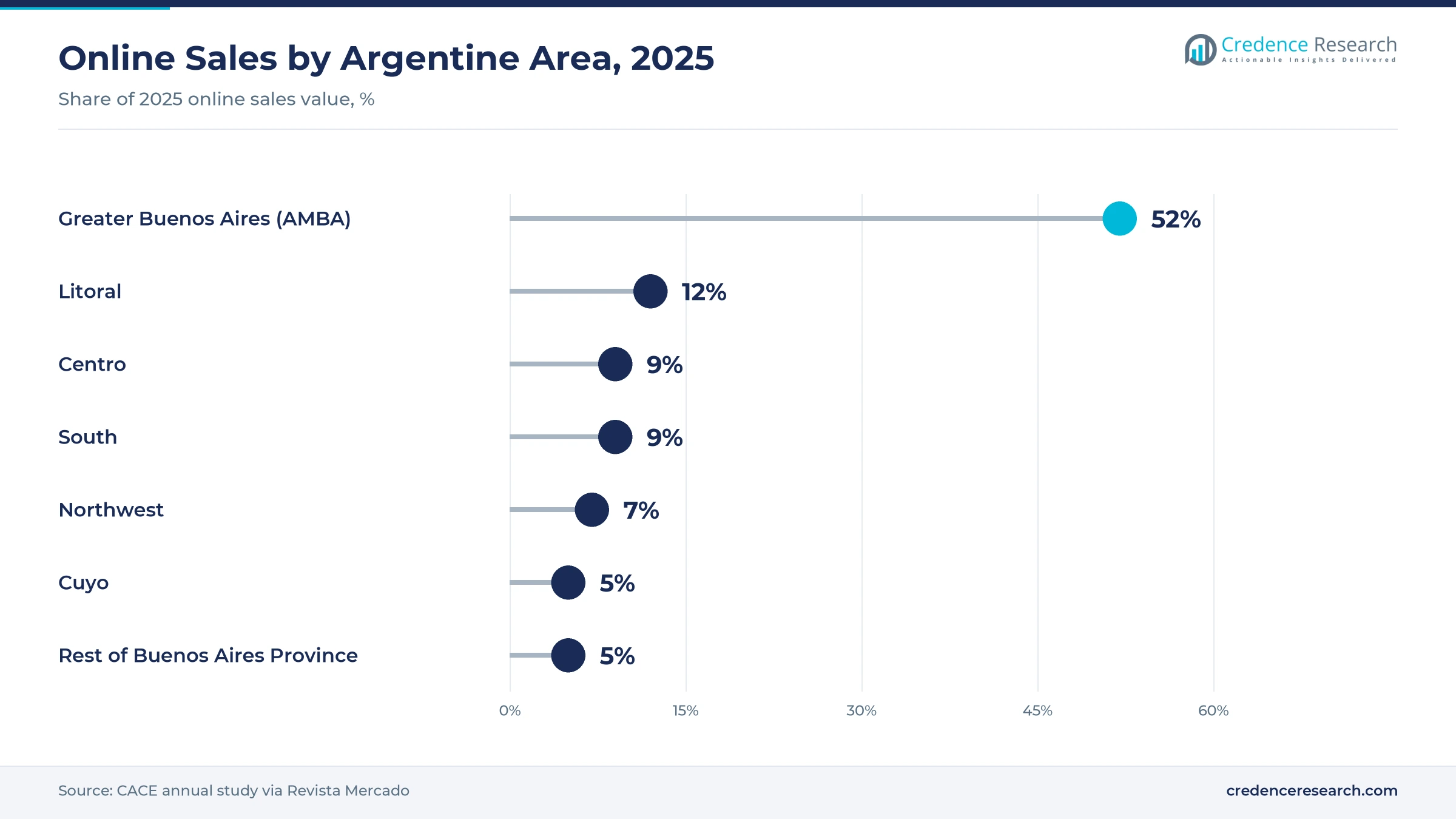
Storage outside Greater Buenos Aires is a clear opening because delivery promises are tightening in provinces that have long been served from the capital. Mercado Libre plans a USD 91 million, 60,000-square-meter center at Estación Juárez Celman in Córdoba by the end of 2027, Perfil reported in August 2026, and iProUP called it the group's first such site outside the metropolitan area. CACE data show the size of the prize, with the Litoral at 12% and Centro at 9% of 2025 online sales. Urbano has named Junín, Córdoba, Mendoza and Santa Fe as expansion points in a USD 30 million plan, El Cronista reported, which suggests regional operators will compete for the same interior volume.
Costs, weak corridors and pharma rules test operators
Fast-rising trucking costs squeeze fixed-price contracts
Trucking inflation is the most immediate pressure on operator margins, especially on contracts priced months in advance. FADEEAC's cost index rose 20% from January to May 2026 and 48% over 12 months, while diesel climbed about 33% in 2026, Sitio Andino reported in June 2026. Smaller hauliers feel this first because they hold less pricing power with large shippers. Operators can respond with monthly tariff clauses, route optimization and higher loads per trip.
Weak corridors and falling port traffic limit network reliability
Infrastructure quality still restricts service levels, which forces operators to carry more buffer stock and longer delivery windows than peers in larger regional markets. Argentina's World Bank logistics performance score was 2.8 in the 2022 data, down from 2.89 in 2018. World Bank data also show container traffic of about 1.47 million TEU in 2024, below 1.67 million in 2022. Shippers on long routes pay most for this gap, so operators promote regional hubs to shorten trips.
Lower vehicle output and exports cut factory logistics volumes
Automotive contracts have become less predictable, which weakens inbound parts and finished vehicle work that operators once planned around stable schedules. ADEFA data published by La Capital in January 2026 show production of 490,876 units in 2025, down 3.1%, with exports down 10.8%. The imported share of domestic sales rose from 30% to 60% in two years, moving volume toward port and pre-delivery work. Operators with manufacturing accounts must therefore redeploy assets and renegotiate volume guarantees.
Medicine rules raise the entry bar for healthcare operators
Healthcare logistics brings regulatory exposure that general parcel operators often underestimate, because licensing depends on technical staffing as well as site quality. ANMAT withdrew Correo Argentino's secondary-packaging authorization for its Malvinas Argentinas plant in January 2026 through Disposition 12/2026, citing the lack of a technical director, Noticias NQN reported. Bidders that lack these credentials risk losing public and laboratory accounts. Operators reduce the risk by hiring licensed pharmacists and ring-fencing medicine storage from other cargo in every facility they run.
Buenos Aires Province and CABA lead as Mendoza grows fastest
| Region | Value, 2025 (USD billion) | Share, 2025 | CAGR, 2026–2035 |
|---|---|---|---|
| Buenos Aires Province and CABA | 3.40 | 52.0% | 9.00% |
| Central Industrial Corridor | 1.77 | 27.0% | 9.45% |
| Remaining Provinces | 0.98 | 15.0% | 9.55% |
| Mendoza | 0.39 | 6.0% | 9.95% |
Buenos Aires Province and CABA hold the largest network
Buenos Aires Province and CABA held 52.0% of 2025 value and grow at 9.00% a year. The zone leads because CACE placed 52% of 2025 online sales in the metropolitan area and a further 5% in the rest of the province. Third-party logistics demand in this zone draws on 2.59 million square meters of warehouse stock tracked by Colliers Argentina in late 2025. Growth trails the national rate because new hubs are beginning to shift some stock toward interior cities, although the capital stays the main import gateway.
Central Industrial Corridor combines grain, parts and new hubs
The Central Industrial Corridor held 27.0% of 2025 value and grows at 9.45% a year. Córdoba and Santa Fe combine grain, machinery and vehicle plants, and Gran Rosario took 850,000 grain trucks by early May 2026. Mercado Libre already runs five last-mile sites in Córdoba, with capacity for up to 75,000 parcels a day, iProUP reported in 2026. However, factory cargo is uneven, since a Fisfe report cited by La Capital showed Santa Fe vehicle output down 24.4% through September 2025.
Mendoza grows on mountain freight and copper plans
Mendoza held 6.0% of 2025 value and grows fastest at 9.95% a year. Freight demand here rests on the Cristo Redentor crossing, which handles more than 360,000 trucks a year, the provincial government said in December 2024. It added that about 75% of Mercosur land cargo uses the pass and that Mendoza has 11% of the national truck fleet. A tender for 329 kilometers of Route 7, with about USD 300 million of planned works, should improve this corridor, Panorama Minero reported in June 2026. A 57-hectare intermodal park at Luján de Cuyo adds rail access, according to Infobae.
Remaining Provinces follow energy, mining and medicine routes
The Remaining Provinces held 15.0% of 2025 value and grow at 9.55% a year. Demand in these provinces is thin, since CACE placed just 9% of 2025 online sales in the south and 7% in the northwest, so work centers on specialist contracts. Andreani's Neuquén and Salta plants serve energy and mining supply, and Droguería Sur distributes to more than 1,500 pharmacies from Bahía Blanca through Patagonia. Long distances keep unit costs high, which favors operators that can share loads across several accounts on each route.
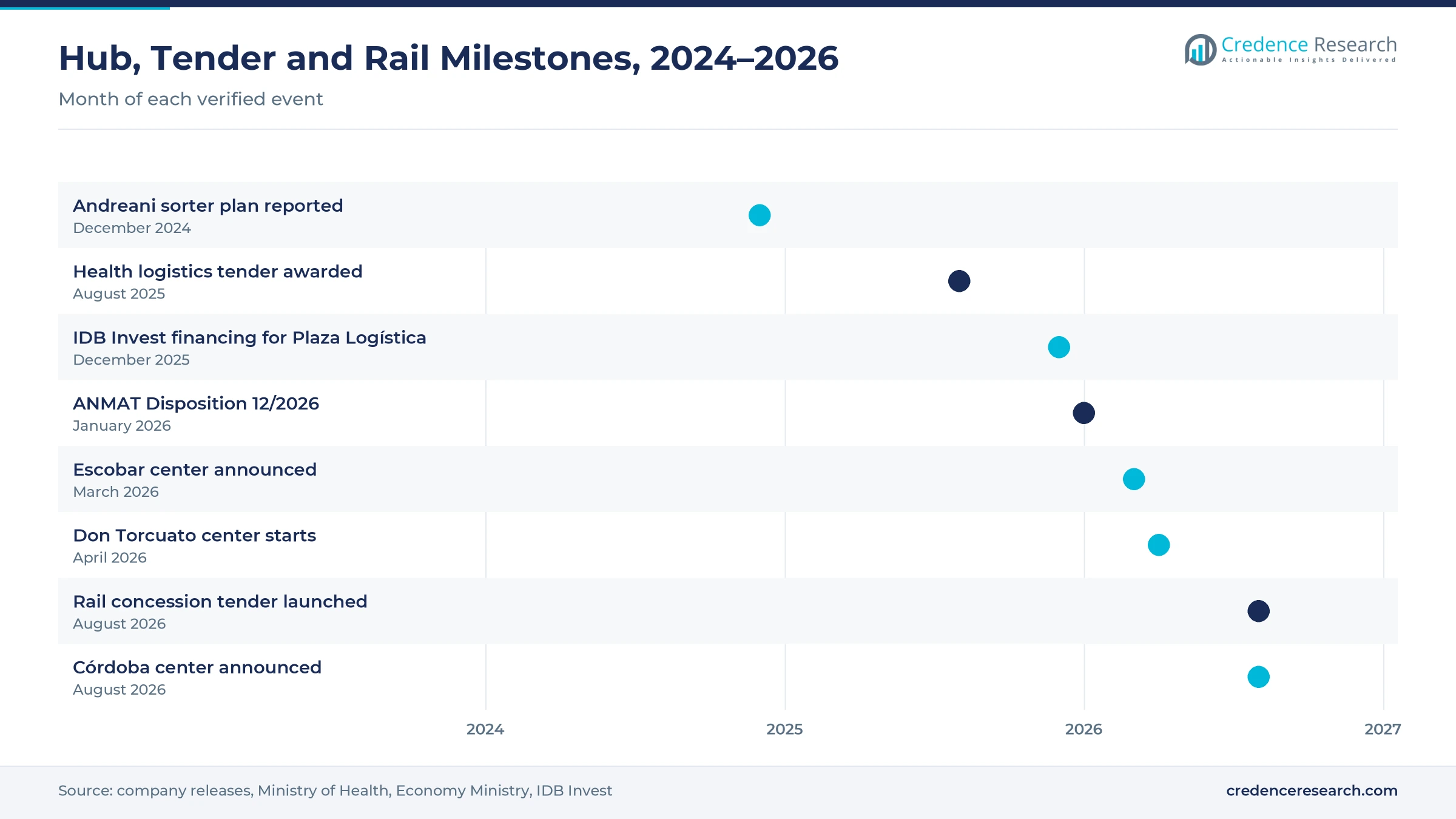
Sorters, parks and a rail tender mark 2024–2026
| Development | Status and market relevance |
|---|---|
| In December 2024, Andreani planned a sorter raising its parcel capacity from about 8,000 to about 26,000 packages an hour, El Cronista reported. | Installed at General Pacheco by 2026; sets the national automation benchmark |
| In August 2025, the Ministry of Health awarded three of four medicine and vaccine logistics services to Suizo Argentina, with Andreani winning vaccine storage. | A 24-month contract billed by service provided; a large public healthcare account |
| In December 2025, IDB Invest and JICA arranged up to USD 100 million for Plaza Logística to expand its parks. | Adds leased capacity that operators can use without owning sites |
| In April 2026, Mercado Libre began operating an 11,000-square-meter Don Torcuato center with Loginter as its operating partner. | Handles up to 1.5 million parcels a month, with peaks of 60,000 shipments a day |
| In August 2026, the Economy Ministry launched a 50-year tender for the Belgrano, San Martín and Urquiza rail lots. | Offers were scheduled for Nov. 11, 2026, and dates may change by circular |
Sorters, robots and routing software change the work
- Automated sorters cut the labor per parcel in large hubs, as Andreani's Chinese-made General Pacheco system shows at peak volumes.
- Pharmacy dispensing robots reduce picking errors for medicine distributors, and Droguería Sur reports dispensing times of 8 to 12 seconds per delivery.
- Route optimization software lowers kilometers per drop and gives operators a partial answer to rising diesel costs on long routes.
- Artificial intelligence tools remain focused on marketing and user experience in CACE's 2025 study, so warehouse and transport use still has room to expand.
Need a Custom Version of This Report?
Tailor the scope, geography, or segments to your exact requirements.
- Custom geography or segment scope
- Direct access to our analyst team
National networks compete with global forwarders
Competition in third-party logistics splits between national networks that win on reach and global forwarders that win on international lanes and multinational accounts. Andreani stands out for automation and scale, while OCA, described by El Cronista as the main private postal operator, was among the bidders in the 2025 Ministry of Health tender. TASA Logística built its contract business partly through the October 2020 purchase of Kuehne+Nagel's local contract operations, which added three Buenos Aires storage centers. Loginter competes for dedicated marketplace work, including Mercado Libre's Don Torcuato site. DSV offers road, sea, air and project services from its Argentine business, and Marken, a UPS subsidiary, holds health ministry and ANMAT licenses for clinical supplies. Mercado Libre's own network is both a large customer and a competitive threat, because merchants that use it may need fewer outside contracts. Tenders are decided largely on price, as Suizo Argentina's winning bids roughly 17% under the reference price showed in 2025.
Companies profiled and their roles in this market
| Company | Type | Role in the market |
|---|---|---|
| Andreani | National integrated operator | Runs the automated General Pacheco hub and handles about 5 million shipments a month |
| OCA | National postal and parcel operator | Bid in the 2025 Ministry of Health medicine and vaccine logistics tender |
| TASA Logística | Contract operator | Serves consumer, food, pharma and agrochemical accounts from multi-site storage |
| LOGINTER | Dedicated contract operator | Operating partner at Mercado Libre's Don Torcuato center |
| DSV | Global forwarder | Offers road, sea, air, project and logistics services through its Argentine business |
| Kuehne+Nagel | Global forwarder | Sold its local contract storage and distribution business to TASA Logística in October 2020 |
| UPS Supply Chain Solutions | Global health and supply chain group | UPS subsidiary Marken holds ANMAT and health ministry licenses for clinical supply distribution |
Outsourcing gains matter more than cargo growth alone
Credence Research's view is that outsourcing share, more than cargo growth alone, explains the 9.26% rate for third-party logistics in Argentina. Total freight in Argentina is likely to grow far more slowly, so this forecast depends on shippers handing over work they run today. The near term argues for caution, because Andreani expected 2026 volumes to end level with 2025, Forbes Argentina reported, even after heavy spending on capacity. Operators that win parcels and pharma work should gain the most, while those relying on factory cargo face a harder path until vehicle output stabilizes.
How the Argentine operator estimate was built
The report uses 2025 as the base year on a calendar basis, and market values come from the Credence Research model. That model draws on official trade statistics from INDEC, World Bank logistics and port indicators, online sales data from CACE, grain transport estimates from the Bolsa de Comercio de Rosario, trucking cost data from FADEEAC, warehouse data published by Colliers Argentina and dated company and government announcements. Segment splits and regional shares and growth rates are Credence Research estimates. No primary interviews or surveys were carried out for this edition of the report.
Parcel, interior and rail work set the path to 2035
The third-party logistics market is expected to reach USD 15.91 billion by 2035, as parcel, storage and specialist work take a larger part of shippers' freight budgets. Automation should keep spreading from Greater Buenos Aires to interior hubs once the Córdoba project and similar sites open toward 2027. Rail is the main swing factor, because a successful concession would change long-haul costs for grain and containers. Mining traffic through Mendoza depends on project financing and the final export route, while diesel prices and medicine licensing will continue to decide which operators keep margins through the forecast period.
Frequently Asked Questions
How big is the Argentina third-party logistics market?
Which service type leads the market?
Which service grows fastest?
Which region holds the largest share?
Which region grows fastest?
What are the main demand drivers?
What challenges do operators face?
Who are the leading companies?
Table of Content
Chapter 1 Market Segmentation
- 1.1 Segmentation Framework
- 1.1.1 Product and Service Classification
- 1.1.2 Application and End-Use Classification
- 1.1.3 Technology and Solution Classification
- 1.1.4 Customer and Distribution Channel Classification
- 1.1.5 Geographic Segmentation
- 1.1.6 Market Segment Definitions and Boundaries
- 1.2 By Service Type
- 1.2.1 Freight Transportation
- 1.2.2 Warehousing and Distribution
- 1.2.3 Courier and Parcel Delivery
- 1.2.4 Specialist Logistics
- 1.3 By End-Use Industry
- 1.3.1 Consumer Goods and Retail
- 1.3.2 E-commerce
- 1.3.3 Automotive and Manufacturing
- 1.3.4 Healthcare and Agribusiness
- 1.4 By Customer Type
- 1.4.1 Multinational Shippers
- 1.4.2 Domestic Brands and Retailers
- 1.4.3 Digital Merchants
- 1.4.4 Dedicated Trade Accounts
- 1.5 By Technology
- 1.5.1 Integrated Digital Execution
- 1.5.2 Standalone Software Execution
- 1.5.3 Manual Execution
- 1.5.4 Automation-Led Execution
Chapter 2 Introduction
- 2.1 Report Objectives and Scope
- 2.2 Product Definition and Industry Terminology
- 2.3 Market Inclusions and Exclusions
- 2.4 Research Process
- 2.4.1 Primary Research and Expert Interviews
- 2.4.2 Secondary Research and Source Review
- 2.4.3 Top-Down and Bottom-Up Estimation
- 2.4.4 Data Triangulation and Verification
- 2.5 Market Size Measurement Basis
- 2.5.1 2025: USD 6.55 billion → 2035: USD 15.91 billion
- 2.6 Historical and Forecast Reference Periods
- 2.6.1 Historical Period: 2018-2025
- 2.6.2 Base Year: 2025
- 2.6.3 Forecast Period: 2025-2035
- 2.7 Research Assumptions and Limitations
Chapter 3 Executive Summary
- 3.1 Market Snapshot and Key Findings
- 3.2 Base-Year Market Size, 2025
- 3.3 Forecast Market Size, 2035
- 3.4 Revenue and Volume Growth Outlook
- 3.5 Key Demand and Supply Indicators
- 3.6 Leading Market Segments
- 3.7 Fastest-Growing Market Opportunities
- 3.8 Regional Performance Highlights
- 3.9 Technology and Industry Transformation
- 3.10 Competitive Landscape Summary
- 3.11 Analyst View and Strategic Implications
Chapter 4 Argentina Third-Party Logistics Market Trends and Developments
- 4.1 Historical Industry Development, 2018-2025
- 4.2 Recent Market Trends and Developments
- 4.3 Demand and Customer Behavior Trends
- 4.4 Technology and Product Innovation
- 4.5 Artificial Intelligence, Automation and Digitalization
- 4.6 Local Manufacturing and Supply Chain Realignment
- 4.7 Industry Partnerships, Mergers and Acquisitions
- 4.8 Sustainability and Circular Economy Developments
- 4.9 Government and Private Sector Investment Trends
- 4.10 Emerging Business Models and Commercialization
- 4.11 Industry Developments and Announcements
Chapter 5 Argentina Third-Party Logistics Market Production, Supply and Demand Analysis
- 5.1 Demand Trend and Consumption Analysis, 2018-2025
- 5.2 Demand Forecast, 2025-2035
- 5.3 Production and Output Trend, 2018-2025
- 5.4 Production and Output Forecast, 2025-2035
- 5.5 Installed Capacity and Capacity Utilization
- 5.6 Company-Wise Production Plants and Statistics
- 5.6.1 Installed Production Capacity
- 5.6.2 Actual Production
- 5.6.3 Planned Capacity and Expansion Targets
- 5.7 Supply Chain Structure and Procurement Trends
- 5.8 Supply-Demand Gap and Bottlenecks
- 5.9 Import Dependence and Sourcing Structure
- 5.10 Contract Manufacturing and Outsourcing
- 5.11 Regional Supply and Demand Concentration
Chapter 6 Argentina Third-Party Logistics Market Pricing Analysis
- 6.1 Pricing Structure and Measurement
- 6.2 Historical Pricing Trends, 2018-2025
- 6.3 Pricing Outlook, 2025-2035
- 6.4 Average Selling Price and Unit Economics
- 6.5 Pricing by Product and Market Segment
- 6.6 Geographic Pricing Differences
- 6.7 Key Input, Energy, Labor and Logistics Costs
- 6.8 Contract Pricing and Purchasing Models
- 6.9 Pricing Sensitivity and Competitive Positioning
- 6.10 Price, Margin and Profitability Implications
Chapter 7 Argentina Third-Party Logistics Market Dynamics
- 7.1 Market Growth Drivers
- 7.1.1 Demand-Side Drivers
- 7.1.2 Technology and Innovation Drivers
- 7.1.3 Infrastructure and Investment Drivers
- 7.1.4 Regulatory and Policy Drivers
- 7.2 Market Restraints
- 7.2.1 Cost and Affordability Constraints
- 7.2.2 Technology and Adoption Barriers
- 7.2.3 Supply Chain and Operational Constraints
- 7.3 Market Challenges
- 7.3.1 Competitive Pressure and Margin Erosion
- 7.3.2 Skills, Infrastructure and Implementation Gaps
- 7.4 Emerging Market Opportunities
- 7.5 Market Dynamics Impact and Time-Horizon Assessment
Chapter 8 Argentina Third-Party Logistics Value Chain Analysis
- 8.1 Industry Value Chain Overview
- 8.2 Upstream Suppliers and Critical Inputs
- 8.3 Technology and Component Providers
- 8.4 Manufacturing or Service Delivery
- 8.5 Distribution, Channel Partners and Integrators
- 8.6 Downstream Applications and End Users
- 8.7 Value Addition and Profit Pools
- 8.8 Vertical Integration and Outsourcing
- 8.9 Supplier Concentration and Risk
- 8.10 Supply Chain Localization and Resilience
Chapter 9 Argentina Third-Party Logistics Market Regulations and Policies
- 9.1 Relevant Laws, Standards and Compliance Frameworks
- 9.2 Product, Service, Safety and Quality Requirements
- 9.3 Government Policies, Incentives and Subsidies
- 9.4 Imports, Exports and Trade Barriers
- 9.5 Public Procurement and Local Content Requirements
- 9.6 Environmental and Sustainability Compliance
- 9.7 Upcoming Policy Changes and Market Implications
Chapter 10 Argentina Third-Party Logistics Market Hotspots and Opportunities
- 10.1 Market Opportunity Mapping and Growth Hotspots
- 10.2 High-Growth Applications and Customer Groups
- 10.3 Underserved Markets and White-Space Opportunities
- 10.4 Emerging Technology and Product Opportunities
- 10.5 New Capacity and Investment Hotspots
- 10.6 Market Entry and Expansion Opportunities
- 10.7 Distribution and Partnership Opportunities
- 10.8 Near-Term and Long-Term Commercial Potential
- 10.9 Opportunity Attractiveness and Execution Risks
Chapter 11 Argentina Third-Party Logistics Market Outlook, 2025-2035
- 11.1 Market Size and Analysis
- 11.1.1 Revenue (Market Measurement: 2025: USD 6.55 billion → 2035: USD 15.91 billion)
- 11.1.2 Market Volume and Quantity Sold
- 11.1.3 Historical Market Size, 2018-2025
- 11.1.4 Base-Year Market Size, 2025
- 11.2 Market Forecast, 2025-2035
- 11.2.1 Revenue Forecast to 2035
- 11.2.2 Volume Forecast to 2035
- 11.2.3 CAGR and Year-on-Year Growth
- 11.2.4 Incremental Revenue Opportunity
- 11.3 Forecast Assumptions and Scenario Analysis
- 11.3.1 Base-Case Forecast
- 11.3.2 Optimistic and Conservative Scenarios
- 11.3.3 Technology, Pricing and Policy Sensitivities
- 11.4 Market Attractiveness and Growth Outlook
Chapter 12 Argentina Third-Party Logistics Market Segmentation and Outlook
- 12.1 Segmentation Summary and Market Shares, 2025
- 12.2 Largest and Fastest-Growing Segments
- 12.3 By Service Type - Market Size and Forecast, 2025-2035
- 12.3.1 Segment Definition and Scope
- 12.3.2 Historical Market Size, 2018-2025
- 12.3.3 Revenue Forecast, 2025-2035
- 12.3.4 Volume Forecast, 2025-2035
- 12.3.5 Base-Year Market Share, 2025
- 12.3.6 Segment CAGR and Growth Drivers
- 12.3.7 Subsegment Market Size and Forecast
- 12.3.7.1 Freight Transportation
- 12.3.7.2 Warehousing and Distribution
- 12.3.7.3 Courier and Parcel Delivery
- 12.3.7.4 Specialist Logistics
- 12.3.8 Subsegment Pricing and Adoption Trends
- 12.3.9 Leading Suppliers and Competition
- 12.3.10 Regional Demand and Opportunities
- 12.4 By End-Use Industry - Market Size and Forecast, 2025-2035
- 12.4.1 Segment Definition and Scope
- 12.4.2 Historical Market Size, 2018-2025
- 12.4.3 Revenue Forecast, 2025-2035
- 12.4.4 Volume Forecast, 2025-2035
- 12.4.5 Base-Year Market Share, 2025
- 12.4.6 Segment CAGR and Growth Drivers
- 12.4.7 Subsegment Market Size and Forecast
- 12.4.7.1 Consumer Goods and Retail
- 12.4.7.2 E-commerce
- 12.4.7.3 Automotive and Manufacturing
- 12.4.7.4 Healthcare and Agribusiness
- 12.4.8 Subsegment Pricing and Adoption Trends
- 12.4.9 Leading Suppliers and Competition
- 12.4.10 Regional Demand and Opportunities
- 12.5 By Customer Type - Market Size and Forecast, 2025-2035
- 12.5.1 Segment Definition and Scope
- 12.5.2 Historical Market Size, 2018-2025
- 12.5.3 Revenue Forecast, 2025-2035
- 12.5.4 Volume Forecast, 2025-2035
- 12.5.5 Base-Year Market Share, 2025
- 12.5.6 Segment CAGR and Growth Drivers
- 12.5.7 Subsegment Market Size and Forecast
- 12.5.7.1 Multinational Shippers
- 12.5.7.2 Domestic Brands and Retailers
- 12.5.7.3 Digital Merchants
- 12.5.7.4 Dedicated Trade Accounts
- 12.5.8 Subsegment Pricing and Adoption Trends
- 12.5.9 Leading Suppliers and Competition
- 12.5.10 Regional Demand and Opportunities
- 12.6 By Technology - Market Size and Forecast, 2025-2035
- 12.6.1 Segment Definition and Scope
- 12.6.2 Historical Market Size, 2018-2025
- 12.6.3 Revenue Forecast, 2025-2035
- 12.6.4 Volume Forecast, 2025-2035
- 12.6.5 Base-Year Market Share, 2025
- 12.6.6 Segment CAGR and Growth Drivers
- 12.6.7 Subsegment Market Size and Forecast
- 12.6.7.1 Integrated Digital Execution
- 12.6.7.2 Standalone Software Execution
- 12.6.7.3 Manual Execution
- 12.6.7.4 Automation-Led Execution
- 12.6.8 Subsegment Pricing and Adoption Trends
- 12.6.9 Leading Suppliers and Competition
- 12.6.10 Regional Demand and Opportunities
- 12.7 Segment Growth Comparison
- 12.8 Segment Attractiveness and Priority Matrix
Chapter 13 Argentina Third-Party Logistics End-Use and Application Market Outlook
- 13.1 End-Use Industry and Customer Demand Structure
- 13.2 Leading Applications and Customer Groups
- 13.3 End-Use Market Size, Share and Forecast
- 13.4 Major End-Use Industry Deep Dives
- 13.4.1 Customer Requirements and Use Cases
- 13.4.2 Demand and Replacement Cycles
- 13.4.3 Technical and Regulatory Considerations
- 13.4.4 Purchasing and Procurement Models
- 13.4.5 Leading Vendors and Distribution Channels
- 13.4.6 Forecast and Commercial Opportunities
- 13.5 Emerging Applications and Cross-Segment Demand
- 13.6 End-Use Industry Investment Priorities
Chapter 14 Argentina Third-Party Logistics Geographic Market Outlook, 2025-2035
- 14.1 Domestic Market Distribution and Demand Clusters
- 14.2 State- or Province-Wise Market Size and Forecast, 2025-2035
- 14.3 City and Metropolitan Market Outlook
- 14.4 Industrial, Manufacturing and Commercial Clusters
- 14.5 Geographic Concentration of Key End Users
- 14.6 Local Pricing and Purchasing Differences
- 14.7 Domestic Production Facilities and Capacity Map
- 14.8 Local Infrastructure and Project Pipeline
- 14.9 State-Level Policy and Incentive Differences
- 14.10 Subnational Investment Hotspots and Opportunities
- 14.11 Distribution and Logistics Networks
- 14.12 Domestic Competitive Footprint
Chapter 15 Argentina Third-Party Logistics Technology, Innovation and Sustainability Outlook
- 15.1 Technology Landscape and Maturity
- 15.2 Product, Process and Service Innovation
- 15.3 AI, Automation and Digital Tools in the Industry
- 15.4 Technology Adoption and Performance Benchmarking
- 15.5 Innovation Pipeline and R&D Investment
- 15.6 Patent and Intellectual Property Trends
- 15.7 Energy Efficiency and Resource Management
- 15.8 Sustainability, Recycling and Circularity
- 15.9 Technology Roadmap, 2025-2035
- 15.10 Risks of Obsolescence and Technology Substitution
Chapter 16 Argentina Third-Party Logistics Market Key Strategic Imperatives
- 16.1 Growth and Market Entry Priorities
- 16.2 High-Return Products and Segments
- 16.3 Pricing, Profitability and Cost Optimization
- 16.4 Technology Investment and Product Differentiation
- 16.5 Supply Chain Localization and Resilience
- 16.6 Distribution and Customer Acquisition
- 16.7 Partnership, Acquisition and Capacity Strategy
- 16.8 Regional Expansion Priorities
- 16.9 Short-, Medium- and Long-Term Actions
Chapter 17 Competition Outlook
- 17.1 Industry Competition Characteristics
- 17.2 Market Structure and Concentration
- 17.3 Market Share and Competitive Positioning, 2025
- 17.4 Company-Wise Revenue and Product Benchmarking
- 17.5 Production and Service Capacity Benchmarking
- 17.6 Technology, Pricing and Differentiation
- 17.7 Regional Footprint and Distribution Strength
- 17.8 Mergers, Acquisitions and Strategic Alliances
- 17.9 New Entrants and Competitive Threats
- 17.10 Porter's Five Forces and Industry Attractiveness
- 17.11 Competitive Outlook, 2025-2035
Chapter 18 Company Profiles
- 18.1 Company Coverage and Selection Criteria
- 18.2 Andreani
- 18.2.1 Business Description
- 18.2.2 Company Ownership and Geographic Presence
- 18.2.3 Product and Service Portfolio
- 18.2.4 Manufacturing and Operating Footprint
- 18.2.5 Production Capacity and Expansion Plans
- 18.2.6 Financial Performance and Investment
- 18.2.7 Market Share and Competitive Position
- 18.2.8 Technology and Innovation Capabilities
- 18.2.9 Strategic Alliances or Partnerships
- 18.2.10 Recent Developments
- 18.2.11 Growth Strategy and Outlook
- 18.3 OCA
- 18.4 DHL Supply Chain
- 18.5 DSV
- 18.6 CEVA Logistics
- 18.7 LOGINTER
- 18.8 Kuehne+Nagel
- 18.9 UPS Supply Chain Solutions
- 18.10 TRF
- 18.11 TASA Logística
- 18.12 Other Relevant Market Participants
Note: Every listed company is profiled on the structure shown under the first company. The company list is preliminary and may change based on research findings, market developments, data availability and client requirements.
Chapter 19 Disclaimer
- 19.1 Research and Forecast Disclaimer
- 19.2 Data Source and Estimation Limitations
Note: The depth of individual sections depends on data availability for this market. Volume, capacity, trade and other unit-based metrics are included where applicable.

