Market Overview
The Bamboo Straws Market size was valued at USD 2,740.68 million in 2018, increased to USD 4,327.21 million in 2024, and is anticipated to reach USD 8,054.99 million by 2032, at a CAGR of 7.52% during the forecast period.
| REPORT ATTRIBUTE | DETAILS |
|---|---|
| Historical Period | 2020-2023 |
| Base Year | 2024 |
| Forecast Period | 2025-2032 |
| Bamboo Straws Market Size 2024 | USD 4,327.21 Million |
| Bamboo Straws Market, CAGR | 7.52% |
| Bamboo Straws Market Size 2032 | USD 8,054.99 Million |
The bamboo straws market is led by prominent players such as Bambaw, Jungle Straws, StrawFree, Buluh Straws, and Kimberly-Clark Corporation, each contributing significantly through innovative product lines and strong sustainability branding. These companies emphasize eco-friendly sourcing, durability, and consumer engagement through e-commerce and hospitality partnerships. Among regions, North America emerged as the dominant market, capturing 40.7% of the global market share in 2024, driven by stringent anti-plastic regulations and high consumer awareness. Asia Pacific follows closely with a 34.1% share, supported by abundant bamboo resources and expanding export activities. These regions collectively shape global demand through both consumption and supply leadership.
Market Insights
- The global bamboo straws market was valued at USD 4,327.21 million in 2024 and is projected to reach USD 8,054.99 million by 2032, growing at a CAGR of 7.52% during the forecast period.
- Rising consumer awareness of plastic pollution and increasing government regulations on single-use plastics are key drivers supporting the adoption of bamboo straws worldwide.
- A growing trend toward reusable and customizable bamboo straws, especially in the hospitality sector, is boosting demand across premium and eco-conscious customer segments.
- Key players such as Bambaw, Jungle Straws, and Kimberly-Clark Corporation dominate the competitive landscape through product innovation, sustainability certifications, and strong global distribution networks.
- North America leads the market with 40.7% share, followed by Asia Pacific at 34.1%; among product types, reusable bamboo straws dominate with over 60% market share, while online retail leads distribution with approximately 42% share.
Market Segmentation Analysis:
By Product Type
The bamboo straws market is segmented into reusable and disposable bamboo straws. Among these, reusable bamboo straws hold the dominant market share, accounting for over 60% of the total revenue in 2024. This dominance is driven by growing consumer preference for sustainable and long-lasting alternatives to plastic straws. Reusable variants appeal to environmentally conscious consumers and businesses, particularly in hospitality and food service industries aiming to reduce single-use waste. Additionally, government bans on plastic straws and campaigns promoting eco-friendly lifestyles further support the growth of this sub-segment.
- For instance, Jungle Straws reported the distribution of over 1.2 million reusable bamboo straws across 35 countries between 2022 and 2023, reflecting the brand’s success in meeting global sustainability goals and hospitality industry demand.
By Straw Type
In terms of straw type, the liquid straw segment dominates the market, holding a share of approximately 68% in 2024. Liquid bamboo straws are widely adopted in beverages such as juices, cocktails, smoothies, and soft drinks, making them the preferred choice in cafés, restaurants, and quick-service outlets. Their ease of use, wide availability, and compatibility with a variety of drinks contribute to their high market penetration. Moreover, increased use in food and beverage service chains, particularly those with sustainability goals, continues to drive demand for liquid bamboo straws globally.
- For instance, Bambaw supplied over 950,000 liquid bamboo straws to restaurant chains and eco-resorts across Europe between 2021 and 2023, aligning with their initiative to replace conventional plastic straws in the F&B industry.
By Distribution Channel
The bamboo straws market is categorized by distribution channels into online retail, supermarkets/hypermarkets, specialty stores, and others. Online retail emerged as the leading channel in 2024, capturing nearly 42% of the market share. This growth is attributed to the convenience of online shopping, wider product variety, and availability of sustainable brands through e-commerce platforms. Additionally, increased digital penetration and rising consumer preference for home delivery services boost online sales. Brands leveraging social media marketing and direct-to-consumer strategies have further strengthened their presence in this segment, making it the fastest-growing distribution channel.
Key Growth Drivers
Rising Demand for Sustainable Alternatives
The growing global movement against single-use plastics is a significant driver for the bamboo straws market. With increasing awareness of environmental degradation and marine pollution, consumers and businesses are shifting toward eco-friendly alternatives. Bamboo straws, being biodegradable and renewable, offer a viable solution to replace plastic straws. Government regulations banning or restricting plastic use in many countries further amplify this demand. As sustainability becomes a mainstream purchasing criterion, the adoption of bamboo straws is expected to witness steady growth across the foodservice and retail sectors.
- For instance, StrawFree reported the elimination of over 14 million plastic straws in 2022 alone through the global distribution of its bamboo alternatives, underscoring the measurable environmental impact and growing commercial traction for sustainable products.
Expansion of the Eco-Conscious Hospitality Sector
The hospitality and foodservice industries are actively adopting sustainable practices, including the use of biodegradable utensils and packaging. Hotels, restaurants, and cafés increasingly use bamboo straws as part of their green initiatives to attract eco-conscious customers and comply with environmental standards. This shift is particularly strong in North America, Europe, and parts of Asia-Pacific, where tourism and sustainability trends intersect. The integration of bamboo straws into branding strategies also enhances the eco-friendly image of businesses, driving greater adoption across the commercial sector.
- For instance, Buluh Straws partnered with over 2,500 hospitality businesses globally by 2023, distributing more than 3.1 million bamboo straws, supporting the sector's efforts to eliminate single-use plastics and boost sustainable
Growth of E-Commerce and D2C Brands
The rise of e-commerce platforms and direct-to-consumer (D2C) brands is facilitating easy access to bamboo straws, especially in urban and semi-urban regions. Online channels enable small and mid-sized eco-friendly brands to reach a broader audience without substantial overhead costs. Consumers benefit from product variety, convenience, and access to sustainable brands globally. Additionally, influencer marketing and eco-lifestyle promotions on digital platforms help increase awareness and visibility, boosting market penetration. This digital transformation plays a crucial role in driving retail sales of bamboo straws across geographies.
Key Trends & Opportunities
Innovation in Product Design and Packaging
Manufacturers are increasingly focusing on enhancing the functionality and aesthetics of bamboo straws to meet evolving consumer preferences. Innovations include varying diameters for different beverages, smoother finishes, and customized branding options. Additionally, eco-friendly packaging solutions-such as recycled paper wraps or cloth pouches-add value to the overall product offering. These enhancements not only appeal to consumers but also position bamboo straws as premium, gift-worthy items. This trend creates opportunities for product differentiation and supports premium pricing strategies, particularly in the hospitality and retail gifting segments.
- For instance, Simply Straws introduced a customized bamboo straw collection in 2023 with over 120 laser-engraved logo variations for corporate gifting and event branding, and rolled out biodegradable packaging certified to decompose in 180 days, significantly enhancing its appeal among eco-conscious buyers.
Growing Opportunities in Emerging Economies
Emerging markets in Asia, Latin America, and Africa are experiencing increasing demand for sustainable consumer products due to rising environmental consciousness and urbanization. Governments in these regions are implementing plastic reduction policies, creating a favorable regulatory environment for bamboo straw manufacturers. Additionally, the abundance of bamboo as a native resource in many of these countries presents opportunities for localized production and export. These dynamics enable cost-effective manufacturing and global supply chain expansion, positioning emerging economies as key contributors to market growth in the coming years.
- For instance, Bamboo Straws Worldwide established a production facility in Vietnam in 2022, producing over 1.6 million straws annually for export to more than 48 countries, reducing lead times by 30 days and lowering shipping costs by 17% compared to its previous overseas operations.
Key Challenges
High Production Costs and Pricing Pressure
Despite growing demand, the bamboo straw market faces challenges related to high production and processing costs. The need for manual labor in cutting, boiling, drying, and finishing bamboo straws adds to operational expenses. As a result, the final product tends to be costlier than plastic or paper alternatives. This pricing gap can deter price-sensitive consumers and limit adoption in lower-income regions. Manufacturers must balance sustainability goals with affordability through production efficiencies, economies of scale, or subsidies to remain competitive.
Limited Shelf Life and Hygiene Concerns
Bamboo straws, especially reusable ones, are susceptible to moisture retention and microbial growth if not cleaned or stored properly. Consumers often express concerns about hygiene, odor, and potential mold development over time. Unlike plastic or metal alternatives, bamboo straws require more careful maintenance and drying, which can affect user convenience. These limitations hinder their widespread acceptance, particularly in high-traffic foodservice establishments where hygiene standards are critical. Addressing these concerns through better design and consumer education is essential for long-term market sustainability.
Inconsistent Quality and Standardization
The absence of global quality standards for bamboo straw production has resulted in varied product quality across brands and suppliers. Inconsistencies in size, finish, durability, and performance can impact user experience and lead to negative perceptions of the product. This variability poses challenges for retailers and distributors seeking to maintain quality assurance across markets. Establishing manufacturing guidelines and certifications can help improve consumer trust and ensure uniformity, which is crucial for scaling operations and fostering repeat purchases.
Regional Analysis
North America
North America held the largest share of the bamboo straws market in 2024, accounting for approximately 40.7% of global revenue. The market size increased from USD 1,129.49 million in 2018 to USD 1,763.71 million in 2024 and is projected to reach USD 3,292.76 million by 2032, growing at a CAGR of 7.6%. This growth is driven by stringent regulations on single-use plastics, rising consumer environmental awareness, and a strong presence of eco-conscious brands. The U.S. and Canada remain primary contributors, with widespread adoption across restaurants, hotels, and retail sectors enhancing regional demand for bamboo straws.
Europe
Europe captured a 17.4% market share in 2024, with the market growing from USD 504.92 million in 2018 to USD 752.95 million, and projected to reach USD 1,272.71 million by 2032 at a CAGR of 6.2%. The regional growth is supported by strong regulatory backing from the EU against plastic products and a well-established sustainable product market. Countries like Germany, France, and the UK are at the forefront of adopting bamboo straws in hospitality and retail sectors. Increasing environmental campaigns and public-private partnerships further fuel demand for eco-friendly alternatives in the region.
Asia Pacific
Asia Pacific held a 34.1% share in 2024 and emerged as the fastest-growing region with a CAGR of 8.6%. The market grew from USD 891.65 million in 2018 to USD 1,477.63 million in 2024 and is anticipated to reach USD 2,973.22 million by 2032. The growth is driven by the region's large bamboo resource availability, growing awareness of plastic pollution, and rising export potential. Countries such as China, India, and Indonesia are major contributors due to expanding local production and supportive government initiatives promoting sustainable alternatives to plastic straws.
Latin America
Latin America accounted for a modest 3.8% share of the global bamboo straws market in 2024. The market increased from USD 105.38 million in 2018 to USD 163.84 million and is forecast to reach USD 261.81 million by 2032, growing at a CAGR of 5.5%. Brazil and Mexico are the key markets, supported by growing environmental awareness and gradual policy changes aimed at reducing plastic usage. While adoption remains lower than in developed markets, increasing interest in sustainable consumer goods and rising tourism are expected to support steady growth across the region.
Middle East
The Middle East bamboo straws market grew from USD 77.68 million in 2018 to USD 112.24 million in 2024, reaching an estimated USD 176.71 million by 2032 at a CAGR of 5.3%, representing a 2.6% market share in 2024. The region's growth is primarily influenced by sustainability campaigns in the UAE, Saudi Arabia, and Qatar. Though limited by harsh climate conditions affecting product longevity, demand is rising in hospitality sectors driven by eco-tourism and high-end foodservice outlets. Increased participation in global climate initiatives also contributes to a more favorable market environment.
Africa
Africa held the smallest share of the bamboo straws market in 2024, with 1.3% of global revenue. The market expanded from USD 31.56 million in 2018 to USD 56.84 million, and is expected to reach USD 77.78 million by 2032, growing at a CAGR of 3.4%. Despite limited market penetration, awareness around plastic pollution is gradually increasing, particularly in South Africa and Kenya. However, economic constraints, limited distribution networks, and low consumer purchasing power hinder widespread adoption. Opportunities lie in leveraging local bamboo resources and expanding partnerships with NGOs promoting sustainable development.
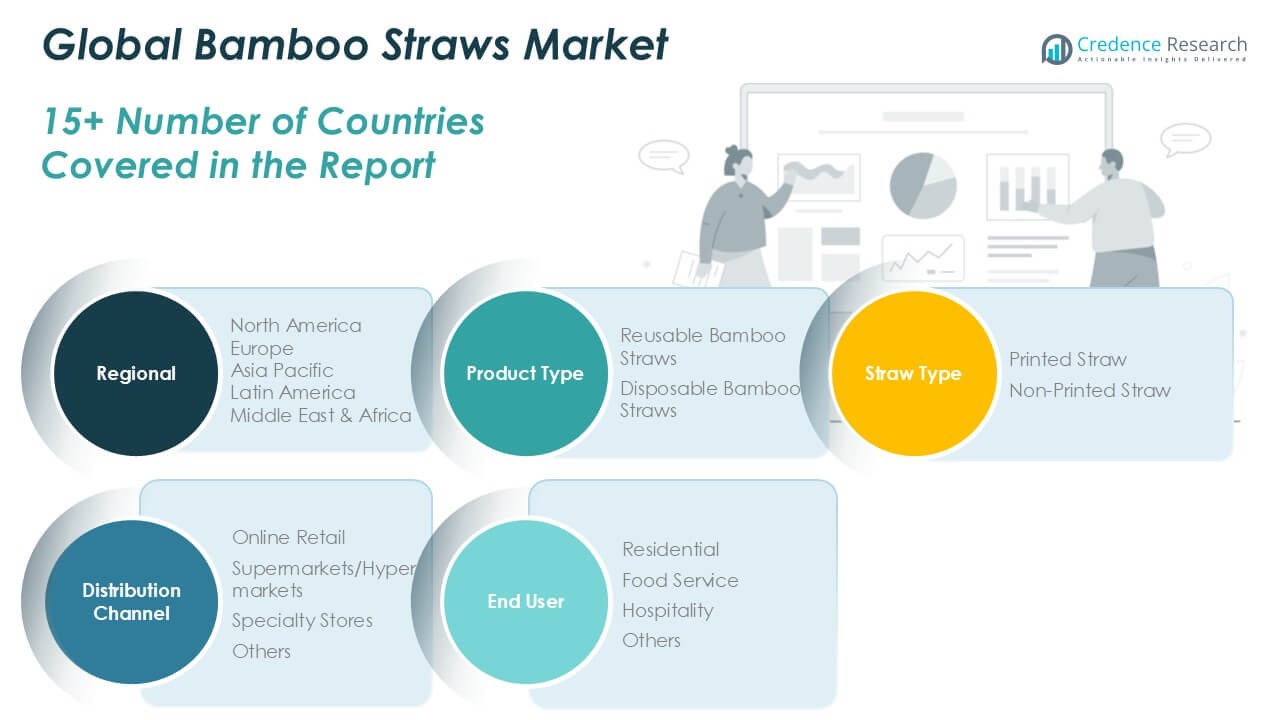
Market Segmentations:
By Product Type
- Reusable Bamboo Straws
- Disposable Bamboo Straws
By Straw Type
- Liquid
- Powder
- Others
By Distribution Channel
- Online Retail
- Supermarkets/Hypermarkets
- Specialty Stores
- Others
By End User
- Residential
- Food Service
- Hospitality
- Others
By Geography:
- North America
- Europe
- Asia Pacific
- Latin America
- Middle East
- Africa
Competitive Landscape
The bamboo straws market features a competitive landscape characterized by a mix of specialized eco-friendly brands and established players diversifying into sustainable product lines. Key players such as Bambaw, StrawFree, Jungle Straws, and Buluh Straws focus on premium-quality, reusable bamboo straws and emphasize ethical sourcing and eco-conscious branding. Simply Straws and Bambu distinguish themselves through innovative product packaging and customization options, targeting niche markets and hospitality sectors. In contrast, Kimberly-Clark Corporation, a global leader in consumer goods, is leveraging its distribution capabilities to introduce sustainable alternatives like bamboo straws, enhancing its environmental portfolio. Players in this market compete on factors such as product quality, sustainability certifications, pricing, and distribution reach. Continuous innovation, global expansion, and strategic collaborations remain key to maintaining competitiveness and responding to rising consumer demand for sustainable solutions.
Key Player Analysis
- Bambaw
- StrawFree
- Jungle Straws
- Buluh Straws
- Bamboo Straws Worldwide
- Zone Bamboo Straws
- Simply Straws
- Kimberly-Clark Corporation
- Bambu
Recent Developments
- In July 2025, Bambaw continues its commitment to plastic-free living by actively promoting bamboo and stainless steel straws as sustainable alternatives. This aligns with the growing global movement towards eco-friendly products and reducing plastic waste.
- In 2025, StrawFree is continuing its dedication to producing handcrafted bamboo straws from locally harvested bamboo. The company's core mission revolves around reducing landfill waste and highlighting the individual character of each straw. StrawFree remains committed to providing sustainable alternatives to plastic straws and promoting the use of eco-friendly materials.
- In 2025, Zone Bamboo Straws, a Netherlands-based company, continues to be recognized as a top global manufacturer of bamboo straws, specializing in sustainable and customizable solutions for bulk and branded needs. The overall bamboo straw market is experiencing growth due to increased adoption in foodservice, eco-friendly packaging, and online sales.
- In 2025, Bamboo Straws Worldwide is identified as a major player in the growing bamboo straw market, alongside other leading suppliers actively promoting eco-friendly and reusable drinking straws globally. This sector is experiencing growth due to increasing environmental awareness and regulations targeting plastic pollution.
Market Concentration & Characteristics
The Bamboo Straws Market displays a moderately fragmented structure with a mix of global and regional players competing across price, quality, and sustainability standards. It features a strong emphasis on eco-friendly materials, ethical sourcing, and minimal environmental impact. The market includes both reusable and disposable straw options, with reusable bamboo straws holding the dominant share due to rising consumer preference for long-lasting, sustainable alternatives. Online retail channels support small and mid-sized players in reaching a global audience without high distribution costs. It demonstrates steady product innovation, such as customization and improved durability, to meet evolving consumer demands. Leading brands focus on certifications and packaging differentiation to enhance brand value and credibility. Demand concentration is highest in North America and Asia Pacific, supported by regulatory action and abundant bamboo resources respectively. Product quality variations and absence of standardization challenge uniform adoption, yet rising sustainability trends continue to influence consumer choices and shape competitive positioning.
Report Coverage
The research report offers an in-depth analysis based on Product Type, Straw Type, Distribution Channel, End User and Geography. It details leading market players, providing an overview of their business, product offerings, investments, revenue streams, and key applications. Additionally, the report includes insights into the competitive environment, SWOT analysis, current market trends, as well as the primary drivers and constraints. Furthermore, it discusses various factors that have driven market expansion in recent years. The report also explores market dynamics, regulatory scenarios, and technological advancements that are shaping the industry. It assesses the impact of external factors and global economic changes on market growth. Lastly, it provides strategic recommendations for new entrants and established companies to navigate the complexities of the market.
Future Outlook
- The market will continue to grow steadily driven by rising environmental awareness and global restrictions on single-use plastics.
- Demand for reusable bamboo straws will rise significantly, supported by increasing adoption in hospitality and foodservice sectors.
- Online retail will remain the dominant distribution channel, expanding access for small and mid-sized eco-friendly brands.
- Asia Pacific will emerge as a key manufacturing and export hub due to its natural bamboo availability and skilled labor.
- North America will maintain its lead in consumption, supported by strong environmental regulations and conscious consumer behavior.
- Innovations in product design, including customization and multi-size offerings, will enhance user appeal and drive repeat purchases.
- Sustainability certifications and eco-friendly packaging will become critical factors in brand differentiation and consumer trust.
- Partnerships with hotels, cafés, and eco-tourism operators will create new revenue streams for manufacturers.
- Regulatory pressures will drive businesses to switch from plastic to bamboo alternatives across various sectors.
- Price competition and quality standardization will be central challenges for market players in maintaining long-term growth.

Request a Free Sample
Fill in your details and we'll send you a free sample report.
- Sample data tables & charts
- Research methodology
Need a Custom Version of This Report?
Tailor the scope, geography, or segments to your exact requirements.
- Custom geography or segment scope
- Direct access to our analyst team
Frequently Asked Questions
What is the current size of the Bamboo Straws Market?
What factors are driving the growth of the Bamboo Straws Market?
What are the key segments within the Bamboo Straws Market?
What are some challenges faced by the Bamboo Straws Market?
Who are the major players in the Bamboo Straws Market?
Table of Content
Chapter 1. Report Introduction
- 1.1 Report Description & Purpose
- 1.1.1 Report Title & Market Definition
- 1.1.2 Unique Selling Propositions (USP) & Key Differentiators
- 1.1.3 Value Proposition for Stakeholders
- 1.2 Research Objectives
- 1.2.1 Market Sizing Objectives (Volume & Revenue) (Volume Where Applicable)
- 1.2.2 Segmentation Objectives
- 1.2.3 Competitive Intelligence Objectives
- 1.2.4 Forecast & Scenario Objectives
- 1.3 Report Scope
- 1.3.1 Bamboo Straws Scope – Segments & Subsegments Covered
- 1.3.2 Geographic Scope – Regions & Countries Covered
- 1.3.3 Historical Period, Base Year & Forecast Period (2024; forecast to 2032)
- 1.3.4 Inclusions & Exclusions
- 1.4 Industry Classification & Applicable Codes
- 1.5 Currency, Measurement Units & Valuation Basis
- 1.6 Target Stakeholders
- 1.7 Limitations & Assumptions
Chapter 2. Executive Summary
- 2.1 Global Bamboo Straws Market Snapshot
- 2.1.1 Market Size – Historical (2024) & Forecast (2024-2032) (2024: USD 4,327.21 million → 2032: USD 8,054.99 million)
- 2.1.2 Volume & Revenue – Global Totals (Volume Where Applicable)
- 2.1.3 Key Market Highlights – Top Five Facts
- 2.2 Bamboo Straws Market Segmentation Snapshot
- 2.2.1 Market Split by Region – 2024 vs. 2032
- 2.3 Competitive Snapshot
- 2.3.1 Top 10 Players by Revenue Share – 2024
- 2.3.2 Top 10 Players by Volume Share – 2024 (Volume Where Applicable)
- 2.3.3 Recent Strategic Developments (18-Month Summary)
- 2.4 Key Investment Highlights & Strategic Conclusions
Chapter 3. Bamboo Straws Market Dynamics & Industry Analysis
- 3.1 Market Overview & Context
- 3.1.1 Bamboo Straws Market Position in the Broader Industry Value Chain
- 3.1.2 Demand Structure & Purchasing Dynamics
- 3.1.3 Market Maturity & Development Stage by Region
- 3.2 Bamboo Straws Market Drivers
- 3.3 Bamboo Straws Market Restraints & Challenges
- 3.4 Bamboo Straws Market Opportunities
- 3.5 Porter's Five Forces Analysis
- 3.5.1 Threat of New Entrants
- 3.5.2 Bargaining Power of Suppliers
- 3.5.3 Bargaining Power of Buyers
- 3.5.4 Threat of Substitutes
- 3.5.5 Competitive Rivalry – Intensity Assessment
- 3.6 Bamboo Straws Value Chain Analysis
- 3.6.1 Upstream – Key Inputs, Resources & Suppliers
- 3.6.1.1 Key Input/Resource 1
- 3.6.1.2 Key Input/Resource 2
- 3.6.1.3 Key Input/Resource 3
- 3.6.2 Midstream – Core Operations & Value Creation
- 3.6.2.1 Operating Model & Process Overview
- 3.6.2.2 Key Operating Locations & Capabilities by Company
- 3.6.3 Downstream – Market Channels & End Users
- 3.6.3.1 Direct Sales & Customer Engagement Channels
- 3.6.3.2 Indirect Sales, Intermediaries & Partner Channels
- 3.6.4 Value Chain Profitability Analysis
- 3.6.1 Upstream – Key Inputs, Resources & Suppliers
- 3.7 PESTEL Analysis
- 3.7.1 Political Factors
- 3.7.2 Economic Factors
- 3.7.3 Social Factors
- 3.7.4 Technological Factors
- 3.7.5 Environmental Factors
- 3.7.6 Legal Factors
- 3.8 Bamboo Straws Supply Chain Analysis
- 3.8.1 Critical Input & Resource Availability Risk Assessment
- 3.8.2 Supplier & Operational Concentration Risk (Geographic Exposure)
- 3.8.3 Supply & Service Disruption Impact Analysis
- 3.9 Regulatory & Policy Landscape
Note: The regulatory and policy landscape section covers regulations based on their applicability to the market, Bamboo Straws category, geography, and scope of the study. Only regulatory frameworks with a material impact on operations, compliance, trade, sustainability, or market access are analyzed in detail.
Chapter 4. Key Investment Pockets & Opportunity Analysis
- 4.1 Bamboo Straws Market Attractiveness Analysis
- 4.1.1 By Region – Investment Attractiveness Matrix (Market Size × CAGR)
- 4.2 Absolute Revenue Growth Opportunity
- 4.2.1 By Region – Absolute Revenue Growth Through 2032
- 4.3 Incremental Demand Opportunity
- 4.3.1 By Region – Incremental Demand Through 2032
- 4.3.2 Segment – Incremental Demand
- 4.4 Emerging Submarket Opportunity Deep Dive (Subject to Applicability)
- 4.5 Priority Market Opportunity Scorecards
- 4.5.1 United States
- 4.5.2 Europe
- 4.5.3 Asia
- 4.5.4 Middle East & Africa
Note: Priority market opportunity scorecards reflect the geographic scope and strategic relevance of the study. Listed markets are indicative and may be adapted to the industry.
Chapter 5. Bamboo Straws Cross-Border Trade & Market Access Analysis
- 5.1 International Trade & Cross-Border Activity Overview
- 5.1.1 Global Export Value by Country (2024)
- 5.1.2 Global Export Volume by Country (2024) (Volume Where Applicable)
- 5.1.3 Global Import Value by Country (2024)
- 5.1.4 Global Import Volume by Country (2024) (Volume Where Applicable)
- 5.1.5 Net Trade Balance by Country (2024)
- 5.2 Export Analysis – Segment
- 5.2.1 Category 1 (Applicable Classification Code)
- 5.2.2 Category 2 (Applicable Classification Code)
- 5.2.3 Category 3 (Applicable Classification Code)
- 5.2.4 Category 4 (Applicable Classification Code)
- 5.2.5 Category 5 (Applicable Classification Code)
- 5.3 Import Analysis – Segment
- 5.3.1 Category 1 (Applicable Classification Code)
- 5.3.2 Category 2 (Applicable Classification Code)
- 5.3.3 Category 3 (Applicable Classification Code)
- 5.3.4 Category 4 (Applicable Classification Code)
- 5.3.5 Category 5 (Applicable Classification Code)
- 5.4 Cross-Border Pricing & Transaction Benchmarks
- 5.4.1 Export Pricing – Segment & Country
- 5.4.2 Import Pricing – Segment & Source Country
- 5.4.3 Price Trends (2024)
- 5.5 Key Cross-Border Trade & Delivery Routes
- 5.5.1 Cross-Border Trade/Delivery Route 1
- 5.5.2 Cross-Border Trade/Delivery Route 2
- 5.5.3 Cross-Border Trade/Delivery Route 3
- 5.5.4 Cross-Border Trade/Delivery Route 4
- 5.5.5 Cross-Border Trade/Delivery Route 5
- 5.6 Trade Policy & Market Access Impact Assessment
- 5.6.1 Tariff & Non-Tariff Barriers
- 5.6.2 Regional Trade & Economic Integration Frameworks
- 5.6.3 Bilateral & Multilateral Trade Agreements
- 5.6.4 Cross-Border Operating, Licensing & Localization Requirements
Note: This chapter applies where cross-border trade or delivery is relevant to Bamboo Straws. Goods, services, and digital offerings are assessed using applicable classifications and transaction measures. Import-export volumes, trade balances, and route analyses are included only where meaningful to the market.
Chapter 6. Competitive Landscape & Company Benchmarking
- 6.1 Bamboo Straws Market Concentration & Structure
- 6.1.1 Herfindahl-Hirschman Index (HHI) – vs. 2024
- 6.1.2 Leading, Mid-Sized & Emerging Player Structure
- 6.1.3 Global, Regional & Local Player Dynamics
- 6.2 Bamboo Straws Market Share Analysis – 2024
- 6.2.1 Global Revenue Share by Company
- 6.2.2 Global Volume Share by Company (Volume Where Applicable)
- 6.2.3 Regional Revenue Share
- 6.2.4 Market Share Evolution ( vs. 2024)
- 6.2.5 Company Market Share by Key Segment
- 6.2.6 Company Market Share by Customer Group
- 6.3 Operating Scale, Capacity & Infrastructure Analysis
- 6.3.1 Global Operating Scale & Supply Capacity
- 6.3.2 Resource Utilization & Operating Efficiency
- 6.3.3 Output, Service Delivery & Activity Metrics
- 6.3.4 Operating Footprint & Infrastructure Map
- 6.3.5 Planned Operational & Capacity Expansion
- 6.4 Bamboo Straws Competitive Benchmarking Matrix
- 6.4.1 Revenue, Growth, Profitability & Operating Metric Comparison
- 6.4.2 Channel Revenue Mix
- 6.4.3 Geographic Revenue Exposure
- 6.4.4 R&D Intensity
- 6.4.5 Sustainability Maturity
- 6.5 Strategic Developments in Bamboo Straws (Last 24 Months)
- 6.5.1 Mergers, Acquisitions & Divestments
- 6.5.2 New Products, Services & Solutions in Bamboo Straws
- 6.5.3 Operational & Infrastructure Expansions
- 6.5.4 Strategic Alliances, Joint Ventures & Partnerships
- 6.5.5 Distribution Expansion & Market Entry
- 6.5.6 Sustainability & ESG Initiatives
- 6.6 Competitive Strategy Mapping
- 6.6.1 Leader, Challenger, Follower & Niche Classification
- 6.6.2 Pricing Strategy Comparison
- 6.6.3 Channel Strategy Matrix
Note: Strategic developments are included based on their materiality and the availability of reliable information.
Chapter 7. Global Bamboo Straws Market – By Sales & Delivery Channel
- 7.1 Segment Overview
- 7.1.1 Volume & Revenue Split by Channel (2024 & 2032) (Volume Where Applicable)
- 7.1.2 Channel Mix Evolution (2024-2032)
Chapter 8. Regional Market Analysis – Global Overview
- 8.1 Global Regional Overview
- 8.1.1 Regional Volume Share (Volume Where Applicable)
- 8.1.2 Regional Revenue Share
- 8.1.3 Regional Volume by Region (Volume Where Applicable)
- 8.1.4 Regional Revenue by Region
- 8.1.5 Regional Forecast Through 2032
- 8.2 Cross-Regional Segment Analysis
- 8.2.1 By Sales & Delivery Channel
- 8.2.2 By Competitive Positioning & Price Tier
Chapter 9. North America Bamboo Straws Market
- 9.1 United States
- 9.2 Canada
- 9.3 Mexico
Chapter 10. Europe Bamboo Straws Market
- 10.1 Germany
- 10.2 France
- 10.3 Italy
- 10.4 United Kingdom
- 10.5 Spain
- 10.6 Poland
- 10.7 Russia
- 10.8 Netherlands
- 10.9 Belgium
- 10.10 Sweden
- 10.11 Denmark
- 10.12 Norway
- 10.13 Rest of Europe
Chapter 11. Asia Pacific Bamboo Straws Market
- 11.1 China
- 11.2 India
- 11.3 Japan
- 11.4 South Korea
- 11.5 Thailand
- 11.6 Indonesia
- 11.7 Vietnam
- 11.8 Malaysia
- 11.9 Australia
- 11.10 Rest of Asia Pacific
Chapter 12. Latin America Bamboo Straws Market
- 12.1 Brazil
- 12.2 Argentina
- 12.3 Colombia
- 12.4 Chile
- 12.5 Rest of Latin America
Chapter 13. Middle East Bamboo Straws Market
- 13.1 Saudi Arabia
- 13.2 United Arab Emirates
- 13.3 Turkey
- 13.4 Israel
- 13.5 Iran
- 13.6 Rest of the Middle East
Chapter 14. Africa Bamboo Straws Market
- 14.1 South Africa
- 14.2 Egypt
- 14.3 Nigeria
- 14.4 Morocco
- 14.5 Rest of Africa
Chapter 15. Bamboo Straws Company Profiles
- 15.1 [Company 01]
- 15.1.1 Company Overview
- 15.1.2 Key Management Personnel
- 15.1.3 Products & Services Portfolio
- 15.1.4 Financial Performance
- 15.1.5 Key Market Focus & Geographic Presence
- 15.1.6 Recent Developments & Strategic Initiatives
Note: The company profile list is preliminary and may change based on research findings, market developments, data availability, and client requirements.
Chapter 16. Appendices
- Appendix A – List of Abbreviations & Acronyms
- Appendix B – Industry Classification Code Reference – Full Series
- Appendix C – Supply, Output & Operating Capacity Data Tables
- Appendix D – End-Use & Demand Base Tables
- Appendix E – Demand, Adoption & Usage Assumptions
- Appendix F – Pricing & Revenue Metric Reference Tables
- Appendix G – Company Operations & Infrastructure Database
- Appendix H – Cross-Border Trade & Activity Data Tables (Where Applicable)
- Appendix I – Regulatory Summary Tables
- Appendix J – Primary Research Participant List (Anonymized)
- Appendix K – Primary Research Questionnaire Framework
- Appendix L – Data Sources & Bibliography
- Appendix M – Market Size Divergence & Source Comparison
Chapter 17. Research Methodology
- 17.1 Research Framework & Philosophy
- 17.2 Secondary Research – Sources, Hierarchy & Data Extraction
- 17.3 Data Modeling – Bottom-Up & Top-Down Market Sizing
- 17.4 Primary Research – Stakeholder Framework, LOI & Sample Sizes
- 17.5 Forecast Methodology – Regression, Scenario & Sensitivity Analysis
- 17.6 Quality Control – Four-Layer Validation Framework
- 17.7 Limitations & Standard Assumptions
- 17.8 Disclaimer