| REPORT ATTRIBUTE | DETAILS |
|---|---|
| Historical Period | 2020-2023 |
| Base Year | 2024 |
| Forecast Period | 2025-2032 |
| Black Friday Packaging Market Size 2024 | USD 1,654.26 million |
| Black Friday Packaging Market, CAGR | 8.40% |
| Black Friday Packaging Market Size 2032 | USD 3,300.94 million |
Market Overview:
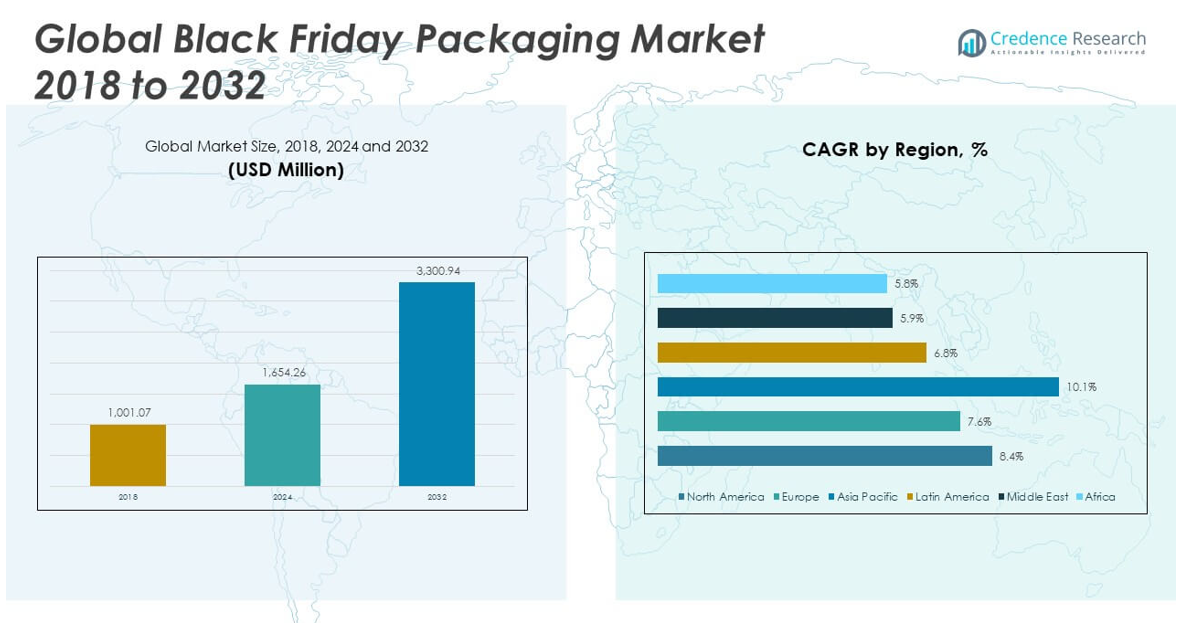
The Global Black Friday Packaging Market size was valued at USD 1,001.07 million in 2018 to USD 1,654.26 million in 2024 and is anticipated to reach USD 3,300.94 million by 2032, at a CAGR of 8.40% during the forecast period.
The growth of the Global Black Friday Packaging Market is driven by several dynamic factors. The surge in global e-commerce, especially during the Black Friday season, is a major driver, as consumers increasingly prefer online shopping for deals and convenience. This shift has intensified the demand for secure, functional, and aesthetically appealing packaging to ensure safe deliveries and enhance unboxing experiences. Simultaneously, brands are leveraging packaging as a strategic marketing tool to differentiate themselves through limited-edition designs, branded boxes, and personalized print elements. Sustainability is another powerful driver, with companies adopting recyclable materials, biodegradable polymers, and minimalistic designs to align with consumer preferences and regulatory frameworks. Additionally, innovations in smart packaging-such as QR codes, tamper-evident seals, and track-and-trace features-are improving product security and logistics efficiency during the high-volume holiday period. Together, these factors position Black Friday packaging as a value-added component of retail strategies, contributing directly to customer engagement, brand recall, and operational performance.
Regionally, North America dominates the Black Friday packaging market, led by the United States, where the event originated and continues to record massive retail and e-commerce sales. High consumer spending, mature supply chain infrastructure, and established packaging vendors give North America a competitive edge. Europe holds a significant share, driven by stringent environmental regulations and a strong push toward sustainable packaging solutions. Countries like the United Kingdom, Germany, and France have seen steady adoption of Black Friday promotions, with packaging suppliers innovating to meet both aesthetic and eco-friendly demands. The Asia-Pacific region is emerging as the fastest-growing market, propelled by rapid digitalization, expanding middle-class consumer bases, and the rising popularity of Western shopping trends. China and India are key contributors, with local packaging manufacturers adapting to meet demand spikes during global shopping events. Meanwhile, Latin America and the Middle East & Africa represent growing opportunities, with increasing internet penetration, mobile commerce adoption, and cross-border retail activity gradually elevating the need for specialized packaging solutions during Black Friday campaigns.
Market Insights:
- The Global Black Friday Packaging Market reached USD 1,654.26 million in 2024 and is projected to grow to USD 3,300.94 million by 2032, expanding at a CAGR of 8.40% due to heightened demand from seasonal retail campaigns.
- E-commerce growth is a key driver, with retailers seeking scalable, secure, and visually appealing packaging to manage the surge in online Black Friday orders and enhance the consumer unboxing experience.
- Sustainability remains a critical focus, as brands adopt recyclable materials, compostable mailers, and minimalist designs to meet rising consumer expectations and regulatory pressures in key markets like North America and Europe.
- Customized packaging is gaining prominence, with retailers using limited-edition boxes, branded sleeves, and gift-ready formats to create exclusivity, drive engagement, and increase customer retention.
- Smart packaging technologies are improving supply chain efficiency and consumer interaction, with features like QR codes, NFC tags, and tamper-evident seals supporting tracking, security, and post-purchase engagement.
- Supply chain volatility and raw material inflation present ongoing challenges, disrupting packaging timelines and forcing companies to balance cost, speed, and quality under tight seasonal constraints.
- Regionally, North America holds the largest market share, followed by Europe and Asia Pacific, while emerging markets in Latin America, the Middle East, and Africa present strong long-term growth opportunities due to expanding digital retail adoption.
Market Drivers:
Expansion of E-commerce and High-Volume Retail Events Increases Packaging Demand
The Global Black Friday Packaging Market is witnessing substantial growth due to the rapid expansion of e-commerce and online retail platforms. Consumers increasingly prefer digital channels to access Black Friday deals, leading to a surge in parcel volumes requiring reliable packaging solutions. Brands and retailers prioritize packaging that ensures product safety, minimizes return rates, and delivers a positive unboxing experience. This seasonal spike places significant pressure on packaging suppliers to provide scalable, high-performance solutions within short timeframes. It contributes directly to the demand for corrugated boxes, protective fillers, tamper-evident seals, and compact mailers. The market benefits from partnerships between retailers and packaging companies that plan months in advance to optimize Black Friday fulfillment logistics.
Increased Focus on Sustainable Packaging Materials and Regulatory Compliance
Environmental concerns and government policies are reshaping packaging practices across retail markets. The Global Black Friday Packaging Market responds to this shift by integrating biodegradable, recyclable, and FSC-certified materials into its product offerings. Consumers now expect packaging to reflect a brand’s commitment to sustainability, prompting companies to eliminate excessive plastics and adopt eco-friendly alternatives. Retailers are choosing minimalist designs, compostable mailers, and water-based inks to reduce environmental impact while maintaining visual appeal. It enables companies to align with corporate ESG goals while meeting rising consumer expectations for responsible consumption. Regulatory frameworks across Europe and North America further reinforce the move toward circular packaging practices during high-demand events like Black Friday.
- Kodak, for example, has partnered with Jindal Films Europe to commercialize mono-material polypropylene (PP) and polyethylene (PE) laminates, which are fully recyclable and compatible with existing recycling streams.
Customization and Branding Opportunities Drive Value Creation in Packaging
Black Friday campaigns serve not only as a sales opportunity but also as a platform for brand engagement. Customized packaging has emerged as a key tool to reinforce brand identity, elevate product perception, and build customer loyalty. The Global Black Friday Packaging Market sees increased investment in personalized boxes, branded sleeves, and limited-edition designs that create memorable experiences. Retailers use thematic packaging to promote exclusivity and encourage gift-ready presentation, reducing the need for additional wrapping. It transforms packaging from a logistic necessity into a strategic marketing asset that amplifies promotional messages. This value-add approach enhances brand recall and customer retention in a competitive retail landscape.
- For example, TricorBraun’s case studies highlight the use of Biotrē™ 1.0, a 60% compostable, plant-based film for Equator Coffees, and 100% post-consumer recycled (PCR) bottles for Sunday Lawn Care, demonstrating measurable reductions in carbon footprint and packaging waste.
Integration of Smart Packaging Technologies Improves Logistics and Consumer Experience
Smart packaging is gaining traction as companies seek to enhance product safety, traceability, and consumer interaction. QR codes, tamper-evident seals, NFC tags, and scannable product information help manage high-volume shipments and elevate post-purchase engagement. It enables real-time tracking, supports automated returns, and improves inventory visibility for both retailers and customers. The Global Black Friday Packaging Market benefits from these innovations by offering packaging that meets operational and experiential demands. Brands are also using these tools to deliver content, warranty details, and feedback channels through the packaging itself. This convergence of technology and packaging supports both efficiency and customer satisfaction in the peak shopping period.
Market Trends:
Rise of Limited-Edition Packaging Formats to Attract Seasonal Shoppers
Brands are increasingly launching limited-edition packaging formats during Black Friday to create urgency and exclusivity. These designs are often themed with bold colors, seasonal motifs, and high-impact visuals to capture consumer attention in crowded marketplaces. The Global Black Friday Packaging Market is adapting to this trend by offering flexible short-run printing solutions that allow retailers to release unique designs in smaller volumes. It enables brands to stand out, encourage impulse purchases, and reinforce festive campaign messages. This approach supports both physical retail displays and e-commerce unboxing experiences. The seasonal nature of these designs encourages repeat customer engagement year after year.
- For example, PrintnBox reports that their digital presses can deliver custom runs as low as 100 units, enabling brands to test unique designs without committing to high minimum order quantities.
Growing Use of Compact and Multi-Functional Packaging for Cost Efficiency
Retailers are adopting compact and multi-functional packaging formats to reduce material waste and shipping costs. Packaging designs that can serve dual purposes-such as storage boxes, foldable gift packs, or return-ready mailers-are gaining traction. The Global Black Friday Packaging Market is responding by engineering lightweight, space-saving designs that minimize dimensional weight while maintaining product protection. It helps retailers lower logistics expenses during peak shipping periods without compromising product presentation. These innovations also support faster handling and easier shelf placement for in-store promotions. The trend aligns with operational efficiency goals and appeals to both retailers and end consumers.
Shift Toward Automation in Packaging Production and Fulfillment
The seasonal demand spikes around Black Friday are prompting manufacturers to invest in automation technologies for packaging production. Automated die-cutting, folding, labeling, and sealing systems are reducing lead times and improving consistency in high-volume orders. The Global Black Friday Packaging Market sees growing deployment of robotic arms, conveyor systems, and software-driven workflows in fulfillment centers to meet tight delivery schedules. It allows packaging providers to maintain high output levels without sacrificing quality or precision. Automation also supports customization at scale, enabling brands to personalize packaging without delaying order processing. This shift is crucial to meeting the compressed timelines of the Black Friday promotional cycle.
- For instance, Mi Rancho, a major food producer, implemented 12 robotic systems for case packing and palletizing through Formic, increasing annual production capacity by 20 million pounds and achieving a 25-30% boost in operational efficiency within the first year.
Adoption of Data-Driven Design and Performance Optimization Tools
Packaging companies are turning to data analytics and simulation tools to optimize performance and reduce design iteration cycles. Software platforms that analyze structural integrity, consumer behavior, and sustainability metrics are shaping packaging decisions in advance of Black Friday campaigns. The Global Black Friday Packaging Market is benefiting from this trend by offering data-backed solutions that reduce failure rates and improve cost-efficiency. It helps packaging firms anticipate stress points, choose optimal materials, and validate supply chain readiness. Brands leverage these insights to refine packaging that not only protects but also resonates with specific customer segments. This analytical approach supports continuous improvement across seasonal retail strategies.
Market Challenges Analysis:
Volatility in Raw Material Prices and Supply Chain Disruptions Impact Packaging Stability
The Global Black Friday Packaging Market faces significant pressure from fluctuating raw material costs and ongoing supply chain disruptions. Price instability in paperboard, plastics, adhesives, and inks directly affects production budgets and squeezes profit margins for packaging manufacturers. Limited availability of recycled or sustainable materials further complicates cost control during high-demand periods. It forces companies to either absorb rising costs or pass them on to clients, which may reduce competitiveness. Port congestion, labor shortages, and transportation delays continue to hinder timely material procurement and order fulfillment. These disruptions threaten to undermine delivery commitments during a time-sensitive retail event like Black Friday.
Balancing Sustainability Goals with High-Speed, High-Volume Fulfillment Demands
Meeting sustainability benchmarks while managing the fast pace of Black Friday logistics remains a complex challenge. Retailers demand environmentally friendly packaging, yet expect rapid turnaround and consistent quality under tight schedules. The Global Black Friday Packaging Market must reconcile eco-design requirements with scalable production processes, often requiring costly innovation and retooling. It creates operational friction, especially for small- and mid-sized packaging firms with limited automation or R&D capacity. Packaging must be protective, brandable, and recyclable-all without slowing down fulfillment lines or increasing shipping weight. Achieving this balance requires investment in advanced materials and continuous collaboration across the supply chain.
Market Opportunities:
Growing Demand for Subscription and Gift-Ready Packaging Formats Creates New Avenues
The Global Black Friday Packaging Market has an opportunity to expand by catering to the rising popularity of subscription boxes and gift-ready packaging. Consumers increasingly seek convenience, presentation, and personalization when purchasing holiday deals, especially for gifting purposes. It enables packaging providers to design versatile, pre-branded, and easy-to-assemble formats that enhance the buyer experience. Gift boxes with magnetic closures, window displays, or reusable components present high-margin growth segments. Packaging companies can collaborate with retailers to launch exclusive seasonal editions that align with marketing campaigns. This trend supports both e-commerce and in-store merchandising strategies.
Integration of Augmented Reality and Smart Packaging Offers Competitive Differentiation
Smart packaging technologies embedded with QR codes, NFC tags, or augmented reality features open new revenue streams for packaging manufacturers. The Global Black Friday Packaging Market can leverage these technologies to deliver interactive content, promote loyalty programs, and enable post-sale engagement. It allows brands to stand out in a crowded marketplace while gathering valuable consumer data. These tools also support anti-counterfeit measures, which are vital during peak sales periods. Packaging firms that offer tech-enabled solutions position themselves as strategic partners to retailers aiming for innovation. This shift presents a premium segment within the broader market.
Market Segmentation Analysis:
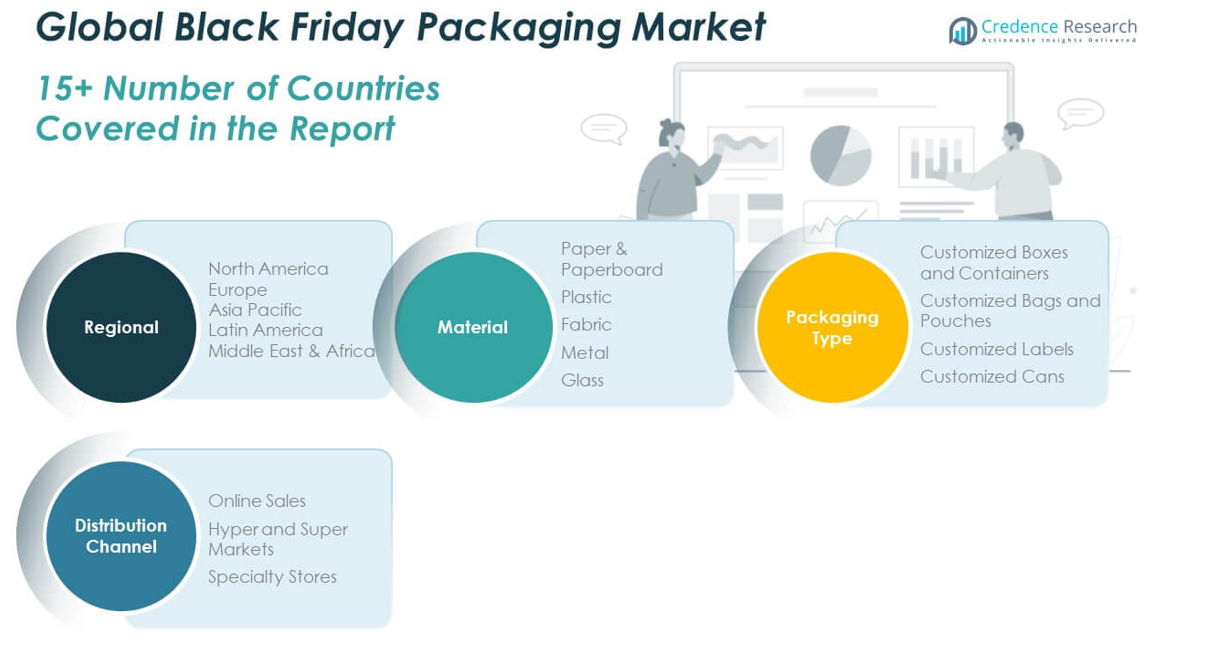
The Global Black Friday Packaging Market is segmented by material, packaging type, and distribution channel, each contributing uniquely to market expansion.
By material, paper and paperboard dominate due to their recyclability, printability, and alignment with sustainability goals. Plastic follows, offering durability and cost-efficiency, though facing regulatory scrutiny. Fabric, metal, and glass remain niche segments, used primarily for premium, reusable, or limited-edition packaging formats that enhance brand perception.
- For example, Amazon ships large products daily in recyclable, FSC-certified corrugated boxes that are optimized for e-commerce and designed to minimize waste.
By packaging type, customized boxes and containers lead the market, driven by their versatility and ability to protect high-volume e-commerce goods. Customized bags and pouches gain traction for lightweight and fashion-related items, while customized labels support brand visibility and product identification. Customized cans serve specific sectors like food, beverages, or promotional collectibles.
- DS Smith for example, is a major provider of e-commerce packaging, producing over 2 billion boxes annually. They are known for supplying packaging tailored to major online retailers like Amazon, ASOS, and Zalando, with a focus on high-quality printing for branding purposes.
By distribution channel, online sales account for the largest share, reflecting the dominance of e-commerce during Black Friday. Hyper and supermarkets follow, supported by in-store promotions. Specialty stores contribute through personalized packaging demands tied to curated or luxury offerings. Each segment reinforces the need for scalable, visually distinct, and eco-conscious packaging strategies.
Segmentation:
By Material
- Paper & Paperboard
- Plastic
- Fabric
- Metal
- Glass
By Packaging Type
- Customized Boxes and Containers
- Customized Bags and Pouches
- Customized Labels
- Customized Cans
By Distribution Channel
- Online Sales
- Hyper and Supermarkets
- Specialty Stores
By Region
- North America
- U.S.
- Canada
- Mexico
- Europe
- Germany
- France
- U.K.
- Italy
- Spain
- Rest of Europe
- Asia Pacific
- China
- Japan
- India
- South Korea
- South-east Asia
- Rest of Asia Pacific
- Latin America
- Brazil
- Argentina
- Rest of Latin America
- Middle East & Africa
- GCC Countries
- South Africa
- Rest of the Middle East and Africa
Regional Analysis:
North America
The North America Black Friday Packaging Market size was valued at USD 422.79 million in 2018 to USD 691.16 million in 2024 and is anticipated to reach USD 1,383.11 million by 2032, at a CAGR of 8.4% during the forecast period. North America holds the largest market share of the Global Black Friday Packaging Market, accounting for nearly 32% in 2024. It benefits from the deep-rooted Black Friday retail culture, high consumer spending, and a well-established e-commerce ecosystem. The U.S. leads the region, with major retailers relying heavily on specialized packaging for promotions, brand engagement, and secure last-mile delivery. Packaging companies in the region offer high-volume, customizable, and eco-conscious solutions to meet retailer expectations. The presence of advanced logistics and automation technologies strengthens the region’s ability to respond to seasonal demand peaks efficiently.
Europe
The Europe Black Friday Packaging Market size was valued at USD 298.77 million in 2018 to USD 476.79 million in 2024 and is anticipated to reach USD 898.59 million by 2032, at a CAGR of 7.6% during the forecast period. Europe contributes around 22% to the Global Black Friday Packaging Market in 2024. It is driven by widespread adoption of Black Friday promotions across the UK, Germany, France, and Nordic countries. Packaging trends in the region emphasize sustainability, recyclability, and minimalist design aligned with strict EU packaging regulations. It supports strong demand for paperboard boxes, biodegradable mailers, and FSC-certified materials. European packaging firms focus on short-run digital printing and value-added services for seasonal campaigns. The market also benefits from high brand sensitivity and consumer preference for premium unboxing experiences.
Asia Pacific
The Asia Pacific Black Friday Packaging Market size was valued at USD 186.54 million in 2018 to USD 334.95 million in 2024 and is anticipated to reach USD 759.61 million by 2032, at a CAGR of 10.1% during the forecast period. Asia Pacific holds nearly 16% of the Global Black Friday Packaging Market in 2024 and is the fastest-growing regional market. It is fueled by rising urbanization, expanding middle-class demographics, and growing awareness of Western shopping events. China and India are key contributors, where local manufacturers scale up seasonal production for both domestic use and global exports. E-commerce giants in the region are increasing investments in sustainable and cost-efficient packaging. It enables competitive pricing and supports regional logistics innovations. Demand for smart packaging and automation technologies is accelerating in APAC fulfillment centers.
Latin America
The Latin America Black Friday Packaging Market size was valued at USD 48.40 million in 2018 to USD 79.00 million in 2024 and is anticipated to reach USD 139.95 million by 2032, at a CAGR of 6.8% during the forecast period. Latin America accounts for nearly 4% of the Global Black Friday Packaging Market. It is supported by the growing penetration of e-commerce platforms and seasonal retail campaigns across Brazil, Mexico, and Chile. Regional packaging providers are expanding their offerings to include digitally printed boxes and recyclable materials to align with evolving retail formats. It faces challenges with logistics infrastructure but is addressing them through investment in localized packaging hubs. Retailers are adopting smaller batch runs for limited-time promotions. The region holds strong potential for expansion through cross-border e-commerce partnerships.
Middle East
The Middle East Black Friday Packaging Market size was valued at USD 26.37 million in 2018 to USD 39.59 million in 2024 and is anticipated to reach USD 65.80 million by 2032, at a CAGR of 5.9% during the forecast period. The Middle East represents about 2% of the Global Black Friday Packaging Market. It is gaining traction as regional retailers and marketplaces embrace global retail trends and invest in digital platforms. Countries like the UAE and Saudi Arabia lead the growth, offering premium packaging formats aligned with luxury retail segments. It benefits from rising online shopping behavior and greater demand for secure, presentable, and customizable packaging. Market development is supported by increasing investments in logistics and packaging automation. Adoption of eco-friendly packaging materials is also gaining momentum due to rising consumer awareness.
Africa
The Africa Black Friday Packaging Market size was valued at USD 18.20 million in 2018 to USD 32.76 million in 2024 and is anticipated to reach USD 53.87 million by 2032, at a CAGR of 5.8% during the forecast period. Africa contributes just over 1% to the Global Black Friday Packaging Market but shows long-term growth potential. E-commerce growth in Nigeria, South Africa, and Kenya is driving packaging demand for seasonal sales and discount-driven events. Infrastructure constraints and limited access to premium materials remain key barriers. It is beginning to attract investment in local packaging manufacturing and recycling facilities. Consumer demand for convenient and protective packaging is on the rise. Regional players are introducing scalable solutions to tap into the emerging middle-class retail base.
Key Player Analysis:
- 5N Plus
- Shepherd Chemical
- Clark Manufacturing
- Hunan Jinwang
- Xianyang Yuehua
- Sichuan Shunda
- Shudu Nanomaterials
- Beijing Easpring
- Henan Maiteer
Competitive Analysis:
The Global Black Friday Packaging Market is highly competitive, with key players focusing on seasonal innovation, sustainable materials, and high-speed customization. Leading companies such as WestRock, International Paper, DS Smith, Smurfit Kappa, and Amcor leverage advanced manufacturing capabilities and global supply chains to meet short lead times and volume spikes. It is shaped by the ability to deliver short-run packaging with personalized branding, enhanced durability, and compliance with environmental standards. Competitors increasingly invest in smart packaging solutions and automation to improve speed, accuracy, and logistics efficiency. Smaller firms compete by offering agile, region-specific services and eco-friendly alternatives that cater to niche retail needs. Strategic collaborations with retailers and digital printing advancements are enabling faster response to seasonal demand. The market’s competitive edge lies in delivering packaging that enhances customer experience while supporting operational efficiency during the intense Black Friday retail cycle.
Recent Developments:
- In January 2025, Trimco Group finalized its acquisition of U.S.-based Nexgen Packaging, a company known for offering brand identity and packaging solutions tailored to specialty retailers in the apparel and footwear sectors.
- In January 2025, Protega Global introduced its new automatic HexaFil dispenser at the Packaging Innovations event. This advanced machine is designed to produce high-quality paper cushioning, offering enhanced protection for products shipped during the Black Friday sales surge.
- In November 2024, Amcor PLC announced its agreement to acquire Berry Global Group in an $8.4 billion all-stock transaction, aiming to create the world’s largest plastic packaging company. This merger positions Amcor to drive efficiency, scale production, and accelerate sustainable packaging solutions-key components in serving the surge demands of the Black Friday packaging market across North America, Europe, and emerging regions.
Market Concentration & Characteristics:
The Global Black Friday Packaging Market exhibits moderate to high market concentration, with a few multinational players dominating large-volume contracts across North America and Europe. It is characterized by seasonal demand spikes, rapid fulfillment requirements, and growing emphasis on sustainable and customized packaging solutions. The market relies heavily on flexible production capabilities, just-in-time delivery, and digital printing technologies to handle short-run, branded packaging. Entry barriers remain moderate due to capital investment in automation and environmental compliance. Regional players maintain a presence by offering agile services, localized design support, and quick turnaround times. The market continues to evolve with advancements in material science, smart packaging integration, and e-commerce alignment.
Report Coverage:
The research report offers an in-depth analysis based on material, packaging type, and distribution channel. It details leading market players, providing an overview of their business, product offerings, investments, revenue streams, and key applications. Additionally, the report includes insights into the competitive environment, SWOT analysis, current market trends, as well as the primary drivers and constraints. Furthermore, it discusses various factors that have driven market expansion in recent years. The report also explores market dynamics, regulatory scenarios, and technological advancements that are shaping the industry. It assesses the impact of external factors and global economic changes on market growth. Lastly, it provides strategic recommendations for new entrants and established companies to navigate the complexities of the market.
Future Outlook:
- E-commerce growth will continue to drive demand for protective, lightweight, and branded Black Friday packaging solutions.
- Retailers will increasingly adopt eco-friendly materials to meet regulatory standards and consumer sustainability preferences.
- Short-run digital printing technologies will enable faster customization for limited-edition and promotional packaging.
- Automation in packaging production and fulfillment will become critical for meeting tight delivery timelines.
- Smart packaging features such as QR codes and tamper-evident seals will gain traction for security and engagement.
- Packaging suppliers will strengthen partnerships with major retailers to co-develop exclusive seasonal formats.
- Asia Pacific will emerge as a leading growth region due to rising digital retail adoption and manufacturing scalability.
- Demand for gift-ready packaging formats will expand as consumers seek convenience during holiday shopping.
- Investment in recyclable, compostable, and reusable packaging designs will accelerate across all regions.
- Market competition will intensify, encouraging innovation in structure, design, and cost-efficient materials.

Request a Free Sample
Fill in your details and we'll send you a free sample report.
- Sample data tables & charts
- Research methodology
Market Dynamics
Expansion of E-commerce and High-Volume Retail Events
The surge in global e-commerce, especially during Black Friday, drives demand for secure, scalable, and visually appealing packaging to handle increased parcel volumes and enhance the unboxing experience.
Sustainability and Regulatory Compliance
Brands are adopting recyclable, compostable, and FSC-certified materials to meet consumer expectations and comply with stringent environmental regulations, particularly in North America and Europe.
Customization and Branding for Seasonal Promotions
Retailers leverage limited-edition, branded, and personalized packaging to differentiate themselves, create exclusivity, and boost customer engagement during Black Friday campaigns.
Integration of Smart Packaging Technologies
The adoption of QR codes, tamper-evident seals, and track-and-trace features improves product security, logistics efficiency, and post-purchase engagement, supporting both operational and marketing objectives.
Automation and Short-Run Digital Printing
Investments in automation and digital printing enable rapid, cost-effective production of customized packaging, allowing brands to respond quickly to seasonal spikes and offer unique designs in smaller volumes.
Need a Custom Version of This Report?
Tailor the scope, geography, or segments to your exact requirements.
- Custom geography or segment scope
- Direct access to our analyst team
Frequently Asked Questions
What is the current size of the Global Black Friday Packaging Market?
What are the key segments within the Global Black Friday Packaging Market?
What are some challenges faced by the Global Black Friday Packaging Market?
Who are the major players in the Global Black Friday Packaging Market?
Table of Content
Chapter 1 Market Segmentation
- 1.1 Segmentation Framework
- 1.1.1 Product and Service Classification
- 1.1.2 Application and End-Use Classification
- 1.1.3 Technology and Solution Classification
- 1.1.4 Customer and Distribution Channel Classification
- 1.1.5 Geographic Segmentation
- 1.1.6 Market Segment Definitions and Boundaries
- 1.2 By Material
- 1.2.1 Paper & Paperboard
- 1.2.2 Plastic
- 1.2.3 Fabric
- 1.2.4 Metal
- 1.2.5 Glass
- 1.3 By Packaging Type
- 1.3.1 Customized Boxes and Containers
- 1.3.2 Customized Bags and Pouches
- 1.3.3 Customized Labels
- 1.3.4 Customized Cans
Chapter 2 Introduction
- 2.1 Report Objectives and Scope
- 2.2 Product Definition and Industry Terminology
- 2.3 Market Inclusions and Exclusions
- 2.4 Research Process
- 2.4.1 Primary Research and Expert Interviews
- 2.4.2 Secondary Research and Source Review
- 2.4.3 Top-Down and Bottom-Up Estimation
- 2.4.4 Data Triangulation and Verification
- 2.5 Market Size Measurement Basis
- 2.5.1 2024: USD 1,654.26 million → 2032: USD 3,300.94 million
- 2.6 Historical and Forecast Reference Periods
- 2.6.1 Base Year: 2024
- 2.6.2 Forecast Period: 2024-2032
- 2.7 Research Assumptions and Limitations
Chapter 3 Executive Summary
- 3.1 Market Snapshot and Key Findings
- 3.2 Base-Year Market Size, 2024
- 3.3 Forecast Market Size, 2032
- 3.4 Revenue and Volume Growth Outlook
- 3.5 Key Demand and Supply Indicators
- 3.6 Leading Market Segments
- 3.7 Fastest-Growing Market Opportunities
- 3.8 Regional Performance Highlights
- 3.9 Technology and Industry Transformation
- 3.10 Competitive Landscape Summary
- 3.11 Analyst View and Strategic Implications
Chapter 4 Global Black Friday Packaging Market Trends and Developments
- 4.1 Historical Industry Development
- 4.2 Recent Market Trends and Developments
- 4.3 Demand and Customer Behavior Trends
- 4.4 Technology and Product Innovation
- 4.5 Artificial Intelligence, Automation and Digitalization
- 4.6 Local Manufacturing and Supply Chain Realignment
- 4.7 Industry Partnerships, Mergers and Acquisitions
- 4.8 Sustainability and Circular Economy Developments
- 4.9 Government and Private Sector Investment Trends
- 4.10 Emerging Business Models and Commercialization
- 4.11 Industry Developments and Announcements
Chapter 5 Global Black Friday Packaging Market Production, Supply and Demand Analysis
- 5.1 Demand Trend and Consumption Analysis
- 5.2 Demand Forecast, 2024-2032
- 5.3 Production and Output Trend
- 5.4 Production and Output Forecast, 2024-2032
- 5.5 Installed Capacity and Capacity Utilization
- 5.6 Company-Wise Production Plants and Statistics
- 5.6.1 Installed Production Capacity
- 5.6.2 Actual Production
- 5.6.3 Planned Capacity and Expansion Targets
- 5.7 Supply Chain Structure and Procurement Trends
- 5.8 Supply-Demand Gap and Bottlenecks
- 5.9 Import Dependence and Sourcing Structure
- 5.10 Contract Manufacturing and Outsourcing
- 5.11 Regional Supply and Demand Concentration
Chapter 6 Global Black Friday Packaging Market Pricing Analysis
- 6.1 Pricing Structure and Measurement
- 6.2 Historical Pricing Trends
- 6.3 Pricing Outlook, 2024-2032
- 6.4 Average Selling Price and Unit Economics
- 6.5 Pricing by Product and Market Segment
- 6.6 Geographic Pricing Differences
- 6.7 Key Input, Energy, Labor and Logistics Costs
- 6.8 Contract Pricing and Purchasing Models
- 6.9 Pricing Sensitivity and Competitive Positioning
- 6.10 Price, Margin and Profitability Implications
Chapter 7 Global Black Friday Packaging Market Dynamics
- 7.1 Market Growth Drivers
- 7.1.1 Demand-Side Drivers
- 7.1.2 Technology and Innovation Drivers
- 7.1.3 Infrastructure and Investment Drivers
- 7.1.4 Regulatory and Policy Drivers
- 7.2 Market Restraints
- 7.2.1 Cost and Affordability Constraints
- 7.2.2 Technology and Adoption Barriers
- 7.2.3 Supply Chain and Operational Constraints
- 7.3 Market Challenges
- 7.3.1 Competitive Pressure and Margin Erosion
- 7.3.2 Skills, Infrastructure and Implementation Gaps
- 7.4 Emerging Market Opportunities
- 7.5 Market Dynamics Impact and Time-Horizon Assessment
Chapter 8 Global Black Friday Packaging Value Chain Analysis
- 8.1 Industry Value Chain Overview
- 8.2 Upstream Suppliers and Critical Inputs
- 8.3 Technology and Component Providers
- 8.4 Manufacturing or Service Delivery
- 8.5 Distribution, Channel Partners and Integrators
- 8.6 Downstream Applications and End Users
- 8.7 Value Addition and Profit Pools
- 8.8 Vertical Integration and Outsourcing
- 8.9 Supplier Concentration and Risk
- 8.10 Supply Chain Localization and Resilience
Chapter 9 Global Black Friday Packaging Market Regulations and Policies
- 9.1 Relevant Laws, Standards and Compliance Frameworks
- 9.2 Product, Service, Safety and Quality Requirements
- 9.3 Government Policies, Incentives and Subsidies
- 9.4 Imports, Exports and Trade Barriers
- 9.5 Public Procurement and Local Content Requirements
- 9.6 Environmental and Sustainability Compliance
- 9.7 Upcoming Policy Changes and Market Implications
Chapter 10 Global Black Friday Packaging Market Hotspots and Opportunities
- 10.1 Market Opportunity Mapping and Growth Hotspots
- 10.2 High-Growth Applications and Customer Groups
- 10.3 Underserved Markets and White-Space Opportunities
- 10.4 Emerging Technology and Product Opportunities
- 10.5 New Capacity and Investment Hotspots
- 10.6 Market Entry and Expansion Opportunities
- 10.7 Distribution and Partnership Opportunities
- 10.8 Near-Term and Long-Term Commercial Potential
- 10.9 Opportunity Attractiveness and Execution Risks
Chapter 11 Global Black Friday Packaging Market Outlook, 2024-2032
- 11.1 Market Size and Analysis
- 11.1.1 Revenue (Market Measurement: 2024: USD 1,654.26 million → 2032: USD 3,300.94 million)
- 11.1.2 Market Volume and Quantity Sold
- 11.1.3 Historical Market Size
- 11.1.4 Base-Year Market Size, 2024
- 11.2 Market Forecast, 2024-2032
- 11.2.1 Revenue Forecast to 2032
- 11.2.2 Volume Forecast to 2032
- 11.2.3 CAGR and Year-on-Year Growth
- 11.2.4 Incremental Revenue Opportunity
- 11.3 Forecast Assumptions and Scenario Analysis
- 11.3.1 Base-Case Forecast
- 11.3.2 Optimistic and Conservative Scenarios
- 11.3.3 Technology, Pricing and Policy Sensitivities
- 11.4 Market Attractiveness and Growth Outlook
Chapter 12 Global Black Friday Packaging Market Segmentation and Outlook
- 12.1 Segmentation Summary and Market Shares, 2024
- 12.2 Largest and Fastest-Growing Segments
- 12.3 By Material - Market Size and Forecast, 2024-2032
- 12.3.1 Segment Definition and Scope
- 12.3.2 Historical Market Size
- 12.3.3 Revenue Forecast, 2024-2032
- 12.3.4 Volume Forecast, 2024-2032
- 12.3.5 Base-Year Market Share, 2024
- 12.3.6 Segment CAGR and Growth Drivers
- 12.3.7 Subsegment Market Size and Forecast
- 12.3.7.1 Paper & Paperboard
- 12.3.7.2 Plastic
- 12.3.7.3 Fabric
- 12.3.7.4 Metal
- 12.3.7.5 Glass
- 12.3.8 Subsegment Pricing and Adoption Trends
- 12.3.9 Leading Suppliers and Competition
- 12.3.10 Regional Demand and Opportunities
- 12.4 By Packaging Type - Market Size and Forecast, 2024-2032
- 12.4.1 Segment Definition and Scope
- 12.4.2 Historical Market Size
- 12.4.3 Revenue Forecast, 2024-2032
- 12.4.4 Volume Forecast, 2024-2032
- 12.4.5 Base-Year Market Share, 2024
- 12.4.6 Segment CAGR and Growth Drivers
- 12.4.7 Subsegment Market Size and Forecast
- 12.4.7.1 Customized Boxes and Containers
- 12.4.7.2 Customized Bags and Pouches
- 12.4.7.3 Customized Labels
- 12.4.7.4 Customized Cans
- 12.4.8 Subsegment Pricing and Adoption Trends
- 12.4.9 Leading Suppliers and Competition
- 12.4.10 Regional Demand and Opportunities
- 12.5 Segment Growth Comparison
- 12.6 Segment Attractiveness and Priority Matrix
Chapter 13 Global Black Friday Packaging Geographic Market Outlook, 2024-2032
- 13.1 Regional Market Size and Share, 2024
- 13.2 Regional Market Forecast, 2024-2032
- 13.3 Regional Pricing, Production and Demand Differences
- 13.4 North America
- 13.4.1 United States
- 13.4.2 Canada
- 13.4.3 Mexico
- 13.5 Europe
- 13.5.1 Germany
- 13.5.2 France
- 13.5.3 Italy
- 13.5.4 United Kingdom
- 13.5.5 Spain
- 13.5.6 Poland
- 13.5.7 Russia
- 13.5.8 Netherlands
- 13.5.9 Belgium
- 13.5.10 Sweden
- 13.5.11 Denmark
- 13.5.12 Norway
- 13.5.13 Rest of Europe
- 13.6 Asia Pacific
- 13.6.1 China
- 13.6.2 India
- 13.6.3 Japan
- 13.6.4 South Korea
- 13.6.5 Thailand
- 13.6.6 Indonesia
- 13.6.7 Vietnam
- 13.6.8 Malaysia
- 13.6.9 Australia
- 13.6.10 Rest of Asia Pacific
- 13.7 Latin America
- 13.7.1 Brazil
- 13.7.2 Argentina
- 13.7.3 Colombia
- 13.7.4 Chile
- 13.7.5 Rest of Latin America
- 13.8 Middle East
- 13.8.1 Saudi Arabia
- 13.8.2 United Arab Emirates
- 13.8.3 Turkey
- 13.8.4 Israel
- 13.8.5 Iran
- 13.8.6 Rest of the Middle East
- 13.9 Africa
- 13.9.1 South Africa
- 13.9.2 Egypt
- 13.9.3 Nigeria
- 13.9.4 Morocco
- 13.9.5 Rest of Africa
- 13.10 Regional Investment, Policy and Supply Chain Differences
- 13.11 Regional Competitive Landscape
- 13.12 Geographic Growth Hotspots
Chapter 14 Global Black Friday Packaging Technology, Innovation and Sustainability Outlook
- 14.1 Technology Landscape and Maturity
- 14.2 Product, Process and Service Innovation
- 14.3 AI, Automation and Digital Tools in the Industry
- 14.4 Technology Adoption and Performance Benchmarking
- 14.5 Innovation Pipeline and R&D Investment
- 14.6 Patent and Intellectual Property Trends
- 14.7 Energy Efficiency and Resource Management
- 14.8 Sustainability, Recycling and Circularity
- 14.9 Technology Roadmap, 2024-2032
- 14.10 Risks of Obsolescence and Technology Substitution
Chapter 15 Global Black Friday Packaging Market Key Strategic Imperatives
- 15.1 Growth and Market Entry Priorities
- 15.2 High-Return Products and Segments
- 15.3 Pricing, Profitability and Cost Optimization
- 15.4 Technology Investment and Product Differentiation
- 15.5 Supply Chain Localization and Resilience
- 15.6 Distribution and Customer Acquisition
- 15.7 Partnership, Acquisition and Capacity Strategy
- 15.8 Regional Expansion Priorities
- 15.9 Short-, Medium- and Long-Term Actions
Chapter 16 Competition Outlook
- 16.1 Industry Competition Characteristics
- 16.2 Market Structure and Concentration
- 16.3 Market Share and Competitive Positioning, 2024
- 16.4 Company-Wise Revenue and Product Benchmarking
- 16.5 Production and Service Capacity Benchmarking
- 16.6 Technology, Pricing and Differentiation
- 16.7 Regional Footprint and Distribution Strength
- 16.8 Mergers, Acquisitions and Strategic Alliances
- 16.9 New Entrants and Competitive Threats
- 16.10 Porter's Five Forces and Industry Attractiveness
- 16.11 Competitive Outlook, 2024-2032
Chapter 17 Company Profiles
- 17.1 Company Coverage and Selection Criteria
- 17.2 WestRock
- 17.2.1 Business Description
- 17.2.2 Company Ownership and Geographic Presence
- 17.2.3 Product and Service Portfolio
- 17.2.4 Manufacturing and Operating Footprint
- 17.2.5 Production Capacity and Expansion Plans
- 17.2.6 Financial Performance and Investment
- 17.2.7 Market Share and Competitive Position
- 17.2.8 Technology and Innovation Capabilities
- 17.2.9 Strategic Alliances or Partnerships
- 17.2.10 Recent Developments
- 17.2.11 Growth Strategy and Outlook
- 17.3 International Paper
- 17.4 DS Smith
- 17.5 Smurfit Kappa
- 17.6 Amcor
- 17.7 Berry Global
- 17.8 Mondi
- 17.9 Sealed Air
- 17.10 Stora Enso
- 17.11 Sonoco
- 17.12 Other Relevant Market Participants
Note: Every listed company is profiled on the structure shown under the first company. The company list is preliminary and may change based on research findings, market developments, data availability and client requirements.
Chapter 18 Disclaimer
- 18.1 Research and Forecast Disclaimer
- 18.2 Data Source and Estimation Limitations
Note: The depth of individual sections depends on data availability for this market. Volume, capacity, trade and other unit-based metrics are included where applicable.