| REPORT ATTRIBUTE | DETAILS |
|---|---|
| Historical Period | 2020-2023 |
| Base Year | 2024 |
| Forecast Period | 2025-2032 |
| Smart Packaging Market Size 2024 | USD 29,768.34 million |
| Smart Packaging Market, CAGR | 6.31% |
| Smart Packaging Market Size 2032 | USD 48,467.84 million |
Market Overview:
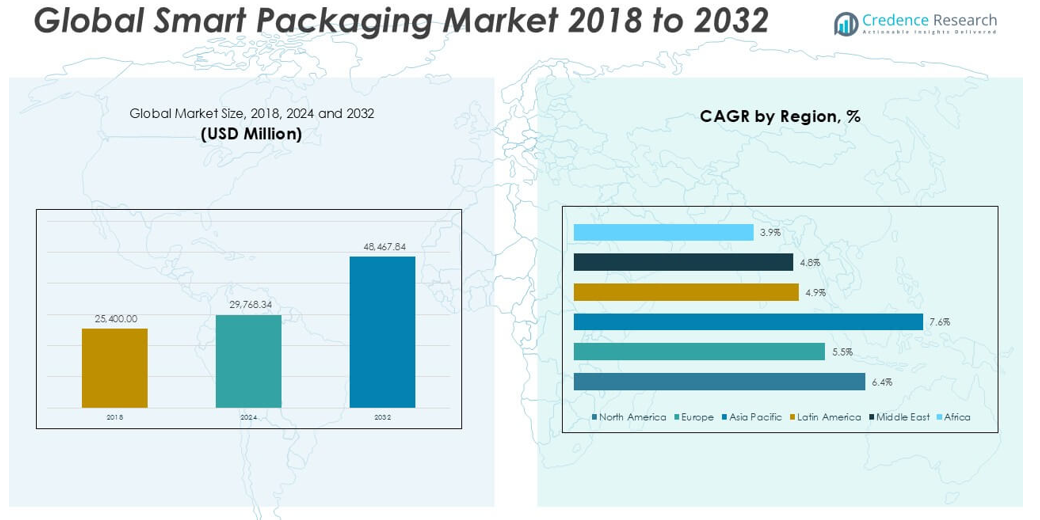
The Smart Packaging market size was valued at USD 25,400.00 million in 2018, reached USD 29,768.34 million in 2024, and is anticipated to reach USD 48,467.84 million by 2032, at a CAGR of 6.31% during the forecast period.
The Smart Packaging market is highly competitive, with key players including Sealed Air Corporation, Multisorb Technologies, Amcor PLC, Ball Corporation, Huhtamaki OYJ, Avery Dennison Corporation, Zebra Technologies Corporation, 3M Company, International Paper Company, Timestrip PLC, Sysco Corporation, Paksense Incorporated, M & G USA Corporation, and BASF SE. These companies focus on technological innovation, product portfolio expansion, and strategic partnerships to strengthen their market positions. North America leads the Smart Packaging market, accounting for 42.41% of the global market share in 2024, driven by strong demand for intelligent and active packaging solutions across the food, pharmaceutical, and logistics sectors. Europe and Asia Pacific follow, supported by rising consumer awareness and increasing adoption in e-commerce and healthcare industries.
Market Insights
- The Smart Packaging market was valued at USD 25,400.00 million in 2018, reached USD 29,768.34 million in 2024, and is projected to reach USD 48,467.84 million by 2032, growing at a CAGR of 6.31% during the forecast period.
- The market is driven by increasing demand for extended shelf life, real-time product monitoring, and safety assurance, particularly in food, beverages, and pharmaceutical sectors.
- Smart packaging trends focus on the growing adoption of intelligent packaging solutions like time-temperature indicators, NFC, and IoT-enabled features, along with a rising preference for sustainable and recyclable materials.
- The competitive landscape is marked by the presence of key players such as Sealed Air Corporation, Amcor PLC, BASF SE, and Zebra Technologies Corporation, who are focusing on innovation, strategic collaborations, and market expansion.
- North America holds the largest regional share at 42.41% in 2024, while food and beverages dominate the application segment due to high demand for freshness and safety
Market Segmentation Analysis:
By Type:
In the Smart Packaging market, Modified Atmosphere Packaging (MAP) holds a significant share due to its strong adoption in extending shelf life and maintaining product quality, especially in the food and beverage sector. Among active packaging types, Gas Scavengers dominate the sub-segment, driven by their critical role in eliminating oxygen and preventing spoilage. Corrosion Control Packaging and Moisture Control Packaging are steadily growing, supported by their increasing demand in electronics and pharmaceuticals for product protection. In the intelligent packaging segment, Time Temperature Indicators (TTI) lead, capturing the largest share as they provide real-time monitoring to ensure temperature-sensitive product safety.
- For instance, Sealed Air’s Cryovac® brand MAP solutions have been implemented in over 2,500 food processing facilities globally, demonstrating the scalability of their technology.
By Application:
Within the Smart Packaging market, Food & Beverages emerge as the dominant application segment, holding the largest market share, supported by rising consumer demand for freshness, safety, and extended shelf life. The Pharmaceuticals segment is also growing rapidly, driven by the need for secure and temperature-controlled packaging for sensitive drugs. Personal Care & Cosmetics leverage smart packaging for product differentiation and anti-counterfeiting solutions. The Electronics segment increasingly adopts moisture and corrosion control packaging to protect delicate components. E-commerce benefits from smart solutions that ensure product integrity during shipping, while other sectors, including industrial and household goods, show steady adoption of smart features.
- For instance, Amcor’s smart pharmaceutical packaging solution for temperature-sensitive drugs has been validated for over 1,500 global cold chain shipments annually, supporting secure drug delivery.
Market Overview
Rising Demand for Extended Shelf Life and Product Safety
The growing focus on product freshness and safety is a major driver for the Smart Packaging market. Industries such as food, beverages, and pharmaceuticals demand packaging solutions that extend shelf life and actively prevent contamination. Smart packaging technologies like modified atmosphere packaging and gas scavengers help maintain product quality during storage and transportation. This rising consumer awareness and stringent safety regulations are accelerating the adoption of smart packaging across multiple sectors, positioning it as a critical solution for reducing waste and enhancing supply chain efficiency.
- For instance, Multisorb Technologies has deployed more than 20 billion gas scavenger units globally, specifically targeting shelf life extension and contamination prevention.
Technological Advancements in Intelligent Packaging
Continuous technological innovation is boosting the Smart Packaging market, particularly in the intelligent packaging segment. Developments in time-temperature indicators, gas indicators, and thermochromic inks are enabling real-time monitoring of product conditions. These advancements offer enhanced traceability, anti-counterfeiting measures, and improved consumer engagement. Companies are increasingly integrating sensors and digital interfaces, driving smart packaging adoption in pharmaceuticals, electronics, and premium consumer goods. The ability to track, monitor, and interact with packaging solutions is transforming supply chains and supporting the growth of smart packaging as a value-added component.
- For instance, Thinfilm Electronics has produced over 50 million NFC tags used in smart packaging to enable real-time consumer interaction and product authentication.
Growth of E-comerce and Global Logistics
The rapid expansion of e-commerce and global trade is significantly driving demand for smart packaging. As supply chains grow more complex, businesses seek packaging solutions that offer real-time tracking, tamper evidence, and product authentication. Smart packaging plays a vital role in ensuring product integrity throughout extended shipping processes, especially for temperature-sensitive and high-value goods. The rising need for secure and reliable delivery in the e-commerce sector has positioned smart packaging as a strategic investment to enhance customer satisfaction and reduce product losses.
Key Trends & Opportunities
Increasing Adoption of Sustainable Smart Packaging Solutions
Sustainability is emerging as a crucial trend in the Smart Packaging market. Companies are developing eco-friendly smart packaging materials and integrating biodegradable components to meet rising consumer and regulatory demands for environmental responsibility. Smart packaging solutions that combine sustainability with advanced functionality present strong growth opportunities, particularly in food, beverages, and cosmetics. The push for reducing plastic waste while maintaining intelligent features is encouraging innovation in recyclable and reusable smart packaging designs.
- For instance, Tetra Pak processed over 32 billion plant-based packages using renewable materials in one year, demonstrating a large-scale commitment to sustainable smart packaging.
Integration of IoT and NFC Technologies
The adoption of Internet of Things (IoT) and Near Field Communication (NFC) technologies is creating new opportunities in the Smart Packaging market. These technologies enable real-time product tracking, consumer interaction, and supply chain transparency. Brands are leveraging NFC-enabled smart packaging to offer personalized consumer experiences and instant product information. The growing preference for connected packaging solutions is driving demand across industries, creating opportunities for smart packaging manufacturers to deliver advanced digital integration and data-driven solutions.
- For instance, Stora Enso has integrated over 10 million RFID and NFC tags in smart packaging solutions for real-time supply chain tracking and product interaction.
Key Challenges
High Initial Costs of Smart Packaging Solutions
The Smart Packaging market faces challenges related to the high initial investment required for advanced packaging technologies. Incorporating intelligent sensors, indicators, and interactive features significantly increases production costs compared to conventional packaging. For small and medium-sized enterprises, these costs can be prohibitive, limiting market penetration. Cost-sensitive industries often hesitate to adopt smart packaging on a large scale, which can slow overall market growth despite its long-term benefits.
Complex Integration with Existing Supply Chains
Integrating smart packaging solutions into existing supply chain systems poses operational challenges. Companies must adapt logistics processes, data management systems, and storage conditions to accommodate smart packaging technologies. Achieving seamless communication between packaging and digital platforms requires specialized infrastructure and technical expertise. These complexities can delay implementation timelines and increase operational costs, especially for companies with legacy systems that lack digital compatibility.
Data Security and Consumer Privacy Concerns
As smart packaging increasingly incorporates digital tracking and consumer interaction features, concerns regarding data security and privacy are intensifying. The collection and transmission of product and consumer data through connected packaging raise potential risks of cyber-attacks and unauthorized access. Companies must ensure robust cybersecurity measures to protect sensitive information, which adds another layer of complexity and cost. Addressing these concerns is critical to building consumer trust and supporting wider adoption of smart packaging technologies.
Regional Analysis
North America
North America led the Smart Packaging market in 2024 with a significant market size of USD 12,628.48 million, accounting for approximately 42.41% of the global share. The region is projected to reach USD 20,649.96 million by 2032, growing at a CAGR of 6.4% during the forecast period. In 2018, the market stood at USD 10,871.20 million. The strong presence of leading packaging companies, advanced retail networks, and rising demand for intelligent packaging in food, beverages, and pharmaceuticals are key drivers supporting market dominance in North America.
Europe
Europe held a substantial share of around 26.76% in the Smart Packaging market in 2024, with a market size of USD 7,971.15 million, up from USD 7,061.20 million in 2018. The market is anticipated to grow at a CAGR of 5.5% and reach USD 12,202.88 million by 2032. The region’s growth is supported by strict food safety regulations, rising demand for sustainable packaging, and increasing adoption of smart solutions in the pharmaceutical and cosmetics industries. Technological advancements and growing consumer awareness are also contributing to the steady expansion across European countries.
Asia Pacific
The Asia Pacific Smart Packaging market accounted for approximately 22.60% of the global share in 2024, with a market size of USD 6,723.06 million, growing from USD 5,461.00 million in 2018. It is projected to reach USD 12,113.02 million by 2032, expanding at the highest CAGR of 7.6% among all regions. Rapid urbanization, the expansion of e-commerce, and increasing demand for packaged food are major growth drivers. The rising middle-class population and growing technological investments in countries like China, Japan, and India further strengthen the region’s market potential.
Latin America
Latin America represented around 3.85% of the Smart Packaging market in 2024, with a market size of USD 1,148.76 million, up from USD 995.68 million in 2018. The market is projected to reach USD 1,675.53 million by 2032, registering a CAGR of 4.9%. Growth in the region is driven by increasing demand for enhanced food safety and shelf-life solutions, especially in Brazil and Mexico. The region’s growing retail sector and gradual technological advancements in smart packaging solutions are expected to offer moderate opportunities for market expansion in the coming years.
Middle East
The Middle East Smart Packaging market held approximately 2.65% share in 2024, with a market size of USD 788.67 million, up from USD 734.06 million in 2018. The market is forecasted to reach USD 1,138.68 million by 2032, expanding at a CAGR of 4.8%. The region is witnessing a steady rise in demand for premium packaging solutions, particularly in the food and personal care sectors. Growing investments in smart logistics and cold chain systems are also supporting market development, although adoption rates remain slower compared to more mature markets.
Africa
Africa accounted for a modest 1.71% of the Smart Packaging market in 2024, with a market size of USD 508.24 million, growing from USD 276.86 million in 2018. The market is expected to reach USD 687.76 million by 2032, registering the lowest CAGR of 3.9% among all regions. Growth in Africa is gradually driven by increasing urbanization, improving retail infrastructure, and rising awareness of food safety. However, limited technological penetration and higher costs of smart packaging solutions may continue to restrain faster adoption across several countries in the region.
Market Segmentations:
By Type:
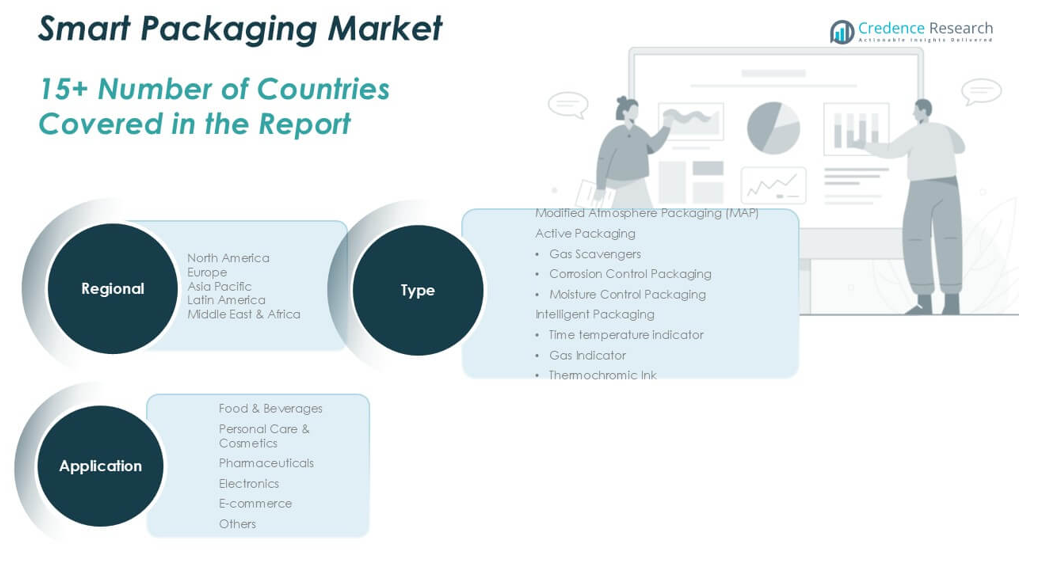
- Modified Atmosphere Packaging (MAP)
- Active Packaging
- Gas Scavengers
- Corrosion Control Packaging
- Moisture Control Packaging
- Intelligent Packaging
- Time Temperature Indicator
- Gas Indicator
- Thermochromic Ink
By Application:
- Food & Beverages
- Personal Care & Cosmetics
- Pharmaceuticals
- Electronics
- E-commerce
- Others
By Geography:
- North America
- U.S.
- Canada
- Mexico
- Europe
- Germany
- France
- U.K.
- Italy
- Spain
- Rest of Europe
- Asia Pacific
- China
- Japan
- India
- South Korea
- South-east Asia
- Rest of Asia Pacific
- Latin America
- Brazil
- Argentina
- Rest of Latin America
- Middle East & Africa
- GCC Countries
- South Africa
- Rest of the Middle East and Africa
Competitive Landscape
The Smart Packaging market is highly competitive, with key players focusing on innovation, product development, and strategic partnerships to strengthen their market presence. Leading companies such as Sealed Air Corporation, Amcor PLC, and BASF SE are investing in advanced technologies like intelligent sensors, moisture control solutions, and eco-friendly materials to meet evolving consumer and regulatory demands. Firms are actively expanding their global footprint through mergers, acquisitions, and collaborations to access new markets and enhance supply chain capabilities. Additionally, companies like Zebra Technologies Corporation and Timestrip PLC are driving growth by offering real-time tracking and time-temperature indicators that improve product safety and traceability. The market also sees consistent investment in sustainable packaging solutions, which is becoming a key differentiator among competitors. Continuous product diversification and a focus on customized smart packaging solutions remain critical strategies to capture consumer interest and maintain a competitive edge in this dynamic market.
Key Player Analysis
- Sealed Air Corporation
- Multisorb Technologies
- Amcor PLC
- Ball Corporation
- Huhtamaki OYJ
- Avery Dennison Corporation
- Zebra Technologies Corporation
- 3M Company
- International Paper Company
- Timestrip PLC
- Sysco Corporation
- Paksense Incorporated
- M & G USA Corporation
- BASF SE
Recent Developments
- In June 2024, Myprotein, a significant online sports nutrition brand in India, strengthened its dedication to the Indian market. It announced a pioneering feature, the 'Authentication QR Code,' empowering consumers to validate their purchases swiftly. This QR code grants access to crucial details like authenticity, country of origin, expiration date, and batch number.
- In November 2023, Smurfit Kappa launched its new Supply Smart digital solution, which helps businesses intelligently adapt their packaging to increase efficiency and reduce emissions across their supply chains.
- In October 2023, Appetite Creative, a digital technology studio, partnered with Tetra Pak, a packaging company, to introduce innovative interactive smart packaging for Rauch, a European fruit juice producer. This smart packaging was designed to complement Rauch's winter drink theme.
- In September 2023, Jus de Fruits Caraïbes and Tetra Pak partnered to build an interactive connected experience in packaging. The connected experience aims at increasing awareness related to sustainability and helping customers to understand the recycling of beverage cartons.
- In September 2023, Bastille Parfums, a French company specializing in sustainable and natural fragrances, partnered with Avery Dennison to combine Avery Dennison’s RFID (radio frequency identification) sensor technology to track and trace tagged products across Bastille’s entire supply chain, improve inventory management and mitigate counterfeit products.
Market Concentration & Characteristics
The Smart Packaging Market demonstrates moderate concentration with the presence of several global and regional players competing on technology, product differentiation, and sustainability. It is characterized by continuous innovation, strong demand for intelligent and active packaging solutions, and increasing integration of digital features such as sensors and NFC technology. The market shows a balanced mix of established companies and emerging entrants, where large players like Sealed Air Corporation, Amcor PLC, and BASF SE maintain a competitive edge through advanced product portfolios and global distribution networks. It serves diverse industries including food and beverages, pharmaceuticals, electronics, and personal care, each driving unique packaging needs. The Smart Packaging Market evolves quickly due to consumer preferences for safety, convenience, and real-time product tracking. It faces pricing pressures and varying regulatory frameworks across regions, requiring companies to adapt their strategies to remain competitive. Demand for sustainable and recyclable materials shapes product development and purchasing decisions across key markets. The market shows a strong inclination towards smart solutions that offer product protection, reduce waste, and improve supply chain visibility. Companies actively invest in research and strategic partnerships to strengthen market presence and address evolving customer expectations.
Report Coverage
The research report offers an in-depth analysis based on Type, Application and Geography. It details leading market players, providing an overview of their business, product offerings, investments, revenue streams, and key applications. Additionally, the report includes insights into the competitive environment, SWOT analysis, current market trends, as well as the primary drivers and constraints. Furthermore, it discusses various factors that have driven market expansion in recent years. The report also explores market dynamics, regulatory scenarios, and technological advancements that are shaping the industry. It assesses the impact of external factors and global economic changes on market growth. Lastly, it provides strategic recommendations for new entrants and established companies to navigate the complexities of the market.
Future Outlook
- The Smart Packaging market is expected to grow steadily due to increasing demand for extended shelf life and enhanced product safety.
- Companies will continue to invest in intelligent packaging technologies to offer real-time tracking and condition monitoring.
- The adoption of sustainable and recyclable smart packaging materials will increase to meet environmental regulations.
- E-commerce growth will drive the demand for smart packaging solutions that ensure product integrity during transit.
- Pharmaceutical and healthcare sectors will expand their use of smart packaging for temperature-sensitive and high-value products.
- Integration of IoT and NFC technologies in smart packaging will improve supply chain visibility and consumer engagement.
- Asia Pacific will witness strong market growth due to rising urbanization and increasing packaged food consumption.
- Active packaging solutions like gas scavengers and moisture control systems will gain more traction across industries.
- Companies will focus on developing cost-effective smart packaging to improve accessibility for small and medium enterprises.
- Data security and consumer privacy management will become more important as digital features in smart packaging expand.

Request a Free Sample
Fill in your details and we'll send you a free sample report.
- Sample data tables & charts
- Research methodology
Market Dynamics
Demand for Extended Shelf Life and Product Safety
Industries such as food, beverages, and pharmaceuticals are increasingly adopting smart packaging solutions like MAP and gas scavengers to extend shelf life and prevent contamination, directly addressing consumer and regulatory demands for freshness and safety.
Technological Advancements in Intelligent Packaging
Continuous innovation in time-temperature indicators, NFC, and IoT-enabled features is enabling real-time product monitoring, traceability, and anti-counterfeiting, which enhances supply chain transparency and consumer trust.
Growth of E-commerce and Global Logistics
The expansion of e-commerce and complex global supply chains is driving the need for smart packaging that offers real-time tracking, tamper evidence, and product authentication, ensuring product integrity during transit and reducing losses.
Rising Adoption of Sustainable Packaging Solutions
Increasing regulatory and consumer pressure for environmental responsibility is pushing companies to develop recyclable, biodegradable, and plant-based smart packaging materials, combining sustainability with advanced functionality.
Integration of IoT and NFC Technologies
Brands are leveraging IoT and NFC-enabled smart packaging to provide interactive consumer experiences, instant product information, and enhanced supply chain visibility, creating new value propositions and differentiation in the market.
Need a Custom Version of This Report?
Tailor the scope, geography, or segments to your exact requirements.
- Custom geography or segment scope
- Direct access to our analyst team
Frequently Asked Questions
What is the current size of the Smart Packaging Market?
What are the key segments within the Smart Packaging Market?
What are some challenges faced by the Smart Packaging Market?
Who are the major players in the Smart Packaging Market?
Table of Content
Chapter 1 Market Segmentation
- 1.1 Segmentation Framework
- 1.1.1 Product and Service Classification
- 1.1.2 Application and End-Use Classification
- 1.1.3 Technology and Solution Classification
- 1.1.4 Customer and Distribution Channel Classification
- 1.1.5 Geographic Segmentation
- 1.1.6 Market Segment Definitions and Boundaries
- 1.2 By Type
- 1.2.1 Modified Atmosphere Packaging (MAP)
- 1.2.2 Active Packaging
- 1.2.3 Intelligent Packaging
- 1.3 By Application
- 1.3.1 Food & Beverages
- 1.3.2 Pharmaceuticals
- 1.3.3 Personal Care & Cosmetics
- 1.3.4 Electronics
- 1.3.5 E-commerce
- 1.3.6 Others
- 1.4 By Active Packaging Subtype
- 1.4.1 Gas Scavengers
- 1.4.2 Corrosion Control Packaging
- 1.4.3 Moisture Control Packaging
- 1.5 By Intelligent Packaging Subtype
- 1.5.1 Time Temperature Indicator
- 1.5.2 Gas Indicator
- 1.5.3 Thermochromic Ink
Chapter 2 Introduction
- 2.1 Report Objectives and Scope
- 2.2 Product Definition and Industry Terminology
- 2.3 Market Inclusions and Exclusions
- 2.4 Research Process
- 2.4.1 Primary Research and Expert Interviews
- 2.4.2 Secondary Research and Source Review
- 2.4.3 Top-Down and Bottom-Up Estimation
- 2.4.4 Data Triangulation and Verification
- 2.5 Market Size Measurement Basis
- 2.5.1 2024: USD 29,768.34 million → 2032: USD 48,467.84 million
- 2.6 Historical and Forecast Reference Periods
- 2.6.1 Base Year: 2024
- 2.6.2 Forecast Period: 2024-2032
- 2.7 Research Assumptions and Limitations
Chapter 3 Executive Summary
- 3.1 Market Snapshot and Key Findings
- 3.2 Base-Year Market Size, 2024
- 3.3 Forecast Market Size, 2032
- 3.4 Revenue and Volume Growth Outlook
- 3.5 Key Demand and Supply Indicators
- 3.6 Leading Market Segments
- 3.7 Fastest-Growing Market Opportunities
- 3.8 Regional Performance Highlights
- 3.9 Technology and Industry Transformation
- 3.10 Competitive Landscape Summary
- 3.11 Analyst View and Strategic Implications
Chapter 4 Global Smart Packaging Market Trends and Developments
- 4.1 Historical Industry Development
- 4.2 Recent Market Trends and Developments
- 4.3 Demand and Customer Behavior Trends
- 4.4 Technology and Product Innovation
- 4.5 Artificial Intelligence, Automation and Digitalization
- 4.6 Local Manufacturing and Supply Chain Realignment
- 4.7 Industry Partnerships, Mergers and Acquisitions
- 4.8 Sustainability and Circular Economy Developments
- 4.9 Government and Private Sector Investment Trends
- 4.10 Emerging Business Models and Commercialization
- 4.11 Industry Developments and Announcements
Chapter 5 Global Smart Packaging Market Production, Supply and Demand Analysis
- 5.1 Demand Trend and Consumption Analysis
- 5.2 Demand Forecast, 2024-2032
- 5.3 Production and Output Trend
- 5.4 Production and Output Forecast, 2024-2032
- 5.5 Installed Capacity and Capacity Utilization
- 5.6 Company-Wise Production Plants and Statistics
- 5.6.1 Installed Production Capacity
- 5.6.2 Actual Production
- 5.6.3 Planned Capacity and Expansion Targets
- 5.7 Supply Chain Structure and Procurement Trends
- 5.8 Supply-Demand Gap and Bottlenecks
- 5.9 Import Dependence and Sourcing Structure
- 5.10 Contract Manufacturing and Outsourcing
- 5.11 Regional Supply and Demand Concentration
Chapter 6 Global Smart Packaging Market Pricing Analysis
- 6.1 Pricing Structure and Measurement
- 6.2 Historical Pricing Trends
- 6.3 Pricing Outlook, 2024-2032
- 6.4 Average Selling Price and Unit Economics
- 6.5 Pricing by Product and Market Segment
- 6.6 Geographic Pricing Differences
- 6.7 Key Input, Energy, Labor and Logistics Costs
- 6.8 Contract Pricing and Purchasing Models
- 6.9 Pricing Sensitivity and Competitive Positioning
- 6.10 Price, Margin and Profitability Implications
Chapter 7 Global Smart Packaging Market Dynamics
- 7.1 Market Growth Drivers
- 7.1.1 Demand-Side Drivers
- 7.1.2 Technology and Innovation Drivers
- 7.1.3 Infrastructure and Investment Drivers
- 7.1.4 Regulatory and Policy Drivers
- 7.2 Market Restraints
- 7.2.1 Cost and Affordability Constraints
- 7.2.2 Technology and Adoption Barriers
- 7.2.3 Supply Chain and Operational Constraints
- 7.3 Market Challenges
- 7.3.1 Competitive Pressure and Margin Erosion
- 7.3.2 Skills, Infrastructure and Implementation Gaps
- 7.4 Emerging Market Opportunities
- 7.5 Market Dynamics Impact and Time-Horizon Assessment
Chapter 8 Global Smart Packaging Value Chain Analysis
- 8.1 Industry Value Chain Overview
- 8.2 Upstream Suppliers and Critical Inputs
- 8.3 Technology and Component Providers
- 8.4 Manufacturing or Service Delivery
- 8.5 Distribution, Channel Partners and Integrators
- 8.6 Downstream Applications and End Users
- 8.7 Value Addition and Profit Pools
- 8.8 Vertical Integration and Outsourcing
- 8.9 Supplier Concentration and Risk
- 8.10 Supply Chain Localization and Resilience
Chapter 9 Global Smart Packaging Market Regulations and Policies
- 9.1 Relevant Laws, Standards and Compliance Frameworks
- 9.2 Product, Service, Safety and Quality Requirements
- 9.3 Government Policies, Incentives and Subsidies
- 9.4 Imports, Exports and Trade Barriers
- 9.5 Public Procurement and Local Content Requirements
- 9.6 Environmental and Sustainability Compliance
- 9.7 Upcoming Policy Changes and Market Implications
Chapter 10 Global Smart Packaging Market Hotspots and Opportunities
- 10.1 Market Opportunity Mapping and Growth Hotspots
- 10.2 High-Growth Applications and Customer Groups
- 10.3 Underserved Markets and White-Space Opportunities
- 10.4 Emerging Technology and Product Opportunities
- 10.5 New Capacity and Investment Hotspots
- 10.6 Market Entry and Expansion Opportunities
- 10.7 Distribution and Partnership Opportunities
- 10.8 Near-Term and Long-Term Commercial Potential
- 10.9 Opportunity Attractiveness and Execution Risks
Chapter 11 Global Smart Packaging Market Outlook, 2024-2032
- 11.1 Market Size and Analysis
- 11.1.1 Revenue (Market Measurement: 2024: USD 29,768.34 million → 2032: USD 48,467.84 million)
- 11.1.2 Market Volume and Quantity Sold
- 11.1.3 Historical Market Size
- 11.1.4 Base-Year Market Size, 2024
- 11.2 Market Forecast, 2024-2032
- 11.2.1 Revenue Forecast to 2032
- 11.2.2 Volume Forecast to 2032
- 11.2.3 CAGR and Year-on-Year Growth
- 11.2.4 Incremental Revenue Opportunity
- 11.3 Forecast Assumptions and Scenario Analysis
- 11.3.1 Base-Case Forecast
- 11.3.2 Optimistic and Conservative Scenarios
- 11.3.3 Technology, Pricing and Policy Sensitivities
- 11.4 Market Attractiveness and Growth Outlook
Chapter 12 Global Smart Packaging Market Segmentation and Outlook
- 12.1 Segmentation Summary and Market Shares, 2024
- 12.2 Largest and Fastest-Growing Segments
- 12.3 By Type - Market Size and Forecast, 2024-2032
- 12.3.1 Segment Definition and Scope
- 12.3.2 Historical Market Size
- 12.3.3 Revenue Forecast, 2024-2032
- 12.3.4 Volume Forecast, 2024-2032
- 12.3.5 Base-Year Market Share, 2024
- 12.3.6 Segment CAGR and Growth Drivers
- 12.3.7 Subsegment Market Size and Forecast
- 12.3.7.1 Modified Atmosphere Packaging (MAP)
- 12.3.7.2 Active Packaging
- 12.3.7.3 Intelligent Packaging
- 12.3.8 Subsegment Pricing and Adoption Trends
- 12.3.9 Leading Suppliers and Competition
- 12.3.10 Regional Demand and Opportunities
- 12.4 By Application - Market Size and Forecast, 2024-2032
- 12.4.1 Segment Definition and Scope
- 12.4.2 Historical Market Size
- 12.4.3 Revenue Forecast, 2024-2032
- 12.4.4 Volume Forecast, 2024-2032
- 12.4.5 Base-Year Market Share, 2024
- 12.4.6 Segment CAGR and Growth Drivers
- 12.4.7 Subsegment Market Size and Forecast
- 12.4.7.1 Food & Beverages
- 12.4.7.2 Pharmaceuticals
- 12.4.7.3 Personal Care & Cosmetics
- 12.4.7.4 Electronics
- 12.4.7.5 E-commerce
- 12.4.7.6 Others
- 12.4.8 Subsegment Pricing and Adoption Trends
- 12.4.9 Leading Suppliers and Competition
- 12.4.10 Regional Demand and Opportunities
- 12.5 By Active Packaging Subtype - Market Size and Forecast, 2024-2032
- 12.5.1 Segment Definition and Scope
- 12.5.2 Historical Market Size
- 12.5.3 Revenue Forecast, 2024-2032
- 12.5.4 Volume Forecast, 2024-2032
- 12.5.5 Base-Year Market Share, 2024
- 12.5.6 Segment CAGR and Growth Drivers
- 12.5.7 Subsegment Market Size and Forecast
- 12.5.7.1 Gas Scavengers
- 12.5.7.2 Corrosion Control Packaging
- 12.5.7.3 Moisture Control Packaging
- 12.5.8 Subsegment Pricing and Adoption Trends
- 12.5.9 Leading Suppliers and Competition
- 12.5.10 Regional Demand and Opportunities
- 12.6 By Intelligent Packaging Subtype - Market Size and Forecast, 2024-2032
- 12.6.1 Segment Definition and Scope
- 12.6.2 Historical Market Size
- 12.6.3 Revenue Forecast, 2024-2032
- 12.6.4 Volume Forecast, 2024-2032
- 12.6.5 Base-Year Market Share, 2024
- 12.6.6 Segment CAGR and Growth Drivers
- 12.6.7 Subsegment Market Size and Forecast
- 12.6.7.1 Time Temperature Indicator
- 12.6.7.2 Gas Indicator
- 12.6.7.3 Thermochromic Ink
- 12.6.8 Subsegment Pricing and Adoption Trends
- 12.6.9 Leading Suppliers and Competition
- 12.6.10 Regional Demand and Opportunities
- 12.7 Segment Growth Comparison
- 12.8 Segment Attractiveness and Priority Matrix
Chapter 13 Global Smart Packaging End-Use and Application Market Outlook
- 13.1 End-Use Industry and Customer Demand Structure
- 13.2 Leading Applications and Customer Groups
- 13.3 End-Use Market Size, Share and Forecast
- 13.4 Major End-Use Industry Deep Dives
- 13.4.1 Customer Requirements and Use Cases
- 13.4.2 Demand and Replacement Cycles
- 13.4.3 Technical and Regulatory Considerations
- 13.4.4 Purchasing and Procurement Models
- 13.4.5 Leading Vendors and Distribution Channels
- 13.4.6 Forecast and Commercial Opportunities
- 13.5 Emerging Applications and Cross-Segment Demand
- 13.6 End-Use Industry Investment Priorities
Chapter 14 Global Smart Packaging Geographic Market Outlook, 2024-2032
- 14.1 Regional Market Size and Share, 2024
- 14.2 Regional Market Forecast, 2024-2032
- 14.3 Regional Pricing, Production and Demand Differences
- 14.4 North America
- 14.4.1 United States
- 14.4.2 Canada
- 14.4.3 Mexico
- 14.5 Europe
- 14.5.1 Germany
- 14.5.2 France
- 14.5.3 Italy
- 14.5.4 United Kingdom
- 14.5.5 Spain
- 14.5.6 Poland
- 14.5.7 Russia
- 14.5.8 Netherlands
- 14.5.9 Belgium
- 14.5.10 Sweden
- 14.5.11 Denmark
- 14.5.12 Norway
- 14.5.13 Rest of Europe
- 14.6 Asia Pacific
- 14.6.1 China
- 14.6.2 India
- 14.6.3 Japan
- 14.6.4 South Korea
- 14.6.5 Thailand
- 14.6.6 Indonesia
- 14.6.7 Vietnam
- 14.6.8 Malaysia
- 14.6.9 Australia
- 14.6.10 Rest of Asia Pacific
- 14.7 Latin America
- 14.7.1 Brazil
- 14.7.2 Argentina
- 14.7.3 Colombia
- 14.7.4 Chile
- 14.7.5 Rest of Latin America
- 14.8 Middle East
- 14.8.1 Saudi Arabia
- 14.8.2 United Arab Emirates
- 14.8.3 Turkey
- 14.8.4 Israel
- 14.8.5 Iran
- 14.8.6 Rest of the Middle East
- 14.9 Africa
- 14.9.1 South Africa
- 14.9.2 Egypt
- 14.9.3 Nigeria
- 14.9.4 Morocco
- 14.9.5 Rest of Africa
- 14.10 Regional Investment, Policy and Supply Chain Differences
- 14.11 Regional Competitive Landscape
- 14.12 Geographic Growth Hotspots
Chapter 15 Global Smart Packaging Technology, Innovation and Sustainability Outlook
- 15.1 Technology Landscape and Maturity
- 15.2 Product, Process and Service Innovation
- 15.3 AI, Automation and Digital Tools in the Industry
- 15.4 Technology Adoption and Performance Benchmarking
- 15.5 Innovation Pipeline and R&D Investment
- 15.6 Patent and Intellectual Property Trends
- 15.7 Energy Efficiency and Resource Management
- 15.8 Sustainability, Recycling and Circularity
- 15.9 Technology Roadmap, 2024-2032
- 15.10 Risks of Obsolescence and Technology Substitution
Chapter 16 Global Smart Packaging Market Key Strategic Imperatives
- 16.1 Growth and Market Entry Priorities
- 16.2 High-Return Products and Segments
- 16.3 Pricing, Profitability and Cost Optimization
- 16.4 Technology Investment and Product Differentiation
- 16.5 Supply Chain Localization and Resilience
- 16.6 Distribution and Customer Acquisition
- 16.7 Partnership, Acquisition and Capacity Strategy
- 16.8 Regional Expansion Priorities
- 16.9 Short-, Medium- and Long-Term Actions
Chapter 17 Competition Outlook
- 17.1 Industry Competition Characteristics
- 17.2 Market Structure and Concentration
- 17.3 Market Share and Competitive Positioning, 2024
- 17.4 Company-Wise Revenue and Product Benchmarking
- 17.5 Production and Service Capacity Benchmarking
- 17.6 Technology, Pricing and Differentiation
- 17.7 Regional Footprint and Distribution Strength
- 17.8 Mergers, Acquisitions and Strategic Alliances
- 17.9 New Entrants and Competitive Threats
- 17.10 Porter's Five Forces and Industry Attractiveness
- 17.11 Competitive Outlook, 2024-2032
Chapter 18 Company Profiles
- 18.1 Company Coverage and Selection Criteria
- 18.2 Sealed Air Corporation
- 18.2.1 Business Description
- 18.2.2 Company Ownership and Geographic Presence
- 18.2.3 Product and Service Portfolio
- 18.2.4 Manufacturing and Operating Footprint
- 18.2.5 Production Capacity and Expansion Plans
- 18.2.6 Financial Performance and Investment
- 18.2.7 Market Share and Competitive Position
- 18.2.8 Technology and Innovation Capabilities
- 18.2.9 Strategic Alliances or Partnerships
- 18.2.10 Recent Developments
- 18.2.11 Growth Strategy and Outlook
- 18.3 Amcor PLC
- 18.4 BASF SE
- 18.5 Zebra Technologies Corporation
- 18.6 Avery Dennison Corporation
- 18.7 Huhtamaki OYJ
- 18.8 Ball Corporation
- 18.9 Multisorb Technologies
- 18.10 3M Company
- 18.11 Timestrip PLC
- 18.12 Other Relevant Market Participants
Note: Every listed company is profiled on the structure shown under the first company. The company list is preliminary and may change based on research findings, market developments, data availability and client requirements.
Chapter 19 Disclaimer
- 19.1 Research and Forecast Disclaimer
- 19.2 Data Source and Estimation Limitations
Note: The depth of individual sections depends on data availability for this market. Volume, capacity, trade and other unit-based metrics are included where applicable.