
Market Overview:
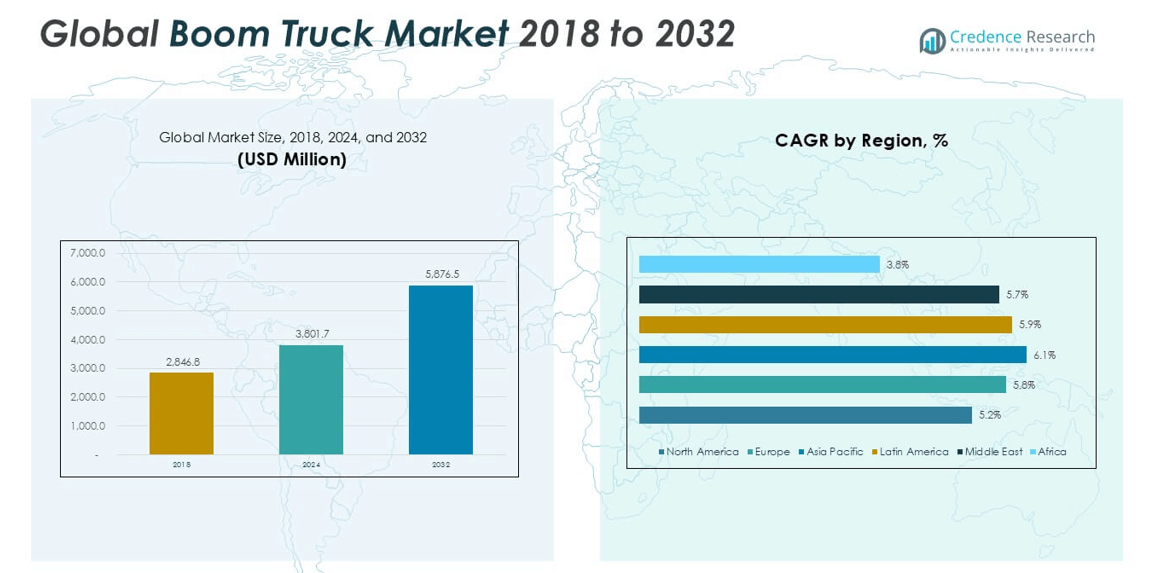
The Boom Truck market size was valued at USD 2,846.8 million in 2018, increased to USD 3,801.7 million in 2024, and is anticipated to reach USD 5,876.5 million by 2032, growing at a CAGR of 5.65% during the forecast period.
| REPORT ATTRIBUTE | DETAILS |
|---|---|
| Historical Period | 2020-2023 |
| Base Year | 2024 |
| Forecast Period | 2025-2032 |
| Boom Truck Market Size 2024 | USD 3,801.7 million |
| Boom Truck Market, CAGR | 5.65% |
| Boom Truck Market Size 2032 | USD 5,876.5 million |
The Boom Truck market is led by prominent players such as Manitex International, Terex Corporation, Altec Inc., Elliott Equipment Company, and Tadano Ltd., all of which maintain a strong global presence through diversified product portfolios and advanced lifting technologies. These companies focus on continuous innovation, strategic partnerships, and expanding service networks to strengthen their market positions. North America emerged as the leading region, accounting for 31.4% of the global market share in 2024, driven by robust infrastructure development, a mature utility sector, and widespread adoption of technologically advanced boom trucks.
Market Insights
- The Boom Truck market was valued at USD 3,801.7 million in 2024 and is projected to reach USD 5,876.5 million by 2032, growing at a CAGR of 5.65% during the forecast period.
- Market growth is primarily driven by increasing demand from the construction, utilities, and logistics sectors, along with growing infrastructure development in emerging economies.
- Trends such as the adoption of GPS-enabled boom trucks and the shift toward electric and hybrid models are reshaping the market landscape with a focus on efficiency and sustainability.
- Key players like Manitex International, Terex Corporation, and Altec Inc. dominate the competitive landscape through innovation, product expansion, and rental service integration, while high capital costs and operator shortages act as major restraints.
- North America leads the regional market with a 31.4% share, followed by Europe (26.5%) and Asia Pacific (23.3%); by product, suitcases dominate due to their organized storage capabilities in boom truck applications.
Market Segmentation Analysis:
By Product
In the Boom Truck market, suitcases represent the dominant product segment, accounting for the largest market share due to their widespread use in commercial and industrial applications where heavy lifting and structured storage are essential. These boom truck-mounted suitcases are often customized for equipment transportation, making them a preferred choice for sectors such as utilities, construction, and logistics. The increasing demand for organized cargo solutions and easy accessibility during operations continues to fuel the adoption of suitcases. Backpacks and other storage variants hold a comparatively smaller share, serving niche and mobile utility needs.
- For instance, Manitex International introduced its TC45127 boom truck, featuring a 45-ton lifting capacity and a 127-foot five-section boom, designed to enhance lifting in utility and construction applications where specialized tool compartments (suitcase designs) are integrated into the truck body.
By Luggage Connectivity
Among the connectivity segments, GPS-enabled boom truck solutions dominate the market, driven by their advanced tracking and fleet management capabilities. GPS integration allows real-time location monitoring, route optimization, and efficient dispatching, making it crucial for industries focusing on operational efficiency and safety compliance. This segment holds the highest revenue and volume share. Wi-Fi and Bluetooth connectivity also find applications, primarily in remote diagnostics and short-range communication, but they trail behind GPS in terms of overall market adoption due to limited range and functionality in expansive outdoor operations.
- For instance, Terex Utilities deployed HyPower™ IM, an intelligent system enabling GPS fleet tracking and real-time load data, which allows utilities to remotely monitor fleet health and positioning with 90% diagnostic coverage across fleet units, significantly reducing unplanned downtime.
By Distribution Channel
Specialty stores lead the distribution channel segment in the Boom Truck market, holding the highest market share due to their focused inventory, expert sales personnel, and after-sales support tailored to commercial customers. These stores are preferred by businesses seeking specific configurations and technical assistance. Online stores are gaining momentum, especially among small and mid-sized enterprises, offering convenience and broader access to models. Brand stores and other retail formats contribute moderately, serving as supplementary sales avenues that cater to both brand-loyal customers and localized demand.
Market Overview
Rising Demand from Construction and Utility Sectors
The growing investment in infrastructure development and utility maintenance activities has significantly boosted demand for boom trucks. These vehicles provide versatile lifting capabilities and efficient material handling, making them essential in construction, electrical grid repair, and telecom installation. Rapid urbanization and government-backed projects in emerging economies are further fueling market expansion. Additionally, boom trucks are increasingly preferred for their ability to operate in constrained spaces, reducing labor intensity and enhancing on-site productivity.
- For instance, Elliott Equipment Company delivered its E160 aerial work platform, supporting 160 feet of working height and a 1,200 lb material handling capacity, which is now used in over 300 telecom tower projects across North America for efficient infrastructure upgrades.
Advancements in Boom Truck Design and Technology
Technological innovation is a major growth catalyst in the boom truck market. Manufacturers are integrating features such as GPS tracking, remote operation, load monitoring systems, and enhanced hydraulic controls, improving safety and operational efficiency. These advancements cater to customer demand for precision and reduced downtime. The development of lightweight yet robust materials has also allowed for increased payload capacity without compromising vehicle performance, supporting the growing demand across diverse industries, including oil & gas, tree care, and signage.
- For instance, Altec Inc. launched its LR7 Series, which incorporates load-sensing hydraulics and fiber-reinforced polymer boom sections, enabling a 14% reduction in total weight and a 25% increase in lifting performance compared to previous models.
Expansion of E-commerce and Logistics Infrastructure
Boom trucks are playing a growing role in supporting logistics operations, particularly in loading and unloading heavy cargo. The surge in e-commerce has necessitated the expansion of warehouses and last-mile delivery hubs, where boom trucks assist in handling storage racks, HVAC units, and construction materials. As logistics companies prioritize speed and automation, the deployment of multipurpose lifting equipment like boom trucks is becoming increasingly common. This trend is especially prominent in regions undergoing rapid industrial and commercial development.
Key Trends and Opportunities
Shift Toward Electrification and Hybrid Boom Trucks
Sustainability trends are encouraging manufacturers to develop electric and hybrid boom trucks to reduce emissions and meet evolving regulatory standards. This shift not only helps companies align with environmental goals but also offers operational benefits such as reduced fuel costs and lower noise pollution. As more municipalities and companies adopt green initiatives, the market for eco-friendly boom trucks presents a significant growth opportunity, particularly in urban applications like utility maintenance and tree trimming.
- For instance, Versalift introduced the VST-52-MHI, an all-electric boom truck with a zero-emissions aerial lift system and a battery range of 90 miles, already deployed in over 120 urban utility fleets across the U.S., reducing fuel usage by over 3,000 gallons annually per unit.
Growing Rental and Leasing Market
The high upfront cost of boom trucks has accelerated the demand for rental and leasing services, especially among small and medium enterprises (SMEs). Renting allows businesses to access modern, well-maintained equipment without capital expenditure, increasing operational flexibility. Equipment rental companies are expanding their boom truck fleets to meet demand, creating a parallel service market. This trend is expected to grow further as project-based work and short-term contracts increase in construction and industrial sectors.
- For instance, United Rentals added over 450 new boom trucks to its North American fleet in 2023, with an average utilization rate of 78% across regional branches, enabling project-based contractors to reduce upfront acquisition costs by over USD 220,000 per unit.
Key Challenges
High Initial Investment and Maintenance Costs
Boom trucks require substantial capital investment, which can be a barrier for smaller businesses. In addition to the high purchase cost, ongoing maintenance, inspection, and repair expenses contribute to the total cost of ownership. Specialized training for operators and adherence to regulatory safety standards further increase operational costs. These financial constraints may delay adoption or force companies to opt for second-hand or rented equipment, thereby impacting new sales volumes.
Regulatory Compliance and Safety Concerns
Strict regulatory standards around boom truck operation, emissions, and workplace safety can hinder market growth. Compliance with OSHA and other regional safety guidelines necessitates frequent inspections, certified training, and equipment modifications. Non-compliance can result in legal liabilities and operational downtime. Additionally, accidents involving improper usage or equipment failure can tarnish the reputation of manufacturers and limit user confidence, especially in industries like construction where safety is paramount.
Limited Skilled Workforce for Operation
Operating boom trucks requires trained personnel, and the industry is facing a shortage of skilled operators. This gap limits the effective utilization of advanced boom trucks and increases the risk of accidents due to improper handling. Training programs are either unavailable or costly in several regions, particularly in developing economies. The lack of skilled labor may deter companies from investing in modern boom truck models, ultimately restricting market penetration.
Regional Analysis
North America
North America held the largest share of the global Boom Truck market in 2024, accounting for approximately 31.4% of the total market. Valued at USD 914.10 million in 2018, the regional market grew to USD 1,193.67 million in 2024 and is projected to reach USD 1,789.40 million by 2032, expanding at a CAGR of 5.2% during the forecast period. The region's dominance is driven by robust infrastructure development, high demand from utility and telecom sectors, and a mature construction industry. The presence of key manufacturers and advanced technology adoption further boost market growth across the U.S. and Canada.
Europe
Europe captured approximately 26.5% of the Boom Truck market in 2024, supported by increasing investments in renewable energy and transportation infrastructure. The market was valued at USD 749.27 million in 2018, reached USD 1,008.09 million in 2024, and is expected to grow to USD 1,573.73 million by 2032, registering a CAGR of 5.8%. Countries such as Germany, France, and the UK are key contributors, with demand stemming from utility maintenance, public infrastructure projects, and the telecom industry. Strict emission regulations are also prompting the adoption of technologically advanced and energy-efficient boom trucks across the region.
Asia Pacific
Asia Pacific accounted for about 23.3% of the global Boom Truck market in 2024 and is poised to become one of the fastest-growing regions with a CAGR of 6.1% through 2032. Valued at USD 645.37 million in 2018, the regional market reached USD 885.30 million in 2024 and is projected to rise to USD 1,416.83 million by 2032. Rapid urbanization, government-backed infrastructure projects, and increasing industrial activities in China, India, and Southeast Asia are driving demand. Additionally, growing investments in the construction and energy sectors are encouraging adoption of boom trucks to enhance operational efficiency.
Latin America
Latin America held a 10.8% market share in 2024, with its Boom Truck market valued at USD 303.75 million in 2018 and increasing to USD 411.01 million in 2024. The market is anticipated to reach USD 646.42 million by 2032, growing at a CAGR of 5.9%. Growth is largely fueled by infrastructure modernization and rising demand for utility services in countries such as Brazil, Mexico, and Argentina. The need for lifting equipment in urban development projects and the expansion of power grids and communication networks are also major contributors to the region’s market expansion.
Middle East
The Middle East Boom Truck market accounted for approximately 5.4% of the global share in 2024. It was valued at USD 153.73 million in 2018, reached USD 205.62 million in 2024, and is forecasted to grow to USD 318.51 million by 2032, at a CAGR of 5.7%. Infrastructure development in the UAE, Saudi Arabia, and Qatar, especially around smart city and energy sector projects, is a key driver. The rising need for efficient heavy-lifting equipment in oil & gas and construction further supports regional market growth, alongside a growing shift toward technologically integrated machinery.
Africa
Africa represented the smallest regional share in 2024, accounting for 2.6% of the global Boom Truck market. The market was valued at USD 80.56 million in 2018, reached USD 97.97 million in 2024, and is expected to grow to USD 131.63 million by 2032, registering a CAGR of 3.8%. While the market is in a nascent stage, gradual growth in public infrastructure, mining, and energy projects is creating demand for boom trucks. Limited industrialization and a lack of skilled operators pose challenges, but increasing foreign investment in infrastructure development could unlock long-term opportunities in the region.
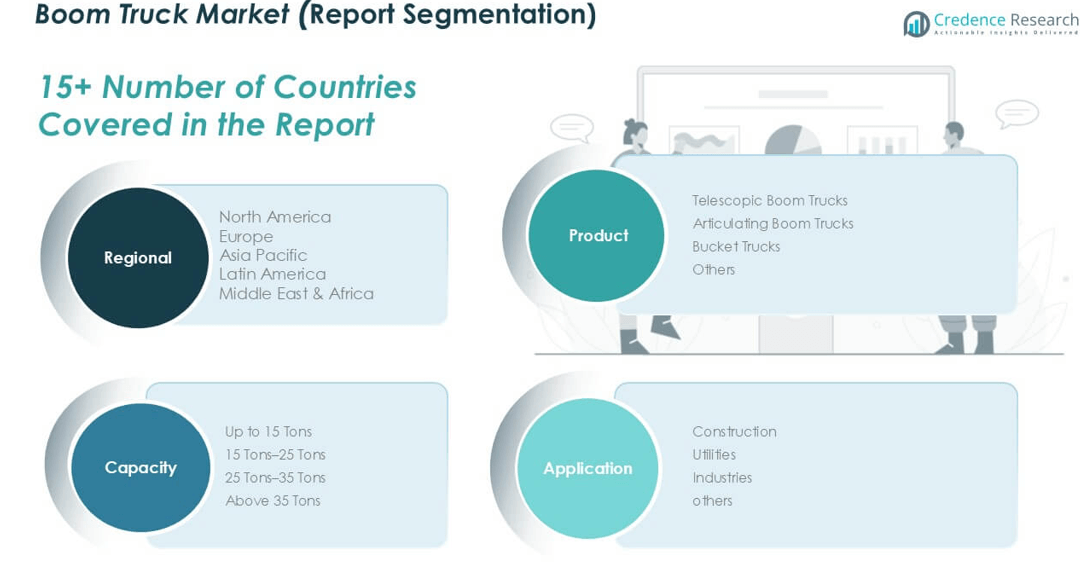
Market Segmentations:
By Product
- Suitcases
- Backpacks
- Others
By Luggage Connectivity
- GPS
- Wi-Fi
- Bluetooth
By Distribution Channel
- Specialty Stores
- Online Stores
- Brand Stores
- Others
By Geography
- North America
- U.S.
- Canada
- Mexico
- Europe
- Germany
- France
- U.K.
- Italy
- Spain
- Rest of Europe
- Asia Pacific
- China
- Japan
- India
- South Korea
- South-east Asia
- Rest of Asia Pacific
- Latin America
- Brazil
- Argentina
- Rest of Latin America
- Middle East & Africa
- GCC Countries
- South Africa
- Rest of the Middle East and Africa
Competitive Landscape
The Boom Truck market features a moderately consolidated competitive landscape, with a mix of established players and emerging manufacturers vying for market share. Key companies such as Manitex International, Terex Corporation, Altec Inc., and Elliott Equipment Company dominate the industry, leveraging their extensive distribution networks, advanced product portfolios, and long-standing customer relationships. These players focus heavily on innovation, integrating GPS systems, remote diagnostics, and fuel-efficient engines to enhance performance and meet evolving industry standards. Strategic collaborations, product launches, and geographic expansions are common competitive strategies aimed at strengthening market positioning. Meanwhile, regional and niche players continue to compete by offering cost-effective solutions tailored to specific industry applications. The growing demand for rental services has also created opportunities for equipment leasing firms to gain traction. As environmental regulations tighten, companies investing in hybrid and electric boom trucks are likely to secure a competitive advantage, further intensifying competition within the market.
Key Player Analysis
- Rimowa
- Samsonite International S.A.
- Away Travel, Inc.
- Bluesmart, Inc.
- G-RO, LLC
- Arlo Skye Inc.
- TRAXPACK LLC
- Barracuda, Inc.
- Floatti, Inc.
- Tile Inc.
Recent Developments
- In January 2025, Samsonite International S.A. changed its corporate name to Samsonite Group S.A. to reflect its expanded portfolio of travel and lifestyle brands. Their recent corporate updates center on branding and expanding retail presence, not on industrial vehicles.
- In August 2024, JCB commenced the sale of their T 65D which is a Diesel powered Telescopic Boom Platform in India during the conference on Aerial Platform Association of India. The platform which was developed in the Jaipur factory of JCB places a great emphasis on reliability, efficiency and safety. The T 65D possesses a 450kg load bearing capacity, a reach of 56 feet, and a boom lift of 65 feet.
- In September 2023, Alectra Utilities made further advancements in the direction of electrification of their fleet by introducing an electric bucket truck for the first time that will assist them in their aim to achieve net zero emissions by the year 2050. For maintenance of overhead lines, powerline electricians will use the truck which is an International eMV model. This EV is one of the first to have been delivered in the province of Ontario and is still in the preliminary stages where its effectiveness for mass manufacturing is being evaluated. The addition of the vehicle is comparable to two average passenger vehicles in terms of emissions. Alectra is further enhancing their sustainability efforts by incorporating more hybrid and electric vehicles in their fleet
- In August 2023, Link-Belt launched a 120 TTLB telescopic boom truck crane. The Link-Belt 120 TTLB truck terrain crane is equipped with a 197 ft. (60 m) seven-section pin and latch boom, along with all-wheel steering and a tight turning radius. Its all-wheel steering capability makes the 120 TTLB highly maneuverable in confined jobsite spaces. Equipped with a steerable rear axle and super single tires, the 120 TTLB offers four steering modes: independent rear, independent front, combination, and crab.
- In June 2023, Terex Utilities introduced the Z-60 Substation Utility Boom (SUB) at the 70th Anniversary Electric Utility Managers Conference. Based on the Genie Z-60 FE, the 60-foot class insulated mobile elevated work platform (MEWP) is designed for substation work and other applications requiring boom articulation and insulation. It is hybrid-powered, offering all-electric and hybrid modes, with regenerative braking for energy recovery. The Z-60 SUB has a fiberglass platform and complies with ANSI A92.2 standard for dielectric ratings.
- In March 2023, Manitex International, Inc. introduced the TC850 Series truck-mounted crane. The TC85159 model offers an 85-ton base rating at a 10-foot radius and is equipped with a 159-foot, 5-section full power boom that extends proportionally. It provides a tip height of 168 feet, or up to 228 feet when fitted with the optional 2-piece, 30’-60’ bi-fold offset lattice jib.
Market Concentration & Characteristics
The Boom Truck Market demonstrates a moderately concentrated structure, dominated by a few global players such as Manitex International, Terex Corporation, Altec Inc., and Tadano Ltd., which collectively hold a significant share of total revenues. It is characterized by steady demand across construction, utility maintenance, and logistics sectors. Leading manufacturers maintain a competitive edge through strong dealer networks, product customization, and integration of technologies like GPS, telematics, and hydraulic control systems. The market shows consistent product standardization aligned with safety regulations and performance benchmarks. Demand varies by region, with North America holding the largest share due to mature infrastructure and equipment rental networks. Europe and Asia Pacific follow, driven by urbanization and industrial expansion. Product innovation and fleet electrification shape the competitive dynamics. Companies focus on reliability, load capacity, and operational efficiency to meet diverse end-user requirements. Despite the presence of regional players, high capital requirements and technical expertise limit new market entries.
Report Coverage
The research report offers an in-depth analysis based on Product, Luggage Connectivity, Distribution Channel and Geography. It details leading market players, providing an overview of their business, product offerings, investments, revenue streams, and key applications. Additionally, the report includes insights into the competitive environment, SWOT analysis, current market trends, as well as the primary drivers and constraints. Furthermore, it discusses various factors that have driven market expansion in recent years. The report also explores market dynamics, regulatory scenarios, and technological advancements that are shaping the industry. It assesses the impact of external factors and global economic changes on market growth. Lastly, it provides strategic recommendations for new entrants and established companies to navigate the complexities of the market.
Future Outlook
- The boom truck market will continue to grow steadily due to rising infrastructure and utility development projects.
- Demand for electric and hybrid boom trucks will increase as sustainability regulations tighten globally.
- Technological integration, including GPS tracking and remote diagnostics, will become a standard feature in new boom truck models.
- Equipment rental and leasing services will expand as cost-conscious businesses seek flexible ownership options.
- The Asia Pacific region will emerge as a key growth area driven by urbanization and industrial expansion.
- Manufacturers will focus on lightweight, high-capacity boom designs to enhance operational efficiency.
- North America and Europe will maintain a strong presence due to mature infrastructure and high safety standards.
- Growing investment in smart city projects will drive adoption of boom trucks for electrical and telecom installations.
- Shortage of skilled operators may encourage automation and simplified controls in future boom truck models.
- Competitive differentiation will rely on innovation, service networks, and cost-efficient solutions.
Request a Free Sample
Fill in your details and we'll send you a free sample report.
- Sample data tables & charts
- Research methodology
Need a Custom Version of This Report?
Tailor the scope, geography, or segments to your exact requirements.
- Custom geography or segment scope
- Direct access to our analyst team
Frequently Asked Questions
What is the current size of the Boom Truck Market?
What factors are driving the growth of the Boom Truck Market?
What are the key segments within the Boom Truck Market?
Who are the major players in the Boom Truck Market?
Table of Content
Chapter 1. Report Introduction
- 1.1 Report Description & Purpose
- 1.1.1 Report Title & Market Definition
- 1.1.2 Unique Selling Propositions (USP) & Key Differentiators
- 1.1.3 Value Proposition for Stakeholders
- 1.2 Research Objectives
- 1.2.1 Market Sizing Objectives (Volume & Revenue)
- 1.2.2 Segmentation Objectives
- 1.2.3 Competitive Intelligence Objectives
- 1.2.4 Forecast & Scenario Objectives
- 1.3 Report Scope
- 1.3.1 Boom Trucks Scope – Types & Subtypes Covered
- 1.3.2 Geographic Scope – Regions & Countries Covered
- 1.3.3 Historical Period, Base Year & Forecast Period (the historical period; forecast to the forecast period)
- 1.3.4 Inclusions & Exclusions
- 1.4 HS Code & Classification Framework
- 1.5 Currency, Units & Pricing Basis
- 1.6 Target Stakeholders
- 1.7 Limitations & Assumptions
Chapter 2. Executive Summary
- 2.1 Global Boom Trucks Market Snapshot
- 2.1.1 Market Size – Historical (the historical period) & Forecast (the forecast period) (base year: NULL → forecast year: NULL)
- 2.1.2 Volume & Revenue – Global Totals
- 2.1.3 Key Market Highlights – Top Five Facts
- 2.2 Boom Trucks Market Segmentation Snapshot
- 2.2.1 Market Split by Region – vs.
- 2.3 Competitive Snapshot
- 2.3.1 Top 10 Players by Revenue Share –
- 2.3.2 Top 10 Players by Volume Share –
- 2.3.3 Recent Strategic Developments (18-Month Summary)
- 2.4 Key Investment Highlights & Strategic Conclusions
Chapter 3. Boom Trucks Market Dynamics & Industry Analysis
- 3.1 Market Overview & Context
- 3.1.1 Boom Trucks Market Position in the Broader Automotive Value Chain
- 3.1.2 OEM vs. Replacement Market Dynamics
- 3.1.3 Market Maturity & Development Stage by Region
- 3.2 Boom Trucks Market Drivers
- 3.3 Boom Trucks Market Restraints & Challenges
- 3.4 Boom Trucks Market Opportunities
- 3.5 Porter's Five Forces Analysis
- 3.5.1 Threat of New Entrants
- 3.5.2 Bargaining Power of Suppliers
- 3.5.3 Bargaining Power of Buyers
- 3.5.4 Threat of Substitutes
- 3.5.5 Competitive Rivalry – Intensity Assessment
- 3.6 Boom Trucks Value Chain Analysis
- 3.6.1 Upstream – Raw Material/Input Suppliers
- 3.6.1.1 Raw Material/Input 1
- 3.6.1.2 Raw Material/Input 2
- 3.6.1.3 Raw Material/Input 3
- 3.6.2 Midstream – Production/Manufacturing/Service Delivery
- 3.6.2.1 Production/Process Overview
- 3.6.2.2 Key Facility Locations & Capacity by Manufacturer
- 3.6.3 Downstream – Distribution & End Consumer
- 3.6.3.1 Primary Channel – B2B/OEM
- 3.6.3.2 Secondary Channels – Dealer, Retail, Online, Direct
- 3.6.4 Value Chain Profitability Analysis
- 3.6.1 Upstream – Raw Material/Input Suppliers
- 3.7 PESTEL Analysis
- 3.7.1 Political Factors
- 3.7.2 Economic Factors
- 3.7.3 Social Factors
- 3.7.4 Technological Factors
- 3.7.5 Environmental Factors
- 3.7.6 Legal Factors
- 3.8 Boom Trucks Supply Chain Analysis
- 3.8.1 Raw Material/Input Supply Risk Assessment
- 3.8.2 Manufacturing Concentration Risk (Geographic Exposure)
- 3.8.3 Trade Disruption Impact Analysis
- 3.9 Regulatory & Policy Landscape
Note: The regulatory and policy landscape section covers regulations based on their applicability to the market, Boom Trucks category, geography, and scope of the study. Only regulatory frameworks with a material impact on operations, compliance, trade, sustainability, or market access are analyzed in detail.
Chapter 4. Key Investment Pockets & Opportunity Analysis
- 4.1 Boom Trucks Market Attractiveness Analysis
- 4.1.1 By Region – Investment Attractiveness Matrix (Volume × CAGR)
- 4.2 Absolute Revenue Growth Opportunity
- 4.2.1 By Region – Absolute USD Growth Through the forecast period
- 4.3 Incremental Volume Opportunity
- 4.3.1 By Region – Incremental Volume Through the forecast period
- 4.3.2 Segment – Incremental Volume
- 4.4 Emerging Submarket Opportunity Deep Dive (Subject to Applicability)
- 4.5 Emerging Market Opportunity Scorecards
- 4.5.1 United States
- 4.5.2 Europe
- 4.5.3 Asia
- 4.5.4 Middle East & Africa
Note: Emerging Market Opportunity Scorecards will be included based on relevance and strategic importance. Regions listed are indicative and may vary depending on data availability and market dynamics.
Chapter 5. Boom Trucks Import-Export Analysis & Trade Flows
- 5.1 Global Trade Overview
- 5.1.1 Global Export Value by Country (the historical period)
- 5.1.2 Global Export Volume by Country (the historical period)
- 5.1.3 Global Import Value by Country (the historical period)
- 5.1.4 Global Import Volume by Country (the historical period)
- 5.1.5 Net Trade Balance by Country (the historical period)
- 5.2 Export Analysis – Segment
- 5.2.1 Type 1 (HS Code)
- 5.2.2 Type 2 (HS Code)
- 5.2.3 Type 3 (HS Code)
- 5.2.4 Type 4 (HS Code)
- 5.2.5 Type 5 (HS Code)
- 5.3 Import Analysis – Segment
- 5.3.1 Type 1 (HS Code)
- 5.3.2 Type 2 (HS Code)
- 5.3.3 Type 3 (HS Code)
- 5.3.4 Type 4 (HS Code)
- 5.3.5 Type 5 (HS Code)
- 5.4 Average Unit Trade Prices
- 5.4.1 Average Export Price – Segment & Country
- 5.4.2 Average Import Price – Segment & Source Country
- 5.4.3 Price Trends (the historical period)
- 5.5 Key Trade Route Analysis
- 5.5.1 Trade Route 1
- 5.5.2 Trade Route 2
- 5.5.3 Trade Route 3
- 5.5.4 Trade Route 4
- 5.5.5 Trade Route 5
- 5.6 Trade Policy Impact Assessment
- 5.6.1 US Anti-Dumping & Section 301 Tariffs
- 5.6.2 EU Customs Union Impact
- 5.6.3 Major Free Trade Agreements
- 5.6.4 USMCA Rules of Origin
Note: Trade policy analysis will be included only where relevant to the Boom Trucks market.
Chapter 6. Competitive Landscape & Company Benchmarking
- 6.1 Boom Trucks Market Concentration & Structure
- 6.1.1 Herfindahl-Hirschman Index (HHI) – vs.
- 6.1.2 Tier 1, Tier 2 & Tier 3 Market Structure
- 6.1.3 Global, Regional & Local Player Dynamics
- 6.2 Boom Trucks Market Share Analysis –
- 6.2.1 Global Revenue Share by Company
- 6.2.2 Global Volume Share by Company
- 6.2.3 Regional Revenue Share
- 6.2.4 Market Share Evolution ( vs. )
- 6.2.5 OEM Segment Share by Company
- 6.2.6 Replacement Segment Share by Company
- 6.3 Production/Delivery Capacity & Facility Analysis
- 6.3.1 Global Installed Capacity
- 6.3.2 Capacity Utilization Rates
- 6.3.3 Production/Output Volume
- 6.3.4 Facility Locations & Capacity Map
- 6.3.5 Planned Capacity Additions
- 6.4 Boom Trucks Competitive Benchmarking Matrix
- 6.4.1 Revenue, Volume, CAGR & Profitability Comparison
- 6.4.2 Channel Revenue Mix
- 6.4.3 Geographic Revenue Exposure
- 6.4.4 R&D Intensity
- 6.4.5 Sustainability Maturity
- 6.5 Strategic Developments in Boom Trucks (Last 24 Months)
- 6.5.1 Mergers, Acquisitions & Divestments
- 6.5.2 New Boom Trucks Launches
- 6.5.3 Facility Expansions
- 6.5.4 Strategic Alliances, Joint Ventures & Partnerships
- 6.5.5 Distribution Expansion & Market Entry
- 6.5.6 Sustainability & ESG Initiatives
- 6.6 Competitive Strategy Mapping
- 6.6.1 Leader, Challenger, Follower & Niche Classification
- 6.6.2 Pricing Strategy Comparison
- 6.6.3 Channel Strategy Matrix
Note: Strategic developments are included based on their materiality and the availability of reliable information.
Chapter 7. Global Boom Trucks Market – By Distribution Channel
- 7.1 Segment Overview
- 7.1.1 Volume & Revenue Split by Channel ( & )
- 7.1.2 Channel Mix Evolution (the forecast period)
Chapter 8. Regional Market Analysis – Global Overview
- 8.1 Global Regional Overview
- 8.1.1 Regional Volume Share
- 8.1.2 Regional Revenue Share
- 8.1.3 Regional Volume by Region
- 8.1.4 Regional Revenue by Region
- 8.1.5 Regional Forecast Through the forecast period
- 8.2 Cross-Regional Segment Analysis
- 8.2.1 By Distribution Channel
- 8.2.2 By Brand/Price Tier
Chapter 9. North America Boom Trucks Market
- 9.1 United States
- 9.2 Canada
- 9.3 Mexico
Chapter 10. Europe Boom Trucks Market
- 10.1 Germany
- 10.2 France
- 10.3 Italy
- 10.4 United Kingdom
- 10.5 Spain
- 10.6 Poland
- 10.7 Russia
- 10.8 Netherlands
- 10.9 Belgium
- 10.10 Sweden
- 10.11 Denmark
- 10.12 Norway
- 10.13 Rest of Europe
Chapter 11. Asia Pacific Boom Trucks Market
- 11.1 China
- 11.2 India
- 11.3 Japan
- 11.4 South Korea
- 11.5 Thailand
- 11.6 Indonesia
- 11.7 Vietnam
- 11.8 Malaysia
- 11.9 Australia
- 11.10 Rest of Asia Pacific
Chapter 12. Latin America Boom Trucks Market
- 12.1 Brazil
- 12.2 Argentina
- 12.3 Colombia
- 12.4 Chile
- 12.5 Rest of Latin America
Chapter 13. Middle East Boom Trucks Market
- 13.1 Saudi Arabia
- 13.2 United Arab Emirates
- 13.3 Turkey
- 13.4 Israel
- 13.5 Iran
- 13.6 Rest of the Middle East
Chapter 14. Africa Boom Trucks Market
- 14.1 South Africa
- 14.2 Egypt
- 14.3 Nigeria
- 14.4 Morocco
- 14.5 Rest of Africa
Chapter 15. Boom Trucks Company Profiles
- 15.1 [Company 01]
- 15.1.1 Company Overview
- 15.1.2 Key Management Personnel
- 15.1.3 Products & Services Portfolio
- 15.1.4 Financial Performance
- 15.1.5 Key Market Focus & Geographic Presence
- 15.1.6 Recent Developments & Strategic Initiatives
Note: The company profile list is preliminary and may change based on research findings, market developments, data availability, and client requirements.
Chapter 16. Appendices
- Appendix A – List of Abbreviations & Acronyms
- Appendix B – Industry Classification Code Reference – Full Series
- Appendix C – Production & Capacity Data Tables
- Appendix D – End-Use & Demand Base Tables
- Appendix E – Consumption & Replacement Rate Assumptions
- Appendix F – ASP Reference Tables
- Appendix G – Manufacturing & Facility Database
- Appendix H – Import-Export Data Tables
- Appendix I – Regulatory Summary Tables
- Appendix J – Primary Research Participant List (Anonymized)
- Appendix K – Primary Research Questionnaire Framework
- Appendix L – Data Sources & Bibliography
- Appendix M – Market Size Divergence & Source Comparison
Chapter 17. Research Methodology
- 17.1 Research Framework & Philosophy
- 17.2 Secondary Research – Sources, Hierarchy & Data Extraction
- 17.3 Data Modeling – Bottom-Up & Top-Down Market Sizing
- 17.4 Primary Research – Stakeholder Framework, LOI & Sample Sizes
- 17.5 Forecast Methodology – Regression, Scenario & Sensitivity Analysis
- 17.6 Quality Control – Four-Layer Validation Framework
- 17.7 Limitations & Standard Assumptions
- 17.8 Disclaimer
