
Market Overview:
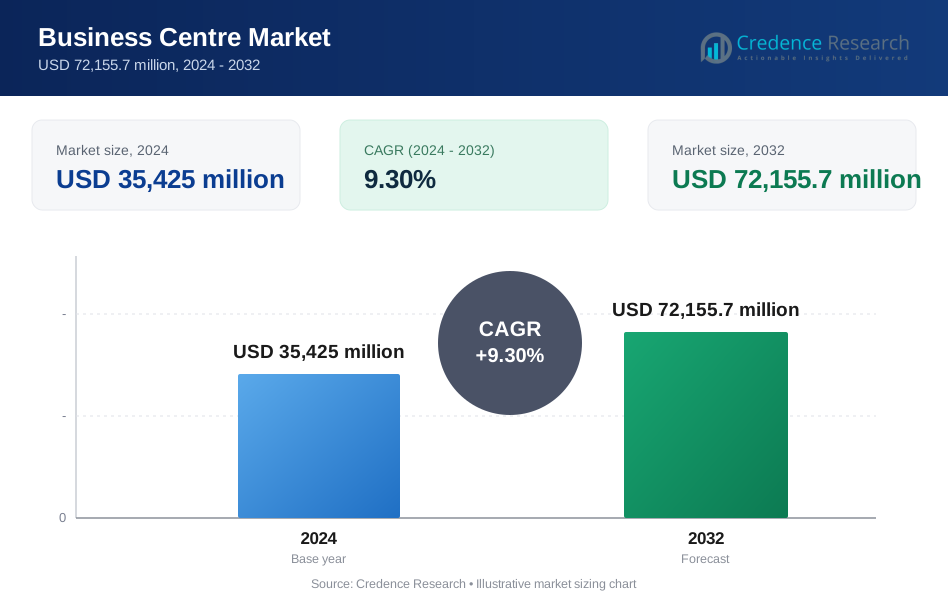
The Business Centre Market size was valued at USD 35425 million in 2024 and is anticipated to reach USD 72155.7 million by 2032, at a CAGR of 9.3% during the forecast period (2024-2032).
| REPORT ATTRIBUTE | DETAILS |
|---|---|
| Historical Period | 2020-2023 |
| Base Year | 2024 |
| Forecast Period | 2025-2032 |
| Business Centre Market Size 2024 | USD 35425 Million |
| Business Centre Market, CAGR | 9.3% |
| Business Centre Market Size 2032 | USD 72155.7 Million |
Several key factors are contributing to the expansion of the Business Centre Market. First, the global shift towards remote and hybrid work models has encouraged enterprises to adopt shared office environments that offer both operational flexibility and lower overhead costs. Secondly, digital transformation and the need for business continuity have made it essential for organizations to operate from well-equipped and tech-enabled office spaces. Additionally, rising entrepreneurship and cross-border business expansion are increasing the demand for temporary and satellite offices. Business centres also attract multinational corporations looking to establish a presence in emerging markets without incurring high setup costs. These trends are further supported by growing investor interest and real estate players entering the flexible workspace segment. Moreover, many operators are enhancing their offerings with integrated IT infrastructure, security services, and collaboration tools. Sustainability initiatives, including energy-efficient buildings and green certifications, are also becoming key differentiators in attracting environmentally conscious tenants.
Regionally, North America dominates the Business Centre Market, driven by high corporate activity, strong demand from technology and service-based industries, and the maturity of flexible workspace providers. The United States leads the region, with major cities such as New York, San Francisco, and Chicago offering extensive networks of serviced offices. Europe follows closely, with significant growth in cities such as London, Berlin, and Amsterdam, where demand for coworking and serviced offices is rising. In these markets, government support for startups and favorable leasing regulations contribute to the sector’s expansion. Meanwhile, Asia Pacific is witnessing rapid growth, fueled by expanding urban populations, a burgeoning startup ecosystem, and increasing foreign investments in commercial real estate, particularly in India, China, and Southeast Asia. Additionally, rising internet penetration and digital entrepreneurship are accelerating demand for business centres in tier 2 and tier 3 cities across the region.
Market Insights:
- The Business Centre Market is valued at USD 35,425 million and is expected to reach USD 72,155.7 million by 2032, growing at a CAGR of 9.3%.
- Enterprises and startups prefer flexible business centres over traditional leases for lower costs and operational agility.
- Hybrid work models are driving demand for satellite offices and decentralized workspace solutions.
- Businesses seek tech-enabled centres with high-speed internet, cybersecurity, and cloud-based tools.
- Emerging markets are attracting startups and multinationals seeking quick, low-risk expansion options.
- High competition in urban areas creates pricing pressure and challenges in maintaining profitability.
- North America leads with 38% market share, followed by Europe at 28% and Asia Pacific at 25%.
Market Drivers:
Growing Demand for Flexible Workspaces among Enterprises and Startups
The Business Centre Market is expanding due to rising demand for flexible office solutions from enterprises and startups. Companies seek agility in their operations, preferring shorter lease terms and scalable infrastructure. Traditional office leases tie up capital and limit relocation or downsizing options. Business centres provide plug-and-play workspaces that reduce upfront costs and enable quick setup. Startups value the ability to operate in premium locations without high investments. The trend toward dynamic workplace strategies continues to drive demand for ready-to-use professional environments.
Widespread Adoption of Hybrid and Remote Work Models Post-Pandemic
Organizations are adopting hybrid work models that combine in-office and remote operations. This shift is fueling demand in the Business Centre Market for satellite offices and coworking environments closer to employees’ homes. Many companies now decentralize their office presence, moving from single headquarters to multiple smaller locations. Business centres offer the flexibility to establish such nodes without the burden of long-term leases. Employers use these spaces to support collaboration, client meetings, and intermittent in-person tasks. It supports workforce productivity while reducing facility management costs.
- For instance, in 2021, NTT enabled 300,000 employees to access more than 3,400 IWG workspaces worldwide, supporting flexible and decentralized work arrangements.
Technology Integration and Demand for Digitally-Enabled Infrastructure
Business centres are evolving into smart work environments that support digital workflows. High-speed connectivity, cloud access, cybersecurity, and video conferencing tools are now expected features. Companies prioritize centres that ensure uninterrupted IT support and secure data environments. It enables seamless operations and supports remote teams in accessing centralized systems. The need for reliable digital infrastructure makes tech-enabled centres more competitive. Businesses view such setups as essential for ensuring operational continuity and responsiveness.
- For instance, Techno Electric & Engineering Company Ltd has launched a 36 MW hyperscale data centre in Chennai, which houses up to 2,400 racks and features a facility design power usage effectiveness (PUE) of 1.35, supporting advanced digital operations for enterprise clients.
Expansion of Startups and Global Businesses in Emerging Economies
The Business Centre Market is benefiting from rising entrepreneurial activity in developing regions. Startups prefer affordable, shared office models that allow focus on growth rather than asset acquisition. Multinational firms entering new geographies use business centres to establish fast, low-risk operational footprints. It helps them avoid complex property negotiations and local legal hurdles. Economic growth in Asia-Pacific, Latin America, and the Middle East is attracting global investment. This trend drives consistent demand for professional, well-managed office environments across diverse regions.
Market Trends:
Rise of Customizable Workspaces and Value-Added Services
Business centres are shifting from basic office rentals to highly customizable spaces that align with specific client needs. Companies now demand tailored layouts, branded interiors, and modular infrastructure that reflect their identity and support team collaboration. Operators respond by offering flexible design options, ergonomic furniture, and curated office zones. The Business Centre Market is witnessing strong interest in value-added services such as concierge support, wellness programs, and in-house IT assistance. It allows tenants to focus on core operations while accessing a professional, managed environment. Enhanced service offerings improve tenant retention and create competitive differentiation in saturated urban markets.
- For instance, WeWork partnered with a Fortune 500 pharmaceutical company to launch 30 to 40 fully branded and customized satellite offices globally by the end of 2021, ensuring a consistent employee experience across all locations.
Increased Emphasis on Sustainability and Smart Building Integration
Sustainability is becoming a critical factor in workspace selection, driving demand for eco-certified buildings and green office practices. Business centres are incorporating energy-efficient lighting, automated climate control, and water-saving fixtures to align with environmental standards. Smart building technologies support real-time energy monitoring, space utilization analytics, and predictive maintenance. It improves operational efficiency and reduces long-term costs for both operators and tenants. The Business Centre Market is adapting to tenant expectations for greener environments that meet ESG goals. This trend is influencing location decisions, lease renewals, and investment strategies in the flexible workspace industry.
- For instance, LVMH’s LIFE 360 program, launched in 2020, is supported by a network of nearly 200 environmental correspondents across its Maisons, ensuring progress on sustainability targets is tracked and reported at scale.
Market Challenges Analysis:
High Competition and Price Sensitivity in Urban Locations
The Business Centre Market faces intense competition, particularly in major metropolitan areas with a high concentration of flexible workspace providers. Operators struggle to differentiate their offerings amid rising price sensitivity among tenants. Businesses often prioritize cost over long-term value, forcing providers to lower prices or offer added services without guaranteed returns. It creates pressure on profit margins and affects service consistency. New entrants with aggressive pricing strategies challenge established players in key cities. Sustaining occupancy while maintaining quality remains a persistent operational hurdle.
Operational Complexity and Dependence on Real Estate Cycles
Managing multiple facilities across diverse locations presents logistical and operational challenges. Operators must ensure consistent service standards, manage vendor relationships, and address tenant concerns in real time. The Business Centre Market remains sensitive to real estate cycles and regional economic conditions. A slowdown in commercial leasing or rise in vacancy rates can reduce demand and impact financial stability. It becomes difficult for providers to maintain fixed-cost spaces during periods of low utilization. Fluctuations in rental prices and local regulatory constraints further complicate long-term planning.
Market Opportunities:
Expansion into Tier 2 and Tier 3 Cities with Emerging Business Activity
Tier 2 and Tier 3 cities present untapped growth potential for business centre operators. These regions are witnessing increased entrepreneurial activity, digital adoption, and corporate decentralization. Businesses are moving operations beyond traditional metros to reduce costs and access new talent pools. The Business Centre Market can benefit by establishing presence in these cities with scalable, cost-effective models. It enables operators to serve a growing demand for professional infrastructure in locations with limited premium office supply. Government incentives and infrastructure development further support expansion strategies in these markets.
Growing Demand from Sector-Specific and Niche Industries
Sector-focused business centres tailored to industries like healthcare, legal services, or creative design offer promising growth opportunities. These industries require specialized infrastructure, privacy protocols, or collaborative environments not addressed by generic office spaces. It allows operators to create differentiated offerings that cater to specific operational needs. The Business Centre Market can strengthen its value proposition by aligning with sector trends and offering domain-relevant features. High-margin clients in regulated or technical sectors value compliance-ready spaces and professional-grade amenities. This trend opens doors for long-term contracts and stronger client loyalty.
Market Segmentation Analysis:
By Type of Business Center
The market includes serviced offices, coworking spaces, and virtual offices. Serviced offices hold the largest share due to their turnkey setup and appeal to corporations seeking fully equipped spaces. Coworking spaces are expanding rapidly, favored by startups and freelancers for their affordability and collaborative settings. Virtual offices cater to businesses aiming to establish a professional presence without physical occupancy. It allows organizations to maintain credibility while minimizing real estate costs.
By Target
The Business Centre Market targets large enterprises, small and medium-sized enterprises (SMEs), startups, and freelancers. Large enterprises use business centres for satellite offices and temporary project teams. SMEs and startups adopt these centres for scalability and reduced overhead. Freelancers and independent professionals benefit from access to business amenities and networking opportunities. It ensures that workspace solutions remain accessible and adaptable across business sizes.
- For instance, Servcorp offers up to 1Gbps fibre internet access for SME clients at every serviced location in 2024.
By Business Model
The market operates through lease-based, membership-based, and pay-per-use models. Lease-based models are preferred by companies requiring dedicated space and predictable costs. Membership-based models attract users seeking regular but flexible access. Pay-per-use is ideal for occasional users who value convenience without long-term commitment. It supports diverse user preferences and maximizes occupancy potential for operators. The Business Centre Market continues to evolve with hybrid models blending these approaches.
- For instance, Regus operated over 4,000 locations globally in 2024, providing flexible workspace solutions for millions of customers.
Segmentations:
By Type of Business Center
- Serviced Offices
- Coworking Spaces
- Virtual Offices
By Target
- Large Enterprises
- Small and Medium-Sized Enterprises (SMEs)
- Startups
- Freelancers
By Business Model
- Lease-Based
- Membership-Based
- Pay-Per-Use
By Services Offered
- Office Space Rental
- Meeting and Conference Rooms
- Virtual Office Services
- Administrative and IT Support
- Mail and Call Handling
By Industry Vertical
- Information Technology
- Financial Services
- Consulting and Legal
- Media and Design
- Healthcare
- Real Estate and Construction
By Region
- North America
- U.S.
- Canada
- Mexico
- Europe
- Germany
- France
- U.K.
- Italy
- Spain
- Rest of Europe
- Asia Pacific
- China
- Japan
- India
- South Korea
- South-east Asia
- Rest of Asia Pacific
- Latin America
- Brazil
- Argentina
- Rest of Latin America
- Middle East & Africa
- GCC Countries
- South Africa
- Rest of the Middle East and Africa
Regional Analysis:
North America Leads with Mature Ecosystem and High Corporate Adoption
North America accounts for 38% of the Business Centre Market, driven by strong corporate demand and mature workspace infrastructure. The United States contributes the majority share within the region, supported by widespread adoption across key urban centers. High commercial activity and growing preference for flexible leasing among technology, finance, and legal firms continue to fuel market penetration. Companies in cities such as New York, San Francisco, and Toronto utilize business centres to reduce fixed costs and enable agile operations. It reflects the strategic shift toward decentralization and hybrid work preferences. Operators in the region offer premium services, integrated IT support, and access to nationwide office networks. Government initiatives supporting entrepreneurship and innovation hubs further reinforce regional growth.
Europe Demonstrates Steady Growth in Urban and Innovation Hubs
Europe holds a 28% share of the global Business Centre Market, with strong activity in both Western and Central European economies. The United Kingdom, Germany, and the Netherlands are leading contributors, with London, Berlin, and Amsterdam emerging as key urban demand centers. Businesses in these cities use serviced office models to support regional offices, project teams, and flexible staffing needs. It aligns with shifting workforce dynamics and the emphasis on cost-effective, scalable workspace solutions. The region's regulatory clarity, digital readiness, and commitment to sustainable infrastructure create favorable conditions for business centre growth. Operators in Europe differentiate through ESG compliance, customized services, and location advantages.
Asia Pacific Emerges as a High-Growth Region with Expanding Urbanization
Asia Pacific captures 25% of the global Business Centre Market and is projected to grow at the fastest regional pace. India, China, and Southeast Asian countries are leading the regional surge, driven by rapid urban development and digital adoption. Businesses in major metropolitan areas such as Bengaluru, Shanghai, and Jakarta prefer flexible office spaces to reduce setup time and lower capital expenditure. It supports regional expansion strategies and improves market responsiveness for global and domestic firms. The rise of digital startups, cross-border trade, and multinational activity adds further demand momentum. Infrastructure investments, favorable demographics, and government support for commercial real estate continue to boost long-term growth prospects.
Key Player Analysis:
- Regus
- CSO
- Allwork.Space
- Startups
- Gorilla Property Solutions
- Instant
- Servcorp
- Clockwise Offices
- OREGA MANAGEMENT LTD
Competitive Analysis:
The Business Centre Market features intense competition driven by a mix of global players and regional operators. Key companies such as IWG plc, WeWork Inc., Servcorp, The Executive Centre, and Regus dominate major urban centres with extensive networks and differentiated service offerings. It remains highly fragmented, with local providers competing through pricing, location, and niche services. Operators focus on enhancing digital infrastructure, flexible lease terms, and sector-specific solutions to attract diverse tenants. Brand reputation, occupancy rates, and service quality play a critical role in customer retention. Strategic partnerships with property developers and real estate investors enable firms to scale operations and enter new markets. The Business Centre Market continues to evolve with innovation in workspace design, technology integration, and sustainability practices. Players that adapt quickly to shifting workplace dynamics and client expectations maintain a competitive edge in this fast-paced environment.
Recent Developments:
- In November 2024, ATHAGORAS Group announced the acquisition of CSO Pharma Consulting, enabling CSO to expand its pharmacovigilance and consulting services internationally while leveraging ATHAGORAS’ expertise and market presence.
- In May 2025, Clockwise launched its next-generation Bespoke Office Packages under the “Your Office, Your Way” initiative, offering highly personalized and flexible workspace solutions to meet evolving client needs.
Market Concentration & Characteristics:
The Business Centre Market exhibits moderate to high market concentration, with a few global firms holding significant influence alongside numerous regional providers. It combines standardized service offerings with location-specific customization to meet varied client needs. The market is characterized by flexible leasing models, tech-enabled infrastructure, and rapid scalability. Operators compete on service quality, accessibility, digital integration, and value-added amenities. Demand is driven by hybrid work trends, startup growth, and the need for operational agility. It shows strong urban orientation, with high penetration in metropolitan hubs and rising interest in tier 2 and tier 3 cities. The market adapts quickly to shifts in workplace preferences and real estate dynamics.
Report Coverage:
The research report offers an in-depth analysis based on Type of Business Center, Target, Business Model, Services Offered, Industry Vertical and Region. It details leading market players, providing an overview of their business, product offerings, investments, revenue streams, and key applications. Additionally, the report includes insights into the competitive environment, SWOT analysis, current market trends, as well as the primary drivers and constraints. Furthermore, it discusses various factors that have driven market expansion in recent years. The report also explores market dynamics, regulatory scenarios, and technological advancements that are shaping the industry. It assesses the impact of external factors and global economic changes on market growth. Lastly, it provides strategic recommendations for new entrants and established companies to navigate the complexities of the market.
Future Outlook:
- The Business Centre Market will expand its presence in tier‑2 and tier‑3 cities to meet growing demand from regional startups and SMEs.
- Operators will prioritize smart infrastructure, integrating IoT systems for energy management and space utilization.
- Client demand for sector‑specific workspaces, particularly in legal, healthcare, and creative industries, will spur customized offerings.
- Providers will strengthen digital service platforms, offering hybrid booking, virtual receptionist, and cloud‑based support.
- Green building certifications and sustainable operations will become standard to attract environmentally conscious tenants.
- Strategic alliances with property developers and co‑investors will accelerate network expansion into new markets.
- Flexible membership models blending daily, monthly, and on-demand access will cater to evolving user preferences.
- Emphasis on wellness and community programming-such as fitness, mindfulness, and networking events-will boost tenant engagement.
- Data‑driven decision‑making using analytics on occupancy, client usage, and service effectiveness will optimize performance.
- Consolidation of smaller providers through mergers or acquisitions will occur, creating more scalable and resilient platforms.
Request a Free Sample
Fill in your details and we'll send you a free sample report.
- Sample data tables & charts
- Research methodology
Market Dynamics
Adoption of Hybrid and Remote Work Models
The shift towards hybrid and remote work has increased demand for flexible, decentralized office solutions, enabling companies to support distributed teams and reduce fixed real estate costs.
Digital Transformation and Tech-Enabled Workspaces
Businesses require advanced IT infrastructure, high-speed connectivity, and secure digital environments, making tech-enabled business centres essential for operational continuity and productivity.
Expansion of Startups and Multinationals in Emerging Markets
Startups and global firms are leveraging business centres to quickly establish operations in new geographies, avoiding high setup costs and complex property negotiations, especially in Asia Pacific and other emerging regions.
Demand for Operational Flexibility and Cost Efficiency
Enterprises and SMEs prefer business centres for their plug-and-play setups, shorter lease terms, and scalable space options, which reduce upfront investments and allow for agile business operations.
Sustainability and Green Building Initiatives
Environmentally conscious tenants are increasingly seeking business centres with energy-efficient buildings and green certifications, driving operators to adopt sustainable practices as a key market differentiator.
Need a Custom Version of This Report?
Tailor the scope, geography, or segments to your exact requirements.
- Custom geography or segment scope
- Direct access to our analyst team
Frequently Asked Questions
What is the current size of the Business Centre Market?
What factors are driving the growth of the Business Centre Market?
What are the key segments within the Business Centre Market?
What are some challenges faced by the Business Centre Market?
Who are the major players in the Business Centre Market?
Which segment is leading the market share?
Table of Content
Chapter 1 Market Segmentation
- 1.1 Segmentation Framework
- 1.1.1 Product and Service Classification
- 1.1.2 Application and End-Use Classification
- 1.1.3 Technology and Solution Classification
- 1.1.4 Customer and Distribution Channel Classification
- 1.1.5 Geographic Segmentation
- 1.1.6 Market Segment Definitions and Boundaries
- 1.2 By Target
- 1.2.1 Large Enterprises
- 1.2.2 Small and Medium-Sized Enterprises (SMEs)
- 1.2.3 Startups
- 1.2.4 Freelancers
- 1.3 By Business Model
- 1.3.1 Lease-Based
- 1.3.2 Membership-Based
- 1.3.3 Pay-Per-Use
- 1.4 By Services Offered
- 1.4.1 Office Space Rental
- 1.4.2 Meeting and Conference Rooms
- 1.4.3 Virtual Office Services
- 1.4.4 Administrative and IT Support
- 1.4.5 Mail and Call Handling
- 1.5 By Type of Business Center
- 1.5.1 Serviced Offices
- 1.5.2 Coworking Spaces
- 1.5.3 Virtual Offices
Chapter 2 Introduction
- 2.1 Report Objectives and Scope
- 2.2 Product Definition and Industry Terminology
- 2.3 Market Inclusions and Exclusions
- 2.4 Research Process
- 2.4.1 Primary Research and Expert Interviews
- 2.4.2 Secondary Research and Source Review
- 2.4.3 Top-Down and Bottom-Up Estimation
- 2.4.4 Data Triangulation and Verification
- 2.5 Market Size Measurement Basis
- 2.5.1 2024: USD 35,425 million → 2032: USD 72,155.7 million
- 2.6 Historical and Forecast Reference Periods
- 2.6.1 Base Year: 2024
- 2.6.2 Forecast Period: 2024-2032
- 2.7 Research Assumptions and Limitations
Chapter 3 Executive Summary
- 3.1 Market Snapshot and Key Findings
- 3.2 Base-Year Market Size, 2024
- 3.3 Forecast Market Size, 2032
- 3.4 Revenue and Volume Growth Outlook
- 3.5 Key Demand and Supply Indicators
- 3.6 Leading Market Segments
- 3.7 Fastest-Growing Market Opportunities
- 3.8 Regional Performance Highlights
- 3.9 Technology and Industry Transformation
- 3.10 Competitive Landscape Summary
- 3.11 Analyst View and Strategic Implications
Chapter 4 Global Business Centre Market Trends and Developments
- 4.1 Historical Industry Development
- 4.2 Recent Market Trends and Developments
- 4.3 Demand and Customer Behavior Trends
- 4.4 Technology and Product Innovation
- 4.5 Artificial Intelligence, Automation and Digitalization
- 4.6 Local Manufacturing and Supply Chain Realignment
- 4.7 Industry Partnerships, Mergers and Acquisitions
- 4.8 Sustainability and Circular Economy Developments
- 4.9 Government and Private Sector Investment Trends
- 4.10 Emerging Business Models and Commercialization
- 4.11 Industry Developments and Announcements
Chapter 5 Global Business Centre Market Supply and Demand Analysis
- 5.1 Demand Trend and Consumption Analysis
- 5.2 Demand Forecast, 2024-2032
- 5.3 Supply Chain Structure and Procurement Trends
- 5.4 Supply-Demand Gap and Bottlenecks
- 5.5 Import Dependence and Sourcing Structure
- 5.6 Regional Supply and Demand Concentration
Chapter 6 Global Business Centre Market Pricing Analysis
- 6.1 Pricing Structure and Measurement
- 6.2 Historical Pricing Trends
- 6.3 Pricing Outlook, 2024-2032
- 6.4 Pricing by Product and Market Segment
- 6.5 Geographic Pricing Differences
- 6.6 Key Input, Energy, Labor and Logistics Costs
- 6.7 Contract Pricing and Purchasing Models
- 6.8 Pricing Sensitivity and Competitive Positioning
- 6.9 Price, Margin and Profitability Implications
Chapter 7 Global Business Centre Market Dynamics
- 7.1 Market Growth Drivers
- 7.1.1 Demand-Side Drivers
- 7.1.2 Technology and Innovation Drivers
- 7.1.3 Infrastructure and Investment Drivers
- 7.1.4 Regulatory and Policy Drivers
- 7.2 Market Restraints
- 7.2.1 Cost and Affordability Constraints
- 7.2.2 Technology and Adoption Barriers
- 7.2.3 Supply Chain and Operational Constraints
- 7.3 Market Challenges
- 7.3.1 Competitive Pressure and Margin Erosion
- 7.3.2 Skills, Infrastructure and Implementation Gaps
- 7.4 Emerging Market Opportunities
- 7.5 Market Dynamics Impact and Time-Horizon Assessment
Chapter 8 Global Business Centre Value Chain Analysis
- 8.1 Industry Value Chain Overview
- 8.2 Upstream Suppliers and Critical Inputs
- 8.3 Technology and Component Providers
- 8.4 Manufacturing or Service Delivery
- 8.5 Distribution, Channel Partners and Integrators
- 8.6 Downstream Applications and End Users
- 8.7 Value Addition and Profit Pools
- 8.8 Vertical Integration and Outsourcing
- 8.9 Supplier Concentration and Risk
- 8.10 Supply Chain Localization and Resilience
Chapter 9 Global Business Centre Market Regulations and Policies
- 9.1 Relevant Laws, Standards and Compliance Frameworks
- 9.2 Product, Service, Safety and Quality Requirements
- 9.3 Government Policies, Incentives and Subsidies
- 9.4 Imports, Exports and Trade Barriers
- 9.5 Public Procurement and Local Content Requirements
- 9.6 Data Protection, AI and Cybersecurity Compliance
- 9.7 Upcoming Policy Changes and Market Implications
Chapter 10 Global Business Centre Market Hotspots and Opportunities
- 10.1 Market Opportunity Mapping and Growth Hotspots
- 10.2 High-Growth Applications and Customer Groups
- 10.3 Underserved Markets and White-Space Opportunities
- 10.4 Emerging Technology and Product Opportunities
- 10.5 New Capacity and Investment Hotspots
- 10.6 Market Entry and Expansion Opportunities
- 10.7 Distribution and Partnership Opportunities
- 10.8 Near-Term and Long-Term Commercial Potential
- 10.9 Opportunity Attractiveness and Execution Risks
Chapter 11 Global Business Centre Market Outlook, 2024-2032
- 11.1 Market Size and Analysis
- 11.1.1 Revenue (Market Measurement: 2024: USD 35,425 million → 2032: USD 72,155.7 million)
- 11.1.2 Historical Market Size
- 11.1.3 Base-Year Market Size, 2024
- 11.2 Market Forecast, 2024-2032
- 11.2.1 Revenue Forecast to 2032
- 11.2.2 CAGR and Year-on-Year Growth
- 11.2.3 Incremental Revenue Opportunity
- 11.3 Forecast Assumptions and Scenario Analysis
- 11.3.1 Base-Case Forecast
- 11.3.2 Optimistic and Conservative Scenarios
- 11.3.3 Technology, Pricing and Policy Sensitivities
- 11.4 Market Attractiveness and Growth Outlook
Chapter 12 Global Business Centre Market Segmentation and Outlook
- 12.1 Segmentation Summary and Market Shares, 2024
- 12.2 Largest and Fastest-Growing Segments
- 12.3 By Target - Market Size and Forecast, 2024-2032
- 12.3.1 Segment Definition and Scope
- 12.3.2 Historical Market Size
- 12.3.3 Revenue Forecast, 2024-2032
- 12.3.4 Base-Year Market Share, 2024
- 12.3.5 Segment CAGR and Growth Drivers
- 12.3.6 Subsegment Market Size and Forecast
- 12.3.6.1 Large Enterprises
- 12.3.6.2 Small and Medium-Sized Enterprises (SMEs)
- 12.3.6.3 Startups
- 12.3.6.4 Freelancers
- 12.3.7 Subsegment Pricing and Adoption Trends
- 12.3.8 Leading Suppliers and Competition
- 12.3.9 Regional Demand and Opportunities
- 12.4 By Business Model - Market Size and Forecast, 2024-2032
- 12.4.1 Segment Definition and Scope
- 12.4.2 Historical Market Size
- 12.4.3 Revenue Forecast, 2024-2032
- 12.4.4 Base-Year Market Share, 2024
- 12.4.5 Segment CAGR and Growth Drivers
- 12.4.6 Subsegment Market Size and Forecast
- 12.4.6.1 Lease-Based
- 12.4.6.2 Membership-Based
- 12.4.6.3 Pay-Per-Use
- 12.4.7 Subsegment Pricing and Adoption Trends
- 12.4.8 Leading Suppliers and Competition
- 12.4.9 Regional Demand and Opportunities
- 12.5 By Services Offered - Market Size and Forecast, 2024-2032
- 12.5.1 Segment Definition and Scope
- 12.5.2 Historical Market Size
- 12.5.3 Revenue Forecast, 2024-2032
- 12.5.4 Base-Year Market Share, 2024
- 12.5.5 Segment CAGR and Growth Drivers
- 12.5.6 Subsegment Market Size and Forecast
- 12.5.6.1 Office Space Rental
- 12.5.6.2 Meeting and Conference Rooms
- 12.5.6.3 Virtual Office Services
- 12.5.6.4 Administrative and IT Support
- 12.5.6.5 Mail and Call Handling
- 12.5.7 Subsegment Pricing and Adoption Trends
- 12.5.8 Leading Suppliers and Competition
- 12.5.9 Regional Demand and Opportunities
- 12.6 By Type of Business Center - Market Size and Forecast, 2024-2032
- 12.6.1 Segment Definition and Scope
- 12.6.2 Historical Market Size
- 12.6.3 Revenue Forecast, 2024-2032
- 12.6.4 Base-Year Market Share, 2024
- 12.6.5 Segment CAGR and Growth Drivers
- 12.6.6 Subsegment Market Size and Forecast
- 12.6.6.1 Serviced Offices
- 12.6.6.2 Coworking Spaces
- 12.6.6.3 Virtual Offices
- 12.6.7 Subsegment Pricing and Adoption Trends
- 12.6.8 Leading Suppliers and Competition
- 12.6.9 Regional Demand and Opportunities
- 12.7 Segment Growth Comparison
- 12.8 Segment Attractiveness and Priority Matrix
Chapter 13 Global Business Centre Geographic Market Outlook, 2024-2032
- 13.1 Regional Market Size and Share, 2024
- 13.2 Regional Market Forecast, 2024-2032
- 13.3 Regional Pricing, Production and Demand Differences
- 13.4 North America
- 13.4.1 United States
- 13.4.2 Canada
- 13.4.3 Mexico
- 13.5 Europe
- 13.5.1 Germany
- 13.5.2 France
- 13.5.3 Italy
- 13.5.4 United Kingdom
- 13.5.5 Spain
- 13.5.6 Poland
- 13.5.7 Russia
- 13.5.8 Netherlands
- 13.5.9 Belgium
- 13.5.10 Sweden
- 13.5.11 Denmark
- 13.5.12 Norway
- 13.5.13 Rest of Europe
- 13.6 Asia Pacific
- 13.6.1 China
- 13.6.2 India
- 13.6.3 Japan
- 13.6.4 South Korea
- 13.6.5 Thailand
- 13.6.6 Indonesia
- 13.6.7 Vietnam
- 13.6.8 Malaysia
- 13.6.9 Australia
- 13.6.10 Rest of Asia Pacific
- 13.7 Latin America
- 13.7.1 Brazil
- 13.7.2 Argentina
- 13.7.3 Colombia
- 13.7.4 Chile
- 13.7.5 Rest of Latin America
- 13.8 Middle East
- 13.8.1 Saudi Arabia
- 13.8.2 United Arab Emirates
- 13.8.3 Turkey
- 13.8.4 Israel
- 13.8.5 Iran
- 13.8.6 Rest of the Middle East
- 13.9 Africa
- 13.9.1 South Africa
- 13.9.2 Egypt
- 13.9.3 Nigeria
- 13.9.4 Morocco
- 13.9.5 Rest of Africa
- 13.10 Regional Investment, Policy and Supply Chain Differences
- 13.11 Regional Competitive Landscape
- 13.12 Geographic Growth Hotspots
Chapter 14 Global Business Centre Technology, Innovation and Sustainability Outlook
- 14.1 Technology Landscape and Maturity
- 14.2 Product, Process and Service Innovation
- 14.3 AI, Automation and Digital Tools in the Industry
- 14.4 Technology Adoption and Performance Benchmarking
- 14.5 Innovation Pipeline and R&D Investment
- 14.6 Energy Efficiency and Resource Management
- 14.7 Sustainability, Recycling and Circularity
- 14.8 Technology Roadmap, 2024-2032
- 14.9 Risks of Obsolescence and Technology Substitution
Chapter 15 Global Business Centre Market Key Strategic Imperatives
- 15.1 Growth and Market Entry Priorities
- 15.2 High-Return Products and Segments
- 15.3 Pricing, Profitability and Cost Optimization
- 15.4 Technology Investment and Product Differentiation
- 15.5 Supply Chain Localization and Resilience
- 15.6 Distribution and Customer Acquisition
- 15.7 Partnership, Acquisition and Capacity Strategy
- 15.8 Regional Expansion Priorities
- 15.9 Short-, Medium- and Long-Term Actions
Chapter 16 Competition Outlook
- 16.1 Industry Competition Characteristics
- 16.2 Market Structure and Concentration
- 16.3 Market Share and Competitive Positioning, 2024
- 16.4 Company-Wise Revenue and Product Benchmarking
- 16.5 Production and Service Capacity Benchmarking
- 16.6 Technology, Pricing and Differentiation
- 16.7 Regional Footprint and Distribution Strength
- 16.8 Mergers, Acquisitions and Strategic Alliances
- 16.9 New Entrants and Competitive Threats
- 16.10 Porter's Five Forces and Industry Attractiveness
- 16.11 Competitive Outlook, 2024-2032
Chapter 17 Company Profiles
- 17.1 Company Coverage and Selection Criteria
- 17.2 Regus (IWG plc)
- 17.2.1 Business Description
- 17.2.2 Company Ownership and Geographic Presence
- 17.2.3 Product and Service Portfolio
- 17.2.4 Manufacturing and Operating Footprint
- 17.2.5 Financial Performance and Investment
- 17.2.6 Market Share and Competitive Position
- 17.2.7 Technology and Innovation Capabilities
- 17.2.8 Strategic Alliances or Partnerships
- 17.2.9 Recent Developments
- 17.2.10 Growth Strategy and Outlook
- 17.3 WeWork Inc.
- 17.4 Servcorp
- 17.5 The Executive Centre
- 17.6 Clockwise Offices
- 17.7 OREGA MANAGEMENT LTD
- 17.8 Allwork.Space
- 17.9 Instant Group
- 17.10 Gorilla Property Solutions
- 17.11 CSO
- 17.12 Other Relevant Market Participants
Note: Every listed company is profiled on the structure shown under the first company. The company list is preliminary and may change based on research findings, market developments, data availability and client requirements.
Chapter 18 Disclaimer
- 18.1 Research and Forecast Disclaimer
- 18.2 Data Source and Estimation Limitations
Note: The depth of individual sections depends on data availability for this market. Volume, capacity, trade and other unit-based metrics are included where applicable.

