
| REPORT ATTRIBUTE | DETAILS |
|---|---|
| Historical Period | 2020-2023 |
| Base Year | 2024 |
| Forecast Period | 2025-2032 |
| Butter Coffee Market Size 2024 | USD 949.58 Million |
| Butter Coffee Market, CAGR | 8.75% |
| Butter Coffee Market Size 2032 | USD 1,946.81 Million |
Market Overview
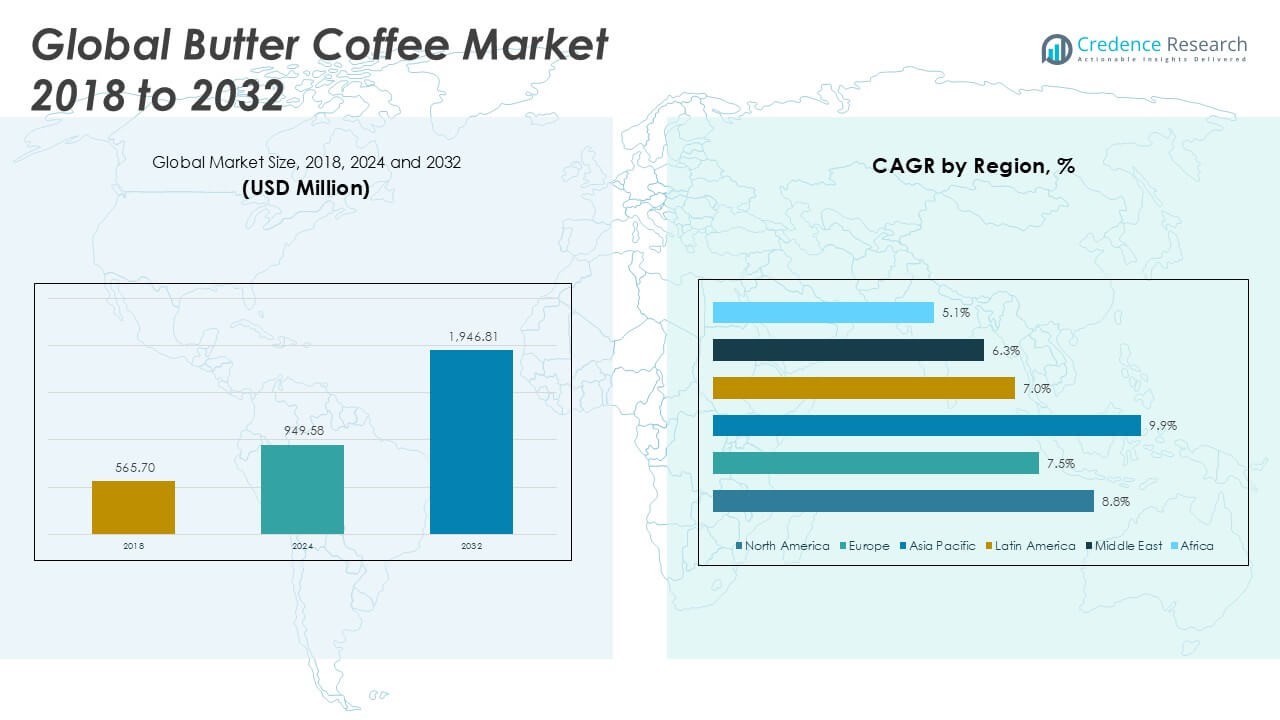
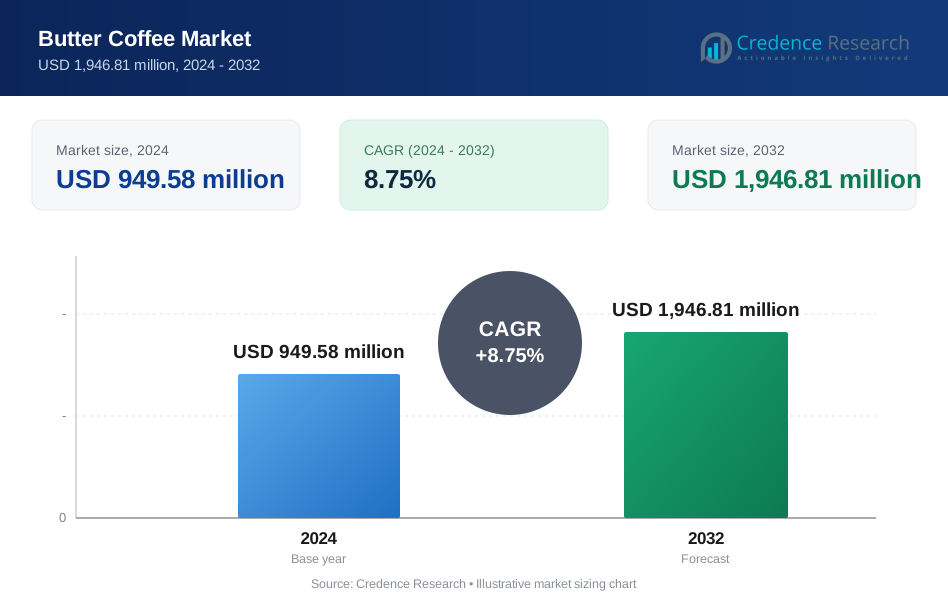
The Butter Coffee market size was valued at USD 565.70 million in 2018, increased to USD 949.58 million in 2024, and is anticipated to reach USD 1,946.81 million by 2032, at a CAGR of 8.75% during the forecast period.
The Butter Coffee market is led by prominent players such as Bulletproof Nutrition, Inc., Nestlé S.A., Starbucks Corporation, Laird Superfood, and Vital Proteins, each contributing to market growth through product innovation, strategic partnerships, and expanded retail presence. Bulletproof Nutrition, Inc. holds a notable position due to its pioneering role in butter coffee and strong brand loyalty. Nestlé S.A. and Starbucks Corporation leverage global distribution networks and established customer bases to accelerate category adoption. North America dominates the market with a 40.9% share in 2024, driven by high consumer awareness, rising demand for functional beverages, and a well-developed e-commerce infrastructure. Competitive activity in this region remains high, with companies focusing on flavored, organic, and ready-to-drink (RTD) formulations to differentiate themselves and capture a health-conscious consumer base.
Market Insights
- The global Butter Coffee market was valued at USD 949.58 million in 2024 and is projected to reach USD 1,946.81 million by 2032, growing at a CAGR of 8.75% during the forecast period.
- Rising consumer focus on functional beverages and high-fat, low-carb diets like keto is a major driver accelerating the demand for butter coffee globally.
- Innovation in flavored and organic ready-to-drink (RTD) variants, along with expanding online retail channels, is a growing trend shaping product availability and consumer reach.
- The market is moderately fragmented, with key players including Bulletproof Nutrition, Nestlé S.A., Starbucks, and Laird Superfood competing through diverse formulations and strong branding.
- North America holds the largest regional share at 40.9%, followed by Asia Pacific with 32.2%; among product types, Conventional Butter Coffee dominates, while Online Retail leads the distribution channel segment due to convenience and wider product access.
Market Segmentation Analysis:
By Type:
The Butter Coffee market is segmented into Organic Butter Coffee and Conventional Butter Coffee. Among these, Conventional Butter Coffee holds the dominant market share, driven by its widespread availability, cost-effectiveness, and strong consumer familiarity. Its popularity is particularly high among consumers seeking high-energy beverages without drastically changing their dietary preferences. However, Organic Butter Coffee is witnessing faster growth, supported by increasing consumer awareness of clean-label products and health benefits associated with organic ingredients. Rising demand for non-GMO and preservative-free options further drives the adoption of organic variants, especially in developed economies focused on sustainable consumption.
- For instance, Laird Superfood’s organic butter coffee range includes products like its Unsweetened Superfood Creamer, which is USDA Certified Organic and has contributed to the company’s revenue reaching USD 36.7 million in FY2021, with organic products accounting for over 60% of total sales.
By Distribution Channel:
Online Retail and Hypermarkets/Supermarkets represent significant distribution channels in the Butter Coffee market. Online Retail dominates the segment, capturing a substantial share due to its convenience, broader product availability, and the rising trend of direct-to-consumer brands. Increasing digital literacy and mobile commerce adoption have further expanded the reach of butter coffee through online platforms. Meanwhile, Hypermarkets/Supermarkets remain a strong secondary channel, attracting health-conscious consumers who prefer in-store purchases and instant availability. Promotional offers and product sampling at physical outlets also support product visibility and consumer engagement, especially in urban regions.
- For instance, Bulletproof Nutrition, Inc. reported that over 70% of its butter coffee sales in 2022 originated from its direct-to-consumer e-commerce platform, with an average monthly site traffic of 1.5 million visits and a subscription reorder rate of 42%.
Key Growth Drivers
Rising Demand for Functional Beverages
Consumers are increasingly seeking beverages that offer health benefits beyond basic nutrition, fueling demand for butter coffee. Known for promoting mental clarity, sustained energy, and ketogenic benefits, butter coffee is gaining traction among health-conscious individuals and fitness enthusiasts. Its association with high-fat, low-carb diets such as keto and paleo further supports its growing appeal. The convenience of ready-to-drink (RTD) formats also enhances adoption, especially among busy professionals and athletes who prioritize cognitive and physical performance.
- For instance, High Brew Coffee launched its “Keto Cold Brew” line with 10g of healthy fats and 0g sugar per serving, and within its first 12 months of release, the product line was listed in over 4,000 retail stores across the U.S., including Whole Foods and Target.
Expansion of Online Retail and E-commerce Platforms
The proliferation of online retail channels significantly drives butter coffee sales, especially among millennials and Gen Z consumers. Brands leverage e-commerce platforms to reach broader audiences, offer product subscriptions, and promote niche formulations like organic or flavored butter coffee. Social media and influencer marketing also play a key role in driving visibility and consumer education. The convenience of doorstep delivery, combined with promotional discounts and customizable order options, continues to encourage trial and repeat purchases.
- For instance, Bulletproof Nutrition, Inc. reported that in 2022, its e-commerce sales accounted for approximately USD 42.7 million, representing over 73% of its total annual revenue, with more than 110,000 active subscribers purchasing through its direct-to-consumer platform.
Increasing Health and Wellness Awareness
Growing awareness around the benefits of healthy fats, low-sugar alternatives, and natural energy boosters is positively impacting the butter coffee market. Consumers are moving away from traditional sugary caffeinated drinks in favor of healthier alternatives. Butter coffee offers metabolic and cognitive support, aligning with consumer goals related to weight management, mental focus, and overall well-being. The market benefits from the broader shift toward clean-label products, where ingredients like grass-fed butter and MCT oil appeal to informed and health-oriented buyers.
Key Trends & Opportunities
Innovation in Product Formulations and Flavors
Manufacturers are increasingly experimenting with new formulations to cater to diverse taste preferences and dietary needs. Innovations include plant-based butter alternatives, dairy-free MCT oil blends, and unique flavor infusions such as vanilla, cacao, and turmeric. These developments attract vegan and lactose-intolerant consumers and help expand the product's appeal across broader demographics. Premium offerings and functional ingredient infusions also open new opportunities in the wellness beverage sector, allowing brands to differentiate themselves in a growing competitive landscape.
- For instance, Chameleon Cold-Brew launched a limited-edition butter coffee blend with turmeric and ghee that was distributed in 250 Sprouts Farmers Market stores in 2023, selling out in 11 weeks after launch due to high demand among plant-based lifestyle consumers.
Growing Penetration in Emerging Markets
Emerging economies in Asia-Pacific and Latin America present lucrative opportunities for market expansion due to rising disposable incomes and growing interest in Western health trends. As awareness of ketogenic and low-carb diets spreads, butter coffee is being introduced to new consumer bases through online platforms and global wellness influencers. Local brands and international players are increasingly investing in regional partnerships, localized marketing strategies, and retail expansion to tap into the evolving health and wellness preferences in these regions.
- For instance, Nestlé S.A. introduced a keto-friendly butter coffee product under its Nescafé brand in South Korea in 2022, distributed through 1,200 GS25 convenience stores and eMart outlets, achieving unit sales of over 100,000 packs in the first quarter.
Key Challenges
Limited Consumer Awareness in Developing Regions
Despite its rising popularity in developed markets, butter coffee faces awareness and acceptance challenges in several developing countries. Many consumers remain unfamiliar with its ingredients, preparation method, and associated health benefits. This knowledge gap hampers product adoption and limits market penetration. Brands must invest in educational campaigns, influencer outreach, and sampling initiatives to build trust and awareness among potential consumers in untapped regions.
High Product Cost and Premium Pricing
Butter coffee, especially in organic or RTD formats, often carries a higher price point than traditional coffee beverages. The inclusion of premium ingredients like grass-fed butter, MCT oil, and specialty flavors contributes to elevated costs. Price-sensitive consumers may find these products less accessible, particularly in regions where disposable incomes are lower. This cost barrier can restrict mass-market adoption, pushing brands to explore cost-efficient production and pricing strategies.
Regulatory and Labeling Challenges
Navigating different food and beverage regulations across global markets poses a significant hurdle for butter coffee brands. Labeling requirements, claims about health benefits, and ingredient approvals vary widely between regions. Ensuring compliance while maintaining product integrity can be complex and costly. Mislabeling or exaggerated health claims may lead to regulatory backlash, impacting brand reputation and consumer trust. Clear, transparent communication and adherence to regional standards remain essential for sustainable growth.
Regional Analysis
North America
North America dominates the global butter coffee market with the largest share of 40.9% in 2024, owing to high consumer awareness and the strong presence of health-focused beverage brands. The market grew from USD 233.89 million in 2018 to USD 388.30 million in 2024 and is projected to reach USD 798.42 million by 2032, registering a CAGR of 8.8%. The region’s demand is fueled by rising adoption of ketogenic and low-carb diets, particularly in the U.S. and Canada. An established e-commerce infrastructure and growing preference for functional beverages continue to support regional growth.
Asia Pacific
Asia Pacific holds the second-largest market share at 32.2% in 2024, with significant growth potential driven by rising health consciousness and increasing urbanization. The market expanded from USD 173.30 million in 2018 to USD 306.22 million in 2024 and is projected to reach USD 681.62 million by 2032, at a CAGR of 9.9%, the highest among all regions. Emerging economies such as China, Japan, South Korea, and India are key contributors, supported by a growing middle class and increased exposure to Western dietary trends. Online channels and social media play a pivotal role in consumer education.
Europe
Europe accounts for a market share of 18.6% in 2024, driven by a rising preference for clean-label, functional beverages. The market grew from USD 111.07 million in 2018 to USD 176.73 million in 2024 and is expected to reach USD 331.18 million by 2032, growing at a CAGR of 7.5%. Demand is particularly strong in Germany, the UK, and Nordic countries, where consumers increasingly favor organic and health-centric coffee options. The presence of established wellness brands and distribution through premium retail chains helps boost product visibility and acceptance across the region.
Latin America
Latin America holds a market share of 4.4% in 2024, with gradual but steady growth in the butter coffee market. It expanded from USD 25.08 million in 2018 to USD 41.55 million in 2024, and is projected to reach USD 74.74 million by 2032, registering a CAGR of 7.0%. Brazil and Mexico lead regional demand, fueled by growing awareness of nutritional supplements and lifestyle shifts among urban consumers. While adoption is slower compared to developed regions, increasing online accessibility and regional wellness trends are expected to accelerate growth over the forecast period.
Middle East
The Middle East butter coffee market has a 2024 market share of 2.4%, supported by increasing consumer interest in alternative, high-energy beverages. The market grew from USD 14.90 million in 2018 to USD 22.73 million in 2024 and is projected to reach USD 38.81 million by 2032, at a CAGR of 6.3%. Gulf countries such as the UAE and Saudi Arabia are seeing a growing base of health-conscious expatriates and locals. Retail expansion and digital marketing campaigns have helped raise product awareness, though broader adoption remains limited due to premium pricing and niche positioning.
Africa
Africa accounts for the smallest share in the butter coffee market at 1.5% in 2024, reflecting the region’s early-stage development in functional beverages. The market increased from USD 7.46 million in 2018 to USD 14.06 million in 2024, and is projected to reach USD 22.05 million by 2032, growing at a CAGR of 5.1%. South Africa leads regional demand, supported by growing urbanization and the spread of Western dietary practices. However, limited distribution networks and lower consumer purchasing power restrict large-scale adoption. Strategic partnerships and affordable product lines may help unlock future growth potential.
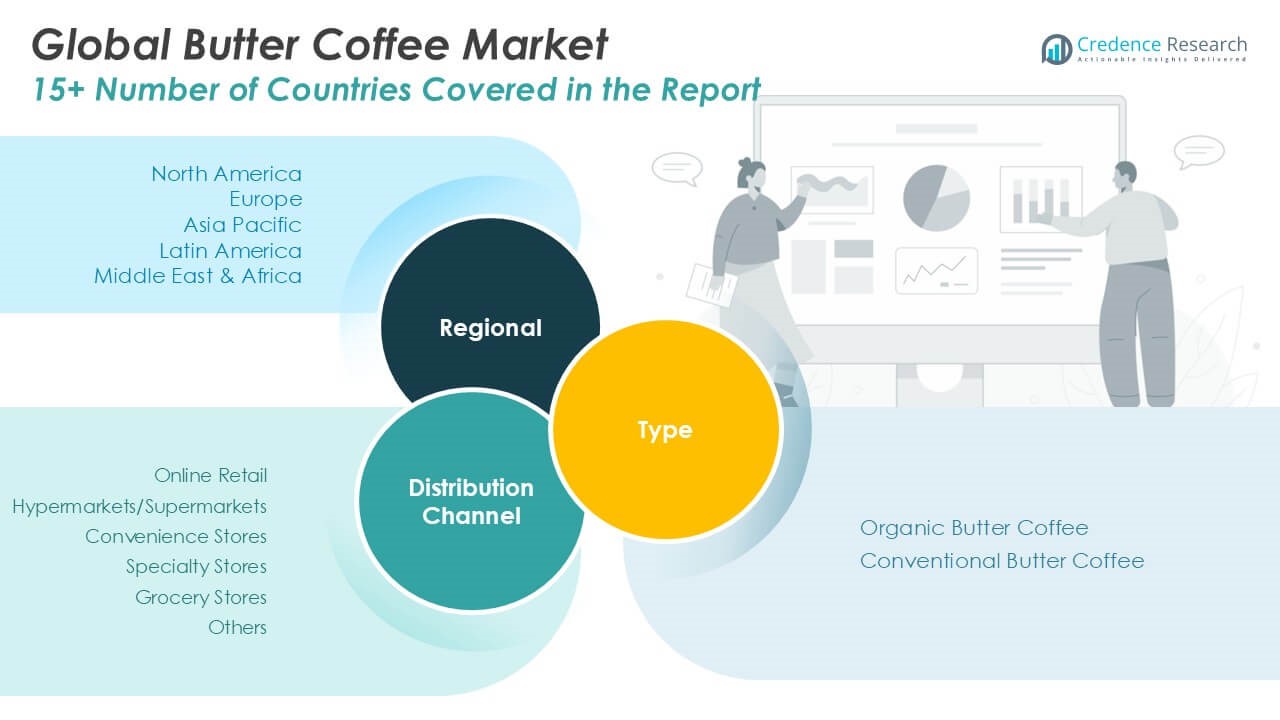
Market Segmentations:
By Type:
- Organic Butter Coffee
- Conventional Butter Coffee
By Distribution Channel:
- Online Retail
- Hypermarkets/Supermarkets
- Convenience Stores
- Specialty Stores
- Grocery Stores
- Others
By Geography:
- North America
- Europe
- Asia Pacific
- Latin America
- Middle East
- Africa
Competitive Landscape
The Butter Coffee market features a moderately fragmented competitive landscape with a mix of established players and emerging brands competing on product innovation, quality, and distribution reach. Leading companies such as Bulletproof Nutrition, Inc., Starbucks Corporation, Nestlé S.A., and Laird Superfood leverage strong brand equity and broad retail networks to maintain market presence. These players focus on expanding their product portfolios with organic, flavored, and ready-to-drink (RTD) variants to meet evolving consumer preferences. New entrants and niche brands, including Keto Coffee Company and High Brew Coffee, emphasize health-oriented formulations and direct-to-consumer strategies to capture targeted demographics. Collaborations with fitness influencers, digital marketing campaigns, and strategic partnerships with e-commerce platforms are common approaches to enhance brand visibility and consumer engagement. Mergers, acquisitions, and investments in R&D for clean-label and plant-based formulations also shape the competitive dynamics. The market is expected to witness further consolidation and product diversification as competition intensifies across global and regional markets.
Key Player Analysis
- Bulletproof Nutrition, Inc.
- Vital Proteins
- Laird Superfood
- Chameleon Cold-Brew
- Keto Coffee Company
- High Brew Coffee
- Black Rifle Coffee Company
- Blue Bottle Coffee
- Starbucks Corporation
- Nestlé S.A.
Recent Developments
- In July 2025, Laird Superfood expanded its functional coffee portfolio by launching Perform Whole Bean Coffee and Perform Decaf Coffee, both featuring functional mushrooms (chaga, lion's mane, maitake, cordyceps). While not explicitly branded as butter coffee, these products target the same health-conscious, functional beverage consumer. The company continues to offer butter-based creamers and is broadening its reach with new adaptogenic and organic offerings.
- In June 2025, Bulletproof launched a major rebrand, introducing all-new packaging across its entire coffee portfolio, including its butter coffee products. The rebrand features a new visual identity, benefit-driven language, and distinct packaging for its Artisan (taste-focused) and Enhanced (functional blends, including Butter Coffee Pods) lines. This move is aimed at appealing to a broader, health-conscious audience and reflects Bulletproof’s evolution from a niche “biohacker” brand to a mainstream functional coffee company.
- In June 2025, Starbucks began testing a new protein cold foam at select U.S. locations, including a banana-flavored version paired with iced lattes. This protein cold foam, which can add about 15 grams of protein to beverages, reflects Starbucks' broader push into protein-rich, functional beverages-a category that overlaps with the health-conscious appeal of butter coffee. However, there is no direct mention of Starbucks launching a traditional butter coffee (coffee blended with butter and oil), but this move signals the company’s interest in high-energy, functional coffee drinks that serve a similar consumer base.
Market Concentration & Characteristics
The Butter Coffee Market demonstrates moderate market concentration with a mix of established global brands and emerging niche players. It features strong participation from companies like Bulletproof Nutrition, Starbucks Corporation, Nestlé S.A., and Laird Superfood, which hold significant influence through widespread distribution and loyal customer bases. It is characterized by a high degree of product innovation, with brands introducing flavored, organic, and ready-to-drink options to cater to evolving consumer preferences. Demand is primarily driven by health-conscious individuals seeking energy-boosting beverages aligned with ketogenic and low-carb lifestyles. Online retail serves as a key distribution channel, supporting smaller brands in gaining visibility alongside major competitors. North America leads in market share due to early adoption and brand awareness, while Asia Pacific shows rapid growth potential. Consumer preference for clean-label and functional beverages continues to define product positioning. Pricing varies by formulation, with organic and specialty variants positioned at a premium. The competitive environment encourages continuous differentiation through ingredient sourcing, branding, and targeted digital marketing.
Report Coverage
The research report offers an in-depth analysis based on Type, Distribution Channel and Geography. It details leading market players, providing an overview of their business, product offerings, investments, revenue streams, and key applications. Additionally, the report includes insights into the competitive environment, SWOT analysis, current market trends, as well as the primary drivers and constraints. Furthermore, it discusses various factors that have driven market expansion in recent years. The report also explores market dynamics, regulatory scenarios, and technological advancements that are shaping the industry. It assesses the impact of external factors and global economic changes on market growth. Lastly, it provides strategic recommendations for new entrants and established companies to navigate the complexities of the market.
Future Outlook
- The butter coffee market will continue to grow steadily due to rising demand for functional and health-boosting beverages.
- Consumer preference for ketogenic and low-carb diets will drive sustained product adoption.
- Online retail channels will expand further, offering increased access and visibility for both established and emerging brands.
- Ready-to-drink butter coffee products will gain more popularity for their convenience and portability.
- Flavored and organic variants will attract health-conscious and younger consumers seeking personalized options.
- Asia Pacific will emerge as a high-growth region with increasing awareness of wellness-oriented products.
- Strategic partnerships and influencer-led marketing will remain vital for brand differentiation and customer engagement.
- Companies will invest in plant-based and dairy-free formulations to cater to vegan and lactose-intolerant consumers.
- Premium product pricing may challenge mass-market penetration in price-sensitive regions.
- Regulatory focus on health claims and labeling accuracy will increase, requiring compliance and transparency from manufacturers.
Request a Free Sample
Fill in your details and we'll send you a free sample report.
- Sample data tables & charts
- Research methodology
Need a Custom Version of This Report?
Tailor the scope, geography, or segments to your exact requirements.
- Custom geography or segment scope
- Direct access to our analyst team
Frequently Asked Questions
What is the current size of the Butter Coffee Market?
What factors are driving the growth of the Butter Coffee Market?
What are the key segments within the Butter Coffee Market?
What are some challenges faced by the Butter Coffee Market?
Who are the major players in the Butter Coffee Market?
Table of Content
Chapter 1. Report Introduction
- 1.1 Report Description & Purpose
- 1.1.1 Report Title & Market Definition
- 1.1.2 Unique Selling Propositions (USP) & Key Differentiators
- 1.1.3 Value Proposition for Stakeholders
- 1.2 Research Objectives
- 1.2.1 Market Sizing Objectives (Volume & Revenue) (Volume Where Applicable)
- 1.2.2 Segmentation Objectives
- 1.2.3 Competitive Intelligence Objectives
- 1.2.4 Forecast & Scenario Objectives
- 1.3 Report Scope
- 1.3.1 Butter Coffee Scope – Segments & Subsegments Covered
- 1.3.2 Geographic Scope – Regions & Countries Covered
- 1.3.3 Historical Period, Base Year & Forecast Period (2024; forecast to 2032)
- 1.3.4 Inclusions & Exclusions
- 1.4 Industry Classification & Applicable Codes
- 1.5 Currency, Measurement Units & Valuation Basis
- 1.6 Target Stakeholders
- 1.7 Limitations & Assumptions
Chapter 2. Executive Summary
- 2.1 Global Butter Coffee Market Snapshot
- 2.1.1 Market Size – Historical (2024) & Forecast (2024-2032) (2024: USD 949.58 million → 2032: USD 1,946.81 million)
- 2.1.2 Volume & Revenue – Global Totals (Volume Where Applicable)
- 2.1.3 Key Market Highlights – Top Five Facts
- 2.2 Butter Coffee Market Segmentation Snapshot
- 2.2.1 Market Split by Region – 2024 vs. 2032
- 2.3 Competitive Snapshot
- 2.3.1 Top 10 Players by Revenue Share – 2024
- 2.3.2 Top 10 Players by Volume Share – 2024 (Volume Where Applicable)
- 2.3.3 Recent Strategic Developments (18-Month Summary)
- 2.4 Key Investment Highlights & Strategic Conclusions
Chapter 3. Butter Coffee Market Dynamics & Industry Analysis
- 3.1 Market Overview & Context
- 3.1.1 Butter Coffee Market Position in the Broader Industry Value Chain
- 3.1.2 Demand Structure & Purchasing Dynamics
- 3.1.3 Market Maturity & Development Stage by Region
- 3.2 Butter Coffee Market Drivers
- 3.3 Butter Coffee Market Restraints & Challenges
- 3.4 Butter Coffee Market Opportunities
- 3.5 Porter's Five Forces Analysis
- 3.5.1 Threat of New Entrants
- 3.5.2 Bargaining Power of Suppliers
- 3.5.3 Bargaining Power of Buyers
- 3.5.4 Threat of Substitutes
- 3.5.5 Competitive Rivalry – Intensity Assessment
- 3.6 Butter Coffee Value Chain Analysis
- 3.6.1 Upstream – Key Inputs, Resources & Suppliers
- 3.6.1.1 Key Input/Resource 1
- 3.6.1.2 Key Input/Resource 2
- 3.6.1.3 Key Input/Resource 3
- 3.6.2 Midstream – Core Operations & Value Creation
- 3.6.2.1 Operating Model & Process Overview
- 3.6.2.2 Key Operating Locations & Capabilities by Company
- 3.6.3 Downstream – Market Channels & End Users
- 3.6.3.1 Direct Sales & Customer Engagement Channels
- 3.6.3.2 Indirect Sales, Intermediaries & Partner Channels
- 3.6.4 Value Chain Profitability Analysis
- 3.6.1 Upstream – Key Inputs, Resources & Suppliers
- 3.7 PESTEL Analysis
- 3.7.1 Political Factors
- 3.7.2 Economic Factors
- 3.7.3 Social Factors
- 3.7.4 Technological Factors
- 3.7.5 Environmental Factors
- 3.7.6 Legal Factors
- 3.8 Butter Coffee Supply Chain Analysis
- 3.8.1 Critical Input & Resource Availability Risk Assessment
- 3.8.2 Supplier & Operational Concentration Risk (Geographic Exposure)
- 3.8.3 Supply & Service Disruption Impact Analysis
- 3.9 Regulatory & Policy Landscape
Note: The regulatory and policy landscape section covers regulations based on their applicability to the market, Butter Coffee category, geography, and scope of the study. Only regulatory frameworks with a material impact on operations, compliance, trade, sustainability, or market access are analyzed in detail.
Chapter 4. Key Investment Pockets & Opportunity Analysis
- 4.1 Butter Coffee Market Attractiveness Analysis
- 4.1.1 By Region – Investment Attractiveness Matrix (Market Size × CAGR)
- 4.2 Absolute Revenue Growth Opportunity
- 4.2.1 By Region – Absolute Revenue Growth Through 2032
- 4.3 Incremental Demand Opportunity
- 4.3.1 By Region – Incremental Demand Through 2032
- 4.3.2 Segment – Incremental Demand
- 4.4 Emerging Submarket Opportunity Deep Dive (Subject to Applicability)
- 4.5 Priority Market Opportunity Scorecards
- 4.5.1 United States
- 4.5.2 Europe
- 4.5.3 Asia
- 4.5.4 Middle East & Africa
Note: Priority market opportunity scorecards reflect the geographic scope and strategic relevance of the study. Listed markets are indicative and may be adapted to the industry.
Chapter 5. Butter Coffee Cross-Border Trade & Market Access Analysis
- 5.1 International Trade & Cross-Border Activity Overview
- 5.1.1 Global Export Value by Country (2024)
- 5.1.2 Global Export Volume by Country (2024) (Volume Where Applicable)
- 5.1.3 Global Import Value by Country (2024)
- 5.1.4 Global Import Volume by Country (2024) (Volume Where Applicable)
- 5.1.5 Net Trade Balance by Country (2024)
- 5.2 Export Analysis – Segment
- 5.2.1 Category 1 (Applicable Classification Code)
- 5.2.2 Category 2 (Applicable Classification Code)
- 5.2.3 Category 3 (Applicable Classification Code)
- 5.2.4 Category 4 (Applicable Classification Code)
- 5.2.5 Category 5 (Applicable Classification Code)
- 5.3 Import Analysis – Segment
- 5.3.1 Category 1 (Applicable Classification Code)
- 5.3.2 Category 2 (Applicable Classification Code)
- 5.3.3 Category 3 (Applicable Classification Code)
- 5.3.4 Category 4 (Applicable Classification Code)
- 5.3.5 Category 5 (Applicable Classification Code)
- 5.4 Cross-Border Pricing & Transaction Benchmarks
- 5.4.1 Export Pricing – Segment & Country
- 5.4.2 Import Pricing – Segment & Source Country
- 5.4.3 Price Trends (2024)
- 5.5 Key Cross-Border Trade & Delivery Routes
- 5.5.1 Cross-Border Trade/Delivery Route 1
- 5.5.2 Cross-Border Trade/Delivery Route 2
- 5.5.3 Cross-Border Trade/Delivery Route 3
- 5.5.4 Cross-Border Trade/Delivery Route 4
- 5.5.5 Cross-Border Trade/Delivery Route 5
- 5.6 Trade Policy & Market Access Impact Assessment
- 5.6.1 Tariff & Non-Tariff Barriers
- 5.6.2 Regional Trade & Economic Integration Frameworks
- 5.6.3 Bilateral & Multilateral Trade Agreements
- 5.6.4 Cross-Border Operating, Licensing & Localization Requirements
Note: This chapter applies where cross-border trade or delivery is relevant to Butter Coffee. Goods, services, and digital offerings are assessed using applicable classifications and transaction measures. Import-export volumes, trade balances, and route analyses are included only where meaningful to the market.
Chapter 6. Competitive Landscape & Company Benchmarking
- 6.1 Butter Coffee Market Concentration & Structure
- 6.1.1 Herfindahl-Hirschman Index (HHI) – vs. 2024
- 6.1.2 Leading, Mid-Sized & Emerging Player Structure
- 6.1.3 Global, Regional & Local Player Dynamics
- 6.2 Butter Coffee Market Share Analysis – 2024
- 6.2.1 Global Revenue Share by Company
- 6.2.2 Global Volume Share by Company (Volume Where Applicable)
- 6.2.3 Regional Revenue Share
- 6.2.4 Market Share Evolution ( vs. 2024)
- 6.2.5 Company Market Share by Key Segment
- 6.2.6 Company Market Share by Customer Group
- 6.3 Operating Scale, Capacity & Infrastructure Analysis
- 6.3.1 Global Operating Scale & Supply Capacity
- 6.3.2 Resource Utilization & Operating Efficiency
- 6.3.3 Output, Service Delivery & Activity Metrics
- 6.3.4 Operating Footprint & Infrastructure Map
- 6.3.5 Planned Operational & Capacity Expansion
- 6.4 Butter Coffee Competitive Benchmarking Matrix
- 6.4.1 Revenue, Growth, Profitability & Operating Metric Comparison
- 6.4.2 Channel Revenue Mix
- 6.4.3 Geographic Revenue Exposure
- 6.4.4 R&D Intensity
- 6.4.5 Sustainability Maturity
- 6.5 Strategic Developments in Butter Coffee (Last 24 Months)
- 6.5.1 Mergers, Acquisitions & Divestments
- 6.5.2 New Products, Services & Solutions in Butter Coffee
- 6.5.3 Operational & Infrastructure Expansions
- 6.5.4 Strategic Alliances, Joint Ventures & Partnerships
- 6.5.5 Distribution Expansion & Market Entry
- 6.5.6 Sustainability & ESG Initiatives
- 6.6 Competitive Strategy Mapping
- 6.6.1 Leader, Challenger, Follower & Niche Classification
- 6.6.2 Pricing Strategy Comparison
- 6.6.3 Channel Strategy Matrix
Note: Strategic developments are included based on their materiality and the availability of reliable information.
Chapter 7. Global Butter Coffee Market – By Sales & Delivery Channel
- 7.1 Segment Overview
- 7.1.1 Volume & Revenue Split by Channel (2024 & 2032) (Volume Where Applicable)
- 7.1.2 Channel Mix Evolution (2024-2032)
Chapter 8. Regional Market Analysis – Global Overview
- 8.1 Global Regional Overview
- 8.1.1 Regional Volume Share (Volume Where Applicable)
- 8.1.2 Regional Revenue Share
- 8.1.3 Regional Volume by Region (Volume Where Applicable)
- 8.1.4 Regional Revenue by Region
- 8.1.5 Regional Forecast Through 2032
- 8.2 Cross-Regional Segment Analysis
- 8.2.1 By Sales & Delivery Channel
- 8.2.2 By Competitive Positioning & Price Tier
Chapter 9. North America Butter Coffee Market
- 9.1 United States
- 9.2 Canada
- 9.3 Mexico
Chapter 10. Europe Butter Coffee Market
- 10.1 Germany
- 10.2 France
- 10.3 Italy
- 10.4 United Kingdom
- 10.5 Spain
- 10.6 Poland
- 10.7 Russia
- 10.8 Netherlands
- 10.9 Belgium
- 10.10 Sweden
- 10.11 Denmark
- 10.12 Norway
- 10.13 Rest of Europe
Chapter 11. Asia Pacific Butter Coffee Market
- 11.1 China
- 11.2 India
- 11.3 Japan
- 11.4 South Korea
- 11.5 Thailand
- 11.6 Indonesia
- 11.7 Vietnam
- 11.8 Malaysia
- 11.9 Australia
- 11.10 Rest of Asia Pacific
Chapter 12. Latin America Butter Coffee Market
- 12.1 Brazil
- 12.2 Argentina
- 12.3 Colombia
- 12.4 Chile
- 12.5 Rest of Latin America
Chapter 13. Middle East Butter Coffee Market
- 13.1 Saudi Arabia
- 13.2 United Arab Emirates
- 13.3 Turkey
- 13.4 Israel
- 13.5 Iran
- 13.6 Rest of the Middle East
Chapter 14. Africa Butter Coffee Market
- 14.1 South Africa
- 14.2 Egypt
- 14.3 Nigeria
- 14.4 Morocco
- 14.5 Rest of Africa
Chapter 15. Butter Coffee Company Profiles
- 15.1 [Company 01]
- 15.1.1 Company Overview
- 15.1.2 Key Management Personnel
- 15.1.3 Products & Services Portfolio
- 15.1.4 Financial Performance
- 15.1.5 Key Market Focus & Geographic Presence
- 15.1.6 Recent Developments & Strategic Initiatives
Note: The company profile list is preliminary and may change based on research findings, market developments, data availability, and client requirements.
Chapter 16. Appendices
- Appendix A – List of Abbreviations & Acronyms
- Appendix B – Industry Classification Code Reference – Full Series
- Appendix C – Supply, Output & Operating Capacity Data Tables
- Appendix D – End-Use & Demand Base Tables
- Appendix E – Demand, Adoption & Usage Assumptions
- Appendix F – Pricing & Revenue Metric Reference Tables
- Appendix G – Company Operations & Infrastructure Database
- Appendix H – Cross-Border Trade & Activity Data Tables (Where Applicable)
- Appendix I – Regulatory Summary Tables
- Appendix J – Primary Research Participant List (Anonymized)
- Appendix K – Primary Research Questionnaire Framework
- Appendix L – Data Sources & Bibliography
- Appendix M – Market Size Divergence & Source Comparison
Chapter 17. Research Methodology
- 17.1 Research Framework & Philosophy
- 17.2 Secondary Research – Sources, Hierarchy & Data Extraction
- 17.3 Data Modeling – Bottom-Up & Top-Down Market Sizing
- 17.4 Primary Research – Stakeholder Framework, LOI & Sample Sizes
- 17.5 Forecast Methodology – Regression, Scenario & Sensitivity Analysis
- 17.6 Quality Control – Four-Layer Validation Framework
- 17.7 Limitations & Standard Assumptions
- 17.8 Disclaimer
