| REPORT ATTRIBUTE | DETAILS |
|---|---|
| Historical Period | 2020-2023 |
| Base Year | 2024 |
| Forecast Period | 2025-2032 |
| Asian Sauces Dressings And Condiments Market Size 2024 | USD 61,846.73 Million |
| Asian Sauces Dressings And Condiments Market, CAGR | 5.92% |
| Asian Sauces Dressings And Condiments Market Size 2032 | USD 97,980.70 Million |
Market Overview
The Asian Sauces Dressings And Condiments Market is projected to grow from USD 61,846.73 million in 2024 to an estimated USD 97,980.70 million by 2032, with a compound annual growth rate (CAGR) of 5.92% from 2025 to 2032. This steady growth reflects the increasing demand for diverse and authentic Asian culinary products across the globe.
The market is driven by several key factors, including the growing popularity of ethnic cuisines, especially among younger consumers seeking new and exciting taste experiences. Increasing awareness of Asian culture through media, tourism, and social platforms has also heightened demand. Additionally, the trend of health-conscious eating has influenced product innovation, with many companies introducing low-sodium, organic, and preservative-free sauces, dressings, and condiments. Moreover, the increasing prevalence of online retailing is making these products more accessible to consumers worldwide.
Geographically, the Asian Sauces, Dressings, and Condiments Market exhibits strong growth potential in regions such as Asia Pacific, North America, and Europe. Countries like China, Japan, and India lead the market in production and consumption, while the rising popularity of Asian food in Western countries contributes significantly to market growth. Key players in the market include companies like Kikkoman Corporation, Nestlé S.A., and Unilever, who continue to drive product innovation and expand their market presence globally.
Market Insights
- The Asian Sauces, Dressings, and Condiments Market is projected to grow from USD 61,846.73 million in 2024 to USD 97,980.70 million by 2032, with a CAGR of 5.92% from 2025 to 2032.
- The market's growth is fueled by the rising demand for diverse and authentic Asian culinary products across the globe, driven by globalization and the increasing popularity of Asian cuisine.
- Health-conscious consumer preferences are influencing product innovations, including low-sodium, organic, and preservative-free sauces, dressings, and condiments.
- The increasing popularity of ethnic cuisines, especially among younger consumers, is a key driver of the market, as they seek new and exciting taste experiences.
- The growth of online retailing is enhancing the accessibility of Asian sauces, dressings, and condiments, contributing to a broader market reach.
- Regional growth is particularly strong in Asia Pacific, North America, and Europe, with China, Japan, and India leading in both production and consumption.
- Major market players like Kikkoman Corporation, Nestlé S.A., and Unilever continue to drive product innovation and expand their global market presence.
Market Drivers
Increasing Demand for Authentic and Ethnic Flavors
The Asian sauces, dressings, and condiments market is experiencing robust growth driven by the global appetite for authentic and ethnic flavors. As culinary preferences diversify, consumers are increasingly exploring Asian cuisines such as Chinese, Japanese, Korean, and Thai. This trend has led to a surge in demand for traditional Asian sauces like soy sauce, teriyaki sauce, hoisin sauce, and chili-based condiments. These products are now staples in households and restaurants worldwide, reflecting a cultural shift toward embracing exotic flavors. The demand is particularly strong in regions outside Asia, such as North America and Europe, where consumers are eager to experiment with new taste experiences. Manufacturers are responding by introducing innovative products that make these flavors accessible to a wider audience. For instance, ready-to-use sauces and specialized condiments cater to the convenience-driven needs of modern consumers while preserving authenticity. The growing popularity of fusion cuisines further amplifies the demand for Asian-inspired products, showcasing their versatility across diverse culinary applications. This evolution in consumer tastes underscores the importance of cultural integration in the food industry, positioning Asian sauces as a vital component of global gastronomy
Rising Popularity of Health-Conscious and Clean Label Products
The market for Asian sauces and condiments is increasingly shaped by the growing demand for health-conscious and clean-label products. Surveys from companies and government authorities reveal that a significant number of consumers now prioritize food items free from artificial additives, preservatives, and excessive sodium or sugar, reflecting a broader shift toward healthier eating habits. For instance, clean-label foods are becoming an "everyday expectation," with consumers seeking transparency in ingredient sourcing and production methods. This trend has driven innovation in the sector, with manufacturers introducing options such as low-sodium soy sauce, gluten-free tamari, and organic vegan sauces. Government policies in regions like Malaysia and Singapore further support this movement by encouraging reformulation of products to meet strictfstandards. Initiatives like Malaysia's Healthier Choice Logo (HCL) promote reduced sodium and sugar levels in condiments, aligning with global health guidelines. Additionally, advancements in technology, such as QR codes on packaging, enable brands to communicate ingredient transparency effectively. These developments not only cater to health-conscious consumers but also expand the appeal of Asian sauces to new demographics focused on ethical and sustainable eating practices. The clean-label movement continues to drive product diversification and reshape the condiment market globally.
Expansion of Global Fast-Casual and Asian Restaurant Chains
The rapid growth of fast-casual and Asian restaurant chains is another significant driver for the Asian sauces, dressings, and condiments market. As more consumers opt for dining out, especially in urban areas, restaurants are incorporating Asian-inspired dishes into their menus to meet the evolving tastes of consumers. Global food chains like Panda Express, Wagamama, and others specializing in Asian cuisine have seen strong growth and have contributed to the increased demand for authentic sauces and condiments. Furthermore, these chains often feature signature sauces and dressings as part of their offerings, creating a direct consumer demand for these products. The rise of food delivery services and the increasing popularity of takeout also play a role in driving the demand for ready-to-use sauces and condiments. As more consumers seek convenience and flavorful options, this trend is expected to continue, providing a boost to the market for Asian sauces, dressings, and condiments.
Growing Interest in Home Cooking and DIY Food Preparations
The growing trend of home cooking, accelerated by the COVID-19 pandemic, has also played a pivotal role in driving the Asian sauces, dressings, and condiments market. As people spend more time at home, they have become more interested in experimenting with cooking and preparing restaurant-style meals in their kitchens. Asian sauces and condiments, which are key to creating authentic Asian dishes, are now readily available in supermarkets and online platforms, allowing home cooks to replicate restaurant-quality meals with ease. This shift in consumer behavior has led to an increase in the retail sales of Asian sauces, dressings, and condiments. Moreover, cooking tutorials, food blogs, and social media platforms have fueled the desire to recreate exotic dishes, further promoting the demand for specific Asian sauces and condiments. As a result, this trend of DIY food preparation, which is expected to continue, provides a strong growth trajectory for the Asian sauces market, with home cooks looking for a variety of sauces and dressings to elevate their meals.
Market Trends
Growth of Plant-Based and Vegan Options
One of the most significant trends in the Asian sauces, dressings, and condiments market is the growing demand for plant-based and vegan products. This trend is driven by the increasing number of consumers adopting plant-based diets and seeking ethical and sustainable food choices. As more people turn to vegetarian, vegan, and flexitarian lifestyles, they are looking for condiments and sauces that align with their dietary preferences. Traditional Asian sauces like soy sauce, hoisin sauce, and teriyaki sauce are being adapted to meet these needs, with a focus on plant-based ingredients that do not compromise on flavor. For instance, many brands are introducing vegan versions of popular sauces, replacing animal-derived ingredients like fish sauce or oyster sauce with plant-based alternatives. This trend is also reflected in the rise of organic and non-GMO options in the market. The growing consumer awareness of health and environmental impacts associated with animal products has propelled the development of plant-based condiments and sauces. As more consumers seek plant-based, dairy-free, and gluten-free options, this shift is reshaping the market landscape and driving manufacturers to innovate and expand their product offerings.
Fusion and Globalization of Flavors
The fusion of Asian flavors with Western and other regional cuisines is another notable trend in the market. Globalization has led to an increased interest in cross-cultural food experiences, resulting in the blending of traditional Asian sauces, dressings, and condiments with local flavors. This trend is particularly evident in the growing popularity of Asian fusion restaurants, which incorporate ingredients like sriracha, miso, and sesame oil into Western-style dishes such as burgers, pizzas, and salads. For instance, soy sauce is now being used as a marinade for meats in Western barbecue dishes, while teriyaki sauce is finding its way into sandwiches and wraps. This fusion of flavors has not only led to the creation of new hybrid dishes but has also increased the demand for Asian-inspired condiments in a wider range of culinary settings. The appeal of these fusion flavors is not just confined to restaurants but is also influencing consumer behavior in home kitchens. As people become more adventurous in their cooking, they are increasingly experimenting with combining Asian sauces and dressings with non-Asian ingredients to create unique flavor profiles. This trend has spurred innovation in the market, with manufacturers developing new sauces that combine the bold flavors of Asia with local tastes to cater to a diverse and evolving consumer base.
Premium and Artisanal Products
The increasing consumer preference for high-quality, premium, and artisanal food products is another key trend in the Asian sauces, dressings, and condiments market. Consumers are becoming more discerning about the provenance and quality of the products they purchase, often opting for smaller, craft brands that emphasize authenticity, high-quality ingredients, and traditional production methods. This trend is particularly evident in the market for soy sauce, where consumers are willing to pay a premium for artisanal, small-batch, and traditionally brewed options. Similarly, other sauces like chili pastes, miso, and vinegar-based condiments are being marketed as premium, highlighting their authentic production processes, such as fermentation or handcrafting. In addition to the growing interest in artisanal products, there is also a demand for sauces and condiments made with organic or non-GMO ingredients, which are perceived as healthier and more sustainable. As a result, many premium and artisanal brands are focusing on transparency, labeling their products with clear ingredient lists and information on production practices to appeal to health-conscious consumers. This shift toward premium products is not limited to high-end retailers but is also being seen in mainstream grocery stores, where consumers are increasingly willing to pay more for high-quality, flavorful sauces and condiments that promise a more authentic and distinctive taste experience.
E-commerce and Online Retail Growth
The rapid growth of e-commerce and online retail channels is significantly influencing the Asian sauces, dressings, and condiments market. With the increasing shift toward online shopping, especially following the COVID-19 pandemic, consumers are now more inclined to purchase sauces, dressings, and condiments through digital platforms, rather than traditional brick-and-mortar stores. This trend is not only driven by convenience but also by the vast array of choices available online, where consumers can explore a broader range of global and niche Asian products that may not be available in local supermarkets. E-commerce platforms like Amazon, specialty food retailers, and dedicated Asian grocery stores online have become crucial channels for both established brands and new, independent producers. Moreover, online platforms allow for the easy comparison of prices, product ingredients, and reviews, which helps consumers make more informed purchasing decisions. Social media and influencer marketing are also playing a significant role in this trend, with food bloggers and influencers showcasing unique and hard-to-find Asian sauces and condiments, further driving demand. Additionally, online shopping offers the benefit of bulk purchasing, which appeals to consumers who enjoy cooking at home regularly or those looking to stock up on their favorite Asian sauces. As e-commerce continues to evolve, the convenience, variety, and accessibility of online retail are expected to further fuel the growth of the market.
Market Challenges
Cultural and Regional Flavor Variation
Another significant challenge in the Asian sauces, dressings, and condiments market is the need to cater to the diverse taste preferences across different regions. Asian cuisines are incredibly varied, with different countries and even regions within countries having unique tastes, ingredients, and cooking methods. For instance, while soy sauce may be a staple in Japan, the flavor profile of Chinese soy sauce can vary significantly, and even more so with Korean or Thai versions. Additionally, consumers in Western countries may prefer milder, less salty sauces compared to traditional Asian versions. This diversity in regional and cultural flavor profiles poses a challenge for manufacturers who need to balance authenticity with local taste preferences. Expanding into global markets requires product adaptation to meet consumer expectations without compromising the authenticity and quality of the product. Striking this balance between traditional Asian flavors and local adaptations while maintaining the essence of the product is crucial for success in international markets.
Supply Chain Disruptions and Ingredient Sourcing Issues
One of the pressing challenges in the Asian sauces, dressings, and condiments market is supply chain disruptions, particularly in sourcing essential ingredients. Many of these products rely on specialty ingredients such as soybeans, rice, and spices, which are often grown in specific regions. For instance, adverse weather conditions or trade restrictions can significantly impact the availability of these raw materials. Additionally, logistical hurdles like shipping delays and rising transportation costs have further complicated ingredient procurement. The COVID-19 pandemic underscored these vulnerabilities by disrupting global trade routes and increasing operational costs for manufacturers. In response, companies are exploring alternative sourcing strategies, such as diversifying suppliers across regions to mitigate risks. They are also investing in long-term partnerships with suppliers to ensure consistent quality and availability of ingredients. Furthermore, some manufacturers are reformulating their products to reduce reliance on high-cost or scarce ingredients. These efforts aim to maintain product availability and competitive pricing in a market where consumers are increasingly price-sensitive. Addressing these supply chain challenges is crucial for manufacturers to sustain profitability while meeting consumer expectations for quality and affordability in this dynamic market.
Market Opportunities
Expansion in Emerging Markets
A significant opportunity for growth in the Asian sauces, dressings, and condiments market lies in the expansion into emerging markets, particularly in regions like Latin America, Africa, and the Middle East. As global urbanization increases and middle-class populations rise in these areas, there is a growing demand for diverse and flavorful food products. The adoption of Asian cuisines in these regions is steadily gaining traction, driven by changing consumer preferences and exposure to international food cultures. As more consumers experiment with cooking and dining out, the demand for authentic and affordable Asian sauces and condiments is expected to rise. Companies can capitalize on this trend by strategically entering these markets with tailored products that cater to local tastes, while leveraging the increasing popularity of Asian cuisine as a means to drive consumer interest. Additionally, these markets offer opportunities for both large multinational food brands and smaller, specialized manufacturers to expand their reach and establish a presence in regions with rising disposable incomes.
Innovation in Health-Conscious and Functional Products
Another promising opportunity in the Asian sauces, dressings, and condiments market lies in the growing demand for health-conscious and functional food products. Consumers are increasingly prioritizing healthier eating habits and looking for sauces and condiments that align with their dietary needs, such as low-sodium, gluten-free, or organic options. As a result, there is significant room for innovation in creating healthier alternatives to traditional sauces, dressings, and condiments without compromising on flavor. Manufacturers can leverage this opportunity by developing products that cater to specific health trends, such as keto, vegan, or paleo diets, and promote the nutritional benefits of their offerings. This approach can attract a wider range of health-conscious consumers and expand the market’s appeal.
Market Segmentation Analysis
By Product Type:
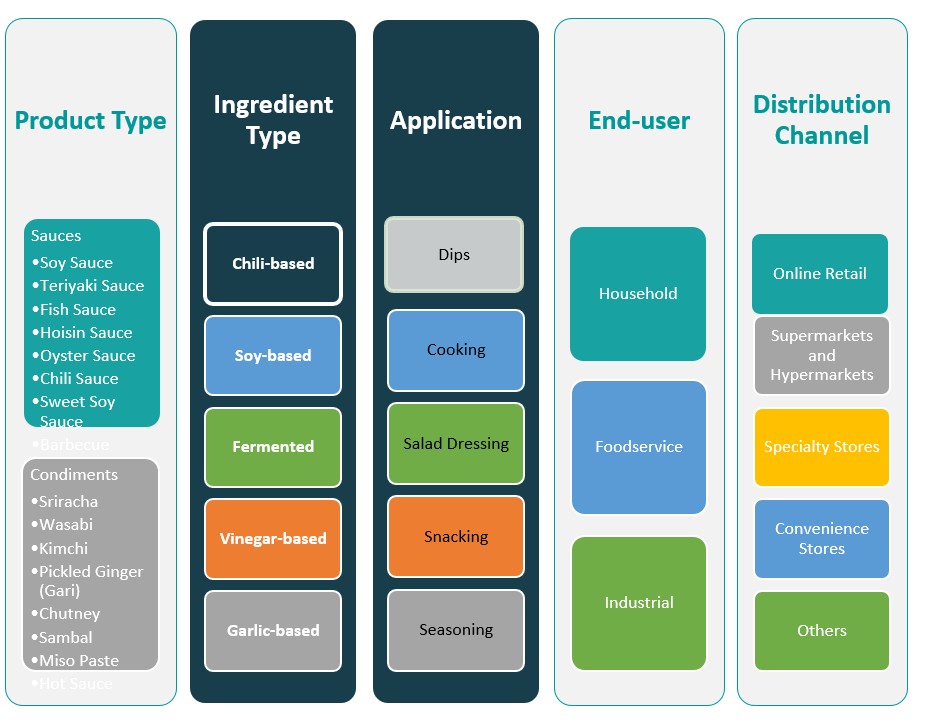
The market can be categorized into sauces and condiments. The sauces segment includes well-known varieties such as soy sauce, teriyaki sauce, fish sauce, hoisin sauce, oyster sauce, chili sauce, sweet soy sauce, barbecue sauce, and satay sauce. These sauces are essential in adding rich, authentic flavors to various dishes. The condiments segment includes products like sriracha, wasabi, kimchi, pickled ginger (gari), chutney, sambal, miso paste, and hot sauce. Condiments serve as both flavor enhancers and accompaniments to meals, contributing to the growing demand for diverse and bold flavors in global cuisines.
By Application:
The application segment is divided into dips, cooking, salad dressings, snacking, and seasoning. Cooking accounts for the largest share, as sauces and condiments are fundamental ingredients in preparing a variety of dishes. Dips and snacking are also growing applications, particularly with the increasing popularity of Asian-inspired snacks and appetizers. Salad dressings and seasoning are witnessing growing demand due to the preference for healthier eating and the incorporation of exotic flavors into everyday meals.
Segments
Based on Product Type
- Sauces
- Soy Sauce
- Teriyaki Sauce
- Fish Sauce
- Hoisin Sauce
- Oyster Sauce
- Chili Sauce
- Sweet Soy Sauce
- Barbecue Sauce
- Satay Sauce
- Condiments
- Sriracha
- Wasabi
- Kimchi
- Pickled Ginger (Gari)
- Chutney
- Sambal
- Miso Paste
- Hot Sauce
Based on Application
- Dips
- Cooking
- Salad Dressing
- Snacking
- Seasoning
Based on End User
- Household
- Foodservice
- Industrial
Based on Ingredient Type
- Chili-based
- Soy-based
- Fermented
- Vinegar-based
- Garlic-based
Based on Distribution channel
- Online Retail
- Supermarkets and Hypermarkets
- Specialty Stores
- Convenience Stores
- Others
Based on Region
- North America
- Europe
- Latin America
- Middle East & Africa
Regional Analysis
Asia-Pacific (50-55%)
The Asia-Pacific region holds the largest market share, accounting for approximately 50-55% of the global market. This dominance is driven by the region's strong cultural connection to Asian cuisines, where sauces and condiments are integral components of daily meals. Countries like China, Japan, South Korea, and India are the primary consumers of a variety of Asian sauces and condiments. The high consumption of soy sauce, fish sauce, chili-based condiments, and other regional specialties propels the market growth in this area. Additionally, the rapid urbanization and increasing disposable incomes in emerging economies like India and Southeast Asia are expanding the middle class, which further boosts the demand for both traditional and modern Asian sauces and condiments. The APAC region also serves as the production hub for these products, with many leading manufacturers based in countries such as Japan, China, and South Korea.
North America (25-30%)
North America holds a significant market share of around 25-30%, driven primarily by the increasing popularity of Asian cuisine and the growing consumer interest in ethnic flavors. The rise in the number of Asian restaurants and food chains, along with the expansion of Asian culinary experiences in the region, is positively impacting the market for sauces, dressings, and condiments. U.S. consumers are becoming more adventurous with their taste profiles, embracing bold flavors like sriracha, soy sauce, and miso. The trend of home cooking, which accelerated during the COVID-19 pandemic, also supports the demand for these products. The increasing availability of Asian sauces and condiments in supermarkets and online retail channels is further fueling market growth.
Key players
- Kikkoman Corporation
- Thai Union Group
- Unilever
- Nestlé
- Amoy
Competitive Analysis
The Asian sauces, dressings, and condiments market is highly competitive, with key players continually innovating to cater to consumer preferences for diverse and authentic flavors. Kikkoman Corporation maintains a strong presence globally, offering a wide range of traditional sauces, including soy sauce and teriyaki. Their focus on product authenticity and quality has helped secure a leading position in the market. Thai Union Group, with its diversified portfolio, has made significant strides in offering Asian-inspired condiments alongside its seafood-based products. Unilever and Nestlé, both established multinational companies, leverage their vast distribution networks and brand recognition to offer a variety of sauces and dressings. Their scale and resources allow them to cater to a broad range of consumer needs, from everyday condiments to premium offerings. Amoy, known for its authentic Chinese sauces, continues to be a strong player in the market by focusing on providing high-quality, easy-to-use sauces for home cooking. These companies, with their robust product offerings and strategic market positioning, continue to drive growth in the competitive landscape.
Recent Developments
- In April 2024, Kikkoman announced plans for a new production facility in Jefferson, Wisconsin, with an investment of approximately $560 million, aiming to support its growing soy sauce business in North America.
- In 2024, Thai Union Group 's sustainability efforts were recognized when it was ranked number one in the food products industry at the 2024 AmCham Corporate Social Impact Awards.
Market Concentration and Characteristics
The Asian Sauces, Dressings, and Condiments Market exhibits moderate market concentration, with a mix of global food giants and regional players competing for market share. Large multinational companies like Kikkoman Corporation, Unilever, Nestlé, and Thai Union Group dominate the market, leveraging their extensive distribution networks, strong brand recognition, and product diversification to maintain a competitive edge. However, regional brands, such as Amoy, are also prominent, particularly in their home markets, where they focus on authenticity and high-quality offerings. The market is characterized by a broad product variety, ranging from traditional, authentic Asian sauces to innovative, health-conscious, and fusion options. Increasing consumer demand for ethnic flavors, premium products, and healthier alternatives is driving innovation and product differentiation. Despite the strong presence of major players, the market remains fragmented due to the growing number of local and artisanal brands catering to specific tastes and dietary preferences.
Report Coverage
The research report offers an in-depth analysis based on Product Type, Application, End User, Ingredient Type, Distribution channel and Region. It details leading market players, providing an overview of their business, product offerings, investments, revenue streams, and key applications. Additionally, the report includes insights into the competitive environment, SWOT analysis, current market trends, as well as the primary drivers and constraints. Furthermore, it discusses various factors that have driven market expansion in recent years. The report also explores market dynamics, regulatory scenarios, and technological advancements that are shaping the industry. It assesses the impact of external factors and global economic changes on market growth. Lastly, it provides strategic recommendations for new entrants and established companies to navigate the complexities of the market.
Future Outlook
- The demand for Asian sauces and condiments will grow significantly in emerging markets like India, Latin America, and Africa, driven by increasing exposure to Asian cuisines. Rising disposable incomes and urbanization will further contribute to this growth.
- There will be an increasing shift towards healthier alternatives, with more consumers seeking low-sodium, gluten-free, organic, and plant-based options. This trend will fuel innovation in product development to cater to the growing demand for functional and clean-label products.
- Fusion cuisine combining Asian flavors with Western dishes will continue to drive demand for diverse condiments. Consumers will increasingly embrace bold and exotic flavors in their everyday meals, further expanding the market for Asian sauces and dressings.
- Consumers will place higher value on premium, artisanal sauces that highlight authentic ingredients and traditional production methods. As the demand for quality over quantity grows, premium offerings will see increased adoption in both retail and foodservice sectors.
- The continued rise of online shopping, accelerated by the COVID-19 pandemic, will make Asian sauces more accessible to consumers globally. E-commerce platforms will become key distribution channels for brands to reach a wider audience.
- As more consumers adopt plant-based diets, the demand for vegan and plant-based Asian sauces and condiments will increase. Companies will innovate to offer vegan-friendly products without compromising on taste and authenticity.
- Consumers will increasingly prioritize sustainability in their food choices, prompting manufacturers to adopt eco-friendly practices. Ethical sourcing of ingredients like soybeans and fish will be a key factor in winning consumer trust and loyalty.
- To cater to diverse consumer tastes, companies will focus on creating region-specific products with tailored flavors. Brands will prioritize understanding local preferences while maintaining the authenticity of their offerings.
- The power of social media and food influencers will continue to shape consumer buying decisions. Online recipes and cooking tutorials featuring Asian condiments will boost product visibility and sales.
- Advancements in food technology, including fermentation and flavor enhancement processes, will enable manufacturers to improve the consistency and quality of their products. These innovations will also lead to faster production and reduced costs.

Request a Free Sample
Fill in your details and we'll send you a free sample report.
- Sample data tables & charts
- Research methodology
Market Dynamics
Globalization and Popularity of Asian Cuisine
The increasing exposure to Asian cuisines through travel, media, and multicultural urban centers has driven demand for authentic Asian sauces, dressings, and condiments in both Western and emerging markets.
Health-Conscious and Clean Label Product Innovation
Rising consumer preference for low-sodium, organic, preservative-free, and plant-based options is prompting manufacturers to innovate, expanding the market to health-focused and ethically minded consumers.
Expansion of Fast-Casual and Asian Restaurant Chains
The proliferation of Asian and fusion restaurant chains globally, along with the growth of food delivery and takeout, is boosting demand for authentic and ready-to-use Asian sauces and condiments.
Growth of E-commerce and Online Retail
The shift toward online shopping, accelerated by the pandemic, has made a wider variety of Asian sauces and condiments accessible to global consumers, supporting market expansion beyond traditional retail channels.
Home Cooking and DIY Food Trends
Increased interest in home cooking, fueled by social media and cooking tutorials, has led consumers to experiment with Asian flavors at home, driving retail sales of sauces and condiments for household use.
Need a Custom Version of This Report?
Tailor the scope, geography, or segments to your exact requirements.
- Custom geography or segment scope
- Direct access to our analyst team
Frequently Asked Questions
What is the market size of the Asian Sauces, Dressings, and Condiments Market in 2023 and 2032?
What are the key drivers of the Asian Sauces, Dressings, and Condiments Market?
How is the trend of health-conscious eating affecting the market?
Which regions are showing strong growth in the Asian Sauces, Dressings, and Condiments Market?
Who are the key players in the Asian Sauces, Dressings, and Condiments Market?
Table of Content
Chapter 1 Market Segmentation
- 1.1 Segmentation Framework
- 1.1.1 Product and Service Classification
- 1.1.2 Application and End-Use Classification
- 1.1.3 Technology and Solution Classification
- 1.1.4 Customer and Distribution Channel Classification
- 1.1.5 Geographic Segmentation
- 1.1.6 Market Segment Definitions and Boundaries
- 1.2 By End User
- 1.2.1 Household
- 1.2.2 Foodservice
- 1.2.3 Industrial
- 1.3 By Application
- 1.3.1 Cooking
- 1.3.2 Dips
- 1.3.3 Salad Dressing
- 1.3.4 Snacking
- 1.3.5 Seasoning
- 1.4 By Product Type
- 1.4.1 Sauces (Soy Sauce, Teriyaki Sauce, Fish Sauce, Hoisin Sauce, Oyster Sauce, Chili Sauce, Sweet Soy Sauce, Barbecue Sauce, Satay Sauce)
- 1.4.2 Condiments (Sriracha, Wasabi, Kimchi, Pickled Ginger, Chutney, Sambal, Miso Paste, Hot Sauce)
Chapter 2 Introduction
- 2.1 Report Objectives and Scope
- 2.2 Product Definition and Industry Terminology
- 2.3 Market Inclusions and Exclusions
- 2.4 Research Process
- 2.4.1 Primary Research and Expert Interviews
- 2.4.2 Secondary Research and Source Review
- 2.4.3 Top-Down and Bottom-Up Estimation
- 2.4.4 Data Triangulation and Verification
- 2.5 Market Size Measurement Basis
- 2.5.1 2024: USD 61,846.73 million → 2024: USD 61,846.73 million
- 2.6 Historical and Forecast Reference Periods
- 2.6.1 Base Year: 2024
- 2.6.2 Forecast Period: 2024-2024
- 2.7 Research Assumptions and Limitations
Chapter 3 Executive Summary
- 3.1 Market Snapshot and Key Findings
- 3.2 Base-Year Market Size, 2024
- 3.3 Forecast Market Size, 2024
- 3.4 Revenue and Volume Growth Outlook
- 3.5 Key Demand and Supply Indicators
- 3.6 Leading Market Segments
- 3.7 Fastest-Growing Market Opportunities
- 3.8 Regional Performance Highlights
- 3.9 Technology and Industry Transformation
- 3.10 Competitive Landscape Summary
- 3.11 Analyst View and Strategic Implications
Chapter 4 Asian Sauces, Dressings, and Condiments Market Trends and Developments
- 4.1 Historical Industry Development
- 4.2 Recent Market Trends and Developments
- 4.3 Demand and Customer Behavior Trends
- 4.4 Technology and Product Innovation
- 4.5 Artificial Intelligence, Automation and Digitalization
- 4.6 Local Manufacturing and Supply Chain Realignment
- 4.7 Industry Partnerships, Mergers and Acquisitions
- 4.8 Sustainability and Circular Economy Developments
- 4.9 Government and Private Sector Investment Trends
- 4.10 Emerging Business Models and Commercialization
- 4.11 Industry Developments and Announcements
Chapter 5 Asian Sauces, Dressings, and Condiments Market Production, Supply and Demand Analysis
- 5.1 Demand Trend and Consumption Analysis
- 5.2 Demand Forecast, 2024-2024
- 5.3 Production and Output Trend
- 5.4 Production and Output Forecast, 2024-2024
- 5.5 Installed Capacity and Capacity Utilization
- 5.6 Company-Wise Production Plants and Statistics
- 5.6.1 Installed Production Capacity
- 5.6.2 Actual Production
- 5.6.3 Planned Capacity and Expansion Targets
- 5.7 Supply Chain Structure and Procurement Trends
- 5.8 Supply-Demand Gap and Bottlenecks
- 5.9 Import Dependence and Sourcing Structure
- 5.10 Contract Manufacturing and Outsourcing
- 5.11 Regional Supply and Demand Concentration
Chapter 6 Asian Sauces, Dressings, and Condiments Market Pricing Analysis
- 6.1 Pricing Structure and Measurement
- 6.2 Historical Pricing Trends
- 6.3 Pricing Outlook, 2024-2024
- 6.4 Average Selling Price and Unit Economics
- 6.5 Pricing by Product and Market Segment
- 6.6 Geographic Pricing Differences
- 6.7 Key Input, Energy, Labor and Logistics Costs
- 6.8 Contract Pricing and Purchasing Models
- 6.9 Pricing Sensitivity and Competitive Positioning
- 6.10 Price, Margin and Profitability Implications
Chapter 7 Asian Sauces, Dressings, and Condiments Market Dynamics
- 7.1 Market Growth Drivers
- 7.1.1 Demand-Side Drivers
- 7.1.2 Technology and Innovation Drivers
- 7.1.3 Infrastructure and Investment Drivers
- 7.1.4 Regulatory and Policy Drivers
- 7.2 Market Restraints
- 7.2.1 Cost and Affordability Constraints
- 7.2.2 Technology and Adoption Barriers
- 7.2.3 Supply Chain and Operational Constraints
- 7.3 Market Challenges
- 7.3.1 Competitive Pressure and Margin Erosion
- 7.3.2 Skills, Infrastructure and Implementation Gaps
- 7.4 Emerging Market Opportunities
- 7.5 Market Dynamics Impact and Time-Horizon Assessment
Chapter 8 Asian Sauces, Dressings, and Condiments Value Chain Analysis
- 8.1 Industry Value Chain Overview
- 8.2 Upstream Suppliers and Critical Inputs
- 8.3 Technology and Component Providers
- 8.4 Manufacturing or Service Delivery
- 8.5 Distribution, Channel Partners and Integrators
- 8.6 Downstream Applications and End Users
- 8.7 Value Addition and Profit Pools
- 8.8 Vertical Integration and Outsourcing
- 8.9 Supplier Concentration and Risk
- 8.10 Supply Chain Localization and Resilience
Chapter 9 Asian Sauces, Dressings, and Condiments Market Regulations and Policies
- 9.1 Relevant Laws, Standards and Compliance Frameworks
- 9.2 Product, Service, Safety and Quality Requirements
- 9.3 Government Policies, Incentives and Subsidies
- 9.4 Imports, Exports and Trade Barriers
- 9.5 Public Procurement and Local Content Requirements
- 9.6 Environmental and Sustainability Compliance
- 9.7 Upcoming Policy Changes and Market Implications
Chapter 10 Asian Sauces, Dressings, and Condiments Market Hotspots and Opportunities
- 10.1 Market Opportunity Mapping and Growth Hotspots
- 10.2 High-Growth Applications and Customer Groups
- 10.3 Underserved Markets and White-Space Opportunities
- 10.4 Emerging Technology and Product Opportunities
- 10.5 New Capacity and Investment Hotspots
- 10.6 Market Entry and Expansion Opportunities
- 10.7 Distribution and Partnership Opportunities
- 10.8 Near-Term and Long-Term Commercial Potential
- 10.9 Opportunity Attractiveness and Execution Risks
Chapter 11 Asian Sauces, Dressings, and Condiments Market Outlook, 2024-2024
- 11.1 Market Size and Analysis
- 11.1.1 Revenue (Market Measurement: 2024: USD 61,846.73 million → 2024: USD 61,846.73 million)
- 11.1.2 Market Volume and Quantity Sold
- 11.1.3 Historical Market Size
- 11.1.4 Base-Year Market Size, 2024
- 11.2 Market Forecast, 2024-2024
- 11.2.1 Revenue Forecast to 2024
- 11.2.2 Volume Forecast to 2024
- 11.2.3 CAGR and Year-on-Year Growth
- 11.2.4 Incremental Revenue Opportunity
- 11.3 Forecast Assumptions and Scenario Analysis
- 11.3.1 Base-Case Forecast
- 11.3.2 Optimistic and Conservative Scenarios
- 11.3.3 Technology, Pricing and Policy Sensitivities
- 11.4 Market Attractiveness and Growth Outlook
Chapter 12 Asian Sauces, Dressings, and Condiments Market Segmentation and Outlook
- 12.1 Segmentation Summary and Market Shares, 2024
- 12.2 Largest and Fastest-Growing Segments
- 12.3 By End User - Market Size and Forecast, 2024-2024
- 12.3.1 Segment Definition and Scope
- 12.3.2 Historical Market Size
- 12.3.3 Revenue Forecast, 2024-2024
- 12.3.4 Volume Forecast, 2024-2024
- 12.3.5 Base-Year Market Share, 2024
- 12.3.6 Segment CAGR and Growth Drivers
- 12.3.7 Subsegment Market Size and Forecast
- 12.3.7.1 Household
- 12.3.7.2 Foodservice
- 12.3.7.3 Industrial
- 12.3.8 Subsegment Pricing and Adoption Trends
- 12.3.9 Leading Suppliers and Competition
- 12.3.10 Regional Demand and Opportunities
- 12.4 By Application - Market Size and Forecast, 2024-2024
- 12.4.1 Segment Definition and Scope
- 12.4.2 Historical Market Size
- 12.4.3 Revenue Forecast, 2024-2024
- 12.4.4 Volume Forecast, 2024-2024
- 12.4.5 Base-Year Market Share, 2024
- 12.4.6 Segment CAGR and Growth Drivers
- 12.4.7 Subsegment Market Size and Forecast
- 12.4.7.1 Cooking
- 12.4.7.2 Dips
- 12.4.7.3 Salad Dressing
- 12.4.7.4 Snacking
- 12.4.7.5 Seasoning
- 12.4.8 Subsegment Pricing and Adoption Trends
- 12.4.9 Leading Suppliers and Competition
- 12.4.10 Regional Demand and Opportunities
- 12.5 By Product Type - Market Size and Forecast, 2024-2024
- 12.5.1 Segment Definition and Scope
- 12.5.2 Historical Market Size
- 12.5.3 Revenue Forecast, 2024-2024
- 12.5.4 Volume Forecast, 2024-2024
- 12.5.5 Base-Year Market Share, 2024
- 12.5.6 Segment CAGR and Growth Drivers
- 12.5.7 Subsegment Market Size and Forecast
- 12.5.7.1 Sauces (Soy Sauce, Teriyaki Sauce, Fish Sauce, Hoisin Sauce, Oyster Sauce, Chili Sauce, Sweet Soy Sauce, Barbecue Sauce, Satay Sauce)
- 12.5.7.2 Condiments (Sriracha, Wasabi, Kimchi, Pickled Ginger, Chutney, Sambal, Miso Paste, Hot Sauce)
- 12.5.8 Subsegment Pricing and Adoption Trends
- 12.5.9 Leading Suppliers and Competition
- 12.5.10 Regional Demand and Opportunities
- 12.6 Segment Growth Comparison
- 12.7 Segment Attractiveness and Priority Matrix
Chapter 13 Asian Sauces, Dressings, and Condiments End-Use and Application Market Outlook
- 13.1 End-Use Industry and Customer Demand Structure
- 13.2 Leading Applications and Customer Groups
- 13.3 End-Use Market Size, Share and Forecast
- 13.4 Major End-Use Industry Deep Dives
- 13.4.1 Customer Requirements and Use Cases
- 13.4.2 Demand and Replacement Cycles
- 13.4.3 Technical and Regulatory Considerations
- 13.4.4 Purchasing and Procurement Models
- 13.4.5 Leading Vendors and Distribution Channels
- 13.4.6 Forecast and Commercial Opportunities
- 13.5 Emerging Applications and Cross-Segment Demand
- 13.6 End-Use Industry Investment Priorities
Chapter 14 Asian Sauces, Dressings, and Condiments Geographic Market Outlook, 2024-2024
- 14.1 Regional Market Size and Country-Level Shares, 2024
- 14.2 Country Market Size Comparison, 2024
- 14.3 Country Market Forecasts, 2024-2024
- 14.4 Subregional Industrial and Demand Clusters
- 14.5 Intra-Regional Pricing and Cost Differences
- 14.6 Cross-Border Trade and Supply Networks
- 14.7 Regional Supply and Demand Balances
- 14.8 Country Opportunity Comparison and Prioritization
Note: Every listed country is covered on the structure shown under the first country.
Chapter 15 Asian Sauces, Dressings, and Condiments Technology, Innovation and Sustainability Outlook
- 15.1 Technology Landscape and Maturity
- 15.2 Product, Process and Service Innovation
- 15.3 AI, Automation and Digital Tools in the Industry
- 15.4 Technology Adoption and Performance Benchmarking
- 15.5 Innovation Pipeline and R&D Investment
- 15.6 Patent and Intellectual Property Trends
- 15.7 Energy Efficiency and Resource Management
- 15.8 Sustainability, Recycling and Circularity
- 15.9 Technology Roadmap, 2024-2024
- 15.10 Risks of Obsolescence and Technology Substitution
Chapter 16 Asian Sauces, Dressings, and Condiments Market Key Strategic Imperatives
- 16.1 Growth and Market Entry Priorities
- 16.2 High-Return Products and Segments
- 16.3 Pricing, Profitability and Cost Optimization
- 16.4 Technology Investment and Product Differentiation
- 16.5 Supply Chain Localization and Resilience
- 16.6 Distribution and Customer Acquisition
- 16.7 Partnership, Acquisition and Capacity Strategy
- 16.8 Regional Expansion Priorities
- 16.9 Short-, Medium- and Long-Term Actions
Chapter 17 Competition Outlook
- 17.1 Industry Competition Characteristics
- 17.2 Market Structure and Concentration
- 17.3 Market Share and Competitive Positioning, 2024
- 17.4 Company-Wise Revenue and Product Benchmarking
- 17.5 Production and Service Capacity Benchmarking
- 17.6 Technology, Pricing and Differentiation
- 17.7 Regional Footprint and Distribution Strength
- 17.8 Mergers, Acquisitions and Strategic Alliances
- 17.9 New Entrants and Competitive Threats
- 17.10 Porter's Five Forces and Industry Attractiveness
- 17.11 Competitive Outlook, 2024-2024
Chapter 18 Company Profiles
- 18.1 Company Coverage and Selection Criteria
- 18.2 Kikkoman Corporation
- 18.2.1 Business Description
- 18.2.2 Company Ownership and Geographic Presence
- 18.2.3 Product and Service Portfolio
- 18.2.4 Manufacturing and Operating Footprint
- 18.2.5 Production Capacity and Expansion Plans
- 18.2.6 Financial Performance and Investment
- 18.2.7 Market Share and Competitive Position
- 18.2.8 Technology and Innovation Capabilities
- 18.2.9 Strategic Alliances or Partnerships
- 18.2.10 Recent Developments
- 18.2.11 Growth Strategy and Outlook
- 18.3 Unilever
- 18.4 Nestlé S.A.
- 18.5 Thai Union Group
- 18.6 Amoy
- 18.7 Lee Kum Kee
- 18.8 Ajinomoto Co., Inc.
- 18.9 McCormick & Company
- 18.10 Huy Fong Foods
- 18.11 Yamasa Corporation
- 18.12 Other Relevant Market Participants
Note: Every listed company is profiled on the structure shown under the first company. The company list is preliminary and may change based on research findings, market developments, data availability and client requirements.
Chapter 19 Disclaimer
- 19.1 Research and Forecast Disclaimer
- 19.2 Data Source and Estimation Limitations
Note: The depth of individual sections depends on data availability for this market. Volume, capacity, trade and other unit-based metrics are included where applicable.