| REPORT ATTRIBUTE | DETAILS |
|---|---|
| Historical Period | 2020-2023 |
| Base Year | 2024 |
| Forecast Period | 2025-2032 |
| Butter Powder Market Size 2024 | USD 2,405.68 Million |
| Butter Powder Market, CAGR | 6.28% |
| Butter Powder Market Size 2032 | USD 4,054.20 Million |
Market Overview
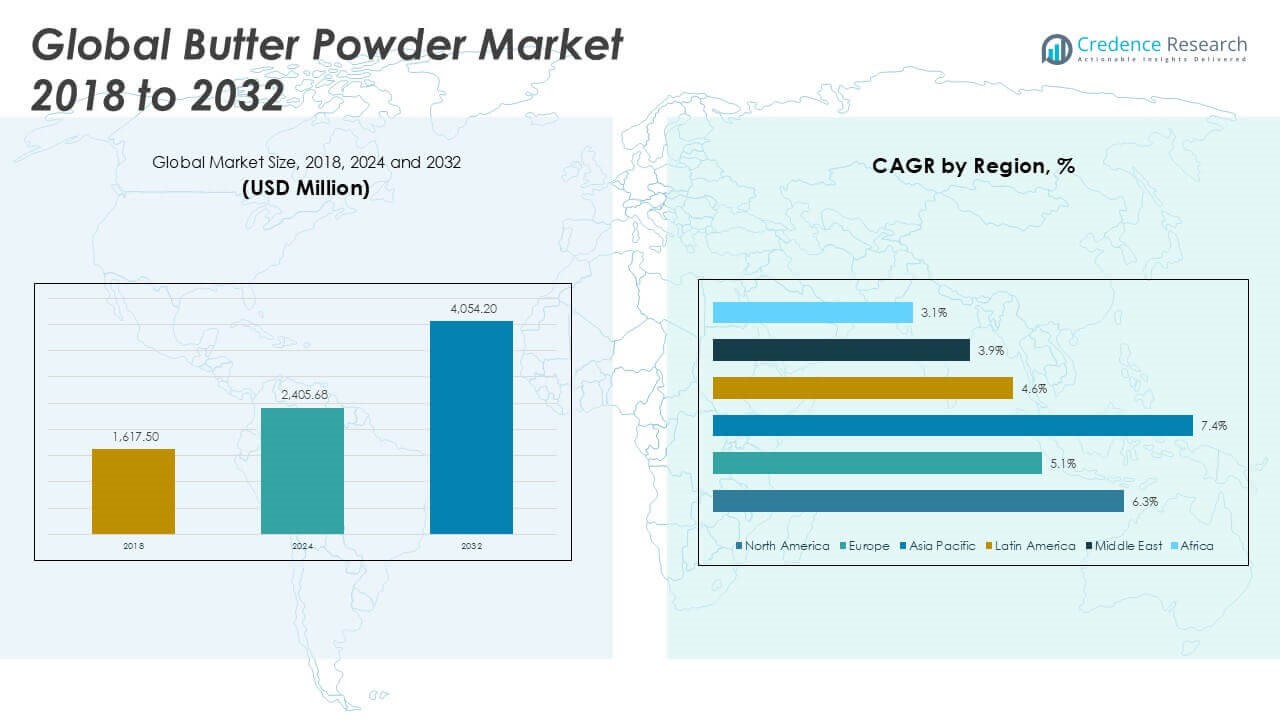
The Butter Powder market size was valued at USD 1,617.50 million in 2018, reached USD 2,405.68 million in 2024, and is anticipated to reach USD 4,054.20 million by 2032, at a CAGR of 6.28% during the forecast period.
The butter powder market is led by key players such as Fonterra Co-operative Group, Lactalis Group, FrieslandCampina, Kerry Group, Land O’Lakes, Amul (GCMMF), Dairy Farmers of America, Arla Foods, Nestlé S.A., and Hilmar Cheese Company. These companies maintain a strong market position through diversified product portfolios, strategic expansions, and partnerships with food manufacturers. North America emerged as the leading region in 2024, accounting for 41.2% of the global market share, driven by high demand from the bakery, confectionery, and foodservice sectors. Asia Pacific follows closely, supported by its rapid urbanization, growing food industry, and rising consumer demand for shelf-stable dairy products.
Market Insights
- The global butter powder market was valued at USD 2,405.68 million in 2024 and is projected to reach USD 4,054.20 million by 2032, expanding at a CAGR of 6.28% during the forecast period.
- Growing demand from the bakery, confectionery, and ready-to-eat meals sectors is a key market driver, supported by the convenience, shelf-stability, and cost-efficiency of butter powder in food manufacturing.
- The market is witnessing a trend toward organic, non-GMO, and functional butter powder variants, catering to health-conscious consumers and premium food segments.
- Leading players such as Fonterra, Lactalis, and Kerry Group dominate the competitive landscape, leveraging global distribution networks and innovation to maintain market share.
- North America accounted for the largest regional share at 41.2% in 2024, followed by Asia Pacific at 31.9%, while conventional butter powder remained the dominant product segment due to its widespread usage across industrial and commercial applications.
Market Segmentation Analysis:
By Product Type:
In the Butter Powder market, Conventional Butter Powder holds the dominant market share due to its widespread availability, cost-effectiveness, and preference among food manufacturers for bulk usage. This segment is primarily driven by consistent demand from the processed food industry and minimal regulatory barriers compared to organic or functional varieties. Organic Butter Powder is gaining traction among health-conscious consumers, especially in North America and Europe. Meanwhile, Non-GMO Butter Powder appeals to consumers seeking clean-label products, and Functional/Enriched Butter Powder is emerging as a niche segment, driven by demand in the nutrition and wellness sectors.
- For instance, FrieslandCampina produces over 15,000 metric tons of functional dairy powders annually, including enriched butter powder variants used in clinical and sports nutrition applications.
By Application:
Bakery & Confectionery represents the leading application segment in the Butter Powder market, accounting for the highest volume and revenue share. Its dominance is driven by butter powder’s long shelf life and ease of incorporation in baked goods without altering texture or flavor. Ready-to-Eat Meals and Snacks follow closely, fueled by growing urbanization and demand for convenient food options. Sauces & Seasonings benefit from the powder’s ability to deliver consistent flavor. Infant Nutrition and Sports Nutrition segments are witnessing steady growth due to rising awareness of high-protein, dairy-based nutritional options. Foodservice & Catering also shows promise with increasing bulk demand in institutional kitchens.
- For instance, Nestlé S.A. uses butter powder in more than 2,800 of its global bakery and ready-meal SKUs, particularly under its Maggi and Buitoni brands.
By Distribution Channel:
Among distribution channels, Supermarkets/Hypermarkets dominate the Butter Powder market, capturing the largest market share due to strong retail networks, wider shelf visibility, and consumer trust in physical retail. Online Retail is the fastest-growing segment, driven by rising e-commerce penetration and consumer preference for convenient doorstep delivery. Specialty Stores cater to niche consumers seeking organic, non-GMO, or enriched variants. Foodservice/Industrial channels contribute significantly in terms of volume, supported by consistent bulk demand from restaurants, caterers, and packaged food manufacturers looking for shelf-stable, cost-efficient butter alternatives.
Key Growth Drivers
Rising Demand from Processed Food and Bakery Industries
The growing consumption of processed food and baked goods is a major driver of the butter powder market. Manufacturers prefer butter powder for its extended shelf life, ease of storage, and convenient incorporation into dry mixes and frozen products. The consistent demand from the bakery, confectionery, and ready-to-eat meal sectors contributes significantly to market growth. As consumers seek convenient meal solutions and indulgent baked goods, food processors are increasingly integrating butter powder as a flavoring and texture-enhancing ingredient, boosting overall market demand globally.
- For instance, Kerry Group supplies butter powder formulations to over 4,200 bakery and snack manufacturers across 40 countries through its Taste & Nutrition division.
Growing Preference for Shelf-Stable Dairy Alternatives
The increasing demand for shelf-stable dairy products, especially in regions with limited cold chain infrastructure, has bolstered the uptake of butter powder. Unlike traditional butter, powdered formats offer long storage life without refrigeration, reducing transportation and spoilage costs. This makes it ideal for remote locations, military rations, institutional kitchens, and emergency food supplies. The extended usability and reduced logistical complexities make butter powder an attractive option for manufacturers and consumers in developing and developed economies alike, strengthening its market penetration.
- For instance, Land O’Lakes produces over 21,000 metric tons of shelf-stable butter and dairy powders annually at its Melrose facility in Minnesota to meet demand from industrial and institutional clients.
Expansion of Health-Conscious and Functional Food Segments
As consumers become more health-conscious, the demand for clean-label and functional food products is rising. This has led to the increased use of Non-GMO, Organic, and Functional/Enriched Butter Powders that align with dietary trends focused on natural and enriched nutrition. These variants are gaining traction in sports nutrition, infant formulas, and wellness foods. Manufacturers are responding by innovating butter powder formulations fortified with additional nutrients, positioning the product as both a functional and indulgent ingredient, thereby accelerating growth in premium product categories.
Key Trends & Opportunities
E-commerce and Direct-to-Consumer Sales Expansion
The rapid growth of e-commerce platforms offers a significant opportunity for butter powder manufacturers to reach broader consumer bases. Direct-to-consumer (DTC) models allow brands to offer premium or niche butter powder variants, such as organic and non-GMO options, to targeted audiences. Online channels support product visibility, customer engagement, and detailed nutritional information. This trend enhances market reach, particularly in urban and tech-savvy demographics, and enables small and mid-sized producers to compete effectively with larger established brands.
- For instance, Amul (GCMMF) recorded over 1.6 million butter powder unit sales through its D2C platform and retail aggregator partners in FY2023.
Product Innovation and Diversification into Niche Categories
Manufacturers are investing in R&D to develop innovative butter powder variants tailored for specific dietary needs, such as lactose-free, protein-enriched, and plant-based alternatives. This trend reflects the broader move toward personalized nutrition and specialty diets. Innovations in flavor infusion and texture enhancement have also opened up new applications in gourmet snacks and culinary sauces. Such diversification not only meets evolving consumer expectations but also creates differentiation in a competitive market, unlocking new growth avenues for both regional and global players.
- For instance, Arla Foods launched over 22 new dairy powder SKUs between 2021 and 2023, including protein-enhanced butter powders for foodservice applications across Scandinavia and the UK.
Key Challenges
Volatility in Dairy Prices and Raw Material Availability
The butter powder market is significantly impacted by fluctuations in raw milk prices and dairy supply chain disruptions. Seasonal variations, feed costs, and climatic conditions influence milk production, which in turn affects butter production and its derivatives. Such price volatility can impact profit margins for manufacturers and limit the affordability of butter powder for cost-sensitive segments. Securing consistent and high-quality raw materials remains a challenge, especially for small and medium enterprises operating in highly competitive markets.
Stringent Regulatory Standards and Labeling Requirements
Compliance with food safety regulations and clean-label requirements poses challenges for manufacturers, particularly in export markets. Butter powder producers must adhere to varying national and international standards regarding food additives, preservatives, GMO content, and allergen disclosures. These regulations may restrict market entry, delay product launches, or require costly reformulations. Constant updates in labelling norms and certifications, especially in organic and functional categories, further add to operational complexities and regulatory burdens.
Consumer Perception of Powdered Dairy Products
Despite functional benefits, powdered dairy products often face perception issues related to taste, freshness, and authenticity. Some consumers perceive butter powder as inferior to fresh butter, particularly in premium food applications. This perception can limit adoption in high-end culinary or gourmet segments, where traditional dairy ingredients are preferred. Overcoming these biases through consumer education and marketing remains essential to broaden the appeal of butter powder across diverse end-use applications.
Regional Analysis
North America
North America dominates the global butter powder market, accounting for the largest market share of approximately 41.2% in 2024. The regional market was valued at USD 673.43 million in 2018 and grew to USD 990.67 million in 2024, with projections indicating a rise to USD 1,674.41 million by 2032, expanding at a CAGR of 6.3%. This growth is driven by high demand from the bakery, snack, and processed food sectors, along with strong distribution networks and rising consumer interest in shelf-stable dairy products. The presence of established food manufacturers further strengthens the region’s dominant position.
Europe
Europe held a significant share of the butter powder market in 2024, contributing around 18.2% of global revenue. Starting at USD 311.11 million in 2018, the market reached USD 438.10 million in 2024 and is expected to grow to USD 673.45 million by 2032, registering a CAGR of 5.1%. Growth in Europe is supported by the widespread consumption of bakery and dairy-based products and rising demand for organic and functional food ingredients. Stringent quality standards and an established food processing industry enhance product reliability and encourage broader usage in both commercial and household segments.
Asia Pacific
Asia Pacific represents the fastest-growing regional market with a CAGR of 7.4% and accounted for 31.9% of the global butter powder market in 2024. The regional market grew from USD 490.65 million in 2018 to USD 768.55 million in 2024, and is forecast to reach USD 1,407.27 million by 2032. This robust growth is attributed to increasing urbanization, expanding middle-class population, and growing demand for packaged and convenient food products. The rising influence of Western diets and rapid growth in bakery and confectionery sectors across China, India, and Southeast Asia are key drivers in the region.
Latin America
Latin America contributed around 4.6% to the global butter powder market in 2024, with the market size increasing from USD 74.60 million in 2018 to USD 109.54 million in 2024 and expected to reach USD 162.88 million by 2032, growing at a CAGR of 4.6%. Market expansion is supported by growing urbanization, an increase in fast-food chains, and demand for dairy-based ingredients in bakery and snacks. However, limited cold storage infrastructure makes shelf-stable products like butter powder more favorable in this region, especially in rural and remote areas, supporting its steady market penetration.
Middle East
The Middle East accounted for approximately 2.5% of the global butter powder market in 2024. With a market size of USD 44.05 million in 2018, it reached USD 59.73 million in 2024 and is projected to grow to USD 84.44 million by 2032 at a CAGR of 3.9%. Rising tourism, hospitality sector expansion, and demand for imported food ingredients are supporting market growth. Foodservice establishments increasingly prefer butter powder for its convenience and longer shelf life. However, dependency on imports and limited local dairy production slightly constrain market expansion despite favorable demand trends.
Africa
Africa held a relatively smaller share of 1.6% in the global butter powder market in 2024, starting from USD 23.65 million in 2018 and rising to USD 39.08 million in 2024, with projections reaching USD 51.75 million by 2032 at a CAGR of 3.1%. The region’s growth is supported by increasing awareness of shelf-stable dairy options and gradual improvements in food processing infrastructure. Butter powder’s suitability for areas lacking refrigeration makes it a viable alternative in various segments. However, economic constraints, limited industrialization, and lower per capita dairy consumption continue to pose challenges to large-scale market development.
Market Segmentations:
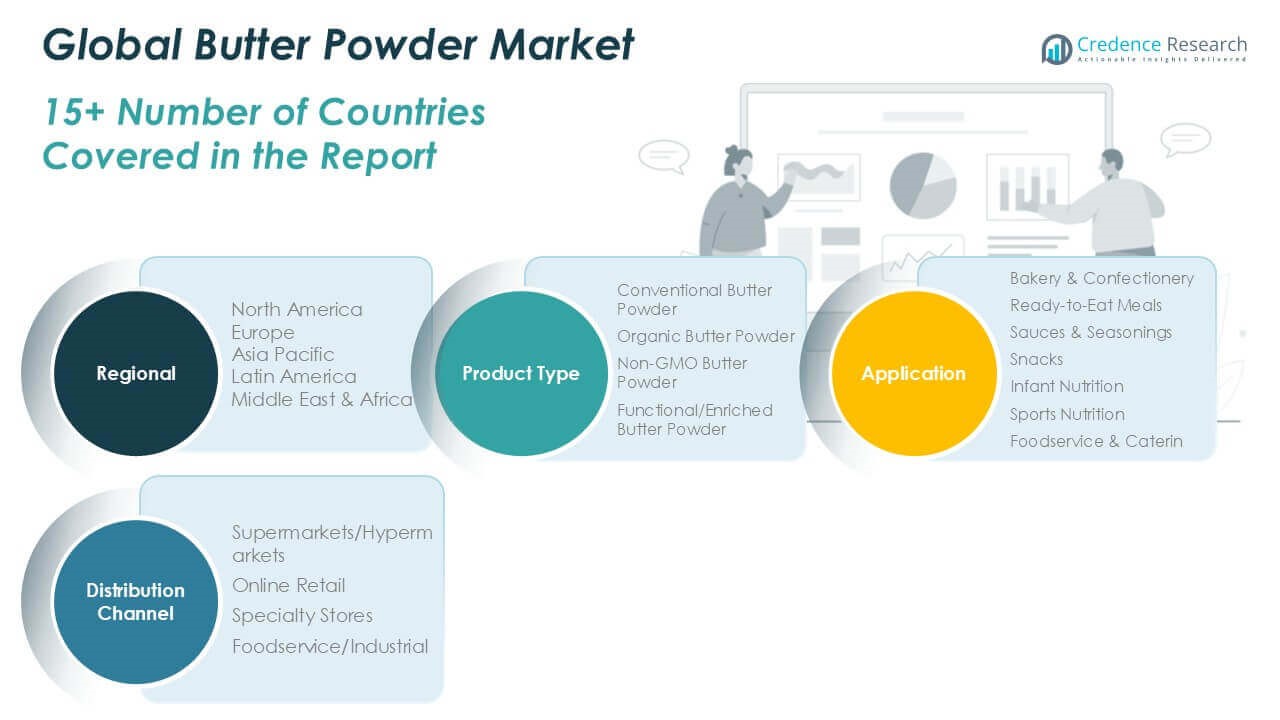
By Product Type
- Conventional Butter Powder
- Organic Butter Powder
- Non-GMO Butter Powder
- Functional/Enriched Butter Powder
By Application
- Bakery & Confectionery
- Ready-to-Eat Meals
- Sauces & Seasonings
- Snacks
- Infant Nutrition
- Sports Nutrition
- Foodservice & Catering
By Distribution Channel
- Supermarkets/Hypermarkets
- Online Retail
- Specialty Stores
- Foodservice/Industrial
By Geography
- North America
- Europe
- Asia Pacific
- Latin America
- Middle East
- Africa
Competitive Landscape
The butter powder market is characterized by the presence of well-established global dairy cooperatives and multinational food ingredient companies, creating a moderately consolidated competitive environment. Key players such as Fonterra Co-operative Group, Lactalis Group, FrieslandCampina, and Arla Foods lead the market with extensive product portfolios, robust global supply chains, and strong procurement capabilities. Companies like Nestlé S.A., Kerry Group, and Land O’Lakes leverage innovation and R&D investments to develop specialized and functional butter powder variants that meet evolving consumer preferences. Amul (GCMMF) and Dairy Farmers of America hold strong regional influence, particularly in Asia and North America, respectively. Strategic initiatives such as mergers, acquisitions, and capacity expansions are prevalent as companies aim to enhance their geographic footprint and production capabilities. Furthermore, partnerships with foodservice and packaged food manufacturers strengthen B2B sales channels. Sustainability, traceability, and clean-label product development remain focal points for players seeking long-term competitive advantage.
Key Player Analysis
- Fonterra Co-operative Group
- Lactalis Group
- FrieslandCampina
- Kerry Group
- Land O’Lakes
- Amul (GCMMF)
- Dairy Farmers of America
- Arla Foods
- Nestlé S.A.
- Hilmar Cheese Company
Recent Developments
- In 2025, Fonterra maintained steady Global Dairy Trade (GDT) offer volumes for butter and milk powders, providing stability amid global dairy market volatility. For the upcoming TE380 auction, Fonterra will offer 1,007 tonnes of butter, aligning with previous forecasts. The cooperative’s 12-month cream forecast also remains unchanged at 106,135 tonnes, with some flexibility in the balance between anhydrous milk fat (AMF) and butter for contracts covering October 2025 and beyond. This approach is seen as a stabilizing factor in a turbulent market.
- In July 2025, the Australian Competition and Consumer Commission(ACCC) approved Lactalis's acquisition of Fonterra's consumer, dairy ingredients, and food service businesses in Australia. The ACCC determined that the deal would not substantially lessen competition, despite Lactalis and Fonterra being major players in the Australian dairy market.
- In March 2025, Kerry's investor update revealed that EU butter prices were strengthening, while powder prices were less favorable. Kerry continues to invest in both dairy and dairy-free flavor innovations, particularly focusing on new butter powder applications for various food and beverage uses. This aligns with their strategy of supporting customers as an innovation and renovation partner.
Market Concentration & Characteristics
The Butter Powder Market exhibits a moderately concentrated structure, with a mix of global dairy cooperatives and regional producers contributing to its competitive landscape. It is characterized by high entry barriers due to capital-intensive processing requirements, strict regulatory standards, and the need for consistent raw milk supply. Key players such as Fonterra, Lactalis, FrieslandCampina, and Kerry Group hold significant market share through established production capabilities and broad distribution networks. The market reflects stability in demand, driven by its application in bakery, snacks, sauces, and foodservice sectors. It also shows growing segmentation into organic, non-GMO, and functional categories, targeting evolving consumer preferences.
Report Coverage
The research report offers an in-depth analysis based on Product Type, Application, Distribution Channel and Geography. It details leading market players, providing an overview of their business, product offerings, investments, revenue streams, and key applications. Additionally, the report includes insights into the competitive environment, SWOT analysis, current market trends, as well as the primary drivers and constraints. Furthermore, it discusses various factors that have driven market expansion in recent years. The report also explores market dynamics, regulatory scenarios, and technological advancements that are shaping the industry. It assesses the impact of external factors and global economic changes on market growth. Lastly, it provides strategic recommendations for new entrants and established companies to navigate the complexities of the market.
Future Outlook
- The butter powder market will continue to grow steadily, driven by rising demand from the bakery and confectionery sectors.
- Shelf-stable and easy-to-store dairy alternatives will remain a key preference for food manufacturers.
- Organic and non-GMO butter powder segments will expand as health-conscious consumer demand increases.
- Asia Pacific will emerge as a high-growth region due to urbanization and the expansion of food processing industries.
- E-commerce and direct-to-consumer sales will support broader market reach and niche product visibility.
- Manufacturers will focus on developing enriched and functional butter powder variants to cater to specialty nutrition markets.
- Partnerships with foodservice and packaged food companies will strengthen B2B sales channels.
- Sustainability and traceability in sourcing and processing will gain more importance in product differentiation.
- Technological advancements in drying and packaging will enhance product quality and shelf life.
- Regulatory compliance and labeling transparency will shape global market strategies for leading producers.

Request a Free Sample
Fill in your details and we'll send you a free sample report.
- Sample data tables & charts
- Research methodology
Market Dynamics
Rising Demand from Processed Food and Bakery Industries
Butter powder is increasingly used by manufacturers in bakery, confectionery, and ready-to-eat meal sectors due to its long shelf life, ease of storage, and ability to enhance flavor and texture in finished products. This consistent demand from food processors is a major contributor to market growth.
Preference for Shelf-Stable Dairy Alternatives
Butter powder’s ability to remain stable without refrigeration makes it highly attractive in regions with limited cold chain infrastructure and for applications such as military rations, institutional kitchens, and emergency food supplies, driving its adoption globally.
Expansion of Health-Conscious and Functional Food Segments
The market is benefiting from the growing consumer preference for organic, non-GMO, and enriched butter powder variants, which align with trends toward clean-label and functional nutrition, especially in sports, infant, and wellness foods.
Growth of E-commerce and Direct-to-Consumer Channels
The rapid expansion of online retail and D2C platforms is enabling manufacturers to reach broader and more targeted consumer bases, particularly for premium and niche butter powder products, thus accelerating market penetration.
Product Innovation and Diversification
Manufacturers are investing in R&D to create new butter powder variants such as lactose-free, protein-enriched, and flavored options, opening up new applications in gourmet foods and specialty diets and supporting overall market expansion.
Need a Custom Version of This Report?
Tailor the scope, geography, or segments to your exact requirements.
- Custom geography or segment scope
- Direct access to our analyst team
Frequently Asked Questions
What is the current size of the Butter Powder Market?
What factors are driving the growth of the Butter Powder Market?
What are the key segments within the Butter Powder Market?
What are some challenges faced by the Butter Powder Market?
Who are the major players in the Butter Powder Market?
Table of Content
Chapter 1 Market Segmentation
- 1.1 Segmentation Framework
- 1.1.1 Product and Service Classification
- 1.1.2 Application and End-Use Classification
- 1.1.3 Technology and Solution Classification
- 1.1.4 Customer and Distribution Channel Classification
- 1.1.5 Geographic Segmentation
- 1.1.6 Market Segment Definitions and Boundaries
- 1.2 By Application
- 1.2.1 Bakery & Confectionery
- 1.2.2 Ready-to-Eat Meals
- 1.2.3 Sauces & Seasonings
- 1.2.4 Snacks
- 1.2.5 Infant Nutrition
- 1.2.6 Sports Nutrition
- 1.2.7 Foodservice & Catering
- 1.3 By Product Type
- 1.3.1 Conventional Butter Powder
- 1.3.2 Organic Butter Powder
- 1.3.3 Non-GMO Butter Powder
- 1.3.4 Functional/Enriched Butter Powder
Chapter 2 Introduction
- 2.1 Report Objectives and Scope
- 2.2 Product Definition and Industry Terminology
- 2.3 Market Inclusions and Exclusions
- 2.4 Research Process
- 2.4.1 Primary Research and Expert Interviews
- 2.4.2 Secondary Research and Source Review
- 2.4.3 Top-Down and Bottom-Up Estimation
- 2.4.4 Data Triangulation and Verification
- 2.5 Market Size Measurement Basis
- 2.5.1 2024: USD 2,405.68 million → 2032: USD 4,054.20 million
- 2.6 Historical and Forecast Reference Periods
- 2.6.1 Base Year: 2024
- 2.6.2 Forecast Period: 2024-2032
- 2.7 Research Assumptions and Limitations
Chapter 3 Executive Summary
- 3.1 Market Snapshot and Key Findings
- 3.2 Base-Year Market Size, 2024
- 3.3 Forecast Market Size, 2032
- 3.4 Revenue and Volume Growth Outlook
- 3.5 Key Demand and Supply Indicators
- 3.6 Leading Market Segments
- 3.7 Fastest-Growing Market Opportunities
- 3.8 Regional Performance Highlights
- 3.9 Technology and Industry Transformation
- 3.10 Competitive Landscape Summary
- 3.11 Analyst View and Strategic Implications
Chapter 4 Global Butter Powder Market Market Trends and Developments
- 4.1 Historical Industry Development
- 4.2 Recent Market Trends and Developments
- 4.3 Demand and Customer Behavior Trends
- 4.4 Technology and Product Innovation
- 4.5 Artificial Intelligence, Automation and Digitalization
- 4.6 Local Manufacturing and Supply Chain Realignment
- 4.7 Industry Partnerships, Mergers and Acquisitions
- 4.8 Sustainability and Circular Economy Developments
- 4.9 Government and Private Sector Investment Trends
- 4.10 Emerging Business Models and Commercialization
- 4.11 Industry Developments and Announcements
Chapter 5 Global Butter Powder Market Market Production, Supply and Demand Analysis
- 5.1 Demand Trend and Consumption Analysis
- 5.2 Demand Forecast, 2024-2032
- 5.3 Production and Output Trend
- 5.4 Production and Output Forecast, 2024-2032
- 5.5 Installed Capacity and Capacity Utilization
- 5.6 Company-Wise Production Plants and Statistics
- 5.6.1 Installed Production Capacity
- 5.6.2 Actual Production
- 5.6.3 Planned Capacity and Expansion Targets
- 5.7 Supply Chain Structure and Procurement Trends
- 5.8 Supply-Demand Gap and Bottlenecks
- 5.9 Import Dependence and Sourcing Structure
- 5.10 Contract Manufacturing and Outsourcing
- 5.11 Regional Supply and Demand Concentration
Chapter 6 Global Butter Powder Market Market Pricing Analysis
- 6.1 Pricing Structure and Measurement
- 6.2 Historical Pricing Trends
- 6.3 Pricing Outlook, 2024-2032
- 6.4 Average Selling Price and Unit Economics
- 6.5 Pricing by Product and Market Segment
- 6.6 Geographic Pricing Differences
- 6.7 Key Input, Energy, Labor and Logistics Costs
- 6.8 Contract Pricing and Purchasing Models
- 6.9 Pricing Sensitivity and Competitive Positioning
- 6.10 Price, Margin and Profitability Implications
Chapter 7 Global Butter Powder Market Market Dynamics
- 7.1 Market Growth Drivers
- 7.1.1 Demand-Side Drivers
- 7.1.2 Technology and Innovation Drivers
- 7.1.3 Infrastructure and Investment Drivers
- 7.1.4 Regulatory and Policy Drivers
- 7.2 Market Restraints
- 7.2.1 Cost and Affordability Constraints
- 7.2.2 Technology and Adoption Barriers
- 7.2.3 Supply Chain and Operational Constraints
- 7.3 Market Challenges
- 7.3.1 Competitive Pressure and Margin Erosion
- 7.3.2 Skills, Infrastructure and Implementation Gaps
- 7.4 Emerging Market Opportunities
- 7.5 Market Dynamics Impact and Time-Horizon Assessment
Chapter 8 Global Butter Powder Market Value Chain Analysis
- 8.1 Industry Value Chain Overview
- 8.2 Upstream Suppliers and Critical Inputs
- 8.3 Technology and Component Providers
- 8.4 Manufacturing or Service Delivery
- 8.5 Distribution, Channel Partners and Integrators
- 8.6 Downstream Applications and End Users
- 8.7 Value Addition and Profit Pools
- 8.8 Vertical Integration and Outsourcing
- 8.9 Supplier Concentration and Risk
- 8.10 Supply Chain Localization and Resilience
Chapter 9 Global Butter Powder Market Market Regulations and Policies
- 9.1 Relevant Laws, Standards and Compliance Frameworks
- 9.2 Product, Service, Safety and Quality Requirements
- 9.3 Government Policies, Incentives and Subsidies
- 9.4 Imports, Exports and Trade Barriers
- 9.5 Public Procurement and Local Content Requirements
- 9.6 Environmental and Sustainability Compliance
- 9.7 Upcoming Policy Changes and Market Implications
Chapter 10 Global Butter Powder Market Market Hotspots and Opportunities
- 10.1 Market Opportunity Mapping and Growth Hotspots
- 10.2 High-Growth Applications and Customer Groups
- 10.3 Underserved Markets and White-Space Opportunities
- 10.4 Emerging Technology and Product Opportunities
- 10.5 New Capacity and Investment Hotspots
- 10.6 Market Entry and Expansion Opportunities
- 10.7 Distribution and Partnership Opportunities
- 10.8 Near-Term and Long-Term Commercial Potential
- 10.9 Opportunity Attractiveness and Execution Risks
Chapter 11 Global Butter Powder Market Market Outlook, 2024-2032
- 11.1 Market Size and Analysis
- 11.1.1 Revenue (Market Measurement: 2024: USD 2,405.68 million → 2032: USD 4,054.20 million)
- 11.1.2 Market Volume and Quantity Sold
- 11.1.3 Historical Market Size
- 11.1.4 Base-Year Market Size, 2024
- 11.2 Market Forecast, 2024-2032
- 11.2.1 Revenue Forecast to 2032
- 11.2.2 Volume Forecast to 2032
- 11.2.3 CAGR and Year-on-Year Growth
- 11.2.4 Incremental Revenue Opportunity
- 11.3 Forecast Assumptions and Scenario Analysis
- 11.3.1 Base-Case Forecast
- 11.3.2 Optimistic and Conservative Scenarios
- 11.3.3 Technology, Pricing and Policy Sensitivities
- 11.4 Market Attractiveness and Growth Outlook
Chapter 12 Global Butter Powder Market Market Segmentation and Outlook
- 12.1 Segmentation Summary and Market Shares, 2024
- 12.2 Largest and Fastest-Growing Segments
- 12.3 By Application - Market Size and Forecast, 2024-2032
- 12.3.1 Segment Definition and Scope
- 12.3.2 Historical Market Size
- 12.3.3 Revenue Forecast, 2024-2032
- 12.3.4 Volume Forecast, 2024-2032
- 12.3.5 Base-Year Market Share, 2024
- 12.3.6 Segment CAGR and Growth Drivers
- 12.3.7 Subsegment Market Size and Forecast
- 12.3.7.1 Bakery & Confectionery
- 12.3.7.2 Ready-to-Eat Meals
- 12.3.7.3 Sauces & Seasonings
- 12.3.7.4 Snacks
- 12.3.7.5 Infant Nutrition
- 12.3.7.6 Sports Nutrition
- 12.3.7.7 Foodservice & Catering
- 12.3.8 Subsegment Pricing and Adoption Trends
- 12.3.9 Leading Suppliers and Competition
- 12.3.10 Regional Demand and Opportunities
- 12.4 By Product Type - Market Size and Forecast, 2024-2032
- 12.4.1 Segment Definition and Scope
- 12.4.2 Historical Market Size
- 12.4.3 Revenue Forecast, 2024-2032
- 12.4.4 Volume Forecast, 2024-2032
- 12.4.5 Base-Year Market Share, 2024
- 12.4.6 Segment CAGR and Growth Drivers
- 12.4.7 Subsegment Market Size and Forecast
- 12.4.7.1 Conventional Butter Powder
- 12.4.7.2 Organic Butter Powder
- 12.4.7.3 Non-GMO Butter Powder
- 12.4.7.4 Functional/Enriched Butter Powder
- 12.4.8 Subsegment Pricing and Adoption Trends
- 12.4.9 Leading Suppliers and Competition
- 12.4.10 Regional Demand and Opportunities
- 12.5 Segment Growth Comparison
- 12.6 Segment Attractiveness and Priority Matrix
Chapter 13 Global Butter Powder Market End-Use and Application Market Outlook
- 13.1 End-Use Industry and Customer Demand Structure
- 13.2 Leading Applications and Customer Groups
- 13.3 End-Use Market Size, Share and Forecast
- 13.4 Major End-Use Industry Deep Dives
- 13.4.1 Customer Requirements and Use Cases
- 13.4.2 Demand and Replacement Cycles
- 13.4.3 Technical and Regulatory Considerations
- 13.4.4 Purchasing and Procurement Models
- 13.4.5 Leading Vendors and Distribution Channels
- 13.4.6 Forecast and Commercial Opportunities
- 13.5 Emerging Applications and Cross-Segment Demand
- 13.6 End-Use Industry Investment Priorities
Chapter 14 Global Butter Powder Market Geographic Market Outlook, 2024-2032
- 14.1 Regional Market Size and Share, 2024
- 14.2 Regional Market Forecast, 2024-2032
- 14.3 Regional Pricing, Production and Demand Differences
- 14.4 North America
- 14.4.1 United States
- 14.4.2 Canada
- 14.4.3 Mexico
- 14.5 Europe
- 14.5.1 Germany
- 14.5.2 France
- 14.5.3 Italy
- 14.5.4 United Kingdom
- 14.5.5 Spain
- 14.5.6 Poland
- 14.5.7 Russia
- 14.5.8 Netherlands
- 14.5.9 Belgium
- 14.5.10 Sweden
- 14.5.11 Denmark
- 14.5.12 Norway
- 14.5.13 Rest of Europe
- 14.6 Asia Pacific
- 14.6.1 China
- 14.6.2 India
- 14.6.3 Japan
- 14.6.4 South Korea
- 14.6.5 Thailand
- 14.6.6 Indonesia
- 14.6.7 Vietnam
- 14.6.8 Malaysia
- 14.6.9 Australia
- 14.6.10 Rest of Asia Pacific
- 14.7 Latin America
- 14.7.1 Brazil
- 14.7.2 Argentina
- 14.7.3 Colombia
- 14.7.4 Chile
- 14.7.5 Rest of Latin America
- 14.8 Middle East
- 14.8.1 Saudi Arabia
- 14.8.2 United Arab Emirates
- 14.8.3 Turkey
- 14.8.4 Israel
- 14.8.5 Iran
- 14.8.6 Rest of the Middle East
- 14.9 Africa
- 14.9.1 South Africa
- 14.9.2 Egypt
- 14.9.3 Nigeria
- 14.9.4 Morocco
- 14.9.5 Rest of Africa
- 14.10 Regional Investment, Policy and Supply Chain Differences
- 14.11 Regional Competitive Landscape
- 14.12 Geographic Growth Hotspots
Chapter 15 Global Butter Powder Market Technology, Innovation and Sustainability Outlook
- 15.1 Technology Landscape and Maturity
- 15.2 Product, Process and Service Innovation
- 15.3 AI, Automation and Digital Tools in the Industry
- 15.4 Technology Adoption and Performance Benchmarking
- 15.5 Innovation Pipeline and R&D Investment
- 15.6 Patent and Intellectual Property Trends
- 15.7 Energy Efficiency and Resource Management
- 15.8 Sustainability, Recycling and Circularity
- 15.9 Technology Roadmap, 2024-2032
- 15.10 Risks of Obsolescence and Technology Substitution
Chapter 16 Global Butter Powder Market Market Key Strategic Imperatives
- 16.1 Growth and Market Entry Priorities
- 16.2 High-Return Products and Segments
- 16.3 Pricing, Profitability and Cost Optimization
- 16.4 Technology Investment and Product Differentiation
- 16.5 Supply Chain Localization and Resilience
- 16.6 Distribution and Customer Acquisition
- 16.7 Partnership, Acquisition and Capacity Strategy
- 16.8 Regional Expansion Priorities
- 16.9 Short-, Medium- and Long-Term Actions
Chapter 17 Competition Outlook
- 17.1 Industry Competition Characteristics
- 17.2 Market Structure and Concentration
- 17.3 Market Share and Competitive Positioning, 2024
- 17.4 Company-Wise Revenue and Product Benchmarking
- 17.5 Production and Service Capacity Benchmarking
- 17.6 Technology, Pricing and Differentiation
- 17.7 Regional Footprint and Distribution Strength
- 17.8 Mergers, Acquisitions and Strategic Alliances
- 17.9 New Entrants and Competitive Threats
- 17.10 Porter's Five Forces and Industry Attractiveness
- 17.11 Competitive Outlook, 2024-2032
Chapter 18 Company Profiles
- 18.1 Company Coverage and Selection Criteria
- 18.2 Fonterra Co-operative Group
- 18.2.1 Business Description
- 18.2.2 Company Ownership and Geographic Presence
- 18.2.3 Product and Service Portfolio
- 18.2.4 Manufacturing and Operating Footprint
- 18.2.5 Production Capacity and Expansion Plans
- 18.2.6 Financial Performance and Investment
- 18.2.7 Market Share and Competitive Position
- 18.2.8 Technology and Innovation Capabilities
- 18.2.9 Strategic Alliances or Partnerships
- 18.2.10 Recent Developments
- 18.2.11 Growth Strategy and Outlook
- 18.3 Lactalis Group
- 18.4 FrieslandCampina
- 18.5 Kerry Group
- 18.6 Land O’Lakes
- 18.7 Amul (GCMMF)
- 18.8 Dairy Farmers of America
- 18.9 Arla Foods
- 18.10 Nestlé S.A.
- 18.11 Hilmar Cheese Company
- 18.12 Other Relevant Market Participants
Note: Every listed company is profiled on the structure shown under the first company. The company list is preliminary and may change based on research findings, market developments, data availability and client requirements.
Chapter 19 Disclaimer
- 19.1 Research and Forecast Disclaimer
- 19.2 Data Source and Estimation Limitations
Note: The depth of individual sections depends on data availability for this market. Volume, capacity, trade and other unit-based metrics are included where applicable.