
Proof of lower impact now decides what buyers choose
The Spain sustainable fashion eco apparel market was valued at USD 1.19 billion in 2025 and is projected to increase from USD 1.31 billion in 2026 to USD 2.81 billion by 2035, registering a CAGR of 8.86% during 2026–2035. Demand rests on shoppers who want proof behind green labels, on European rules that turn lower-impact design into a legal requirement, and on new recycled fiber supply from Spanish mills and recyclers. Eastern and Southern Spain held the largest regional share, 28.0% in 2025, because it is the most populous of the four zones, even though spending per head is lower than in Madrid or the Basque Country. The Community of Madrid is the fastest-growing region at 9.3% a year as purpose-led brands open their first Spanish stores in the capital. The EU directive on empowering consumers applies from Sept. 27, 2026, and it bans generic claims such as eco-friendly unless a recognized performance or certification backs them.
Which products and claims qualify as lower-impact clothing in Spain?
The market counts apparel, footwear, activewear, bags and accessories sold new to Spanish buyers when the product carries a documented sustainability proposition. That proposition can be a recognized certification, recycled or organic fiber content, a repair or take-back service, an animal-free material or a traceable local supply chain. Buyers range from families buying organic cotton basics to professionals paying premium prices for recycled outerwear and leather-free sneakers.
Value is counted at retail selling prices including VAT, across brand stores, department store corners, independent shops and online channels. The eco apparel estimate excludes secondhand resale between private individuals, workwear, home textiles and products that carry only a generic claim without supporting evidence. Collection, sorting and recycling services are treated as upstream supply rather than as part of the consumer market.
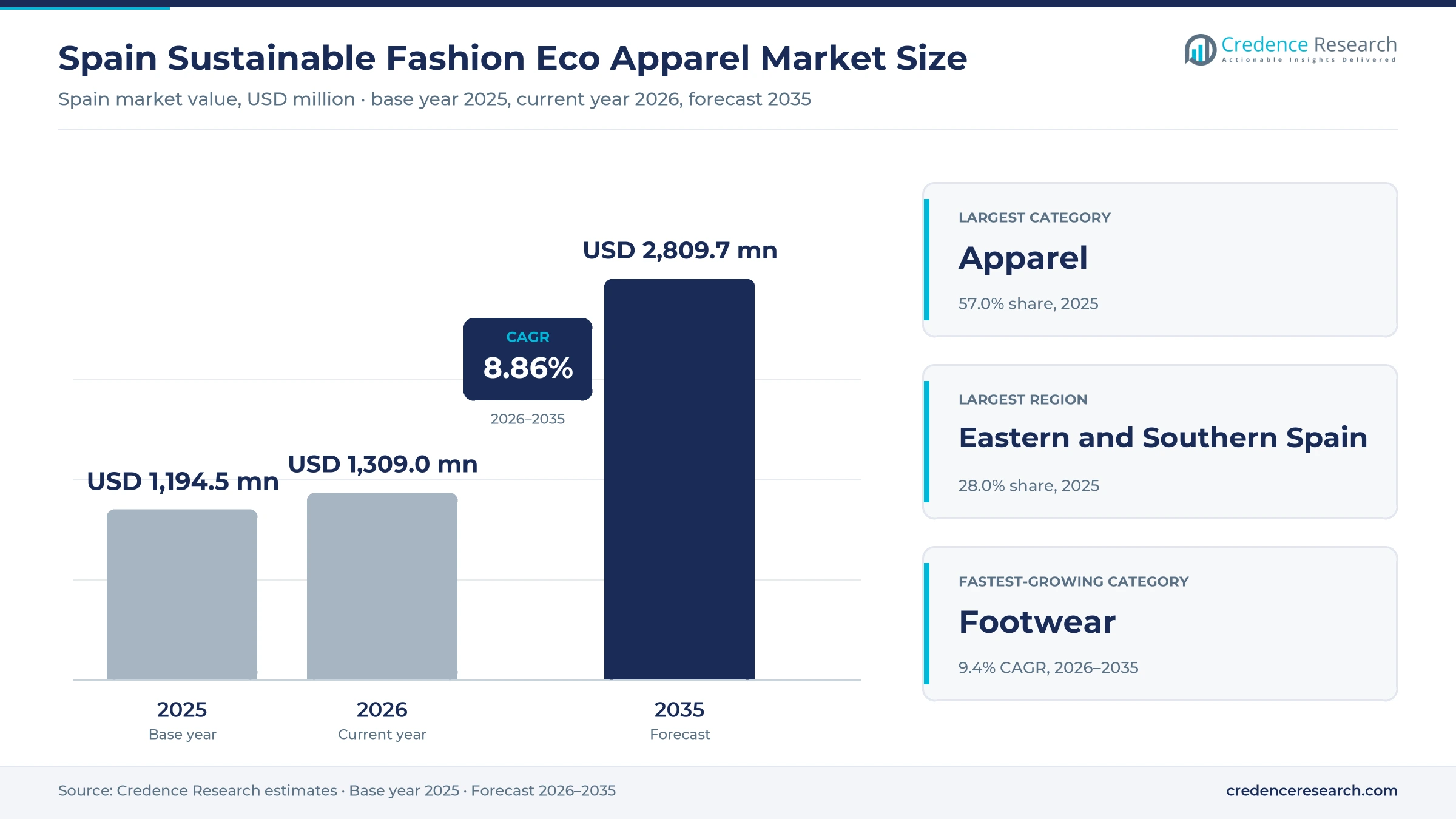
Spain Sustainable Fashion Eco Apparel Market Insights
- Spending on eco apparel in Spain grows from USD 1.19 billion in 2025 to USD 2.81 billion by 2035, an 8.86% pace that far outruns the near-flat total fashion market.
- Eastern and Southern Spain led with 28.0% of 2025 value, while the Community of Madrid grows fastest at 9.3% a year on new brand stores.
- Apparel held 57.0% of 2025 value, because tops, knitwear and outerwear dominate household clothing budgets and brand ranges.
- The EU ban on destroying unsold clothing and footwear applies to large companies from July 19, 2026, pushing brands toward resale, repair and recycling.
- Moda re- collected 50,926 metric tons of used textiles in 2025, and new plants in Galicia will expand domestic sorting for recycled fiber supply.
Apparel, recycled inputs and own stores hold most value
Why does apparel carry most value, and why is footwear rising?
Based on product category, the market is categorized into apparel, footwear, activewear and bags and accessories. Apparel led with 57.0% of 2025 value because shirts, knitwear and jackets are where Spanish brands offer recycled and organic ranges, and Ecoalf reached 45 points of sale in Spain, including its first stores in Valencia and Seville, FashionUnited reported in August 2026. Footwear grows fastest at 9.4% a year as Veja opened its first Spanish store in Madrid with an in-store cobbler that repairs shoes of any brand, FashionUnited reported in July 2023. Repairable leather and rubber sneakers give buyers a longer life per pair, which supports the price premium.
Which materials lead, and which inputs grow fastest?
Based on material type, the market is categorized into recycled synthetics, organic natural fibres, man-made cellulosic fibres and upcycled and next-generation materials. Recycled Synthetics led with 37.0% of 2025 value because outerwear and swimwear rely on recycled polyester, and Ecoalf lists main fabric, filling and lining of 100% recycled polyester in its Aspenalf jacket. Organic cotton follows closely, because basics, T-shirts and denim are the core of most purpose-brand ranges. Upcycled and Next-Generation Materials grow fastest at 10.2% a year as Mango committed in June 2025 to use Circulose, a pulp made from 100% discarded cotton-rich textiles, according to the company.
How do certified, circular and vegan offers split demand?
Based on sustainability proposition, the market is categorized into certified lower-impact products, circular and repairable products, local and traceable products, and vegan and animal-free products. Certified Lower-Impact Products led with 46.0% of 2025 value because EU rules treat sustainability labels not based on a certification scheme or public authority as unfair practice from September 2026, Baker McKenzie noted. Circular and Repairable Products grow fastest at 9.8% a year as Zara launched Pre-Owned in Spain on Dec. 12, 2023, offering repair, resale and donation pickup through its website, app and stores, Forbes Spain reported.
Why do brand stores lead, and why are marketplaces gaining?
Based on distribution channel, the market is categorized into brand-owned stores, department and independent retail, brand e-commerce and multi-brand online marketplaces. Brand-Owned Stores led with 35.0% of 2025 value because physical stores still handled 83.1% of fashion retail sales in 2025, according to Acotex, and purpose brands use stores to explain materials and repairs. Multi-Brand Online Marketplaces grow fastest at 9.7% a year as Zalando Spain lists organic cotton lines from Armedangels next to mainstream labels, while online channels already held 16.9% of fashion sales, Acotex reported.
| Segment Group | Leading Sub-segment | Share, 2025 | Fastest-growing Sub-segment | CAGR, 2026–2035 |
|---|---|---|---|---|
| By Product Category | Apparel | 57.0% | Footwear | 9.4% |
| By Material Type | Recycled Synthetics | 37.0% | Upcycled and Next-Generation Materials | 10.2% |
| By Sustainability Proposition | Certified Lower-Impact Products | 46.0% | Circular and Repairable Products | 9.8% |
| By Distribution Channel | Brand-Owned Stores | 35.0% | Multi-Brand Online Marketplaces | 9.7% |
Price points run from 30-euro basics to 160-euro fleeces
Pricing works per item, and the listings below run from about 30 euros for recycled children’s outerwear to about 160 euros for a branded fleece. Where a premium over mainstream basics exists, it reflects certified fiber costs, smaller production runs and the cost of repair or take-back services. Purpose brands defend it through durability and design, while mainstream groups absorb part of the extra cost to keep recycled lines near standard price points, as with the Mango Kids jacket below. Buyers trade down in weak spending years, so value-conscious ranges hold volume while premium outerwear relies on loyal customers.
| Product or price element | Typical price or fee | Basis |
|---|---|---|
| Mango Kids recycled tweed jacket | 29.99 euros | FashionUnited, February 2025 |
| Armedangels organic cotton T-shirt | 34.08 euros | Zalando Spain listing, November 2026 |
| Thinking MU organic cotton T-shirt | 45 to 60 euros | Brand online shop via FashionUnited, November 2025 |
| Veja Campo sneakers | 139.95 euros | Zalando Spain listing, November 2026 |
| Patagonia Better Sweater fleece jacket | 159.99 euros | SportsShoes.com Spain listing, November 2026 |
Request a Free Sample
Fill in your details and we'll send you a free sample report.
- Sample data tables & charts
- Research methodology
Regulation, recycled supply and collection lift demand
Shoppers want lower-impact products they can trust
Spanish households still spend steadily on clothing, and a growing share of them weighs durability and proof before buying new. Households spent an average of 1,432 euros on clothing and footwear in 2024, 112 euros more than in 2023, according to INE, so the budget for a premium item exists. Vinted said in its 2025 impact report that 41% of its members consider an item’s resale value before buying new, which favors well-made, documented products. Wallapop reported 19 million monthly users in Spain in May 2025, showing how widely buyers now think about a second life for clothing. Brands that print fiber content, repair options and certifications on the label convert this preference into sales of Certified Lower-Impact Products.
EU and Spanish rules make lower impact a requirement
Regulation is turning sustainability from a marketing choice into a condition of selling clothes in Spain. The EU ban on destroying unsold clothing and footwear applies to large companies from July 19, 2026, with medium-sized firms following in 2030, according to the European Commission’s circular economy platform. Spain notified the European Commission on May 27, 2026, of its draft royal decree on textile and footwear producer responsibility, which sets targets for prevention, separate collection, reuse and recycling. Inditex, Mango, Tendam and H&M already formed Re-Viste to run that collective scheme. Producers that design for reuse and recycling will face lower compliance costs, which shifts ranges toward Recycled Synthetics and repairable products.
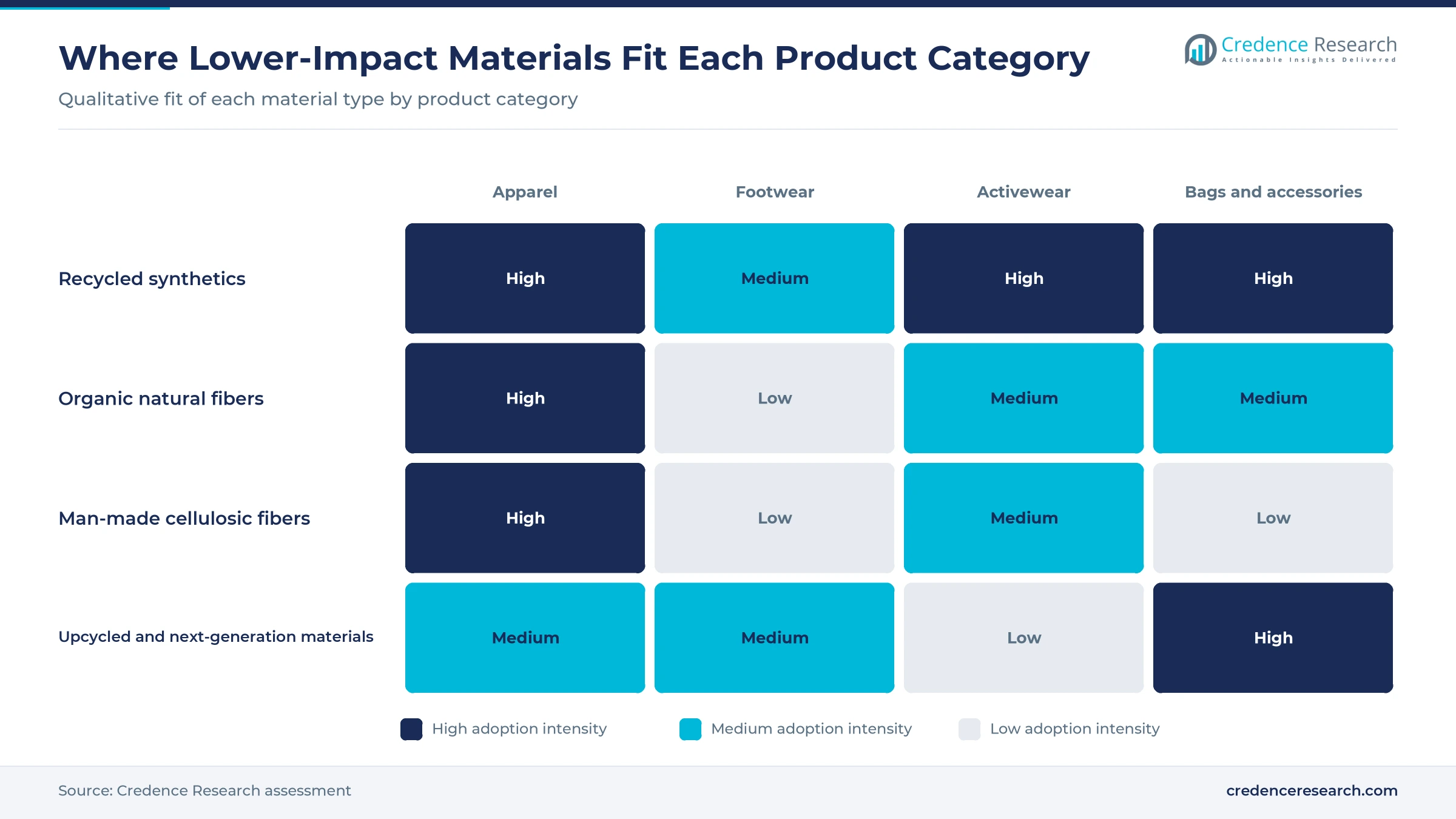
Recycled and lower-impact material supply is scaling
Recycled fiber is becoming available in commercial volumes, which lowers the cost of lower-impact ranges for Spanish brands. Recover, based in Banyeres de Mariola in Alicante, supplies Primark Cares items that contain up to 20% recycled cotton, Alicante Plaza reported in February 2025, and it renewed its Global Recycled Standard certification in Spain in 2025. The same company signed a multi-year agreement with H&M to use its recycled cotton fiber. Circulose pulp can be spun into viscose, modal or lyocell fiber, giving Mango a route to recycled cellulosic fabrics. Mango said almost 30% of its garments were designed with circular criteria by the end of 2024.
Collection and sorting capacity feeds a domestic fiber loop
New collection and sorting capacity gives Spanish brands local feedstock and a credible take-back promise. Moda re-, the Cáritas cooperative, collected 50,926 metric tons of used textiles in 2025 through containers across the country. In Galicia, Moda re- placed the first pillar of a plant in Santiago de Compostela on Feb. 12, 2026, with 2 million euros from Inditex and capacity for up to 10,000 metric tons a year, FashionUnited reported. The Xunta de Galicia is also building a public sorting plant in Cerceda that can grow to 24,000 metric tons a year, according to a regional government release of August 2025. Together these projects favor textile recycling at home rather than export of mixed bales.
Repair services and local fiber loops reshape supply
Shift toward repair and take-back as part of the product
Repair services are moving from a niche gesture to a standard feature that buyers expect from premium brands. Patagonia offers customers in Spain free repairs through its European repair centers, with a turnaround of four to six weeks and only a small shipping fee, according to its Spanish website. Zara Pre-Owned also offers repairs in Spain, one of 14 European markets where the service runs. El Corte Inglés collected 630,916 kilograms of used textiles from 73 containers in its Spanish centers in fiscal 2025, FashionUnited reported in August 2026. A repair promise lengthens product life, so it adds to the faster growth of Circular and Repairable Products and justifies higher shelf prices.
Rise of low-impact store formats and brand-run shops
Purpose-led brands are opening their own stores in Spanish cities, and they use the store itself to prove their claims. Ecoalf opened a 185-square-meter store in San Sebastián in December 2025 built from FSC-certified paper and cardboard supplied by Smurfit Westrock, FashionUnited reported. Thinking MU runs stores in Barcelona, Madrid and San Sebastián and plans about ten own stores within a couple of years, FashionUnited reported in November 2025. More than 80% of the Barcelona brand’s sales come from outside Spain, so the home store network is a deliberate push into its domestic market. Most of Ecoalf’s 45 Spanish points of sale are corners inside El Corte Inglés centers, FashionUnited reported in August 2026. These openings keep Brand-Owned Stores the leading channel while showing buyers how materials and repairs work.
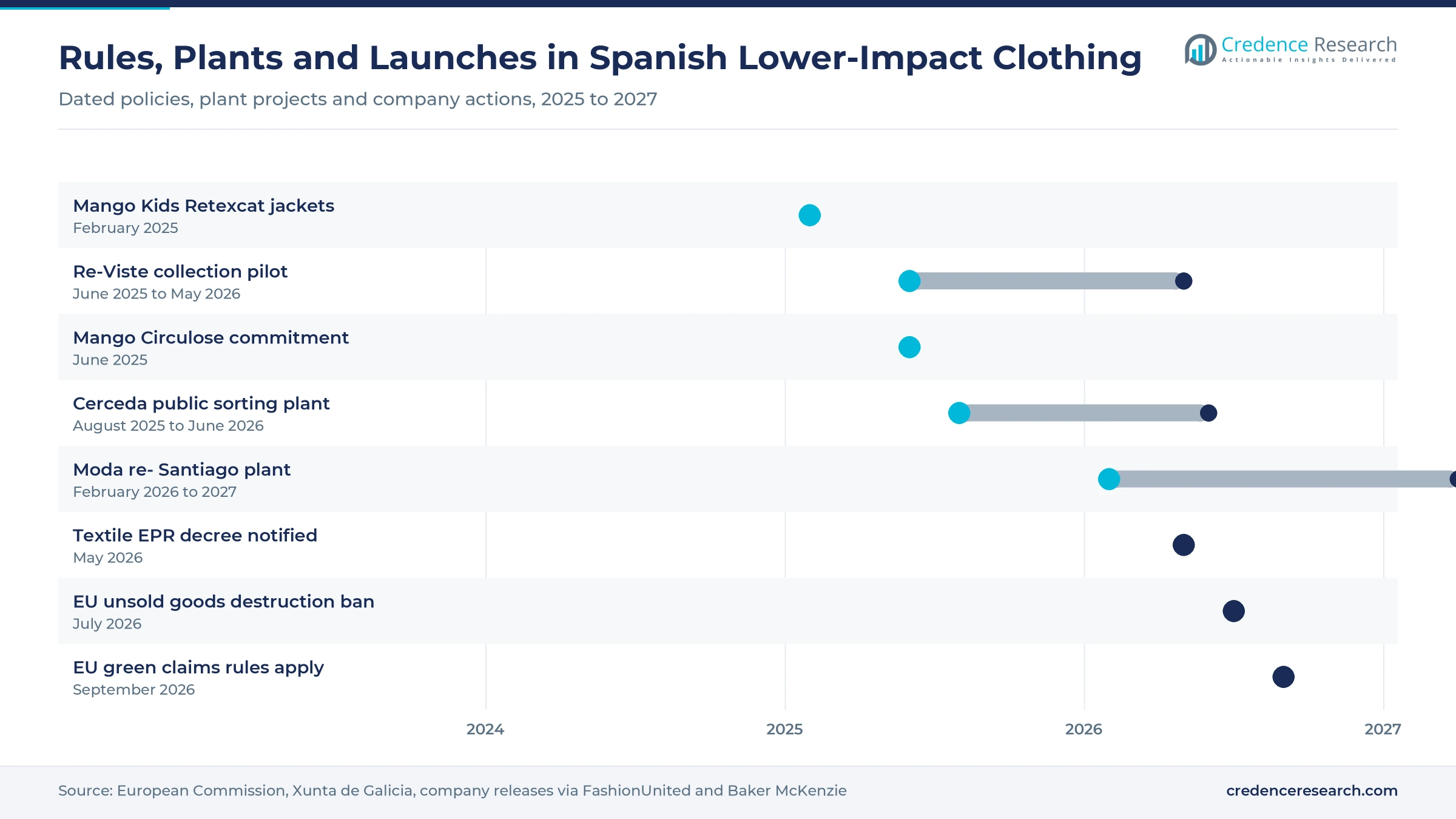
Opening in recycled lines for children and value ranges
Locally recycled fabric offers an opening in children’s wear and value ranges, where parents replace clothes often and price matters most. The Retexcat pilot, funded with 854,474 euros by the Catalan Waste Agency, turned 30,290 kilograms of collected clothing into 5,500 kilograms of recycled yarn, FashionUnited reported in February 2025. Mango Kids sold jackets from that yarn, and Boboli produced baby knitwear in the same project. About 990,000 metric tons of textiles still go to landfill in Spain each year, FashionUnited reported in November 2025, so feedstock is plentiful. Suppliers that pair Catalan or Valencian spinning with children’s brands can sell recycled content without a large premium.
Opening for brands that add resale to new products
Resale offers brands an opening to keep customers after the first sale and to capture part of the second one. Vinted said in its 2025 impact report that 88% of its members check the platform before considering a new item, so the resale value of a garment now shapes the first purchase. Wallapop estimated that an average user generates economic value of 1,112 euros a year through reuse, according to its La Red del Cambio 2025 study. Growth in secondhand clothing across Europe suggests that buy-back credit and certified pre-owned ranges can raise loyalty. Brands with durable products and repair records are best placed to run such programs.
Flat spending and saturated sorting hold back growth
Can lower-impact ranges grow while fashion spending stalls?
Total fashion spending in Spain is barely growing, so lower-impact ranges must take share from conventional products rather than ride a rising market. Fashion retail sales rose only 0.61% in 2025 to 11,107 million euros, still far below the 18,078 million euros of 2019, according to Acotex. Retailers with flat sales resist paying more for certified fibers. Brands therefore need to show durability and resale value to justify their prices.
Will shoppers keep paying a green premium?
Willingness to pay a green premium is limited while the wider fashion market stalls, and Acotex president Eduardo Zamácola described the sector in 2026 as being in a phase of stabilization, not expansion. Organic basics priced at 45 to 60 euros, as listed in the price table, therefore limit uptake among price-sensitive families. Suppliers respond with value-tier recycled lines and clearer evidence of longer product life.
Is sorting capacity keeping up with collected clothing?
Separate collection is rising faster than sorting and resale capacity, which raises costs for municipalities and recyclers. In Catalonia, only 13.6% of textile waste is collected separately, and about 21,600 metric tons now reach containers, according to Ara in December 2025. The Catalan government will raise payments to municipalities from 10 to 50 euros per metric ton in 2026 to relieve sorting firms. Until the producer responsibility scheme is funded, collected clothing that cannot be resold adds cost rather than feedstock for brands.
Are outlets for reused clothing narrowing?
Markets for reused clothing are narrowing, which pushes more collected material toward recycling or energy recovery. At El Corte Inglés, the share of collected textiles going to direct reuse fell from 57% to 54% in fiscal 2025, while energy recovery rose from 10.4% to 12%, FashionUnited reported. Low-quality garments are harder to resell abroad, and recycling them costs more. Brands that design single-fiber products make reuse and recycling easier and cheaper.
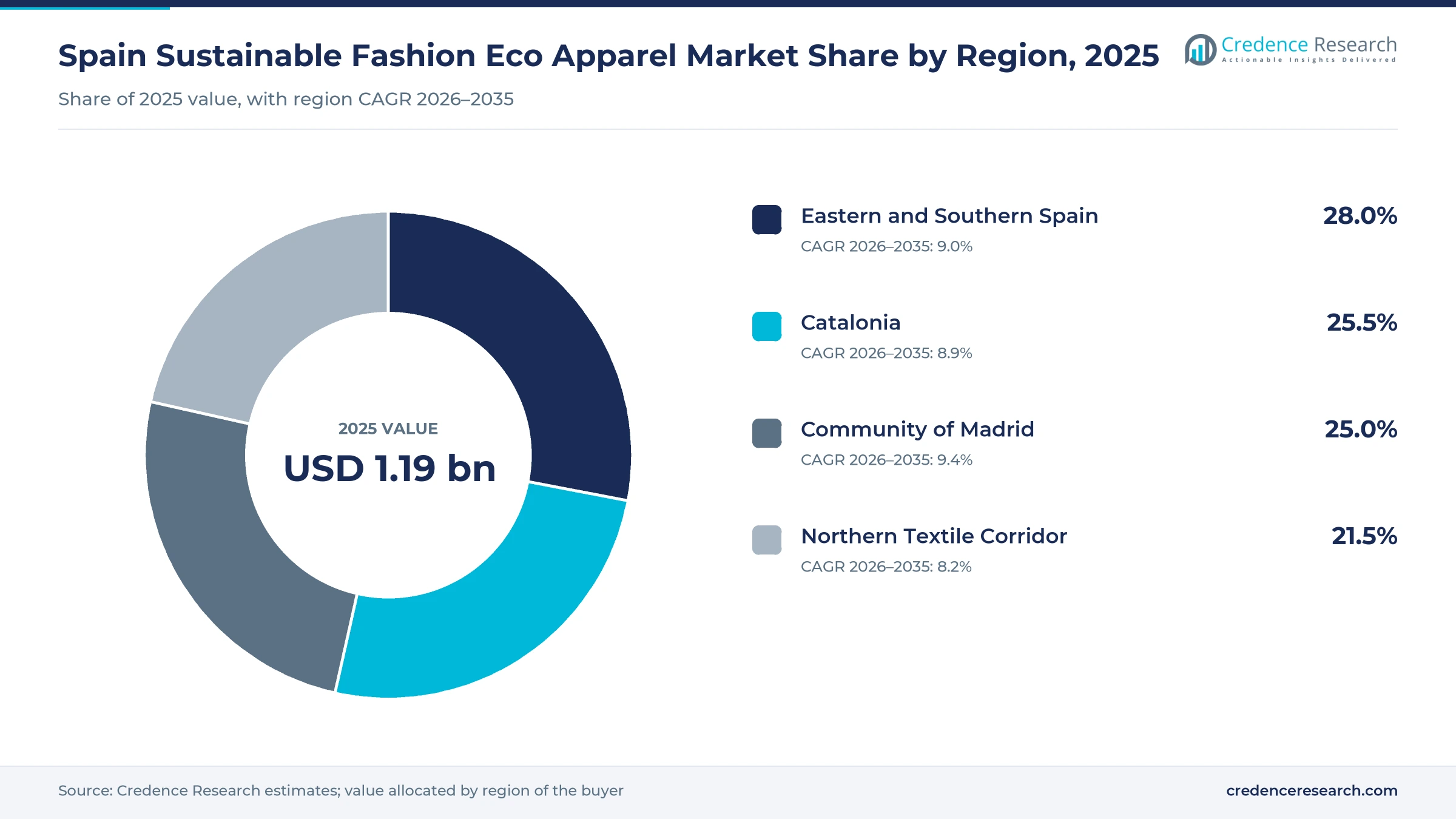
Southern and Eastern regions lead while Madrid grows fastest
| Region | Value, 2025 (USD billion) | Share, 2025 | CAGR, 2026–2035 |
|---|---|---|---|
| Eastern and Southern Spain | 0.33 | 28.0% | 8.9% |
| Catalonia | 0.30 | 25.5% | 8.8% |
| Community of Madrid | 0.30 | 25.0% | 9.3% |
| Northern Textile Corridor | 0.26 | 21.5% | 8.2% |
Eastern and Southern Spain lead on population and new stores
Eastern and Southern Spain held a 28.0% share of 2025 value and grows at 8.9% a year. The zone covers Andalusia, the Valencian Community, Murcia, Castilla-La Mancha, Extremadura and the Balearic and Canary Islands, where spending on clothing averaged 272.27 euros per person in Andalusia in 2025, below the national 316.33 euros, according to Acotex. The Valencian Community recorded the fastest population growth in Spain in the second quarter of 2026, at 0.43%, according to INE. Ecoalf’s first stores in Valencia and Seville, noted above, show brands moving into this larger but more price-sensitive market.
Catalonia combines design brands with recycling pilots
Catalonia held a 25.5% share of 2025 value and grows at 8.8% a year. Spending on clothing averaged 315.31 euros per person in 2025, close to the national average, according to Acotex. Barcelona is home to Mango and Thinking MU, and to the Catalan fashion cluster Modacc that coordinated the Retexcat pilot noted above. Catalan policy also funds municipal textile collection, giving local brands an early source of recycled fiber and a visible take-back promise.
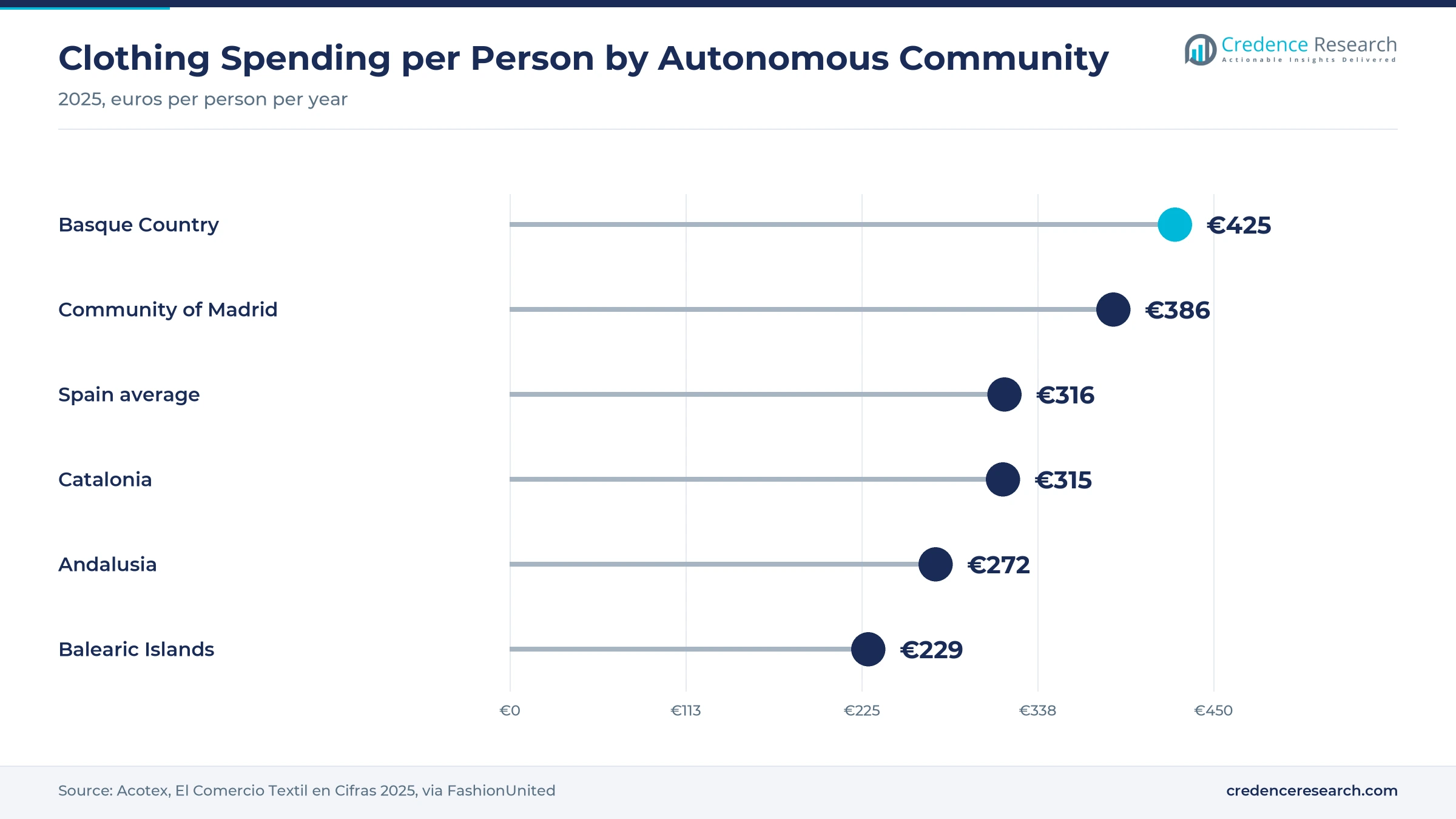
Madrid grows fastest as purpose brands open stores
The Community of Madrid held a 25.0% share of 2025 value and grows fastest at 9.3% a year. Spending on clothing reached 385.95 euros per person in 2025, second only to the Basque Country, according to Acotex. Veja and Thinking MU both chose central Madrid for their stores. Ecoalf also has its headquarters in Madrid, close to its largest group of buyers, according to Euronews. Buyers of premium outerwear and sneakers are concentrated here, which supports the region’s growth lead.
Northern Textile Corridor pairs high spending with sorting plants
The Northern Textile Corridor held a 21.5% share of 2025 value and grows at 8.2% a year. The zone stretches from Galicia through Asturias, Cantabria and Castile and León to the Basque Country, Navarre, La Rioja and Aragon. Spending on clothing averaged 425.39 euros per person in the Basque Country in 2025, the highest in Spain, according to Acotex. San Sebastián hosts stores of both Ecoalf and Thinking MU, while the Galician sorting plants noted above will supply recycled feedstock close to Inditex, which co-funds the Santiago plant.
Recycling plants and EU rules mark 2025 and 2026
| Development | Status and market relevance |
|---|---|
| In February 2025, Mango Kids launched jackets made from recycled yarn produced in the Catalan Retexcat project. | On sale; first circular garments made fully in Catalonia |
| In June 2025, Re-Viste began its first textile collection pilot in San Miguel de Abona, Tenerife. | Running; pilot extended to six municipalities by May 2026 |
| In June 2025, Mango committed to use Circulose pulp made from discarded cotton-rich textiles. | Agreed; supports recycled cellulosic fabrics |
| In February 2026, Moda re- began building a textile sorting plant in Santiago de Compostela co-funded by Inditex. | Under construction; operations planned for the second quarter of 2027 |
| In May 2026, Spain notified the European Commission of its draft royal decree on textile and footwear producer responsibility. | Draft; adoption expected after the EU standstill period |
Traceability and fiber recycling shape product claims
- Digital product passports will record fiber content, origin and repair options for each product under the EU ecodesign rules, giving buyers and inspectors the same data.
- Mechanical recycling shreds used garments and cutting waste into new cotton fiber, the process Recover uses in Banyeres de Mariola for blended yarns.
- Cellulosic recycling dissolves cotton-rich textiles into pulp such as Circulose, which spinners turn into viscose, modal or lyocell fabrics.
- Fiber tracing tokens follow recycled cotton through each production step, as Recover tested with TextileGenesis in a June 2025 pilot.
Need a Custom Version of This Report?
Tailor the scope, geography, or segments to your exact requirements.
- Custom geography or segment scope
- Direct access to our analyst team
Fashion groups and purpose brands split the field
Competition for eco apparel buyers in Spain pits large fashion groups with certified lines against purpose-led brands that build every product around lower-impact materials. Inditex runs Zara Pre-Owned for repair, resale and donation and co-funds new sorting capacity in Galicia, while Mango invests in recycled cellulosic fiber through Circulose. H&M sells recycled cotton lines and is a founding member of Re-Viste with Inditex, Mango and Tendam. Ecoalf leads among Spanish purpose brands through its own stores and its corners in El Corte Inglés. Thinking MU sells organic cotton and hemp collections from Barcelona, mostly to buyers abroad. Patagonia, Veja and Armedangels compete on durable outerwear, sneakers and organic basics, with repair services as a key selling point. Suppliers compete on proof of claims, durability and repair rather than on price alone.
How is supply organized, and where do margins sit?
Supply splits into three groups that compete for the same shopper. Large Spanish and European groups such as Inditex, Mango and H&M sell certified and recycled lines at scale inside conventional ranges. Purpose-led brands such as Ecoalf and Thinking MU build their whole offer around recycled, organic or regenerative materials. Imported specialists such as Veja, Patagonia and Armedangels sell through own stores, department stores and marketplaces. Entry barriers sit in certified fiber supply, documentation for EU claim rules and access to store space. Margins are highest for purpose brands with own stores and thinnest for value lines that carry recycled content without a price premium.
Which companies shape lower-impact clothing supply in Spain?
| Company | Type | Role in the market |
|---|---|---|
| Ecoalf | Spanish purpose brand | Recycled-material apparel and footwear through 45 points of sale in Spain |
| Industria de Diseño Textil SA (Inditex) | Fashion group | Lower-impact Zara lines, Zara Pre-Owned services and co-funding of Galician sorting |
| Punto Fa SL (Mango) | Fashion group | Recycled and lower-impact collections, including Circulose and Retexcat projects |
| H&M Group | Fashion group | Recycled cotton lines in Spain and founding member of the Re-Viste scheme |
| Patagonia | Outdoor specialist | Recycled fleeces and outerwear with free repairs for Spanish customers |
| Veja | Footwear specialist | Leather and rubber sneakers sold from its Madrid store and on Zalando Spain |
| Armedangels | Organic apparel brand | Organic cotton basics and denim sold on Zalando Spain and in retail |
| Thinking MU | Spanish purpose brand | Organic cotton and hemp collections from stores in Barcelona, Madrid and San Sebastián |
Documented claims will decide share gains to 2035
Credence Research’s view is that documented claims, not green marketing, will decide which eco apparel suppliers gain share in Spain to 2035. The EU directive on consumer claims and the destruction ban move the burden of proof onto brands, and the Spanish producer responsibility decree will add fees that favor recyclable designs. Suppliers that pair certified fiber, a repair service and a resale route can defend premium prices even while total fashion spending stays flat. The most useful investments are traceability data, single-fiber product design and partnerships with Spanish recyclers.
Household spending and retail data anchor the estimate
The report uses 2025 as the base year and forecasts values to 2035. Market values come from the Credence Research model, and segment and regional splits are Credence Research estimates. The Spain estimate was cross-checked against INE household spending on clothing and footwear and Acotex retail sales data, applying a share for eco apparel and footwear sold on a documented sustainability claim. Evidence comes from INE releases, European Commission and Spanish regulatory notices, regional government releases, company announcements and national trade press. No interviews or surveys were conducted for this report, and private secondhand resale is excluded.
Rules, not slogans, carry growth through 2035
Spanish spending on eco apparel should rise from USD 1.31 billion in 2026 to USD 2.81 billion by 2035, with most growth coming from share gains inside a flat fashion market. Upcycled and Next-Generation Materials should grow at 10.2% a year as Spanish sorting plants and recyclers supply more feedstock. The Community of Madrid should gain share as purpose brands add stores in the capital. The main risks are weak enforcement of claim rules, a slow start for the producer responsibility scheme and households that keep cutting fashion budgets.
What separates the downside, base and upside paths to 2035?
The range of outcomes depends on how strictly the new EU claim rules are enforced and on whether Spanish households regain spending power. A downside path follows if enforcement is light, recycled fiber stays expensive and fashion spending keeps falling. The base case assumes steady enforcement, a funded producer responsibility scheme from 2027 and gradual store openings. An upside path needs fast enforcement, cheaper recycled fiber from new Spanish plants and wide uptake of repair and resale services.
| Scenario | CAGR, 2026–2035 | Value, 2035 | What has to hold |
|---|---|---|---|
| Downside | 7.1% | USD 2.42 billion | Claim rules are enforced lightly, recycled fiber stays costly and household fashion spending keeps declining |
| Base | 8.86% | USD 2.81 billion | Rules are enforced steadily and the producer responsibility scheme is funded from 2027 |
| Upside | 10.4% | USD 3.18 billion | Strict enforcement, cheaper domestic recycled fiber and wide uptake of repair and resale services |
Frequently Asked Questions
How big is the Spain sustainable fashion eco apparel market?
Which region leads lower-impact clothing sales in Spain?
Which region grows fastest?
Which material type holds the largest share?
How do new EU rules affect brands selling in Spain?
What is Re-Viste?
What is the biggest challenge for the market?
Which companies are active in the market?
Table of Content
Chapter 1 Market Segmentation
- 1.1 Segmentation Framework
- 1.1.1 Product and Service Classification
- 1.1.2 Application and End-Use Classification
- 1.1.3 Technology and Solution Classification
- 1.1.4 Customer and Distribution Channel Classification
- 1.1.5 Geographic Segmentation
- 1.1.6 Market Segment Definitions and Boundaries
- 1.2 By Product Category
- 1.2.1 Apparel
- 1.2.2 Footwear
- 1.2.3 Activewear
- 1.2.4 Bags and Accessories
- 1.3 By Material Type
- 1.3.1 Recycled Synthetics
- 1.3.2 Organic Natural Fibres
- 1.3.3 Man-Made Cellulosic Fibres
- 1.3.4 Upcycled and Next-Generation Materials
- 1.4 By Sustainability Proposition
- 1.4.1 Certified Lower-Impact Products
- 1.4.2 Circular and Repairable Products
- 1.4.3 Local and Traceable Products
- 1.4.4 Vegan and Animal-Free Products
Chapter 2 Introduction
- 2.1 Report Objectives and Scope
- 2.2 Product Definition and Industry Terminology
- 2.3 Market Inclusions and Exclusions
- 2.4 Research Process
- 2.4.1 Primary Research and Expert Interviews
- 2.4.2 Secondary Research and Source Review
- 2.4.3 Top-Down and Bottom-Up Estimation
- 2.4.4 Data Triangulation and Verification
- 2.5 Market Size Measurement Basis
- 2.5.1 2025: USD 1.19 billion → 2035: USD 2.81 billion
- 2.6 Historical and Forecast Reference Periods
- 2.6.1 Historical Period: 2018-2025
- 2.6.2 Base Year: 2025
- 2.6.3 Forecast Period: 2025-2035
- 2.7 Research Assumptions and Limitations
Chapter 3 Executive Summary
- 3.1 Market Snapshot and Key Findings
- 3.2 Base-Year Market Size, 2025
- 3.3 Forecast Market Size, 2035
- 3.4 Revenue and Volume Growth Outlook
- 3.5 Key Demand and Supply Indicators
- 3.6 Leading Market Segments
- 3.7 Fastest-Growing Market Opportunities
- 3.8 Regional Performance Highlights
- 3.9 Technology and Industry Transformation
- 3.10 Competitive Landscape Summary
- 3.11 Analyst View and Strategic Implications
Chapter 4 Spain Sustainable Fashion Eco Apparel Market Trends and Developments
- 4.1 Historical Industry Development, 2018-2025
- 4.2 Recent Market Trends and Developments
- 4.3 Demand and Customer Behavior Trends
- 4.4 Technology and Product Innovation
- 4.5 Artificial Intelligence, Automation and Digitalization
- 4.6 Local Manufacturing and Supply Chain Realignment
- 4.7 Industry Partnerships, Mergers and Acquisitions
- 4.8 Sustainability and Circular Economy Developments
- 4.9 Government and Private Sector Investment Trends
- 4.10 Emerging Business Models and Commercialization
- 4.11 Industry Developments and Announcements
Chapter 5 Spain Sustainable Fashion Eco Apparel Market Production, Supply and Demand Analysis
- 5.1 Demand Trend and Consumption Analysis, 2018-2025
- 5.2 Demand Forecast, 2025-2035
- 5.3 Production and Output Trend, 2018-2025
- 5.4 Production and Output Forecast, 2025-2035
- 5.5 Installed Capacity and Capacity Utilization
- 5.6 Company-Wise Production Plants and Statistics
- 5.6.1 Installed Production Capacity
- 5.6.2 Actual Production
- 5.6.3 Planned Capacity and Expansion Targets
- 5.7 Supply Chain Structure and Procurement Trends
- 5.8 Supply-Demand Gap and Bottlenecks
- 5.9 Import Dependence and Sourcing Structure
- 5.10 Contract Manufacturing and Outsourcing
- 5.11 Regional Supply and Demand Concentration
Chapter 6 Spain Sustainable Fashion Eco Apparel Market Pricing Analysis
- 6.1 Pricing Structure and Measurement
- 6.2 Historical Pricing Trends, 2018-2025
- 6.3 Pricing Outlook, 2025-2035
- 6.4 Average Selling Price and Unit Economics
- 6.5 Pricing by Product and Market Segment
- 6.6 Geographic Pricing Differences
- 6.7 Key Input, Energy, Labor and Logistics Costs
- 6.8 Contract Pricing and Purchasing Models
- 6.9 Pricing Sensitivity and Competitive Positioning
- 6.10 Price, Margin and Profitability Implications
Chapter 7 Spain Sustainable Fashion Eco Apparel Market Dynamics
- 7.1 Market Growth Drivers
- 7.1.1 Demand-Side Drivers
- 7.1.2 Technology and Innovation Drivers
- 7.1.3 Infrastructure and Investment Drivers
- 7.1.4 Regulatory and Policy Drivers
- 7.2 Market Restraints
- 7.2.1 Cost and Affordability Constraints
- 7.2.2 Technology and Adoption Barriers
- 7.2.3 Supply Chain and Operational Constraints
- 7.3 Market Challenges
- 7.3.1 Competitive Pressure and Margin Erosion
- 7.3.2 Skills, Infrastructure and Implementation Gaps
- 7.4 Emerging Market Opportunities
- 7.5 Market Dynamics Impact and Time-Horizon Assessment
Chapter 8 Spain Sustainable Fashion Eco Apparel Value Chain Analysis
- 8.1 Industry Value Chain Overview
- 8.2 Upstream Suppliers and Critical Inputs
- 8.3 Technology and Component Providers
- 8.4 Manufacturing or Service Delivery
- 8.5 Distribution, Channel Partners and Integrators
- 8.6 Downstream Applications and End Users
- 8.7 Value Addition and Profit Pools
- 8.8 Vertical Integration and Outsourcing
- 8.9 Supplier Concentration and Risk
- 8.10 Supply Chain Localization and Resilience
Chapter 9 Spain Sustainable Fashion Eco Apparel Market Regulations and Policies
- 9.1 Relevant Laws, Standards and Compliance Frameworks
- 9.2 Product, Service, Safety and Quality Requirements
- 9.3 Government Policies, Incentives and Subsidies
- 9.4 Imports, Exports and Trade Barriers
- 9.5 Public Procurement and Local Content Requirements
- 9.6 Environmental and Sustainability Compliance
- 9.7 Upcoming Policy Changes and Market Implications
Chapter 10 Spain Sustainable Fashion Eco Apparel Market Hotspots and Opportunities
- 10.1 Market Opportunity Mapping and Growth Hotspots
- 10.2 High-Growth Applications and Customer Groups
- 10.3 Underserved Markets and White-Space Opportunities
- 10.4 Emerging Technology and Product Opportunities
- 10.5 New Capacity and Investment Hotspots
- 10.6 Market Entry and Expansion Opportunities
- 10.7 Distribution and Partnership Opportunities
- 10.8 Near-Term and Long-Term Commercial Potential
- 10.9 Opportunity Attractiveness and Execution Risks
Chapter 11 Spain Sustainable Fashion Eco Apparel Market Outlook, 2025-2035
- 11.1 Market Size and Analysis
- 11.1.1 Revenue (Market Measurement: 2025: USD 1.19 billion → 2035: USD 2.81 billion)
- 11.1.2 Market Volume and Quantity Sold
- 11.1.3 Historical Market Size, 2018-2025
- 11.1.4 Base-Year Market Size, 2025
- 11.2 Market Forecast, 2025-2035
- 11.2.1 Revenue Forecast to 2035
- 11.2.2 Volume Forecast to 2035
- 11.2.3 CAGR and Year-on-Year Growth
- 11.2.4 Incremental Revenue Opportunity
- 11.3 Forecast Assumptions and Scenario Analysis
- 11.3.1 Base-Case Forecast
- 11.3.2 Optimistic and Conservative Scenarios
- 11.3.3 Technology, Pricing and Policy Sensitivities
- 11.4 Market Attractiveness and Growth Outlook
Chapter 12 Spain Sustainable Fashion Eco Apparel Market Segmentation and Outlook
- 12.1 Segmentation Summary and Market Shares, 2025
- 12.2 Largest and Fastest-Growing Segments
- 12.3 By Product Category - Market Size and Forecast, 2025-2035
- 12.3.1 Segment Definition and Scope
- 12.3.2 Historical Market Size, 2018-2025
- 12.3.3 Revenue Forecast, 2025-2035
- 12.3.4 Volume Forecast, 2025-2035
- 12.3.5 Base-Year Market Share, 2025
- 12.3.6 Segment CAGR and Growth Drivers
- 12.3.7 Subsegment Market Size and Forecast
- 12.3.7.1 Apparel
- 12.3.7.2 Footwear
- 12.3.7.3 Activewear
- 12.3.7.4 Bags and Accessories
- 12.3.8 Subsegment Pricing and Adoption Trends
- 12.3.9 Leading Suppliers and Competition
- 12.3.10 Regional Demand and Opportunities
- 12.4 By Material Type - Market Size and Forecast, 2025-2035
- 12.4.1 Segment Definition and Scope
- 12.4.2 Historical Market Size, 2018-2025
- 12.4.3 Revenue Forecast, 2025-2035
- 12.4.4 Volume Forecast, 2025-2035
- 12.4.5 Base-Year Market Share, 2025
- 12.4.6 Segment CAGR and Growth Drivers
- 12.4.7 Subsegment Market Size and Forecast
- 12.4.7.1 Recycled Synthetics
- 12.4.7.2 Organic Natural Fibres
- 12.4.7.3 Man-Made Cellulosic Fibres
- 12.4.7.4 Upcycled and Next-Generation Materials
- 12.4.8 Subsegment Pricing and Adoption Trends
- 12.4.9 Leading Suppliers and Competition
- 12.4.10 Regional Demand and Opportunities
- 12.5 By Sustainability Proposition - Market Size and Forecast, 2025-2035
- 12.5.1 Segment Definition and Scope
- 12.5.2 Historical Market Size, 2018-2025
- 12.5.3 Revenue Forecast, 2025-2035
- 12.5.4 Volume Forecast, 2025-2035
- 12.5.5 Base-Year Market Share, 2025
- 12.5.6 Segment CAGR and Growth Drivers
- 12.5.7 Subsegment Market Size and Forecast
- 12.5.7.1 Certified Lower-Impact Products
- 12.5.7.2 Circular and Repairable Products
- 12.5.7.3 Local and Traceable Products
- 12.5.7.4 Vegan and Animal-Free Products
- 12.5.8 Subsegment Pricing and Adoption Trends
- 12.5.9 Leading Suppliers and Competition
- 12.5.10 Regional Demand and Opportunities
- 12.6 Segment Growth Comparison
- 12.7 Segment Attractiveness and Priority Matrix
Chapter 13 Spain Sustainable Fashion Eco Apparel Geographic Market Outlook, 2025-2035
- 13.1 Domestic Market Distribution and Demand Clusters
- 13.2 State- or Province-Wise Market Size and Forecast, 2025-2035
- 13.3 City and Metropolitan Market Outlook
- 13.4 Industrial, Manufacturing and Commercial Clusters
- 13.5 Geographic Concentration of Key End Users
- 13.6 Local Pricing and Purchasing Differences
- 13.7 Domestic Production Facilities and Capacity Map
- 13.8 Local Infrastructure and Project Pipeline
- 13.9 State-Level Policy and Incentive Differences
- 13.10 Subnational Investment Hotspots and Opportunities
- 13.11 Distribution and Logistics Networks
- 13.12 Domestic Competitive Footprint
Chapter 14 Spain Sustainable Fashion Eco Apparel Technology, Innovation and Sustainability Outlook
- 14.1 Technology Landscape and Maturity
- 14.2 Product, Process and Service Innovation
- 14.3 AI, Automation and Digital Tools in the Industry
- 14.4 Technology Adoption and Performance Benchmarking
- 14.5 Innovation Pipeline and R&D Investment
- 14.6 Patent and Intellectual Property Trends
- 14.7 Energy Efficiency and Resource Management
- 14.8 Sustainability, Recycling and Circularity
- 14.9 Technology Roadmap, 2025-2035
- 14.10 Risks of Obsolescence and Technology Substitution
Chapter 15 Spain Sustainable Fashion Eco Apparel Market Key Strategic Imperatives
- 15.1 Growth and Market Entry Priorities
- 15.2 High-Return Products and Segments
- 15.3 Pricing, Profitability and Cost Optimization
- 15.4 Technology Investment and Product Differentiation
- 15.5 Supply Chain Localization and Resilience
- 15.6 Distribution and Customer Acquisition
- 15.7 Partnership, Acquisition and Capacity Strategy
- 15.8 Regional Expansion Priorities
- 15.9 Short-, Medium- and Long-Term Actions
Chapter 16 Competition Outlook
- 16.1 Industry Competition Characteristics
- 16.2 Market Structure and Concentration
- 16.3 Market Share and Competitive Positioning, 2025
- 16.4 Company-Wise Revenue and Product Benchmarking
- 16.5 Production and Service Capacity Benchmarking
- 16.6 Technology, Pricing and Differentiation
- 16.7 Regional Footprint and Distribution Strength
- 16.8 Mergers, Acquisitions and Strategic Alliances
- 16.9 New Entrants and Competitive Threats
- 16.10 Porter's Five Forces and Industry Attractiveness
- 16.11 Competitive Outlook, 2025-2035
Chapter 17 Company Profiles
- 17.1 Company Coverage and Selection Criteria
- 17.2 Ecoalf
- 17.2.1 Business Description
- 17.2.2 Company Ownership and Geographic Presence
- 17.2.3 Product and Service Portfolio
- 17.2.4 Manufacturing and Operating Footprint
- 17.2.5 Production Capacity and Expansion Plans
- 17.2.6 Financial Performance and Investment
- 17.2.7 Market Share and Competitive Position
- 17.2.8 Technology and Innovation Capabilities
- 17.2.9 Strategic Alliances or Partnerships
- 17.2.10 Recent Developments
- 17.2.11 Growth Strategy and Outlook
- 17.3 Industria de Diseño Textil SA (Inditex)
- 17.4 Punto Fa SL (Mango)
- 17.5 H&M Group
- 17.6 Patagonia
- 17.7 Veja
- 17.8 Armedangels
- 17.9 Thinking MU
- 17.10 Other Relevant Market Participants
Note: Every listed company is profiled on the structure shown under the first company. The company list is preliminary and may change based on research findings, market developments, data availability and client requirements.
Chapter 18 Disclaimer
- 18.1 Research and Forecast Disclaimer
- 18.2 Data Source and Estimation Limitations
Note: The depth of individual sections depends on data availability for this market. Volume, capacity, trade and other unit-based metrics are included where applicable.

