Market Overview
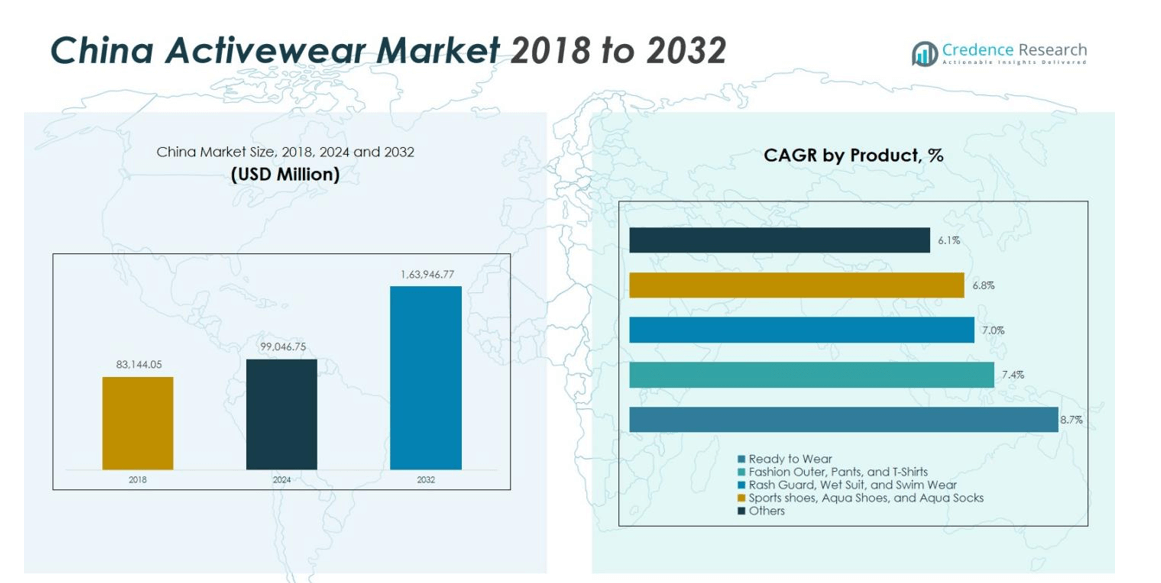
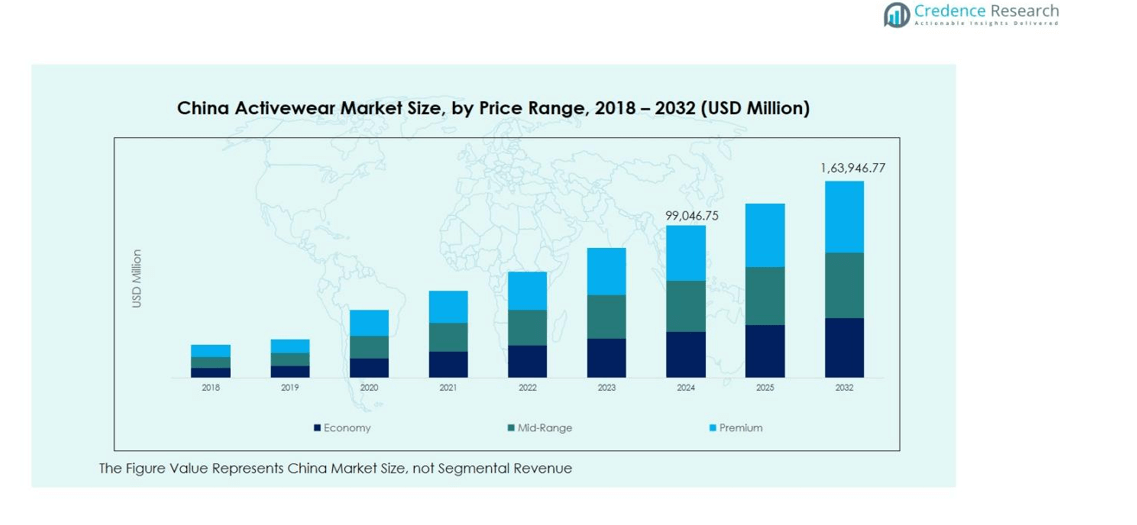
The China Activewear Market size was valued at USD 83,144.05 Million in 2018, increased to USD 99,046.75 Million in 2024, and is anticipated to reach USD 163,946.77 Million by 2032, at a CAGR of 6.50% during the forecast period.
| REPORT ATTRIBUTE | DETAILS |
|---|---|
| Historical Period | 2020-2023 |
| Base Year | 2024 |
| Forecast Period | 2025-2032 |
| China Activewear Market Size 2024 | USD 99,046.75 Million |
| China Activewear Market, CAGR | 6.50% |
| China Activewear Market Size 2032 | USD 163,946.77 Million |
The China Activewear Market is dominated by key players such as Anta Sports, Li-Ning, Nike China, Adidas China, and Under Armour China, who have established a strong presence through innovative products and extensive retail networks. Anta Sports and Li-Ning lead the domestic segment, catering to local preferences and offering performance-focused activewear. International giants Nike and Adidas continue to capture the premium segment with their global recognition and premium offerings. The market is also influenced by growing brands like Xtep International Holdings and Decathlon China, which are expanding their footprint in the region. In 2024, Eastern China holds the largest market share of 40%, driven by rapid urbanization, higher disposable incomes, and a strong fitness culture, particularly in cities such as Shanghai, Beijing, and Hangzhou. This region remains pivotal in shaping the growth trajectory of the China Activewear Market.
Market Insights
- The China Activewear Market reached USD 99,046.75 million in 2024 and is projected to grow at a CAGR of 6.50% through 2032.
- Growing health awareness and athleisure trends in urban China drive the Ready to Wear segment to hold a 40% market share, while Polyester dominates the fabric segment with 45% market share.
- E‑commerce expansion, sustainable material adoption, and smart‑fabric innovations position the market to benefit from shifting consumer behavior and technology‑driven apparel.
- Intense rivalries among domestic giants such as Anta Sports and Li‑Ning and global leaders including Nike China and Adidas China raise barriers to entry, while counterfeit products and quality concerns restrain market expansion.
- Eastern China commands the largest regional share at 40% in 2024, supported by higher disposable incomes and fitness culture, with Southern China holding 25%, Northern China 18%, Western China 10%, and Central China 7%.
Market Segmentation Analysis:
By Product
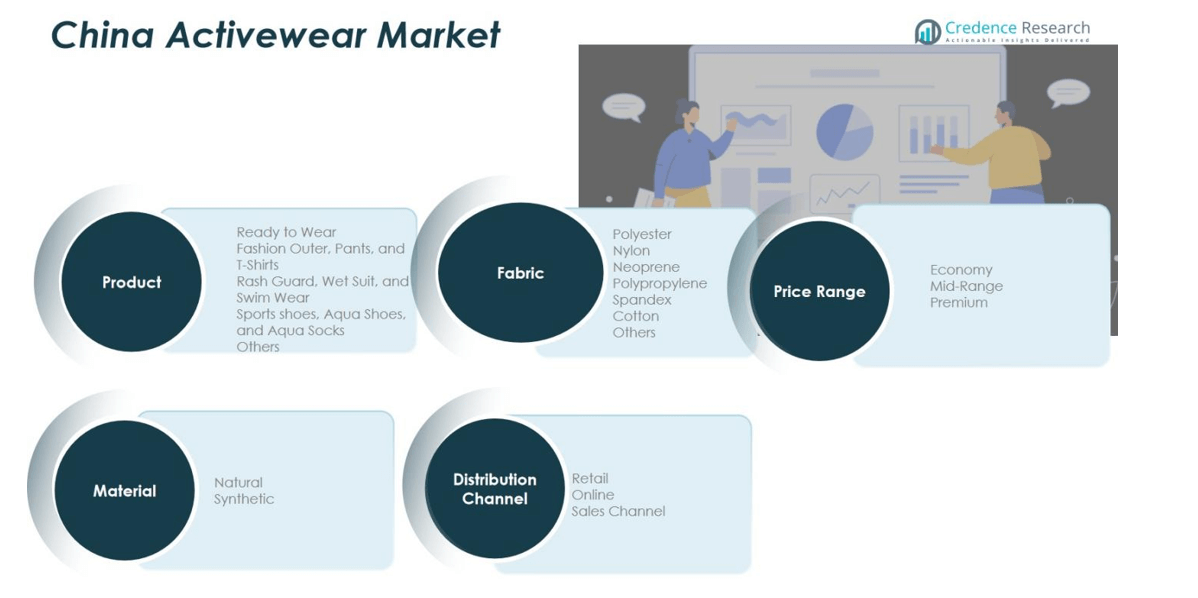
The China Activewear Market is diverse, with key product categories including Ready to Wear, Fashion Outer, Pants, and T-Shirts, Rash Guard, Wet Suit, and Swim Wear, and Sports Shoes, Aqua Shoes, and Aqua Socks. Among these, the Ready to Wear sub-segment dominates the market, holding a substantial share of 40% in 2024. This segment’s growth is fueled by the increasing demand for versatile, stylish, and comfortable activewear suitable for both daily wear and fitness activities. The rising health and fitness awareness in China, along with the growing trend of athleisure, continues to propel the demand for ready-to-wear activewear.
- For instance, Xtep Group sponsored 44 marathons across China in 2024, promoting its running shoes and connecting with fitness enthusiasts nationwide.
By Fabric
In the fabric segment, Polyester leads with the largest market share, commanding 45% in 2024. Polyester is preferred for its durability, moisture-wicking properties, and affordability, making it an ideal fabric for activewear. The widespread use of polyester in various activewear items, from leggings to sports bras, is a key factor driving its market dominance. Furthermore, advancements in fabric technology, such as eco-friendly recycled polyester, are enhancing its appeal among environmentally conscious consumers seeking sustainable yet functional materials for their activewear.
- For instance, Under Armour has committed to increasing recycled polyester use, with over 300 products featuring recycled polyester last fiscal year, including their Tech Tee and Armour Fleece lines made from 100% recycled polyester.
By Material
The Synthetic material segment leads the market, holding 60% of the market share in 2024. Synthetic materials, particularly polyester and spandex, are favored for their stretchability, durability, and performance-enhancing features. These materials offer excellent flexibility, moisture management, and breathability, making them ideal for activewear. As consumers increasingly prioritize comfort and performance in their fitness apparel, the demand for synthetic materials continues to rise, further solidifying their dominance in the China Activewear Market.
Key Growth Drivers
Rising Health and Fitness Awareness
The increasing awareness of health and fitness among Chinese consumers is a key growth driver for the activewear market. As more individuals adopt fitness routines and prioritize a healthy lifestyle, demand for comfortable and performance-oriented activewear rises. This growing health consciousness, particularly among millennials and Gen Z, drives a shift toward athleisure as consumers seek versatile apparel that can transition from the gym to daily wear. The government’s focus on promoting physical activities through national health campaigns also supports the rise of fitness culture, further fueling market growth.
- For instance, Li-Ning integrates advanced moisture-wicking TurboDri technology in its Freestyle Tees to enhance comfort during workouts, catering to fitness enthusiasts seeking high-performance apparel.
Athleisure Trend and Fashion Integration
The blending of athletic and casual fashion, commonly known as athleisure, is a significant driver in the China Activewear Market. This trend has reshaped consumer perceptions of activewear, making it not only suitable for fitness but also for casual and work environments. As fashion-conscious consumers look for stylish yet functional clothing, activewear brands are increasingly offering versatile designs that cater to both performance and everyday wear. The widespread acceptance of athleisure in urban China, especially among young professionals, has contributed to substantial market growth.
- For instance, Nike’s localized product launches in China include the Spring Festival collection with styles inspired by traditional Chinese culture.
Technological Advancements in Activewear Fabrics
Innovations in fabric technology play a crucial role in driving the China Activewear Market. Advances in materials such as moisture-wicking, quick-drying fabrics, and eco-friendly options like recycled polyester enhance the performance and sustainability of activewear. Additionally, the use of smart fabrics that improve comfort and flexibility, along with the incorporation of features like UV protection and temperature regulation, attracts consumers who prioritize both performance and eco-conscious choices. These technological advancements make activewear more appealing and drive the demand for functional, high-performance apparel.
Key Trends & Opportunities
Rise of Online Retail Channels
The growth of e-commerce is rapidly reshaping the distribution landscape of the China Activewear Market. As more consumers turn to online platforms for convenience and variety, brands are increasingly focusing on expanding their online presence. The ease of browsing, personalized recommendations, and direct-to-consumer models offered by online retailers have become significant drivers of sales in the activewear sector. The rise of social media and influencer marketing further boosts online sales by reaching targeted, fitness-focused demographics and increasing consumer engagement with brands.
- For instance, Adidas uses augmented reality for virtual shoe try-ons and leverages live streaming on Tmall to launch new products, engaging millions of viewers effectively.
Sustainability and Eco-conscious Consumer Preferences
Sustainability is becoming a key trend in the China Activewear Market, as consumers increasingly prioritize environmentally friendly products. The growing preference for eco-conscious materials, such as recycled fabrics and organic cotton, is influencing purchasing decisions. Brands that incorporate sustainable practices, such as reducing carbon footprints and adopting circular economy models, are gaining a competitive edge. As more Chinese consumers demand transparency in production processes, the focus on sustainable manufacturing and product life-cycle management presents a significant opportunity for market growth.
- For instance, Ninghow Apparel, a sustainable clothing manufacturer in China, which partners with brands to produce eco-friendly activewear using GRS-certified recycled polyester and low-water dyeing technologies, delivering market-ready prototypes within a month.
Key Challenges
Intense Competition Among Domestic and International Brands
The China Activewear Market faces intense competition from both domestic and international brands, making it challenging for companies to establish a strong foothold. Domestic players such as Li-Ning and Anta Sports have a well-established presence, while international giants like Nike and Adidas continue to dominate the premium segment. This competitive landscape requires activewear companies to constantly innovate, differentiate their products, and engage in aggressive marketing campaigns to capture consumer attention. The pressure from both local and global brands complicates market entry and profitability for new players.
Counterfeit and Low-quality Products
The prevalence of counterfeit and low-quality activewear products is a significant challenge in the China market. Many consumers are attracted to cheaper alternatives, which are often sold through online platforms or unbranded retail stores. These counterfeit products not only undermine the profitability of legitimate brands but also pose a threat to consumer trust and brand reputation. To combat this issue, activewear brands must invest in authentication technology, strict quality control measures, and brand protection strategies, while also educating consumers about the risks of purchasing counterfeit goods.
Regional Analysis
Eastern China
Eastern China holds the largest share of the China Activewear Market, accounting for 40% of the total market in 2024. This region's dominance is driven by the rapid urbanization, high disposable incomes, and a strong inclination toward fitness and wellness among consumers. Cities like Shanghai, Beijing, and Hangzhou are hotspots for activewear demand, where consumers increasingly adopt athleisure for both fitness and daily wear. The presence of key retail hubs and a growing middle-class population further contribute to the region's market growth, making it a key player in shaping the overall market dynamics.
Southern China
Southern China represents a significant portion of the activewear market, holding 25% of the market share in 2024. This region benefits from a high concentration of affluent consumers in cities like Guangzhou and Shenzhen, who are increasingly adopting active lifestyles. The warm climate of Southern China also supports the demand for lightweight and breathable activewear. With growing health awareness and a shift towards more casual, functional apparel, the demand for activewear is expected to continue rising, particularly in the urban centers, where fitness culture and athleisure are gaining widespread popularity.
Northern China
Northern China holds 18% of the China Activewear Market share in 2024. The region's market is characterized by a mix of traditional fitness culture and the rising trend of athleisure among younger populations. Cities such as Beijing and Tianjin are seeing an increasing number of fitness centers and activewear stores, contributing to the growth of the market. Additionally, the region benefits from a strong retail presence and a growing demand for both casual and performance-focused activewear. As disposable income continues to rise in the region, the market for activewear is expected to expand steadily.
Western China
Western China, though accounting for 10% of the market share in 2024, is showing rapid growth in activewear demand. The region's market is primarily driven by emerging urban centers such as Chengdu and Xi'an, where there is a rising interest in fitness and wellness. The growing middle-class population and increased investment in infrastructure have made activewear more accessible. As the region continues to urbanize and more consumers adopt active lifestyles, the demand for activewear is expected to increase, albeit at a slower pace than in more developed eastern regions.
Central China
Central China holds 7% of the market share in 2024, with cities like Wuhan and Zhengzhou leading the activewear market in the region. While the market is smaller compared to other regions, it is experiencing steady growth due to the rise in health consciousness and fitness activities. The region benefits from its central location, which allows for easier distribution and retail expansion. As more consumers in central China adopt fitness-focused lifestyles, the demand for activewear, particularly affordable and versatile options, is expected to continue expanding, contributing to the overall growth of the market.
Market Segmentations:
By Product
- Ready to Wear
- Fashion Outer, Pants, and T-Shirts
- Rash Guard, Wet Suit, and Swim Wear
- Sports Shoes, Aqua Shoes, and Aqua Socks
- Others
By Fabric
- Polyester
- Nylon
- Neoprene
- Polypropylene
- Spandex
- Cotton
- Others
By Material :
- Natural
- Synthetic
By Price Range :
- Economy
- Mid-Range
- Premium
By Distribution Channel
- Retail
- Online
- Others
By Region
- Eastern China
- Southern China
- Western China
- Northern China
- Central China
Competitive Landscape
Competitive analysis in the China Activewear Market is dominated by major players such as Anta Sports, Li-Ning, Nike, Adidas, and Under Armour, who hold a significant share of the market. These brands are leveraging strong retail networks, innovative product designs, and strategic partnerships to maintain their competitive edge. Domestic brands like Anta Sports and Li-Ning are particularly strong, focusing on high-performance activewear tailored to the local consumer's needs, while global giants like Nike and Adidas continue to dominate the premium segment with their global presence and brand recognition. E-commerce platforms have become increasingly important, with companies investing in direct-to-consumer models and online sales channels to reach the growing number of digital shoppers. Furthermore, the market is also seeing the rise of niche players focusing on sustainable and eco-friendly products, catering to the growing demand for environmentally conscious activewear. As competition intensifies, product innovation, brand loyalty, and strategic marketing will play key roles in shaping the future dynamics of the market.
Key Player Analysis
- Anta Sports
- Li-Ning
- Xtep International Holdings
- ERKE (Hongxing Erke Group)
- Peak Sport Products
- MAIA Active
- Topsports International
- Decathlon China
- Under Armour China
- Nike China
- Adidas China
- Skechers China
- Lululemon China
- Bosideng Sports
Recent Developments
- In June 2025, CRAFT launched immersive pop‑up experiences in China (Shanghai and Nanjing) to strengthen its brand presence and high‑performance apparel offering.
- In August 2025, ANTA Sports Products Limited and Musinsa Co., Ltd announced the creation of a joint venture “Musinsa China”, with Musinsa holding 60 % and ANTA 40 %, for online/offline expansion of Musinsa in China.
- In April 2025, Decathlon Group announced it plans to sell about 30% stake in its China business, in a deal valued at around US $1 billion or more.
Report Coverage
The research report offers an in-depth analysis based on Product, Fabric, Material, Price Range, Distribution Channel and Region. It details leading market players, providing an overview of their business, product offerings, investments, revenue streams, and key applications. Additionally, the report includes insights into the competitive environment, SWOT analysis, current market trends, as well as the primary drivers and constraints. Furthermore, it discusses various factors that have driven market expansion in recent years. The report also explores market dynamics, regulatory scenarios, and technological advancements that are shaping the industry. It assesses the impact of external factors and global economic changes on market growth. Lastly, it provides strategic recommendations for new entrants and established companies to navigate the complexities of the market.
Future Outlook
- The China Activewear Market is expected to continue its strong growth trajectory, driven by increasing health consciousness and the adoption of fitness lifestyles.
- Athleisure will remain a dominant trend, with consumers increasingly seeking versatile activewear that blends performance with style for both fitness and casual wear.
- E-commerce and online retail channels will experience rapid growth, as more consumers turn to digital platforms for convenience and a wider selection of products.
- Sustainable and eco-friendly activewear will gain significant traction, with brands focusing on using recycled materials and reducing their environmental impact.
- Innovations in fabric technology, such as moisture-wicking, temperature-regulating, and breathable materials, will drive product development and enhance consumer demand.
- The demand for premium and high-performance activewear will grow, especially among affluent and urban consumers seeking advanced features and quality.
- The increasing popularity of fitness-focused lifestyles, including outdoor and water sports, will contribute to a rise in demand for specialized activewear like wetsuits and sports shoes.
- Domestic activewear brands will strengthen their market positions through localized product offerings and improved brand strategies to compete with international players.
- The younger generation, particularly millennials and Gen Z, will continue to drive market growth, as they prioritize fitness, comfort, and fashion in their activewear purchases.
- Urbanization and rising disposable incomes in lower-tier cities will open new growth opportunities, expanding the market beyond the major metropolitan areas.

Request a Free Sample
Fill in your details and we'll send you a free sample report.
- Sample data tables & charts
- Research methodology
Need a Custom Version of This Report?
Tailor the scope, geography, or segments to your exact requirements.
- Custom geography or segment scope
- Direct access to our analyst team
Frequently Asked Questions
What is the current market size for the China Activewear Market, and what is its projected size in 2032?
At what Compound Annual Growth Rate is the China Activewear Market projected to grow between 2025 and 2032?
Which China Activewear Market segment held the largest share in 2024?
What are the primary factors fueling the growth of the China Activewear Market?
Who are the leading companies in the China Activewear Market?
Table of Content
Chapter 1 Market Segmentation
- 1.1 Segmentation Framework
- 1.1.1 Product and Service Classification
- 1.1.2 Application and End-Use Classification
- 1.1.3 Technology and Solution Classification
- 1.1.4 Customer and Distribution Channel Classification
- 1.1.5 Geographic Segmentation
- 1.1.6 Market Segment Definitions and Boundaries
Chapter 2 Introduction
- 2.1 Report Objectives and Scope
- 2.2 Product Definition and Industry Terminology
- 2.3 Market Inclusions and Exclusions
- 2.4 Research Process
- 2.4.1 Primary Research and Expert Interviews
- 2.4.2 Secondary Research and Source Review
- 2.4.3 Top-Down and Bottom-Up Estimation
- 2.4.4 Data Triangulation and Verification
- 2.5 Market Size Measurement Basis
- 2.5.1 2024: USD 99,046.75 Million → 2032: USD 163,946.77 Million
- 2.6 Historical and Forecast Reference Periods
- 2.6.1 Base Year: 2024
- 2.6.2 Forecast Period: 2024-2032
- 2.7 Research Assumptions and Limitations
Chapter 3 Executive Summary
- 3.1 Market Snapshot and Key Findings
- 3.2 Base-Year Market Size, 2024
- 3.3 Forecast Market Size, 2032
- 3.4 Revenue and Volume Growth Outlook
- 3.5 Key Demand and Supply Indicators
- 3.6 Leading Market Segments
- 3.7 Fastest-Growing Market Opportunities
- 3.8 Regional Performance Highlights
- 3.9 Technology and Industry Transformation
- 3.10 Competitive Landscape Summary
- 3.11 Analyst View and Strategic Implications
Chapter 4 China Activewear Market Trends and Developments
- 4.1 Historical Industry Development
- 4.2 Recent Market Trends and Developments
- 4.3 Demand and Customer Behavior Trends
- 4.4 Technology and Product Innovation
- 4.5 Artificial Intelligence, Automation and Digitalization
- 4.6 Local Manufacturing and Supply Chain Realignment
- 4.7 Industry Partnerships, Mergers and Acquisitions
- 4.8 Sustainability and Circular Economy Developments
- 4.9 Government and Private Sector Investment Trends
- 4.10 Emerging Business Models and Commercialization
- 4.11 Industry Developments and Announcements
Chapter 5 China Activewear Market Production, Supply and Demand Analysis
- 5.1 Demand Trend and Consumption Analysis
- 5.2 Demand Forecast, 2024-2032
- 5.3 Production and Output Trend
- 5.4 Production and Output Forecast, 2024-2032
- 5.5 Installed Capacity and Capacity Utilization
- 5.6 Company-Wise Production Plants and Statistics
- 5.6.1 Installed Production Capacity
- 5.6.2 Actual Production
- 5.6.3 Planned Capacity and Expansion Targets
- 5.7 Supply Chain Structure and Procurement Trends
- 5.8 Supply-Demand Gap and Bottlenecks
- 5.9 Import Dependence and Sourcing Structure
- 5.10 Contract Manufacturing and Outsourcing
- 5.11 Regional Supply and Demand Concentration
Chapter 6 China Activewear Market Pricing Analysis
- 6.1 Pricing Structure and Measurement
- 6.2 Historical Pricing Trends
- 6.3 Pricing Outlook, 2024-2032
- 6.4 Average Selling Price and Unit Economics
- 6.5 Pricing by Product and Market Segment
- 6.6 Geographic Pricing Differences
- 6.7 Key Input, Energy, Labor and Logistics Costs
- 6.8 Contract Pricing and Purchasing Models
- 6.9 Pricing Sensitivity and Competitive Positioning
- 6.10 Price, Margin and Profitability Implications
Chapter 7 China Activewear Market Dynamics
- 7.1 Market Growth Drivers
- 7.1.1 Demand-Side Drivers
- 7.1.2 Technology and Innovation Drivers
- 7.1.3 Infrastructure and Investment Drivers
- 7.1.4 Regulatory and Policy Drivers
- 7.2 Market Restraints
- 7.2.1 Cost and Affordability Constraints
- 7.2.2 Technology and Adoption Barriers
- 7.2.3 Supply Chain and Operational Constraints
- 7.3 Market Challenges
- 7.3.1 Competitive Pressure and Margin Erosion
- 7.3.2 Skills, Infrastructure and Implementation Gaps
- 7.4 Emerging Market Opportunities
- 7.5 Market Dynamics Impact and Time-Horizon Assessment
Chapter 8 China Activewear Value Chain Analysis
- 8.1 Industry Value Chain Overview
- 8.2 Upstream Suppliers and Critical Inputs
- 8.3 Technology and Component Providers
- 8.4 Manufacturing or Service Delivery
- 8.5 Distribution, Channel Partners and Integrators
- 8.6 Downstream Applications and End Users
- 8.7 Value Addition and Profit Pools
- 8.8 Vertical Integration and Outsourcing
- 8.9 Supplier Concentration and Risk
- 8.10 Supply Chain Localization and Resilience
Chapter 9 China Activewear Market Regulations and Policies
- 9.1 Relevant Laws, Standards and Compliance Frameworks
- 9.2 Product, Service, Safety and Quality Requirements
- 9.3 Government Policies, Incentives and Subsidies
- 9.4 Imports, Exports and Trade Barriers
- 9.5 Public Procurement and Local Content Requirements
- 9.6 Environmental and Sustainability Compliance
- 9.7 Upcoming Policy Changes and Market Implications
Chapter 10 China Activewear Market Hotspots and Opportunities
- 10.1 Market Opportunity Mapping and Growth Hotspots
- 10.2 High-Growth Applications and Customer Groups
- 10.3 Underserved Markets and White-Space Opportunities
- 10.4 Emerging Technology and Product Opportunities
- 10.5 New Capacity and Investment Hotspots
- 10.6 Market Entry and Expansion Opportunities
- 10.7 Distribution and Partnership Opportunities
- 10.8 Near-Term and Long-Term Commercial Potential
- 10.9 Opportunity Attractiveness and Execution Risks
Chapter 11 China Activewear Market Outlook, 2024-2032
- 11.1 Market Size and Analysis
- 11.1.1 Revenue (Market Measurement: 2024: USD 99,046.75 Million → 2032: USD 163,946.77 Million)
- 11.1.2 Market Volume and Quantity Sold
- 11.1.3 Historical Market Size
- 11.1.4 Base-Year Market Size, 2024
- 11.2 Market Forecast, 2024-2032
- 11.2.1 Revenue Forecast to 2032
- 11.2.2 Volume Forecast to 2032
- 11.2.3 CAGR and Year-on-Year Growth
- 11.2.4 Incremental Revenue Opportunity
- 11.3 Forecast Assumptions and Scenario Analysis
- 11.3.1 Base-Case Forecast
- 11.3.2 Optimistic and Conservative Scenarios
- 11.3.3 Technology, Pricing and Policy Sensitivities
- 11.4 Market Attractiveness and Growth Outlook
Chapter 12 China Activewear Market Segmentation and Outlook
- 12.1 Segmentation Summary and Market Shares, 2024
- 12.2 Largest and Fastest-Growing Segments
- 12.3 Segment Growth Comparison
- 12.4 Segment Attractiveness and Priority Matrix
Chapter 13 China Activewear Geographic Market Outlook, 2024-2032
- 13.1 Domestic Market Distribution and Demand Clusters
- 13.2 State- or Province-Wise Market Size and Forecast, 2024-2032
- 13.3 City and Metropolitan Market Outlook
- 13.4 Industrial, Manufacturing and Commercial Clusters
- 13.5 Geographic Concentration of Key End Users
- 13.6 Local Pricing and Purchasing Differences
- 13.7 Domestic Production Facilities and Capacity Map
- 13.8 Local Infrastructure and Project Pipeline
- 13.9 State-Level Policy and Incentive Differences
- 13.10 Subnational Investment Hotspots and Opportunities
- 13.11 Distribution and Logistics Networks
- 13.12 Domestic Competitive Footprint
Chapter 14 China Activewear Technology, Innovation and Sustainability Outlook
- 14.1 Technology Landscape and Maturity
- 14.2 Product, Process and Service Innovation
- 14.3 AI, Automation and Digital Tools in the Industry
- 14.4 Technology Adoption and Performance Benchmarking
- 14.5 Innovation Pipeline and R&D Investment
- 14.6 Patent and Intellectual Property Trends
- 14.7 Energy Efficiency and Resource Management
- 14.8 Sustainability, Recycling and Circularity
- 14.9 Technology Roadmap, 2024-2032
- 14.10 Risks of Obsolescence and Technology Substitution
Chapter 15 China Activewear Market Key Strategic Imperatives
- 15.1 Growth and Market Entry Priorities
- 15.2 High-Return Products and Segments
- 15.3 Pricing, Profitability and Cost Optimization
- 15.4 Technology Investment and Product Differentiation
- 15.5 Supply Chain Localization and Resilience
- 15.6 Distribution and Customer Acquisition
- 15.7 Partnership, Acquisition and Capacity Strategy
- 15.8 Regional Expansion Priorities
- 15.9 Short-, Medium- and Long-Term Actions
Chapter 16 Competition Outlook
- 16.1 Industry Competition Characteristics
- 16.2 Market Structure and Concentration
- 16.3 Market Share and Competitive Positioning, 2024
- 16.4 Company-Wise Revenue and Product Benchmarking
- 16.5 Production and Service Capacity Benchmarking
- 16.6 Technology, Pricing and Differentiation
- 16.7 Regional Footprint and Distribution Strength
- 16.8 Mergers, Acquisitions and Strategic Alliances
- 16.9 New Entrants and Competitive Threats
- 16.10 Porter's Five Forces and Industry Attractiveness
- 16.11 Competitive Outlook, 2024-2032
Chapter 17 Company Profiles
- 17.1 Company Coverage and Selection Criteria
- 17.2 Leading Market Participants – Standard Profile Structure
- 17.2.1 Business Description
- 17.2.2 Company Ownership and Geographic Presence
- 17.2.3 Product and Service Portfolio
- 17.2.4 Manufacturing and Operating Footprint
- 17.2.5 Production Capacity and Expansion Plans
- 17.2.6 Financial Performance and Investment
- 17.2.7 Market Share and Competitive Position
- 17.2.8 Technology and Innovation Capabilities
- 17.2.9 Strategic Alliances or Partnerships
- 17.2.10 Recent Developments
- 17.2.11 Growth Strategy and Outlook
- 17.3 Other Relevant Market Participants
Note: Every listed company is profiled on the structure shown under the first company. The company list is preliminary and may change based on research findings, market developments, data availability and client requirements.
Chapter 18 Disclaimer
- 18.1 Research and Forecast Disclaimer
- 18.2 Data Source and Estimation Limitations
Note: The depth of individual sections depends on data availability for this market. Volume, capacity, trade and other unit-based metrics are included where applicable.